13
Communication
Organizational Behavior
(OB)
Lecturer:Student:
Chapter 13: Communication
Learning Objectives:
 EXPLAIN the elements in the communication process.
 COMPARE the four major directions of communication.
 DESCRIBE the role played by interpersonal communication
in organizations.
 DISCUSS multicultural communication.
 IDENTIFY significant barriers to effective communication.
 DESCRIBE ways in which communication in organizations
can be improved.
Definition:
Communication: The transmission of information and understanding
through the use of common symbols from one person to another.
Common Symbols can be:
Verbal
Non-verbal
Chapter 13: Communication
The importance of communication:
 Communication promotes motivation by informing and clarifying the
employees about the tasks to be done, the manner they are performing
the tasks, and how to improve their performance if it is not up to the
mark.
 Communication is a source of information to the organizational
manners for decision making processes, it helps identifying and
assessing alternative course of actions.
 Communication also plays a crucial role in altering individuals
attitudes i.e., a well informed individual will have better attitude than a
less informed individual, organizational
magazines, journals, meetings, and various other forms of oral and
written communication help in molding employee’s attitudes.
Chapter 13: Communication
 Communication also helps in socializing. In today’s life, the only
presence of another individual fosters communication. It is also said
that one cannot survive without communication.
 Communication also assists in Controlling Process. It helps
controlling organizational member’s behavior in various ways. There
are various levels of hierarchy and certain principles and guidelines
that employees must follow in organization.
The importance of communication (con’t):
Chapter 13: Communication
Communication Process:
Feedback
Chapter 13: Communication
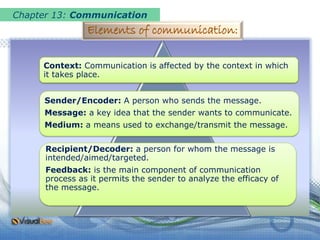
Context: Communication is affected by the context in which
it takes place.
Sender/Encoder: A person who sends the message.
Message: a key idea that the sender wants to communicate.
Medium: a means used to exchange/transmit the message.
Recipient/Decoder: a person for whom the message is
intended/aimed/targeted.
Feedback: is the main component of communication
process as it permits the sender to analyze the efficacy of
the message.
Elements of communication:
Chapter 13: Communication
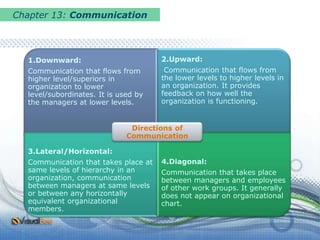
1.Downward:
Communication that flows from
higher level/superiors in
organization to lower
level/subordinates. It is used by
the managers at lower levels.
2.Upward:
Communication that flows from
the lower levels to higher levels in
an organization. It provides
feedback on how well the
organization is functioning.
3.Lateral/Horizontal:
Communication that takes place at
same levels of hierarchy in an
organization, communication
between managers at same levels
or between any horizontally
equivalent organizational
members.
4.Diagonal:
Communication that takes place
between managers and employees
of other work groups. It generally
does not appear on organizational
chart.
Directions of
Communication
Chapter 13: Communication
 Voice mail
links a telephone
system to a
computer and
digitizes and store
incoming messages.
 Videoconferencing
and Teleconferencing
refer to technologies
associating with
viewing and
speaking
 Electronic Meetings
use networked
computers to
automate
meetings
 The Internet
covers a wide range
of services and
information
technologies.
 An intranet
is a private protected
electronic
communication
system within an
organization
 E-mail
is transmitting
messages through
personal computers.
Chapter 13: Communication
Interpersonal Communication
flows from individual to individual in face-
to-face and group settings
It can influence how
people feel about the
organization and its
members
Individuals have
different interpersonal
styles to describe the
way they relate to
others in interpersonal
communication
situations
Chapter 13: Communication
Multicultural Communication
occurs when two or more individuals from
different cultures communicate with one
another.
 Value judgment: Assigning overall worth prior to receiving entire
message
 Information Overload: Causes individuals to screen out the
majority of messages
 Inattention/Selective Listening:
Perception
Interpretation
Evaluation
Action
 Time Pressure: May result in short-circuiting
 Frame of reference: Interpretation differences depending on
previous experiences
Chapter 13: Communication
 Emotions/Filtering: Manipulation of information so the receivers
perceive it as positive
 Status Differences: Hierarchical ranking expressed through
various symbols
 Source of Credibility: Trust, confidence, and faith in receiver
 In-Group Language: Words, phrases that have meaning only to
group members
Chapter 13: Communication
•Follow up
•Principle of
sufficiency
•Empathy
•Repetition
•Encouraging
•Mutual trust
•Effective
timing
•Simplifying
•Language
•Utilizing
feedback
•Using the
grapevine
ReceiverDecoding
Field of Experience
EncodingSender
Field of Experience
Chapter 13: Communication
Message
Ch 13 communication

Ch 13 communication

  • 1.
  • 2.
    Chapter 13: Communication LearningObjectives:  EXPLAIN the elements in the communication process.  COMPARE the four major directions of communication.  DESCRIBE the role played by interpersonal communication in organizations.  DISCUSS multicultural communication.  IDENTIFY significant barriers to effective communication.  DESCRIBE ways in which communication in organizations can be improved.
  • 3.
    Definition: Communication: The transmissionof information and understanding through the use of common symbols from one person to another. Common Symbols can be: Verbal Non-verbal Chapter 13: Communication
  • 4.
    The importance ofcommunication:  Communication promotes motivation by informing and clarifying the employees about the tasks to be done, the manner they are performing the tasks, and how to improve their performance if it is not up to the mark.  Communication is a source of information to the organizational manners for decision making processes, it helps identifying and assessing alternative course of actions.  Communication also plays a crucial role in altering individuals attitudes i.e., a well informed individual will have better attitude than a less informed individual, organizational magazines, journals, meetings, and various other forms of oral and written communication help in molding employee’s attitudes. Chapter 13: Communication
  • 5.
     Communication alsohelps in socializing. In today’s life, the only presence of another individual fosters communication. It is also said that one cannot survive without communication.  Communication also assists in Controlling Process. It helps controlling organizational member’s behavior in various ways. There are various levels of hierarchy and certain principles and guidelines that employees must follow in organization. The importance of communication (con’t): Chapter 13: Communication
  • 6.
  • 7.
    Context: Communication isaffected by the context in which it takes place. Sender/Encoder: A person who sends the message. Message: a key idea that the sender wants to communicate. Medium: a means used to exchange/transmit the message. Recipient/Decoder: a person for whom the message is intended/aimed/targeted. Feedback: is the main component of communication process as it permits the sender to analyze the efficacy of the message. Elements of communication: Chapter 13: Communication
  • 8.
    1.Downward: Communication that flowsfrom higher level/superiors in organization to lower level/subordinates. It is used by the managers at lower levels. 2.Upward: Communication that flows from the lower levels to higher levels in an organization. It provides feedback on how well the organization is functioning. 3.Lateral/Horizontal: Communication that takes place at same levels of hierarchy in an organization, communication between managers at same levels or between any horizontally equivalent organizational members. 4.Diagonal: Communication that takes place between managers and employees of other work groups. It generally does not appear on organizational chart. Directions of Communication Chapter 13: Communication
  • 9.
     Voice mail linksa telephone system to a computer and digitizes and store incoming messages.  Videoconferencing and Teleconferencing refer to technologies associating with viewing and speaking  Electronic Meetings use networked computers to automate meetings  The Internet covers a wide range of services and information technologies.  An intranet is a private protected electronic communication system within an organization  E-mail is transmitting messages through personal computers. Chapter 13: Communication
  • 10.
    Interpersonal Communication flows fromindividual to individual in face- to-face and group settings It can influence how people feel about the organization and its members Individuals have different interpersonal styles to describe the way they relate to others in interpersonal communication situations Chapter 13: Communication
  • 11.
    Chapter 13: Communication MulticulturalCommunication occurs when two or more individuals from different cultures communicate with one another.
  • 12.
     Value judgment:Assigning overall worth prior to receiving entire message  Information Overload: Causes individuals to screen out the majority of messages  Inattention/Selective Listening: Perception Interpretation Evaluation Action  Time Pressure: May result in short-circuiting  Frame of reference: Interpretation differences depending on previous experiences Chapter 13: Communication
  • 13.
     Emotions/Filtering: Manipulationof information so the receivers perceive it as positive  Status Differences: Hierarchical ranking expressed through various symbols  Source of Credibility: Trust, confidence, and faith in receiver  In-Group Language: Words, phrases that have meaning only to group members Chapter 13: Communication
  • 14.
    •Follow up •Principle of sufficiency •Empathy •Repetition •Encouraging •Mutualtrust •Effective timing •Simplifying •Language •Utilizing feedback •Using the grapevine ReceiverDecoding Field of Experience EncodingSender Field of Experience Chapter 13: Communication Message