
What is cloud technology?
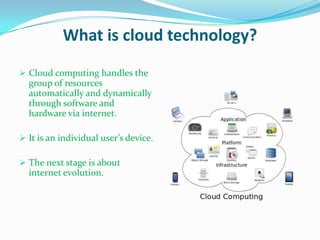
 Cloud computing handles the
group of resources
automatically and dynamically
through software and
hardware via internet.
 It is an individual user’s device.
 The next stage is about
internet evolution.
Types of cloud computing
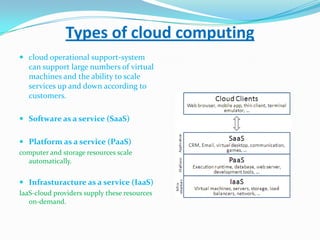
 cloud operational support-system
can support large numbers of virtual
machines and the ability to scale
services up and down according to
customers.
 Software as a service (SaaS)
 Platform as a service (PaaS)
computer and storage resources scale
automatically.
 Infrasturacture as a service (IaaS)
IaaS-cloud providers supply these resources
on-demand.
Characteristics of cloud technology
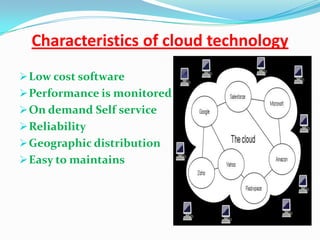
Low cost software
Performance is monitored
On demand Self service
Reliability
Geographic distribution
Easy to maintains
How else can cloud computing help small
businesses ?
 The cloud technology allows business owner to
simplify and also helps in better forecast of IT budget.
 Convenience :-
More efficient case of limited IT staff.
 Cloud can better manage uncertainty.
 No need to invest on more IT based.
How can small businesses get benefits from
cloud computing?
 High levels of security by storing files in a secure
location.
 Controlling information flexibility.
 Cost saving :-
For small business there is no need to purchase expensive equipments.
 Increase efficiency
 Employees can work from different areas at any time.
 Easy to manage
 Access to enterprise level technology.
Advantages
 Improved performance
 Reduced software cost
 Improved document format compatibility
 Unlimited storage capacity
 Increased data reliability
 Latest version availability
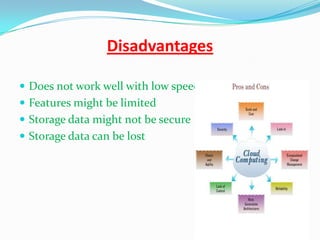
Disadvantages
 Does not work well with low speed
 Features might be limited
 Storage data might not be secure
 Storage data can be lost
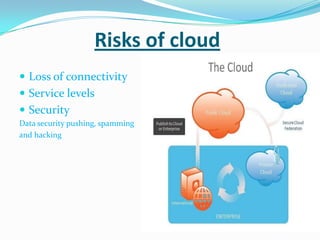
Risks of cloud
 Loss of connectivity
 Service levels
 Security
Data security pushing, spamming
and hacking
Challenges
 Security
 Performance
 Availability
 Bringing in house may be difficult
 Not enough major supplies yet.
Future implementation
 Many technology develop for IT industries, web
technology, and server based computing.
 Cloud contributes in commercial and technical model.
 The owner can operate different parties located in
different geographical areas.
Conclusion
 Cloud solution are easy to implement
 Cloud solution are not right for every need or every
organization.
 Cloud provides lots of offers.
 Scientific analysis is moving more and more towards
close and related technology.
THANK YOU

Presentation ppm ppt

  • 2.
    What is cloudtechnology?  Cloud computing handles the group of resources automatically and dynamically through software and hardware via internet.  It is an individual user’s device.  The next stage is about internet evolution.
  • 3.
    Types of cloudcomputing  cloud operational support-system can support large numbers of virtual machines and the ability to scale services up and down according to customers.  Software as a service (SaaS)  Platform as a service (PaaS) computer and storage resources scale automatically.  Infrasturacture as a service (IaaS) IaaS-cloud providers supply these resources on-demand.
  • 4.
    Characteristics of cloudtechnology Low cost software Performance is monitored On demand Self service Reliability Geographic distribution Easy to maintains
  • 5.
    How else cancloud computing help small businesses ?  The cloud technology allows business owner to simplify and also helps in better forecast of IT budget.  Convenience :- More efficient case of limited IT staff.  Cloud can better manage uncertainty.  No need to invest on more IT based.
  • 6.
    How can smallbusinesses get benefits from cloud computing?  High levels of security by storing files in a secure location.  Controlling information flexibility.  Cost saving :- For small business there is no need to purchase expensive equipments.  Increase efficiency  Employees can work from different areas at any time.  Easy to manage  Access to enterprise level technology.
  • 7.
    Advantages  Improved performance Reduced software cost  Improved document format compatibility  Unlimited storage capacity  Increased data reliability  Latest version availability
  • 8.
    Disadvantages  Does notwork well with low speed  Features might be limited  Storage data might not be secure  Storage data can be lost
  • 9.
    Risks of cloud Loss of connectivity  Service levels  Security Data security pushing, spamming and hacking
  • 10.
    Challenges  Security  Performance Availability  Bringing in house may be difficult  Not enough major supplies yet.
  • 11.
    Future implementation  Manytechnology develop for IT industries, web technology, and server based computing.  Cloud contributes in commercial and technical model.  The owner can operate different parties located in different geographical areas.
  • 12.
    Conclusion  Cloud solutionare easy to implement  Cloud solution are not right for every need or every organization.  Cloud provides lots of offers.  Scientific analysis is moving more and more towards close and related technology.
  • 13.