© PeopleFluent 2014
Presented by John Moore, CCWP
John.moore@peoplefluent.com
www.peoplefluent.com
PeopleFluent
Moving Your Contingent Workforce
Program from Tactical to Strategic
© 2014 PeopleFluent
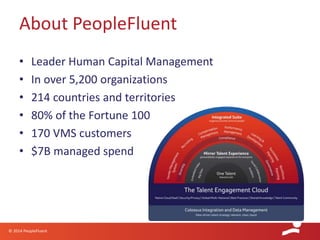
• Leader Human Capital Management
• In over 5,200 organizations
• 214 countries and territories
• 80% of the Fortune 100
• 170 VMS customers
• $7B managed spend
About PeopleFluent
© 2014 PeopleFluent
• CW program maturity
• Diagnosing where you are
• Strategies to address issues
• Building a program roadmap
• Identifying cost savings
Agenda
© 2014 PeopleFluent
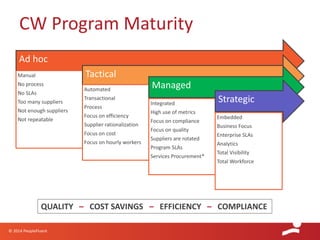
CW Program Maturity
Ad hoc
Manual
No process
No SLAs
Too many suppliers
Not enough suppliers
Not repeatable
Tactical
Automated
Transactional
Process
Focus on efficiency
Supplier rationalization
Focus on cost
Focus on hourly workers
Managed
Integrated
High use of metrics
Focus on compliance
Focus on quality
Suppliers are rotated
Program SLAs
Services Procurement*
Strategic
Embedded
Business Focus
Enterprise SLAs
Analytics
Total Visibility
Total Workforce
QUALITY – COST SAVINGS – EFFICIENCY – COMPLIANCE
© 2014 PeopleFluent
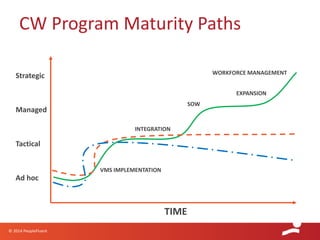
CW Program Maturity Paths
Ad hoc
Tactical
Managed
Strategic
VMS IMPLEMENTATION
SOW
EXPANSION
INTEGRATION
WORKFORCE MANAGEMENT
TIME
© 2014 PeopleFluent
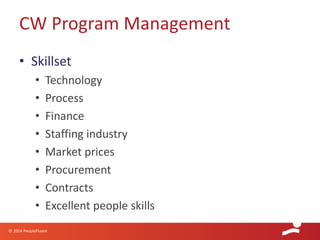
• Skillset
• Technology
• Process
• Finance
• Staffing industry
• Market prices
• Procurement
• Contracts
• Excellent people skills
CW Program Management
© 2014 PeopleFluent
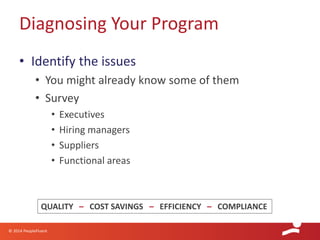
• Identify the issues
• You might already know some of them
• Survey
• Executives
• Hiring managers
• Suppliers
• Functional areas
Diagnosing Your Program
QUALITY – COST SAVINGS – EFFICIENCY – COMPLIANCE
© 2014 PeopleFluent
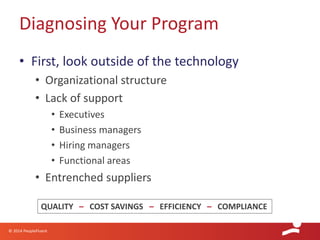
• First, look outside of the technology
• Organizational structure
• Lack of support
• Executives
• Business managers
• Hiring managers
• Functional areas
• Entrenched suppliers
Diagnosing Your Program
QUALITY – COST SAVINGS – EFFICIENCY – COMPLIANCE
© 2014 PeopleFluent
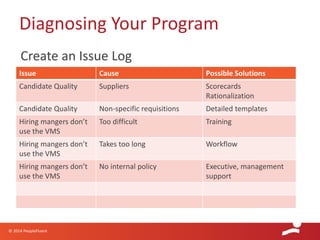
Diagnosing Your Program
Issue Cause Possible Solutions
Candidate Quality Suppliers Scorecards
Rationalization
Candidate Quality Non-specific requisitions Detailed templates
Hiring mangers don’t
use the VMS
Too difficult Training
Hiring mangers don’t
use the VMS
Takes too long Workflow
Hiring mangers don’t
use the VMS
No internal policy Executive, management
support
Create an Issue Log
© 2014 PeopleFluent
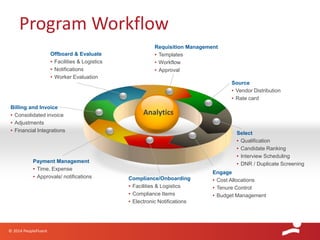
Requisition Management
• Templates
• Workflow
• Approval
Offboard & Evaluate
• Facilities & Logistics
• Notifications
• Worker Evaluation
Source
• Vendor Distribution
• Rate card
Billing and Invoice
• Consolidated invoice
• Adjustments
• Financial Integrations
Payment Management
• Time, Expense
• Approvals/ notifications Compliance/Onboarding
• Facilities & Logistics
• Compliance Items
• Electronic Notifications
Engage
• Cost Allocations
• Tenure Control
• Budget Management
Select
• Qualification
• Candidate Ranking
• Interview Scheduling
• DNR / Duplicate Screening
Analytics
Program Workflow
© 2014 PeopleFluent
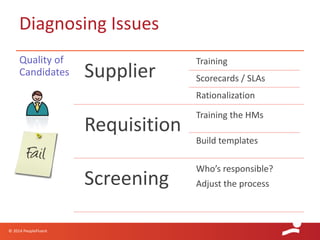
Diagnosing Issues
Quality of
Candidates Supplier
Training
Scorecards / SLAs
Rationalization
Requisition
Training the HMs
Build templates
Screening
Who’s responsible?
Adjust the process
© 2014 PeopleFluent
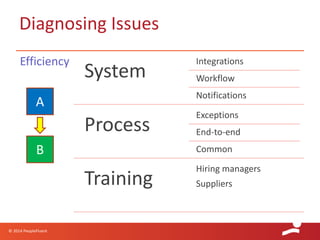
Diagnosing Issues
Efficiency
System
Integrations
Workflow
Notifications
Process
Exceptions
End-to-end
Common
Training
Hiring managers
Suppliers
A
B
© 2014 PeopleFluent
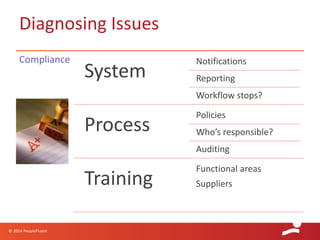
Diagnosing Issues
Compliance
System
Notifications
Reporting
Workflow stops?
Process
Policies
Who’s responsible?
Auditing
Training
Functional areas
Suppliers
© 2014 PeopleFluent
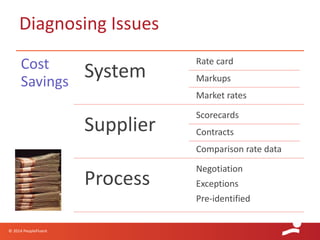
Diagnosing Issues
Cost
Savings
System
Rate card
Markups
Market rates
Supplier
Scorecards
Contracts
Comparison rate data
Process
Negotiation
Exceptions
Pre-identified
© 2014 PeopleFluent
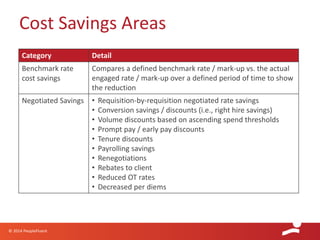
Cost Savings Areas
Category Detail
Benchmark rate
cost savings
Compares a defined benchmark rate / mark-up vs. the actual
engaged rate / mark-up over a defined period of time to show
the reduction
Negotiated Savings • Requisition-by-requisition negotiated rate savings
• Conversion savings / discounts (i.e., right hire savings)
• Volume discounts based on ascending spend thresholds
• Prompt pay / early pay discounts
• Tenure discounts
• Payrolling savings
• Renegotiations
• Rebates to client
• Reduced OT rates
• Decreased per diems
© 2014 PeopleFluent
Cost Savings Areas
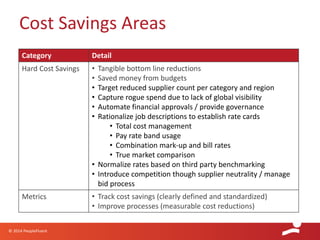
Category Detail
Hard Cost Savings • Tangible bottom line reductions
• Saved money from budgets
• Target reduced supplier count per category and region
• Capture rogue spend due to lack of global visibility
• Automate financial approvals / provide governance
• Rationalize job descriptions to establish rate cards
• Total cost management
• Pay rate band usage
• Combination mark-up and bill rates
• True market comparison
• Normalize rates based on third party benchmarking
• Introduce competition though supplier neutrality / manage
bid process
Metrics • Track cost savings (clearly defined and standardized)
• Improve processes (measurable cost reductions)
© 2014 PeopleFluent
Cost Savings Areas
Category Detail
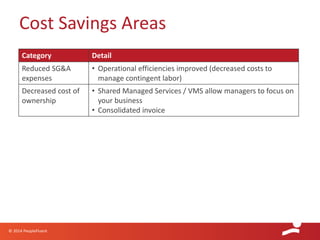
Reduced SG&A
expenses
• Operational efficiencies improved (decreased costs to
manage contingent labor)
Decreased cost of
ownership
• Shared Managed Services / VMS allow managers to focus on
your business
• Consolidated invoice
© 2014 PeopleFluent
Soft Cost Savings Areas
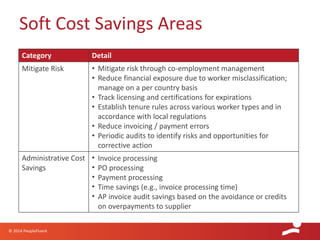
Category Detail
Mitigate Risk • Mitigate risk through co-employment management
• Reduce financial exposure due to worker misclassification;
manage on a per country basis
• Track licensing and certifications for expirations
• Establish tenure rules across various worker types and in
accordance with local regulations
• Reduce invoicing / payment errors
• Periodic audits to identify risks and opportunities for
corrective action
Administrative Cost
Savings
• Invoice processing
• PO processing
• Payment processing
• Time savings (e.g., invoice processing time)
• AP invoice audit savings based on the avoidance or credits
on overpayments to supplier
© 2014 PeopleFluent
Soft Cost Savings Areas
Category Detail
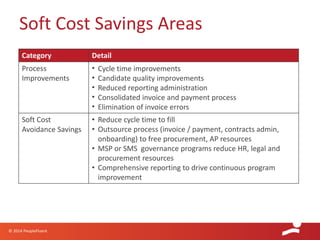
Process
Improvements
• Cycle time improvements
• Candidate quality improvements
• Reduced reporting administration
• Consolidated invoice and payment process
• Elimination of invoice errors
Soft Cost
Avoidance Savings
• Reduce cycle time to fill
• Outsource process (invoice / payment, contracts admin,
onboarding) to free procurement, AP resources
• MSP or SMS governance programs reduce HR, legal and
procurement resources
• Comprehensive reporting to drive continuous program
improvement
© 2014 PeopleFluent
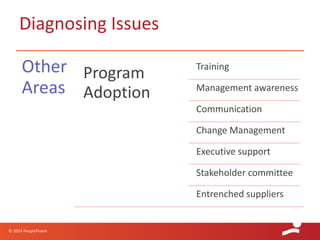
Diagnosing Issues
Other
Areas
Program
Adoption
Training
Management awareness
Communication
Change Management
Executive support
Stakeholder committee
Entrenched suppliers
© 2014 PeopleFluent
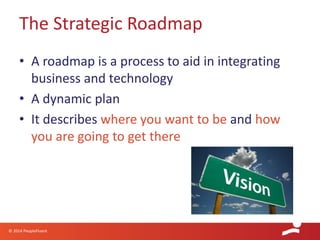
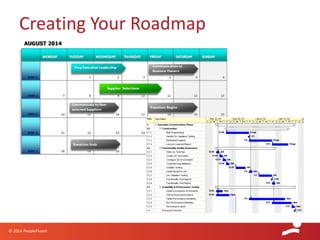
• A roadmap is a process to aid in integrating
business and technology
• A dynamic plan
• It describes where you want to be and how
you are going to get there
The Strategic Roadmap
© 2014 PeopleFluent
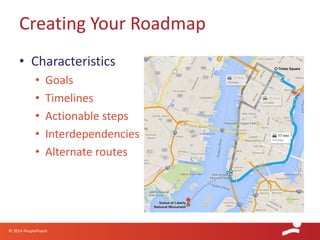
• Characteristics
• Goals
• Timelines
• Actionable steps
• Interdependencies
• Alternate routes
Creating Your Roadmap
© 2014 PeopleFluent
• Goals need to be
• Specific
• Measurable
• Realistic
• Time-bound
• “Expand VMS to capture 90 percent of Admin
category within corporate by end of year.”
Creating Your Roadmap
© 2014 PeopleFluent
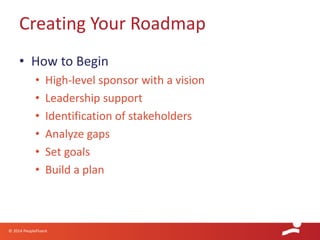
• How to Begin
• High-level sponsor with a vision
• Leadership support
• Identification of stakeholders
• Analyze gaps
• Set goals
• Build a plan
Creating Your Roadmap
© 2014 PeopleFluent
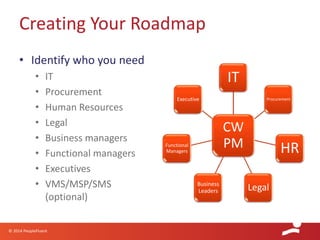
• Identify who you need
• IT
• Procurement
• Human Resources
• Legal
• Business managers
• Functional managers
• Executives
• VMS/MSP/SMS
(optional)
CW
PM
IT
Procurement
HR
LegalBusiness
Leaders
Functional
Managers
Executive
Creating Your Roadmap
© 2014 PeopleFluent
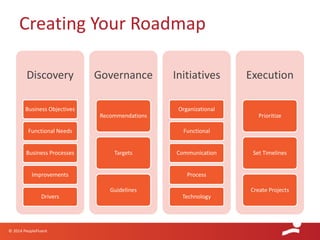
Discovery
Business Objectives
Functional Needs
Business Processes
Improvements
Drivers
Governance
Recommendations
Targets
Guidelines
Initiatives
Organizational
Functional
Communication
Process
Technology
Execution
Prioritize
Set Timelines
Create Projects
Creating Your Roadmap
© 2014 PeopleFluent
Creating Your Roadmap
© 2014 PeopleFluent
• Put the issues, solutions and roadmap into a
business case
• Present to the stakeholder committee
• Work the roadmap
• Rebrand and relaunch
• Start the road show
Begin Your Journey
© 2014 PeopleFluent
Contact Me
John Moore, CCWP
John.moore@peoplefluent.com
Thank You

Moving Your Contingent Workforce Program from Tactical to Strategic

  • 1.
    © PeopleFluent 2014 Presentedby John Moore, CCWP John.moore@peoplefluent.com www.peoplefluent.com PeopleFluent Moving Your Contingent Workforce Program from Tactical to Strategic
  • 2.
    © 2014 PeopleFluent •Leader Human Capital Management • In over 5,200 organizations • 214 countries and territories • 80% of the Fortune 100 • 170 VMS customers • $7B managed spend About PeopleFluent
  • 3.
    © 2014 PeopleFluent •CW program maturity • Diagnosing where you are • Strategies to address issues • Building a program roadmap • Identifying cost savings Agenda
  • 4.
    © 2014 PeopleFluent CWProgram Maturity Ad hoc Manual No process No SLAs Too many suppliers Not enough suppliers Not repeatable Tactical Automated Transactional Process Focus on efficiency Supplier rationalization Focus on cost Focus on hourly workers Managed Integrated High use of metrics Focus on compliance Focus on quality Suppliers are rotated Program SLAs Services Procurement* Strategic Embedded Business Focus Enterprise SLAs Analytics Total Visibility Total Workforce QUALITY – COST SAVINGS – EFFICIENCY – COMPLIANCE
  • 5.
    © 2014 PeopleFluent CWProgram Maturity Paths Ad hoc Tactical Managed Strategic VMS IMPLEMENTATION SOW EXPANSION INTEGRATION WORKFORCE MANAGEMENT TIME
  • 6.
    © 2014 PeopleFluent •Skillset • Technology • Process • Finance • Staffing industry • Market prices • Procurement • Contracts • Excellent people skills CW Program Management
  • 7.
    © 2014 PeopleFluent •Identify the issues • You might already know some of them • Survey • Executives • Hiring managers • Suppliers • Functional areas Diagnosing Your Program QUALITY – COST SAVINGS – EFFICIENCY – COMPLIANCE
  • 8.
    © 2014 PeopleFluent •First, look outside of the technology • Organizational structure • Lack of support • Executives • Business managers • Hiring managers • Functional areas • Entrenched suppliers Diagnosing Your Program QUALITY – COST SAVINGS – EFFICIENCY – COMPLIANCE
  • 9.
    © 2014 PeopleFluent DiagnosingYour Program Issue Cause Possible Solutions Candidate Quality Suppliers Scorecards Rationalization Candidate Quality Non-specific requisitions Detailed templates Hiring mangers don’t use the VMS Too difficult Training Hiring mangers don’t use the VMS Takes too long Workflow Hiring mangers don’t use the VMS No internal policy Executive, management support Create an Issue Log
  • 10.
    © 2014 PeopleFluent RequisitionManagement • Templates • Workflow • Approval Offboard & Evaluate • Facilities & Logistics • Notifications • Worker Evaluation Source • Vendor Distribution • Rate card Billing and Invoice • Consolidated invoice • Adjustments • Financial Integrations Payment Management • Time, Expense • Approvals/ notifications Compliance/Onboarding • Facilities & Logistics • Compliance Items • Electronic Notifications Engage • Cost Allocations • Tenure Control • Budget Management Select • Qualification • Candidate Ranking • Interview Scheduling • DNR / Duplicate Screening Analytics Program Workflow
  • 11.
    © 2014 PeopleFluent DiagnosingIssues Quality of Candidates Supplier Training Scorecards / SLAs Rationalization Requisition Training the HMs Build templates Screening Who’s responsible? Adjust the process
  • 12.
    © 2014 PeopleFluent DiagnosingIssues Efficiency System Integrations Workflow Notifications Process Exceptions End-to-end Common Training Hiring managers Suppliers A B
  • 13.
    © 2014 PeopleFluent DiagnosingIssues Compliance System Notifications Reporting Workflow stops? Process Policies Who’s responsible? Auditing Training Functional areas Suppliers
  • 14.
    © 2014 PeopleFluent DiagnosingIssues Cost Savings System Rate card Markups Market rates Supplier Scorecards Contracts Comparison rate data Process Negotiation Exceptions Pre-identified
  • 15.
    © 2014 PeopleFluent CostSavings Areas Category Detail Benchmark rate cost savings Compares a defined benchmark rate / mark-up vs. the actual engaged rate / mark-up over a defined period of time to show the reduction Negotiated Savings • Requisition-by-requisition negotiated rate savings • Conversion savings / discounts (i.e., right hire savings) • Volume discounts based on ascending spend thresholds • Prompt pay / early pay discounts • Tenure discounts • Payrolling savings • Renegotiations • Rebates to client • Reduced OT rates • Decreased per diems
  • 16.
    © 2014 PeopleFluent CostSavings Areas Category Detail Hard Cost Savings • Tangible bottom line reductions • Saved money from budgets • Target reduced supplier count per category and region • Capture rogue spend due to lack of global visibility • Automate financial approvals / provide governance • Rationalize job descriptions to establish rate cards • Total cost management • Pay rate band usage • Combination mark-up and bill rates • True market comparison • Normalize rates based on third party benchmarking • Introduce competition though supplier neutrality / manage bid process Metrics • Track cost savings (clearly defined and standardized) • Improve processes (measurable cost reductions)
  • 17.
    © 2014 PeopleFluent CostSavings Areas Category Detail Reduced SG&A expenses • Operational efficiencies improved (decreased costs to manage contingent labor) Decreased cost of ownership • Shared Managed Services / VMS allow managers to focus on your business • Consolidated invoice
  • 18.
    © 2014 PeopleFluent SoftCost Savings Areas Category Detail Mitigate Risk • Mitigate risk through co-employment management • Reduce financial exposure due to worker misclassification; manage on a per country basis • Track licensing and certifications for expirations • Establish tenure rules across various worker types and in accordance with local regulations • Reduce invoicing / payment errors • Periodic audits to identify risks and opportunities for corrective action Administrative Cost Savings • Invoice processing • PO processing • Payment processing • Time savings (e.g., invoice processing time) • AP invoice audit savings based on the avoidance or credits on overpayments to supplier
  • 19.
    © 2014 PeopleFluent SoftCost Savings Areas Category Detail Process Improvements • Cycle time improvements • Candidate quality improvements • Reduced reporting administration • Consolidated invoice and payment process • Elimination of invoice errors Soft Cost Avoidance Savings • Reduce cycle time to fill • Outsource process (invoice / payment, contracts admin, onboarding) to free procurement, AP resources • MSP or SMS governance programs reduce HR, legal and procurement resources • Comprehensive reporting to drive continuous program improvement
  • 20.
    © 2014 PeopleFluent DiagnosingIssues Other Areas Program Adoption Training Management awareness Communication Change Management Executive support Stakeholder committee Entrenched suppliers
  • 21.
    © 2014 PeopleFluent •A roadmap is a process to aid in integrating business and technology • A dynamic plan • It describes where you want to be and how you are going to get there The Strategic Roadmap
  • 22.
    © 2014 PeopleFluent •Characteristics • Goals • Timelines • Actionable steps • Interdependencies • Alternate routes Creating Your Roadmap
  • 23.
    © 2014 PeopleFluent •Goals need to be • Specific • Measurable • Realistic • Time-bound • “Expand VMS to capture 90 percent of Admin category within corporate by end of year.” Creating Your Roadmap
  • 24.
    © 2014 PeopleFluent •How to Begin • High-level sponsor with a vision • Leadership support • Identification of stakeholders • Analyze gaps • Set goals • Build a plan Creating Your Roadmap
  • 25.
    © 2014 PeopleFluent •Identify who you need • IT • Procurement • Human Resources • Legal • Business managers • Functional managers • Executives • VMS/MSP/SMS (optional) CW PM IT Procurement HR LegalBusiness Leaders Functional Managers Executive Creating Your Roadmap
  • 26.
    © 2014 PeopleFluent Discovery BusinessObjectives Functional Needs Business Processes Improvements Drivers Governance Recommendations Targets Guidelines Initiatives Organizational Functional Communication Process Technology Execution Prioritize Set Timelines Create Projects Creating Your Roadmap
  • 27.
  • 28.
    © 2014 PeopleFluent •Put the issues, solutions and roadmap into a business case • Present to the stakeholder committee • Work the roadmap • Rebrand and relaunch • Start the road show Begin Your Journey
  • 29.
    © 2014 PeopleFluent ContactMe John Moore, CCWP John.moore@peoplefluent.com Thank You

Editor's Notes

  • #5 Common Characteristics – Tactical – Managed- integrated with other system Strategic- contributes to business decisions, includes all worker types. Most straddle between Tactical and Managed.
  • #14 Goes beyond external- drug screening and background check Look at internal processes that prevent things from moving forward- documentation and who is responsible as well as auditing
  • #15 Busiest part of a VMS How to determine cost savings- rate cards need to be updated on a regular basis All suppliers should provide market rate cards per role. Look at the supplier rate cards to ensure placement and cost relevance and cost savings Which is better? Market rates change all the time so hard to build a current rate card. A markup prevents a supplier to push the rate down and allows for even footing. VMS allows for a competitive system and bill rate. How to benchmark outside of your suppliers? MSP will provide that data as well as a VMS may have access to scrubbed data across different geographies. The final negotiation is where you can realize cost savings by reduced hourly rate.