Page 1 of 10


                                Due Diligence Checklist
                                                                                                             Yes             No
                                                Corporate Organization
1.        Review Incorporation Documents of the Company.
2.        Obtain Certificate of Status/Good standing for the Company.
3.        Review by-laws of the Company.
4.        Conduct a corporate review of the minute books of the Company.
5.        Focus on validity of major corporate actions.
6.        Obtain a list of countries and states where the Company is or should be
          qualified to do business
7.        Review partnership or joint venture agreements, if any.
8.        Perform asset searches in jurisdictions where principal assets are
          located.


                                               Public Document Review
9.        Review all publicly filed documents of the Company.
10.       Perform Internet searches in respect of the Company.
11.       Review all press releases and media articles relating to the Company
          and the industry.
12.       Review all management speeches.


                                       Financial Statements And Forecasts
13.       Review audited and unaudited consolidated financial statements of the
          Business and the Company and notes thereto and review any financial
          forecasts.
14.       Review monthly or interim reports prepared by or for management
          concerning financial or operating matters relating to the Business and
          the Company.
15.       Obtain copies of letters to the Company's auditors with respect to
          current, pending or threatened lawsuits or Company with respect to
          current, pending or threatened lawsuits or litigation or regulatory
          actions by or against the Business and the Company.
16.       Obtain budget projections or business plans for the Business and the
          Company and review with Company officials to determine any material
          changes in the financial position of the Business and the Company and
          compare past budgets and projections with actual experience in order
          to assess the accuracy of management estimates.


© Angel Investment Network Limited. This document can only be used by Angel Investment Network Limited users. It may not be copied
or distributed by any third party without permission from Angel Investment Network Limited. Disclaimer. All information and advice
provided within this site is intended for guidance purposes only. It is of a general nature and Angel Investment Network Limited
recommends each user seeks advice from a relevant person before using this information. Angel Investment Network Limited cannot
accept responsibility for loss arising from using this information.
Page 2 of 10


                                                              Taxes
17.       Request copies of tax returns and any audit reports for the last five
          years.
18.       Note the date of the last tax audit and obtain a list of nay notices
          received or notices of assessment contemplated by Internal Revenue
          Service.
19.       Evaluate the effect of changes in tax laws, to the future operation of
          the Business.
20.       Assess any potential tax liabilities.


                                                             Audits
21.       Arrange full "due diligence" meeting with the auditors of the Company
          to review and consider the following matters in respect of the
          Business:
          (a)       the financial statements and financial forecasts;
          (b)      any recent, proposed or contemplated changes in the
                   accounting policies of the Company;
          (c)      the relationship of the auditors and management concerning,
                   among other things, access of the auditors to any necessary
                   information and including any difficulties with any prior audit
                   or reports on the financial statements;
          (d)      the substance and resolution of any recent significant
                   accounting policies or issues discussed between the Company
                   and its auditors with respect to the preparation of the financial
                   statements;
          (e)      the adequacy of the company’s internal controls and
                   accounting methods with respect to financial matters,
                   including their internal reporting system, the recording of sales
                   and expenses and other matters;
          (f)      the comments and opinions of the auditors with respect to the
                   general fairness of the accounting policies and the
                   presentation of the financial statements;
          (g)      the function or role, if any, of the auditors in respect of the
                   preparation and issuance by the Company of interim unaudited
                   financial statements; and
          (h)      the actual post-audit results relative to interim unaudited
                   results or with respect to any projections, forecasts and
                   budgets prepared by the management of the Company prior to
                   the completion of any audit on the financial statements.
22.       Discuss the nature and scope of the review and examination by the
          auditors of the financial statements.
23.       Discuss the nature and scope of the review and examination by the
          auditors of any financial forecasts.
24.       Review and discuss any oral or written supplementary financial or
          management reports or letters to management prepared by or
          initiated from the auditors to the Company or its financial officers with

© Angel Investment Network Limited. This document can only be used by Angel Investment Network Limited users. It may not be copied
or distributed by any third party without permission from Angel Investment Network Limited. Disclaimer. All information and advice
provided within this site is intended for guidance purposes only. It is of a general nature and Angel Investment Network Limited
recommends each user seeks advice from a relevant person before using this information. Angel Investment Network Limited cannot
accept responsibility for loss arising from using this information.
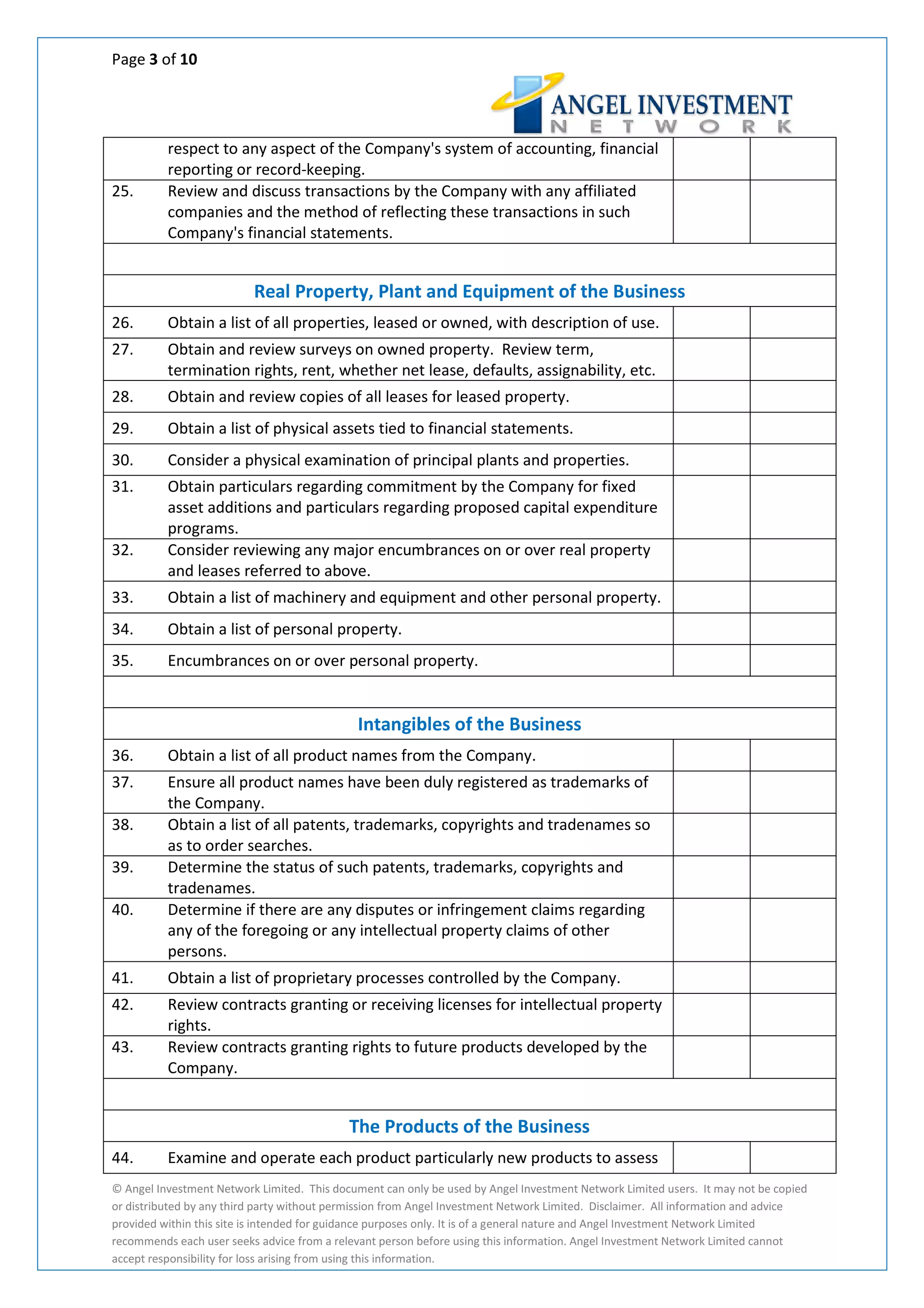
Page 3 of 10


          respect to any aspect of the Company's system of accounting, financial
          reporting or record-keeping.
25.       Review and discuss transactions by the Company with any affiliated
          companies and the method of reflecting these transactions in such
          Company's financial statements.


                          Real Property, Plant and Equipment of the Business
26.       Obtain a list of all properties, leased or owned, with description of use.
27.       Obtain and review surveys on owned property. Review term,
          termination rights, rent, whether net lease, defaults, assignability, etc.
28.       Obtain and review copies of all leases for leased property.
29.       Obtain a list of physical assets tied to financial statements.
30.       Consider a physical examination of principal plants and properties.
31.       Obtain particulars regarding commitment by the Company for fixed
          asset additions and particulars regarding proposed capital expenditure
          programs.
32.       Consider reviewing any major encumbrances on or over real property
          and leases referred to above.
33.       Obtain a list of machinery and equipment and other personal property.
34.       Obtain a list of personal property.
35.       Encumbrances on or over personal property.


                                             Intangibles of the Business
36.       Obtain a list of all product names from the Company.
37.       Ensure all product names have been duly registered as trademarks of
          the Company.
38.       Obtain a list of all patents, trademarks, copyrights and tradenames so
          as to order searches.
39.       Determine the status of such patents, trademarks, copyrights and
          tradenames.
40.       Determine if there are any disputes or infringement claims regarding
          any of the foregoing or any intellectual property claims of other
          persons.
41.       Obtain a list of proprietary processes controlled by the Company.
42.       Review contracts granting or receiving licenses for intellectual property
          rights.
43.       Review contracts granting rights to future products developed by the
          Company.


                                            The Products of the Business
44.       Examine and operate each product particularly new products to assess
© Angel Investment Network Limited. This document can only be used by Angel Investment Network Limited users. It may not be copied
or distributed by any third party without permission from Angel Investment Network Limited. Disclaimer. All information and advice
provided within this site is intended for guidance purposes only. It is of a general nature and Angel Investment Network Limited
recommends each user seeks advice from a relevant person before using this information. Angel Investment Network Limited cannot
accept responsibility for loss arising from using this information.
Page 4 of 10


          appearance, function, design, etc.

45.       Assess the threat of obsolescence for each significant product line.
46.       Review new product and service plans and development progress.
47.       Compare the products with those of competitors, and assess the threat
          from new competitors.
48.       Perform an analysis of unproven technology, using experts if necessary.


                                                         The Industry
49.       Estimate the size of the industry, present and projected, in each
          significant product line, and compare Business growth projections with
          anticipated market size for consistency.
50.       Review government and trade reports and trade literature regarding
          the market segments of the Business.
51.       Review any internal or outside studies of the Business, the market and
          the products.
52.       Interview trade association personnel concerning trends of relevance.
53.       Assess the effect of macroeconomic trend (e.g. interest rate
          fluctuations, inflation rates, economic growth rates).
54.       Assess the comparative strengths and weaknesses of competitors in
          terms of the dominant competitive factors in the industry (e.g. price,
          service, performance, etc.)
55.       Determine whether research and development (R&D) expenditures are
          consistent with industry practice.


                                             Marketing and Distribution
56.       Evaluate the importance of original equipment manufacturers (OEMs),
          present and future.
57.       Analyze each significant contract regarding contingencies, extent of
          warranties and other service obligations, rights of cancellation, etc.
58.       Check material contracts with customers for completeness, to
          determine existence of side written or oral commitments, or other
          terms that materially vary Business contracts.
59.       Evaluate the extent to which the Company finances any customer
          purchases from the Business and obtain a copy of documentation.
60.       Review model sales contract, sales representative agreements and
          dealer agreements used by the Business.
61.       Evaluate the adequacy of the distribution network, the degree of
          control over distribution, etc.
62.       Evaluate the effectiveness of marketing personnel.
63.       For new products, estimate the cost of introduction, and determine
          whether the cost is adequately reflected in cash flow projections.
64.       Assess the likelihood of discontinuation of products or services.


© Angel Investment Network Limited. This document can only be used by Angel Investment Network Limited users. It may not be copied
or distributed by any third party without permission from Angel Investment Network Limited. Disclaimer. All information and advice
provided within this site is intended for guidance purposes only. It is of a general nature and Angel Investment Network Limited
recommends each user seeks advice from a relevant person before using this information. Angel Investment Network Limited cannot
accept responsibility for loss arising from using this information.
Page 5 of 10


                                                         Technology
65.       Review the research and development plans of the Business to
          determine whether any radical changes in product direction are
          anticipated and what cost burden will be imposed on the Business in
          coming years.
66.       Evaluate the effectiveness of research and development personnel and
          organization to assess the capacity for technological innovation of the
          Business.
67.       Review royalty contracts for contingencies, etc. and contact the
          licensees to determine the existence of any agreement or
          understanding that varies the terms of the contracts.
68.       Evaluate other professional affiliations of management or research and
          development personnel (e.g. academic) to assess the likelihood of
          competing claims on technology of the Business.
69.       Determine whether the Business's exports are consistent with export
          control laws.


                                                          Production
70.       Assess ability of production facilities to handle anticipated volumes,
          and whether the cost of new plant and equipment is consistent with
          anticipated cash flow.
71.       Evaluate product and process obsolescence, and compare production
          facilities to those of industry competitors to determine future
          competitiveness, both technical and economic.
72.       Inquire into anticipated plant closings as well as plans for new facilities.
73.       Evaluate adequacy of management information systems and inventory
          control programs.
74.       Assess exposure from single source suppliers, and evaluate the
          contingency plans of the Business for responding to interruption of
          supplies.
75.       Contact major suppliers to determine their satisfaction with the
          Business, and their plans to retire, reduce, or raise the price of, key
          supplies and components.
76.       Review material contracts with suppliers.
77.       Review agreements, subcontractors and manufacture of the
          Company's products; any "private label" supply or purchase contracts.


                                       Other Contracts and Commitments
78.       In respect of all material contracts, review for assignability,
          enforceability, breaches and escalation clauses.
79.       Obtain copies of all:
          (a)       franchise, user or licence agreements and ancillary documents;
          (b)       franchise, user or licence registrations or disclosure
                    documents;

© Angel Investment Network Limited. This document can only be used by Angel Investment Network Limited users. It may not be copied
or distributed by any third party without permission from Angel Investment Network Limited. Disclaimer. All information and advice
provided within this site is intended for guidance purposes only. It is of a general nature and Angel Investment Network Limited
recommends each user seeks advice from a relevant person before using this information. Angel Investment Network Limited cannot
accept responsibility for loss arising from using this information.
Page 6 of 10


          (c)       government licences and permits;
          (d)       warranties of products sold and warranty claim history;
          (e)       contracts with and liabilities to insiders or other affiliates;
          (f)       secrecy or non-competition agreements;
          (g)       membership agreements;
          (h)       powers of attorney and agency agreements;
          (i)       contracts or arrangements which individually provide for the
                    payment or receipt by the Business of, say, £10,000 or more,
                    including but not limited contracts for purchase and sale of
                    goods and services; and
          (j)       all other contracts which materially affect the Business;
80.       Review proposed contracts or negotiations.
81.       Obtain all material consents of private persons or entitles required to
          be obtained by or on behalf of the Business.


                            Acquisition Agreements Respecting the Business
82.       Obtain and review copies of all
          (a)       acquisition agreements;
          (b)       filings with government agencies made in connection with the
                    acquisitions;
          (c)       other closing documents for the acquisitions.


                               Management and Employees of the Business
83.       Investigate the prior experience of management and directors in the
          same industry and the same size company, their experience with large
          firms etc. Also investigate their reputation in the industry.
84.       Review prior transactions between the Business and insiders for
          fairness, propriety, full disclosure, etc.
85.       Determine whether any significant defections from management are
          imminent and assess their effect on competitiveness.
86.       Obtain copies of all personnel policies.
87.       Obtain copies of all employee handbooks.
88.       Obtain a complete employee list of the entire Business, setting out
          names, job titles, addresses, age (where available), salary and length of
          service.
89.       Analyze written employment contracts with regard to:
          (a)       name of employee;
          (b)       description of position;


© Angel Investment Network Limited. This document can only be used by Angel Investment Network Limited users. It may not be copied
or distributed by any third party without permission from Angel Investment Network Limited. Disclaimer. All information and advice
provided within this site is intended for guidance purposes only. It is of a general nature and Angel Investment Network Limited
recommends each user seeks advice from a relevant person before using this information. Angel Investment Network Limited cannot
accept responsibility for loss arising from using this information.
Page 7 of 10


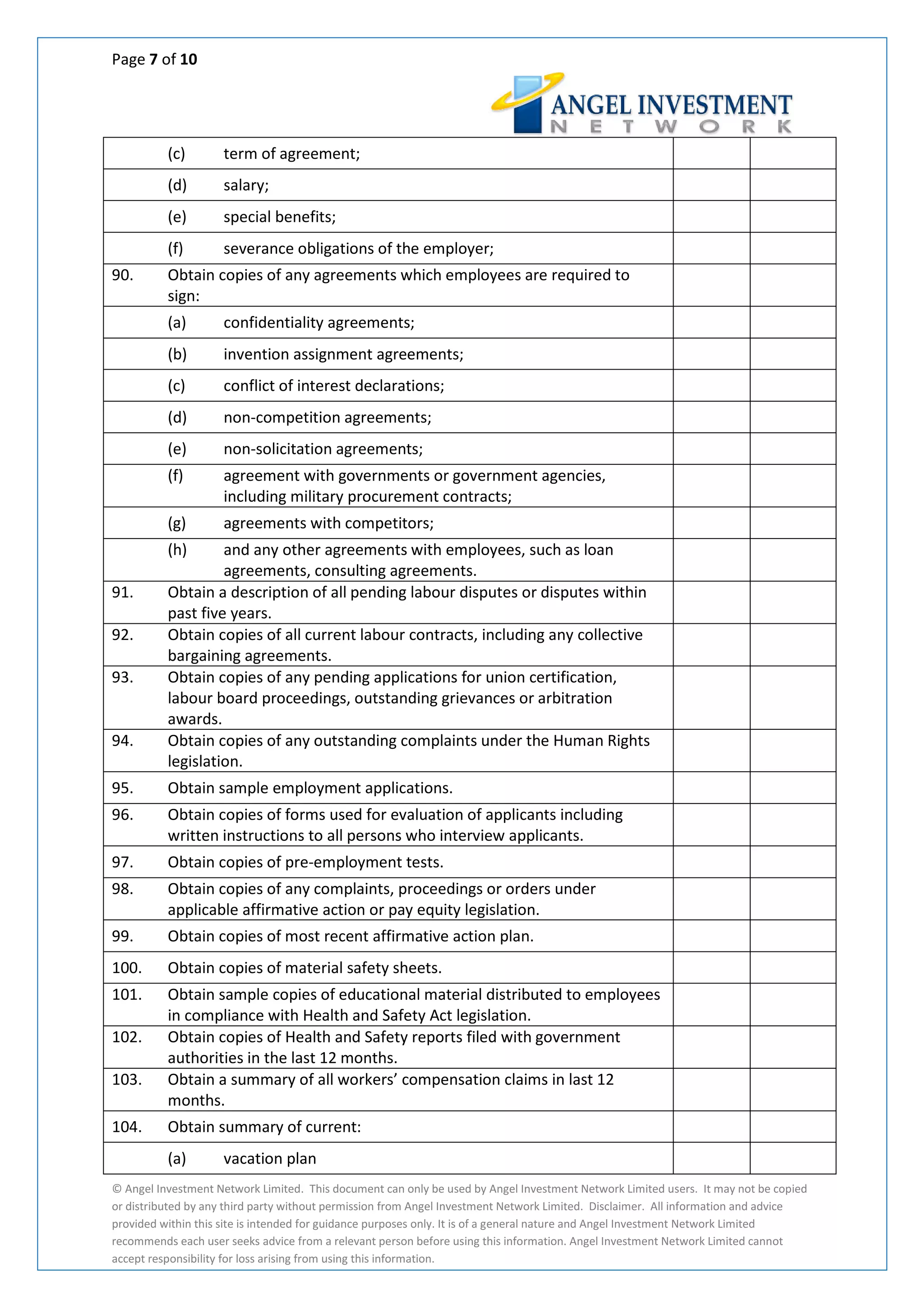
          (c)       term of agreement;
          (d)       salary;
          (e)       special benefits;
          (f)       severance obligations of the employer;
90.       Obtain copies of any agreements which employees are required to
          sign:
          (a)       confidentiality agreements;
          (b)       invention assignment agreements;
          (c)       conflict of interest declarations;
          (d)       non-competition agreements;
          (e)       non-solicitation agreements;
          (f)       agreement with governments or government agencies,
                    including military procurement contracts;
          (g)       agreements with competitors;
          (h)      and any other agreements with employees, such as loan
                   agreements, consulting agreements.
91.       Obtain a description of all pending labour disputes or disputes within
          past five years.
92.       Obtain copies of all current labour contracts, including any collective
          bargaining agreements.
93.       Obtain copies of any pending applications for union certification,
          labour board proceedings, outstanding grievances or arbitration
          awards.
94.       Obtain copies of any outstanding complaints under the Human Rights
          legislation.
95.       Obtain sample employment applications.
96.       Obtain copies of forms used for evaluation of applicants including
          written instructions to all persons who interview applicants.
97.       Obtain copies of pre-employment tests.
98.       Obtain copies of any complaints, proceedings or orders under
          applicable affirmative action or pay equity legislation.
99.       Obtain copies of most recent affirmative action plan.
100.      Obtain copies of material safety sheets.
101.      Obtain sample copies of educational material distributed to employees
          in compliance with Health and Safety Act legislation.
102.      Obtain copies of Health and Safety reports filed with government
          authorities in the last 12 months.
103.      Obtain a summary of all workers’ compensation claims in last 12
          months.
104.      Obtain summary of current:
          (a)       vacation plan
© Angel Investment Network Limited. This document can only be used by Angel Investment Network Limited users. It may not be copied
or distributed by any third party without permission from Angel Investment Network Limited. Disclaimer. All information and advice
provided within this site is intended for guidance purposes only. It is of a general nature and Angel Investment Network Limited
recommends each user seeks advice from a relevant person before using this information. Angel Investment Network Limited cannot
accept responsibility for loss arising from using this information.
Page 8 of 10


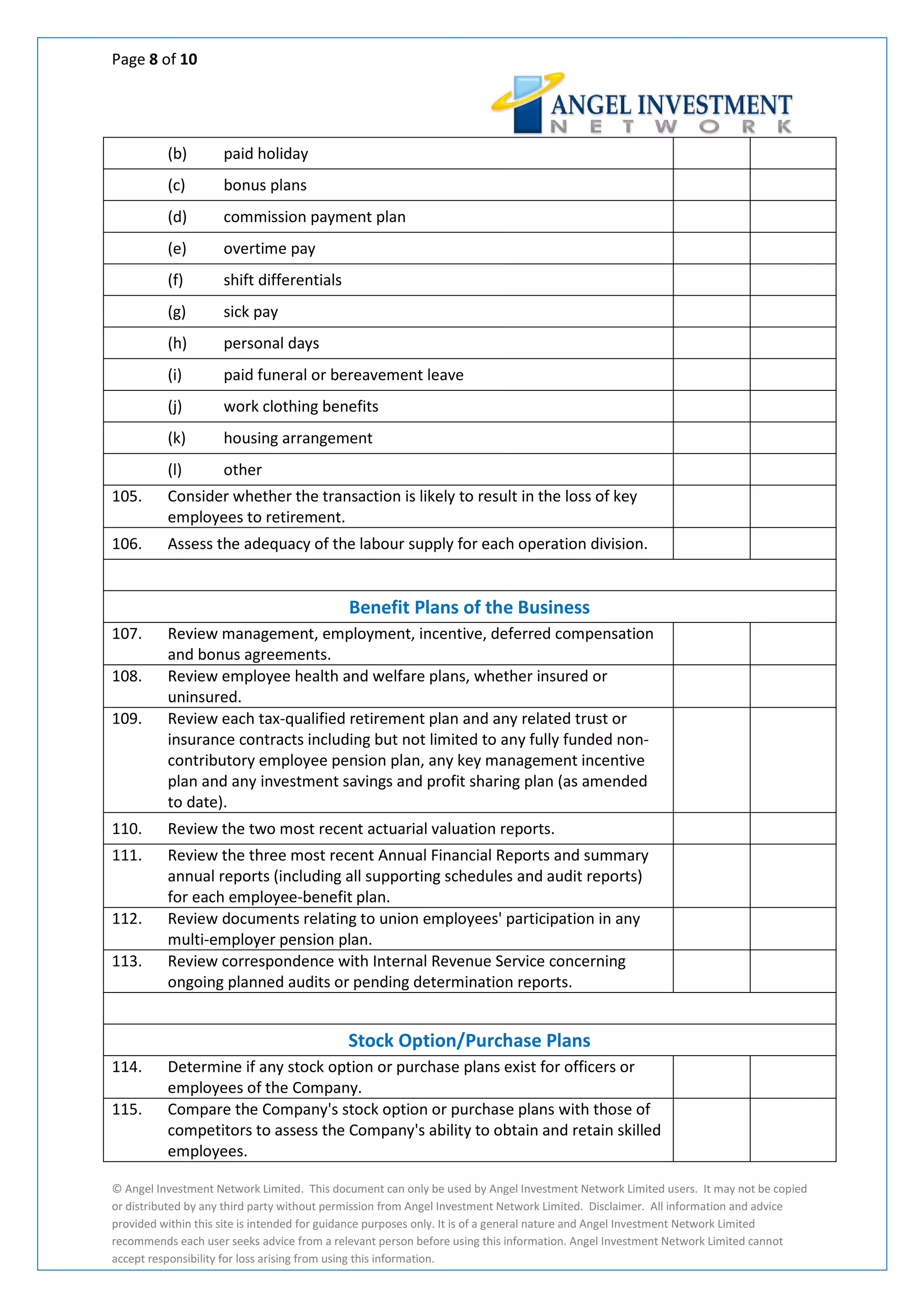
          (b)       paid holiday
          (c)       bonus plans
          (d)       commission payment plan
          (e)       overtime pay
          (f)       shift differentials
          (g)       sick pay
          (h)       personal days
          (i)       paid funeral or bereavement leave
          (j)       work clothing benefits
          (k)       housing arrangement
          (l)       other
105.      Consider whether the transaction is likely to result in the loss of key
          employees to retirement.
106.      Assess the adequacy of the labour supply for each operation division.


                                            Benefit Plans of the Business
107.      Review management, employment, incentive, deferred compensation
          and bonus agreements.
108.      Review employee health and welfare plans, whether insured or
          uninsured.
109.      Review each tax-qualified retirement plan and any related trust or
          insurance contracts including but not limited to any fully funded non-
          contributory employee pension plan, any key management incentive
          plan and any investment savings and profit sharing plan (as amended
          to date).
110.      Review the two most recent actuarial valuation reports.
111.      Review the three most recent Annual Financial Reports and summary
          annual reports (including all supporting schedules and audit reports)
          for each employee-benefit plan.
112.      Review documents relating to union employees' participation in any
          multi-employer pension plan.
113.      Review correspondence with Internal Revenue Service concerning
          ongoing planned audits or pending determination reports.


                                            Stock Option/Purchase Plans
114.      Determine if any stock option or purchase plans exist for officers or
          employees of the Company.
115.      Compare the Company's stock option or purchase plans with those of
          competitors to assess the Company's ability to obtain and retain skilled
          employees.

© Angel Investment Network Limited. This document can only be used by Angel Investment Network Limited users. It may not be copied
or distributed by any third party without permission from Angel Investment Network Limited. Disclaimer. All information and advice
provided within this site is intended for guidance purposes only. It is of a general nature and Angel Investment Network Limited
recommends each user seeks advice from a relevant person before using this information. Angel Investment Network Limited cannot
accept responsibility for loss arising from using this information.
Page 9 of 10


                                                           Insurance
116.      Obtain and review copies of all insurance contracts; list of pending
          claims, disputes with insurance companies or denials of coverage.
117.      Review any key-man insurance and present value calculation.
118.      Review product liability insurance, including description of claims
          history.


                                                Environmental Matters
119.      Identify where finished product, inventory and raw materials are being
          stored.
120.      Identify methods of waste disposal:
          (a)       paperboard waste;
          (b)       hazardous waste;
          (c)       effluents.
121.      Determine whether they are any drums or waste buried on plant
          premises.
122.      Determine whether any plants are subject to an environmental
          compliance schedule, consent order or administrative order and
          whether any plant received notice that it is not in compliance with
          applicable environmental laws.
123.      Determine if any plants operate under an air or water pollution permit.
124.      Determine if any plants have underground tanks. If so, obtain a
          description of them including age.
125.      Provide general information about the age of the plant(s), former
          operations, prior land use, prior owners to the extent possible.
126.      Determine whether any environmental audits or assessments have
          been done. If so, obtain copies of reports.
127.      Describe the status of the environmental clean-up efforts in progress.
128.      Determine what steps have been taken to ensure compliance with the
          Environmental laws.
129.      Determine environmental problems, and what the Company plans to
          spend between (dates) on environmental matters.


                   Government Regulations and Grants Respecting the Business
130.      Analyze all government grants as to amounts, repayment of principal
          and/or interest obligations, any conditions or undertakings in favour of
          the government as to the use to which funds must be put, or events
          which may trigger a repayment obligation and any rights of ownership
          in any asset produced as a result of the project funded by any grant.
131.      Determine all statutes and regulations to which the Business is subject
          and confirm, to the extent practicable, that the Company is in

© Angel Investment Network Limited. This document can only be used by Angel Investment Network Limited users. It may not be copied
or distributed by any third party without permission from Angel Investment Network Limited. Disclaimer. All information and advice
provided within this site is intended for guidance purposes only. It is of a general nature and Angel Investment Network Limited
recommends each user seeks advice from a relevant person before using this information. Angel Investment Network Limited cannot
accept responsibility for loss arising from using this information.
Page 10 of 10


          compliance therewith.
132.      Obtain all material governmental consents required to be obtained by
          or on behalf of the Company.


                        Legal Proceedings and Claims Respecting the Business
133.      Review with the auditors and with officers of the Company any current,
          pending or threatened lawsuits or litigation or regulatory actions by or
          against the Company.
134.      Review pleadings and other documents relating to any such lawsuits,
          litigation or regulatory actions.
135.      Obtain opinions of counsel, if necessary, as to the likelihood of success
          of litigation and its materiality to the operations of the Business and
          consider the degree to which any losses may be uninsured.
136.      Obtain and review a list of litigation and administrative proceedings
          currently pending or pending during the past three years and counsel
          handling same;
137.      Obtain and review copies of consent decrees and applicable
          injunctions, etc.;
138.      Obtain and review a description of all threatened claims or
          proceedings;
139.      Obtain and review copies of regulatory compliance correspondence;
140.      Obtain and review lists of any audits or proceedings conducted by the
          Inland Revenue.


© Angel Investment Network Limited. This document can only be used by Angel Investment Network Limited users. It may not be copied
or distributed by any third party without permission from Angel Investment Network Limited. Disclaimer. All information and advice
provided within this site is intended for guidance purposes only. It is of a general nature and Angel Investment Network Limited
recommends each user seeks advice from a relevant person before using this information. Angel Investment Network Limited cannot
accept responsibility for loss arising from using this information.

Due diligence checklist

  • 1.
    Page 1 of10 Due Diligence Checklist Yes No Corporate Organization 1. Review Incorporation Documents of the Company. 2. Obtain Certificate of Status/Good standing for the Company. 3. Review by-laws of the Company. 4. Conduct a corporate review of the minute books of the Company. 5. Focus on validity of major corporate actions. 6. Obtain a list of countries and states where the Company is or should be qualified to do business 7. Review partnership or joint venture agreements, if any. 8. Perform asset searches in jurisdictions where principal assets are located. Public Document Review 9. Review all publicly filed documents of the Company. 10. Perform Internet searches in respect of the Company. 11. Review all press releases and media articles relating to the Company and the industry. 12. Review all management speeches. Financial Statements And Forecasts 13. Review audited and unaudited consolidated financial statements of the Business and the Company and notes thereto and review any financial forecasts. 14. Review monthly or interim reports prepared by or for management concerning financial or operating matters relating to the Business and the Company. 15. Obtain copies of letters to the Company's auditors with respect to current, pending or threatened lawsuits or Company with respect to current, pending or threatened lawsuits or litigation or regulatory actions by or against the Business and the Company. 16. Obtain budget projections or business plans for the Business and the Company and review with Company officials to determine any material changes in the financial position of the Business and the Company and compare past budgets and projections with actual experience in order to assess the accuracy of management estimates. © Angel Investment Network Limited. This document can only be used by Angel Investment Network Limited users. It may not be copied or distributed by any third party without permission from Angel Investment Network Limited. Disclaimer. All information and advice provided within this site is intended for guidance purposes only. It is of a general nature and Angel Investment Network Limited recommends each user seeks advice from a relevant person before using this information. Angel Investment Network Limited cannot accept responsibility for loss arising from using this information.
  • 2.
    Page 2 of10 Taxes 17. Request copies of tax returns and any audit reports for the last five years. 18. Note the date of the last tax audit and obtain a list of nay notices received or notices of assessment contemplated by Internal Revenue Service. 19. Evaluate the effect of changes in tax laws, to the future operation of the Business. 20. Assess any potential tax liabilities. Audits 21. Arrange full "due diligence" meeting with the auditors of the Company to review and consider the following matters in respect of the Business: (a) the financial statements and financial forecasts; (b) any recent, proposed or contemplated changes in the accounting policies of the Company; (c) the relationship of the auditors and management concerning, among other things, access of the auditors to any necessary information and including any difficulties with any prior audit or reports on the financial statements; (d) the substance and resolution of any recent significant accounting policies or issues discussed between the Company and its auditors with respect to the preparation of the financial statements; (e) the adequacy of the company’s internal controls and accounting methods with respect to financial matters, including their internal reporting system, the recording of sales and expenses and other matters; (f) the comments and opinions of the auditors with respect to the general fairness of the accounting policies and the presentation of the financial statements; (g) the function or role, if any, of the auditors in respect of the preparation and issuance by the Company of interim unaudited financial statements; and (h) the actual post-audit results relative to interim unaudited results or with respect to any projections, forecasts and budgets prepared by the management of the Company prior to the completion of any audit on the financial statements. 22. Discuss the nature and scope of the review and examination by the auditors of the financial statements. 23. Discuss the nature and scope of the review and examination by the auditors of any financial forecasts. 24. Review and discuss any oral or written supplementary financial or management reports or letters to management prepared by or initiated from the auditors to the Company or its financial officers with © Angel Investment Network Limited. This document can only be used by Angel Investment Network Limited users. It may not be copied or distributed by any third party without permission from Angel Investment Network Limited. Disclaimer. All information and advice provided within this site is intended for guidance purposes only. It is of a general nature and Angel Investment Network Limited recommends each user seeks advice from a relevant person before using this information. Angel Investment Network Limited cannot accept responsibility for loss arising from using this information.
  • 3.
    Page 3 of10 respect to any aspect of the Company's system of accounting, financial reporting or record-keeping. 25. Review and discuss transactions by the Company with any affiliated companies and the method of reflecting these transactions in such Company's financial statements. Real Property, Plant and Equipment of the Business 26. Obtain a list of all properties, leased or owned, with description of use. 27. Obtain and review surveys on owned property. Review term, termination rights, rent, whether net lease, defaults, assignability, etc. 28. Obtain and review copies of all leases for leased property. 29. Obtain a list of physical assets tied to financial statements. 30. Consider a physical examination of principal plants and properties. 31. Obtain particulars regarding commitment by the Company for fixed asset additions and particulars regarding proposed capital expenditure programs. 32. Consider reviewing any major encumbrances on or over real property and leases referred to above. 33. Obtain a list of machinery and equipment and other personal property. 34. Obtain a list of personal property. 35. Encumbrances on or over personal property. Intangibles of the Business 36. Obtain a list of all product names from the Company. 37. Ensure all product names have been duly registered as trademarks of the Company. 38. Obtain a list of all patents, trademarks, copyrights and tradenames so as to order searches. 39. Determine the status of such patents, trademarks, copyrights and tradenames. 40. Determine if there are any disputes or infringement claims regarding any of the foregoing or any intellectual property claims of other persons. 41. Obtain a list of proprietary processes controlled by the Company. 42. Review contracts granting or receiving licenses for intellectual property rights. 43. Review contracts granting rights to future products developed by the Company. The Products of the Business 44. Examine and operate each product particularly new products to assess © Angel Investment Network Limited. This document can only be used by Angel Investment Network Limited users. It may not be copied or distributed by any third party without permission from Angel Investment Network Limited. Disclaimer. All information and advice provided within this site is intended for guidance purposes only. It is of a general nature and Angel Investment Network Limited recommends each user seeks advice from a relevant person before using this information. Angel Investment Network Limited cannot accept responsibility for loss arising from using this information.
  • 4.
    Page 4 of10 appearance, function, design, etc. 45. Assess the threat of obsolescence for each significant product line. 46. Review new product and service plans and development progress. 47. Compare the products with those of competitors, and assess the threat from new competitors. 48. Perform an analysis of unproven technology, using experts if necessary. The Industry 49. Estimate the size of the industry, present and projected, in each significant product line, and compare Business growth projections with anticipated market size for consistency. 50. Review government and trade reports and trade literature regarding the market segments of the Business. 51. Review any internal or outside studies of the Business, the market and the products. 52. Interview trade association personnel concerning trends of relevance. 53. Assess the effect of macroeconomic trend (e.g. interest rate fluctuations, inflation rates, economic growth rates). 54. Assess the comparative strengths and weaknesses of competitors in terms of the dominant competitive factors in the industry (e.g. price, service, performance, etc.) 55. Determine whether research and development (R&D) expenditures are consistent with industry practice. Marketing and Distribution 56. Evaluate the importance of original equipment manufacturers (OEMs), present and future. 57. Analyze each significant contract regarding contingencies, extent of warranties and other service obligations, rights of cancellation, etc. 58. Check material contracts with customers for completeness, to determine existence of side written or oral commitments, or other terms that materially vary Business contracts. 59. Evaluate the extent to which the Company finances any customer purchases from the Business and obtain a copy of documentation. 60. Review model sales contract, sales representative agreements and dealer agreements used by the Business. 61. Evaluate the adequacy of the distribution network, the degree of control over distribution, etc. 62. Evaluate the effectiveness of marketing personnel. 63. For new products, estimate the cost of introduction, and determine whether the cost is adequately reflected in cash flow projections. 64. Assess the likelihood of discontinuation of products or services. © Angel Investment Network Limited. This document can only be used by Angel Investment Network Limited users. It may not be copied or distributed by any third party without permission from Angel Investment Network Limited. Disclaimer. All information and advice provided within this site is intended for guidance purposes only. It is of a general nature and Angel Investment Network Limited recommends each user seeks advice from a relevant person before using this information. Angel Investment Network Limited cannot accept responsibility for loss arising from using this information.
  • 5.
    Page 5 of10 Technology 65. Review the research and development plans of the Business to determine whether any radical changes in product direction are anticipated and what cost burden will be imposed on the Business in coming years. 66. Evaluate the effectiveness of research and development personnel and organization to assess the capacity for technological innovation of the Business. 67. Review royalty contracts for contingencies, etc. and contact the licensees to determine the existence of any agreement or understanding that varies the terms of the contracts. 68. Evaluate other professional affiliations of management or research and development personnel (e.g. academic) to assess the likelihood of competing claims on technology of the Business. 69. Determine whether the Business's exports are consistent with export control laws. Production 70. Assess ability of production facilities to handle anticipated volumes, and whether the cost of new plant and equipment is consistent with anticipated cash flow. 71. Evaluate product and process obsolescence, and compare production facilities to those of industry competitors to determine future competitiveness, both technical and economic. 72. Inquire into anticipated plant closings as well as plans for new facilities. 73. Evaluate adequacy of management information systems and inventory control programs. 74. Assess exposure from single source suppliers, and evaluate the contingency plans of the Business for responding to interruption of supplies. 75. Contact major suppliers to determine their satisfaction with the Business, and their plans to retire, reduce, or raise the price of, key supplies and components. 76. Review material contracts with suppliers. 77. Review agreements, subcontractors and manufacture of the Company's products; any "private label" supply or purchase contracts. Other Contracts and Commitments 78. In respect of all material contracts, review for assignability, enforceability, breaches and escalation clauses. 79. Obtain copies of all: (a) franchise, user or licence agreements and ancillary documents; (b) franchise, user or licence registrations or disclosure documents; © Angel Investment Network Limited. This document can only be used by Angel Investment Network Limited users. It may not be copied or distributed by any third party without permission from Angel Investment Network Limited. Disclaimer. All information and advice provided within this site is intended for guidance purposes only. It is of a general nature and Angel Investment Network Limited recommends each user seeks advice from a relevant person before using this information. Angel Investment Network Limited cannot accept responsibility for loss arising from using this information.
  • 6.
    Page 6 of10 (c) government licences and permits; (d) warranties of products sold and warranty claim history; (e) contracts with and liabilities to insiders or other affiliates; (f) secrecy or non-competition agreements; (g) membership agreements; (h) powers of attorney and agency agreements; (i) contracts or arrangements which individually provide for the payment or receipt by the Business of, say, £10,000 or more, including but not limited contracts for purchase and sale of goods and services; and (j) all other contracts which materially affect the Business; 80. Review proposed contracts or negotiations. 81. Obtain all material consents of private persons or entitles required to be obtained by or on behalf of the Business. Acquisition Agreements Respecting the Business 82. Obtain and review copies of all (a) acquisition agreements; (b) filings with government agencies made in connection with the acquisitions; (c) other closing documents for the acquisitions. Management and Employees of the Business 83. Investigate the prior experience of management and directors in the same industry and the same size company, their experience with large firms etc. Also investigate their reputation in the industry. 84. Review prior transactions between the Business and insiders for fairness, propriety, full disclosure, etc. 85. Determine whether any significant defections from management are imminent and assess their effect on competitiveness. 86. Obtain copies of all personnel policies. 87. Obtain copies of all employee handbooks. 88. Obtain a complete employee list of the entire Business, setting out names, job titles, addresses, age (where available), salary and length of service. 89. Analyze written employment contracts with regard to: (a) name of employee; (b) description of position; © Angel Investment Network Limited. This document can only be used by Angel Investment Network Limited users. It may not be copied or distributed by any third party without permission from Angel Investment Network Limited. Disclaimer. All information and advice provided within this site is intended for guidance purposes only. It is of a general nature and Angel Investment Network Limited recommends each user seeks advice from a relevant person before using this information. Angel Investment Network Limited cannot accept responsibility for loss arising from using this information.
  • 7.
    Page 7 of10 (c) term of agreement; (d) salary; (e) special benefits; (f) severance obligations of the employer; 90. Obtain copies of any agreements which employees are required to sign: (a) confidentiality agreements; (b) invention assignment agreements; (c) conflict of interest declarations; (d) non-competition agreements; (e) non-solicitation agreements; (f) agreement with governments or government agencies, including military procurement contracts; (g) agreements with competitors; (h) and any other agreements with employees, such as loan agreements, consulting agreements. 91. Obtain a description of all pending labour disputes or disputes within past five years. 92. Obtain copies of all current labour contracts, including any collective bargaining agreements. 93. Obtain copies of any pending applications for union certification, labour board proceedings, outstanding grievances or arbitration awards. 94. Obtain copies of any outstanding complaints under the Human Rights legislation. 95. Obtain sample employment applications. 96. Obtain copies of forms used for evaluation of applicants including written instructions to all persons who interview applicants. 97. Obtain copies of pre-employment tests. 98. Obtain copies of any complaints, proceedings or orders under applicable affirmative action or pay equity legislation. 99. Obtain copies of most recent affirmative action plan. 100. Obtain copies of material safety sheets. 101. Obtain sample copies of educational material distributed to employees in compliance with Health and Safety Act legislation. 102. Obtain copies of Health and Safety reports filed with government authorities in the last 12 months. 103. Obtain a summary of all workers’ compensation claims in last 12 months. 104. Obtain summary of current: (a) vacation plan © Angel Investment Network Limited. This document can only be used by Angel Investment Network Limited users. It may not be copied or distributed by any third party without permission from Angel Investment Network Limited. Disclaimer. All information and advice provided within this site is intended for guidance purposes only. It is of a general nature and Angel Investment Network Limited recommends each user seeks advice from a relevant person before using this information. Angel Investment Network Limited cannot accept responsibility for loss arising from using this information.
  • 8.
    Page 8 of10 (b) paid holiday (c) bonus plans (d) commission payment plan (e) overtime pay (f) shift differentials (g) sick pay (h) personal days (i) paid funeral or bereavement leave (j) work clothing benefits (k) housing arrangement (l) other 105. Consider whether the transaction is likely to result in the loss of key employees to retirement. 106. Assess the adequacy of the labour supply for each operation division. Benefit Plans of the Business 107. Review management, employment, incentive, deferred compensation and bonus agreements. 108. Review employee health and welfare plans, whether insured or uninsured. 109. Review each tax-qualified retirement plan and any related trust or insurance contracts including but not limited to any fully funded non- contributory employee pension plan, any key management incentive plan and any investment savings and profit sharing plan (as amended to date). 110. Review the two most recent actuarial valuation reports. 111. Review the three most recent Annual Financial Reports and summary annual reports (including all supporting schedules and audit reports) for each employee-benefit plan. 112. Review documents relating to union employees' participation in any multi-employer pension plan. 113. Review correspondence with Internal Revenue Service concerning ongoing planned audits or pending determination reports. Stock Option/Purchase Plans 114. Determine if any stock option or purchase plans exist for officers or employees of the Company. 115. Compare the Company's stock option or purchase plans with those of competitors to assess the Company's ability to obtain and retain skilled employees. © Angel Investment Network Limited. This document can only be used by Angel Investment Network Limited users. It may not be copied or distributed by any third party without permission from Angel Investment Network Limited. Disclaimer. All information and advice provided within this site is intended for guidance purposes only. It is of a general nature and Angel Investment Network Limited recommends each user seeks advice from a relevant person before using this information. Angel Investment Network Limited cannot accept responsibility for loss arising from using this information.
  • 9.
    Page 9 of10 Insurance 116. Obtain and review copies of all insurance contracts; list of pending claims, disputes with insurance companies or denials of coverage. 117. Review any key-man insurance and present value calculation. 118. Review product liability insurance, including description of claims history. Environmental Matters 119. Identify where finished product, inventory and raw materials are being stored. 120. Identify methods of waste disposal: (a) paperboard waste; (b) hazardous waste; (c) effluents. 121. Determine whether they are any drums or waste buried on plant premises. 122. Determine whether any plants are subject to an environmental compliance schedule, consent order or administrative order and whether any plant received notice that it is not in compliance with applicable environmental laws. 123. Determine if any plants operate under an air or water pollution permit. 124. Determine if any plants have underground tanks. If so, obtain a description of them including age. 125. Provide general information about the age of the plant(s), former operations, prior land use, prior owners to the extent possible. 126. Determine whether any environmental audits or assessments have been done. If so, obtain copies of reports. 127. Describe the status of the environmental clean-up efforts in progress. 128. Determine what steps have been taken to ensure compliance with the Environmental laws. 129. Determine environmental problems, and what the Company plans to spend between (dates) on environmental matters. Government Regulations and Grants Respecting the Business 130. Analyze all government grants as to amounts, repayment of principal and/or interest obligations, any conditions or undertakings in favour of the government as to the use to which funds must be put, or events which may trigger a repayment obligation and any rights of ownership in any asset produced as a result of the project funded by any grant. 131. Determine all statutes and regulations to which the Business is subject and confirm, to the extent practicable, that the Company is in © Angel Investment Network Limited. This document can only be used by Angel Investment Network Limited users. It may not be copied or distributed by any third party without permission from Angel Investment Network Limited. Disclaimer. All information and advice provided within this site is intended for guidance purposes only. It is of a general nature and Angel Investment Network Limited recommends each user seeks advice from a relevant person before using this information. Angel Investment Network Limited cannot accept responsibility for loss arising from using this information.
  • 10.
    Page 10 of10 compliance therewith. 132. Obtain all material governmental consents required to be obtained by or on behalf of the Company. Legal Proceedings and Claims Respecting the Business 133. Review with the auditors and with officers of the Company any current, pending or threatened lawsuits or litigation or regulatory actions by or against the Company. 134. Review pleadings and other documents relating to any such lawsuits, litigation or regulatory actions. 135. Obtain opinions of counsel, if necessary, as to the likelihood of success of litigation and its materiality to the operations of the Business and consider the degree to which any losses may be uninsured. 136. Obtain and review a list of litigation and administrative proceedings currently pending or pending during the past three years and counsel handling same; 137. Obtain and review copies of consent decrees and applicable injunctions, etc.; 138. Obtain and review a description of all threatened claims or proceedings; 139. Obtain and review copies of regulatory compliance correspondence; 140. Obtain and review lists of any audits or proceedings conducted by the Inland Revenue. © Angel Investment Network Limited. This document can only be used by Angel Investment Network Limited users. It may not be copied or distributed by any third party without permission from Angel Investment Network Limited. Disclaimer. All information and advice provided within this site is intended for guidance purposes only. It is of a general nature and Angel Investment Network Limited recommends each user seeks advice from a relevant person before using this information. Angel Investment Network Limited cannot accept responsibility for loss arising from using this information.