Fixed vs Floating 
Exchange Rate 
System 
By 
Pankaj Newar 
13A2HP029
AGENDA 
Fixed Exchange Rates 
Benefits 
Breakup of Fixed Exchange Rate 
Floating Exchange Rate 
Benefits
Exchange Rates 
It is value of one nations currency in 
comparison to another 
Types: 
1) Fixed Exchange Rate 
2) Floating Exchange Rate
Fixed Exchange Rates 
A fixed exchange rate pegs one 
country's currency to another country’s 
currency 
The government of a country doesn’t 
let the exchange rate change in 
accordance with the demand and 
supply for the currency 
The purpose of a fixed rate system is 
to maintain a country’s currency value 
within a very narrow band.
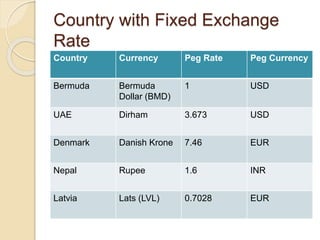
Country with Fixed Exchange 
Rate 
Country Currency Peg Rate Peg Currency 
Bermuda Bermuda 
Dollar (BMD) 
1 USD 
UAE Dirham 3.673 USD 
Denmark Danish Krone 7.46 EUR 
Nepal Rupee 1.6 INR 
Latvia Lats (LVL) 0.7028 EUR
Benefits 
Promote International Trade 
Helpful for Small Nations 
Restricts Speculation 
Major Crisis 
Mexican Peso Crisis, 1994 
Asian Currency Crisis, 1997
Breakup of Fixed Exchange 
Rate 
Macroeconomic Policy Package of 
1965-1968 i.e., 
1) Finance Vietnam Conflicts 
2) Own welfare programs 
 In August 1971, US President 
announced that dollar was no longer 
convertible into gold 
 By March 1973, most of the currency 
began to float against each other
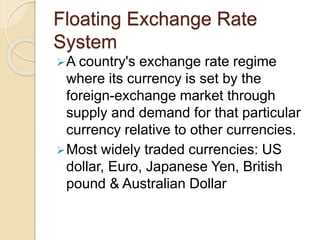
Floating Exchange Rate 
System 
A country's exchange rate regime 
where its currency is set by the 
foreign-exchange market through 
supply and demand for that particular 
currency relative to other currencies. 
Most widely traded currencies: US 
dollar, Euro, Japanese Yen, British 
pound & Australian Dollar
Benefits 
 Automatic BOP adjustments 
 Independent Monetary Policy 
 Promotes Economic Development 
 Increase in Liquidity
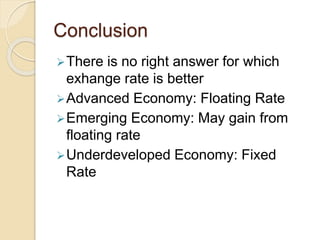
Conclusion 
There is no right answer for which 
exhange rate is better 
Advanced Economy: Floating Rate 
Emerging Economy: May gain from 
floating rate 
Underdeveloped Economy: Fixed 
Rate
Fixed vs floating exchange rate system

Fixed vs floating exchange rate system

  • 1.
    Fixed vs Floating Exchange Rate System By Pankaj Newar 13A2HP029
  • 2.
    AGENDA Fixed ExchangeRates Benefits Breakup of Fixed Exchange Rate Floating Exchange Rate Benefits
  • 3.
    Exchange Rates Itis value of one nations currency in comparison to another Types: 1) Fixed Exchange Rate 2) Floating Exchange Rate
  • 4.
    Fixed Exchange Rates A fixed exchange rate pegs one country's currency to another country’s currency The government of a country doesn’t let the exchange rate change in accordance with the demand and supply for the currency The purpose of a fixed rate system is to maintain a country’s currency value within a very narrow band.
  • 5.
    Country with FixedExchange Rate Country Currency Peg Rate Peg Currency Bermuda Bermuda Dollar (BMD) 1 USD UAE Dirham 3.673 USD Denmark Danish Krone 7.46 EUR Nepal Rupee 1.6 INR Latvia Lats (LVL) 0.7028 EUR
  • 6.
    Benefits Promote InternationalTrade Helpful for Small Nations Restricts Speculation Major Crisis Mexican Peso Crisis, 1994 Asian Currency Crisis, 1997
  • 7.
    Breakup of FixedExchange Rate Macroeconomic Policy Package of 1965-1968 i.e., 1) Finance Vietnam Conflicts 2) Own welfare programs  In August 1971, US President announced that dollar was no longer convertible into gold  By March 1973, most of the currency began to float against each other
  • 8.
    Floating Exchange Rate System A country's exchange rate regime where its currency is set by the foreign-exchange market through supply and demand for that particular currency relative to other currencies. Most widely traded currencies: US dollar, Euro, Japanese Yen, British pound & Australian Dollar
  • 9.
    Benefits  AutomaticBOP adjustments  Independent Monetary Policy  Promotes Economic Development  Increase in Liquidity
  • 10.
    Conclusion There isno right answer for which exhange rate is better Advanced Economy: Floating Rate Emerging Economy: May gain from floating rate Underdeveloped Economy: Fixed Rate