Project Procurement Management
Processes necessary to purchase or acquire products, services or results
needed from outside the project team.
PROJECT PROCUREMENT MANAGEMENT
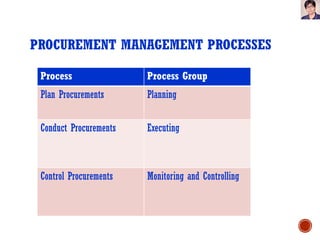
PROCUREMENT MANAGEMENT PROCESSES
Process Process Group
Plan Procurements Planning
Conduct Procurements Executing
Control Procurements Monitoring and Controlling
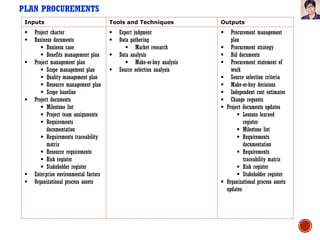
PLAN PROCUREMENTS
Plan Procurements is the process of documenting project
purchasing decisions, specifying the approach, and identifying
potential sellers
PLAN PROCUREMENTS
Inputs Tools and Techniques Outputs
 Project charter
 Business documents
 Business case
 Benefits management plan
 Project management plan
 Scope management plan
 Quality management plan
 Resource management plan
 Scope baseline
 Project documents
 Milestone list
 Project team assignments
 Requirements
documentation
 Requirements traceability
matrix
 Resource requirements
 Risk register
 Stakeholder register
 Enterprise environmental factors
 Organizational process assets
 Expert judgment
 Data gathering
 Market research
 Data analysis
 Make-or-buy analysis
 Source selection analysis
 Procurement management
plan
 Procurement strategy
 Bid documents
 Procurement statement of
work
 Source selection criteria
 Make-or-buy decisions
 Independent cost estimates
 Change requests
 Project documents updates
 Lessons learned
register
 Milestone list
 Requirements
documentation
 Requirements
traceability matrix
 Risk register
 Stakeholder register
 Organizational process assets
updates
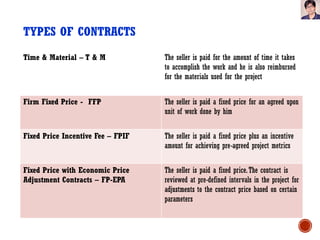
TYPES OF CONTRACTS
Time & Material – T & M The seller is paid for the amount of time it takes
to accomplish the work and he is also reimbursed
for the materials used for the project
Firm Fixed Price - FFP The seller is paid a fixed price for an agreed upon
unit of work done by him
Fixed Price Incentive Fee – FPIF The seller is paid a fixed price plus an incentive
amount for achieving pre-agreed project metrics
Fixed Price with Economic Price
Adjustment Contracts – FP-EPA
The seller is paid a fixed price.The contract is
reviewed at pre-defined intervals in the project for
adjustments to the contract price based on certain
parameters
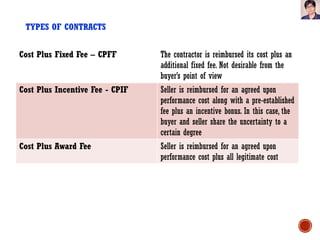
TYPES OF CONTRACTS
Cost Plus Fixed Fee – CPFF The contractor is reimbursed its cost plus an
additional fixed fee. Not desirable from the
buyer’s point of view
Cost Plus Incentive Fee - CPIF Seller is reimbursed for an agreed upon
performance cost along with a pre-established
fee plus an incentive bonus. In this case, the
buyer and seller share the uncertainty to a
certain degree
Cost Plus Award Fee Seller is reimbursed for an agreed upon
performance cost plus all legitimate cost
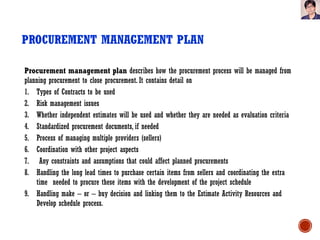
PROCUREMENT MANAGEMENT PLAN
Procurement management plan describes how the procurement process will be managed from
planning procurement to close procurement. It contains detail on
1. Types of Contracts to be used
2. Risk management issues
3. Whether independent estimates will be used and whether they are needed as evaluation criteria
4. Standardized procurement documents, if needed
5. Process of managing multiple providers (sellers)
6. Coordination with other project aspects
7. Any constraints and assumptions that could affect planned procurements
8. Handling the long lead times to purchase certain items from sellers and coordinating the extra
time needed to procure these items with the development of the project schedule
9. Handling make – or – buy decision and linking them to the Estimate Activity Resources and
Develop schedule process.
Practicing Key Concepts
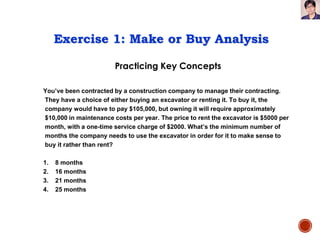
Exercise 1: Make or Buy Analysis
You’ve been contracted by a construction company to manage their contracting.
They have a choice of either buying an excavator or renting it. To buy it, the
company would have to pay $105,000, but owning it will require approximately
$10,000 in maintenance costs per year. The price to rent the excavator is $5000 per
month, with a one-time service charge of $2000. What’s the minimum number of
months the company needs to use the excavator in order for it to make sense to
buy it rather than rent?
1. 8 months
2. 16 months
3. 21 months
4. 25 months
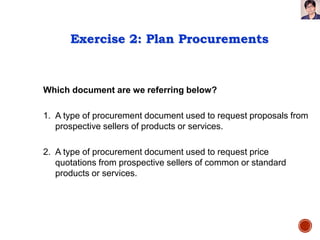
Exercise 2: Plan Procurements
Which document are we referring below?
1. A type of procurement document used to request proposals from
prospective sellers of products or services.
2. A type of procurement document used to request price
quotations from prospective sellers of common or standard
products or services.
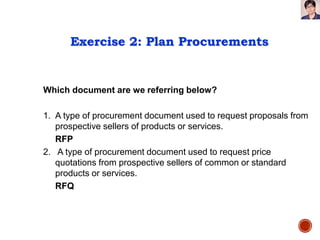
Exercise 2: Plan Procurements
Which document are we referring below?
1. A type of procurement document used to request proposals from
prospective sellers of products or services.
RFP
2. A type of procurement document used to request price
quotations from prospective sellers of common or standard
products or services.
RFQ
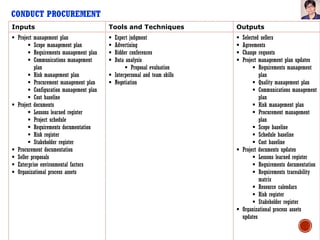
CONDUCT PROCUREMENT
Conduct Procurements is the process of obtaining seller responses,
selecting a seller, and awarding a contract
CONDUCT PROCUREMENT
Inputs Tools and Techniques Outputs
 Project management plan
 Scope management plan
 Requirements management plan
 Communications management
plan
 Risk management plan
 Procurement management plan
 Configuration management plan
 Cost baseline
 Project documents
 Lessons learned register
 Project schedule
 Requirements documentation
 Risk register
 Stakeholder register
 Procurement documentation
 Seller proposals
 Enterprise environmental factors
 Organizational process assets
 Expert judgment
 Advertising
 Bidder conferences
 Data analysis
 Proposal evaluation
 Interpersonal and team skills
 Negotiation
 Selected sellers
 Agreements
 Change requests
 Project management plan updates
 Requirements management
plan
 Quality management plan
 Communications management
plan
 Risk management plan
 Procurement management
plan
 Scope baseline
 Schedule baseline
 Cost baseline
 Project documents updates
 Lessons learned register
 Requirements documentation
 Requirements traceability
matrix
 Resource calendars
 Risk register
 Stakeholder register
 Organizational process assets
updates
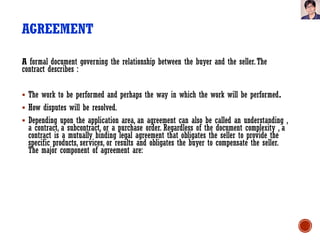
AGREEMENT
A formal document governing the relationship between the buyer and the seller.The
contract describes :
 The work to be performed and perhaps the way in which the work will be performed.
 How disputes will be resolved.
 Depending upon the application area, an agreement can also be called an understanding ,
a contract, a subcontract, or a purchase order. Regardless of the document complexity , a
contract is a mutually binding legal agreement that obligates the seller to provide the
specific products, services, or results and obligates the buyer to compensate the seller.
The major component of agreement are:
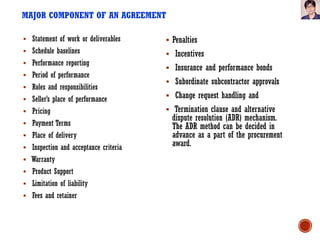
MAJOR COMPONENT OF AN AGREEMENT
 Statement of work or deliverables
 Schedule baselines
 Performance reporting
 Period of performance
 Roles and responsibilities
 Seller’s place of performance
 Pricing
 Payment Terms
 Place of delivery
 Inspection and acceptance criteria
 Warranty
 Product Support
 Limitation of liability
 Fees and retainer
 Penalties
 Incentives
 Insurance and performance bonds
 Subordinate subcontractor approvals
 Change request handling and
 Termination clause and alternative
dispute resolution (ADR) mechanism.
The ADR method can be decided in
advance as a part of the procurement
award.
CONTROL PROCUREMENTS
Managing procurement relationships, monitoring contract performance and
making changes and corrections as needed.
CONTROL PROCUREMENT
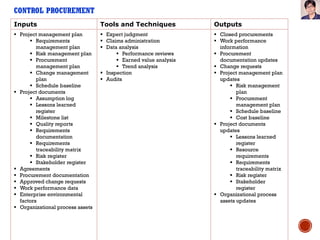
Inputs Tools and Techniques Outputs
 Project management plan
 Requirements
management plan
 Risk management plan
 Procurement
management plan
 Change management
plan
 Schedule baseline
 Project documents
 Assumption log
 Lessons learned
register
 Milestone list
 Quality reports
 Requirements
documentation
 Requirements
traceability matrix
 Risk register
 Stakeholder register
 Agreements
 Procurement documentation
 Approved change requests
 Work performance data
 Enterprise environmental
factors
 Organizational process assets
 Expert judgment
 Claims administration
 Data analysis
 Performance reviews
 Earned value analysis
 Trend analysis
 Inspection
 Audits
 Closed procurements
 Work performance
information
 Procurement
documentation updates
 Change requests
 Project management plan
updates
 Risk management
plan
 Procurement
management plan
 Schedule baseline
 Cost baseline
 Project documents
updates
 Lessons learned
register
 Resource
requirements
 Requirements
traceability matrix
 Risk register
 Stakeholder
register
 Organizational process
assets updates
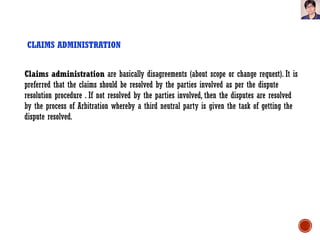
CLAIMS ADMINISTRATION
Claims administration are basically disagreements (about scope or change request). It is
preferred that the claims should be resolved by the parties involved as per the dispute
resolution procedure . If not resolved by the parties involved, then the disputes are resolved
by the process of Arbitration whereby a third neutral party is given the task of getting the
dispute resolved.
Revising Tools and Techniques
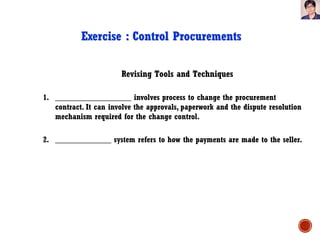
Exercise : Control Procurements
1. ___________________ involves process to change the procurement
contract. It can involve the approvals, paperwork and the dispute resolution
mechanism required for the change control.
2. ______________ system refers to how the payments are made to the seller.
Revising Tools and Techniques
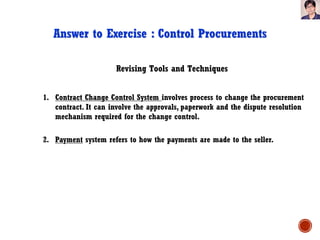
Answer to Exercise : Control Procurements
1. Contract Change Control System involves process to change the procurement
contract. It can involve the approvals, paperwork and the dispute resolution
mechanism required for the change control.
2. Payment system refers to how the payments are made to the seller.
 Negotiations Techniques
– Deadline: imposing a deadline to reach an agreement
– Stalling: one party may claim that an agreement cannot be finalized because of his
limited authority
– Fair and Responsible: a negotiator may claim that the price for a product is equitable
because that’s what another company is paying.
– Delay: are useful when tempers are beginning to flare, to divert from a subject, etc (Ex:
arrival of refreshments, request for recess etc)
– Withdrawal: one party may attack an issue, then retreat
– Arbitration: a third party may be brought in when agreement cannot be reached. (out of
court settlement)
– Fait Accompli: a party may claim that what is being asked for has already been
accomplished and cannot be changed
Project Procurement Management
On line QUIZ !
http://www.pankajpmp.com/search/label/Procurement%20Management

Project procurement management PMBOK Sixth Edition

  • 1.
  • 2.
    Processes necessary topurchase or acquire products, services or results needed from outside the project team. PROJECT PROCUREMENT MANAGEMENT
  • 3.
    PROCUREMENT MANAGEMENT PROCESSES ProcessProcess Group Plan Procurements Planning Conduct Procurements Executing Control Procurements Monitoring and Controlling
  • 4.
    PLAN PROCUREMENTS Plan Procurementsis the process of documenting project purchasing decisions, specifying the approach, and identifying potential sellers
  • 5.
    PLAN PROCUREMENTS Inputs Toolsand Techniques Outputs  Project charter  Business documents  Business case  Benefits management plan  Project management plan  Scope management plan  Quality management plan  Resource management plan  Scope baseline  Project documents  Milestone list  Project team assignments  Requirements documentation  Requirements traceability matrix  Resource requirements  Risk register  Stakeholder register  Enterprise environmental factors  Organizational process assets  Expert judgment  Data gathering  Market research  Data analysis  Make-or-buy analysis  Source selection analysis  Procurement management plan  Procurement strategy  Bid documents  Procurement statement of work  Source selection criteria  Make-or-buy decisions  Independent cost estimates  Change requests  Project documents updates  Lessons learned register  Milestone list  Requirements documentation  Requirements traceability matrix  Risk register  Stakeholder register  Organizational process assets updates
  • 6.
    TYPES OF CONTRACTS Time& Material – T & M The seller is paid for the amount of time it takes to accomplish the work and he is also reimbursed for the materials used for the project Firm Fixed Price - FFP The seller is paid a fixed price for an agreed upon unit of work done by him Fixed Price Incentive Fee – FPIF The seller is paid a fixed price plus an incentive amount for achieving pre-agreed project metrics Fixed Price with Economic Price Adjustment Contracts – FP-EPA The seller is paid a fixed price.The contract is reviewed at pre-defined intervals in the project for adjustments to the contract price based on certain parameters
  • 7.
    TYPES OF CONTRACTS CostPlus Fixed Fee – CPFF The contractor is reimbursed its cost plus an additional fixed fee. Not desirable from the buyer’s point of view Cost Plus Incentive Fee - CPIF Seller is reimbursed for an agreed upon performance cost along with a pre-established fee plus an incentive bonus. In this case, the buyer and seller share the uncertainty to a certain degree Cost Plus Award Fee Seller is reimbursed for an agreed upon performance cost plus all legitimate cost
  • 8.
    PROCUREMENT MANAGEMENT PLAN Procurementmanagement plan describes how the procurement process will be managed from planning procurement to close procurement. It contains detail on 1. Types of Contracts to be used 2. Risk management issues 3. Whether independent estimates will be used and whether they are needed as evaluation criteria 4. Standardized procurement documents, if needed 5. Process of managing multiple providers (sellers) 6. Coordination with other project aspects 7. Any constraints and assumptions that could affect planned procurements 8. Handling the long lead times to purchase certain items from sellers and coordinating the extra time needed to procure these items with the development of the project schedule 9. Handling make – or – buy decision and linking them to the Estimate Activity Resources and Develop schedule process.
  • 9.
    Practicing Key Concepts Exercise1: Make or Buy Analysis You’ve been contracted by a construction company to manage their contracting. They have a choice of either buying an excavator or renting it. To buy it, the company would have to pay $105,000, but owning it will require approximately $10,000 in maintenance costs per year. The price to rent the excavator is $5000 per month, with a one-time service charge of $2000. What’s the minimum number of months the company needs to use the excavator in order for it to make sense to buy it rather than rent? 1. 8 months 2. 16 months 3. 21 months 4. 25 months
  • 10.
    Exercise 2: PlanProcurements Which document are we referring below? 1. A type of procurement document used to request proposals from prospective sellers of products or services. 2. A type of procurement document used to request price quotations from prospective sellers of common or standard products or services.
  • 11.
    Exercise 2: PlanProcurements Which document are we referring below? 1. A type of procurement document used to request proposals from prospective sellers of products or services. RFP 2. A type of procurement document used to request price quotations from prospective sellers of common or standard products or services. RFQ
  • 12.
    CONDUCT PROCUREMENT Conduct Procurementsis the process of obtaining seller responses, selecting a seller, and awarding a contract
  • 13.
    CONDUCT PROCUREMENT Inputs Toolsand Techniques Outputs  Project management plan  Scope management plan  Requirements management plan  Communications management plan  Risk management plan  Procurement management plan  Configuration management plan  Cost baseline  Project documents  Lessons learned register  Project schedule  Requirements documentation  Risk register  Stakeholder register  Procurement documentation  Seller proposals  Enterprise environmental factors  Organizational process assets  Expert judgment  Advertising  Bidder conferences  Data analysis  Proposal evaluation  Interpersonal and team skills  Negotiation  Selected sellers  Agreements  Change requests  Project management plan updates  Requirements management plan  Quality management plan  Communications management plan  Risk management plan  Procurement management plan  Scope baseline  Schedule baseline  Cost baseline  Project documents updates  Lessons learned register  Requirements documentation  Requirements traceability matrix  Resource calendars  Risk register  Stakeholder register  Organizational process assets updates
  • 14.
    AGREEMENT A formal documentgoverning the relationship between the buyer and the seller.The contract describes :  The work to be performed and perhaps the way in which the work will be performed.  How disputes will be resolved.  Depending upon the application area, an agreement can also be called an understanding , a contract, a subcontract, or a purchase order. Regardless of the document complexity , a contract is a mutually binding legal agreement that obligates the seller to provide the specific products, services, or results and obligates the buyer to compensate the seller. The major component of agreement are:
  • 15.
    MAJOR COMPONENT OFAN AGREEMENT  Statement of work or deliverables  Schedule baselines  Performance reporting  Period of performance  Roles and responsibilities  Seller’s place of performance  Pricing  Payment Terms  Place of delivery  Inspection and acceptance criteria  Warranty  Product Support  Limitation of liability  Fees and retainer  Penalties  Incentives  Insurance and performance bonds  Subordinate subcontractor approvals  Change request handling and  Termination clause and alternative dispute resolution (ADR) mechanism. The ADR method can be decided in advance as a part of the procurement award.
  • 16.
    CONTROL PROCUREMENTS Managing procurementrelationships, monitoring contract performance and making changes and corrections as needed.
  • 17.
    CONTROL PROCUREMENT Inputs Toolsand Techniques Outputs  Project management plan  Requirements management plan  Risk management plan  Procurement management plan  Change management plan  Schedule baseline  Project documents  Assumption log  Lessons learned register  Milestone list  Quality reports  Requirements documentation  Requirements traceability matrix  Risk register  Stakeholder register  Agreements  Procurement documentation  Approved change requests  Work performance data  Enterprise environmental factors  Organizational process assets  Expert judgment  Claims administration  Data analysis  Performance reviews  Earned value analysis  Trend analysis  Inspection  Audits  Closed procurements  Work performance information  Procurement documentation updates  Change requests  Project management plan updates  Risk management plan  Procurement management plan  Schedule baseline  Cost baseline  Project documents updates  Lessons learned register  Resource requirements  Requirements traceability matrix  Risk register  Stakeholder register  Organizational process assets updates
  • 18.
    CLAIMS ADMINISTRATION Claims administrationare basically disagreements (about scope or change request). It is preferred that the claims should be resolved by the parties involved as per the dispute resolution procedure . If not resolved by the parties involved, then the disputes are resolved by the process of Arbitration whereby a third neutral party is given the task of getting the dispute resolved.
  • 19.
    Revising Tools andTechniques Exercise : Control Procurements 1. ___________________ involves process to change the procurement contract. It can involve the approvals, paperwork and the dispute resolution mechanism required for the change control. 2. ______________ system refers to how the payments are made to the seller.
  • 20.
    Revising Tools andTechniques Answer to Exercise : Control Procurements 1. Contract Change Control System involves process to change the procurement contract. It can involve the approvals, paperwork and the dispute resolution mechanism required for the change control. 2. Payment system refers to how the payments are made to the seller.
  • 21.
     Negotiations Techniques –Deadline: imposing a deadline to reach an agreement – Stalling: one party may claim that an agreement cannot be finalized because of his limited authority – Fair and Responsible: a negotiator may claim that the price for a product is equitable because that’s what another company is paying. – Delay: are useful when tempers are beginning to flare, to divert from a subject, etc (Ex: arrival of refreshments, request for recess etc) – Withdrawal: one party may attack an issue, then retreat – Arbitration: a third party may be brought in when agreement cannot be reached. (out of court settlement) – Fait Accompli: a party may claim that what is being asked for has already been accomplished and cannot be changed Project Procurement Management
  • 22.
    On line QUIZ! http://www.pankajpmp.com/search/label/Procurement%20Management