Advances in Vegetable
Production
Course no: VSC-601
Credit: 2+1=3
Course Teacher
Dr. C. D. Pawar
Department of Horticulture
College of Agriculture,
Dapoli
Presented by : Miss Pravina Barde
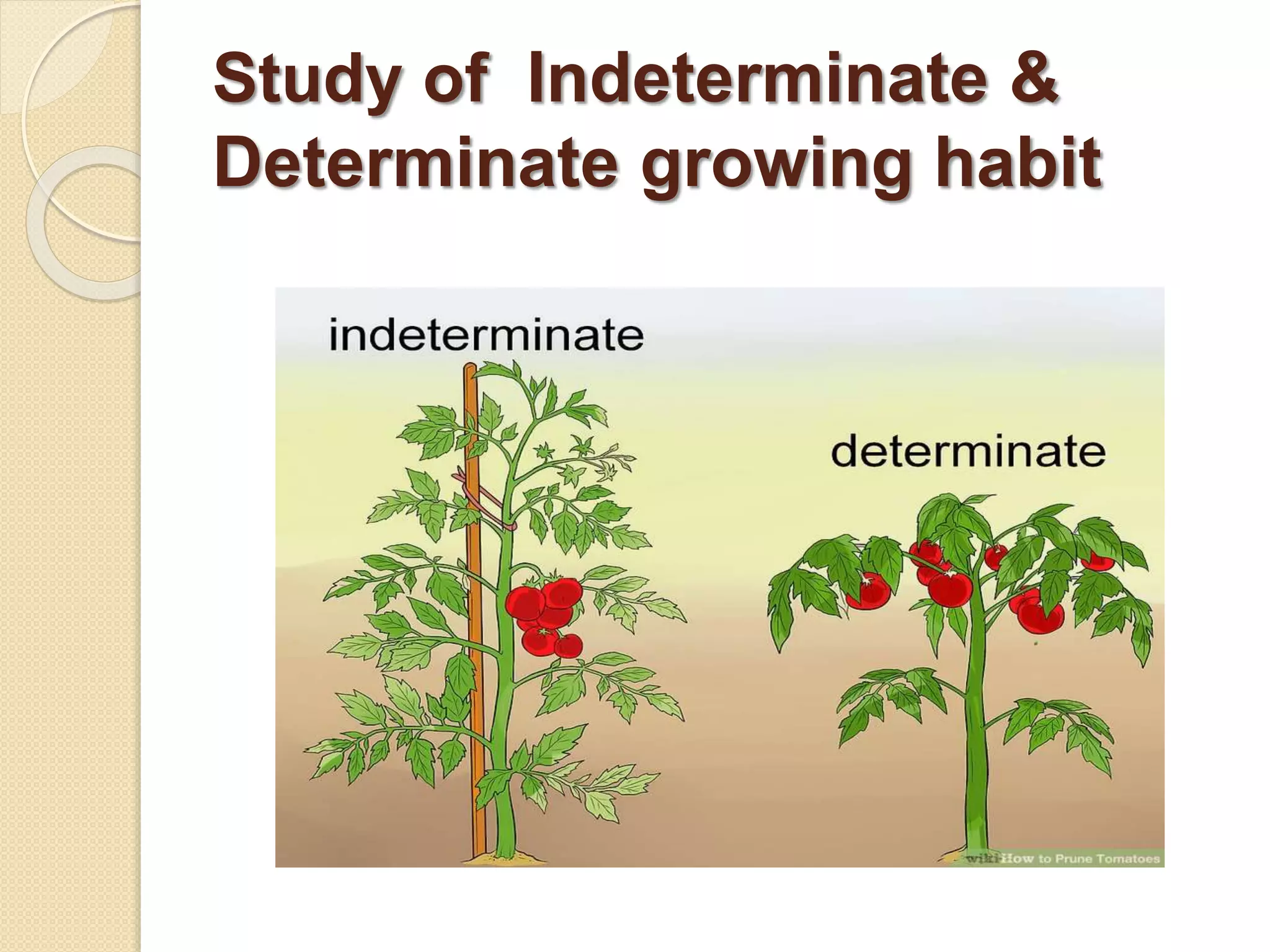
Study of Indeterminate &
Determinate growing habit
Botanical definition
 The botanical definitions of determinate
and indeterminate tell us the science
behind basic growth patterns.
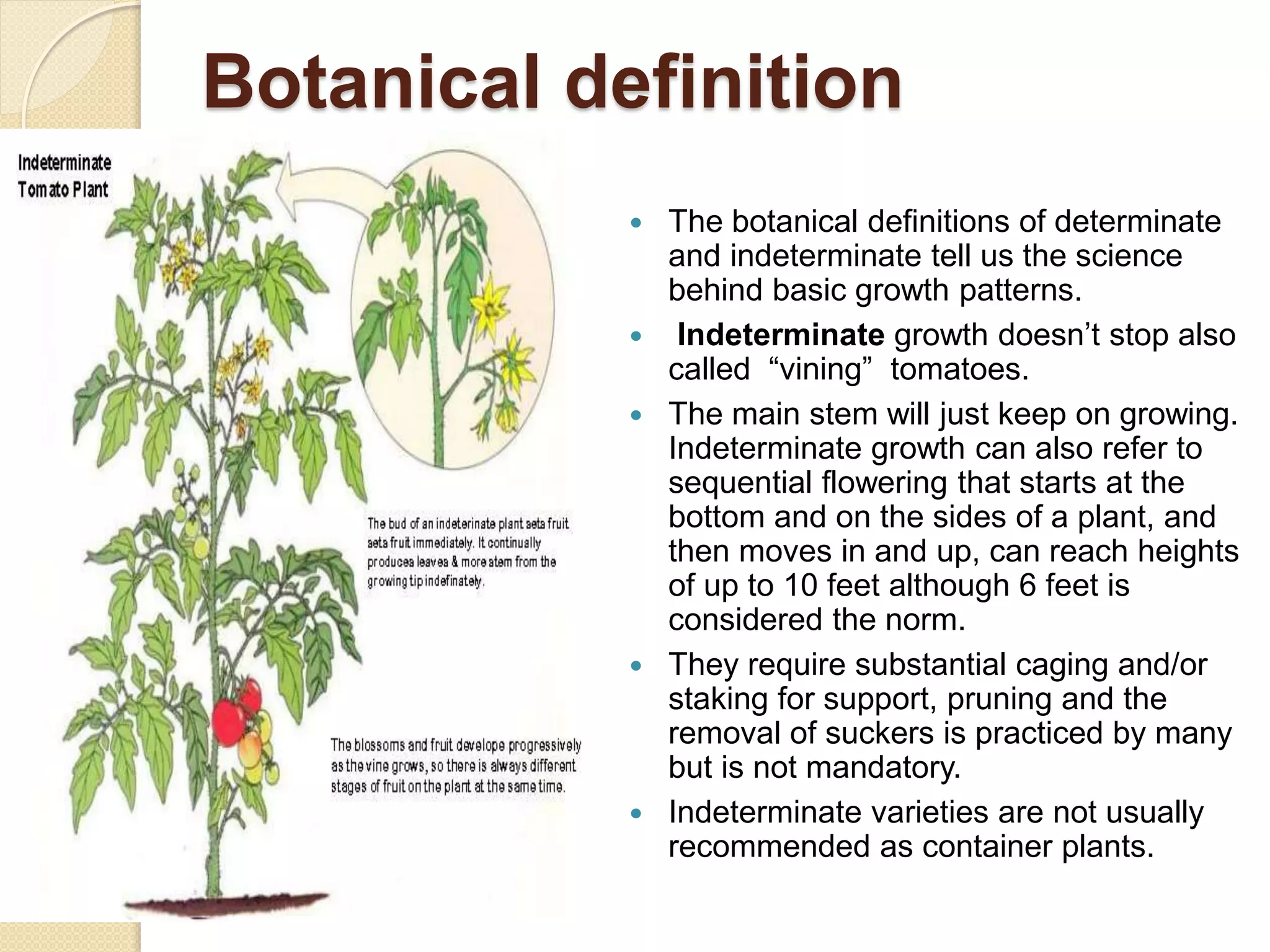
 Indeterminate growth doesn’t stop also
called “vining” tomatoes.
 The main stem will just keep on growing.
Indeterminate growth can also refer to
sequential flowering that starts at the
bottom and on the sides of a plant, and
then moves in and up, can reach heights
of up to 10 feet although 6 feet is
considered the norm.
 They require substantial caging and/or
staking for support, pruning and the
removal of suckers is practiced by many
but is not mandatory.
 Indeterminate varieties are not usually
recommended as container plants.
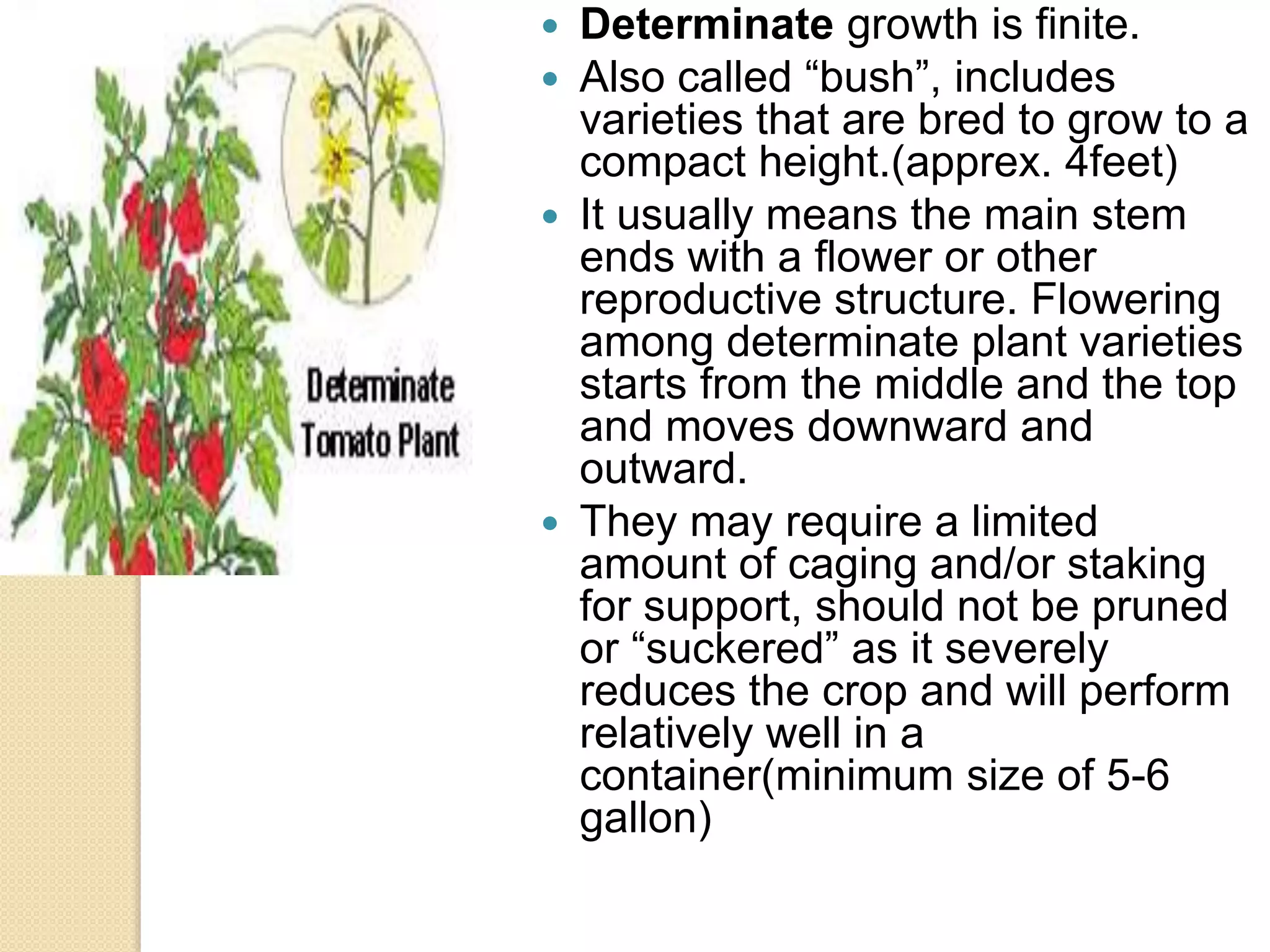
 Determinate growth is finite.
 Also called “bush”, includes
varieties that are bred to grow to a
compact height.(apprex. 4feet)
 It usually means the main stem
ends with a flower or other
reproductive structure. Flowering
among determinate plant varieties
starts from the middle and the top
and moves downward and
outward.
 They may require a limited
amount of caging and/or staking
for support, should not be pruned
or “suckered” as it severely
reduces the crop and will perform
relatively well in a
container(minimum size of 5-6
gallon)
Genetic survival and ripe fruit
 All those fruits and vegetables are a plant’s way of
passing on genetic information. It’s survival of the
species.
 Different plants solve the problem of genetic survival in
different ways. In fact, the range of behaviours and
adaptations goes beyond bizarre in some cases,
basically, in nature, some plants spread their bounty out
over several weeks or even months (indeterminate),
while others seem to ripen everything on the same day
(determinate).
 In some cases, plants can switch from one to the other!
Fruit trees tend to reach harvestable conditions on a
determinate schedule. An overabundance of ripe fruit
may attract more animals which then spread the seeds
over a wider area. Plants that spread their harvest out
over a longer period of time may be improving their
odds at favourable conditions for their offspring.
Human intervention
 Since the Agricultural Revolution, we
have been modifying plants for size,
flavour, disease resistance, and time
of harvest, among other things.
 In commercial agriculture, determinate
plants are preferred because crops
must be harvested by machinery, all at
the same time.
Bushes and vines
 In the garden, tomatoes, potatoes, cucumbers, strawberries,
peas, and beans are just a few of the plants that can be either
determinate or indeterminate.
 Most determinate garden plants are labelled as ‘bush’ variety,
though many of them don’t actually grow into bushes.
 Indeterminate cucumbers, for example, will use tendrils to climb
as far as they want and produce the biggest fruit they can.
Determinate, or ‘bush’ cucumbers, will still spread out, but they
generally stay lower to the ground and will produce a set size
fruit.
 Indeterminate tomatoes will grow as tall as they can and
continue to put out flowers throughout the growing season,
whereas determinate tomatoes tend to focus their energy into
bushier growth and producing their crop of tomatoes pretty much
around the same time. This is helpful if one is making and
canning own tomato sauce, but it can be a problem if prefer all
tomatoes fresh from the garden.
Semi-determinate
 Some crops, such as peas and beans,
can be semi determinate. This means
they tend to stop producing at a set
point but can be continue into a
second or even third round of
production by regularly harvesting
pods as soon as they are produced.
(Carberry,2018)
Pruning and determinism
 Indeterminate plants can be pruned of
unwanted shoots to direct growth and
nutrients where needed them.
 Determinate plants, on the other hand,
perform better if they are not pruned
excessively.
If you are going for
pruning..........
1) Determine which variety you're growing.
Before you make any cuts, figure out
whether you're growing an indeterminate or
determinate variety of tomato plant.
Indeterminate varieties grow like vines, and
they must be trained upright on poles and
pruned in order to grow correctly.
Determinate varieties contain themselves
before they grow into a bush, and they
naturally direct their energy toward fruiting
without needing as much intervention. Here
are the common varieties of each:
Indeterminate: Early girl is most heirloom
type variety, Big boy, beef master most
cherry types.(Pusa Ruby, Pant Bahar ,
Hissar Lalit, and Pusa Divya)
Determinate: Celebrity, Rutgers, Roma,
and Marglobe
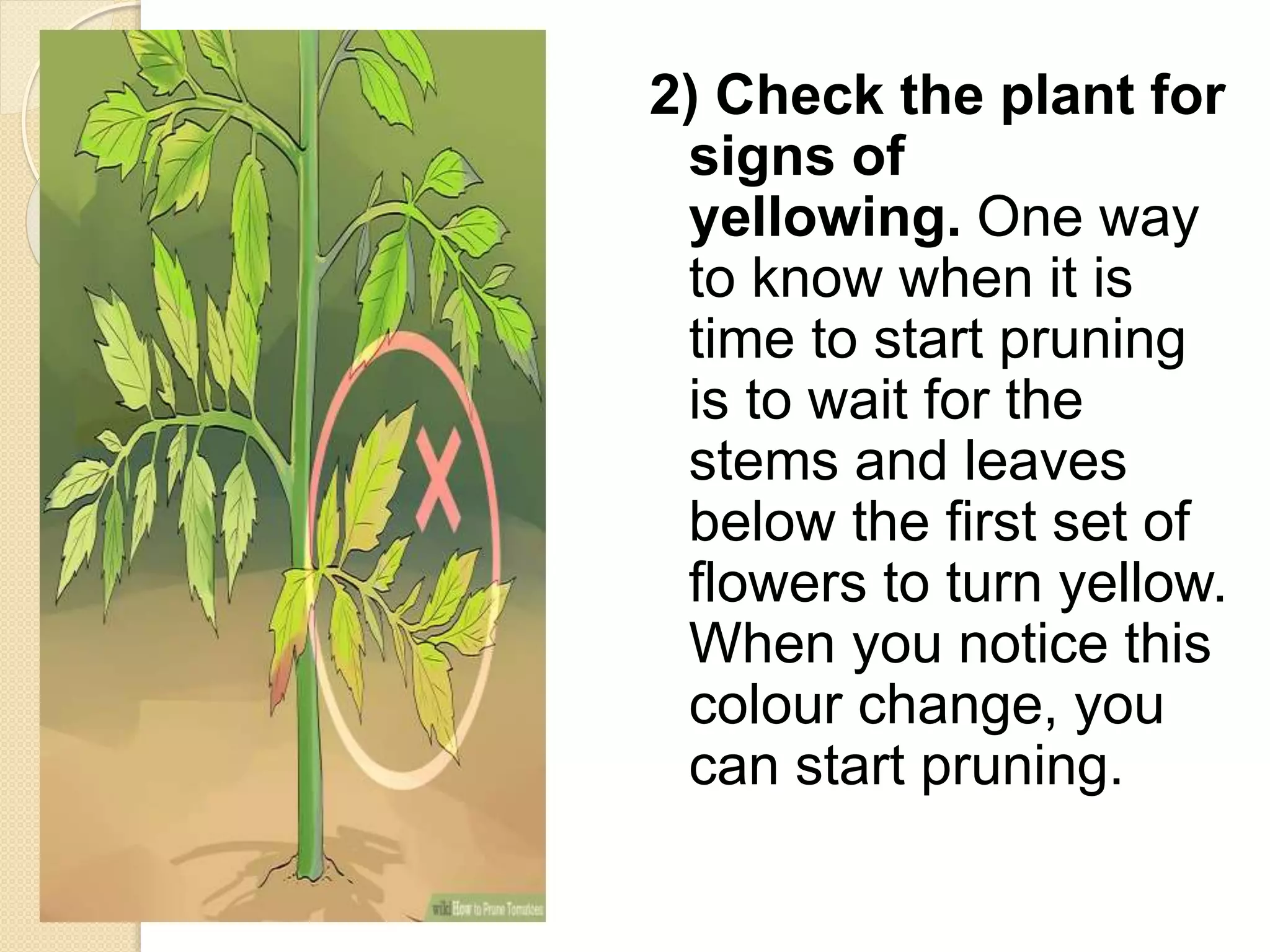
2) Check the plant for
signs of
yellowing. One way
to know when it is
time to start pruning
is to wait for the
stems and leaves
below the first set of
flowers to turn yellow.
When you notice this
colour change, you
can start pruning.
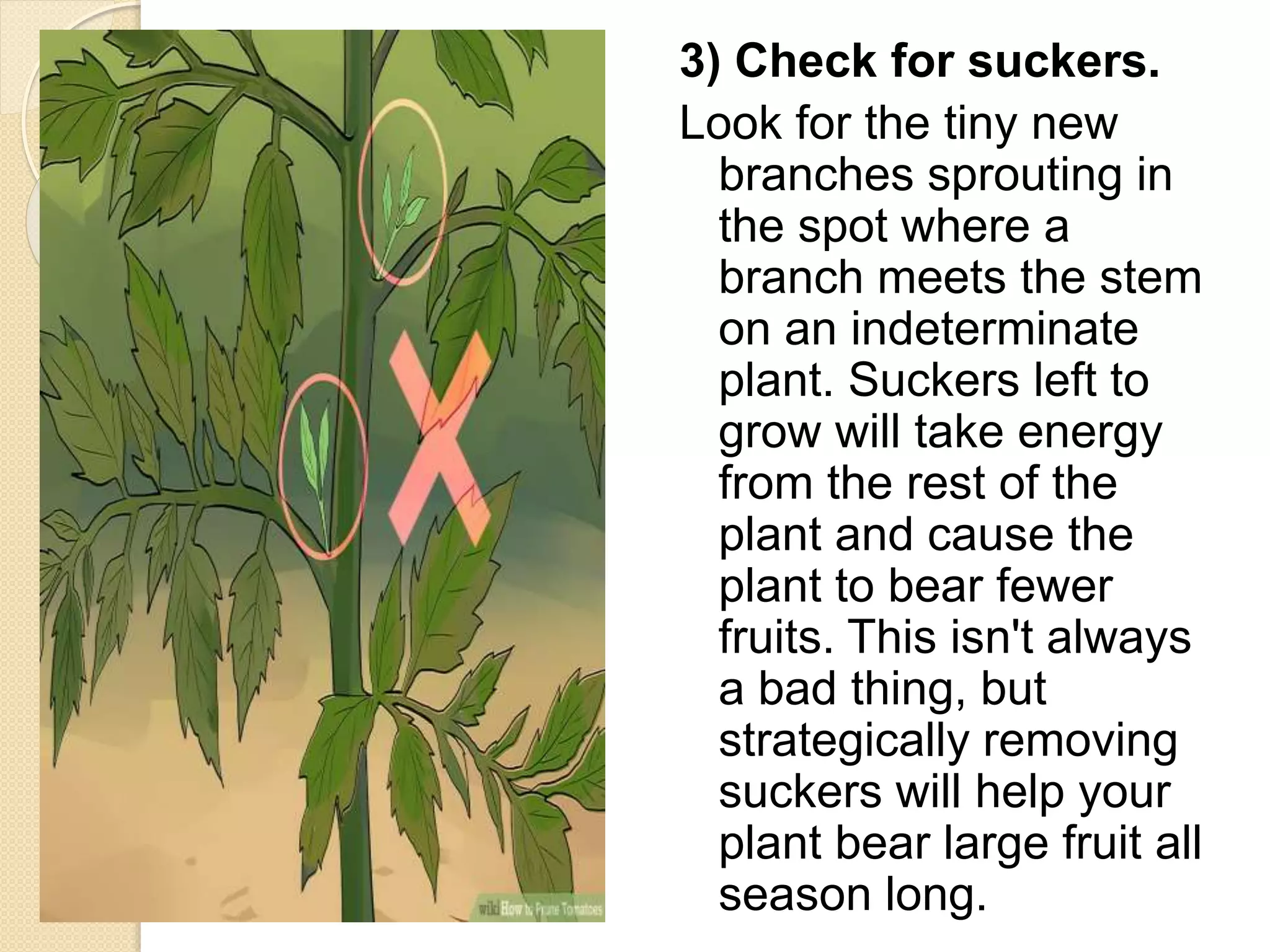
3) Check for suckers.
Look for the tiny new
branches sprouting in
the spot where a
branch meets the stem
on an indeterminate
plant. Suckers left to
grow will take energy
from the rest of the
plant and cause the
plant to bear fewer
fruits. This isn't always
a bad thing, but
strategically removing
suckers will help your
plant bear large fruit all
season long.
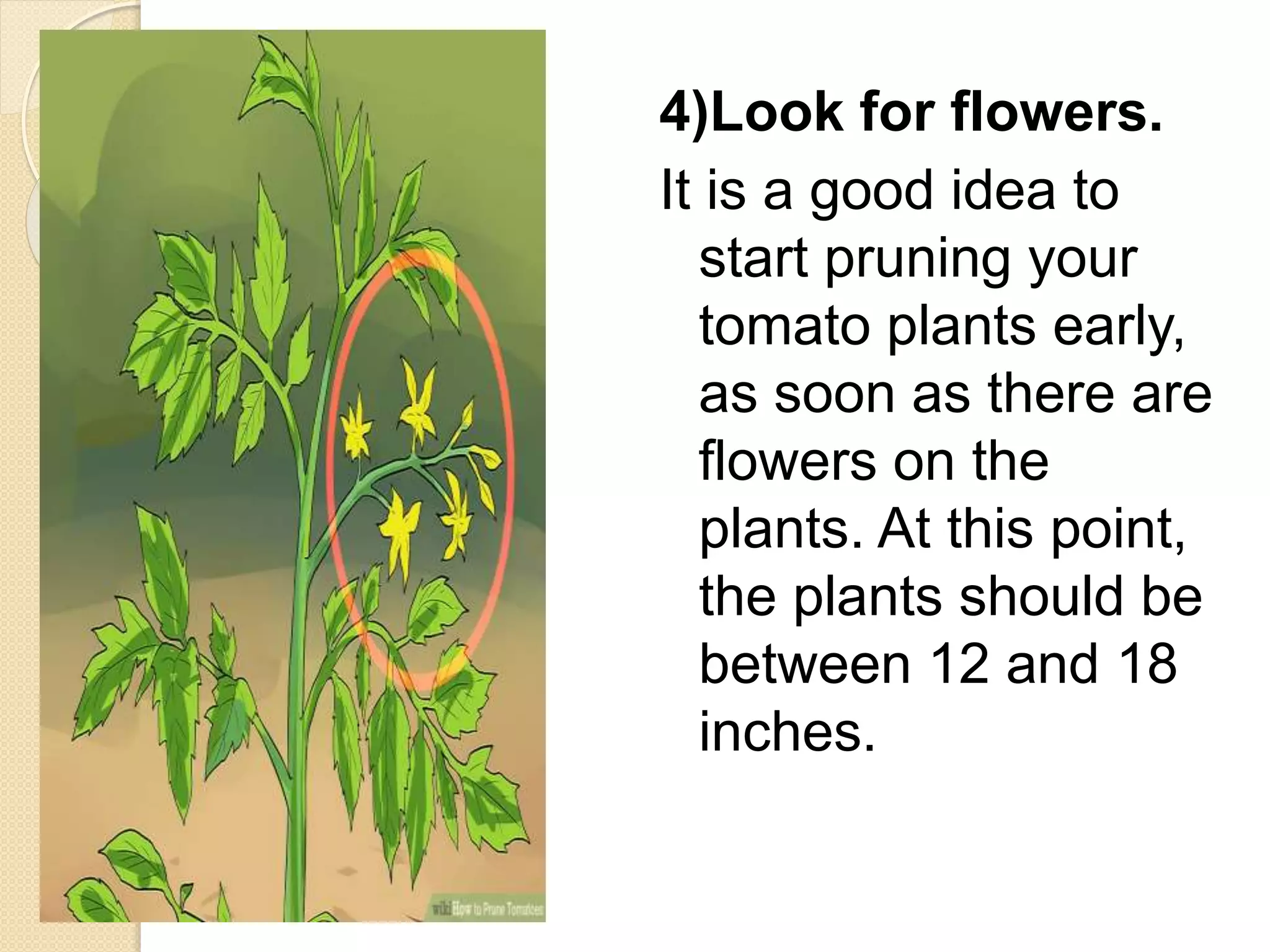
4)Look for flowers.
It is a good idea to
start pruning your
tomato plants early,
as soon as there are
flowers on the
plants. At this point,
the plants should be
between 12 and 18
inches.
Using Proper
Pruning Techniques
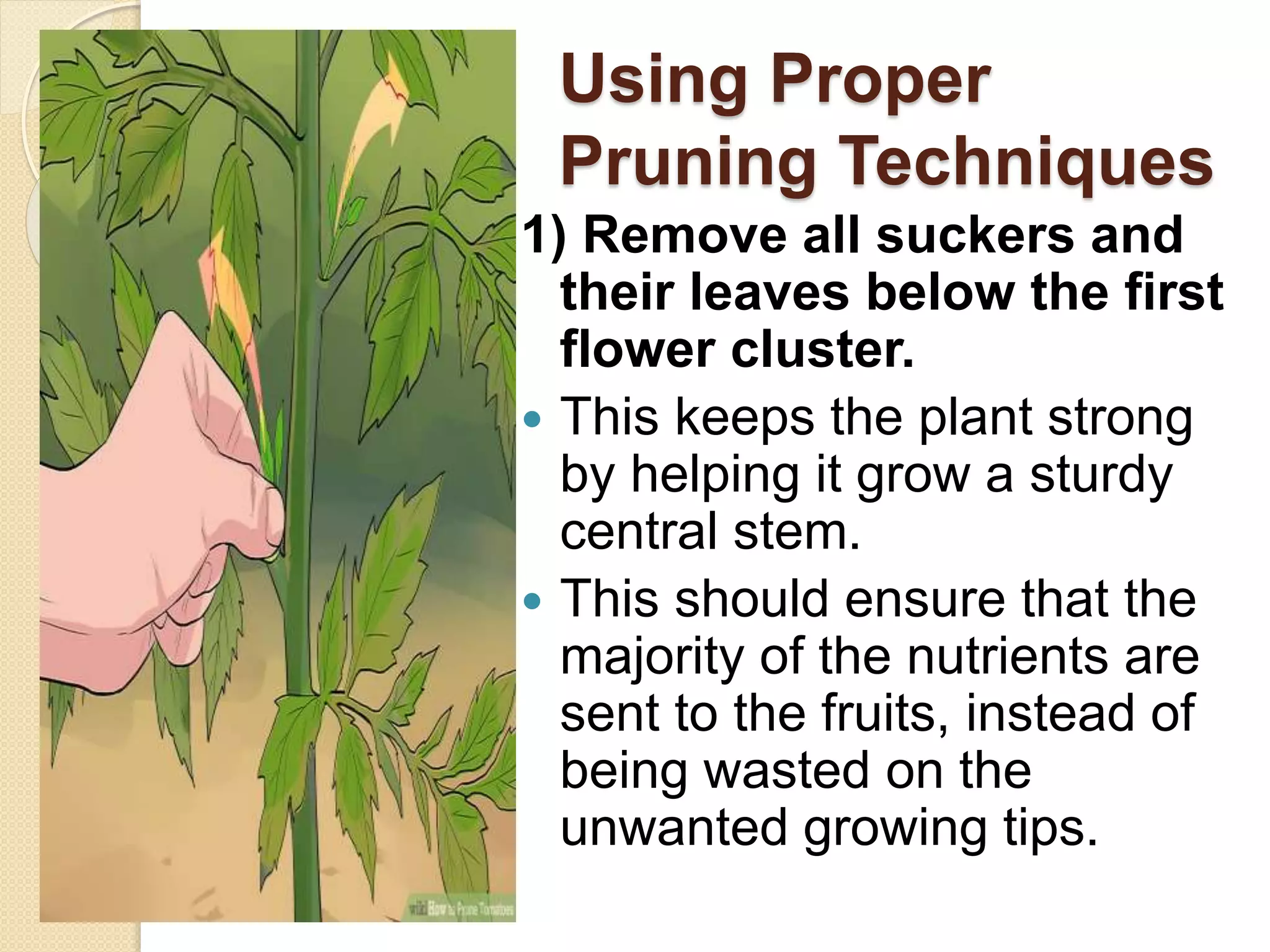
1) Remove all suckers and
their leaves below the first
flower cluster.
 This keeps the plant strong
by helping it grow a sturdy
central stem.
 This should ensure that the
majority of the nutrients are
sent to the fruits, instead of
being wasted on the
unwanted growing tips.
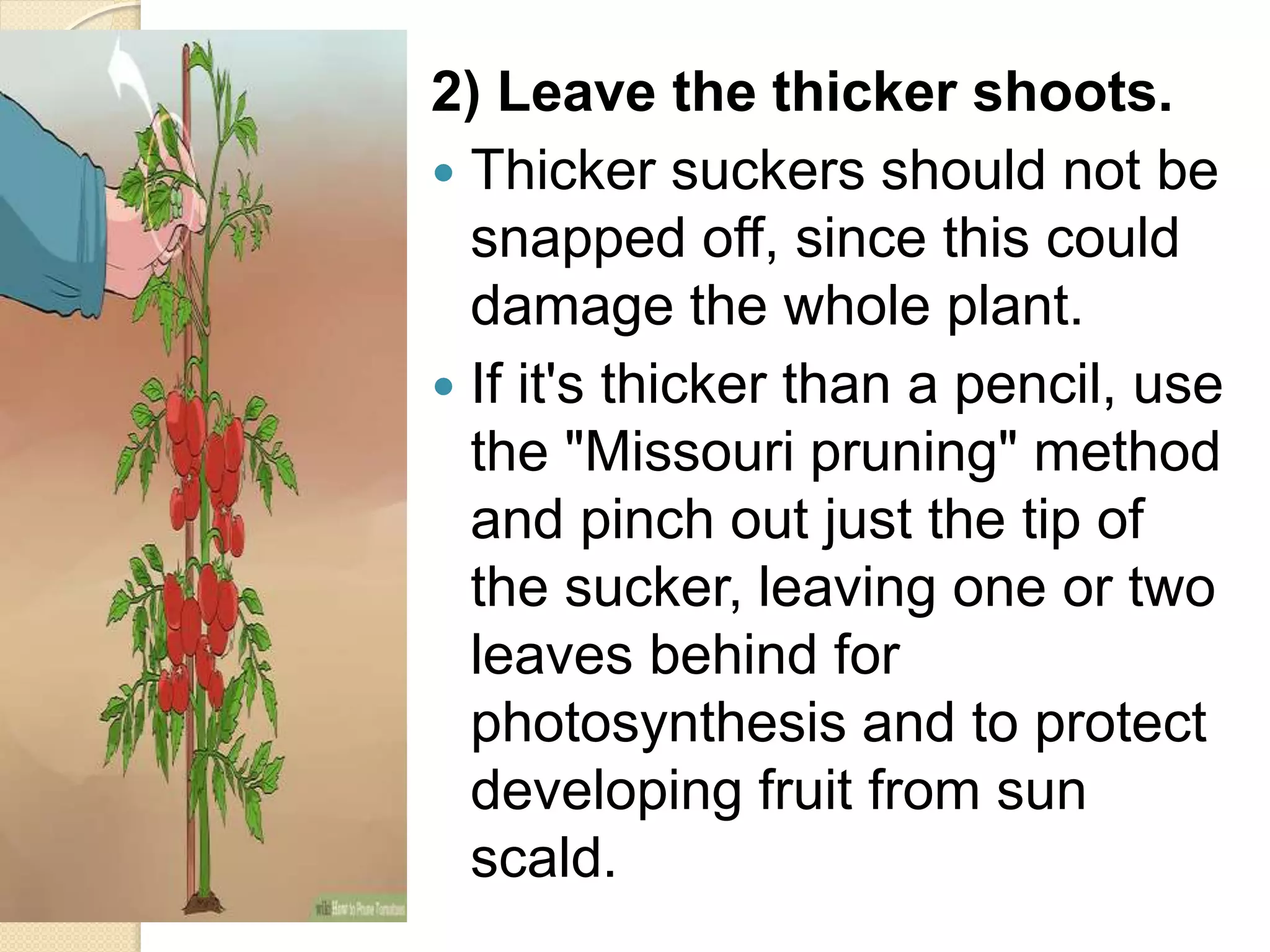
2) Leave the thicker shoots.
 Thicker suckers should not be
snapped off, since this could
damage the whole plant.
 If it's thicker than a pencil, use
the "Missouri pruning" method
and pinch out just the tip of
the sucker, leaving one or two
leaves behind for
photosynthesis and to protect
developing fruit from sun
scald.
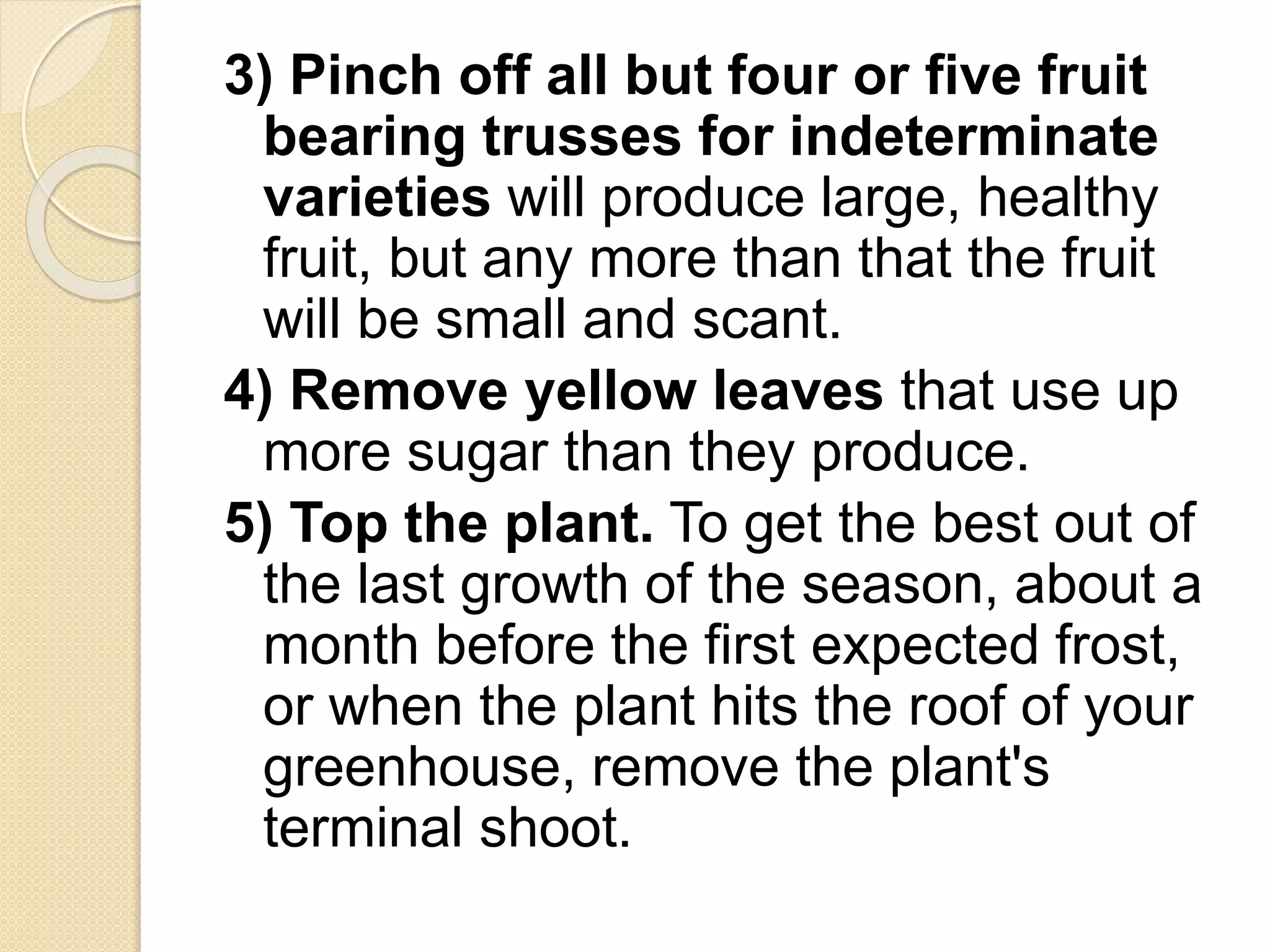
3) Pinch off all but four or five fruit
bearing trusses for indeterminate
varieties will produce large, healthy
fruit, but any more than that the fruit
will be small and scant.
4) Remove yellow leaves that use up
more sugar than they produce.
5) Top the plant. To get the best out of
the last growth of the season, about a
month before the first expected frost,
or when the plant hits the roof of your
greenhouse, remove the plant's
terminal shoot.
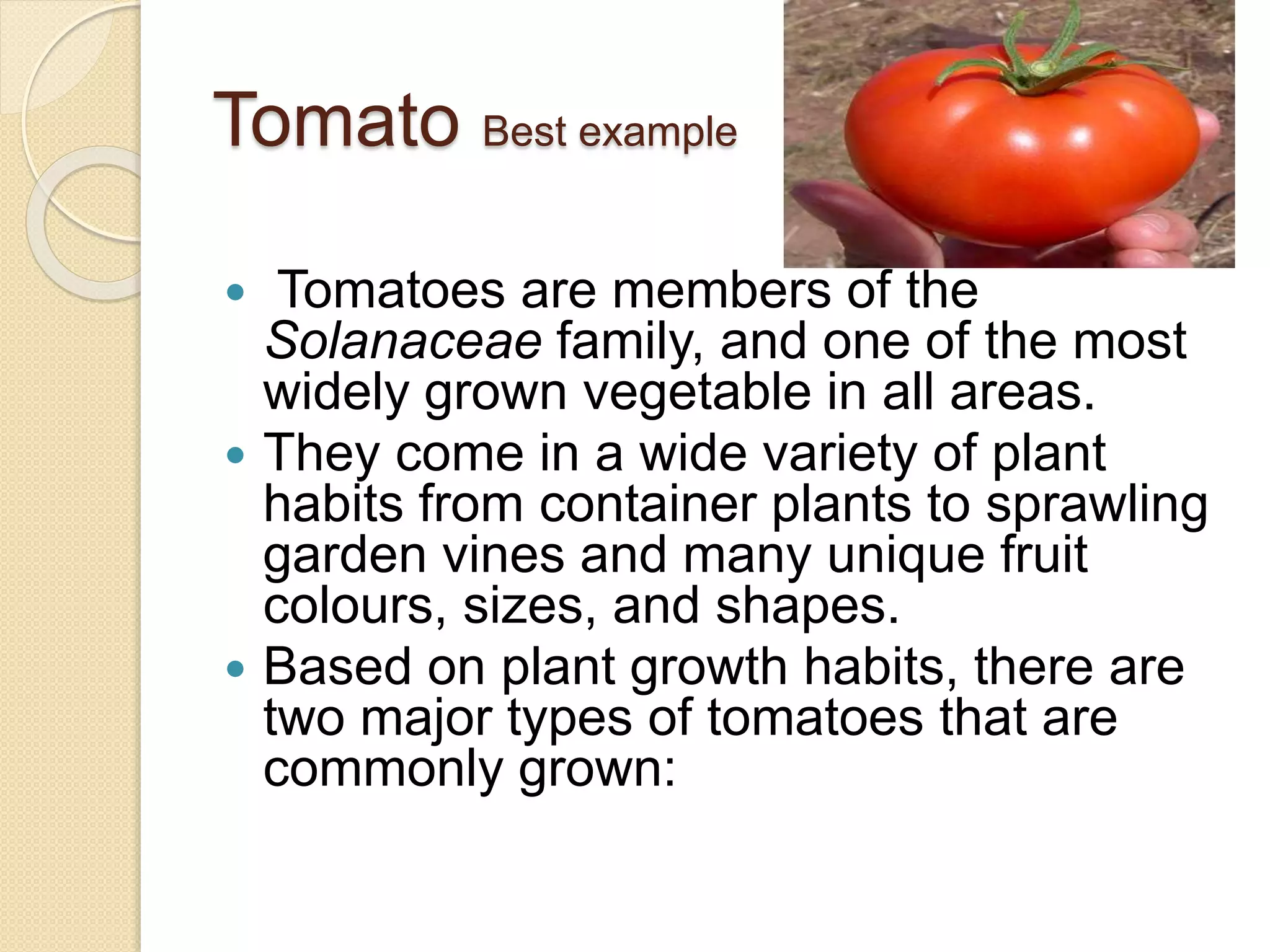
Tomato Best example
 Tomatoes are members of the
Solanaceae family, and one of the most
widely grown vegetable in all areas.
 They come in a wide variety of plant
habits from container plants to sprawling
garden vines and many unique fruit
colours, sizes, and shapes.
 Based on plant growth habits, there are
two major types of tomatoes that are
commonly grown:
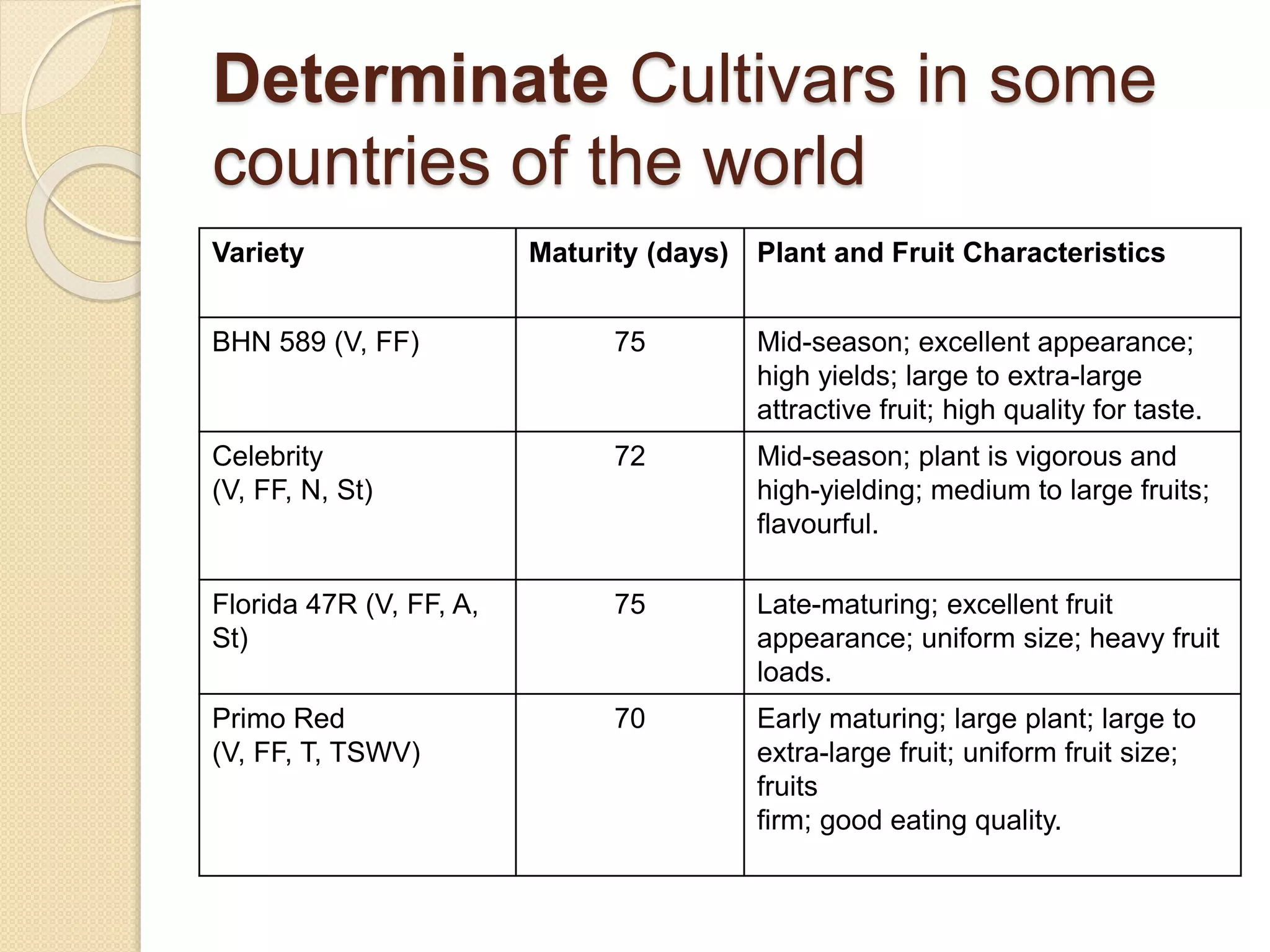
Determinate Cultivars in some
countries of the world
Variety Maturity (days) Plant and Fruit Characteristics
BHN 589 (V, FF) 75 Mid-season; excellent appearance;
high yields; large to extra-large
attractive fruit; high quality for taste.
Celebrity
(V, FF, N, St)
72 Mid-season; plant is vigorous and
high-yielding; medium to large fruits;
flavourful.
Florida 47R (V, FF, A,
St)
75 Late-maturing; excellent fruit
appearance; uniform size; heavy fruit
loads.
Primo Red
(V, FF, T, TSWV)
70 Early maturing; large plant; large to
extra-large fruit; uniform fruit size;
fruits
firm; good eating quality.
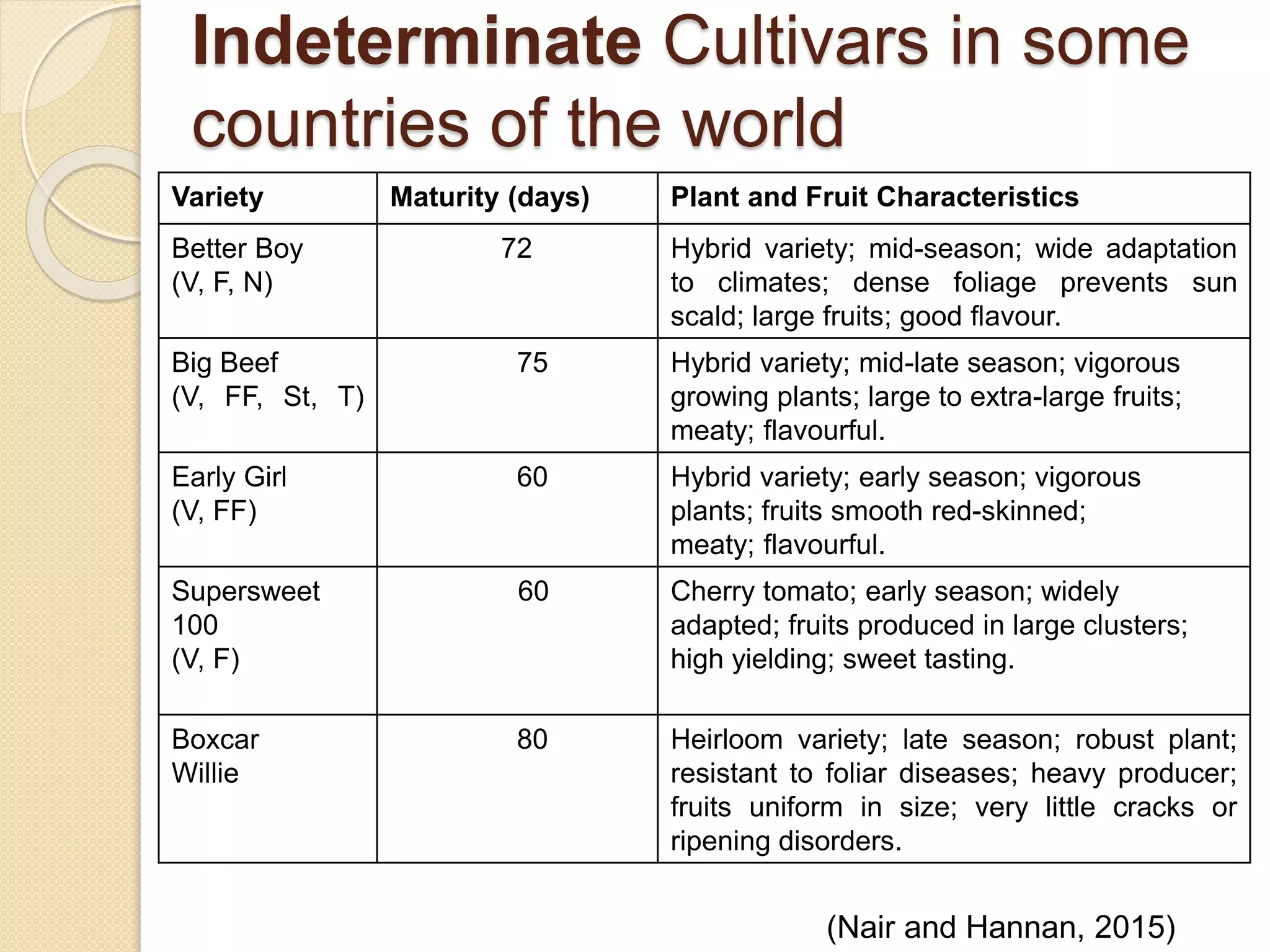
Indeterminate Cultivars in some
countries of the world
Variety Maturity (days) Plant and Fruit Characteristics
Better Boy
(V, F, N)
72 Hybrid variety; mid-season; wide adaptation
to climates; dense foliage prevents sun
scald; large fruits; good flavour.
Big Beef
(V, FF, St, T)
75 Hybrid variety; mid-late season; vigorous
growing plants; large to extra-large fruits;
meaty; flavourful.
Early Girl
(V, FF)
60 Hybrid variety; early season; vigorous
plants; fruits smooth red-skinned;
meaty; flavourful.
Supersweet
100
(V, F)
60 Cherry tomato; early season; widely
adapted; fruits produced in large clusters;
high yielding; sweet tasting.
Boxcar
Willie
80 Heirloom variety; late season; robust plant;
resistant to foliar diseases; heavy producer;
fruits uniform in size; very little cracks or
ripening disorders.
(Nair and Hannan, 2015)
Conclusion
 If you want everything to come ripe around the
same time, plant determinate varieties.
 If you prefer an on going harvest, plant
indeterminate varieties.
 Growers should select varieties based on
adaptability under a wide range of environmental
conditions, earliness, maturity needed to match
the cropping season, market demand, consumer
preference, yield potential, resistance to
diseases, and physiological disorders (e.g.,
cracking, blossom-end rot, etc.).
 There are a number of tomato varieties available
in the market, of which some have been popular
among growers for many years while others get
replaced by newer varieties after only a few
seasons.
References
 https://www.wikihow.com/Prune-
Tomatoes
 Book- Crop physiology –S. N. Pandey
& B. K. Sinha
Thank
you

Determinate &; indeterminate habit

  • 1.
    Advances in Vegetable Production Courseno: VSC-601 Credit: 2+1=3 Course Teacher Dr. C. D. Pawar Department of Horticulture College of Agriculture, Dapoli Presented by : Miss Pravina Barde
  • 2.
    Study of Indeterminate& Determinate growing habit
  • 3.
    Botanical definition  Thebotanical definitions of determinate and indeterminate tell us the science behind basic growth patterns.  Indeterminate growth doesn’t stop also called “vining” tomatoes.  The main stem will just keep on growing. Indeterminate growth can also refer to sequential flowering that starts at the bottom and on the sides of a plant, and then moves in and up, can reach heights of up to 10 feet although 6 feet is considered the norm.  They require substantial caging and/or staking for support, pruning and the removal of suckers is practiced by many but is not mandatory.  Indeterminate varieties are not usually recommended as container plants.
  • 4.
     Determinate growthis finite.  Also called “bush”, includes varieties that are bred to grow to a compact height.(apprex. 4feet)  It usually means the main stem ends with a flower or other reproductive structure. Flowering among determinate plant varieties starts from the middle and the top and moves downward and outward.  They may require a limited amount of caging and/or staking for support, should not be pruned or “suckered” as it severely reduces the crop and will perform relatively well in a container(minimum size of 5-6 gallon)
  • 5.
    Genetic survival andripe fruit  All those fruits and vegetables are a plant’s way of passing on genetic information. It’s survival of the species.  Different plants solve the problem of genetic survival in different ways. In fact, the range of behaviours and adaptations goes beyond bizarre in some cases, basically, in nature, some plants spread their bounty out over several weeks or even months (indeterminate), while others seem to ripen everything on the same day (determinate).  In some cases, plants can switch from one to the other! Fruit trees tend to reach harvestable conditions on a determinate schedule. An overabundance of ripe fruit may attract more animals which then spread the seeds over a wider area. Plants that spread their harvest out over a longer period of time may be improving their odds at favourable conditions for their offspring.
  • 6.
    Human intervention  Sincethe Agricultural Revolution, we have been modifying plants for size, flavour, disease resistance, and time of harvest, among other things.  In commercial agriculture, determinate plants are preferred because crops must be harvested by machinery, all at the same time.
  • 7.
    Bushes and vines In the garden, tomatoes, potatoes, cucumbers, strawberries, peas, and beans are just a few of the plants that can be either determinate or indeterminate.  Most determinate garden plants are labelled as ‘bush’ variety, though many of them don’t actually grow into bushes.  Indeterminate cucumbers, for example, will use tendrils to climb as far as they want and produce the biggest fruit they can. Determinate, or ‘bush’ cucumbers, will still spread out, but they generally stay lower to the ground and will produce a set size fruit.  Indeterminate tomatoes will grow as tall as they can and continue to put out flowers throughout the growing season, whereas determinate tomatoes tend to focus their energy into bushier growth and producing their crop of tomatoes pretty much around the same time. This is helpful if one is making and canning own tomato sauce, but it can be a problem if prefer all tomatoes fresh from the garden.
  • 8.
    Semi-determinate  Some crops,such as peas and beans, can be semi determinate. This means they tend to stop producing at a set point but can be continue into a second or even third round of production by regularly harvesting pods as soon as they are produced. (Carberry,2018)
  • 9.
    Pruning and determinism Indeterminate plants can be pruned of unwanted shoots to direct growth and nutrients where needed them.  Determinate plants, on the other hand, perform better if they are not pruned excessively.
  • 10.
    If you aregoing for pruning..........
  • 11.
    1) Determine whichvariety you're growing. Before you make any cuts, figure out whether you're growing an indeterminate or determinate variety of tomato plant. Indeterminate varieties grow like vines, and they must be trained upright on poles and pruned in order to grow correctly. Determinate varieties contain themselves before they grow into a bush, and they naturally direct their energy toward fruiting without needing as much intervention. Here are the common varieties of each: Indeterminate: Early girl is most heirloom type variety, Big boy, beef master most cherry types.(Pusa Ruby, Pant Bahar , Hissar Lalit, and Pusa Divya) Determinate: Celebrity, Rutgers, Roma, and Marglobe
  • 12.
    2) Check theplant for signs of yellowing. One way to know when it is time to start pruning is to wait for the stems and leaves below the first set of flowers to turn yellow. When you notice this colour change, you can start pruning.
  • 13.
    3) Check forsuckers. Look for the tiny new branches sprouting in the spot where a branch meets the stem on an indeterminate plant. Suckers left to grow will take energy from the rest of the plant and cause the plant to bear fewer fruits. This isn't always a bad thing, but strategically removing suckers will help your plant bear large fruit all season long.
  • 14.
    4)Look for flowers. Itis a good idea to start pruning your tomato plants early, as soon as there are flowers on the plants. At this point, the plants should be between 12 and 18 inches.
  • 15.
    Using Proper Pruning Techniques 1)Remove all suckers and their leaves below the first flower cluster.  This keeps the plant strong by helping it grow a sturdy central stem.  This should ensure that the majority of the nutrients are sent to the fruits, instead of being wasted on the unwanted growing tips.
  • 16.
    2) Leave thethicker shoots.  Thicker suckers should not be snapped off, since this could damage the whole plant.  If it's thicker than a pencil, use the "Missouri pruning" method and pinch out just the tip of the sucker, leaving one or two leaves behind for photosynthesis and to protect developing fruit from sun scald.
  • 17.
    3) Pinch offall but four or five fruit bearing trusses for indeterminate varieties will produce large, healthy fruit, but any more than that the fruit will be small and scant. 4) Remove yellow leaves that use up more sugar than they produce. 5) Top the plant. To get the best out of the last growth of the season, about a month before the first expected frost, or when the plant hits the roof of your greenhouse, remove the plant's terminal shoot.
  • 18.
    Tomato Best example Tomatoes are members of the Solanaceae family, and one of the most widely grown vegetable in all areas.  They come in a wide variety of plant habits from container plants to sprawling garden vines and many unique fruit colours, sizes, and shapes.  Based on plant growth habits, there are two major types of tomatoes that are commonly grown:
  • 19.
    Determinate Cultivars insome countries of the world Variety Maturity (days) Plant and Fruit Characteristics BHN 589 (V, FF) 75 Mid-season; excellent appearance; high yields; large to extra-large attractive fruit; high quality for taste. Celebrity (V, FF, N, St) 72 Mid-season; plant is vigorous and high-yielding; medium to large fruits; flavourful. Florida 47R (V, FF, A, St) 75 Late-maturing; excellent fruit appearance; uniform size; heavy fruit loads. Primo Red (V, FF, T, TSWV) 70 Early maturing; large plant; large to extra-large fruit; uniform fruit size; fruits firm; good eating quality.
  • 20.
    Indeterminate Cultivars insome countries of the world Variety Maturity (days) Plant and Fruit Characteristics Better Boy (V, F, N) 72 Hybrid variety; mid-season; wide adaptation to climates; dense foliage prevents sun scald; large fruits; good flavour. Big Beef (V, FF, St, T) 75 Hybrid variety; mid-late season; vigorous growing plants; large to extra-large fruits; meaty; flavourful. Early Girl (V, FF) 60 Hybrid variety; early season; vigorous plants; fruits smooth red-skinned; meaty; flavourful. Supersweet 100 (V, F) 60 Cherry tomato; early season; widely adapted; fruits produced in large clusters; high yielding; sweet tasting. Boxcar Willie 80 Heirloom variety; late season; robust plant; resistant to foliar diseases; heavy producer; fruits uniform in size; very little cracks or ripening disorders. (Nair and Hannan, 2015)
  • 21.
    Conclusion  If youwant everything to come ripe around the same time, plant determinate varieties.  If you prefer an on going harvest, plant indeterminate varieties.  Growers should select varieties based on adaptability under a wide range of environmental conditions, earliness, maturity needed to match the cropping season, market demand, consumer preference, yield potential, resistance to diseases, and physiological disorders (e.g., cracking, blossom-end rot, etc.).  There are a number of tomato varieties available in the market, of which some have been popular among growers for many years while others get replaced by newer varieties after only a few seasons.
  • 22.
    References  https://www.wikihow.com/Prune- Tomatoes  Book-Crop physiology –S. N. Pandey & B. K. Sinha
  • 23.