Dietetics
Reflective
 practice
   Orna O’Brien
   March 2012
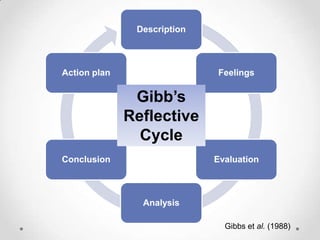
Description


Action plan                  Feelings

               Gibb’s
              Reflective
                Cycle
Conclusion                   Evaluation


                Analysis

                               Gibbs et al. (1988)
Framework
     for
 reflective
  practice


              Rolfe et al. (2001)
Description (summary of patient case)
PC:           36yo , referred to Community dietetics dept. by GP, for weight loss
              advice
Dx:           Wt: 138kg (rising)     Ht: 1.76m     Obesity III (BMI 44kg/m2)
PMHx:         Sleep apnoea x 1y (untreated)
              Dyslipidaemia (total cholesterol↑, LDL↑., HDL↓, Trigs↑)
              SOBOE, attended PLAN in past, ? mild learning difficulty
Social Hx:    Lives alone, unemployed non-smoker, non-drinker, poor mobility 2 to
              weight
Nutritional   Why did pt. feel he was here; previous wt loss attempts; acceptability
Ax:           of weight/being weighed. Little confidence in weight loss ability.
              Explained benefits of 5-10% wt loss.
              Diet Ax: Poor meal pattern, portion size+++, treats+, good F&V, PA 3/7
              (cycling/walking 45mins), night eating.
Goals set:       Breakfast (porridge measurements, toppings, fruit, water)
                 Biscuits (buy ½ packet, have after evening snack)
                 Plate model
                 Sleep clinic discussion
                 (potato portions)
Feelings
               On
Initially
            Reflection
Evaluation
Positive

• Sensitive, non-judgemental attitude and
  approach1
• Expanded knowledge
• Insight into human behaviour

Negative

•Bad judgement – put my own assumptions
ahead of the patient’s capabilities
•Readiness to change
                                    1   DOM, UK (2008, 2011)
Analysis
                 Significant
                  learning
           Flexible       Practical
                 experience


                              Input
      Research1,2,3            from
                              others


  What
                     Did my           What did I
  was I
                     advice           base my
trying to
                     help?           actions on?
achieve?

     1   Dept. of Health, UK (2006); 2 INDI (2007); 3 DOM, UK (2008)
Conclusion
How does this learning experience
integrate into my dietetic practice?


 • Lessened the gap between theory I learned in
   college and practice I learned in placement

 • Improved quality of care for patients through
   patient-tailored assessment and goals
Action plan
• Assess readiness to change:                    • Understanding patients
                                                   thoughts on referral
   o Is your weight affecting your life in any
                                                 • Expectations of treatment
     way at the moment? (UK DH, 2006)            • Motivation to change
                                                   lifestyle
                                                 • Weight history
• Referral to relevant health services           • Dieting history
                                                 • Patient understanding of
                                                   obesity
• If patient not ready to change:                • Potential barriers to
   o Reassure that I am available to talk          change
     about it when he/she is ready               • Eating patterns
   o Briefly advise on the risk of overweight    • Current lifestyle: dietary
                                                   intake and physical
     & benefits of weight loss
                                                   activity
   o Offer an appointment in, e.g. 6             • Support networks
     months.
References
UK Department of Health (2006) Care pathway for the management of
overweight and obesity. London: DH.

Weigh Management Interest Group, INDI (2007) Position of the Irish
Nutrition and Dietetics Institute: weigh management. Available at:
http://www.indi.ie/docs/979_94_wmig.pdf [accessed March 16th 2012]

Grace C, Pearson D et al. (2008) DOM, UK: The Dietetic Weight
Management Intervention for Adults in the One to One Setting: is it time
for a radical rethink? Available at: www.domuk.org/docs/dietetic-
interventionfinalversion301007.doc [accessed March 18th, 2012]

Grace, C. (2011), A review of one-to-one dietetic obesity management
in adults. Journal of Human Nutrition and Dietetics, 24: 13–22.
doi: 10.1111/j.1365-277X.2010.01137.x
References
Rolfe et al. (2001) Framework for reflective practice, as cited by Students
Learning with Communities: information for students: resources. Available
at: http://www.communitylinks.ie/students-learning-with-
communities/information-for-students/resources/
[accessed March 23rd, 2012]

Gibbs et al. (1988) Gibb’s Reflective Cycle, as cited by Students Learning
with Communities: information for students: resources. Available at:
http://www.communitylinks.ie/students-learning-with-
communities/information-for-students/resources/
[accessed March 23rd, 2012]
Thank you!

Any questions?

Reflective Practice Presentation

  • 1.
    Dietetics Reflective practice Orna O’Brien March 2012
  • 2.
    Description Action plan Feelings Gibb’s Reflective Cycle Conclusion Evaluation Analysis Gibbs et al. (1988)
  • 3.
    Framework for reflective practice Rolfe et al. (2001)
  • 4.
    Description (summary ofpatient case) PC: 36yo , referred to Community dietetics dept. by GP, for weight loss advice Dx: Wt: 138kg (rising) Ht: 1.76m Obesity III (BMI 44kg/m2) PMHx: Sleep apnoea x 1y (untreated) Dyslipidaemia (total cholesterol↑, LDL↑., HDL↓, Trigs↑) SOBOE, attended PLAN in past, ? mild learning difficulty Social Hx: Lives alone, unemployed non-smoker, non-drinker, poor mobility 2 to weight Nutritional Why did pt. feel he was here; previous wt loss attempts; acceptability Ax: of weight/being weighed. Little confidence in weight loss ability. Explained benefits of 5-10% wt loss. Diet Ax: Poor meal pattern, portion size+++, treats+, good F&V, PA 3/7 (cycling/walking 45mins), night eating. Goals set: Breakfast (porridge measurements, toppings, fruit, water) Biscuits (buy ½ packet, have after evening snack) Plate model Sleep clinic discussion (potato portions)
  • 5.
    Feelings On Initially Reflection
  • 6.
    Evaluation Positive • Sensitive, non-judgementalattitude and approach1 • Expanded knowledge • Insight into human behaviour Negative •Bad judgement – put my own assumptions ahead of the patient’s capabilities •Readiness to change 1 DOM, UK (2008, 2011)
  • 7.
    Analysis Significant learning Flexible Practical experience Input Research1,2,3 from others What Did my What did I was I advice base my trying to help? actions on? achieve? 1 Dept. of Health, UK (2006); 2 INDI (2007); 3 DOM, UK (2008)
  • 8.
    Conclusion How does thislearning experience integrate into my dietetic practice? • Lessened the gap between theory I learned in college and practice I learned in placement • Improved quality of care for patients through patient-tailored assessment and goals
  • 9.
    Action plan • Assessreadiness to change: • Understanding patients thoughts on referral o Is your weight affecting your life in any • Expectations of treatment way at the moment? (UK DH, 2006) • Motivation to change lifestyle • Weight history • Referral to relevant health services • Dieting history • Patient understanding of obesity • If patient not ready to change: • Potential barriers to o Reassure that I am available to talk change about it when he/she is ready • Eating patterns o Briefly advise on the risk of overweight • Current lifestyle: dietary intake and physical & benefits of weight loss activity o Offer an appointment in, e.g. 6 • Support networks months.
  • 10.
    References UK Department ofHealth (2006) Care pathway for the management of overweight and obesity. London: DH. Weigh Management Interest Group, INDI (2007) Position of the Irish Nutrition and Dietetics Institute: weigh management. Available at: http://www.indi.ie/docs/979_94_wmig.pdf [accessed March 16th 2012] Grace C, Pearson D et al. (2008) DOM, UK: The Dietetic Weight Management Intervention for Adults in the One to One Setting: is it time for a radical rethink? Available at: www.domuk.org/docs/dietetic- interventionfinalversion301007.doc [accessed March 18th, 2012] Grace, C. (2011), A review of one-to-one dietetic obesity management in adults. Journal of Human Nutrition and Dietetics, 24: 13–22. doi: 10.1111/j.1365-277X.2010.01137.x
  • 11.
    References Rolfe et al.(2001) Framework for reflective practice, as cited by Students Learning with Communities: information for students: resources. Available at: http://www.communitylinks.ie/students-learning-with- communities/information-for-students/resources/ [accessed March 23rd, 2012] Gibbs et al. (1988) Gibb’s Reflective Cycle, as cited by Students Learning with Communities: information for students: resources. Available at: http://www.communitylinks.ie/students-learning-with- communities/information-for-students/resources/ [accessed March 23rd, 2012]
  • 12.

Editor's Notes

  • #4 Rolfe et al 2001:Descriptive reflectionReflection on theoryAction-based reflection
  • #5 Supervised by senior community dietitianA 36yo gentleman presented to the community dietetics dept. for weight loss adviceAs you can see, he was class 3 obese, and had many co-morbidities as a result of his weightPoor social supportTrouble losing weight in the past – little confidence, but important to himNutritional Ax: tried to draw out where the patient was mentally at – I found this useful in prior experiences. Happy to accept wt loss advice @ this time as was unhappy/frustrated with weight and was impacting on lifestyle.Made 3 very small goalsSupervising dietitian signalled to me to wrap up
  • #6 Initial:Confident in weight reduction adviceRelief that there were clear areas for improvement in diet historySatisfaction that I had linked eating patterns (binge eating and night eating)Frustration @ supervising dietitian because I felt I was doing well.On reflection:Disappointment about areas I focused on.In hindsight, I should have spent more time assessing his past failures, and his readiness to change.Realisation – of significant learning experience – will talk about later.
  • #7 Insight into human behaviour (confidence, motivation)I should have focused more on assessing his readiness to change, motivators, perceived barriers and support.More time would have been needed to successfully complete a behavioural lifestyle assessment: 45-60minutes (DOM, UK 2008)Cognitive behavioural approach – self monitoring, stimulus control, goal setting, problem solving, cognitive restructuring, social support (DOM, UK 2008)
  • #10 Assessment of barriers to change:Sleep apnoea, poor social support, lack of confidenceHow I should have addressed these:Referral to Sleep Clinic, explore more social support options, ? Psychological input re overeating.Psych referral: “some of my patients find it helpful to talk to the...”