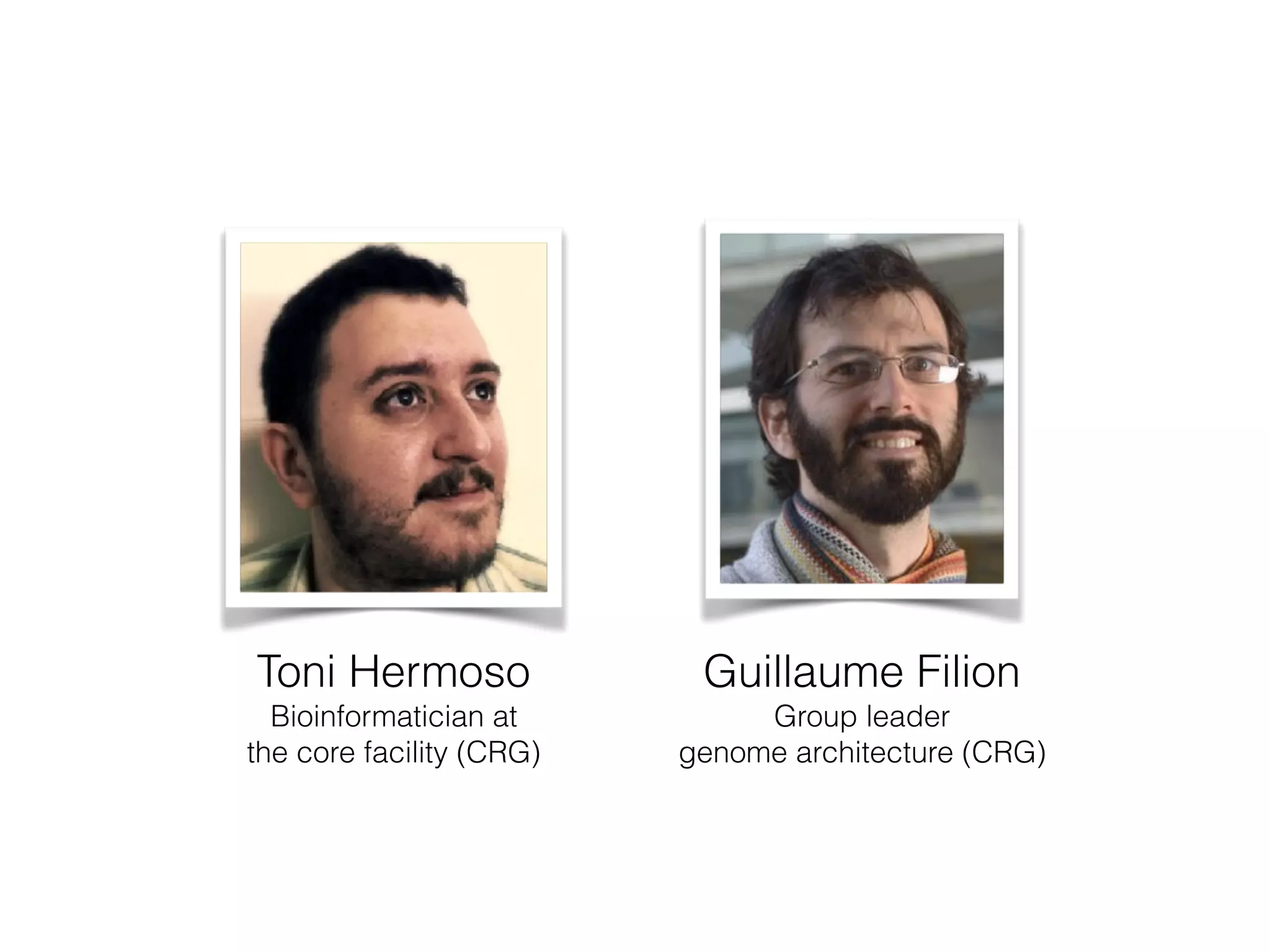
Guillaume Filion
Group leader
genome architecture (CRG)
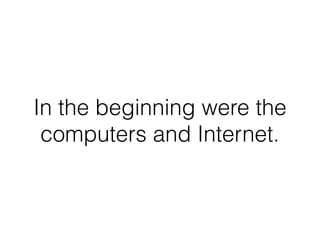
Toni Hermoso
Bioinformatician at
the core facility (CRG)
In the beginning were the
computers and Internet.
Open access in research
Open means
Transparent
Open means
Accessible
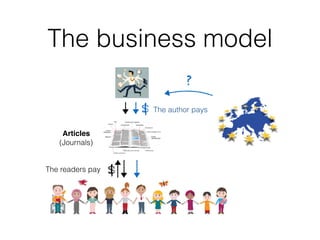
The business model
$
$
Articles
(Journals)
The readers pay
The author pays
?
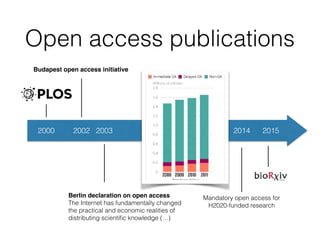
Open access publications
Berlin declaration on open access
The Internet has fundamentally changed
the practical and economic realities of
distributing scientific knowledge (…)
2000 2003 20152014
Mandatory open access for
H2020-funded research
2002
Budapest open access initiative
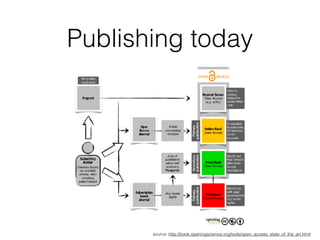
Publishing today
source: http://book.openingscience.org/tools/open_access_state_of_the_art.html
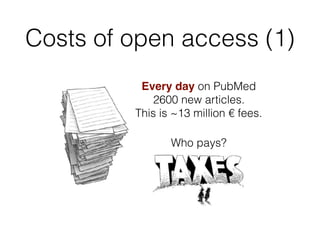
Costs of open access (1)
Every day on PubMed
2600 new articles.
This is ~13 million € fees.
Who pays?
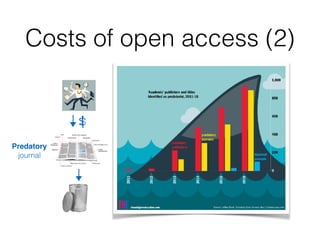
Costs of open access (2)
$
Predatory
journal
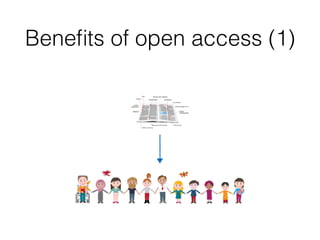
Benefits of open access (1)
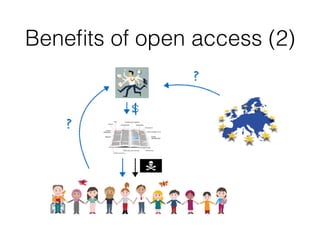
Benefits of open access (2)
?
$
?
Why publish open
access?
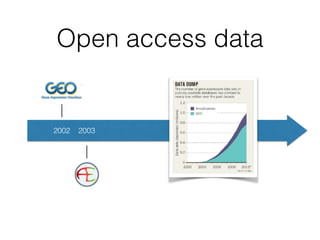
Open access data
2002 2003
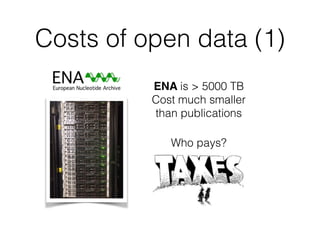
Costs of open data (1)
ENA is > 5000 TB
Cost much smaller
than publications
Who pays?
Costs of open data (2)
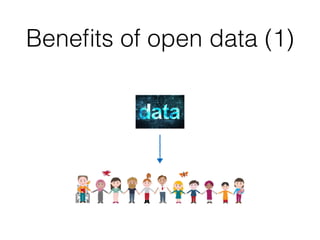
Benefits of open data (1)
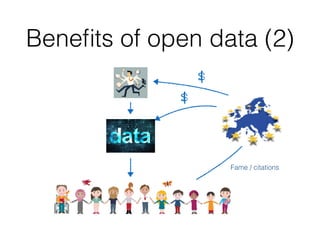
Benefits of open data (2)
$
$
Fame / citations
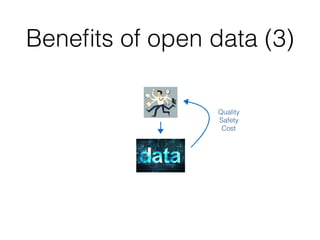
Benefits of open data (3)
Quality
Safety
Cost
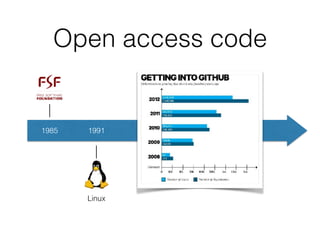
Open access code
1985 1991
Linux
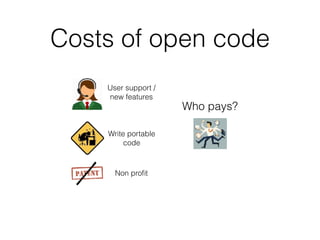
Costs of open code
Who pays?
User support /
new features
Write portable
code
Non profit
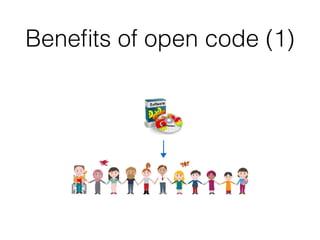
Benefits of open code (1)
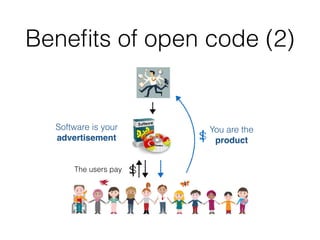
Benefits of open code (2)
$
$
You are the
product
Software is your
advertisement
The users pay
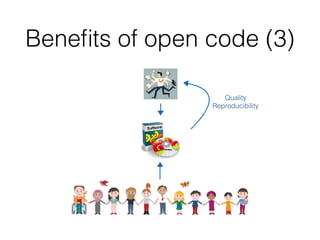
Benefits of open code (3)
Quality
Reproducibility
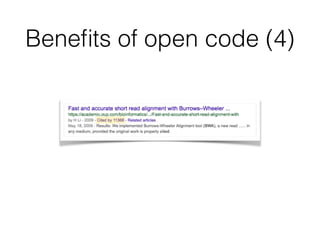
Benefits of open code (4)
Open access software and data
can boost your research.
But how to do it right?
Open Science.
Good practices in
Bioinformatics
Toni Hermoso Pulido (@ )
Bioinformatics Core Facility
Centre for Genomic Regulation (BCN)
toniher
https://biocore.crg.eu
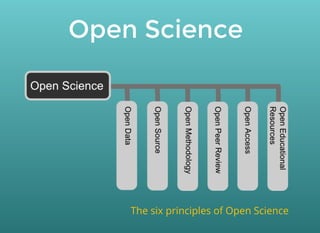
Open Science
The six principles of Open Science
Document
Write it down or ...
it didn't happen!
Document: Why?
Organise ideas
Understanding code and steps in the
future for you and others
Fixing errors
Help in future publication
Document: Where?
File System (e.g. README or TODO files)
Control Version System
Git, SVN, etc.
Content Management System
Wiki CMS, Drupal, etc.
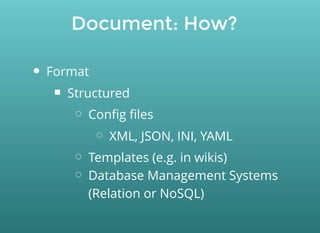
Document: How?
Plain text
Format
Unstructured
Free
Wikitext
Markdown
Document: How?
Format
Structured
Config files
XML, JSON, INI, YAML
Templates (e.g. in wikis)
Database Management Systems
(Relation or NoSQL)
Tag and track
I never said so!
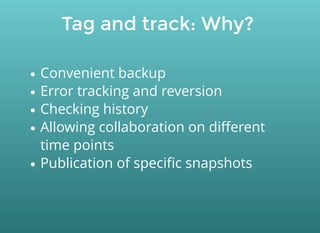
Tag and track: Why?
Convenient backup
Error tracking and reversion
Checking history
Allowing collaboration on different
time points
Publication of specific snapshots
Tag and track: Where?
Code, documentation:
Control Version System (Git, SVN, etc.)
Interfaces:
(local installation)
Wiki CMS (e.g. )
Data, files
Plain Git (small files) or
Document Management Systems
Github
Gitlab
[Semantic] MediaWiki
Git with large files
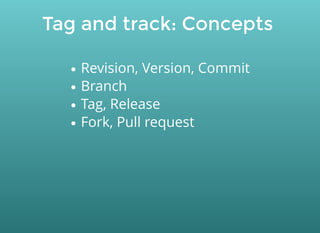
Tag and track: Concepts
Revision, Version, Commit
Branch
Tag, Release
Fork, Pull request
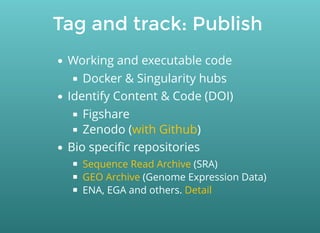
Tag and track: Publish
Working and executable code
Docker & Singularity hubs
Identify Content & Code (DOI)
Figshare
Zenodo ( )
Bio specific repositories
(SRA)
(Genome Expression Data)
ENA, EGA and others.
with Github
Sequence Read Archive
GEO Archive
Detail
Reproduce
Run it again, Sam!
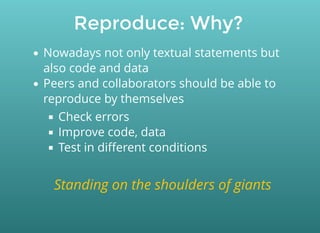
Reproduce: Why?
Nowadays not only textual statements but
also code and data
Peers and collaborators should be able to
reproduce by themselves
Check errors
Improve code, data
Test in different conditions
Standing on the shoulders of giants
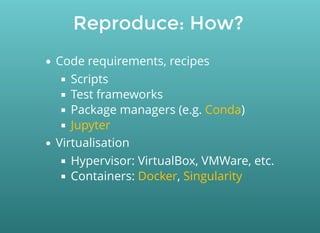
Reproduce: How?
Code requirements, recipes
Scripts
Test frameworks
Package managers (e.g. )
Virtualisation
Hypervisor: VirtualBox, VMWare, etc.
Containers: ,
Conda
Jupyter
Docker Singularity
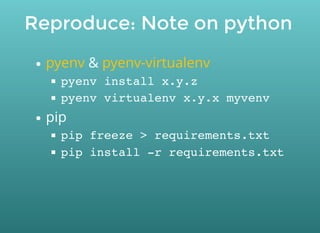
Reproduce: Note on python
&
pip
pyenv pyenv-virtualenv
pyenv install x.y.z
pyenv virtualenv x.y.x myvenv
pip freeze > requirements.txt
pip install -r requirements.txt
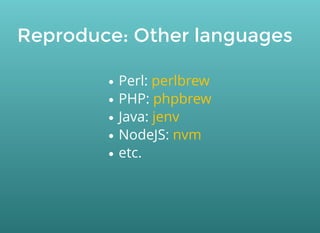
Reproduce: Other languages
Perl:
PHP:
Java:
NodeJS:
etc.
perlbrew
phpbrew
jenv
nvm
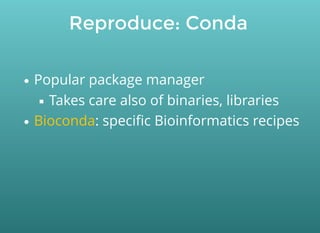
Reproduce: Conda
Popular package manager
Takes care also of binaries, libraries
: specific Bioinformatics recipesBioconda
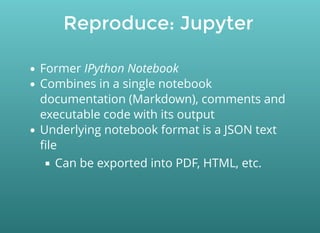
Reproduce: Jupyter
Former IPython Notebook
Combines in a single notebook
documentation (Markdown), comments and
executable code with its output
Underlying notebook format is a JSON text
file
Can be exported into PDF, HTML, etc.
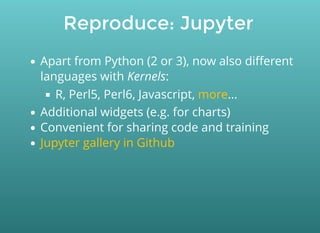
Reproduce: Jupyter
Apart from Python (2 or 3), now also different
languages with Kernels:
R, Perl5, Perl6, Javascript, ...
Additional widgets (e.g. for charts)
Convenient for sharing code and training
more
Jupyter gallery in Github
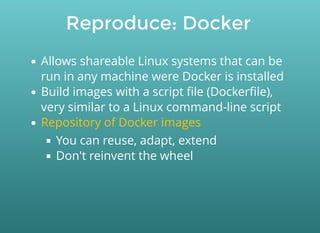
Reproduce: Docker
Allows shareable Linux systems that can be
run in any machine were Docker is installed
Build images with a script file (Dockerfile),
very similar to a Linux command-line script
You can reuse, adapt, extend
Don't reinvent the wheel
Repository of Docker images
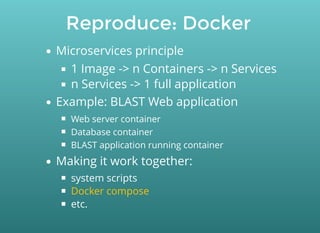
Reproduce: Docker
Microservices principle
1 Image -> n Containers -> n Services
n Services -> 1 full application
Example: BLAST Web application
Web server container
Database container
BLAST application running container
Making it work together:
system scripts
etc.
Docker compose
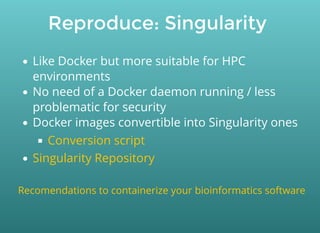
Reproduce: Singularity
Like Docker but more suitable for HPC
environments
No need of a Docker daemon running / less
problematic for security
Docker images convertible into Singularity ones
Conversion script
Singularity Repository
Recomendations to containerize your bioinformatics software
Pipelines & Workflows
Guilty by association
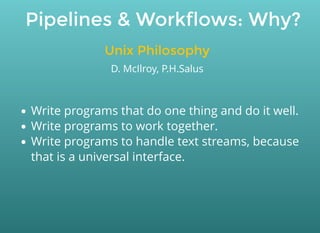
Pipelines & Workflows: Why?
Write programs that do one thing and do it well.
Write programs to work together.
Write programs to handle text streams, because
that is a universal interface.
D. McIlroy, P.H.Salus
Unix Philosophy
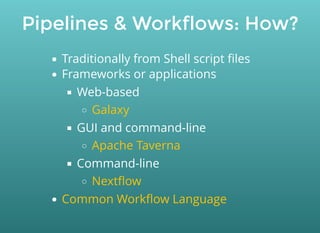
Pipelines & Workflows: How?
Traditionally from Shell script files
Frameworks or applications
Web-based
GUI and command-line
Command-line
Galaxy
Apache Taverna
Nextflow
Common Workflow Language
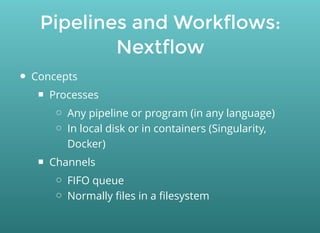
Pipelines and Workflows:
Nextflow
Concepts
Processes
Any pipeline or program (in any language)
In local disk or in containers (Singularity,
Docker)
Channels
FIFO queue
Normally files in a filesystem
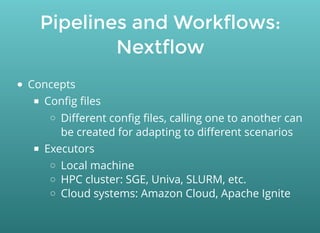
Pipelines and Workflows:
Nextflow
Concepts
Config files
Different config files, calling one to another can
be created for adapting to different scenarios
Executors
Local machine
HPC cluster: SGE, Univa, SLURM, etc.
Cloud systems: Amazon Cloud, Apache Ignite
Questions?
Comments?
Diversity
There's more than
one way to do it
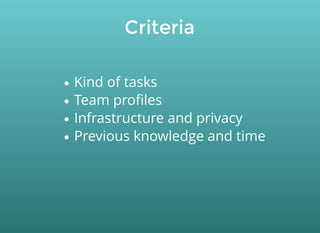
Criteria
Kind of tasks
Team profiles
Infrastructure and privacy
Previous knowledge and time
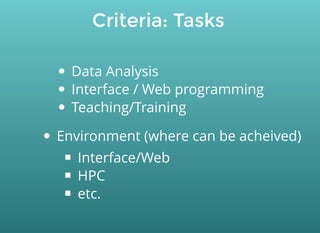
Criteria: Tasks
Data Analysis
Interface / Web programming
Teaching/Training
Environment (where can be acheived)
Interface/Web
HPC
etc.
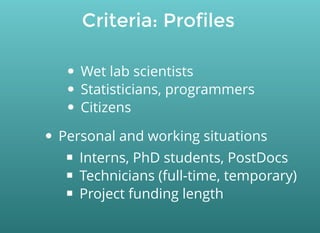
Criteria: Profiles
Wet lab scientists
Statisticians, programmers
Citizens
Personal and working situations
Interns, PhD students, PostDocs
Technicians (full-time, temporary)
Project funding length
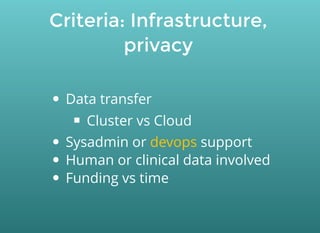
Criteria: Infrastructure,
privacy
Data transfer
Cluster vs Cloud
Sysadmin or support
Human or clinical data involved
Funding vs time
devops
Criteria: Knowledge
Programming language(s)
Python, R, JavaScript, Java, Perl
Availability of libraries / reusing
Frameworks, platforms
Learning curve
Bus factor

Open Access Week 2017: Life Sciences and Open Sciences - worfkflows and tools