Presenter’s Name June 17, 2003 1 
Office for Bombing Prevention 
Improvised Explosive Device Awareness 
prepared for: 
Bomb Making Materials Awareness Program
Madrid, Spain 
Presenter’s Name June 17, 2003 2
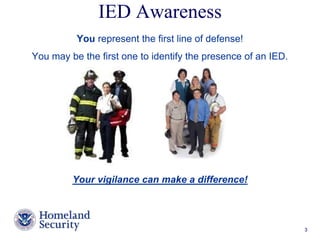
IED Awareness 
You represent the first line of defense! 
You may be the first one to identify the presence of an IED. 
Your vigilance can make a difference! 
Presenter’s Name June 17, 2003 3
What is an IED? 
Presenter’s Name June 17, 2003 4 
Improvised Explosive Device 
U.S. Federal Statutes define an IED as: 
 A modified explosive device built with available materials to achieve 
specific results, to destroy, kill, incapacitate, harass or distract. 
 A “Destructive Device” means any explosive, incendiary, or poison 
gas bomb, grenade, rocket having a propellant charge more than four 
ounces, missile having an explosive or incendiary charge of more 
than one-quarter ounce, mine or similar device 
The federal term for IED is “Destructive Device (DD)” and can be found 
in 26 USC section 5845(f).
What are we up against? 
IED attacks remain the primary tactic for bombers, terrorists and criminals seeking 
relatively uncomplicated, inexpensive means for inflicting 
mass casualties and maximum damage. 
The use of IED’s represents the most likely domestic threat to the United States, 
our citizens, and our way of life. 
Presenter’s Name June 17, 2003 5
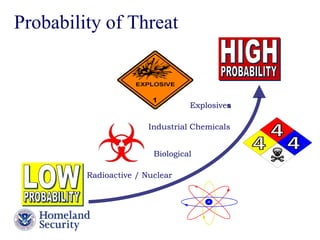
Explosives 
Probability of Threat 
Industrial Chemicals 
Presenter’s Name June 17, 2003 
Biological 
Radioactive / Nuclear
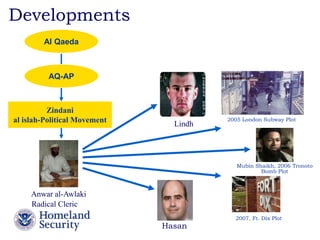
2005 London Subway Plot 
Presenter’s Name June 17, 2003 
Developments 
AQ-AP 
Hasan 
Zindani 
al islah-Political Movement 
Anwar al-Awlaki 
Lindh 
Radical Cleric 
Mubin Shaikh, 2006 Tronoto 
Bomb Plot 
2007, Ft. Dix Plot 
Al Qaeda
Presenter’s Name June 17, 2003 
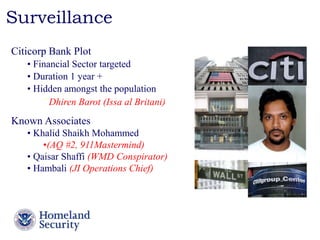
Surveillance 
Citicorp Bank Plot 
• Financial Sector targeted 
• Duration 1 year + 
• Hidden amongst the population 
ˉ Dhiren Barot (Issa al Britani) 
Known Associates 
• Khalid Shaikh Mohammed 
•(AQ #2, 911Mastermind) 
• Qaisar Shaffi (WMD Conspirator) 
• Hambali (JI Operations Chief)
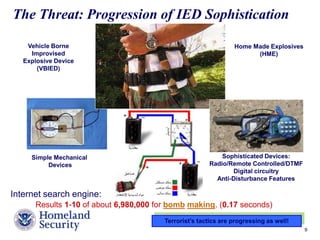
The Threat: Progression of IED Sophistication 
Home Made Explosives 
(HME) 
Presenter’s Name June 17, 2003 9 
Vehicle Borne 
Improvised 
Explosive Device 
(VBIED) 
Simple Mechanical 
Devices 
Sophisticated Devices: 
Radio/Remote Controlled/DTMF 
Digital circuitry 
Anti-Disturbance Features 
Internet search engine: 
Suicide Bombers 
Results 1-10 of about 6,980,000 for bomb making. (0.17 seconds) 
Terrorist’s tactics are progressing as well!
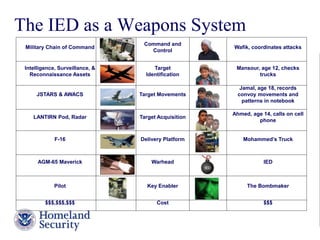
The IED as a Weapons System 
Ahmed, age 14, calls on cell 
phone 
F-16 Delivery Platform Mohammed’s Truck 
AGM-65 Maverick Warhead IED 
Pilot Key Enabler The Bombmaker 
$$$,$$$,$$$ Cost $$$ 
Presenter’s Name June 17, 2003 
LANTIRN Pod, Radar Target Acquisition 
Jamal, age 18, records 
convoy movements and 
patterns in notebook 
JSTARS & AWACS Target Movements 
Mansour, age 12, checks 
trucks 
Target 
Identification 
Intelligence, Surveillance, & 
Reconnaissance Assets 
Wafik, coordinates attacks 
Command and 
Control 
Military Chain of Command
Types of Explosives 
What’s the Difference? 
High Explosives (HE): Detonating – Above 3300 fps. 
A High Explosive is a compound or mixture of compounds which, when subject to 
heat, shock, friction or impact undergoes a very rapid self propagating, heat 
producing decomposition. 
Examples include TNT, C-4, Tetryl, Composition B, ANFO and many more. 
Low Explosives (LE): Deflagrating – Below 3300 fps. 
Low Explosives create a subsonic explosion and lack HE’s overpressure wave. 
Examples include gun powders (black powder, smokeless powder), propellants and most 
pyrotechnic materials . 
Presenter’s Name June 17, 2003
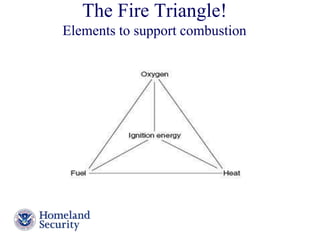
The Fire Triangle! 
Elements to support combustion 
Presenter’s Name June 17, 2003
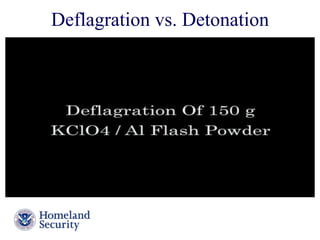
Deflagration vs. Detonation 
Presenter’s Name June 17, 2003
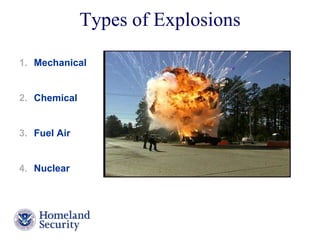
Types of Explosions 
Presenter’s Name June 17, 2003 
1. Mechanical 
2. Chemical 
3. Fuel Air 
4. Nuclear
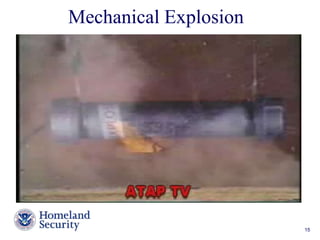
Mechanical Explosion 
Presenter’s Name June 17, 2003 15
Flash Powder Pipe Bomb 
Presenter’s Name June 17, 2003 16
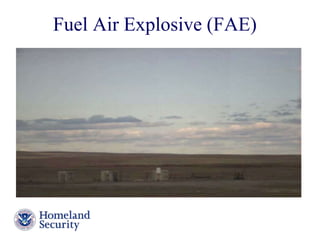
Fuel Air Explosive (FAE) 
Presenter’s Name June 17, 2003
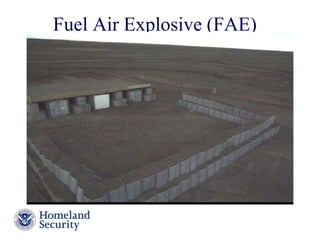
Fuel Air Explosive (FAE) 
Presenter’s Name June 17, 2003
Presenter’s Name June 17, 2003 19
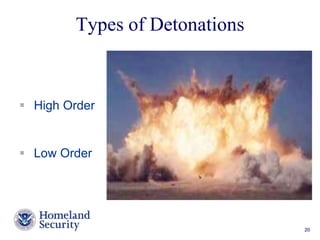
Types of Detonations 
Presenter’s Name June 17, 2003 20 
 High Order 
 Low Order
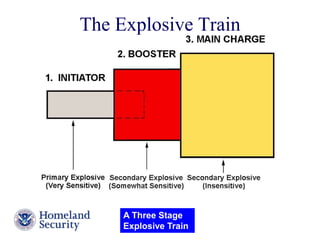
The Explosive Train 
Presenter’s Name June 17, 2003 
A Three Stage 
Explosive Train
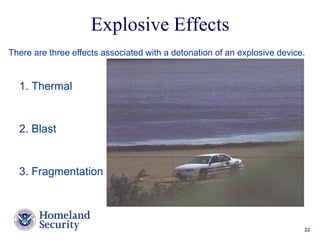
Explosive Effects 
There are three effects associated with a detonation of an explosive device. 
Presenter’s Name June 17, 2003 22 
1. Thermal 
2. Blast 
3. Fragmentation
Presenter’s Name June 17, 2003 23 
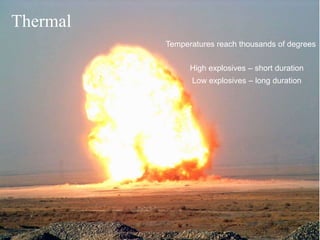
Thermal 
Temperatures reach thousands of degrees 
High explosives – short duration 
Low explosives – long duration
Presenter’s Name June 17, 2003 24 
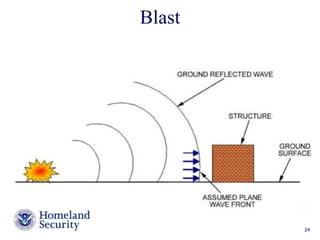
Blast
Presenter’s Name June 17, 2003 25 
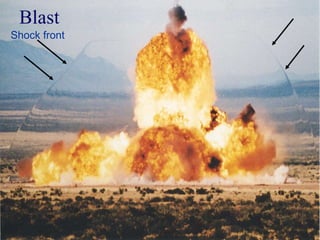
Blast 
Shock front
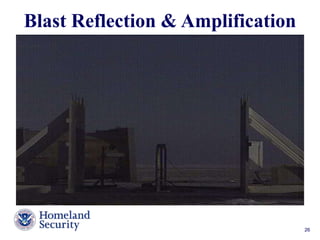
Blast ReflectionBl a&st Re fAlectimon &p Amlpilifficiactioan tion 
Presenter’s Name June 17, 2003 26
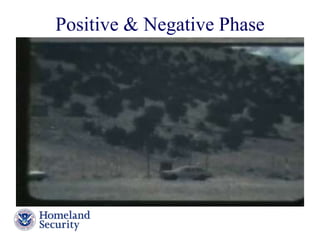
Positive & Negative Phase 
Presenter’s Name June 17, 2003
Presenter’s Name June 17, 2003 28 
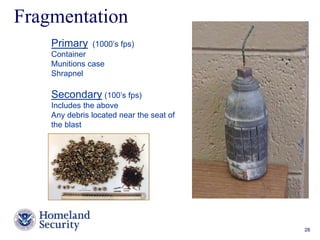
Fragmentation 
Primary (1000’s fps) 
Container 
Munitions case 
Shrapnel 
Secondary (100’s fps) 
Includes the above 
Any debris located near the seat of 
the blast
Combination of Blast & Frag 
Presenter’s Name June 17, 2003 29
Presenter’s Name June 17, 2003 30
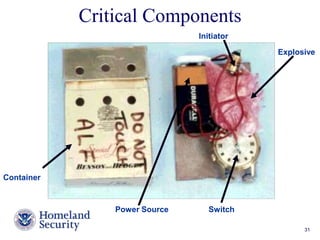
Critical Components 
Presenter’s Name June 17, 2003 31 
Power Source 
Initiator 
Explosive 
Container 
Switch
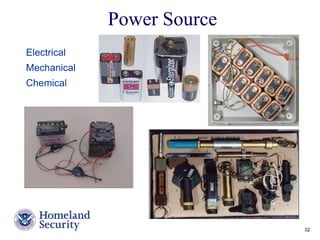
Presenter’s Name June 17, 2003 32 
Electrical 
Mechanical 
Chemical 
Power Source
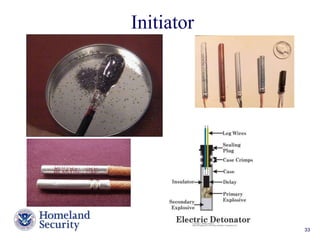
Presenter’s Name June 17, 2003 33 
Initiator
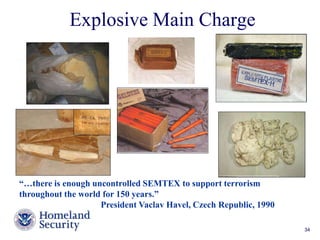
Explosive Main Charge 
“…there is enough uncontrolled SEMTEX to support terrorism 
throughout the world for 150 years.” 
President Vaclav Havel, Czech Republic, 1990 
TNT Equivalent: 1.35 (Semtex-H) 
Presenter’s Name June 17, 2003 34
Presenter’s Name June 17, 2003 35 
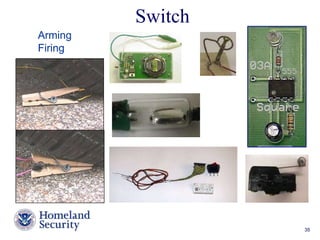
Switch 
Arming 
Firing
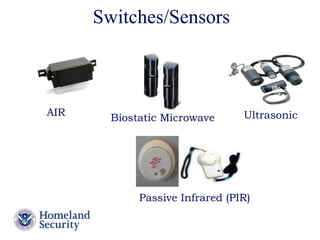
Switches/Sensors 
Biostatic Microwave Ultrasonic 
Presenter’s Name June 17, 2003 
AIR 
Passive Infrared (PIR)
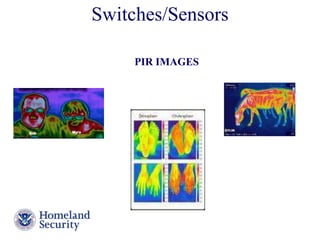
Switches/Sensors 
Presenter’s Name June 17, 2003 
PIR IMAGES
Presenter’s Name June 17, 2003 38 
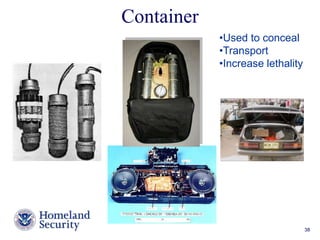
Container 
•Used to conceal 
•Transport 
•Increase lethality
Type by Function 
Three typical type by function categories of IED 
Presenter’s Name June 17, 2003 39 
are most commonly used. 
1.Time fired 
2.Victim operated 
3.Command initiated
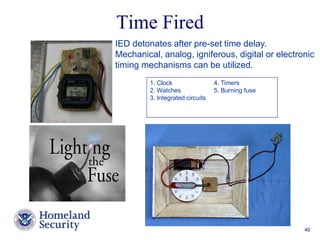
IED detonates after pre-set time delay. 
Mechanical, analog, igniferous, digital or electronic 
timing mechanisms can be utilized. 
Presenter’s Name June 17, 2003 40 
Time Fired 
1. Clock 4. Timers 
2. Watches 5. Burning fuse 
3. Integrated circuits
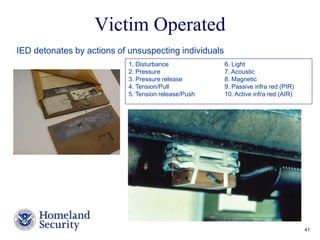
Victim Operated 
IED detonates by actions of unsuspecting individuals 
1. Disturbance 6. Light 
2. Pressure 7. Acoustic 
3. Pressure release 8. Magnetic 
4. Tension/Pull 9. Passive infra red (PIR) 
5. Tension release/Push 10. Active infra red (AIR) 
Presenter’s Name June 17, 2003 41
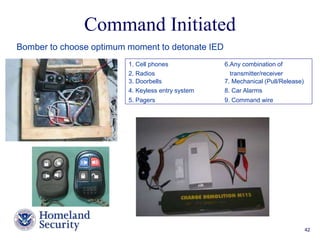
Command Initiated 
Bomber to choose optimum moment to detonate IED 
1. Cell phones 6.Any combination of 
2. Radios transmitter/receiver 
3. Doorbells 7. Mechanical (Pull/Release) 
4. Keyless entry system 8. Car Alarms 
5. Pagers 9. Command wire 
Presenter’s Name June 17, 2003 42
Presenter’s Name June 17, 2003 43 
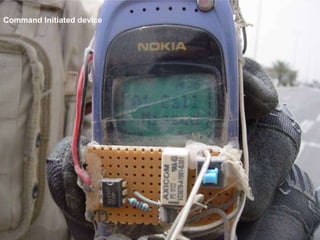
Command Initiated device
Presenter’s Name June 17, 2003 44
IED Threats 
Presenter’s Name June 17, 2003 46 
1. Vehicle Borne IED (VBIED) 
2. Suicide Bombs (PBIED) 
3. Remote Controlled (RCIED) 
4. Maritime (WBIED) 
5. Multiple/Simultaneous Incidents 
6. Soft Target/High Risk Re-Capture 
7. Secondary Device
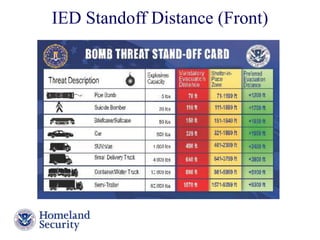
IED Standoff Distance (Front) 
Presenter’s Name June 17, 2003
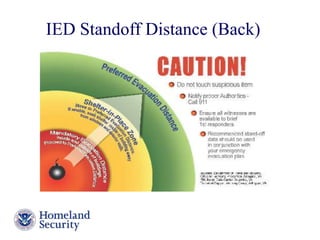
IED Standoff Distance (Back) 
Presenter’s Name June 17, 2003
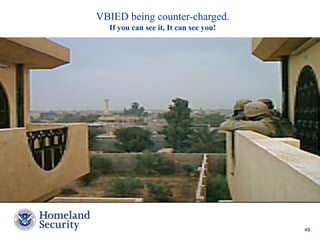
VBIED being counter-charged. 
If you can see it, It can see you! 
Presenter’s Name June 17, 2003 49
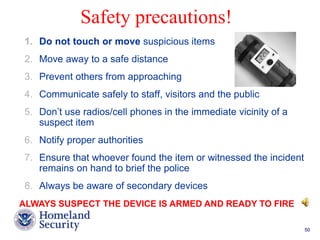
Safety precautions! 
1. Do not touch or move suspicious items 
2. Move away to a safe distance 
3. Prevent others from approaching 
4. Communicate safely to staff, visitors and the public 
5. Don’t use radios/cell phones in the immediate vicinity of a 
Presenter’s Name June 17, 2003 50 
suspect item 
6. Notify proper authorities 
7. Ensure that whoever found the item or witnessed the incident 
remains on hand to brief the police 
8. Always be aware of secondary devices 
ALWAYS SUSPECT THE DEVICE IS ARMED AND READY TO FIRE
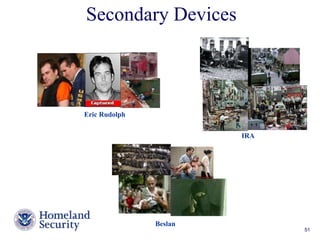
Secondary Devices 
Presenter’s Name June 17, 2003 51 
Eric Rudolph 
Beslan 
IRA
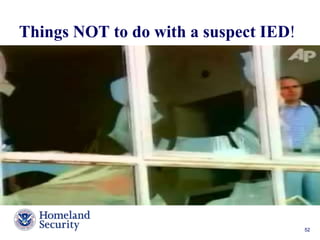
Things NOT to do with a suspect IED! 
Presenter’s Name June 17, 2003 52
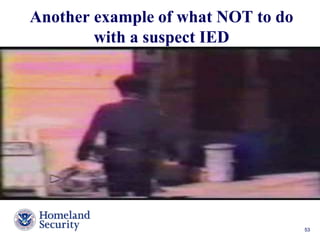
Another example of what NOT to do 
with a suspect IED 
Presenter’s Name June 17, 2003 53
Are there any questions? 
Presenter’s Name June 17, 2003
Presenter’s Name June 17, 2003 55 
Improvised Explosive Device Awareness 
For more information on IED security programs and initiatives contact: 
DHS Office for Bombing Prevention 
(703) 235-5723 
OBP@dhs.gov

OFFSHC gets briefed on IEDs

  • 1.
    Presenter’s Name June17, 2003 1 Office for Bombing Prevention Improvised Explosive Device Awareness prepared for: Bomb Making Materials Awareness Program
  • 2.
    Madrid, Spain Presenter’sName June 17, 2003 2
  • 3.
    IED Awareness Yourepresent the first line of defense! You may be the first one to identify the presence of an IED. Your vigilance can make a difference! Presenter’s Name June 17, 2003 3
  • 4.
    What is anIED? Presenter’s Name June 17, 2003 4 Improvised Explosive Device U.S. Federal Statutes define an IED as:  A modified explosive device built with available materials to achieve specific results, to destroy, kill, incapacitate, harass or distract.  A “Destructive Device” means any explosive, incendiary, or poison gas bomb, grenade, rocket having a propellant charge more than four ounces, missile having an explosive or incendiary charge of more than one-quarter ounce, mine or similar device The federal term for IED is “Destructive Device (DD)” and can be found in 26 USC section 5845(f).
  • 5.
    What are weup against? IED attacks remain the primary tactic for bombers, terrorists and criminals seeking relatively uncomplicated, inexpensive means for inflicting mass casualties and maximum damage. The use of IED’s represents the most likely domestic threat to the United States, our citizens, and our way of life. Presenter’s Name June 17, 2003 5
  • 6.
    Explosives Probability ofThreat Industrial Chemicals Presenter’s Name June 17, 2003 Biological Radioactive / Nuclear
  • 7.
    2005 London SubwayPlot Presenter’s Name June 17, 2003 Developments AQ-AP Hasan Zindani al islah-Political Movement Anwar al-Awlaki Lindh Radical Cleric Mubin Shaikh, 2006 Tronoto Bomb Plot 2007, Ft. Dix Plot Al Qaeda
  • 8.
    Presenter’s Name June17, 2003 Surveillance Citicorp Bank Plot • Financial Sector targeted • Duration 1 year + • Hidden amongst the population ˉ Dhiren Barot (Issa al Britani) Known Associates • Khalid Shaikh Mohammed •(AQ #2, 911Mastermind) • Qaisar Shaffi (WMD Conspirator) • Hambali (JI Operations Chief)
  • 9.
    The Threat: Progressionof IED Sophistication Home Made Explosives (HME) Presenter’s Name June 17, 2003 9 Vehicle Borne Improvised Explosive Device (VBIED) Simple Mechanical Devices Sophisticated Devices: Radio/Remote Controlled/DTMF Digital circuitry Anti-Disturbance Features Internet search engine: Suicide Bombers Results 1-10 of about 6,980,000 for bomb making. (0.17 seconds) Terrorist’s tactics are progressing as well!
  • 10.
    The IED asa Weapons System Ahmed, age 14, calls on cell phone F-16 Delivery Platform Mohammed’s Truck AGM-65 Maverick Warhead IED Pilot Key Enabler The Bombmaker $$$,$$$,$$$ Cost $$$ Presenter’s Name June 17, 2003 LANTIRN Pod, Radar Target Acquisition Jamal, age 18, records convoy movements and patterns in notebook JSTARS & AWACS Target Movements Mansour, age 12, checks trucks Target Identification Intelligence, Surveillance, & Reconnaissance Assets Wafik, coordinates attacks Command and Control Military Chain of Command
  • 11.
    Types of Explosives What’s the Difference? High Explosives (HE): Detonating – Above 3300 fps. A High Explosive is a compound or mixture of compounds which, when subject to heat, shock, friction or impact undergoes a very rapid self propagating, heat producing decomposition. Examples include TNT, C-4, Tetryl, Composition B, ANFO and many more. Low Explosives (LE): Deflagrating – Below 3300 fps. Low Explosives create a subsonic explosion and lack HE’s overpressure wave. Examples include gun powders (black powder, smokeless powder), propellants and most pyrotechnic materials . Presenter’s Name June 17, 2003
  • 12.
    The Fire Triangle! Elements to support combustion Presenter’s Name June 17, 2003
  • 13.
    Deflagration vs. Detonation Presenter’s Name June 17, 2003
  • 14.
    Types of Explosions Presenter’s Name June 17, 2003 1. Mechanical 2. Chemical 3. Fuel Air 4. Nuclear
  • 15.
  • 16.
    Flash Powder PipeBomb Presenter’s Name June 17, 2003 16
  • 17.
    Fuel Air Explosive(FAE) Presenter’s Name June 17, 2003
  • 18.
    Fuel Air Explosive(FAE) Presenter’s Name June 17, 2003
  • 19.
  • 20.
    Types of Detonations Presenter’s Name June 17, 2003 20  High Order  Low Order
  • 21.
    The Explosive Train Presenter’s Name June 17, 2003 A Three Stage Explosive Train
  • 22.
    Explosive Effects Thereare three effects associated with a detonation of an explosive device. Presenter’s Name June 17, 2003 22 1. Thermal 2. Blast 3. Fragmentation
  • 23.
    Presenter’s Name June17, 2003 23 Thermal Temperatures reach thousands of degrees High explosives – short duration Low explosives – long duration
  • 24.
    Presenter’s Name June17, 2003 24 Blast
  • 25.
    Presenter’s Name June17, 2003 25 Blast Shock front
  • 26.
    Blast ReflectionBl a&stRe fAlectimon &p Amlpilifficiactioan tion Presenter’s Name June 17, 2003 26
  • 27.
    Positive & NegativePhase Presenter’s Name June 17, 2003
  • 28.
    Presenter’s Name June17, 2003 28 Fragmentation Primary (1000’s fps) Container Munitions case Shrapnel Secondary (100’s fps) Includes the above Any debris located near the seat of the blast
  • 29.
    Combination of Blast& Frag Presenter’s Name June 17, 2003 29
  • 30.
  • 31.
    Critical Components Presenter’sName June 17, 2003 31 Power Source Initiator Explosive Container Switch
  • 32.
    Presenter’s Name June17, 2003 32 Electrical Mechanical Chemical Power Source
  • 33.
    Presenter’s Name June17, 2003 33 Initiator
  • 34.
    Explosive Main Charge “…there is enough uncontrolled SEMTEX to support terrorism throughout the world for 150 years.” President Vaclav Havel, Czech Republic, 1990 TNT Equivalent: 1.35 (Semtex-H) Presenter’s Name June 17, 2003 34
  • 35.
    Presenter’s Name June17, 2003 35 Switch Arming Firing
  • 36.
    Switches/Sensors Biostatic MicrowaveUltrasonic Presenter’s Name June 17, 2003 AIR Passive Infrared (PIR)
  • 37.
    Switches/Sensors Presenter’s NameJune 17, 2003 PIR IMAGES
  • 38.
    Presenter’s Name June17, 2003 38 Container •Used to conceal •Transport •Increase lethality
  • 39.
    Type by Function Three typical type by function categories of IED Presenter’s Name June 17, 2003 39 are most commonly used. 1.Time fired 2.Victim operated 3.Command initiated
  • 40.
    IED detonates afterpre-set time delay. Mechanical, analog, igniferous, digital or electronic timing mechanisms can be utilized. Presenter’s Name June 17, 2003 40 Time Fired 1. Clock 4. Timers 2. Watches 5. Burning fuse 3. Integrated circuits
  • 41.
    Victim Operated IEDdetonates by actions of unsuspecting individuals 1. Disturbance 6. Light 2. Pressure 7. Acoustic 3. Pressure release 8. Magnetic 4. Tension/Pull 9. Passive infra red (PIR) 5. Tension release/Push 10. Active infra red (AIR) Presenter’s Name June 17, 2003 41
  • 42.
    Command Initiated Bomberto choose optimum moment to detonate IED 1. Cell phones 6.Any combination of 2. Radios transmitter/receiver 3. Doorbells 7. Mechanical (Pull/Release) 4. Keyless entry system 8. Car Alarms 5. Pagers 9. Command wire Presenter’s Name June 17, 2003 42
  • 43.
    Presenter’s Name June17, 2003 43 Command Initiated device
  • 44.
  • 45.
    IED Threats Presenter’sName June 17, 2003 46 1. Vehicle Borne IED (VBIED) 2. Suicide Bombs (PBIED) 3. Remote Controlled (RCIED) 4. Maritime (WBIED) 5. Multiple/Simultaneous Incidents 6. Soft Target/High Risk Re-Capture 7. Secondary Device
  • 46.
    IED Standoff Distance(Front) Presenter’s Name June 17, 2003
  • 47.
    IED Standoff Distance(Back) Presenter’s Name June 17, 2003
  • 48.
    VBIED being counter-charged. If you can see it, It can see you! Presenter’s Name June 17, 2003 49
  • 49.
    Safety precautions! 1.Do not touch or move suspicious items 2. Move away to a safe distance 3. Prevent others from approaching 4. Communicate safely to staff, visitors and the public 5. Don’t use radios/cell phones in the immediate vicinity of a Presenter’s Name June 17, 2003 50 suspect item 6. Notify proper authorities 7. Ensure that whoever found the item or witnessed the incident remains on hand to brief the police 8. Always be aware of secondary devices ALWAYS SUSPECT THE DEVICE IS ARMED AND READY TO FIRE
  • 50.
    Secondary Devices Presenter’sName June 17, 2003 51 Eric Rudolph Beslan IRA
  • 51.
    Things NOT todo with a suspect IED! Presenter’s Name June 17, 2003 52
  • 52.
    Another example ofwhat NOT to do with a suspect IED Presenter’s Name June 17, 2003 53
  • 53.
    Are there anyquestions? Presenter’s Name June 17, 2003
  • 54.
    Presenter’s Name June17, 2003 55 Improvised Explosive Device Awareness For more information on IED security programs and initiatives contact: DHS Office for Bombing Prevention (703) 235-5723 OBP@dhs.gov