UPDATING THE POLICY
FRAMEWORK FOR INVESTMENT:
INVESTMENT PROMOTION & FACILITATION
IN SOUTHEAST ASIA
Mike Pfister
Investment Policy Review Unit, OECD
Global Task Force Meeting
Bali, 24 March 2014
• Investment promotion & facilitation in a PFI
rationale
• Experience from SEA, OECD IPRs and
seminars in SEA and elements from the
OECD Southeast Asia Investment Policy
Perspectives
• Updating and strengthening chapter 2 of
the PFI – questions & discussion
Outline
• Private investment: can bring capital, jobs, technology,
knowledge, new market outlets, additional domestic
resources, help diversification, increase trade…
development impact of investment
• Chapter 1 focuses on the hard framework conditions for
investment
• Investment promotion & facilitation critical complement
to attract investment: link between the policies and
business activity
• Also means: promotion depends on policies = PFI
rationale – holistic approach
Approach and rationale: why investment
promotion & facilitation in the PFI?
• Investment promotion and facilitation measures, including incentives, can be effective
instruments to attract investment provided they aim to correct for market failures and
are developed in a way that can leverage the strong points of a country’s investment
environment. The quality of investment promotion depends by and large on the quality of the
investment related policies in place.
• Investment promotion and facilitation can take various forms. Many governments have
established specialised investment promotion agencies (IPAs), either as independent bodies or
under the tutelage of a Ministry.
• Effective investment promotion also goes beyond attracting new investors. An important
element is after-care once investors have set up shop. This is particularly important to retain
existing investment, and to motivate established investors to expand their investments.
• In terms of investment facilitation, the government should ensure that investors find it easy and
convenient to get all the relevant information linked to their operations, from pre- to post-
establishment. The institutional structure should be lean, thus avoiding bureaucratic layers.
• Investment promotion and facilitation also needs to be carefully co-ordinated nationally, as
different ministries and institutions may do some promotional activities on their own.
• The domestic eco-system is critical for investment: suppliers, support institutions (including
financial services, access to quality training, R&D, BDS) – cluster perspective
• The regional dimension is critical – where is the province, country or region positioned in the
value chain?
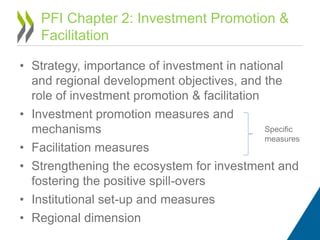
• Strategy, importance of investment in national
and regional development objectives, and the
role of investment promotion & facilitation
• Investment promotion measures and
mechanisms
• Facilitation measures
• Strengthening the ecosystem for investment and
fostering the positive spill-overs
• Institutional set-up and measures
• Regional dimension
PFI Chapter 2: Investment Promotion &
Facilitation
Specific
measures
INVESTMENT STRATEGY
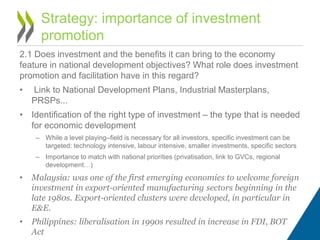
2.1 Does investment and the benefits it can bring to the economy
feature in national development objectives? What role does investment
promotion and facilitation have in this regard?
• Link to National Development Plans, Industrial Masterplans,
PRSPs...
• Identification of the right type of investment – the type that is needed
for economic development
– While a level playing–field is necessary for all investors, specific investment can be
targeted: technology intensive, labour intensive, smaller investments, specific sectors
– Importance to match with national priorities (privatisation, link to GVCs, regional
development…)
• Malaysia: was one of the first emerging economies to welcome foreign
investment in export-oriented manufacturing sectors beginning in the
late 1980s. Export-oriented clusters were developed, in particular in
E&E.
• Philippines: liberalisation in 1990s resulted in increase in FDI, BOT
Act
Strategy: importance of investment
promotion
INVESTMENT PROMOTION MEASURES
• How are investors targeted?
• Value-propositions? Have effective are they? How are
they reviewed/revised?
• How is investment promotion undertaken – city level,
provincial, country level? Any regional approaches in
ASEAN?
• Special Economic Zones
• How is promotion co-ordinated?
Philippines: 17 IPAs, but recent efforts to harmonise
through BOI
Viet Nam: FIA, Northern, Central and South
• Incentives
Investment Promotion measures
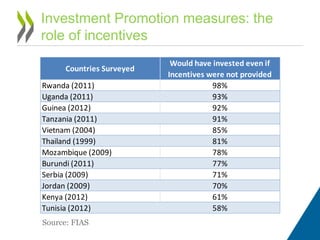
Investment Promotion measures: the
role of incentives
Countries Surveyed
Would have invested even if
Incentives were not provided
Rwanda (2011) 98%
Uganda (2011) 93%
Guinea (2012) 92%
Tanzania (2011) 91%
Vietnam (2004) 85%
Thailand (1999) 81%
Mozambique (2009) 78%
Burundi (2011) 77%
Serbia (2009) 71%
Jordan (2009) 70%
Kenya (2012) 61%
Tunisia (2012) 58%
Source: FIAS
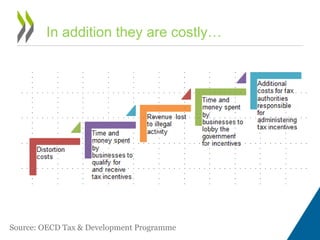
In addition they are costly…
Source: OECD Tax & Development Programme
• Common: income tax holidays (ITH), preferential tax rates, import
duty and VAT exemptions, tax credits and other taxable income
deductions.
• Regulation: in most cases part of national investment laws (eg:
Myanmar FIL)
• but differences in implementation:
Cambodia’s incentives granted in SEZs aligned with the national
legislation, where as in the Philippines, SEZ incentives governed by
the 1995 SEZ Act.
• Differences in the so-called trigger period:
Thailand and Lao PDR, the tax holiday begin after the project has
begun, but Viet Nam and Cambodia later.
• Difficult to examine incentives at ASEAN level
SEA dimension of fiscal incentives
• ASEAN countries share a common interest in establishing a level
playing field among themselves.
• Regional co-operation and agreements can help fight excessive
incentives, protecting tax bases of the ASEAN member countries,
and provide a comprehensive ASEAN-wide mechanism to address
tax competition
• The ASEAN Economic Community (AEC) & strengthening the notion
of an ASEAN investment destination supports fighting race-to-the
bottom of AMS
• How? Framework to assist policy makers in tackling associated
challenges: understanding the extent of divergences of tax
incentives policies and practices across AMS; platform for dialogue
on tax incentives-related policies; mechanisms to improve
knowledge-sharing between AMS
ASEAN avenues
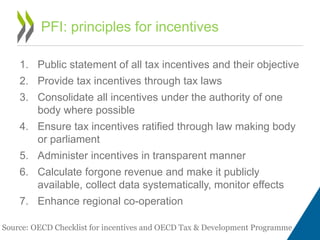
1. Public statement of all tax incentives and their objective
2. Provide tax incentives through tax laws
3. Consolidate all incentives under the authority of one
body where possible
4. Ensure tax incentives ratified through law making body
or parliament
5. Administer incentives in transparent manner
6. Calculate forgone revenue and make it publicly
available, collect data systematically, monitor effects
7. Enhance regional co-operation
PFI: principles for incentives
Source: OECD Checklist for incentives and OECD Tax & Development Programme
INVESTMENT FACILITATION MEASURES
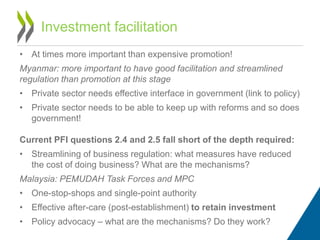
Investment facilitation
• At times more important than expensive promotion!
Myanmar: more important to have good facilitation and streamlined
regulation than promotion at this stage
• Private sector needs effective interface in government (link to policy)
• Private sector needs to be able to keep up with reforms and so does
government!
Current PFI questions 2.4 and 2.5 fall short of the depth required:
• Streamlining of business regulation: what measures have reduced
the cost of doing business? What are the mechanisms?
Malaysia: PEMUDAH Task Forces and MPC
• One-stop-shops and single-point authority
• Effective after-care (post-establishment) to retain investment
• Policy advocacy – what are the mechanisms? Do they work?
INSTITUTIONAL SET-UP
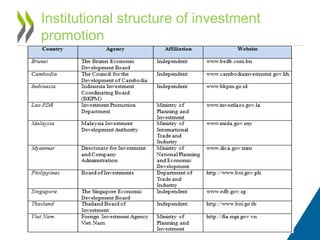
Institutional structure of investment
promotion
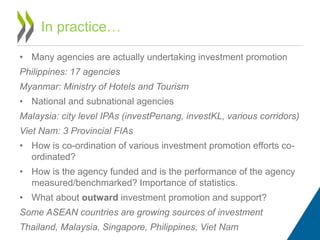
• Many agencies are actually undertaking investment promotion
Philippines: 17 agencies
Myanmar: Ministry of Hotels and Tourism
• National and subnational agencies
Malaysia: city level IPAs (investPenang, investKL, various corridors)
Viet Nam: 3 Provincial FIAs
• How is co-ordination of various investment promotion efforts co-
ordinated?
• How is the agency funded and is the performance of the agency
measured/benchmarked? Importance of statistics.
• What about outward investment promotion and support?
Some ASEAN countries are growing sources of investment
Thailand, Malaysia, Singapore, Philippines, Viet Nam
In practice…
IMPACT AND STRENGTHENING THE
INVESTMENT ECOSYSTEM
Linkages, Global Value Chains, Clusters
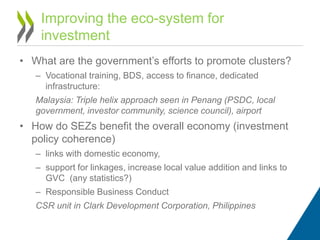
• What are the government’s efforts to promote clusters?
– Vocational training, BDS, access to finance, dedicated
infrastructure:
Malaysia: Triple helix approach seen in Penang (PSDC, local
government, investor community, science council), airport
• How do SEZs benefit the overall economy (investment
policy coherence)
– links with domestic economy,
– support for linkages, increase local value addition and links to
GVC (any statistics?)
– Responsible Business Conduct
CSR unit in Clark Development Corporation, Philippines
Improving the eco-system for
investment
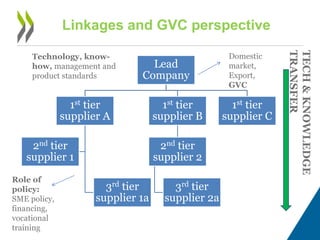
Lead
Company
1st tier
supplier A
3rd tier
supplier 1a
2nd tier
supplier 1
1st tier
supplier B
2nd tier
supplier 2
3rd tier
supplier 2a
1st tier
supplier C
Linkages and GVC perspective
Technology, know-
how, management and
product standards
Domestic
market,
Export,
GVC
TECH&KNOWLEDGE
TRANSFER
Role of
policy:
SME policy,
financing,
vocational
training
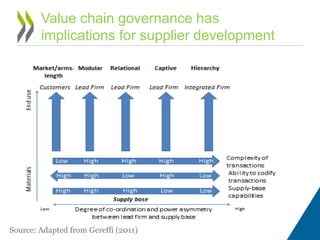
Value chain governance has
implications for supplier development
Source: Adapted from Gereffi (2011)
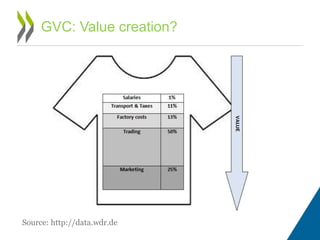
GVC: Value creation?
Source: http://data.wdr.de
• Again, little in current PFI (2.7)
• Framework could be fine-tuned:
– Is the potential for linkages taken into consideration in
investment promotion measures?
– What SME/supplier development programmes are
geared to promote linkages (hence GVC integration,
technology and knowledge transfer)?
– How are foreign investors involved in local skills
development?
– Are IPAs involved in linkages creation (eg: match-
making, making supplier data-base available to
investors)
– Is local value creation measured in SEZs? Stats!
For the PFI?
REGIONAL DIMENSION
• Investors think regionally (larger markets, integrating production
networks) – ASEAN well placed with AEC
Only 5.4% of respondents to a Baker McKinsey survey run the
ASEAN Region from a base outside ASEAN!!
• SEA is heterogeneous: important to map your country in the
regional (ASEAN) value chain (R&D, electronics, tourism, textile,
natural resources…)
• Discuss regional investment promotion efforts at ASEAN level: to
address intra and extra-regional investment
ASEAN Investment Forum
• Brand and “sell” the ASEAN investment destination: ASEAN
Secretariat could play a role.
Regional dimension
• What investment promotion measures have proven most
effective?
• Biggest challenge to promote investment?
• How do you undertake policy advocacy?
• How do you gather feedback from investors – aftercare?
• How do you view the importance of the your supply base
for your investment climate competitiveness?
• Does your IPA have a linkages programme?
• Do you map yourself in the ASEAN value chain? How?
• Any regional investment promotion initiatives? Any
suggestions?
Let’s discuss
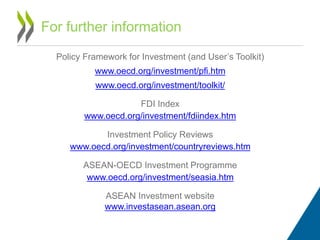
Policy Framework for Investment (and User’s Toolkit)
www.oecd.org/investment/pfi.htm
www.oecd.org/investment/toolkit/
FDI Index
www.oecd.org/investment/fdiindex.htm
Investment Policy Reviews
www.oecd.org/investment/countryreviews.htm
ASEAN-OECD Investment Programme
www.oecd.org/investment/seasia.htm
ASEAN Investment website
www.investasean.asean.org
For further information
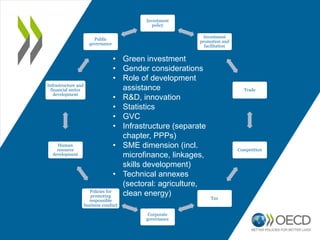
NEW DIMENSIONS OF THE PFI
Investment
policy
Investment
promotion and
facilitation
Trade
Competition
Tax
Corporate
governance
Policies for
promoting
responsible
business conduct
Human
resource
development
Infrastructure and
financial sector
development
Public
governance
• Green investment
• Gender considerations
• Role of development
assistance
• R&D, innovation
• Statistics
• GVC
• Infrastructure (separate
chapter, PPPs)
• SME dimension (incl.
microfinance, linkages,
skills development)
• Technical annexes
(sectoral: agriculture,
clean energy)

Investment promotion in Southeast Asia - Mike Pfister – Southeast Asia Regional Forum

  • 1.
    UPDATING THE POLICY FRAMEWORKFOR INVESTMENT: INVESTMENT PROMOTION & FACILITATION IN SOUTHEAST ASIA Mike Pfister Investment Policy Review Unit, OECD Global Task Force Meeting Bali, 24 March 2014
  • 2.
    • Investment promotion& facilitation in a PFI rationale • Experience from SEA, OECD IPRs and seminars in SEA and elements from the OECD Southeast Asia Investment Policy Perspectives • Updating and strengthening chapter 2 of the PFI – questions & discussion Outline
  • 3.
    • Private investment:can bring capital, jobs, technology, knowledge, new market outlets, additional domestic resources, help diversification, increase trade… development impact of investment • Chapter 1 focuses on the hard framework conditions for investment • Investment promotion & facilitation critical complement to attract investment: link between the policies and business activity • Also means: promotion depends on policies = PFI rationale – holistic approach Approach and rationale: why investment promotion & facilitation in the PFI?
  • 4.
    • Investment promotionand facilitation measures, including incentives, can be effective instruments to attract investment provided they aim to correct for market failures and are developed in a way that can leverage the strong points of a country’s investment environment. The quality of investment promotion depends by and large on the quality of the investment related policies in place. • Investment promotion and facilitation can take various forms. Many governments have established specialised investment promotion agencies (IPAs), either as independent bodies or under the tutelage of a Ministry. • Effective investment promotion also goes beyond attracting new investors. An important element is after-care once investors have set up shop. This is particularly important to retain existing investment, and to motivate established investors to expand their investments. • In terms of investment facilitation, the government should ensure that investors find it easy and convenient to get all the relevant information linked to their operations, from pre- to post- establishment. The institutional structure should be lean, thus avoiding bureaucratic layers. • Investment promotion and facilitation also needs to be carefully co-ordinated nationally, as different ministries and institutions may do some promotional activities on their own. • The domestic eco-system is critical for investment: suppliers, support institutions (including financial services, access to quality training, R&D, BDS) – cluster perspective • The regional dimension is critical – where is the province, country or region positioned in the value chain?
  • 5.
    • Strategy, importanceof investment in national and regional development objectives, and the role of investment promotion & facilitation • Investment promotion measures and mechanisms • Facilitation measures • Strengthening the ecosystem for investment and fostering the positive spill-overs • Institutional set-up and measures • Regional dimension PFI Chapter 2: Investment Promotion & Facilitation Specific measures
  • 6.
  • 7.
    2.1 Does investmentand the benefits it can bring to the economy feature in national development objectives? What role does investment promotion and facilitation have in this regard? • Link to National Development Plans, Industrial Masterplans, PRSPs... • Identification of the right type of investment – the type that is needed for economic development – While a level playing–field is necessary for all investors, specific investment can be targeted: technology intensive, labour intensive, smaller investments, specific sectors – Importance to match with national priorities (privatisation, link to GVCs, regional development…) • Malaysia: was one of the first emerging economies to welcome foreign investment in export-oriented manufacturing sectors beginning in the late 1980s. Export-oriented clusters were developed, in particular in E&E. • Philippines: liberalisation in 1990s resulted in increase in FDI, BOT Act Strategy: importance of investment promotion
  • 8.
  • 9.
    • How areinvestors targeted? • Value-propositions? Have effective are they? How are they reviewed/revised? • How is investment promotion undertaken – city level, provincial, country level? Any regional approaches in ASEAN? • Special Economic Zones • How is promotion co-ordinated? Philippines: 17 IPAs, but recent efforts to harmonise through BOI Viet Nam: FIA, Northern, Central and South • Incentives Investment Promotion measures
  • 10.
    Investment Promotion measures:the role of incentives Countries Surveyed Would have invested even if Incentives were not provided Rwanda (2011) 98% Uganda (2011) 93% Guinea (2012) 92% Tanzania (2011) 91% Vietnam (2004) 85% Thailand (1999) 81% Mozambique (2009) 78% Burundi (2011) 77% Serbia (2009) 71% Jordan (2009) 70% Kenya (2012) 61% Tunisia (2012) 58% Source: FIAS
  • 11.
    In addition theyare costly… Source: OECD Tax & Development Programme
  • 12.
    • Common: incometax holidays (ITH), preferential tax rates, import duty and VAT exemptions, tax credits and other taxable income deductions. • Regulation: in most cases part of national investment laws (eg: Myanmar FIL) • but differences in implementation: Cambodia’s incentives granted in SEZs aligned with the national legislation, where as in the Philippines, SEZ incentives governed by the 1995 SEZ Act. • Differences in the so-called trigger period: Thailand and Lao PDR, the tax holiday begin after the project has begun, but Viet Nam and Cambodia later. • Difficult to examine incentives at ASEAN level SEA dimension of fiscal incentives
  • 13.
    • ASEAN countriesshare a common interest in establishing a level playing field among themselves. • Regional co-operation and agreements can help fight excessive incentives, protecting tax bases of the ASEAN member countries, and provide a comprehensive ASEAN-wide mechanism to address tax competition • The ASEAN Economic Community (AEC) & strengthening the notion of an ASEAN investment destination supports fighting race-to-the bottom of AMS • How? Framework to assist policy makers in tackling associated challenges: understanding the extent of divergences of tax incentives policies and practices across AMS; platform for dialogue on tax incentives-related policies; mechanisms to improve knowledge-sharing between AMS ASEAN avenues
  • 14.
    1. Public statementof all tax incentives and their objective 2. Provide tax incentives through tax laws 3. Consolidate all incentives under the authority of one body where possible 4. Ensure tax incentives ratified through law making body or parliament 5. Administer incentives in transparent manner 6. Calculate forgone revenue and make it publicly available, collect data systematically, monitor effects 7. Enhance regional co-operation PFI: principles for incentives Source: OECD Checklist for incentives and OECD Tax & Development Programme
  • 15.
  • 16.
    Investment facilitation • Attimes more important than expensive promotion! Myanmar: more important to have good facilitation and streamlined regulation than promotion at this stage • Private sector needs effective interface in government (link to policy) • Private sector needs to be able to keep up with reforms and so does government! Current PFI questions 2.4 and 2.5 fall short of the depth required: • Streamlining of business regulation: what measures have reduced the cost of doing business? What are the mechanisms? Malaysia: PEMUDAH Task Forces and MPC • One-stop-shops and single-point authority • Effective after-care (post-establishment) to retain investment • Policy advocacy – what are the mechanisms? Do they work?
  • 17.
  • 18.
    Institutional structure ofinvestment promotion
  • 19.
    • Many agenciesare actually undertaking investment promotion Philippines: 17 agencies Myanmar: Ministry of Hotels and Tourism • National and subnational agencies Malaysia: city level IPAs (investPenang, investKL, various corridors) Viet Nam: 3 Provincial FIAs • How is co-ordination of various investment promotion efforts co- ordinated? • How is the agency funded and is the performance of the agency measured/benchmarked? Importance of statistics. • What about outward investment promotion and support? Some ASEAN countries are growing sources of investment Thailand, Malaysia, Singapore, Philippines, Viet Nam In practice…
  • 20.
    IMPACT AND STRENGTHENINGTHE INVESTMENT ECOSYSTEM Linkages, Global Value Chains, Clusters
  • 21.
    • What arethe government’s efforts to promote clusters? – Vocational training, BDS, access to finance, dedicated infrastructure: Malaysia: Triple helix approach seen in Penang (PSDC, local government, investor community, science council), airport • How do SEZs benefit the overall economy (investment policy coherence) – links with domestic economy, – support for linkages, increase local value addition and links to GVC (any statistics?) – Responsible Business Conduct CSR unit in Clark Development Corporation, Philippines Improving the eco-system for investment
  • 22.
    Lead Company 1st tier supplier A 3rdtier supplier 1a 2nd tier supplier 1 1st tier supplier B 2nd tier supplier 2 3rd tier supplier 2a 1st tier supplier C Linkages and GVC perspective Technology, know- how, management and product standards Domestic market, Export, GVC TECH&KNOWLEDGE TRANSFER Role of policy: SME policy, financing, vocational training
  • 23.
    Value chain governancehas implications for supplier development Source: Adapted from Gereffi (2011)
  • 24.
    GVC: Value creation? Source:http://data.wdr.de
  • 25.
    • Again, littlein current PFI (2.7) • Framework could be fine-tuned: – Is the potential for linkages taken into consideration in investment promotion measures? – What SME/supplier development programmes are geared to promote linkages (hence GVC integration, technology and knowledge transfer)? – How are foreign investors involved in local skills development? – Are IPAs involved in linkages creation (eg: match- making, making supplier data-base available to investors) – Is local value creation measured in SEZs? Stats! For the PFI?
  • 26.
  • 27.
    • Investors thinkregionally (larger markets, integrating production networks) – ASEAN well placed with AEC Only 5.4% of respondents to a Baker McKinsey survey run the ASEAN Region from a base outside ASEAN!! • SEA is heterogeneous: important to map your country in the regional (ASEAN) value chain (R&D, electronics, tourism, textile, natural resources…) • Discuss regional investment promotion efforts at ASEAN level: to address intra and extra-regional investment ASEAN Investment Forum • Brand and “sell” the ASEAN investment destination: ASEAN Secretariat could play a role. Regional dimension
  • 28.
    • What investmentpromotion measures have proven most effective? • Biggest challenge to promote investment? • How do you undertake policy advocacy? • How do you gather feedback from investors – aftercare? • How do you view the importance of the your supply base for your investment climate competitiveness? • Does your IPA have a linkages programme? • Do you map yourself in the ASEAN value chain? How? • Any regional investment promotion initiatives? Any suggestions? Let’s discuss
  • 29.
    Policy Framework forInvestment (and User’s Toolkit) www.oecd.org/investment/pfi.htm www.oecd.org/investment/toolkit/ FDI Index www.oecd.org/investment/fdiindex.htm Investment Policy Reviews www.oecd.org/investment/countryreviews.htm ASEAN-OECD Investment Programme www.oecd.org/investment/seasia.htm ASEAN Investment website www.investasean.asean.org For further information
  • 30.
  • 31.
    Investment policy Investment promotion and facilitation Trade Competition Tax Corporate governance Policies for promoting responsible businessconduct Human resource development Infrastructure and financial sector development Public governance • Green investment • Gender considerations • Role of development assistance • R&D, innovation • Statistics • GVC • Infrastructure (separate chapter, PPPs) • SME dimension (incl. microfinance, linkages, skills development) • Technical annexes (sectoral: agriculture, clean energy)