“Youth moving South Africa forward”
NYDA Presentation template/Rev02
PROFILE
• The National Youth Development Agency (NYDA) was established in 2009 following a
merger between Umsobomvu Youth Fund and the National Youth Commission.
• The NYDA was formally launched on 16 June 2009, as pronounced by His Excellency
President Jacob G Zuma in his 2009 State of the Nation Address.
• The Agency derives its mandate from the legislative frameworks, including the NYDA Act
(54 of 2008), the National Youth Policy (2009 -2014) and the draft Integrated Youth
Development Strategy.
• The Act requires and legitimizes the NYDA to conduct the Status of the Youth
report/research that happens after every three years
• The NYDA is the only state entity in the country that reports to the Presidency through
the Minister of Performance, Monitoring and Evaluation
1
VISION, MISSION, VALUES & STRATEGIC SHIFT
Vision
To be a Credible and Capable Development Agency for South Africa's Youth.
Mission
• To mainstream youth issues into society; and
• To Facilitate youth development with all sectors of society
Values
• Excellence
• Honesty and Integrity
• Respect
• Care
• Punctuality and Timeliness
NYDA’s New Focus
• The National Youth Development Agency has shifted its core business away from
Enterprise Finance towards Education and Skills Development.
2
KEY PERFORMANCE AREAS
1. ECONOMIC PARTICIPATION
To enhance the participation of young people in the economy through targeted and
integrated programmes.
2. EDUCATION AND SKILLS DEVELOPMENT
To promote, facilitate and provide training and development opportunities to young people
to enhance their socio-economic wellbeing.
3. HEALTH AND WELL-BEING
To improve the health and wellbeing of young people to allow them to productively lead
fulfilling socio-economic lives associated with a responsible and sustainable nation.
4. POLICY AND RESEARCH
To Develop a body of knowledge and best practice in the youth development sector to inform
and influence policy development, planning and implementation.
5. GOVERNANCE AND ADMINISTRATION
Ensures that NYDA operations comply with applicable legislation and regulations governing a
schedule 3A institution
3
BENEFICIARIES & TARGET AUDIENCES
• The NYDA is targeted at youth aged between 14 and 35 years;
• South African youth irrespective of race, gender, colour, creed, geographical location or political
affiliations
We have a bias towards:
• Youth in rural areas
• Out of school youth
• Young with Disabilities;
• Young Women and;
• Unemployed youth
• Youth in conflict with the law
We have a bias towards youth in:
• Rural areas
• Semi-rural
• Peri-urban
4
CRITERIA
1. Age 14 – 35 years at the time of application;
2. Are South African citizens;
3. Resident within the borders of South Africa;
4. Business are operating within the borders of South Africa;
5. Potential skill appropriate for the enterprise that they conduct or intend to conduct;
6. Members of entities should comprise 100% South African youth citizen;
7. Are involved in the day-to-day operation and management of the business;
8. Operate either informally or formally; generally recognized as micro enterprises (e.g. street traders,
vendors, emerging enterprises);
5
NYDA PRODUCTS & SERVICES OFFERED
ECONOMIC DVELOPMENT
• Grant Programme
• Volunteer Business Mentorship Programme
• The Voucher Programme
• Market Linkages
• Rural and Community Development (including
Cooperative Support)
SKILLS DEVELOPMENT AND EDUCATION
• Entrepreneurship Development Programme
• Jobs database and matching service
• Job Preparedness workshops
• Career Guidance and Counselling services
• Life skills training
NATIONAL YOUTH SERVICE
• National Youth Service Programme
6
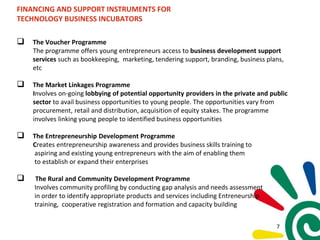
FINANCING AND SUPPORT INSTRUMENTS FOR
TECHNOLOGY BUSINESS INCUBATORS
 The Voucher Programme
The programme offers young entrepreneurs access to business development support
services such as bookkeeping, marketing, tendering support, branding, business plans,
etc
 The Market Linkages Programme
Involves on-going lobbying of potential opportunity providers in the private and public
sector to avail business opportunities to young people. The opportunities vary from
procurement, retail and distribution, acquisition of equity stakes. The programme
involves linking young people to identified business opportunities
 The Entrepreneurship Development Programme
Creates entrepreneurship awareness and provides business skills training to
aspiring and existing young entrepreneurs with the aim of enabling them
to establish or expand their enterprises
 The Rural and Community Development Programme
Involves community profiling by conducting gap analysis and needs assessment
in order to identify appropriate products and services including Entreneurship
training, cooperative registration and formation and capacity building
7
FINANCING AND SUPPORT INSTRUMENTS FOR
TECHNOLOGY BUSINESS INCUBATORS
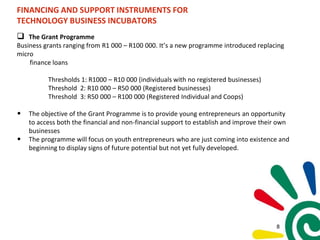
 The Grant Programme
Business grants ranging from R1 000 – R100 000. It’s a new programme introduced replacing
micro
finance loans
Thresholds 1: R1000 – R10 000 (individuals with no registered businesses)
Threshold 2: R10 000 – R50 000 (Registered businesses)
Threshold 3: R50 000 – R100 000 (Registered Individual and Coops)
• The objective of the Grant Programme is to provide young entrepreneurs an opportunity
to access both the financial and non-financial support to establish and improve their own
businesses
• The programme will focus on youth entrepreneurs who are just coming into existence and
beginning to display signs of future potential but not yet fully developed.
8
FINANCING AND SUPPORT INSTRUMENTS FOR
TECHNOLOGY BUSINESS INCUBATORS
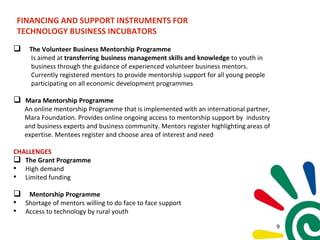
 The Volunteer Business Mentorship Programme
Is aimed at transferring business management skills and knowledge to youth in
business through the guidance of experienced volunteer business mentors.
Currently registered mentors to provide mentorship support for all young people
participating on all economic development programmes
 Mara Mentorship Programme
An online mentorship Programme that is implemented with an international partner,
Mara Foundation. Provides online ongoing access to mentorship support by industry
and business experts and business community. Mentors register highlighting areas of
expertise. Mentees register and choose area of interest and need
CHALLENGES
 The Grant Programme
• High demand
• Limited funding
 Mentorship Programme
• Shortage of mentors willing to do face to face support
• Access to technology by rural youth
9
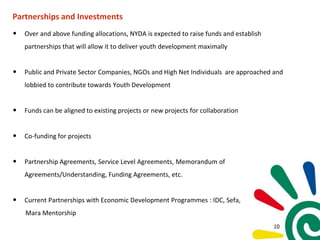
• Over and above funding allocations, NYDA is expected to raise funds and establish
partnerships that will allow it to deliver youth development maximally
• Public and Private Sector Companies, NGOs and High Net Individuals are approached and
lobbied to contribute towards Youth Development
• Funds can be aligned to existing projects or new projects for collaboration
• Co-funding for projects
• Partnership Agreements, Service Level Agreements, Memorandum of
Agreements/Understanding, Funding Agreements, etc.
• Current Partnerships with Economic Development Programmes : IDC, Sefa,
Mara Mentorship
10
Partnerships and Investments
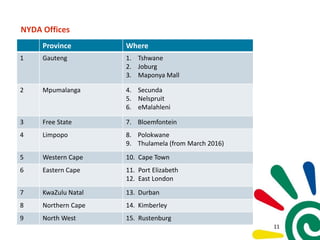
NYDA Offices
11
Province Where
1 Gauteng 1. Tshwane
2. Joburg
3. Maponya Mall
2 Mpumalanga 4. Secunda
5. Nelspruit
6. eMalahleni
3 Free State 7. Bloemfontein
4 Limpopo 8. Polokwane
9. Thulamela (from March 2016)
5 Western Cape 10. Cape Town
6 Eastern Cape 11. Port Elizabeth
12. East London
7 KwaZulu Natal 13. Durban
8 Northern Cape 14. Kimberley
9 North West 15. Rustenburg
CONCLUSION
• Strategic partnerships will go a long way in investing in the future of our
country “the youth”
RE A LEBOHA
12

Nyada

  • 1.
    “Youth moving SouthAfrica forward” NYDA Presentation template/Rev02
  • 2.
    PROFILE • The NationalYouth Development Agency (NYDA) was established in 2009 following a merger between Umsobomvu Youth Fund and the National Youth Commission. • The NYDA was formally launched on 16 June 2009, as pronounced by His Excellency President Jacob G Zuma in his 2009 State of the Nation Address. • The Agency derives its mandate from the legislative frameworks, including the NYDA Act (54 of 2008), the National Youth Policy (2009 -2014) and the draft Integrated Youth Development Strategy. • The Act requires and legitimizes the NYDA to conduct the Status of the Youth report/research that happens after every three years • The NYDA is the only state entity in the country that reports to the Presidency through the Minister of Performance, Monitoring and Evaluation 1
  • 3.
    VISION, MISSION, VALUES& STRATEGIC SHIFT Vision To be a Credible and Capable Development Agency for South Africa's Youth. Mission • To mainstream youth issues into society; and • To Facilitate youth development with all sectors of society Values • Excellence • Honesty and Integrity • Respect • Care • Punctuality and Timeliness NYDA’s New Focus • The National Youth Development Agency has shifted its core business away from Enterprise Finance towards Education and Skills Development. 2
  • 4.
    KEY PERFORMANCE AREAS 1.ECONOMIC PARTICIPATION To enhance the participation of young people in the economy through targeted and integrated programmes. 2. EDUCATION AND SKILLS DEVELOPMENT To promote, facilitate and provide training and development opportunities to young people to enhance their socio-economic wellbeing. 3. HEALTH AND WELL-BEING To improve the health and wellbeing of young people to allow them to productively lead fulfilling socio-economic lives associated with a responsible and sustainable nation. 4. POLICY AND RESEARCH To Develop a body of knowledge and best practice in the youth development sector to inform and influence policy development, planning and implementation. 5. GOVERNANCE AND ADMINISTRATION Ensures that NYDA operations comply with applicable legislation and regulations governing a schedule 3A institution 3
  • 5.
    BENEFICIARIES & TARGETAUDIENCES • The NYDA is targeted at youth aged between 14 and 35 years; • South African youth irrespective of race, gender, colour, creed, geographical location or political affiliations We have a bias towards: • Youth in rural areas • Out of school youth • Young with Disabilities; • Young Women and; • Unemployed youth • Youth in conflict with the law We have a bias towards youth in: • Rural areas • Semi-rural • Peri-urban 4
  • 6.
    CRITERIA 1. Age 14– 35 years at the time of application; 2. Are South African citizens; 3. Resident within the borders of South Africa; 4. Business are operating within the borders of South Africa; 5. Potential skill appropriate for the enterprise that they conduct or intend to conduct; 6. Members of entities should comprise 100% South African youth citizen; 7. Are involved in the day-to-day operation and management of the business; 8. Operate either informally or formally; generally recognized as micro enterprises (e.g. street traders, vendors, emerging enterprises); 5
  • 7.
    NYDA PRODUCTS &SERVICES OFFERED ECONOMIC DVELOPMENT • Grant Programme • Volunteer Business Mentorship Programme • The Voucher Programme • Market Linkages • Rural and Community Development (including Cooperative Support) SKILLS DEVELOPMENT AND EDUCATION • Entrepreneurship Development Programme • Jobs database and matching service • Job Preparedness workshops • Career Guidance and Counselling services • Life skills training NATIONAL YOUTH SERVICE • National Youth Service Programme 6
  • 8.
    FINANCING AND SUPPORTINSTRUMENTS FOR TECHNOLOGY BUSINESS INCUBATORS  The Voucher Programme The programme offers young entrepreneurs access to business development support services such as bookkeeping, marketing, tendering support, branding, business plans, etc  The Market Linkages Programme Involves on-going lobbying of potential opportunity providers in the private and public sector to avail business opportunities to young people. The opportunities vary from procurement, retail and distribution, acquisition of equity stakes. The programme involves linking young people to identified business opportunities  The Entrepreneurship Development Programme Creates entrepreneurship awareness and provides business skills training to aspiring and existing young entrepreneurs with the aim of enabling them to establish or expand their enterprises  The Rural and Community Development Programme Involves community profiling by conducting gap analysis and needs assessment in order to identify appropriate products and services including Entreneurship training, cooperative registration and formation and capacity building 7
  • 9.
    FINANCING AND SUPPORTINSTRUMENTS FOR TECHNOLOGY BUSINESS INCUBATORS  The Grant Programme Business grants ranging from R1 000 – R100 000. It’s a new programme introduced replacing micro finance loans Thresholds 1: R1000 – R10 000 (individuals with no registered businesses) Threshold 2: R10 000 – R50 000 (Registered businesses) Threshold 3: R50 000 – R100 000 (Registered Individual and Coops) • The objective of the Grant Programme is to provide young entrepreneurs an opportunity to access both the financial and non-financial support to establish and improve their own businesses • The programme will focus on youth entrepreneurs who are just coming into existence and beginning to display signs of future potential but not yet fully developed. 8
  • 10.
    FINANCING AND SUPPORTINSTRUMENTS FOR TECHNOLOGY BUSINESS INCUBATORS  The Volunteer Business Mentorship Programme Is aimed at transferring business management skills and knowledge to youth in business through the guidance of experienced volunteer business mentors. Currently registered mentors to provide mentorship support for all young people participating on all economic development programmes  Mara Mentorship Programme An online mentorship Programme that is implemented with an international partner, Mara Foundation. Provides online ongoing access to mentorship support by industry and business experts and business community. Mentors register highlighting areas of expertise. Mentees register and choose area of interest and need CHALLENGES  The Grant Programme • High demand • Limited funding  Mentorship Programme • Shortage of mentors willing to do face to face support • Access to technology by rural youth 9
  • 11.
    • Over andabove funding allocations, NYDA is expected to raise funds and establish partnerships that will allow it to deliver youth development maximally • Public and Private Sector Companies, NGOs and High Net Individuals are approached and lobbied to contribute towards Youth Development • Funds can be aligned to existing projects or new projects for collaboration • Co-funding for projects • Partnership Agreements, Service Level Agreements, Memorandum of Agreements/Understanding, Funding Agreements, etc. • Current Partnerships with Economic Development Programmes : IDC, Sefa, Mara Mentorship 10 Partnerships and Investments
  • 12.
    NYDA Offices 11 Province Where 1Gauteng 1. Tshwane 2. Joburg 3. Maponya Mall 2 Mpumalanga 4. Secunda 5. Nelspruit 6. eMalahleni 3 Free State 7. Bloemfontein 4 Limpopo 8. Polokwane 9. Thulamela (from March 2016) 5 Western Cape 10. Cape Town 6 Eastern Cape 11. Port Elizabeth 12. East London 7 KwaZulu Natal 13. Durban 8 Northern Cape 14. Kimberley 9 North West 15. Rustenburg
  • 13.
    CONCLUSION • Strategic partnershipswill go a long way in investing in the future of our country “the youth” RE A LEBOHA 12