GROUP DYNAMICS AND TEAM
WORK IN NURSING EDUCATION
Nursingspark.blogspot.com
Definition of group
A social group is a give aggregate of people,
playing inter-related roles &recognized by themselves
or others as a unit of interaction.-Williams
Nursingspark.blogspot.com
CHARACTERISTICS OF A GROUP
 Each group has its own identity & structure.
 A group includes at least two or more people.
 Group members have a shared purpose or goal.
 Group members have a conscious identification with each
other.
 Group members need each other’s help to accomplish the
purposes for which they have organize.
 Group members influence, interact with each other.
 Every group has its own rules & norms members are
supposed to follow.
Nursingspark.blogspot.com
INDIVIDUALAND GROUPS
 An individual is a single unit in a group & a group is a
collection of many individuals with a common
purpose.
 Individuals & groups are reciprocal to each other
because without individuals groups cannot be formed
& individuals have no existence or cannot meet their
physical, psychological, social & spiritual needs
without groups of other individuals.
Nursingspark.blogspot.com
Classification of groups
Dwight Sanderson classification of social groups by
structure.
 Involuntary group
 Voluntary group
 Delegate group
Charles Cooley classification
 Primary group
 Secondary group
Nursingspark.blogspot.com
Georgehasenclassificationofgroupsonthebasisoftheirrel
ationshipwithothergroups.
 Unsocialgroup
 Pseudosocialgroup
 Antisocialgroup
 Prosocialgroup
Nursingspark.blogspot.com
TASKS OR ROLES OF AN
INDIVIDUAL IN A GROUP
 Initiator
 Information seeker
 Information giver
 Opinion seeker
 Elaborator
 Coordinator
 Orienteer
 Evaluator
 Energizer
 Procedural technician
 Recorder
 Group-building & maintenance roles
Nursingspark.blogspot.com
GROUP DYNAMICS
 Kurt Lewin, a social psychologist at the University of
Lowa, USA, was the creator of the term group
dynamics.
 Group dynamics is the study of groups & also a
general term for a group process.
 In organizational development or group dynamics, the
phrase group process refers to an insight into the
behavior of group members & to incline their
behaviors towards the achievement of group goals.
Nursingspark.blogspot.com
MEANING OF GROUP DYNAMICS
 Group dynamics is the study of activities or processes
that are responsible for various group phenomena.
 The word dynamics means ‘force’. Group dynamics
means the study of forces within a group. In an
organization or in a society, we can see groups, small
or large, working for the well-being.
 The social process by which people interact with each
other in small groups can be called group dynamism. A
group has certain common objectives and goals and
members are bound together with certain values and
culture.
Nursingspark.blogspot.com
PROCESS/STAGES OF GROUP
DEVELOPMENT/EVOLUTION:
 Group Development is a dynamic process.
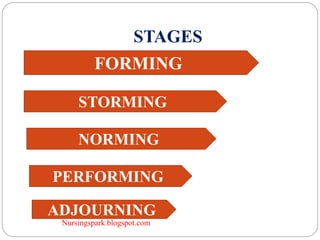
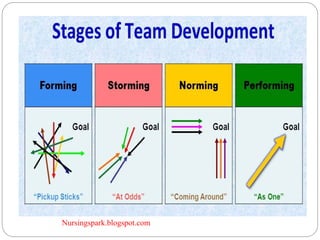
 Bruce Tuckman presented a model of five stages
Forming, Storming, Norming, Performing and
Adjourning in order to develop as a group.
Nursingspark.blogspot.com
STAGES
FORMING
STORMING
NORMING
PERFORMING
ADJOURNING
Nursingspark.blogspot.com
Orientation (Forming Stage)
 This stage presents a time where the group is just
starting to come together.
 Members are discreet with their behavior, which is
driven by their desire to be accepted by all members of
the group.
 Conflict, controversy, misunderstanding and personal
opinions are avoided
 At this stage, group members are learning what to do,
how the group is going to operate, what is expected,
and what is acceptable.
Nursingspark.blogspot.com
 Typical consequences of the forming stage include
achieving an understanding of the group's purpose,
determining how the team is going to be organized and
who will be responsible for what, discussion of major
milestones or phases of the group's goal, outlining
general group rules
Nursingspark.blogspot.com
Power Struggle (Storming Stage)
 The second stage of group development is the
storming stage. The storming stage is where dispute
and competition are at its greatest because now group
members have an understanding of the work and a
general feel of belongingness towards the group as
well as the group members.
 This is the stage where the dominating group members
emerge, while the less confrontational members stay in
their comfort zone.
Nursingspark.blogspot.com
 Questions around leadership, authority, rules, policies,
norms, responsibilities, structure, evaluation criteria
and reward systems tend to arise during the storming
stage.
 Such questions need to be answered so that the group
can move further on to the next stage.
Nursingspark.blogspot.com
Cooperation and Integration (Norming Stage)
 In this stage, the group becomes fun and enjoyable.
Group interaction are lot more easier, more
cooperative, and productive, with weighed give and
take, open communication, bonding, and mutual
respect.
 If there is a dispute or disruption, it’s comparatively
easy to be resolved and the group gets back on track.
 Group leadership is very important, but the facilitator
can step back a little and let group members take the
initiative and move forward together.
Nursingspark.blogspot.com
Synergy (Performing Stage)
 Once a group is clear about its needs, it can move
forward to the norming stage. This is the time where
the group becomes really united.
 At this stage, the morale is high as group members
actively acknowledge the talents, skills and experience
that each member brings to the group.
 A sense of belongingness is established and the group
remains focused on the group's purpose and goal.
Nursingspark.blogspot.com
 Members are flexible, interdependent, and trust each
other.
 Leadership is distributive and members are willing to
adapt according to the needs of the group.
Nursingspark.blogspot.com
Closure (Adjourning Stage)
 This stage of a group can be confusing and is usually
reached when the task is successfully completed.
 At this stage, the project is coming to an end and the
team members are moving off in different directions.
 This stage looks at the team from the perspective of the
well-being of the team instead of the perspective of
handling a team through the original four stages of
team growth.
Nursingspark.blogspot.com
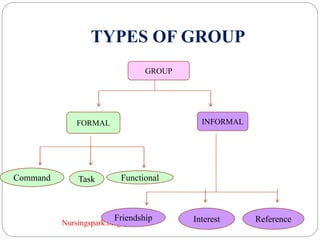
TYPES OF GROUP
GROUP
FORMAL INFORMAL
Command Task Functional
Friendship Interest Reference
Nursingspark.blogspot.com
FORMAL GROUP
 Formal groups are established by an organization to
achieve its goals
 Formal groups may take the form of command groups,
task groups, and functional groups.
1. Command Groups:
 Command groups are specified by the organizational
chart and often consist of a supervisor and the
subordinates that report to that supervisor.
 An example of a command group is a market research
firm CEO and the research associates under him.
Nursingspark.blogspot.com
2. Task Groups:
 Task groups consist of people who work together to achieve
a common task.
 Members are brought together to accomplish a narrow
range of goals within a specified time period.
 Task groups are also commonly referred to as task forces.
 The organization appoints members and assigns the goals
and tasks to be accomplished.
Nursingspark.blogspot.com
3. Functional Groups:
 A functional group is created by the organization to
accomplish specific goals within an unspecified time
frame. Functional groups remain in existence after
achievement of current goals and objectives.
Nursingspark.blogspot.com
INFORMAL GROUP
Informal groups can take the form of interest groups,
friendship groups, or reference groups.
1. Interest Group:
 Interest groups usually continue over time and may
last longer than general informal groups. Members of
interest groups may not be part of the same
organizational department but they are bound together
by some other common interest.
Nursingspark.blogspot.com
2. Friendship Groups:
 Friendship groups are formed by members who enjoy
similar social activities, political beliefs, religious
values, or other common bonds. Members enjoy each
other’s company and often meet after work to
participate in these activities.
Nursingspark.blogspot.com
3. Reference Groups:
 A reference group is a type of group that people use to
evaluate themselves. The main objectives of reference
groups are to seek social validation and social
comparison. Social validation allows individuals to
justify their attitudes and values while social
comparison helps individuals evaluate their own
actions by comparing themselves to others. Reference
groups have a strong influence on members’ behavior.
Nursingspark.blogspot.com
FACTORS AFFECTING GROUP
BEHAVIOUR
The success or failure of a group depends upon so many
factors.
 Group member resources
 structure (group size, group roles, group norms, and
group cohesiveness)
 group processes (the communication, group decision
making processes, power dynamics, conflicting
interactions, etc.)
 group tasks (complexity and interdependence).
Nursingspark.blogspot.com
TURNING GROUPS INTO
EFFECTIVE TEAMS:
All teams are groups but not all groups are
teams. Teams often are difficult to form because it
takes time for members to learn how to work together.
People in every workplace talk about building the
team, working as a team, and my team, but few
understand how to create the experience of team work
or how to develop an effective team.
Nursingspark.blogspot.com
DIFFERENCE BETWEEN GROUP
AND TEAM
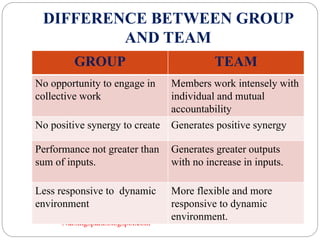
GROUP TEAM
No opportunity to engage in
collective work
Members work intensely with
individual and mutual
accountability
No positive synergy to create Generates positive synergy
Performance not greater than
sum of inputs.
Generates greater outputs
with no increase in inputs.
Less responsive to dynamic
environment
More flexible and more
responsive to dynamic
environment.
Nursingspark.blogspot.com
TYPES OF TEAM
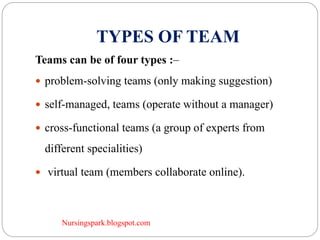
Teams can be of four types :–
 problem-solving teams (only making suggestion)
 self-managed, teams (operate without a manager)
 cross-functional teams (a group of experts from
different specialities)
 virtual team (members collaborate online).
Nursingspark.blogspot.com
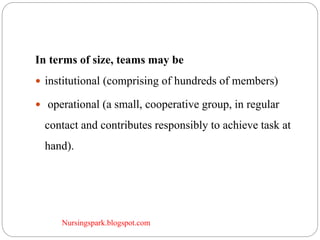
In terms of size, teams may be
 institutional (comprising of hundreds of members)
 operational (a small, cooperative group, in regular
contact and contributes responsibly to achieve task at
hand).
Nursingspark.blogspot.com
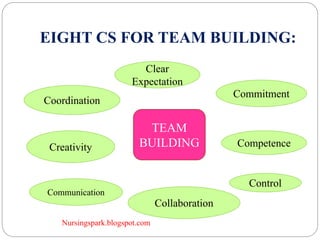
EIGHT CS FOR TEAM BUILDING:
Clear
Expectation
Commitment
Coordination
Creativity
Communication
Collaboration
Competence
Control
TEAM
BUILDING
Nursingspark.blogspot.com
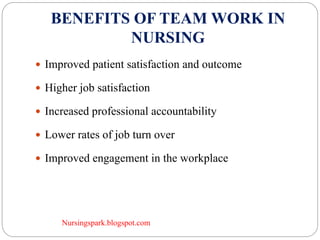
BENEFITS OF TEAM WORK IN
NURSING
 Improved patient satisfaction and outcome
 Higher job satisfaction
 Increased professional accountability
 Lower rates of job turn over
 Improved engagement in the workplace
Nursingspark.blogspot.com
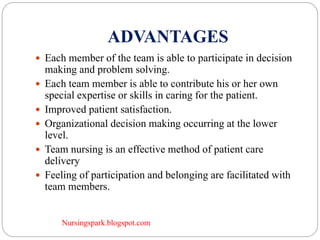
ADVANTAGES
 Each member of the team is able to participate in decision
making and problem solving.
 Each team member is able to contribute his or her own
special expertise or skills in caring for the patient.
 Improved patient satisfaction.
 Organizational decision making occurring at the lower
level.
 Team nursing is an effective method of patient care
delivery
 Feeling of participation and belonging are facilitated with
team members.
Nursingspark.blogspot.com
 Work load can be balanced and shared and allows
members the opportunity to develop leadership skills.
 Every team member has the opportunity to learn from
and teach colleagues
 Interest in client’s care is shared by several people,
reliability of decisions is increased.
 Continuity of care is facilitated, especially if teams are
constant.
 Barriers between professional and non-professional
workers can be minimized, the group efforts prevail.
Nursingspark.blogspot.com
DISADVANTAGES
 Establishing a team concept takes time, effort and
constancy of personnel.
 Unstable staffing pattern make team nursing difficult.
 There is less individual responsibility regarding
nursing functions.
 Continuity of care may suffer if the daily team
assignments vary
 Insufficient time for care planning and communication
may lead to unclear goals.
 Therefore, responsibilities and care may become
fragmented.

Human Relation in Nursing - Group dynamics& Team work

  • 1.
    GROUP DYNAMICS ANDTEAM WORK IN NURSING EDUCATION
  • 2.
    Nursingspark.blogspot.com Definition of group Asocial group is a give aggregate of people, playing inter-related roles &recognized by themselves or others as a unit of interaction.-Williams
  • 3.
    Nursingspark.blogspot.com CHARACTERISTICS OF AGROUP  Each group has its own identity & structure.  A group includes at least two or more people.  Group members have a shared purpose or goal.  Group members have a conscious identification with each other.  Group members need each other’s help to accomplish the purposes for which they have organize.  Group members influence, interact with each other.  Every group has its own rules & norms members are supposed to follow.
  • 4.
    Nursingspark.blogspot.com INDIVIDUALAND GROUPS  Anindividual is a single unit in a group & a group is a collection of many individuals with a common purpose.  Individuals & groups are reciprocal to each other because without individuals groups cannot be formed & individuals have no existence or cannot meet their physical, psychological, social & spiritual needs without groups of other individuals.
  • 5.
    Nursingspark.blogspot.com Classification of groups DwightSanderson classification of social groups by structure.  Involuntary group  Voluntary group  Delegate group Charles Cooley classification  Primary group  Secondary group
  • 6.
  • 7.
    Nursingspark.blogspot.com TASKS OR ROLESOF AN INDIVIDUAL IN A GROUP  Initiator  Information seeker  Information giver  Opinion seeker  Elaborator  Coordinator  Orienteer  Evaluator  Energizer  Procedural technician  Recorder  Group-building & maintenance roles
  • 8.
    Nursingspark.blogspot.com GROUP DYNAMICS  KurtLewin, a social psychologist at the University of Lowa, USA, was the creator of the term group dynamics.  Group dynamics is the study of groups & also a general term for a group process.  In organizational development or group dynamics, the phrase group process refers to an insight into the behavior of group members & to incline their behaviors towards the achievement of group goals.
  • 9.
    Nursingspark.blogspot.com MEANING OF GROUPDYNAMICS  Group dynamics is the study of activities or processes that are responsible for various group phenomena.  The word dynamics means ‘force’. Group dynamics means the study of forces within a group. In an organization or in a society, we can see groups, small or large, working for the well-being.  The social process by which people interact with each other in small groups can be called group dynamism. A group has certain common objectives and goals and members are bound together with certain values and culture.
  • 10.
    Nursingspark.blogspot.com PROCESS/STAGES OF GROUP DEVELOPMENT/EVOLUTION: Group Development is a dynamic process.  Bruce Tuckman presented a model of five stages Forming, Storming, Norming, Performing and Adjourning in order to develop as a group.
  • 11.
  • 12.
    Nursingspark.blogspot.com Orientation (Forming Stage) This stage presents a time where the group is just starting to come together.  Members are discreet with their behavior, which is driven by their desire to be accepted by all members of the group.  Conflict, controversy, misunderstanding and personal opinions are avoided  At this stage, group members are learning what to do, how the group is going to operate, what is expected, and what is acceptable.
  • 13.
    Nursingspark.blogspot.com  Typical consequencesof the forming stage include achieving an understanding of the group's purpose, determining how the team is going to be organized and who will be responsible for what, discussion of major milestones or phases of the group's goal, outlining general group rules
  • 14.
    Nursingspark.blogspot.com Power Struggle (StormingStage)  The second stage of group development is the storming stage. The storming stage is where dispute and competition are at its greatest because now group members have an understanding of the work and a general feel of belongingness towards the group as well as the group members.  This is the stage where the dominating group members emerge, while the less confrontational members stay in their comfort zone.
  • 15.
    Nursingspark.blogspot.com  Questions aroundleadership, authority, rules, policies, norms, responsibilities, structure, evaluation criteria and reward systems tend to arise during the storming stage.  Such questions need to be answered so that the group can move further on to the next stage.
  • 16.
    Nursingspark.blogspot.com Cooperation and Integration(Norming Stage)  In this stage, the group becomes fun and enjoyable. Group interaction are lot more easier, more cooperative, and productive, with weighed give and take, open communication, bonding, and mutual respect.  If there is a dispute or disruption, it’s comparatively easy to be resolved and the group gets back on track.  Group leadership is very important, but the facilitator can step back a little and let group members take the initiative and move forward together.
  • 17.
    Nursingspark.blogspot.com Synergy (Performing Stage) Once a group is clear about its needs, it can move forward to the norming stage. This is the time where the group becomes really united.  At this stage, the morale is high as group members actively acknowledge the talents, skills and experience that each member brings to the group.  A sense of belongingness is established and the group remains focused on the group's purpose and goal.
  • 18.
    Nursingspark.blogspot.com  Members areflexible, interdependent, and trust each other.  Leadership is distributive and members are willing to adapt according to the needs of the group.
  • 19.
    Nursingspark.blogspot.com Closure (Adjourning Stage) This stage of a group can be confusing and is usually reached when the task is successfully completed.  At this stage, the project is coming to an end and the team members are moving off in different directions.  This stage looks at the team from the perspective of the well-being of the team instead of the perspective of handling a team through the original four stages of team growth.
  • 20.
    Nursingspark.blogspot.com TYPES OF GROUP GROUP FORMALINFORMAL Command Task Functional Friendship Interest Reference
  • 21.
    Nursingspark.blogspot.com FORMAL GROUP  Formalgroups are established by an organization to achieve its goals  Formal groups may take the form of command groups, task groups, and functional groups. 1. Command Groups:  Command groups are specified by the organizational chart and often consist of a supervisor and the subordinates that report to that supervisor.  An example of a command group is a market research firm CEO and the research associates under him.
  • 22.
    Nursingspark.blogspot.com 2. Task Groups: Task groups consist of people who work together to achieve a common task.  Members are brought together to accomplish a narrow range of goals within a specified time period.  Task groups are also commonly referred to as task forces.  The organization appoints members and assigns the goals and tasks to be accomplished.
  • 23.
    Nursingspark.blogspot.com 3. Functional Groups: A functional group is created by the organization to accomplish specific goals within an unspecified time frame. Functional groups remain in existence after achievement of current goals and objectives.
  • 24.
    Nursingspark.blogspot.com INFORMAL GROUP Informal groupscan take the form of interest groups, friendship groups, or reference groups. 1. Interest Group:  Interest groups usually continue over time and may last longer than general informal groups. Members of interest groups may not be part of the same organizational department but they are bound together by some other common interest.
  • 25.
    Nursingspark.blogspot.com 2. Friendship Groups: Friendship groups are formed by members who enjoy similar social activities, political beliefs, religious values, or other common bonds. Members enjoy each other’s company and often meet after work to participate in these activities.
  • 26.
    Nursingspark.blogspot.com 3. Reference Groups: A reference group is a type of group that people use to evaluate themselves. The main objectives of reference groups are to seek social validation and social comparison. Social validation allows individuals to justify their attitudes and values while social comparison helps individuals evaluate their own actions by comparing themselves to others. Reference groups have a strong influence on members’ behavior.
  • 27.
    Nursingspark.blogspot.com FACTORS AFFECTING GROUP BEHAVIOUR Thesuccess or failure of a group depends upon so many factors.  Group member resources  structure (group size, group roles, group norms, and group cohesiveness)  group processes (the communication, group decision making processes, power dynamics, conflicting interactions, etc.)  group tasks (complexity and interdependence).
  • 28.
    Nursingspark.blogspot.com TURNING GROUPS INTO EFFECTIVETEAMS: All teams are groups but not all groups are teams. Teams often are difficult to form because it takes time for members to learn how to work together. People in every workplace talk about building the team, working as a team, and my team, but few understand how to create the experience of team work or how to develop an effective team.
  • 29.
    Nursingspark.blogspot.com DIFFERENCE BETWEEN GROUP ANDTEAM GROUP TEAM No opportunity to engage in collective work Members work intensely with individual and mutual accountability No positive synergy to create Generates positive synergy Performance not greater than sum of inputs. Generates greater outputs with no increase in inputs. Less responsive to dynamic environment More flexible and more responsive to dynamic environment.
  • 30.
    Nursingspark.blogspot.com TYPES OF TEAM Teamscan be of four types :–  problem-solving teams (only making suggestion)  self-managed, teams (operate without a manager)  cross-functional teams (a group of experts from different specialities)  virtual team (members collaborate online).
  • 31.
    Nursingspark.blogspot.com In terms ofsize, teams may be  institutional (comprising of hundreds of members)  operational (a small, cooperative group, in regular contact and contributes responsibly to achieve task at hand).
  • 32.
    Nursingspark.blogspot.com EIGHT CS FORTEAM BUILDING: Clear Expectation Commitment Coordination Creativity Communication Collaboration Competence Control TEAM BUILDING
  • 33.
  • 34.
    Nursingspark.blogspot.com BENEFITS OF TEAMWORK IN NURSING  Improved patient satisfaction and outcome  Higher job satisfaction  Increased professional accountability  Lower rates of job turn over  Improved engagement in the workplace
  • 35.
    Nursingspark.blogspot.com ADVANTAGES  Each memberof the team is able to participate in decision making and problem solving.  Each team member is able to contribute his or her own special expertise or skills in caring for the patient.  Improved patient satisfaction.  Organizational decision making occurring at the lower level.  Team nursing is an effective method of patient care delivery  Feeling of participation and belonging are facilitated with team members.
  • 36.
    Nursingspark.blogspot.com  Work loadcan be balanced and shared and allows members the opportunity to develop leadership skills.  Every team member has the opportunity to learn from and teach colleagues  Interest in client’s care is shared by several people, reliability of decisions is increased.  Continuity of care is facilitated, especially if teams are constant.  Barriers between professional and non-professional workers can be minimized, the group efforts prevail.
  • 37.
    Nursingspark.blogspot.com DISADVANTAGES  Establishing ateam concept takes time, effort and constancy of personnel.  Unstable staffing pattern make team nursing difficult.  There is less individual responsibility regarding nursing functions.  Continuity of care may suffer if the daily team assignments vary  Insufficient time for care planning and communication may lead to unclear goals.  Therefore, responsibilities and care may become fragmented.