Ecocriticism: Depiction in
Indian English Literature
By Nidhi Jethava
• Prepared by : Nidhi Jethava
• Batch : 20-22 MKBU English Department(Sem-3)
• Submitted : Department of English, MK Bhavnagar University.
• Paper : Cultural Studies (205)
• Roll Number : 13
• Enrollment Number : 3069206420200009
• Email Id : jethavanidhi8@gmail.com
What is Ecocriticism?
• Ecocriticism was a term coined in the late
1970s by combining “criticism” with a
shortened form of “ecology”—the science
that investigates the interrelations of all
forms of plant and animal life with each
other and with their physical habitats.
“Ecocriticism” (or by alternative names,
environmental criticism and green
studies) designates the critical writings
which explore the relations between
literature and the biological and physical
environment, conducted with an acute
awareness of the damage being wrought
on that environment by human
activities.(M.H. Abrams and Geoffrey Galt
Harpham.)
Eccritics ask questions such as:
• (1) How is nature represented in the novel/poem/play ?
(2) What role does the physical-geographical setting play in the
structure of the novel?
(3) How do our metaphors of the land influence the way we treat it?
That is, what is the link between pedagogic or creative practice and
actual political, sociocultural and ethical behavior towards the land
and other non-human life forms?
(4) How is science —in the form of genetic engineering, technologies
of reproduction, sexualities—open to critical scrutiny terms of the
effects of science upon the land? (Nasrullah Mambrol)
According Dr. Cynthia Catherine Michael
• There has always been a close
relationship between nature and
literature all over the world. Bond,
a true artist, like an ascetic, sees
the vision of paradise in the
sunlight and green of the earth, in
the beauty of the human face and
the wealth of human life even in
objects that are apparently
insignificant. Nature, life, sense,
forms, love and the secret of the
divine power are therefore the key
words to his credo as a writer.
Some of the interesting works by Bond
• The India I Love
• Our Trees Still Grow in Dehra
• The Road to the Bazaar
• Rain in the Mountains
• Panther’s Moon and Other Stories
According to Kumari Shikha
• When history is examined we find Raja Rao as one of the most prominent
writers of Indian English novels. His depiction of the South Indian village
culture and environmental setting is a true depiction of relationship
between man and nature.
• R. K. Narayan wrote in the same decade and has given life to a place,
Malgudi, or it can be said that he has developed a place as a character
which can be seen in almost all his prose fictions bearing the same
features.
• The other writer in whose work also we witness a reference to the Bengal
famine is Kamala Markandya in her novel ‘Nectar in Sieve’. ‘The Flood’,
which is taken from her novel, Nectar in Sieve’, has very well described the
control of nature over human beings. She writes “Nature is like a wild
animal that you have trained to work for you.
Continue
• The other prominent writer of this age in whose work we see the
dominance of nature images which act as important part of theme is
Anita Desai. Nature which includes animals, plants and birds, has a
strong presence in almost all her works. Known in Indian-English
fiction for ushering in the psychological novel, Desai uses external
landscapes to portray interior states of mind. Ex. ‘Cry, the Peacock’
• Rachel Azima’s theory of ecocriticism might have raised the eyebrows
of many writers but it indeed has led to inclusion of many novels
under this branch. She has tried to close the gap between
postcolonialism and ecocriticism by analyzing the texts that depict a
range of engagements with the environment and that complicates
and extend the notion of place-connectedness.
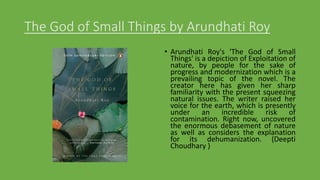
The God of Small Things by Arundhati Roy
• Arundhati Roy's 'The God of Small
Things' is a depiction of Exploitation of
nature, by people for the sake of
progress and modernization which is a
prevailing topic of the novel. The
creator here has given her sharp
familiarity with the present squeezing
natural issues. The writer raised her
voice for the earth, which is presently
under an incredible risk of
contamination. Right now, uncovered
the enormous debasement of nature
as well as considers the explanation
for its dehumanization. (Deepti
Choudhary )
R K Narayan’s works
Ali Rayhun Sarker observed
“R K Narayan’s The Man-eater of Malgudi is a fertile ground of applying
ecocriticism. To bring out the ecocritical connotation of this novel, it
must be considered as an allegory, and the symbolical indications must
be extended up to the issues of environmental disaster. The focal point
of this novel is the massive killing of animals and the ruthless process
of stuffing. The activities of taxidermy detailed here can be extended to
show the larger scale of environmental disruption. As hunting of
animals is an important issue here, the connection between hunting
and literature should be discussed briefly, and of course, it should be
seen by the lens of ecocriticism. “
Amitav Ghosh’s Novels
• Ghosh‘s novels are not only a substantial body of work which deals
with historical issues and social issues, but also show how the author
has dealt with the environmental issues from an ecological
perspective too. Ghosh himself has confessed in an interview that he
loves to write and be based on ideas what he would love to read, as
Binayak Roy (2011) recounts the words of Ghosh: ―
“I write the books that I want to read, about the things that interest
me. I am curious about the environment, about history, words and
language. The idea of writing a book where you leave those things out
5 seems boring because these are the textures that make life
interesting” (Sandhya. G)
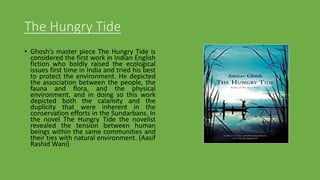
The Hungry Tide
• Ghosh’s master piece The Hungry Tide is
considered the first work in Indian English
fiction who boldly raised the ecological
issues first time in India and tried his best
to protect the environment. He depicted
the association between the people, the
fauna and flora, and the physical
environment, and in doing so this work
depicted both the calamity and the
duplicity that were inherent in the
conservation efforts in the Sundarbans. In
the novel The Hungry Tide the novelist
revealed the tension between human
beings within the same communities and
their ties with natural environment. (Aasif
Rashid Wani)
Ecocriticism in Indian English poetry
• Toru Dutt is one of the famous Indo-
Anglican poets. By birth she is an
Indian. Later, she went to France and
next to England. Finally, she returned
to India and learned Sanskrit. Though
she is a converted Christian, she wrote
a number of poems on Indian
mythical stories. Most of her poems
have an Indian theme and an Indian
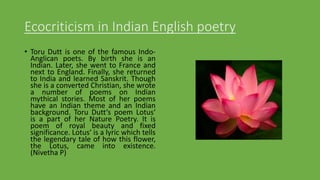
background. Toru Dutt‘s poem Lotus‘
is a part of her Nature Poetry. It is
poem of royal beauty and fixed
significance. Lotus‘ is a lyric which tells
the legendary tale of how this flower,
the Lotus, came into existence.
(Nivetha P)
Ecological Overtones in ‘A River’ by Attipate
Krishnaswami Ramanujan
• In the poem ‘The River‘ the narrator talks of the river Vaikai, flowing
through the ancient city of Madurai in the State of Tamil Nadu, in India. The
poet, A.K. Ramanujan brings out the truth about the river during summer,
and reminiscent about the flood and destruction caused by it. The river is
given spiritual significance and is considered holy in the past, and in the
present. Madurai, in this poem, has been sketched by the narrator, who
visits, to see the culture, but to him it is in a state of dissolution. He
observes that the poets, past and present only speak of the river during the
rains and floods; whereas, A.K. Ramanujan investigates the relation
between humans and the river in the everyday world. It shows how this
river, praised to have originated from the waters of the Ganges, has today
lost all its beauty and has become symbol of environmental and cultural
degradation. The poet‘s understanding of the environment is clearly noted
in this poem. (Nivetha P)
The poems which depict, the deterioration of
earth‘s environment and ecology.
1. Morning After a Storm‘ by H.L.V. Derozio
2. A River‘ by A.K. Ramanujan
3. On Killing a Tree‘ by Gieve Patel
4. The Ghaghra in Spate‘ by Keki N Daruwallah
Citation
• Abrams, M H, and Geoffrey G. Harpham. A Glossary of Literary Terms. Boston, Mass: Thomson Wadsworth, 1999.
• Choudhary, Deepti. "Environmental Issues in Indian English Fiction." Ignited Minds Journals May
2019: 6.
• G, Sandhya. An Ecocritical Reading Of Amitav Ghosh s Novels. 2017.
• Mambrol, Nasrullah. "Ecocriticism: An Essay." Literary Theory and Criticism 27 November 2016.
• Michael, Dr. Cynthia Catherine. "Man and Nature: The Everlasting Bond." SMART MOVES
JOURNAL IJELLH 9 September 2020: 11.
• P, Nivetha. "ECOLOGICAL OVERTONES IN SELECTED INDIAN ENGLISH POETRY." International
Journal of Advanced Research (2020): 6.
• Sarker, Ali Rayhun. "Ecocritical Analysis of R. K. Narayan’s The Maneater of Malgudi." Global
Journal of HUMAN-SOCIAL SCIENCE: A (2019): 7.
• Shikha, Kumari. "Ecocriticism in Indian Fiction." IRWLE VOL. 7 No. I (2011): 11.
• Wani, Aasif Rashid. "Ecocritical Concerns in Indian Writing in English." Electronic Research Journal
of Social Sciences and Humanities Apr-Jun 2 2019: 5.
Ecocriticism

Ecocriticism

  • 1.
    Ecocriticism: Depiction in IndianEnglish Literature By Nidhi Jethava
  • 2.
    • Prepared by: Nidhi Jethava • Batch : 20-22 MKBU English Department(Sem-3) • Submitted : Department of English, MK Bhavnagar University. • Paper : Cultural Studies (205) • Roll Number : 13 • Enrollment Number : 3069206420200009 • Email Id : jethavanidhi8@gmail.com
  • 3.
    What is Ecocriticism? •Ecocriticism was a term coined in the late 1970s by combining “criticism” with a shortened form of “ecology”—the science that investigates the interrelations of all forms of plant and animal life with each other and with their physical habitats. “Ecocriticism” (or by alternative names, environmental criticism and green studies) designates the critical writings which explore the relations between literature and the biological and physical environment, conducted with an acute awareness of the damage being wrought on that environment by human activities.(M.H. Abrams and Geoffrey Galt Harpham.)
  • 4.
    Eccritics ask questionssuch as: • (1) How is nature represented in the novel/poem/play ? (2) What role does the physical-geographical setting play in the structure of the novel? (3) How do our metaphors of the land influence the way we treat it? That is, what is the link between pedagogic or creative practice and actual political, sociocultural and ethical behavior towards the land and other non-human life forms? (4) How is science —in the form of genetic engineering, technologies of reproduction, sexualities—open to critical scrutiny terms of the effects of science upon the land? (Nasrullah Mambrol)
  • 5.
    According Dr. CynthiaCatherine Michael • There has always been a close relationship between nature and literature all over the world. Bond, a true artist, like an ascetic, sees the vision of paradise in the sunlight and green of the earth, in the beauty of the human face and the wealth of human life even in objects that are apparently insignificant. Nature, life, sense, forms, love and the secret of the divine power are therefore the key words to his credo as a writer.
  • 6.
    Some of theinteresting works by Bond • The India I Love • Our Trees Still Grow in Dehra • The Road to the Bazaar • Rain in the Mountains • Panther’s Moon and Other Stories
  • 7.
    According to KumariShikha • When history is examined we find Raja Rao as one of the most prominent writers of Indian English novels. His depiction of the South Indian village culture and environmental setting is a true depiction of relationship between man and nature. • R. K. Narayan wrote in the same decade and has given life to a place, Malgudi, or it can be said that he has developed a place as a character which can be seen in almost all his prose fictions bearing the same features. • The other writer in whose work also we witness a reference to the Bengal famine is Kamala Markandya in her novel ‘Nectar in Sieve’. ‘The Flood’, which is taken from her novel, Nectar in Sieve’, has very well described the control of nature over human beings. She writes “Nature is like a wild animal that you have trained to work for you.
  • 8.
    Continue • The otherprominent writer of this age in whose work we see the dominance of nature images which act as important part of theme is Anita Desai. Nature which includes animals, plants and birds, has a strong presence in almost all her works. Known in Indian-English fiction for ushering in the psychological novel, Desai uses external landscapes to portray interior states of mind. Ex. ‘Cry, the Peacock’ • Rachel Azima’s theory of ecocriticism might have raised the eyebrows of many writers but it indeed has led to inclusion of many novels under this branch. She has tried to close the gap between postcolonialism and ecocriticism by analyzing the texts that depict a range of engagements with the environment and that complicates and extend the notion of place-connectedness.
  • 9.
    The God ofSmall Things by Arundhati Roy • Arundhati Roy's 'The God of Small Things' is a depiction of Exploitation of nature, by people for the sake of progress and modernization which is a prevailing topic of the novel. The creator here has given her sharp familiarity with the present squeezing natural issues. The writer raised her voice for the earth, which is presently under an incredible risk of contamination. Right now, uncovered the enormous debasement of nature as well as considers the explanation for its dehumanization. (Deepti Choudhary )
  • 10.
    R K Narayan’sworks Ali Rayhun Sarker observed “R K Narayan’s The Man-eater of Malgudi is a fertile ground of applying ecocriticism. To bring out the ecocritical connotation of this novel, it must be considered as an allegory, and the symbolical indications must be extended up to the issues of environmental disaster. The focal point of this novel is the massive killing of animals and the ruthless process of stuffing. The activities of taxidermy detailed here can be extended to show the larger scale of environmental disruption. As hunting of animals is an important issue here, the connection between hunting and literature should be discussed briefly, and of course, it should be seen by the lens of ecocriticism. “
  • 11.
    Amitav Ghosh’s Novels •Ghosh‘s novels are not only a substantial body of work which deals with historical issues and social issues, but also show how the author has dealt with the environmental issues from an ecological perspective too. Ghosh himself has confessed in an interview that he loves to write and be based on ideas what he would love to read, as Binayak Roy (2011) recounts the words of Ghosh: ― “I write the books that I want to read, about the things that interest me. I am curious about the environment, about history, words and language. The idea of writing a book where you leave those things out 5 seems boring because these are the textures that make life interesting” (Sandhya. G)
  • 12.
    The Hungry Tide •Ghosh’s master piece The Hungry Tide is considered the first work in Indian English fiction who boldly raised the ecological issues first time in India and tried his best to protect the environment. He depicted the association between the people, the fauna and flora, and the physical environment, and in doing so this work depicted both the calamity and the duplicity that were inherent in the conservation efforts in the Sundarbans. In the novel The Hungry Tide the novelist revealed the tension between human beings within the same communities and their ties with natural environment. (Aasif Rashid Wani)
  • 13.
    Ecocriticism in IndianEnglish poetry • Toru Dutt is one of the famous Indo- Anglican poets. By birth she is an Indian. Later, she went to France and next to England. Finally, she returned to India and learned Sanskrit. Though she is a converted Christian, she wrote a number of poems on Indian mythical stories. Most of her poems have an Indian theme and an Indian background. Toru Dutt‘s poem Lotus‘ is a part of her Nature Poetry. It is poem of royal beauty and fixed significance. Lotus‘ is a lyric which tells the legendary tale of how this flower, the Lotus, came into existence. (Nivetha P)
  • 14.
    Ecological Overtones in‘A River’ by Attipate Krishnaswami Ramanujan • In the poem ‘The River‘ the narrator talks of the river Vaikai, flowing through the ancient city of Madurai in the State of Tamil Nadu, in India. The poet, A.K. Ramanujan brings out the truth about the river during summer, and reminiscent about the flood and destruction caused by it. The river is given spiritual significance and is considered holy in the past, and in the present. Madurai, in this poem, has been sketched by the narrator, who visits, to see the culture, but to him it is in a state of dissolution. He observes that the poets, past and present only speak of the river during the rains and floods; whereas, A.K. Ramanujan investigates the relation between humans and the river in the everyday world. It shows how this river, praised to have originated from the waters of the Ganges, has today lost all its beauty and has become symbol of environmental and cultural degradation. The poet‘s understanding of the environment is clearly noted in this poem. (Nivetha P)
  • 15.
    The poems whichdepict, the deterioration of earth‘s environment and ecology. 1. Morning After a Storm‘ by H.L.V. Derozio 2. A River‘ by A.K. Ramanujan 3. On Killing a Tree‘ by Gieve Patel 4. The Ghaghra in Spate‘ by Keki N Daruwallah
  • 16.
    Citation • Abrams, MH, and Geoffrey G. Harpham. A Glossary of Literary Terms. Boston, Mass: Thomson Wadsworth, 1999. • Choudhary, Deepti. "Environmental Issues in Indian English Fiction." Ignited Minds Journals May 2019: 6. • G, Sandhya. An Ecocritical Reading Of Amitav Ghosh s Novels. 2017. • Mambrol, Nasrullah. "Ecocriticism: An Essay." Literary Theory and Criticism 27 November 2016. • Michael, Dr. Cynthia Catherine. "Man and Nature: The Everlasting Bond." SMART MOVES JOURNAL IJELLH 9 September 2020: 11. • P, Nivetha. "ECOLOGICAL OVERTONES IN SELECTED INDIAN ENGLISH POETRY." International Journal of Advanced Research (2020): 6. • Sarker, Ali Rayhun. "Ecocritical Analysis of R. K. Narayan’s The Maneater of Malgudi." Global Journal of HUMAN-SOCIAL SCIENCE: A (2019): 7. • Shikha, Kumari. "Ecocriticism in Indian Fiction." IRWLE VOL. 7 No. I (2011): 11. • Wani, Aasif Rashid. "Ecocritical Concerns in Indian Writing in English." Electronic Research Journal of Social Sciences and Humanities Apr-Jun 2 2019: 5.