It’s not all about the tool!
Having both worked on large Business Change Programmes over the last 25 years, we will talk about how there is
a need for flexibility in terms of Programme Governance, depending on the scope of the Programme, the type of
organisation, and the nature of your Sponsors and Stakeholders..
It is never a ‘one size fits all’, but there is always a minimum level of Programme Governance required. Successful
Programmes will always have a great Team, People, and Communications, and appropriate governance. . A minimum level
of governance, and ‘less is more’ approach to ongoing Programme Control has to be the start point for the majority!
Programme Control
Nick Wilson - MD David Broom - MD
…‘Tools’ in relation to Programme Control?
 Reliance on an Enterprise PPM Software Solution to deliver successful Change Programmes
What do we mean by Enterprise PPM Software Solution?
 Approximately £100k Plus investment
 Manages all projects in an Organisation end to end
 Integrates with all other Business Systems (HR, Finance etc)
Wh at d o we mean by…
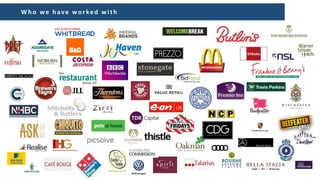
Wh o we h ave worked with
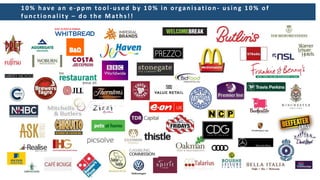
1 0 % h ave an e -p p m tool -u s ed by 1 0 % in o rgan is atio n - u s in g 1 0 % of
fu n ction ality – d o th e Math s !!
 Try to develop into a Project Maturity that is a step too far (and possibly not required)
 Engage with the whole business to develop requirements
 This leads to only an e-ppm solution meeting the requirements resulting in:
 Investing heavily (cost and time) and not realising the benefit, using minimum functionality, and only being
used by resources with advanced level Project Management skills
 Long lead times to implement across the whole organisation that the requirement has changed by the time
implementation has completed
 The journey of gathering requirements, selecting a solution, developing the business case fails at one of the
stages – back to manual processes
 Develop ‘in house’ because they’ve already got the license!
 A solution that will not realistically fit the different Business Change Programmes in the organisation
Common mistakes by th e maj ority
Disclaimer - Understand some Project driven industries require e-ppm solutions, but the majority don’t!
David Broom
Why am I h ere?
 Opportunity to pass on my views and experience of delivering major programmes over many
years to my clients
 Frustration of working with my peers and the emphasis and time they invest on using complex
tools to manage and communicate programmes of activity
 Share my approach and priorities when I start any new assignment
 Explain why the tool we decide to use is not, and should not be a major factor in delivering a
successful outcome
Wh at are my p riorities at th e start of a n ew p rogramme?
 Identify and appoint the Project Managers based on their:
 Ability and knowledge
 Sector experience
 Fit with the culture and values of the client organisation
 Fit with the nature and style of their stakeholders
 Establish a relationship with my stakeholders and sponsor
 Understand their style and approach
 Recognise their priorities
 Establish a “contract” for delivery and deliverables
Wh at are my p riorities at th e start of a n ew p rogramme?
 Develop a communication strategy based on:
 The organisation’s style and values
 The sponsors requirements
 Agreeing the minimum level of communication to satisfy the above
 Establish a fit for purpose governance model based on
 The organisation style and values
 The sponsors requirements
 A realistic view of how much time is available and required to maintain control
Wh at are my p riorities at th e start of a n ew p rogramme?
 Identify the tool or tools we will use to manage the programme
 Support the Governance model, not drive it
 Simplify the Programme control process
 Improve quality of Project meetings (discuss exceptions not status)
 Demonstrate a Professional approach with Sponsors/Stakeholders
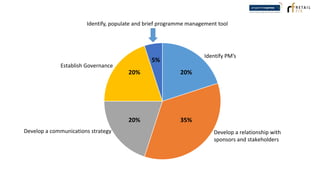
Develop a relationship with
sponsors and stakeholders
Develop a communications strategy
Establish Governance
Identify PM’s
Identify, populate and brief programme management tool
35%
20%
5%
20%
20%
My ex p erien ce
 I have to get the programme established as quickly as possible, therefore:
 I do not spend any time deciding which tool I should use to manage the programme
 I do not spend any time training or briefing my project managers on how to report at programme level
 My project managers are tasked with managing their individual projects with the necessary and
appropriate rigour and attention to detail, using whatever tools they deem necessary or are
comfortable using (Excel, MSP etc)
 I am tasked with providing a simple and consistent summary of the programme status for the
sponsors
My ex p erien ce
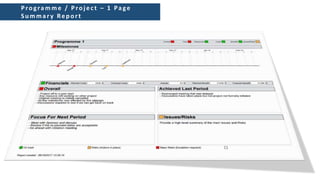
 One report has always been sufficient to achieve this goal, covering:
 Achievements and targets for next period
 High level milestones
 RAG status of each workstream / project
 Red risks and issues
 Decisions required
 I have never encountered a sponsor who has had to request more detail
Programme / Proj ect – 1 Page
Su mmar y Rep ort
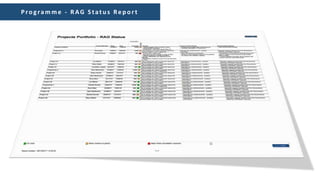
Programme - RAG Statu s Rep ort
Nick Wilson
Wh at are we s ayin g s o far?
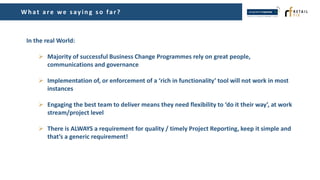
In the real World:
 Majority of successful Business Change Programmes rely on great people,
communications and governance
 Implementation of, or enforcement of a ‘rich in functionality’ tool will not work in most
instances
 Engaging the best team to deliver means they need flexibility to ‘do it their way’, at work
stream/project level
 There is ALWAYS a requirement for quality / timely Project Reporting, keep it simple and
that’s a generic requirement!
Wh at are we s ayin g s o far?
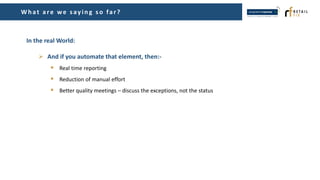
In the real World:
 And if you automate that element, then:-
 Real time reporting
 Reduction of manual effort
 Better quality meetings – discuss the exceptions, not the status
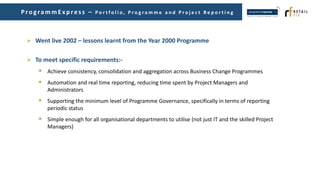
 Went live 2002 – lessons learnt from the Year 2000 Programme
 To meet specific requirements:-
 Achieve consistency, consolidation and aggregation across Business Change Programmes
 Automation and real time reporting, reducing time spent by Project Managers and
Administrators
 Supporting the minimum level of Programme Governance, specifically in terms of reporting
periodic status
 Simple enough for all organisational departments to utilise (not just IT and the skilled Project
Managers)
ProgrammEx p res s – P o r t f o l i o , P r o g r a m m e a n d P r o j e c t R e p o r t i n g
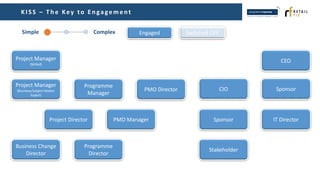
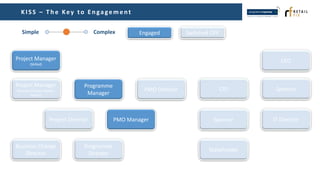
Simple Complex
Project Manager
(Skilled)
KI SS – T h e Key to En gagement
Engaged Switched OFF
Project Manager
(Business/Subject Matter
Expert)
Programme
Manager
Project Director
Programme
Director
Business Change
Director
PMO Director
PMO Manager
Stakeholder
Sponsor
CIO Sponsor
IT Director
CEO
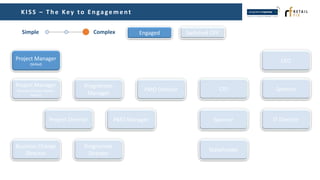
Simple Complex
Project Manager
(Skilled)
KI SS – T h e Key to En gagement
Engaged Switched OFF
Project Manager
(Business/Subject Matter
Expert)
Programme
Manager
Project Director
Programme
Director
Business Change
Director
PMO Director
PMO Manager
Stakeholder
Sponsor
CIO Sponsor
IT Director
CEO
Simple Complex
KI SS – T h e Key to En gagement
Engaged Switched OFF
Project Manager
(Skilled)
Project Manager
(Business/Subject Matter
Expert)
Programme
Manager
Project Director
Programme
Director
Business Change
Director
PMO Director
PMO Manager
Stakeholder
Sponsor
CIO Sponsor
IT Director
CEO
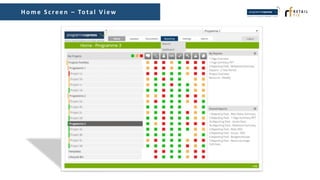
Home Screen – Total V iew
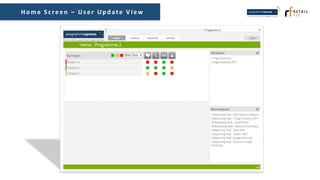
Home Screen – Us er Up d ate V iew
Wh at is ou r Key Mes s age?
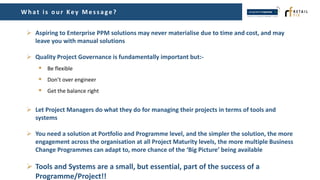
 Aspiring to Enterprise PPM solutions may never materialise due to time and cost, and may
leave you with manual solutions
 Quality Project Governance is fundamentally important but:-
 Be flexible
 Don’t over engineer
 Get the balance right
 Let Project Managers do what they do for managing their projects in terms of tools and
systems
 You need a solution at Portfolio and Programme level, and the simpler the solution, the more
engagement across the organisation at all Project Maturity levels, the more multiple Business
Change Programmes can adapt to, more chance of the ‘Big Picture’ being available
 Tools and Systems are a small, but essential, part of the success of a
Programme/Project!!
Q&AFurther Discussion – Stand 128
If you have a requirement for a ‘lite’ PPM Tool, and would like to discuss further,
contact Nick Wilson @ ProgrammExpress:-
Phone +44 (0)1908 586039
Email nick.wilson@programmexpress.co.uk
Website www.programmexpress.co.uk
If you have a requirement for IT/Business Change Strategy Consultancy and
would like to discuss further, contact David Broom @ Retail Fix:-
Phone +44 (0)1582 222588
Email david.broom@retailfix.co.uk
27

Programme control it's not all about the tool-11-10-17

  • 1.
    It’s not allabout the tool! Having both worked on large Business Change Programmes over the last 25 years, we will talk about how there is a need for flexibility in terms of Programme Governance, depending on the scope of the Programme, the type of organisation, and the nature of your Sponsors and Stakeholders.. It is never a ‘one size fits all’, but there is always a minimum level of Programme Governance required. Successful Programmes will always have a great Team, People, and Communications, and appropriate governance. . A minimum level of governance, and ‘less is more’ approach to ongoing Programme Control has to be the start point for the majority! Programme Control Nick Wilson - MD David Broom - MD
  • 2.
    …‘Tools’ in relationto Programme Control?  Reliance on an Enterprise PPM Software Solution to deliver successful Change Programmes What do we mean by Enterprise PPM Software Solution?  Approximately £100k Plus investment  Manages all projects in an Organisation end to end  Integrates with all other Business Systems (HR, Finance etc) Wh at d o we mean by…
  • 3.
    Wh o weh ave worked with
  • 4.
    1 0 %h ave an e -p p m tool -u s ed by 1 0 % in o rgan is atio n - u s in g 1 0 % of fu n ction ality – d o th e Math s !!
  • 5.
     Try todevelop into a Project Maturity that is a step too far (and possibly not required)  Engage with the whole business to develop requirements  This leads to only an e-ppm solution meeting the requirements resulting in:  Investing heavily (cost and time) and not realising the benefit, using minimum functionality, and only being used by resources with advanced level Project Management skills  Long lead times to implement across the whole organisation that the requirement has changed by the time implementation has completed  The journey of gathering requirements, selecting a solution, developing the business case fails at one of the stages – back to manual processes  Develop ‘in house’ because they’ve already got the license!  A solution that will not realistically fit the different Business Change Programmes in the organisation Common mistakes by th e maj ority Disclaimer - Understand some Project driven industries require e-ppm solutions, but the majority don’t!
  • 6.
  • 7.
    Why am Ih ere?  Opportunity to pass on my views and experience of delivering major programmes over many years to my clients  Frustration of working with my peers and the emphasis and time they invest on using complex tools to manage and communicate programmes of activity  Share my approach and priorities when I start any new assignment  Explain why the tool we decide to use is not, and should not be a major factor in delivering a successful outcome
  • 8.
    Wh at aremy p riorities at th e start of a n ew p rogramme?  Identify and appoint the Project Managers based on their:  Ability and knowledge  Sector experience  Fit with the culture and values of the client organisation  Fit with the nature and style of their stakeholders  Establish a relationship with my stakeholders and sponsor  Understand their style and approach  Recognise their priorities  Establish a “contract” for delivery and deliverables
  • 9.
    Wh at aremy p riorities at th e start of a n ew p rogramme?  Develop a communication strategy based on:  The organisation’s style and values  The sponsors requirements  Agreeing the minimum level of communication to satisfy the above  Establish a fit for purpose governance model based on  The organisation style and values  The sponsors requirements  A realistic view of how much time is available and required to maintain control
  • 10.
    Wh at aremy p riorities at th e start of a n ew p rogramme?  Identify the tool or tools we will use to manage the programme  Support the Governance model, not drive it  Simplify the Programme control process  Improve quality of Project meetings (discuss exceptions not status)  Demonstrate a Professional approach with Sponsors/Stakeholders
  • 11.
    Develop a relationshipwith sponsors and stakeholders Develop a communications strategy Establish Governance Identify PM’s Identify, populate and brief programme management tool 35% 20% 5% 20% 20%
  • 12.
    My ex perien ce  I have to get the programme established as quickly as possible, therefore:  I do not spend any time deciding which tool I should use to manage the programme  I do not spend any time training or briefing my project managers on how to report at programme level  My project managers are tasked with managing their individual projects with the necessary and appropriate rigour and attention to detail, using whatever tools they deem necessary or are comfortable using (Excel, MSP etc)  I am tasked with providing a simple and consistent summary of the programme status for the sponsors
  • 13.
    My ex perien ce  One report has always been sufficient to achieve this goal, covering:  Achievements and targets for next period  High level milestones  RAG status of each workstream / project  Red risks and issues  Decisions required  I have never encountered a sponsor who has had to request more detail
  • 14.
    Programme / Project – 1 Page Su mmar y Rep ort
  • 15.
    Programme - RAGStatu s Rep ort
  • 16.
  • 17.
    Wh at arewe s ayin g s o far? In the real World:  Majority of successful Business Change Programmes rely on great people, communications and governance  Implementation of, or enforcement of a ‘rich in functionality’ tool will not work in most instances  Engaging the best team to deliver means they need flexibility to ‘do it their way’, at work stream/project level  There is ALWAYS a requirement for quality / timely Project Reporting, keep it simple and that’s a generic requirement!
  • 18.
    Wh at arewe s ayin g s o far? In the real World:  And if you automate that element, then:-  Real time reporting  Reduction of manual effort  Better quality meetings – discuss the exceptions, not the status
  • 19.
     Went live2002 – lessons learnt from the Year 2000 Programme  To meet specific requirements:-  Achieve consistency, consolidation and aggregation across Business Change Programmes  Automation and real time reporting, reducing time spent by Project Managers and Administrators  Supporting the minimum level of Programme Governance, specifically in terms of reporting periodic status  Simple enough for all organisational departments to utilise (not just IT and the skilled Project Managers) ProgrammEx p res s – P o r t f o l i o , P r o g r a m m e a n d P r o j e c t R e p o r t i n g
  • 20.
    Simple Complex Project Manager (Skilled) KISS – T h e Key to En gagement Engaged Switched OFF Project Manager (Business/Subject Matter Expert) Programme Manager Project Director Programme Director Business Change Director PMO Director PMO Manager Stakeholder Sponsor CIO Sponsor IT Director CEO
  • 21.
    Simple Complex Project Manager (Skilled) KISS – T h e Key to En gagement Engaged Switched OFF Project Manager (Business/Subject Matter Expert) Programme Manager Project Director Programme Director Business Change Director PMO Director PMO Manager Stakeholder Sponsor CIO Sponsor IT Director CEO
  • 22.
    Simple Complex KI SS– T h e Key to En gagement Engaged Switched OFF Project Manager (Skilled) Project Manager (Business/Subject Matter Expert) Programme Manager Project Director Programme Director Business Change Director PMO Director PMO Manager Stakeholder Sponsor CIO Sponsor IT Director CEO
  • 23.
    Home Screen –Total V iew
  • 24.
    Home Screen –Us er Up d ate V iew
  • 25.
    Wh at isou r Key Mes s age?  Aspiring to Enterprise PPM solutions may never materialise due to time and cost, and may leave you with manual solutions  Quality Project Governance is fundamentally important but:-  Be flexible  Don’t over engineer  Get the balance right  Let Project Managers do what they do for managing their projects in terms of tools and systems  You need a solution at Portfolio and Programme level, and the simpler the solution, the more engagement across the organisation at all Project Maturity levels, the more multiple Business Change Programmes can adapt to, more chance of the ‘Big Picture’ being available  Tools and Systems are a small, but essential, part of the success of a Programme/Project!!
  • 26.
  • 27.
    If you havea requirement for a ‘lite’ PPM Tool, and would like to discuss further, contact Nick Wilson @ ProgrammExpress:- Phone +44 (0)1908 586039 Email nick.wilson@programmexpress.co.uk Website www.programmexpress.co.uk If you have a requirement for IT/Business Change Strategy Consultancy and would like to discuss further, contact David Broom @ Retail Fix:- Phone +44 (0)1582 222588 Email david.broom@retailfix.co.uk 27