March 17th 2017 - KUWAIT
Feasibility Study
FEASIBILTIY STUDY
Consultant
Management
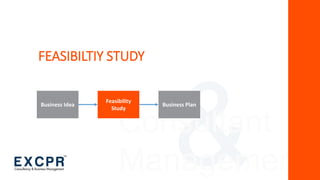
Business Idea
Feasibility
Study
Business Plan
Consultant
Management
Introduction
 A Feasibility Study is an integral part of cooperative business development.
 A Feasibility Study is an analytical tool used during a business development
process to show how a business would operate under a set of assumptions.
 It evaluates the project's potential for success.
 Taking a project from the initial idea through the operational stage is a complex
and time-consuming effort.
FEASIBILTIY STUDY
Consultant
Management
Introduction, cont.
 Before potential members invest in a proposed business project, they
must determine if it can be economically viable and then they must
decide if investment advantages outweigh the risks involved—a
Feasibility Study is the means by which these decisions are made.
 The Feasibility study occurs during the deliberation stage when the
focus is on whether to proceed with a project.
FEASIBILTIY STUDY
Consultant
Management
Introduction, cont.
 Without Feasibility Studies the percentage of startups that fail would be
higher.
 The rule of thumb for the Feasibility analysis step for most development
projects is 3 to 6 months.
 Some complex project required what we call “Pre-Feasibility” Study
done early in the project timeline to provide a first-cut evaluation of the
proposed business idea.
FEASIBILTIY STUDY
Consultant
Management
Introduction, cont.
 Preparing a Pre-Feasibility analysis may decrease the effort required to
complete the feasibility study and reduce the cost.
 Feasibility Studies are useful and valid for many kind of business
development projects.
 A Feasibility Study assists decision-makers whenever they need to
consider alternative development opportunities.
FEASIBILTIY STUDY
Consultant
Management
Introduction, cont.
 A Feasibility Study presents and clarifies the risks and returns associated
with the project so that prospective members can evaluate them.
 A Feasibility Study is not intended to identify new ideas or concepts for
a project. These ideas should be clearly identified before a study is
initiated.
FEASIBILTIY STUDY
Consultant
Management
Key actions
 Who will conduct the study, Consultant or Internal.
 Has previous experience conducting feasibility studies.
 Knowledge of the industry to be studied.
 Understands the local cooperatives (Operations, Governance, Customer, etc.).
 Provides clear, useful information in the completed study.
 Reasonableness of cost.
FEASIBILTIY STUDY
Consultant
Management
Key actions, cont.
 Project assumptions.
• It should be determined at the initial stage of the study.
• Consultant can be approach for setting such assumptions.
 Determining components for a comprehensive study.
 Accepting/rejecting the study.
FEASIBILTIY STUDY
Consultant
Management
FEASIBILITY STUDY
Executive summery
 It is the final stage of the study, thus it should be at the end.
 A summery of the study finding and recommendation.
 It should contain 200 words as maximum.
Consultant
Management
FEASIBILITY STUDY
Introduction
 General about the Feasibility Study.
 Project description and justification.
 Project requirements.
 Works already completed.
 No finding or conclusion in this stage.
Consultant
Management
FEASIBILITY STUDY
Strategic analysis
 Vision
The overall picture for the company in the future.
 Mission
Why the company exist and choose this market.
Consultant
Management
FEASIBILITY STUDY
Strategic analysis, cont.
 Values
The principle and standards of operation.
 Long/ short term objectives
Setting the company’s goals.
C
onsultant
FEASIBILITY STUDY
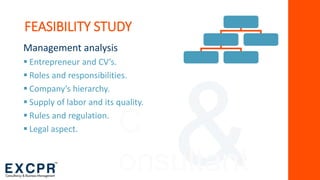
Management analysis
 Entrepreneur and CV’s.
 Roles and responsibilities.
 Company’s hierarchy.
 Supply of labor and its quality.
 Rules and regulation.
 Legal aspect.
Consultant
Management
FEASIBILITY STUDY
Operation analysis
 Production lines.
 Business idea.
 Business model.
 Raw material.
 Project location.
 Equipment's and tools.
 Suppliers.
Consultant
Management
FEASIBILITY STUDY
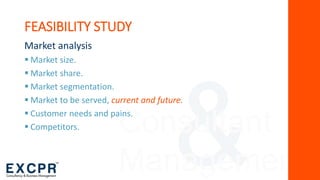
Market analysis
 Market size.
 Market share.
 Market segmentation.
 Market to be served, current and future.
 Customer needs and pains.
 Competitors.
Consultant
Management
FEASIBILITY STUDY
Market analysis, cont.
 Competitive advantages.
 SWOT analysis.
 Market plan.
Consultant
Management
FEASIBILITY STUDY
Marketing analysis
 Marketing costs.
 Expected sales.
 Branding and title.
 Customer relation and services .
 Media.
Consultant
Management
FEASIBILITY STUDY
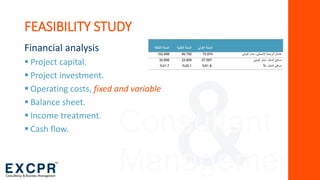
Financial analysis
 Project capital.
 Project investment.
 Operating costs, fixed and variable
 Balance sheet.
 Income treatment.
 Cash flow.
-72,67490,792102,898
--37,59722,80632,668
% --51.8%25.1%31.7%
Consultant
Management
FEASIBILITY STUDY
Financial analysis
 Break even analysis.
Break even (B/E) analysis is very effective Financial Feasibility test. B/E is used
to find the amount of sales required to pay all fixed costs.
 NPV, IRR and PBP.
Consultant
Management
FEASIBILITY STUDY
Recommendation and Conclusion
 Major finding.
 Summary.
 Recommendation.
 Conclusion.
Consultant
Management
FEASIBILITY STUDY
Reference
 Major finding.
Appendix
 Important supplemental information and data.
Consultant
Management
Discussion..
Consultant
Management
Thank You

Feasibility study presentation

Editor's Notes

  • #21 Break even (B/E) analysis is a simple, but very effective financial feasibility test. B/E is used to find the amount of sales necessary to pay all fixed costs (and have zero income.)