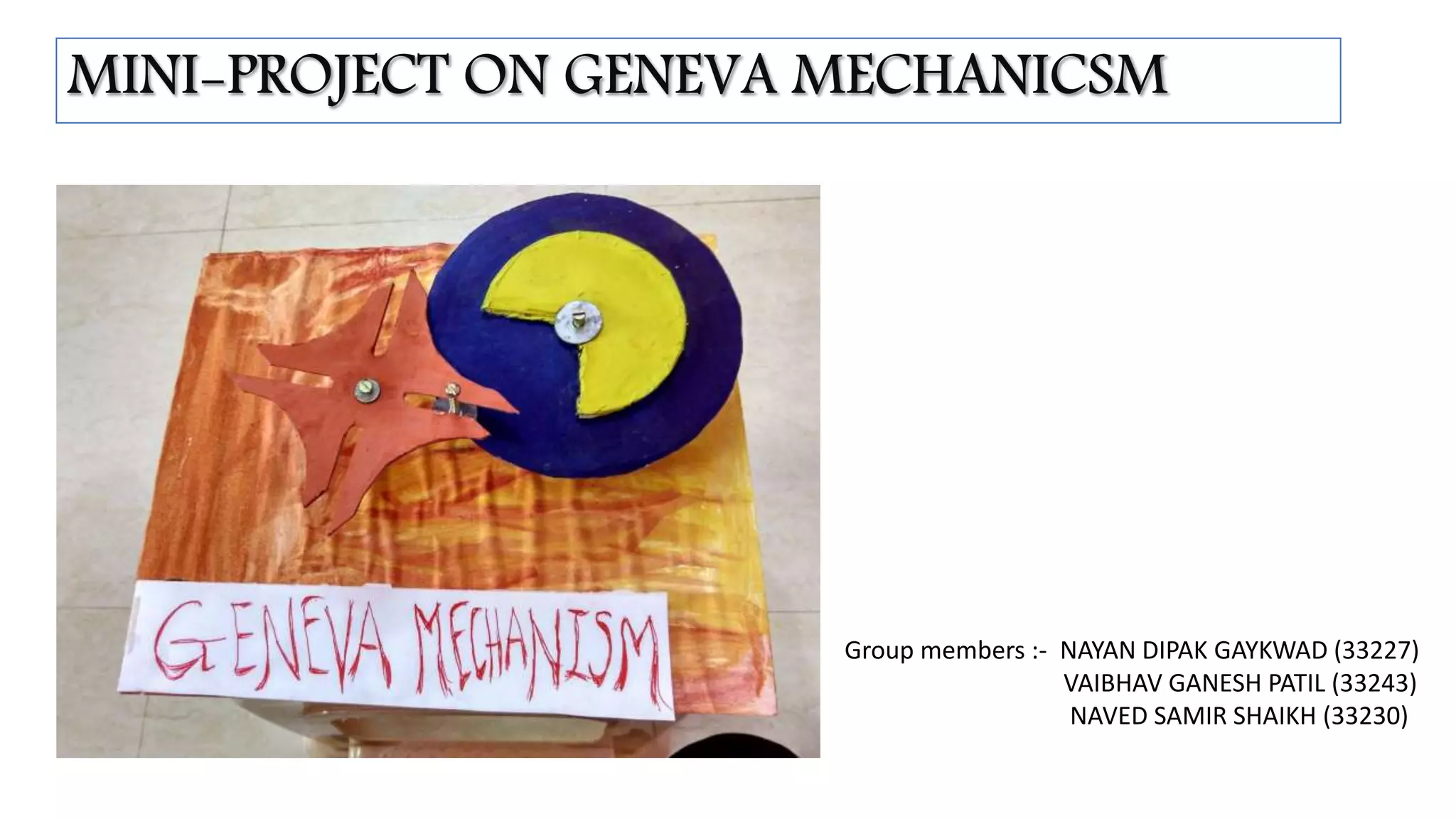
Group members :- NAYAN DIPAK GAYKWAD (33227)
VAIBHAV GANESH PATIL (33243)
NAVED SAMIR SHAIKH (33230)
Introduction
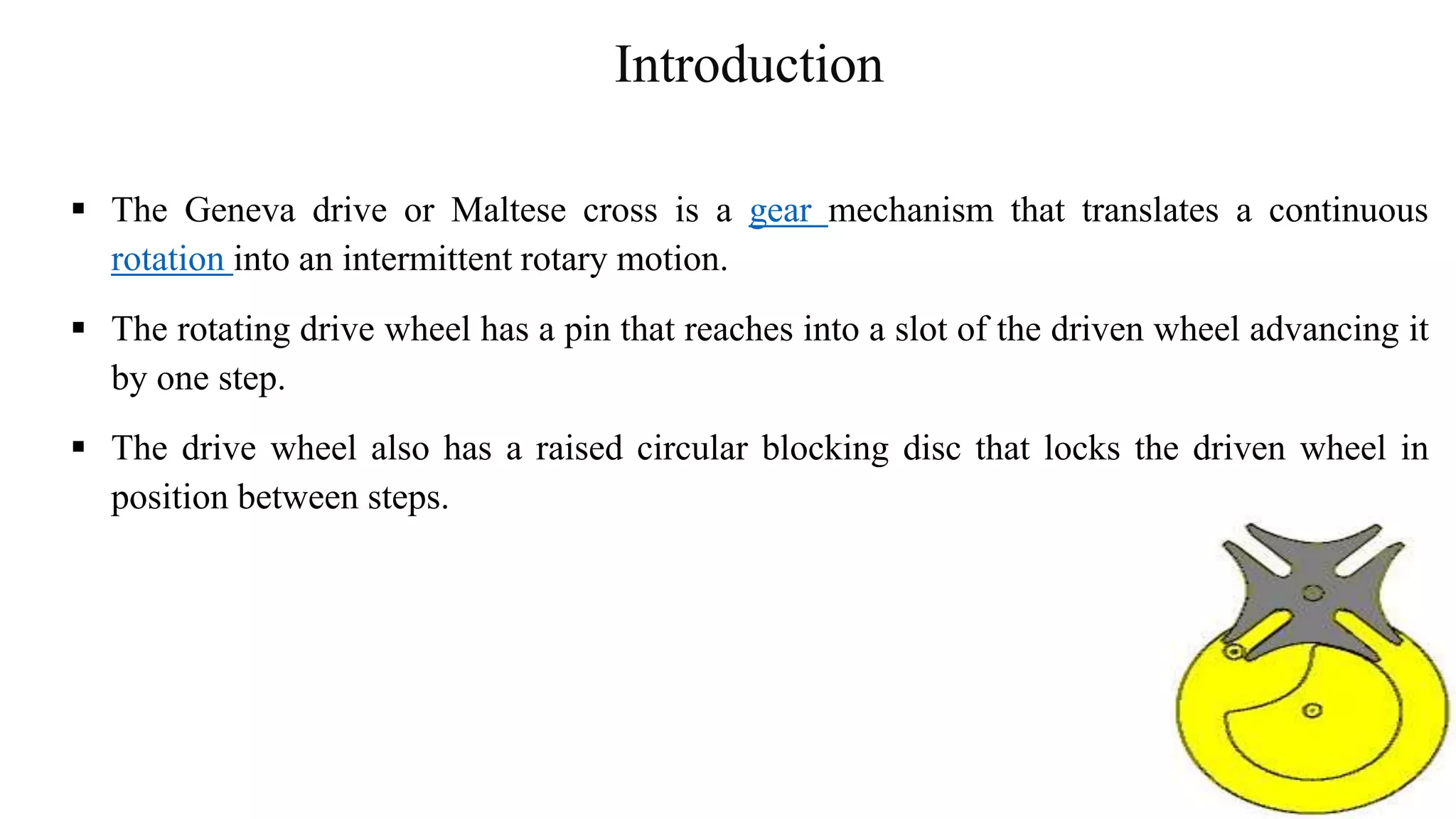
 The Geneva drive or Maltese cross is a gear mechanism that translates a continuous
rotation into an intermittent rotary motion.
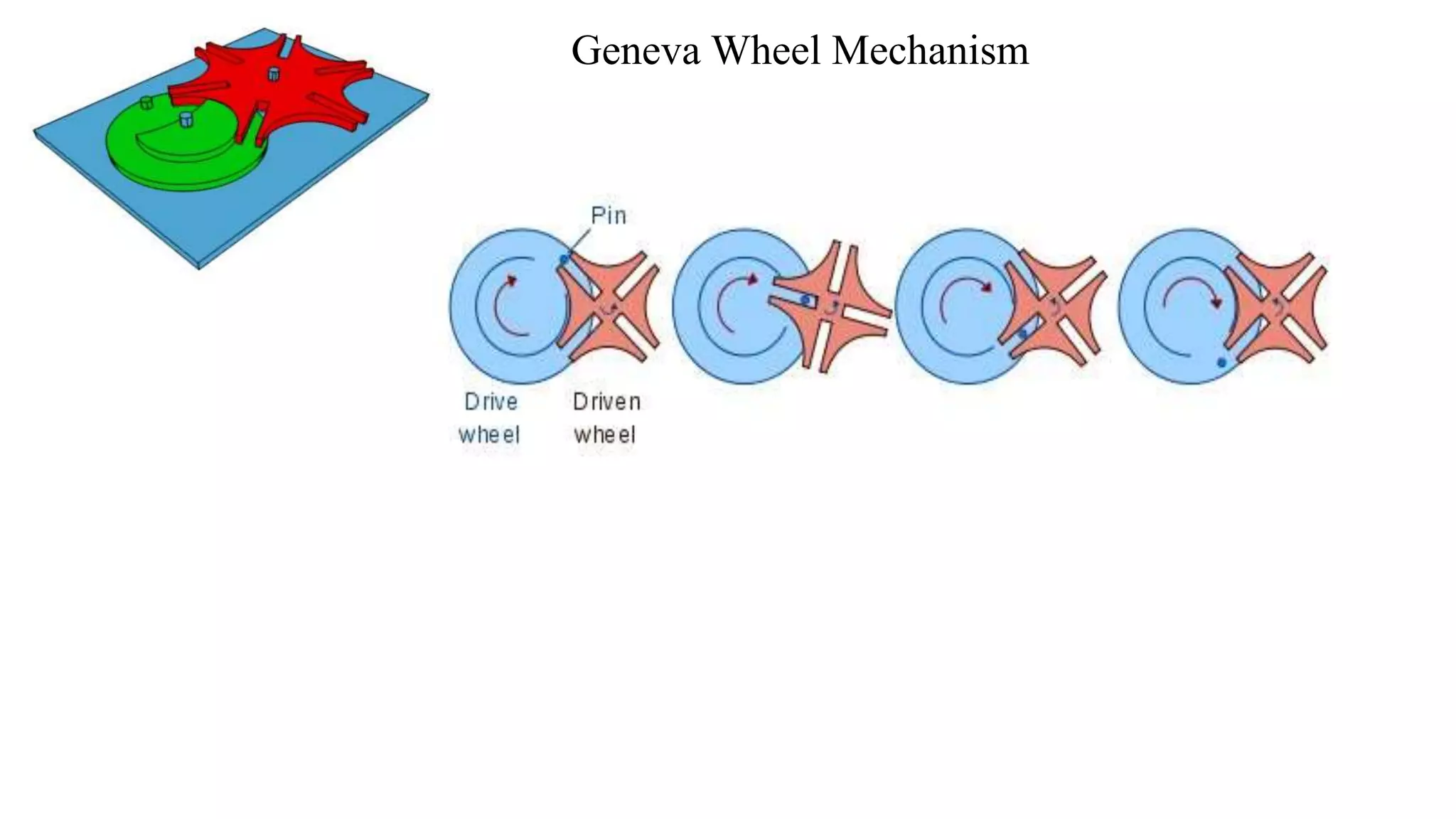
 The rotating drive wheel has a pin that reaches into a slot of the driven wheel advancing it
by one step.
 The drive wheel also has a raised circular blocking disc that locks the driven wheel in
position between steps.
Geneva Wheel Mechanism
Types Of Geneva Drive:-
Locking-arm Geneva drive:
Planetary gear Geneva drive:
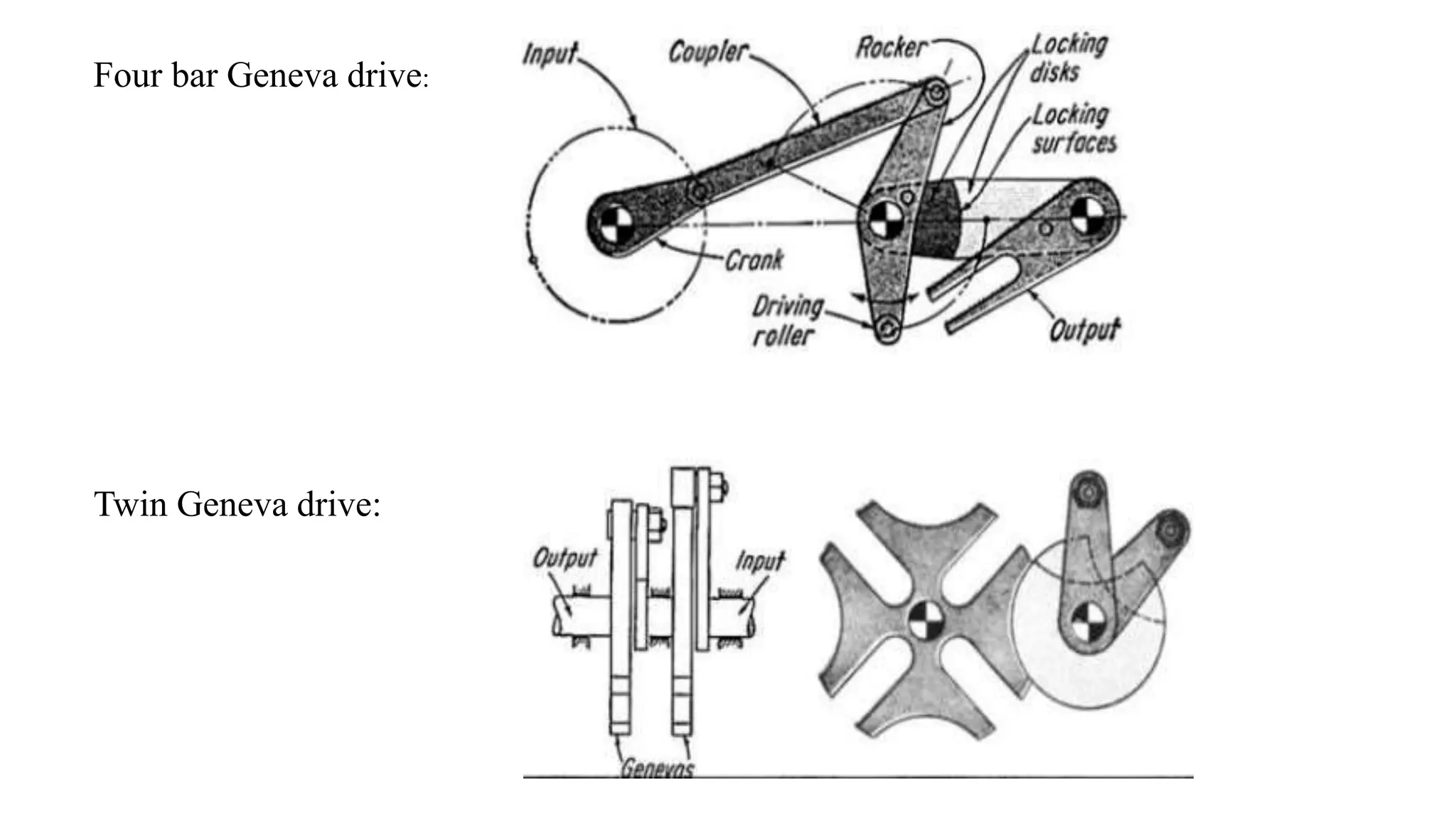
Four bar Geneva drive:
Twin Geneva drive:
Groove cam Geneva drive:
Locking slide Geneva drive:
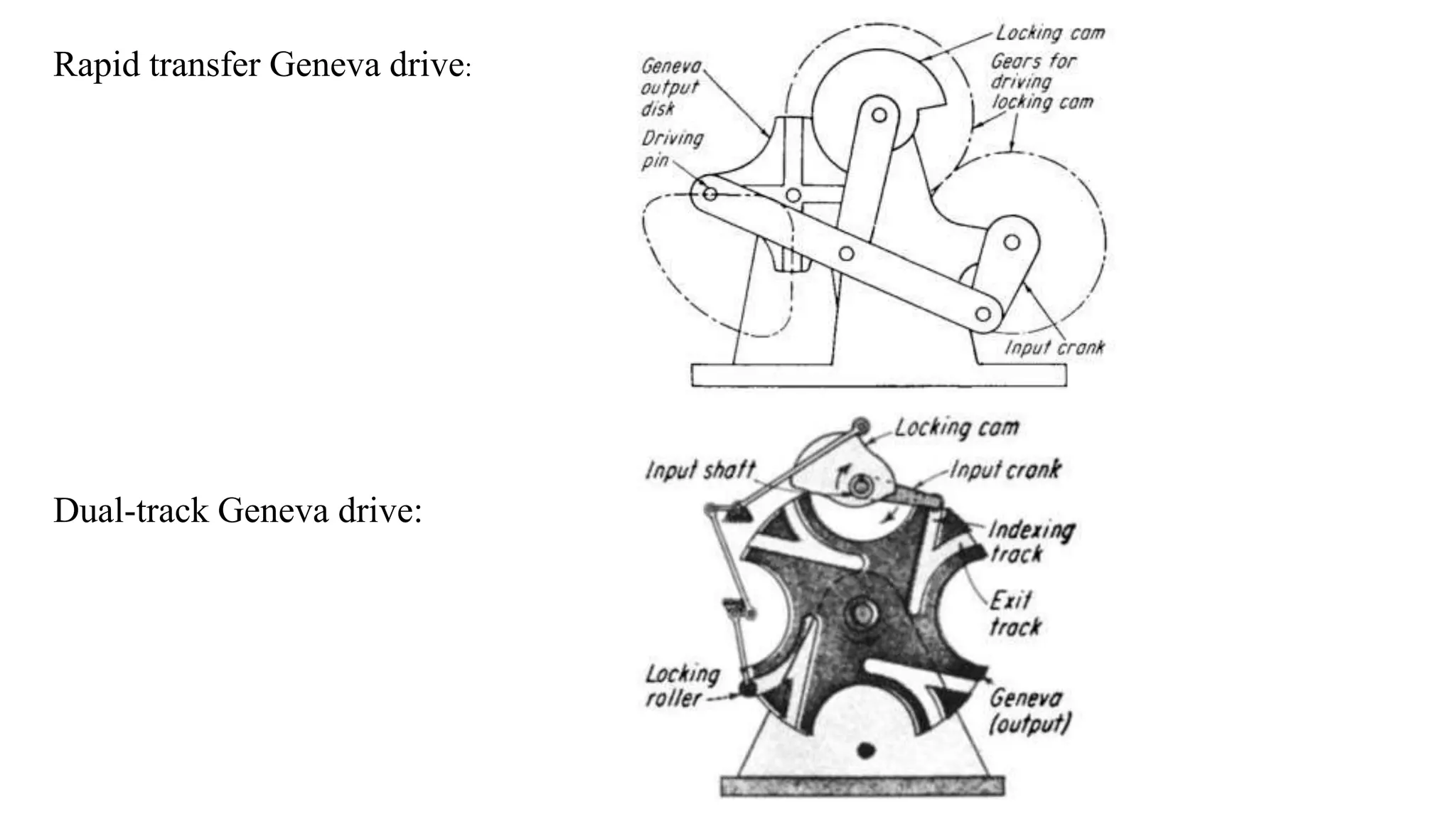
Rapid transfer Geneva drive:
Dual-track Geneva drive:
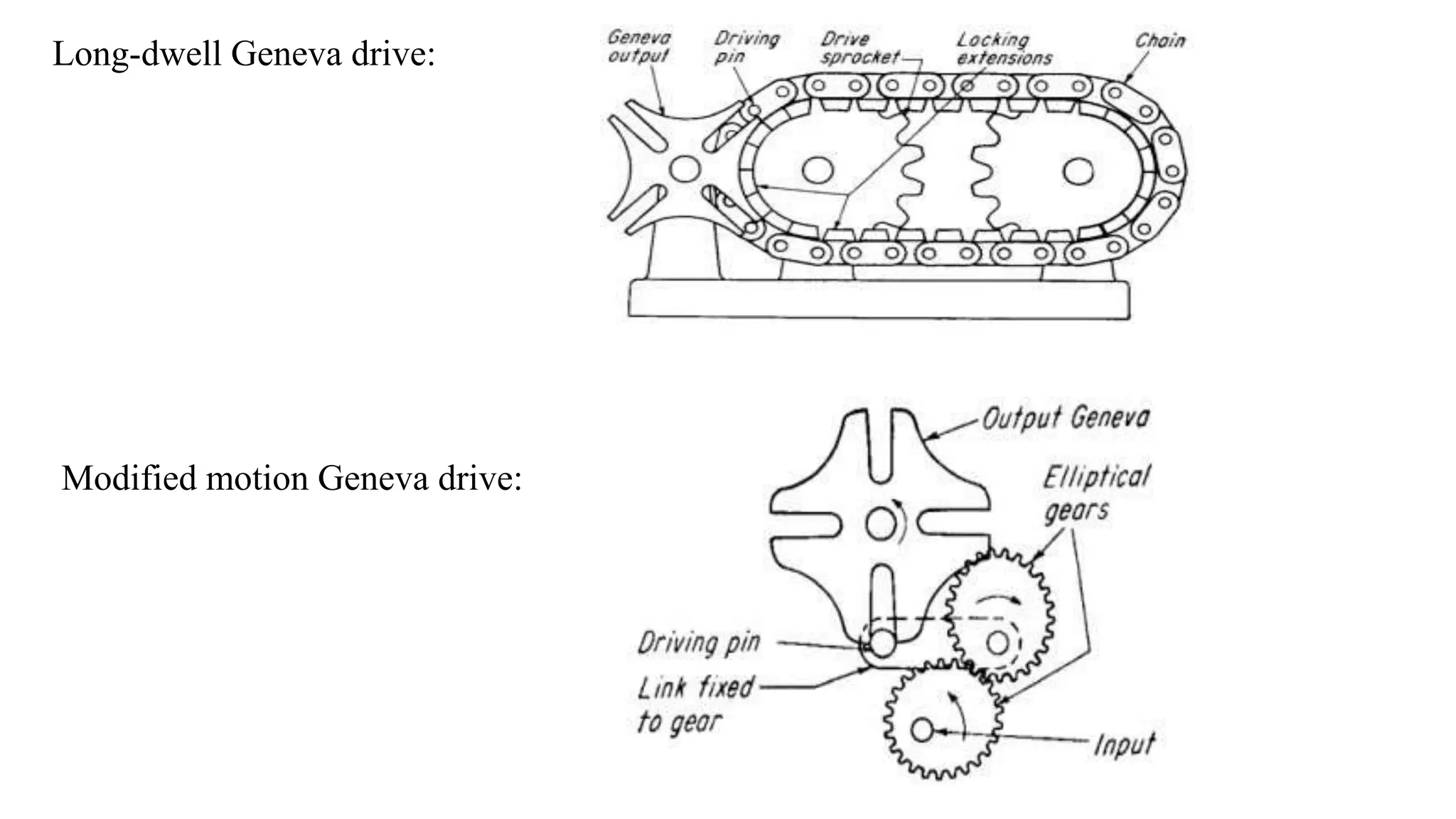
Long-dwell Geneva drive:
Modified motion Geneva drive:
Internal groove Geneva drive:
Progressive oscillating drive:
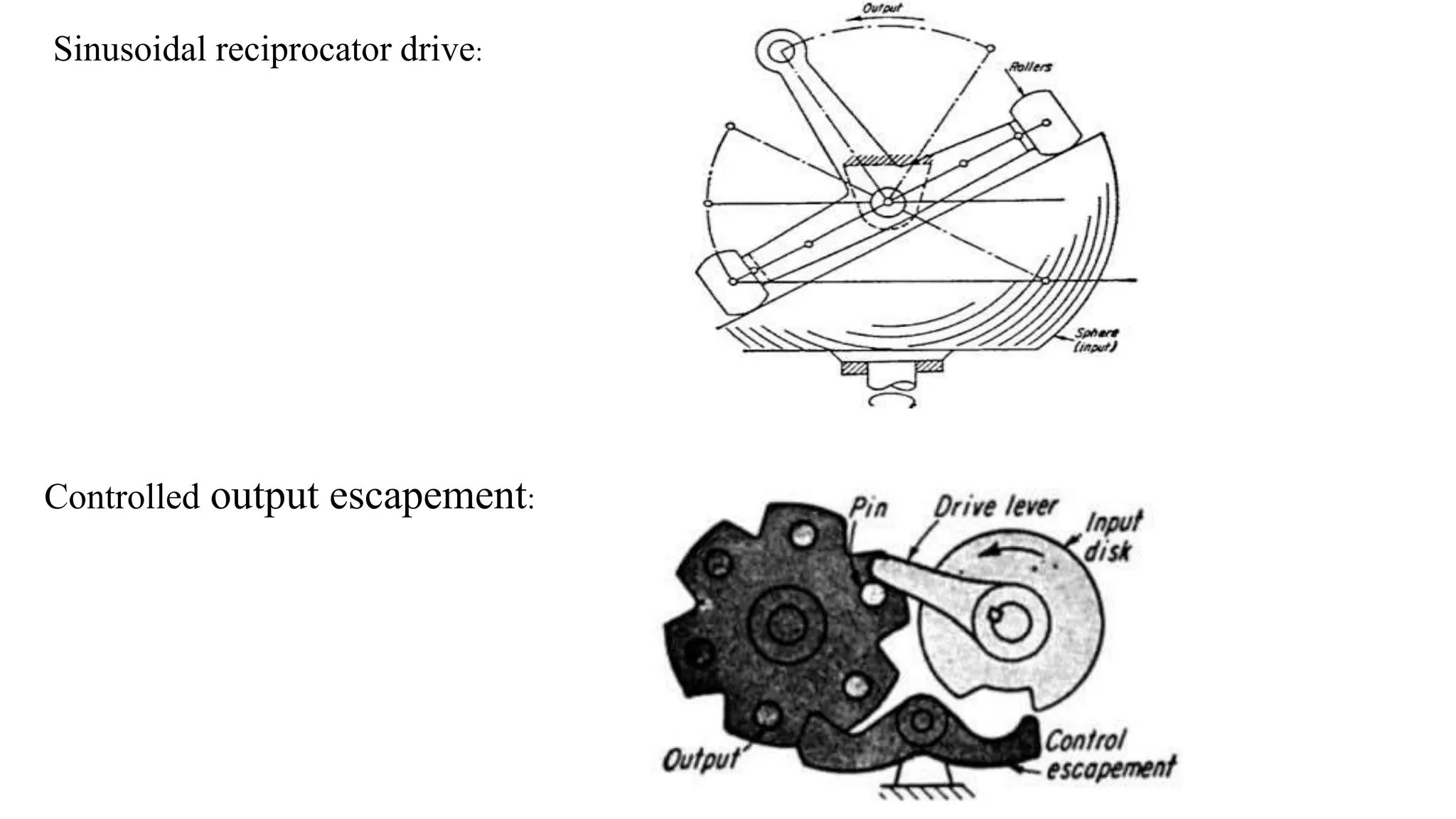
Sinusoidal reciprocator drive:
Controlled output escapement:
Parallel guidance drive:
Rotating-cam reciprocator drive:
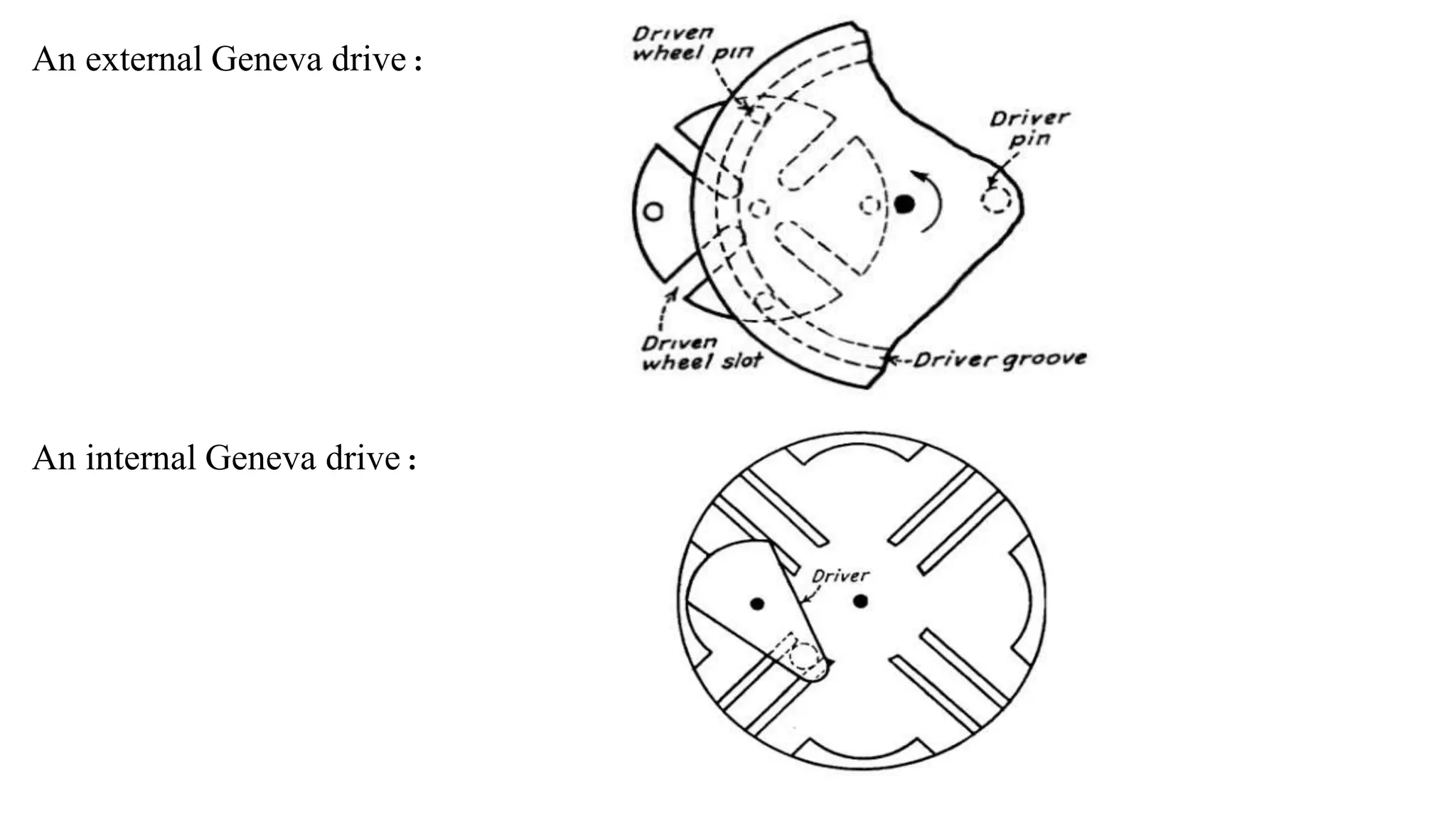
An external Geneva drive :
An internal Geneva drive :
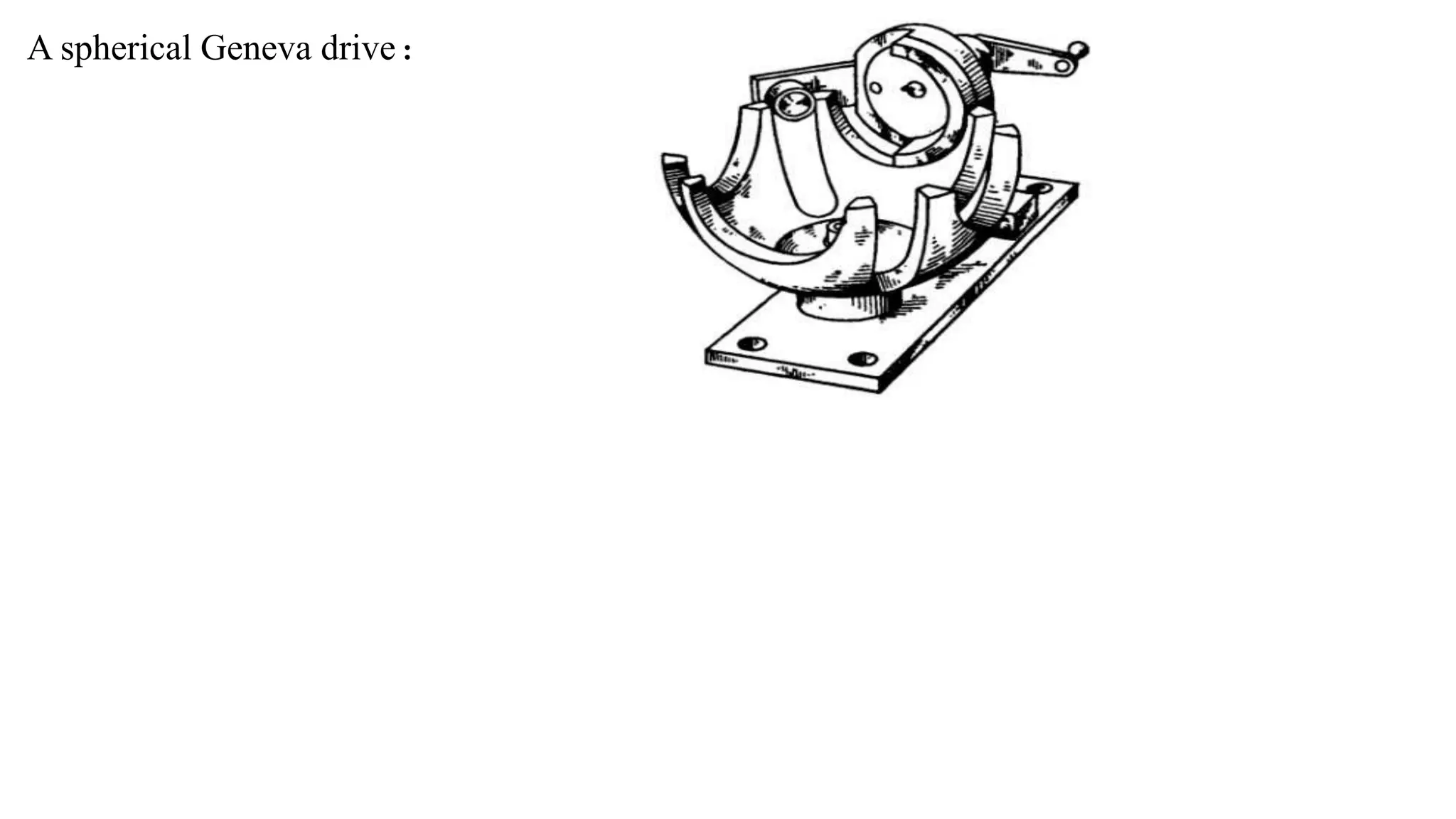
A spherical Geneva drive :
Uses and applications
APPLICATION OF GENEVA MECHANISMS IN INDUSTRY
Geneva mechanisms are generally used in induction unit.
In industry we use this cam in pharma machines. This cam has great precision work.
There are three basic types of Geneva motion uses in our industry as shown in the figures below.
movie projectors
The name derives from the device's earliest application in
mechanical watches, Geneva, Switzerland being an important
center of watch making.
Advantages
• Available in a wide variety of sizes.
• Maintains good control of its load at all times.
• Have little wear leading to a very long life span.
Disadvantages
• Limited number of dwells from 3 to 18 per rotation.
• Has a greater instantaneous change of acceleration than a cam mechanism.
• Very difficult to change timing once design is chosen.
Conclusion
 − Taking into account the presented relationships it was created a computer program to
determine the geometric parameters of Geneva mechanism elements.
 − The determined data were used for computer-aided design of the crank and wheel of
Geneva mechanism using NX CAD module.
 − By using adequate relationships was made Geneva mechanism.
 − It was performed Computer aided manufacturing of virtual prototype of the
 Geneva wheel with NX CAM module
 − It was verified the CNC program obtained by post processing on Heidenhain iTNC 530
equipment.

Geneva mechanism (mini-project)

  • 1.
    Group members :-NAYAN DIPAK GAYKWAD (33227) VAIBHAV GANESH PATIL (33243) NAVED SAMIR SHAIKH (33230)
  • 2.
    Introduction  The Genevadrive or Maltese cross is a gear mechanism that translates a continuous rotation into an intermittent rotary motion.  The rotating drive wheel has a pin that reaches into a slot of the driven wheel advancing it by one step.  The drive wheel also has a raised circular blocking disc that locks the driven wheel in position between steps.
  • 3.
  • 4.
    Types Of GenevaDrive:- Locking-arm Geneva drive: Planetary gear Geneva drive:
  • 5.
    Four bar Genevadrive: Twin Geneva drive:
  • 6.
    Groove cam Genevadrive: Locking slide Geneva drive:
  • 7.
    Rapid transfer Genevadrive: Dual-track Geneva drive:
  • 8.
  • 9.
    Internal groove Genevadrive: Progressive oscillating drive:
  • 10.
  • 11.
  • 12.
    An external Genevadrive : An internal Geneva drive :
  • 13.
  • 14.
    Uses and applications APPLICATIONOF GENEVA MECHANISMS IN INDUSTRY Geneva mechanisms are generally used in induction unit. In industry we use this cam in pharma machines. This cam has great precision work. There are three basic types of Geneva motion uses in our industry as shown in the figures below. movie projectors The name derives from the device's earliest application in mechanical watches, Geneva, Switzerland being an important center of watch making.
  • 15.
    Advantages • Available ina wide variety of sizes. • Maintains good control of its load at all times. • Have little wear leading to a very long life span. Disadvantages • Limited number of dwells from 3 to 18 per rotation. • Has a greater instantaneous change of acceleration than a cam mechanism. • Very difficult to change timing once design is chosen.
  • 16.
    Conclusion  − Takinginto account the presented relationships it was created a computer program to determine the geometric parameters of Geneva mechanism elements.  − The determined data were used for computer-aided design of the crank and wheel of Geneva mechanism using NX CAD module.  − By using adequate relationships was made Geneva mechanism.  − It was performed Computer aided manufacturing of virtual prototype of the  Geneva wheel with NX CAM module  − It was verified the CNC program obtained by post processing on Heidenhain iTNC 530 equipment.