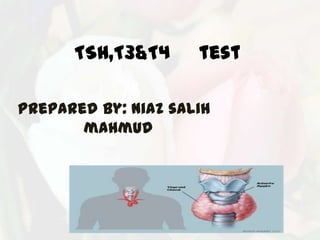
TSH,T3&T4      test

Prepared by: niaz salih
       mahmud
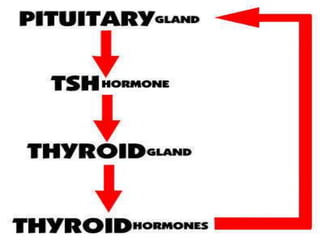
(TSH) blood test is used to check for thyroid gland problems.

 TSH is produced when the hypothalamus

releases a substance called thyrotropin-releasing

 hormone (TRH). TRH then triggers the pituitary gland

 to release TSH.


TSH causes the thyroid gland to make two hormones:

triiodothyronine (T3) and thyroxine (T4). T3 and T4 help

control your body's metabolism.
Why It Is Done
*Find out whether the thyroid gland is working
properly
_An underactive thyroid gland (hypothyroidism)
_An overactive thyroid (hyperthyroidism)

*Find the cause of an underactive thyroid gland
(hypothyroidism).
• Keep track of treatment with thyroid replacement medicine for

  people who have hypothyroidism.

• Keep track of thyroid gland function in people who are being treated

  for hyperthyroidism. This treatment may include antithyroid

   medicine, surgery, or radiation therapy.

• Double-check the diagnosis of an underactive thyroid gland in

  a newborn(congenital hypothyroidism).
How To Prepare

Tell your doctor if you have had any tests in which you were

given radioactive materials or had X-rays that used iodine dye

within the last 4 to 6 weeks. Your test results may not be

correct if you have had iodine contrast material before having

a thyroid-stimulating hormone (TSH) test.
How It Is Done
The health professional drawing blood will:

• Wrap an elastic band around your upper arm to stop the flow of blood. This
  makes the veins below the band larger so it is easier to put a needle into the
  vein.

• Clean the needle site with alcohol.

• Put the needle into the vein. More than one needle stick may be needed.

• Attach a tube to the needle to fill it with blood.

• Remove the band from your arm when enough blood is collected.

• Put a gauze pad or cotton ball over the needle site as the needle is removed.

• Put pressure to the site and then put on a bandage.
TSH- Normal range
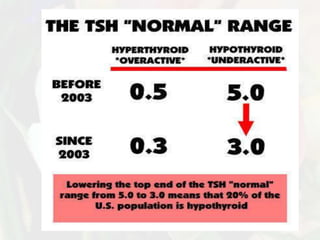
 Until 2002, the official TSH "normal range"
 that laboratories and most doctors used
 throughout the U.S. was a range of 0.5 to 5.0.
 Since late 2002, however, the American
  Association of Clinical Endocrinologists (AACE)
 and other professional groups have
 recommended a narrower range of .3 to 3.0.
Free T4 - Free Thyroxine

 Free T4 measures the free, unbound thyroxine levels in your
 bloodstream. Free T4 is typically elevated in hyperthyroidism, and
 lowered in hypothyroidism.
 Free or unbound T4 levels represent the level of hormone available
 for uptake and use by cells. Bound levels represent a circulating
 hormone that may not all be immediately available, because it is
 affected by other drugs, illness, and physical changes such as
 pregnancy. Because the free levels of T4 represent immediately
  available hormone, free T4 is thought to better reflect the patient's
  hormonal status than total T4
Total T4/Total Thyroxine/Serum Thyroxine
 This test measures the total amount of circulating thyroxine in your blood.

Thyroxine, a hormone produced by the thyroid, is also known as T4. A high

value can indicate hyperthyroidism, a low value can indicate hypothyroidism.

Total T4 levels can be elevated due to pregnancy, and other high estrogen

states, including use of estrogen replacement or birth control pills.
Total T3-Total Triiodothyronine

 Triiodothyronine is the active thyroid

hormone, and is also known as T3. Total T3 is

typically elevated in hyperthyroidism, and

lowered in hypothyroidism.
Free T3 - Free Triiodothyronine

Free T3 measures the free, unbound levels of triiodothyronin

in your bloodstream. Free T3 is

considered more accurate than Total T3. Free T3 is typically elevated

in hyperthyroidism, and lowered in

hypothyroidism.
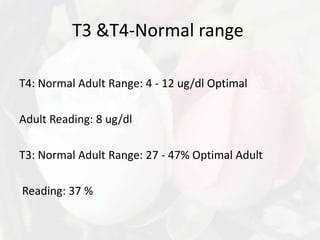
T3 &T4-Normal range

T4: Normal Adult Range: 4 - 12 ug/dl Optimal

Adult Reading: 8 ug/dl

T3: Normal Adult Range: 27 - 47% Optimal Adult

Reading: 37 %
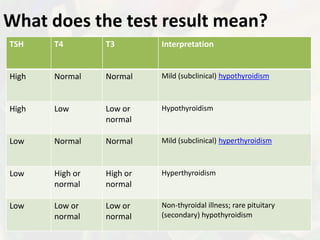
What does the test result mean?
TSH    T4        T3        Interpretation


High   Normal    Normal    Mild (subclinical) hypothyroidism


High   Low       Low or    Hypothyroidism
                 normal

Low    Normal    Normal    Mild (subclinical) hyperthyroidism


Low    High or   High or   Hyperthyroidism
       normal    normal

Low    Low or    Low or    Non-thyroidal illness; rare pituitary
       normal    normal    (secondary) hypothyroidism
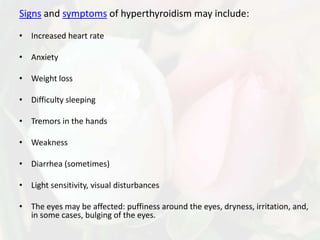
Signs and symptoms of hyperthyroidism may include:

• Increased heart rate

• Anxiety

• Weight loss

• Difficulty sleeping

• Tremors in the hands

• Weakness

• Diarrhea (sometimes)

• Light sensitivity, visual disturbances

• The eyes may be affected: puffiness around the eyes, dryness, irritation, and,
  in some cases, bulging of the eyes.
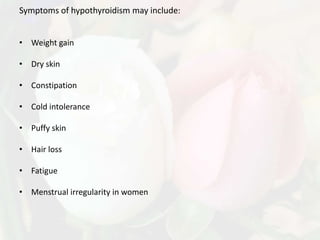
Symptoms of hypothyroidism may include:


• Weight gain

• Dry skin

• Constipation

• Cold intolerance

• Puffy skin

• Hair loss

• Fatigue

• Menstrual irregularity in women

Tsh,t3&t4 test

  • 1.
    TSH,T3&T4 test Prepared by: niaz salih mahmud
  • 2.
    (TSH) blood testis used to check for thyroid gland problems. TSH is produced when the hypothalamus releases a substance called thyrotropin-releasing hormone (TRH). TRH then triggers the pituitary gland to release TSH. TSH causes the thyroid gland to make two hormones: triiodothyronine (T3) and thyroxine (T4). T3 and T4 help control your body's metabolism.
  • 4.
    Why It IsDone *Find out whether the thyroid gland is working properly _An underactive thyroid gland (hypothyroidism) _An overactive thyroid (hyperthyroidism) *Find the cause of an underactive thyroid gland (hypothyroidism).
  • 5.
    • Keep trackof treatment with thyroid replacement medicine for people who have hypothyroidism. • Keep track of thyroid gland function in people who are being treated for hyperthyroidism. This treatment may include antithyroid medicine, surgery, or radiation therapy. • Double-check the diagnosis of an underactive thyroid gland in a newborn(congenital hypothyroidism).
  • 6.
    How To Prepare Tellyour doctor if you have had any tests in which you were given radioactive materials or had X-rays that used iodine dye within the last 4 to 6 weeks. Your test results may not be correct if you have had iodine contrast material before having a thyroid-stimulating hormone (TSH) test.
  • 7.
    How It IsDone The health professional drawing blood will: • Wrap an elastic band around your upper arm to stop the flow of blood. This makes the veins below the band larger so it is easier to put a needle into the vein. • Clean the needle site with alcohol. • Put the needle into the vein. More than one needle stick may be needed. • Attach a tube to the needle to fill it with blood. • Remove the band from your arm when enough blood is collected. • Put a gauze pad or cotton ball over the needle site as the needle is removed. • Put pressure to the site and then put on a bandage.
  • 8.
    TSH- Normal range Until 2002, the official TSH "normal range" that laboratories and most doctors used throughout the U.S. was a range of 0.5 to 5.0. Since late 2002, however, the American Association of Clinical Endocrinologists (AACE) and other professional groups have recommended a narrower range of .3 to 3.0.
  • 10.
    Free T4 -Free Thyroxine Free T4 measures the free, unbound thyroxine levels in your bloodstream. Free T4 is typically elevated in hyperthyroidism, and lowered in hypothyroidism. Free or unbound T4 levels represent the level of hormone available for uptake and use by cells. Bound levels represent a circulating hormone that may not all be immediately available, because it is affected by other drugs, illness, and physical changes such as pregnancy. Because the free levels of T4 represent immediately available hormone, free T4 is thought to better reflect the patient's hormonal status than total T4
  • 11.
    Total T4/Total Thyroxine/SerumThyroxine This test measures the total amount of circulating thyroxine in your blood. Thyroxine, a hormone produced by the thyroid, is also known as T4. A high value can indicate hyperthyroidism, a low value can indicate hypothyroidism. Total T4 levels can be elevated due to pregnancy, and other high estrogen states, including use of estrogen replacement or birth control pills.
  • 12.
    Total T3-Total Triiodothyronine Triiodothyronine is the active thyroid hormone, and is also known as T3. Total T3 is typically elevated in hyperthyroidism, and lowered in hypothyroidism.
  • 13.
    Free T3 -Free Triiodothyronine Free T3 measures the free, unbound levels of triiodothyronin in your bloodstream. Free T3 is considered more accurate than Total T3. Free T3 is typically elevated in hyperthyroidism, and lowered in hypothyroidism.
  • 14.
    T3 &T4-Normal range T4:Normal Adult Range: 4 - 12 ug/dl Optimal Adult Reading: 8 ug/dl T3: Normal Adult Range: 27 - 47% Optimal Adult Reading: 37 %
  • 15.
    What does thetest result mean? TSH T4 T3 Interpretation High Normal Normal Mild (subclinical) hypothyroidism High Low Low or Hypothyroidism normal Low Normal Normal Mild (subclinical) hyperthyroidism Low High or High or Hyperthyroidism normal normal Low Low or Low or Non-thyroidal illness; rare pituitary normal normal (secondary) hypothyroidism
  • 16.
    Signs and symptomsof hyperthyroidism may include: • Increased heart rate • Anxiety • Weight loss • Difficulty sleeping • Tremors in the hands • Weakness • Diarrhea (sometimes) • Light sensitivity, visual disturbances • The eyes may be affected: puffiness around the eyes, dryness, irritation, and, in some cases, bulging of the eyes.
  • 17.
    Symptoms of hypothyroidismmay include: • Weight gain • Dry skin • Constipation • Cold intolerance • Puffy skin • Hair loss • Fatigue • Menstrual irregularity in women