Function of the Speech Organs
Conducted By:
Monir Hossen
Lecturer
Department of English
CCN University of Science and Technology
Email: monir.eng.cou@gmail.com
E
The Organs of Speech
Definition:
The various organs of our mouth we use to produce speech
sounds are called the organs of speech or Speech organs.
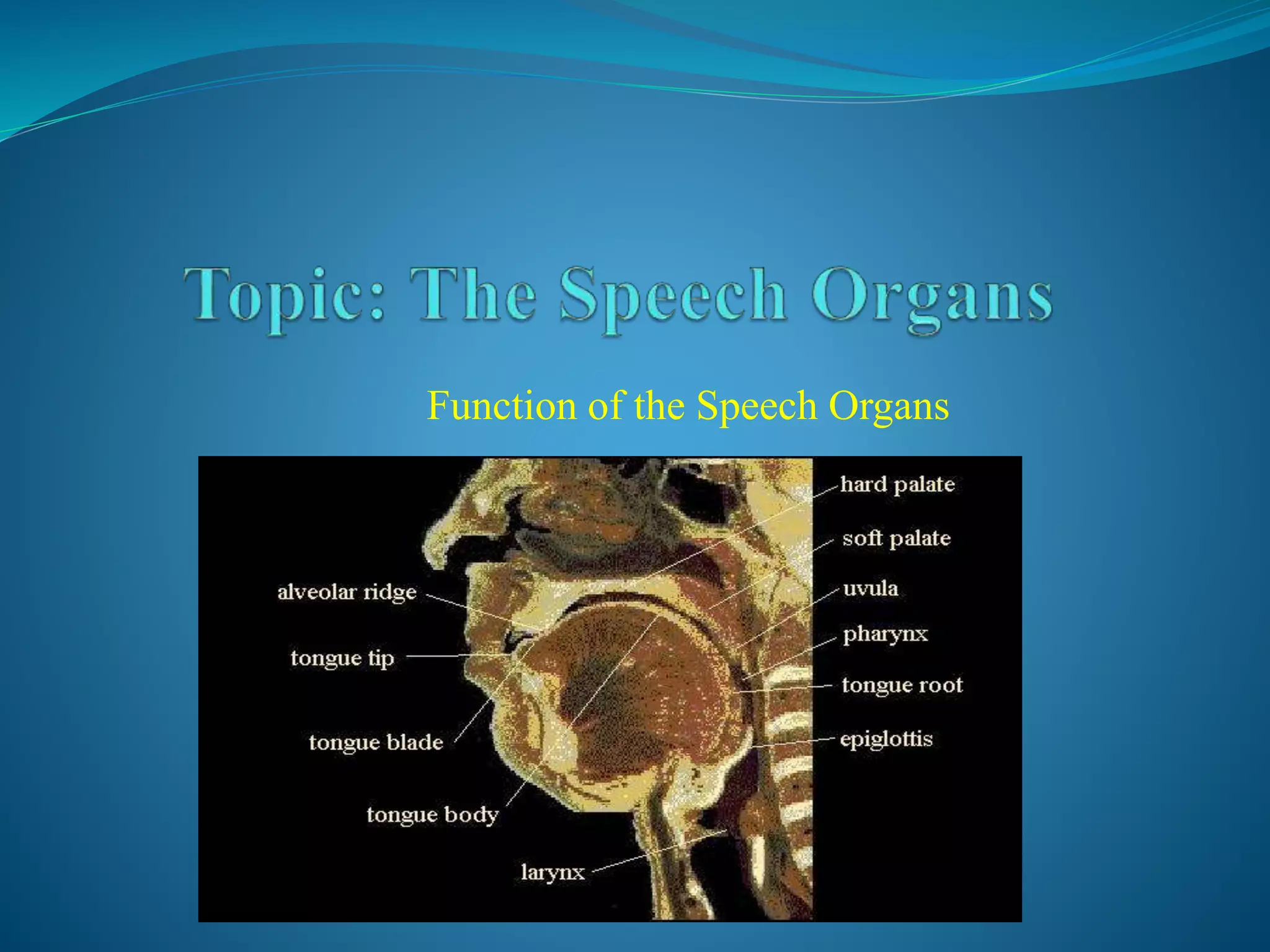
Speech organs or articulators, produce the sounds of
language. Organs used for speech include the lips, teeth,
alveolar ridge, hard palate, velum (soft palate), uvula,
glottis and various parts of the tongue. They can be divided
into two types: passive articulators and active articulators.
Alveolar ridge
Upper lip
Lower lip
Teeth
Hard Palate
Soft Palate
Uvula
Back
Middle(Dorsum
)
Front(Blade)
Tip (Apex)
Glottis
SPEECH ORGANS
Descriptions for Different Organs of Speech
 The study of speech sound is essentially important for
getting the fundamental idea about producing speech
sounds. The various organs work in different ways to
produce speech sounds.
Lips
The two lips serve for creating different sounds -
mainly the labial, bilabial (e.g. /p/, /b/, /m/, /hw/, and
/w/) and labio-dental consonant sounds (e. g. /f/ and
/v/ - and thus create an important part of the speech
apparatus.
Upper Lip
Lower Lip
Teeth
The upper and lower teeth are used to produce a lot of
speech sounds, especially dental and labiodentals
consonants. For example: to produce the dental /ð/and
/θ/, the tongue tip is pushed between the upper and lower
front teeth and to produce the labiodentals /f/, /v/, the
upper front of teeth are brought into contact with the lower
lip.
Teeth
Tongue
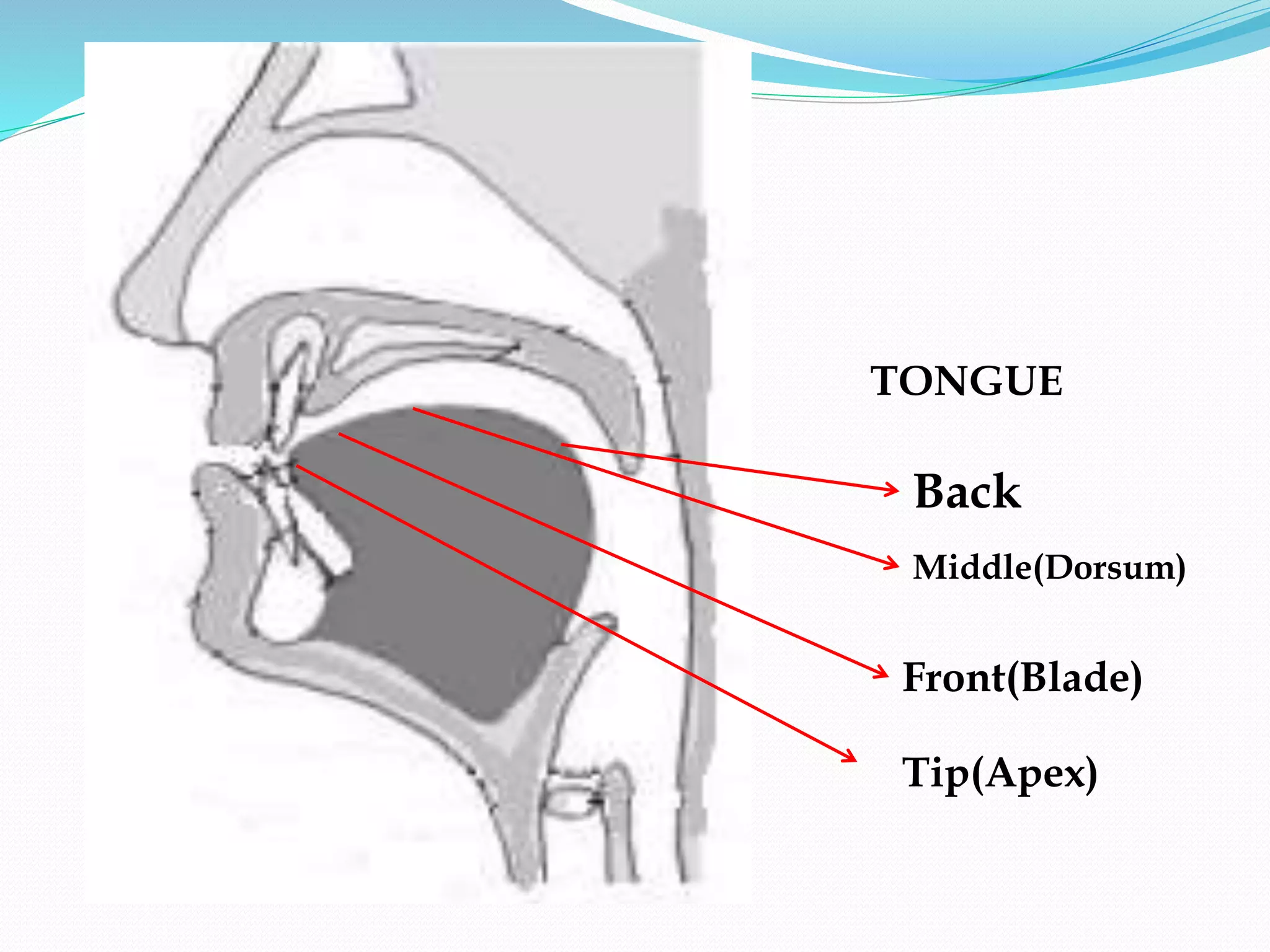
The tongue is the most important articulator in the
speech organs. It moves in different ways in different
shapes to produce speech sounds. Tongue is divided
into five parts namely tip, blade, front, back and root.
Back
Middle(Dorsum)
Front(Blade)
Tip(Apex)
TONGUE
Alveolar Ridge
The alveolar ridge includes the area between the upper
front teeth and the hard palate. To produce alveolar
consonant sounds such as /t d l n s z/, the alveolar
ridge and the blade of the tongue are used.
Alveolar Ridge
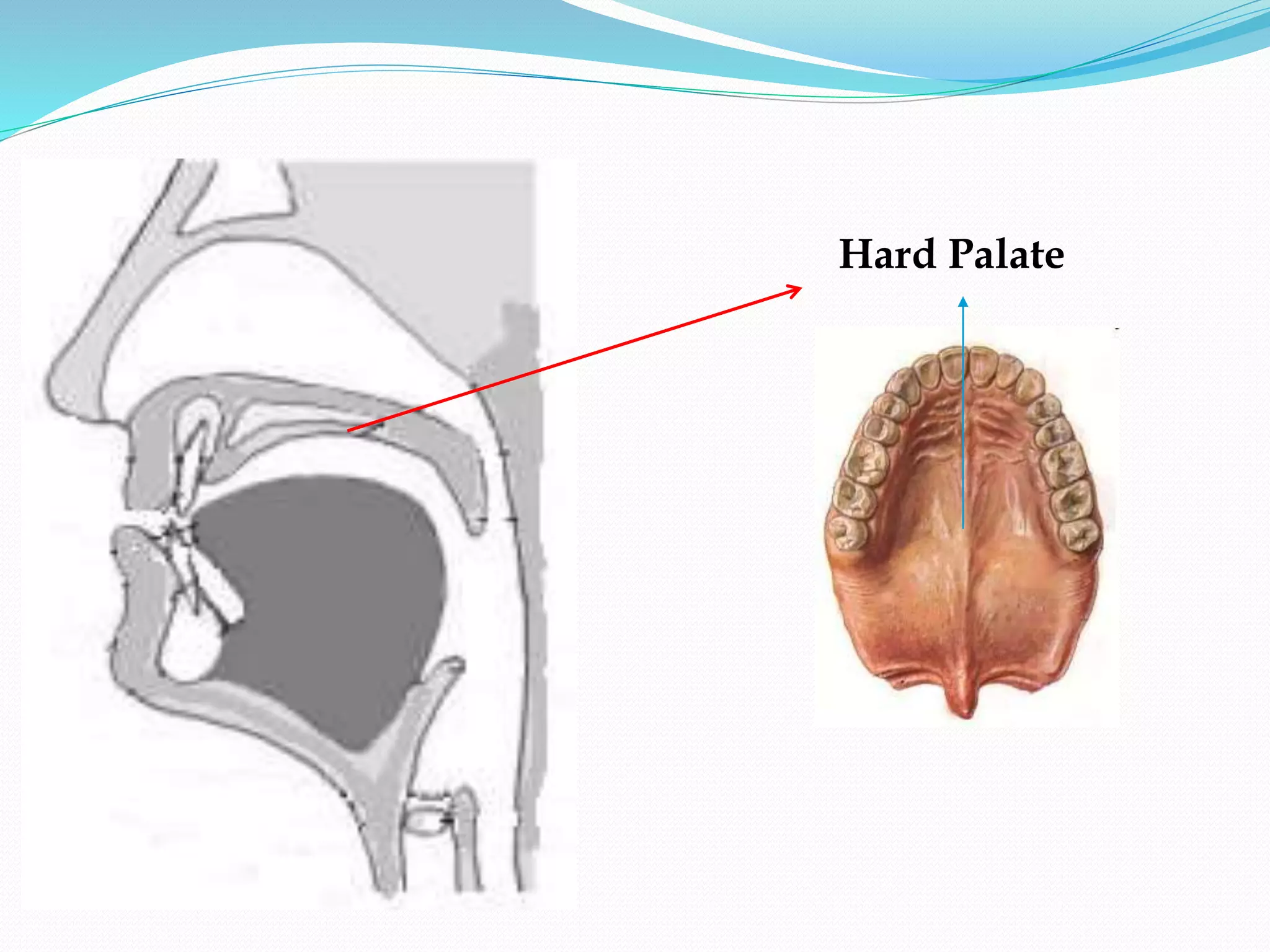
Hard palate
 a thin horizontal bony plate of the skull, located in the
roof of the mouth.
 the interaction between the tongue and the hard
palate is essential in the formation of certain speech
sounds, notably /t/, /d/, and /j/.
Hard Palate
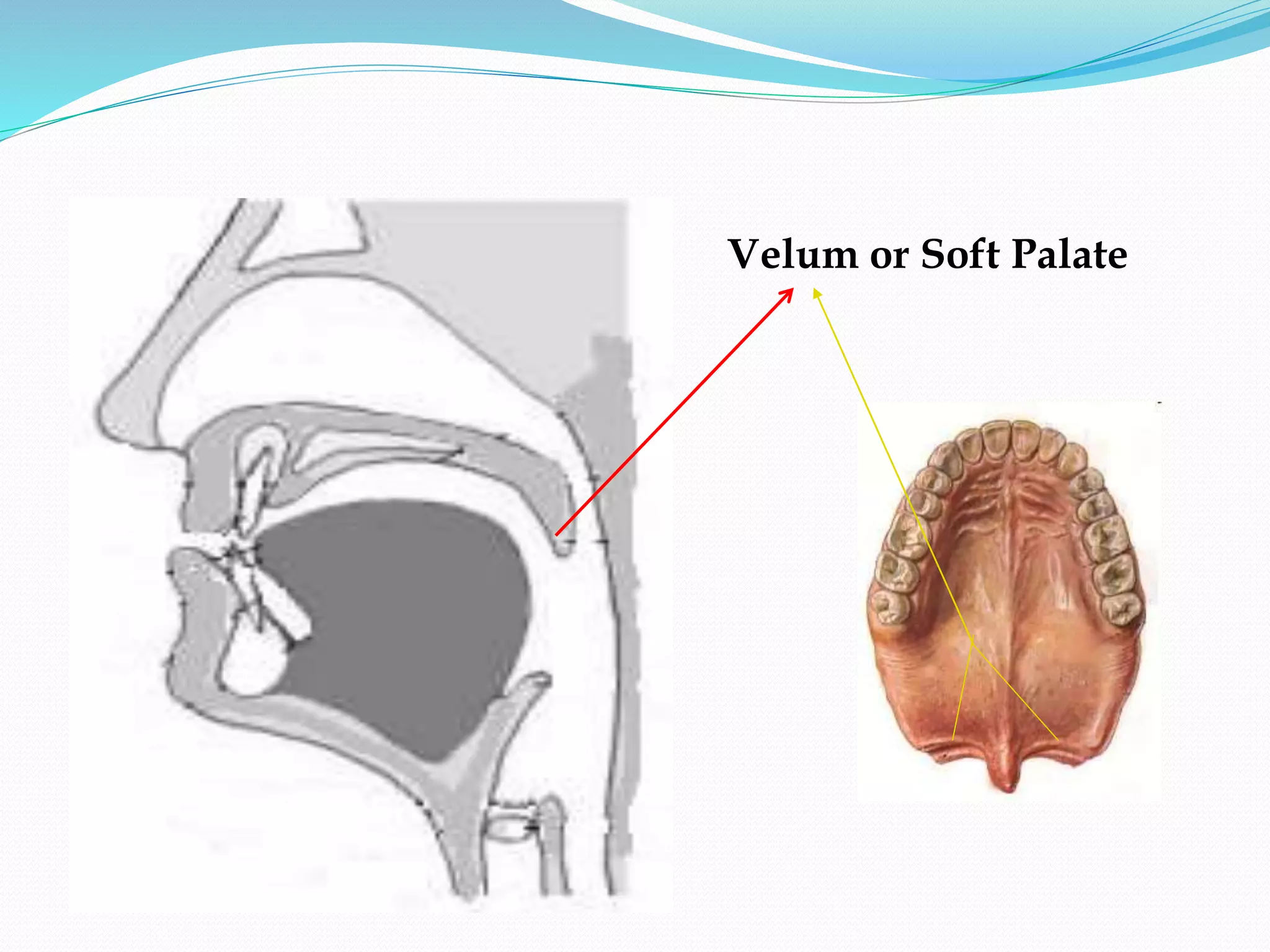
Soft Palate or Velum
It should have holes forming that function during
speech to separate the oral cavity (mouth) from the
nose, in order to produce the oral speech sounds. If
this separation is incomplete, air escapes through the
nose during speech and the speech is perceived as
hyper nasal.
Velum or Soft Palate
Pharynx
The pharynx is like a tube beginning just above the
larynx and ending two parts. The structure that holds
and manipulates the vocal cords. The "Adam's apple" in
males is the bump formed by the front part of the larynx
Uvula
- it functions in tandem with the back of the throat, the
palate, and air coming up from the lungs to create a
number of guttural and other sounds.
- In many languages, it closes to prevent air escaping
through the nose when making some sounds.
Glottis
 combination of vocal folds and space in between the
folds
 as the vocal folds vibrate, the resulting vibration
produces a “buzzing” quality to the speech called
voice or voicing or pronunciation.
 sound production involving only the glottis is called
glottal. Example is the sound /h/.
Thank You

The organs of speech

  • 2.
    Function of theSpeech Organs
  • 3.
    Conducted By: Monir Hossen Lecturer Departmentof English CCN University of Science and Technology Email: monir.eng.cou@gmail.com E
  • 4.
    The Organs ofSpeech Definition: The various organs of our mouth we use to produce speech sounds are called the organs of speech or Speech organs. Speech organs or articulators, produce the sounds of language. Organs used for speech include the lips, teeth, alveolar ridge, hard palate, velum (soft palate), uvula, glottis and various parts of the tongue. They can be divided into two types: passive articulators and active articulators.
  • 5.
    Alveolar ridge Upper lip Lowerlip Teeth Hard Palate Soft Palate Uvula Back Middle(Dorsum ) Front(Blade) Tip (Apex) Glottis SPEECH ORGANS
  • 6.
    Descriptions for DifferentOrgans of Speech  The study of speech sound is essentially important for getting the fundamental idea about producing speech sounds. The various organs work in different ways to produce speech sounds.
  • 7.
    Lips The two lipsserve for creating different sounds - mainly the labial, bilabial (e.g. /p/, /b/, /m/, /hw/, and /w/) and labio-dental consonant sounds (e. g. /f/ and /v/ - and thus create an important part of the speech apparatus.
  • 8.
  • 9.
    Teeth The upper andlower teeth are used to produce a lot of speech sounds, especially dental and labiodentals consonants. For example: to produce the dental /ð/and /θ/, the tongue tip is pushed between the upper and lower front teeth and to produce the labiodentals /f/, /v/, the upper front of teeth are brought into contact with the lower lip.
  • 10.
  • 11.
    Tongue The tongue isthe most important articulator in the speech organs. It moves in different ways in different shapes to produce speech sounds. Tongue is divided into five parts namely tip, blade, front, back and root.
  • 12.
  • 13.
    Alveolar Ridge The alveolarridge includes the area between the upper front teeth and the hard palate. To produce alveolar consonant sounds such as /t d l n s z/, the alveolar ridge and the blade of the tongue are used.
  • 14.
  • 15.
    Hard palate  athin horizontal bony plate of the skull, located in the roof of the mouth.  the interaction between the tongue and the hard palate is essential in the formation of certain speech sounds, notably /t/, /d/, and /j/.
  • 16.
  • 17.
    Soft Palate orVelum It should have holes forming that function during speech to separate the oral cavity (mouth) from the nose, in order to produce the oral speech sounds. If this separation is incomplete, air escapes through the nose during speech and the speech is perceived as hyper nasal.
  • 18.
  • 19.
    Pharynx The pharynx islike a tube beginning just above the larynx and ending two parts. The structure that holds and manipulates the vocal cords. The "Adam's apple" in males is the bump formed by the front part of the larynx
  • 20.
    Uvula - it functionsin tandem with the back of the throat, the palate, and air coming up from the lungs to create a number of guttural and other sounds. - In many languages, it closes to prevent air escaping through the nose when making some sounds.
  • 21.
    Glottis  combination ofvocal folds and space in between the folds  as the vocal folds vibrate, the resulting vibration produces a “buzzing” quality to the speech called voice or voicing or pronunciation.  sound production involving only the glottis is called glottal. Example is the sound /h/.
  • 22.