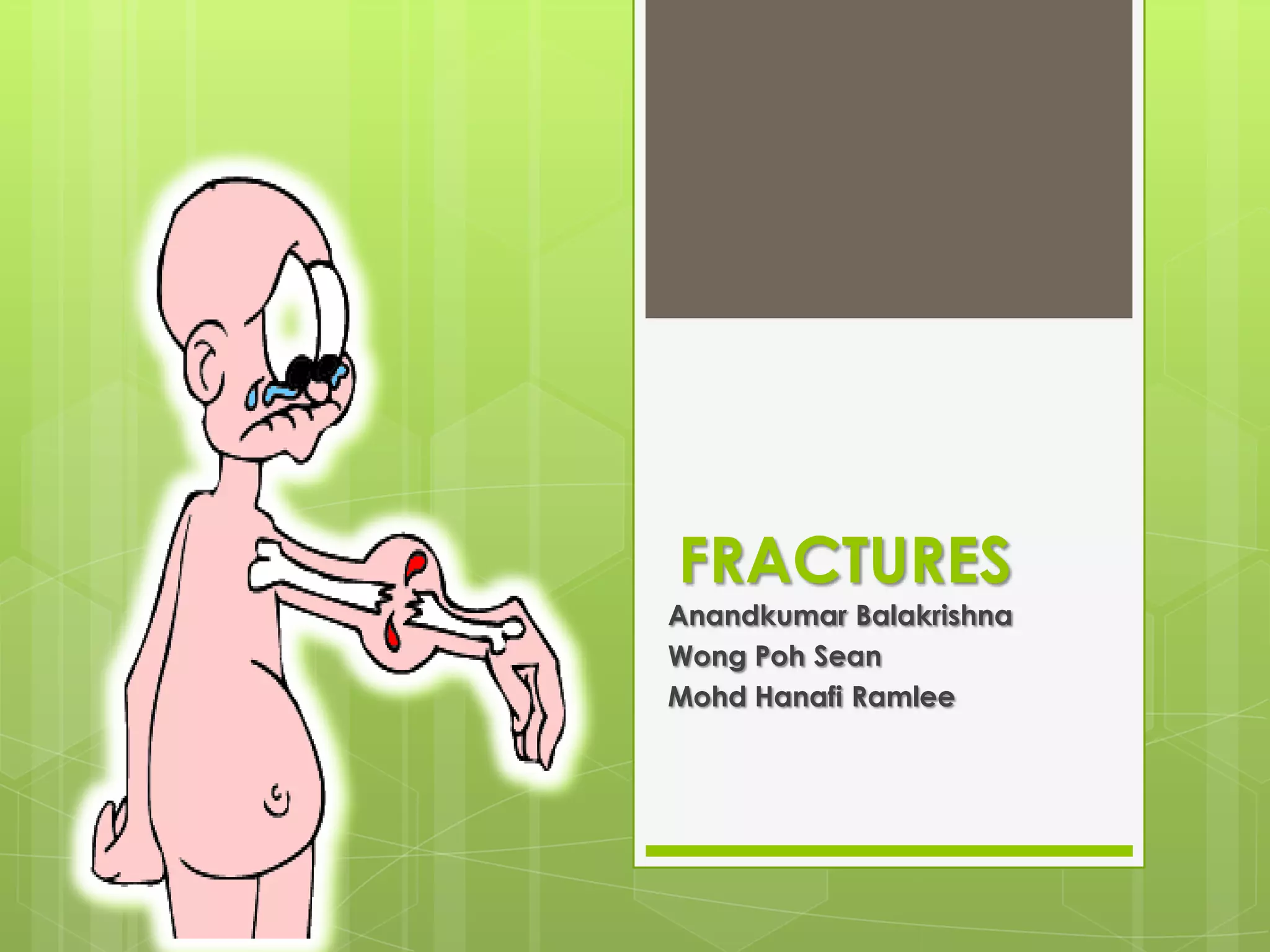
FRACTURESAnandkumarBalakrishnaWong Poh SeanMohdHanafiRamlee
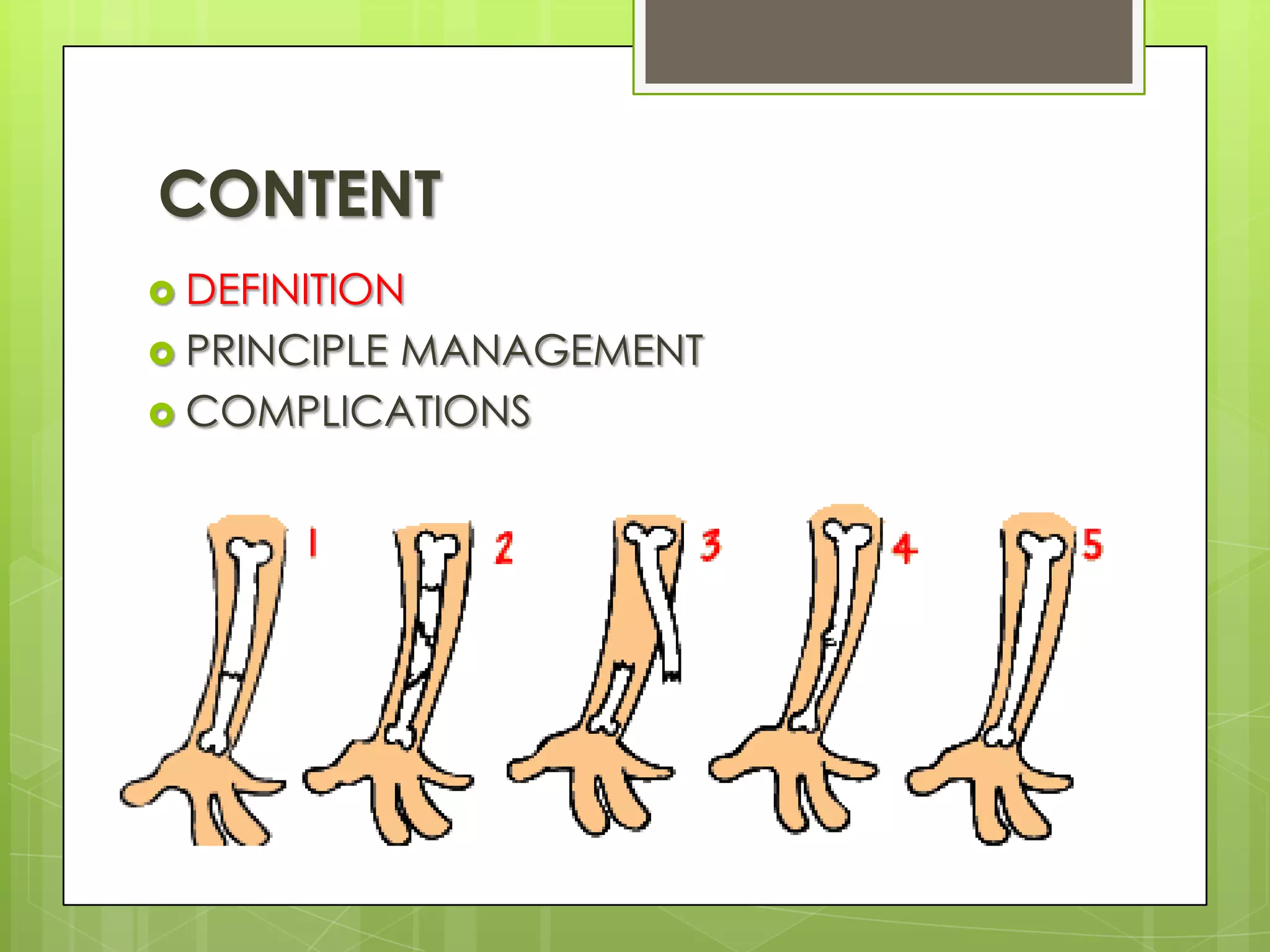
CONTENTDEFINITIONPRINCIPLE MANAGEMENTCOMPLICATIONS
DEFINITION
CAUSESSudden traumadirect(fracture of the ulna caused by blow on the arm)indirect(spiral fractures of the tibia and fibula due to torsion of the leg, vertebral compression fractures, avulsion fractures)Stress or fatigue-repetitive stress(athletes, dancers, army recruits)Pathological(osteoporosis, Paget’s disease, bone tumour)
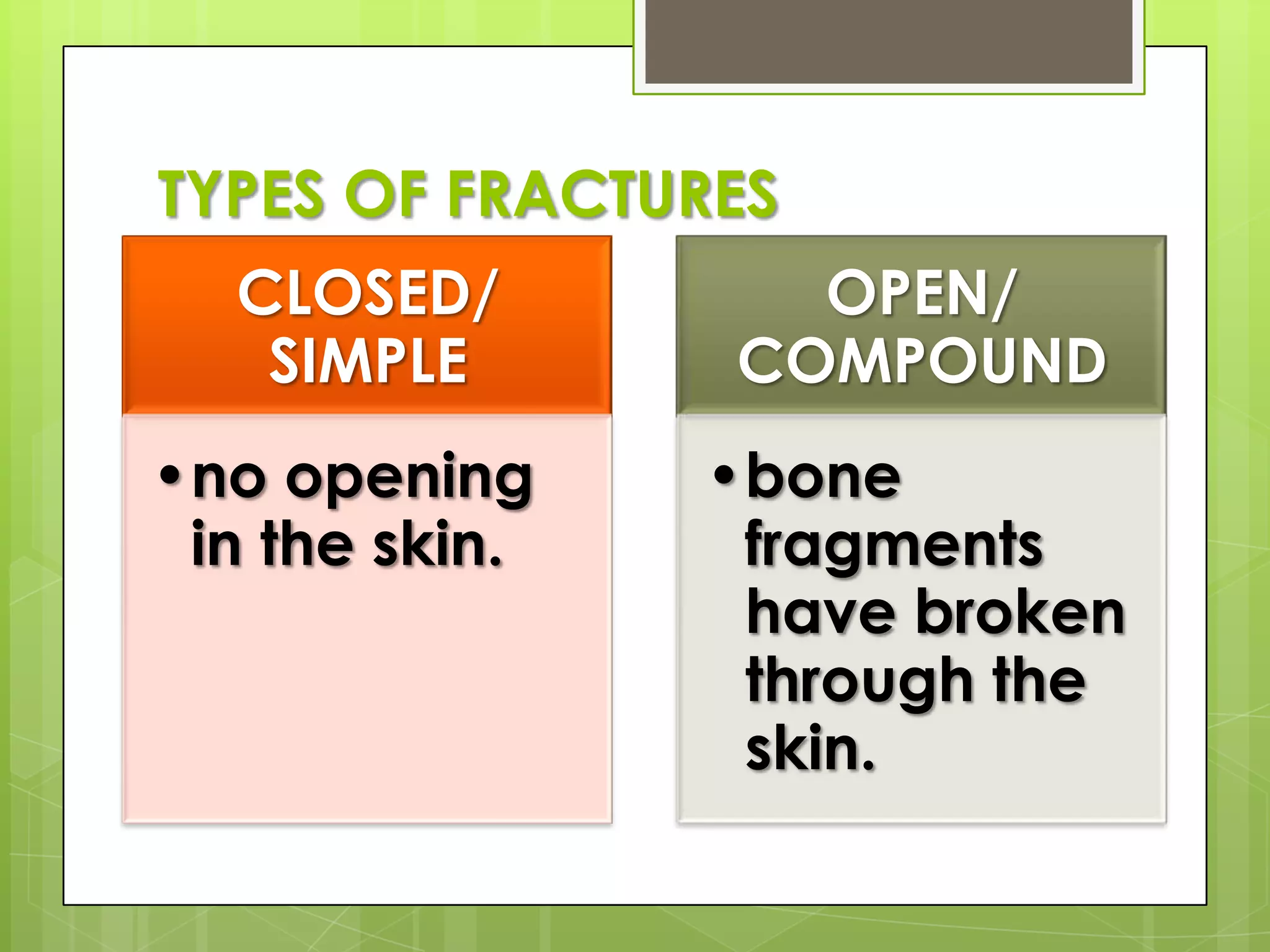
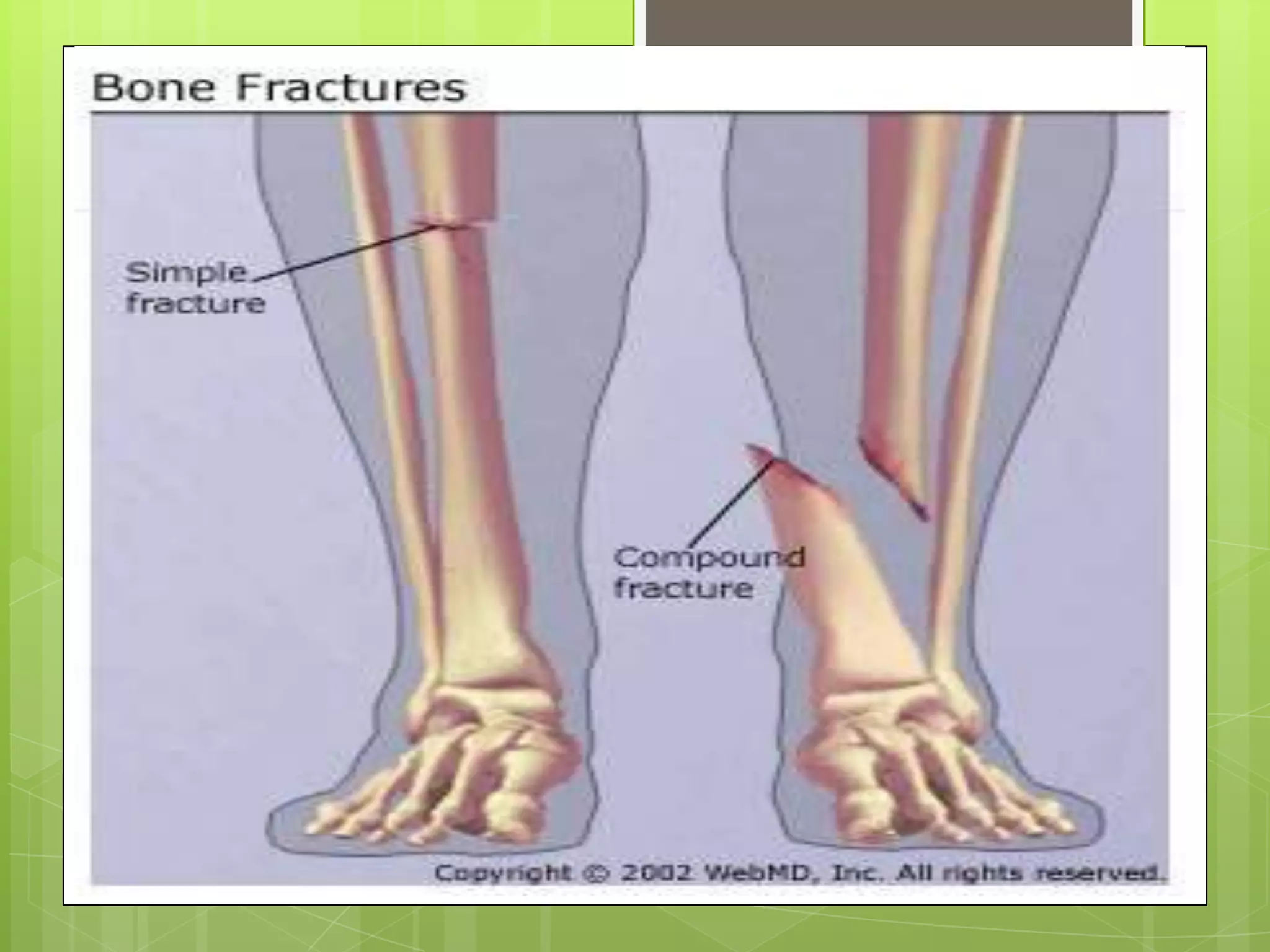
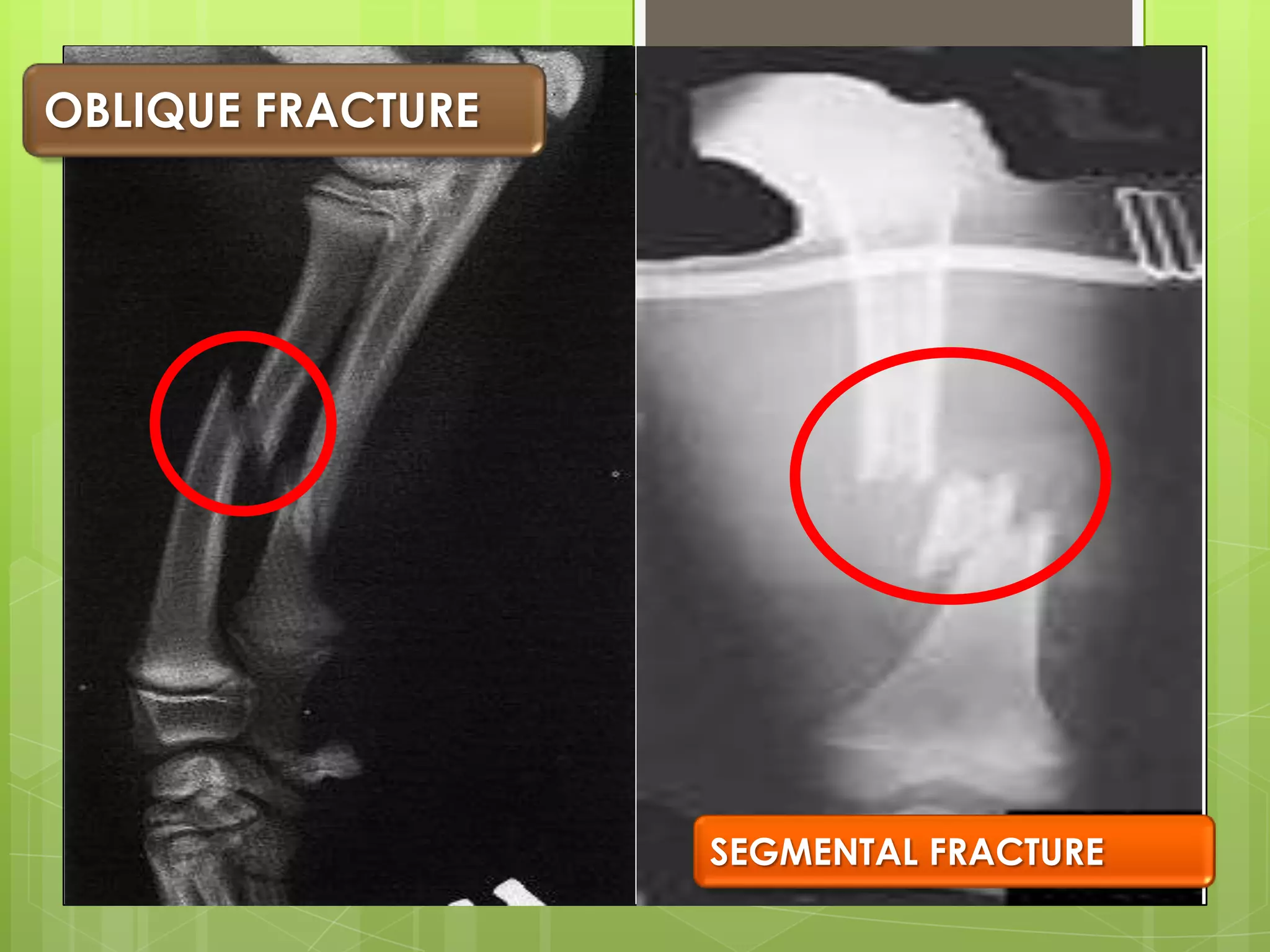
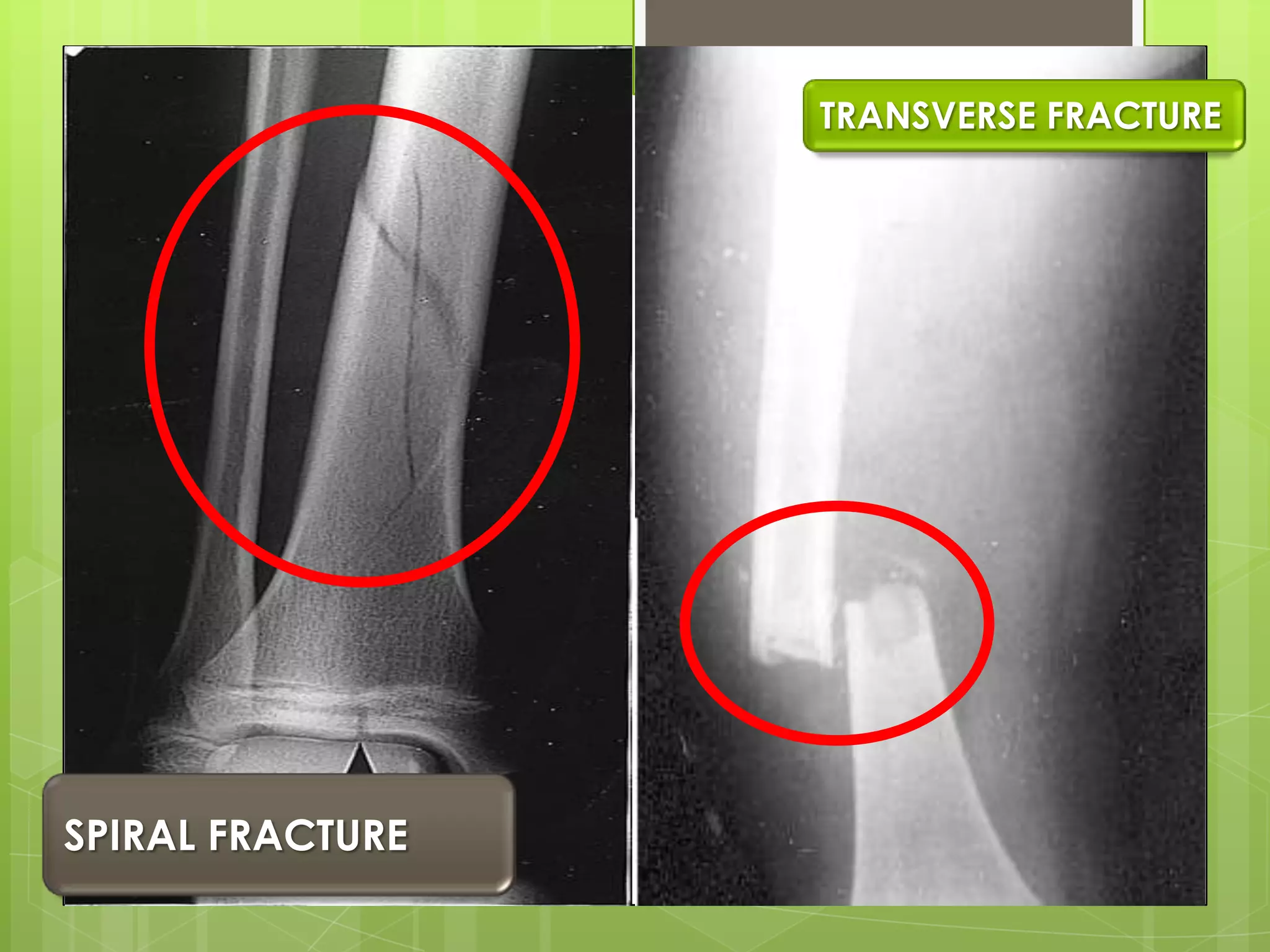
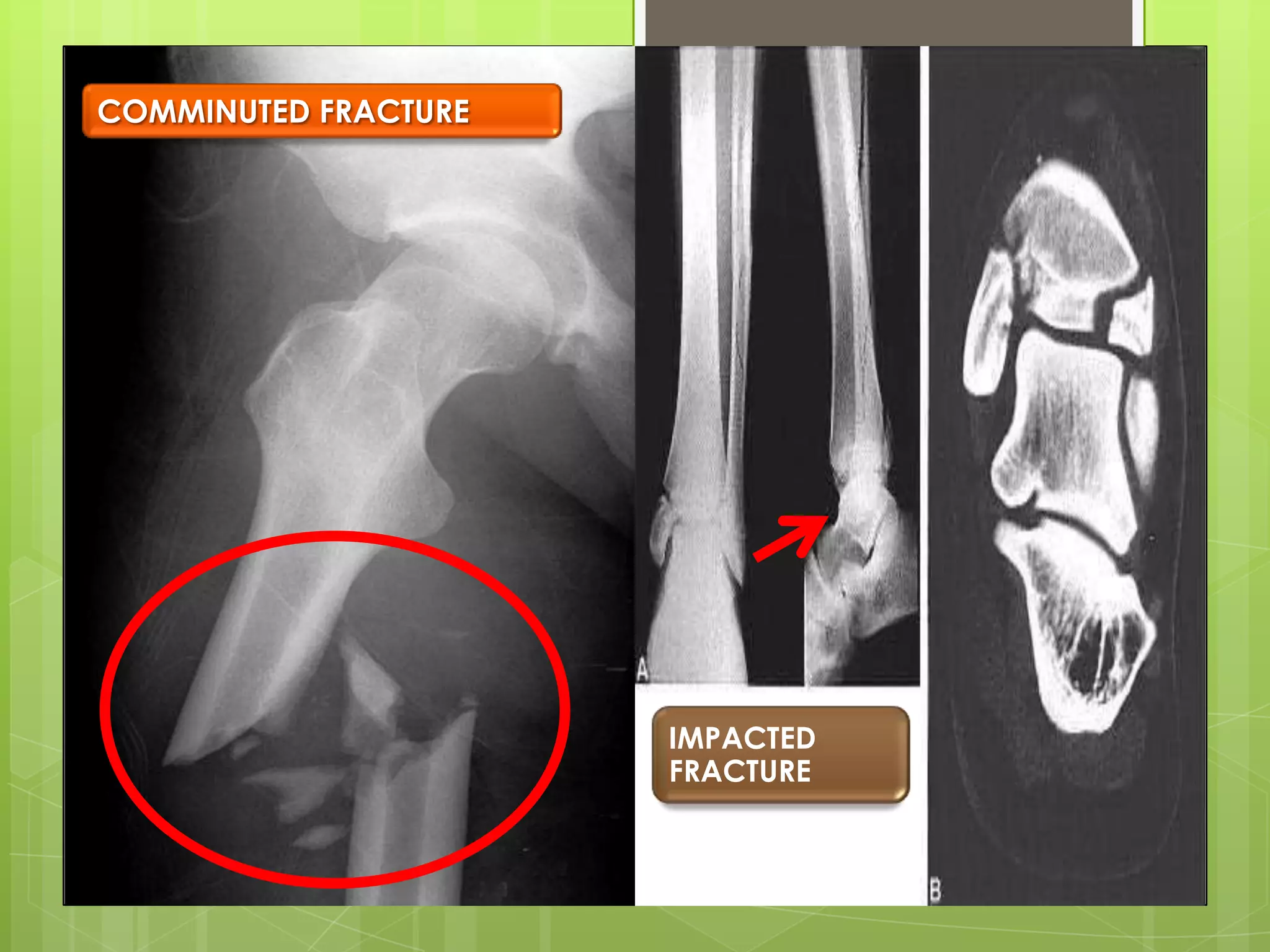
TYPES OF FRACTURES
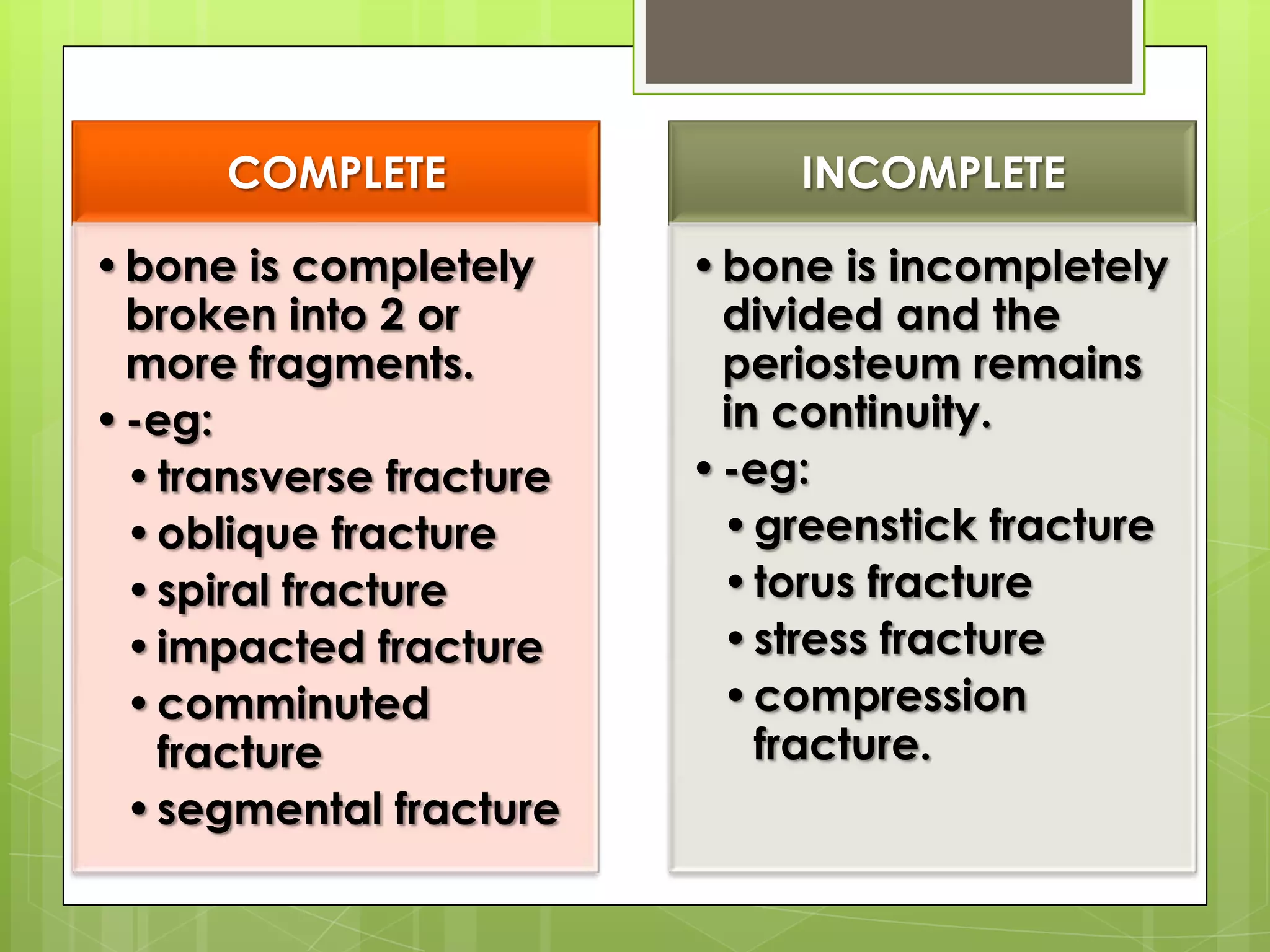
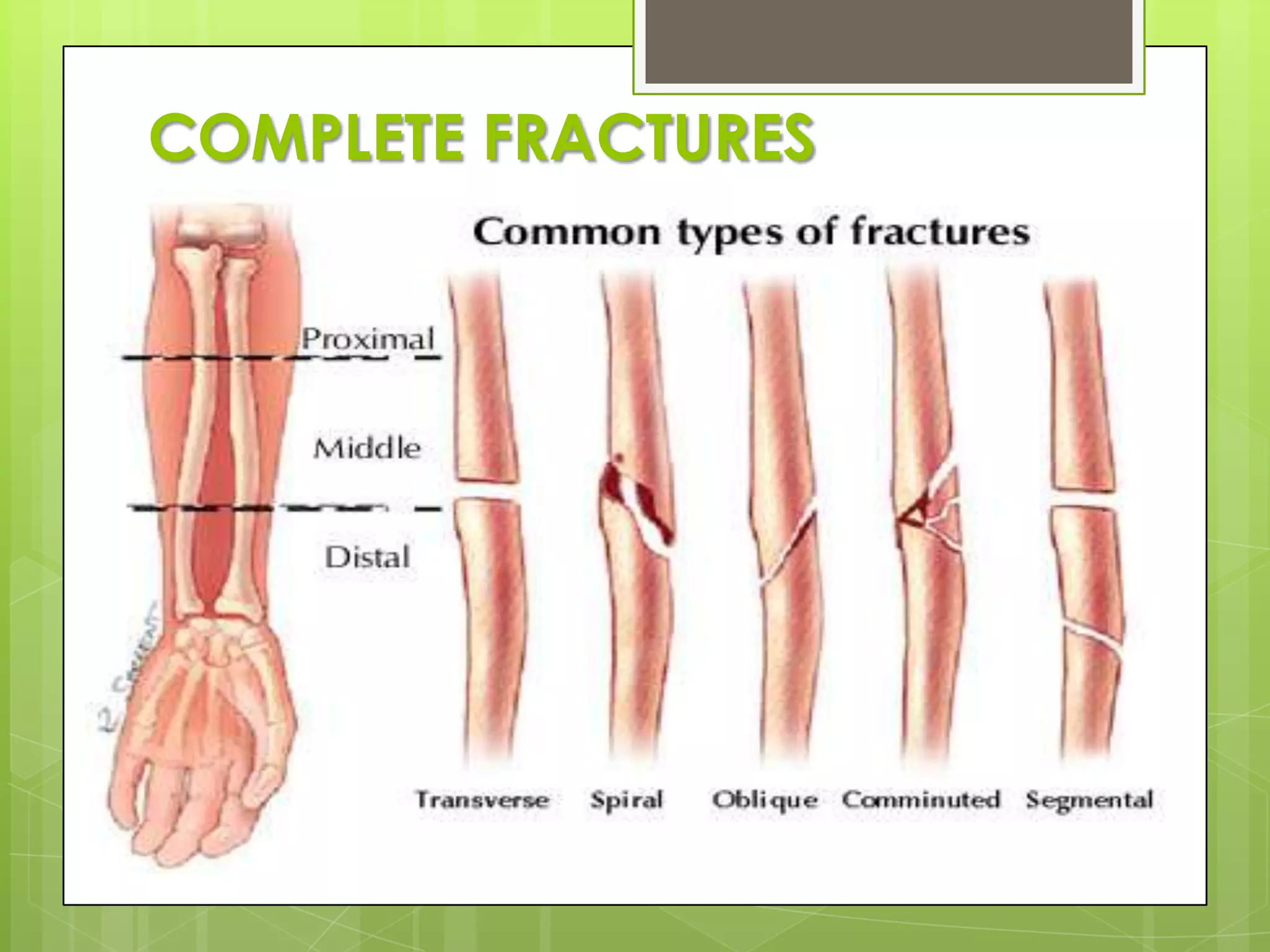
COMPLETE FRACTURES
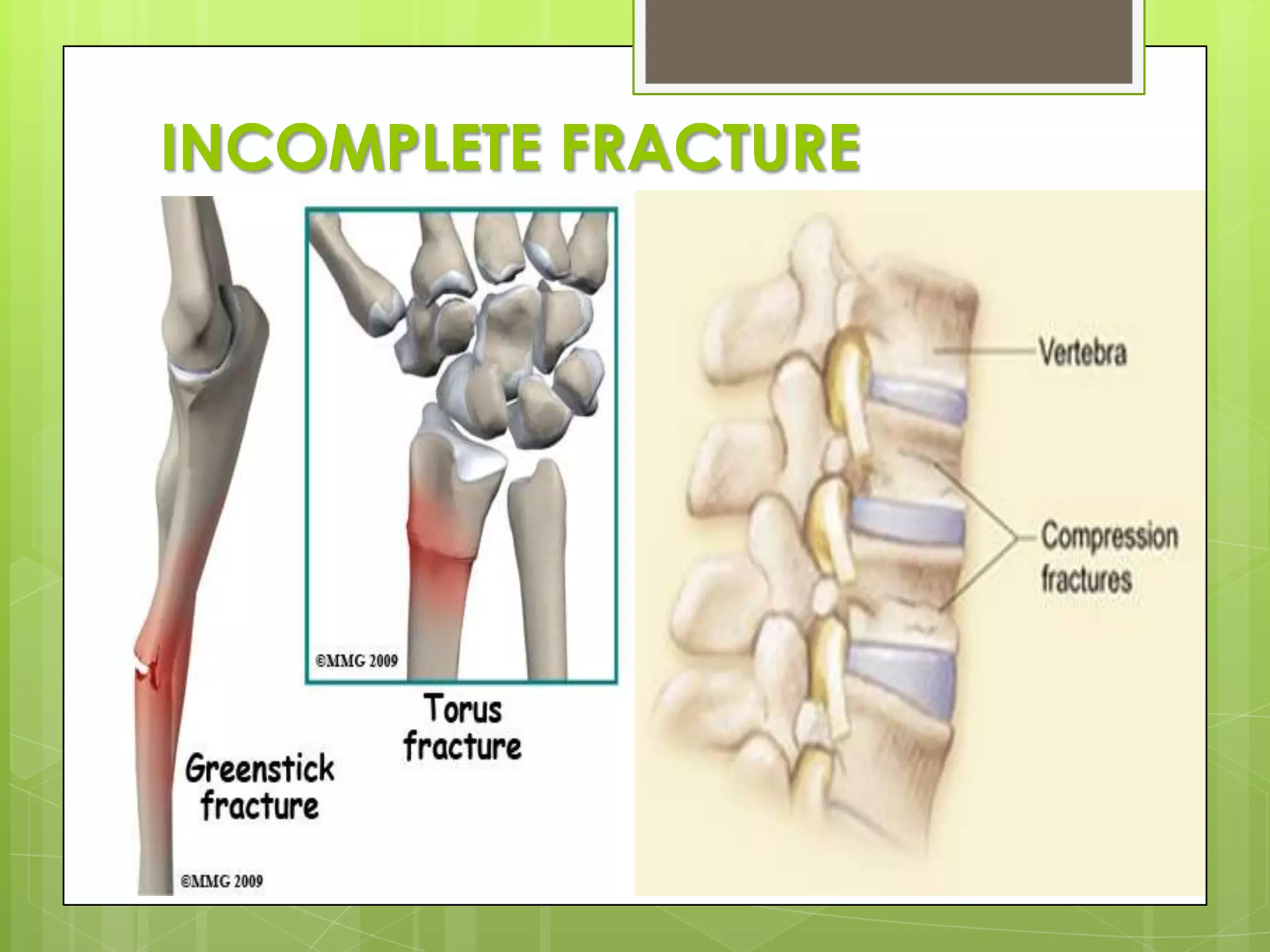
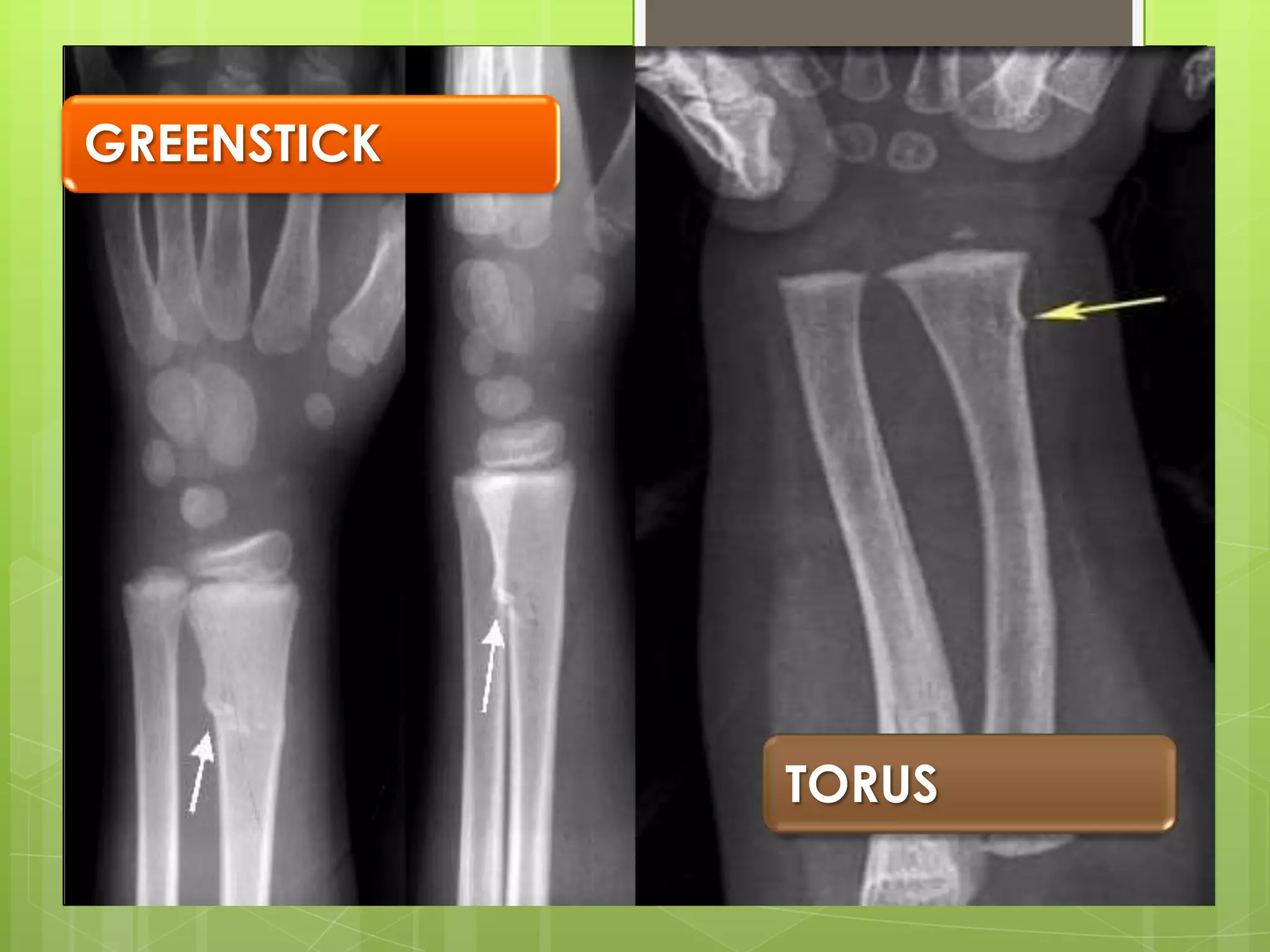
INCOMPLETE FRACTURE
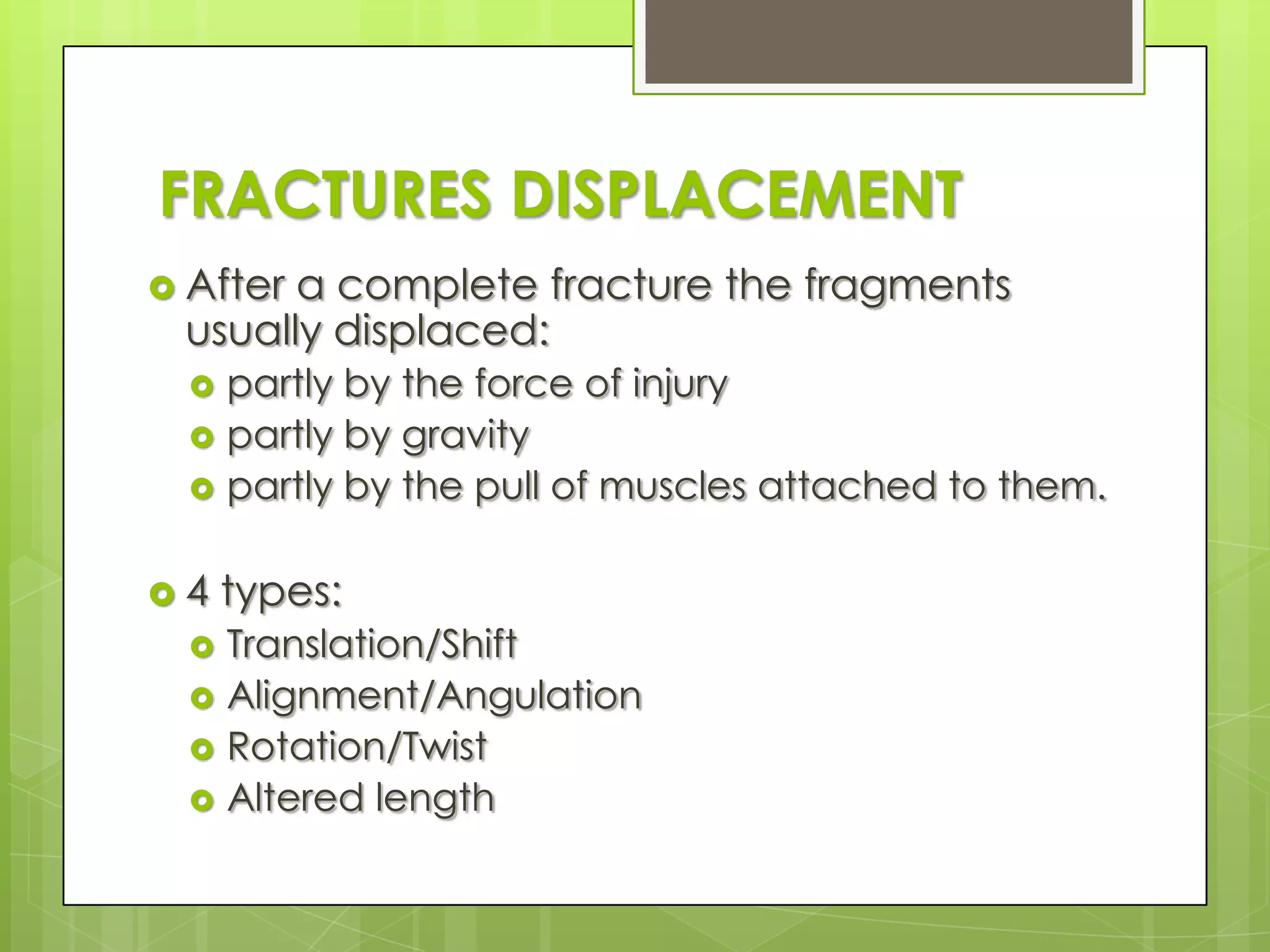
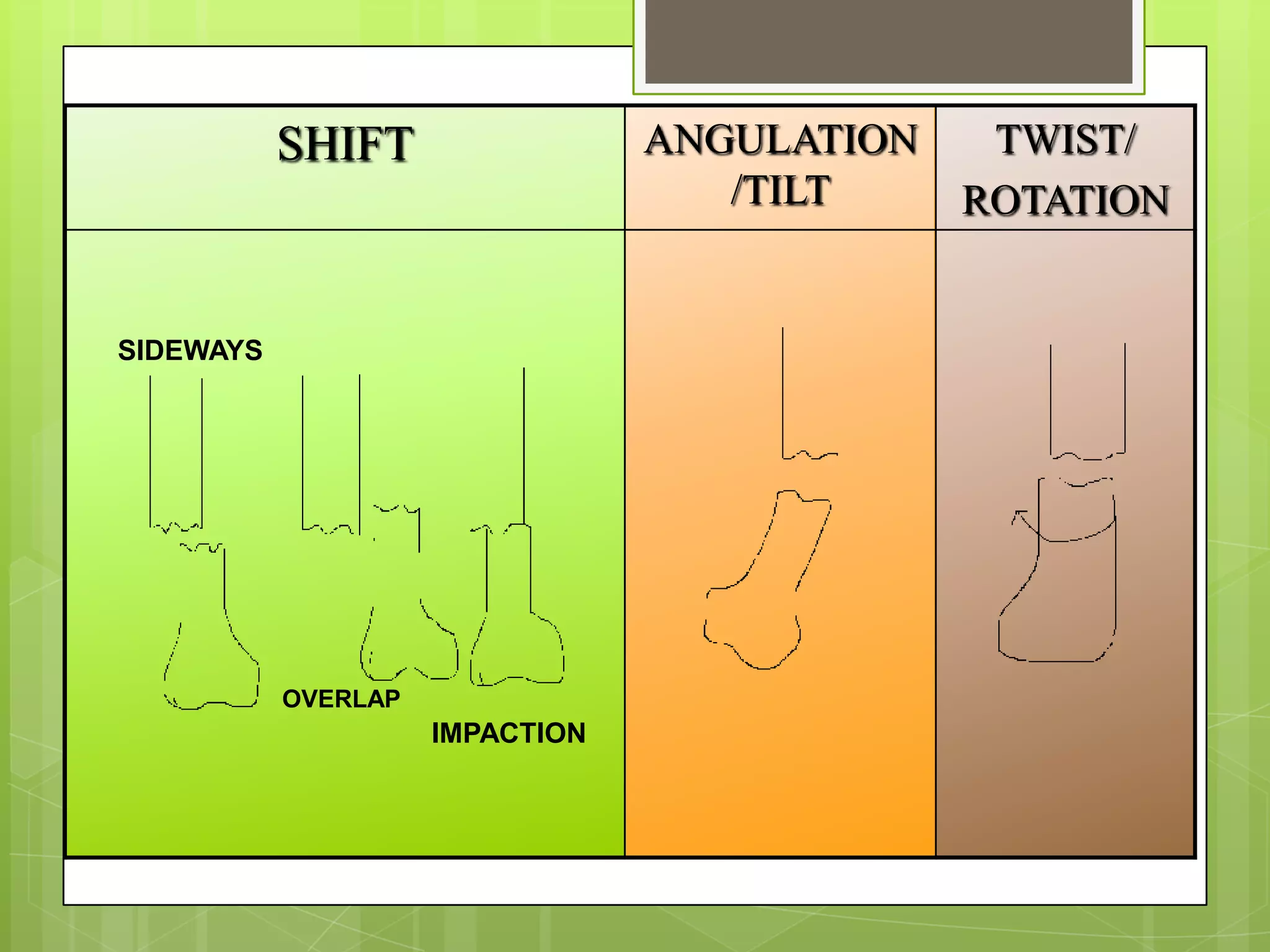
FRACTURES DISPLACEMENTAfter a complete fracture the fragments usually displaced:partly by the force of injurypartly by gravitypartly by the pull of muscles attached to them.4 types: Translation/ShiftAlignment/AngulationRotation/TwistAltered length
SIDEWAYSOVERLAPIMPACTION
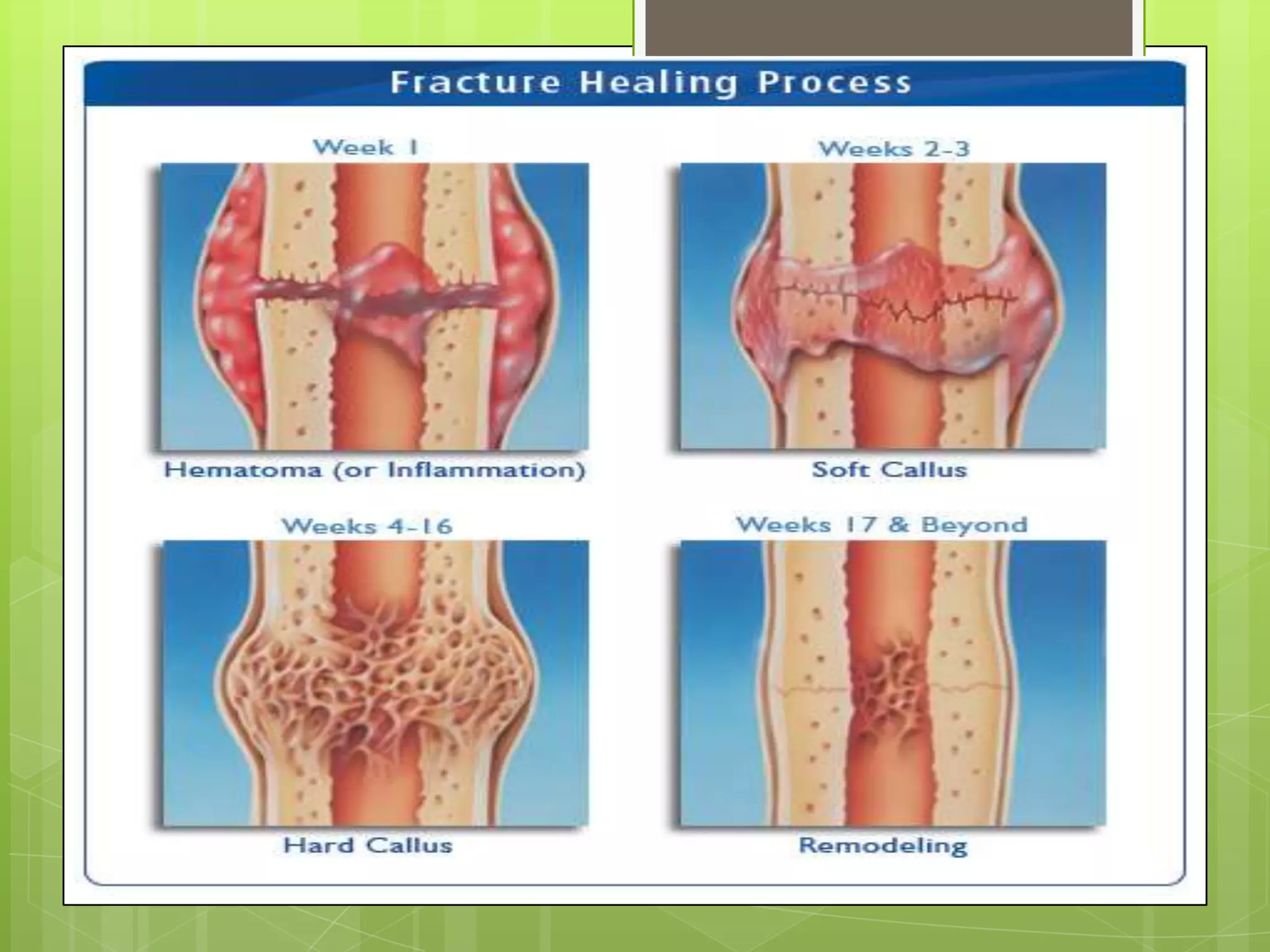
HOW FRACTURES HEAL?Healing by callusHealing without callus
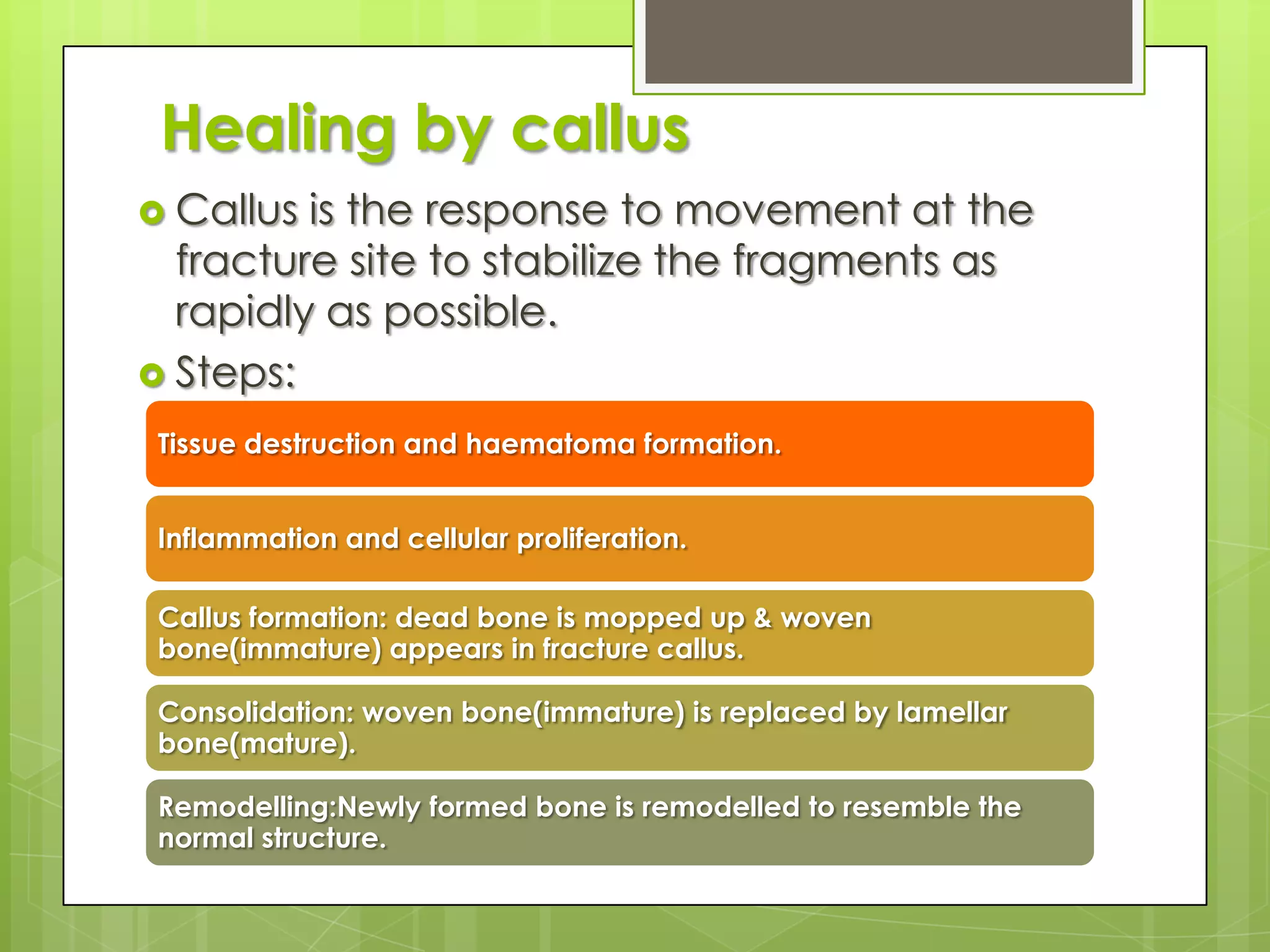
Healing by callusCallus is the response to movement at the fracture site to stabilize the fragments as rapidly as possible.Steps:
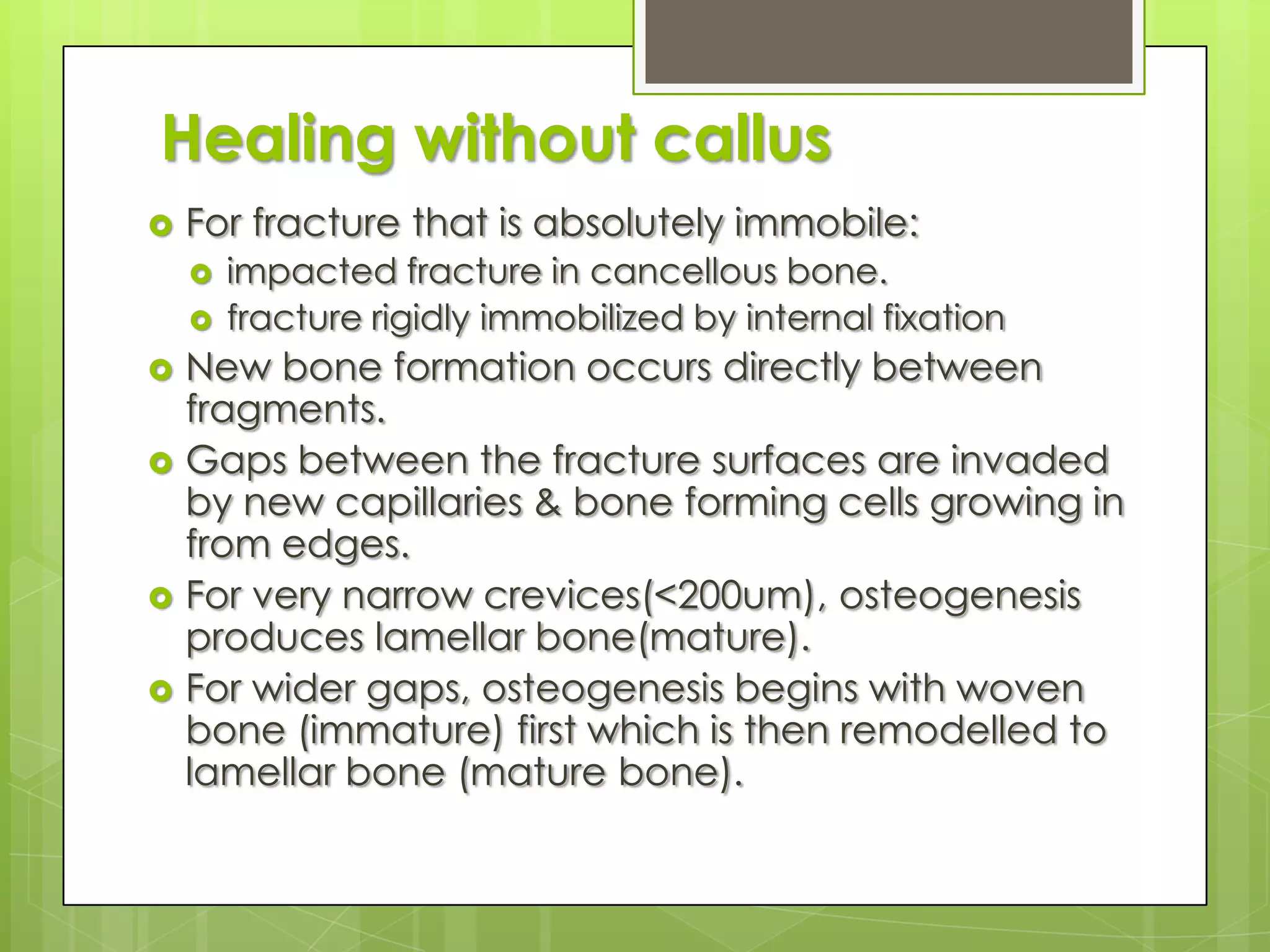
Healing without callusFor fracture that is absolutely immobile:impacted fracture in cancellous bone.fracture rigidly immobilized by internal fixationNew bone formation occurs directly between fragments.Gaps between the fracture surfaces are invaded by new capillaries & bone forming cells growing in from edges.For very narrow crevices(<200um), osteogenesis produces lamellar bone(mature).For wider gaps, osteogenesis begins with woven bone (immature) first which is then remodelled to lamellar bone (mature bone).
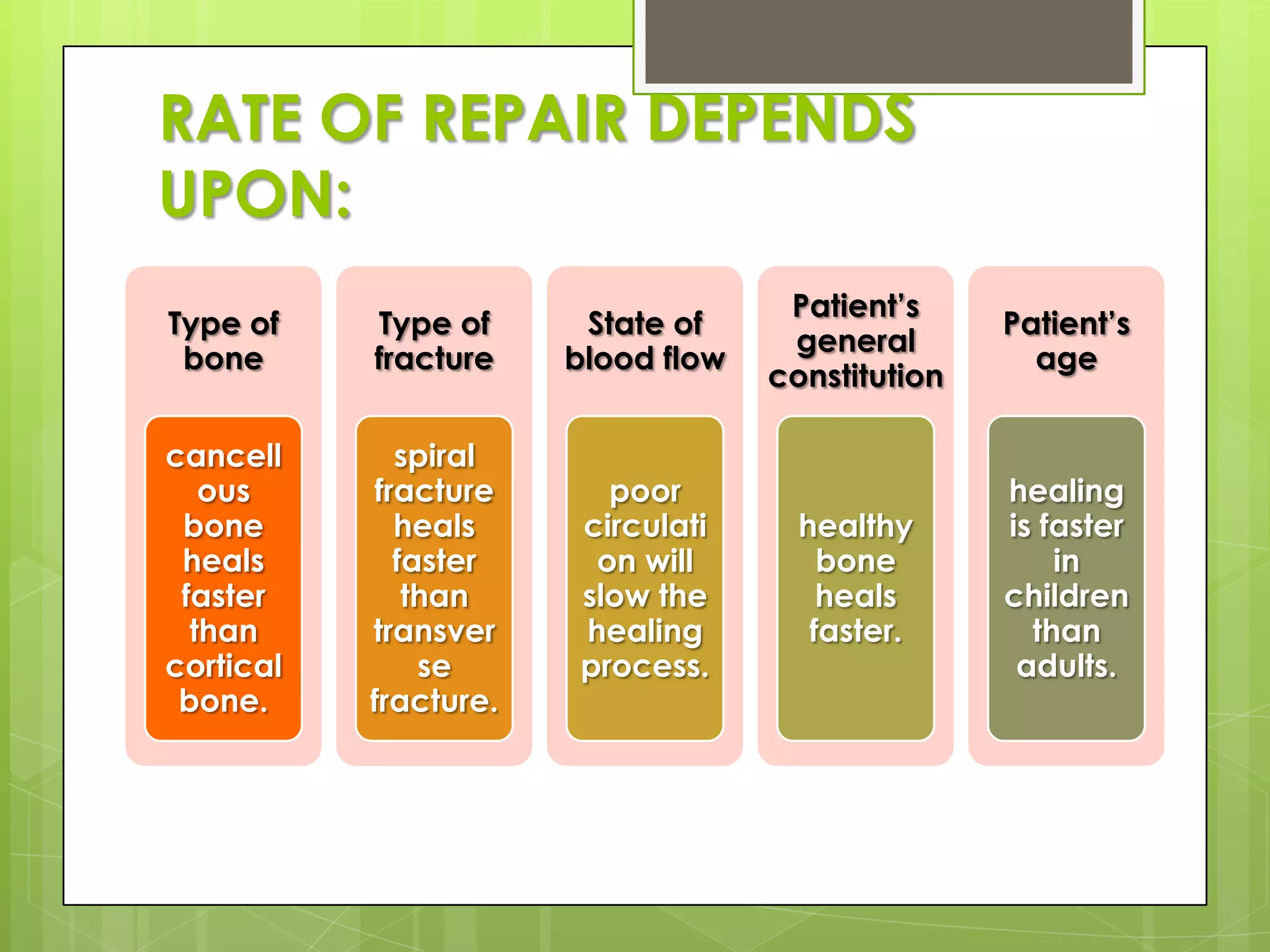
RATE OF REPAIR DEPENDS UPON:
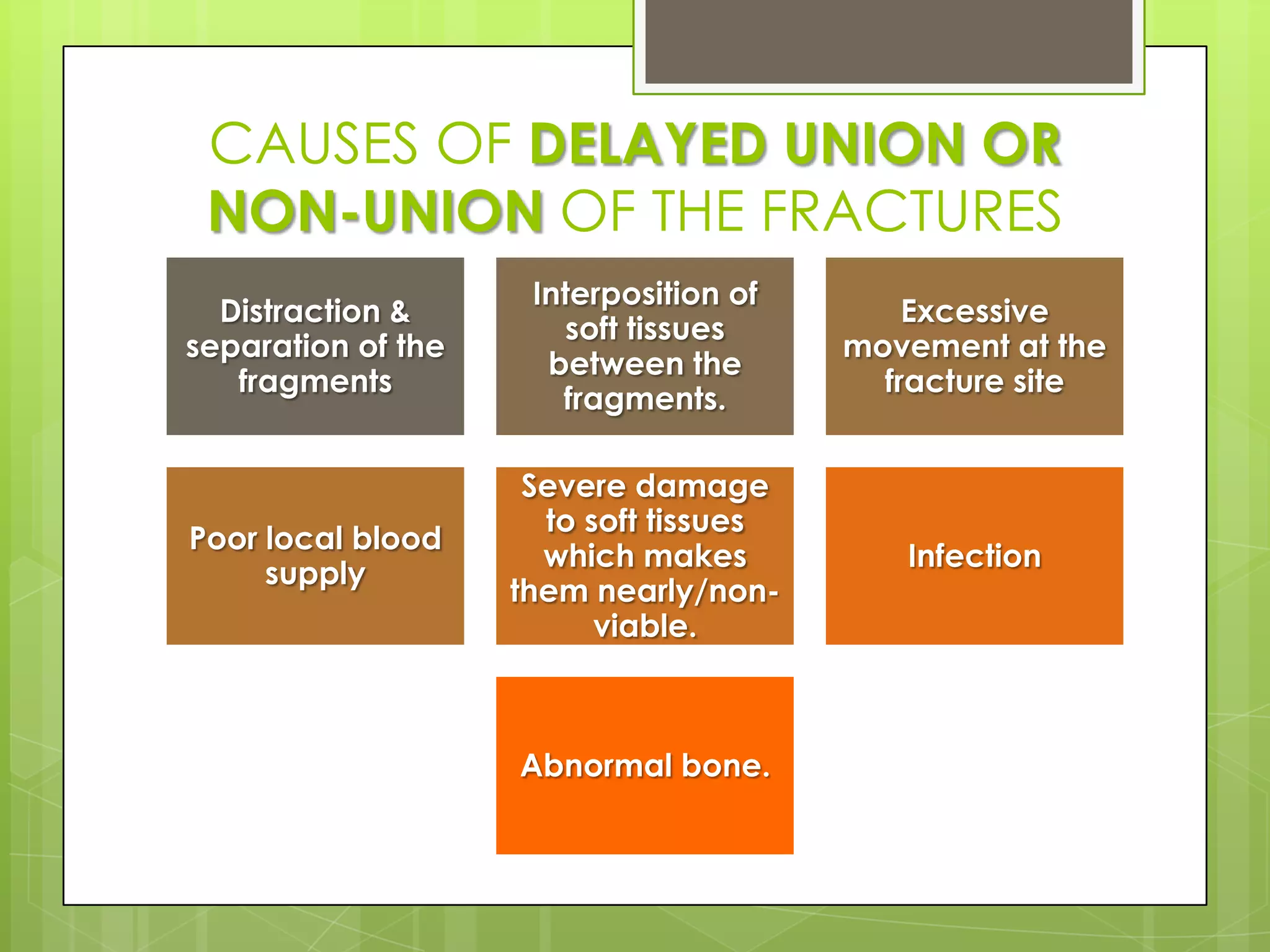
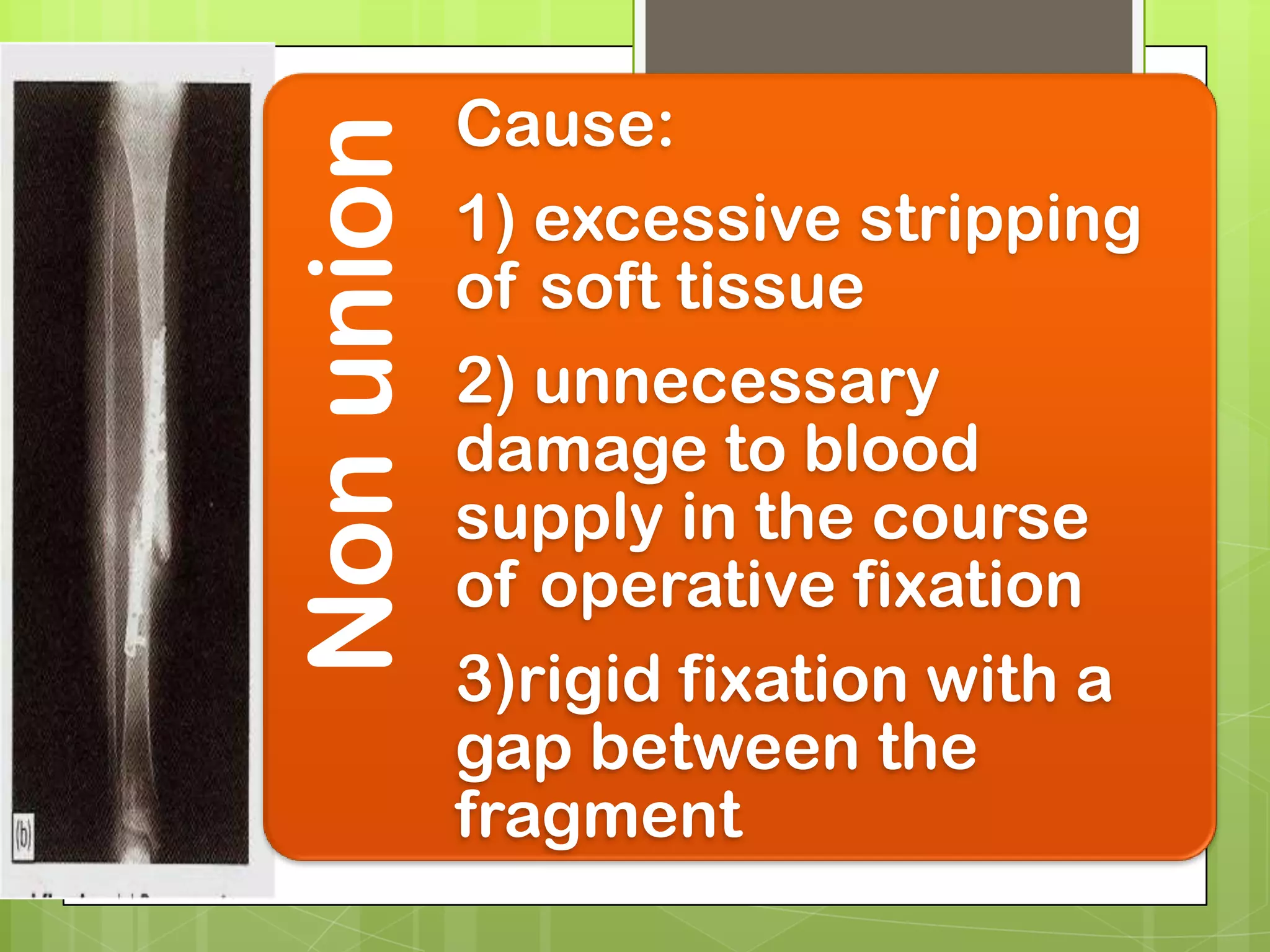
CAUSES OF DELAYED UNION OR NON-UNION OF THE FRACTURES
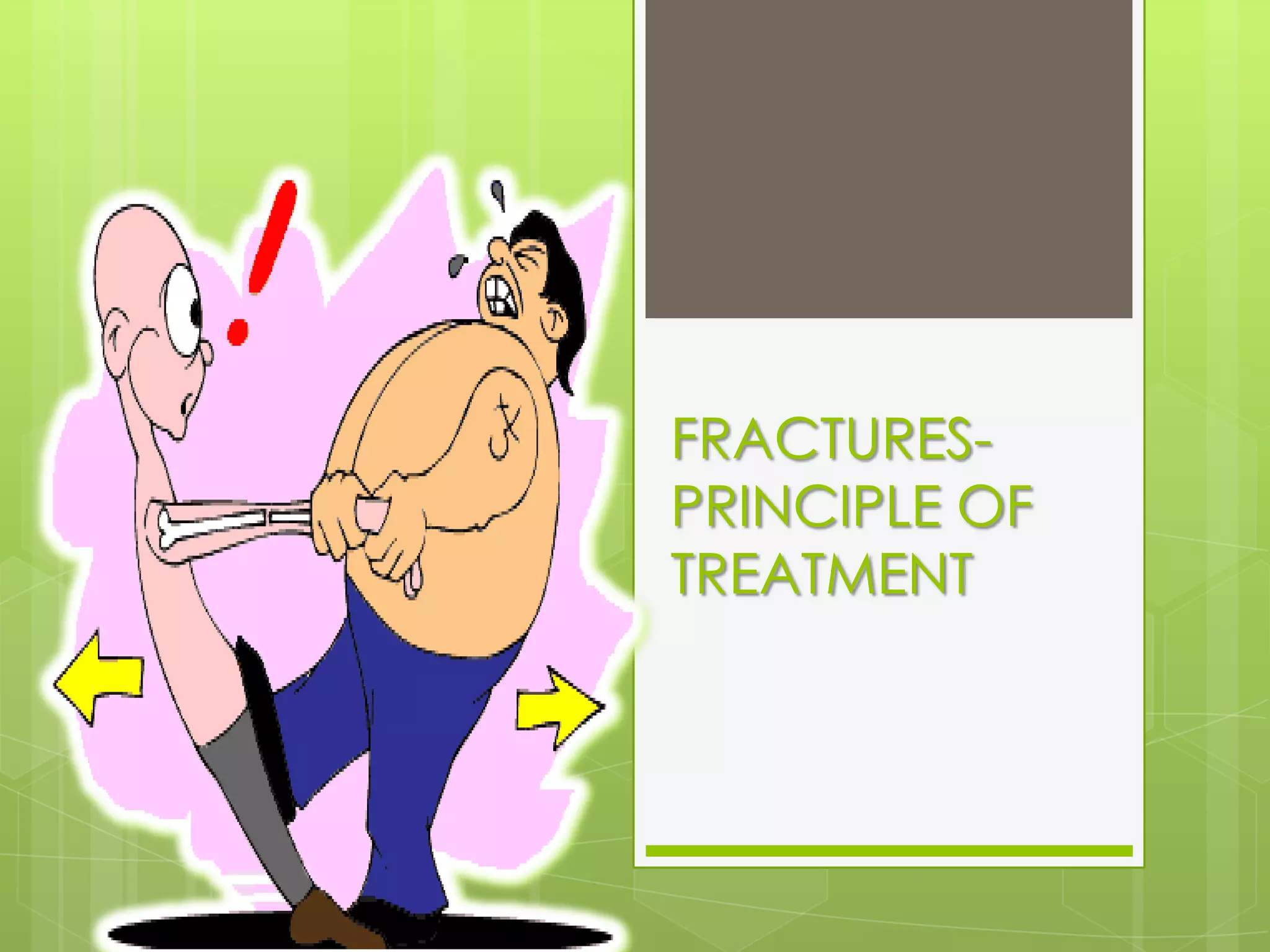
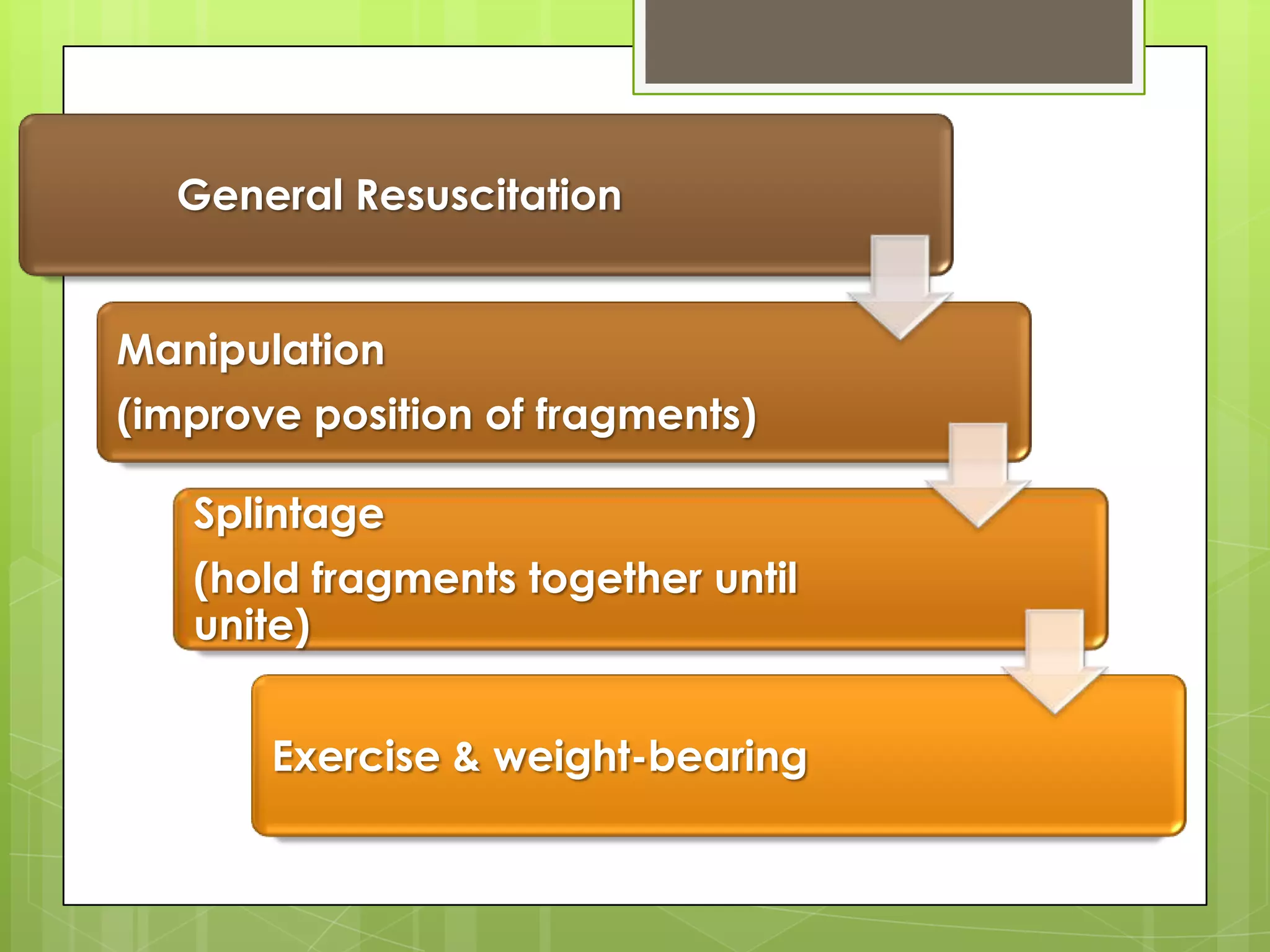
FRACTURES- PRINCIPLE OF TREATMENT
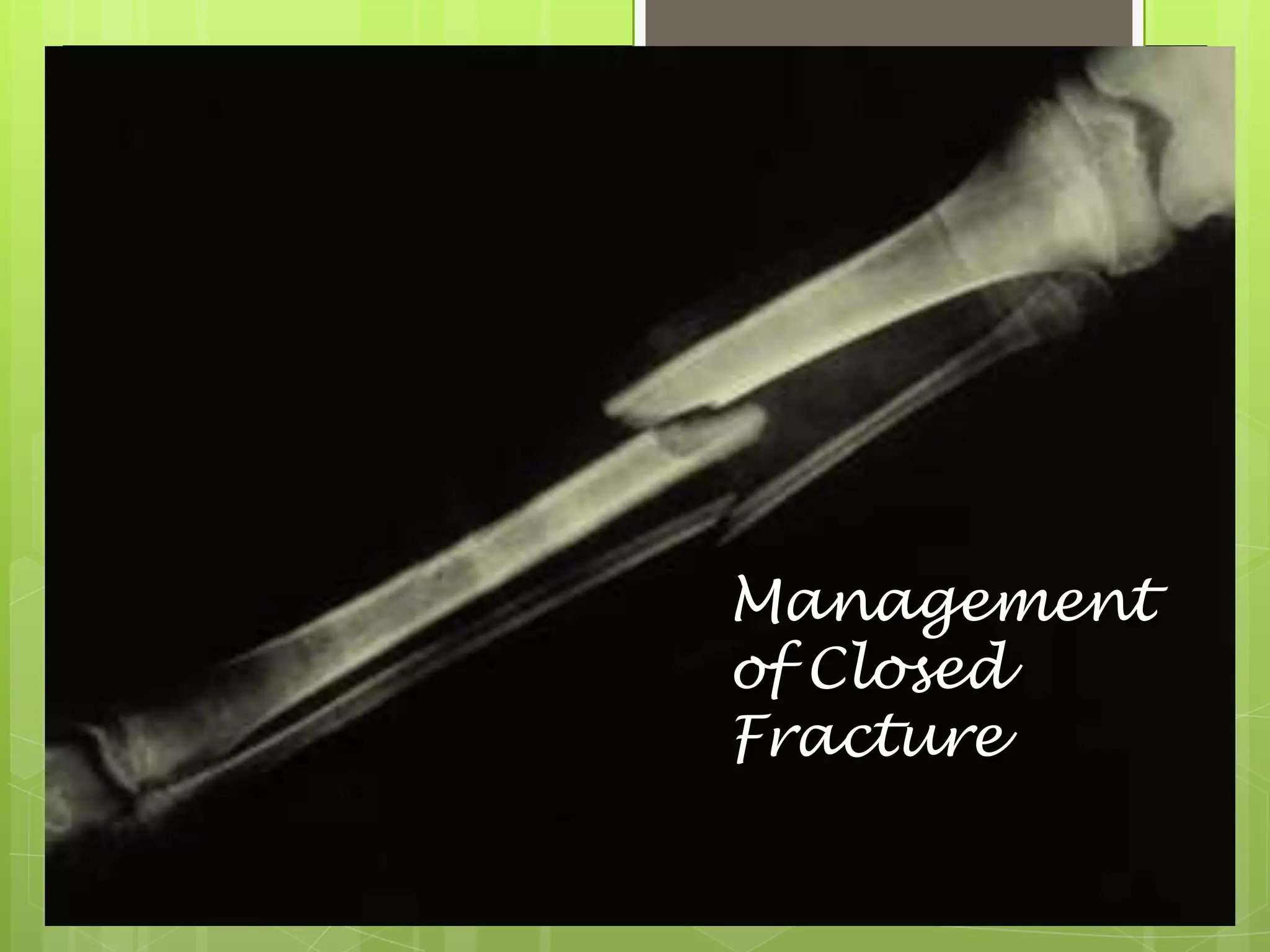
Management of Closed Fracture
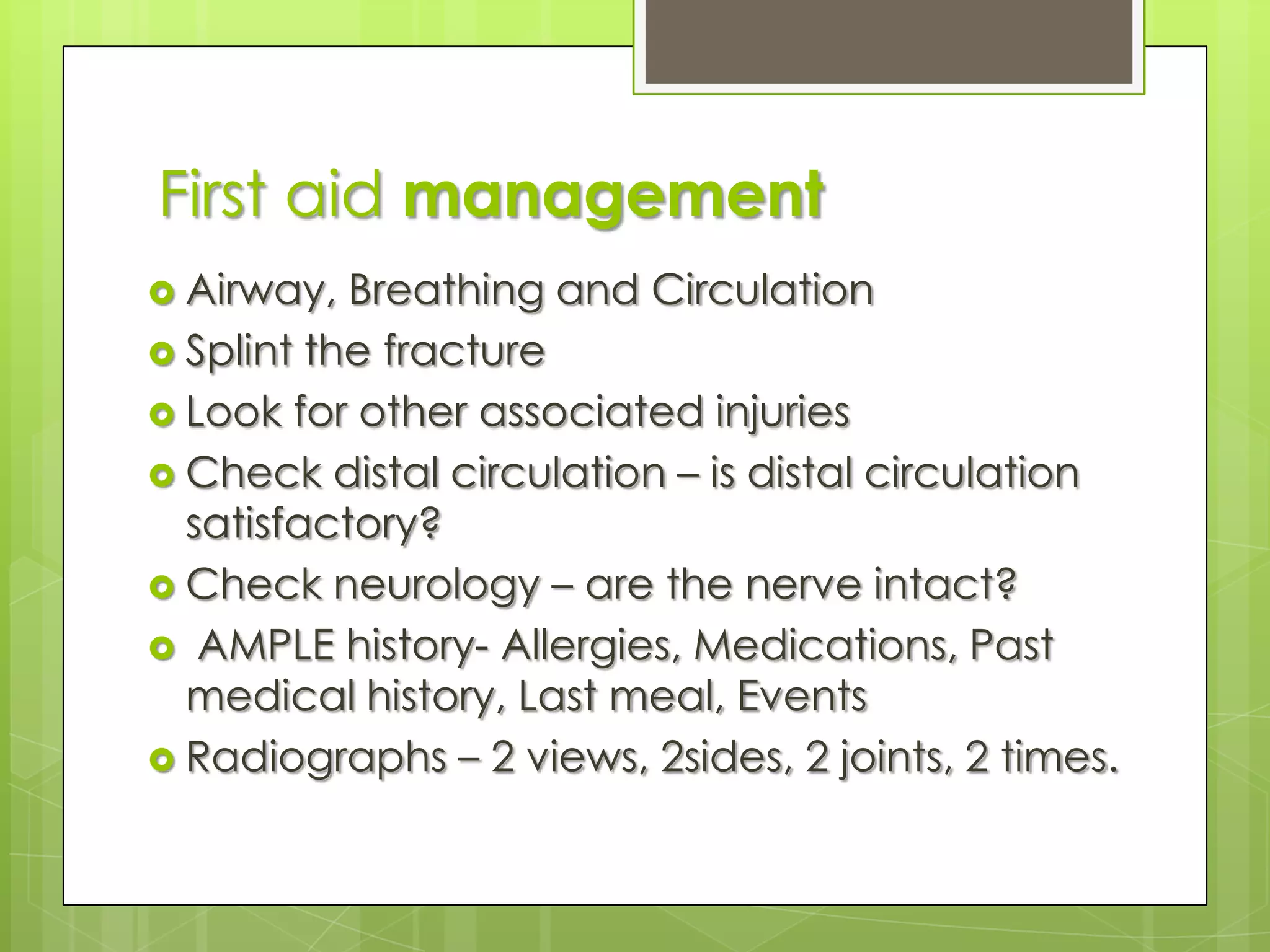
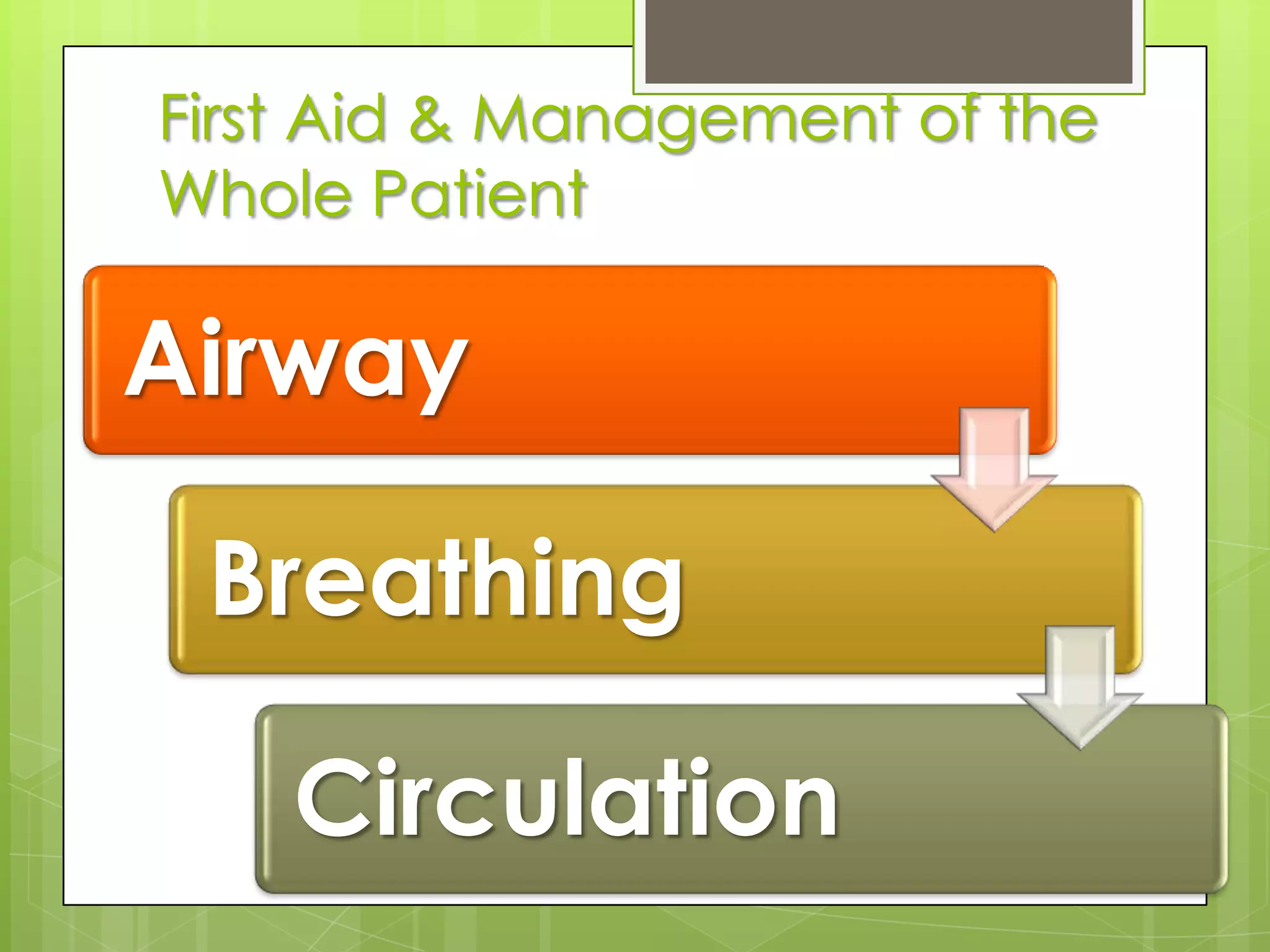
First aid management Airway, Breathing and CirculationSplint the fracture Look for other associated injuriesCheck distal circulation – is distal circulation satisfactory? Check neurology – are the nerve intact?AMPLE history- Allergies, Medications, Past medical history, Last meal, Events Radiographs – 2 views, 2sides, 2 joints, 2 times.
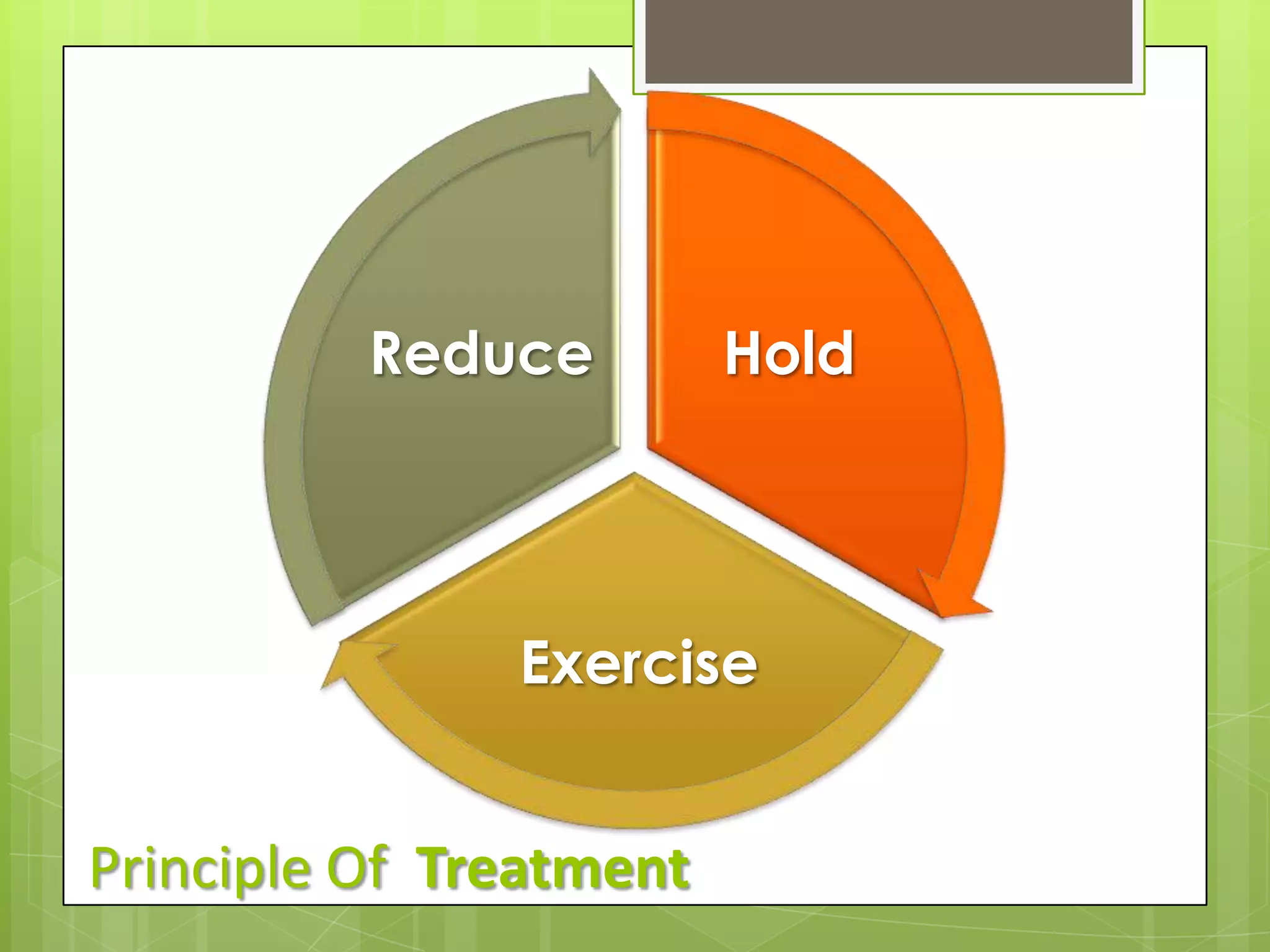
Principle Of  Treatment
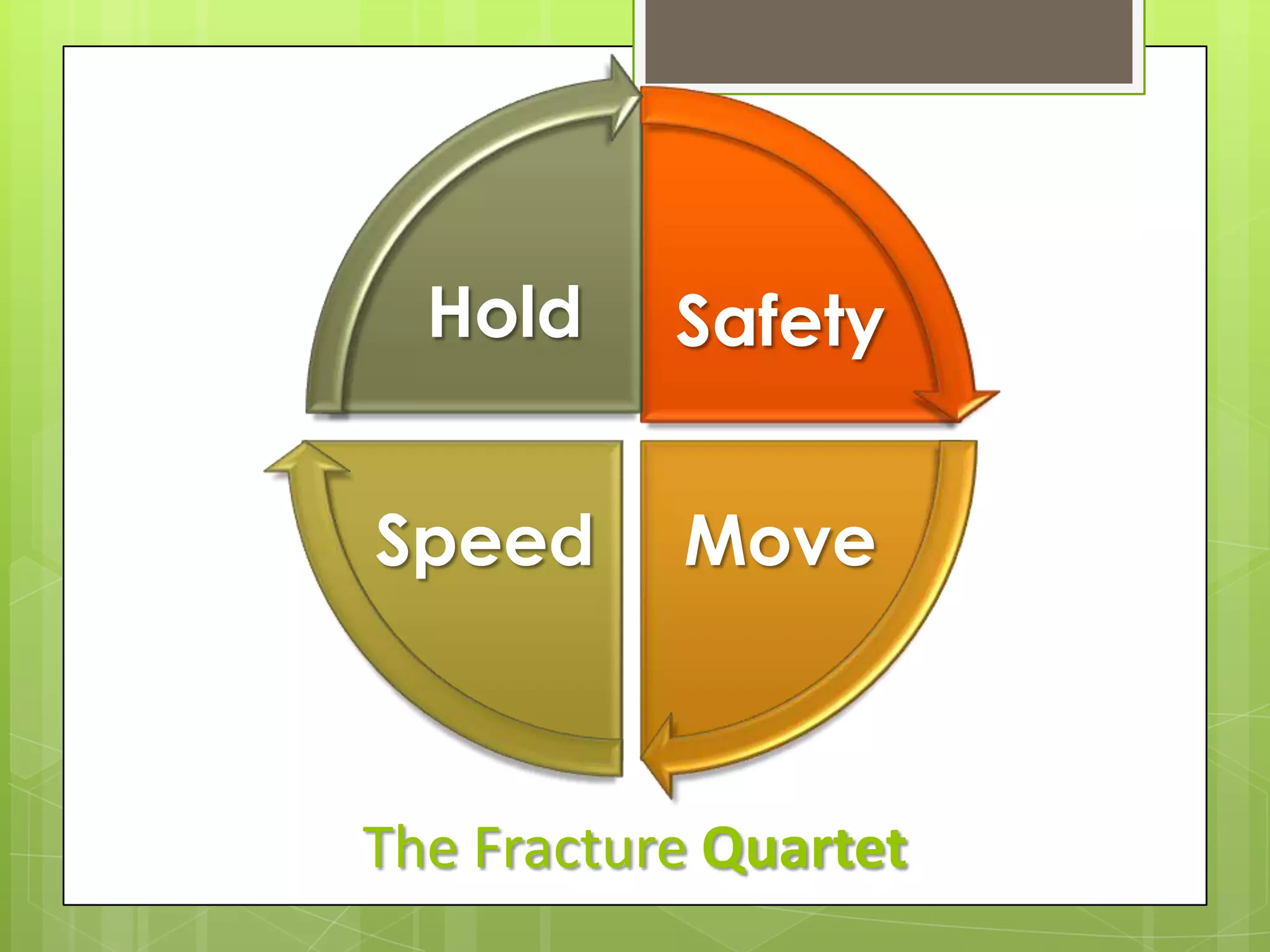
The Fracture Quartet
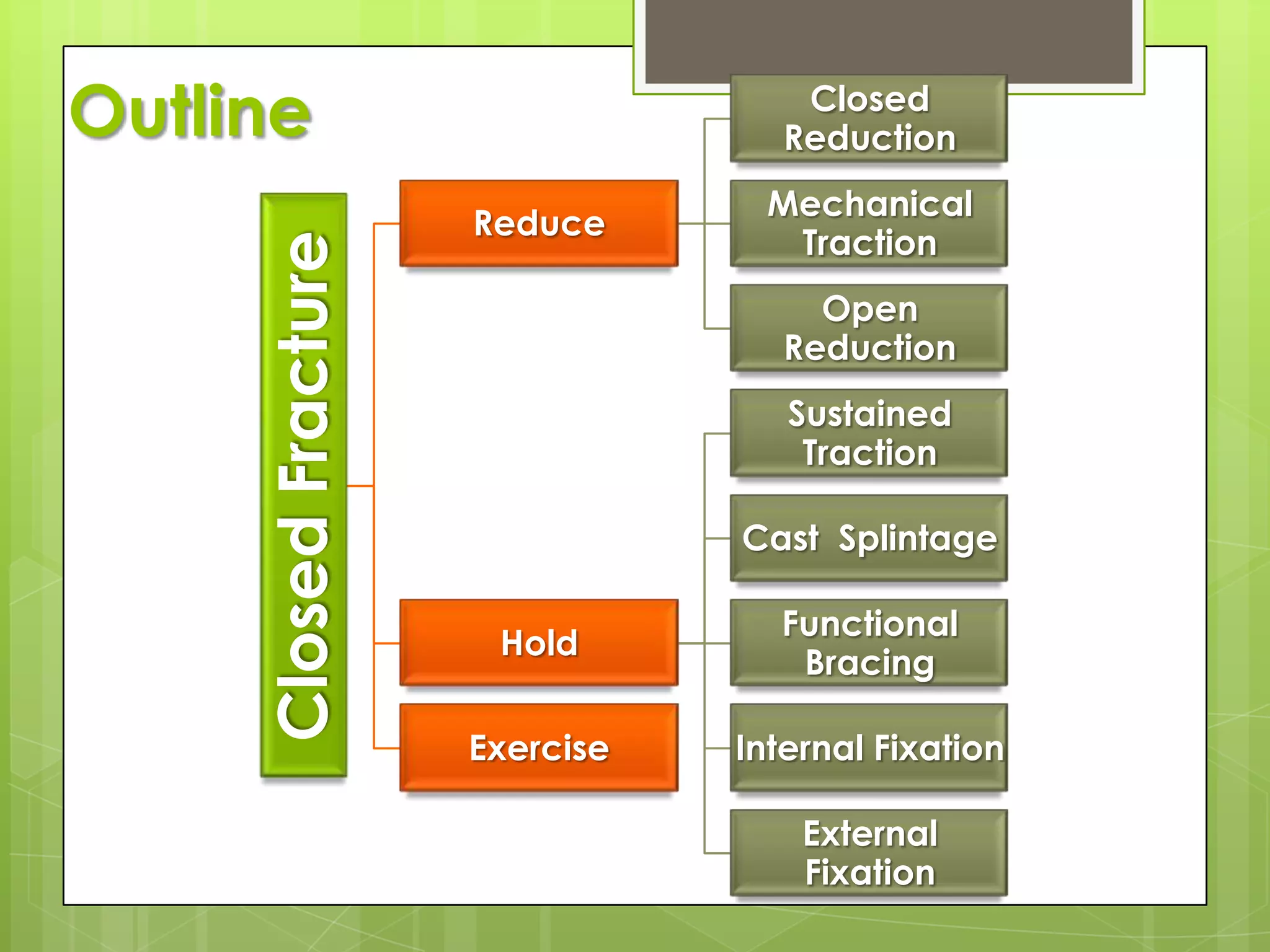
Outline
ReduceAim for adequate apposition and normal alignment of the bone fragmentsThe greater contact surface area between fragments, the more likely is healing to occur
However, there are some situations in which reduction is unnecessary:When  there is little or no displacementWhen displacement does not matter (e.g. in some fractures of the clavicle)When reduction is unlikely to succeed (e.g. with compression fracture of the vertebrae)
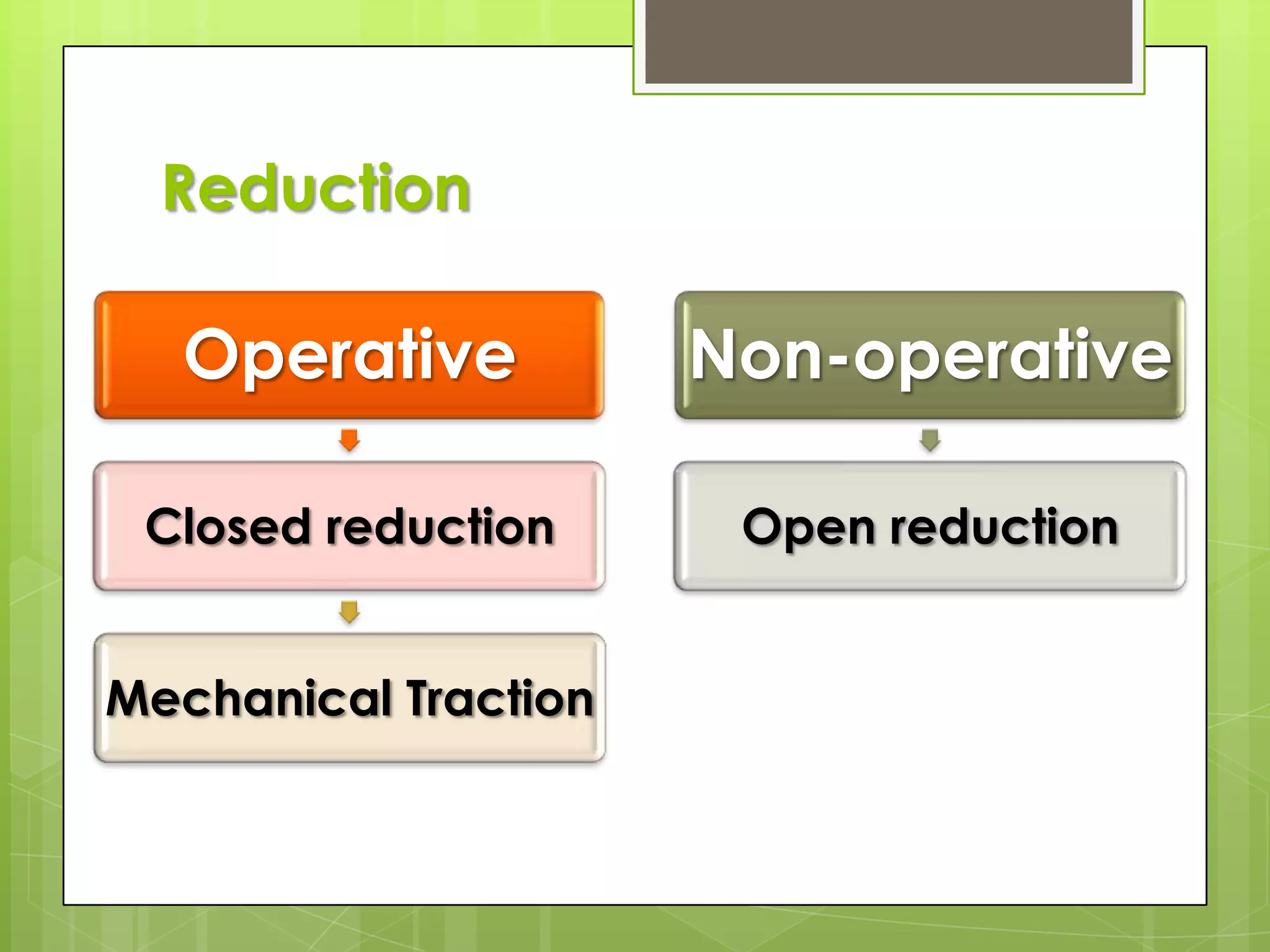
Reduction
Closed ReductionSuitable forMinimally displaced fracturesMost fractures in childrenFractures that are likely to be stable after reduction
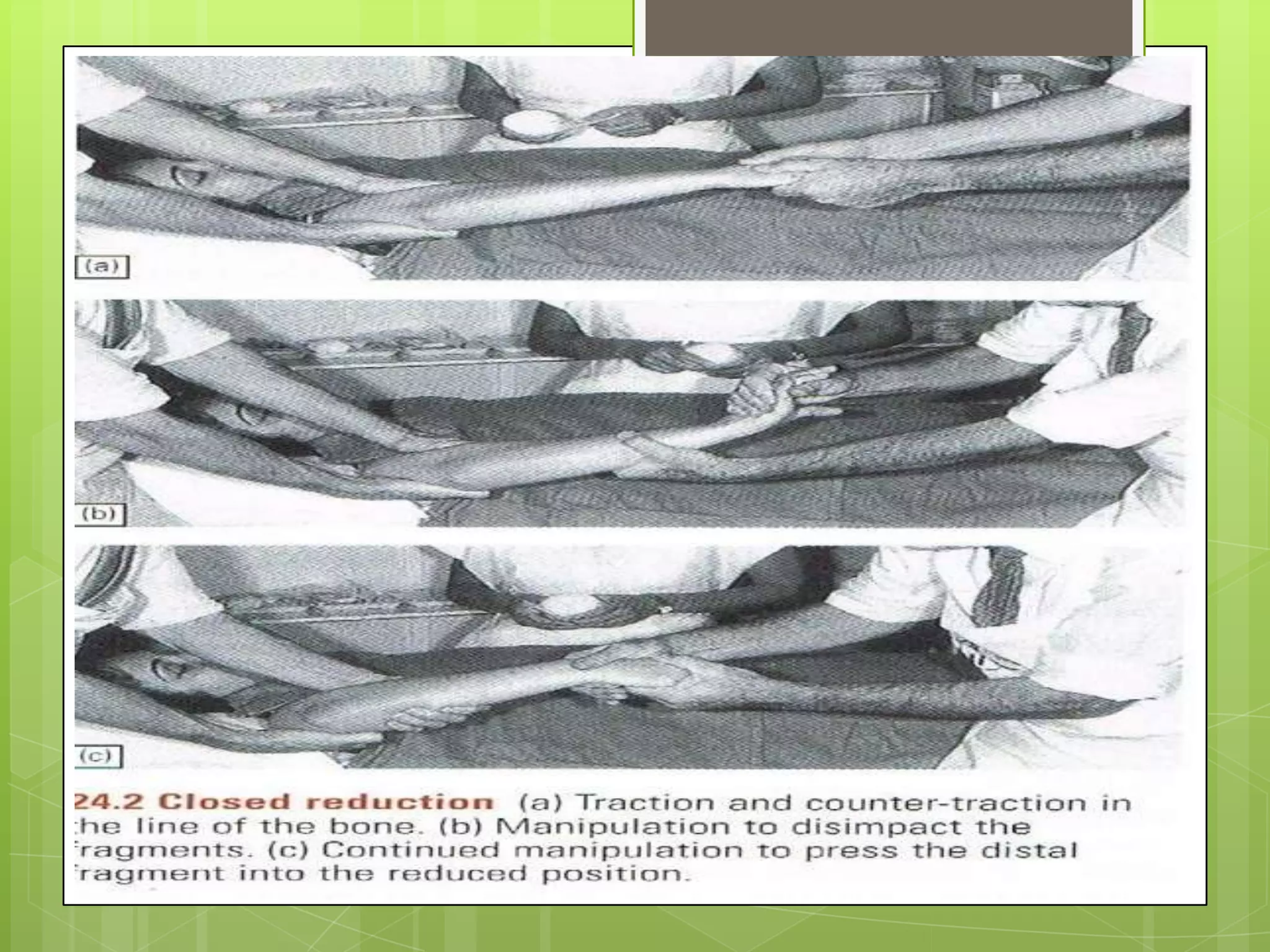
Most effective when the periosteum and muscles on one side of fracture remain intactUnder anaesthesia and muscle relaxation, a threefold manoeuvre applied:Distal part of the limb is pulled in line of the boneDisengaged, repositionedAlignment is adjusted
Mechanical TractionSome  fractures (example fracture of femoral shaft)  are difficult to reduce by manipulation  because of powerful muscle pullHowever, they can be reduced by sustained muscle mechanical traction; also serves to hold the fracture until it starts to unite
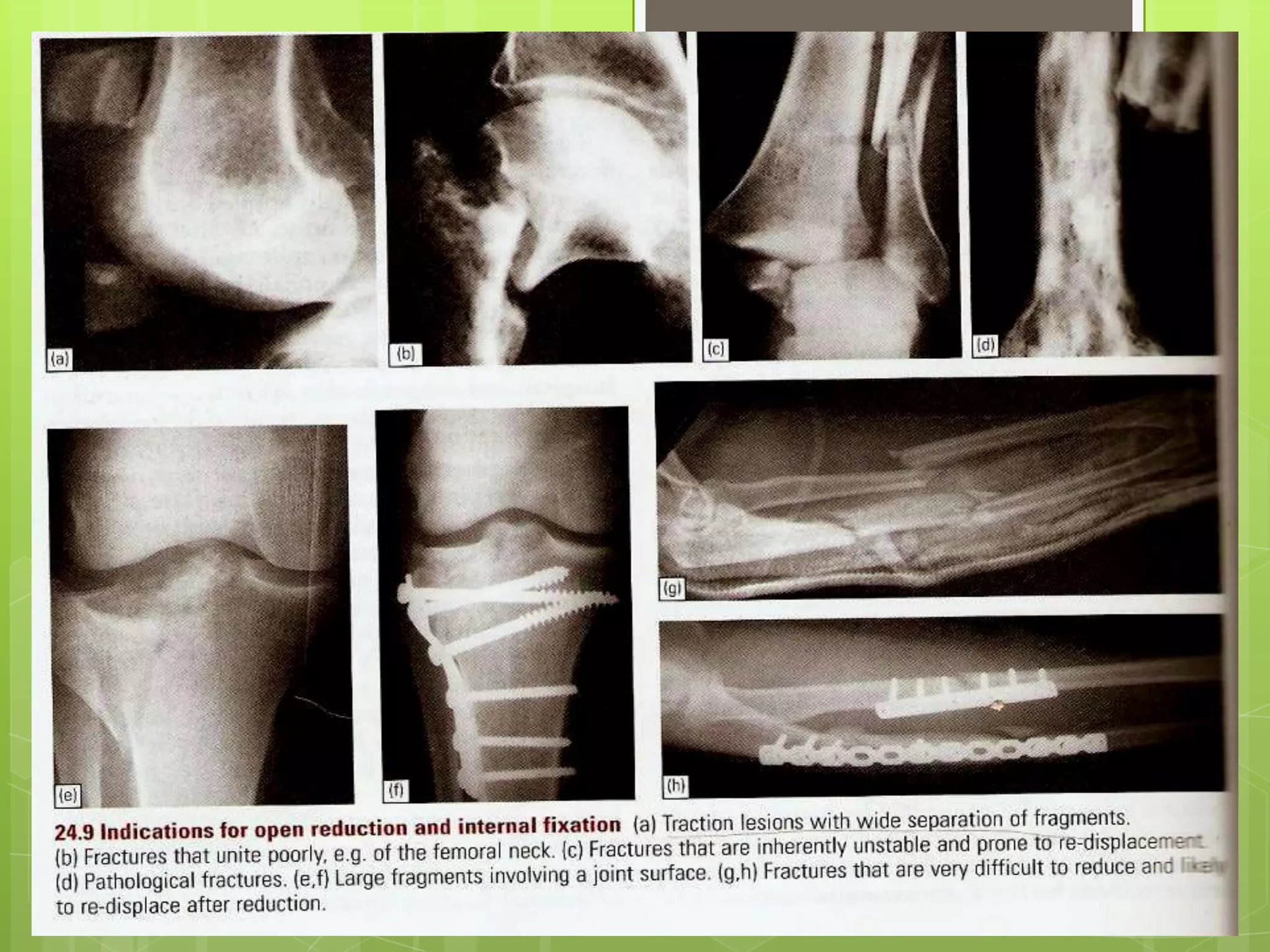
Open ReductionOperative reduction under direct visionIndications:When closed reduction failsWhen there is a large articular fragment that needs accurate positioningFor avulsion fractures in which the fragments are held apart by muscle pullWhen an operation is needed for associated injuriesWhen a fracture needs an internal fixation
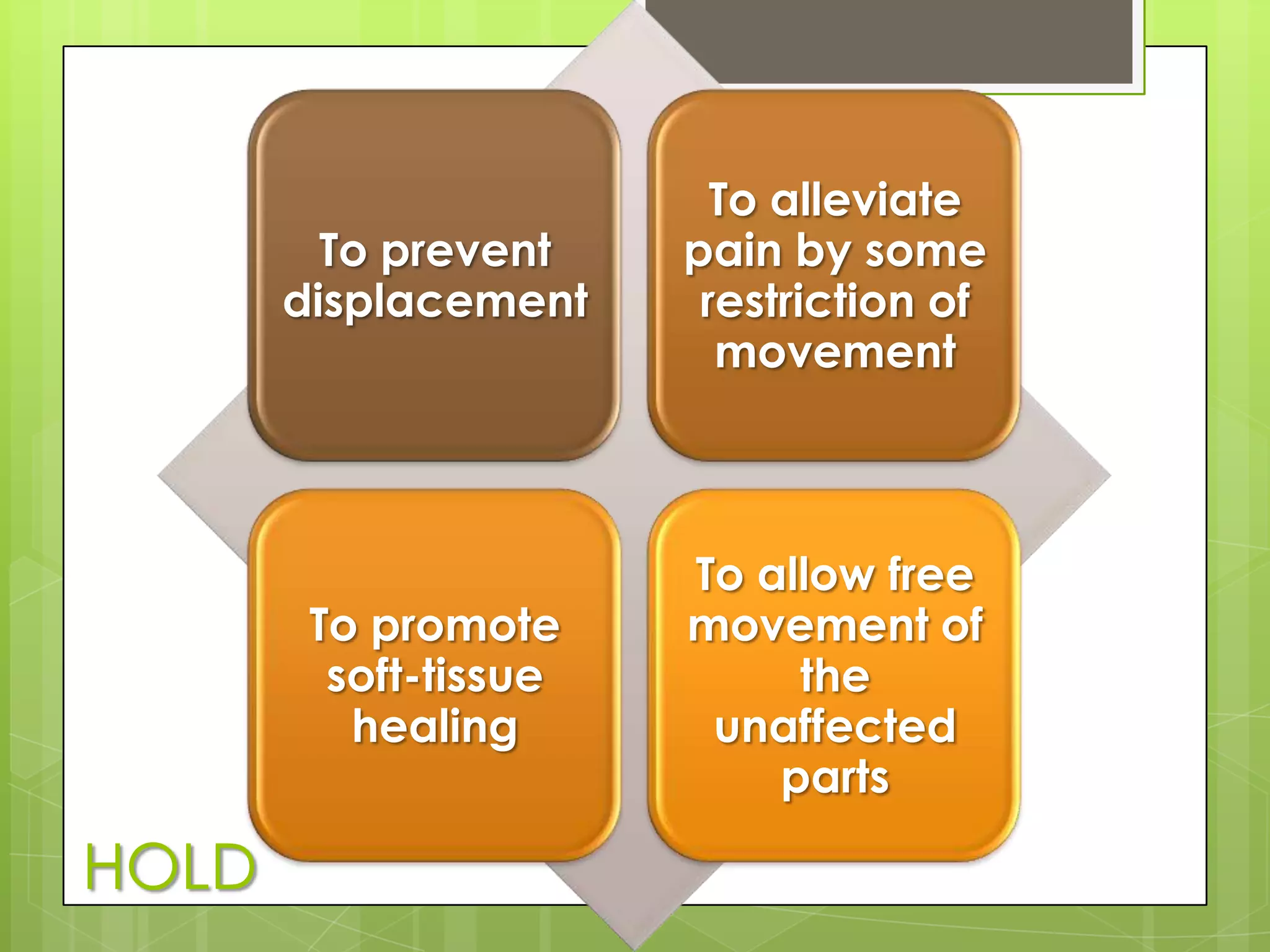
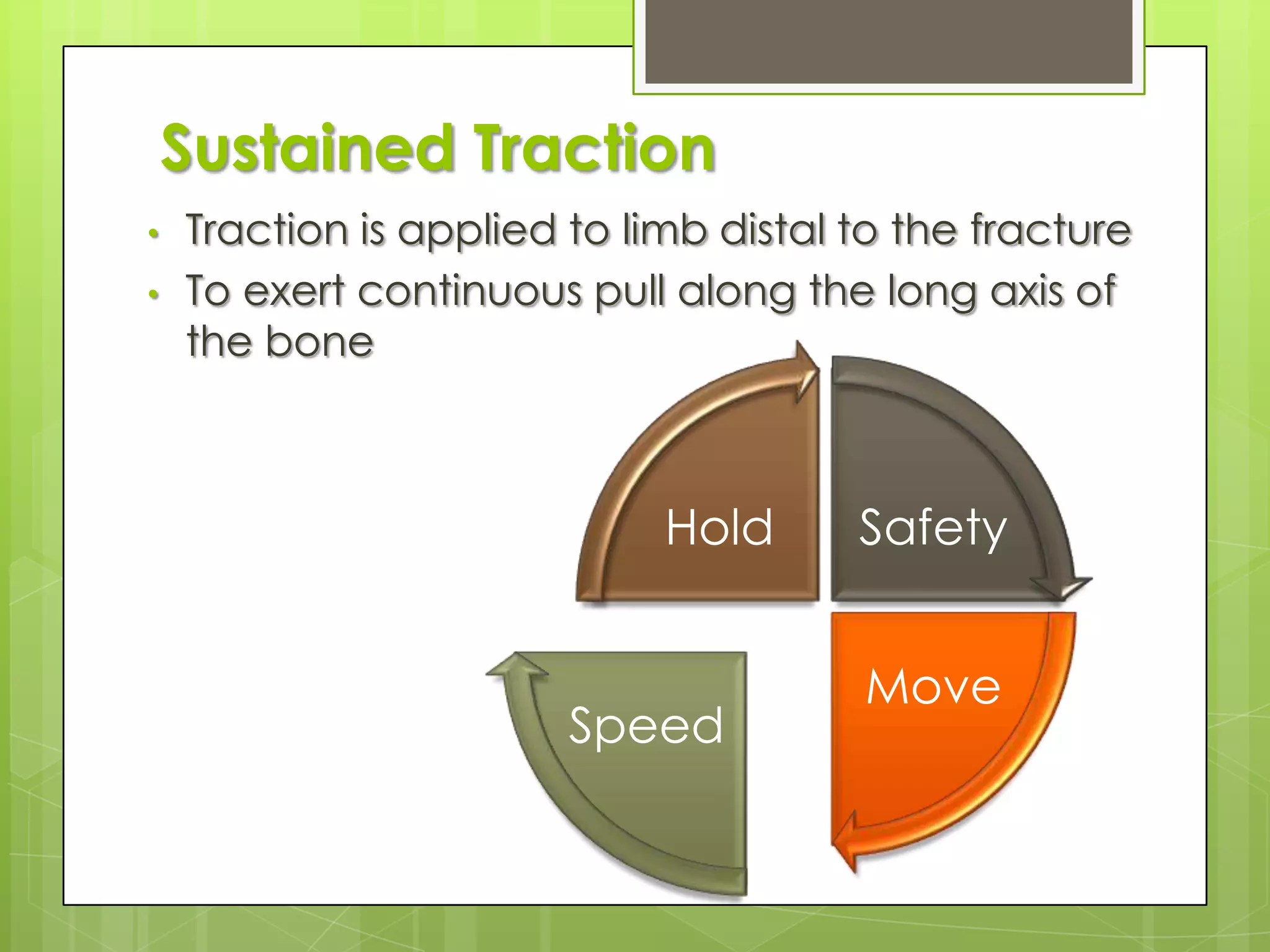
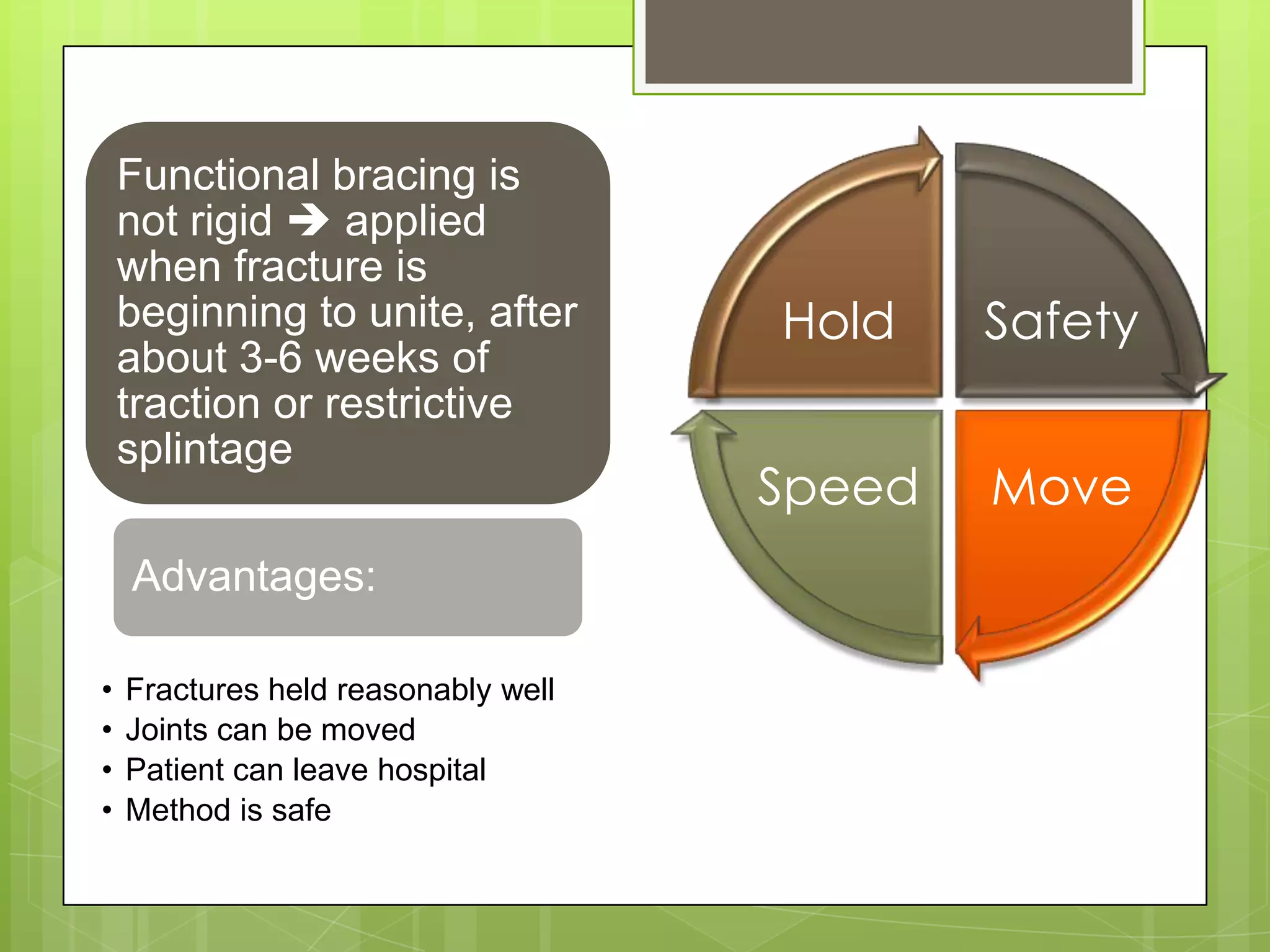
Hold
HOLD
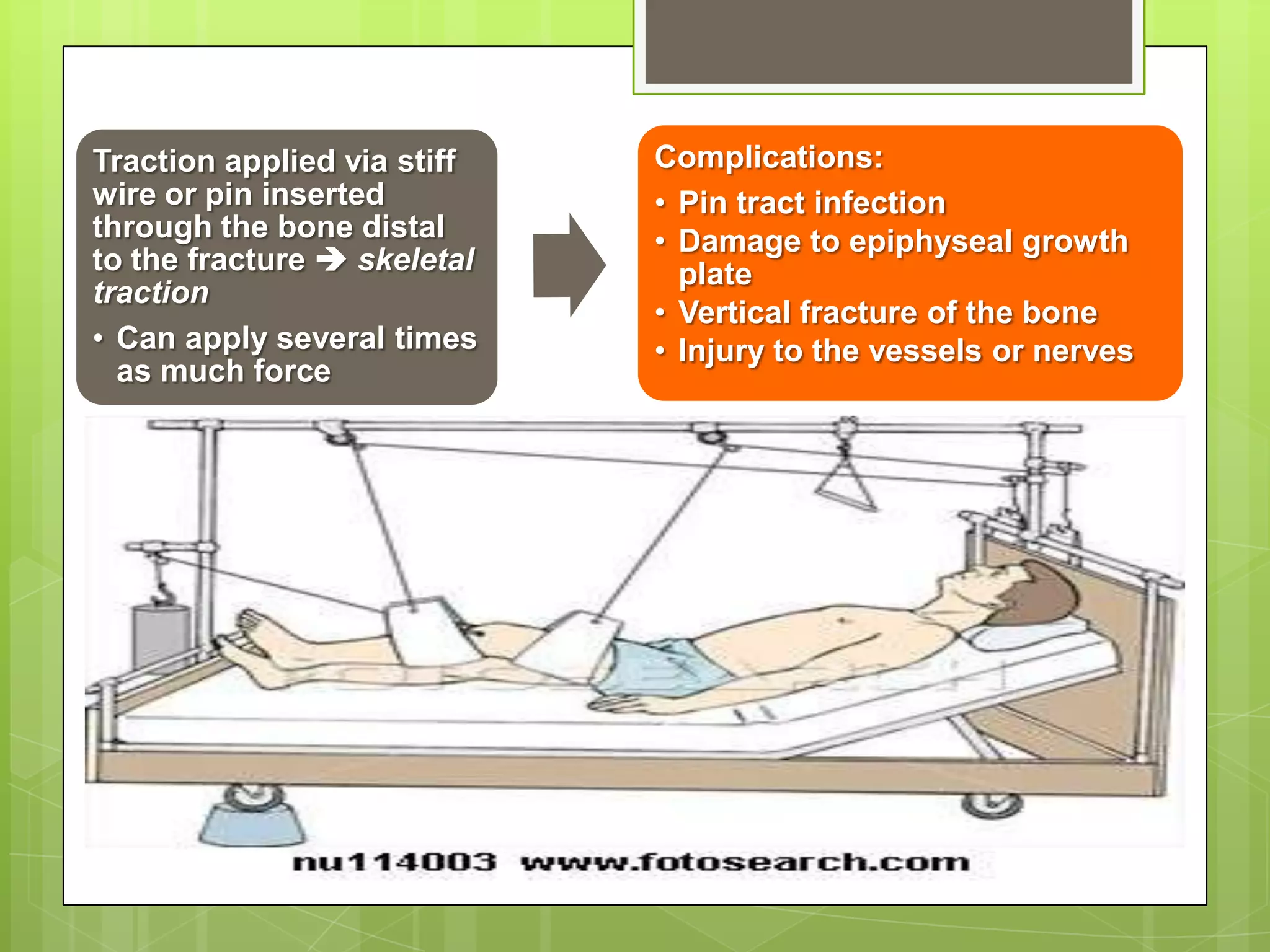
Sustained TractionTraction is applied to limb distal to the fracture
To exert continuous pull along the long axis of the bone
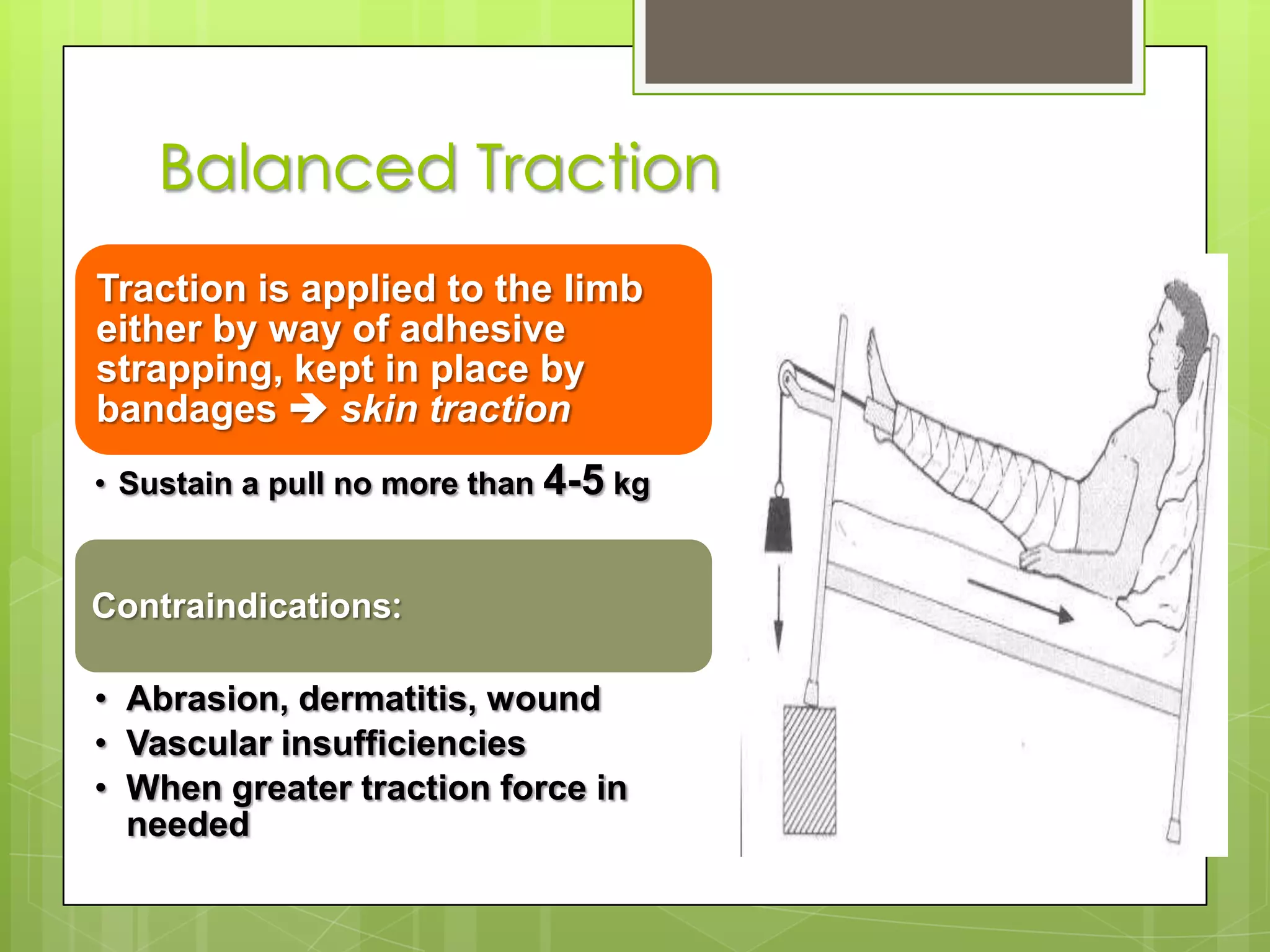
Disadvantage and complicationsPatient kept on bed for long timePressure ulcerGeneral weaknessPulmonary infectionContracturePin tract infectionThromboembolic eventMethodsTraction by gravityBalanced tractionFixed traction
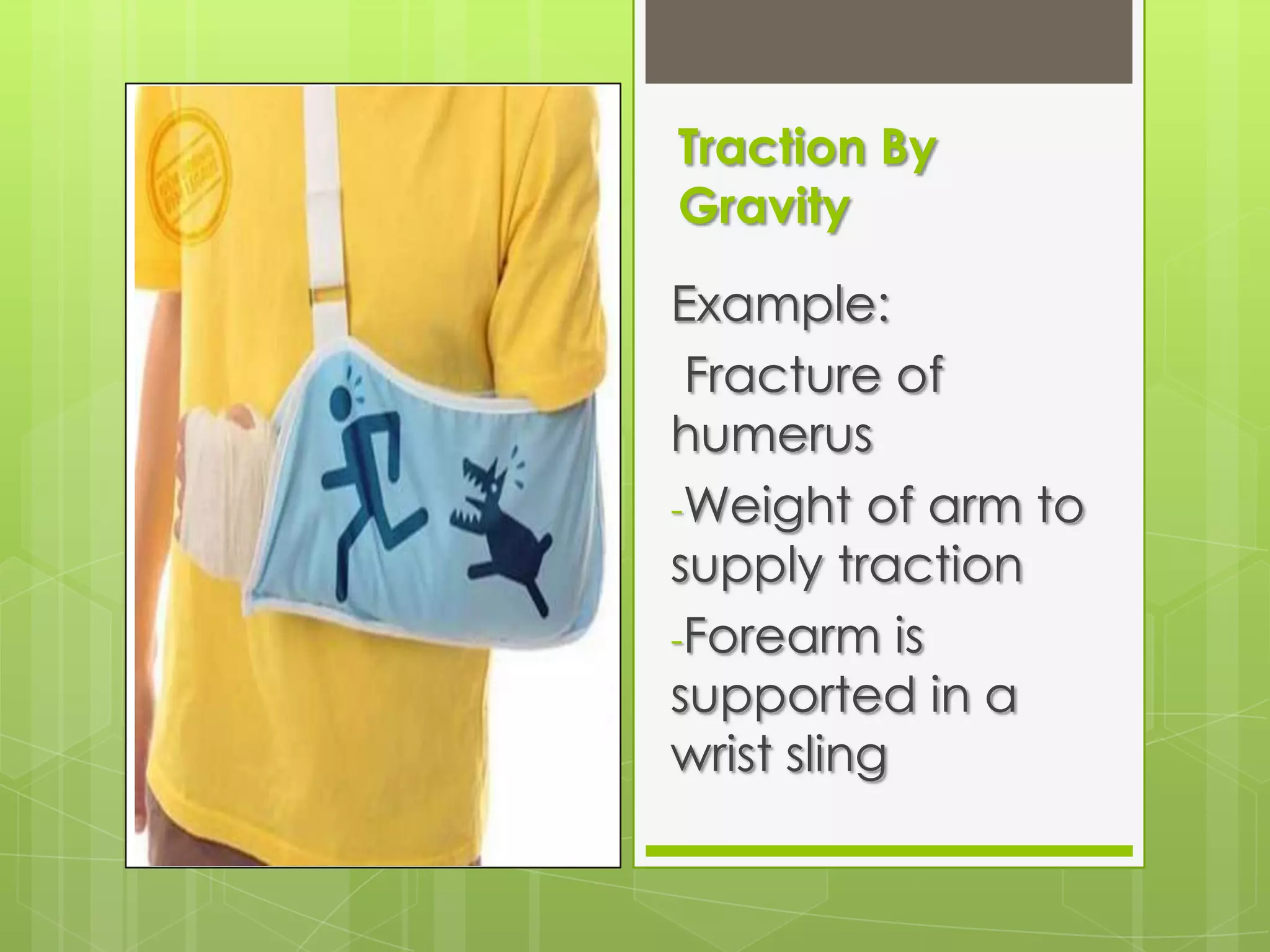
Traction By GravityExample: Fracture of humerusWeight of arm to supply traction
Forearm is supported in a wrist slingBalanced Traction
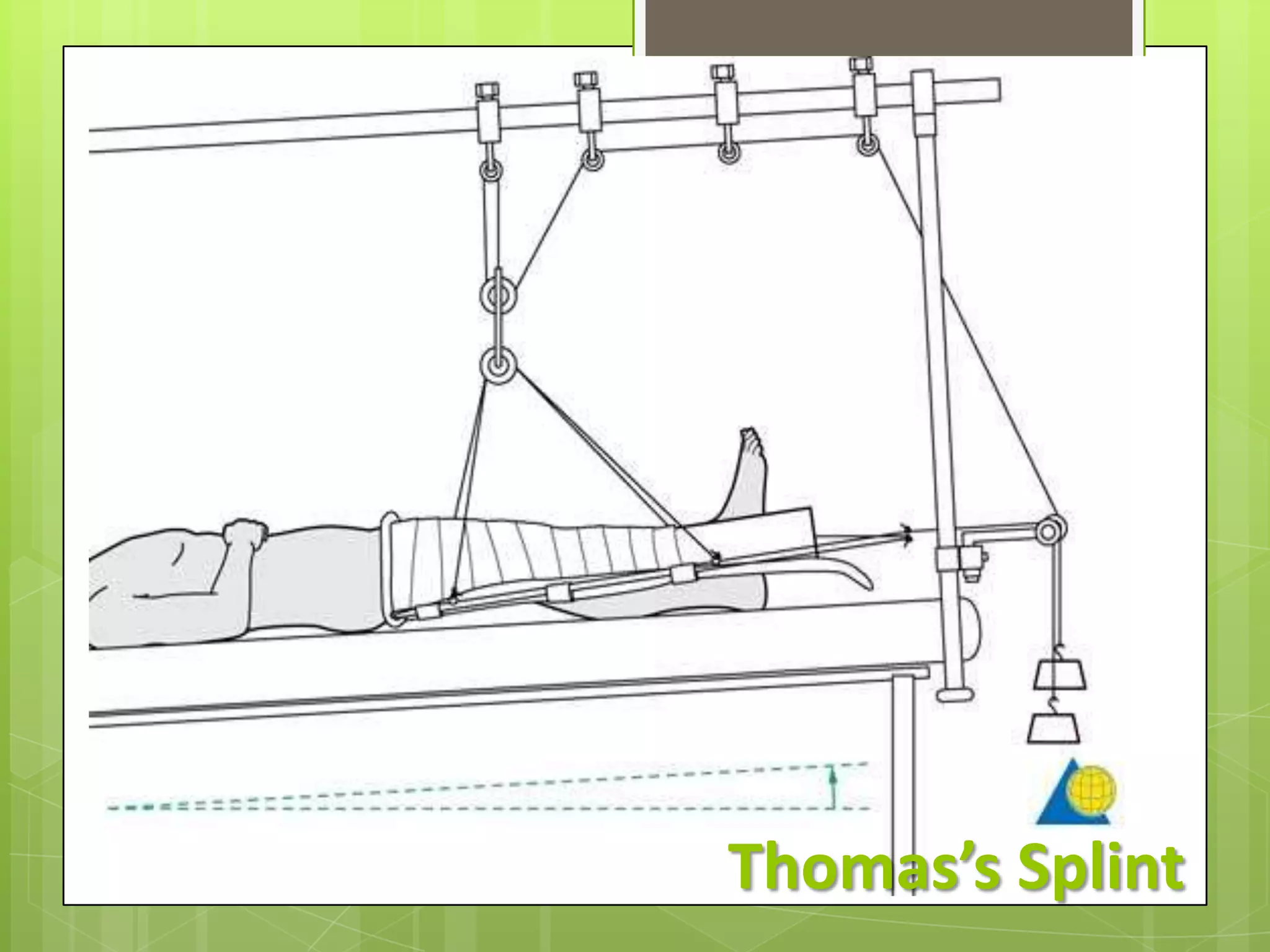
Thomas’s Splint
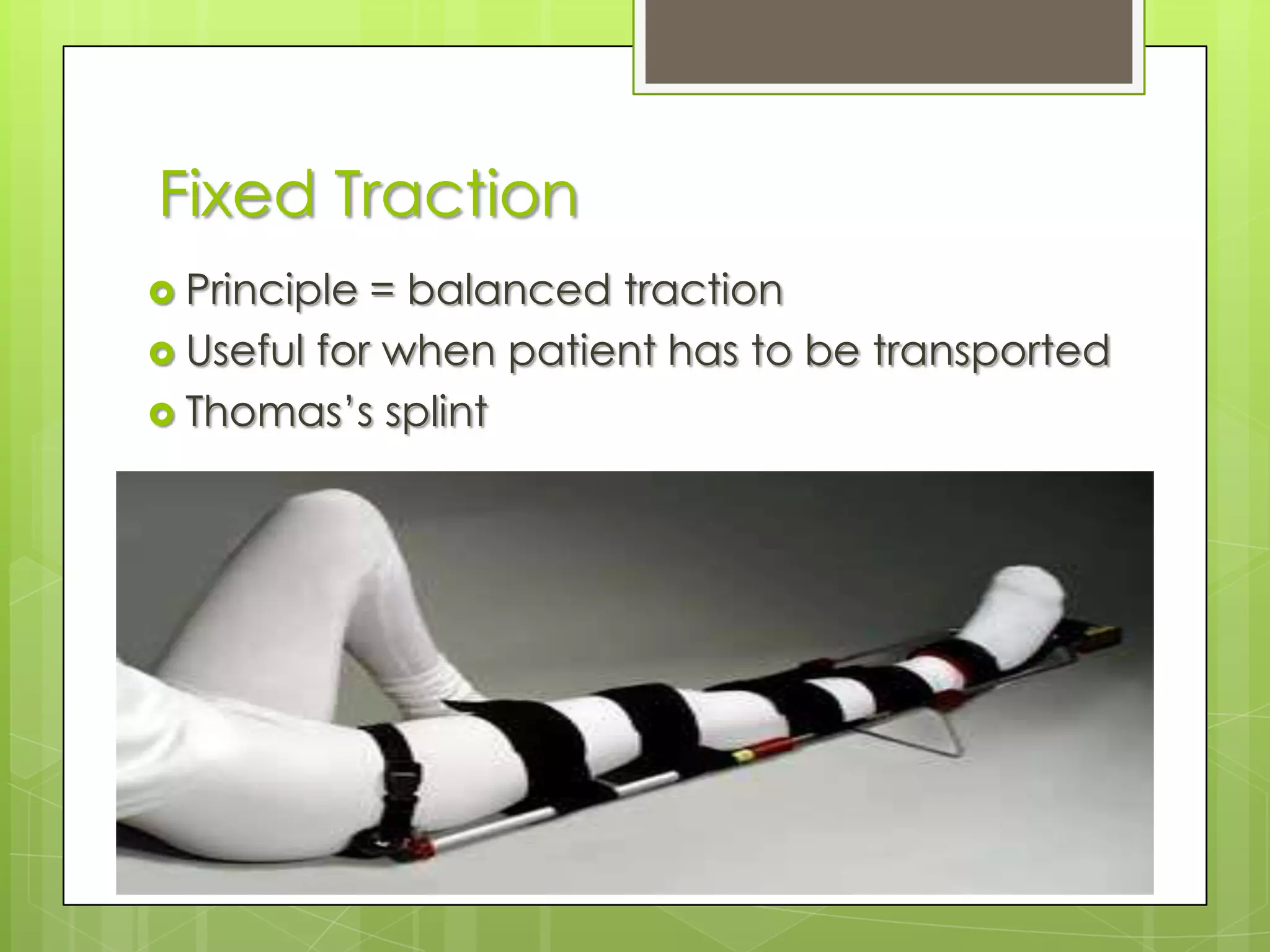
Fixed TractionPrinciple = balanced tractionUseful for when patient has to be transportedThomas’s splint
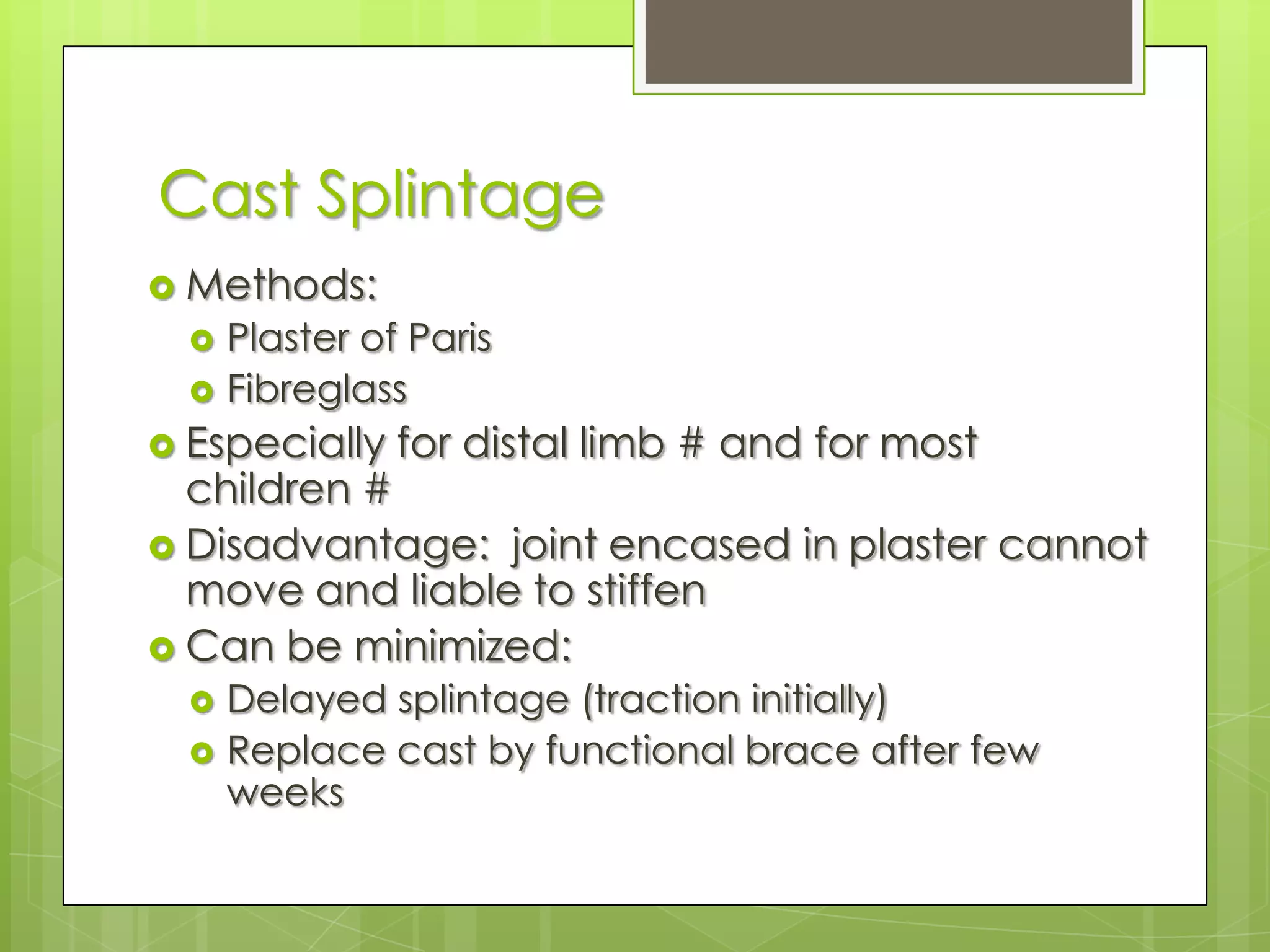
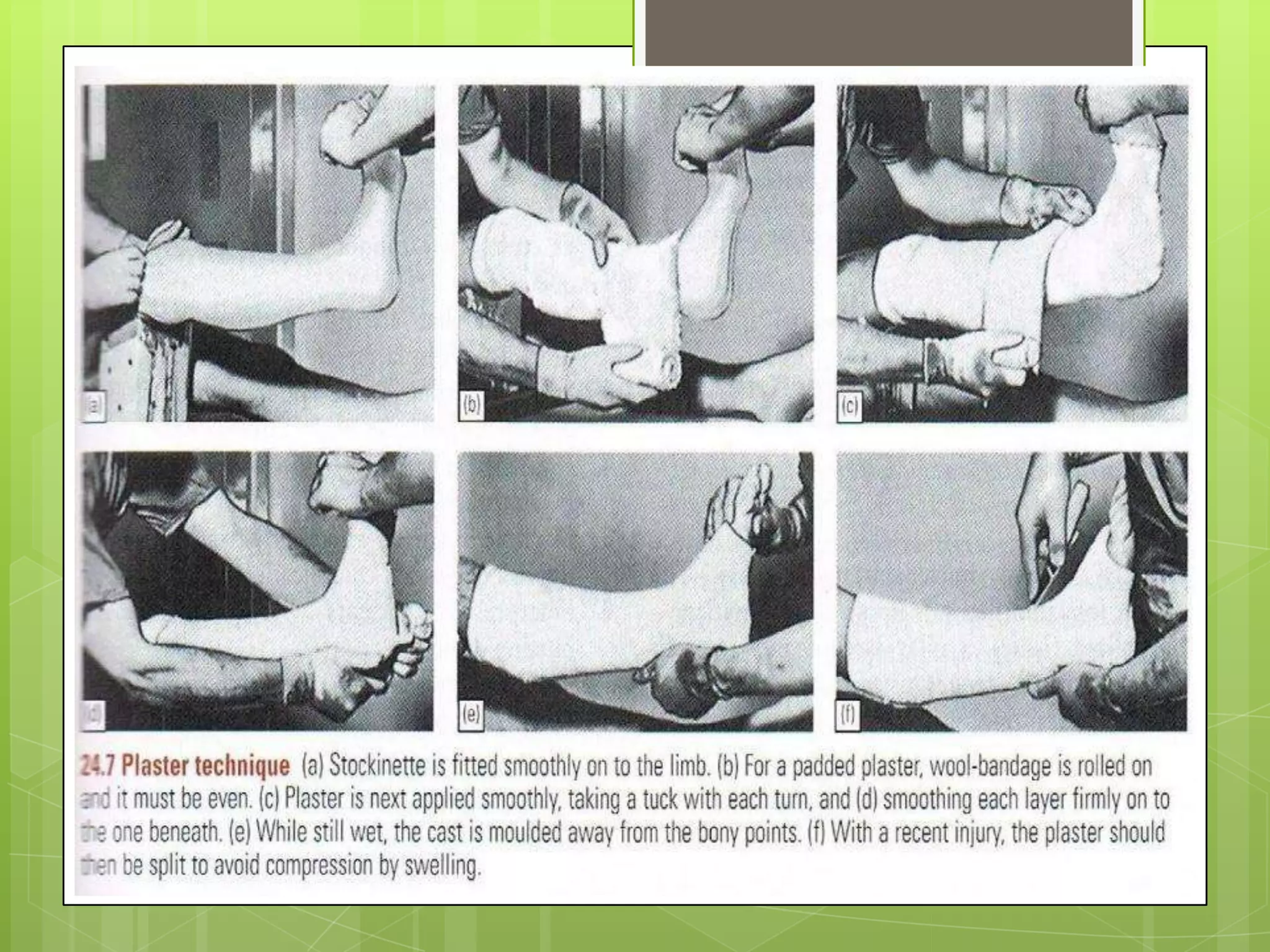
Cast SplintageMethods:Plaster of Paris FibreglassEspecially for distal limb # and for most children #Disadvantage:  joint encased in plaster cannot move and liable to stiffenCan be minimized:Delayed splintage (traction initially)Replace cast by functional brace after few weeks
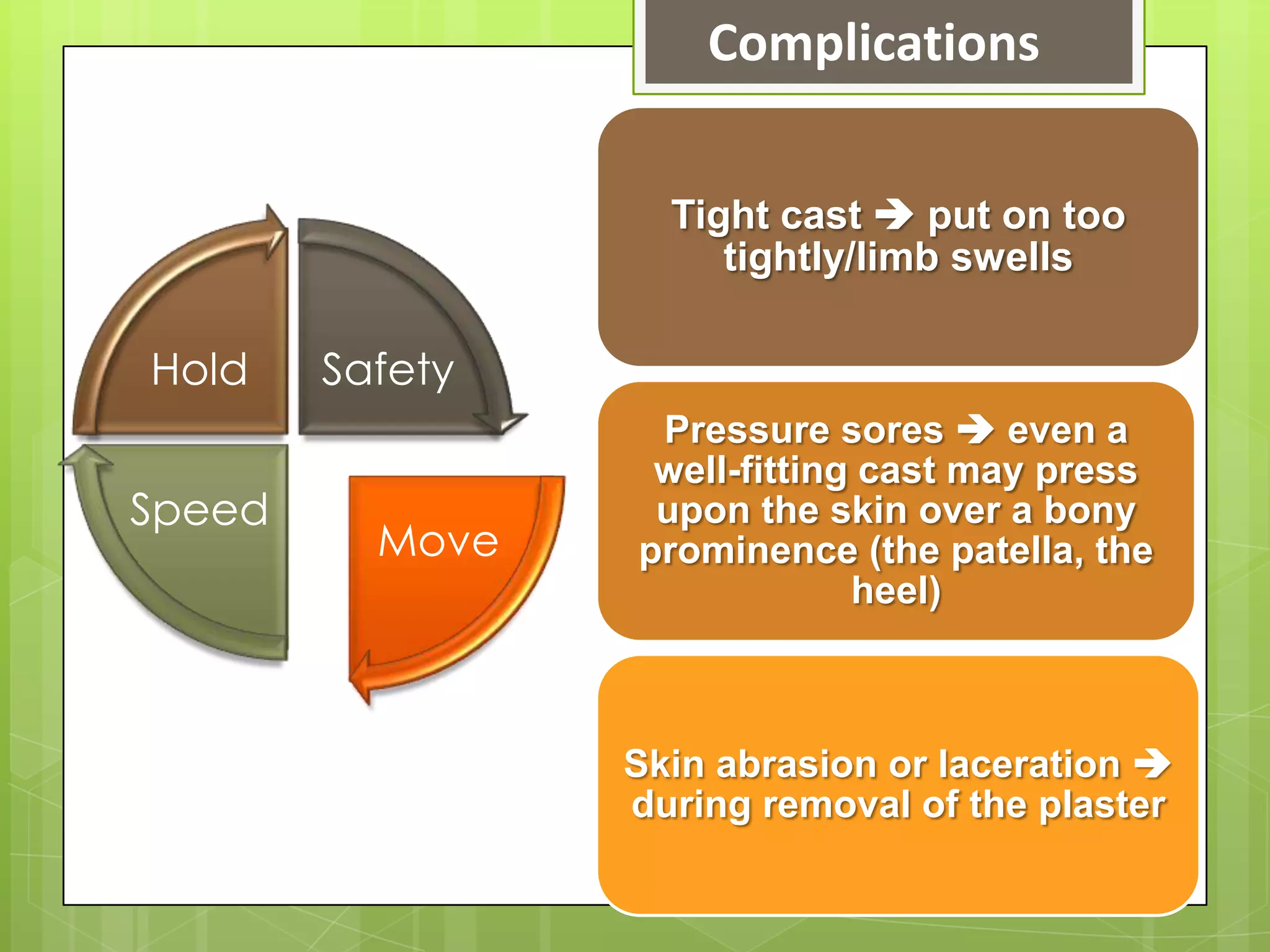
Complications
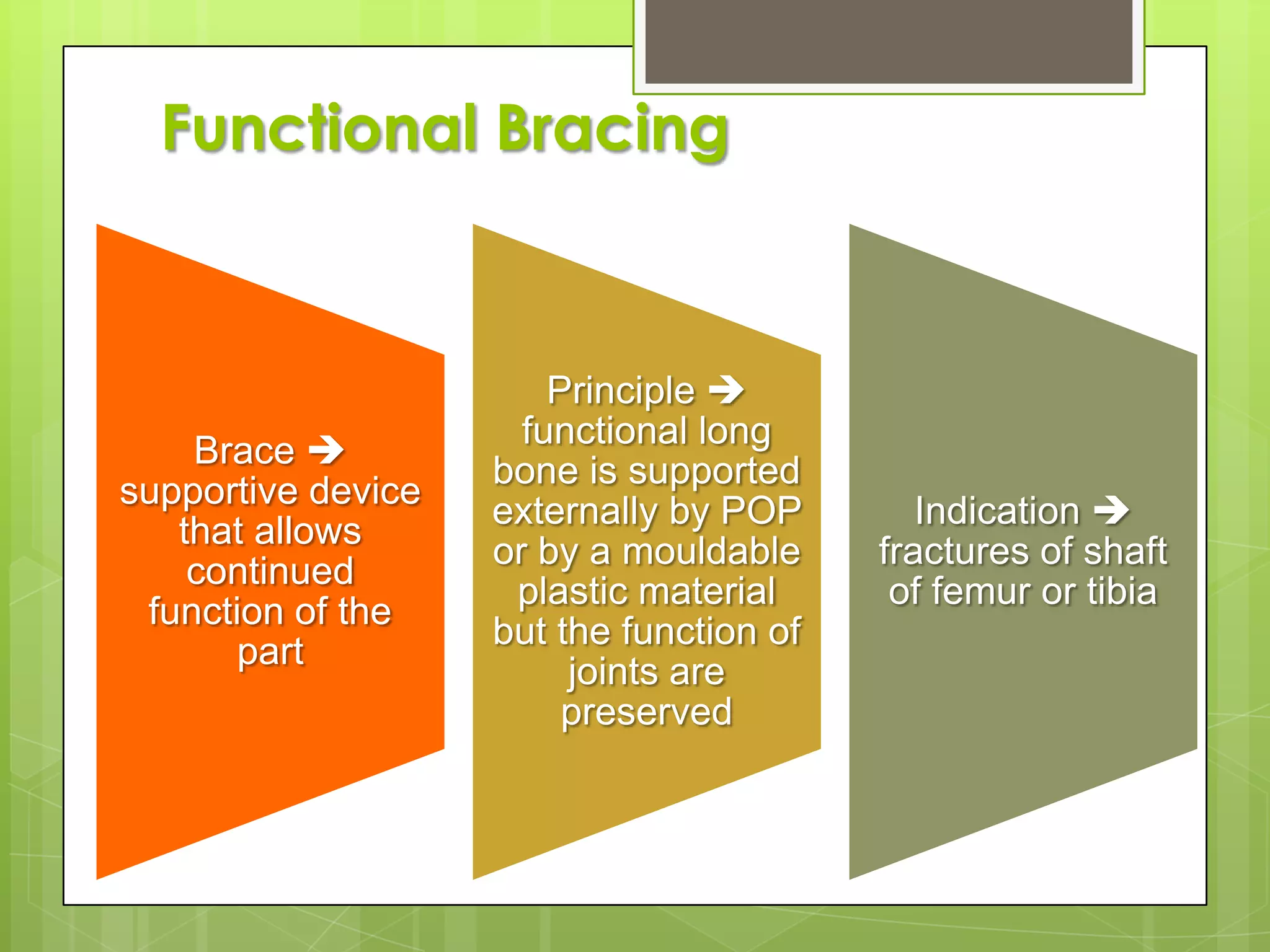
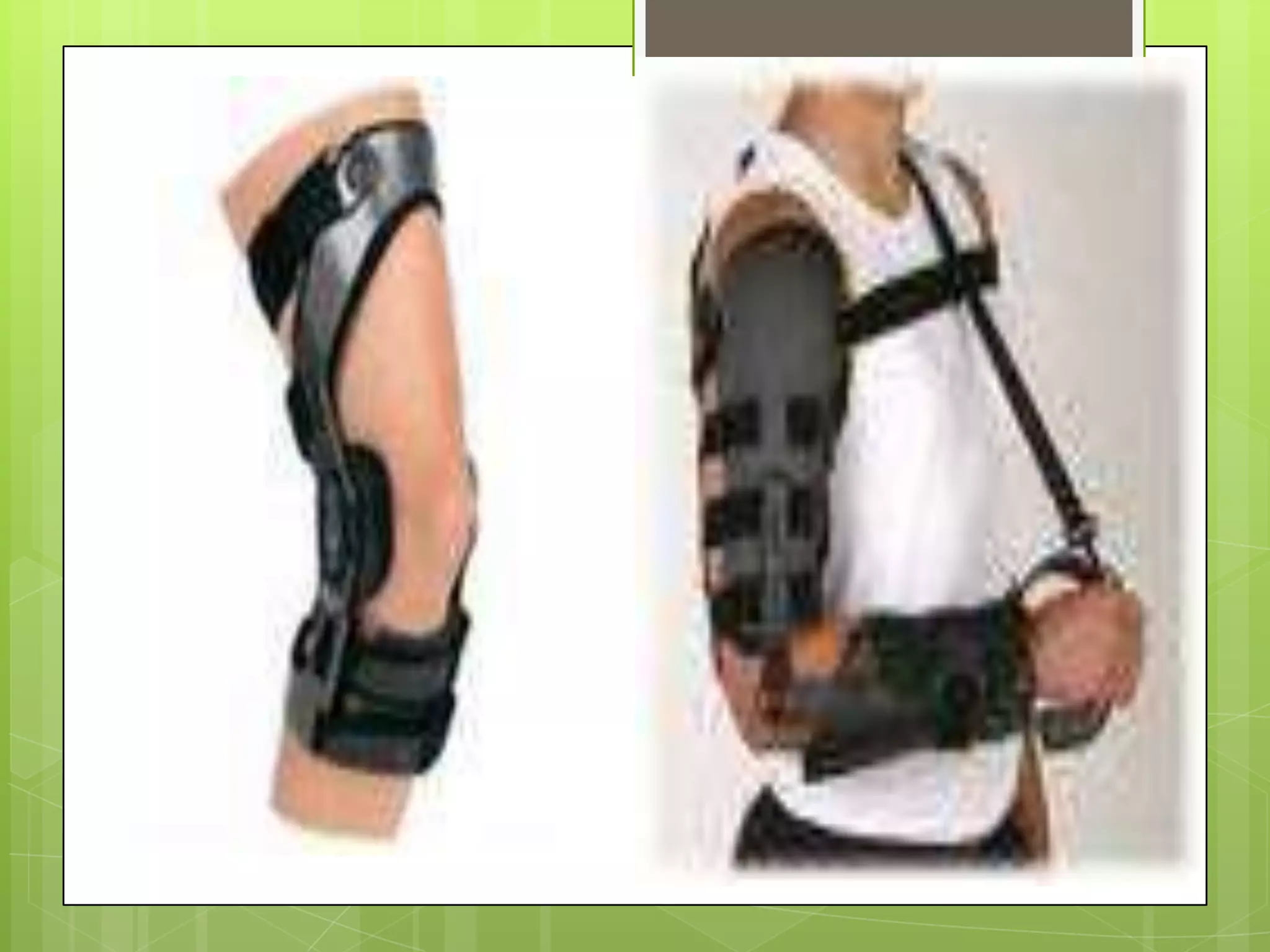
Functional Bracing
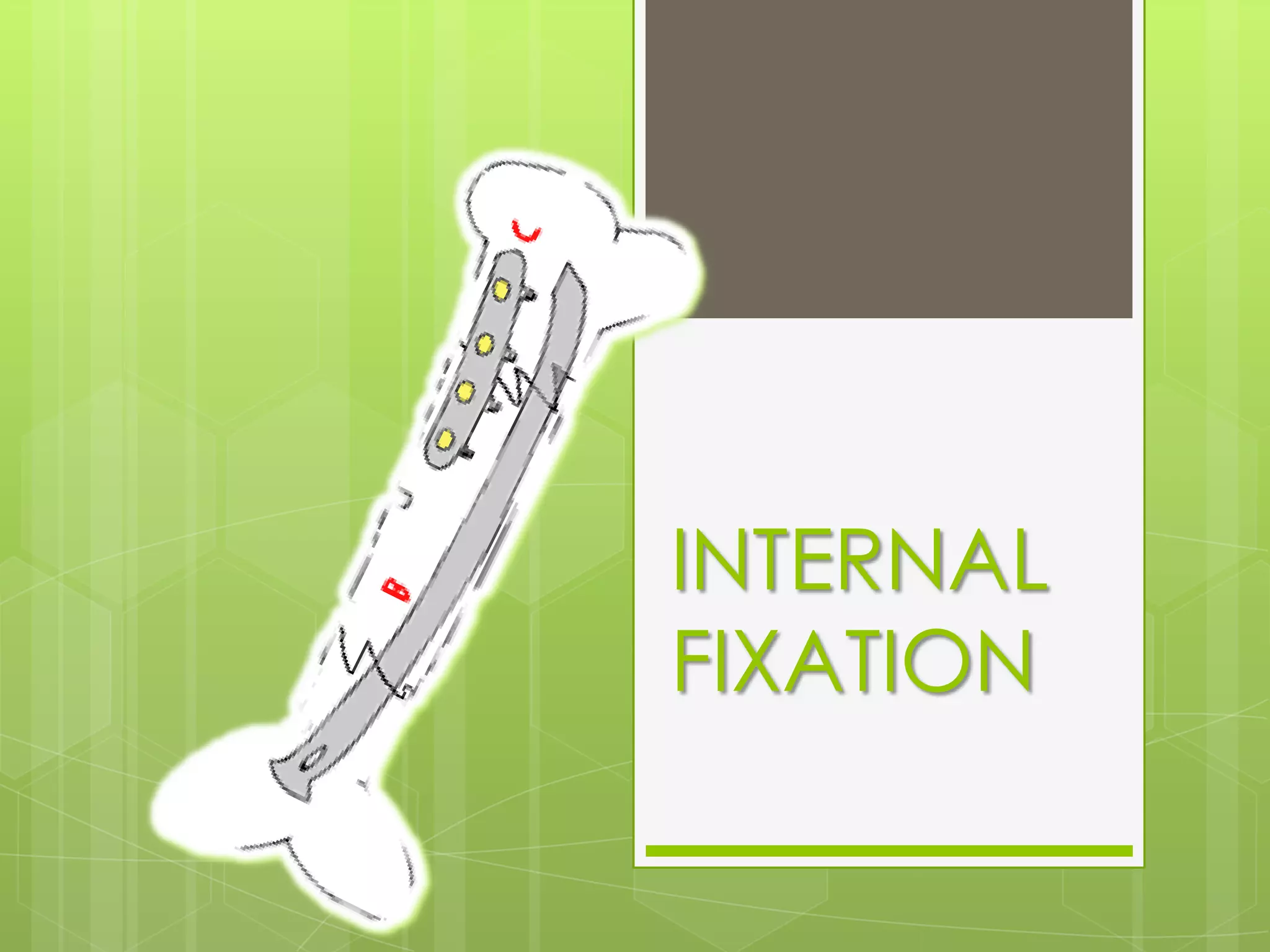
INTERNAL FIXATION
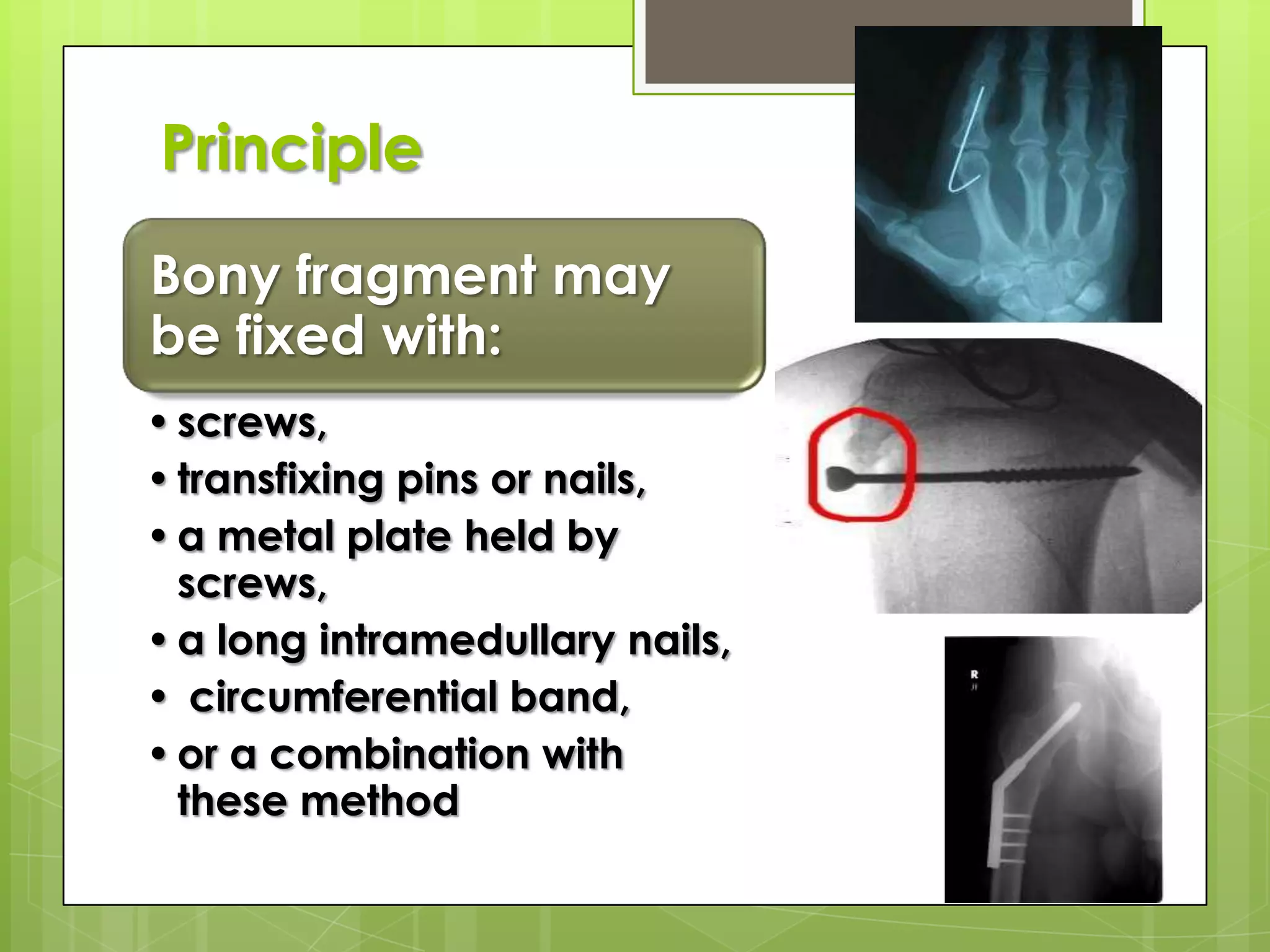
Principle
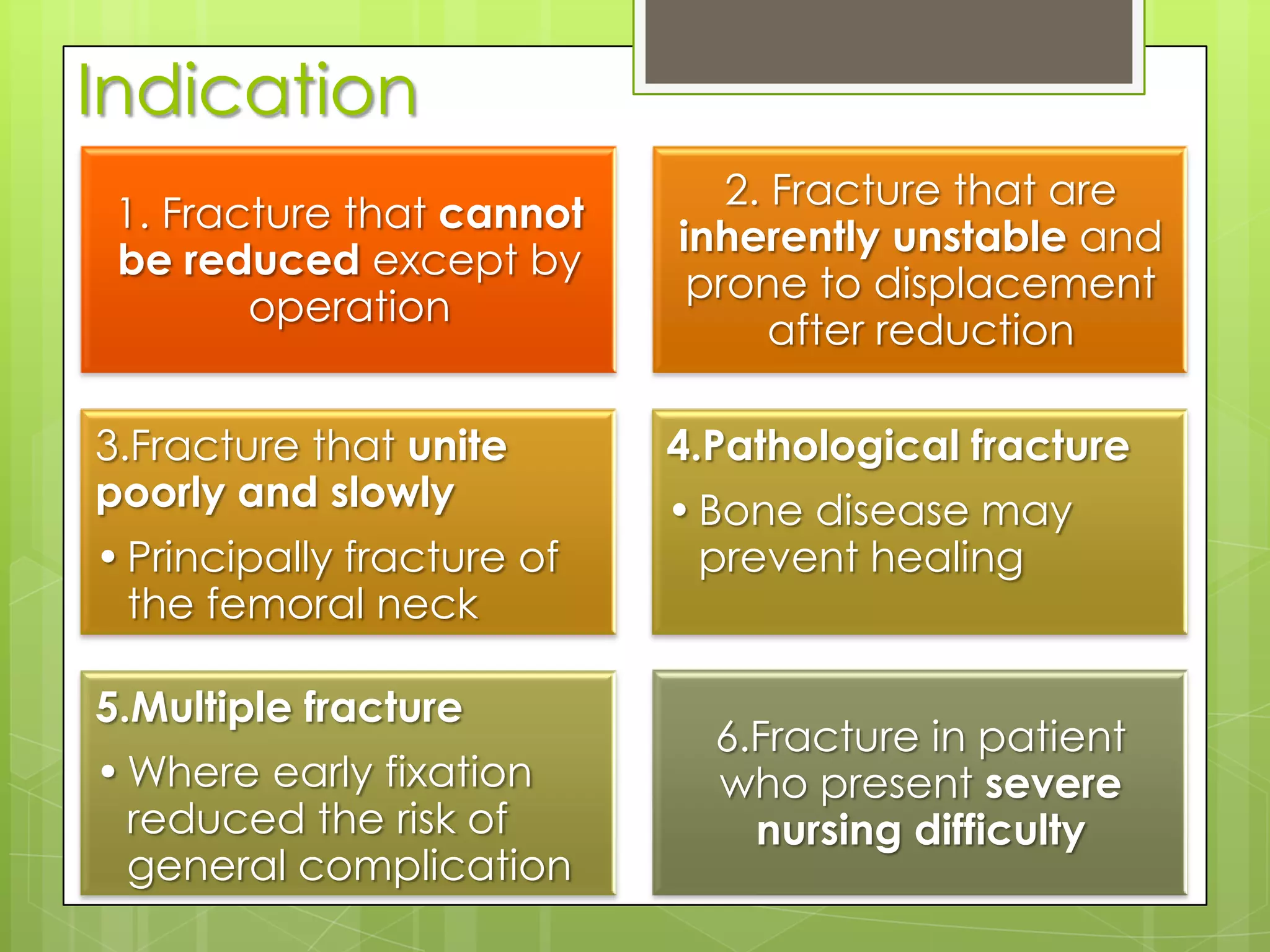
Indication
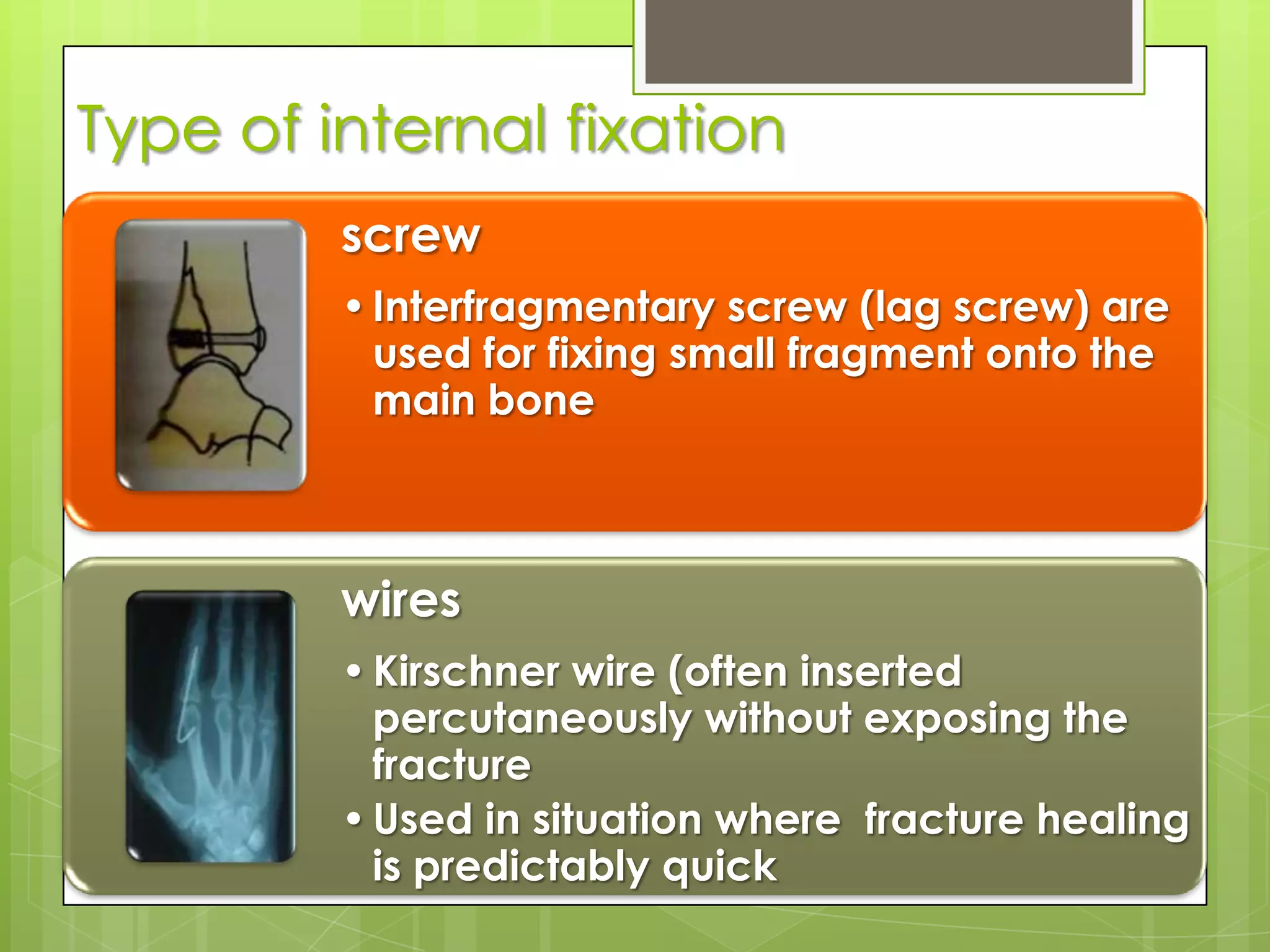
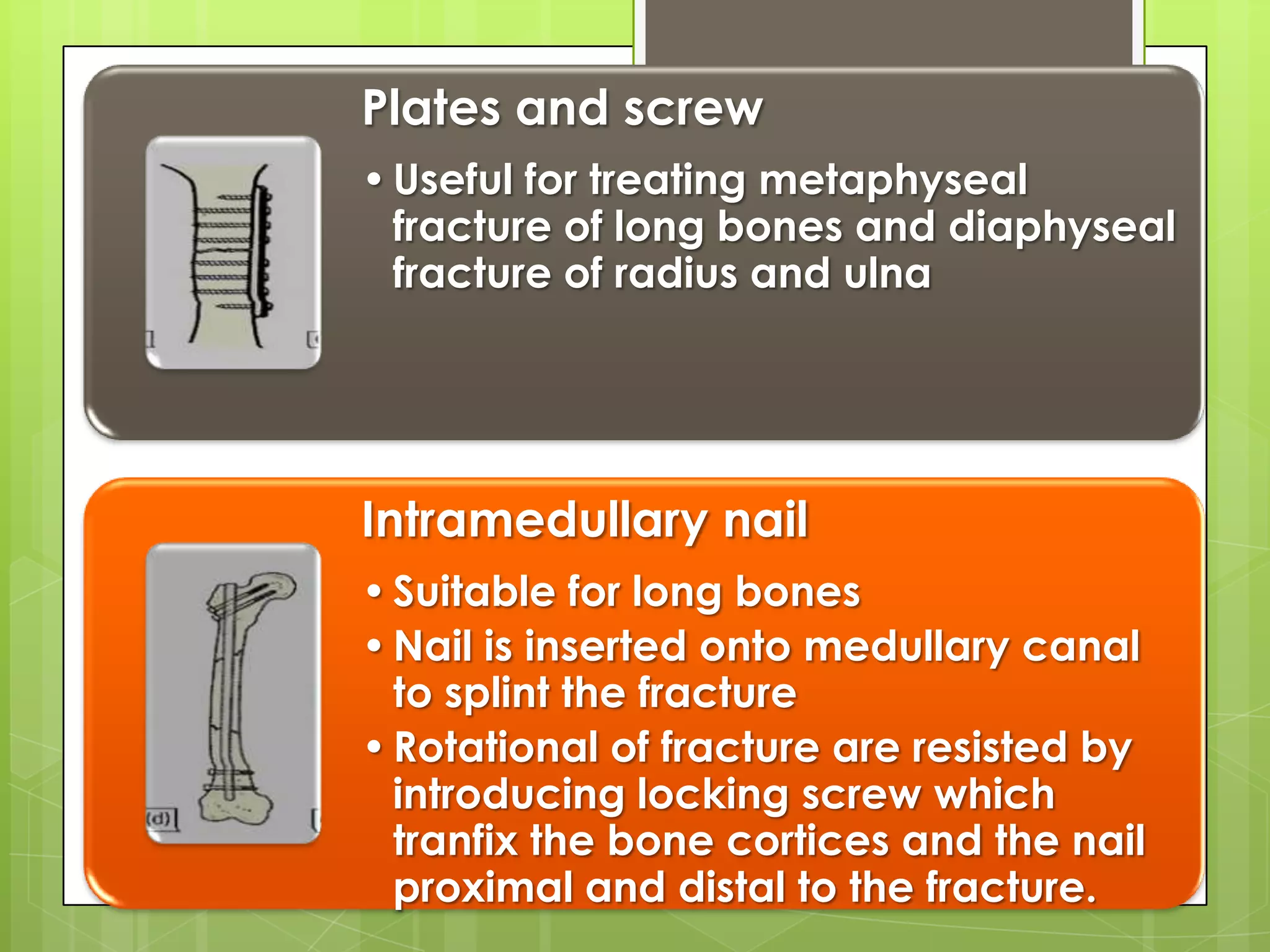
Type of internal fixation
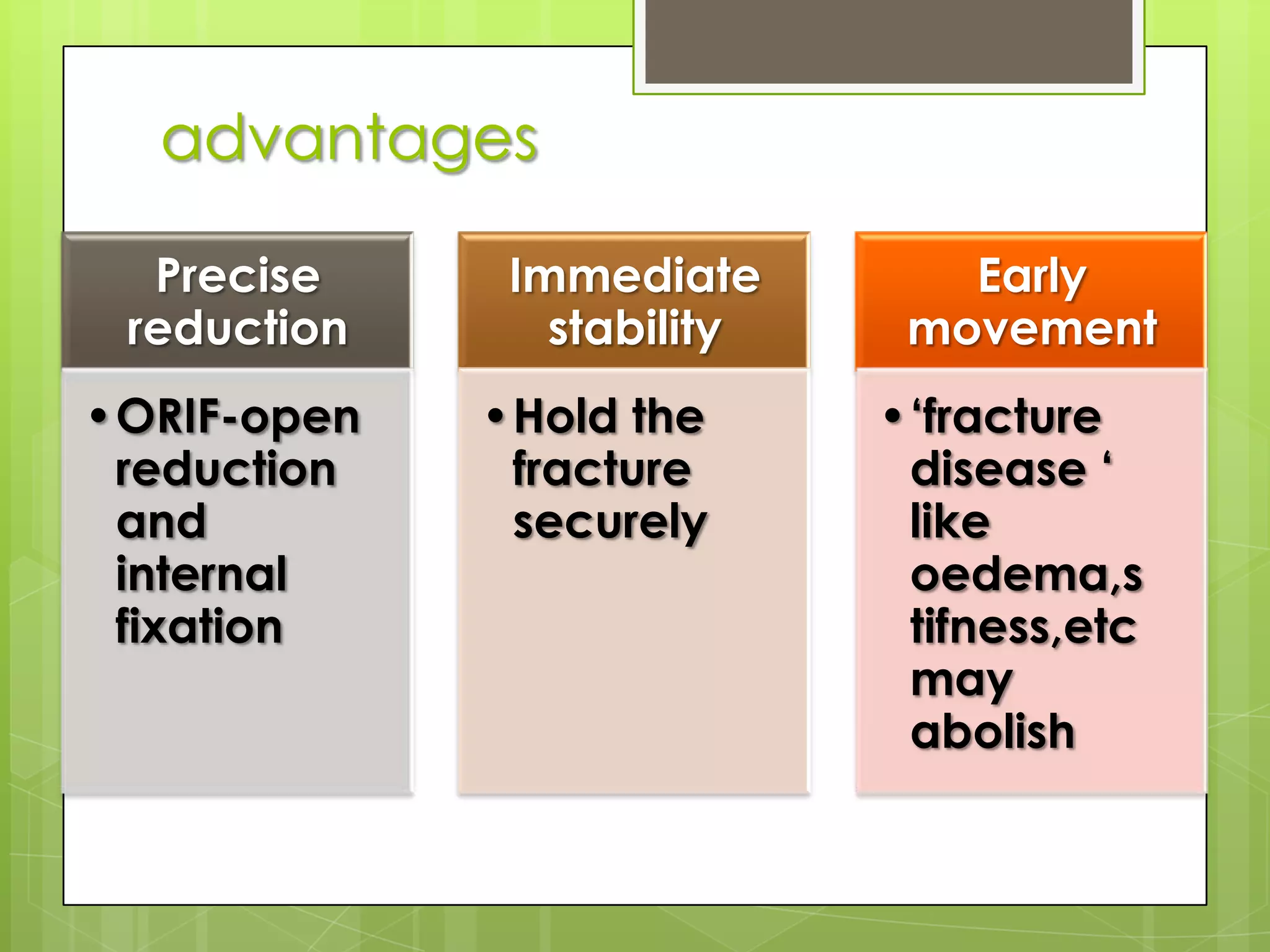
advantages
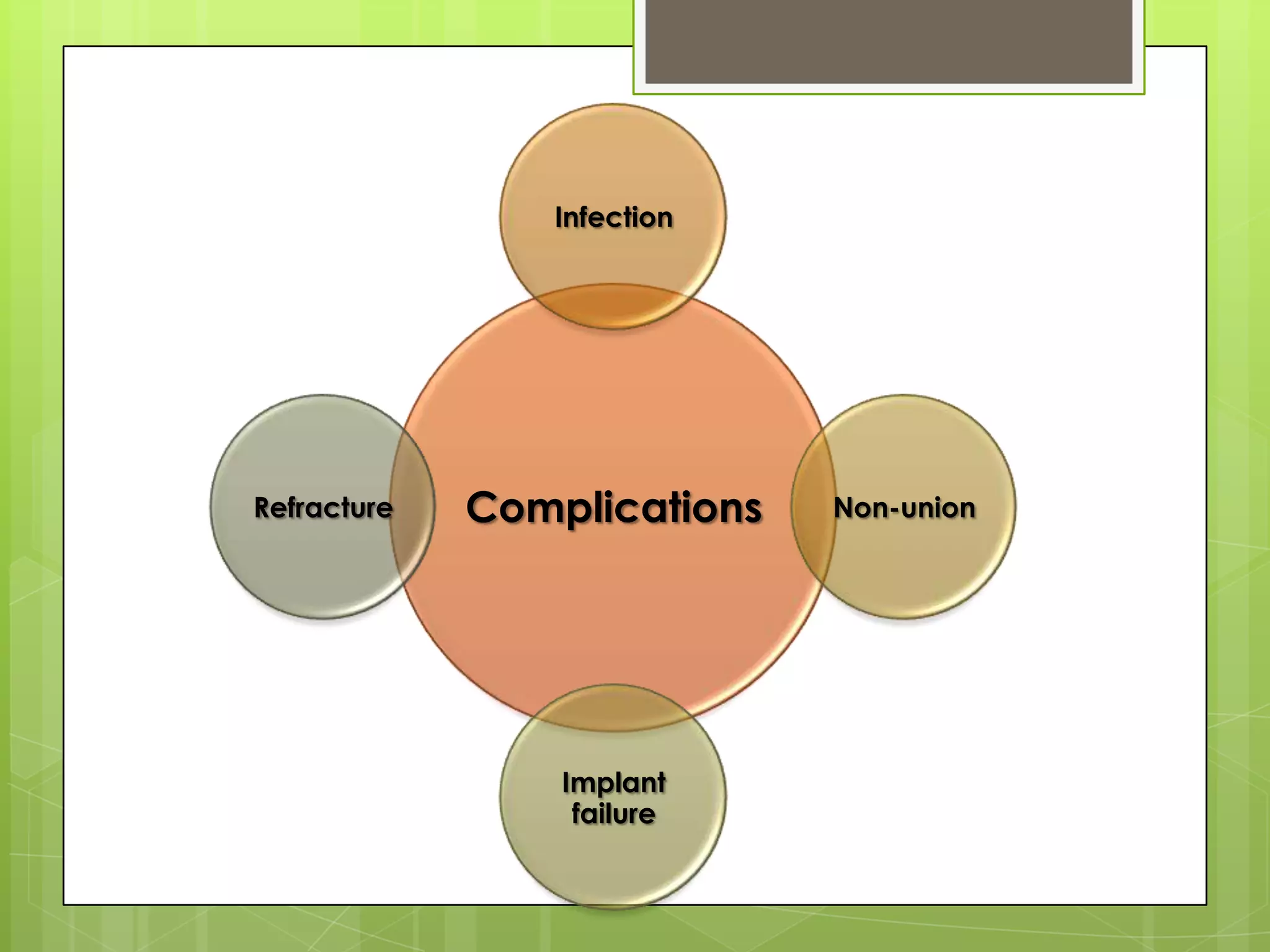
Implant failureMetal is subjected to fatigueMetal is subjected to fatigue
So, undue stress should therefore be avoided until the fragment  has united.
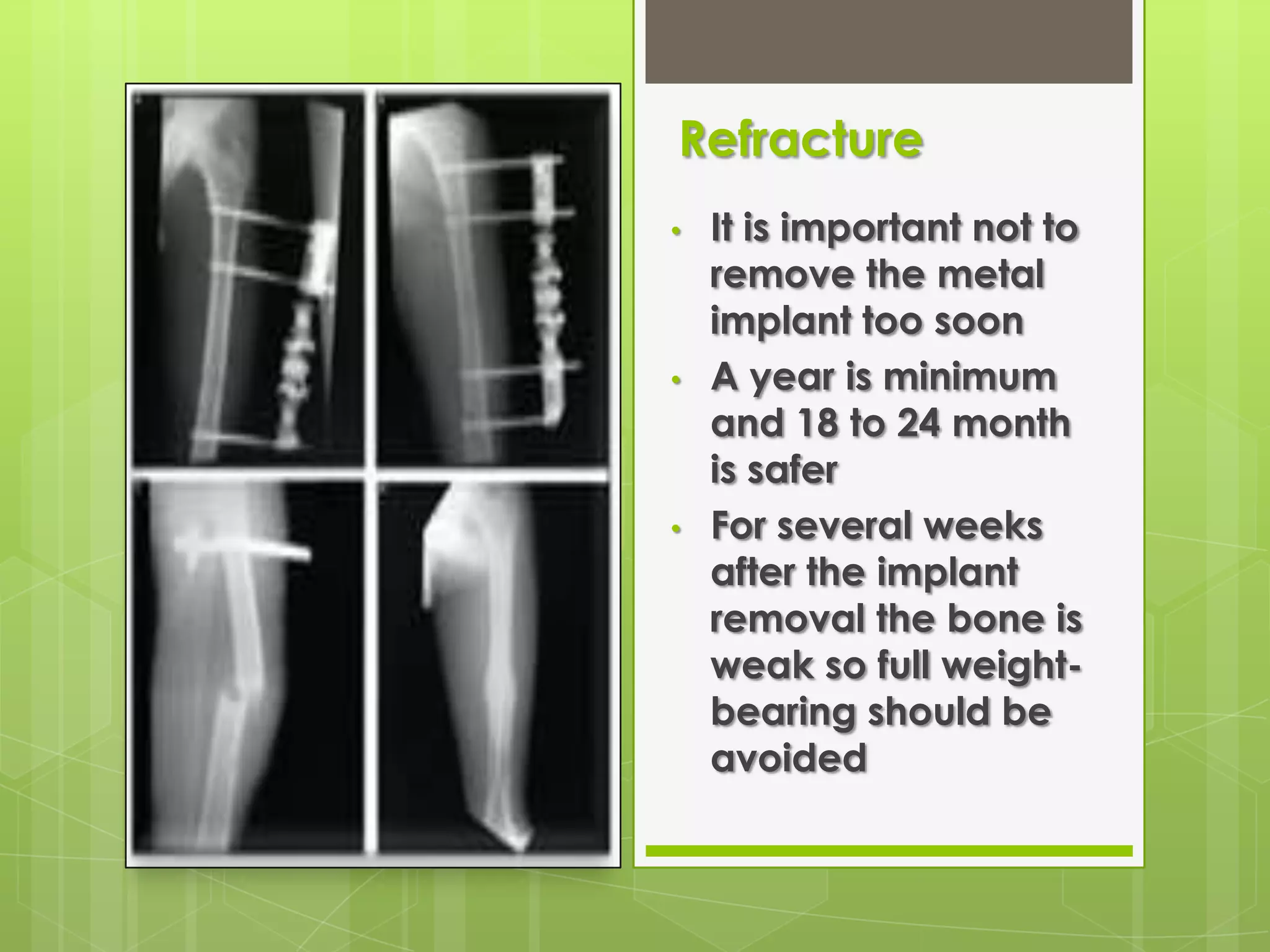
Pain at the site of fracture site is a danger signal.RefractureIt is important not to remove the metal implant too soon
A year is minimum and 18 to 24 month is safer
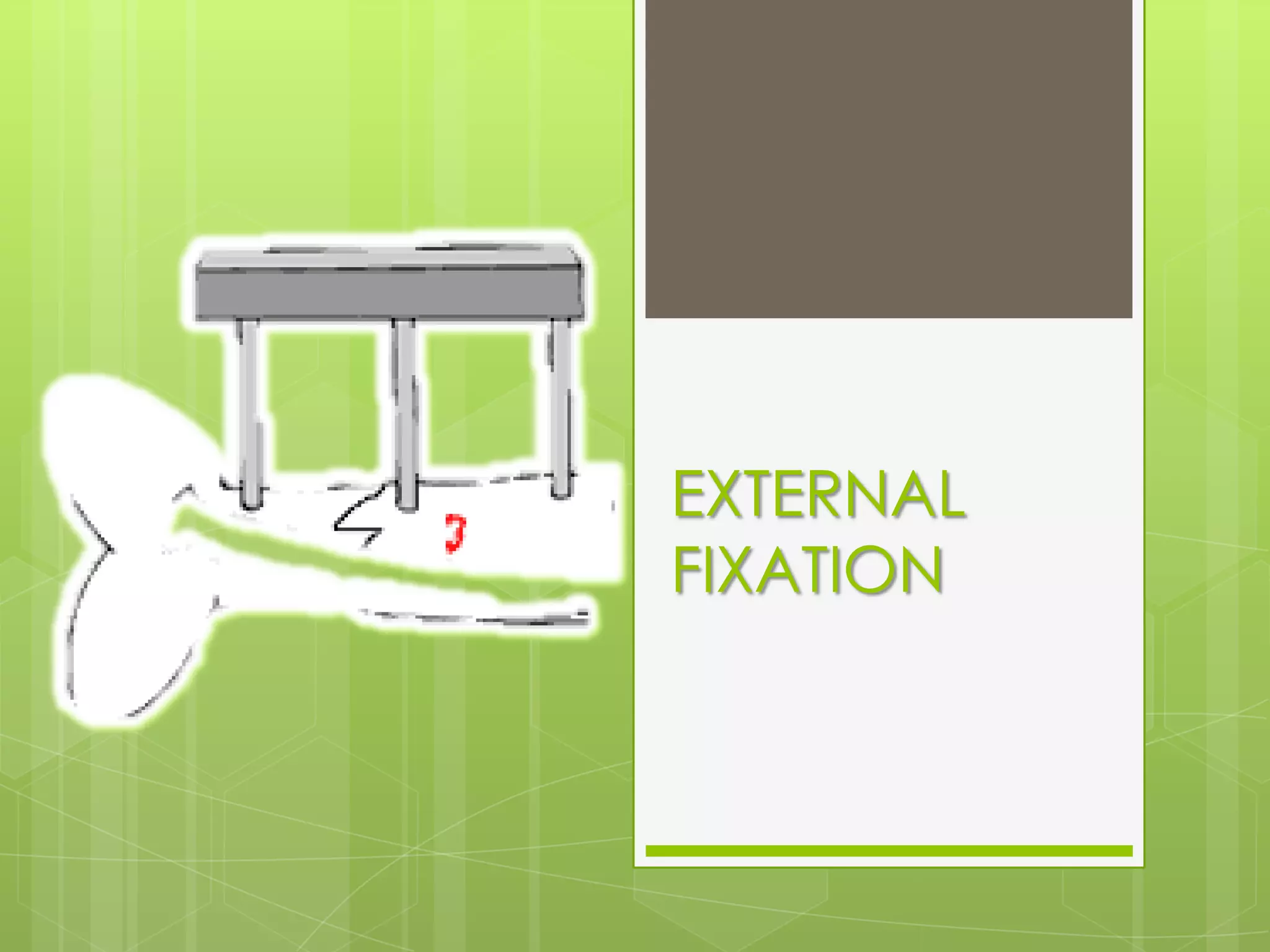
For several weeks after the implant removal the bone is weak so full weight-bearing should be avoidedEXTERNAL FIXATION
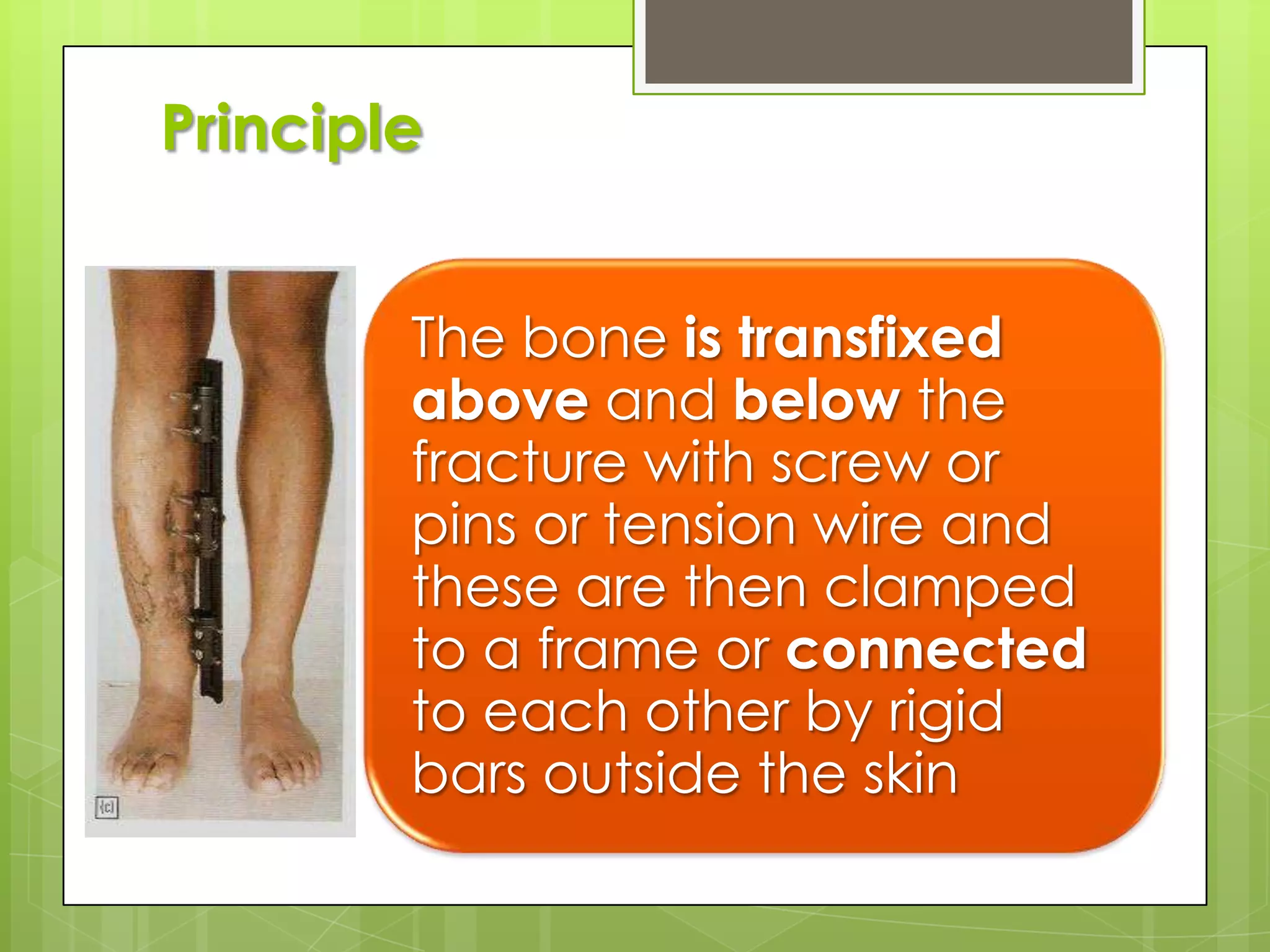
Principle
Indication
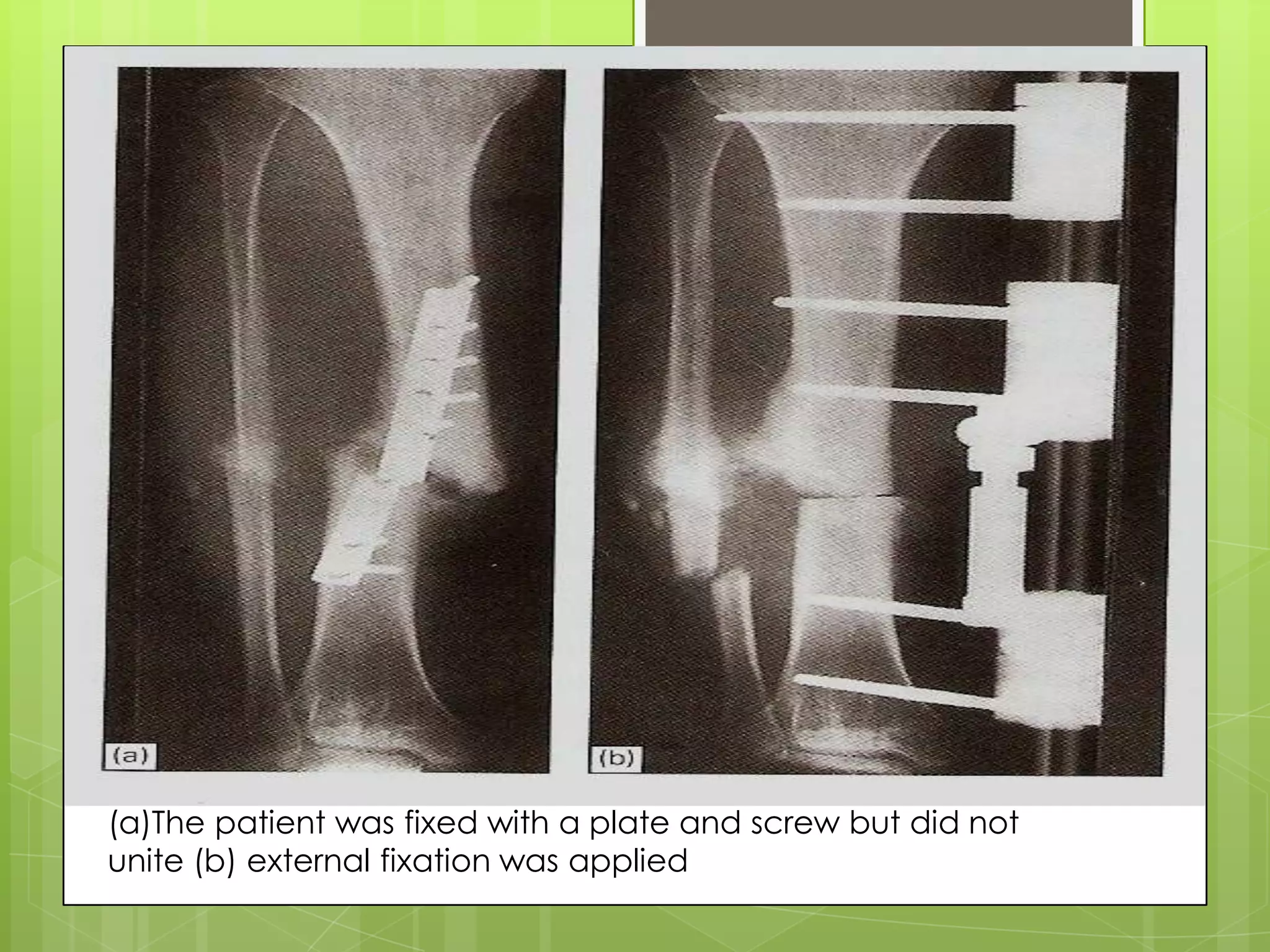
(a)The patient was fixed with a plate and screw but did not unite (b) external fixation was applied
Advantages
ExercisePrevention of edemaactive exercise and elevationActive exercise also stimulates the circulation. Prevents soft-tissue adhesion and promotes fracture healing.Preserve the joint movementRestore muscle powerFunctional activity
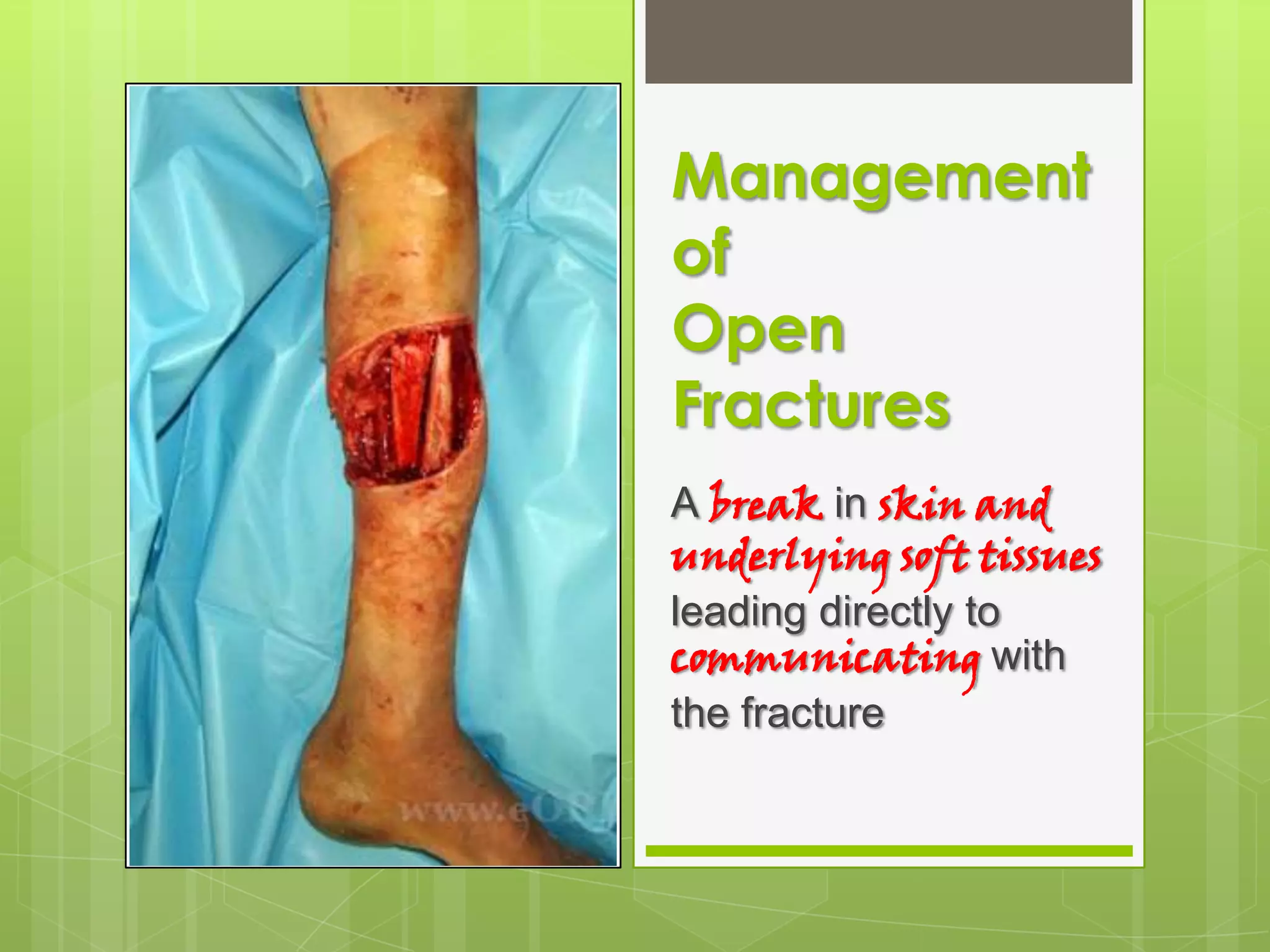
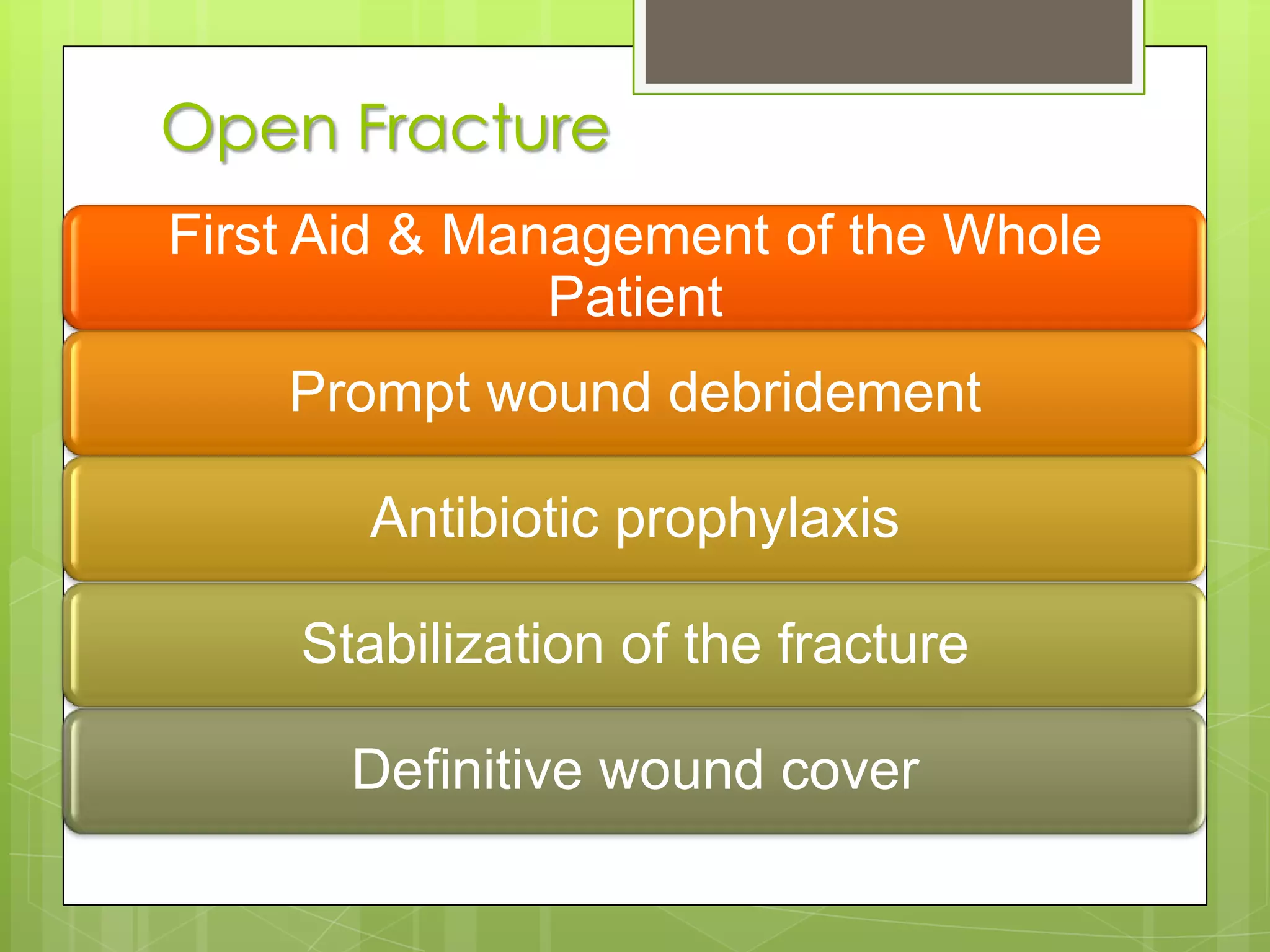
Management of Open FracturesAbreakin skin and underlying soft tissues leading directly to communicating with the fracture
Open Fracture
First Aid & Management of the Whole Patient
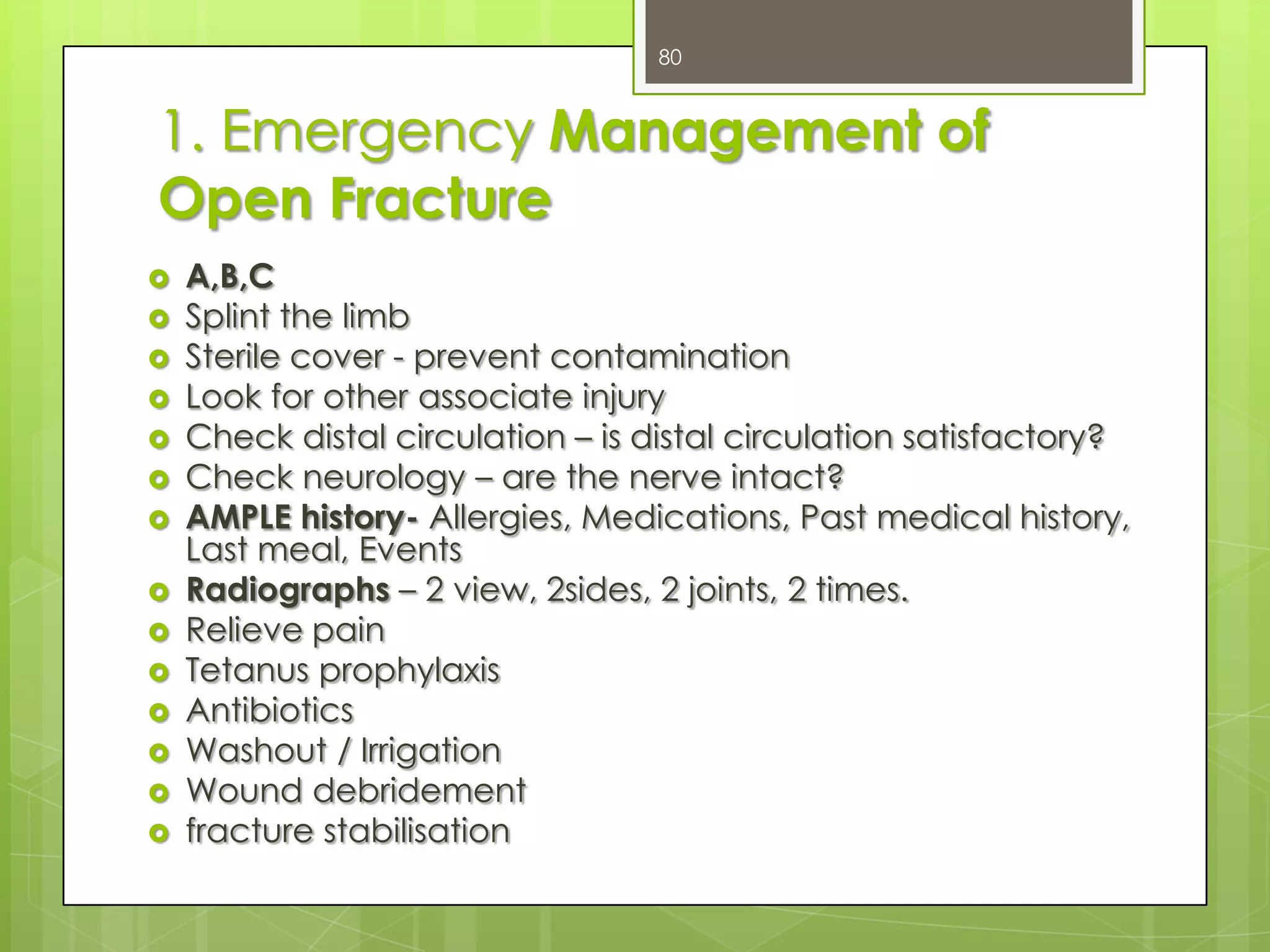
1. Emergency Management of Open FractureA,B,C Splint the limb Sterile cover - prevent contaminationLook for other associate injury Check distal circulation – is distal circulation satisfactory?Check neurology – are the nerve intact?AMPLE history- Allergies, Medications, Past medical history, Last meal, EventsRadiographs – 2 view, 2sides, 2 joints, 2 times. Relieve pain Tetanus prophylaxisAntibioticsWashout / IrrigationWound debridement  fracture stabilisation80
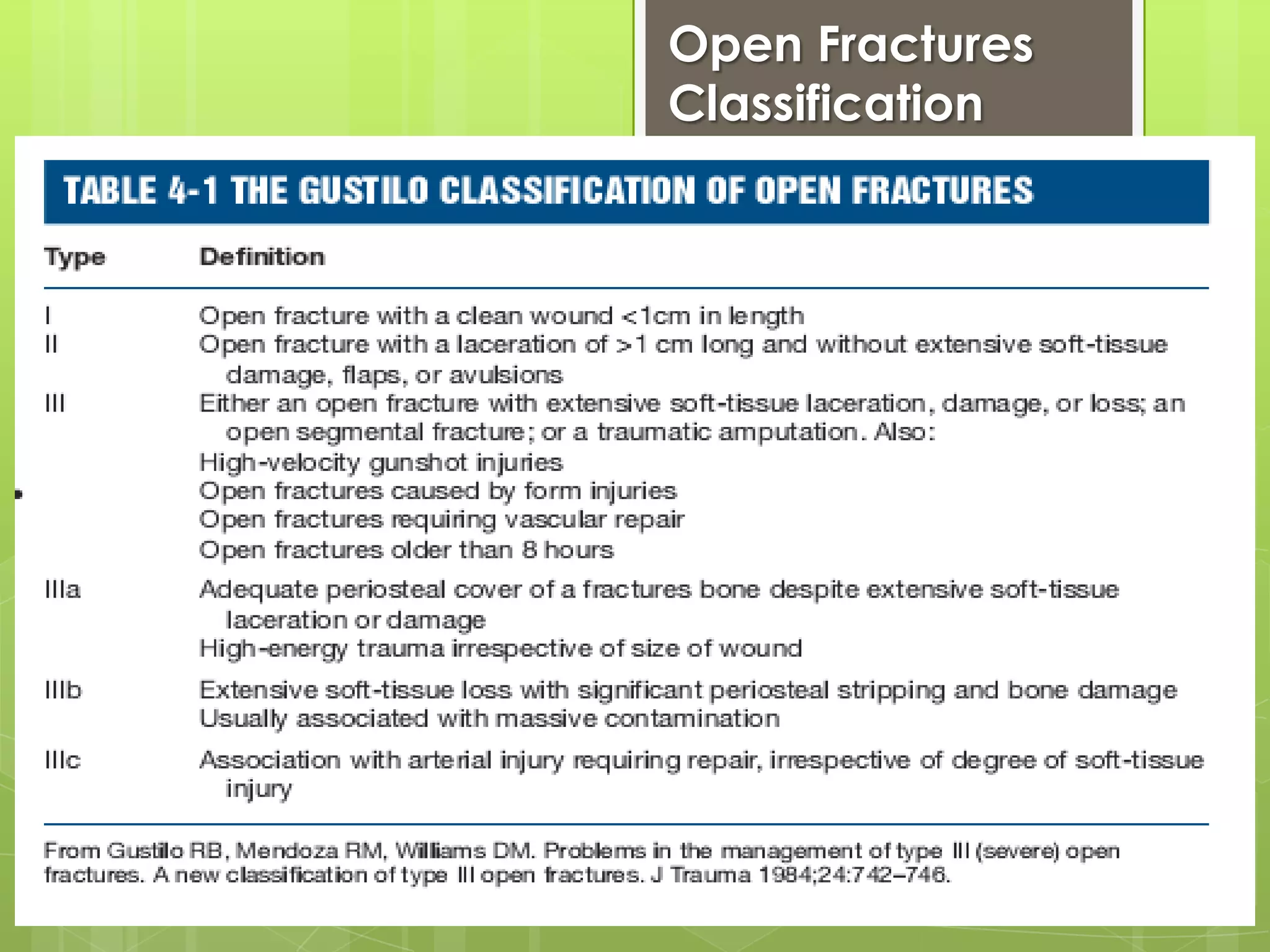
Open Fractures Classification
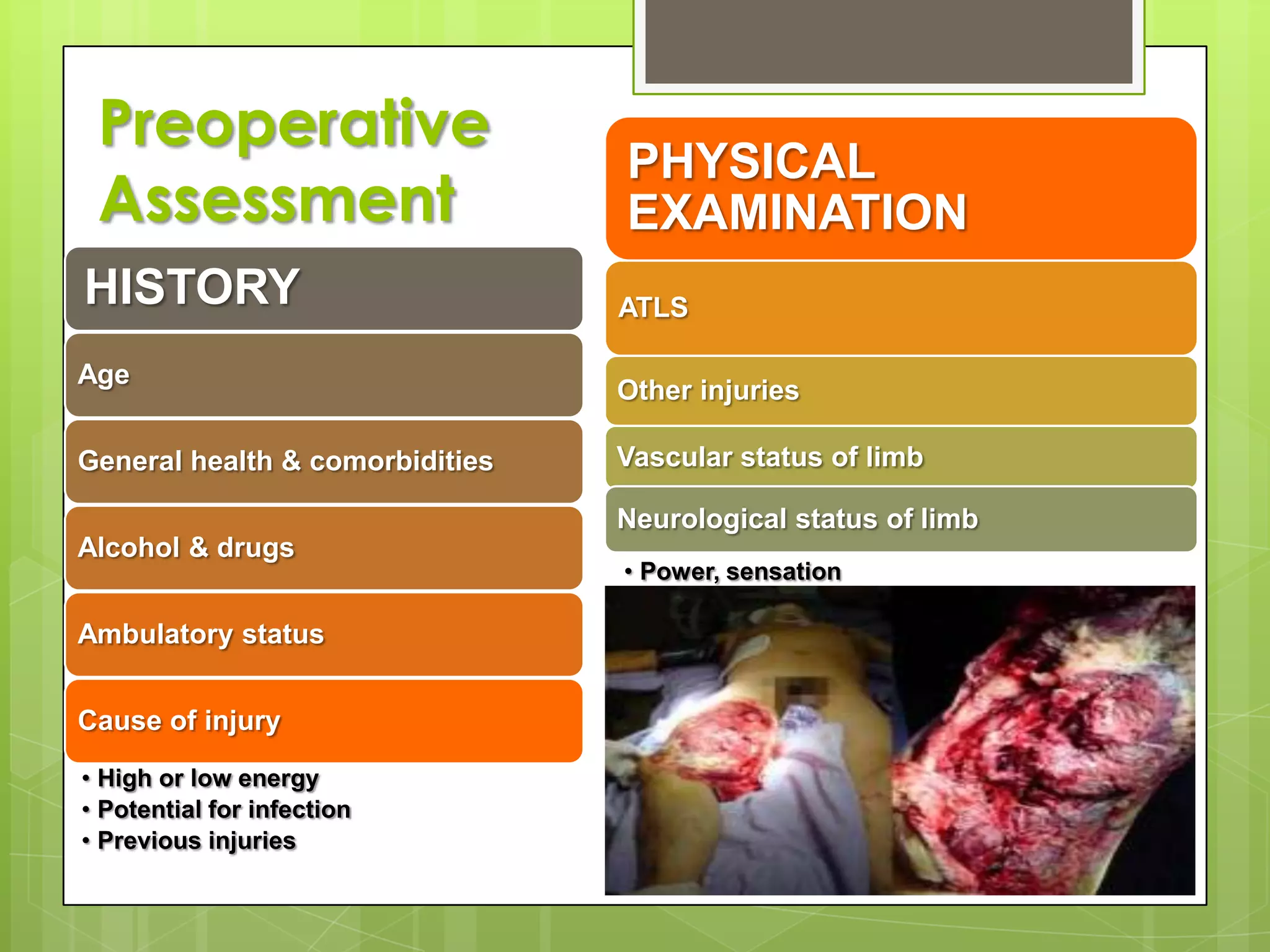
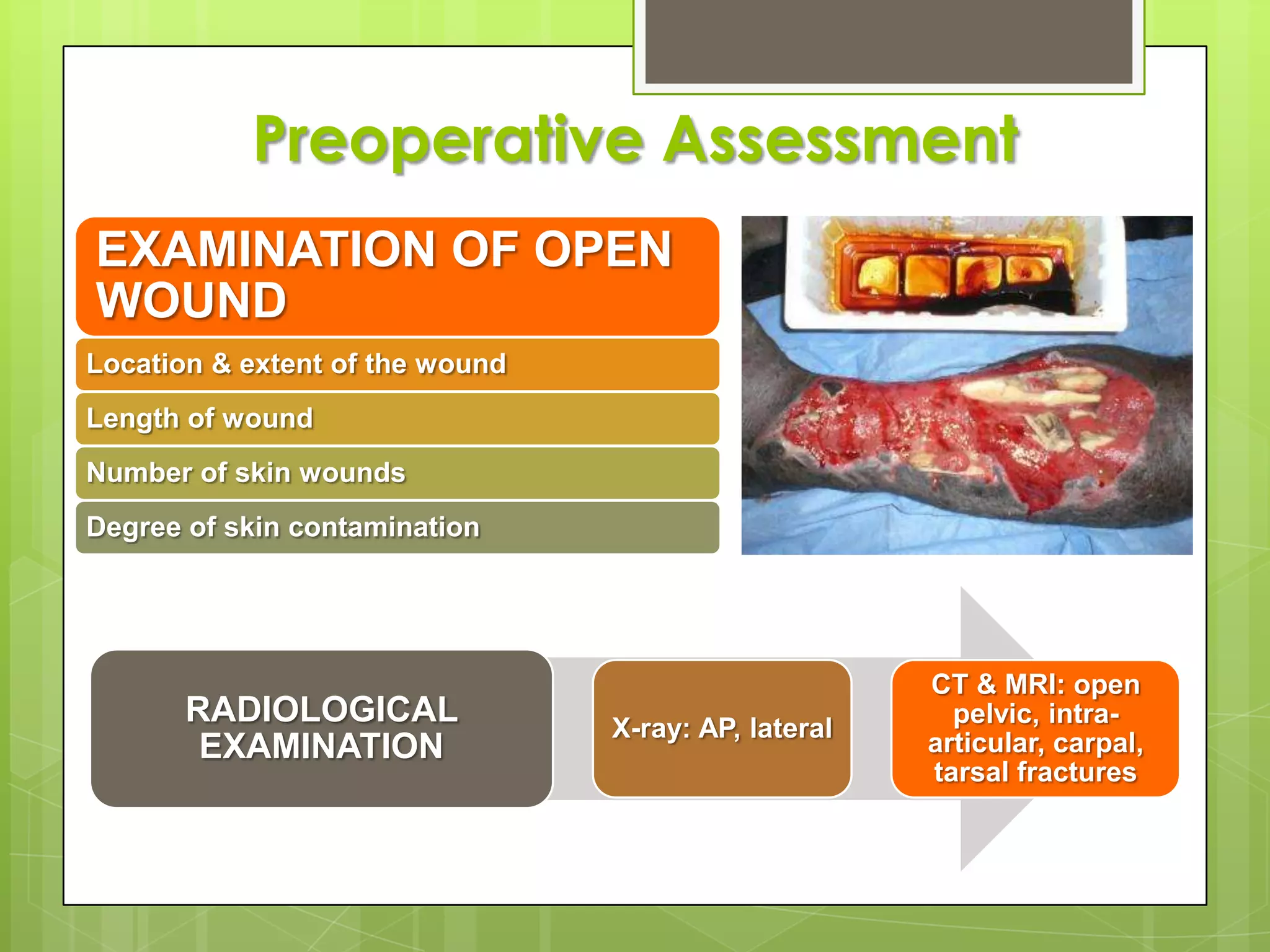
Preoperative Assessment
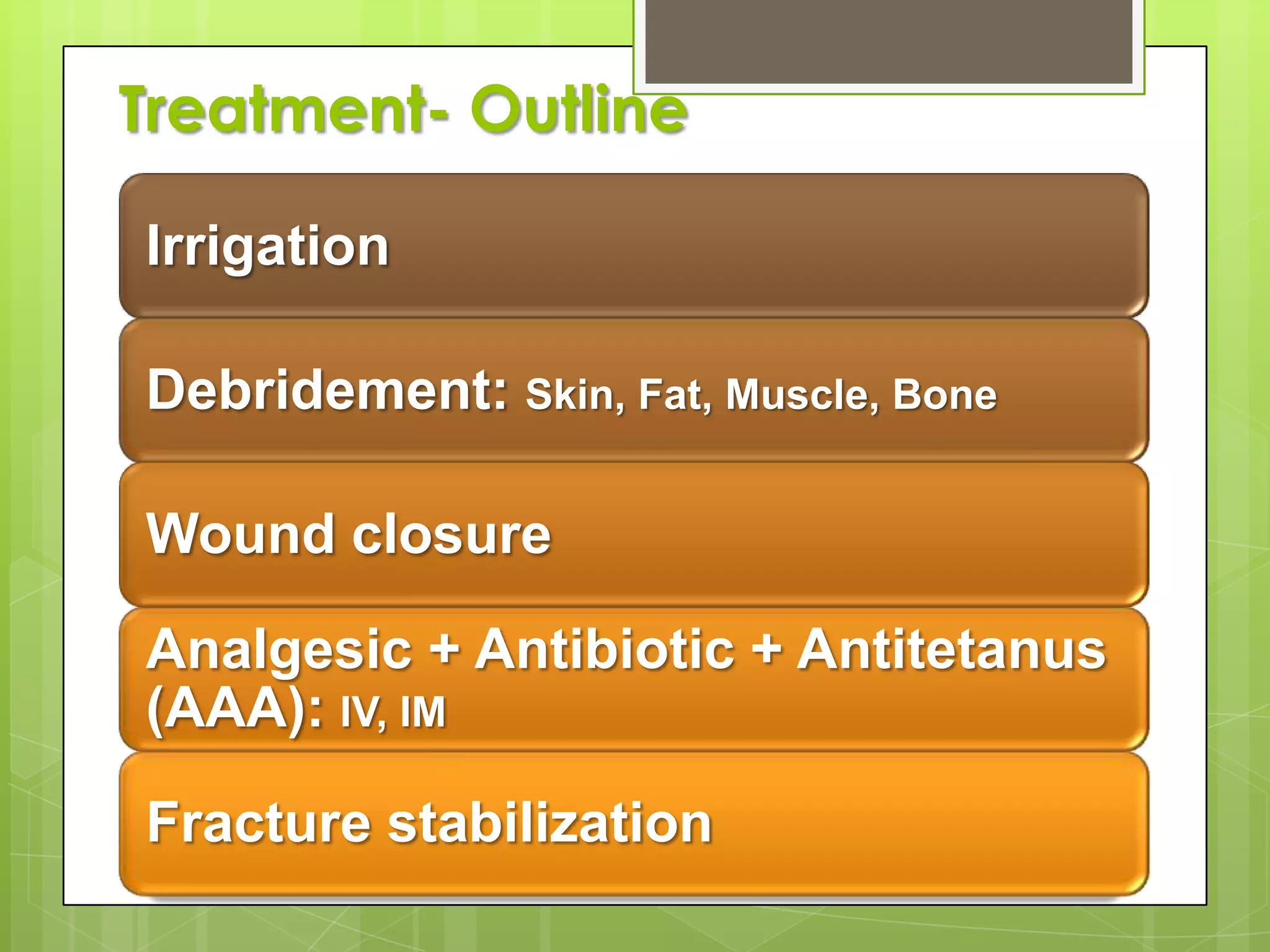
Treatment- Outline
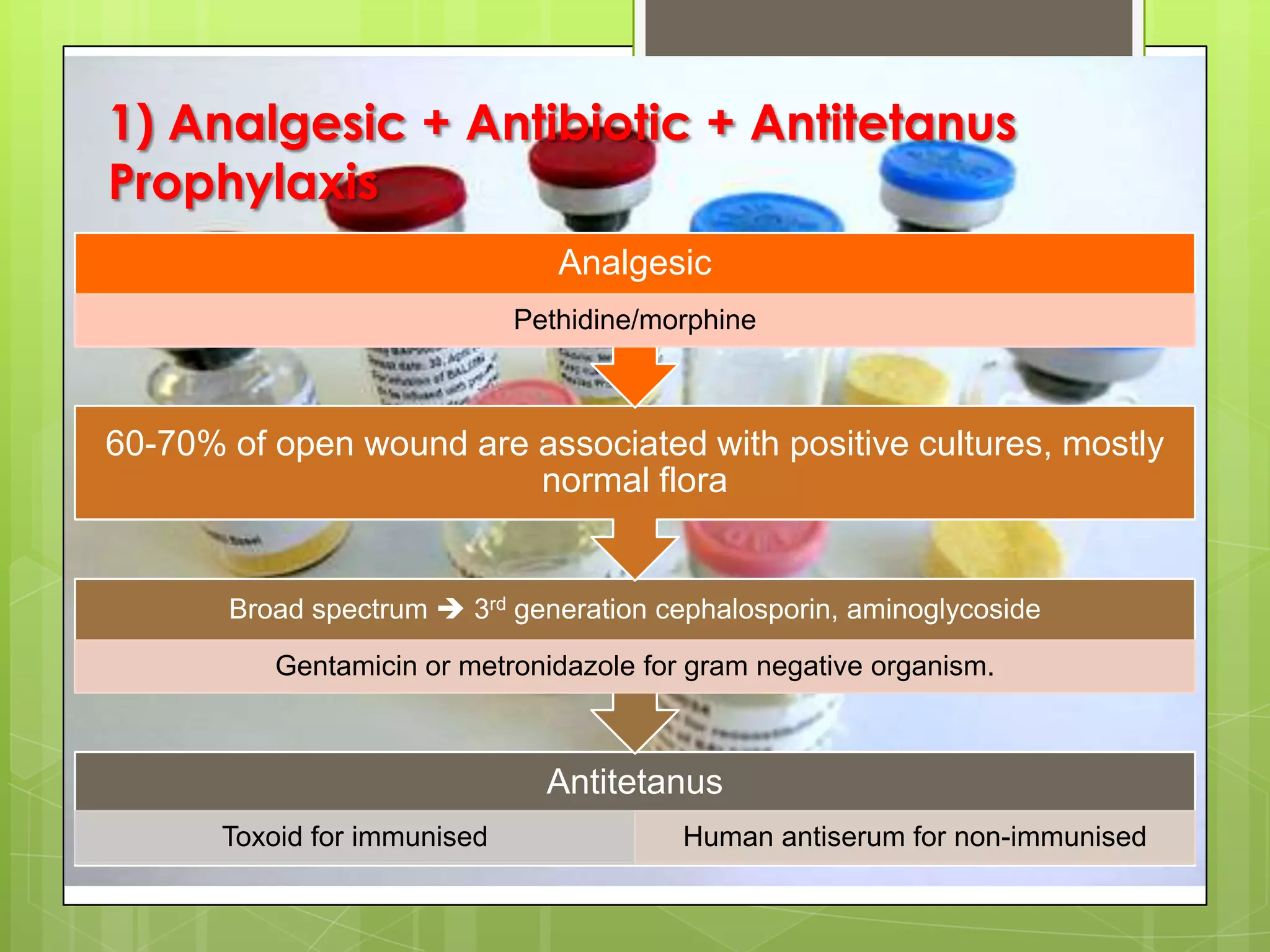
1) Analgesic + Antibiotic + AntitetanusProphylaxis
AntibioticGustiloGrade I- first generation of cephalosporin for 72 hours
Gustilo Grade II- first generation cephalosporin for 72 hours + Gram negative coverage (gentamicin) for at least 72 hours
Gustilo Grade III- first generation cephalosporin +G –ve coverage for at least 72 hours
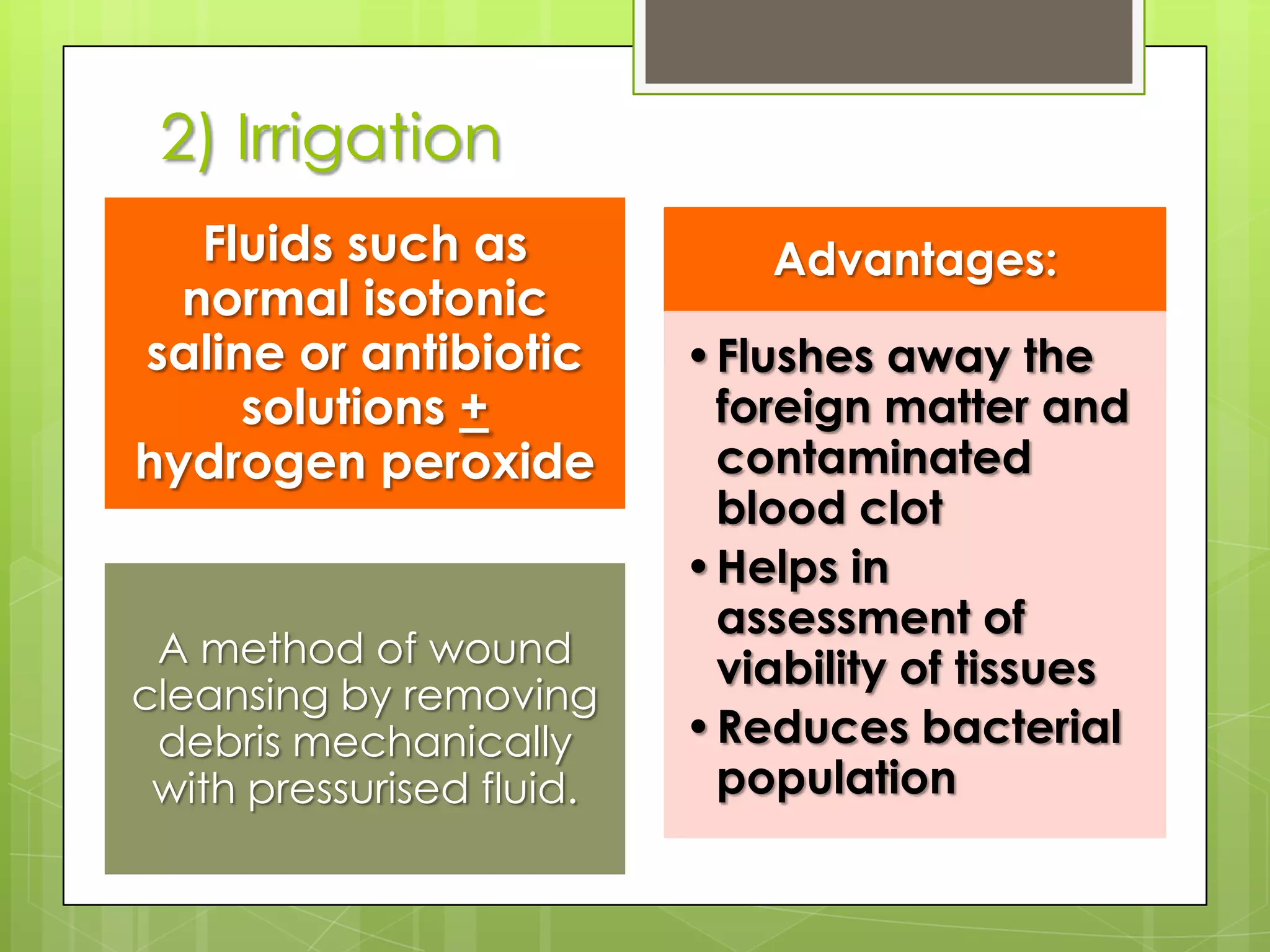
For soil contamination- penicillin is added for clostridial coverage2) Irrigation
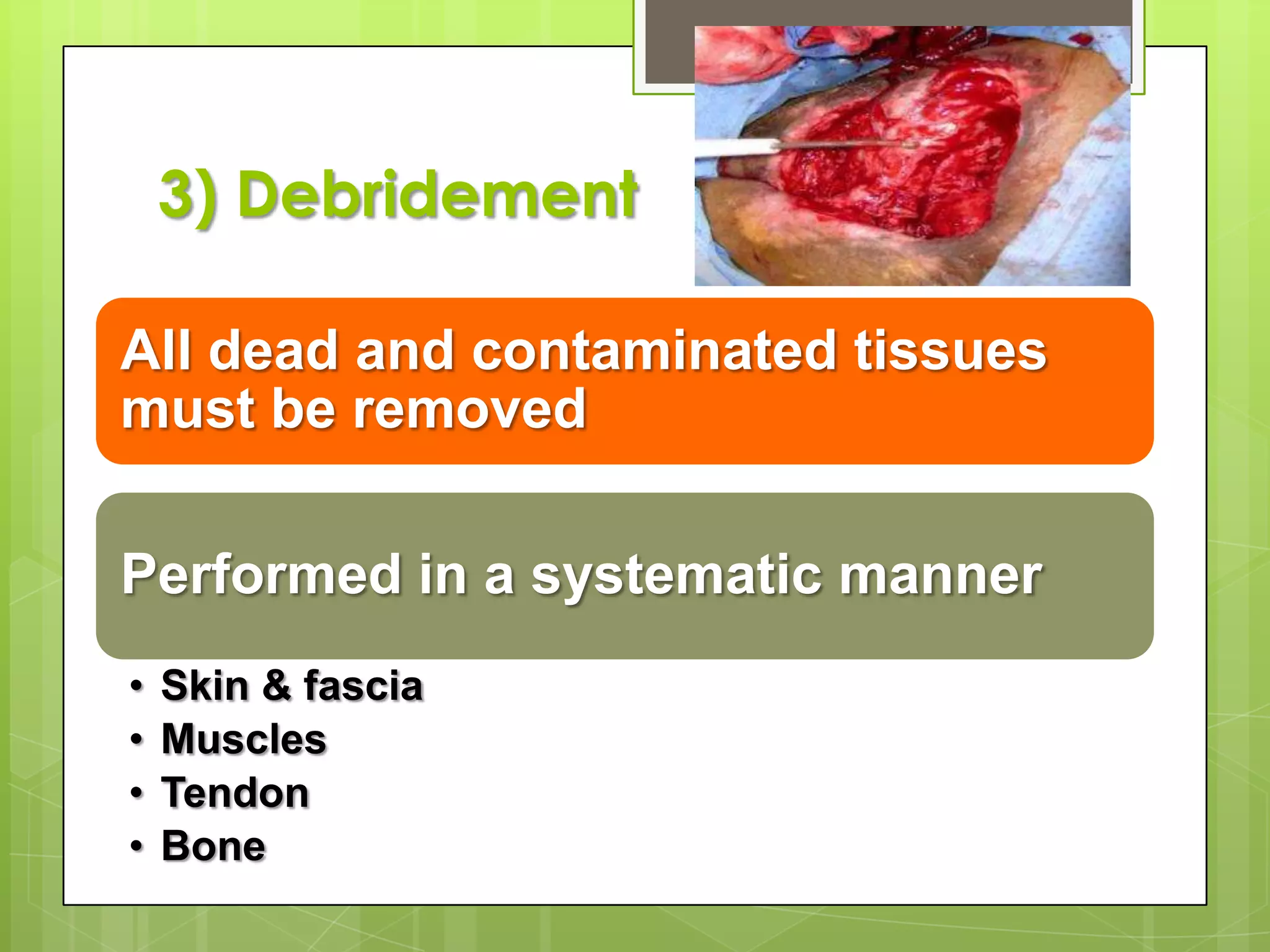
3) Debridement
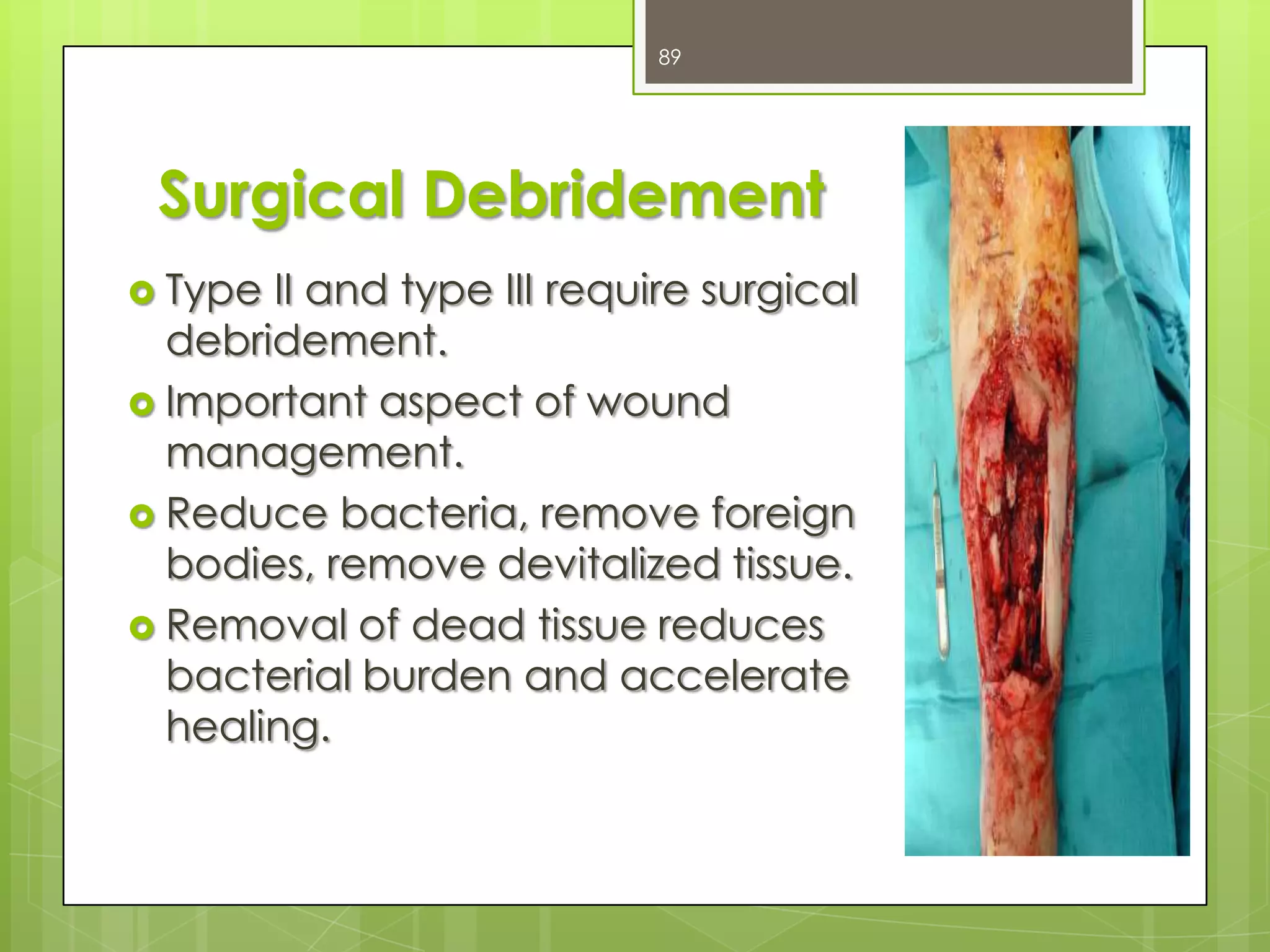
Surgical DebridementType II and type III require surgical debridement. Important aspect of wound management.Reduce bacteria, remove foreign bodies, remove devitalized tissue. Removal of dead tissue reduces bacterial burden and accelerate healing. 89
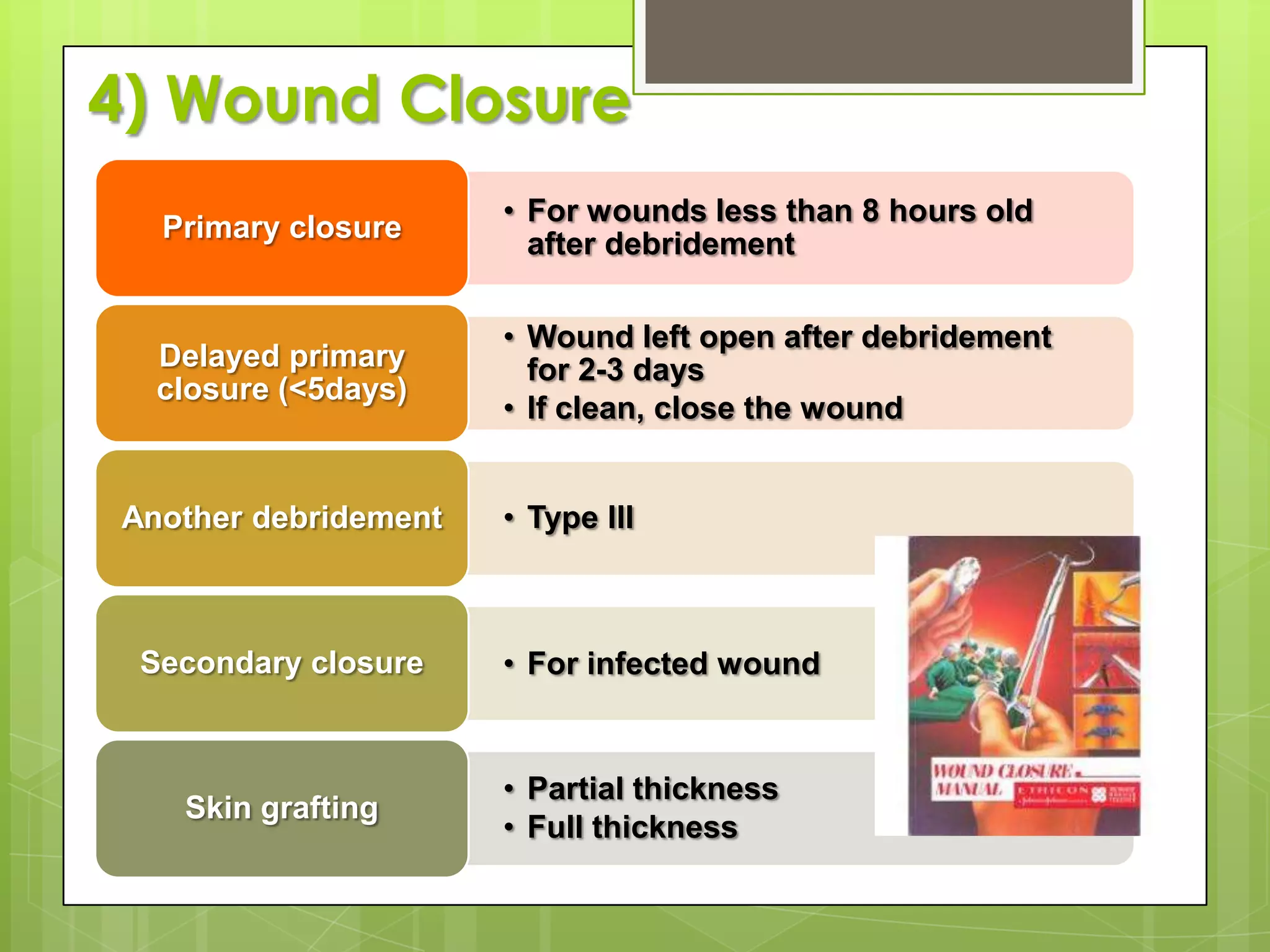
4) Wound Closure
Wound ClosureUncontaminated I & II can be sutured – provided without tensionAll other wounds left open, packed with moist sterile gauze, to be inspected 24-48 hours – primary delayed closureIf wound cannot be closed without tension – skin grafting
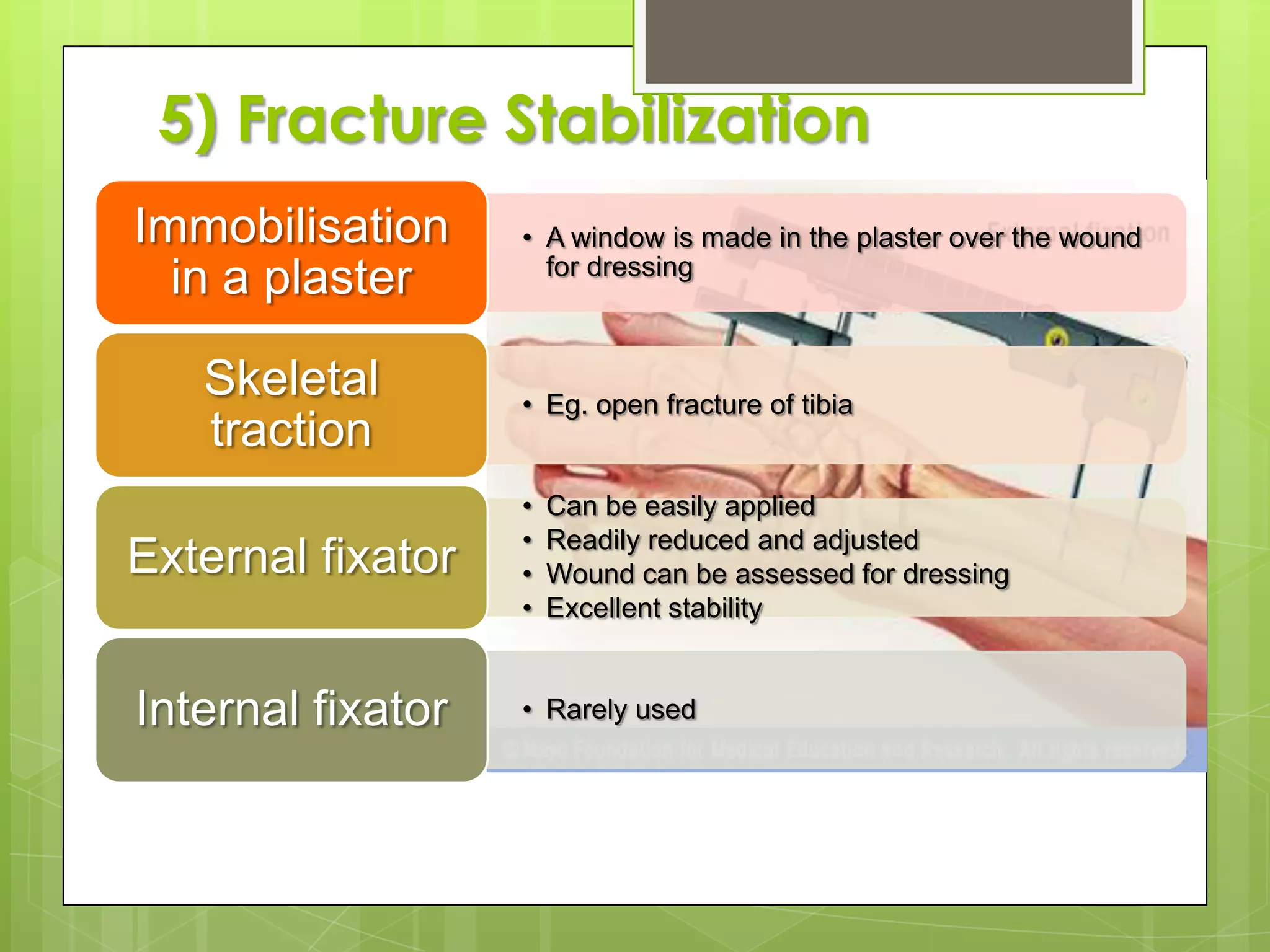
5) Fracture Stabilization
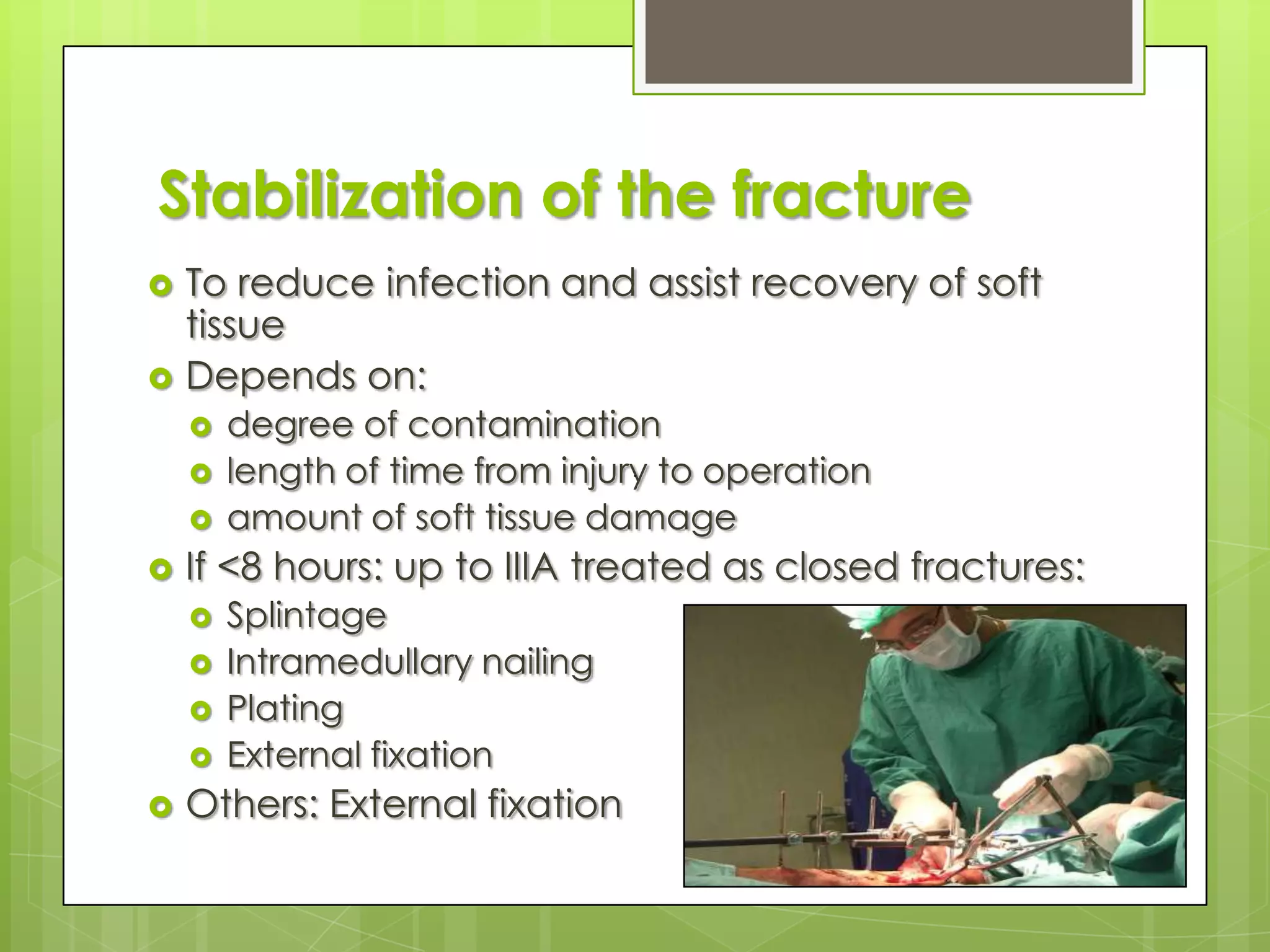
Stabilization of the fractureTo reduce infection and assist recovery of soft tissueDepends on:degree of contaminationlength of time from injury to operationamount of soft tissue damageIf <8 hours: up to IIIA treated as closed fractures:SplintageIntramedullary nailingPlating External fixationOthers: External fixation
Aftercare
COMPLICATION OF FRACTURE
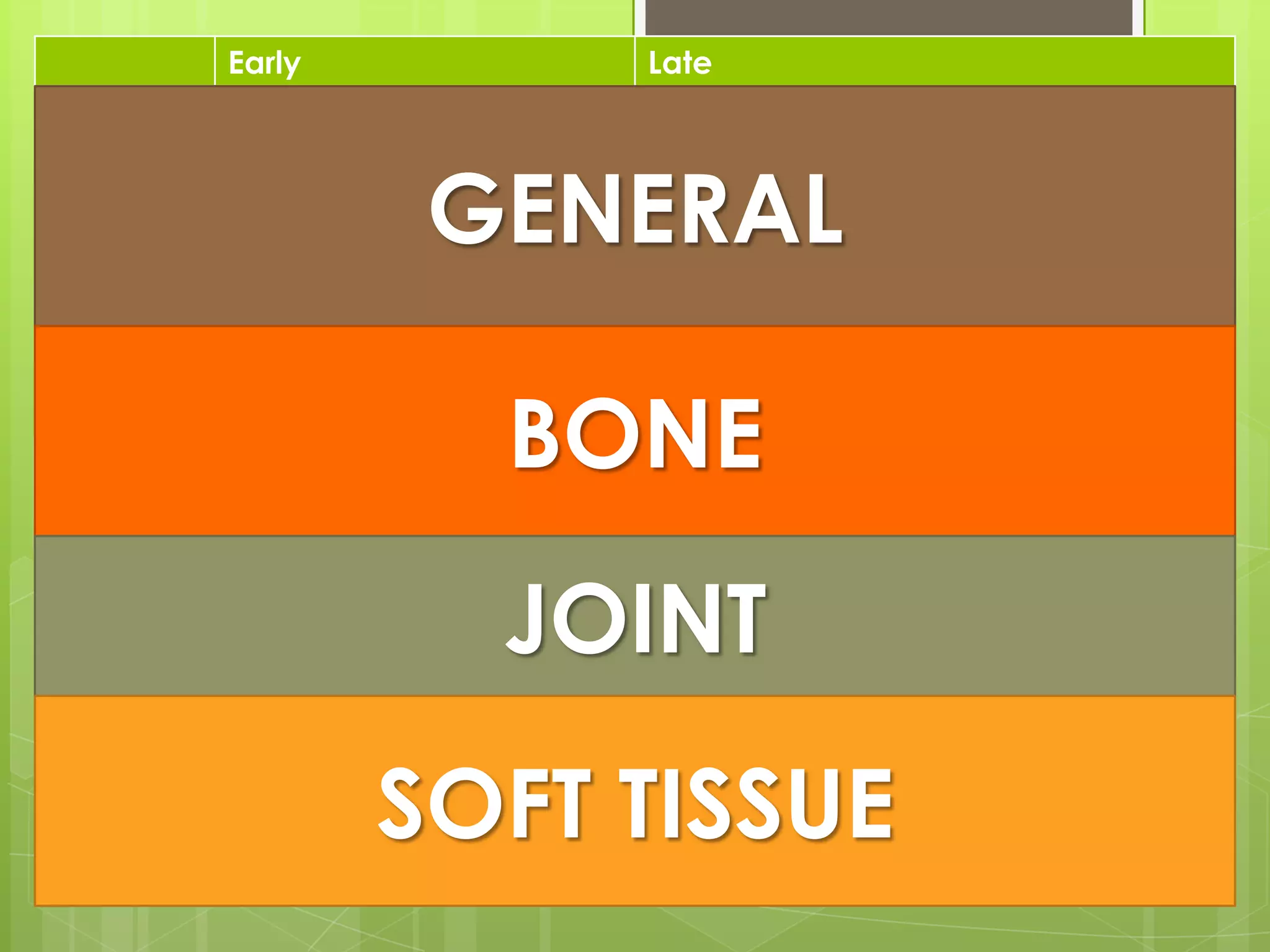
GENERALBONEJOINTSOFT TISSUE
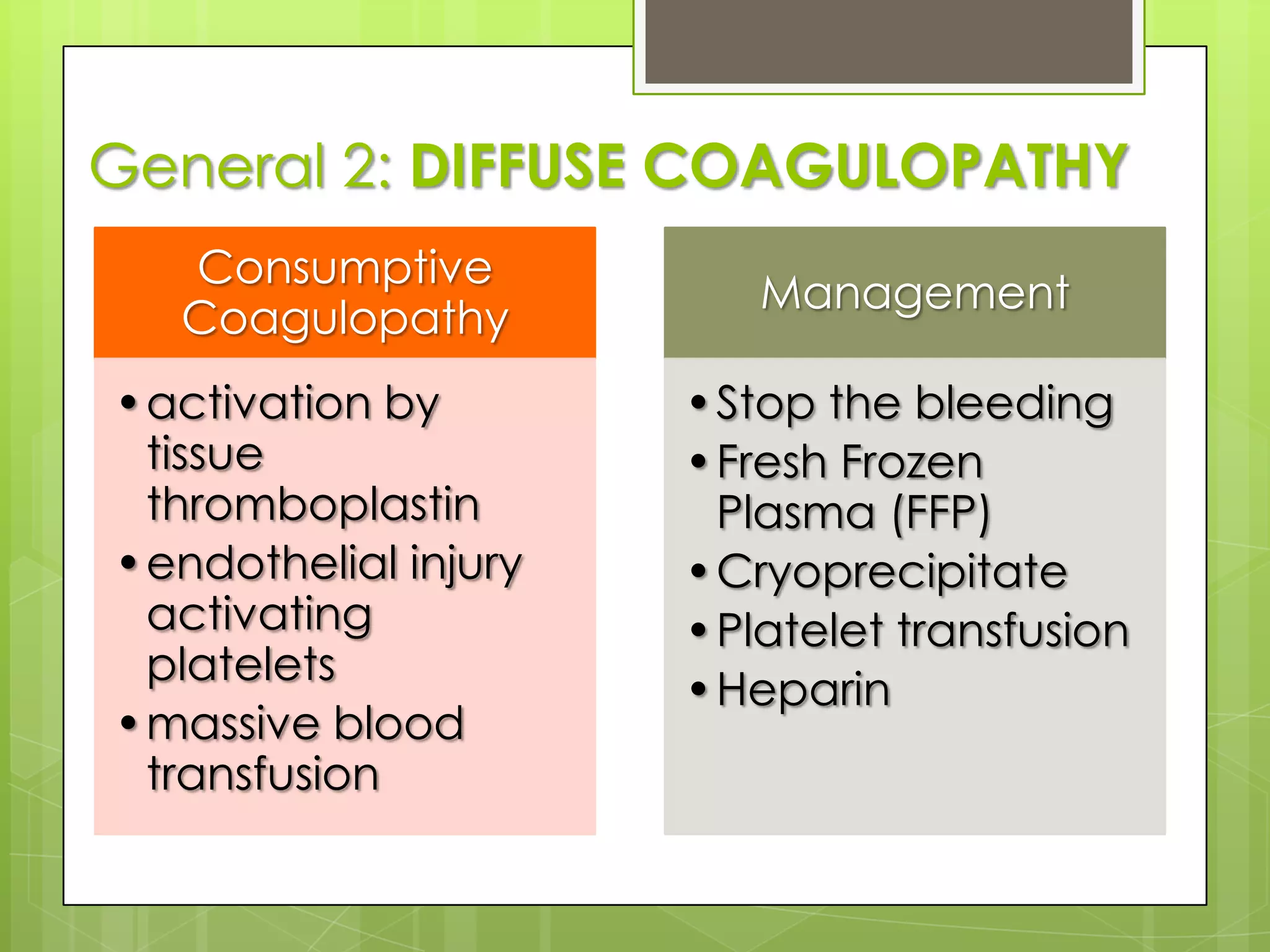
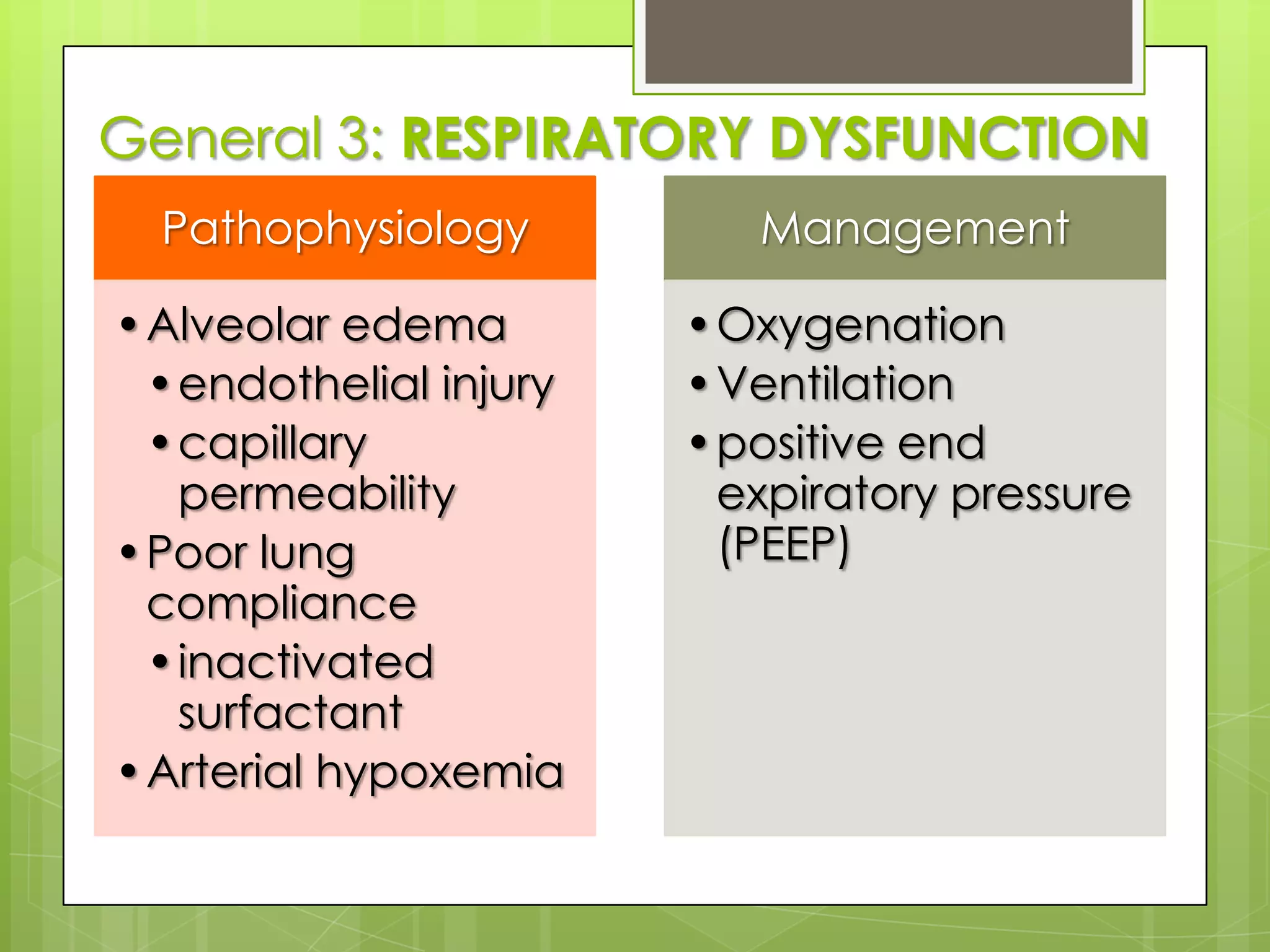
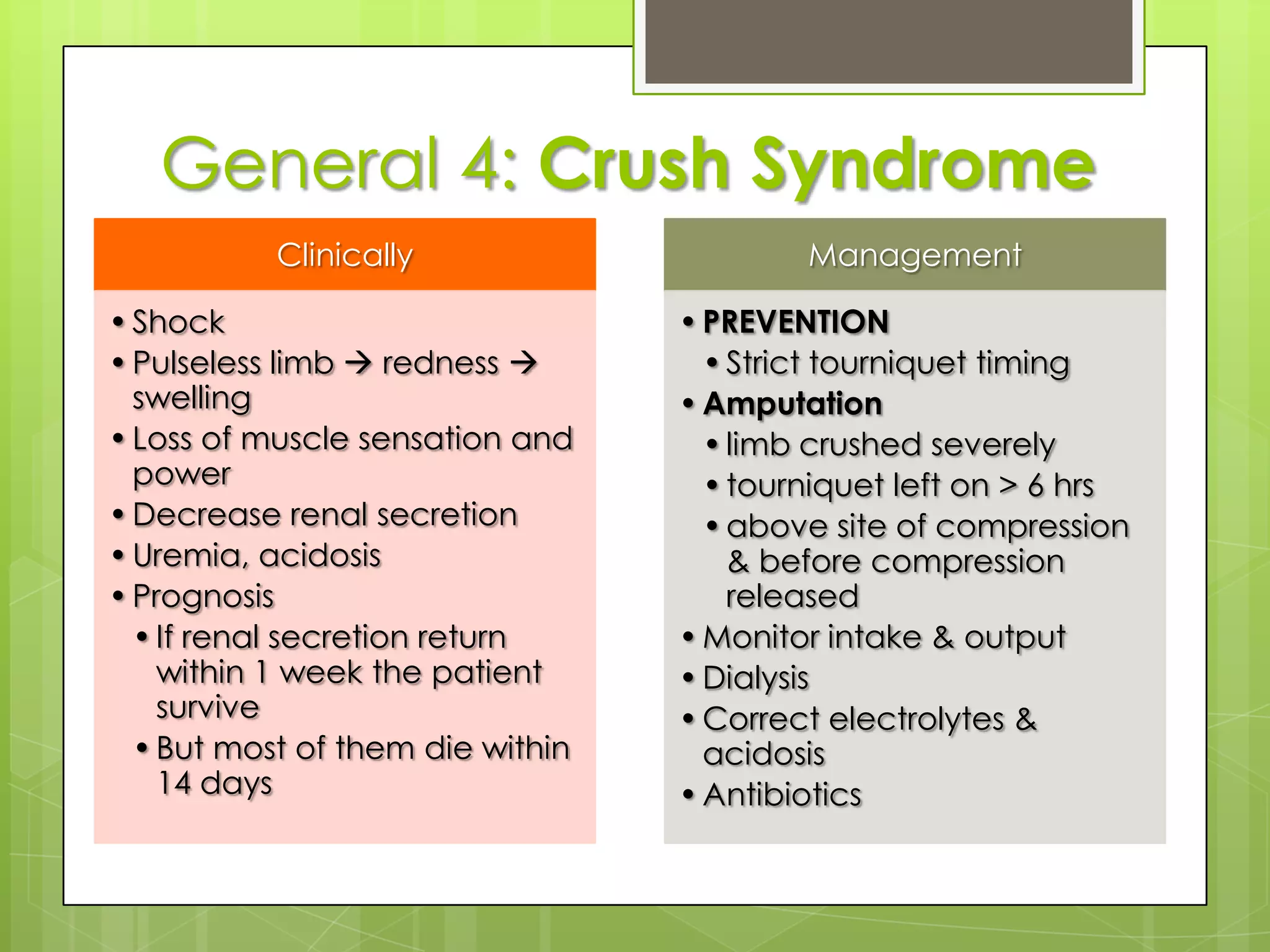
General ComplicationsShockDiffuse coagulopathyRespiratory dysfunctionCrush syndromeVenous thrombosis & Pulmonary embolismFat embolismGas GangreneTetanus
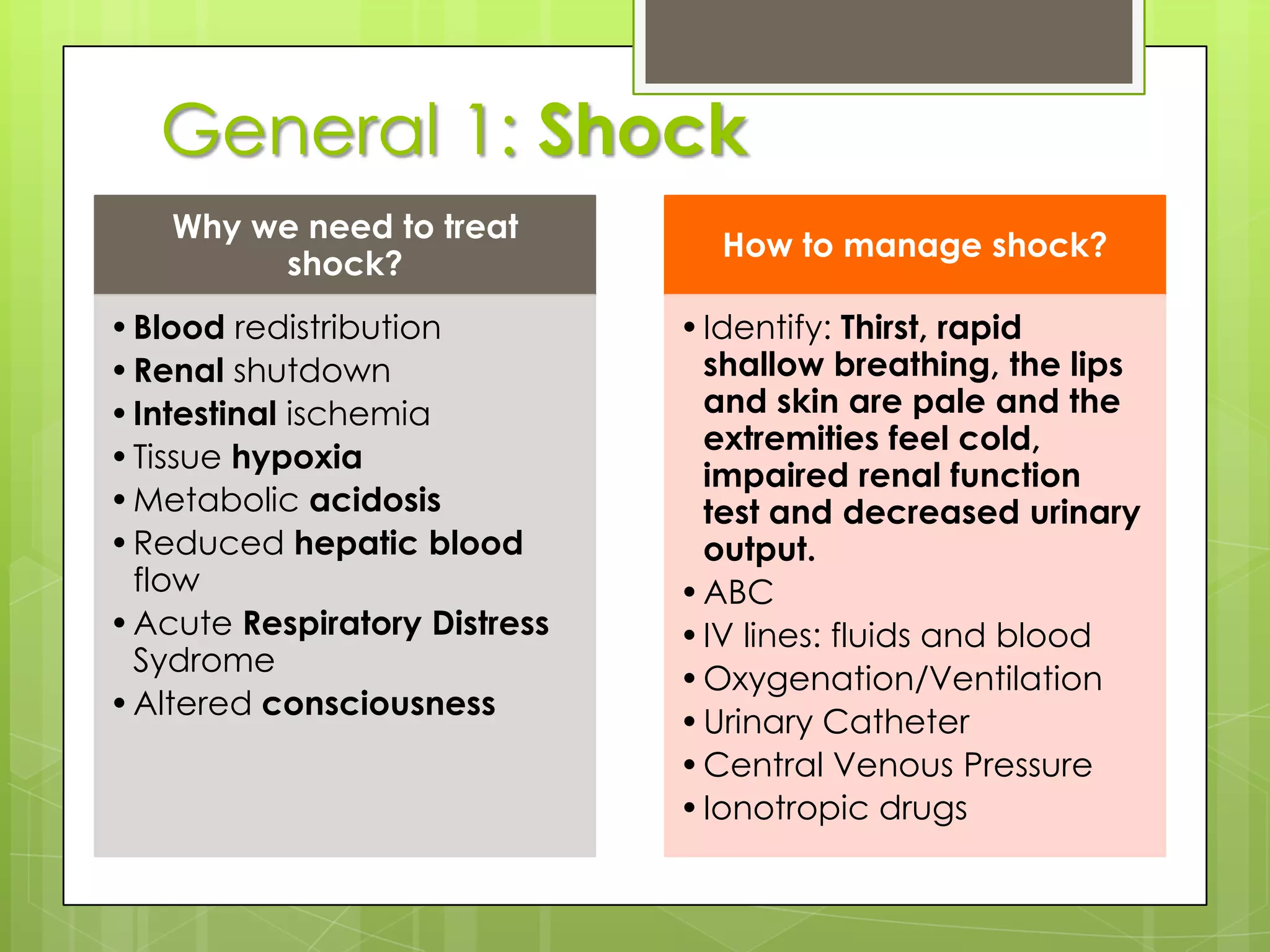
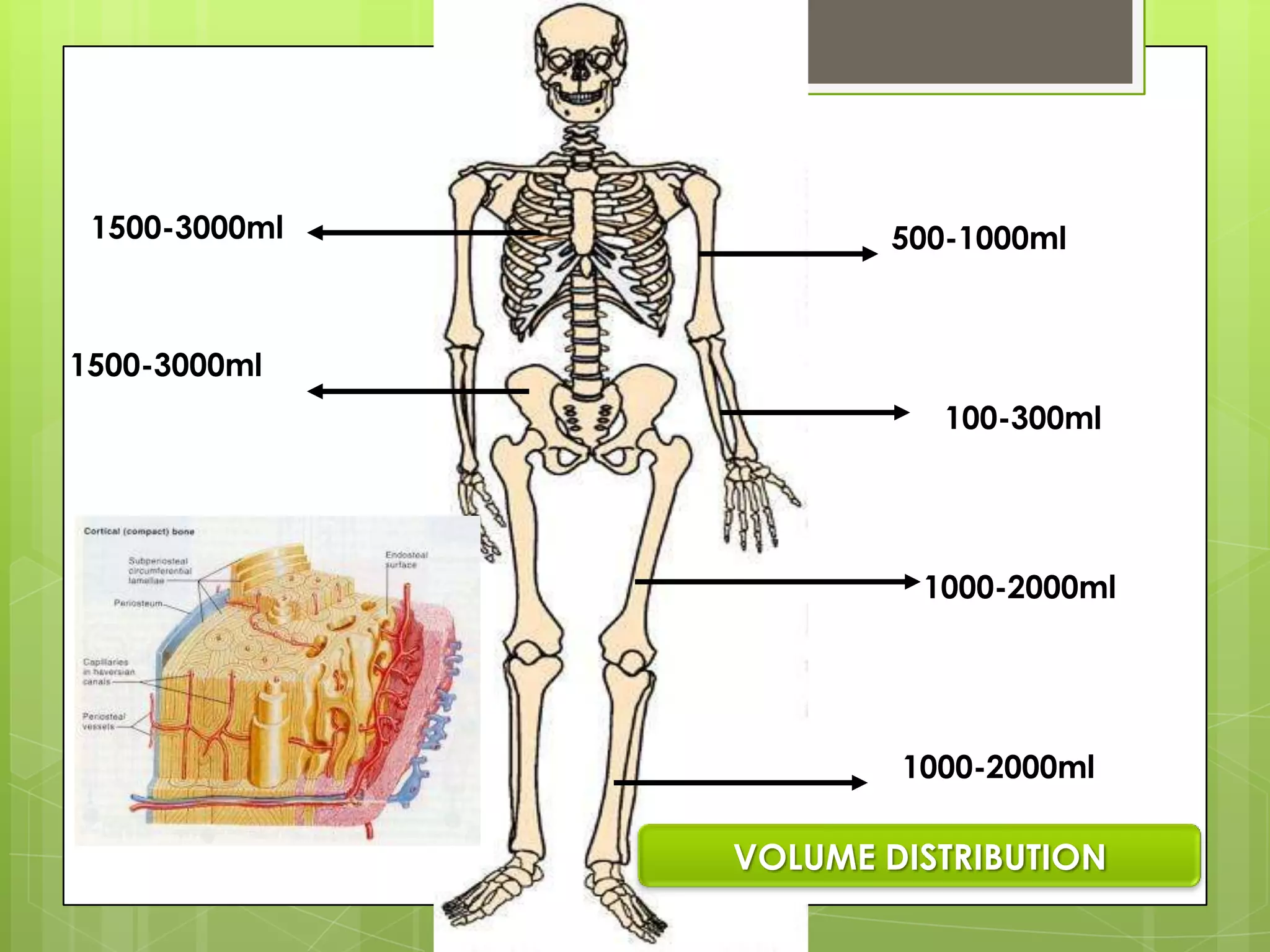
General 1: ShockAltered physiologic status with generalized inadequate tissue perfusion relative to metabolic requirements.  irreversible damage to vital organs
1500-3000ml500-1000ml1500-3000ml100-300ml1000-2000ml1000-2000mlVOLUME DISTRIBUTION
General 1: Shock
General 2: DIFFUSE COAGULOPATHY
General 3: RESPIRATORY DYSFUNCTION
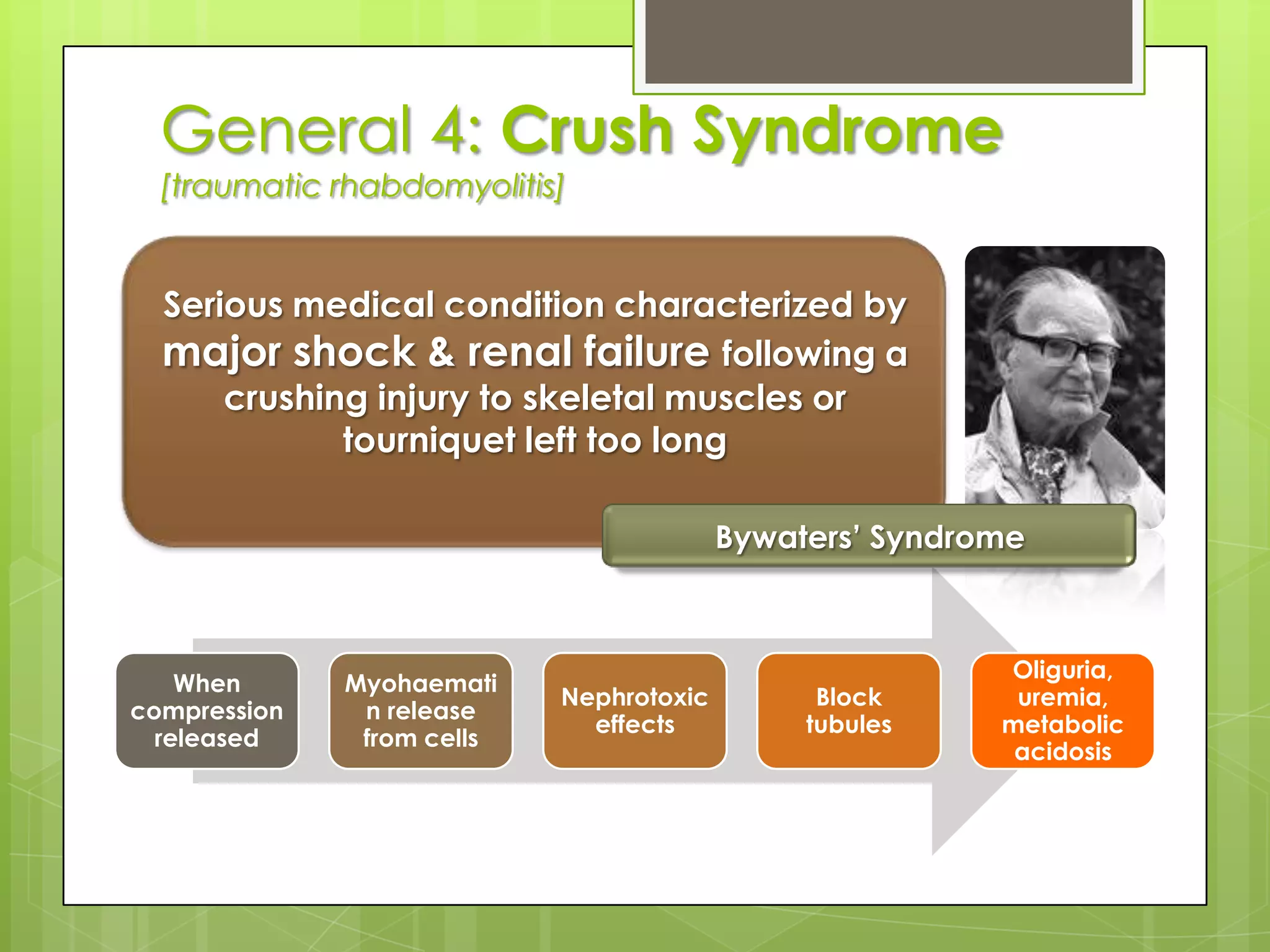
General 4: Crush Syndrome[traumatic rhabdomyolitis]Serious medical condition characterized by major shock & renal failure following a crushing injury to skeletal muscles or tourniquet left too longBywaters’ Syndrome
General 4: Crush Syndrome
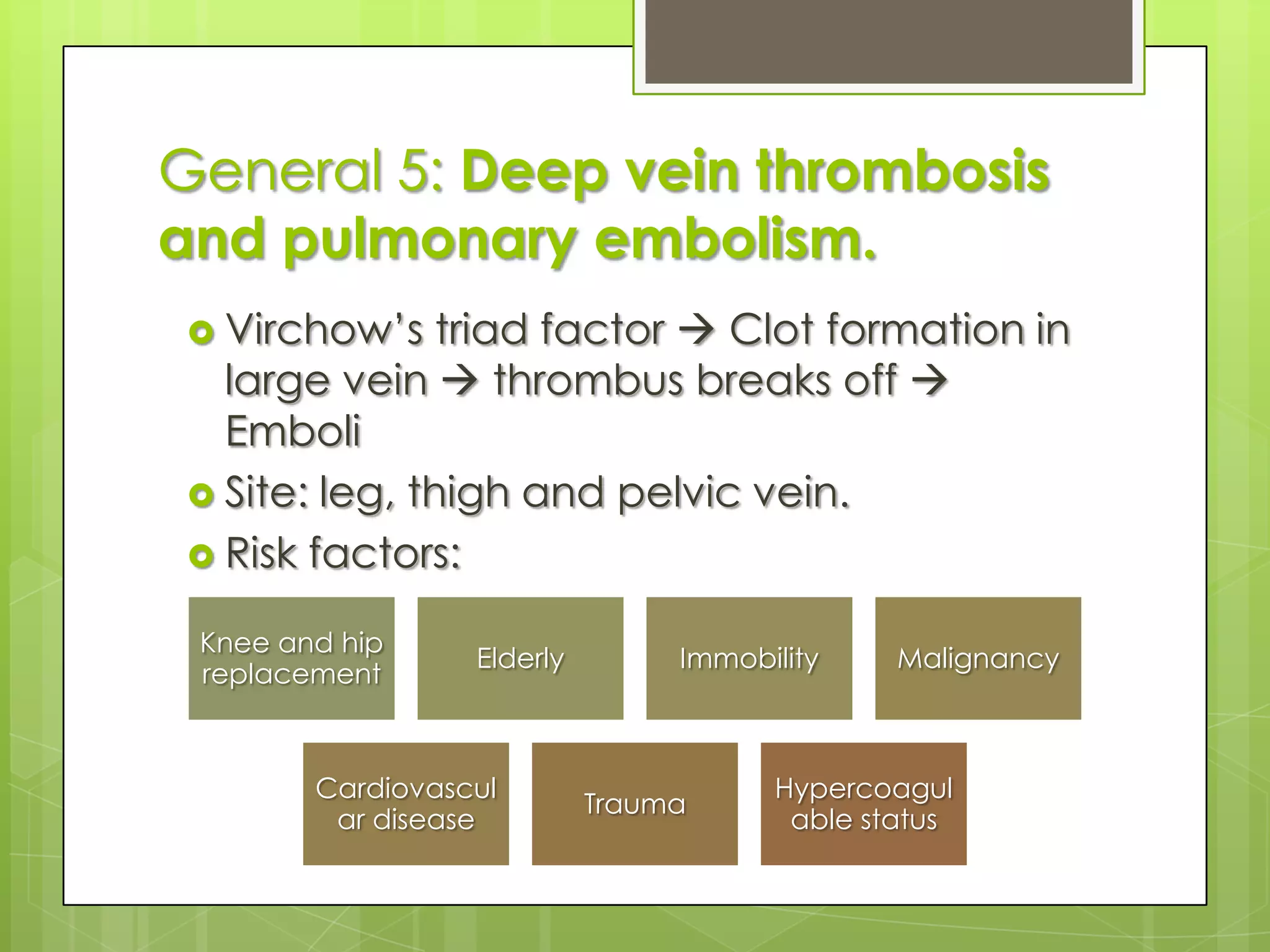
General 5: Deep vein thrombosis and pulmonary embolism.Virchow’s triad factor  Clot formation in large vein  thrombus breaks off  EmboliSite: leg, thigh and pelvic vein.Risk factors:
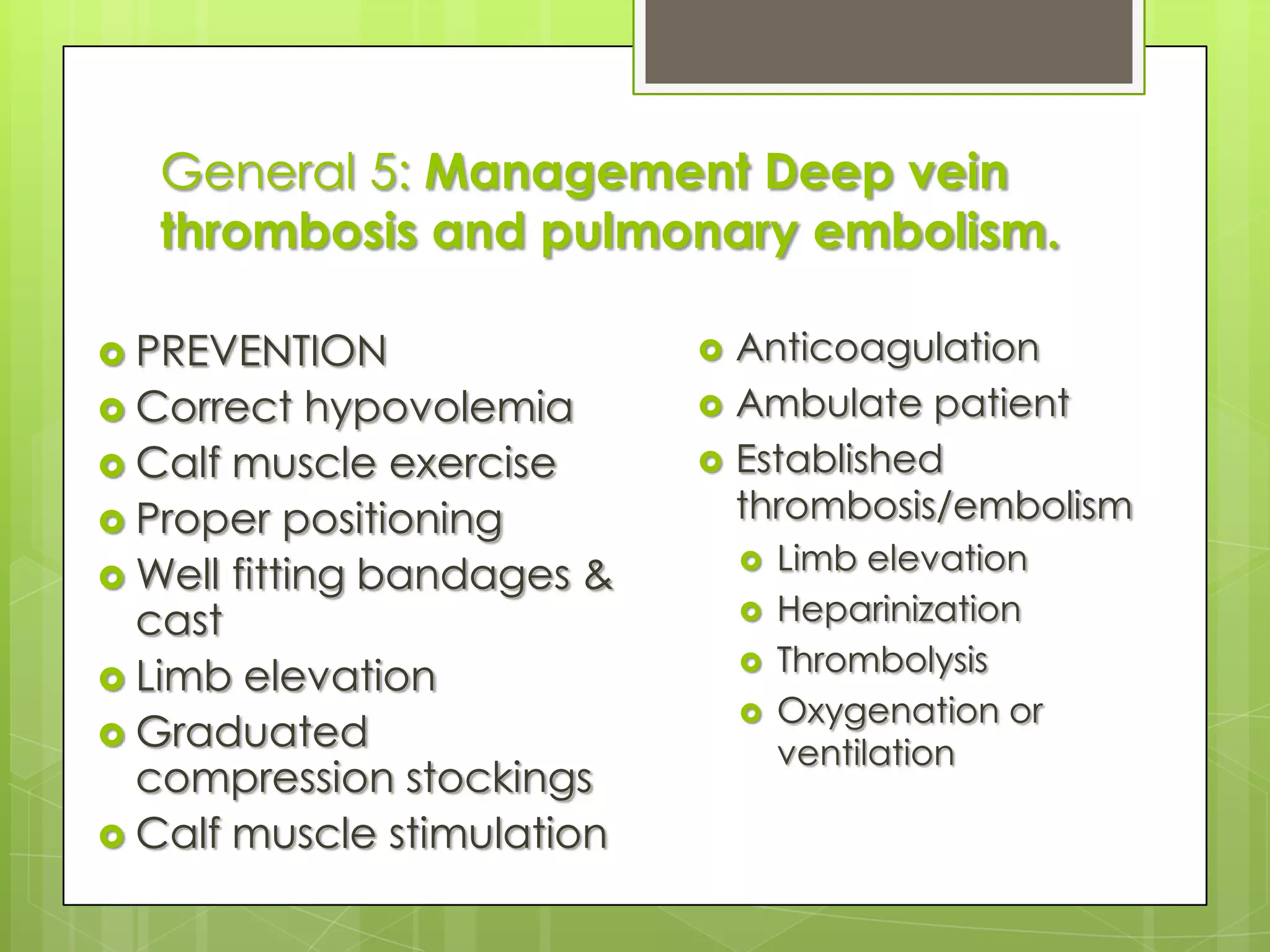
General 5: Management Deep vein thrombosis and pulmonary embolism.AnticoagulationAmbulate patientEstablished thrombosis/embolismLimb elevationHeparinizationThrombolysisOxygenation or ventilationPREVENTIONCorrect hypovolemiaCalf muscle exerciseProper positioningWell fitting bandages & castLimb elevationGraduated compression stockingsCalf muscle stimulation
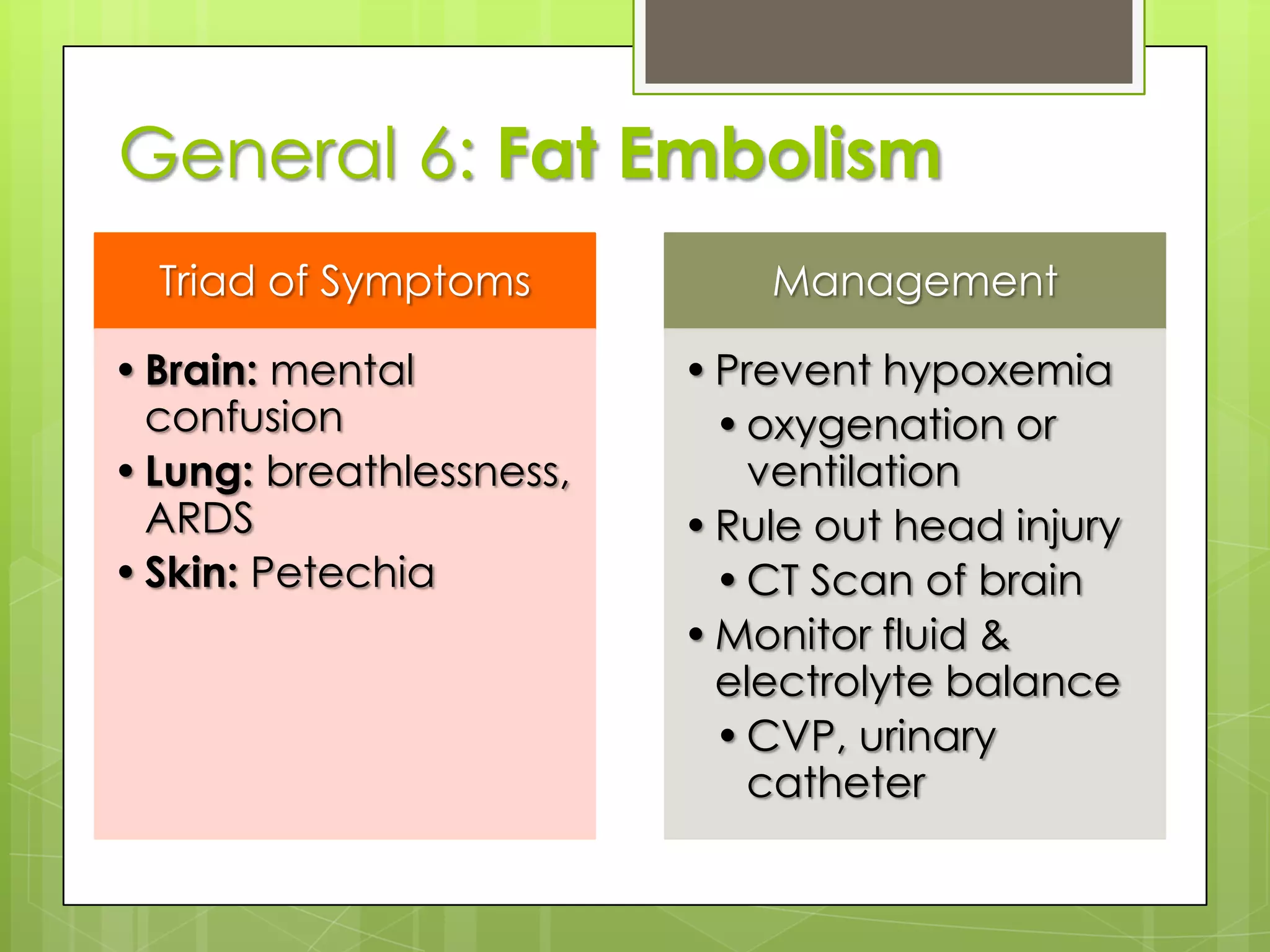
General 6: Fat EmbolismFat globules from marrow pushed into circulation by the force of trauma that causing embolic phenomena
General 6: Fat Embolism
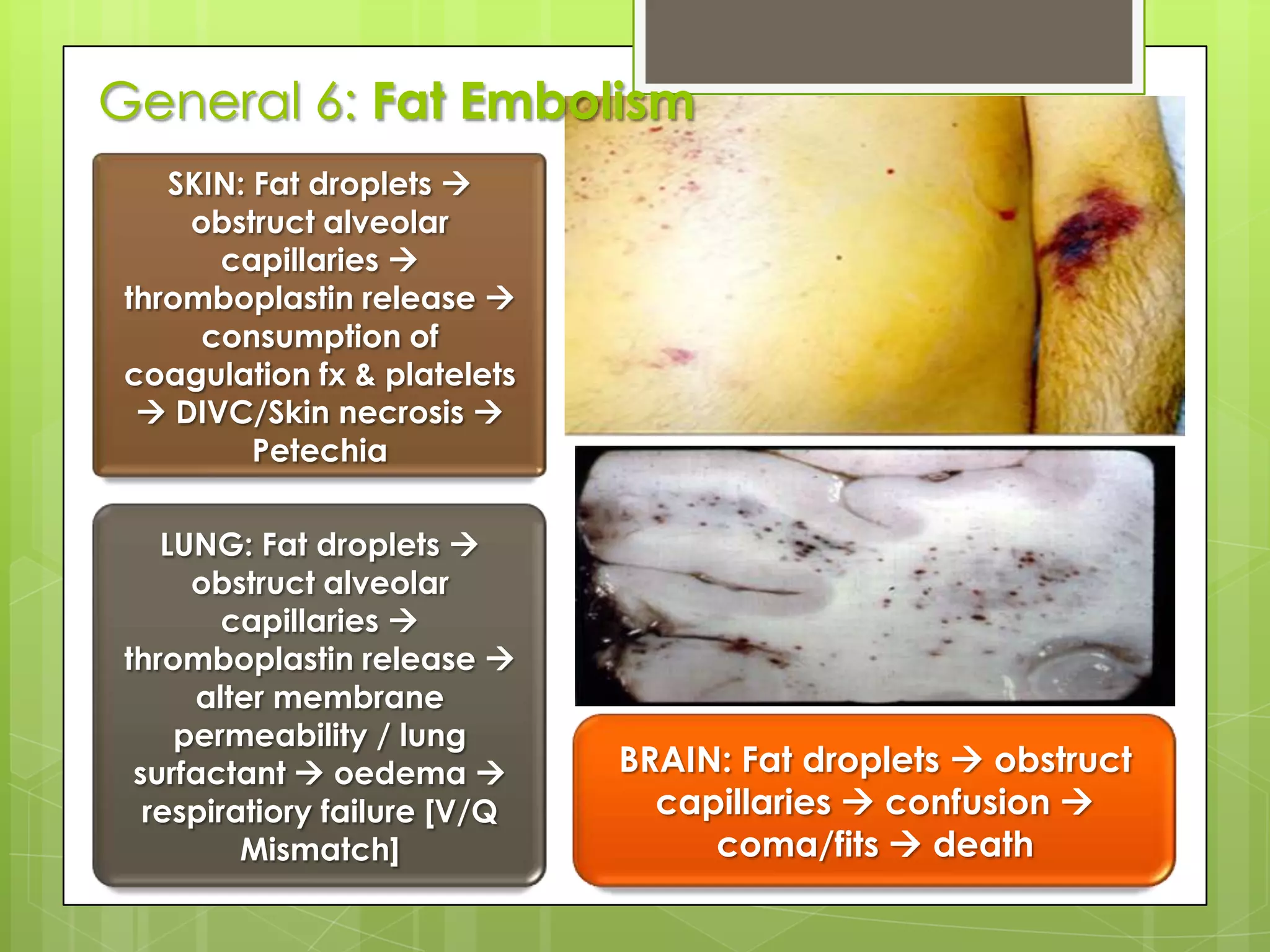
General 6: Fat EmbolismSKIN: Fat droplets  obstruct alveolar capillaries  thromboplastin release  consumption of coagulation fx & platelets  DIVC/Skin necrosis  PetechiaLUNG: Fat droplets  obstruct alveolar capillaries  thromboplastin release  alter membrane permeability / lung surfactant  oedema  respiratiory failure [V/Q Mismatch]BRAIN: Fat droplets  obstruct capillaries  confusion  coma/fits  death
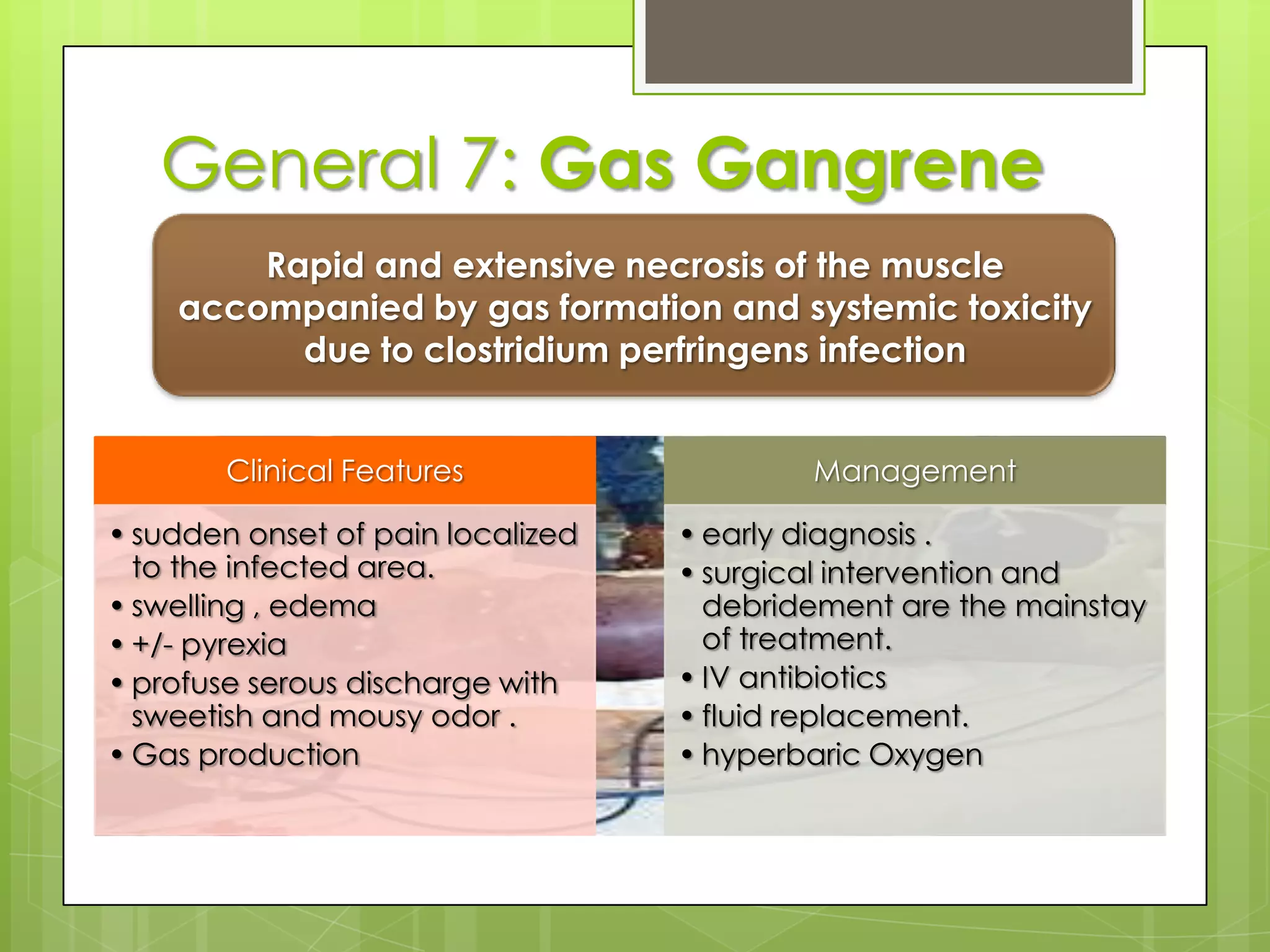
General 7: Gas GangreneRapid and extensive necrosis of the muscle accompanied by gas formation and systemic toxicity due to clostridium perfringens infection
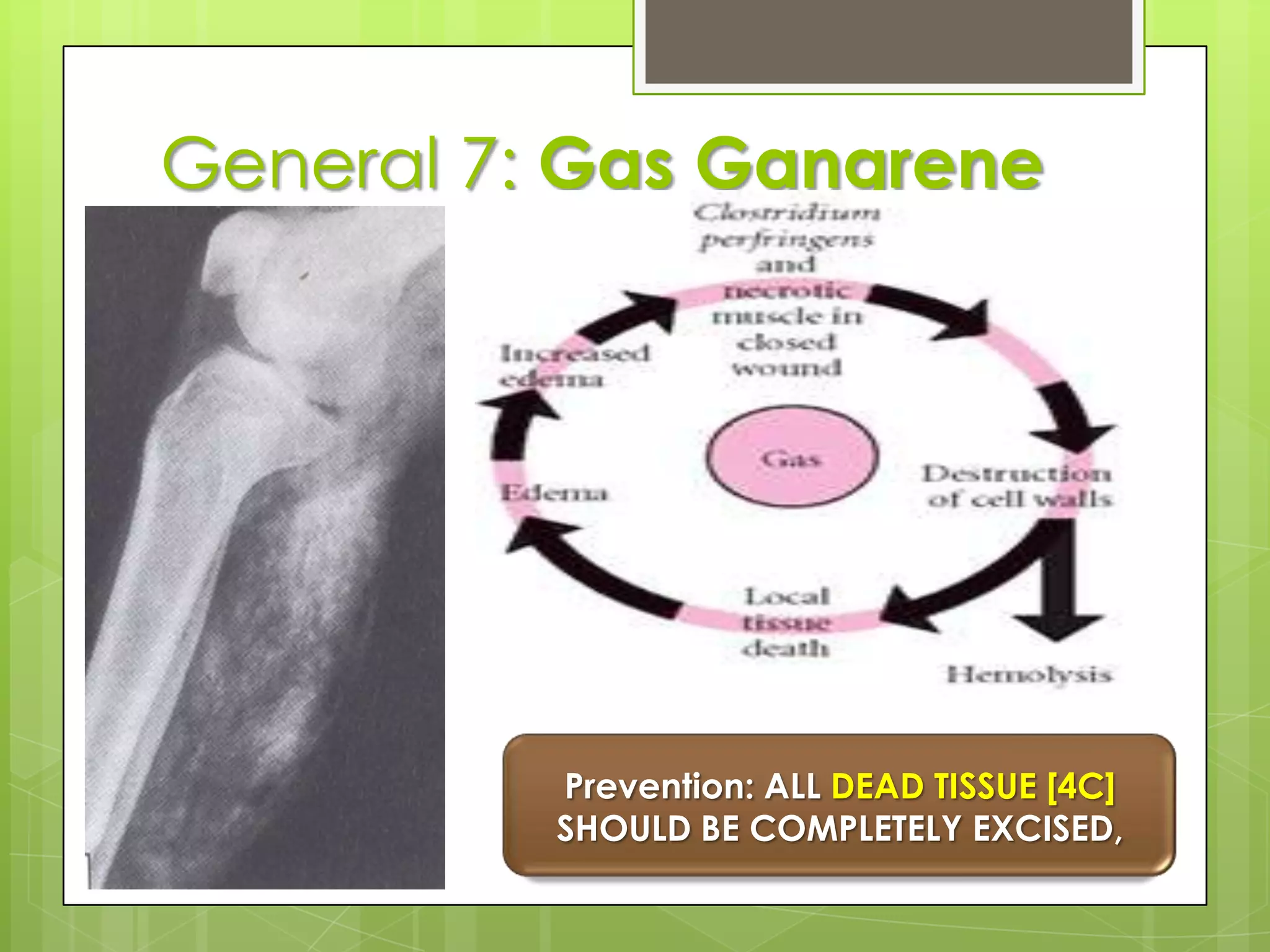
General 7: Gas GangrenePrevention: ALL DEAD TISSUE [4C] SHOULD BE COMPLETELY EXCISED,
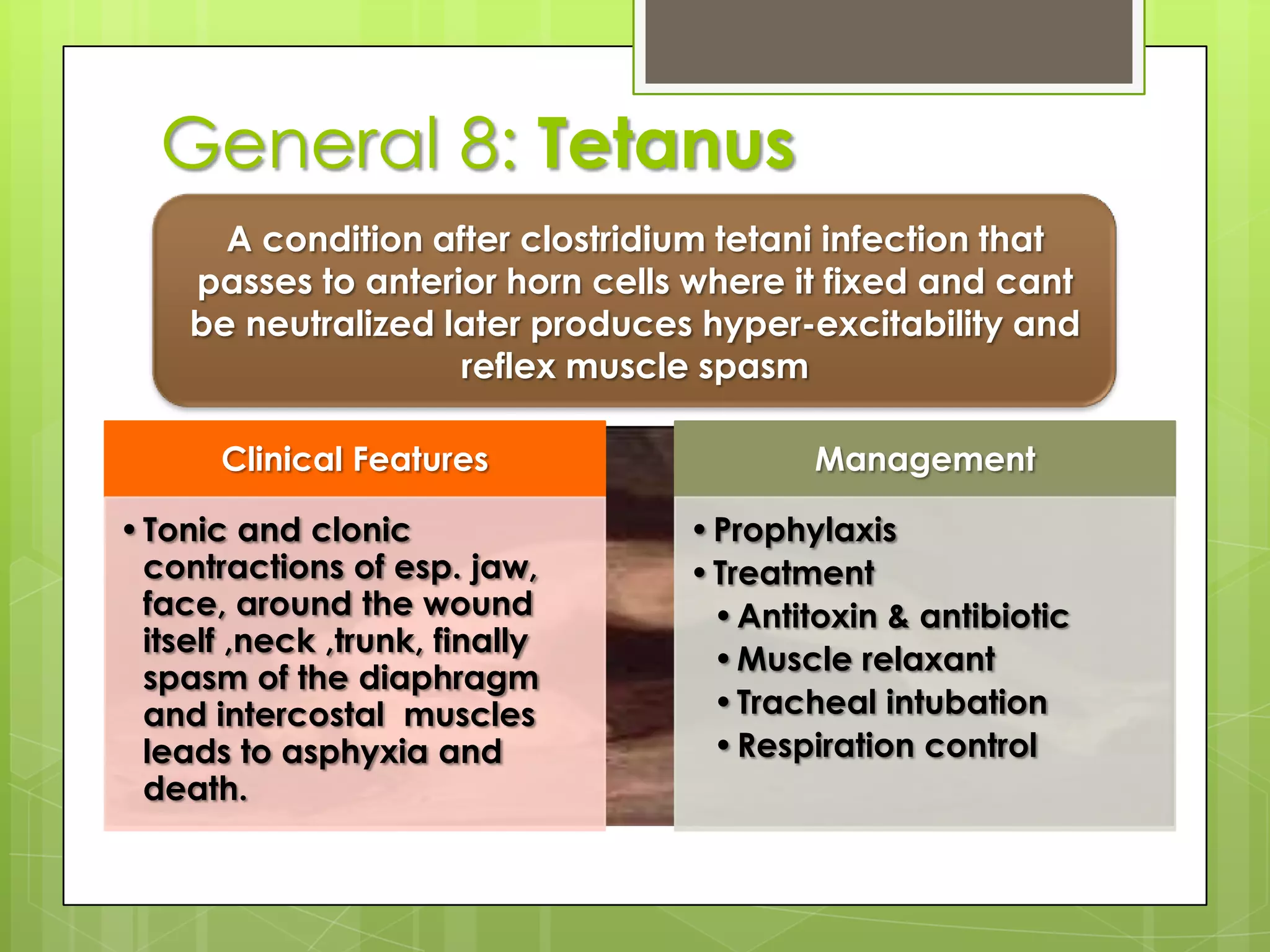
General 8: TetanusA condition after clostridium tetani infection that passes to anterior horn cells where it fixed and cant be neutralized later produces hyper-excitability and reflex muscle spasm
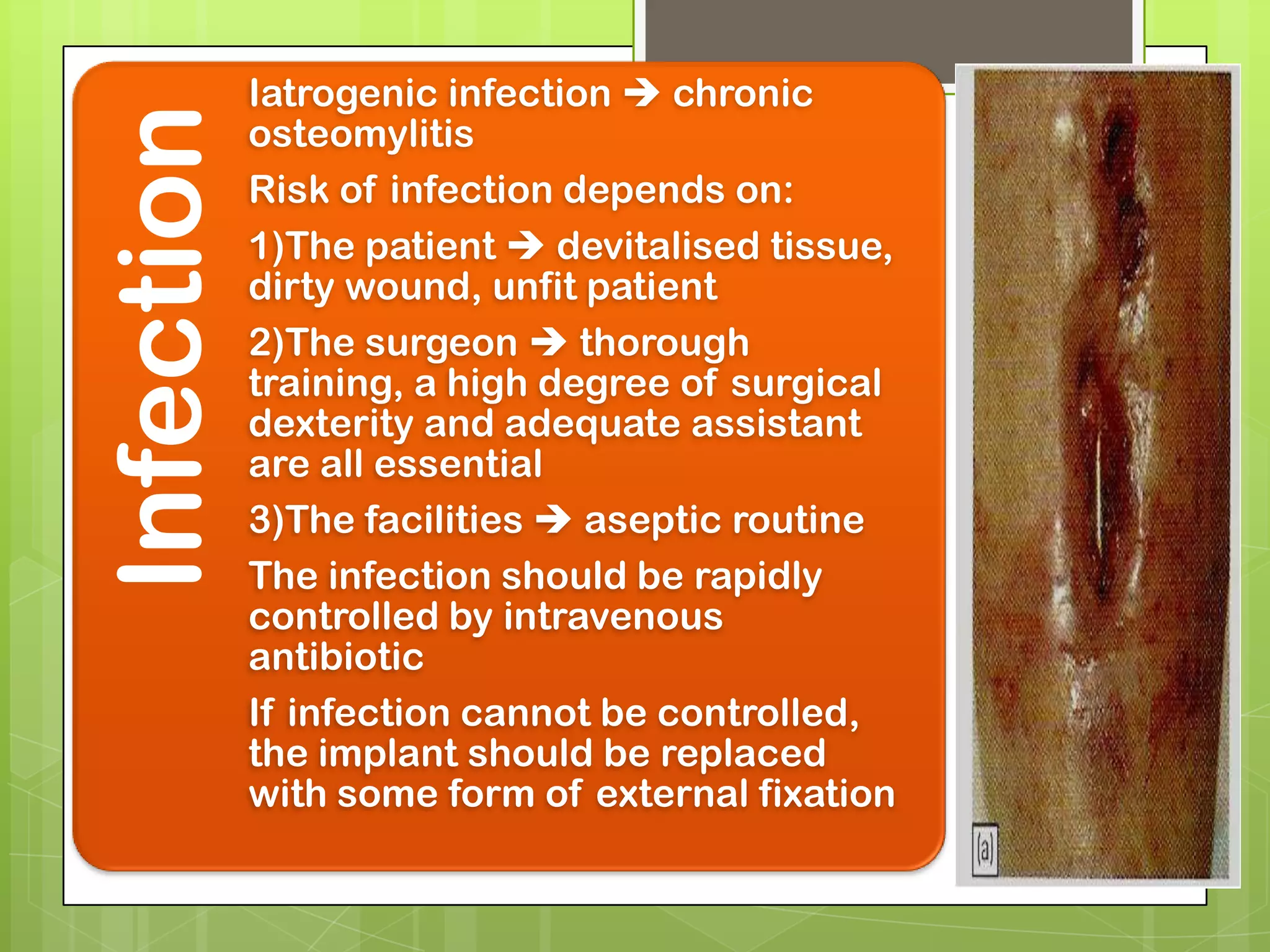
Early ComplicationsVisceral InjuryVascular InjuryCompartment SyndromesNerve injuryHaemarthrosisInfection
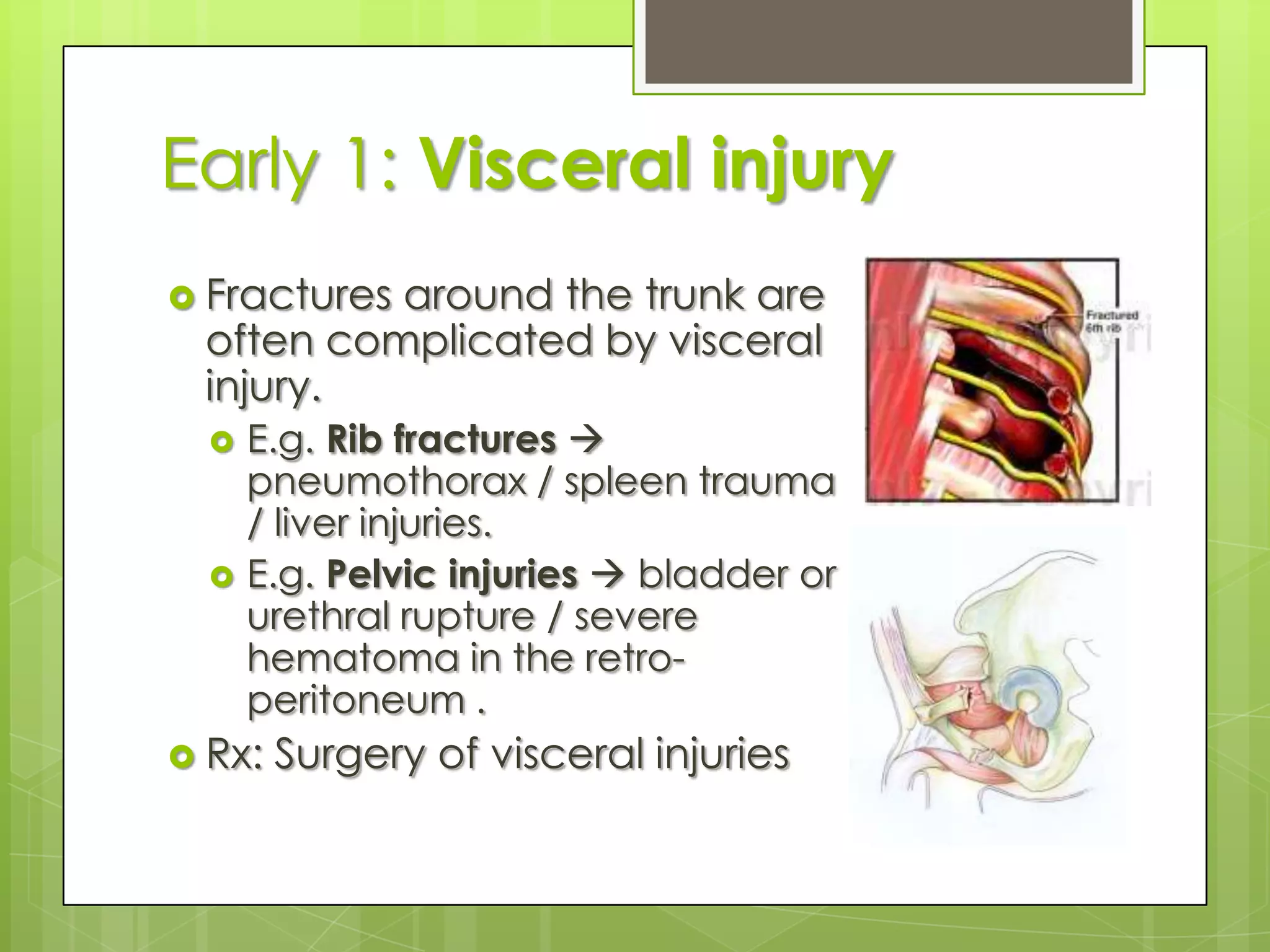
Early 1: Visceral injuryFractures around the trunk are often complicated by visceral injury.E.g. Rib fractures  pneumothorax / spleen trauma / liver injuries.E.g. Pelvic injuries  bladder or urethral rupture / severe hematoma in the retro-peritoneum .Rx: Surgery of visceral injuries
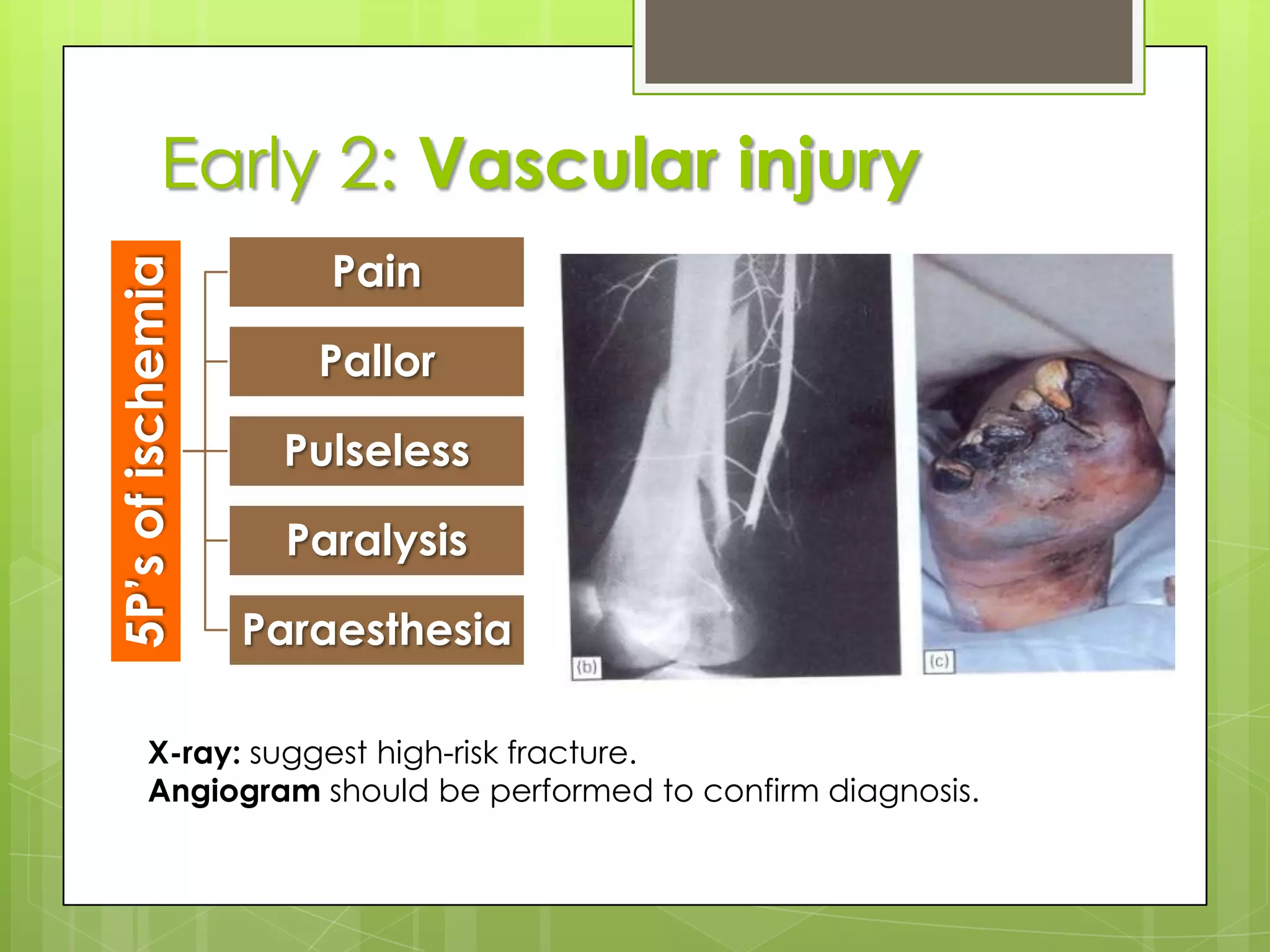
Early 2: Vascular injuryCommonly associated with high-energy open fractures. They are rare but well-recognized.Mechanism of injuries:The artery may be cut or torn. Compressed by the fragment of bone. normal appearance, with intimal detachment that lead to thrombus formation.segment of artery may be in spasm.It may causeTransient diminution of blood flowProfound ischaemiaTissue death and gangrene
Early 2: Vascular injuryX-ray: suggest high-risk fracture.Angiogram should be performed to confirm diagnosis.
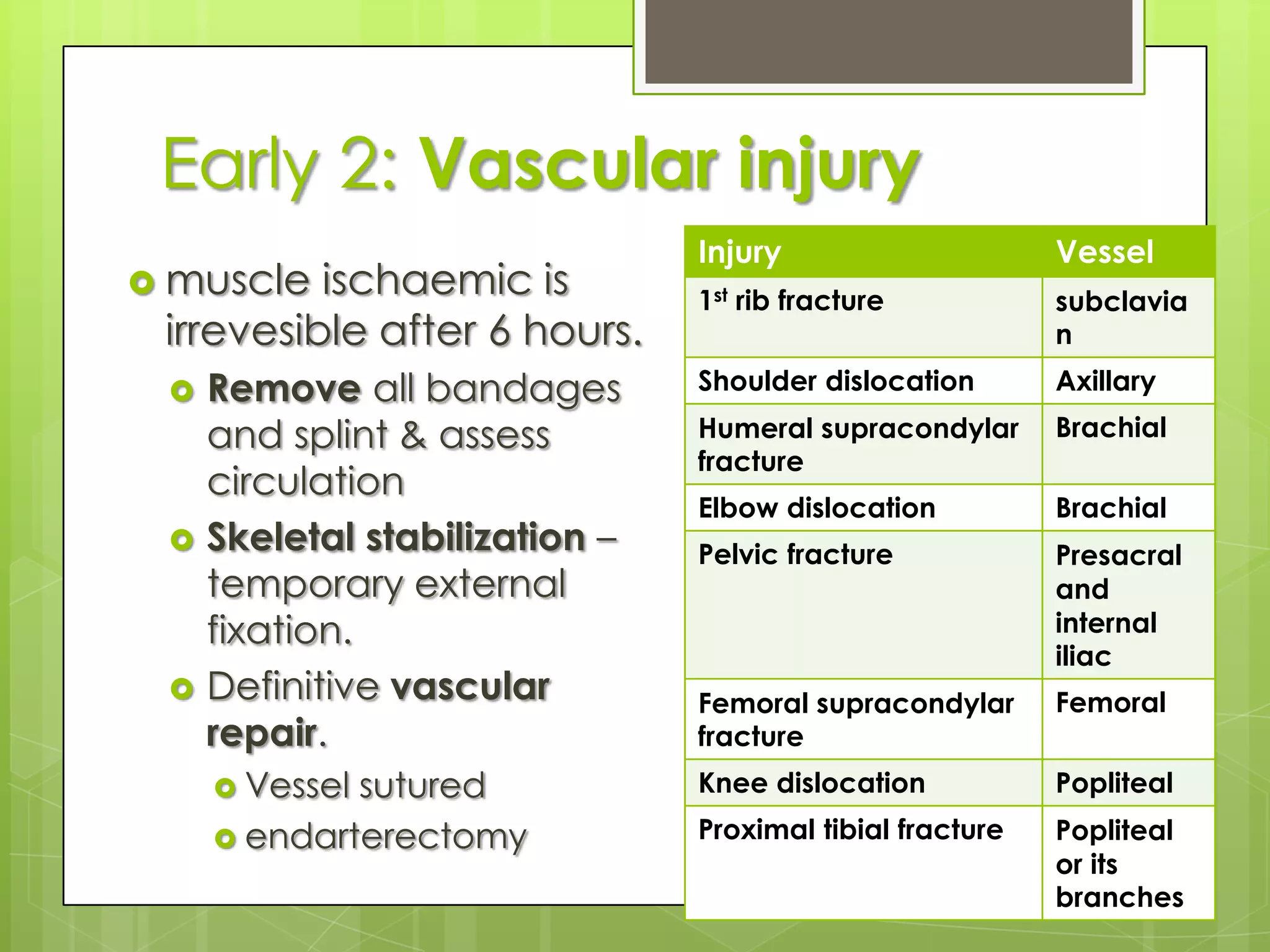
Early 2: Vascular injurymuscle ischaemic is irrevesible after 6 hours.Remove all bandages and splint & assess circulationSkeletal stabilization – temporary external fixation.Definitive vascular repair.Vessel suturedendarterectomy
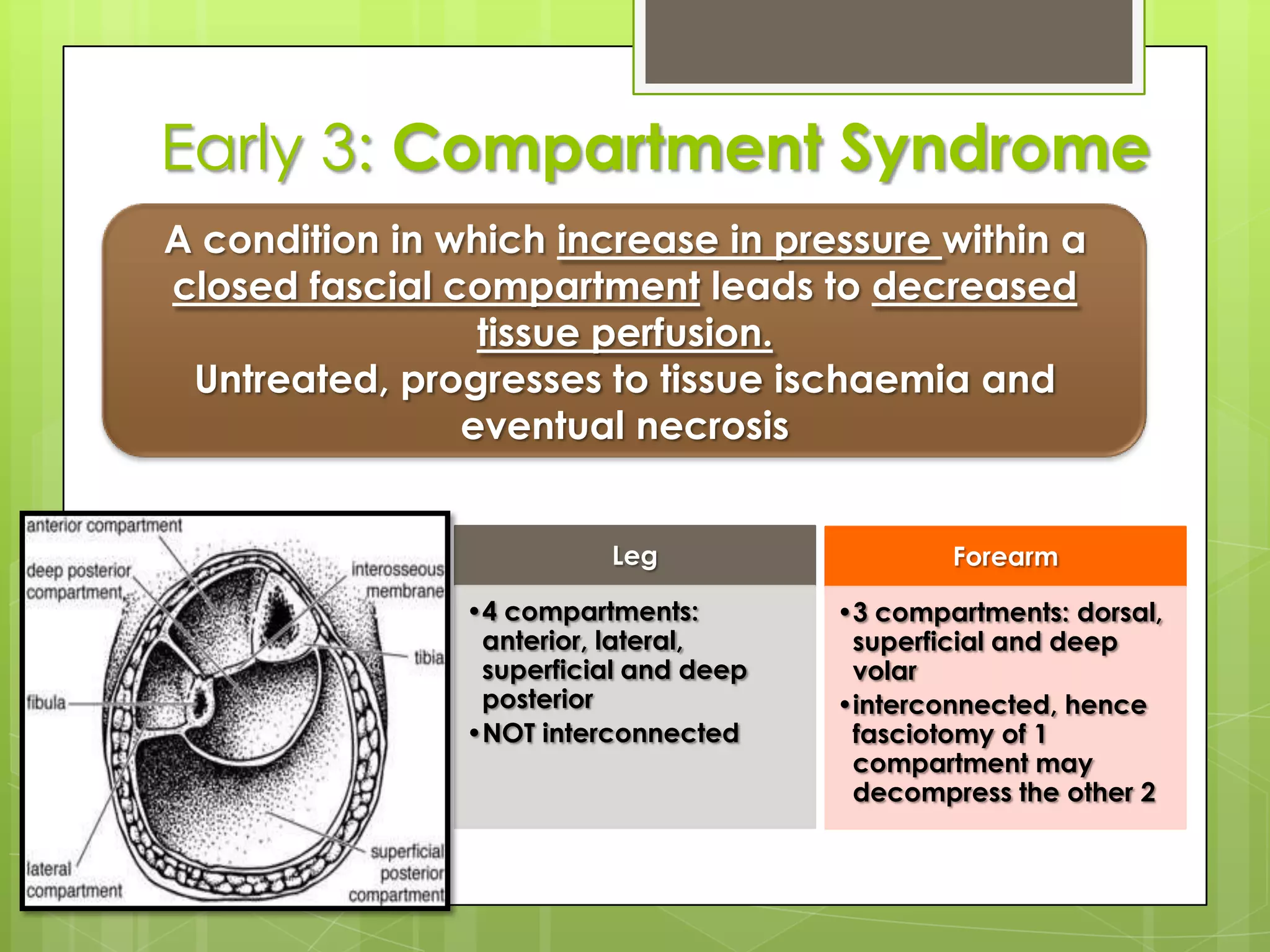
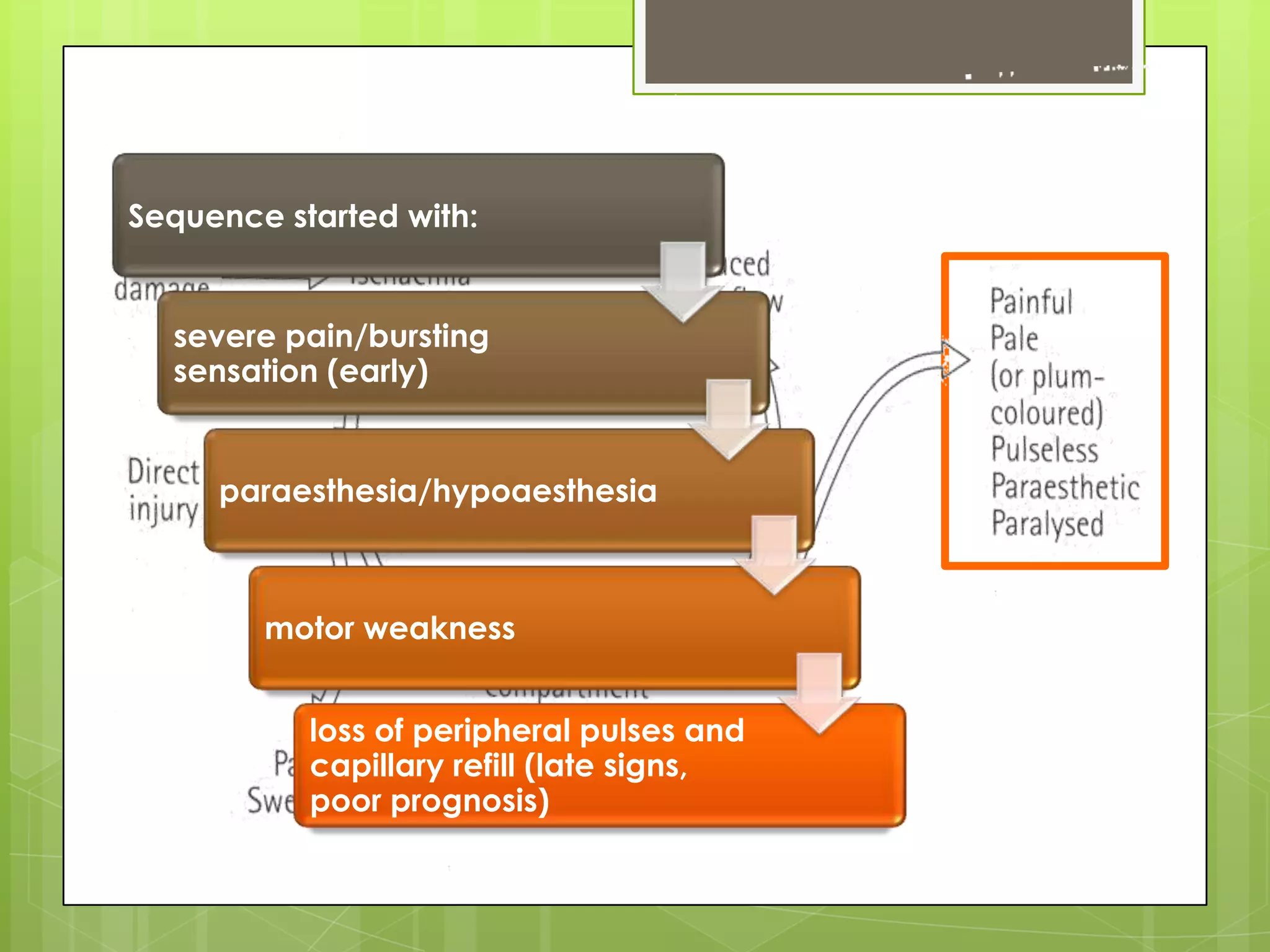
Early 3: Compartment SyndromeA condition in which increase in pressure within a closed fascial compartment leads to decreased tissue perfusion. Untreated, progresses to tissue ischaemia and eventual necrosis
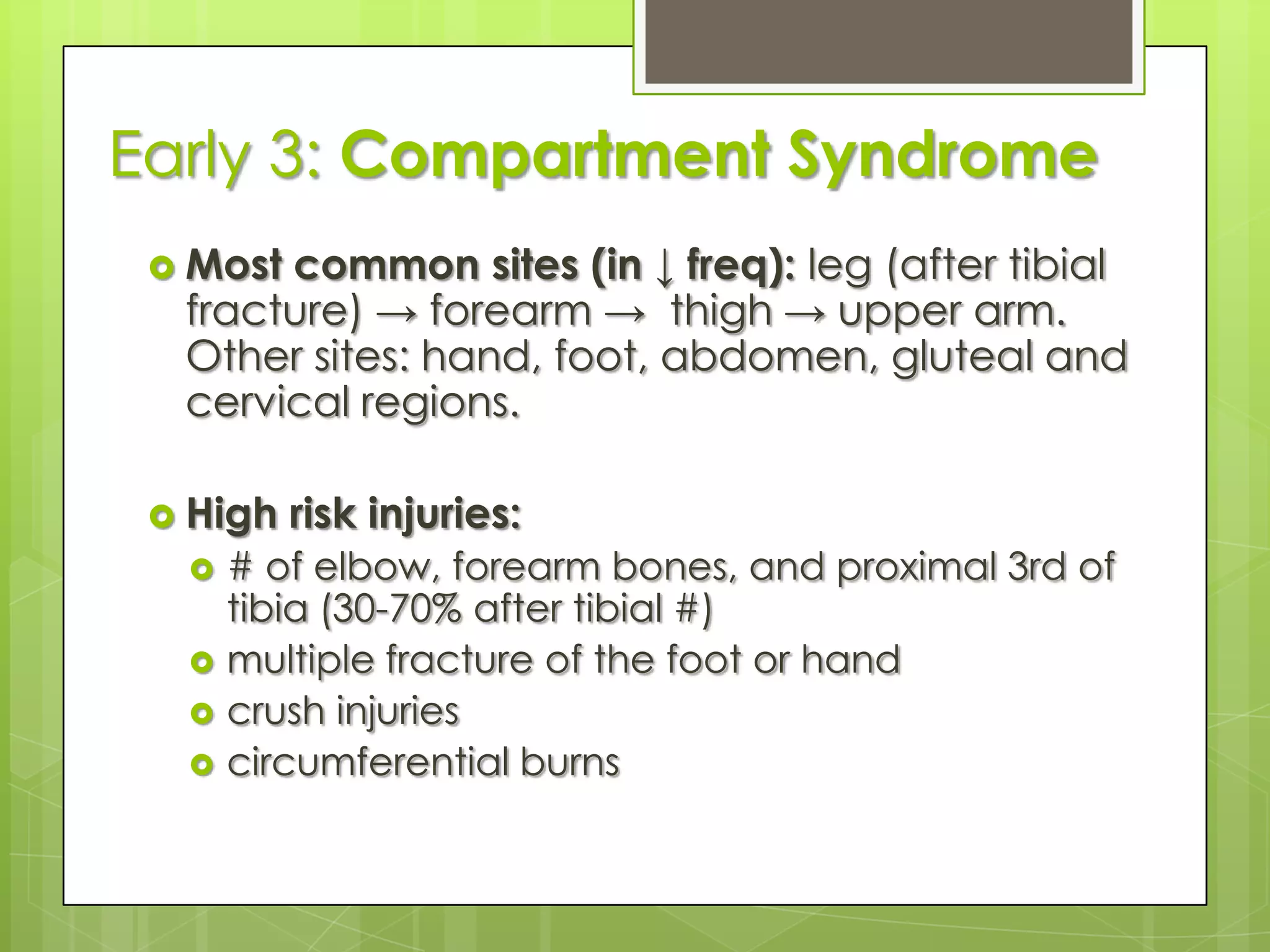
Early 3: Compartment SyndromeMost common sites (in ↓ freq): leg (after tibial fracture) -> forearm ->  thigh -> upper arm.  Other sites: hand, foot, abdomen, gluteal and cervical regions.High risk injuries:# of elbow, forearm bones, and proximal 3rd of tibia (30-70% after tibial #)multiple fracture of the foot or handcrush injuriescircumferential burns
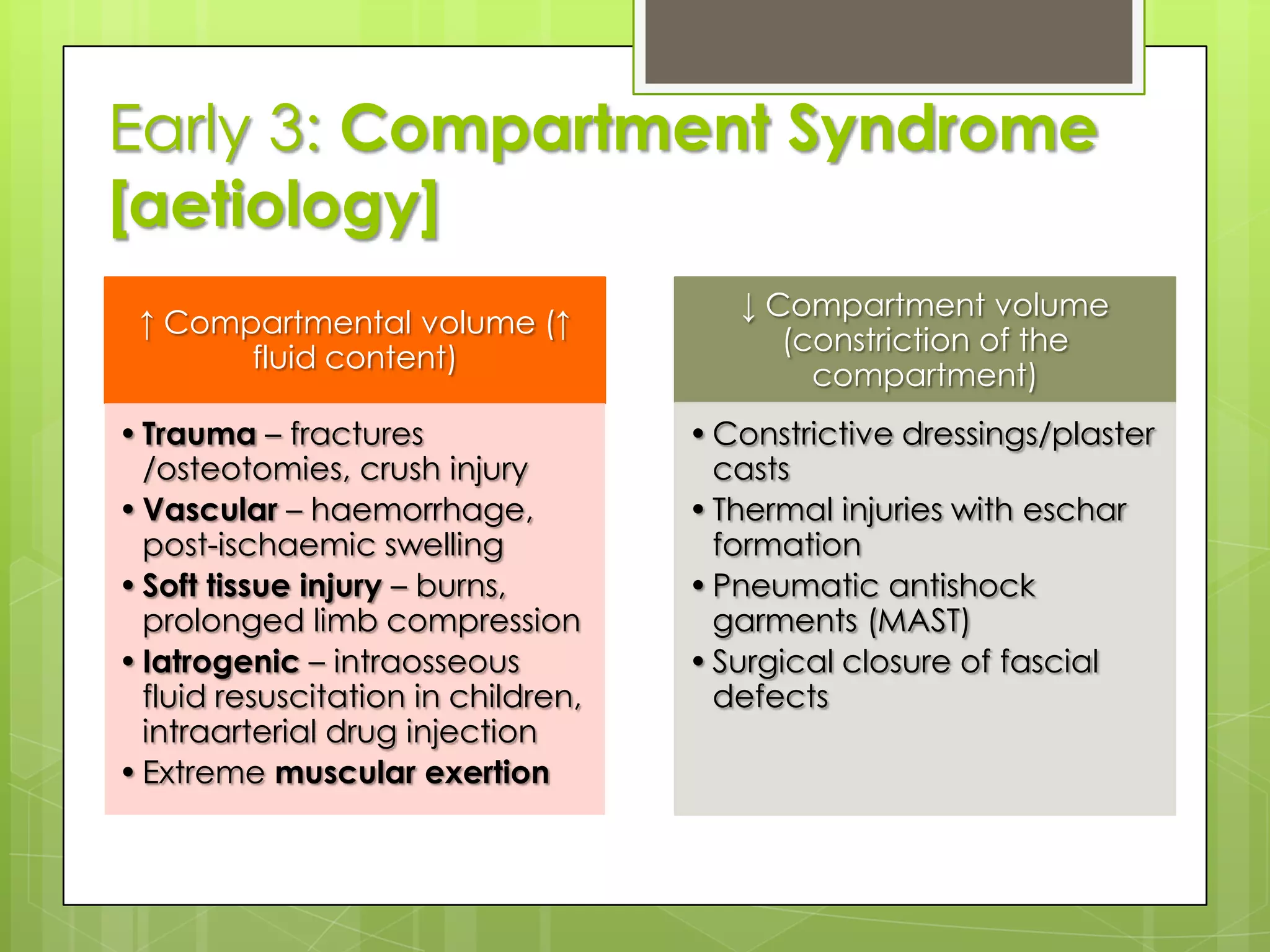
Early 3: Compartment Syndrome [aetiology]
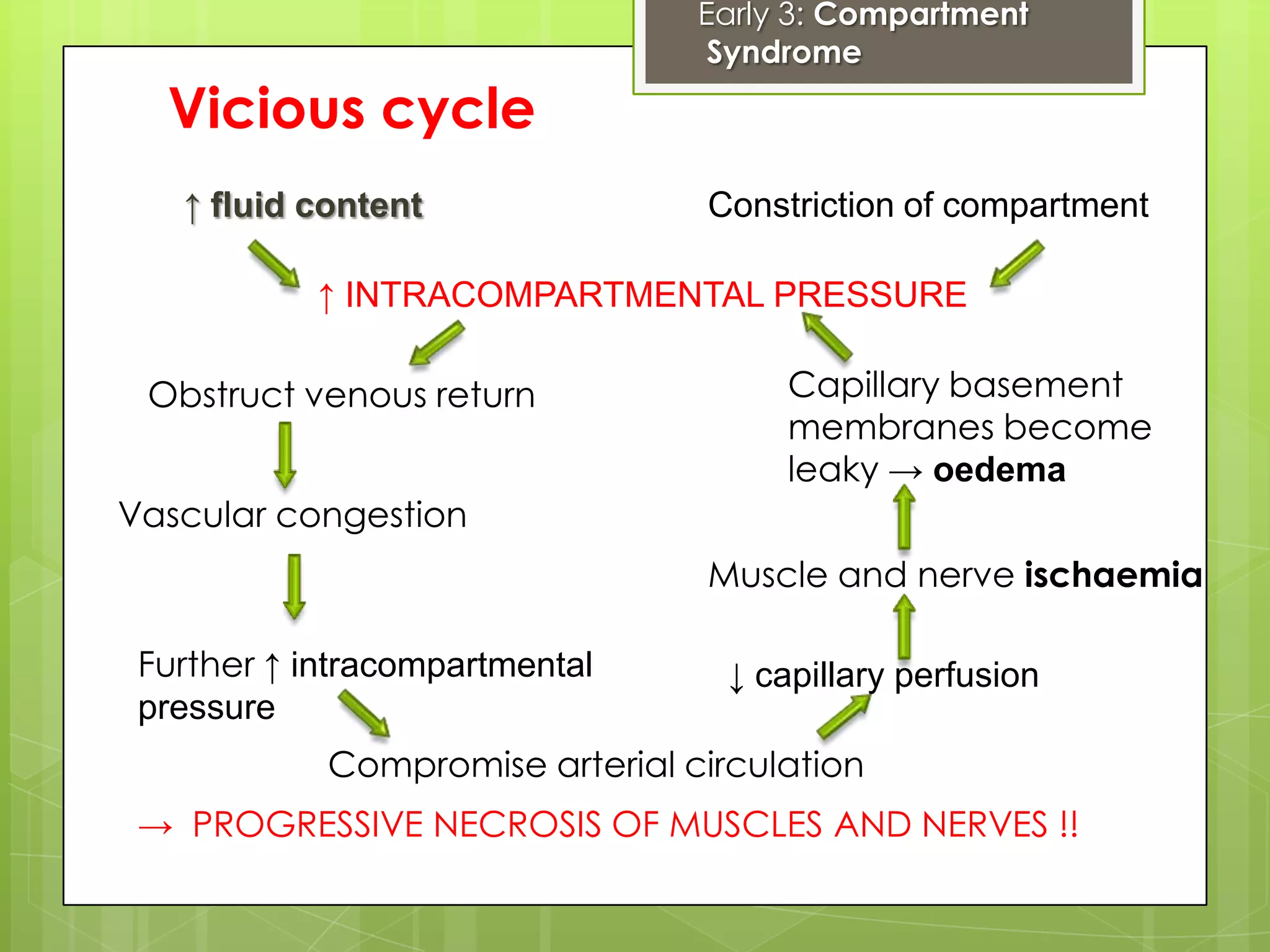
Early 3: Compartment Syndrome Vicious cycle↑ fluid contentConstriction of compartment↑ INTRACOMPARTMENTAL PRESSURECapillary basement membranes become leaky -> oedemaObstruct venous returnVascular congestionMuscle and nerve ischaemiaFurther ↑ intracompartmental pressure↓ capillary perfusionCompromise arterial circulation->  PROGRESSIVE NECROSIS OF MUSCLES AND NERVES !!
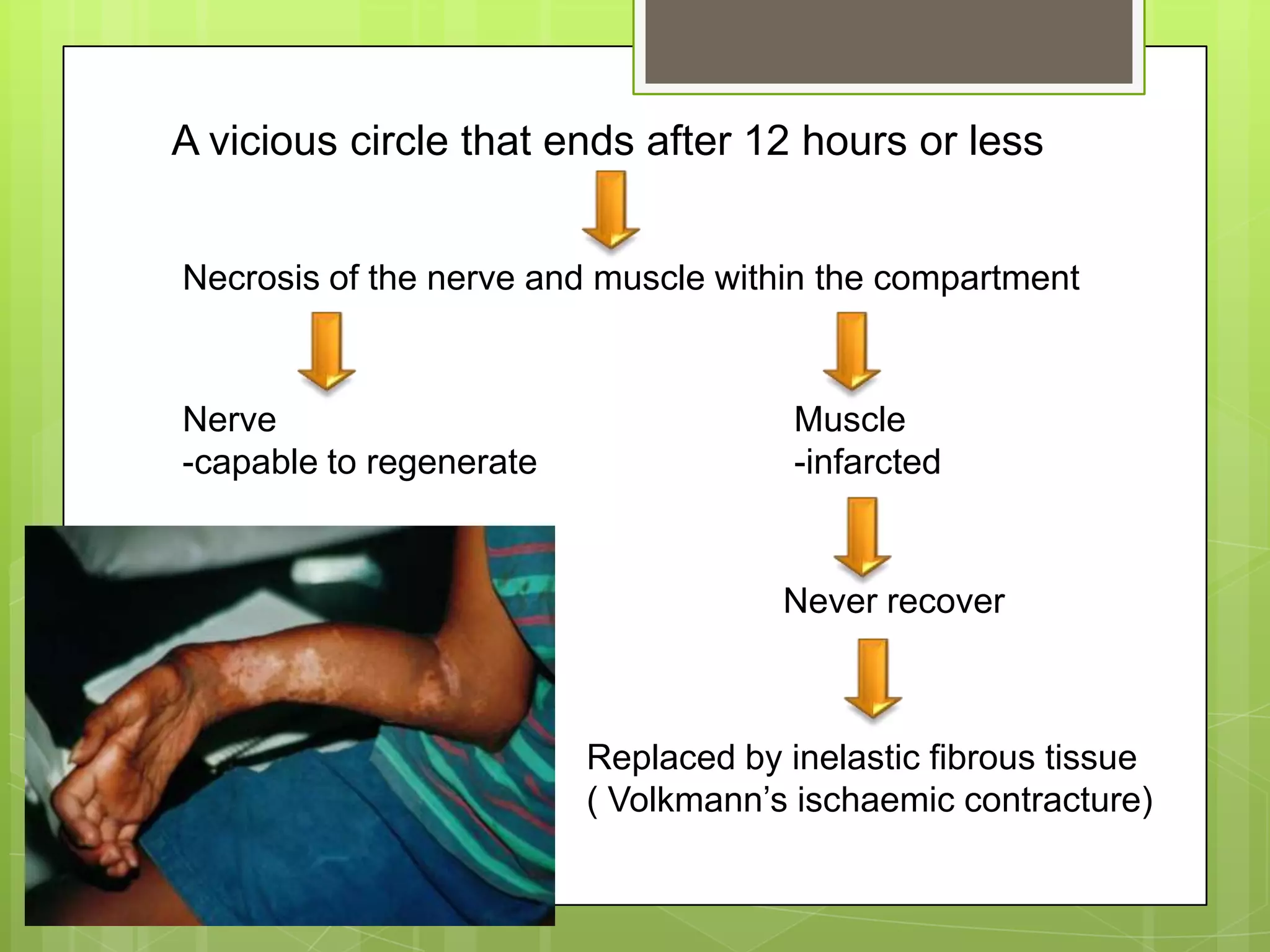
A vicious circle that ends after 12 hours or lessNecrosis of the nerve and muscle within the compartmentNerve-capable to regenerateMuscle-infarctedNever recoverReplaced by inelastic fibrous tissue( Volkmann’s ischaemic contracture)
Investigations of compartment sydromesIntra-compartment Pressure Measurement (ICP)Use of slit catheter; quick and easyIndications:Unconscious patientThose who are difficult to assessConcomitant neurovascular injuryEquivocal symptomsEspecially long bone # in lower limbPerform as soon as dx considered> 40mmHg – urgent Rx! (normal 0 – 10 mmHg)
Investigations of compartment syndromesOther Ix – limited value; +ve only when CS is advancedPlasma creatinine and CPKUrinanalysis – myoglobinuriaNerve conduction studies Ix to establish underlying cause or exclude differentialsX-ray of affected extremity Doppler US/arteriograms – determine presence of pulses; exclude vascular injuries and DVTPT/APTT – exclude bleeding disorder
ManagementPrompt DECOMPRESSION of affected compartmentRemove all bandages, casts and dressingsExamination of whole limbLimb should be maintained at heart levelElevation may ↓ arterio-venous pressure gradient on which perfusion dependsEnsure patient is normotensive. Hypotension ↓ tissue perfusion, aggravate the tissue injury.
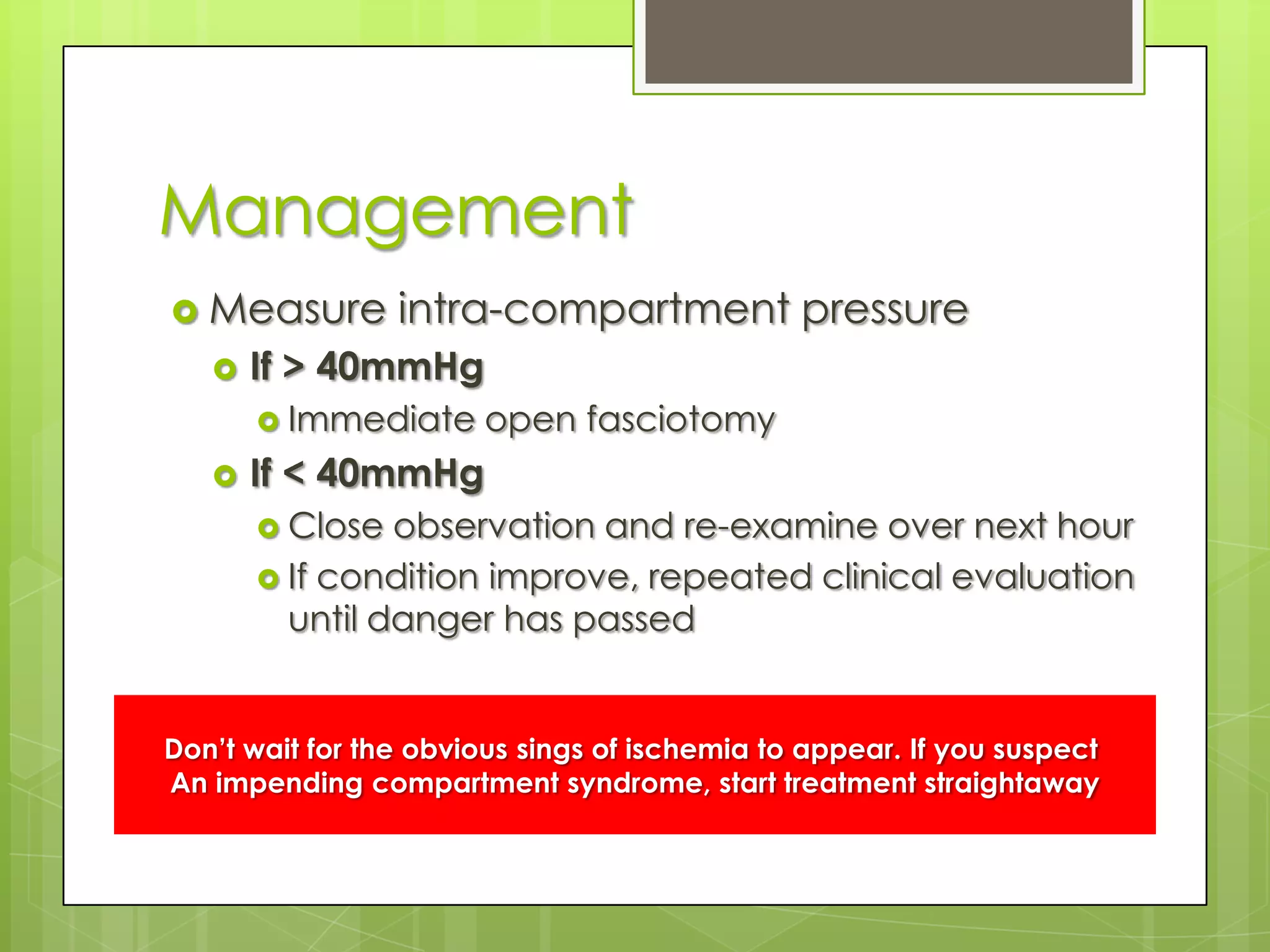
ManagementMeasure intra-compartment pressureIf > 40mmHgImmediate open fasciotomyIf < 40mmHgClose observation and re-examine over next hourIf condition improve, repeated clinical evaluation until danger has passedDon’t wait for the obvious sings of ischemia to appear. If you suspect An impending compartment syndrome, start treatment straightaway
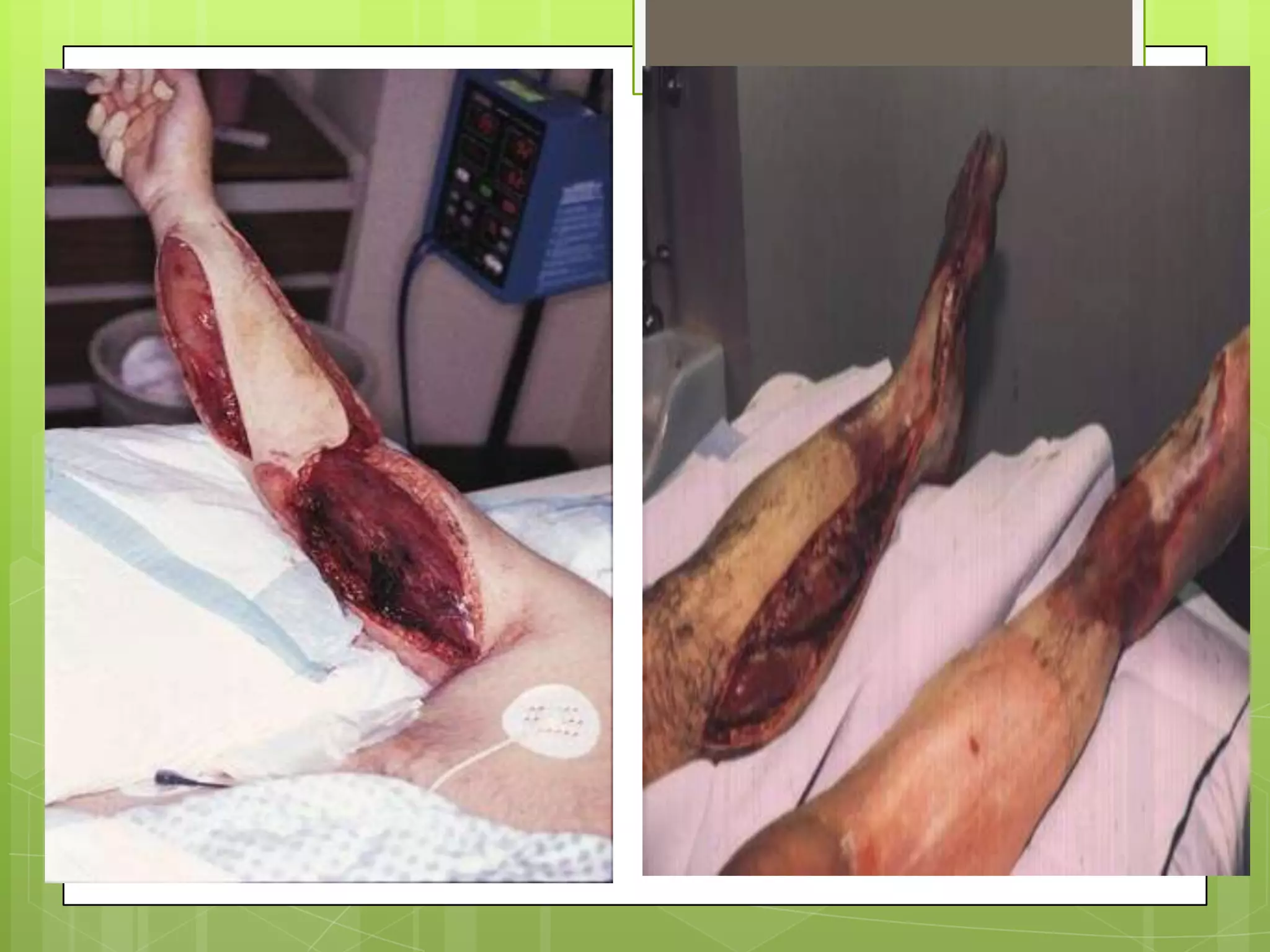
FasciotomyOpening all 4 compartmentsDivide skin and deep fascia for the whole length of compartmentWound left openInspect 5 days laterIf muscle necrosis, do debridementIf healthy tissue, for delayed closure or skin grafting
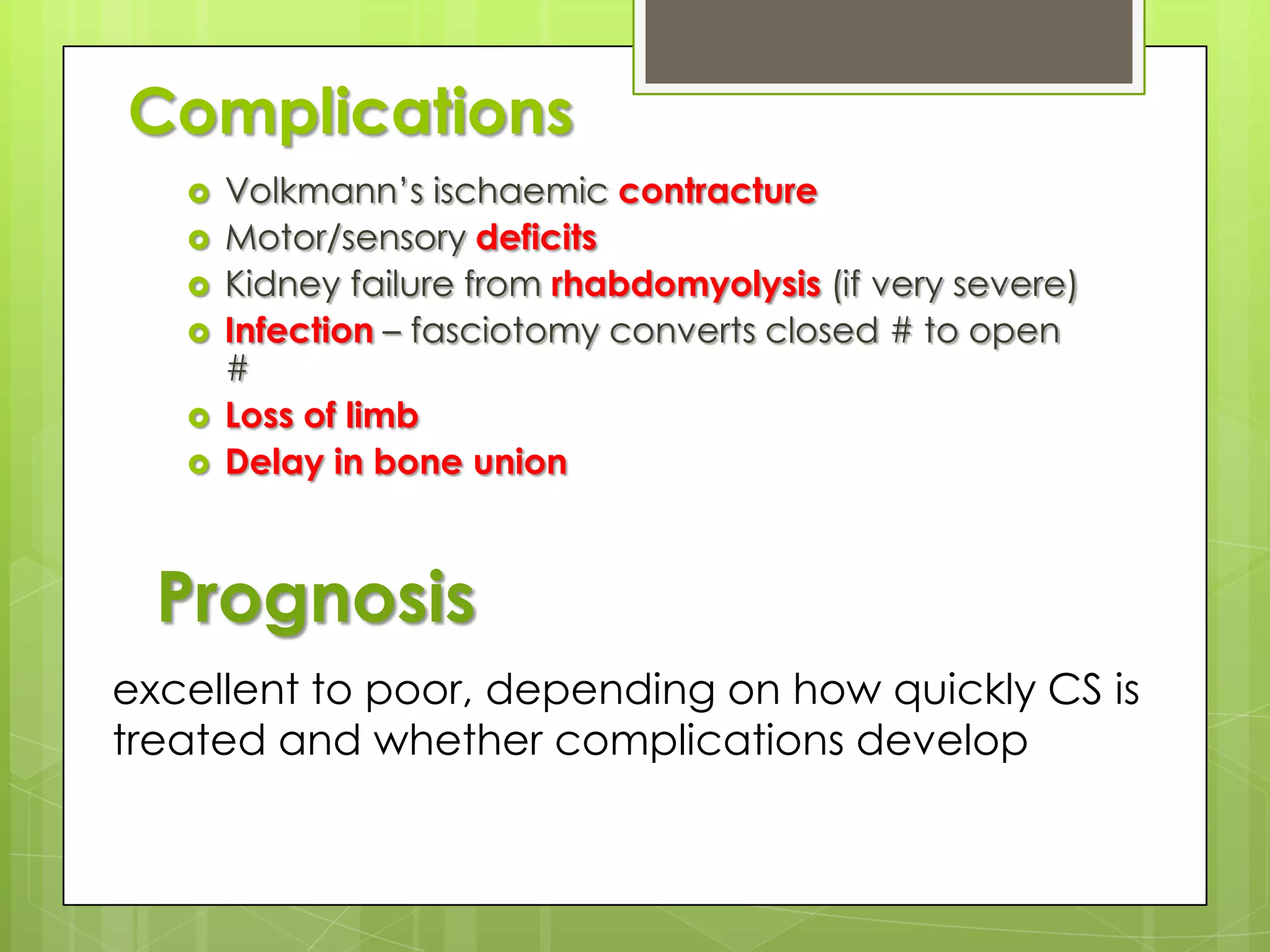
ComplicationsVolkmann’s ischaemiccontracture Motor/sensory deficitsKidney failure from rhabdomyolysis (if very severe)Infection – fasciotomy converts closed # to open #Loss of limbDelay in bone unionPrognosisexcellent to poor, depending on how quickly CS is treated and whether complications develop
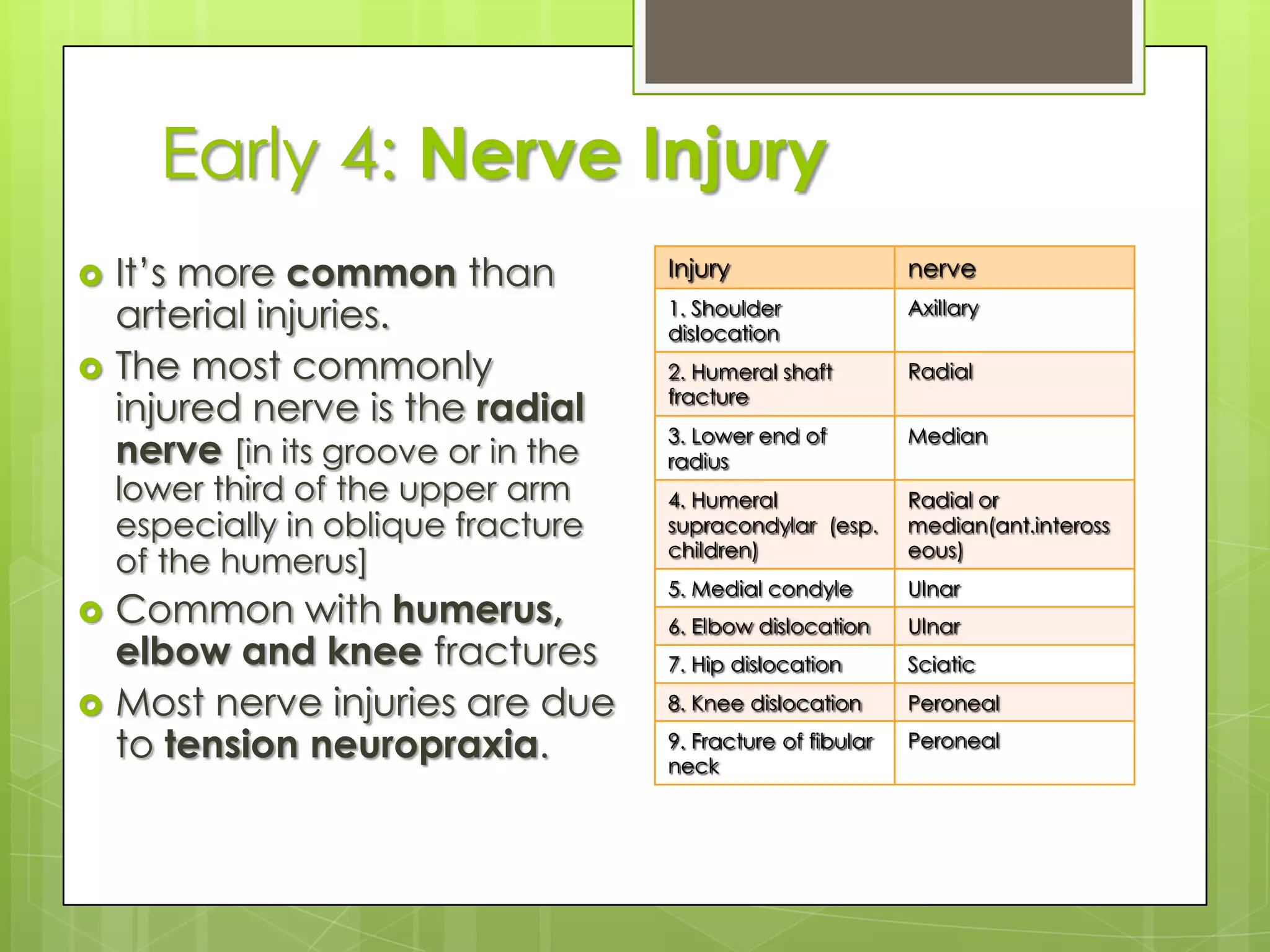
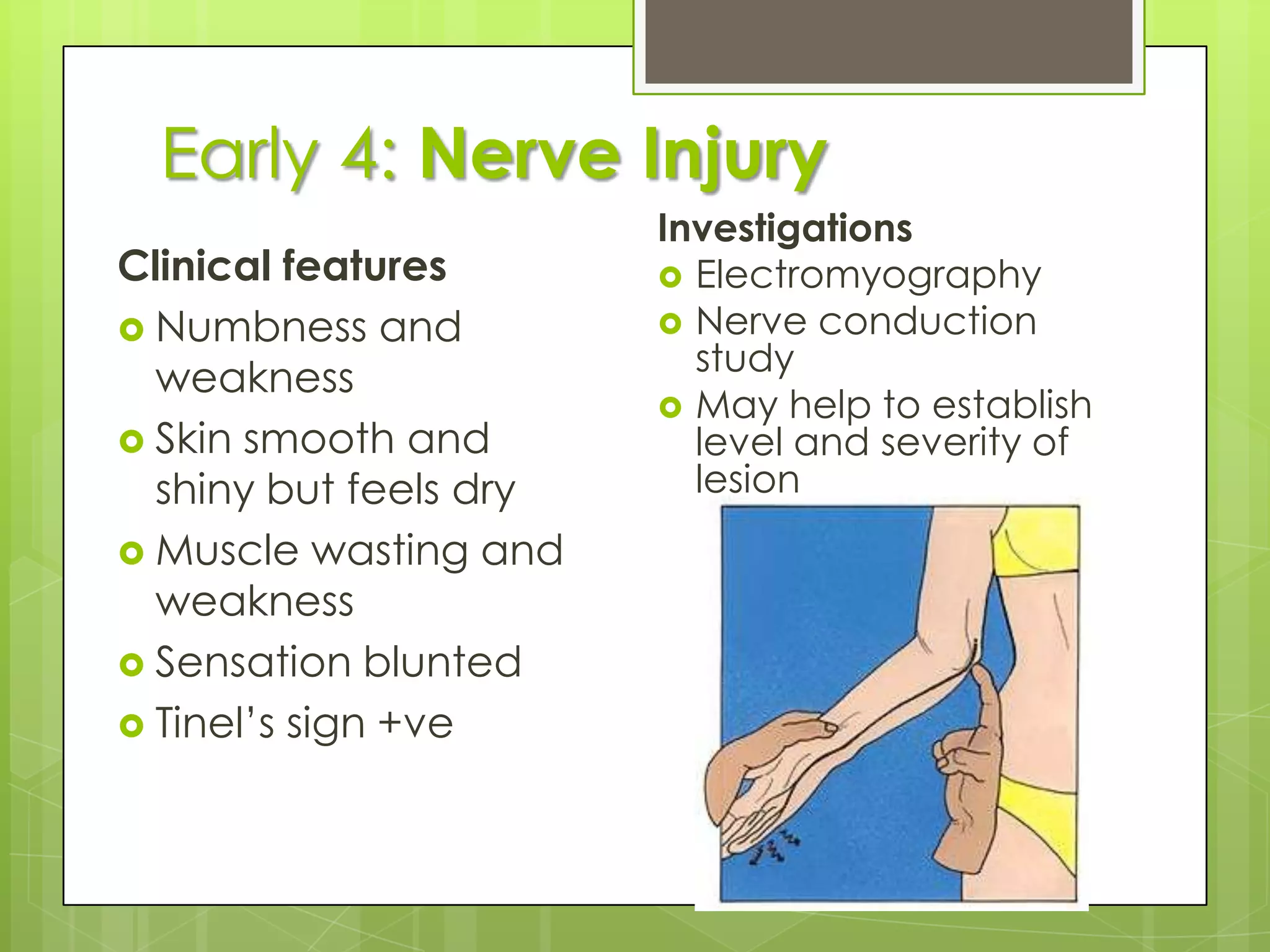
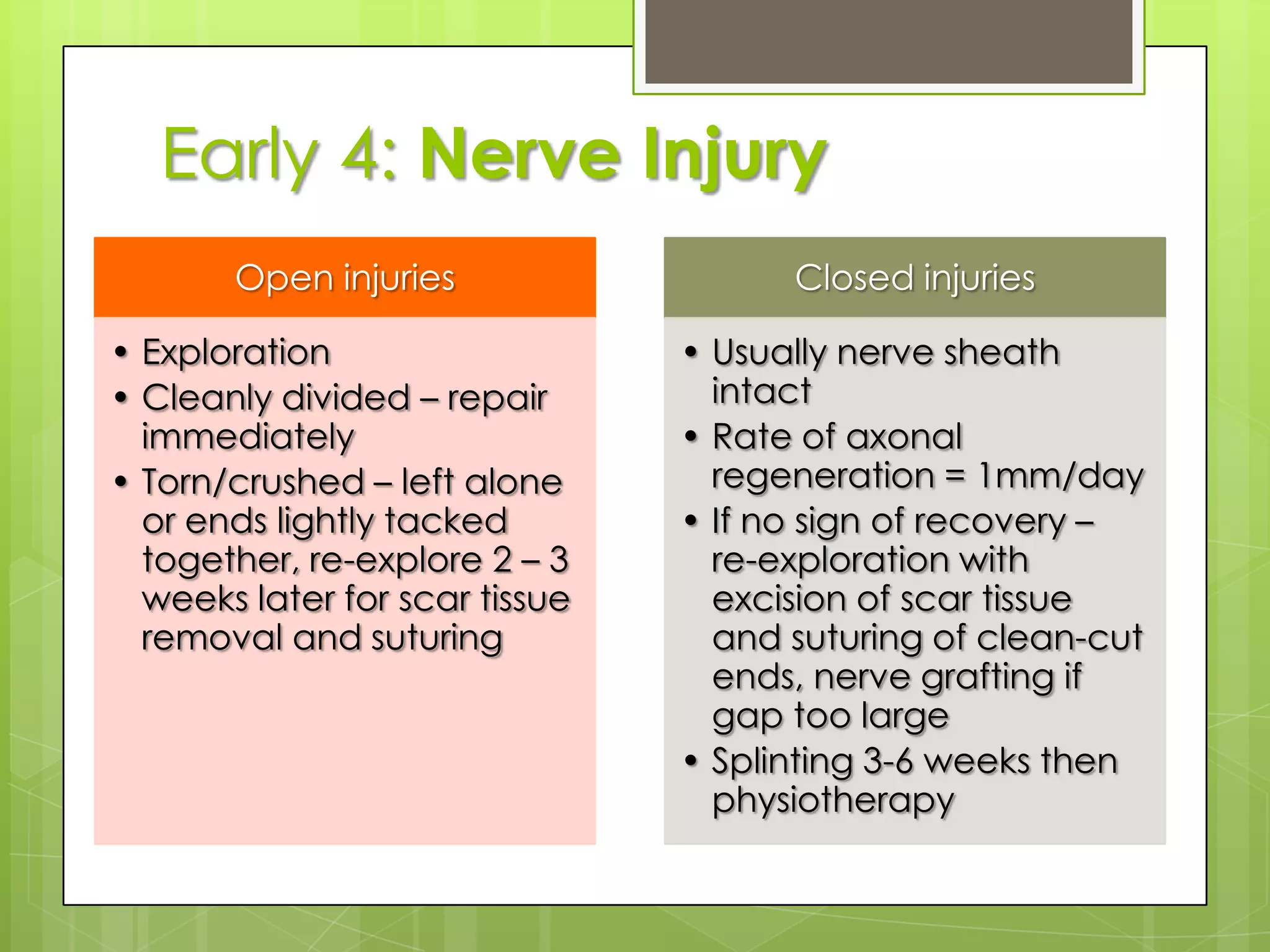
Early 4: Nerve InjuryIt’s more common than arterial injuries.The most commonly injured nerve is the radial nerve [in its groove or in the lower third of the upper arm especially in oblique fracture of the humerus]Common with humerus, elbow and knee fracturesMost nerve injuries are due to tension neuropraxia.
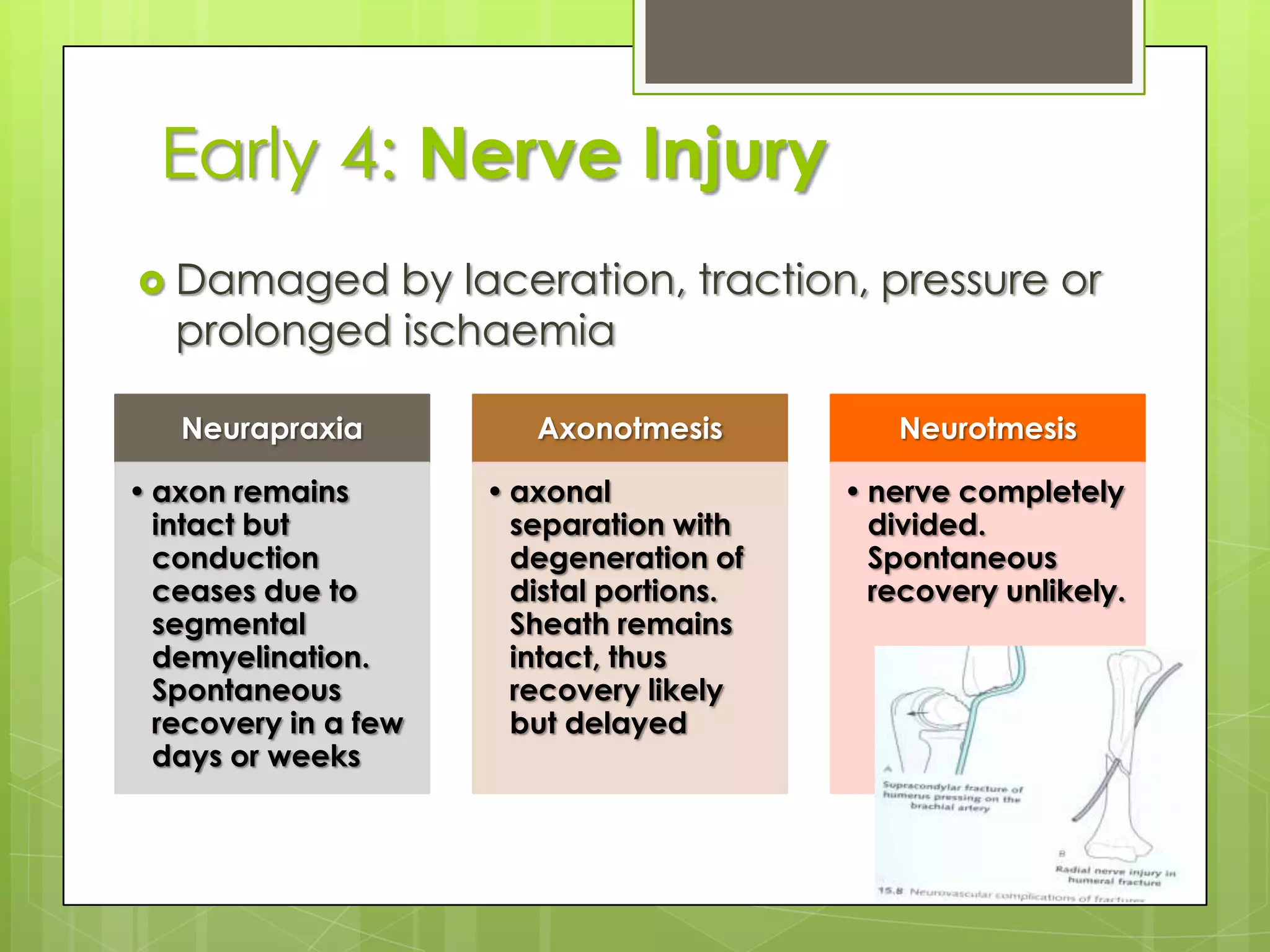
Early 4: Nerve InjuryDamaged by laceration, traction, pressure or prolonged ischaemia
Early 4: Nerve InjuryInvestigationsElectromyographyNerve conduction studyMay help to establish level and severity of lesionClinical featuresNumbness and weaknessSkin smooth and shiny but feels dryMuscle wasting and weaknessSensation bluntedTinel’s sign +ve
Early 4: Nerve Injury
Early 5: HaemarthrosisBleeding into a joint spaces.Occurs if a joint is involved in the fracture.Presentation:swollen tense joint; the patient resists any attempt to moving ittreatment:blood aspiration before dealing with the fracture; to prevent the development of synovial adhesions.
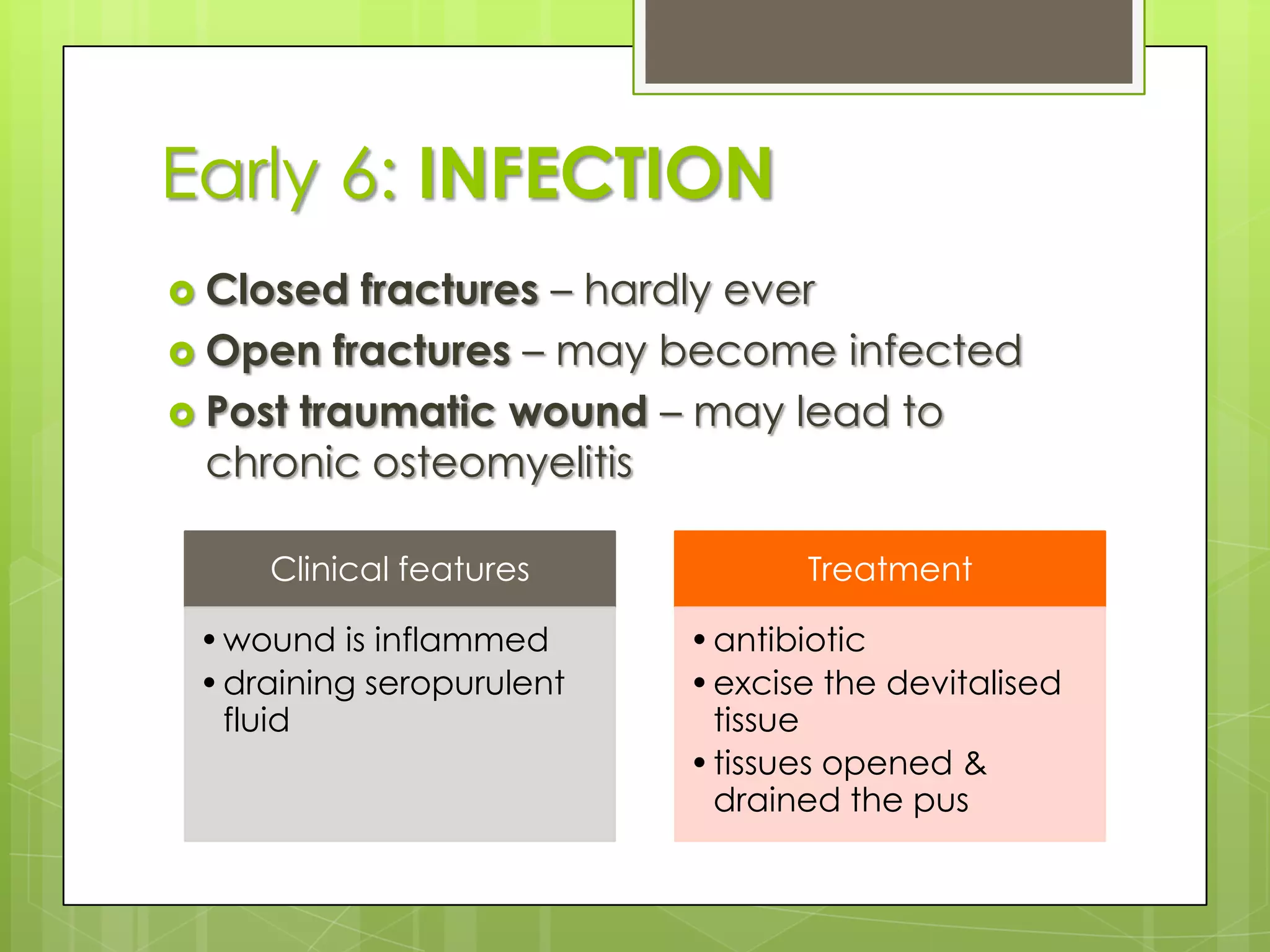
Early 6: INFECTIONClosed fractures – hardly everOpen fractures – may become infectedPost traumatic wound – may lead to chronic osteomyelitis
Late ComplicationsDelayed UnionNon-unionMal-unionAvascular NecrosisOsteoarthritisJoint Stiffness
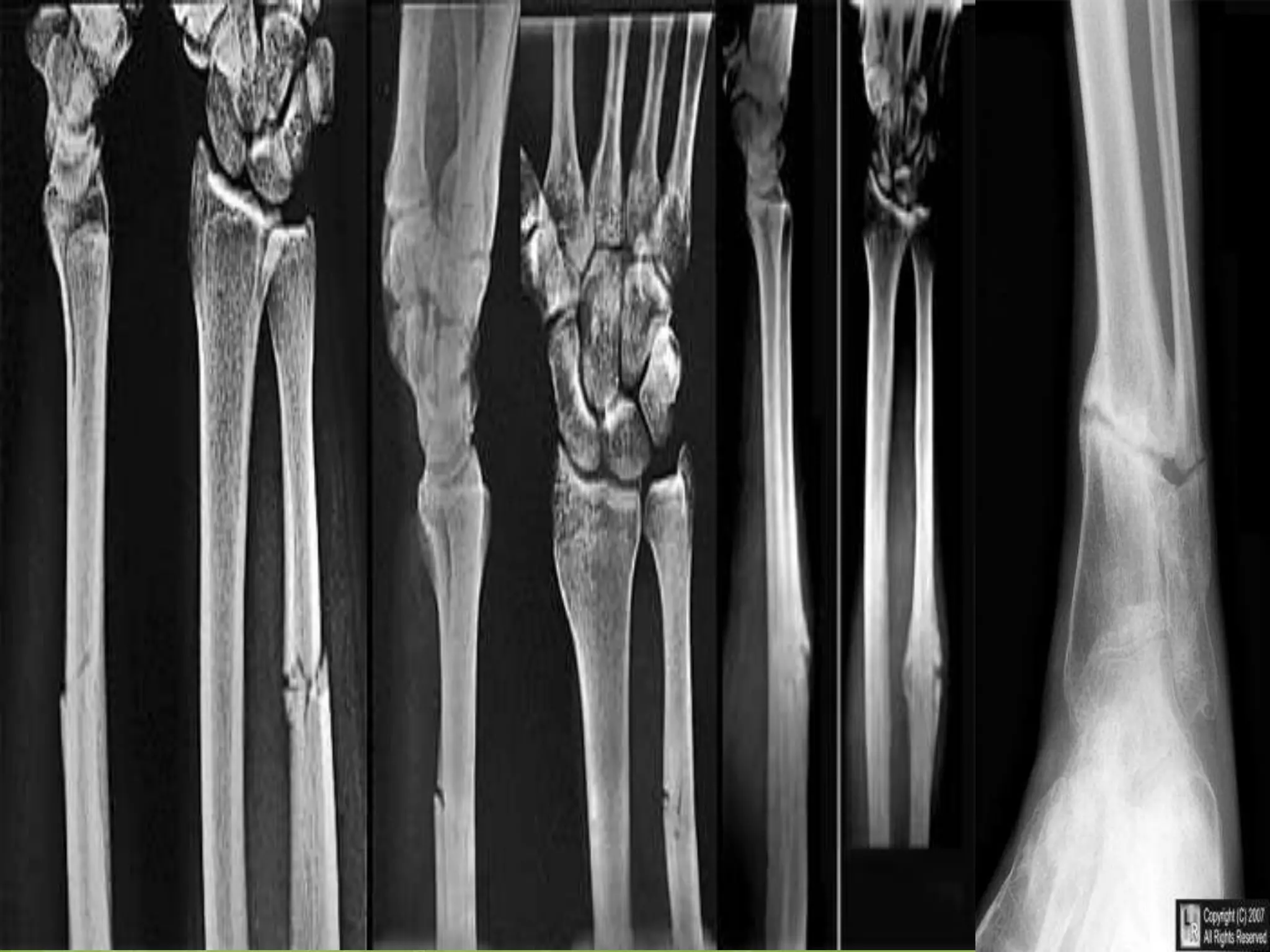
Late 1: DELAYED UNION Union of the upper limbs - 4-6 weeksUnion of the lower limbs - 8-12 weeks(rough guide)Any prolong time taken is considered delayed
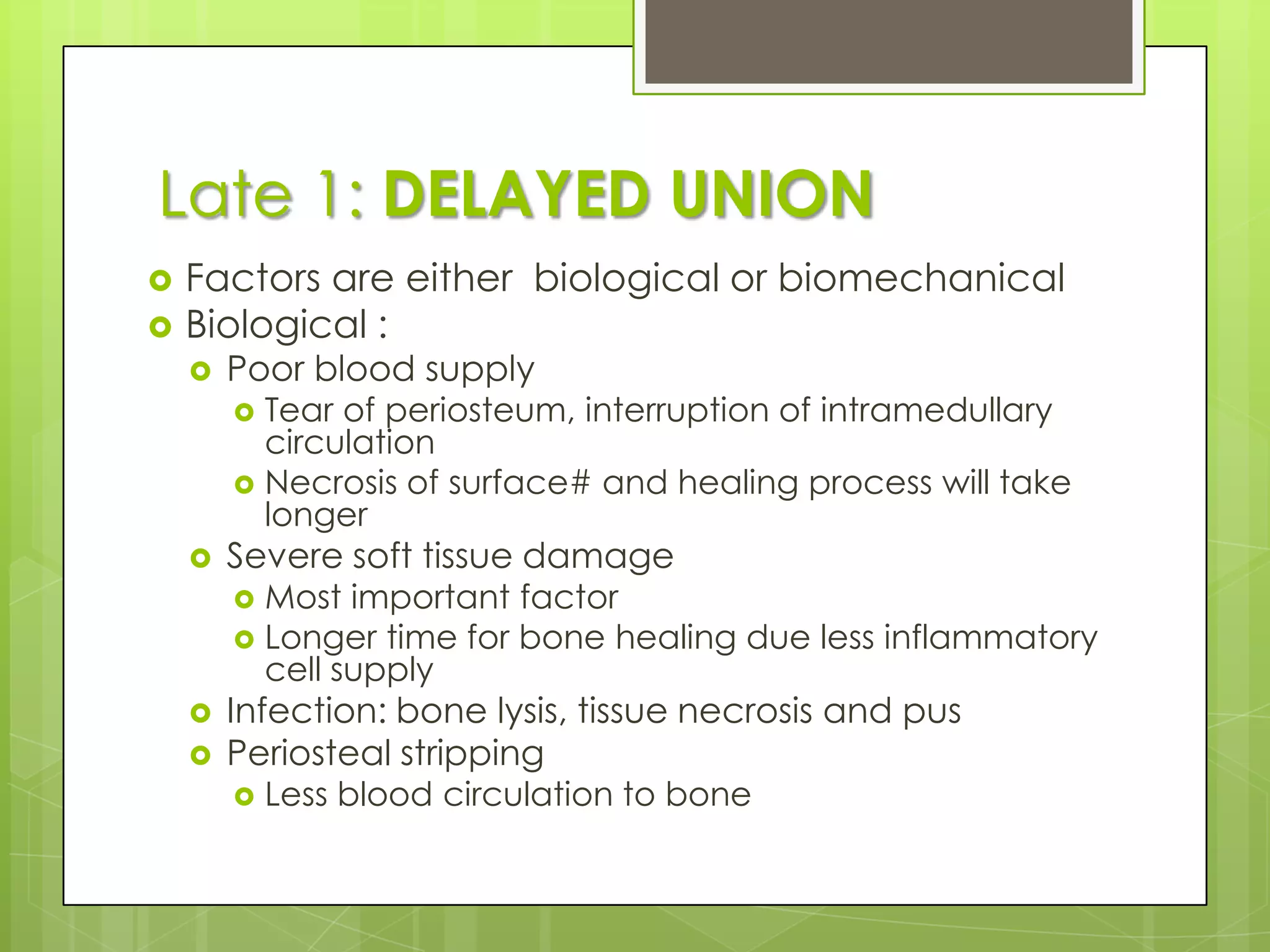
Late 1: DELAYED UNIONFactors are either  biological or biomechanicalBiological :Poor blood supplyTear of periosteum, interruption of intramedullary circulationNecrosis of surface# and healing process will take longerSevere soft tissue damageMost important factorLonger time for bone healing due less inflammatory cell supplyInfection: bone lysis, tissue necrosis and pus Periosteal strippingLess blood circulation to bone
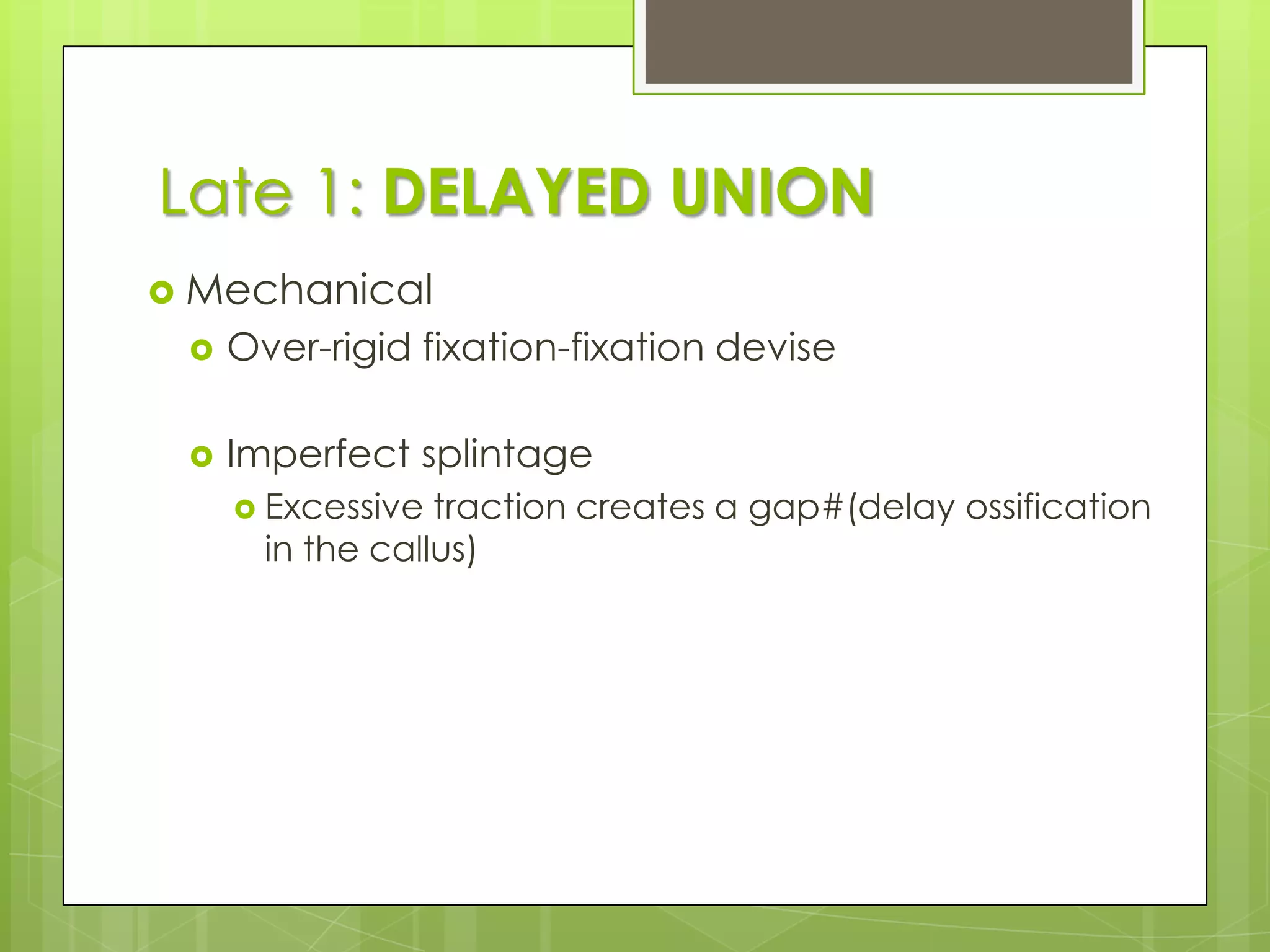
Mechanical Over-rigid fixation-fixation deviseImperfect splintageExcessive traction creates a gap#(delay ossification in the callus)Late 1: DELAYED UNION
Clinical features:Tenderness persistAcute pain if bone is subjected to stress*( * ask pt to walk, move affected limb)X RAYS -visible line# and very little callus               formation/periosteal reaction        - bone ends are not sclerosed/ atrophic               (it will eventually unite)Late1: DELAYED UNION
Tx: conservative and operativeEliminate possible causes of delayPromote healingImmobilization should be sufficient to prevent movement at # site(cast / internal fixation)Not to neglect # loading so, encourage muscle exercise and weight bearing in the cast/braceOperation> 6 mths & no signs of callus formationInternal fixation and bone graffting(operation-least possible damage to the soft tissue)Late 1: DELAYED UNION
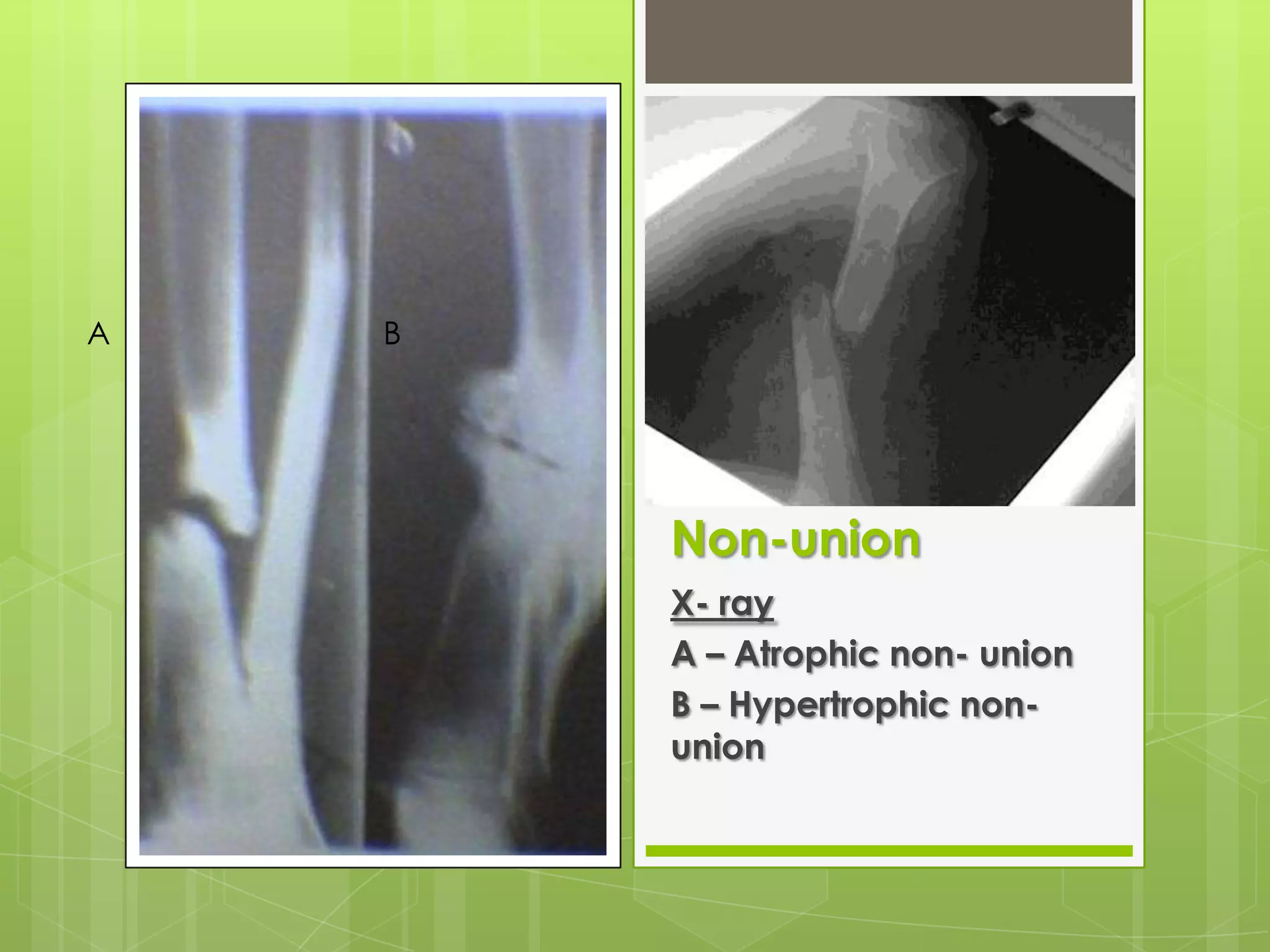
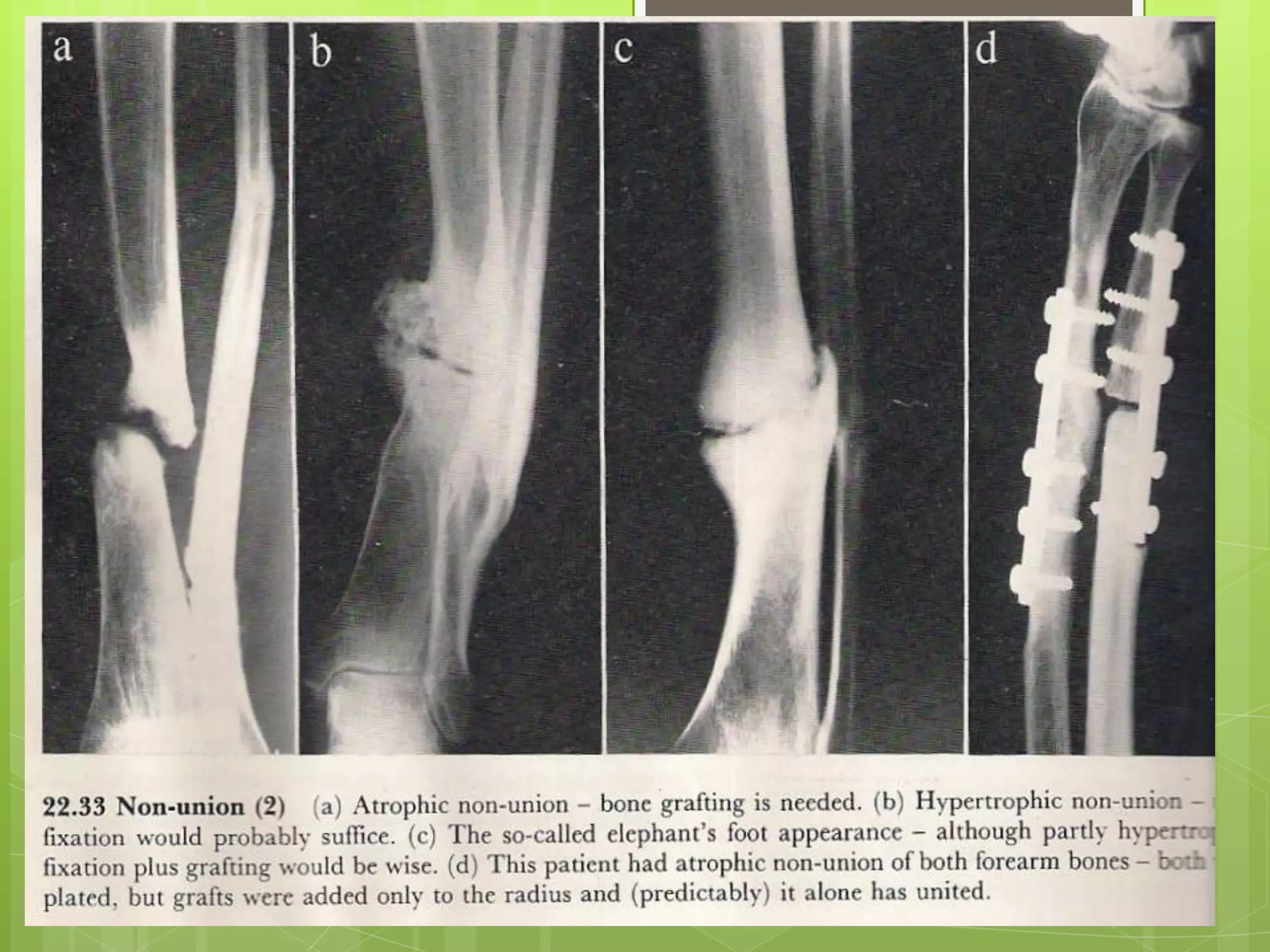
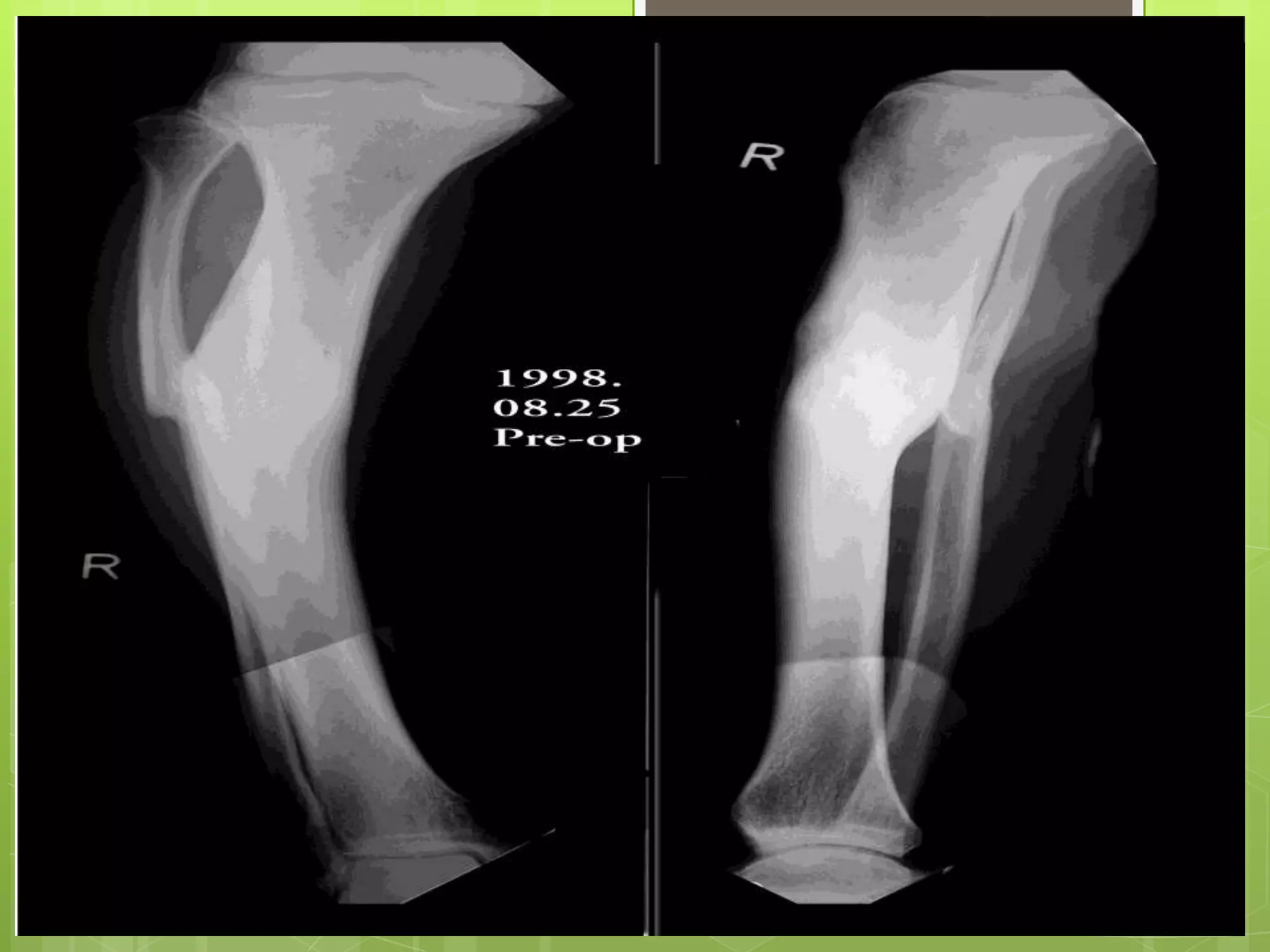
 Late 2 : NON-UNIONIn a minority of cases, delayed union--non-unionFactors contributing to non-union:-inadequate treatment of delayed union too large gapinterposition of soft tissues between the fragmentsThe growth has stopped and pain diminished- replaced by fibrous tissue - pseudoarthrosisTreatment :-conservative / operativeatrophic non-union – fixation and grafting hypertrophic non-union – rigid fixation
Late 2: NON UNIONbone ends are rounded off or exuberantHypertrophic non unionBone ends are enlarged, osteogenesis is still active but not capable of bridging the gap‘elephant feet’ on X rayAtrophic non unionCessation of osteogenesisNo suggestion of new bone formation
Non-unionX- rayA – Atrophic non- unionB – Hypertrophic non- unionAB
Late 2: Non unionTx:Mostly symptomlessConservativeRemovable splintFor hypertrophic non-union, functional bracing-induce unionPulsed electromagnetic fields and low frequency pulsed u/s can also be used to stimulate union.OperativeHypertrophic--Rigid fixation (internal or  external)Atrophic--Excision of fibrous tissue ,sclerotic tissue at bone end, bone grafts packed around the fracture
Late 3: MALUNION Factors:-failure to reduce the fracturefailure to hold the reduction while healing proceedgradual collapse of comminuted / osteoporotic bone
MALUNION
Late 3: Mal-union X-ray are essential to check the position of the fracture while uniting. important- the first 3 weeks so it can be easily corrected Clinical features:Deformity usually obvious , but sometimes the true extent of malunion is apparent only on x-rayRotational deformity can be missed in the femur, tibia, humerus or forearm unless is compared with it’s opposite fellow
TreatmentDecision about the need for re-manipulation and correction-difficult
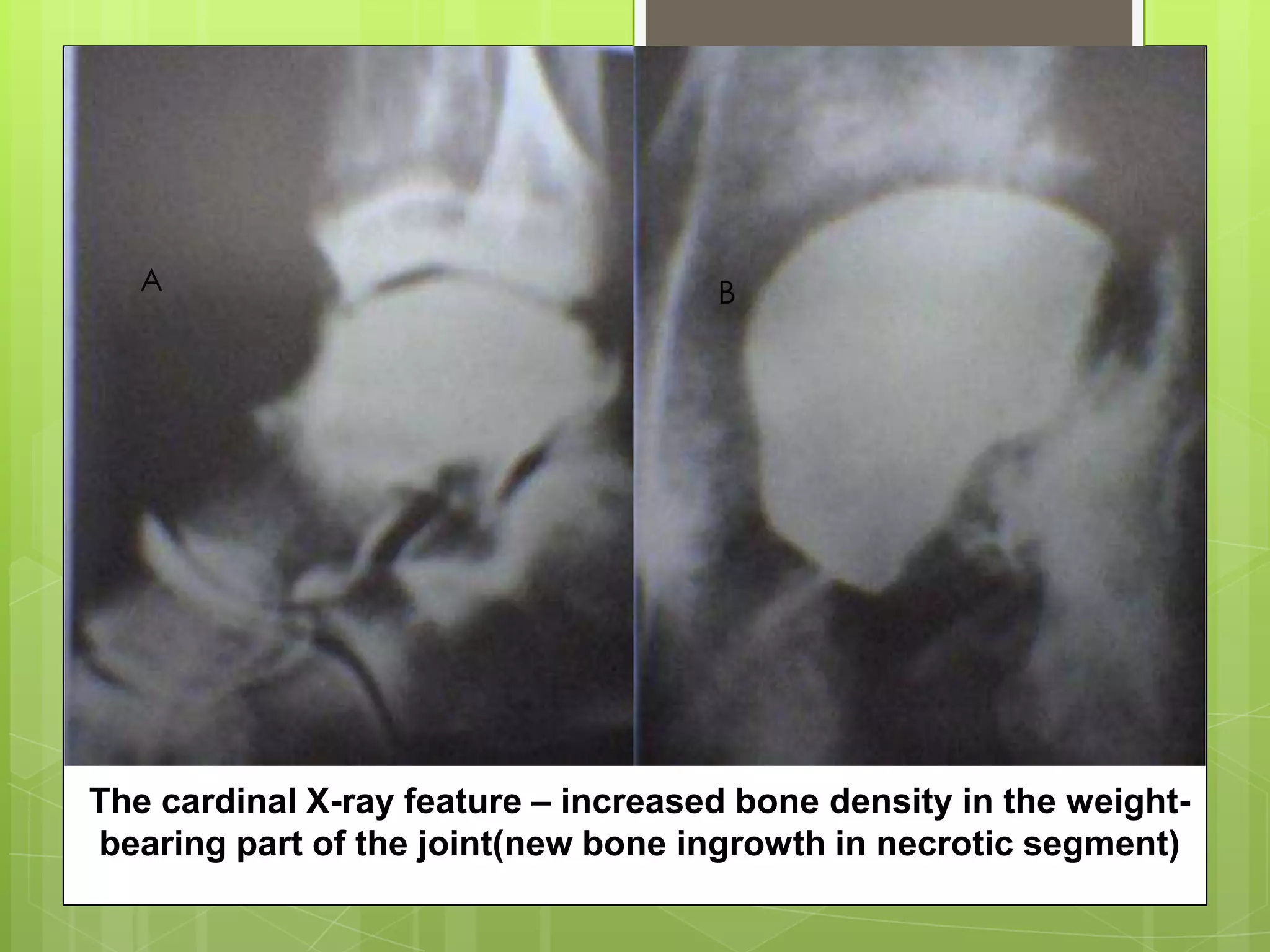
Late 4: AVASCULAR NECROSISCertain region-known for their propensity to develop ischaemia and bone necrosisHead of femur Proximal part of scaphoidLunateBody of talus(Actually this is an early complication however the clinical and radiological effects are not seen until weeks or even months)No clinical feature of avascular necrosis but if there is a failure to unite or bone collapse-pain
ABThe cardinal X-ray feature – increased bone density in the weight-bearing part of the joint(new bone ingrowth in necrotic segment)
Treatment:- Avascular necrosis can be prevented by early reduction of susceptible fractures and dislocations. Arthroplasty - Old people with necrosis of the femoral head.Realignment osteotomy or arthrodesis  - for younger people with necrosis of the femoral head Symptomatic treatment for scaphoid or talus

Complication of fracture

  • 1.
  • 2.
  • 3.
  • 4.
    CAUSESSudden traumadirect(fracture ofthe ulna caused by blow on the arm)indirect(spiral fractures of the tibia and fibula due to torsion of the leg, vertebral compression fractures, avulsion fractures)Stress or fatigue-repetitive stress(athletes, dancers, army recruits)Pathological(osteoporosis, Paget’s disease, bone tumour)
  • 5.
  • 8.
  • 12.
  • 14.
    FRACTURES DISPLACEMENTAfter acomplete fracture the fragments usually displaced:partly by the force of injurypartly by gravitypartly by the pull of muscles attached to them.4 types: Translation/ShiftAlignment/AngulationRotation/TwistAltered length
  • 15.
  • 16.
    HOW FRACTURES HEAL?Healingby callusHealing without callus
  • 17.
    Healing by callusCallusis the response to movement at the fracture site to stabilize the fragments as rapidly as possible.Steps:
  • 20.
    Healing without callusForfracture that is absolutely immobile:impacted fracture in cancellous bone.fracture rigidly immobilized by internal fixationNew bone formation occurs directly between fragments.Gaps between the fracture surfaces are invaded by new capillaries & bone forming cells growing in from edges.For very narrow crevices(<200um), osteogenesis produces lamellar bone(mature).For wider gaps, osteogenesis begins with woven bone (immature) first which is then remodelled to lamellar bone (mature bone).
  • 21.
    RATE OF REPAIRDEPENDS UPON:
  • 22.
    CAUSES OF DELAYEDUNION OR NON-UNION OF THE FRACTURES
  • 23.
  • 24.
  • 25.
    First aid managementAirway, Breathing and CirculationSplint the fracture Look for other associated injuriesCheck distal circulation – is distal circulation satisfactory? Check neurology – are the nerve intact?AMPLE history- Allergies, Medications, Past medical history, Last meal, Events Radiographs – 2 views, 2sides, 2 joints, 2 times.
  • 27.
    Principle Of Treatment
  • 28.
  • 29.
  • 30.
    ReduceAim for adequateapposition and normal alignment of the bone fragmentsThe greater contact surface area between fragments, the more likely is healing to occur
  • 31.
    However, there aresome situations in which reduction is unnecessary:When there is little or no displacementWhen displacement does not matter (e.g. in some fractures of the clavicle)When reduction is unlikely to succeed (e.g. with compression fracture of the vertebrae)
  • 32.
  • 33.
    Closed ReductionSuitable forMinimallydisplaced fracturesMost fractures in childrenFractures that are likely to be stable after reduction
  • 34.
    Most effective whenthe periosteum and muscles on one side of fracture remain intactUnder anaesthesia and muscle relaxation, a threefold manoeuvre applied:Distal part of the limb is pulled in line of the boneDisengaged, repositionedAlignment is adjusted
  • 36.
    Mechanical TractionSome fractures (example fracture of femoral shaft) are difficult to reduce by manipulation because of powerful muscle pullHowever, they can be reduced by sustained muscle mechanical traction; also serves to hold the fracture until it starts to unite
  • 37.
    Open ReductionOperative reductionunder direct visionIndications:When closed reduction failsWhen there is a large articular fragment that needs accurate positioningFor avulsion fractures in which the fragments are held apart by muscle pullWhen an operation is needed for associated injuriesWhen a fracture needs an internal fixation
  • 39.
  • 40.
  • 41.
    Sustained TractionTraction isapplied to limb distal to the fracture
  • 42.
    To exert continuouspull along the long axis of the bone
  • 43.
    Disadvantage and complicationsPatientkept on bed for long timePressure ulcerGeneral weaknessPulmonary infectionContracturePin tract infectionThromboembolic eventMethodsTraction by gravityBalanced tractionFixed traction
  • 44.
    Traction By GravityExample:Fracture of humerusWeight of arm to supply traction
  • 45.
    Forearm is supportedin a wrist slingBalanced Traction
  • 46.
  • 48.
    Fixed TractionPrinciple =balanced tractionUseful for when patient has to be transportedThomas’s splint
  • 49.
    Cast SplintageMethods:Plaster ofParis FibreglassEspecially for distal limb # and for most children #Disadvantage: joint encased in plaster cannot move and liable to stiffenCan be minimized:Delayed splintage (traction initially)Replace cast by functional brace after few weeks
  • 51.
  • 52.
  • 55.
  • 56.
  • 57.
  • 59.
  • 61.
  • 65.
    Implant failureMetal issubjected to fatigueMetal is subjected to fatigue
  • 66.
    So, undue stressshould therefore be avoided until the fragment has united.
  • 67.
    Pain at thesite of fracture site is a danger signal.RefractureIt is important not to remove the metal implant too soon
  • 68.
    A year isminimum and 18 to 24 month is safer
  • 69.
    For several weeksafter the implant removal the bone is weak so full weight-bearing should be avoidedEXTERNAL FIXATION
  • 70.
  • 71.
  • 72.
    (a)The patient wasfixed with a plate and screw but did not unite (b) external fixation was applied
  • 73.
  • 78.
    ExercisePrevention of edemaactiveexercise and elevationActive exercise also stimulates the circulation. Prevents soft-tissue adhesion and promotes fracture healing.Preserve the joint movementRestore muscle powerFunctional activity
  • 79.
    Management of OpenFracturesAbreakin skin and underlying soft tissues leading directly to communicating with the fracture
  • 80.
  • 81.
    First Aid &Management of the Whole Patient
  • 82.
    1. Emergency Managementof Open FractureA,B,C Splint the limb Sterile cover - prevent contaminationLook for other associate injury Check distal circulation – is distal circulation satisfactory?Check neurology – are the nerve intact?AMPLE history- Allergies, Medications, Past medical history, Last meal, EventsRadiographs – 2 view, 2sides, 2 joints, 2 times. Relieve pain Tetanus prophylaxisAntibioticsWashout / IrrigationWound debridement fracture stabilisation80
  • 83.
  • 84.
  • 85.
  • 86.
  • 87.
    1) Analgesic +Antibiotic + AntitetanusProphylaxis
  • 88.
    AntibioticGustiloGrade I- firstgeneration of cephalosporin for 72 hours
  • 89.
    Gustilo Grade II-first generation cephalosporin for 72 hours + Gram negative coverage (gentamicin) for at least 72 hours
  • 90.
    Gustilo Grade III-first generation cephalosporin +G –ve coverage for at least 72 hours
  • 91.
    For soil contamination-penicillin is added for clostridial coverage2) Irrigation
  • 92.
  • 93.
    Surgical DebridementType IIand type III require surgical debridement. Important aspect of wound management.Reduce bacteria, remove foreign bodies, remove devitalized tissue. Removal of dead tissue reduces bacterial burden and accelerate healing. 89
  • 94.
  • 95.
    Wound ClosureUncontaminated I& II can be sutured – provided without tensionAll other wounds left open, packed with moist sterile gauze, to be inspected 24-48 hours – primary delayed closureIf wound cannot be closed without tension – skin grafting
  • 96.
  • 97.
    Stabilization of thefractureTo reduce infection and assist recovery of soft tissueDepends on:degree of contaminationlength of time from injury to operationamount of soft tissue damageIf <8 hours: up to IIIA treated as closed fractures:SplintageIntramedullary nailingPlating External fixationOthers: External fixation
  • 98.
  • 99.
  • 100.
  • 101.
    General ComplicationsShockDiffuse coagulopathyRespiratorydysfunctionCrush syndromeVenous thrombosis & Pulmonary embolismFat embolismGas GangreneTetanus
  • 102.
    General 1: ShockAlteredphysiologic status with generalized inadequate tissue perfusion relative to metabolic requirements.  irreversible damage to vital organs
  • 103.
  • 104.
  • 105.
    General 2: DIFFUSECOAGULOPATHY
  • 106.
  • 107.
    General 4: CrushSyndrome[traumatic rhabdomyolitis]Serious medical condition characterized by major shock & renal failure following a crushing injury to skeletal muscles or tourniquet left too longBywaters’ Syndrome
  • 108.
  • 109.
    General 5: Deepvein thrombosis and pulmonary embolism.Virchow’s triad factor  Clot formation in large vein  thrombus breaks off  EmboliSite: leg, thigh and pelvic vein.Risk factors:
  • 110.
    General 5: ManagementDeep vein thrombosis and pulmonary embolism.AnticoagulationAmbulate patientEstablished thrombosis/embolismLimb elevationHeparinizationThrombolysisOxygenation or ventilationPREVENTIONCorrect hypovolemiaCalf muscle exerciseProper positioningWell fitting bandages & castLimb elevationGraduated compression stockingsCalf muscle stimulation
  • 111.
    General 6: FatEmbolismFat globules from marrow pushed into circulation by the force of trauma that causing embolic phenomena
  • 112.
  • 113.
    General 6: FatEmbolismSKIN: Fat droplets  obstruct alveolar capillaries  thromboplastin release  consumption of coagulation fx & platelets  DIVC/Skin necrosis  PetechiaLUNG: Fat droplets  obstruct alveolar capillaries  thromboplastin release  alter membrane permeability / lung surfactant  oedema  respiratiory failure [V/Q Mismatch]BRAIN: Fat droplets  obstruct capillaries  confusion  coma/fits  death
  • 114.
    General 7: GasGangreneRapid and extensive necrosis of the muscle accompanied by gas formation and systemic toxicity due to clostridium perfringens infection
  • 115.
    General 7: GasGangrenePrevention: ALL DEAD TISSUE [4C] SHOULD BE COMPLETELY EXCISED,
  • 116.
    General 8: TetanusAcondition after clostridium tetani infection that passes to anterior horn cells where it fixed and cant be neutralized later produces hyper-excitability and reflex muscle spasm
  • 117.
    Early ComplicationsVisceral InjuryVascularInjuryCompartment SyndromesNerve injuryHaemarthrosisInfection
  • 118.
    Early 1: VisceralinjuryFractures around the trunk are often complicated by visceral injury.E.g. Rib fractures  pneumothorax / spleen trauma / liver injuries.E.g. Pelvic injuries  bladder or urethral rupture / severe hematoma in the retro-peritoneum .Rx: Surgery of visceral injuries
  • 119.
    Early 2: VascularinjuryCommonly associated with high-energy open fractures. They are rare but well-recognized.Mechanism of injuries:The artery may be cut or torn. Compressed by the fragment of bone. normal appearance, with intimal detachment that lead to thrombus formation.segment of artery may be in spasm.It may causeTransient diminution of blood flowProfound ischaemiaTissue death and gangrene
  • 120.
    Early 2: VascularinjuryX-ray: suggest high-risk fracture.Angiogram should be performed to confirm diagnosis.
  • 121.
    Early 2: Vascularinjurymuscle ischaemic is irrevesible after 6 hours.Remove all bandages and splint & assess circulationSkeletal stabilization – temporary external fixation.Definitive vascular repair.Vessel suturedendarterectomy
  • 122.
    Early 3: CompartmentSyndromeA condition in which increase in pressure within a closed fascial compartment leads to decreased tissue perfusion. Untreated, progresses to tissue ischaemia and eventual necrosis
  • 123.
    Early 3: CompartmentSyndromeMost common sites (in ↓ freq): leg (after tibial fracture) -> forearm -> thigh -> upper arm. Other sites: hand, foot, abdomen, gluteal and cervical regions.High risk injuries:# of elbow, forearm bones, and proximal 3rd of tibia (30-70% after tibial #)multiple fracture of the foot or handcrush injuriescircumferential burns
  • 124.
    Early 3: CompartmentSyndrome [aetiology]
  • 125.
    Early 3: CompartmentSyndrome Vicious cycle↑ fluid contentConstriction of compartment↑ INTRACOMPARTMENTAL PRESSURECapillary basement membranes become leaky -> oedemaObstruct venous returnVascular congestionMuscle and nerve ischaemiaFurther ↑ intracompartmental pressure↓ capillary perfusionCompromise arterial circulation-> PROGRESSIVE NECROSIS OF MUSCLES AND NERVES !!
  • 127.
    A vicious circlethat ends after 12 hours or lessNecrosis of the nerve and muscle within the compartmentNerve-capable to regenerateMuscle-infarctedNever recoverReplaced by inelastic fibrous tissue( Volkmann’s ischaemic contracture)
  • 128.
    Investigations of compartmentsydromesIntra-compartment Pressure Measurement (ICP)Use of slit catheter; quick and easyIndications:Unconscious patientThose who are difficult to assessConcomitant neurovascular injuryEquivocal symptomsEspecially long bone # in lower limbPerform as soon as dx considered> 40mmHg – urgent Rx! (normal 0 – 10 mmHg)
  • 129.
    Investigations of compartmentsyndromesOther Ix – limited value; +ve only when CS is advancedPlasma creatinine and CPKUrinanalysis – myoglobinuriaNerve conduction studies Ix to establish underlying cause or exclude differentialsX-ray of affected extremity Doppler US/arteriograms – determine presence of pulses; exclude vascular injuries and DVTPT/APTT – exclude bleeding disorder
  • 130.
    ManagementPrompt DECOMPRESSION ofaffected compartmentRemove all bandages, casts and dressingsExamination of whole limbLimb should be maintained at heart levelElevation may ↓ arterio-venous pressure gradient on which perfusion dependsEnsure patient is normotensive. Hypotension ↓ tissue perfusion, aggravate the tissue injury.
  • 131.
    ManagementMeasure intra-compartment pressureIf> 40mmHgImmediate open fasciotomyIf < 40mmHgClose observation and re-examine over next hourIf condition improve, repeated clinical evaluation until danger has passedDon’t wait for the obvious sings of ischemia to appear. If you suspect An impending compartment syndrome, start treatment straightaway
  • 132.
    FasciotomyOpening all 4compartmentsDivide skin and deep fascia for the whole length of compartmentWound left openInspect 5 days laterIf muscle necrosis, do debridementIf healthy tissue, for delayed closure or skin grafting
  • 134.
    ComplicationsVolkmann’s ischaemiccontracture Motor/sensorydeficitsKidney failure from rhabdomyolysis (if very severe)Infection – fasciotomy converts closed # to open #Loss of limbDelay in bone unionPrognosisexcellent to poor, depending on how quickly CS is treated and whether complications develop
  • 135.
    Early 4: NerveInjuryIt’s more common than arterial injuries.The most commonly injured nerve is the radial nerve [in its groove or in the lower third of the upper arm especially in oblique fracture of the humerus]Common with humerus, elbow and knee fracturesMost nerve injuries are due to tension neuropraxia.
  • 136.
    Early 4: NerveInjuryDamaged by laceration, traction, pressure or prolonged ischaemia
  • 137.
    Early 4: NerveInjuryInvestigationsElectromyographyNerve conduction studyMay help to establish level and severity of lesionClinical featuresNumbness and weaknessSkin smooth and shiny but feels dryMuscle wasting and weaknessSensation bluntedTinel’s sign +ve
  • 138.
  • 139.
    Early 5: HaemarthrosisBleedinginto a joint spaces.Occurs if a joint is involved in the fracture.Presentation:swollen tense joint; the patient resists any attempt to moving ittreatment:blood aspiration before dealing with the fracture; to prevent the development of synovial adhesions.
  • 140.
    Early 6: INFECTIONClosedfractures – hardly everOpen fractures – may become infectedPost traumatic wound – may lead to chronic osteomyelitis
  • 141.
  • 142.
    Late 1: DELAYEDUNION Union of the upper limbs - 4-6 weeksUnion of the lower limbs - 8-12 weeks(rough guide)Any prolong time taken is considered delayed
  • 144.
    Late 1: DELAYEDUNIONFactors are either biological or biomechanicalBiological :Poor blood supplyTear of periosteum, interruption of intramedullary circulationNecrosis of surface# and healing process will take longerSevere soft tissue damageMost important factorLonger time for bone healing due less inflammatory cell supplyInfection: bone lysis, tissue necrosis and pus Periosteal strippingLess blood circulation to bone
  • 145.
    Mechanical Over-rigid fixation-fixationdeviseImperfect splintageExcessive traction creates a gap#(delay ossification in the callus)Late 1: DELAYED UNION
  • 146.
    Clinical features:Tenderness persistAcutepain if bone is subjected to stress*( * ask pt to walk, move affected limb)X RAYS -visible line# and very little callus formation/periosteal reaction - bone ends are not sclerosed/ atrophic (it will eventually unite)Late1: DELAYED UNION
  • 147.
    Tx: conservative andoperativeEliminate possible causes of delayPromote healingImmobilization should be sufficient to prevent movement at # site(cast / internal fixation)Not to neglect # loading so, encourage muscle exercise and weight bearing in the cast/braceOperation> 6 mths & no signs of callus formationInternal fixation and bone graffting(operation-least possible damage to the soft tissue)Late 1: DELAYED UNION
  • 148.
    Late 2: NON-UNIONIn a minority of cases, delayed union--non-unionFactors contributing to non-union:-inadequate treatment of delayed union too large gapinterposition of soft tissues between the fragmentsThe growth has stopped and pain diminished- replaced by fibrous tissue - pseudoarthrosisTreatment :-conservative / operativeatrophic non-union – fixation and grafting hypertrophic non-union – rigid fixation
  • 149.
    Late 2: NONUNIONbone ends are rounded off or exuberantHypertrophic non unionBone ends are enlarged, osteogenesis is still active but not capable of bridging the gap‘elephant feet’ on X rayAtrophic non unionCessation of osteogenesisNo suggestion of new bone formation
  • 150.
    Non-unionX- rayA –Atrophic non- unionB – Hypertrophic non- unionAB
  • 151.
    Late 2: NonunionTx:Mostly symptomlessConservativeRemovable splintFor hypertrophic non-union, functional bracing-induce unionPulsed electromagnetic fields and low frequency pulsed u/s can also be used to stimulate union.OperativeHypertrophic--Rigid fixation (internal or external)Atrophic--Excision of fibrous tissue ,sclerotic tissue at bone end, bone grafts packed around the fracture
  • 154.
    Late 3: MALUNIONFactors:-failure to reduce the fracturefailure to hold the reduction while healing proceedgradual collapse of comminuted / osteoporotic bone
  • 155.
  • 156.
    Late 3: Mal-unionX-ray are essential to check the position of the fracture while uniting. important- the first 3 weeks so it can be easily corrected Clinical features:Deformity usually obvious , but sometimes the true extent of malunion is apparent only on x-rayRotational deformity can be missed in the femur, tibia, humerus or forearm unless is compared with it’s opposite fellow
  • 157.
    TreatmentDecision about theneed for re-manipulation and correction-difficult
  • 158.
    Late 4: AVASCULARNECROSISCertain region-known for their propensity to develop ischaemia and bone necrosisHead of femur Proximal part of scaphoidLunateBody of talus(Actually this is an early complication however the clinical and radiological effects are not seen until weeks or even months)No clinical feature of avascular necrosis but if there is a failure to unite or bone collapse-pain
  • 159.
    ABThe cardinal X-rayfeature – increased bone density in the weight-bearing part of the joint(new bone ingrowth in necrotic segment)
  • 160.
    Treatment:- Avascular necrosiscan be prevented by early reduction of susceptible fractures and dislocations. Arthroplasty - Old people with necrosis of the femoral head.Realignment osteotomy or arthrodesis - for younger people with necrosis of the femoral head Symptomatic treatment for scaphoid or talus
  • 161.
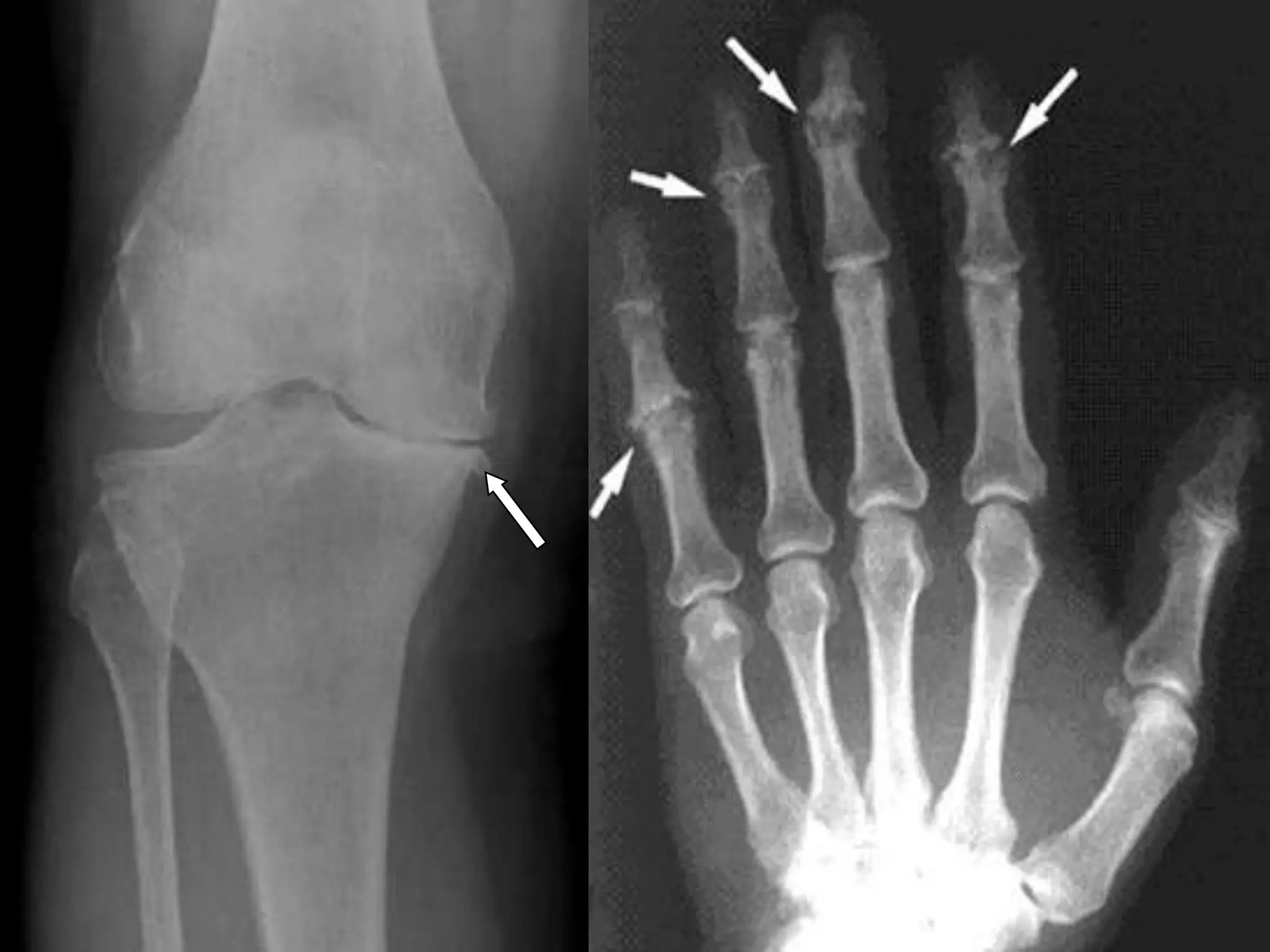
    Late 5: OSTEOARTHRITISAfracture-joint may damage the articular cartilage and give rise to post traumatic osteoarthritis within a period of months.Even if the cartilage heals, irregularity of the joint surface may cause localized stress and so predispose to secondary osteoarthritis years later
  • 163.
    Late 6: JOINTSTIFFNESSCommonly occur at the joints close to malunion or bone loss eg: knee, elbow, shoulder Causes of joint stiffnesshaemarthrosis -> lead to synovial adhesionoedema and fibrosis adhesion of the soft tissuesWorsen by prolong immobilizationTreatment prevented with exercisephysiotherapy
  • 164.

Editor's Notes

  • #90 Type I open fracture can be managed with non-operative approach and closed reduction.
  • #99 may lead to irreversible damage of the life supporting organs.Thirst, rapid shallow breathing, the lips and skin are pale and the extremities feel cold,if the compansation fails….. impaired renal function test and decreased urinary output.
  • #101 Dopamine (1-20g/kg/min)Dobutamine (1-20g/kg/min)Adrenaline (1-20g/min)Noradrenaline (1-20g/min)
  • #102 DIVC
  • #104 It’s a re-perfusion injury seen after the release of crushing pressure, there will be release of muscular breakdown products(myoglobin,k+,p) which have nephrotoxic effect on the kidneyFirst describe by Eric Bywaters
  • #105 It’s a re-perfusion injury seen after the release of crushing pressure, there will be release of muscular breakdown products(myoglobin,k+,p) which have nephrotoxic effect on the kidneyFirst describe by Eric Bywaters
  • #110 Petechial haemorrhage
  • #112 4C – Colour – blue-black purpleConsistency – MushyContractibility – unableCut – not capable to bleedDeep, penetrating wound in muscular tissue should be explored, ALL DEAD TISSUE SHOULD BE COMPLETELY EXCISED, if there is doubt about tissue viability, the wound should be left opened
  • #133 Neuropraxia = misspellingNeurapraxia = neuro + a [no] + praxia [action]Axonotmesis = axon + tmesis [cut]Neurotmesis = Nerve + tmesis [cut]