Architecture Review Board
(ARB): Enabling Digital Strategy
Execution*
*Based on case study of establishing Architecture Review Board
(ARB) at a multinational manufacturing
Author: Mohan K (Enterprise Architect with extensive consulting background)
https://www.linkedin.com/in/mohanbabuk or mohan@garamchai.com
Organizations continue to execute their corporate digitization strategies, requiring
CIOs and IT leaders to engage with business stakeholders to deliver specific
outcomes.
• Such engagement must be governed by the organization’s processes, operating
model, and technology governance to ensure robust, scalable architectures and
roadmaps.
Among my first tasks with the EA team for a multinational chemical company was
redefining the global architecture governance process.
• These processes were being reviewed to enable programs to realize the
digitization strategy.
Background
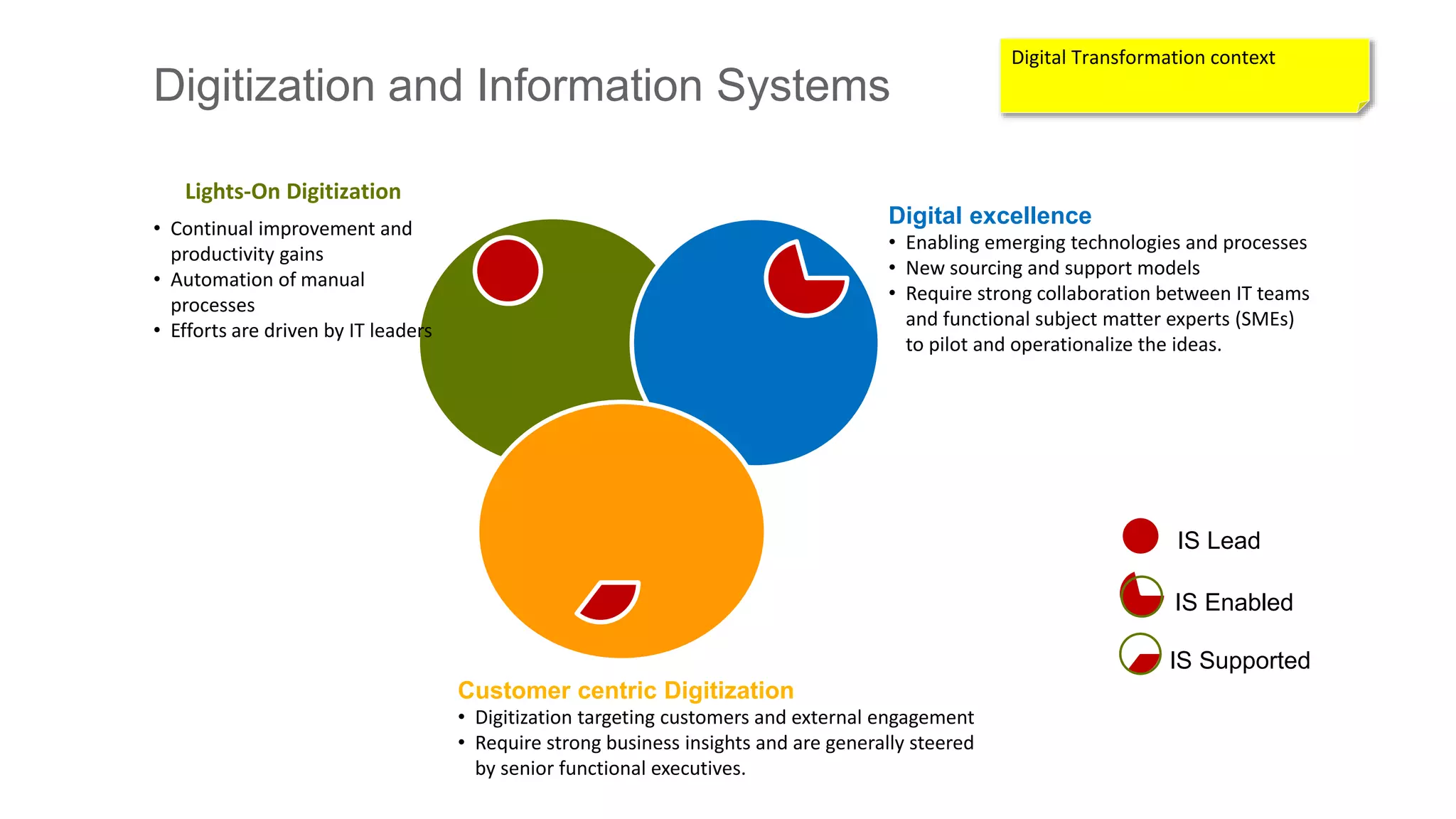
Lights-On Digitization
• Continual improvement and
productivity gains
• Automation of manual
processes
• Efforts are driven by IT leaders
Customer centric Digitization
• Digitization targeting customers and external engagement
• Require strong business insights and are generally steered
by senior functional executives.
Digital excellence
• Enabling emerging technologies and processes
• New sourcing and support models
• Require strong collaboration between IT teams
and functional subject matter experts (SMEs)
to pilot and operationalize the ideas.
IS Lead
IS Supported
IS Enabled
Digitization and Information Systems
Digital Transformation context
Digital
excellence
Lights On
Customer
centric
Digitization
Digital
excellence
Lights OnCustomer
centric
Digitization
Digital
Enterprise
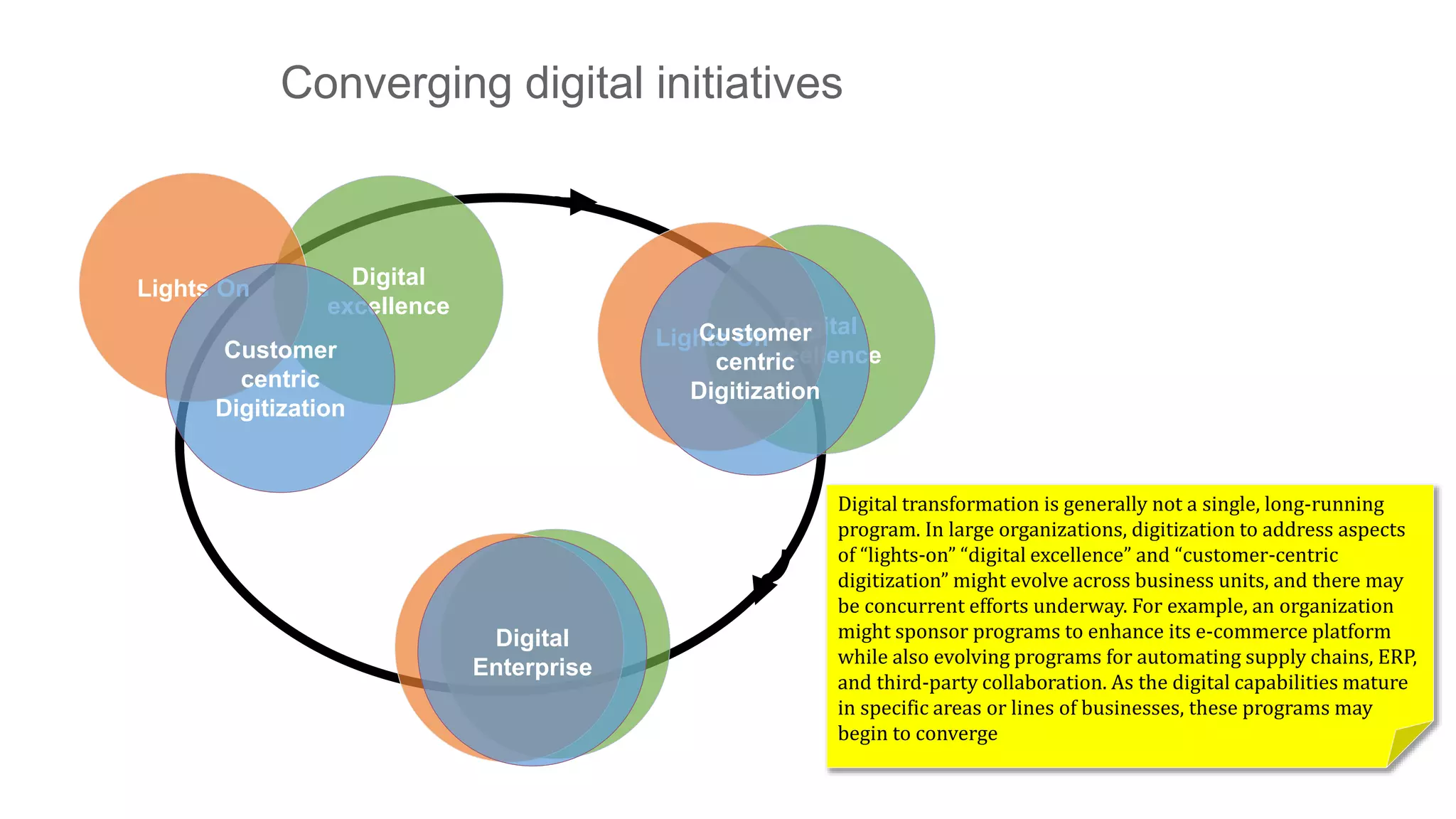
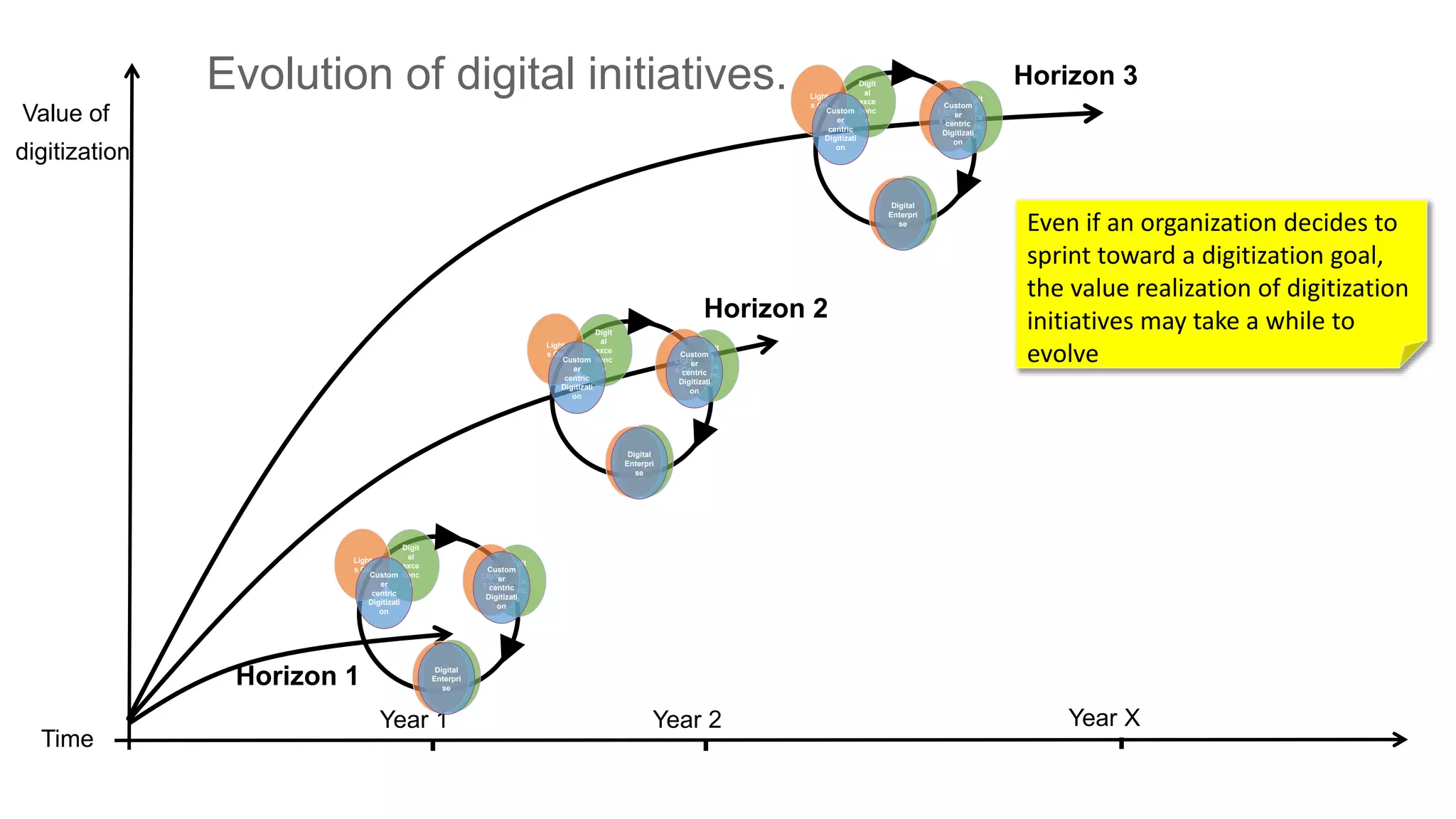
Digital transformation is generally not a single, long-running
program. In large organizations, digitization to address aspects
of “lights-on” “digital excellence” and “customer-centric
digitization” might evolve across business units, and there may
be concurrent efforts underway. For example, an organization
might sponsor programs to enhance its e-commerce platform
while also evolving programs for automating supply chains, ERP,
and third-party collaboration. As the digital capabilities mature
in specific areas or lines of businesses, these programs may
begin to converge
Converging digital initiatives
Value of
digitization
Horizon 3
Horizon 1
Horizon 2
Time
Year 1 Year 2 Year X
Digit
al
exce
llenc
e
Light
s On
Custom
er
centric
Digitizati
on
Digit
al
exce
llenc
e
Light
s On
Custom
er
centric
Digitizati
on
Digital
Enterpri
se
Digit
al
exce
llenc
e
Light
s On
Custom
er
centric
Digitizati
on
Digit
al
exce
llenc
e
Light
s On
Custom
er
centric
Digitizati
on
Digital
Enterpri
se
Digit
al
exce
llenc
e
Light
s On
Custom
er
centric
Digitizati
on
Digit
al
exce
llenc
e
Light
s On
Custom
er
centric
Digitizati
on
Digital
Enterpri
se
Even if an organization decides to
sprint toward a digitization goal,
the value realization of digitization
initiatives may take a while to
evolve
Evolution of digital initiatives.
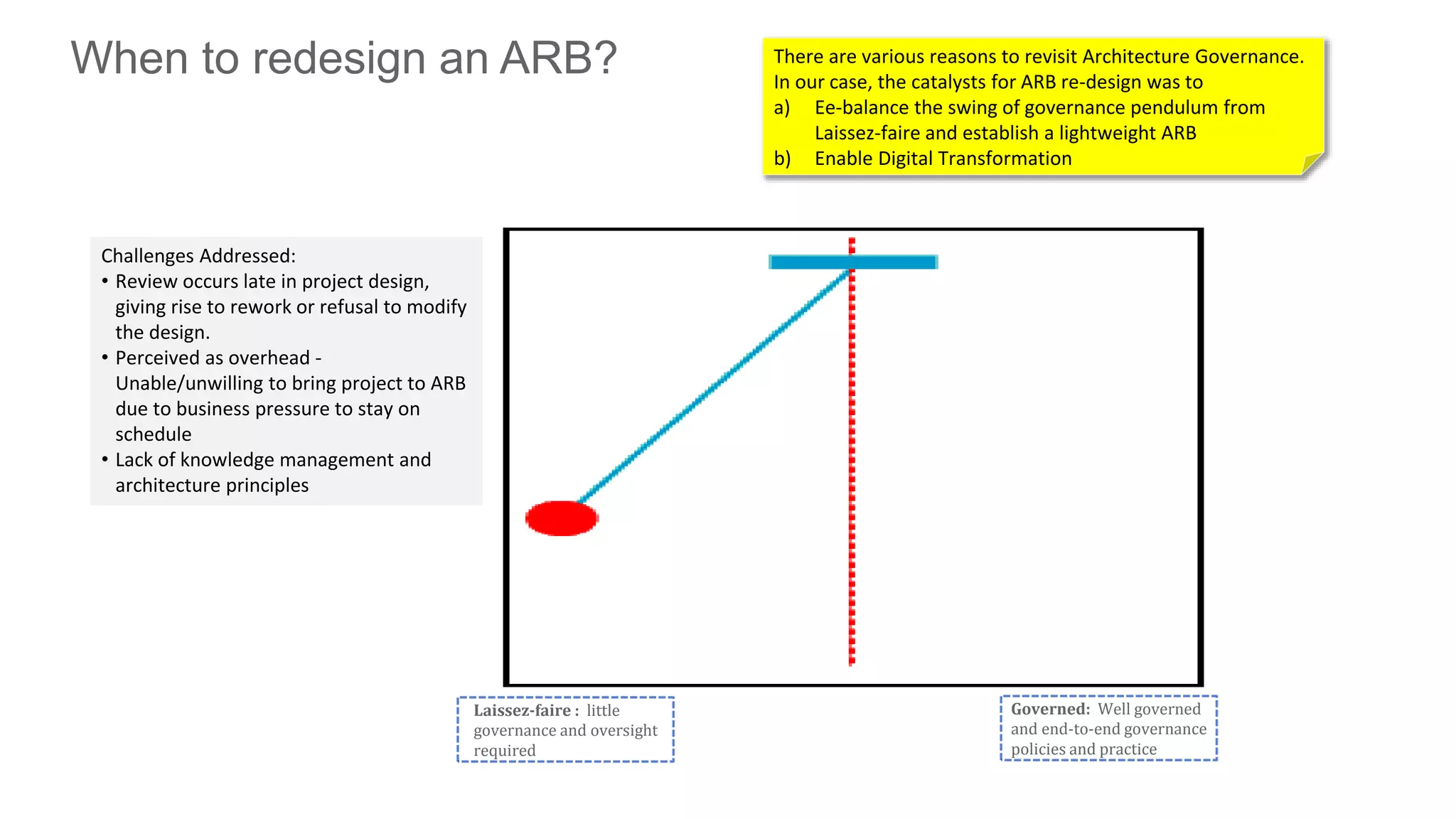
When to redesign an ARB?
Laissez-faire : little
governance and oversight
required
Governed: Well governed
and end-to-end governance
policies and practice
Challenges Addressed:
• Review occurs late in project design,
giving rise to rework or refusal to modify
the design.
• Perceived as overhead -
Unable/unwilling to bring project to ARB
due to business pressure to stay on
schedule
• Lack of knowledge management and
architecture principles
There are various reasons to revisit Architecture Governance.
In our case, the catalysts for ARB re-design was to
a) Ee-balance the swing of governance pendulum from
Laissez-faire and establish a lightweight ARB
b) Enable Digital Transformation
Right Sized
Design
Enterprise
Context
Stakeholder
Alignment
Architecture
Governance
Predictable
processes
Operational
Efficiency
Governance with
predictable outcomes
Efficient and Transparent
Processes
Identify and
Engage
stakeholders
Clarity of
enterprise
context and
drivers
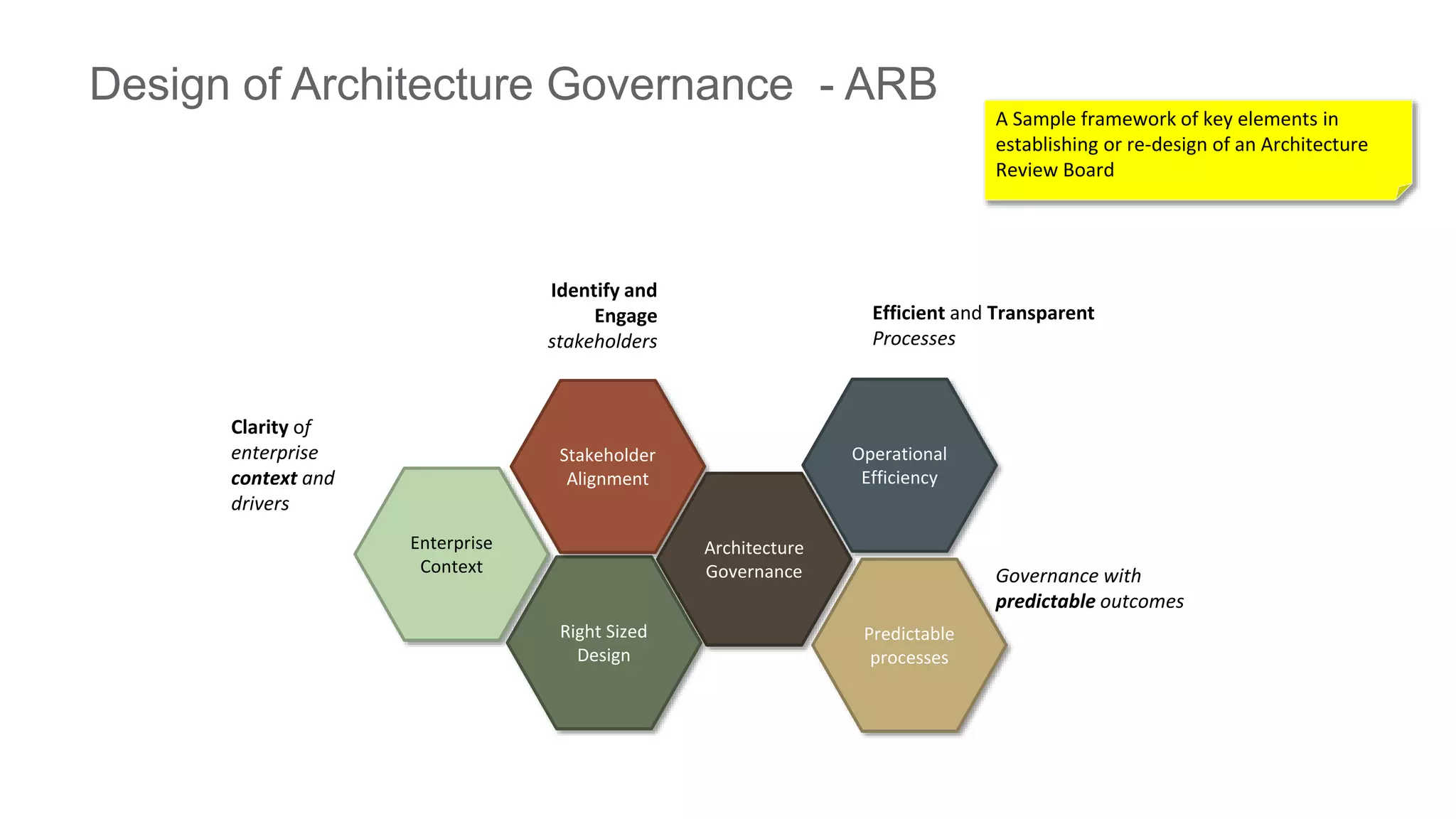
Design of Architecture Governance - ARB
A Sample framework of key elements in
establishing or re-design of an Architecture
Review Board
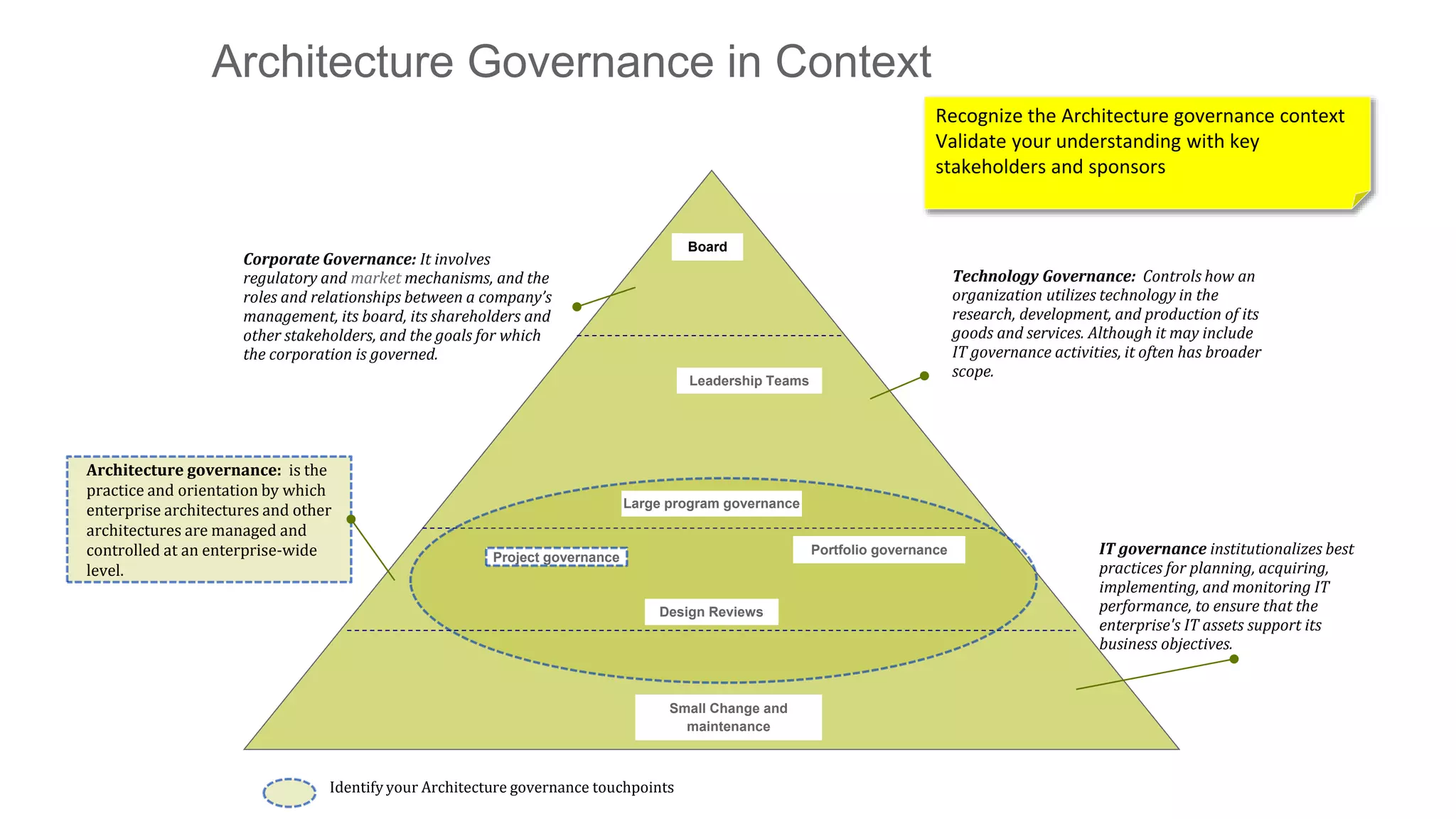
Architecture Governance in Context
Leadership Teams
Corporate Governance: It involves
regulatory and market mechanisms, and the
roles and relationships between a company’s
management, its board, its shareholders and
other stakeholders, and the goals for which
the corporation is governed.
Architecture governance: is the
practice and orientation by which
enterprise architectures and other
architectures are managed and
controlled at an enterprise-wide
level.
Technology Governance: Controls how an
organization utilizes technology in the
research, development, and production of its
goods and services. Although it may include
IT governance activities, it often has broader
scope.
IT governance institutionalizes best
practices for planning, acquiring,
implementing, and monitoring IT
performance, to ensure that the
enterprise's IT assets support its
business objectives.
Board
Large program governance
Small Change and
maintenance
Identify your Architecture governance touchpoints
Design Reviews
Project governance
Portfolio governance
Recognize the Architecture governance context
Validate your understanding with key
stakeholders and sponsors
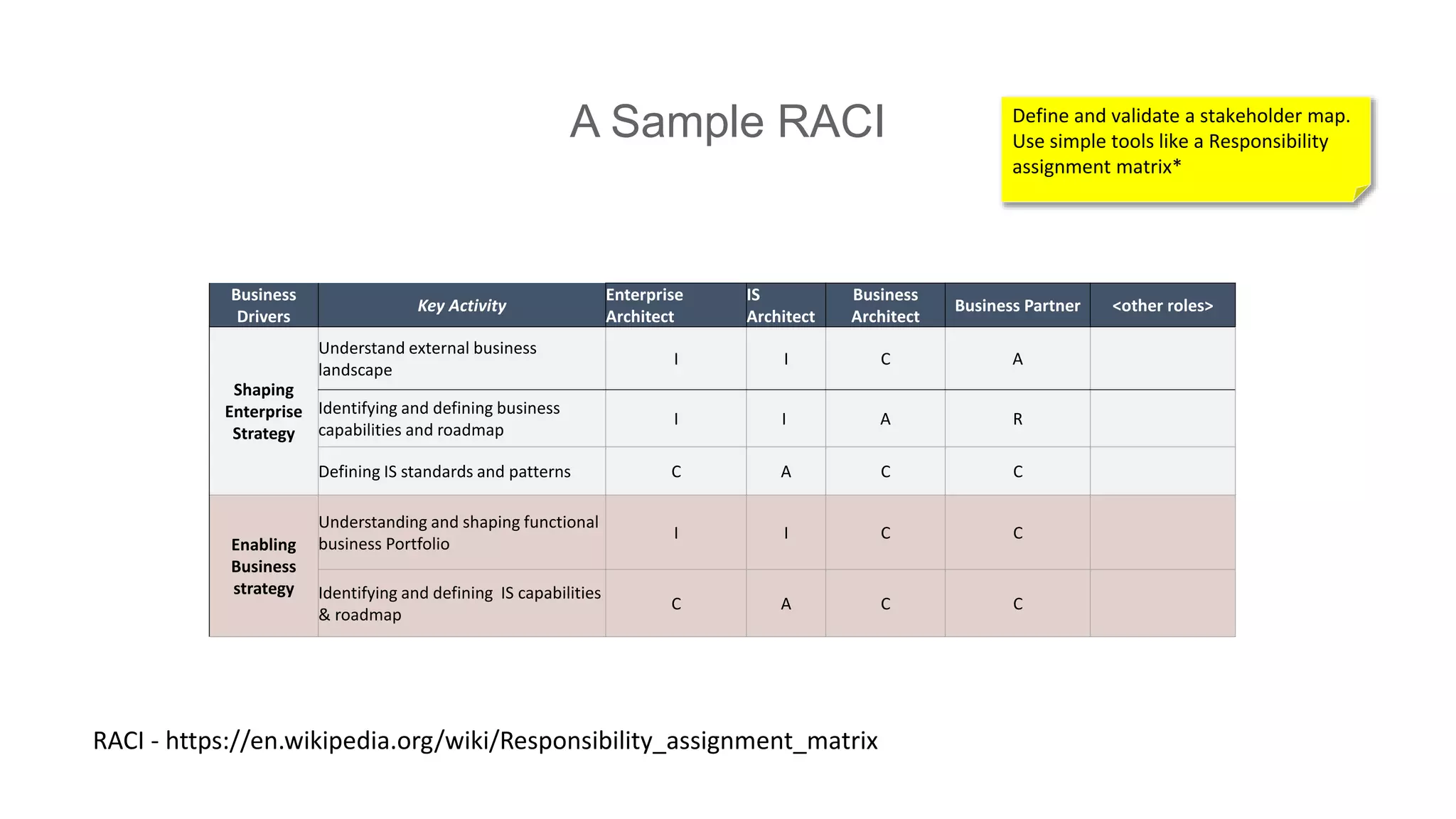
A Sample RACI
Business
Drivers
Key Activity
Enterprise
Architect
IS
Architect
Business
Architect
Business Partner <other roles>
Shaping
Enterprise
Strategy
Understand external business
landscape
I I C A
Identifying and defining business
capabilities and roadmap
I I A R
Defining IS standards and patterns C A C C
Enabling
Business
strategy
Understanding and shaping functional
business Portfolio
I I C C
Identifying and defining IS capabilities
& roadmap
C A C C
Define and validate a stakeholder map.
Use simple tools like a Responsibility
assignment matrix*
RACI - https://en.wikipedia.org/wiki/Responsibility_assignment_matrix
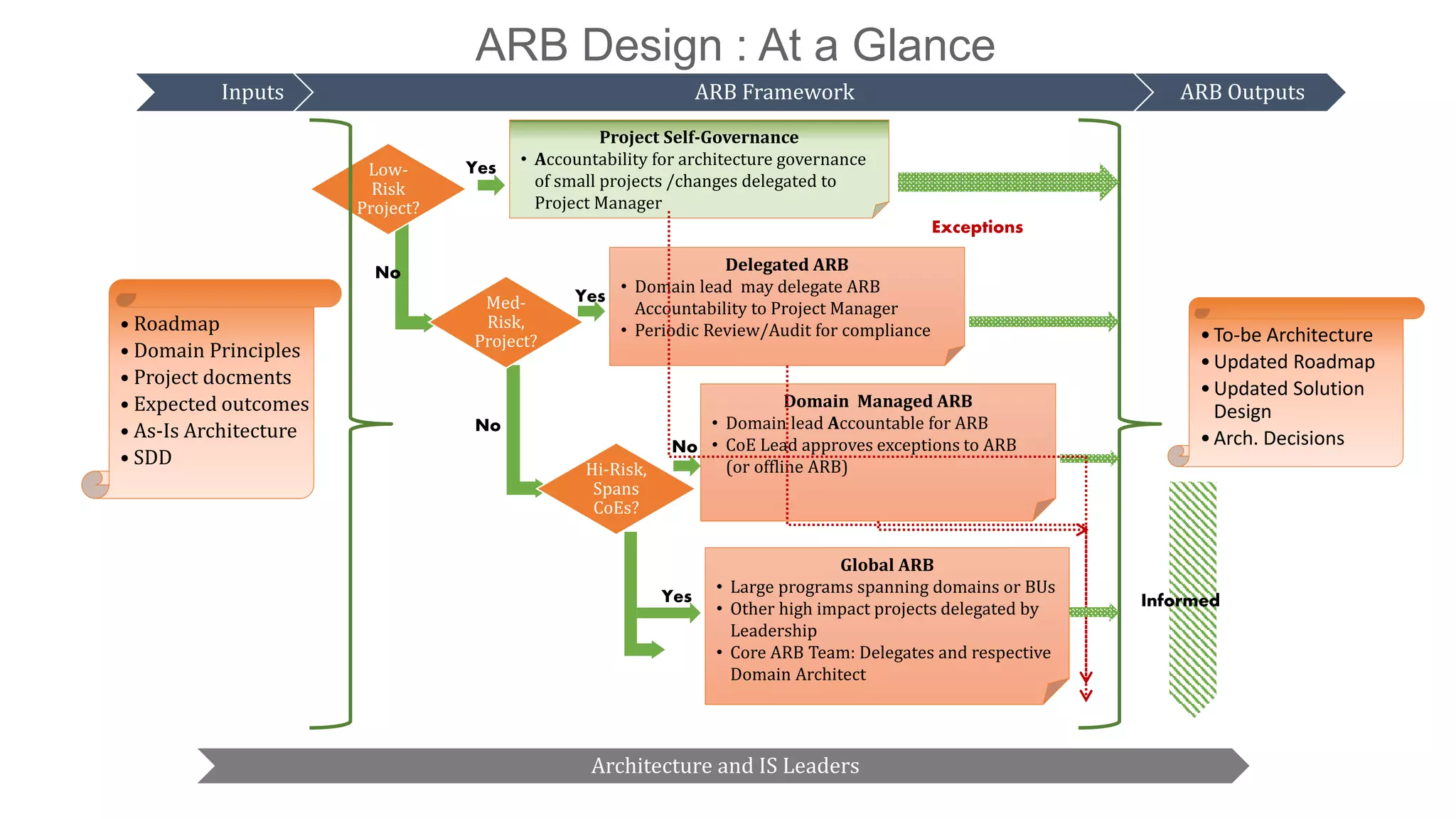
ARB Design : At a Glance
Low-
Risk
Project?
Med-
Risk,
Project?
Hi-Risk,
Spans
CoEs?
• Roadmap
• Domain Principles
• Project docments
• Expected outcomes
• As-Is Architecture
• SDD
Project Self-Governance
• Accountability for architecture governance
of small projects /changes delegated to
Project Manager
Delegated ARB
• Domain lead may delegate ARB
Accountability to Project Manager
• Periodic Review/Audit for compliance
Domain Managed ARB
• Domain lead Accountable for ARB
• CoE Lead approves exceptions to ARB
(or offline ARB)
Global ARB
• Large programs spanning domains or BUs
• Other high impact projects delegated by
Leadership
• Core ARB Team: Delegates and respective
Domain Architect
•To-be Architecture
•Updated Roadmap
•Updated Solution
Design
•Arch. Decisions
No
No
Yes
Yes
Yes
No
Inputs ARB Framework ARB Outputs
Architecture and IS Leaders
Exceptions
Informed
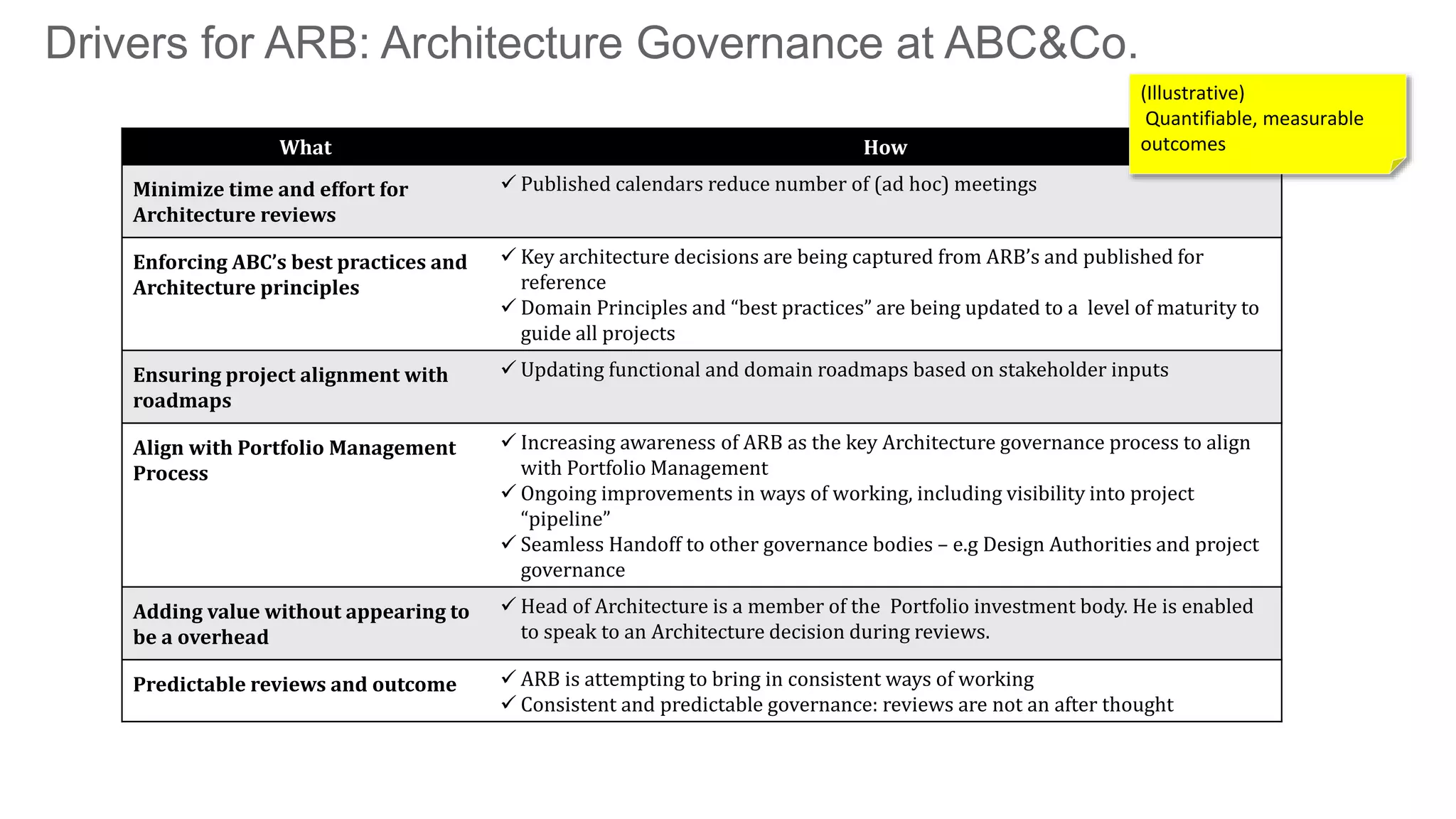
Drivers for ARB: Architecture Governance at ABC&Co.
What How
Minimize time and effort for
Architecture reviews
 Published calendars reduce number of (ad hoc) meetings
Enforcing ABC’s best practices and
Architecture principles
 Key architecture decisions are being captured from ARB’s and published for
reference
 Domain Principles and “best practices” are being updated to a level of maturity to
guide all projects
Ensuring project alignment with
roadmaps
 Updating functional and domain roadmaps based on stakeholder inputs
Align with Portfolio Management
Process
 Increasing awareness of ARB as the key Architecture governance process to align
with Portfolio Management
 Ongoing improvements in ways of working, including visibility into project
“pipeline”
 Seamless Handoff to other governance bodies – e.g Design Authorities and project
governance
Adding value without appearing to
be a overhead
 Head of Architecture is a member of the Portfolio investment body. He is enabled
to speak to an Architecture decision during reviews.
Predictable reviews and outcome  ARB is attempting to bring in consistent ways of working
 Consistent and predictable governance: reviews are not an after thought
(Illustrative)
Quantifiable, measurable
outcomes
• Enabling Successful EA Governance with an Architecture Review Board (ARB) - by
Mohan Babu K (Cutter IT March 2015)
• Enablers for Right Sizing the Architecture Review Board - Mohan K (Architecture
and Governance Journal, March 2015)
• Executing Digital Strategies - by Mohan Babu K (Cutter IT - March 2016)
References

Design Architecture Review Board (ARB) to Enable Digital Strategy

  • 1.
    Architecture Review Board (ARB):Enabling Digital Strategy Execution* *Based on case study of establishing Architecture Review Board (ARB) at a multinational manufacturing Author: Mohan K (Enterprise Architect with extensive consulting background) https://www.linkedin.com/in/mohanbabuk or mohan@garamchai.com
  • 2.
    Organizations continue toexecute their corporate digitization strategies, requiring CIOs and IT leaders to engage with business stakeholders to deliver specific outcomes. • Such engagement must be governed by the organization’s processes, operating model, and technology governance to ensure robust, scalable architectures and roadmaps. Among my first tasks with the EA team for a multinational chemical company was redefining the global architecture governance process. • These processes were being reviewed to enable programs to realize the digitization strategy. Background
  • 3.
    Lights-On Digitization • Continualimprovement and productivity gains • Automation of manual processes • Efforts are driven by IT leaders Customer centric Digitization • Digitization targeting customers and external engagement • Require strong business insights and are generally steered by senior functional executives. Digital excellence • Enabling emerging technologies and processes • New sourcing and support models • Require strong collaboration between IT teams and functional subject matter experts (SMEs) to pilot and operationalize the ideas. IS Lead IS Supported IS Enabled Digitization and Information Systems Digital Transformation context
  • 4.
    Digital excellence Lights On Customer centric Digitization Digital excellence Lights OnCustomer centric Digitization Digital Enterprise Digitaltransformation is generally not a single, long-running program. In large organizations, digitization to address aspects of “lights-on” “digital excellence” and “customer-centric digitization” might evolve across business units, and there may be concurrent efforts underway. For example, an organization might sponsor programs to enhance its e-commerce platform while also evolving programs for automating supply chains, ERP, and third-party collaboration. As the digital capabilities mature in specific areas or lines of businesses, these programs may begin to converge Converging digital initiatives
  • 5.
    Value of digitization Horizon 3 Horizon1 Horizon 2 Time Year 1 Year 2 Year X Digit al exce llenc e Light s On Custom er centric Digitizati on Digit al exce llenc e Light s On Custom er centric Digitizati on Digital Enterpri se Digit al exce llenc e Light s On Custom er centric Digitizati on Digit al exce llenc e Light s On Custom er centric Digitizati on Digital Enterpri se Digit al exce llenc e Light s On Custom er centric Digitizati on Digit al exce llenc e Light s On Custom er centric Digitizati on Digital Enterpri se Even if an organization decides to sprint toward a digitization goal, the value realization of digitization initiatives may take a while to evolve Evolution of digital initiatives.
  • 6.
    When to redesignan ARB? Laissez-faire : little governance and oversight required Governed: Well governed and end-to-end governance policies and practice Challenges Addressed: • Review occurs late in project design, giving rise to rework or refusal to modify the design. • Perceived as overhead - Unable/unwilling to bring project to ARB due to business pressure to stay on schedule • Lack of knowledge management and architecture principles There are various reasons to revisit Architecture Governance. In our case, the catalysts for ARB re-design was to a) Ee-balance the swing of governance pendulum from Laissez-faire and establish a lightweight ARB b) Enable Digital Transformation
  • 7.
    Right Sized Design Enterprise Context Stakeholder Alignment Architecture Governance Predictable processes Operational Efficiency Governance with predictableoutcomes Efficient and Transparent Processes Identify and Engage stakeholders Clarity of enterprise context and drivers Design of Architecture Governance - ARB A Sample framework of key elements in establishing or re-design of an Architecture Review Board
  • 8.
    Architecture Governance inContext Leadership Teams Corporate Governance: It involves regulatory and market mechanisms, and the roles and relationships between a company’s management, its board, its shareholders and other stakeholders, and the goals for which the corporation is governed. Architecture governance: is the practice and orientation by which enterprise architectures and other architectures are managed and controlled at an enterprise-wide level. Technology Governance: Controls how an organization utilizes technology in the research, development, and production of its goods and services. Although it may include IT governance activities, it often has broader scope. IT governance institutionalizes best practices for planning, acquiring, implementing, and monitoring IT performance, to ensure that the enterprise's IT assets support its business objectives. Board Large program governance Small Change and maintenance Identify your Architecture governance touchpoints Design Reviews Project governance Portfolio governance Recognize the Architecture governance context Validate your understanding with key stakeholders and sponsors
  • 9.
    A Sample RACI Business Drivers KeyActivity Enterprise Architect IS Architect Business Architect Business Partner <other roles> Shaping Enterprise Strategy Understand external business landscape I I C A Identifying and defining business capabilities and roadmap I I A R Defining IS standards and patterns C A C C Enabling Business strategy Understanding and shaping functional business Portfolio I I C C Identifying and defining IS capabilities & roadmap C A C C Define and validate a stakeholder map. Use simple tools like a Responsibility assignment matrix* RACI - https://en.wikipedia.org/wiki/Responsibility_assignment_matrix
  • 10.
    ARB Design :At a Glance Low- Risk Project? Med- Risk, Project? Hi-Risk, Spans CoEs? • Roadmap • Domain Principles • Project docments • Expected outcomes • As-Is Architecture • SDD Project Self-Governance • Accountability for architecture governance of small projects /changes delegated to Project Manager Delegated ARB • Domain lead may delegate ARB Accountability to Project Manager • Periodic Review/Audit for compliance Domain Managed ARB • Domain lead Accountable for ARB • CoE Lead approves exceptions to ARB (or offline ARB) Global ARB • Large programs spanning domains or BUs • Other high impact projects delegated by Leadership • Core ARB Team: Delegates and respective Domain Architect •To-be Architecture •Updated Roadmap •Updated Solution Design •Arch. Decisions No No Yes Yes Yes No Inputs ARB Framework ARB Outputs Architecture and IS Leaders Exceptions Informed
  • 11.
    Drivers for ARB:Architecture Governance at ABC&Co. What How Minimize time and effort for Architecture reviews  Published calendars reduce number of (ad hoc) meetings Enforcing ABC’s best practices and Architecture principles  Key architecture decisions are being captured from ARB’s and published for reference  Domain Principles and “best practices” are being updated to a level of maturity to guide all projects Ensuring project alignment with roadmaps  Updating functional and domain roadmaps based on stakeholder inputs Align with Portfolio Management Process  Increasing awareness of ARB as the key Architecture governance process to align with Portfolio Management  Ongoing improvements in ways of working, including visibility into project “pipeline”  Seamless Handoff to other governance bodies – e.g Design Authorities and project governance Adding value without appearing to be a overhead  Head of Architecture is a member of the Portfolio investment body. He is enabled to speak to an Architecture decision during reviews. Predictable reviews and outcome  ARB is attempting to bring in consistent ways of working  Consistent and predictable governance: reviews are not an after thought (Illustrative) Quantifiable, measurable outcomes
  • 12.
    • Enabling SuccessfulEA Governance with an Architecture Review Board (ARB) - by Mohan Babu K (Cutter IT March 2015) • Enablers for Right Sizing the Architecture Review Board - Mohan K (Architecture and Governance Journal, March 2015) • Executing Digital Strategies - by Mohan Babu K (Cutter IT - March 2016) References

Editor's Notes

  • #2 Architecture Review Board (ARB): Enabling Digital Strategy Execution* *Based on case study of establishing Architecture Review Board (ARB) at a multinational manufacturing Author: Mohan K (Enterprise Architect with extensive consulting background) https://www.linkedin.com/in/mohanbabuk or mohan@garamchai.com