Days of Future Past: An Optimization-based
Adaptive Bitrate Algorithm over HTTP/3
EPIQ’21 (ACM CoNEXT 2021)
07.-10.12.2021 | Munich, Germany
Daniele Lorenzi, Minh Nguyen, Farzad Tashtarian, Christian Timmerer, Hermann Hellwagner, Simone Milani
Christian Doppler laboratory ATHENA | Alpen-Adria University | Austria
daniele.lorenzi@aau.at | https://athena.itec.aau.at/
1
● Introduction
● Motivation
● Proposed method
● Experimental setup
● Results and analysis
● Conclusion
Agenda
2
3
Introduction
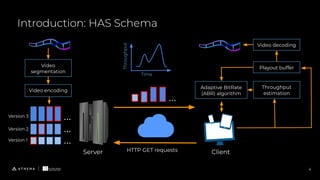
Introduction: HAS Schema
4
Video
segmentation
Video encoding
...
...
...
Server Client
Adaptive BitRate
(ABR) algorithm
Throughput
estimation
Playout buffer
Video decoding
...
HTTP GET requests
Version 3
Version 2
Version 1
Throughput
Time
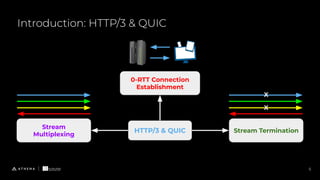
Introduction: HTTP/3 & QUIC
5
Stream
Multiplexing
0-RTT Connection
Establishment
Stream Termination
HTTP/3 & QUIC
X
X
6
Motivation
Motivation
7
8
Proposed Method
DoFP: An Optimization-based ABR algorithm
9
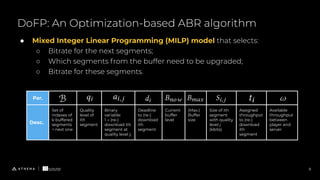
● Mixed Integer Linear Programming (MILP) model that selects:
○ Bitrate for the next segments;
○ Which segments from the buffer need to be upgraded;
○ Bitrate for these segments.
Par.
Desc.
Set of
indexes of
k buffered
segments
+ next one
Quality
level of
ith
segment
Binary
variable:
1 → (re-)
download ith
segment at
quality level j;
Deadline
to (re-)
download
ith
segment
Current
buffer
level
(Max.)
Buffer
size
Size of ith
segment
with quality
level 𝑗
(kbits)
Assigned
throughput
to (re-)
download
ith
segment
Available
throughput
between
player and
server
DoFP: An Optimization-based ABR algorithm
10
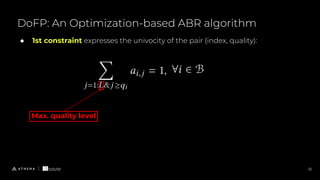
● 1st constraint expresses the univocity of the pair (index, quality):
Max. quality level
DoFP: An Optimization-based ABR algorithm
11
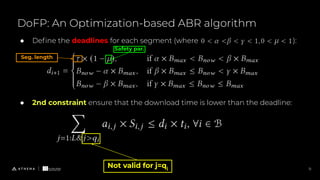
● Define the deadlines for each segment (where , ):
● 2nd constraint ensure that the download time is lower than the deadline:
Not valid for j=qi
Seg. length
Safety par.
DoFP: An Optimization-based ABR algorithm
12
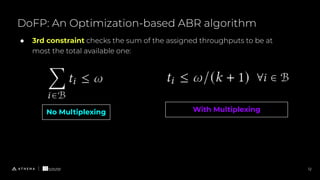
● 3rd constraint checks the sum of the assigned throughputs to be at
most the total available one:
No Multiplexing With Multiplexing
DoFP: An Optimization-based ABR algorithm
13
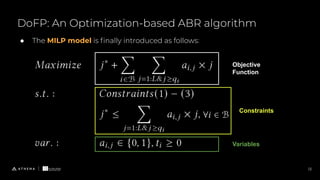
● The MILP model is finally introduced as follows:
Objective
Function
Constraints
Variables
14
Experimental setup
Experimental setup
15
● HAS + LSQUIC [1] testbed
● 5-min test sequence (Tears of Steel - begin)
● Bitrate ladder: {107, 240, 346, 715, 1347, 2426, 4121} kbps [2]
● Resolution: {144, 240, 360, 480, 720, 1080, 1440} p [2]
● Codec: H.264
● Linux tc (bash script)
○ 4G Network trace
○ RTT: 40 ms
● 𝛕 = 4s, Bmax
= 20s
● 𝛍 = 0.1, 𝛂 = 0.25, 𝛃 = 0.5, 𝛄 = 0.75
[1] https://github.com/litespeedtech/lsquic
[2] T. Karagkioules, et al.: A Public Dataset for YouTube’s Mobile Streaming Client.
16
Results and analysis
17
● Metrics considered:
○ Average quality: average quality level of the played segments
○ Video instability: average quality fluctuation among adjacent segments
○ Number of switches: number of segments whose quality is lower than their
previous one
○ Number of stalls: number of buffer underruns
○ Stall duration: total video freeze time
○ QoE score: computed via ITU-T P.1203 mode 0 and its extension [3]
[3] https://github.com/Telecommunication-Telemedia-Assessment/itu-p1203-codecextension
Results and analysis
18
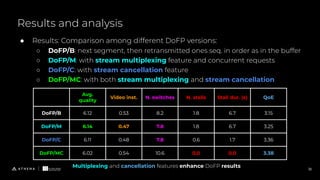
● Results: Comparison among different DoFP versions:
○ DoFP/B: next segment, then retransmitted ones seq. in order as in the buffer
○ DoFP/M: with stream multiplexing feature and concurrent requests
○ DoFP/C: with stream cancellation feature
○ DoFP/MC: with both stream multiplexing and stream cancellation
Avg.
quality
Video inst. N. switches N. stalls Stall dur. (s) QoE
DoFP/B 6.12 0.53 8.2 1.8 6.7 3.15
DoFP/M 6.14 0.47 7.8 1.8 6.7 3.25
DoFP/C 6.11 0.48 7.8 0.6 1.7 3.36
DoFP/MC 6.02 0.54 10.6 0.0 0.0 3.38
Multiplexing and cancellation features enhance DoFP results
Results and analysis
19
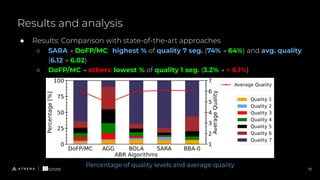
● Results: Comparison with state-of-the-art approaches
○ SARA → DoFP/MC: highest % of quality 7 seg. (74% → 64%) and avg. quality
(6.12 → 6.02)
○ DoFP/MC → others: lowest % of quality 1 seg. (3.2% → > 6.1%)
Percentage of quality levels and average quality
Results and analysis
20
● Results: Comparison with state-of-the-art approaches
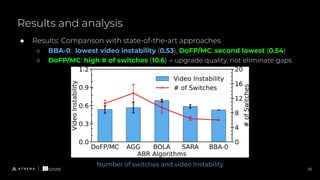
○ BBA-0: lowest video instability (0.53); DoFP/MC: second lowest (0.54)
○ DoFP/MC: high # of switches (10.6) → upgrade quality, not eliminate gaps
Number of switches and video Instability
Results and analysis
21
● Results: Comparison with state-of-the-art approaches
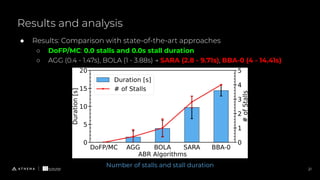
○ DoFP/MC: 0.0 stalls and 0.0s stall duration
○ AGG (0.4 - 1.47s), BOLA (1 - 3.88s) → SARA (2.8 - 9.71s), BBA-0 (4 - 14.41s)
Number of stalls and stall duration
Results and analysis
22
● Results: Comparison with state-of-the-art approaches
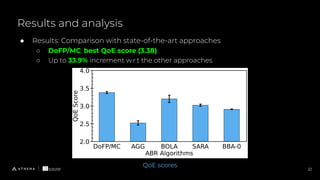
○ DoFP/MC: best QoE score (3.38)
○ Up to 33.9% increment w.r.t the other approaches
QoE scores
23
Conclusions
Conclusions
24
● DoFP(/MC): a MILP model to provide high QoE (and low stall-probability)
through HTTP/3 and QUIC features
● Taking into account throughput, buffer, and quality of each buffered
segment
● The model chooses the bitrates for the next segment and (if needed) for the
buffered segments to be re-transmitted
● DoFP/MC: outperforms the other approaches with the highest QoE score
● Multiplexing and cancellation features enhance DoFP results
● In the future, investigate the stream priority feature, the impact of DoFP’s
parameters and different streaming (video sequence, bitrate ladder, segment
duration) and network scenarios (bandwidth traces)
Thank you
25

EPIQ'21: Days of Future Past: An Optimization-based Adaptive Bitrate Algorithm over HTTP/3

  • 1.
    Days of FuturePast: An Optimization-based Adaptive Bitrate Algorithm over HTTP/3 EPIQ’21 (ACM CoNEXT 2021) 07.-10.12.2021 | Munich, Germany Daniele Lorenzi, Minh Nguyen, Farzad Tashtarian, Christian Timmerer, Hermann Hellwagner, Simone Milani Christian Doppler laboratory ATHENA | Alpen-Adria University | Austria daniele.lorenzi@aau.at | https://athena.itec.aau.at/ 1
  • 2.
    ● Introduction ● Motivation ●Proposed method ● Experimental setup ● Results and analysis ● Conclusion Agenda 2
  • 3.
  • 4.
    Introduction: HAS Schema 4 Video segmentation Videoencoding ... ... ... Server Client Adaptive BitRate (ABR) algorithm Throughput estimation Playout buffer Video decoding ... HTTP GET requests Version 3 Version 2 Version 1 Throughput Time
  • 5.
    Introduction: HTTP/3 &QUIC 5 Stream Multiplexing 0-RTT Connection Establishment Stream Termination HTTP/3 & QUIC X X
  • 6.
  • 7.
  • 8.
  • 9.
    DoFP: An Optimization-basedABR algorithm 9 ● Mixed Integer Linear Programming (MILP) model that selects: ○ Bitrate for the next segments; ○ Which segments from the buffer need to be upgraded; ○ Bitrate for these segments. Par. Desc. Set of indexes of k buffered segments + next one Quality level of ith segment Binary variable: 1 → (re-) download ith segment at quality level j; Deadline to (re-) download ith segment Current buffer level (Max.) Buffer size Size of ith segment with quality level 𝑗 (kbits) Assigned throughput to (re-) download ith segment Available throughput between player and server
  • 10.
    DoFP: An Optimization-basedABR algorithm 10 ● 1st constraint expresses the univocity of the pair (index, quality): Max. quality level
  • 11.
    DoFP: An Optimization-basedABR algorithm 11 ● Define the deadlines for each segment (where , ): ● 2nd constraint ensure that the download time is lower than the deadline: Not valid for j=qi Seg. length Safety par.
  • 12.
    DoFP: An Optimization-basedABR algorithm 12 ● 3rd constraint checks the sum of the assigned throughputs to be at most the total available one: No Multiplexing With Multiplexing
  • 13.
    DoFP: An Optimization-basedABR algorithm 13 ● The MILP model is finally introduced as follows: Objective Function Constraints Variables
  • 14.
  • 15.
    Experimental setup 15 ● HAS+ LSQUIC [1] testbed ● 5-min test sequence (Tears of Steel - begin) ● Bitrate ladder: {107, 240, 346, 715, 1347, 2426, 4121} kbps [2] ● Resolution: {144, 240, 360, 480, 720, 1080, 1440} p [2] ● Codec: H.264 ● Linux tc (bash script) ○ 4G Network trace ○ RTT: 40 ms ● 𝛕 = 4s, Bmax = 20s ● 𝛍 = 0.1, 𝛂 = 0.25, 𝛃 = 0.5, 𝛄 = 0.75 [1] https://github.com/litespeedtech/lsquic [2] T. Karagkioules, et al.: A Public Dataset for YouTube’s Mobile Streaming Client.
  • 16.
  • 17.
    Results and analysis 17 ●Metrics considered: ○ Average quality: average quality level of the played segments ○ Video instability: average quality fluctuation among adjacent segments ○ Number of switches: number of segments whose quality is lower than their previous one ○ Number of stalls: number of buffer underruns ○ Stall duration: total video freeze time ○ QoE score: computed via ITU-T P.1203 mode 0 and its extension [3] [3] https://github.com/Telecommunication-Telemedia-Assessment/itu-p1203-codecextension
  • 18.
    Results and analysis 18 ●Results: Comparison among different DoFP versions: ○ DoFP/B: next segment, then retransmitted ones seq. in order as in the buffer ○ DoFP/M: with stream multiplexing feature and concurrent requests ○ DoFP/C: with stream cancellation feature ○ DoFP/MC: with both stream multiplexing and stream cancellation Avg. quality Video inst. N. switches N. stalls Stall dur. (s) QoE DoFP/B 6.12 0.53 8.2 1.8 6.7 3.15 DoFP/M 6.14 0.47 7.8 1.8 6.7 3.25 DoFP/C 6.11 0.48 7.8 0.6 1.7 3.36 DoFP/MC 6.02 0.54 10.6 0.0 0.0 3.38 Multiplexing and cancellation features enhance DoFP results
  • 19.
    Results and analysis 19 ●Results: Comparison with state-of-the-art approaches ○ SARA → DoFP/MC: highest % of quality 7 seg. (74% → 64%) and avg. quality (6.12 → 6.02) ○ DoFP/MC → others: lowest % of quality 1 seg. (3.2% → > 6.1%) Percentage of quality levels and average quality
  • 20.
    Results and analysis 20 ●Results: Comparison with state-of-the-art approaches ○ BBA-0: lowest video instability (0.53); DoFP/MC: second lowest (0.54) ○ DoFP/MC: high # of switches (10.6) → upgrade quality, not eliminate gaps Number of switches and video Instability
  • 21.
    Results and analysis 21 ●Results: Comparison with state-of-the-art approaches ○ DoFP/MC: 0.0 stalls and 0.0s stall duration ○ AGG (0.4 - 1.47s), BOLA (1 - 3.88s) → SARA (2.8 - 9.71s), BBA-0 (4 - 14.41s) Number of stalls and stall duration
  • 22.
    Results and analysis 22 ●Results: Comparison with state-of-the-art approaches ○ DoFP/MC: best QoE score (3.38) ○ Up to 33.9% increment w.r.t the other approaches QoE scores
  • 23.
  • 24.
    Conclusions 24 ● DoFP(/MC): aMILP model to provide high QoE (and low stall-probability) through HTTP/3 and QUIC features ● Taking into account throughput, buffer, and quality of each buffered segment ● The model chooses the bitrates for the next segment and (if needed) for the buffered segments to be re-transmitted ● DoFP/MC: outperforms the other approaches with the highest QoE score ● Multiplexing and cancellation features enhance DoFP results ● In the future, investigate the stream priority feature, the impact of DoFP’s parameters and different streaming (video sequence, bitrate ladder, segment duration) and network scenarios (bandwidth traces)
  • 25.