All rights reserved. ©2020
A Distributed Delivery Architecture for User
Generated Content Live Streaming over HTTP
Christian Doppler laboratory ATHENA | Klagenfurt University | Austria
farzad.tashtarian@aau.at | https://athena.itec.aau.at/
Farzad Tashtarian, Abdelhak Bentaleb, Reza Farahani, Minh Nguyen,
Christian Timmerer, Hermann Hellwagner, and Roger Zimmermann
The 46th IEEE Conference on Local Computer Networks (LCN)
October 4-7, 2021, Edmonton, Canada
1
● Challenges of user generated content
● Problem definition
● Proposed approach
● Results
● Conclusion and future work
● Q&A
Agenda
2
All rights reserved. ©2020
User Generated Content
● With the advancement of mobile phones, live User Generated
Content (UGC) has become very popular in today’s video streaming
applications, in particular with gaming and e-sport.
● Majority of UGC services use HTTP-based adaptive streaming (HAS) for
video distribution.
● UGC challenges:
○ Technical complexity of managing parallel streams,
○ Difficult trade-offs with video quality and latency
3
All rights reserved. ©2020
Problem Definition
How to dynamically optimize quality and latency
fairness for concurrent heterogeneous clients that
rapidly join or leave various live UGC stream channels
located in different geographical zones?
How to design a scalable solution?
4
All rights reserved. ©2020
QuaLA: Joint Quality-Latency Architecture
A three-layer, fully distributed architecture for HAS-enabled live UGC
delivery over Internet
● Access/Cell Layer
● Edge/Zone Layer
● Backbone/CDN layer
5
All rights reserved. ©2020
QuaLA Design
● Formulate the joint quality-latency fairness problem for optimized
QoE of live UGC streaming
○ Centralized QuaLA (C-QuaLA)
○ Distributed QuaLA (D-QuaLA)
● Introduce two concept of QoE fairness :
○ Fine-grained fairness
○ Coarse-grained fairness
6
All rights reserved. ©2020
Centralized QuaLA (C-QuaLA)
● Quality Constraints
7
Set of Cells
Source CDN
server for v
Binary variable Requested live
channel by c
percentage of all qualities of
channel v transmitted to cell c
Which qualities should be served by which CDN server?
The volume of transmitted data from source CDN servers to cells:
C1
C2
All rights reserved. ©2020
Centralized QuaLA (C-QuaLA)
● Latency Constraints
and adjusting bitrates from source cell to the CDN server
8
Given latency
Transmission bit
rate variable
Satisfying the given latency by selecting optimal bitrates from CDN
server to the requesting cell
C3
C4
C5
C6
All rights reserved. ©2020
Centralized QuaLA (C-QuaLA) ...
● Resource Constraints:
Considering available bandwidth of cell c, zone z, and CDN server d
9
C7
C8
C9
All rights reserved. ©2020
Fine-grained C-QuaLA and Coarse-grained C-QuaLA
Providing quality-latency fairness for each live channel independently
The fairness is determined over all live channels
10
Minimum fairness of
each live channel v
Minimum fairness of
all live channels
Fine-grained
Fairness
Coarse-grained
Fairness
All rights reserved. ©2020
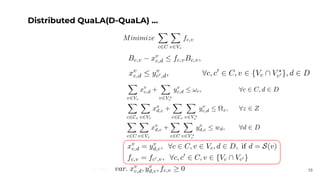
Distributed QuaLA(D-QuaLA)
● Mathematical distribution techniques:
○ Two blocks of functions and variables (ADMM: The alternating
direction method of multipliers)[1]
○ Multi-block approaches:
■ Variable Splitting ADMM [2]
■ ADMM with Gaussian Back Substitution [3]
■ Proximal Jacobian ADMM (ProxJ-ADMM) [4]
● Fast convergence rate
11
[1] S. Boyd, N. Parikh, and E. Chu, Distributed optimization and statistical learning via the alternating direction method of multipliers. Now Publishers Inc, 2011.
[2] D. P. Bertsekas and J. N. Tsitsiklis, Parallel and distributed computation: numerical methods. Prentice hall Englewood Cliffs, NJ, 1989, vol. 23.
[3] B. He, M. Tao, and X. Yuan, “Alternating direction method with gaussian back substitution for separable convex programming,” SIAM Journal on
Optimization, vol. 22, no. 2, pp. 313–340, 2012.
[4] W. Deng, M.-J. Lai, Z. Peng, and W. Yin, “Parallel multi-block admm with o (1/k) convergence,” Journal of Scientific Computing, vol. 71, no. 2, pp. 712–736,
2017.
How Does Distributed QuaLA(D-QuaLA) Work?
12
Applying Proximal Jacobian ADMM (ProxJ-ADMM) method
How Does Distributed QuaLA(D-QuaLA) Work?
13
Applying Proximal Jacobian ADMM (ProxJ-ADMM) method
All rights reserved. ©2020
How Does Distributed QuaLA(D-QuaLA) Work?
14
Applying Proximal Jacobian ADMM (ProxJ-ADMM) method
All rights reserved. ©2020
Distributed QuaLA(D-QuaLA) for Coarse-grained Fairness
How to relax the binary variable
1- Define the following two variables showing the outgoing and
incoming video traffics to and from cells and CDN servers:
these two variables enable us to run the model over a group of cells
in a distributed manner.
2- Define as the required bitrate for downloading
video v by cell c with respect to desired qualities
15
From CDN server j to cell i for video v
From cell i to CDN server j for video v
Distributed QuaLA(D-QuaLA) ...
16
All rights reserved. ©2020
Distributed QuaLA(D-QuaLA)...
By considering the equality constraints in the proposed model and
having the Lagrangian multipliers λ and γ as well as the penalty
parameters ρ and ρ , the Lagrangian equation can be represented as
follows:
17
1 2
All rights reserved. ©2020
Distributed QuaLA(D-QuaLA)...
● Cell updates
18
● GCC updates the Lagrangian multipliers λ and γ as follows
(if cell c has request(s))
(if cell c hosts streamer(s))
(if cell c has request(s))
All rights reserved. ©2020
Distributed QuaLA(D-QuaLA)...
● Cell updates ( if cell c hosts streamer(s))
19
where
All rights reserved. ©2020
Distributed QuaLA(D-QuaLA)...
● Cell updates (if cell c has request(s))
20
where
All rights reserved. ©2020
Distributed QuaLA(D-QuaLA)...
● GCC updates the Lagrangian multipliers λ and γ as follows
21
All rights reserved. ©2020
Performance Evaluation
● To test the practicality of QuaLA in real-world scenarios, we implemented the
following entities within CloudLab:
○ streamers use our video dataset to generate video sources
(V1–V4)
○ viewers use the open-source Python-based HAS player (AStream) [34]
○ FFmpeg encoder with HAS packager (DASH-based)
○ Apache HTTP server as an origin
○ Python-based HTTP servers for cell VRPs and the GCC
22
M1: all bitrates have the same priority
M2: the three lowest bitrates have the
higher priority
M3: the three highest bitrates have the
higher priority
All rights reserved. ©2020
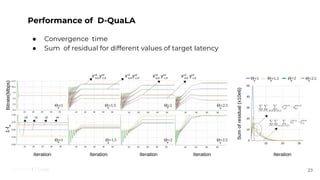
Performance of D-QuaLA
● Convergence time
● Sum of residual for different values of target latency
23
All rights reserved. ©2020
Comparison of C-QuaLA, D-QuaLA
24
Performance of C-QuaLA and D-QuaLA for different values of target latency
Comparison of C-QuaLA, D-QuaLA, and traditional approach
in terms of serving bitrate
All rights reserved. ©2020
Impact of priority on bitrate selection by C-QuaLA
25/12
●
All rights reserved. ©2020
Conclusion and Future Work
● we proposed QuaLA, a video streaming architecture that considers
the high quality and low latency requirements of user-generated live
content (UGC) applications.
○ Centralized- and Distributed-QuaLA
○ Fine-/coarse-grained fairness
● QuaLA showed 57% improvement in bitrate and fairness at various
given target latency values among all the clients.
● Extend QuaLA to support learning-based approach in the future
● Design D-QuaLA for the fine-grained fairness model
26
All rights reserved. ©2020
A Distributed Delivery Architecture for User
Generated Content Live Streaming over HTTP
Christian Doppler laboratory ATHENA | Klagenfurt University | Austria
farzad.tashtarian@aau.at | https://athena.itec.aau.at/
Farzad Tashtarian, Abdelhak Bentaleb, Reza Farahani, Minh Nguyen,
Christian Timmerer, Hermann Hellwagner, and Roger Zimmermann
The 46th IEEE Conference on Local Computer Networks (LCN)
October 4-7, 2021, Edmonton, Canada
27

A Distributed Delivery Architecture for User Generated Content Live Streaming over HTTP

  • 1.
    All rights reserved.©2020 All rights reserved. ©2020 A Distributed Delivery Architecture for User Generated Content Live Streaming over HTTP Christian Doppler laboratory ATHENA | Klagenfurt University | Austria farzad.tashtarian@aau.at | https://athena.itec.aau.at/ Farzad Tashtarian, Abdelhak Bentaleb, Reza Farahani, Minh Nguyen, Christian Timmerer, Hermann Hellwagner, and Roger Zimmermann The 46th IEEE Conference on Local Computer Networks (LCN) October 4-7, 2021, Edmonton, Canada 1
  • 2.
    ● Challenges ofuser generated content ● Problem definition ● Proposed approach ● Results ● Conclusion and future work ● Q&A Agenda 2
  • 3.
    All rights reserved.©2020 User Generated Content ● With the advancement of mobile phones, live User Generated Content (UGC) has become very popular in today’s video streaming applications, in particular with gaming and e-sport. ● Majority of UGC services use HTTP-based adaptive streaming (HAS) for video distribution. ● UGC challenges: ○ Technical complexity of managing parallel streams, ○ Difficult trade-offs with video quality and latency 3
  • 4.
    All rights reserved.©2020 Problem Definition How to dynamically optimize quality and latency fairness for concurrent heterogeneous clients that rapidly join or leave various live UGC stream channels located in different geographical zones? How to design a scalable solution? 4
  • 5.
    All rights reserved.©2020 QuaLA: Joint Quality-Latency Architecture A three-layer, fully distributed architecture for HAS-enabled live UGC delivery over Internet ● Access/Cell Layer ● Edge/Zone Layer ● Backbone/CDN layer 5
  • 6.
    All rights reserved.©2020 QuaLA Design ● Formulate the joint quality-latency fairness problem for optimized QoE of live UGC streaming ○ Centralized QuaLA (C-QuaLA) ○ Distributed QuaLA (D-QuaLA) ● Introduce two concept of QoE fairness : ○ Fine-grained fairness ○ Coarse-grained fairness 6 All rights reserved. ©2020
  • 7.
    All rights reserved.©2020 Centralized QuaLA (C-QuaLA) ● Quality Constraints 7 Set of Cells Source CDN server for v Binary variable Requested live channel by c percentage of all qualities of channel v transmitted to cell c Which qualities should be served by which CDN server? The volume of transmitted data from source CDN servers to cells: C1 C2
  • 8.
    All rights reserved.©2020 Centralized QuaLA (C-QuaLA) ● Latency Constraints and adjusting bitrates from source cell to the CDN server 8 Given latency Transmission bit rate variable Satisfying the given latency by selecting optimal bitrates from CDN server to the requesting cell C3 C4 C5 C6
  • 9.
    All rights reserved.©2020 Centralized QuaLA (C-QuaLA) ... ● Resource Constraints: Considering available bandwidth of cell c, zone z, and CDN server d 9 C7 C8 C9
  • 10.
    All rights reserved.©2020 Fine-grained C-QuaLA and Coarse-grained C-QuaLA Providing quality-latency fairness for each live channel independently The fairness is determined over all live channels 10 Minimum fairness of each live channel v Minimum fairness of all live channels Fine-grained Fairness Coarse-grained Fairness
  • 11.
    All rights reserved.©2020 Distributed QuaLA(D-QuaLA) ● Mathematical distribution techniques: ○ Two blocks of functions and variables (ADMM: The alternating direction method of multipliers)[1] ○ Multi-block approaches: ■ Variable Splitting ADMM [2] ■ ADMM with Gaussian Back Substitution [3] ■ Proximal Jacobian ADMM (ProxJ-ADMM) [4] ● Fast convergence rate 11 [1] S. Boyd, N. Parikh, and E. Chu, Distributed optimization and statistical learning via the alternating direction method of multipliers. Now Publishers Inc, 2011. [2] D. P. Bertsekas and J. N. Tsitsiklis, Parallel and distributed computation: numerical methods. Prentice hall Englewood Cliffs, NJ, 1989, vol. 23. [3] B. He, M. Tao, and X. Yuan, “Alternating direction method with gaussian back substitution for separable convex programming,” SIAM Journal on Optimization, vol. 22, no. 2, pp. 313–340, 2012. [4] W. Deng, M.-J. Lai, Z. Peng, and W. Yin, “Parallel multi-block admm with o (1/k) convergence,” Journal of Scientific Computing, vol. 71, no. 2, pp. 712–736, 2017.
  • 12.
    How Does DistributedQuaLA(D-QuaLA) Work? 12 Applying Proximal Jacobian ADMM (ProxJ-ADMM) method
  • 13.
    How Does DistributedQuaLA(D-QuaLA) Work? 13 Applying Proximal Jacobian ADMM (ProxJ-ADMM) method
  • 14.
    All rights reserved.©2020 How Does Distributed QuaLA(D-QuaLA) Work? 14 Applying Proximal Jacobian ADMM (ProxJ-ADMM) method
  • 15.
    All rights reserved.©2020 Distributed QuaLA(D-QuaLA) for Coarse-grained Fairness How to relax the binary variable 1- Define the following two variables showing the outgoing and incoming video traffics to and from cells and CDN servers: these two variables enable us to run the model over a group of cells in a distributed manner. 2- Define as the required bitrate for downloading video v by cell c with respect to desired qualities 15 From CDN server j to cell i for video v From cell i to CDN server j for video v
  • 16.
  • 17.
    All rights reserved.©2020 Distributed QuaLA(D-QuaLA)... By considering the equality constraints in the proposed model and having the Lagrangian multipliers λ and γ as well as the penalty parameters ρ and ρ , the Lagrangian equation can be represented as follows: 17 1 2
  • 18.
    All rights reserved.©2020 Distributed QuaLA(D-QuaLA)... ● Cell updates 18 ● GCC updates the Lagrangian multipliers λ and γ as follows (if cell c has request(s)) (if cell c hosts streamer(s)) (if cell c has request(s))
  • 19.
    All rights reserved.©2020 Distributed QuaLA(D-QuaLA)... ● Cell updates ( if cell c hosts streamer(s)) 19 where
  • 20.
    All rights reserved.©2020 Distributed QuaLA(D-QuaLA)... ● Cell updates (if cell c has request(s)) 20 where
  • 21.
    All rights reserved.©2020 Distributed QuaLA(D-QuaLA)... ● GCC updates the Lagrangian multipliers λ and γ as follows 21
  • 22.
    All rights reserved.©2020 Performance Evaluation ● To test the practicality of QuaLA in real-world scenarios, we implemented the following entities within CloudLab: ○ streamers use our video dataset to generate video sources (V1–V4) ○ viewers use the open-source Python-based HAS player (AStream) [34] ○ FFmpeg encoder with HAS packager (DASH-based) ○ Apache HTTP server as an origin ○ Python-based HTTP servers for cell VRPs and the GCC 22 M1: all bitrates have the same priority M2: the three lowest bitrates have the higher priority M3: the three highest bitrates have the higher priority
  • 23.
    All rights reserved.©2020 Performance of D-QuaLA ● Convergence time ● Sum of residual for different values of target latency 23
  • 24.
    All rights reserved.©2020 Comparison of C-QuaLA, D-QuaLA 24 Performance of C-QuaLA and D-QuaLA for different values of target latency Comparison of C-QuaLA, D-QuaLA, and traditional approach in terms of serving bitrate
  • 25.
    All rights reserved.©2020 All rights reserved. ©2020 Impact of priority on bitrate selection by C-QuaLA 25/12 ●
  • 26.
    All rights reserved.©2020 Conclusion and Future Work ● we proposed QuaLA, a video streaming architecture that considers the high quality and low latency requirements of user-generated live content (UGC) applications. ○ Centralized- and Distributed-QuaLA ○ Fine-/coarse-grained fairness ● QuaLA showed 57% improvement in bitrate and fairness at various given target latency values among all the clients. ● Extend QuaLA to support learning-based approach in the future ● Design D-QuaLA for the fine-grained fairness model 26
  • 27.
    All rights reserved.©2020 All rights reserved. ©2020 A Distributed Delivery Architecture for User Generated Content Live Streaming over HTTP Christian Doppler laboratory ATHENA | Klagenfurt University | Austria farzad.tashtarian@aau.at | https://athena.itec.aau.at/ Farzad Tashtarian, Abdelhak Bentaleb, Reza Farahani, Minh Nguyen, Christian Timmerer, Hermann Hellwagner, and Roger Zimmermann The 46th IEEE Conference on Local Computer Networks (LCN) October 4-7, 2021, Edmonton, Canada 27