RESINS AND RESIN
COMBINATIONS
DEFINITION
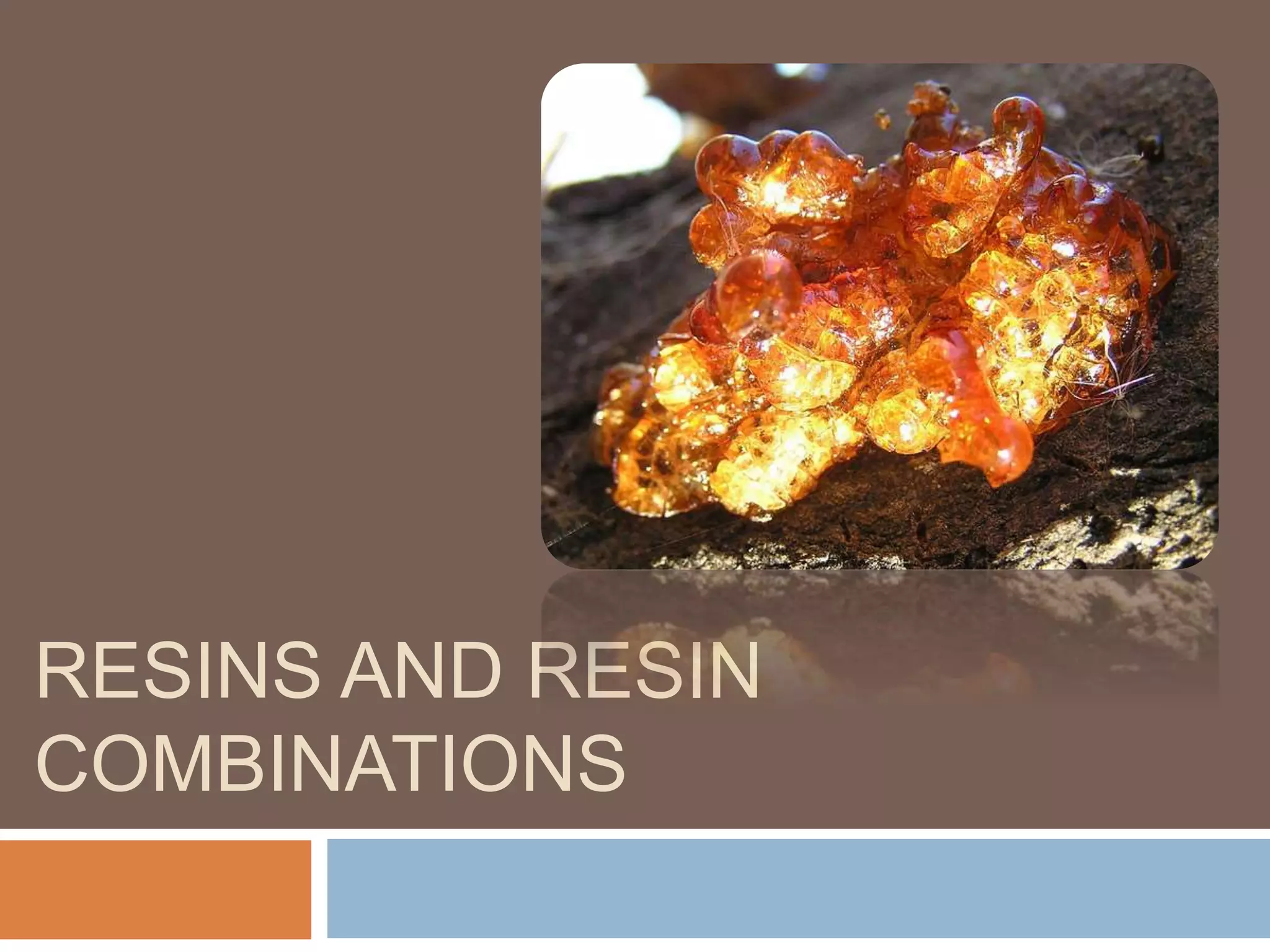
 Resins are solid or semi-solid, amorphous
products derived from natural living sources and
are mostly from the plant origin (exception is
shellac that is obtained from the secretions of
insect)
 Resins are secondary metabolites produced by
higher plants and are nothing but oxidative
products of terpenes
 Obtained as exudates from plants and considered
as end product of metabolism
 Solid or semi-solid amorphous products of
complex chemical nature
PROPERTIES
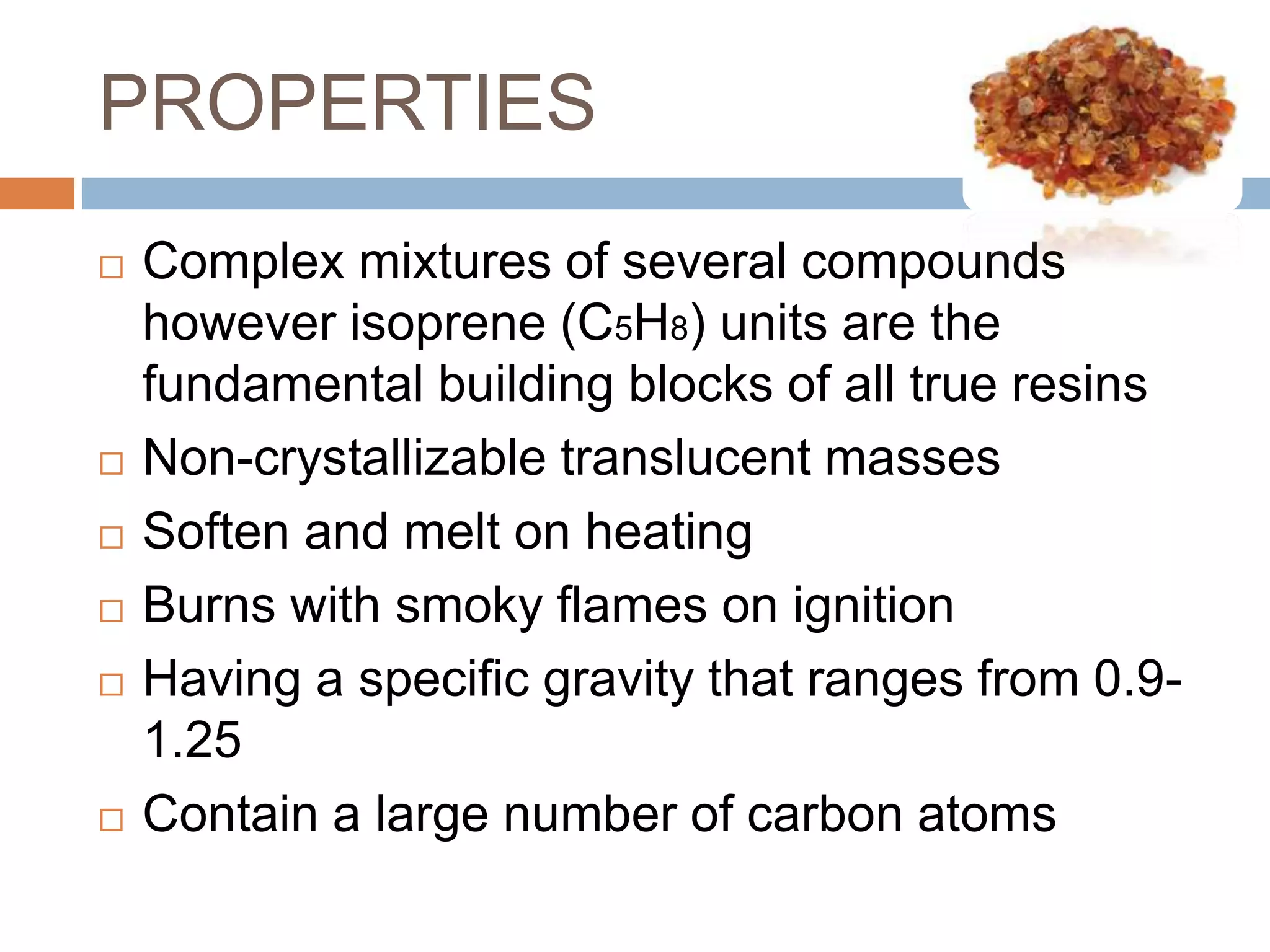
 Complex mixtures of several compounds
however isoprene (C5H8) units are the
fundamental building blocks of all true resins
 Non-crystallizable translucent masses
 Soften and melt on heating
 Burns with smoky flames on ignition
 Having a specific gravity that ranges from 0.9-
1.25
 Contain a large number of carbon atoms
PROPERTIES
 The thin film of resin on drying becomes hard
and transparent which is unaffected by
moisture and air
 Are usually found in homogenous combination
with other plant metabolites and hence,
collectively known as resin combinations
 Practically insoluble in water, but frequently
soluble in ethanol, volatile oils, fixed oils,
chloral hydrate and non-polar organic solvents
(benzene, n-hexane and petroleum ether.
PROPERTIES
 Regarded as the end products of destructive
metabolism
 Majority of them undergo slow atmospheric
oxidation whereby their color gets dark with
impaired solubility
 Acidic resins when treated with alkaline
solutions they yield soaps (or resin-soaps)
DISTRIBUTION
 Resins are generally distributed in plants and
rarely in the insects (e.g. Shellac)
 They are present in the ducts or cavities known as
schizolysigenous ducts
 2 types:
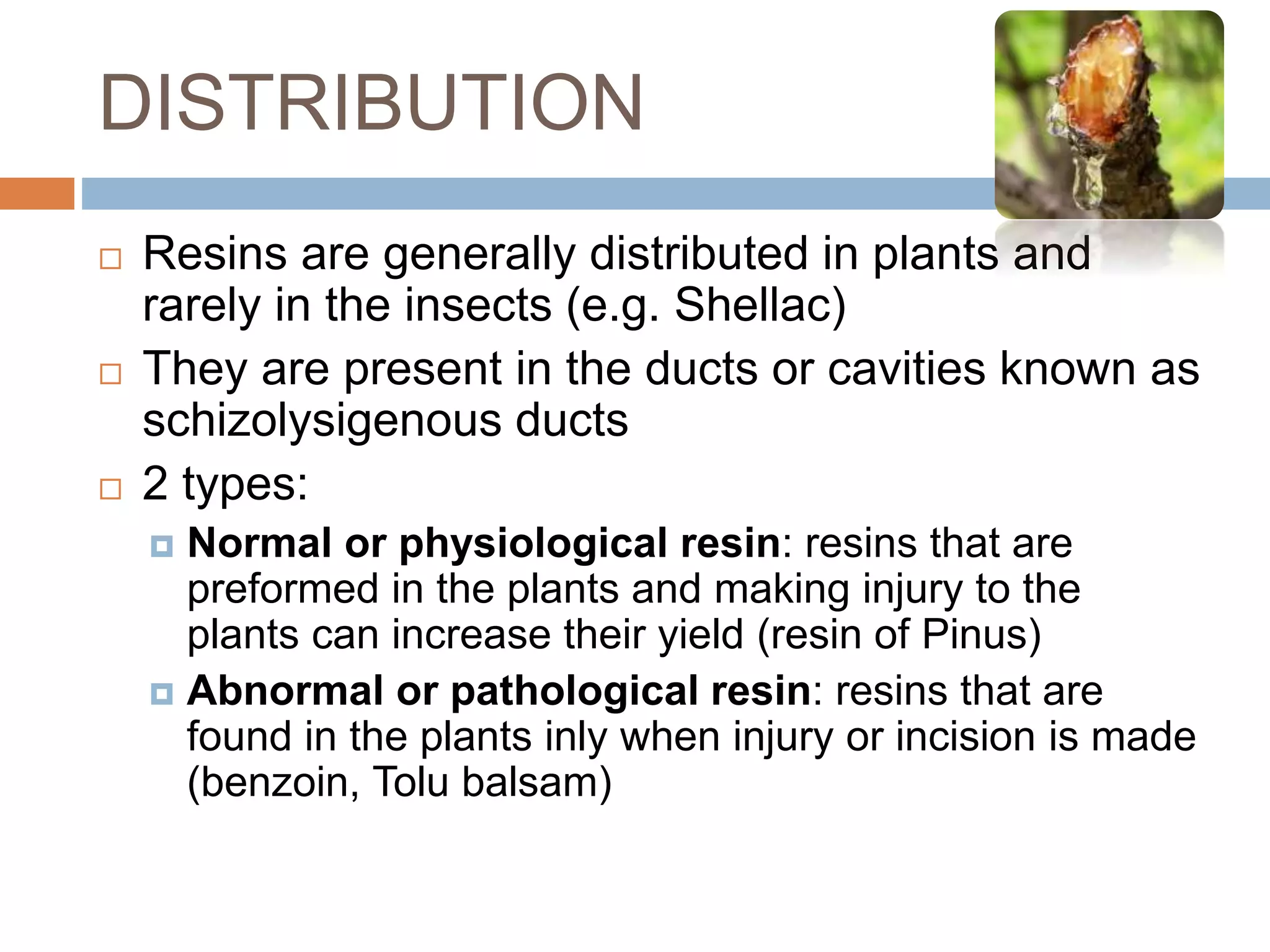
 Normal or physiological resin: resins that are
preformed in the plants and making injury to the
plants can increase their yield (resin of Pinus)
 Abnormal or pathological resin: resins that are
found in the plants inly when injury or incision is made
(benzoin, Tolu balsam)
OCCURENCE
 Usually occur in different secretory zones or
structures. Examples:
 Resin cells
 Ginger
 Schizogenous ducts or Shizolysigenous ducts
or cavities
 Pine wood
 Glandular hairs
 Cannabis
CLASSIFICATION
 On the basis of their formation
A. Physiological resins – these are formed as a
normal product of metabolism without making
injury to the plants
B. Pathological Resins – formed as a result of
wound, injury or abnormal circumstances
(benzoin, colophony, balsams, aloe resin etc.)
CLASSIFICATION
 On the basis of chemical nature
A. Resin acids – resinolic acids
B. Resin alcohols – resinols
C. Resin phenols – resinotannols
D. Ester resins
E. Resenes
CLASSIFICATION
 On the basis of occurrence with other secondary
metabolites
A. Oleoresins – naturally occurring mixtures of a
volatile oil and a resin
B. Gum resins – resin associated with gum
C. Oleo-gum resins – a naturally occurring mix of
volatile oil, gums/mucilagenous compound with a
resin
D. Glycoresins – resins in combination with sugar
compounds via Glycosidal linkages
E. Balsams – resins in combination with benzoic or
cinnamic acid either free or combined
ISOLATION OF RESINS
 By extracting the drug with alcohol and
precipitating resins present in concentrated
extract by addition of large proportion of water
(e.g. Jalap, Ipomea, Podophyllum)
 By distillation for separation of oils (e.g.
Copaiba, Colophony)
 By heating the plant parts (e.g. Guacum)
 As plant exudates my making incision (e.g.
Myrrh, Asafoetida, Balsams)
ISOLATION OF RESINS
 By collecting fossil resins (e.g. Copal, Kaury)
 By processing the incrustations* (e.g. Shellac)
 *In some exceptionally rare instances, the
resin occurs as a result of sucking the juice of
the plants by scale insects and converting the
sucked juice into the resinous substance that
ultimately covers the insect itself and twigs of
the plant (e.g. Laccifer lacca)
EXTRACTION or ISOLATION
methods
 Method – A
Powdered drug
1. Extract the resin with alcohol
2. Filter
3. Concentrate
Concentrate extract an excess of water, shake
Resins get precipitate
EXTRACTION or ISOLATION
methods
 Method – B
Powdered drug containing oleo-resin, percolate
the powdered drug with non-polar solvent (e.g.
acetone, chloroform)
Non-polar solvent
Steam distillation Oleo-resin
Volatile oils (e.g. Rosin)
IDENTIFICATION TEST
 3 types:
 Physical test
 Such as solubility, taste, odor and examination of
powder under the microscope
 Chemical test – for the identification of resins
 Acid value
 Saponification value
 Iodine value
 Specific chemical test – for specific
constituents such as Cinnamic acid, Benzoic
acid in Benzoin, Tolu balsam and Peru Balsam
CHEMICAL TESTS
IDENTIFICATION
TEST
REAGENTS
USED
POSITIVE
RESULT
COMPOUNDS
POSITIVE FOR
THE TEST
HCl TEST HCl Formation of pink
color
Presence of
resins
FeCl3 TEST Fecl3 Greenish blue
color
Presence of
resins
Combined
Umbelliferone
Test
(Specific test for
Asafoetida)
HCl + conc.
NH4OH
Nitric acid
Sulfuric acid
Washed with
water
Blue
fluorescence
Green color
Red color
Violet
Umbelliferone
Copper Acetate
test
Petroleum ether Emerald green Abietic acid
CHEMICAL TESTS
IDENTIFICATION
TEST
REAGENTS
USED
POSITIVE
RESULT
COMPOUNDS
POSITIVE FOR
THE TEST
Test for Aspidium
(Oleoresin)
Diluted alcohol
sol’n + FeCl3
GREEN color Filmarone,
flavaspidinol,
flavaspidic acid
Test for Myrrh
(Oleo-gum-resin)
Ether + HNO3
Br2 vapor
PURPLISH
VIOLET
VIOLET
Commiphoric acid
Test for Benzoin
(Balsam)
Sumatra benzoin:
KMnO4
Petroleum ether
solution + H2SO4
 faint odor of
Benzaldehyde
 REDDISH
BROWN color
Cinnamic acid
CHEMICAL TESTS
IDENTIFICATION
TEST
REAGENTS
USED
POSITIVE
RESULT
COMPOUNDS
POSITIVE FOR
THE TEST
Siam benzoin:
Alc Ext +
Alcoholic FeCl3
Petroleum ether
solution + H2SO4
 GREEN color
 PURPLE-RED
color
Coniferyl
benzoate-tannins
Test for Balsam of
Tolu
FeCl3
KMnO4
 GREEN color
 Odor of
Benzaldehyde
Cinnamic and
benzoic acids
(resinotannol)
Cinnamic acid
PHARMACEUTICAL
APPLICATION
 Resins are local irritant and hence act as local
cathartics (e.g. Jalap and Ipomea)
 As anti cancer (Podophyllum)
 In bronchial asthma (e.g. Cannabis)
 Used externally as mild antiseptic in the form
of tinctures (Benzoin), ointment and plasters
(Turpentine and Colophony)
 Used in the preparation of emulsion and
sustained released formulations
References:
 Pharmacognosy Part I: Rumit M. Shah,
Rupesh T. Nayak and Heena K. Kathad. 1st
ed. New Delhi, Global Vision Publishing
House.
 Trease and Evans' Pharmacognosy, 16th
Edition. William Charles Evans, BPharm, BSc,
PhD, DSc, FIBiol, FLS, FRPharmS. University
of Nottingham, Nottingham, UK
 http://www.epharmacognosy.com/2012/05/resi
ns-and-resin-combinations.html

Resins and Resin Combinations

  • 1.
  • 2.
    DEFINITION  Resins aresolid or semi-solid, amorphous products derived from natural living sources and are mostly from the plant origin (exception is shellac that is obtained from the secretions of insect)  Resins are secondary metabolites produced by higher plants and are nothing but oxidative products of terpenes  Obtained as exudates from plants and considered as end product of metabolism  Solid or semi-solid amorphous products of complex chemical nature
  • 3.
    PROPERTIES  Complex mixturesof several compounds however isoprene (C5H8) units are the fundamental building blocks of all true resins  Non-crystallizable translucent masses  Soften and melt on heating  Burns with smoky flames on ignition  Having a specific gravity that ranges from 0.9- 1.25  Contain a large number of carbon atoms
  • 4.
    PROPERTIES  The thinfilm of resin on drying becomes hard and transparent which is unaffected by moisture and air  Are usually found in homogenous combination with other plant metabolites and hence, collectively known as resin combinations  Practically insoluble in water, but frequently soluble in ethanol, volatile oils, fixed oils, chloral hydrate and non-polar organic solvents (benzene, n-hexane and petroleum ether.
  • 5.
    PROPERTIES  Regarded asthe end products of destructive metabolism  Majority of them undergo slow atmospheric oxidation whereby their color gets dark with impaired solubility  Acidic resins when treated with alkaline solutions they yield soaps (or resin-soaps)
  • 6.
    DISTRIBUTION  Resins aregenerally distributed in plants and rarely in the insects (e.g. Shellac)  They are present in the ducts or cavities known as schizolysigenous ducts  2 types:  Normal or physiological resin: resins that are preformed in the plants and making injury to the plants can increase their yield (resin of Pinus)  Abnormal or pathological resin: resins that are found in the plants inly when injury or incision is made (benzoin, Tolu balsam)
  • 7.
    OCCURENCE  Usually occurin different secretory zones or structures. Examples:  Resin cells  Ginger  Schizogenous ducts or Shizolysigenous ducts or cavities  Pine wood  Glandular hairs  Cannabis
  • 8.
    CLASSIFICATION  On thebasis of their formation A. Physiological resins – these are formed as a normal product of metabolism without making injury to the plants B. Pathological Resins – formed as a result of wound, injury or abnormal circumstances (benzoin, colophony, balsams, aloe resin etc.)
  • 9.
    CLASSIFICATION  On thebasis of chemical nature A. Resin acids – resinolic acids B. Resin alcohols – resinols C. Resin phenols – resinotannols D. Ester resins E. Resenes
  • 10.
    CLASSIFICATION  On thebasis of occurrence with other secondary metabolites A. Oleoresins – naturally occurring mixtures of a volatile oil and a resin B. Gum resins – resin associated with gum C. Oleo-gum resins – a naturally occurring mix of volatile oil, gums/mucilagenous compound with a resin D. Glycoresins – resins in combination with sugar compounds via Glycosidal linkages E. Balsams – resins in combination with benzoic or cinnamic acid either free or combined
  • 11.
    ISOLATION OF RESINS By extracting the drug with alcohol and precipitating resins present in concentrated extract by addition of large proportion of water (e.g. Jalap, Ipomea, Podophyllum)  By distillation for separation of oils (e.g. Copaiba, Colophony)  By heating the plant parts (e.g. Guacum)  As plant exudates my making incision (e.g. Myrrh, Asafoetida, Balsams)
  • 12.
    ISOLATION OF RESINS By collecting fossil resins (e.g. Copal, Kaury)  By processing the incrustations* (e.g. Shellac)  *In some exceptionally rare instances, the resin occurs as a result of sucking the juice of the plants by scale insects and converting the sucked juice into the resinous substance that ultimately covers the insect itself and twigs of the plant (e.g. Laccifer lacca)
  • 13.
    EXTRACTION or ISOLATION methods Method – A Powdered drug 1. Extract the resin with alcohol 2. Filter 3. Concentrate Concentrate extract an excess of water, shake Resins get precipitate
  • 14.
    EXTRACTION or ISOLATION methods Method – B Powdered drug containing oleo-resin, percolate the powdered drug with non-polar solvent (e.g. acetone, chloroform) Non-polar solvent Steam distillation Oleo-resin Volatile oils (e.g. Rosin)
  • 15.
    IDENTIFICATION TEST  3types:  Physical test  Such as solubility, taste, odor and examination of powder under the microscope  Chemical test – for the identification of resins  Acid value  Saponification value  Iodine value  Specific chemical test – for specific constituents such as Cinnamic acid, Benzoic acid in Benzoin, Tolu balsam and Peru Balsam
  • 16.
    CHEMICAL TESTS IDENTIFICATION TEST REAGENTS USED POSITIVE RESULT COMPOUNDS POSITIVE FOR THETEST HCl TEST HCl Formation of pink color Presence of resins FeCl3 TEST Fecl3 Greenish blue color Presence of resins Combined Umbelliferone Test (Specific test for Asafoetida) HCl + conc. NH4OH Nitric acid Sulfuric acid Washed with water Blue fluorescence Green color Red color Violet Umbelliferone Copper Acetate test Petroleum ether Emerald green Abietic acid
  • 17.
    CHEMICAL TESTS IDENTIFICATION TEST REAGENTS USED POSITIVE RESULT COMPOUNDS POSITIVE FOR THETEST Test for Aspidium (Oleoresin) Diluted alcohol sol’n + FeCl3 GREEN color Filmarone, flavaspidinol, flavaspidic acid Test for Myrrh (Oleo-gum-resin) Ether + HNO3 Br2 vapor PURPLISH VIOLET VIOLET Commiphoric acid Test for Benzoin (Balsam) Sumatra benzoin: KMnO4 Petroleum ether solution + H2SO4  faint odor of Benzaldehyde  REDDISH BROWN color Cinnamic acid
  • 18.
    CHEMICAL TESTS IDENTIFICATION TEST REAGENTS USED POSITIVE RESULT COMPOUNDS POSITIVE FOR THETEST Siam benzoin: Alc Ext + Alcoholic FeCl3 Petroleum ether solution + H2SO4  GREEN color  PURPLE-RED color Coniferyl benzoate-tannins Test for Balsam of Tolu FeCl3 KMnO4  GREEN color  Odor of Benzaldehyde Cinnamic and benzoic acids (resinotannol) Cinnamic acid
  • 19.
    PHARMACEUTICAL APPLICATION  Resins arelocal irritant and hence act as local cathartics (e.g. Jalap and Ipomea)  As anti cancer (Podophyllum)  In bronchial asthma (e.g. Cannabis)  Used externally as mild antiseptic in the form of tinctures (Benzoin), ointment and plasters (Turpentine and Colophony)  Used in the preparation of emulsion and sustained released formulations
  • 20.
    References:  Pharmacognosy PartI: Rumit M. Shah, Rupesh T. Nayak and Heena K. Kathad. 1st ed. New Delhi, Global Vision Publishing House.  Trease and Evans' Pharmacognosy, 16th Edition. William Charles Evans, BPharm, BSc, PhD, DSc, FIBiol, FLS, FRPharmS. University of Nottingham, Nottingham, UK  http://www.epharmacognosy.com/2012/05/resi ns-and-resin-combinations.html