Lesson 2
Explain that the Earth
consists of Four Subsystems,
Across whose Boundaries
Matter and Energy Flow
Objectives
1. cite the four subsystems of the
Earth
2. explain what these subsystems
of the Earth consist of
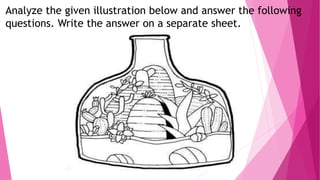
Analyze the given illustration below and answer the following
questions. Write the answer on a separate sheet.
Guide questions:
1. What are the components of the terrarium?
2. Give the functions of each component in the
terrarium that enable life to sustain on it.
3.How can you compare the terrarium to an Earth
system
1 2
3 4
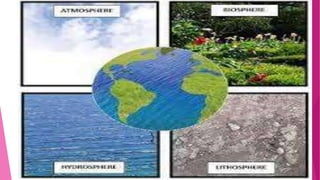
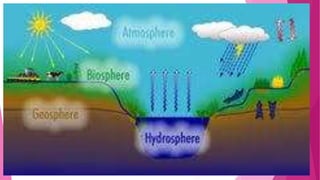
 The planet Earth is home to varied life forms which interact
continuously with the non-living components. There are four
subsystems that composed the earth.
 These include the atmosphere, geosphere, hydrosphere
and biosphere. Each of these systems, allow earth to keep
itself in balance. A change in one system will affect other
system.
In this lesson, you will explain that the earth consists of
four (4) subsystems,across whose boundaries, matter
and energy flow.11
Earth is one of the inner planets in the solar system.
According to radiometric dating record, it is said to
be 4.56 billion years old. It is the only planet in the
solar system to harbor life. Earth is a closed system.
This means that if it gets what it wants, it does not
return it back. It gets energy from the Sun but
returns only some back to space. Biogeochemical
cycles drive the Earth’s subsystems. It is through
these cycles that earth materials are recycled and
replenish. The following are the definitions of the
subsystems.
1. Atmosphere –. Its name rooted from the Greek
word atmos which means gas and sphaira which
means globe or ball
-A set of layers of gases that blankets the planet held
by the planet’s gravity. It is consisted of 78% nitrogen, 20.95%
oxygen, 0.93% argonand 0.04% water vapor including all other
gases. Different layers of theatmosphere include the
troposphere, stratosphere, mesosphere andthermosphere.
- Atmosphere is affected by the Earth’s gravity, so this
is the reason why as the altitude increases the amount
of gases in the atmosphere decreases.
2. Hydrosphere - Hydro is a Greek word which
means water.
is composed of all the water on Earth in any form
It is the liquid component of the Earth including
oceans,glacial waters, and freshwater bodies that
covers 70% of the earth’s surface;98% of the water on
Earth is saltwater.
Water on Earth is constantly and consistently moving
because of temperature and salinity. It also plays an
important role in absorption and redistribution of
solar radiation.
3. Geosphere -comes from the Greek word geos
meaning ground
 It is the solid sphere of the earth. This is where
geologic processes such as volcanism and orogenesis
(mountain building) take place.
. It contains all the soil, rocks, and minerals present
in the crust to the core of the Earth.
It comprises the geologic landforms such as
mountains and hills.
The lithosphere is a part of the geosphere that is
composed of the solid,outermost part of the planet.
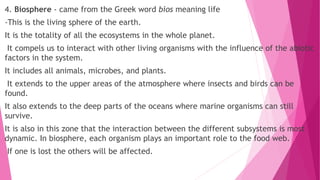
4. Biosphere - came from the Greek word bios meaning life
-This is the living sphere of the earth.
It is the totality of all the ecosystems in the whole planet.
It compels us to interact with other living organisms with the influence of the abiotic
factors in the system.
It includes all animals, microbes, and plants.
It extends to the upper areas of the atmosphere where insects and birds can be
found.
It also extends to the deep parts of the oceans where marine organisms can still
survive.
It is also in this zone that the interaction between the different subsystems is most
dynamic. In biosphere, each organism plays an important role to the food web.
If one is lost the others will be affected.
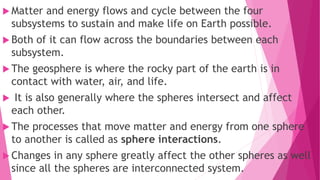
 Matter and energy flows and cycle between the four
subsystems to sustain and make life on Earth possible.
 Both of it can flow across the boundaries between each
subsystem.
 The geosphere is where the rocky part of the earth is in
contact with water, air, and life.
 It is also generally where the spheres intersect and affect
each other.
 The processes that move matter and energy from one sphere
to another is called as sphere interactions.
 Changes in any sphere greatly affect the other spheres as well
since all the spheres are interconnected system.
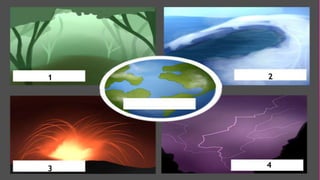
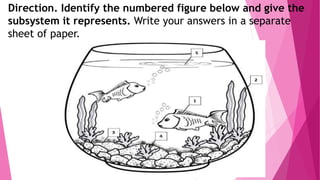
Direction. Identify the numbered figure below and give the
subsystem it represents. Write your answers in a separate
sheet of paper.
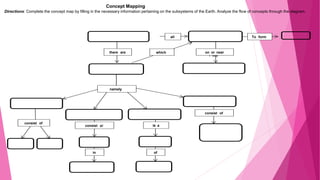
Concept Mapping
Directions: Complete the concept map by filling in the necessary information pertaining on the subsystems of the Earth. Analyze the flow of concepts through the diagram.
all To form
on or near
r near
which
there are
namely
consist of
consist of
consist of
Is a
in of
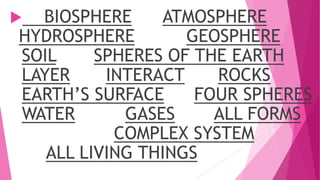
 BIOSPHERE ATMOSPHERE
HYDROSPHERE GEOSPHERE
SOIL SPHERES OF THE EARTH
LAYER INTERACT ROCKS
EARTH’S SURFACE FOUR SPHERES
WATER GASES ALL FORMS
COMPLEX SYSTEM
ALL LIVING THINGS
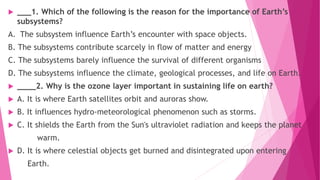
 ___1. Which of the following is the reason for the importance of Earth’s
subsystems?
A. The subsystem influence Earth’s encounter with space objects.
B. The subsystems contribute scarcely in flow of matter and energy
C. The subsystems barely influence the survival of different organisms
D. The subsystems influence the climate, geological processes, and life on Earth.
 ____2. Why is the ozone layer important in sustaining life on earth?
 A. It is where Earth satellites orbit and auroras show.
 B. It influences hydro-meteorological phenomenon such as storms.
 C. It shields the Earth from the Sun's ultraviolet radiation and keeps the planet
warm.
 D. It is where celestial objects get burned and disintegrated upon entering
Earth.
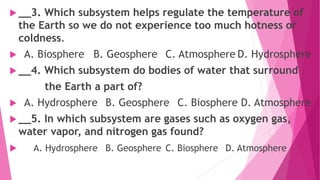
 __3. Which subsystem helps regulate the temperature of
the Earth so we do not experience too much hotness or
coldness.
 A. Biosphere B. Geosphere C. Atmosphere D. Hydrosphere
 __4. Which subsystem do bodies of water that surround
the Earth a part of?
 A. Hydrosphere B. Geosphere C. Biosphere D. Atmosphere
 __5. In which subsystem are gases such as oxygen gas,
water vapor, and nitrogen gas found?
 A. Hydrosphere B. Geosphere C. Biosphere D. Atmosphere

Lesson 2 EARTH'S SUBSYSTEMS.pptx

  • 1.
    Lesson 2 Explain thatthe Earth consists of Four Subsystems, Across whose Boundaries Matter and Energy Flow
  • 2.
    Objectives 1. cite thefour subsystems of the Earth 2. explain what these subsystems of the Earth consist of
  • 3.
    Analyze the givenillustration below and answer the following questions. Write the answer on a separate sheet.
  • 4.
    Guide questions: 1. Whatare the components of the terrarium? 2. Give the functions of each component in the terrarium that enable life to sustain on it. 3.How can you compare the terrarium to an Earth system
  • 5.
  • 7.
     The planetEarth is home to varied life forms which interact continuously with the non-living components. There are four subsystems that composed the earth.  These include the atmosphere, geosphere, hydrosphere and biosphere. Each of these systems, allow earth to keep itself in balance. A change in one system will affect other system. In this lesson, you will explain that the earth consists of four (4) subsystems,across whose boundaries, matter and energy flow.11
  • 8.
    Earth is oneof the inner planets in the solar system. According to radiometric dating record, it is said to be 4.56 billion years old. It is the only planet in the solar system to harbor life. Earth is a closed system. This means that if it gets what it wants, it does not return it back. It gets energy from the Sun but returns only some back to space. Biogeochemical cycles drive the Earth’s subsystems. It is through these cycles that earth materials are recycled and replenish. The following are the definitions of the subsystems.
  • 9.
    1. Atmosphere –.Its name rooted from the Greek word atmos which means gas and sphaira which means globe or ball -A set of layers of gases that blankets the planet held by the planet’s gravity. It is consisted of 78% nitrogen, 20.95% oxygen, 0.93% argonand 0.04% water vapor including all other gases. Different layers of theatmosphere include the troposphere, stratosphere, mesosphere andthermosphere. - Atmosphere is affected by the Earth’s gravity, so this is the reason why as the altitude increases the amount of gases in the atmosphere decreases.
  • 10.
    2. Hydrosphere -Hydro is a Greek word which means water. is composed of all the water on Earth in any form It is the liquid component of the Earth including oceans,glacial waters, and freshwater bodies that covers 70% of the earth’s surface;98% of the water on Earth is saltwater. Water on Earth is constantly and consistently moving because of temperature and salinity. It also plays an important role in absorption and redistribution of solar radiation.
  • 11.
    3. Geosphere -comesfrom the Greek word geos meaning ground  It is the solid sphere of the earth. This is where geologic processes such as volcanism and orogenesis (mountain building) take place. . It contains all the soil, rocks, and minerals present in the crust to the core of the Earth. It comprises the geologic landforms such as mountains and hills. The lithosphere is a part of the geosphere that is composed of the solid,outermost part of the planet.
  • 12.
    4. Biosphere -came from the Greek word bios meaning life -This is the living sphere of the earth. It is the totality of all the ecosystems in the whole planet. It compels us to interact with other living organisms with the influence of the abiotic factors in the system. It includes all animals, microbes, and plants. It extends to the upper areas of the atmosphere where insects and birds can be found. It also extends to the deep parts of the oceans where marine organisms can still survive. It is also in this zone that the interaction between the different subsystems is most dynamic. In biosphere, each organism plays an important role to the food web. If one is lost the others will be affected.
  • 14.
     Matter andenergy flows and cycle between the four subsystems to sustain and make life on Earth possible.  Both of it can flow across the boundaries between each subsystem.  The geosphere is where the rocky part of the earth is in contact with water, air, and life.  It is also generally where the spheres intersect and affect each other.  The processes that move matter and energy from one sphere to another is called as sphere interactions.  Changes in any sphere greatly affect the other spheres as well since all the spheres are interconnected system.
  • 15.
    Direction. Identify thenumbered figure below and give the subsystem it represents. Write your answers in a separate sheet of paper.
  • 16.
    Concept Mapping Directions: Completethe concept map by filling in the necessary information pertaining on the subsystems of the Earth. Analyze the flow of concepts through the diagram. all To form on or near r near which there are namely consist of consist of consist of Is a in of
  • 17.
     BIOSPHERE ATMOSPHERE HYDROSPHEREGEOSPHERE SOIL SPHERES OF THE EARTH LAYER INTERACT ROCKS EARTH’S SURFACE FOUR SPHERES WATER GASES ALL FORMS COMPLEX SYSTEM ALL LIVING THINGS
  • 18.
     ___1. Whichof the following is the reason for the importance of Earth’s subsystems? A. The subsystem influence Earth’s encounter with space objects. B. The subsystems contribute scarcely in flow of matter and energy C. The subsystems barely influence the survival of different organisms D. The subsystems influence the climate, geological processes, and life on Earth.  ____2. Why is the ozone layer important in sustaining life on earth?  A. It is where Earth satellites orbit and auroras show.  B. It influences hydro-meteorological phenomenon such as storms.  C. It shields the Earth from the Sun's ultraviolet radiation and keeps the planet warm.  D. It is where celestial objects get burned and disintegrated upon entering Earth.
  • 19.
     __3. Whichsubsystem helps regulate the temperature of the Earth so we do not experience too much hotness or coldness.  A. Biosphere B. Geosphere C. Atmosphere D. Hydrosphere  __4. Which subsystem do bodies of water that surround the Earth a part of?  A. Hydrosphere B. Geosphere C. Biosphere D. Atmosphere  __5. In which subsystem are gases such as oxygen gas, water vapor, and nitrogen gas found?  A. Hydrosphere B. Geosphere C. Biosphere D. Atmosphere