EKTHA JAIN
CLINICAL PSYCHOLOGIST
DEPT OF PSYCHIATRY
MGMCI
ASSESSMENT & ANALYSIS
1
• CASE HISTORY
2
• QUALITATIVE ANALYSIS
3
• QUANTITATIVE ANALYSIS
DETAILED CASE HISTORY
PRENATAL BIRTH DEVELOPMENTAL
MILESTONES
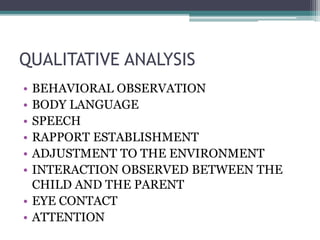
QUALITATIVE ANALYSIS
• BEHAVIORAL OBSERVATION
• BODY LANGUAGE
• SPEECH
• RAPPORT ESTABLISHMENT
• ADJUSTMENT TO THE ENVIRONMENT
• INTERACTION OBSERVED BETWEEN THE
CHILD AND THE PARENT
• EYE CONTACT
• ATTENTION
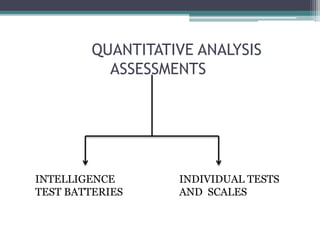
QUANTITATIVE ANALYSIS
ASSESSMENTS
INTELLIGENCE
TEST BATTERIES
INDIVIDUAL TESTS
AND SCALES
TEST BATTERIES
• WESCHLER’S INTELLIGENCE SCALE FOR
CHILDREN (WISC)
• STANDFORD-BINET IQ TEST
• BINET-KAMAT TEST OF INTELLIGENCE
(BKT)
• KAUFFMAN ASSESSMENT BATTERY FOR
CHILDREN (K-ABC)
• BHATIA’S BATTERY OF PERFORMANCE
INTELLIGENCE TEST
• STANDARD PROGRESSIVE MATRICES (SPM)
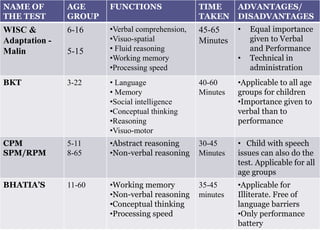
NAME OF
THE TEST
AGE
GROUP
FUNCTIONS TIME
TAKEN
ADVANTAGES/
DISADVANTAGES
WISC &
Adaptation -
Malin
6-16
5-15
•Verbal comprehension,
•Visuo-spatial
• Fluid reasoning
•Working memory
•Processing speed
45-65
Minutes
• Equal importance
given to Verbal
and Performance
• Technical in
administration
BKT 3-22 • Language
• Memory
•Social intelligence
•Conceptual thinking
•Reasoning
•Visuo-motor
40-60
Minutes
•Applicable to all age
groups for children
•Importance given to
verbal than to
performance
CPM
SPM/RPM
5-11
8-65
•Abstract reasoning
•Non-verbal reasoning
30-45
Minutes
• Child with speech
issues can also do the
test. Applicable for all
age groups
BHATIA’S 11-60 •Working memory
•Non-verbal reasoning
•Conceptual thinking
•Processing speed
35-45
minutes
•Applicable for
Illiterate. Free of
language barriers
•Only performance
battery
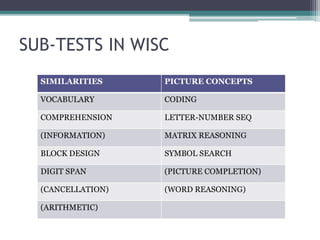
SUB-TESTS IN WISC
SIMILARITIES PICTURE CONCEPTS
VOCABULARY CODING
COMPREHENSION LETTER-NUMBER SEQ
(INFORMATION) MATRIX REASONING
BLOCK DESIGN SYMBOL SEARCH
DIGIT SPAN (PICTURE COMPLETION)
(CANCELLATION) (WORD REASONING)
(ARITHMETIC)
Individual tests and scales
Name of the
test
Age group Functions Time
taken
Advantages/
Disadvantages
Seguin Form
board test
3 to 15
years
• Speed and
accuracy
• Activity level
10 seconds
– 1 minute
•Easy task
•Limited to Eye-
hand co-ordination
Vineland Social
Maturity scale
1 to 18 years • Social maturity
• Adaptation to
environment
10 minutes • Growth of Daily
tasks measured
•Not culture specific
Developmental
psychopathology
checklist for
children
1-15 years •Social contact
•Fine motor
•Language
•Gross-motor
10 minutes •Detectes severe
developmental
problems
•IQ cannot be
achieved
quantitatively
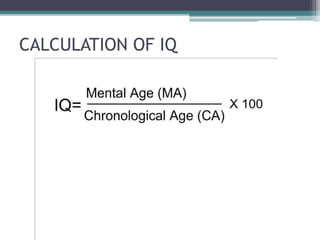
CALCULATION OF IQ
FACTORS THAT HINDER ASSESSMENT
• COMPREHENSION CAPACITY OF THE CHILD
• MOTIVATION OF THE CHILD
• PARENT’S MOTIVATION TO ASSESS THE
CHILD
• ATTENTION LEVEL OF THE CHILD
• ENVIRONMENTAL DISTRACTIONS
• TIMINGS WHEN THE TESTS ARE
ADMINISTERED
Intellectual disability

Intellectual disability

  • 1.
  • 3.
    ASSESSMENT & ANALYSIS 1 •CASE HISTORY 2 • QUALITATIVE ANALYSIS 3 • QUANTITATIVE ANALYSIS
  • 4.
    DETAILED CASE HISTORY PRENATALBIRTH DEVELOPMENTAL MILESTONES
  • 5.
    QUALITATIVE ANALYSIS • BEHAVIORALOBSERVATION • BODY LANGUAGE • SPEECH • RAPPORT ESTABLISHMENT • ADJUSTMENT TO THE ENVIRONMENT • INTERACTION OBSERVED BETWEEN THE CHILD AND THE PARENT • EYE CONTACT • ATTENTION
  • 6.
  • 7.
    TEST BATTERIES • WESCHLER’SINTELLIGENCE SCALE FOR CHILDREN (WISC) • STANDFORD-BINET IQ TEST • BINET-KAMAT TEST OF INTELLIGENCE (BKT) • KAUFFMAN ASSESSMENT BATTERY FOR CHILDREN (K-ABC) • BHATIA’S BATTERY OF PERFORMANCE INTELLIGENCE TEST • STANDARD PROGRESSIVE MATRICES (SPM)
  • 8.
    NAME OF THE TEST AGE GROUP FUNCTIONSTIME TAKEN ADVANTAGES/ DISADVANTAGES WISC & Adaptation - Malin 6-16 5-15 •Verbal comprehension, •Visuo-spatial • Fluid reasoning •Working memory •Processing speed 45-65 Minutes • Equal importance given to Verbal and Performance • Technical in administration BKT 3-22 • Language • Memory •Social intelligence •Conceptual thinking •Reasoning •Visuo-motor 40-60 Minutes •Applicable to all age groups for children •Importance given to verbal than to performance CPM SPM/RPM 5-11 8-65 •Abstract reasoning •Non-verbal reasoning 30-45 Minutes • Child with speech issues can also do the test. Applicable for all age groups BHATIA’S 11-60 •Working memory •Non-verbal reasoning •Conceptual thinking •Processing speed 35-45 minutes •Applicable for Illiterate. Free of language barriers •Only performance battery
  • 9.
    SUB-TESTS IN WISC SIMILARITIESPICTURE CONCEPTS VOCABULARY CODING COMPREHENSION LETTER-NUMBER SEQ (INFORMATION) MATRIX REASONING BLOCK DESIGN SYMBOL SEARCH DIGIT SPAN (PICTURE COMPLETION) (CANCELLATION) (WORD REASONING) (ARITHMETIC)
  • 10.
    Individual tests andscales Name of the test Age group Functions Time taken Advantages/ Disadvantages Seguin Form board test 3 to 15 years • Speed and accuracy • Activity level 10 seconds – 1 minute •Easy task •Limited to Eye- hand co-ordination Vineland Social Maturity scale 1 to 18 years • Social maturity • Adaptation to environment 10 minutes • Growth of Daily tasks measured •Not culture specific Developmental psychopathology checklist for children 1-15 years •Social contact •Fine motor •Language •Gross-motor 10 minutes •Detectes severe developmental problems •IQ cannot be achieved quantitatively
  • 12.
  • 17.
    FACTORS THAT HINDERASSESSMENT • COMPREHENSION CAPACITY OF THE CHILD • MOTIVATION OF THE CHILD • PARENT’S MOTIVATION TO ASSESS THE CHILD • ATTENTION LEVEL OF THE CHILD • ENVIRONMENTAL DISTRACTIONS • TIMINGS WHEN THE TESTS ARE ADMINISTERED