English for Academic Purposes (EAP) vs.
general English—a 101 crash course
Presenter: Zoe Smith
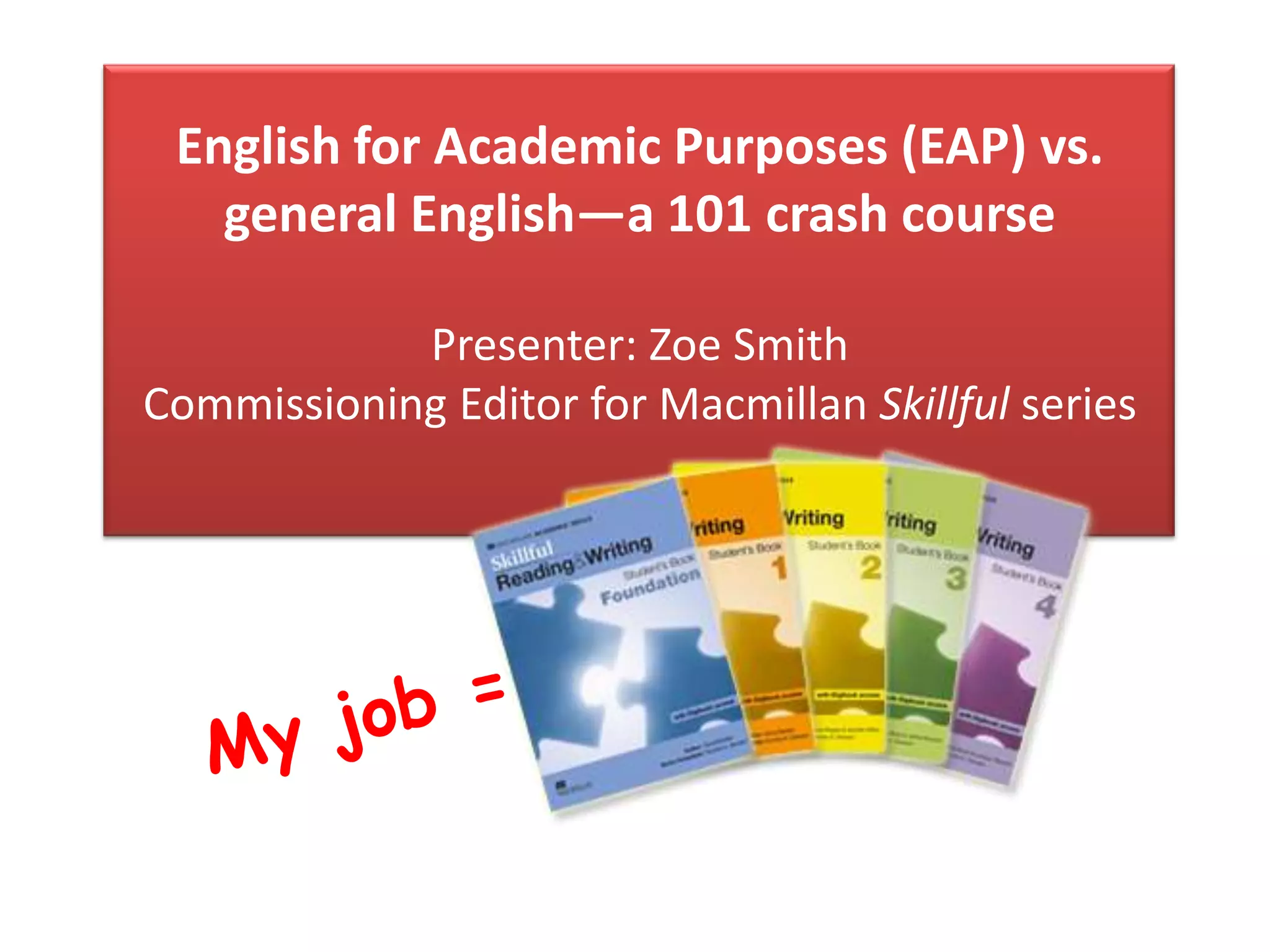
Commissioning Editor for Macmillan Skillful series
Summary:
EAP has been one of the most recent booms in English language
markets across the world, with a free flow of international
students wishing to gain access to higher education courses
taught in English. But what does EAP mean exactly, and how
should a teacher trained in traditional ELT methods adapt to
students who need to operate in a higher education learning
environment? This presentation offers an overview of some of
the differences between teaching and studying EAP vs. general
English, featuring excerpts from Macmillan’s brand new EAP
series, Skillful.
© Zoe Smith, 2013 2
Unit 1: At the Shops
Exciting Role Play
Storekeeper: Hello. How can I help you?
Customer: Hello. I would like to buy a loaf of bread.
Storekeeper: Sure. Bread is in aisle 3.
Customer: Where is aisle 3?
Storekeeper: It’s over there. It’s next to the pasta.
Customer: And how much is the bread?
Storekeeper: I don’t know. It’s on the price tag.
Customer: Oh, okay. Thank you.
Storekeeper: You’re welcome. Have a nice day. And we’ll discuss
quantum physics next time.
© Zoe Smith, 2013 3
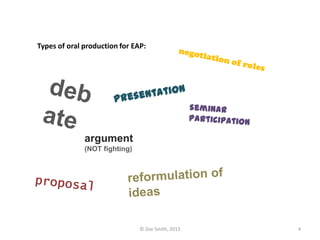
Types of oral production for EAP:
© Zoe Smith, 2013 4
argument
(NOT fighting)
© Zoe Smith, 2013 5
However, many international students fail to reach their
potential at an overseas university.
Why?
Knowing how to structure the
language they know effectively.
© Zoe Smith, 2013 6
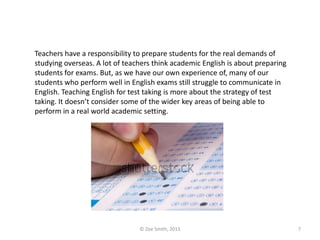
Teachers have a responsibility to prepare students for the real demands of
studying overseas. A lot of teachers think academic English is about preparing
students for exams. But, as we have our own experience of, many of our
students who perform well in English exams still struggle to communicate in
English. Teaching English for test taking is more about the strategy of test
taking. It doesn’t consider some of the wider key areas of being able to
perform in a real world academic setting.
© Zoe Smith, 2013 7
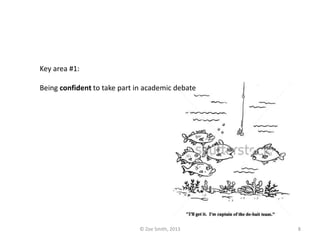
Key area #1:
Being confident to take part in academic debate
© Zoe Smith, 2013 8
Sub issue a:
Cultural difference – in a Western university, students must not
be afraid of expressing their opinion. To some extent, this is
about CONFIDENCE.
Critical thinking - It’s also important your students understand
the word ‘CRITICAL’. It doesn’t mean that you say bad things
about your teacher’s clothing, for example. The word ‘critical’
has had a much more sophisticated concept for around 500
years, related to the word ‘crucial’, and being about deciding
what is most important in the meaning of something.
CRITICAL THINKING is at the heart of EAP.
© Zoe Smith, 2013 9
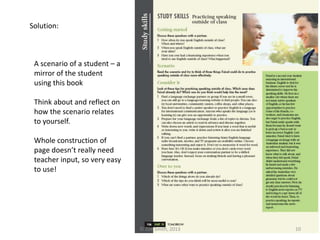
Solution:
© Zoe Smith, 2013 10
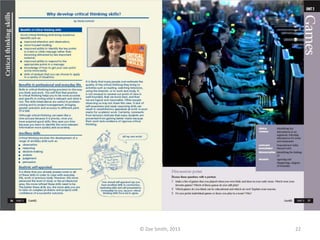
A scenario of a student – a
mirror of the student
using this book
Think about and reflect on
how the scenario relates
to yourself.
Whole construction of
page doesn’t really need
teacher input, so very easy
to use!
Sub issue b:
Students feel linguistically inadequate alongside native-speaker
students. After all, surely only a native speaker is going to say
something such as:
“Well if you’d care for my impartial view on
the matter, which pertains to the utmost
thought of the philosopher in question, I’d
surmise that the answer to your question
would be ‘no’.”
© Zoe Smith, 2013 11
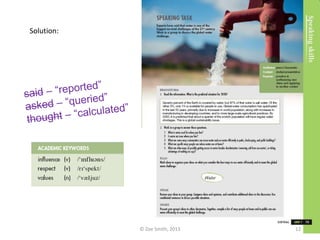
Solution:
© Zoe Smith, 2013 12
Key area #2:
Knowing how to write an academic essay in English
© Zoe Smith, 2013 13
Sub issue 1:
Cultural difference – some cultures favour indirect, vague
language, that never gets to the main point.
Some cultures also favour plagiarism – after all, why
try to disrespect text that another author has already written
perfectly elsewhere?
© Zoe Smith, 2013 14
Solution:
It is as much about understanding
organizational frameworks of language as
it is to understand the content and all the words within a text.
© Zoe Smith, 2013 15
© Zoe Smith, 2013 16
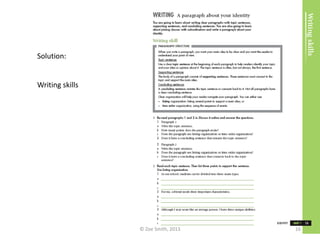
Solution:
Writing skills
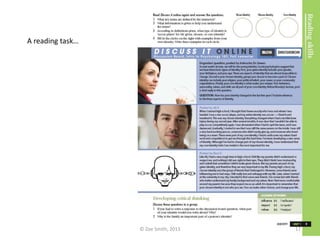
A reading task…
© Zoe Smith, 2013 17
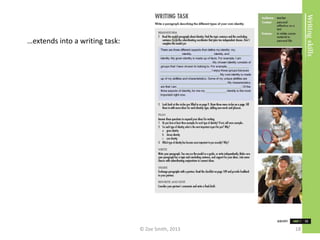
…extends into a writing task:
© Zoe Smith, 2013 18
Sub issue b:
Students feel linguistically inadequate alongside native
speaker students. After all, surely only a native speaker is going to be able to
know how to select the correct modal verbs to make this sentence sound really
respectful:
Well if you’d care for my impartial view on the
matter, which pertains to the utmost thought of the
philosopher in question, I’d surmise that the answer
to your question would be ‘no’.
© Zoe Smith, 2013 19
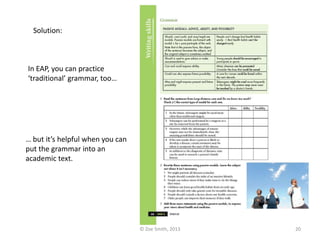
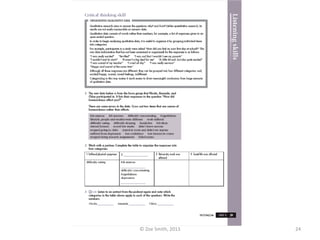
In EAP, you can practice
‘traditional’ grammar, too…
… but it’s helpful when you can
put the grammar into an
academic text.
Solution:
© Zoe Smith, 2013 20
© Zoe Smith, 2013 21
© Zoe Smith, 2013 22
© Zoe Smith, 2013 23
© Zoe Smith, 2013 24
© Zoe Smith, 2013 25
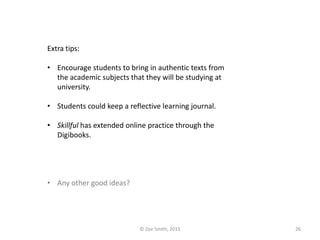
Extra tips:
• Encourage students to bring in authentic texts from
the academic subjects that they will be studying at
university.
• Students could keep a reflective learning journal.
• Skillful has extended online practice through the
Digibooks.
• Any other good ideas?
© Zoe Smith, 2013 26
=The End=
Presenter contact: zoe.smith@macmillan.com
Skillful website: www.macmillanskillful.com
© Zoe Smith, 2013 27

English for Academic Purposes (EAP) vs. general English—a 101 crash course . Zoe Smith

  • 1.
    English for AcademicPurposes (EAP) vs. general English—a 101 crash course Presenter: Zoe Smith Commissioning Editor for Macmillan Skillful series
  • 2.
    Summary: EAP has beenone of the most recent booms in English language markets across the world, with a free flow of international students wishing to gain access to higher education courses taught in English. But what does EAP mean exactly, and how should a teacher trained in traditional ELT methods adapt to students who need to operate in a higher education learning environment? This presentation offers an overview of some of the differences between teaching and studying EAP vs. general English, featuring excerpts from Macmillan’s brand new EAP series, Skillful. © Zoe Smith, 2013 2
  • 3.
    Unit 1: Atthe Shops Exciting Role Play Storekeeper: Hello. How can I help you? Customer: Hello. I would like to buy a loaf of bread. Storekeeper: Sure. Bread is in aisle 3. Customer: Where is aisle 3? Storekeeper: It’s over there. It’s next to the pasta. Customer: And how much is the bread? Storekeeper: I don’t know. It’s on the price tag. Customer: Oh, okay. Thank you. Storekeeper: You’re welcome. Have a nice day. And we’ll discuss quantum physics next time. © Zoe Smith, 2013 3
  • 4.
    Types of oralproduction for EAP: © Zoe Smith, 2013 4 argument (NOT fighting)
  • 5.
  • 6.
    However, many internationalstudents fail to reach their potential at an overseas university. Why? Knowing how to structure the language they know effectively. © Zoe Smith, 2013 6
  • 7.
    Teachers have aresponsibility to prepare students for the real demands of studying overseas. A lot of teachers think academic English is about preparing students for exams. But, as we have our own experience of, many of our students who perform well in English exams still struggle to communicate in English. Teaching English for test taking is more about the strategy of test taking. It doesn’t consider some of the wider key areas of being able to perform in a real world academic setting. © Zoe Smith, 2013 7
  • 8.
    Key area #1: Beingconfident to take part in academic debate © Zoe Smith, 2013 8
  • 9.
    Sub issue a: Culturaldifference – in a Western university, students must not be afraid of expressing their opinion. To some extent, this is about CONFIDENCE. Critical thinking - It’s also important your students understand the word ‘CRITICAL’. It doesn’t mean that you say bad things about your teacher’s clothing, for example. The word ‘critical’ has had a much more sophisticated concept for around 500 years, related to the word ‘crucial’, and being about deciding what is most important in the meaning of something. CRITICAL THINKING is at the heart of EAP. © Zoe Smith, 2013 9
  • 10.
    Solution: © Zoe Smith,2013 10 A scenario of a student – a mirror of the student using this book Think about and reflect on how the scenario relates to yourself. Whole construction of page doesn’t really need teacher input, so very easy to use!
  • 11.
    Sub issue b: Studentsfeel linguistically inadequate alongside native-speaker students. After all, surely only a native speaker is going to say something such as: “Well if you’d care for my impartial view on the matter, which pertains to the utmost thought of the philosopher in question, I’d surmise that the answer to your question would be ‘no’.” © Zoe Smith, 2013 11
  • 12.
  • 13.
    Key area #2: Knowinghow to write an academic essay in English © Zoe Smith, 2013 13
  • 14.
    Sub issue 1: Culturaldifference – some cultures favour indirect, vague language, that never gets to the main point. Some cultures also favour plagiarism – after all, why try to disrespect text that another author has already written perfectly elsewhere? © Zoe Smith, 2013 14
  • 15.
    Solution: It is asmuch about understanding organizational frameworks of language as it is to understand the content and all the words within a text. © Zoe Smith, 2013 15
  • 16.
    © Zoe Smith,2013 16 Solution: Writing skills
  • 17.
    A reading task… ©Zoe Smith, 2013 17
  • 18.
    …extends into awriting task: © Zoe Smith, 2013 18
  • 19.
    Sub issue b: Studentsfeel linguistically inadequate alongside native speaker students. After all, surely only a native speaker is going to be able to know how to select the correct modal verbs to make this sentence sound really respectful: Well if you’d care for my impartial view on the matter, which pertains to the utmost thought of the philosopher in question, I’d surmise that the answer to your question would be ‘no’. © Zoe Smith, 2013 19
  • 20.
    In EAP, youcan practice ‘traditional’ grammar, too… … but it’s helpful when you can put the grammar into an academic text. Solution: © Zoe Smith, 2013 20
  • 21.
  • 22.
  • 23.
  • 24.
  • 25.
  • 26.
    Extra tips: • Encouragestudents to bring in authentic texts from the academic subjects that they will be studying at university. • Students could keep a reflective learning journal. • Skillful has extended online practice through the Digibooks. • Any other good ideas? © Zoe Smith, 2013 26
  • 27.
    =The End= Presenter contact:zoe.smith@macmillan.com Skillful website: www.macmillanskillful.com © Zoe Smith, 2013 27

Editor's Notes

  • #4 Most teachers are familiar with giving students tasks such as role-playing buying some bread in a shop. Advanced students might be taught how to complain and get a refund if they don’t like the bread they’ve just bought. You might also have given a writing task: Write about your summer vacation (hidden motive = great practice for the past simple tense!)But all of this is very synthetic production. It’s simplified, often unnatural, and the given situations are often not that useful to an academic context. (We’ll see some more useful material later.) These types of typical general English role plays don’t allow students to move up to native-level competence.
  • #5 Most teachers are familiar with giving students tasks such as role playing buying some bread in a shop. Advanced students might be taught how to complain and get a refund if they don’t like the bread they’ve just bought. You might also have given a writing task: Write about your summer vacation (hidden motive = great practice for the past simple tense!)
  • #6 These days, the goal of many students is to study overseas in an English-speaking university, for part or all of their university studies. Many students entering overseas educational establishments arrive with a good range of English expressions. – Afterall, you’ve carefully prepared them to buy bread in a shop, so at least they will never starve! These students might also have done well academically back home, and know a lot about their subject in their mother tongue. They are fundamentally smart individuals.
  • #9 I used to tell my students that 50% of your success in English relates to how much confidence you have.
  • #10 In some cultures, “critical” = bad – it has political associations.
  • #11 One way to develop confidence and start to develop critical thinking skills is to get the students to start to analyze their own habits and practice in applying the English they know to academic situations – ie self awareness.Students need to be taught study skills in addition to functional language knowledge. They also need more English practice outside of class, since we might only see our students for a couple of hours each week. Ideas for building confidence and getting more language practice:
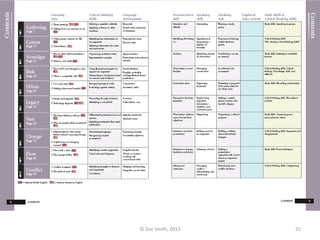
  • #13 The first thing you can do: start to encourage habit formation of replacing ‘simple’ words with their academic equivalent.Building confidence is a key issue here, and some of that confidence can be addressed by the students getting more time to practice English, as discussed above.Whereas in many general English course books, students are given a very artificially constructed role play model, this isn’t sufficient for EAP. EAP students need more challenging academic topics. Using topics that come from academic curricula material and from real media are much better. The function of speaking in EAP is not to get a material reward, such as a loaf of bread. The purpose is to be able to demonstrate the ability to organize ideas, process other people’s ideas, and display solid knowledge about the topic area. Don’t provide simplistic material. Challenge your students and push them to critically analyze that material.Students also need to learn how to plan their ideas for extended participation in a debate or seminar. Just like in preparing for this webinar, even native English speakers need a chance to think about what they want to say before they say it if it is to sound good – at least, I hope my talk sounds good.The staging of the Speaking Task page below offers a good model for:Reading background informationHaving an informal initial group discussion – this is the opportunity to get some further ideas from other peoplePlanning through brainstorming or mind-mapping – a very efficient way to organize ideas without needing to write a long script; allows students to mentally rehearse ideas that they think are importantSpeak in small groups – now is the time to show off your ideas about the topic; if students have made their notes on card prompts, don’t let them be afraid to read from them to remind them what they want to talk aboutShare with the whole class – students have already spoken in front of other students.
  • #14 So much of academic assessment is based on the ability to write essays. Written formal language is quite a different style to how we casually think.
  • #15 Some teachers don’t actually recognize this – there is a zero tolerance approach to plagiarism in the West
  • #17 Writing skill – Paragraph structureHere, we see the key framework needed for an academic essay.
  • #18 Then, we have the chance to identify this framework in action in a reading text.
  • #19 The first activity uses a framework support to guide students to write an effective topic sentence from the outset. Also, the topic itself isn’t purely just ‘about me’, but adds the more sophisticated angle of ‘identity’. Students are now automatically weaving the necessary structures together with nice vocabulary.Again, we’re back to the habit-formation training of brainstorming and planning before you write or speak.
  • #21 This is where the design of a good EAP book becomes important, as it might be difficult to find target grammar in authentic materials, and organize those materials in a meaningful syllabus.