Lesson 1: Introductionto English for Academic
and Professional Purposes | EAPP
Differentiating Academic and
Non-Academic Text
Types of academic and Non-
Academic Texts
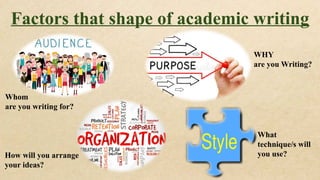
Factors that Shape Academic
Writing
3.
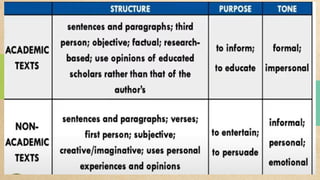
Academic
Text
Written by
professionals in
thegiven field
Well-edited and
often takes years to
publish
Uses Formal
language
Contains words
and terms specific
to the field
(jargons).
4.
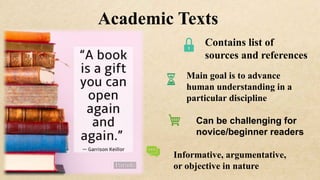
Academic Texts
Main goalis to advance
human understanding in a
particular discipline
Can be challenging for
novice/beginner readers
Informative, argumentative,
or objective in nature
Contains list of
sources and references
5.
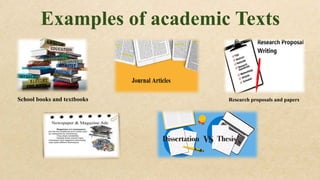
Examples of academicTexts
School books and textbooks Research proposals and papers
6.
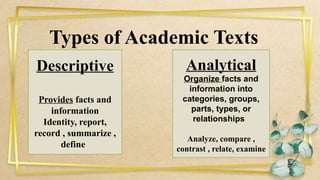
Types of AcademicTexts
Descriptive
Provides facts and
information
Identity, report,
record , summarize ,
define
Analytical
Organize facts and
information into
categories, groups,
parts, types, or
relationships
Analyze, compare ,
contrast , relate, examine
7.
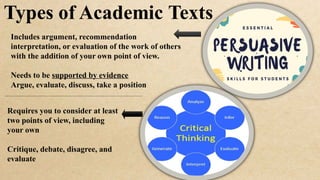
Includes argument, recommendation
interpretation,or evaluation of the work of others
with the addition of your own point of view.
Needs to be supported by evidence
Argue, evaluate, discuss, take a position
Requires you to consider at least
two points of view, including
your own
Critique, debate, disagree, and
evaluate
8.
Non- Academic Texts
Writtenfor the
mass public
May
contain
slang
2019
2020
2021
2022
2023
2018
Uses informal and
more conversational
language
Often doesn’t involve
research or sources
Published quickly and can
be written by anyone
9.
Non-Academic Texts
01
02
03
04
Author maybe unknown
Usually delivers simple and basic
information
Can be read and easily understood by
any kind of reader
Personal, emotional, impressionistic,
or subjective in nature
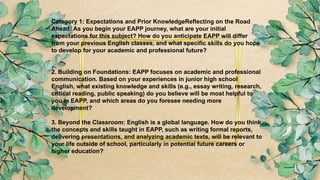
Category 1: Expectationsand Prior KnowledgeReflecting on the Road
Ahead: As you begin your EAPP journey, what are your initial
expectations for this subject? How do you anticipate EAPP will differ
from your previous English classes, and what specific skills do you hope
to develop for your academic and professional future?
2. Building on Foundations: EAPP focuses on academic and professional
communication. Based on your experiences in junior high school
English, what existing knowledge and skills (e.g., essay writing, research,
critical reading, public speaking) do you believe will be most helpful to
you in EAPP, and which areas do you foresee needing more
development?
3. Beyond the Classroom: English is a global language. How do you think
the concepts and skills taught in EAPP, such as writing formal reports,
delivering presentations, and analyzing academic texts, will be relevant to
your life outside of school, particularly in potential future careers or
higher education?
Editor's Notes
#1 WELCOME TO OUR SUBJECT ENGLISH FOR ACADEMIC AND PROFESSIONAL PURPOSES.
#3 LET’S BEGIN BY DEFINING WHAT ACADEMIC TEXTS ARE. ACADEMIC TEXTS ARE SIMPLY CHARACTERIZED AS TYPE OF FACTS THAT ARE WRITTEN BY FROFESSIONALS IN A PARTICULAR FIELD. SO FOR INSTANCE, MEDICAL FIELD, EDUCATION FIELD AND SO ON AND SO FORTH. THIS TYPE OF TEXT IS ALSO WELL EDITED AND IT OFTEN TAKES YEARS TO PUBLISH, IT’S NOT EASY TO COME UP WITH A PARTICULAR ACADEMIC TEXT AND EVEN TO GET SOMEONE AND OR HAVE A PUBLISHER, IT IS ALSO A KIND OF TEXT THAT USES FORMAL LANGUAGE. SIMILARLY SINCE IT IS WRITTEN BY PROFESSIONALS IN A PARTICULAR FIELD, ACADEMIC TEXT CONTAINS WORDS AND TERMS THAT ARE VERY SPECIFIC TO THAT PARTICULAR FIELD, LIKE FOR EXAMPLE IF IT’S A DOCTOR WRITING ABOUT CERTAIN THINGS IN THE FIELD OF MEDICINE, THEN THEREFORE HE OR SHE MIGHT BE USING WORDS AND TERMS THAT ARE SPECIFIC TO MEDICINE ALONE AND PEOPLE LIKE US, FOR EXAMPLE ARE NOT FAMILIAR WITH THE FIELD OF MEDICINE, WE CAN CONSIDER THIS TERMS AS UNFAMILIAR TO US. NOW, THESE TERMS THAT ARE VERY SPECIFIC, THESE WORDS AND TERMS THAT ARE SPECIFIC TO A PARTICULAR FIELD ARE WHAT WE REFER TO AS JARGONS. (special words or expressions that are used by a particular profession or group and are difficult for others to understand)
#4 ACADEMIC TEXTS ALSO CONTAIN A LIST OF SOURCES AND REFERENCES, SO WHAT DO WE MEAN BY THAT? EVERY PIECE OF INFORMATION THAT IS PRESENTED IN A PARTICULAR ACADEMIC TEXT, HAS TO BE BACKED UP BY OR IT HAS TO BE SUPPORTED BY OTHER SOURCES THAT HAVE TO BE VALIDATED BY OTHER REFERENCES MORE OFTEN THAN NOT WHEN YOU FORM ACADEMIC TEXTS, YOU REFER TO OTHER SOURCES AS WELL.








![Academic Reading and Writing [Autosaved].pptx](https://cdn.slidesharecdn.com/ss_thumbnails/academicreadingandwritingautosaved-230928222324-89318f29-thumbnail.jpg?width=640&height=640&fit=bounds)


