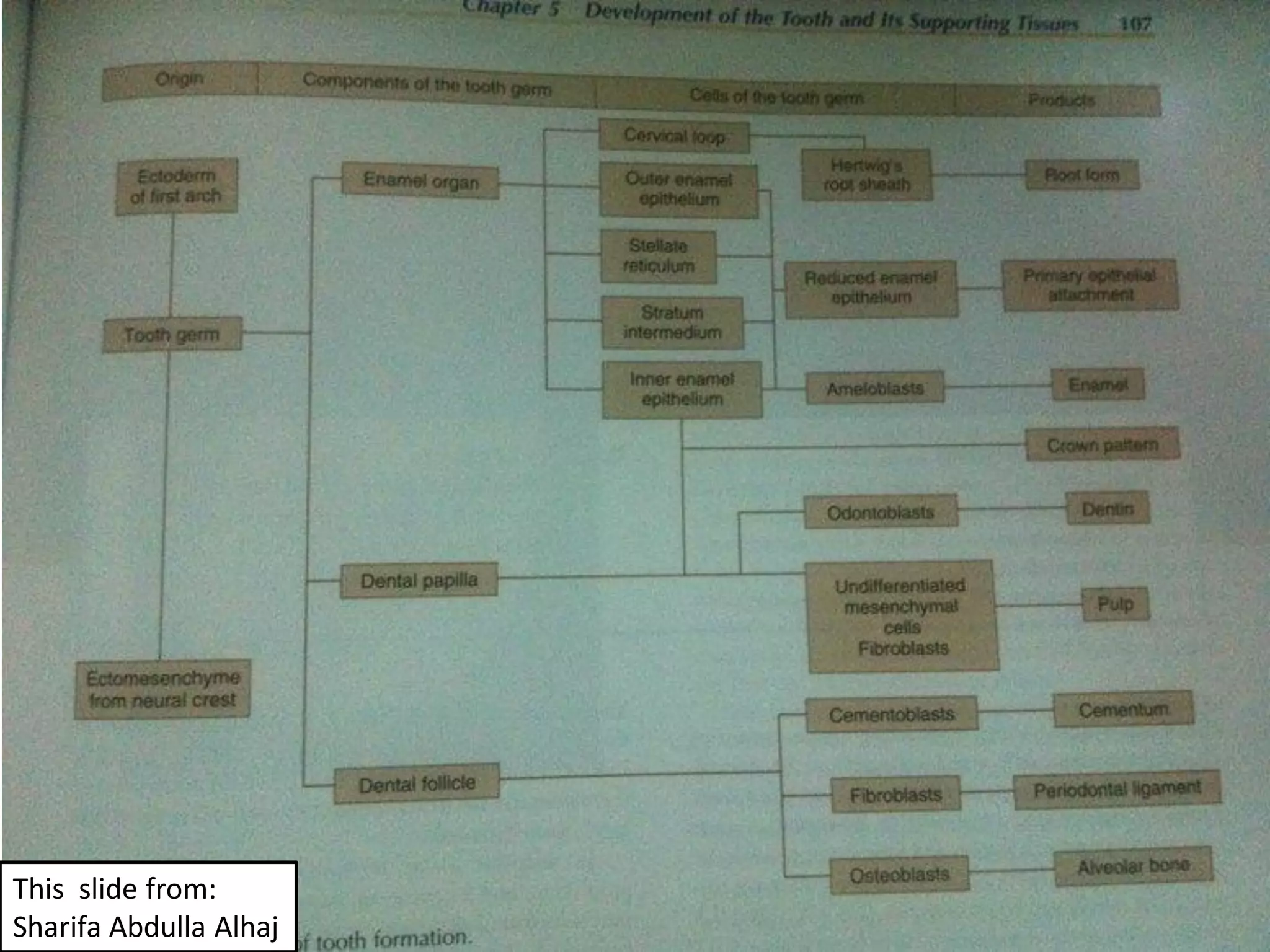
Odontogenesis
Dental lamina

• During the fifth
  week of
  embryonic
  development, the
  oral epithelium
  thickens along the
  future dental
  arches to form the
  dental lamina.
               Legend: A, dental lamina; B, Mesenchymal neural crest
Bud stage

• Around the eighth week of
  embryonic development, the
  mesenchymal neural crest
  induces the development of
  tooth buds at ten locations
  in the upper and lower
  dental lamina.
• During the bud stage the
  dental lamina grows into the
  mesenchyme in the shape of
  a bud.
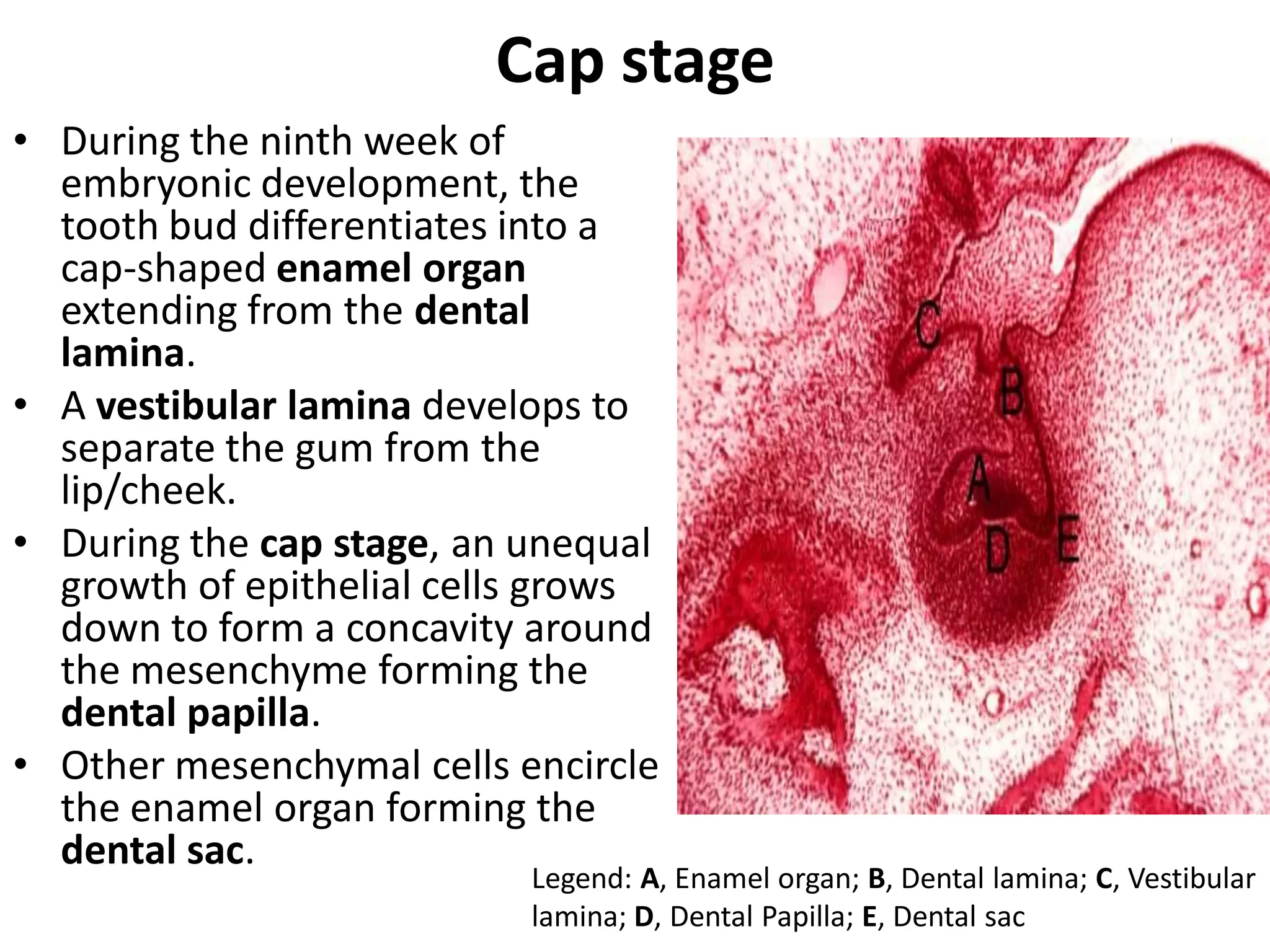
Cap stage
• During the ninth week of
  embryonic development, the
  tooth bud differentiates into a
  cap-shaped enamel organ
  extending from the dental
  lamina.
• A vestibular lamina develops to
  separate the gum from the
  lip/cheek.
• During the cap stage, an unequal
  growth of epithelial cells grows
  down to form a concavity around
  the mesenchyme forming the
  dental papilla.
• Other mesenchymal cells encircle
  the enamel organ forming the
  dental sac.
                           Legend: A, Enamel organ; B, Dental lamina; C, Vestibular
                           lamina; D, Dental Papilla; E, Dental sac
Bell stage
• Cytodifferentiation becomes
  apparent during the bell stage,
  when the epithelial cells
  outlining the enamel organ can
  be distinguished as the inner
  enamel epithelium and outer
  enamel epithelium.
• The interior of the enamel
  organ comprises the stellate
  reticulum, a cushiony layer
  which will protect the
  developing tooth.
• The successional lamina, which
  will give rise to the secondary
  tooth, arises from the dental
  lamina.
                              A, Inner enamel epithelium; B, Outer enamel epithelium;
                              C, Stellate reticulum; D, Successional lamina; E, Dental
                              lamina; F, Dental papilla; G, Dental sac.
Cervical loop
• The inner enamel epithelium and
  outer enamel epithelium joint at
  the cervical loop, that portion of
  the enamel organ which is growing
  down into the mesenchyme.
• The cells of the inner enamel
  epithelium will eventually become
  ameloblasts.
• The layer adjacent to the inner
  enamel epithelium is the stratum
  intermedium, and will become
  important in transporting nutrients
  to the future ameloblasts.

                             Legend: A, Cervical loop; B, Inner enamel epithelium;
                             C, Outer enamel epithelium; D, Stratum intermedium;
                             E, Stellate reticulum
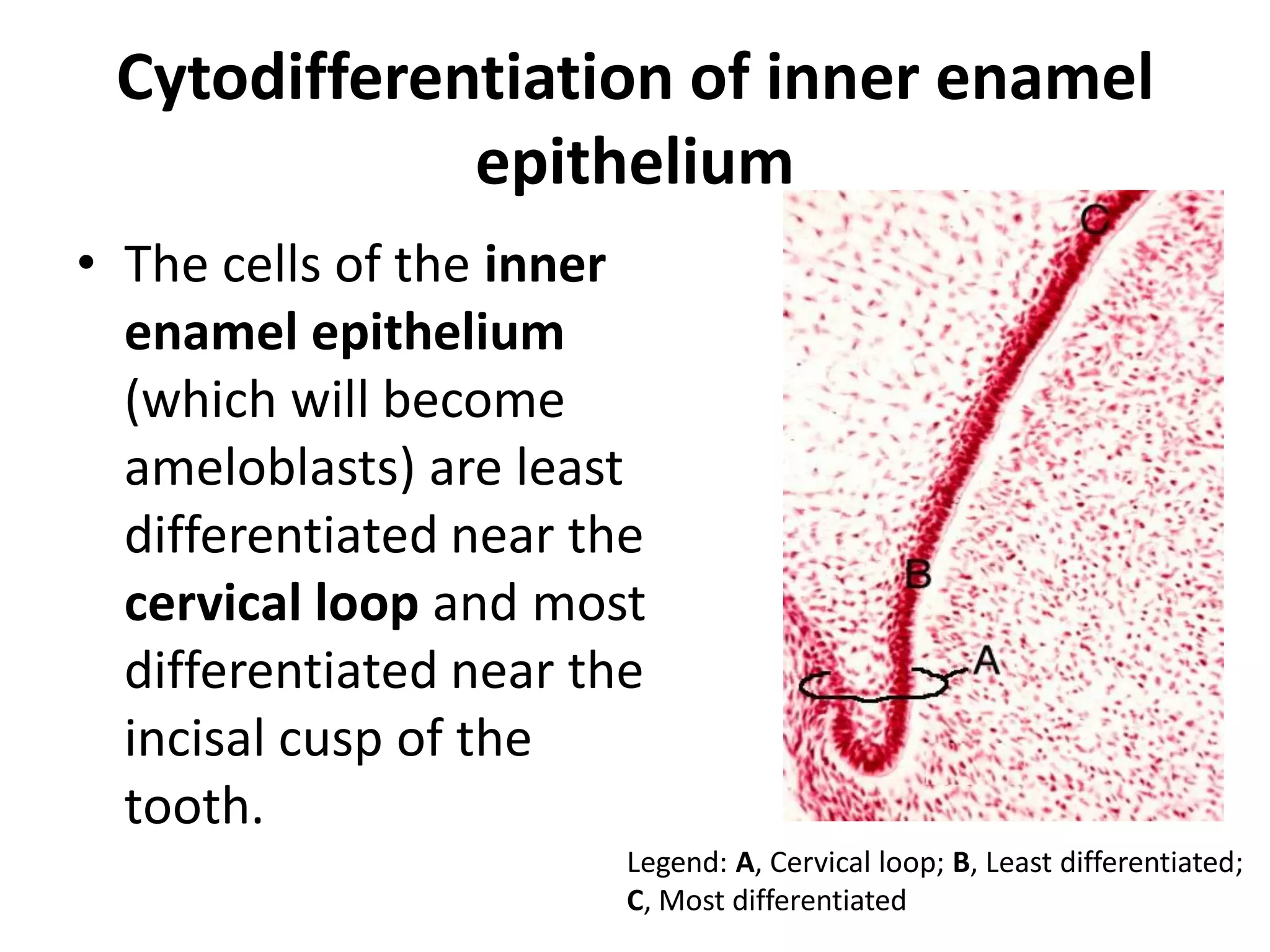
Cytodifferentiation of inner enamel
             epithelium
• The cells of the inner
  enamel epithelium
  (which will become
  ameloblasts) are least
  differentiated near the
  cervical loop and most
  differentiated near the
  incisal cusp of the
  tooth.
                        Legend: A, Cervical loop; B, Least differentiated;
                        C, Most differentiated
Odontoblastic differentiation
• Preameloblasts initiate
  the differentiation of
  odontoblasts which arise
  from cells in the dental
  papilla. The odontoblasts
  are called
  preodontoblasts before
  they begin the production
  of dentin.             Legend: A, Preameloblasts; B, Preodontoblasts;
                                 C, Stellate reticullum; D, Dental papilla
Deposition of dentin and enamel
• Mature, elongated odontoblasts
  begin the deposition of
  predentin.
• This deprives the preameloblasts
  of their nutritional source
  inducing their differentiation into
  ameloblasts which then begin to
  deposit enamel.
• Predentin is completely organic
  when it is formed and gradually is
  mineralized to form dentin.
• Enamel is partially mineralized
  when it is deposited.
• Arrows show the direction of
  movement of ameloblasts and           Legend: A, Odontoblasts; B, Predentin;
  odontoblasts.                         C, Ameloblasts; D, Enamel; E, Dentin.
Reduced enamel epithelium
• Following the formation of the
  crown , the enamel organ
  collapses to form the reduced
  enamel epithelium which
  covers the tooth through
  eruption.
• The reduced enamel epithelium
  consists of the
  mature/protective ameloblasts
  and remanants of the outer
  layers of the enamel organ.
• Numerous capillaries,which had
  formed to supply oxygen and
  nutrients to the ameloblasts
  following dentin formation,      Legend: A, Reduced enamel
  surround the reduced enamel      epithelium; B, Maturative/protective
  epithelium.                      ameloblasts; C, Capillary
Immature enamel

• Ameloblasts
  secrete immature
  enamel which is
  only partially
  mineralized.


                     Legend: A, Ameloblasts; B, Immature enamel
Preodontoblast

• Prior to dentinogenesis
  the basement
  membrane thickens
  between the
  preodontoblast and
  preameloblast.
• Processes from the
  preodontoblasts extend
  through the basement
  membrane to come into
  close association with
  the preameloblast.
                            Legend: A, Preodontoblast; B, Preameloblast;
                            C, Basement membrane
Odontoblast

• Following differentiation of
  preodontoblasts into
  odontoblasts, dentin begins
  to be deposited first as
  predentin.
• The odontoblasts nucleus has
  moved away from the
  secretory end of the cell
  where numerous organelles
  have accumulated to aid in
  predentin deposition.
                           Legend: A, Odontoblast nucleus; B, Secretory
                           end of odontoblast; C, Predentin
Ameloblasts

• After dentinogenesis begins, the
  preameloblasts differentiate
  into ameloblasts which begin to
  deposit enamel.
• Ameloblasts are very tall
  columnar cells with a nucleus
  displaced away from the
  secretory end of the cell. The
  ameloblasts develop a Tome's
  process shortly after beginning
  amelogenesis.
• This process is responsible for
  the production of enamel in the
  form of rods.
                                     Legend: A, Ameloblast nucleus; B, Enamel;
                                     C, Tome's process
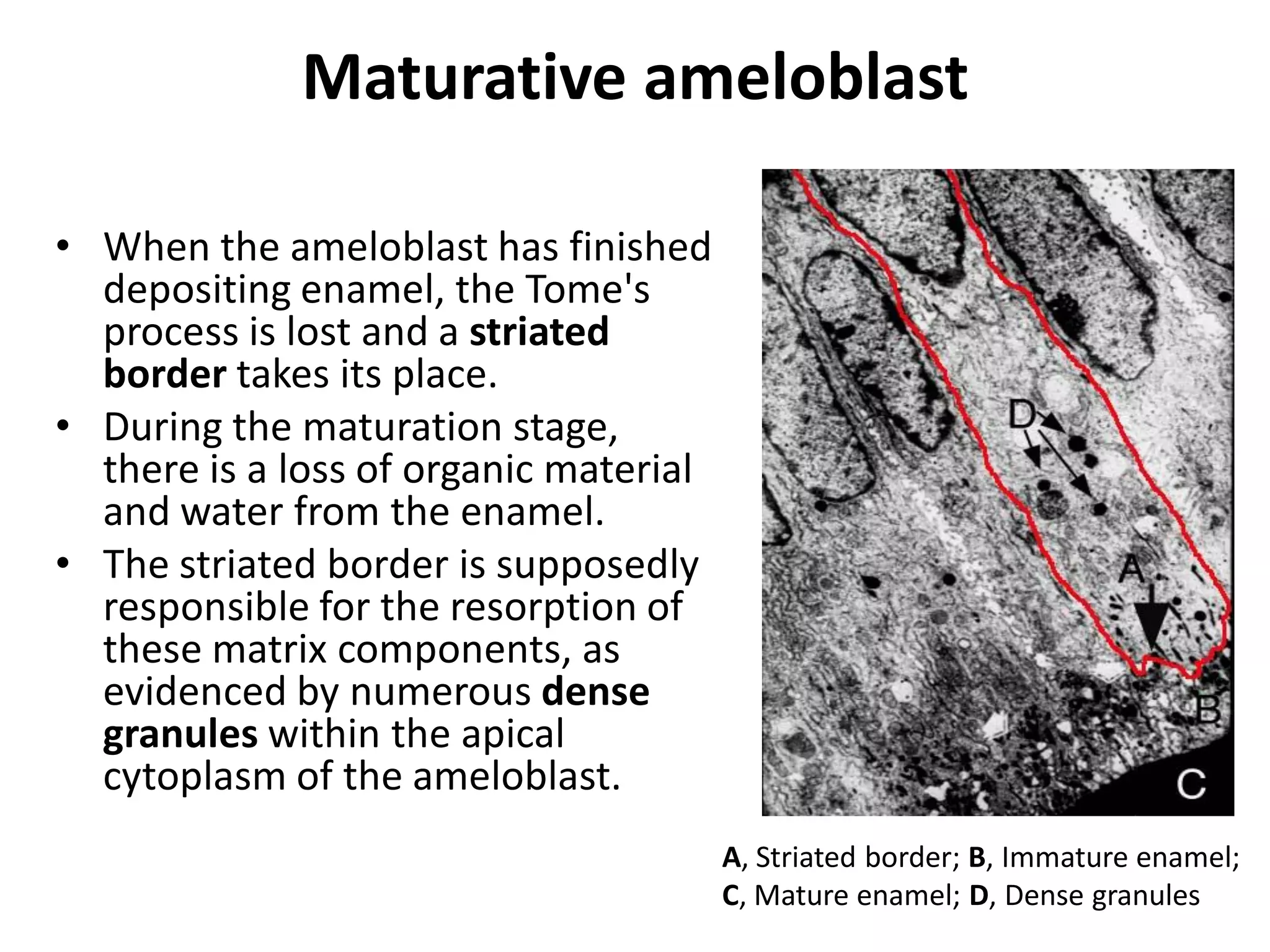
Maturative ameloblast

• When the ameloblast has finished
  depositing enamel, the Tome's
  process is lost and a striated
  border takes its place.
• During the maturation stage,
  there is a loss of organic material
  and water from the enamel.
• The striated border is supposedly
  responsible for the resorption of
  these matrix components, as
  evidenced by numerous dense
  granules within the apical
  cytoplasm of the ameloblast.
                                        A, Striated border; B, Immature enamel;
                                        C, Mature enamel; D, Dense granules
Calcification

• Enamel and dentin is
  fairly evenly calcified in
  the erupted deciduous
  tooth (1) but a gradient
  of calcification can be
  seen in the developing
  permanent tooth (2)
  with the more calcified
  areas located in the
  incisal areas (arrow)
                               Legend: A, Enamel; B, Dentin
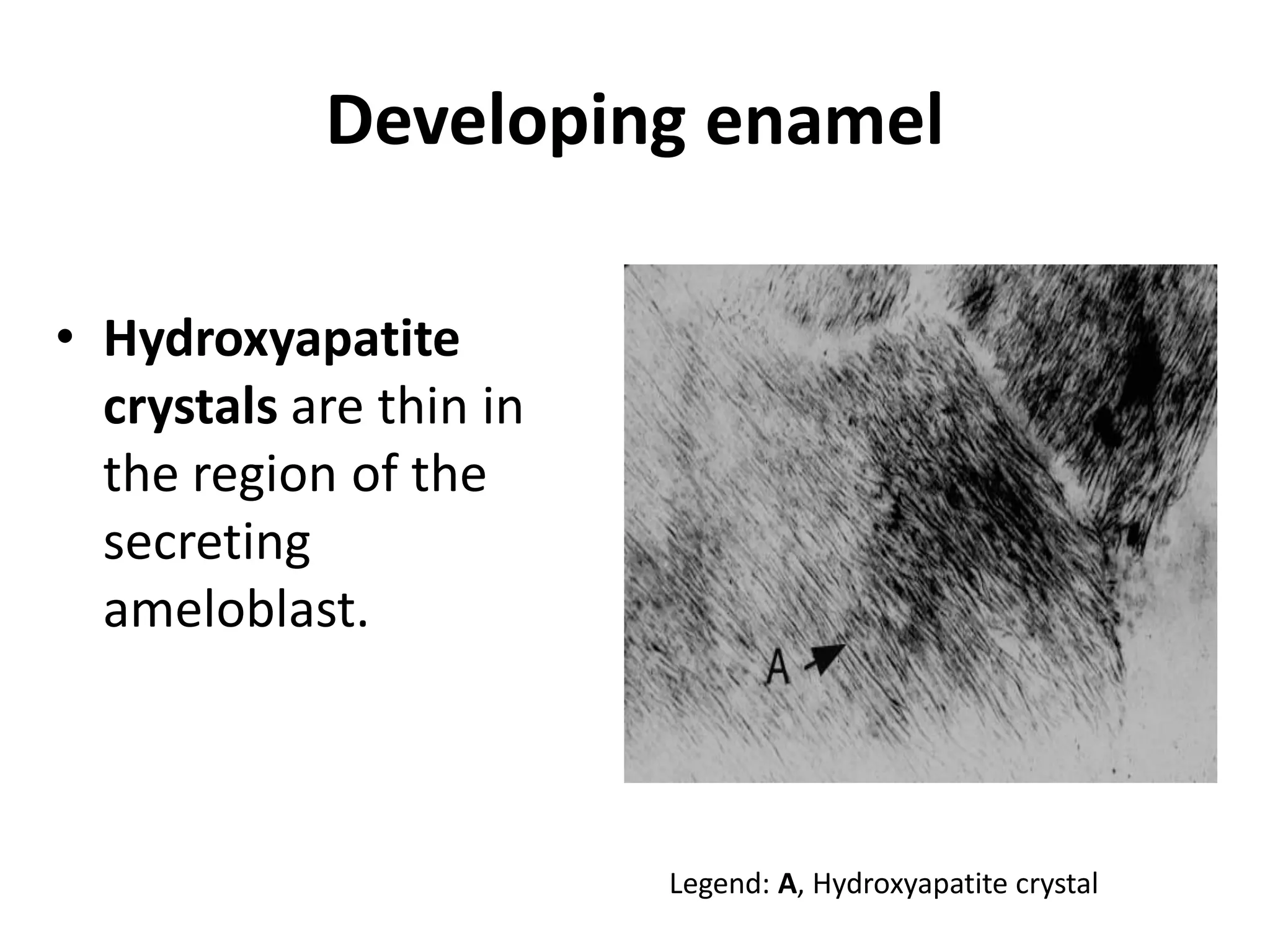
Developing enamel

• Hydroxyapatite
  crystals are thin in
  the region of the
  secreting
  ameloblast.


                         Legend: A, Hydroxyapatite crystal
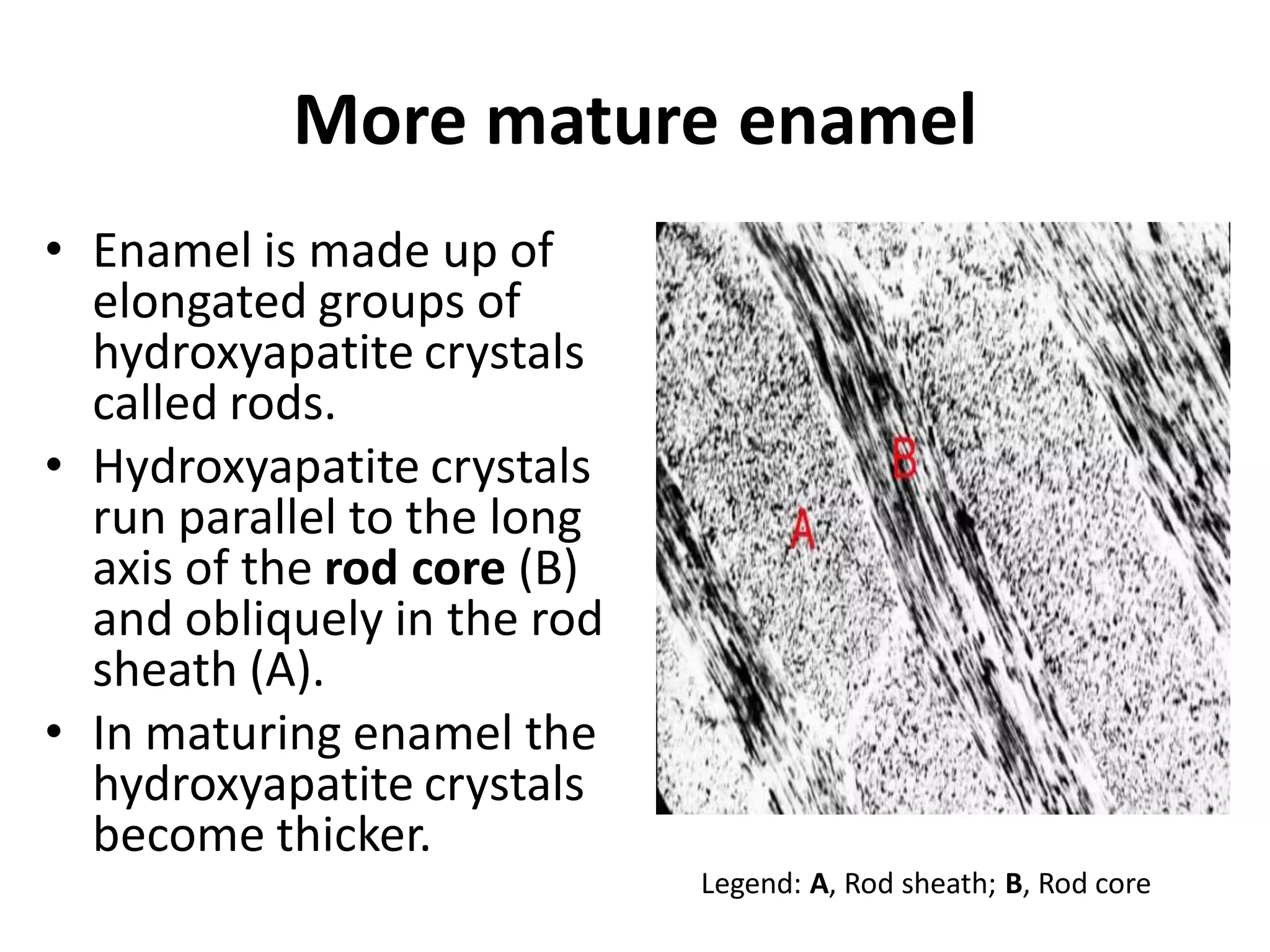
More mature enamel
• Enamel is made up of
  elongated groups of
  hydroxyapatite crystals
  called rods.
• Hydroxyapatite crystals
  run parallel to the long
  axis of the rod core (B)
  and obliquely in the rod
  sheath (A).
• In maturing enamel the
  hydroxyapatite crystals
  become thicker.
                             Legend: A, Rod sheath; B, Rod core
Root formation
• After complete formation of the
  crown of the tooth, the root is
  formed.
• An extension of the enamel organ,
  called the epithelial root sheath of
  Hertwig, continues to grow apically.
• The epithelial root sheath induces
  the differentiation of odontoblasts
  which form root dentin.
• The apical most portion of the root
  sheath turns inward toward the
  radicular pulp cavity (that portion of
  the pulp cavity inside the root) and is
                                            A, Epithelial diaphragm;
  called the epithelial diaphragm.
                                             B, Radicular pulp cavity;
                                            C, Dentin; D, Enamel
                                            space; E, Alveolar Bone;
                                            F, Root
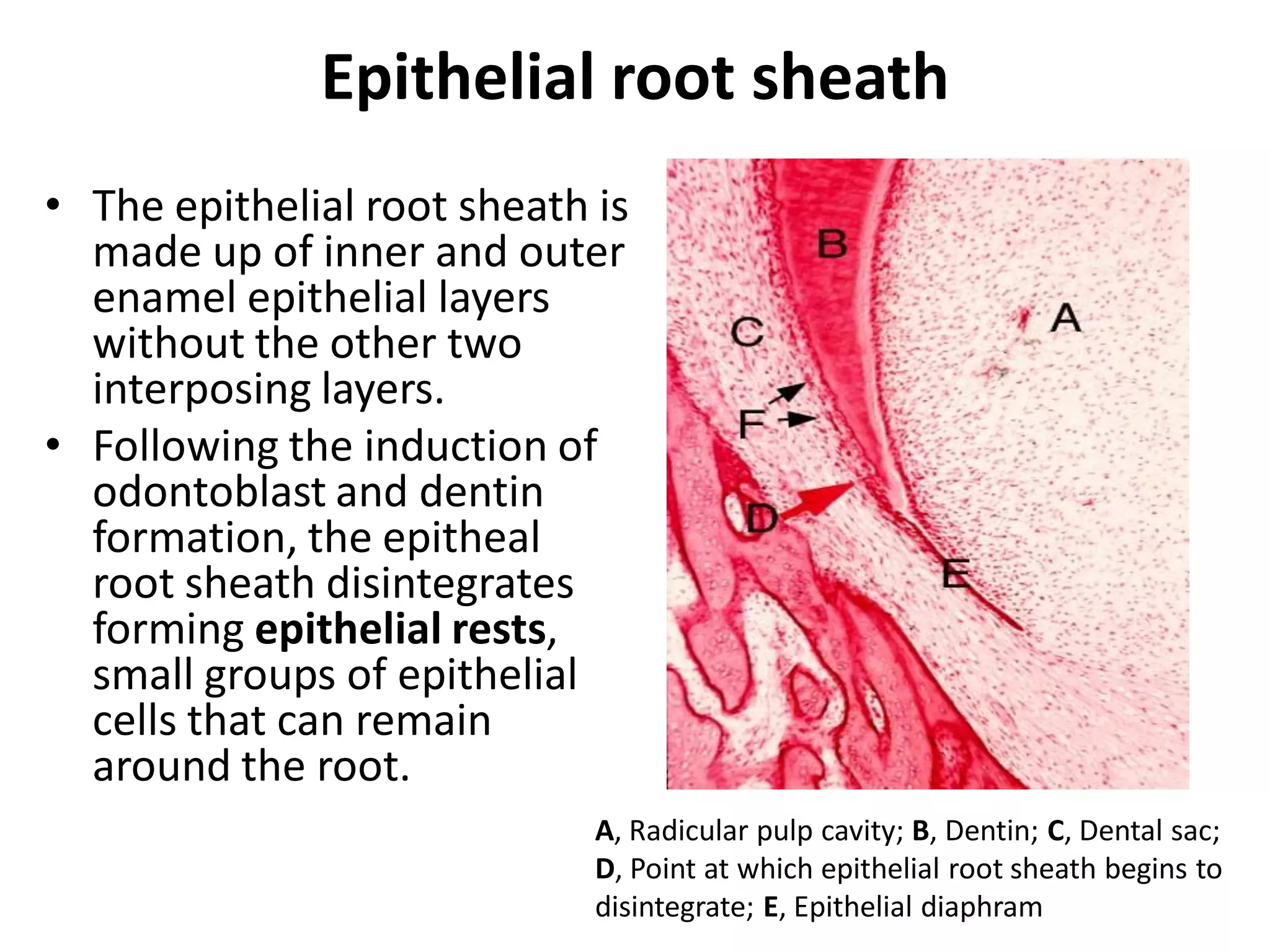
Epithelial root sheath
• The epithelial root sheath is
  made up of inner and outer
  enamel epithelial layers
  without the other two
  interposing layers.
• Following the induction of
  odontoblast and dentin
  formation, the epitheal
  root sheath disintegrates
  forming epithelial rests,
  small groups of epithelial
  cells that can remain
  around the root.
                             A, Radicular pulp cavity; B, Dentin; C, Dental sac;
                             D, Point at which epithelial root sheath begins to
                             disintegrate; E, Epithelial diaphram
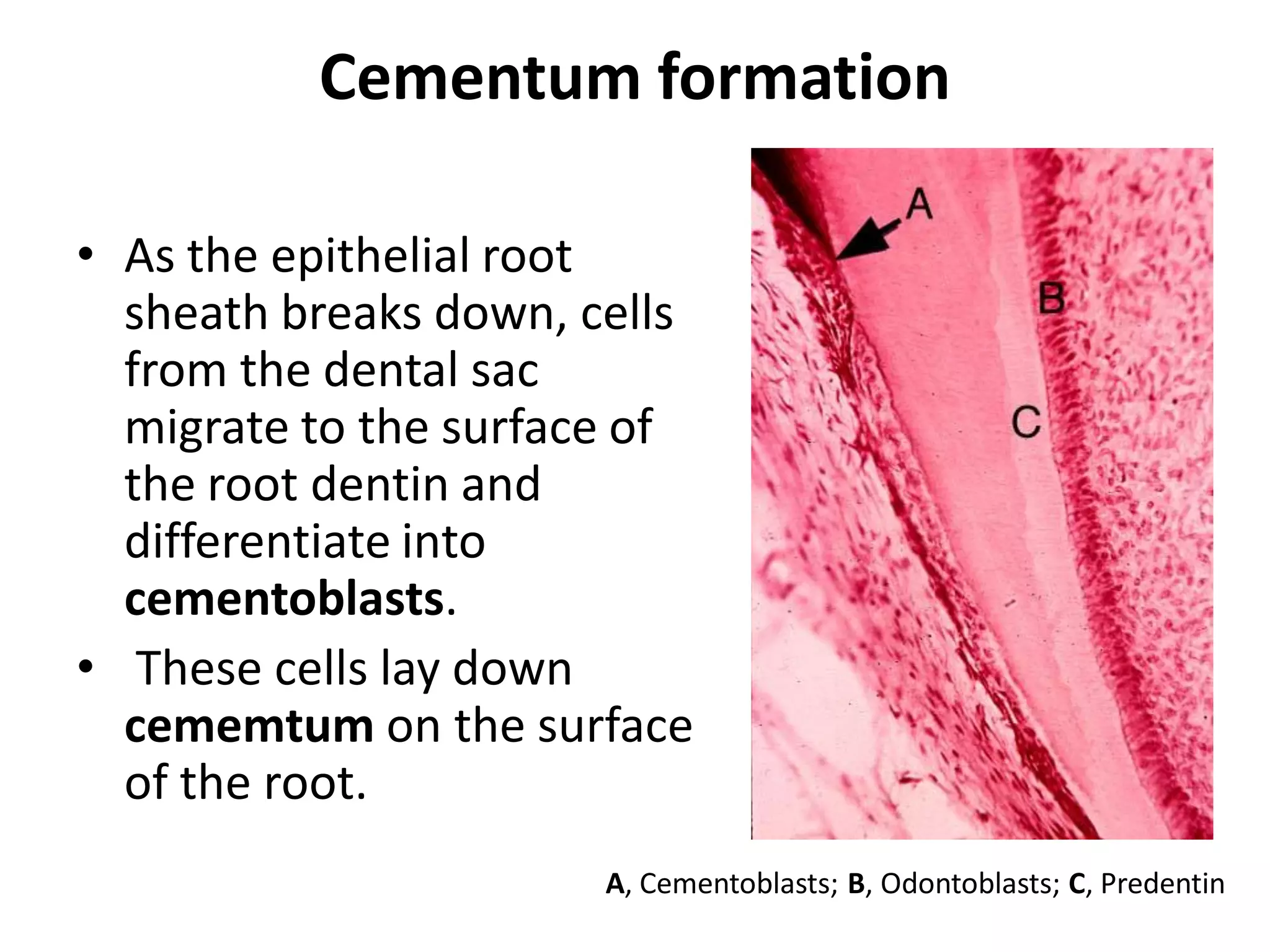
Cementum formation

• As the epithelial root
  sheath breaks down, cells
  from the dental sac
  migrate to the surface of
  the root dentin and
  differentiate into
  cementoblasts.
• These cells lay down
  cememtum on the surface
  of the root.
                       A, Cementoblasts; B, Odontoblasts; C, Predentin
Epithelial rests

• Remnants of the disintegrated
  root sheath called epithelial
  rests can remain for long
  periods of time following
  eruption of the tooth.
• The first dentin that is formed is
  called mantle dentin, while the
  remaining dentin is called
  circumpulpal dentin.
• There is also a small layer
  interposed between these two
  dentin layers of less mineralized
  dentin called globular dentin.
                                       A, Epithelial rests; B, Mantle dentin; C,
                                       Globular dentin; D, Circumpulpal dentin
First maxillary deciduous molar
• This molar is from a 22-
  week fetus.
• The red coloration
  indicates the formation
  of the hard tissues.
• Enamel and dentin are
  first formed at the cuspal
  region and their
  formation proceeds
  toward the cervix of the
  tooth.                       Legend: A, Cusp of molar
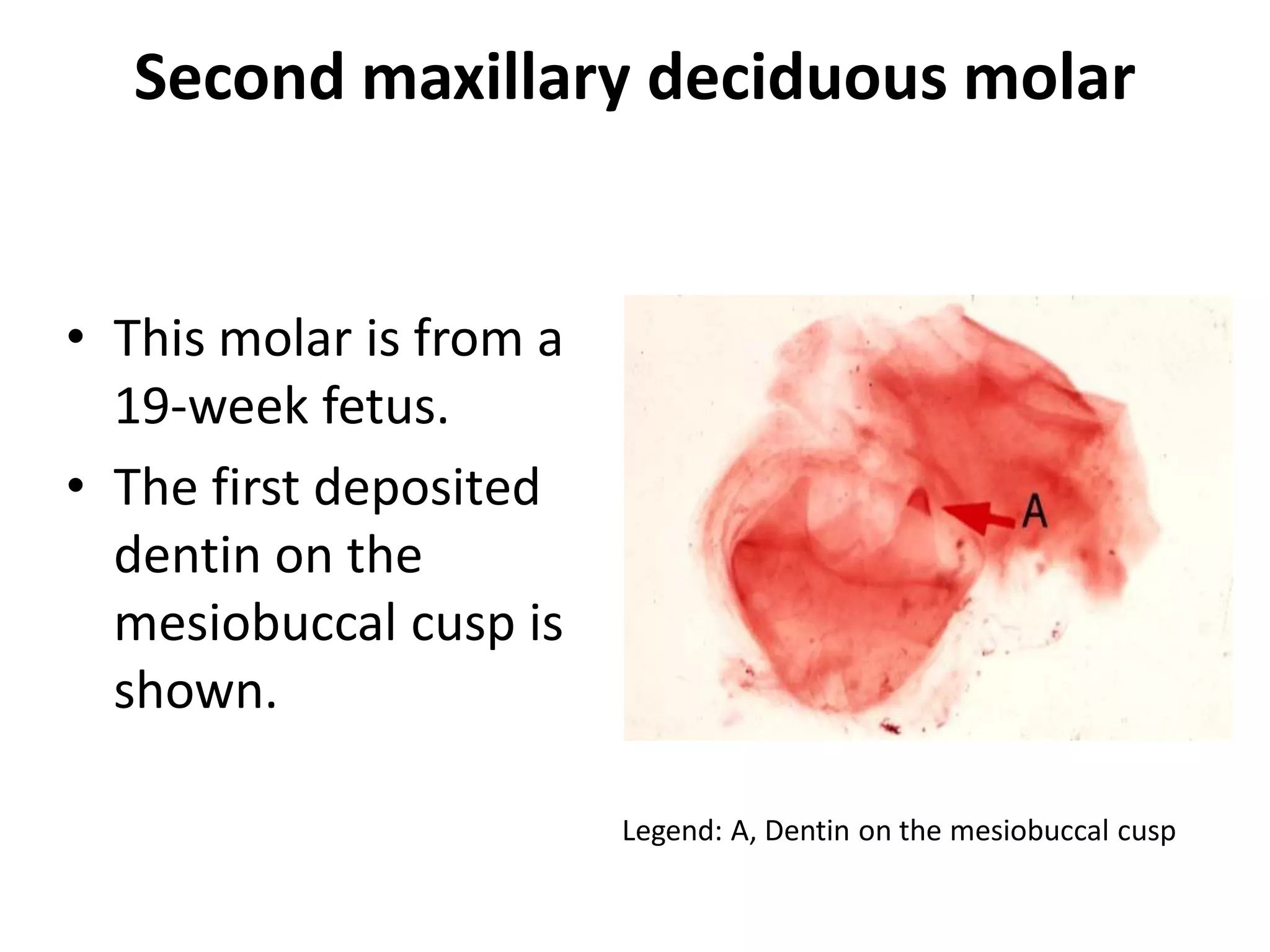
Second maxillary deciduous molar


• This molar is from a
  19-week fetus.
• The first deposited
  dentin on the
  mesiobuccal cusp is
  shown.

                         Legend: A, Dentin on the mesiobuccal cusp
This slide from:
Sharifa Abdulla Alhaj
Good
Luck
All
       Done by: Bedour Al-Arfaj.
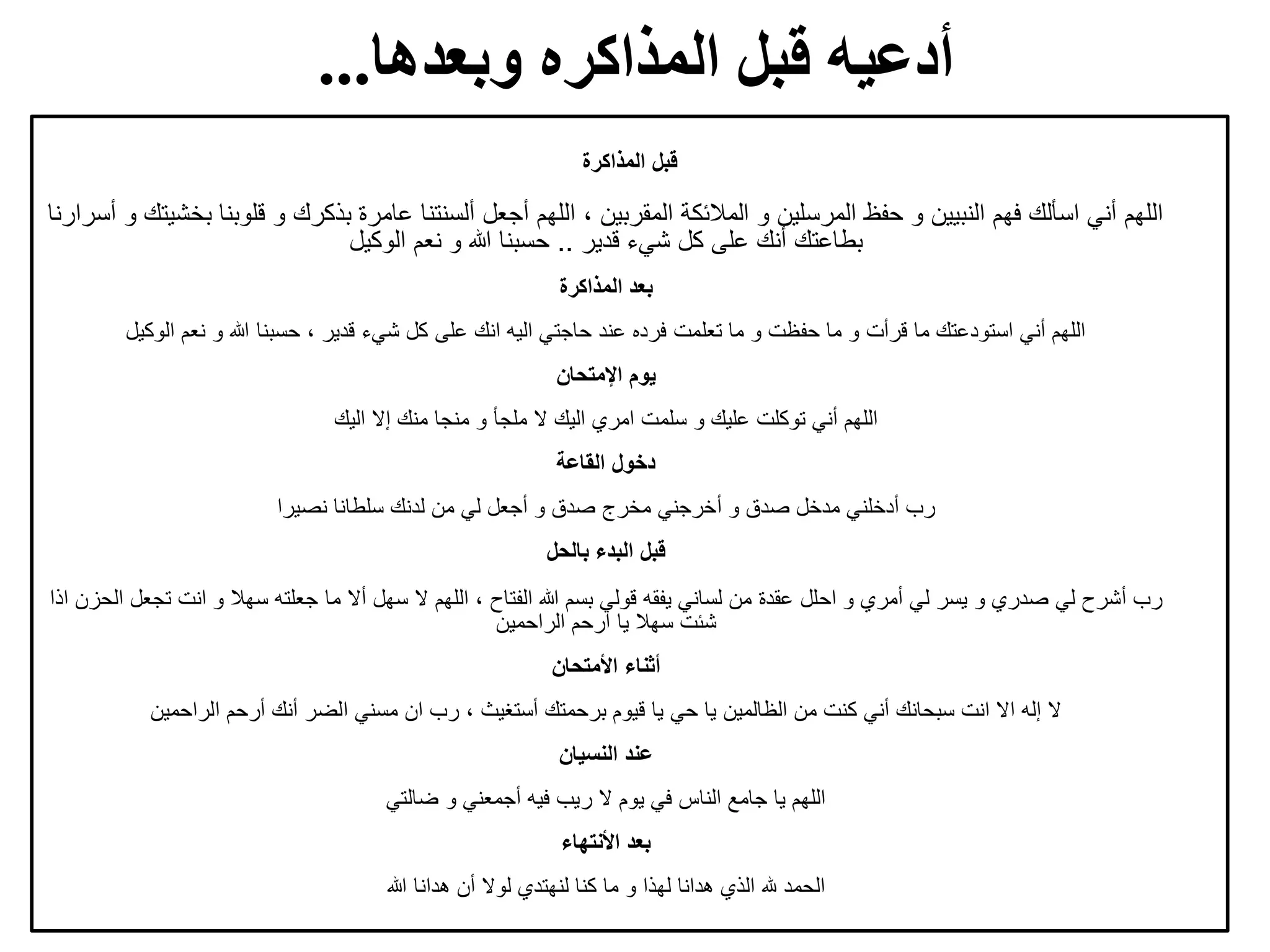
‫أدعيه قبل المذاكره وبعدها...‬
                                                                 ‫قبل المذاكرة‬

‫اللهم أنً اسألك فهم النبٌٌن و حفظ المرسلٌن و المالئكة المقربٌن ، اللهم أجعل ألسنتنا عامرة بذكرك و قلوبنا بخشٌتك و أسرارنا‬
                               ‫بطاعتك أنك على كل شًء قدٌر .. حسبنا هللا و نعم الوكٌل‬
                                                              ‫بعد المذاكرة‬
        ‫اللهم أنً استودعتك ما قرأت و ما حفظت و ما تعلمت فرده عند حاجتً الٌه انك على كل شًء قدٌر ، حسبنا هللا و نعم الوكٌل‬
                                                              ‫يوم اإلمتحان‬
                                 ‫اللهم أنً توكلت علٌك و سلمت امري الٌك ال ملجأ و منجا منك إال الٌك‬
                                                              ‫دخول القاعة‬
                          ‫رب أدخلنً مدخل صدق و أخرجنً مخرج صدق و أجعل لً من لدنك سلطانا نصٌرا‬
                                                            ‫قبل البدء بالحل‬
‫رب أشرح لً صدري و ٌسر لً أمري و احلل عقدة من لسانً ٌفقه قولً بسم هللا الفتاح ، اللهم ال سهل أال ما جعلته سهال و انت تجعل الحزن اذا‬
                                                      ‫شئت سهال ٌا ارحم الراحمٌن‬
                                                             ‫أثناء األمتحان‬
           ‫ال إله اال انت سبحانك أنً كنت من الظالمٌن ٌا حً ٌا قٌوم برحمتك أستغٌث ، رب ان مسنً الضر أنك أرحم الراحمٌن‬
                                                              ‫عند النسيان‬
                                       ‫اللهم ٌا جامع الناس فً ٌوم ال رٌب فٌه أجمعنً و ضالتً‬
                                                              ‫بعد األنتهاء‬
                                       ‫الحمد هلل الذي هدانا لهذا و ما كنا لنهتدي لوال أن هدانا هللا‬

Odontogenesis

  • 1.
  • 2.
    Dental lamina • Duringthe fifth week of embryonic development, the oral epithelium thickens along the future dental arches to form the dental lamina. Legend: A, dental lamina; B, Mesenchymal neural crest
  • 3.
    Bud stage • Aroundthe eighth week of embryonic development, the mesenchymal neural crest induces the development of tooth buds at ten locations in the upper and lower dental lamina. • During the bud stage the dental lamina grows into the mesenchyme in the shape of a bud.
  • 4.
    Cap stage • Duringthe ninth week of embryonic development, the tooth bud differentiates into a cap-shaped enamel organ extending from the dental lamina. • A vestibular lamina develops to separate the gum from the lip/cheek. • During the cap stage, an unequal growth of epithelial cells grows down to form a concavity around the mesenchyme forming the dental papilla. • Other mesenchymal cells encircle the enamel organ forming the dental sac. Legend: A, Enamel organ; B, Dental lamina; C, Vestibular lamina; D, Dental Papilla; E, Dental sac
  • 5.
    Bell stage • Cytodifferentiationbecomes apparent during the bell stage, when the epithelial cells outlining the enamel organ can be distinguished as the inner enamel epithelium and outer enamel epithelium. • The interior of the enamel organ comprises the stellate reticulum, a cushiony layer which will protect the developing tooth. • The successional lamina, which will give rise to the secondary tooth, arises from the dental lamina. A, Inner enamel epithelium; B, Outer enamel epithelium; C, Stellate reticulum; D, Successional lamina; E, Dental lamina; F, Dental papilla; G, Dental sac.
  • 6.
    Cervical loop • Theinner enamel epithelium and outer enamel epithelium joint at the cervical loop, that portion of the enamel organ which is growing down into the mesenchyme. • The cells of the inner enamel epithelium will eventually become ameloblasts. • The layer adjacent to the inner enamel epithelium is the stratum intermedium, and will become important in transporting nutrients to the future ameloblasts. Legend: A, Cervical loop; B, Inner enamel epithelium; C, Outer enamel epithelium; D, Stratum intermedium; E, Stellate reticulum
  • 7.
    Cytodifferentiation of innerenamel epithelium • The cells of the inner enamel epithelium (which will become ameloblasts) are least differentiated near the cervical loop and most differentiated near the incisal cusp of the tooth. Legend: A, Cervical loop; B, Least differentiated; C, Most differentiated
  • 8.
    Odontoblastic differentiation • Preameloblastsinitiate the differentiation of odontoblasts which arise from cells in the dental papilla. The odontoblasts are called preodontoblasts before they begin the production of dentin. Legend: A, Preameloblasts; B, Preodontoblasts; C, Stellate reticullum; D, Dental papilla
  • 9.
    Deposition of dentinand enamel • Mature, elongated odontoblasts begin the deposition of predentin. • This deprives the preameloblasts of their nutritional source inducing their differentiation into ameloblasts which then begin to deposit enamel. • Predentin is completely organic when it is formed and gradually is mineralized to form dentin. • Enamel is partially mineralized when it is deposited. • Arrows show the direction of movement of ameloblasts and Legend: A, Odontoblasts; B, Predentin; odontoblasts. C, Ameloblasts; D, Enamel; E, Dentin.
  • 10.
    Reduced enamel epithelium •Following the formation of the crown , the enamel organ collapses to form the reduced enamel epithelium which covers the tooth through eruption. • The reduced enamel epithelium consists of the mature/protective ameloblasts and remanants of the outer layers of the enamel organ. • Numerous capillaries,which had formed to supply oxygen and nutrients to the ameloblasts following dentin formation, Legend: A, Reduced enamel surround the reduced enamel epithelium; B, Maturative/protective epithelium. ameloblasts; C, Capillary
  • 11.
    Immature enamel • Ameloblasts secrete immature enamel which is only partially mineralized. Legend: A, Ameloblasts; B, Immature enamel
  • 12.
    Preodontoblast • Prior todentinogenesis the basement membrane thickens between the preodontoblast and preameloblast. • Processes from the preodontoblasts extend through the basement membrane to come into close association with the preameloblast. Legend: A, Preodontoblast; B, Preameloblast; C, Basement membrane
  • 13.
    Odontoblast • Following differentiationof preodontoblasts into odontoblasts, dentin begins to be deposited first as predentin. • The odontoblasts nucleus has moved away from the secretory end of the cell where numerous organelles have accumulated to aid in predentin deposition. Legend: A, Odontoblast nucleus; B, Secretory end of odontoblast; C, Predentin
  • 14.
    Ameloblasts • After dentinogenesisbegins, the preameloblasts differentiate into ameloblasts which begin to deposit enamel. • Ameloblasts are very tall columnar cells with a nucleus displaced away from the secretory end of the cell. The ameloblasts develop a Tome's process shortly after beginning amelogenesis. • This process is responsible for the production of enamel in the form of rods. Legend: A, Ameloblast nucleus; B, Enamel; C, Tome's process
  • 15.
    Maturative ameloblast • Whenthe ameloblast has finished depositing enamel, the Tome's process is lost and a striated border takes its place. • During the maturation stage, there is a loss of organic material and water from the enamel. • The striated border is supposedly responsible for the resorption of these matrix components, as evidenced by numerous dense granules within the apical cytoplasm of the ameloblast. A, Striated border; B, Immature enamel; C, Mature enamel; D, Dense granules
  • 16.
    Calcification • Enamel anddentin is fairly evenly calcified in the erupted deciduous tooth (1) but a gradient of calcification can be seen in the developing permanent tooth (2) with the more calcified areas located in the incisal areas (arrow) Legend: A, Enamel; B, Dentin
  • 17.
    Developing enamel • Hydroxyapatite crystals are thin in the region of the secreting ameloblast. Legend: A, Hydroxyapatite crystal
  • 18.
    More mature enamel •Enamel is made up of elongated groups of hydroxyapatite crystals called rods. • Hydroxyapatite crystals run parallel to the long axis of the rod core (B) and obliquely in the rod sheath (A). • In maturing enamel the hydroxyapatite crystals become thicker. Legend: A, Rod sheath; B, Rod core
  • 19.
    Root formation • Aftercomplete formation of the crown of the tooth, the root is formed. • An extension of the enamel organ, called the epithelial root sheath of Hertwig, continues to grow apically. • The epithelial root sheath induces the differentiation of odontoblasts which form root dentin. • The apical most portion of the root sheath turns inward toward the radicular pulp cavity (that portion of the pulp cavity inside the root) and is A, Epithelial diaphragm; called the epithelial diaphragm. B, Radicular pulp cavity; C, Dentin; D, Enamel space; E, Alveolar Bone; F, Root
  • 20.
    Epithelial root sheath •The epithelial root sheath is made up of inner and outer enamel epithelial layers without the other two interposing layers. • Following the induction of odontoblast and dentin formation, the epitheal root sheath disintegrates forming epithelial rests, small groups of epithelial cells that can remain around the root. A, Radicular pulp cavity; B, Dentin; C, Dental sac; D, Point at which epithelial root sheath begins to disintegrate; E, Epithelial diaphram
  • 21.
    Cementum formation • Asthe epithelial root sheath breaks down, cells from the dental sac migrate to the surface of the root dentin and differentiate into cementoblasts. • These cells lay down cememtum on the surface of the root. A, Cementoblasts; B, Odontoblasts; C, Predentin
  • 22.
    Epithelial rests • Remnantsof the disintegrated root sheath called epithelial rests can remain for long periods of time following eruption of the tooth. • The first dentin that is formed is called mantle dentin, while the remaining dentin is called circumpulpal dentin. • There is also a small layer interposed between these two dentin layers of less mineralized dentin called globular dentin. A, Epithelial rests; B, Mantle dentin; C, Globular dentin; D, Circumpulpal dentin
  • 23.
    First maxillary deciduousmolar • This molar is from a 22- week fetus. • The red coloration indicates the formation of the hard tissues. • Enamel and dentin are first formed at the cuspal region and their formation proceeds toward the cervix of the tooth. Legend: A, Cusp of molar
  • 24.
    Second maxillary deciduousmolar • This molar is from a 19-week fetus. • The first deposited dentin on the mesiobuccal cusp is shown. Legend: A, Dentin on the mesiobuccal cusp
  • 26.
  • 27.
    Good Luck All Done by: Bedour Al-Arfaj.
  • 28.
    ‫أدعيه قبل المذاكرهوبعدها...‬ ‫قبل المذاكرة‬ ‫اللهم أنً اسألك فهم النبٌٌن و حفظ المرسلٌن و المالئكة المقربٌن ، اللهم أجعل ألسنتنا عامرة بذكرك و قلوبنا بخشٌتك و أسرارنا‬ ‫بطاعتك أنك على كل شًء قدٌر .. حسبنا هللا و نعم الوكٌل‬ ‫بعد المذاكرة‬ ‫اللهم أنً استودعتك ما قرأت و ما حفظت و ما تعلمت فرده عند حاجتً الٌه انك على كل شًء قدٌر ، حسبنا هللا و نعم الوكٌل‬ ‫يوم اإلمتحان‬ ‫اللهم أنً توكلت علٌك و سلمت امري الٌك ال ملجأ و منجا منك إال الٌك‬ ‫دخول القاعة‬ ‫رب أدخلنً مدخل صدق و أخرجنً مخرج صدق و أجعل لً من لدنك سلطانا نصٌرا‬ ‫قبل البدء بالحل‬ ‫رب أشرح لً صدري و ٌسر لً أمري و احلل عقدة من لسانً ٌفقه قولً بسم هللا الفتاح ، اللهم ال سهل أال ما جعلته سهال و انت تجعل الحزن اذا‬ ‫شئت سهال ٌا ارحم الراحمٌن‬ ‫أثناء األمتحان‬ ‫ال إله اال انت سبحانك أنً كنت من الظالمٌن ٌا حً ٌا قٌوم برحمتك أستغٌث ، رب ان مسنً الضر أنك أرحم الراحمٌن‬ ‫عند النسيان‬ ‫اللهم ٌا جامع الناس فً ٌوم ال رٌب فٌه أجمعنً و ضالتً‬ ‫بعد األنتهاء‬ ‫الحمد هلل الذي هدانا لهذا و ما كنا لنهتدي لوال أن هدانا هللا‬