Chapter 7 The Control of Microbial Growth
Control of Microbial Growth Sterilization = the complete removal or killing of all microbes  - they are unable to reproduce even in most favorable conditions – no partial sterilization Endospores   are one of the most resistant forms of life Their destruction is the goal of sterilization  because any process that kills endospores will kill the vegetative cell Used on  inanimate objects  or material ex. Liquid media
Control of Microbial Growth Disinfection  =  the reduction or removal of vegetative pathogens but not endospores  by chemicals, UV radiation, boiling H2O or steam Chemical agents  used If object is  inanimate  (tabletop) =  disinfectant If object is  living  (animal tissue) =  antiseptic Antiseptics are regulated by FDA
Some definitions Sepsis  = Greek for putrid Refers to  growth of microbes in blood and other tissues Is stem for septicemia (in blood), antiseptic, aseptic Degerming = mechanical removal (not killing) of microbes from surface of object Ex. ROH w/ shot, wash hands
Some definitions
Physical Control of Microbes Thermal death point (TDP) = the lowest temp. required to kill all microbes in a liquid culture in 10 minutes For  spore bearing organisms  there are  2 TDPs  – 1 for the  vegetative cell  and 1 for the  spore form  Thermal death time (TDT) = length of time to kill all microbes in a liquid culture at a given temperature TDP and TDT are important in the food industry wh/ uses heat for preservation
Sterilization by Heat Heat is fast, reliable and cheap and does not introduce toxic substances into material being treated Moist heat   Kills microbes by denaturing proteins  – breaks H-bonds thus chgs shape Penetrates material faster than dry heat so need less time and lower temperatures Boiling H2O  – not a sterilizing agent because of spores and viruses
Sterilization by Heat Autoclave  (pix –pg 191) =  pressure is used to raise temp of steam > 100 Deg. C Most rapid and efficient method of sterilization by heat As pressure > temp. rises At 15 psi pressure the temperature rises from 100 deg C to 121 deg C 15 psi at 121 deg C 15 – 30 min  depending on what you are sterilizing
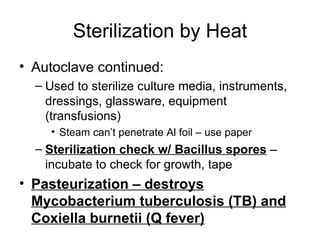
Sterilization by Heat Autoclave continued: Used to sterilize culture media, instruments, dressings, glassware, equipment (transfusions) Steam can’t penetrate Al foil – use paper Sterilization check w/ Bacillus spores  – incubate to check for growth, tape Pasteurization – destroys Mycobacterium tuberculosis (TB) and Coxiella burnetii (Q fever)
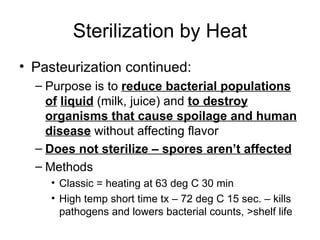
Sterilization by Heat Pasteurization continued: Purpose is to  reduce bacterial populations of   liquid  (milk, juice) and  to destroy organisms that cause spoilage and human   disease  without affecting flavor Does not sterilize – spores aren’t affected Methods Classic = heating at 63 deg C 30 min High temp short time tx – 72 deg C 15 sec. – kills pathogens and lowers bacterial counts, >shelf life
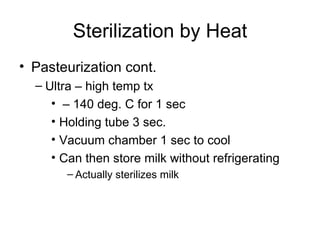
Sterilization by Heat Pasteurization cont. Ultra – high temp tx –  140 deg. C for 1 sec Holding tube 3 sec. Vacuum chamber 1 sec to cool Can then store milk without refrigerating  Actually sterilizes milk
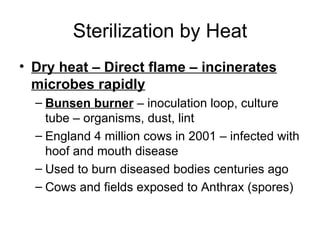
Sterilization by Heat Dry heat – Direct flame – incinerates microbes rapidly Bunsen burner  – inoculation loop, culture tube – organisms, dust, lint England 4 million cows in 2001 – infected with hoof and mouth disease Used to burn diseased bodies centuries ago Cows and fields exposed to Anthrax (spores)
Sterilization by Heat Dry heat – hot air ovens Does not penetrate material easy so needs long periods of time at high temps –  170 deg C at least 2 hrs  Used to sterilize dry powders, water free oily substances, glassware Changes microbial proteins by oxidation rxs
Filtration Used in food industries, laboratories (medical, environmental, industrial) A filter is a mechanical device  used to remove microbes from a solution or gas Several  types of filters  used in a laboratory Membrane filter  – cellulose acetate or polycarbonate – 0.22um, 0.45um, .01um – viruses, lg protein molecules
Filtration Membrane filtration cont. Can  use to sterilize media or any liquid that can’t tolerate heat Serum, blood products, drugs, IV fluids, enzymes Can use for a  bacterial count  – traps bacteria on filter which is place on media in a petri dish and incubated
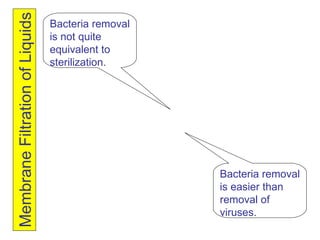
Membrane Filtration of Liquids Bacteria removal is easier than removal of viruses. Bacteria removal is not quite equivalent to sterilization.
Filtration HEPA filters  (high efficiency particulate air) –  removes microbes from air Removes 99 % of particles > 0.3um Used in hospitals – whole rooms, labs – hoods, home air filters
HEPA Filtration of Air
Control of Microbial Growth Low temperatures  – refrig, freezer Slows growth but does not kill < enzyme activity, lowers rate of chemical rxs in cytoplasm Desiccation = drying Viruses, endospores resistant Lyophilization = freeze drying Coffee, fruit additives for cereals, used to preserve microbes in laboratory
Control of Microbial Growth Osmotic pressure High salt, sugar or spice external environments ( hypertonic environment ) – higher water concentration in cell than outside cell causing H2O to flow from the cytoplasm thru cell membrane out to the environment Causes  cell  to  shrivel and die  – cell membrane pulls away from cell wall =  plasmolysis  Preserves foods – ex. Ham, bacon
Radiation Ionizing radiation = high energy radiation  that induces electrons to jump out of molecules they strike and create ions = atoms or molecules that lack 1 or more electrons ex.  X-rays, gamma rays, high energy electron beams X-rays and gamma rays enter cells and  break bonds in DNA  causing cell mutations and death
Radiation Ionizing radiation cont.  Some foods have been irradiated for more than 50 years  Radiation is used to kill bacterial pathogens, insects, worms and to inhibit the sprouting of potatoes ( > shelf life of food) Used to  sterilize heat sensitive vitamins, hormones, Abs, plastics, suture material Used to sterilize mail after Anthrax scare Used to preserve food Bone, skin and heart valves for grafting - sterilized
Radiation Non-ionizing radiation - has a longer wavelength and less energy  Ultraviolet Light (UV)  – has a wavelength of 100 - 400 nm  Used for airborne or surface contamination in hospital rooms, food industry, toilets Bacteria  are destroyed at approx. 260 nm –  causes thymine   dimers  (bonds form between adjacent bases on the same DNA strand) – bacteria can no longer produce proteins or reproduce  DRAW Disadvantage = does not penetrate liquids or solids
Chemical control of Microbes tables pg 207-08 Most chemical methods are unreliable for sterilization but are effective as disinfectants and preservatives Evaluating a disinfectant Phenol coefficient test – compare the activity of  a disinfectant with that of phenol American official Analytical Chemist’s  use – dilution test – current standard
Evaluating a Disinfectant Use – dilution test Use  Salmonella,   Staphylococcus , and  Pseudomonas  as  test microbes A series of tubes containing concentrations of the test disinfectants are inoculated and incubated The more the chemical can be diluted and still be effective the higher its rating
Evaluating a Disinfectant Disk-diffusion method  – pg 199 Filter paper disk is soaked with a chemical and placed on an agar plate that has been inoculated with a test organism and then incubated After incubation if the chemical is effective will see a  clear zone of inhibition  around the disk Also used to evaluate microbial susceptibility to Abs
Types of Disinfectants Phenol and phenolics  (phenol derivatives)-  disrupt plasma membranes  resulting in leakage of cellular contents,  denature proteins  1860’s –  Joseph Lister  established the principles of  aseptic surgery  by using  carbolic acid (phenol ) on wounds and instruments Phenol is caustic to skin and has been replaced by phenol derivatives wh/ are better germicidals and have lower toxicity
Types of Disinfectants Phenol derivatives Cresols  – derived from coal tar  O-phenylphenol used in  Lysol, Amphyll Bisphenols  = 2 phenol molecules – prominent in modern disinfection Hexachlorophene = pHisoHex  – combined with detergent to bath infants to retard Staph infections of scalp and umbilical cord – found could be absorbed through the skin and cause neurological damage – removed from OTC products
Types of Disinfectants Bisphenols cont.  Triclosan  – broad spectrum antimicrobial agent – destroys plasma membrane by blocking lipid synthesis Found in soap Halogens oxidize proteins, disrupts membranes Chlorine – as gas or in combination with other chemicals Germicidal action caused by hypochlorous acid (HOCL) that forms when chlorine is added to H2O Sodium hypochlorite 5% - Clorox bleach , disinfectant in dairies, food processing plants, hemodialysis systems In emergency CDC recommend 2 drops/liter (clear H2O) for 30 min. Chloramines  (Cl + ammonia)  release free chlorine  slower than hypochlorite solution and are more stable Used for disinfectants, antiseptics, sanitizing agents, tx of H2O supplies
Types of Disinfectants Iodine – more germicidal than chlorine , found in marine seaweed Tincture of iodine  (iodine dissolved in ROH) – used as  antiseptic for wounds Iodophors = iodine-detergent complexes that release iodine over a long period of time  ex. Betadine – for local wounds
Iodine & Iodophores
Types of Disinfectants Alcohols – denature proteins and disrupt membranes ETOH and isopropyl ROH are effective in killing vegetative bacteria and fungi  but not endospores or nonenveloped viruses  Used to disinfect thermometer, medical instruments, mechanically remove bacteria from skin before drawing blood or giving a shot
Heavy Metals Hg, Ag, Cu – denatures proteins Small amts of heavy metal  (Ag, Cu)  have antimicrobial effects = oligodynamic action Demonstrated when place a coin on petri dish w/ bacteria and growth is inhibited from diffusion of metals into media 1% silver nitrate solution  used to be  placed in eyes of newborns  to guard against  Neisseria gonorrhoeae   Can   cause   blindness  if contracted while going thru birth canal Can cause eye irritation so now use antibiotics
Heavy Metals Hg  used in the form of  mercuric chloride  used for  skin disease but toxic to skin Mercury compound –  thimerosal – vaccines , 1999 CDC advised removal Copper as  Cu sulfate  is used as an  algicide  to control algal and cyanobacteria growth in swimming pools, fish tanks, and H2O supplies Zinc chloride  used in  mouth washes ,  Zn oxide  is used in  paints  as an  anti-fungal
Types of Disinfectants Soaps and detergents are surfactants that emulsify particles and reduce surface tension, good degerming agents Aldehydes – denature proteins Formaldehyde  Gas at high temps  used to sterilize hospital gowns, medical instruments MC as  formalin  a 37% aqueous solution used to preserve biological specimens, embalming fluid, inactivate bacteria and viruses in vaccines
Aldehydes  Glutaraldehyde  – disinfectant that can be considered as a  sterilizing agent Kills bacteria and viruses in 10 min. and spores in 3 -10 hrs Used to sterilize endoscopes, respiratory therapy equipment Also used for embalming

Chapter 7 micro

  • 1.
    Chapter 7 TheControl of Microbial Growth
  • 2.
    Control of MicrobialGrowth Sterilization = the complete removal or killing of all microbes - they are unable to reproduce even in most favorable conditions – no partial sterilization Endospores are one of the most resistant forms of life Their destruction is the goal of sterilization because any process that kills endospores will kill the vegetative cell Used on inanimate objects or material ex. Liquid media
  • 3.
    Control of MicrobialGrowth Disinfection = the reduction or removal of vegetative pathogens but not endospores by chemicals, UV radiation, boiling H2O or steam Chemical agents used If object is inanimate (tabletop) = disinfectant If object is living (animal tissue) = antiseptic Antiseptics are regulated by FDA
  • 4.
    Some definitions Sepsis = Greek for putrid Refers to growth of microbes in blood and other tissues Is stem for septicemia (in blood), antiseptic, aseptic Degerming = mechanical removal (not killing) of microbes from surface of object Ex. ROH w/ shot, wash hands
  • 5.
  • 6.
    Physical Control ofMicrobes Thermal death point (TDP) = the lowest temp. required to kill all microbes in a liquid culture in 10 minutes For spore bearing organisms there are 2 TDPs – 1 for the vegetative cell and 1 for the spore form Thermal death time (TDT) = length of time to kill all microbes in a liquid culture at a given temperature TDP and TDT are important in the food industry wh/ uses heat for preservation
  • 7.
    Sterilization by HeatHeat is fast, reliable and cheap and does not introduce toxic substances into material being treated Moist heat Kills microbes by denaturing proteins – breaks H-bonds thus chgs shape Penetrates material faster than dry heat so need less time and lower temperatures Boiling H2O – not a sterilizing agent because of spores and viruses
  • 8.
    Sterilization by HeatAutoclave (pix –pg 191) = pressure is used to raise temp of steam > 100 Deg. C Most rapid and efficient method of sterilization by heat As pressure > temp. rises At 15 psi pressure the temperature rises from 100 deg C to 121 deg C 15 psi at 121 deg C 15 – 30 min depending on what you are sterilizing
  • 9.
    Sterilization by HeatAutoclave continued: Used to sterilize culture media, instruments, dressings, glassware, equipment (transfusions) Steam can’t penetrate Al foil – use paper Sterilization check w/ Bacillus spores – incubate to check for growth, tape Pasteurization – destroys Mycobacterium tuberculosis (TB) and Coxiella burnetii (Q fever)
  • 10.
    Sterilization by HeatPasteurization continued: Purpose is to reduce bacterial populations of liquid (milk, juice) and to destroy organisms that cause spoilage and human disease without affecting flavor Does not sterilize – spores aren’t affected Methods Classic = heating at 63 deg C 30 min High temp short time tx – 72 deg C 15 sec. – kills pathogens and lowers bacterial counts, >shelf life
  • 11.
    Sterilization by HeatPasteurization cont. Ultra – high temp tx – 140 deg. C for 1 sec Holding tube 3 sec. Vacuum chamber 1 sec to cool Can then store milk without refrigerating Actually sterilizes milk
  • 12.
    Sterilization by HeatDry heat – Direct flame – incinerates microbes rapidly Bunsen burner – inoculation loop, culture tube – organisms, dust, lint England 4 million cows in 2001 – infected with hoof and mouth disease Used to burn diseased bodies centuries ago Cows and fields exposed to Anthrax (spores)
  • 13.
    Sterilization by HeatDry heat – hot air ovens Does not penetrate material easy so needs long periods of time at high temps – 170 deg C at least 2 hrs Used to sterilize dry powders, water free oily substances, glassware Changes microbial proteins by oxidation rxs
  • 14.
    Filtration Used infood industries, laboratories (medical, environmental, industrial) A filter is a mechanical device used to remove microbes from a solution or gas Several types of filters used in a laboratory Membrane filter – cellulose acetate or polycarbonate – 0.22um, 0.45um, .01um – viruses, lg protein molecules
  • 15.
    Filtration Membrane filtrationcont. Can use to sterilize media or any liquid that can’t tolerate heat Serum, blood products, drugs, IV fluids, enzymes Can use for a bacterial count – traps bacteria on filter which is place on media in a petri dish and incubated
  • 16.
    Membrane Filtration ofLiquids Bacteria removal is easier than removal of viruses. Bacteria removal is not quite equivalent to sterilization.
  • 17.
    Filtration HEPA filters (high efficiency particulate air) – removes microbes from air Removes 99 % of particles > 0.3um Used in hospitals – whole rooms, labs – hoods, home air filters
  • 18.
  • 19.
    Control of MicrobialGrowth Low temperatures – refrig, freezer Slows growth but does not kill < enzyme activity, lowers rate of chemical rxs in cytoplasm Desiccation = drying Viruses, endospores resistant Lyophilization = freeze drying Coffee, fruit additives for cereals, used to preserve microbes in laboratory
  • 20.
    Control of MicrobialGrowth Osmotic pressure High salt, sugar or spice external environments ( hypertonic environment ) – higher water concentration in cell than outside cell causing H2O to flow from the cytoplasm thru cell membrane out to the environment Causes cell to shrivel and die – cell membrane pulls away from cell wall = plasmolysis Preserves foods – ex. Ham, bacon
  • 21.
    Radiation Ionizing radiation= high energy radiation that induces electrons to jump out of molecules they strike and create ions = atoms or molecules that lack 1 or more electrons ex. X-rays, gamma rays, high energy electron beams X-rays and gamma rays enter cells and break bonds in DNA causing cell mutations and death
  • 22.
    Radiation Ionizing radiationcont. Some foods have been irradiated for more than 50 years Radiation is used to kill bacterial pathogens, insects, worms and to inhibit the sprouting of potatoes ( > shelf life of food) Used to sterilize heat sensitive vitamins, hormones, Abs, plastics, suture material Used to sterilize mail after Anthrax scare Used to preserve food Bone, skin and heart valves for grafting - sterilized
  • 23.
    Radiation Non-ionizing radiation- has a longer wavelength and less energy Ultraviolet Light (UV) – has a wavelength of 100 - 400 nm Used for airborne or surface contamination in hospital rooms, food industry, toilets Bacteria are destroyed at approx. 260 nm – causes thymine dimers (bonds form between adjacent bases on the same DNA strand) – bacteria can no longer produce proteins or reproduce DRAW Disadvantage = does not penetrate liquids or solids
  • 24.
    Chemical control ofMicrobes tables pg 207-08 Most chemical methods are unreliable for sterilization but are effective as disinfectants and preservatives Evaluating a disinfectant Phenol coefficient test – compare the activity of a disinfectant with that of phenol American official Analytical Chemist’s use – dilution test – current standard
  • 25.
    Evaluating a DisinfectantUse – dilution test Use Salmonella, Staphylococcus , and Pseudomonas as test microbes A series of tubes containing concentrations of the test disinfectants are inoculated and incubated The more the chemical can be diluted and still be effective the higher its rating
  • 26.
    Evaluating a DisinfectantDisk-diffusion method – pg 199 Filter paper disk is soaked with a chemical and placed on an agar plate that has been inoculated with a test organism and then incubated After incubation if the chemical is effective will see a clear zone of inhibition around the disk Also used to evaluate microbial susceptibility to Abs
  • 27.
    Types of DisinfectantsPhenol and phenolics (phenol derivatives)- disrupt plasma membranes resulting in leakage of cellular contents, denature proteins 1860’s – Joseph Lister established the principles of aseptic surgery by using carbolic acid (phenol ) on wounds and instruments Phenol is caustic to skin and has been replaced by phenol derivatives wh/ are better germicidals and have lower toxicity
  • 28.
    Types of DisinfectantsPhenol derivatives Cresols – derived from coal tar O-phenylphenol used in Lysol, Amphyll Bisphenols = 2 phenol molecules – prominent in modern disinfection Hexachlorophene = pHisoHex – combined with detergent to bath infants to retard Staph infections of scalp and umbilical cord – found could be absorbed through the skin and cause neurological damage – removed from OTC products
  • 29.
    Types of DisinfectantsBisphenols cont. Triclosan – broad spectrum antimicrobial agent – destroys plasma membrane by blocking lipid synthesis Found in soap Halogens oxidize proteins, disrupts membranes Chlorine – as gas or in combination with other chemicals Germicidal action caused by hypochlorous acid (HOCL) that forms when chlorine is added to H2O Sodium hypochlorite 5% - Clorox bleach , disinfectant in dairies, food processing plants, hemodialysis systems In emergency CDC recommend 2 drops/liter (clear H2O) for 30 min. Chloramines (Cl + ammonia) release free chlorine slower than hypochlorite solution and are more stable Used for disinfectants, antiseptics, sanitizing agents, tx of H2O supplies
  • 30.
    Types of DisinfectantsIodine – more germicidal than chlorine , found in marine seaweed Tincture of iodine (iodine dissolved in ROH) – used as antiseptic for wounds Iodophors = iodine-detergent complexes that release iodine over a long period of time ex. Betadine – for local wounds
  • 31.
  • 32.
    Types of DisinfectantsAlcohols – denature proteins and disrupt membranes ETOH and isopropyl ROH are effective in killing vegetative bacteria and fungi but not endospores or nonenveloped viruses Used to disinfect thermometer, medical instruments, mechanically remove bacteria from skin before drawing blood or giving a shot
  • 33.
    Heavy Metals Hg,Ag, Cu – denatures proteins Small amts of heavy metal (Ag, Cu) have antimicrobial effects = oligodynamic action Demonstrated when place a coin on petri dish w/ bacteria and growth is inhibited from diffusion of metals into media 1% silver nitrate solution used to be placed in eyes of newborns to guard against Neisseria gonorrhoeae Can cause blindness if contracted while going thru birth canal Can cause eye irritation so now use antibiotics
  • 34.
    Heavy Metals Hg used in the form of mercuric chloride used for skin disease but toxic to skin Mercury compound – thimerosal – vaccines , 1999 CDC advised removal Copper as Cu sulfate is used as an algicide to control algal and cyanobacteria growth in swimming pools, fish tanks, and H2O supplies Zinc chloride used in mouth washes , Zn oxide is used in paints as an anti-fungal
  • 35.
    Types of DisinfectantsSoaps and detergents are surfactants that emulsify particles and reduce surface tension, good degerming agents Aldehydes – denature proteins Formaldehyde Gas at high temps used to sterilize hospital gowns, medical instruments MC as formalin a 37% aqueous solution used to preserve biological specimens, embalming fluid, inactivate bacteria and viruses in vaccines
  • 36.
    Aldehydes Glutaraldehyde – disinfectant that can be considered as a sterilizing agent Kills bacteria and viruses in 10 min. and spores in 3 -10 hrs Used to sterilize endoscopes, respiratory therapy equipment Also used for embalming