







SNACK FOODS
MANAGING MOISTURE
Mary Galloway
Application Scientist
METER Group, Inc. USA
CONTENTS
Top 3 Snack Food Pit-falls
• Rancidity
• Texture Changes
• Moisture Migration
Product Formulation
Achieving Consistency
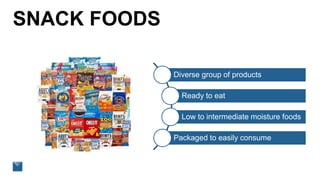
SNACK FOODS
SNACK FOODS
Diverse group of products
Ready to eat
Low to intermediate moisture foods
Packaged to easily consume
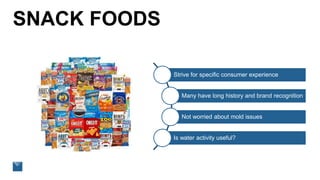
SNACK FOODS
Strive for specific consumer experience
Many have long history and brand recognition
Not worried about mold issues
Is water activity useful?
WHAT HAPPENS WHEN
PROBLEMS ARISE?
Trail mix now has
rancid nuts?
Bars are getting
hard or worse,
molding before the
expiration date?
Filled cakes are
sticky in the
package?
Can future
problems be
foreseen and
avoided?
What about new
formulations?
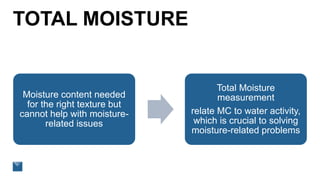
TOTAL MOISTURE
Moisture content needed
for the right texture but
cannot help with moisture-
related issues
Total Moisture
measurement
relate MC to water activity,
which is crucial to solving
moisture-related problems
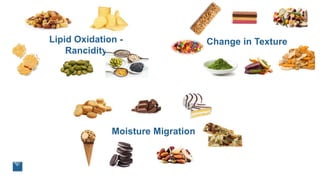
Lipid Oxidation -
Rancidity
Moisture Migration
Change in Texture
LIPID OXIDATION - RANCIDITY
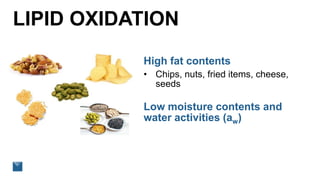
LIPID OXIDATION
High fat contents
• Chips, nuts, fried items, cheese,
seeds
Low moisture contents and
water activities (aw)
LIPID OXIDATION
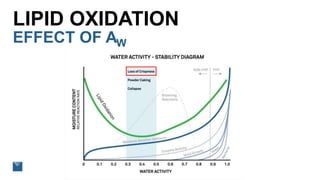
EFFECT OF AW
LIPID OXIDATION
• Products are generally in the 0.1-0.2 aw range to maintain
their crispness
High rate of oxidation >0.2; Lowest 0.3-0.5
• Can reduce O2 with oxygen absorber or with a N2 flush
• Pick the right packaging (WVTR & OTR)
• Minimize the effect of light
Need to balance texture and rancidity
CHANGE IN TEXTURE
CHANGE IN TEXTURE
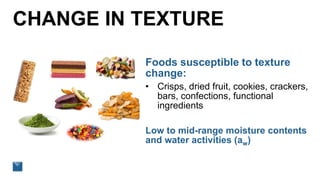
Foods susceptible to texture
change:
• Crisps, dried fruit, cookies, crackers,
bars, confections, functional
ingredients
Low to mid-range moisture contents
and water activities (aw)
CHANGE IN TEXTURE
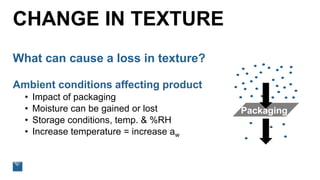
What can cause a loss in texture?
Ambient conditions affecting product
• Impact of packaging
• Moisture can be gained or lost
• Storage conditions, temp. & %RH
• Increase temperature = increase aw
Packaging
CHANGE IN TEXTURE
0
10
20
30
40
50
60
0 0.1 0.2 0.3 0.4 0.5 0.6 0.7 0.8 0.9 1
MoistureContent(%w.b.)
Water Activity
KALE CHIPS
RHc = 0.57
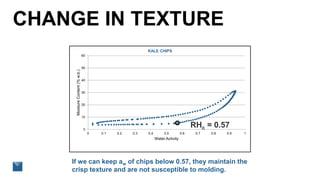
If we can keep aw of chips below 0.57, they maintain the
crisp texture and are not susceptible to molding.
MOISTURE MIGRATION
MOISTURE MIGRATION
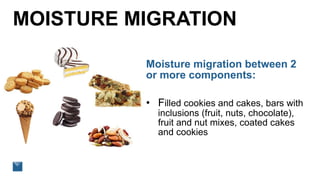
Moisture migration between 2
or more components:
• Filled cookies and cakes, bars with
inclusions (fruit, nuts, chocolate),
fruit and nut mixes, coated cakes
and cookies
MOISTURE MIGRATION
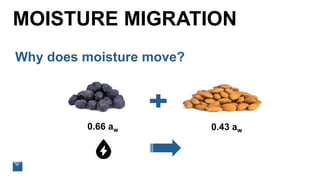
0.66 aw 0.43 aw
Why does moisture move?
MOISTURE MIGRATION
How to manage moisture
migration?
MOISTURE MIGRATION
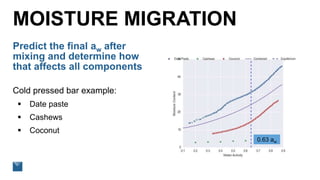
Predict the final aw after
mixing and determine how
that affects all components
Cold pressed bar example:
 Date paste
 Cashews
 Coconut
0.63 aw
MOISTURE MIGRATION
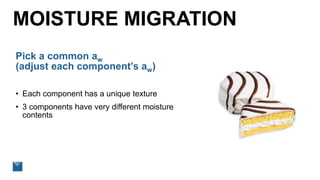
Pick a common aw
(adjust each component’s aw)
• Each component has a unique texture
• 3 components have very different moisture
contents
MOISTURE MIGRATION
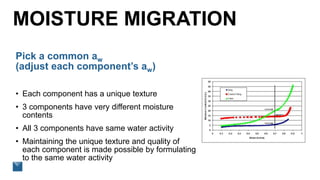
Pick a common aw
(adjust each component’s aw)
• Each component has a unique texture
• 3 components have very different moisture
contents
• All 3 components have same water activity
• Maintaining the unique texture and quality of
each component is made possible by formulating
to the same water activity
MOISTURE MIGRATION
Other ways to manage moisture migration
 Slow diffusion process (fats, starches)
 Moisture barrier (chocolate)
 Separate packaging
NEW FORMULATION
NEW FORMULATION
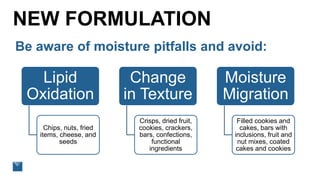
Be aware of moisture pitfalls and avoid:
Lipid
Oxidation
Chips, nuts, fried
items, cheese, and
seeds
Change
in Texture
Crisps, dried fruit,
cookies, crackers,
bars, confections,
functional
ingredients
Moisture
Migration
Filled cookies and
cakes, bars with
inclusions, fruit and
nut mixes, coated
cakes and cookies
NEW FORMULATION
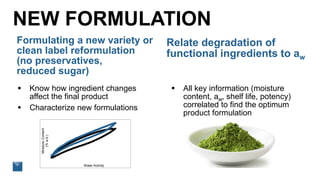
 Know how ingredient changes
affect the final product
 Characterize new formulations
Relate degradation of
functional ingredients to aw
 All key information (moisture
content, aw, shelf life, potency)
correlated to find the optimum
product formulation
MoistureContent
(%w.b.)
Water Activity
Formulating a new variety or
clean label reformulation
(no preservatives,
reduced sugar)
PRODUCING CONSISTENCY
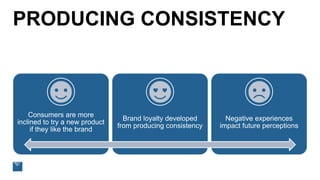
Consumers are more
inclined to try a new product
if they like the brand
Brand loyalty developed
from producing consistency
Negative experiences
impact future perceptions
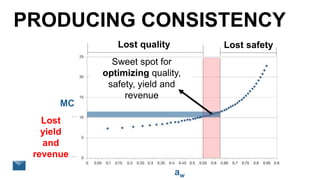
aw
MC
Lost
yield
and
revenue
Lost quality Lost safety
Sweet spot for
optimizing quality,
safety, yield and
revenue
PRODUCING CONSISTENCY
Use Total Moisture measurements (%MC, aw) in-process
to:
 Set process specifications
 Track changes during production
 Make process adjustments before it’s too late
 Deliver a reliable product
 Maintain the desired shelf life with no surprises
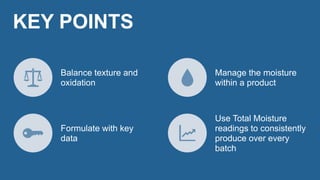
Balance texture and
oxidation
Manage the moisture
within a product
Formulate with key
data
Use Total Moisture
readings to consistently
produce over every
batch
KEY POINTS
QUESTIONS?

Solving Moisture Issues in Snack Foods

  • 2.
    SNACK FOODS MANAGING MOISTURE MaryGalloway Application Scientist METER Group, Inc. USA
  • 3.
    CONTENTS Top 3 SnackFood Pit-falls • Rancidity • Texture Changes • Moisture Migration Product Formulation Achieving Consistency
  • 4.
  • 5.
    SNACK FOODS Diverse groupof products Ready to eat Low to intermediate moisture foods Packaged to easily consume
  • 6.
    SNACK FOODS Strive forspecific consumer experience Many have long history and brand recognition Not worried about mold issues Is water activity useful?
  • 7.
    WHAT HAPPENS WHEN PROBLEMSARISE? Trail mix now has rancid nuts? Bars are getting hard or worse, molding before the expiration date? Filled cakes are sticky in the package? Can future problems be foreseen and avoided? What about new formulations?
  • 8.
    TOTAL MOISTURE Moisture contentneeded for the right texture but cannot help with moisture- related issues Total Moisture measurement relate MC to water activity, which is crucial to solving moisture-related problems
  • 9.
    Lipid Oxidation - Rancidity MoistureMigration Change in Texture
  • 10.
  • 11.
    LIPID OXIDATION High fatcontents • Chips, nuts, fried items, cheese, seeds Low moisture contents and water activities (aw)
  • 12.
  • 13.
    LIPID OXIDATION • Productsare generally in the 0.1-0.2 aw range to maintain their crispness High rate of oxidation >0.2; Lowest 0.3-0.5 • Can reduce O2 with oxygen absorber or with a N2 flush • Pick the right packaging (WVTR & OTR) • Minimize the effect of light Need to balance texture and rancidity
  • 14.
  • 15.
    CHANGE IN TEXTURE Foodssusceptible to texture change: • Crisps, dried fruit, cookies, crackers, bars, confections, functional ingredients Low to mid-range moisture contents and water activities (aw)
  • 16.
    CHANGE IN TEXTURE Whatcan cause a loss in texture? Ambient conditions affecting product • Impact of packaging • Moisture can be gained or lost • Storage conditions, temp. & %RH • Increase temperature = increase aw Packaging
  • 17.
    CHANGE IN TEXTURE 0 10 20 30 40 50 60 00.1 0.2 0.3 0.4 0.5 0.6 0.7 0.8 0.9 1 MoistureContent(%w.b.) Water Activity KALE CHIPS RHc = 0.57 If we can keep aw of chips below 0.57, they maintain the crisp texture and are not susceptible to molding.
  • 18.
  • 19.
    MOISTURE MIGRATION Moisture migrationbetween 2 or more components: • Filled cookies and cakes, bars with inclusions (fruit, nuts, chocolate), fruit and nut mixes, coated cakes and cookies
  • 20.
    MOISTURE MIGRATION 0.66 aw0.43 aw Why does moisture move?
  • 21.
    MOISTURE MIGRATION How tomanage moisture migration?
  • 22.
    MOISTURE MIGRATION Predict thefinal aw after mixing and determine how that affects all components Cold pressed bar example:  Date paste  Cashews  Coconut 0.63 aw
  • 23.
    MOISTURE MIGRATION Pick acommon aw (adjust each component’s aw) • Each component has a unique texture • 3 components have very different moisture contents
  • 24.
    MOISTURE MIGRATION Pick acommon aw (adjust each component’s aw) • Each component has a unique texture • 3 components have very different moisture contents • All 3 components have same water activity • Maintaining the unique texture and quality of each component is made possible by formulating to the same water activity
  • 25.
    MOISTURE MIGRATION Other waysto manage moisture migration  Slow diffusion process (fats, starches)  Moisture barrier (chocolate)  Separate packaging
  • 26.
  • 27.
    NEW FORMULATION Be awareof moisture pitfalls and avoid: Lipid Oxidation Chips, nuts, fried items, cheese, and seeds Change in Texture Crisps, dried fruit, cookies, crackers, bars, confections, functional ingredients Moisture Migration Filled cookies and cakes, bars with inclusions, fruit and nut mixes, coated cakes and cookies
  • 28.
    NEW FORMULATION  Knowhow ingredient changes affect the final product  Characterize new formulations Relate degradation of functional ingredients to aw  All key information (moisture content, aw, shelf life, potency) correlated to find the optimum product formulation MoistureContent (%w.b.) Water Activity Formulating a new variety or clean label reformulation (no preservatives, reduced sugar)
  • 29.
  • 30.
    PRODUCING CONSISTENCY Consumers aremore inclined to try a new product if they like the brand Brand loyalty developed from producing consistency Negative experiences impact future perceptions
  • 31.
    aw MC Lost yield and revenue Lost quality Lostsafety Sweet spot for optimizing quality, safety, yield and revenue PRODUCING CONSISTENCY
  • 32.
    PRODUCING CONSISTENCY Use TotalMoisture measurements (%MC, aw) in-process to:  Set process specifications  Track changes during production  Make process adjustments before it’s too late  Deliver a reliable product  Maintain the desired shelf life with no surprises
  • 33.
    Balance texture and oxidation Managethe moisture within a product Formulate with key data Use Total Moisture readings to consistently produce over every batch KEY POINTS
  • 34.

Editor's Notes

  • #10 Have you every wondered how you can have a nice tender raisin and crispy bran flakes. Or a snack cake that can maintain the texture of all of its components? And the same with a cheese filled cracker. How can you avoid caking and clumping issues with ingredients? Or determine if your product will be susceptible to spoilage? All of these examples are controlled by water activity. If you understand how water activity works, you will be able to develop products that are stable and desirable to the consumer, and can predict and prevent potential issues.
  • #18 Determine RHc for product by running an isotherm. VSA Toolkit -> Glass Transition (milk pwd DDI) RHc = 0.57. If could get product Aw below 0.57, could maintain desired texture and be shelf stable. BEFORE: Shelf life of less than 30 days, limited market, Undesirable texture changes, Risk of mold growth AFTER: Shelf life increased to over 6 months, 3 stores to over 60 stores carrying product, Increased confidence in safety and quality
  • #21 The hard truth about moisture migration – it is driven by water activity and NOT moisture content. It would be easier for people to understand if it was MC – people are more familiar with MC. But if that was true, then we couldn’t have things like Raisin Bran – soggy flakes and hard raisins, Cheese filled Crackers, or delicious Cream filled snack cakes. They would all be gross.
  • #22 The hard truth about moisture migration – it is driven by water activity and NOT moisture content. It would be easier for people to understand if it was MC – people are more familiar with MC. But if that was true, then we couldn’t have things like Raisin Bran – soggy flakes and hard raisins, Cheese filled Crackers, or delicious Cream filled snack cakes. They would all be gross.
  • #26 The hard truth about moisture migration – it is driven by water activity and NOT moisture content. It would be easier for people to understand if it was MC – people are more familiar with MC. But if that was true, then we couldn’t have things like Raisin Bran – soggy flakes and hard raisins, Cheese filled Crackers, or delicious Cream filled snack cakes. They would all be gross.
  • #28 The hard truth about moisture migration – it is driven by water activity and NOT moisture content. It would be easier for people to understand if it was MC – people are more familiar with MC. But if that was true, then we couldn’t have things like Raisin Bran – soggy flakes and hard raisins, Cheese filled Crackers, or delicious Cream filled snack cakes. They would all be gross.