Working with Technology Seminar
Opportunities in
Online Advertising
VINOGRADOVO, October 9-10 2013
2
1. Ad Delivery – New Formats
2. Online Ads Specification
3. Ad Serving
4. Latest Trends in Online Marketing
Agenda: What we will cover
3
Online Ad Delivery Methods
 Display advertising
 Search Engine Marketing (SEM)
 Social Media Marketing
 Mobile Advertising
 Email Advertising
 Online Classified Advertising
 Affiliate Marketing
4
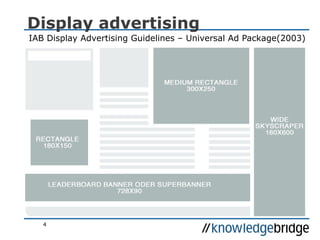
Display advertising
IAB Display Advertising Guidelines – Universal Ad Package(2003)
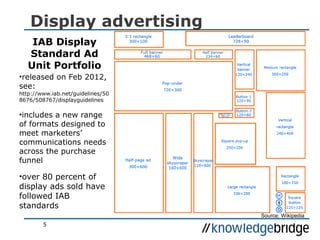
Display advertising
IAB Display
Standard Ad
Unit Portfolio
•released on Feb 2012,
see:
http://www.iab.net/guidelines/50
8676/508767/displayguidelines
•includes a new range
of formats designed to
meet marketers’
communications needs
across the purchase
funnel
•over 80 percent of
display ads sold have
followed IAB
standards
5
Source: Wikipedia
6
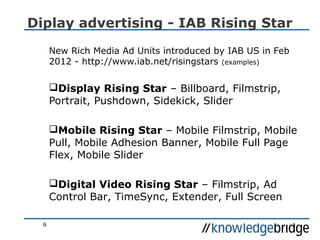
Diplay advertising - IAB Rising Star
New Rich Media Ad Units introduced by IAB US in Feb
2012 - http://www.iab.net/risingstars (examples)
Display Rising Star – Billboard, Filmstrip,
Portrait, Pushdown, Sidekick, Slider
Mobile Rising Star – Mobile Filmstrip, Mobile
Pull, Mobile Adhesion Banner, Mobile Full Page
Flex, Mobile Slider
Digital Video Rising Star – Filmstrip, Ad
Control Bar, TimeSync, Extender, Full Screen
7
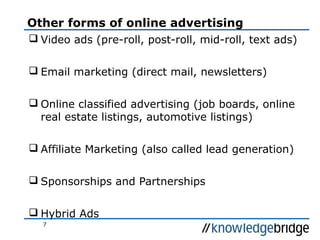
Other forms of online advertising
 Video ads (pre-roll, post-roll, mid-roll, text ads)
 Email marketing (direct mail, newsletters)
 Online classified advertising (job boards, online
real estate listings, automotive listings)
 Affiliate Marketing (also called lead generation)
 Sponsorships and Partnerships
 Hybrid Ads
8
Online Ads Specification
 Develop your own rules and recommendations for
advertisers (create a document available at your website
that covers all area of online ads specification)
General Guidelines and Requirements
(examples)
• An ad must be clearly marked with the word “ad” close to the
ad location, with graphic separation from the content, to avoid
confusion with the content
• Ads covering content are among the most aggressive formats.
Should always be used with some limitation of display for the
user and time (frequency). Ads covering content must contain
a „Close X“ button
• All sound in ads must be click initiated
9
Ad Unit Specification
Ad Type (use common terminology for each ad form to
avoid misunderstanding, e.g. square banner, leaderboard,
overlay)
Dimensions (in pixels – in case of expandable formats,
specify also dimmension of expanded ad unit)
File Size (initial data volume, including scripts, libraries,
form data and associated graphics)
Video File Size (in case of video streaming, specify
max. data volume)
Animation (e.g. up to XY seconds)
Serving Options (will you accept third party?)
Notes (e.g. auto-expands once per user per day, must be
click to expand and click to close, frequency cap of 1 per user/
per 24 hours, max. amount of characters in case of text ads)
10
Online Ad Submission Instructions
Creatives must comply with your reqs -
examples:
Max of 5 individual ad codes in rotation at one time
unless otherwise specified for a particular placement.
Max of 1 instance of code or image changes per
week unless otherwise specific for a particular
placement.
Submit all creatives to your account manager at
least 3 days prior to campaign launch for standard
creative. 5 days prior for rich media.
Approved Ad Servers for Web/Mobile Web/Mobile
Apps/Video Ads
11
Online Technical Specifications
(examples)
Always create an alternative to Flash version, with the same
dimensions and in GIF/JPEG
Never insert target URL into Flash directly, but import it from the
clickthru or clickTag variable
Test and program banner behaviour in different browsers, provide
alternative content for browsers where full functionality is not possible
No ad can prompt the download of a plug-in, and must be coded to
search for any required plug-ins and display an alternate ad to those
who don't have it.
Especially for Flash advertising, test for CPU load on slower machines
(around 300 MHz processor speed)
For commercials with a display time limit, ensure such limit will be
observed on slower and less powerful machines
Advertising content with sounds should always be tested with the
sound on
See also (in Russian): https://rbc.medialand.ru/formats.html
12
Advertising Platform
 What does Advertising Platform mean?
An advertising platform (also called Ad Serving) is an intermediary
technology between publisher and advertisers that allows publisher
to publish and manage text, graphic or animated advertisements on
websites.
 What are the main advantages of using Online
Advertising Platform?
 management and automated deployment of advertising on a
website
 easy and fast creation and efficient control of the advertising
campaigns
 different targeting methods (on the site, geographic, by the
context, behavior)
 accurate and independent statistics for publisher and advertiser
13
Ad Serving – decision criteria
Before choosing an ad server platform, ask
yourself:
What is your selling strategy?
Do you have any special ad serving
requirements?
How much support do you need?
Ad Serving Platforms Functionality
Common functions
Uploading advertisements
and rich media.
Trafficking ads according to
differing business rules.
Targeting ads to different
users, or content.
Tuning and optimization
based on results.
Reporting impressions,
clicks, post-click & post-
impression activities, and
interaction metrics.
Advanced functions
Frequency capping so users only
see messages a limited amount of
time. (Advertisers can also limit ads
by setting a frequency cap on
money-spending)
Sequencing ads so users see
messages in a specific order
(sometimes known as surround
sessions).
Excluding competition so users do
not see competitors' ads directly
next to one another. (Usually done
by bidding on keywords)
Displaying ads so an advertiser can
own 100%
14
Ad Serving Decision Criteria
Pricing:
- usually based on number of served impressions per
month, sometimes based on data volume transfered per
month.
Free platforms:
Rontar
http://www.rontar.ua – free up to 100 million impps per month
Google DoubleClick Small Business
http://www.google.com/intl/en/dfp/info/sb/ - free up to 90 million
impps per month
AdTech Lite
http://www.adtechlite.com) - free up to 90 million impps per month
Epom
http://epom.com - - free up to 250k impps per month
15
Ad Serving Decision Criteria
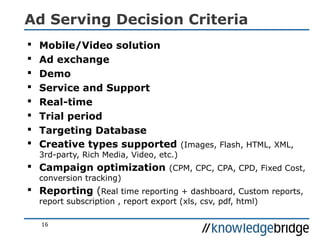
 Mobile/Video solution
 Ad exchange
 Demo
 Service and Support
 Real-time
 Trial period
 Targeting Database
 Creative types supported (Images, Flash, HTML, XML,
3rd-party, Rich Media, Video, etc.)
 Campaign optimization (CPM, CPC, CPA, CPD, Fixed Cost,
conversion tracking)
 Reporting (Real time reporting + dashboard, Custom reports,
report subscription , report export (xls, csv, pdf, html)
16
Ad Serving Platforms
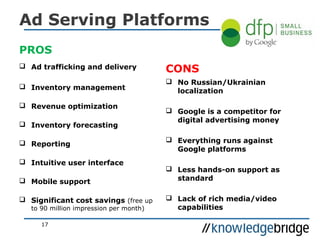
PROS
 Ad trafficking and delivery
 Inventory management
 Revenue optimization
 Inventory forecasting
 Reporting
 Intuitive user interface
 Mobile support
 Significant cost savings (free up
to 90 million impression per month)
CONS
 No Russian/Ukrainian
localization
 Google is a competitor for
digital advertising money
 Everything runs against
Google platforms
 Less hands-on support as
standard
 Lack of rich media/video
capabilities
17
Ad Serving Platforms in RU
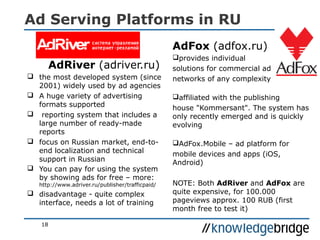
AdRiver (adriver.ru)
 the most developed system (since
2001) widely used by ad agencies
 A huge variety of advertising
formats supported
 reporting system that includes a
large number of ready-made
reports
 focus on Russian market, end-to-
end localization and technical
support in Russian
 You can pay for using the system
by showing ads for free – more:
http://www.adriver.ru/publisher/trafficpaid/
 disadvantage - quite complex
interface, needs a lot of training
AdFox (adfox.ru)
provides individual
solutions for commercial ad
networks of any complexity
affiliated with the publishing
house "Kommersant". The system has
only recently emerged and is quickly
evolving
AdFox.Mobile – ad platform for
mobile devices and apps (iOS,
Android)
NOTE: Both AdRiver and AdFox are
quite expensive, for 100.000
pageviews approx. 100 RUB (first
month free to test it)
18
19
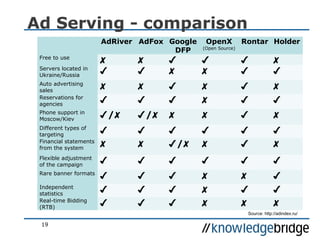
Ad Serving - comparison
AdRiver AdFox Google
DFP
OpenX
(Open Source)
Rontar Holder
Free to use
✘ ✘ ✔ ✔ ✔ ✘
Servers located in
Ukraine/Russia
✔ ✔ ✘ ✘ ✔ ✔
Auto advertising
sales
✘ ✘ ✔ ✘ ✔ ✘
Reservations for
agencies
✔ ✔ ✔ ✘ ✔ ✔
Phone support in
Moscow/Kiev
✔/✘ ✔/✘ ✘ ✘ ✔ ✘
Different types of
targeting
✔ ✔ ✔ ✔ ✔ ✔
Financial statements
from the system
✘ ✘ ✔/✘ ✘ ✔ ✘
Flexible adjustment
of the campaign
✔ ✔ ✔ ✔ ✔ ✔
Rare banner formats
✔ ✔ ✔ ✘ ✘ ✔
Independent
statistics
✔ ✔ ✔ ✘ ✔ ✔
Real-time Bidding
(RTB)
✔ ✔ ✔ ✘ ✘ ✘
Source: http://adindex.ru/
20
Ad Serving – Targeting
Targeting options exist for a long time and are used in
almost all campaigns/ad serving platforms:
 date and time targeting
 geographical location of users (up to city/district level – hyperlocal
targeting)
 number of hits per user (based on cookie and IP) - capping
 bandwidth, browser, languahe settings, OS, connection type, etc.
Retargeting is the practice of serving ads based on prior engagement.
Serving up ads to people who previously visit your website after they leave.
Social Media Targeting is a method of using social media profile data to
deliver advertisements directly to individual users.
Contextual Targeting (also known as Semantic targeting) - Inferring the
optimum ad placement from information contained on the page where the ad
is being served.
21
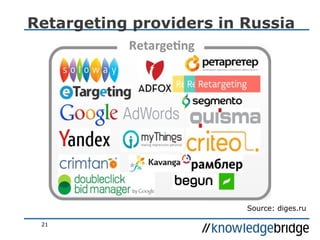
Retargeting providers in Russia
Source: diges.ru
22
Advanced Targeting: Behavioral
Behavioral Targeting - using prior behavior on the part of
the viewer to determine which ad to show during a given
visit.
Targeting thematic words - showing ads to users who
have entered on the search engines certain search terms.
Targeting on thematic sites - showing ads to users who
have visited certain sites. Ads will not show on the theme
site, but on any other user to visit and where it can be shown
banner system.
2 types of behavioral targeting:
ad network behavioral targeting
on site behavioral targeting (creating a profile to a user)
23
Trends in Online Advertising - RTB
RTB (Real-time bidding) is a specific methodology for
creating a real-time/instantaneous marketplace for online ads
(similar to High Frequency Trading on Stock Exchanges).
There are 3 groups of entities involved (just like in financial
markets):
Demand Side Platforms (DSP)
Data Management Platforms (DMP)
Supply Side Platforms(SSP)
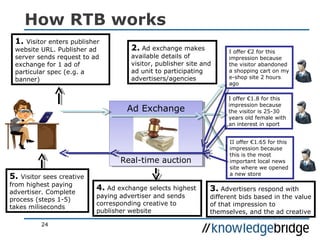
How RTB works
24
1. Visitor enters publisher
website URL. Publisher ad
server sends request to ad
exchange for 1 ad of
particular spec (e.g. a
banner)
2. Ad exchange makes
available details of
visitor, publisher site and
ad unit to participating
advertisers/agencies
Ad Exchange
Real-time auction
Ad Exchange
Real-time auction
I offer €2 for this
impression because
the visitor abandoned
a shopping cart on my
e-shop site 2 hours
ago
I offer €1.8 for this
impression because
the visitor is 25-30
years old female with
an interest in sport
II offer €1.65 for this
impression because
this is the most
important local news
site where we opened
a new store
3. Advertisers respond with
different bids based in the value
of that impression to
themselves, and the ad creative
4. Ad exchange selects highest
paying advertiser and sends
corresponding creative to
publisher website
5. Visitor sees creative
from highest paying
advertiser. Complete
process (steps 1-5)
takes miliseconds
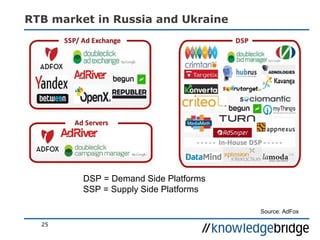
RTB market in Russia and Ukraine
25
DSP = Demand Side Platforms
SSP = Supply Side Platforms
Source: AdFox
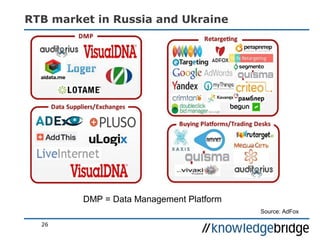
RTB market in Russia and Ukraine
26
DMP = Data Management Platform
Source: AdFox

KB Seminars: Working with Technology - Advertising; 10/13

  • 1.
    Working with TechnologySeminar Opportunities in Online Advertising VINOGRADOVO, October 9-10 2013
  • 2.
    2 1. Ad Delivery– New Formats 2. Online Ads Specification 3. Ad Serving 4. Latest Trends in Online Marketing Agenda: What we will cover
  • 3.
    3 Online Ad DeliveryMethods  Display advertising  Search Engine Marketing (SEM)  Social Media Marketing  Mobile Advertising  Email Advertising  Online Classified Advertising  Affiliate Marketing
  • 4.
    4 Display advertising IAB DisplayAdvertising Guidelines – Universal Ad Package(2003)
  • 5.
    Display advertising IAB Display StandardAd Unit Portfolio •released on Feb 2012, see: http://www.iab.net/guidelines/50 8676/508767/displayguidelines •includes a new range of formats designed to meet marketers’ communications needs across the purchase funnel •over 80 percent of display ads sold have followed IAB standards 5 Source: Wikipedia
  • 6.
    6 Diplay advertising -IAB Rising Star New Rich Media Ad Units introduced by IAB US in Feb 2012 - http://www.iab.net/risingstars (examples) Display Rising Star – Billboard, Filmstrip, Portrait, Pushdown, Sidekick, Slider Mobile Rising Star – Mobile Filmstrip, Mobile Pull, Mobile Adhesion Banner, Mobile Full Page Flex, Mobile Slider Digital Video Rising Star – Filmstrip, Ad Control Bar, TimeSync, Extender, Full Screen
  • 7.
    7 Other forms ofonline advertising  Video ads (pre-roll, post-roll, mid-roll, text ads)  Email marketing (direct mail, newsletters)  Online classified advertising (job boards, online real estate listings, automotive listings)  Affiliate Marketing (also called lead generation)  Sponsorships and Partnerships  Hybrid Ads
  • 8.
    8 Online Ads Specification Develop your own rules and recommendations for advertisers (create a document available at your website that covers all area of online ads specification) General Guidelines and Requirements (examples) • An ad must be clearly marked with the word “ad” close to the ad location, with graphic separation from the content, to avoid confusion with the content • Ads covering content are among the most aggressive formats. Should always be used with some limitation of display for the user and time (frequency). Ads covering content must contain a „Close X“ button • All sound in ads must be click initiated
  • 9.
    9 Ad Unit Specification AdType (use common terminology for each ad form to avoid misunderstanding, e.g. square banner, leaderboard, overlay) Dimensions (in pixels – in case of expandable formats, specify also dimmension of expanded ad unit) File Size (initial data volume, including scripts, libraries, form data and associated graphics) Video File Size (in case of video streaming, specify max. data volume) Animation (e.g. up to XY seconds) Serving Options (will you accept third party?) Notes (e.g. auto-expands once per user per day, must be click to expand and click to close, frequency cap of 1 per user/ per 24 hours, max. amount of characters in case of text ads)
  • 10.
    10 Online Ad SubmissionInstructions Creatives must comply with your reqs - examples: Max of 5 individual ad codes in rotation at one time unless otherwise specified for a particular placement. Max of 1 instance of code or image changes per week unless otherwise specific for a particular placement. Submit all creatives to your account manager at least 3 days prior to campaign launch for standard creative. 5 days prior for rich media. Approved Ad Servers for Web/Mobile Web/Mobile Apps/Video Ads
  • 11.
    11 Online Technical Specifications (examples) Alwayscreate an alternative to Flash version, with the same dimensions and in GIF/JPEG Never insert target URL into Flash directly, but import it from the clickthru or clickTag variable Test and program banner behaviour in different browsers, provide alternative content for browsers where full functionality is not possible No ad can prompt the download of a plug-in, and must be coded to search for any required plug-ins and display an alternate ad to those who don't have it. Especially for Flash advertising, test for CPU load on slower machines (around 300 MHz processor speed) For commercials with a display time limit, ensure such limit will be observed on slower and less powerful machines Advertising content with sounds should always be tested with the sound on See also (in Russian): https://rbc.medialand.ru/formats.html
  • 12.
    12 Advertising Platform  Whatdoes Advertising Platform mean? An advertising platform (also called Ad Serving) is an intermediary technology between publisher and advertisers that allows publisher to publish and manage text, graphic or animated advertisements on websites.  What are the main advantages of using Online Advertising Platform?  management and automated deployment of advertising on a website  easy and fast creation and efficient control of the advertising campaigns  different targeting methods (on the site, geographic, by the context, behavior)  accurate and independent statistics for publisher and advertiser
  • 13.
    13 Ad Serving –decision criteria Before choosing an ad server platform, ask yourself: What is your selling strategy? Do you have any special ad serving requirements? How much support do you need?
  • 14.
    Ad Serving PlatformsFunctionality Common functions Uploading advertisements and rich media. Trafficking ads according to differing business rules. Targeting ads to different users, or content. Tuning and optimization based on results. Reporting impressions, clicks, post-click & post- impression activities, and interaction metrics. Advanced functions Frequency capping so users only see messages a limited amount of time. (Advertisers can also limit ads by setting a frequency cap on money-spending) Sequencing ads so users see messages in a specific order (sometimes known as surround sessions). Excluding competition so users do not see competitors' ads directly next to one another. (Usually done by bidding on keywords) Displaying ads so an advertiser can own 100% 14
  • 15.
    Ad Serving DecisionCriteria Pricing: - usually based on number of served impressions per month, sometimes based on data volume transfered per month. Free platforms: Rontar http://www.rontar.ua – free up to 100 million impps per month Google DoubleClick Small Business http://www.google.com/intl/en/dfp/info/sb/ - free up to 90 million impps per month AdTech Lite http://www.adtechlite.com) - free up to 90 million impps per month Epom http://epom.com - - free up to 250k impps per month 15
  • 16.
    Ad Serving DecisionCriteria  Mobile/Video solution  Ad exchange  Demo  Service and Support  Real-time  Trial period  Targeting Database  Creative types supported (Images, Flash, HTML, XML, 3rd-party, Rich Media, Video, etc.)  Campaign optimization (CPM, CPC, CPA, CPD, Fixed Cost, conversion tracking)  Reporting (Real time reporting + dashboard, Custom reports, report subscription , report export (xls, csv, pdf, html) 16
  • 17.
    Ad Serving Platforms PROS Ad trafficking and delivery  Inventory management  Revenue optimization  Inventory forecasting  Reporting  Intuitive user interface  Mobile support  Significant cost savings (free up to 90 million impression per month) CONS  No Russian/Ukrainian localization  Google is a competitor for digital advertising money  Everything runs against Google platforms  Less hands-on support as standard  Lack of rich media/video capabilities 17
  • 18.
    Ad Serving Platformsin RU AdRiver (adriver.ru)  the most developed system (since 2001) widely used by ad agencies  A huge variety of advertising formats supported  reporting system that includes a large number of ready-made reports  focus on Russian market, end-to- end localization and technical support in Russian  You can pay for using the system by showing ads for free – more: http://www.adriver.ru/publisher/trafficpaid/  disadvantage - quite complex interface, needs a lot of training AdFox (adfox.ru) provides individual solutions for commercial ad networks of any complexity affiliated with the publishing house "Kommersant". The system has only recently emerged and is quickly evolving AdFox.Mobile – ad platform for mobile devices and apps (iOS, Android) NOTE: Both AdRiver and AdFox are quite expensive, for 100.000 pageviews approx. 100 RUB (first month free to test it) 18
  • 19.
    19 Ad Serving -comparison AdRiver AdFox Google DFP OpenX (Open Source) Rontar Holder Free to use ✘ ✘ ✔ ✔ ✔ ✘ Servers located in Ukraine/Russia ✔ ✔ ✘ ✘ ✔ ✔ Auto advertising sales ✘ ✘ ✔ ✘ ✔ ✘ Reservations for agencies ✔ ✔ ✔ ✘ ✔ ✔ Phone support in Moscow/Kiev ✔/✘ ✔/✘ ✘ ✘ ✔ ✘ Different types of targeting ✔ ✔ ✔ ✔ ✔ ✔ Financial statements from the system ✘ ✘ ✔/✘ ✘ ✔ ✘ Flexible adjustment of the campaign ✔ ✔ ✔ ✔ ✔ ✔ Rare banner formats ✔ ✔ ✔ ✘ ✘ ✔ Independent statistics ✔ ✔ ✔ ✘ ✔ ✔ Real-time Bidding (RTB) ✔ ✔ ✔ ✘ ✘ ✘ Source: http://adindex.ru/
  • 20.
    20 Ad Serving –Targeting Targeting options exist for a long time and are used in almost all campaigns/ad serving platforms:  date and time targeting  geographical location of users (up to city/district level – hyperlocal targeting)  number of hits per user (based on cookie and IP) - capping  bandwidth, browser, languahe settings, OS, connection type, etc. Retargeting is the practice of serving ads based on prior engagement. Serving up ads to people who previously visit your website after they leave. Social Media Targeting is a method of using social media profile data to deliver advertisements directly to individual users. Contextual Targeting (also known as Semantic targeting) - Inferring the optimum ad placement from information contained on the page where the ad is being served.
  • 21.
    21 Retargeting providers inRussia Source: diges.ru
  • 22.
    22 Advanced Targeting: Behavioral BehavioralTargeting - using prior behavior on the part of the viewer to determine which ad to show during a given visit. Targeting thematic words - showing ads to users who have entered on the search engines certain search terms. Targeting on thematic sites - showing ads to users who have visited certain sites. Ads will not show on the theme site, but on any other user to visit and where it can be shown banner system. 2 types of behavioral targeting: ad network behavioral targeting on site behavioral targeting (creating a profile to a user)
  • 23.
    23 Trends in OnlineAdvertising - RTB RTB (Real-time bidding) is a specific methodology for creating a real-time/instantaneous marketplace for online ads (similar to High Frequency Trading on Stock Exchanges). There are 3 groups of entities involved (just like in financial markets): Demand Side Platforms (DSP) Data Management Platforms (DMP) Supply Side Platforms(SSP)
  • 24.
    How RTB works 24 1.Visitor enters publisher website URL. Publisher ad server sends request to ad exchange for 1 ad of particular spec (e.g. a banner) 2. Ad exchange makes available details of visitor, publisher site and ad unit to participating advertisers/agencies Ad Exchange Real-time auction Ad Exchange Real-time auction I offer €2 for this impression because the visitor abandoned a shopping cart on my e-shop site 2 hours ago I offer €1.8 for this impression because the visitor is 25-30 years old female with an interest in sport II offer €1.65 for this impression because this is the most important local news site where we opened a new store 3. Advertisers respond with different bids based in the value of that impression to themselves, and the ad creative 4. Ad exchange selects highest paying advertiser and sends corresponding creative to publisher website 5. Visitor sees creative from highest paying advertiser. Complete process (steps 1-5) takes miliseconds
  • 25.
    RTB market inRussia and Ukraine 25 DSP = Demand Side Platforms SSP = Supply Side Platforms Source: AdFox
  • 26.
    RTB market inRussia and Ukraine 26 DMP = Data Management Platform Source: AdFox