Addressing the ’Wicked’
problems of real life
that require multiple
skills, approaches and
knowledges
“Learning is the process
whereby knowledge is
created through the
transformation of
experience”
(Kolb, 198).
Exploring Post-digital Experiental Education
Learning by Developing
in a Living Lab
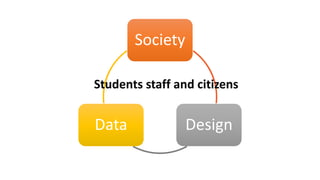
Society
DesignData
Students staff and citizens
Challenge
Learning the messy business of trying to
pull together the materiality and
relationships of the real world (Law 2007)
Our Activities
A three year cycle of design and run of Learning by Developing
in a Living Lab in 1 semester courses
3x PG Design for Informatics. Stakeholder:
Neighbourhood partnerships, and City Waste department
1x UG course Data Design and Society (DDS)
Stakeholder: the University Food Strategy team.
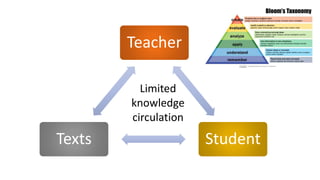
Teacher
StudentTexts
Limited
knowledge
circulation
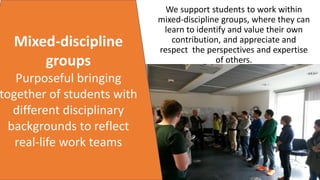
Mixed-discipline
groups
Purposeful bringing
together of students with
different disciplinary
backgrounds to reflect
real-life work teams
We support students to work within
mixed-discipline groups, where they can
learn to identify and value their own
contribution, and appreciate and
respect the perspectives and expertise
of others.
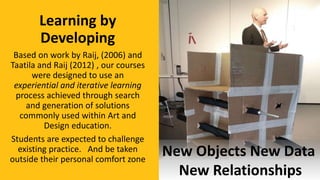
Learning by
Developing
Based on work by Raij, (2006) and
Taatila and Raij (2012) , our courses
were designed to use an
experiential and iterative learning
process achieved through search
and generation of solutions
commonly used within Art and
Design education.
Students are expected to challenge
existing practice. And be taken
outside their personal comfort zone
New Objects New Data
New Relationships
Research Foundations: Based on studies of
Social Learning in Innovation
Activity theory (EngestrĂśm 1986),
insights into real-life innovation processes (Williams and
Edge, Stewart and Williams 2005 )
Learning by failure, doing and
interacting.
The meeting of a goal, and achieving closure of a solution or
completing a syllabus is second to the learning achieved the
process of inquiry and intervention
Graduate Skills:
Develop Relational and Social awareness
and capabilities,
Learn how different sorts of incomplete
evidence work in messy social context
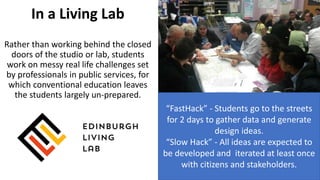
“FastHack” - Students go to the streets
for 2 days to gather data and generate
design ideas.
“Slow Hack” - All ideas are expected to
be developed and iterated at least once
with citizens and stakeholders.
In a Living Lab
Rather than working behind the closed
doors of the studio or lab, students
work on messy real life challenges set
by professionals in public services, for
which conventional education leaves
the students largely un-prepared.
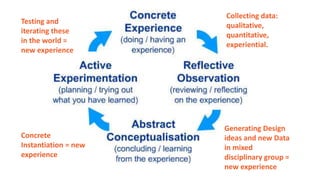
Collecting data:
qualitative,
quantitative,
experiential.
Generating Design
ideas and new Data
in mixed
disciplinary group =
new experience
Testing and
iterating these
in the world =
new experience
Concrete
Instantiation = new
experience
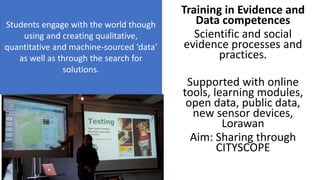
Training in Evidence and
Data competences
Scientific and social
evidence processes and
practices.
Supported with online
tools, learning modules,
open data, public data,
new sensor devices,
Lorawan
Aim: Sharing through
CITYSCOPE
Students engage with the world though
using and creating qualitative,
quantitative and machine-sourced ‘data’
as well as through the search for
solutions.
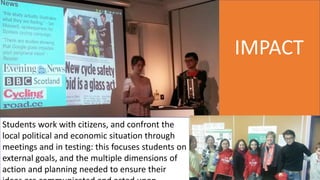
IMPACT
Students work with citizens, and confront the
local political and economic situation through
meetings and in testing: this focuses students on
external goals, and the multiple dimensions of
action and planning needed to ensure their
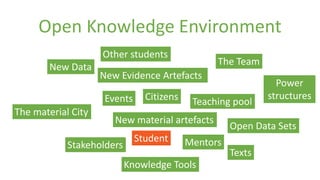
Open Knowledge Environment
New Data
Other students
New material artefacts
Student
Teaching pool
MentorsStakeholders
Citizens
New Evidence Artefacts
The Team
Open Data Sets
Knowledge Tools
Texts
The material City
Power
structuresEvents
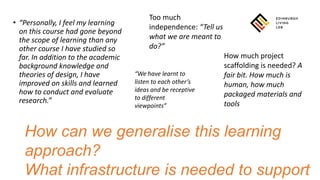
• “Personally, I feel my learning
on this course had gone beyond
the scope of learning than any
other course I have studied so
far. In addition to the academic
background knowledge and
theories of design, I have
improved on skills and learned
how to conduct and evaluate
research.”
Too much
independence: “Tell us
what we are meant to
do?”
How much project
scaffolding is needed? A
fair bit. How much is
human, how much
packaged materials and
tools
How can we generalise this learning
approach?
What infrastructure is needed to support
“We have learnt to
listen to each other’s
ideas and be receptive
to different
viewpoints”
Edinburgh Living Lab for Data-Driven Innovation
Edinburgh Living Lab Community of Practice
http://www.edinburghlivinglab.org
James Stewart, Science, Technology and Innovation; j.kstewart@ed.ac.uk
Arno Verhoeven, Design,
Ewan Klein, Informatics
University of Edinburgh

Learning by developing in a Living Lab

  • 1.
    Addressing the ’Wicked’ problemsof real life that require multiple skills, approaches and knowledges “Learning is the process whereby knowledge is created through the transformation of experience” (Kolb, 198). Exploring Post-digital Experiental Education Learning by Developing in a Living Lab
  • 2.
  • 3.
    Challenge Learning the messybusiness of trying to pull together the materiality and relationships of the real world (Law 2007) Our Activities A three year cycle of design and run of Learning by Developing in a Living Lab in 1 semester courses 3x PG Design for Informatics. Stakeholder: Neighbourhood partnerships, and City Waste department 1x UG course Data Design and Society (DDS) Stakeholder: the University Food Strategy team.
  • 4.
  • 5.
    Mixed-discipline groups Purposeful bringing together ofstudents with different disciplinary backgrounds to reflect real-life work teams We support students to work within mixed-discipline groups, where they can learn to identify and value their own contribution, and appreciate and respect the perspectives and expertise of others.
  • 6.
    Learning by Developing Based onwork by Raij, (2006) and Taatila and Raij (2012) , our courses were designed to use an experiential and iterative learning process achieved through search and generation of solutions commonly used within Art and Design education. Students are expected to challenge existing practice. And be taken outside their personal comfort zone New Objects New Data New Relationships
  • 7.
    Research Foundations: Basedon studies of Social Learning in Innovation Activity theory (EngestrĂśm 1986), insights into real-life innovation processes (Williams and Edge, Stewart and Williams 2005 ) Learning by failure, doing and interacting. The meeting of a goal, and achieving closure of a solution or completing a syllabus is second to the learning achieved the process of inquiry and intervention Graduate Skills: Develop Relational and Social awareness and capabilities, Learn how different sorts of incomplete evidence work in messy social context
  • 8.
    “FastHack” - Studentsgo to the streets for 2 days to gather data and generate design ideas. “Slow Hack” - All ideas are expected to be developed and iterated at least once with citizens and stakeholders. In a Living Lab Rather than working behind the closed doors of the studio or lab, students work on messy real life challenges set by professionals in public services, for which conventional education leaves the students largely un-prepared.
  • 9.
    Collecting data: qualitative, quantitative, experiential. Generating Design ideasand new Data in mixed disciplinary group = new experience Testing and iterating these in the world = new experience Concrete Instantiation = new experience
  • 10.
    Training in Evidenceand Data competences Scientific and social evidence processes and practices. Supported with online tools, learning modules, open data, public data, new sensor devices, Lorawan Aim: Sharing through CITYSCOPE Students engage with the world though using and creating qualitative, quantitative and machine-sourced ‘data’ as well as through the search for solutions.
  • 11.
    IMPACT Students work withcitizens, and confront the local political and economic situation through meetings and in testing: this focuses students on external goals, and the multiple dimensions of action and planning needed to ensure their
  • 12.
    Open Knowledge Environment NewData Other students New material artefacts Student Teaching pool MentorsStakeholders Citizens New Evidence Artefacts The Team Open Data Sets Knowledge Tools Texts The material City Power structuresEvents
  • 13.
    • “Personally, Ifeel my learning on this course had gone beyond the scope of learning than any other course I have studied so far. In addition to the academic background knowledge and theories of design, I have improved on skills and learned how to conduct and evaluate research.” Too much independence: “Tell us what we are meant to do?” How much project scaffolding is needed? A fair bit. How much is human, how much packaged materials and tools How can we generalise this learning approach? What infrastructure is needed to support “We have learnt to listen to each other’s ideas and be receptive to different viewpoints”
  • 14.
    Edinburgh Living Labfor Data-Driven Innovation Edinburgh Living Lab Community of Practice http://www.edinburghlivinglab.org James Stewart, Science, Technology and Innovation; j.kstewart@ed.ac.uk Arno Verhoeven, Design, Ewan Klein, Informatics University of Edinburgh

Editor's Notes

  • #6 Most university education occurs within a disciplinary framework, but most work environments are multi-disciplinary, because this is what real-life problems require.
  • #11 The analysis of the data is crucial to the justification and presentation of any potential solutions to the stakeholders