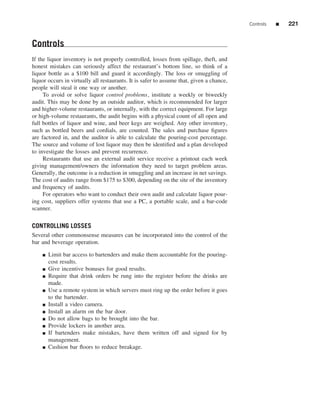
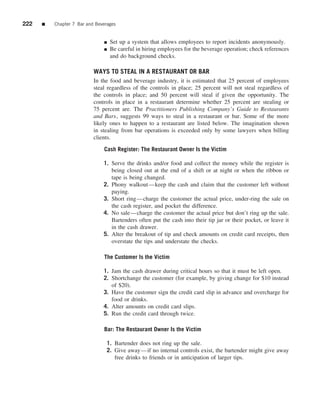
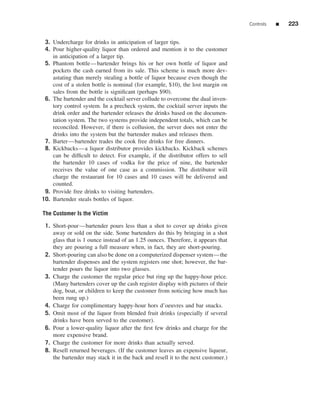
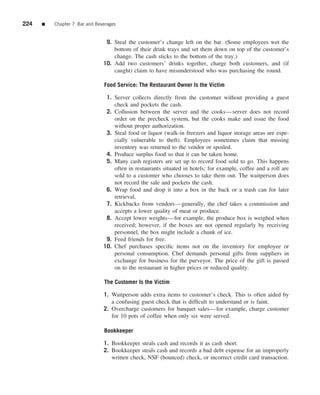
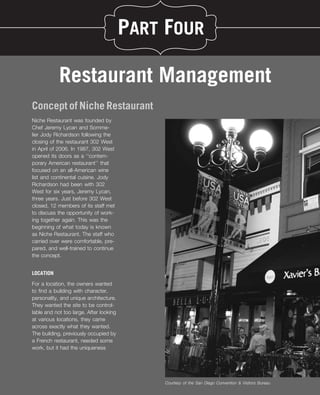
This page intentionally left blank
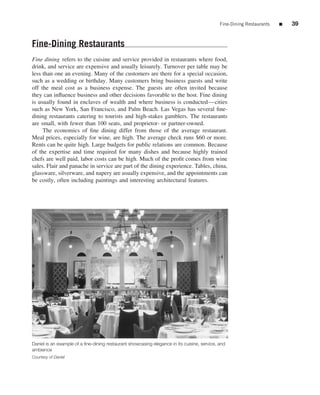
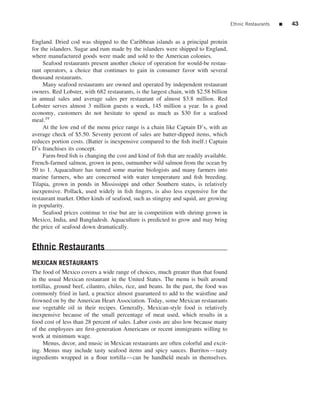
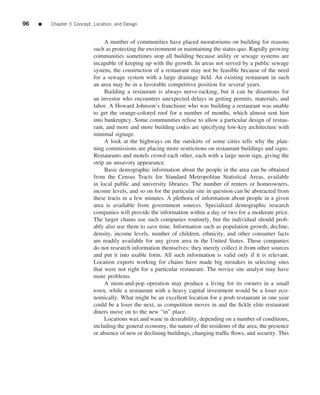
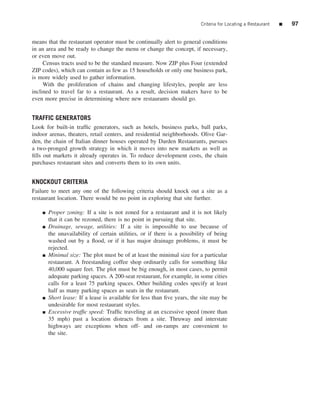
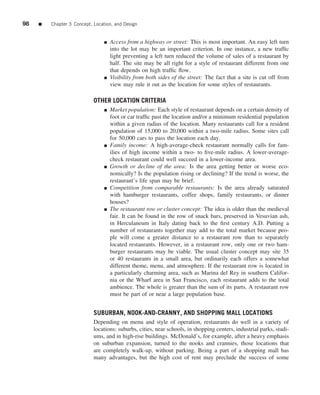
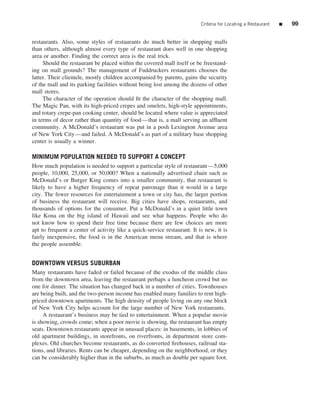
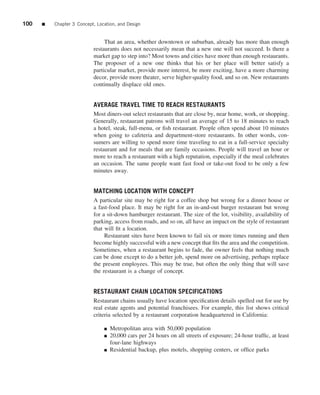
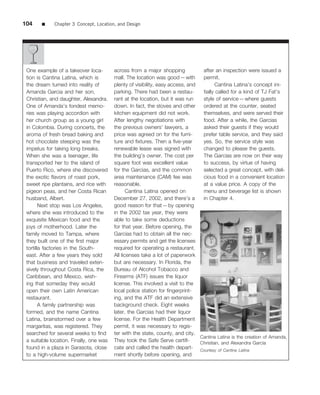
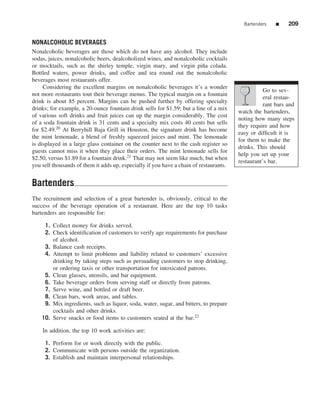
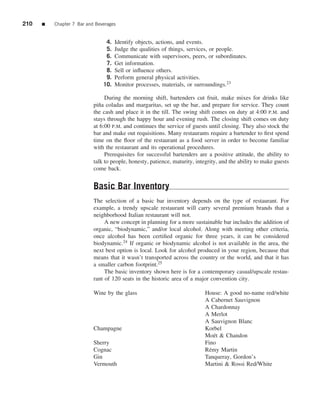
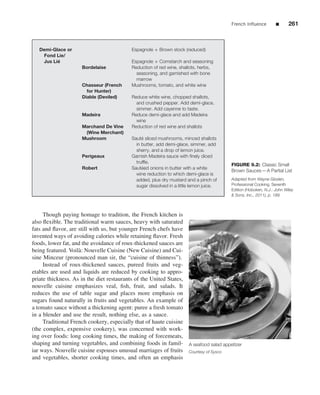
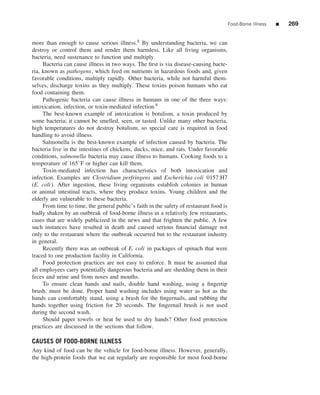
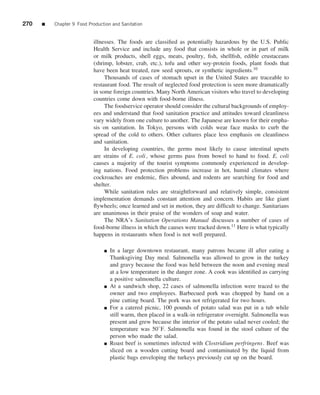
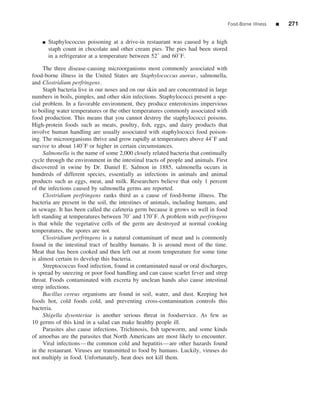
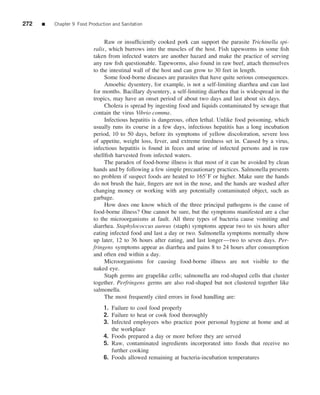
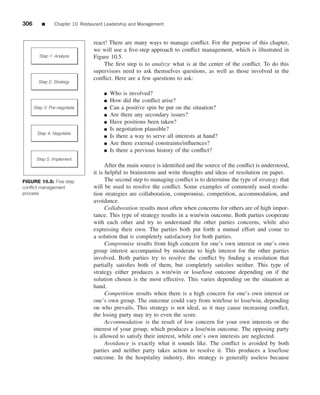
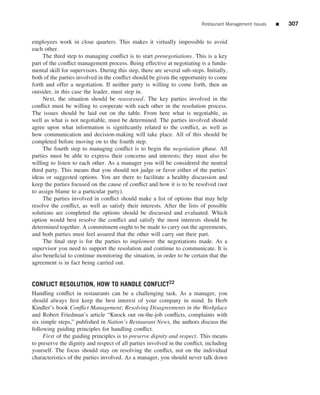
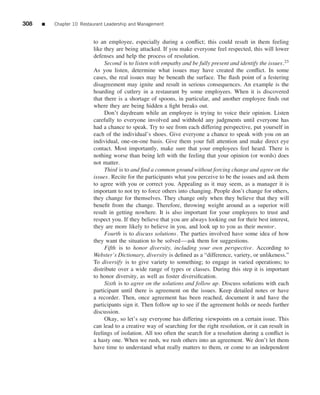
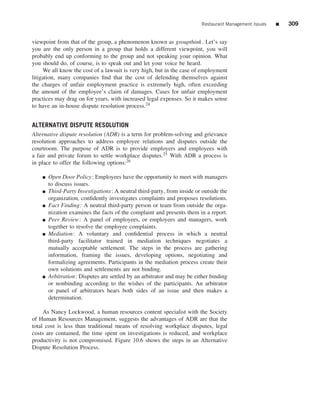
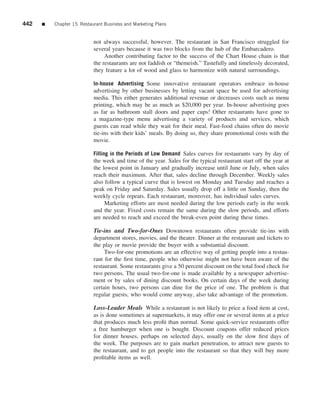
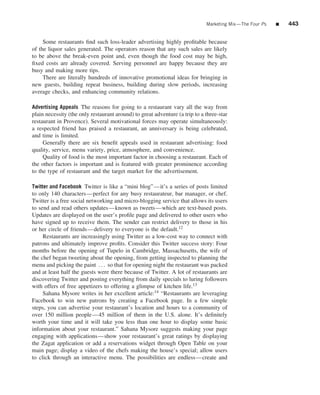
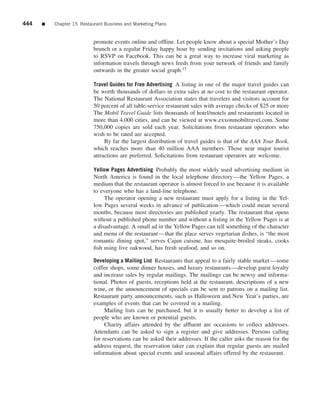
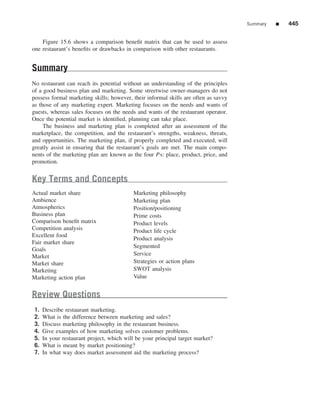
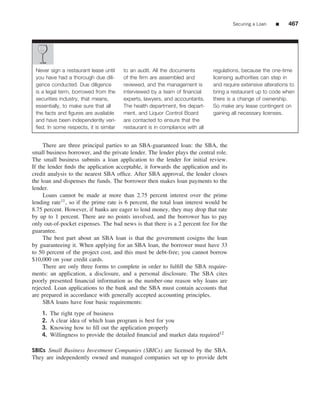
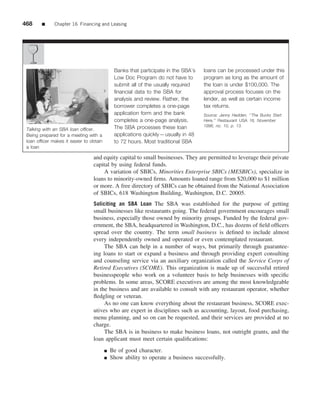
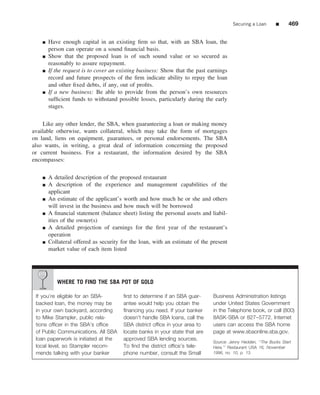
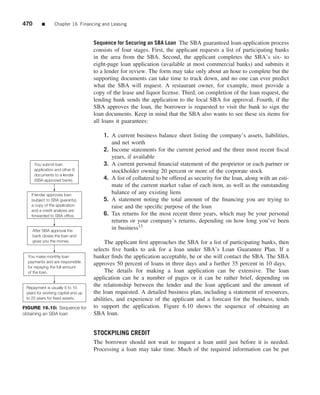
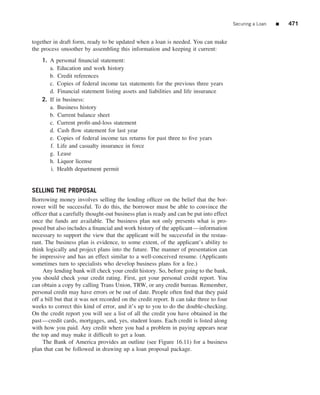
The
Restaurant
From Concept to Operation                         Sixth Edition

                        John R. Walker, DBA, CHA, FMP
                             McKibbon Professor of Hotel and Restaurant Management
                                                     and Fulbright Senior Specialist,
                                       University of South Florida Sarasota-Manatee


   JOHN WILEY & SONS, INC.
Photos were taken by the author unless otherwise noted.

This book is printed on acid-free paper.

Copyright © 2011, 2008, 2005 by John Wiley & Sons, Inc. All rights reserved.

Published by John Wiley & Sons, Inc., Hoboken, New Jersey.
Published simultaneously in Canada.

No part of this publication may be reproduced, stored in a retrieval system, or transmitted in any
form or by any means, electronic, mechanical, photocopying, recording, scanning, or otherwise,
except as permitted under Section 107 or 108 of
the 1976 United States Copyright Act, without either the prior written permission of the Publisher,
or authorization through payment of the appropriate per-copy fee to the Copyright Clearance Center,
Inc., 222 Rosewood Drive, Danvers, MA 01923, 978-750-8400, fax 978-646-8600, or on the web at
www.copyright.com. Requests to the Publisher for permission should be addressed to the
Permissions Department, John Wiley & Sons, Inc., 111 River Street, Hoboken, NJ 07030,
201-748-6011, fax 201-748-6008, or online at http://www.wiley.com/go/permissions.

Limit of Liability/Disclaimer of Warranty: While the publisher and author have used their best efforts
in preparing this book, they make no representations or warranties with respect to the accuracy or
completeness of the contents of this book and specifically disclaim any implied warranties of
merchantability or fitness for a particular purpose. No warranty may be created or extended by sales
representatives or written sales materials. The advice and strategies contained herein may not be
suitable for your situation. You should consult with a professional where appropriate. Neither the
publisher nor author shall be liable for any loss of profit or any other commercial damages,
including but not limited to special, incidental, consequential, or other damages.

Evaluation copies are provided to qualified academics and professionals for review purposes only,
for use in their courses during the next academic year. These copies are licensed and may not be
sold or transferred to a third party. Upon completion of the review period, please return the
evaluation copy to Wiley. Return instructions and a free of charge return shipping label are available
at www.wiley.com/go/returnlabel. Outside of the United States, please contact your local
representative.

For general information on our other products and services, or technical support, please contact our
Customer Care Department within the United States at 800-762-2974, outside the United States at
317-572-3993 or fax 317-572-4002.

Wiley also publishes its books in a variety of electronic formats. Some content that appears in print
may not be available in electronic books. For more information about Wiley products, visit our Web
site at http://www.wiley.com.

Library of Congress Cataloging-in-Publication Data:
Walker, John R., 1944-
The restaurant : from concept to operation / John Walker.—6th ed.
      p. cm.
Includes index.
ISBN 978-0-470-62643-6 (hardback : acid-free paper) 1. Restaurant
management. I. Title.
TX911.3.M27W352 2011
647.95068— dc22
                                                         2010025727

Printed in the United States of America

10 9 8 7 6 5 4 3 2 1
To Donald Lundberg, Ph.D.,
my mentor, colleague, and friend.
Don was admired and respected
in the halls of academia
as a scholar and pioneer
of hospitality and tourism education.

And to you, the professors, students,
and future restaurant owners, wishing
you success and happiness.
This page intentionally left blank
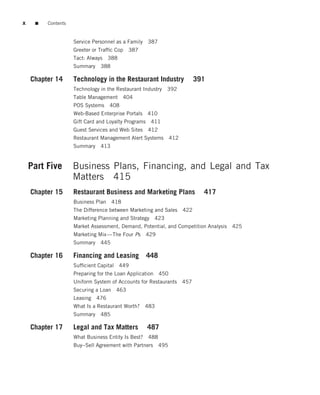
Contents
             Preface   xiii
             Acknowledgments         xvii


Part One     Restaurants, Owners, Locations, and Concepts                   1
 Chapter 1   Introduction 3
             Early History of Eating Out 6
             French Culinary History 7
             Birth of Restaurants in America 7
             Challenges of Restaurant Operation 13
             Buy, Build, Franchise, or Manage?   15
             Starting from Scratch 19
             Restaurants as Roads to Riches 20
             Summary    21

 Chapter 2   Kinds and Characteristics of Restaurants and Their Owners 24
             Kinds and Characteristics of Restaurants 25
             Sandwich Shops         30
             Quick-Service Restaurants 34
             Quick Casual Restaurants 35
             Family Restaurants 37
             Casual Restaurants 37
             Fine-Dining Restaurants 39
             Steakhouses 40
             Seafood Restaurants 42
             Ethnic Restaurants 43
             Theme Restaurants 47
             Coffee Shops      50
             Chef-Owned Restaurants 51
             Celebrity Chefs    55
             Centralized Home Delivery Restaurants 58
             Summary    59
vi     ■   Contents


      Chapter 3       Concept, Location, and Design            62
                      Restaurant Concepts 63
                      Defining the Concept and Market 68
                      Successful Restaurant Concepts 70
                      Concept Adaptation 77
                      Changing or Modifying a Concept 77
                      Copy and Improve 78
                      Restaurant Symbology 79
                      When a Concept Fails 79
                      Multiple-Concept Chains 80
                      Sequence of Restaurant Development: From Concept to Opening 80
                      Utility versus Pleasure 84
                      Degree of Service Offered 84
                      Time of Eating and Seat Turnover 85
                      Advertising and Promotion Expenditures    88
                      Labor Costs as a Percentage of Sales 89
                      Planning Decisions That Relate to Concept Development 89
                      Profitability 91
                      Mission Statement 91
                      Concept and Location 92
                      Criteria for Locating a Restaurant 93
                      Location Information Checklist 107
                      Summary     108


     Part Two         Menus, Kitchens, and Purchasing 111
      Chapter 4       The Menu          113
                      Capability/Consistency 116
                      Equipment     116
                      Availability 116
                      Price 117
                      Nutritional Value 120
                      Contribution Margin 122
                      Flavor 122
                      Accuracy in Menu 123
                      Sustainable Menus    128
                      Kids’ Menus    128
                      Menu Items    129
Contents   ■   vii


              Menu Types   132
              Restaurants in Las Vegas Represent the Best Countrywide 136
              Menu Engineering 136
              Menu Design and Layout 138
              Standardized Recipes 142
              Menu Trends 142
              Summary   143

  Chapter 5   Planning and Equipping the Kitchen 146
              Back of the House Green 150
              Open Kitchen 151
              Kitchen Floor Coverings 154
              Kitchen Equipment 154
              Equipment Stars    159
              Maintaining Kitchen Equipment 169
              Meeting with the Health Inspector 170
              Summary   171

  Chapter 6   Food Purchasing 174
              Sustainable Purchasing 175
              Food-Purchasing System    178
              Types of Purchasing 183
              Buying Meat 185
              Buying Fresh Fruits and Vegetables 188
              Selecting the Right Coffee 192
              Summary   192


Part Three    Restaurant Operations 197
  Chapter 7   Bar and Beverages 199
              Alcoholic Beverage Licenses 200
              How to Apply for a License 201
              Bar Layout and Design 202
              Placement of a Bar within a Restaurant 204
              Beverages 206
              Bartenders 209
              Basic Bar Inventory 210
              Wines 212
              Responsible Alcoholic Beverage Service 219
viii     ■   Contents


                        Third-Party Liability 220
                        Controls 221
                        Summary       226

        Chapter 8       Operations, Budgeting, and Control 228
                        Restaurant Operations 229
                        Front of the House 229
                        Back of the House 233
                        Control   238
                        Liquor Control      239
                        Controllable Expenses      243
                        Labor Costs     244
                        Guest Check Control 250
                        Productivity Analysis and Cost Control 251
                        Summary       252

        Chapter 9       Food Production and Sanitation               254
                        Our Culinary Heritage 255
                        Native American Influence 256
                        African American Influence 256
                        Italian Influence 256
                        French Influence 257
                        Receiving 262
                        Storage 263
                        Food Production 264
                        Production Procedures 266
                        Staffing and Scheduling 268
                        Food-Borne Illness 268
                        Hazard Analysis of Critical Control Points   275
                        Common Food Safety Mistakes 278
                        Approaches to Food Safety 279
                        Food Protection as a System      280
                        Summary       282


  Part Four             Restaurant Management 285
       Chapter 10       Restaurant Leadership and Management 289
                        Leading Employees         290
                        The Nature of Leadership 293
Contents   ■   ix


             Employee Input and What’s in It for Me?      295
             Management Topics 296
             Communicating 299
             Motivating 300
             Performance Management 301
             Restaurant Management Issues     302
             Summary    310

Chapter 11   Organization, Recruiting, and Staffing              314
             Task and Job Analysis    315
             Job Descriptions 319
             Organizing People and Jobs     323
             Staffing the Restaurant 325
             Civil Rights Laws 333
             Questions to Avoid on the Application Form and during the Interview 338
             Careful Selection of Personnel   343
             Summary    345

Chapter 12   Employee Training and Development 348
             Orientation 349
             Training 350
             Part-Time Employees     352
             Training and Development 352
             Methods for Training Employees       360
             Leadership 363
             Summary    369

Chapter 13   Service and Guest Relations                371
             Service Encounter 373
             Gamesmanship 374
             Greeters 375
             Server as Independent Businessperson       376
             Foodservice Teams      376
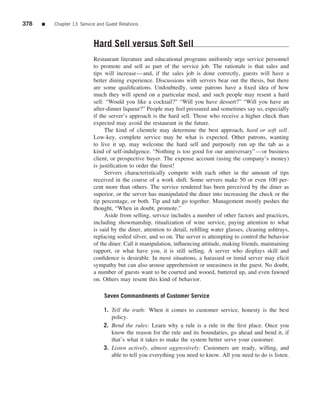
             Hard Sell versus Soft Sell 378
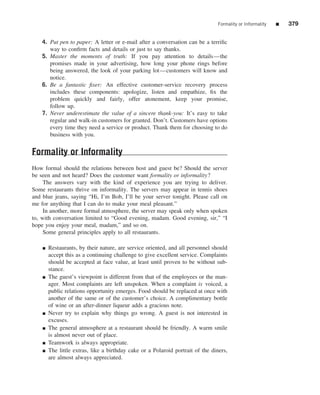
             Formality or Informality 379
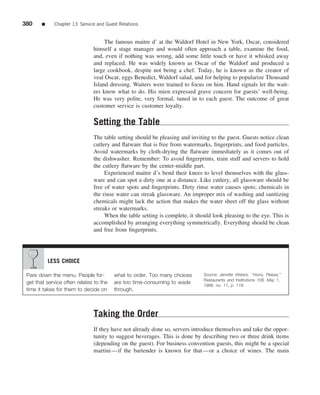
             Setting the Table 380
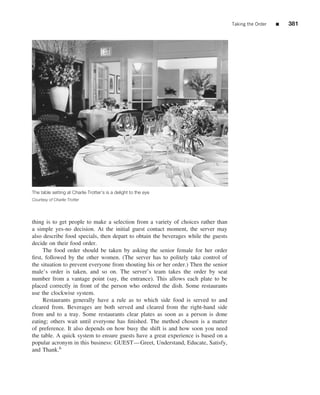
             Taking the Order 380
             Magic Phrases    382
             Servers’ Viewpoint 383
             Difficult Guests 384
x    ■   Contents


                    Service Personnel as a Family 387
                    Greeter or Traffic Cop   387
                    Tact: Always 388
                    Summary    388

    Chapter 14      Technology in the Restaurant Industry            391
                    Technology in the Restaurant Industry   392
                    Table Management 404
                    POS Systems    408
                    Web-Based Enterprise Portals 410
                    Gift Card and Loyalty Programs 411
                    Guest Services and Web Sites 412
                    Restaurant Management Alert Systems      412
                    Summary    413


    Part Five       Business Plans, Financing, and Legal and Tax
                    Matters 415
    Chapter 15      Restaurant Business and Marketing Plans             417
                    Business Plan 418
                    The Difference between Marketing and Sales 422
                    Marketing Planning and Strategy 423
                    Market Assessment, Demand, Potential, and Competition Analysis   425
                    Marketing Mix—The Four Ps     429
                    Summary    445

    Chapter 16      Financing and Leasing         448
                    Sufficient Capital 449
                    Preparing for the Loan Application 450
                    Uniform System of Accounts for Restaurants 457
                    Securing a Loan 463
                    Leasing 476
                    What Is a Restaurant Worth?   483
                    Summary    485

    Chapter 17      Legal and Tax Matters         487
                    What Business Entity Is Best? 488
                    Buy–Sell Agreement with Partners 495
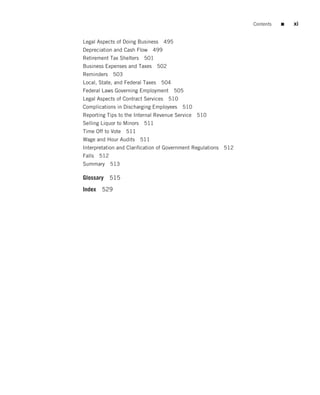
Contents   ■   xi


Legal Aspects of Doing Business   495
Depreciation and Cash Flow 499
Retirement Tax Shelters 501
Business Expenses and Taxes    502
Reminders 503
Local, State, and Federal Taxes 504
Federal Laws Governing Employment 505
Legal Aspects of Contract Services 510
Complications in Discharging Employees 510
Reporting Tips to the Internal Revenue Service 510
Selling Liquor to Minors 511
Time Off to Vote 511
Wage and Hour Audits   511
Interpretation and Clarification of Government Regulations 512
Falls 512
Summary     513

Glossary    515
Index   529
This page intentionally left blank
Preface
A one-stop guide to the restaurant business, the Sixth Edition of The Restaurant
continues the success of previous editions, providing all of the skills and infor-
mation needed to master every challenge and succeed in this highly competitive
and rewarding industry.
     However, there are numerous hurdles to overcome before opening day. The
good news is that, with careful planning, including the writing of a solid business
plan, coupled with perseverance and a pinch of luck, the chances of success are
improved. The opportunity to be the boss and call the shots is appealing. To be
responsible for the buzz created and orchestrated is a rush. Maybe the concept
will have legs. If successful, a restaurant operator might become a small-town,
or even large-town, dignitary.
     Restaurants are struggling with continuing economic uncertainties and ris-
ing labor and other costs—particularly health care. The conditions for restaurant
success change quickly, leaving financial scars on some operators. There are sev-
eral new styles of restaurants, and delivery of their products and services has
changed as well. Foods formerly considered exotic are now routinely accepted
and expected. Taste titillation comes by offering interesting foods and flavor com-
binations that challenge chefs and owners, and entice guests.


For the Student
Opening a restaurant is a distinct challenge. It is also a thrill that gives one the
opportunity for tremendous creative expression. Developing the menu, creating a
new dish, designing the decor, attending to the level of service, or establishing an
ambience—these factors all contribute to exceeding the expectations of guests.
     The Restaurant will help those who are interested in learning more about
the restaurant industry. It will help students gain the knowledge they need to be
successful in an easy-to-read style with several features like sidebars and profiles
of successful restaurateurs that impart the knowledge of experts for your benefit.


For the Instructor
The Restaurant is a comprehensive primer for restaurant management courses
at the college and university level. It is used for a variety of restaurant courses
and covers everything from the concept; types of ownership; types of restaurants;
menus, planning, and equipping the kitchen; purchasing; bar and beverages; opera-
tions, budgeting, and control; food production and sanitation; restaurant leadership
and management; organization and staffing; training and development; service and
xiv   ■   Preface


                    guest relations; technology; business and marketing plans; financing and leasing;
                    and legal and tax matters.
                         The Restaurant assumes no specific knowledge other than a general familiar-
                    ity with restaurants. It can be used at any course level in a restaurant, hospitality,
                    or culinary arts program. It is also suitable for seminars and continuing education
                    courses.
                         Helping to meet the continuing restaurant challenges is the oncoming wave
                    of students who have studied the culinary arts and restaurant management and
                    who view the restaurant business as a career of choice. A restaurant can be fun to
                    operate, and the profit margins can be substantial. It is interesting to learn that at
                    least one billionaire, Tom Monaghan, made his fortune in the pizza business, and
                    that dozens of millionaires have acquired fortunes in restaurants. Some of their
                    stories are told in this book.


                    New to this Edition
                    For The Restaurant, Sixth Edition, revisions include:

                        ■   New reorganization of the chapters. Characteristics of restaurants, the
                            menu and kitchens, and restaurant operations now comprise the first three
                            parts of the text. Management, planning, and finance topics are now orga-
                            nized in the last two parts of the book.
                        ■   NEW! Chapter 10: Restaurant Leadership and Management. This new
                            chapter defines the characteristics of being an effective leader as well as
                            what it takes to successfully lead restaurant employees.
                        ■   It’s easy being “green.” The themes of sustainability and sustainable
                            restaurant management have been added throughout this new edition.
                        ■   New sections on the early history of eating out and restaurants in
                            America are included in Chapter 1.
                        ■   An increased focus toward the independent restaurateur.
                        ■   A new section on purchasing meat has been added to Chapter 6: Food
                            Purchasing.
                        ■   New sections on cocktails, spirits, and nonalcoholic beverages have been
                            added to Chapter 7: Bar and Beverages.
                        ■   New sections on the influences of Native American and African
                            American food have been added to Chapter 9: Food Production and
                            Sanitation.
                        ■   Greater emphasis on restaurant business plans, restaurant manage-
                            ment, and restaurant operations.

                         Additionally, each chapter has been revised, updated, and enhanced with
                    numerous industry examples, sidebars offering advice, charts, tables, photographs,
                    and menus.
                         All these additions and changes enhance the contents, look, and usefulness
                    of the book.
Preface   ■   xv


Features
The Restaurant, Sixth Edition is carefully structured for teaching and learning.
The chapters of The Restaurant are organized into five parts and take the reader
step-by-step through the complicated process of creating, opening, operating, and
managing a restaurant:

  Part One: Restaurants, Owners, Locations, and Concepts
        Chapter 1. Introduction
        Chapter 2. Restaurants and Their Owners
        Chapter 3. Concept, Location, and Design

  Part Two: Menus, Kitchens, and Purchasing
        Chapter 4. The Menu
        Chapter 5. Planning and Equipping the Kitchen
        Chapter 6. Food Purchasing

  Part Three: Restaurant Operations
        Chapter 7. Bar and Beverages
        Chapter 8. Operations, Budgeting, and Control
        Chapter 9. Food Production and Sanitation

  Part Four: Restaurant Management
        Chapter   10.   Restaurant Leadership and Management
        Chapter   11.   Organization, Recruiting, and Staffing
        Chapter   12.   Employee Training and Development
        Chapter   13.   Service and Guest Relations
        Chapter   14.   Technology in the Restaurant Industry

  Part Five: Business Plans, Financing, and Legal and Tax Matters
        Chapter 15. Restaurant Business and Marketing Plans
        Chapter 16. Financing and Leasing
        Chapter 17. Legal and Tax Matters


AIDS TO FACILITATE LEARNING
The writing in The Restaurant, Sixth Edition, is clear and engaging, in a conver-
sational style using numerous industry examples for ease of understanding topics
and concepts.
     Following are pedagogical features found within each chapter:

    ■   Clearly stated Learning Objectives so students and faculty can monitor
        learning progress.
xvi   ■   Preface


                        ■   Numerous Industry Examples are interspersed throughout to help students
                            understand the topics and concepts being discussed.
                        ■   Interesting Sidebars highlight facets of the restaurant industry.
                        ■   New Illustrations and Photographs enliven the text, and diagrams, flow
                            charts, and sample materials provide examples and focal points for
                            discussion.
                        ■   Restaurant Profiles are featured at the beginning of each of the five parts
                            of the book. These profiles highlight a particular restaurant and detail all
                            components of its organization.
                        ■   Key Terms and concepts are highlighted in the text and described in the
                            glossary. A list of these Key Terms is also provided at the end of every
                            chapter.
                        ■   Review Questions help hone the students’ skills and offer critical-thinking
                            opportunities.
                        ■   Internet Exercises provide opportunities to go beyond the book in search
                            of information relating to the chapters.


                    Additional Resources
                    To aid students in retaining and mastering restaurant management concepts, there
                    is a Study Guide (ISBN: 978-0-470-93045-8), which includes chapter objectives,
                    chapter outlines, and practice quizzes that include key term and concept reviews.
                         An Instructor’s Manual (ISBN: 978-0-470-62645-0) and set of PowerPoint
                    Slides to accompany this textbook are available to qualified adopters from the
                    publisher, and are also available for download at www.wiley.com/college/walker.
                         The Test Bank has been specifically formatted for Respondus, an easy-to-use
                    software program for creating and managing exams that can be printed to paper or
                    published directly to Blackboard, WebCT, Desire2Learn, eCollege, ANGEL, and
                    other eLearning systems. Instructors who adopt The Restaurant, Sixth Edition,
                    can download the Test Bank for free. Additional Wiley resources also can be
                    uploaded into your LMS course at no charge.
                         A companion web site (www.wiley.com/college/walker) provides readers
                    with additional resources as well as enables instructors to download the elec-
                    tronic files for the Instructor’s Manual, PowerPoint Presentations, Test Bank,
                    and Respondus Test Bank.

                                                                 John R. Walker, DBA, CHA, FMP
                                           McKibbon Professor of Hotel and Restaurant Management
                                                                    and Fulbright Senior Specialist,
                                                     University of South Florida Sarasota-Manatee
Acknowledgments
For their insightful suggestions on this and previous editions of the text, I thank
Dr. Cihan Cobanoglu, University of South Florida Sarasota-Manatee; Ken Rubin,
CPA; Dr. Cora Gatchalian, University of the Philippines; Volker Schmitz of Cal-
ifornia Cafe Restaurants; Dr. Jay Schrock of the University of South Florida;
Dr. Greg Dunn and Dr. Katerina Annaraud of the University of South Florida
Sarasota-Manatee; Karl Engstrom of Mesa College, San Diego; Brad Peters of
Mesa College, San Diego; Dr. Andy Feinstein of California Polytechnic Univer-
sity, Pomona; Dr. Karl Titz, University of Houston; Anthony Battaglia, Glendale
Community College; Dr. Paul G. VanLandingham, Johnson and Wales University;
Dan Beard, Orange Coast College; Marco Adornetto, Muskingum Area Technical
College; Thomas Rosenberger, College of Southern Nevada; C. Gus Katsigris,
El Centro College; Karl V. Bins of the University of Maryland—Eastern Shore;
Marcel R. Escoffier of Florida International University; H. G. Parsa of the Uni-
versity of Central Florida; and Chef John Bandman of The Art Institute of New
York.
     Thanks to the National Restaurant Association and to the restaurants that
allowed me to include their menus or photos, and to these restaurant companies
for their provision of resource information:

       Burton M. Sack, Past President of the National Restaurant Association
       Charlie Trotter
       John Horn
       Red Lobster Restaurants
       Gary Harkness
       T.G.I. Friday’s
       Stephen Ananicz
       The Lettuce Entertain You Group
       The Hard Rock Cafes
       David Cohn and the Cohn Restaurant Group
       Dick Rivera
       Sean Murphy, The Beach Bistro
       Holly Carvalho
       Jim Lynde, Senior Vice President People, Red Lobster
       The Garcia Family
       John C. Cini, President and CEO of Cini Little
       U.S. Bank
       The Childs Restaurant Group
       Danny Meyer
       Culinary Software Services
       Outback Steakhouse, Inc.
       Union Square Hospitality
xviii   ■   Acknowledgments


                                     NCR ALOHA Technologies
                                     SYSCO Food Service
                                     Aria Restaurant
                                     B. Caf´
                                           e
                                     Niche
                                     Panificio
                                     21 Club
                                     David Laxer, Bern’s Restaurant
                                     Richard Gonzmart, Columbia Restaurants

                                   And, finally, to the numerous restaurant operators who have graciously given
                              their time and ideas, photographs, and menus, my sincere appreciation.
PART ONE
             Restaurants, Owners,
           Locations, and Concepts
                     ´
The Concept of B. Cafe
        ´
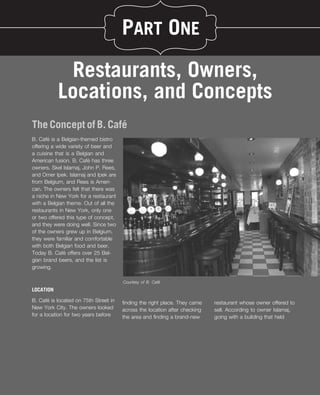
B. Cafe is a Belgian-themed bistro
offering a wide variety of beer and
a cuisine that is a Belgian and
                         ´
American fusion. B. Cafe has three
owners, Skel Islamaj, John P. Rees,
and Omer Ipek. Islamaj and Ipek are
from Belgium, and Rees is Ameri-
can. The owners felt that there was
a niche in New York for a restaurant
with a Belgian theme. Out of all the
restaurants in New York, only one
or two offered this type of concept,
and they were doing well. Since two
of the owners grew up in Belgium,
they were familiar and comfortable
with both Belgian food and beer.
              ´
Today B. Cafe offers over 25 Bel-
gian brand beers, and the list is
growing.

                                                         ´
                                       Courtesy of B. Cafe
LOCATION
        ´
B. Cafe is located on 75th Street in   finding the right place. They came    restaurant whose owner offered to
New York City. The owners looked       across the location after checking   sell. According to owner Islamaj,
for a location for two years before    the area and finding a brand-new      going with a building that held
2    ■     Part One Restaurants, Owners, Locations, and Concepts


occupancy as a restaurant was ‘‘a       and journalism community. Their        ■   They cannot estimate their
good way to control cost.’’ They        preopening marketing consisted             percentage of profit (it is 0
did some renovations and adapted        of contacting old connections,             percent so far), as the cafe´
what already existed.                   which landed them an article in a          opened three weeks prior to
                                        newspaper. They recommend that             this interview.
                                        anyone who is considering open-
MENU
                                        ing a restaurant should send out a     WHAT TURNED OUT DIFFERENT FROM
B. Cafe’s third partner, John P.        one-time press release.                EXPECTED?
Rees (who is also the culinary direc-
                                                                               The sales the first week were as
tor and executive chef) created the
                                        CHALLENGES                             expected. Sales in the second week
menu. The men wanted a menu
                                                                               went down due to the holidays. This
that was a fusion of Belgian and        The first main challenge for the own-
                                                                               was not anticipated. Other than this,
American, but did not want to com-                    ´
                                        ers of B. Cafe was finding the right
                                                                               all went as planned.
promise their ethnic backgrounds.       staff. They also found organizing
They created a menu with many           vendors and purchasing products
options that was not too ethnic as      (such as their beer) in quantity to    MOST EMBARRASSING MOMENT
to alienate people. By doing this       be challenging because when you
                                                                               When I asked Skel Islamaj what his
they hoped to target the main-          first open, ‘‘you have to buy, buy,
                                                                               most embarrassing moment during
stream.                                 and buy’’ to be sure that you have
                                                                               opening was, he responded that
                                        enough, but you don’t know what
                                                                               on the day of opening, a customer
                                        quantities you will need. You should
PERMITS AND LICENSES                                                           ordered coffee. That is when ‘‘we
                                        also expect to go over budget. At
                                                                               realized that we forgot to order cof-
The building where B. Cafe is  ´        minimum, you should take what
                                                                               fee!’’ There was none! All was okay
located today was previously a          your expected budget is and then
                                                                               though; a server went to a coffee-
restaurant. This made the obtain-       add on 20 percent.
                                                                               house and purchased some to get
ing of permits and licenses a bit
                                                                               them through.
easier than it would have been had
                                        FINANCIAL INFORMATION
the building not been a restaurant
before. Some of the licenses were                               ´
                                        Annual sales at B. Cafe are            ADVICE TO PROSPECTIVE
transferred over. The owners hired      expected to reach $1 million in        ENTREPRENEURS FROM THE OWNERS
lawyers to obtain other permits and     the first year. They have about 540              ´
                                                                               OF B. CAFE
licenses needed to gain occupancy.      guest covers a week. Guest checks
        ´
B. Cafe is a limited liability corpo-   average $38 per person. A break-       1. Understand the business
ration (LLC) with three owners. The     down of sales percentages follows.        before you get into it.
                   ´
owners of B. Cafe strongly recom-       .                                      2. Location, location, location!
mend going with a preestablished        ■ Percentage of sales that goes
                                                                               3. Believe in your business, never
site when opening a new restaurant.       to rent: approximately                  give up, and be persistent.
                                          9 percent
                                        ■ Percentage of food sales:
MARKETING
                                          85 percent
                      ´
The owners of B. Cafe were lucky        ■ Percentage of beverage sales:

to be well known in the food critic       15 percent
CHAPTER 1

                                      Introduction
LEARNING OBJECTIVES
After reading and studying this chap-
ter, you should be able to:
.
■ Discuss reasons why some peo-
   ple open restaurants.

■   List some challenges of restau-
    rant operation.

■   Outline the history of restaurants.

■   Compare the advantages and dis-
    advantages of buying, building,
    and franchising restaurants.


Courtesy of Sysco
4     ■      Chapter 1 Introduction


                                  Restaurants play a significant role in our lifestyles, and dining out is a favorite
                      Money
                                  social activity. Everyone needs to eat—so, to enjoy good food and perhaps wine
                                  in the company of friends and in pleasant surroundings is one of life’s pleasures.
                     Buyout       Eating out has become a way of life for families. Today, more meals than ever
                     Potential    are being eaten away from home.
                                       The successful restaurant offers a reasonable return on investment. One
                    Challenge     restaurant, then two, then perhaps a small chain. Retire wealthy. To be a winner
                                  in today’s economy requires considerable experience, planning, financial support,
Reasons             A Place to    and energy. Luck also plays a part. This book takes you from day one—that time
for going
into the
                    Socialize     when you dream of a restaurant—through the opening and into operation. What
restaurant                        kind of restaurant do you want to run? Would you prefer quick service, cafeteria,
business:                 Habit   coffee shop, family, ethnic, casual, or luxury? Most restaurant dreamers—perhaps
                                  too many—think of being in the middle of a restaurant with lots of guests; skilled,
                     A Firm
                                  motivated employees; and great social interaction, food, service, and profits. The
                     Lifestyle    kind of restaurant concept you select determines, to a large extent, the kind of
                                  talents required. Talent and temperament correlate with restaurant style. Managing
                     Express      a quick-service restaurant is quite different from being the proprietor of a luxury
                     Yourself     restaurant. The person who may do well with a Taco Bell franchise could be a
FIGURE 1.1: Reasons for           failure in a personality-style restaurant. The range of restaurant styles is broad.
going into the restaurant         Each choice makes its own demands and offers its own rewards to the operator.
business                               This book shows the logical progression from dream to reality, from concept
                                  to finding a market gap to operating a restaurant. Along the way, it gives a
                                  comprehensive picture of the restaurant business.
                                       Going into the restaurant business is not for the faint of heart. People con-
                                  templating opening a restaurant come from diverse backgrounds and bring with
                                  them a wealth of experience. However, there is no substitute for experience in
                                  the restaurant business—especially in the segment in which you are planning to
                                  operate.
                                       So why go into the restaurant business? Here are some reasons others have
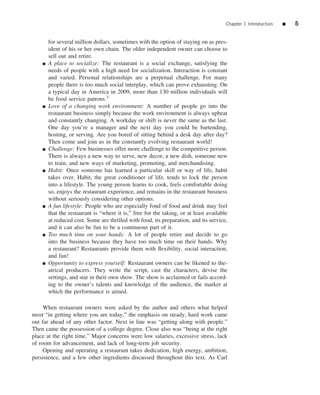
                                  done so, along with some of the liabilities involved. Figure 1.1 shows reasons for
                                  going into the restaurant business.

                                      ■   Money: The restaurant is a potential money factory. According to the
                                          National Restaurant Association (NRA) the restaurant industry totals $580
                                          billion in sales.1 Successful restaurants can be highly profitable. Even
                                          in a failing economy the NRA is predicting restaurant-industry sales to
                                          advance 2.5 percent in 2010 and equal 4 percent of the U.S. gross domestic
                                          product.2 Few businesses can generate as much profit for a given invest-
                                          ment. A restaurant with a million-dollar sales volume per year can generate
                                          $150,000 to $200,000 per year in profit before taxes. But a failing restau-
Chef-owner Bob Kinkead, of                rant, one with a large investment and a large payroll, can lose thousands
Kinkead’s Restaurant,                     of dollars a month. Most restaurants are neither big winners nor big losers.
Washington, D.C.                      ■   The potential for a buyout: The successful restaurant owner is likely to be
Courtesy of Bob Kinkead                   courted by a buyer. A number of large corporations have bought restau-
                                          rants, especially small restaurant chains. The operator is often bought out
Chapter 1 Introduction   ■   5


        for several million dollars, sometimes with the option of staying on as pres-
        ident of his or her own chain. The older independent owner can choose to
        sell out and retire.
    ■   A place to socialize: The restaurant is a social exchange, satisfying the
        needs of people with a high need for socialization. Interaction is constant
        and varied. Personal relationships are a perpetual challenge. For many
        people there is too much social interplay, which can prove exhausting. On
        a typical day in America in 2009, more than 130 million individuals will
        be food service patrons.3
    ■   Love of a changing work environment: A number of people go into the
        restaurant business simply because the work environment is always upbeat
        and constantly changing. A workday or shift is never the same as the last.
        One day you’re a manager and the next day you could be bartending,
        hosting, or serving. Are you bored of sitting behind a desk day after day?
        Then come and join us in the constantly evolving restaurant world!
    ■   Challenge: Few businesses offer more challenge to the competitive person.
        There is always a new way to serve, new decor, a new dish, someone new
        to train, and new ways of marketing, promoting, and merchandising.
    ■   Habit: Once someone has learned a particular skill or way of life, habit
        takes over. Habit, the great conditioner of life, tends to lock the person
        into a lifestyle. The young person learns to cook, feels comfortable doing
        so, enjoys the restaurant experience, and remains in the restaurant business
        without seriously considering other options.
    ■   A fun lifestyle: People who are especially fond of food and drink may feel
        that the restaurant is “where it is,” free for the taking, or at least available
        at reduced cost. Some are thrilled with food, its preparation, and its service,
        and it can also be fun to be a continuous part of it.
    ■   Too much time on your hands: A lot of people retire and decide to go
        into the business because they have too much time on their hands. Why
        a restaurant? Restaurants provide them with flexibility, social interaction,
        and fun!
    ■   Opportunity to express yourself: Restaurant owners can be likened to the-
        atrical producers. They write the script, cast the characters, devise the
        settings, and star in their own show. The show is acclaimed or fails accord-
        ing to the owner’s talents and knowledge of the audience, the market at
        which the performance is aimed.

     When restaurant owners were asked by the author and others what helped
most “in getting where you are today,” the emphasis on steady, hard work came
out far ahead of any other factor. Next in line was “getting along with people.”
Then came the possession of a college degree. Close also was “being at the right
place at the right time.” Major concerns were low salaries, excessive stress, lack
of room for advancement, and lack of long-term job security.
     Opening and operating a restaurant takes dedication, high energy, ambition,
persistence, and a few other ingredients discussed throughout this text. As Carl
6   ■   Chapter 1 Introduction


                            Karcher, founder of Carl’s Jr., said, in America you can easily begin a restaurant
                            as he did, on a cart outside Dodger Stadium selling hot dogs.


                            Early History of Eating Out4
                            Eating out has a long history. Taverns existed as early as 1700 B.C.E. The
                            record of a public dining place in Ancient Egypt in 512 B.C.E. shows a lim-
                            ited menu—only one dish was served, consisting of cereal, wild fowl, and onion.
                            Be that as it may, the ancient Egyptians had a fair selection of foods to choose
                            from: peas, lentils, watermelons, artichokes, lettuce, endive, radishes, onions, gar-
                            lic, leeks, fats (both vegetable and animal), beef, honey, dates, and dairy products,
                            including milk, cheese, and butter.
                                   The ancient Romans were great eaters out. Evidence can be seen even today
                            in Herculaneum, a Roman town near Naples that in A.D. 70 was buried under
                            some 65 feet of mud and lava by the eruption of Mt. Vesuvius.5 Along its streets
                            were a number of snack bars vending bread, cheese, wine, nuts, dates, figs, and hot
                            foods. The counters were faced with marble fragments. Wine jugs were imbedded
                            in them, kept fresh by the cold stone. Mulled and spiced wines were served, often
                            sweetened with honey. A number of the snack bars were identical or nearly so
                            giving the impression that they were part of a group under single ownership.
                                   Bakeries were nearby, where grain was milled in the courtyard, the mill
                            turned by blindfolded asses. Some bakeries specialized in cakes. One of them
                            had 25 bronze baking pans of various sizes, from about 4 inches to about 1.5 feet
                            in diameter.
                                   After the fall of Rome, eating out usually took place in an inn or tavern, but
                            by 1200 there were cooking houses in London, Paris, and elsewhere in Europe,
                            where cooked food could by purchased but with no seating. Medieval travelers
                            dined at inns, taverns, hostelries, and monasteries.
                                   The first caf´ was established in then Constantinople in 1550. It was a cof-
                                                e
                            feehouse, hence the word caf´ .6 The coffeehouse, which appeared in Oxford in
                                                             e
                            1650 and seven years later in London, was a forerunner of the restaurant today.
                            Coffee at the time was considered a cure-all. As one advertisement in 1657 had it:
                            “ . . . Coffee closes the orifices of the stomach, fortifies the heat within, and helpeth
                            digesting . . . is good against eyesores, coughs, or colds . . . ” Lloyd’s of London,
                            the international insurance company, was founded in Lloyd’s Coffee House. By
                            the eighteenth century, there were about 3,000 coffeehouses in London.
                                   Coffeehouses were also popular in Colonial America. Boston had many of
                            them, as did Virginia and New York. Both the words caf´ , meaning a small restau-
                                                                                        e
                            rant and bar, and cafeteria come from the single word caf´ , French for coffee.
                                                                                            e
                                   In the eighteenth century, with the exception of inns which were primarily
                            for travelers, food away from home could be purchased in places where alcoholic
                            beverages were sold. Such places were equipped to serve simple, inexpensive
                            dishes either cooked on the premises or ordered from a nearby inn or food shop.
                            Tavern-restaurants existed in much of Europe including France and Germany with
Birth of Restaurants in America   ■   7


its winestuben that served delicatessen, sauerkraut, and cheese. In Spain bodegas
served tapas. Greek taverns served various foods with olive oil.


French Culinary History
The first restaurant ever was called a “public dining room” and originated in
France. Throughout history France has played a key role in the development of
restaurants. The first restaurant ever that actually consisted of patrons sitting at a
table and being served individual portions, which they selected from menus, was
founded in 1782 by a man named Beauvilliers. It was called the Grand Taverne
de Londres. However, this was not the beginning of the restaurant concept.
     The first restaurant proprietor is believed to have been one A. Boulanger, a
soup vendor, who opened his business in Paris in 1765.7 He sold soups at his all-
night tavern on the Rue Bailleul. He called these soups restorantes (restoratives),
which is the origin of the word restaurant. Boulanger believed that soup was
the cure to all sorts of illnesses. However, he was not content to let his culinary
repertoire rest with only a soup kitchen. By law at the time, only hotels could serve
“food” (soup did not fit into this category). In 1767, he challenged the traiteurs’
monopoly and created a soup that consisted of sheep’s feet in a white sauce. The
traiteurs guild filed a lawsuit against Boulanger, and the case went before the
French Parliament. Boulanger won the suit and soon opened his restaurant, Le
Champ d’Oiseau.
     In 1782, the Grand Tavern de Londres, a true restaurant, opened on the Rue
de Richelieu; three years later, Aux Trois Fr` res Provencaux opened near the
                                                 e            ¸
Palais-Royal. The French Revolution in 1794 literally caused heads to roll—so
much so that the chefs to the former nobility suddenly had no work. Some stayed
in France to open restaurants and some went to other parts of Europe; many
crossed the Atlantic to America, especially to New Orleans.


Birth of Restaurants in America
The beginning of the American restaurant industry is usually said to be in 1634,
when Samuel Coles opened an establishment in Boston that was named Coles
Ordinary. It was a tavern—the first tavern of record in the American colonies. It
was quite successful, lasting well over 125 years.8
     Prior to the American Revolution, places selling food, beverages, and a place
to sleep were called ordinaries, taverns, or inns. Rum and beer flowed freely. A
favorite drink, called flip, was made from rum, beer, beaten eggs, and spices.
The bartender plunged a hot iron with a ball on the end into the drink. Flips
were considered both food and a drink. If customers had one too many flips, the
ordinaries provided a place to sleep.
     In America the innkeeper, unlike in Europe, was often the most respected
member of the community and was certainly one of its substantial citizens. The
innkeeper usually held some local elected office and sometimes rose much higher
8   ■   Chapter 1 Introduction


                            than that. John Adams, the second president of the United States, owned and
                            managed his own tavern between 1783 and 1789.9
                                 The oldest continually operating tavern in America is the Fraunces Tavern
                            in New York City, dating from about 1762. It served as the Revolutionary head-
                            quarters of General George Washington, and was the place where he made his
                            farewell address. It is still operating today.
                                 The restaurant, as we know it today, is said to have been a byproduct of
                            the French Revolution. The term restaurant came to the United States in 1794
                            via a French refugee from the guillotine, Jean-Baptiste Gilbert Paypalt. Paypalt
                            set up what must have been the first French restaurant in this country, Julien’s
                            Restaurator, in Boston. There he served truffles, cheese fondues, and soups. The
                            French influence on American cooking began early; both Washington and Jeffer-
                            son were fond of French cuisine, and several French eating establishments were
                            opened in Boston by Huguenots who fled France in the eighteenth century to
                            escape religious persecution.
                                 Delmonico’s, located in New York City, is thought to be the first restaurant
                            in America. Delmonico’s opened its doors in 1827. This claim is disputed by
                            others—in particular by the Union Oyster House in Cambridge, Massachusetts,
                            opened in 1826 by Atwood and Bacon and still operating.10 The story of Del-
                            monico’s and its proprietors exemplifies much about family-operated restaurants
                            in America. John Delmonico, the founder, was a Swiss sea captain who retired
                            from ship life in 1825 and opened a tiny shop on the Battery in New York City.
                            At first, he sold only French and Spanish wines, but in 1827 with his brother
                            Peter, a confectioner, he opened an establishment that also served fancy cakes
                            and ices that could be enjoyed on the spot. New Yorker’s apparently bored with
                            plain food, approved of the petits gateaux (little cakes), chocolate, and bonbons
                            served by the brothers Delmonico. Success led in 1832 to the opening of a restau-
                            rant on the building’s second story, and brother Lorenzo joined the enterprise.
                            Lorenzo proved to be the restaurant genius. New Yorkers were ready to change
                            from a roast-and-boiled bill of fare to la grande cuisine —and Lorenzo was ready
                            for New Yorkers.
                                 A hard worker, the basic qualification for restaurant success, Lorenzo was up
                            at 4:00 A.M. and on his way to the public markets. By 8:00 A.M. he appeared at the
                            restaurant, drank a small cup of black coffee, and smoked the third or fourth of his
                            daily 30 cigars. Then home to bed until the dinner hour, when he reappeared to
                            direct the restaurant show. Guests were encouraged to be as profligate with food
                            as they could afford. In the 1870s a yachtsman gave a banquet at Delmonico’s
                            that cost $400 a person, astronomical at the time.
                                 Delmonico’s pioneered the idea of printing a menu in both French and
                            English. The menu was enormous—it offered 12 soups; 32 hors d’oeuvres; 28
                            different beef entrees, 46 of veal, 20 of mutton, 47 of poultry, 22 of game, 46 of
                            fish, shellfish, turtle, and eels; 51 vegetable and egg dishes; 19 pastries and cakes;
                            plus 28 additional desserts. Except for a few items temporarily unobtainable, any
                            dish could be ordered at any time, and it would be served promptly, as a matter of
                            routine. What restaurant today would or could offer 371 separate dishes to order?
Birth of Restaurants in America   ■   9


     Delmonico’s expanded to four locations, each operated by one member of the
family. Lorenzo did so well in handling large parties that he soon was called on
to cater affairs all over town. Delmonico’s was the restaurant. In 1881 Lorenzo
died, leaving a $2-million estate. Charles, a nephew, took over, but in three years
he suffered a nervous breakdown, brought on, it was believed, by overindulgence
in the stock market. Other members of the family stepped in and kept the good
name of Delmonico’s alive.
     Delmonico’s continued to prosper with new owners until the financial crash
of 1987 forced it to close, and the magnificent old building sat boarded up for
most of the 1990s. Delmonico’s has since undergone renovations to restore the
restaurant to its former brilliance. Restaurants bearing the Delmonico name once
stood for what was best in the American French restaurant. Delmonico’s served
Swiss-French cuisine and was the focus of American gastronomy (the art of good
eating). Delmonico’s is also credited with the invention of the bilingual menu
(until then French was the language of world-wide upscale restaurant menus, so
diners could understand the menu in any part of the world and order their choice
of dishes knowing what would be served), Baked Alaska, Chicken a la King, and
Lobster Newberg. The Delmonico steak is named after the restaurant.
     Few family restaurants last more than a generation. The Delmonico family
was involved in nine restaurants from 1827 to 1923 (an early prohibition year),
spanning four generations.11 The family had gathered acclaim and fortune, but
finally the drive for success and the talent for it were missing in the family line.
As has happened with most family restaurants, the name and the restaurants faded
into history.
     Although Delmonico’s restaurant is to be admired for its subtlety, grace, and
service, it will probably remain more of a novelty on the American scene than
the norm. While they won the kudos of the day and were the scene of high-style
entertaining, there were hundreds of more typical eating establishments transacting
business. It has been so ever since. It should be pointed out that there is also an
American style in restaurants; in fact, several American styles. There are coffee
shops, quick-service restaurants, delis, cafeterias, family-style restaurants, casual
dining restaurants, and dinner house restaurants, all now being copied around the
world. They meet the taste, timetable, and pocketbook of the average American
and increasingly that of others elsewhere.
     The Americans used their special brand of ingenuity to create something for
everyone. By 1848, a hierarchy of eating places existed in New York City. At the
bottom was Sweeney’s “sixpenny eating house” on Ann Street, whose proprietor,
Daniel Sweeney, achieved the questionable fame as the father of the greasy spoon.
Sweeney’s less-than-appealing fare (“small plate sixpence, large plate shilling”)
was literally thrown or slid down a well-greased path to his hungry customers,
who cared little for the social amenities of dining.12 The next step up was Brown’s,
an establishment of little more gentility than Sweeney’s, but boasting a bill of
fare, with all the extras honestly marked off and priced in the margin.
     In 1888 Katz’s deli (a fancy word for sandwich shop) was opened by immi-
grants in the Lower East Side of New York City. Long before refrigeration,
10   ■   Chapter 1 Introduction


                            smoking, pickling, and other curing methods of prolonging the useful life of food
                            had been perfected. The Lower East Side was teeming with millions of newly
                            emigrated families and, given the lack of public and private transportation, a
                            solid community of customers was readily available. Katz’s reputation for serv-
                            ing the flavors of the Old World created a loyal following for many generations
                            of residents and visitors to New York.13
                                 More and more, eating places in the United States and abroad catered to the
                            residents of a town or city and less to travelers. The custom of eating out for
                            its own sake had arrived. Major cities all had hotels with fine restaurants that
                            attracted the rich and famous.
                                 The nineteenth century also saw the birth of the ice cream soda, and marble-
                            topped soda fountains began to make their appearances in so-called ice cream
                            parlors. This century brought about enormous changes in travel and eating habits.
                            Tastes were refined and expanded in the twentieth century and it is interesting to
                            note that there are thirty-five restaurants in New York City that have celebrated
                            their one hundredth birthdays. One of them, P.J. Clark’s, established in 1890, is
                            a real restaurant-bar that has changed little in its hundred years of operation. On
                            entering one sees a large mahogany bar, its mirror tarnished by time, the original
                            tin ceiling, and a tile mosaic floor. Memorabilia ranges from celebrity pictures
                            to Jessie, the house fox terrier that guests had stuffed when she died and who
                            now stands guard over the ladies’ room door. Guests still write their own guest
                            checks at lunch time, on pads with their table number on them (this goes back
                            to the days when some servers could not read or write and were struggling to
                            memorize orders).14
                                 The public restaurant business grew steadily, but even as late as 1919 there
                            were still only 42,600 restaurants in this country. For the average family in small
                            cities and towns, dining out was an occasion. The workman’s restaurant was
                            strictly meat and potatoes. In 1919 the Volstead Act prohibited the sale of alcoholic
                            beverages and forced many restaurants that depended on their liquor sales for
                            profit out of business. It also forced a new emphasis on food-cost control and
                            accounting.
                                 In 1921, Walter Anderson and Billy Ingram began the White Castle ham-
                            burger chain. The name White Castle was selected because white stood for purity
                            and castle for strength. The eye-catching restaurants were nothing more than
                            stucco building shells, a griddle, and a few chairs. People came in droves, and
                            within 10 years White Castle had expanded to 115 units.15
                                 Marriott’s Hot Shoppe and root beer stand opened in 1927. About this
                            time, the drive-in roadside and fast-food restaurants also began springing up
                            across America. The expression car hop was coined because as an order-taker
                            approached an automobile, he or she would hop onto the running board. The drive-
                            in became an established part of Americana and a gathering place of the times.
                            In 1925, another symbol of American eateries, Howard Johnson’s original restau-
                            rant, opened in Wollaston, Massachusetts. Howard Johnson is credited with being
                            the first restaurant to franchise. His first store was an ice cream parlor. In 1928 he
                            had convinced a friend to build a restaurant and sell Howard Johnson’s ice cream.
Birth of Restaurants in America   ■   11


Johnson’s profit came from selling Howard Johnson’s ice cream to the restaurant.
By 1939 there were 107 Howard Johnson’s restaurants operating in six states.
      After the stock market crash of 1929 and the Great Depression, America
rebounded with the elegance and deluxe dining of the 1930s a la Fred Astaire.
                                                                  `
The Rainbow Room opened in 1934. This art deco restaurant championed the
reemergence of New York as a center of power and glamour.
      Trader Vic’s opened in 1937. Although the idea was borrowed from another
restaurant known as the Beachcomber, Trader Vic’s became successful by drawing
the social elite to the Polynesian-themed restaurant where Vic concocted exotic
cocktails including the mai-tai, which he invented.16
      At the World’s Fair in 1939, a restaurant called Le Pavillon de France was so
successful that it later opened a nightclub in New York. By the end of the 1930s,
every city had a deluxe supper club or nightclub.
      The Four Seasons opened in 1959. The Four Seasons was the first elegant
American restaurant that was not French in style. It expressed the total experience
of dining, and everything from the scale of the space to the tabletop accessories
was in harmony.17 The Four Seasons was the first restaurant to offer seasonal
menus—spring, summer, fall, and winter, with its modern architecture and art
as a part of the theme. Joe Baum, the developer of this restaurant, understood
why people go to restaurants—to be together and to connect with one another.
It is very important that the restaurant reinforce why guests choose it in the first
place. Restaurants exist to create pleasure, and how well a restaurant meets this
expectation of pleasure is a measure of its success.18
      The savvy restaurateur is adaptable. Being quick to respond to changing mar-
ket conditions has always been the key to success in the restaurant business. An
interesting example of this was demonstrated in the early 1900s by the operator of
Delmonico’s. As business declined during a recession in the 1930s, Delmonico’s
opened for breakfast, then began delivering breakfast, lunch, dinner, and other
fare to Wall Street firms for late-evening meetings. Next he turned his attention
to the weekends when Wall Street was quiet. He built up a weekend catering
business and developed a specialty of weddings. Later he connected with tour
groups going to Ellis Island and encouraged them to stop off for meals.19
      World War II was the watershed period that made eating away from home
a habit to be enjoyed by millions of people and thought of as a necessity by
other millions. Since World War II, a number of social and economic trends have
favored the restaurant business. The most important has been the rise in family
income, the principal source of which has been the working woman. The more
disposable income available, the greater the likelihood of eating out. Lifestyle
changes have also been important for restaurant sales. Millions at work or travel-
ing eat away from home at restaurants out of necessity, foregoing a “brown bag.”
Despite economic cycles, many people perceive restaurant eating to be some-
thing deserved or even a different kind of necessity. The tremendous increase
in divorce and the number of singles living alone, coupled with smaller living
quarters, favors dining out as an escape.20
12   ■   Chapter 1 Introduction


                                 Following World War II, North America took to the road. There was a rapid
                            development of hotels and coffee shops. They sprang up at almost every highway
                            intersection. The 1950s saw the emergence of a new phenomenon—“fast food.”21
                            Perhaps one of the most colorful of the franchise stories involves the originator of
                            Kentucky Fried Chicken, “Colonel” Harland Sanders. He had been a farmhand,
                            carriage painter, soldier, railroad fireman, blacksmith, streetcar conductor, justice
                            of the peace, salesman, and service station operator. At the age of 65, he found
                            himself operating his own Kentucky restaurant/motel with little business because
                            a new interstate highway bypassed it by 7 miles. His only income was a social
                            security check of $105 per month.22 He had previously experimented with frying
                            chicken in his restaurant and found that preparing it in a home-sized pressure
                            cooker produced an especially tender product in seven minutes. He set off on a
                            trip around the country to sell restaurant operators a franchise to produce and sell
                            what he now called Kentucky Fried Chicken (KFC). He often slept in the back
                            of his old car wrapped up in a blanket because he could not afford a motel room.
                            Since it was a promotion package and procedure only for cooking chicken, the
                            franchise could be used in an existing restaurant. The initial investment was low,
                            only enough to buy a few needed pieces of cooking equipment. The franchisee
                            would pay the Colonel 5 cents for every order served.23 The Colonel’s thoughts
                            on marketing: “If you have something good, a certain number of people will beat
                            a path to your doorstep; the rest you have to go and get.”24 A $5,000 investment
                            in KFC in 1964 was worth $3.5 million five years later.
                                 Of all the hospitality entrepreneurs, none have been more financially suc-
                            cessful than Ray Kroc. Among the remarkable things about him was that it was
                            not until the age of 52 that he even embarked on the road to fame and fortune.
                            The accomplishment is all the more astounding because Kroc invented noth-
                            ing new. In fact, the concept was leased from two brothers who had set up an
                            octagonal-shaped, fast-food “hamburgatorium” in San Bernadino, California. Kroc
                            was impressed with the property’s golden arches, the McDonald’s sign lighting
                            up the sky at night, and the cleanliness and simplicity of the operation. Even more
                            fascinating was the long waiting line of customers.25
                                 Kroc’s genius came in the way of organizational ability, perseverance sparked
                            with enthusiasm, and an incredible talent for marketing. His talents extended to
                            selecting equally dedicated close associates who added financial, analytical, and
                            managerial skills to the enterprise. The McDonald’s Corporation is the projected
                            image of one man, entrepreneur par excellence, who believed with a passion that
                            business means competition, dedication, and drive. The empire was built in good
                            part as a result of his arch-competitiveness, best illustrated by his reply to this
                            question: “Is the restaurant business a dog-eat-dog business?” His reply: “No, it’s
                            a rat-eat-rat business.”
                                 The 1960s and 1970s saw the introduction of new establishments like Taco
                            Bell, Steak and Ale, T.G.I. Friday’s (now Friday’s) Houston’s, Red Lobster, and
                            others. Several new chains have emerged and are discussed in the subsequent
                            chapters from time to time and the “indy” (independent) restaurateur is also
                            discussed throughout the text.
Challenges of Restaurant Operation   ■   13


Challenges of Restaurant Operation
Long working hours are the norm in restaurants. Some people like this; others
get burned out. Excessive fatigue can lead to general health problems and sus-
ceptibility to viral infections, such as colds and mononucleosis. Many restaurant
operators have to work 70 hours or longer per week, too long for many people to
operate effectively. Long hours mean a lack of quality time with family, partic-
ularly when children are young and of school age. Restaurant owners have little
time for thinking—an activity required to make the enterprise grow.
     In working for others, managers have little job security. A shift of owners,
for example, can mean discharge. Although restaurant owners can work as long
as the restaurant is successful, they often put in so many hours that they begin to
feel incarcerated. Family life can suffer. The divorce rate is high among restaurant
managers for several reasons. Stress comes from both the long hours of work and
the many variables presented by the restaurant, some beyond a manager’s control.
     One big challenge for owners is the possibility of losing their investment
and that of other investors, who may be friends or relatives. Too often, a restau-
rant failure endangers a family’s financial security because collateral, such as a
home, is also lost. Potential restaurateurs must consider whether their personal-
ity, temperament, and abilities fit the restaurant business. They must also factor
the economy into the equation. New restaurants are always opening, even in a
failing economy. New restaurant owners can count on the fact that, even in a bad
economy, people still have to eat, even if they go out less often and spend less
when they do.26
     Consumers are carefully watching how they spend their hard-earned money,
and restaurant dining is a part of discretionary income, meaning people will
spend first on essentials and then on niceties like dining out. They may trade
down and dine at quick-service or casual restaurants instead of using fine-dining
restaurants. Even grocery stores are going head to head with restaurants, trying
to lure budget-conscious and time-starved consumers away from eateries toward
a variety of prepared foods.27
     Christopher Muller, a restaurant professor at the Rosen College of Hospi-
tality Management, says that it would not surprise him if around 10 percent of
restaurants closed in this the most challenging times for restaurants in decades.28
     A few years ago, the well-known and highly successful football coach Vince
Lombardi described the perfect football player as “agile, mobile, and hostile.”
In the same vein, the perfect restaurant operator could be described as “affable,
imperturbable, and indefatigable.” In other words, he or she is someone who
enjoys serving people, can handle frustration easily, and is tireless.
     Lacking one or more of these traits, the would-be restaurant operator can
consider a restaurant that opens on a limited schedule, say for lunch only, or
five nights a week. Alternatively, an operator can be an investor only and find
someone else to operate the restaurant. However, most restaurants with limited
hours or days of operation have problems with financial success. Fixed costs force
operators to maximize facility use.
14   ■   Chapter 1 Introduction


                                 Operating a restaurant demands lots of energy and stamina. Successful restau-
                            rant operators almost always are energetic, persevering, and able to withstand
                            pressure. Recruiters for chain restaurants look for the ambitious, outgoing person
                            with a record of hard work. The trainee normally works no fewer than 10 hours a
                            day, five days a week. Weekends, holidays, and evenings are usually the busiest
                            periods, with weekends sometimes accounting for 40 percent or more of sales.
                            The restaurant business is no place for those who want weekends off.
                                 Knowledge of food is highly desirable—a must in a dinner house, of less
                            importance in fast food. Business skills, especially cost controls and marketing,
                            are also necessities in all foodservice businesses. Plenty of skilled chefs have
                            gone broke without them. A personality restaurant needs a personality; if the
                            personality leaves, then the restaurant changes character.
                                 Whatever the true rate of business failure, it is clear that starting a restaurant
                            involves high risk, but risks must be taken in order to achieve success. Restaurants
                            may require a year or two, or longer, to become profitable and need capital or
                            credit to survive. A landmark study by Dr. H. G. Parsa found the actual failure
                            rate of restaurants in Columbus, Ohio, was 59 percent for a three-year period. The
                            highest failure rate was during the first year, when 26 percent of the restaurants
                            failed. In the second year, 19 percent failed, and in the third year, the failure rate
                            dropped to only 14 percent.
                                 Dr. Parsa’s study is valid because it used data from the health department
                            in determining when the restaurants opened; some studies obtain their data from
                            other sources, including the Yellow Pages. Parsa adds that many restaurants close
                            not because they did not succeed financially, but because of personal reasons
                            involving the owner or owners.29 If a restaurant survives for three years, its
                            chances of continued operation are high. This suggests that in buying a restaurant,
                            you should choose one that is more than three years old.
                                 One reason family-owned restaurants survive the start-up period is that chil-
                            dren and members of the extended family can pitch in when needed and work at
                            low cost. Presumably, also, there is less danger of theft by family members than
                            from employees who are not well known. Chain restaurant owners reduce the risk
                            of start-up by calling on experienced and trusted personnel from existing units
                            in the chain. Even restaurants started by families or chains, however, cannot be
                            certain of a sufficient and sustainable market for success. When a new restaurant
                            opens in a given area, it must share the market with existing restaurants unless
                            the population or the per-capita income of the area is increasing fast enough to
                            support it.
                                 Many restaurants fail because of family problems. Too many hours are spent
                            in the restaurant, and so much energy is exerted that there is none left for a
                            balanced family life. These factors often cause dissatisfaction for the spouse and,
                            eventually, divorce. In states such as California, where being married means
                            having communal property, the divorce settlement can divide the couple’s assets.
                            If a divorcing spouse has no interest in the restaurant but demands half of the
                            assets, a judgment of the cost can force a sale of the operation.
Buy, Build, Franchise, or Manage?   ■       15


    When a husband and wife operate a restaurant as a team, both must enjoy
the business and be highly motivated to make it successful. These traits should
be determined before the final decision is made to finance and enter the business.


Buy, Build, Franchise, or Manage?
A person considering the restaurant business has several career and investment
options:

    ■   To   buy an existing restaurant, operate it as is, or change its concept
    ■   To   build a new restaurant and operate it
    ■   To   purchase a franchise and operate the franchise restaurant
    ■   To   manage a restaurant for someone else, either an individual or a chain

      In comparing the advantages and disadvantages of buying, building, franchis-
ing, and working as a professional manager, individuals should assess their own
temperament, ambitions, and ability to cope with frustrations as well as the differ-
ent risks and potential rewards. On one hand, buying a restaurant may satisfy an
aesthetic personal desire. If the restaurant is a success, the rewards can be high.
If it fails, the financial loss is also high, but usually not as high as it would have
been if the investment were made in a new building. When buying an existing
restaurant that has failed or is for sale for some other reason, the purchaser has
information that a builder lacks. The buyer may know that the previous style of
restaurant was not successful in that location or that
a certain menu or style of management was unsuc-                                       Career &
cessful. Such information cuts risks somewhat. On the                                 Investment
                                                                                        Options
other hand, the buyer may find it difficult to overcome
a poor reputation acquired by the previous operator
over a period of time. There are no quick fixes in               Manage a    Purchase &
                                                                                               Buy &     Build &
overcoming a poor reputation or a poor location, but                                         Operate an Operate a
                                                               Restaurant    Operate a
                                                                                              Existing    New
clearly, knowledge of these circumstances decreases           in Operation   Franchise
                                                                                             Restaurant Restaurant
risk. Figure 1.2 illustrates the restaurant career and FIGURE 1.2: Restaurant career and investment options
investment options.
      Without experience, the would-be restaurateur who builds from scratch is
taking a great risk. Million-dollar investments in restaurants are fairly common.
Finding investors who are ready to join in does not reduce that risk.
      A 100-seat restaurant, fully equipped, costs anywhere from $6,000 to $10,000
or more per seat, or $600,000 to $1 million. In addition, a site must be bought
or leased. Examples can be given of inexperienced people who have gone into
the business, built a restaurant, and been successful from day one. Unfortunately,
more examples can be given of those who have failed.
      By contrast, a sandwich shop can usually be opened for less than $30,000.
As one entrepreneur put it, “All you really need is a refrigerator, a microwave
oven, and a sharp knife.”
16       ■     Chapter 1 Introduction


                                          Franchising involves the least financial risk in that the restaurant format,
                                    including building design, menu, and marketing plans, already has been tested in
                                    the marketplace. Some franchises require less than $10,000 to start, including the
                                    franchise fee and other operational expenses.30 Even so, franchises can and have
                                    failed.
                                          The last option—being a professional manager working for an owner—
                                    involves the least financial risk. The psychological cost of failure, however, can
                                    be high.
                                          Luckily, no one has to make all of the decisions in the abstract. Successful
                                    existing restaurants can be analyzed. Be a discriminating copycat.
                                          Borrow the good points and practices; modify and improve them if possible.
                                    It is doubtful that any restaurant cannot be improved. Some of the most successful
                                    restaurants are surprisingly weak in certain areas. One of the best-known fast-food
                                    chains has mediocre coffee; another offers pie with a tough crust; yet another
                                    typically overcooks the vegetables. Still another highly successful chain could
                                    improve a number of its items by preparing them on the premises.
                                          The restaurant business is a mixed bag of variables. The successful mix is the
                                    one that is better than the competition’s. Few restaurants handle all variables well.
                                    Michelin has been in the business of evaluating and recommending restaurants
                                    and hotels for over a century.31 For restaurants, Michelin stars are based on five
                                    criteria: quality of the products, mastery of flavor and cooking, “personality”
                                    of the cuisine, value for the money, and consistency between visits.32 In all of
                                    France, only 18 to 20 restaurants are granted the Michelin three-star rating. In
                                    the United States, hundreds of restaurants do what they were conceived to do
                                    and do it well—serve a particular market, meeting that market’s needs at a price
                                    acceptable to that market. The advantages and disadvantages of the buy, build,
                                    franchise, or manage decision are shown in Figure 1.3.
                                          The person planning a new dinner house should know that even huge com-
                                    panies like General Mills can make big mistakes. Once owner of two profitable
                                    dinner house chains, Olive Garden and Red Lobster, General Mills bombed with
                                    Chinese, steak, and health-food restaurants.
                                          The small operator lacks the purchasing power of the chain, which can save
                                    as much as 10 percent on food costs through mass purchasing. The new operator


                                    Original                         Potential Psychological
                                    Investment      Experience       Personal Cost of        Financial Potential
                                    Needed          Needed           Stress    Failure       Risk      Reward

     Buy                            medium          high             high      high          High       high
     Build                          highest         high             high      highest       Highest    high
     Franchise (A) Ex. Subway       low to medium   low              medium    medium        Medium     medium to high
     Franchise (B) Ex. Applebee’s   high            high             high      high          High       High
     Manage                         none            medium to high   medium    medium        None       Medium

                                    FIGURE 1.3: Buy, build, franchise, or manage—advantages and disadvantages
Buy, Build, Franchise, or Manage?   ■   17


The Beach Bistro, Anna Maria Island, Sean Murphy’s award-winning restaurant
Courtesy of Sean Murphy


is usually unsophisticated in forecasting. Compare this with Red Lobster’s system,
which provides the manager with the number of each menu item to be prepared
the next day. Each night, the manager uses a computer file on sales records to
forecast the next day’s sales. Based on what was served on the same day in
the previous week and on the same day in the previous year, sales dollars for
each menu item are forecast for the next day. Frozen items can be defrosted
and preprepped items produced to meet the forecast. Wholesale purchasing and
mass processing give the chain an additional advantage. The Red Lobster chain
processes most of its shrimp in St. Petersburg, Florida. Their shrimp are peeled,
deveined, cooked, quick-frozen, and packaged for shipping daily to Red Lobster
restaurants. Swordfish and other fish are sent to several warehouses, where they
are inspected and flown fresh to wherever they are needed.
     Quality control is critical; all managers should carry thermometers in their
shirt pockets so they can check at any time that food is served at exactly the
correct temperature. For example, clam chowder must be at least 150◦ F when
served; coffee must be at least 170◦ F and salads at 40◦ F or lower. Swordfish is
grilled no more than four or five minutes on a side with the grill set at 450◦ F.
A 1-pound lobster is steamed for 10 minutes. In chains, illustrated diagrams tell
cooks where to place a set number of parsley sprigs on the plate.
     Individual operators can institute similar serving-temperature and cooking
controls. They may be able to do a better job of plate presentation than chain
unit managers can. Independent operators can develop a personal following and
appeal to a niche market among customers who are bored with chain operators
18   ■   Chapter 1 Introduction


                            Dining at a popular La Jolla, California, restaurant
                            Courtesy of the San Diego Convention & Visitors Bureau


                            and menus. This puts individual owners at an advantage over chain competitors.
                            Being on the job and having a distinct personality can really make the difference.
                                 The restaurant business has both the element of production (food preparation)
                            and of delivery (takeout). Food is a unique product because in order to experi-
                            ence the exact taste again, the customer must return to the same restaurant. The
                            atmosphere is important to the patrons. Some would argue that restaurants are
                            in the business of providing memorable experiences. Successful restaurateurs are
                            generally streetwise, savvy individuals, as evidenced in The Life of the Restaura-
                            teur, attributed to a former consummate restaurateur, Dominique Chapeau, of the
                            Chauntaclair Restaurant, Victoria, British Columbia:

                                  It’s a wonderful life, if you can take it. A restaurateur must be a diplomat, a
                                  democrat, an autocrat, an acrobat, and a doormat. He must have the facility to
                                  entertain presidents, princes of industry, pickpockets, gamblers, bookmakers, pirates,
                                  philanthropists, popsies, and panderers. He must be on both sides of the “political
                                  fence” and be able to jump the fence . . . He should be or should have been a foot-
                                  baller, golfer, bowler, and a linguist as well as have a good knowledge of any other
                                  sport involving dice, cards, horse racing, and pool. This is also useful, as he has
                                  sometimes to settle arguments and squabbles. He must be a qualified boxer, wrestler,
                                  weight lifter, sprinter, and peacemaker.

                                  He must always look immaculate—when drinking with ladies and gentlemen, as
                                  well as bankers, swank people, actors, commercial travelers, and company repre-
                                  sentatives, even though he has just made peace between any two, four, six, or more
Starting from Scratch   ■   19

   of the aforementioned patrons. To be successful, he must keep the bar full, the
   house full, the stateroom full, the wine cellar full, the customers full, yet not get full
   himself. He must have staff who are clean, honest, quick workers, quick thinkers,
   nondrinkers, mathematicians, technicians, and who at all times must be on the boss’s
   side, the customer’s side, and must stay on the outside of the bar.

   In summary, he must be outside, inside, offside, glorified, sanctified, crucified, stu-
   pidified, cross-eyed, and if he’s not the strong, silent type, there’s always suicide!i


Starting from Scratch
Occasionally, a faculty colleague from another discipline (usually arts and sci-
ences) says that he or she is thinking of opening up a restaurant and do I have
any advice. My reply is: “Let me bring a few of my friends over to your house
for dinner for the next month, and then after that we’ll talk about it.” So far, no
takers. Joking apart, doing all it takes to prepare 100 meals or more night in and
night out is very different from having a few friends over for dinner because, for
one thing, there are multiple choices on the menu.
     Would-be restaurant operators may have already worked in their family’s
restaurant, perhaps starting at an early age. Hundreds of thousands of aspiring
restaurant operators have tasted the restaurant business as employees of quick-
service restaurants. For others, their first food business experience was in one
of the 740 cooking school programs offered in vocational school or community
college programs or at cooking institutes. Yet the industry still does not have
nearly enough employees, and the turnover rate is high. The tens of thousands of
young people who work in restaurants know that, but also welcome the experience
and enjoy working with other young people who never consider the job as a
career. One message comes through loud and clear: The restaurant business is
highly competitive and requires inordinate energy, the ability to work long hours,
and the willingness to accept a low salary. According to the National Restaurant
Association, the restaurant industry is expected to add 1.8 million jobs by 2019,
for total employment of 14.4 million in 2019.33
     The cost of attending culinary training programs varies from none, at the
many public high school programs offered around the country, to the $29,950
charged by New York City’s French Culinary Institute for a six-month course
(this includes uniforms, tools, and books).34 The Culinary Institute of America
offers a two-year associate degree program at approximately $14,700 for fresh-
man/sophomore and $13,800 for junior/senior years; uniforms, tools, and books
are extra.35 A number of strong apprenticeship programs are offered by the Amer-
ican Culinary Federation and local community colleges, as well as by area chefs
in restaurants, hotels, and clubs.
     Following the European tradition, students who wish to become known as
master chefs often seek jobs at the name restaurants in big cities, such as New
York, Atlanta, Baltimore, Chicago, Orlando, Las Vegas, Houston, New Orleans,
20   ■   Chapter 1 Introduction


                            San Francisco, and Los Angeles. Many go abroad for the same reason, building
                            their skills and rounding out personal resumes.


                            Restaurants as Roads to Riches
                            Probably the biggest reason thousands of people seek restaurant ownership is the
                            possible financial rewards. With relatively few financial assets, it is possible to
                            buy or lease a restaurant or to purchase a franchise. Names like Ray Kroc of
                            McDonald’s, Colonel Sanders of KFC chicken, and Dave Thomas of Wendy’s
                            exemplify the potential success one can experience in the restaurant business.
                                 Dozens of McDonald’s franchise holders are multimillionaires, yet some
                            McDonald’s restaurants fail. Some owners and franchisees of KFC stores are
                            also wealthy. A surprise billionaire is Tom Monaghan, the Domino’s Pizza
                            entrepreneur. Hundreds of lesser-known people are also making it big, some by
                            building or buying restaurants, others by becoming franchisees.
                                 Declining consumer confidence took a bite out of restaurants’ sales and profits
                            in 2008, leading to bankruptcy filings at casual dining chains like Bennigan’s and
                            the closure of more than 600 Starbucks locations.36 With the economy in trouble,
                            all segments of the restaurant industry are feeling it. Consider all the effects of a
                            failing economy. While prices of food and energy costs (heating, lighting, kitchen
                            equipment, etc.) go up, sales slow down.
                                 Here are some of the things this book will help you with:
                                  ■   Ownership: Sole proprietorship, partnership, company, or franchise.
                                  ■   Development of a business plan: A good business plan may take a while
                                      to develop, but you’re not going to obtain financing without one.
                                  ■   Marketing/Sales: You need to know who your guests will be and how
                                      many there are of them.
                                  ■   Location: Will your location be freestanding, in a mall or a city center,
                                      suburban, or something else?
                                  ■   Who is on your team?: Your chef and staff, lawyer, accountant, insurance,
                                      sales, marketing, and public relations.
                                  ■   Design/Ambience: What design/ambience will you select?
                                  ■   Menu: What will your menu feature? How many appetizers, entr´ es, and
                                                                                                        e
                                      desserts will you offer?
                                  ■   Beverages: Who will develop your beverage menu, and what will be
                                      on it?
                                  ■   Legal: What permits do you need?
                                  ■   Budgets: What will your budget look like?
                                  ■   Control: What kind of control system will you have, and how will it work?
                                  ■   Service: What style of service will you select and how will it operate?
                                  ■   Management: How will your restaurant operate?
                                  ■   Operations: An overview of restaurant operations.
Summary   ■   21


Summary
Earlier we mentioned some of the things this book will help you with. The purpose
of this book is to take the would-be restaurateur through the steps necessary to
open a successful restaurant. Sitting in a busy restaurant can be a fascinating
experience. Food servers move deftly up and down aisles and around booths,
guests are greeted and seated, orders are placed and picked up, the cashier handles
a steady stream of people paying their bills and leaving. The flow of customers,
the warm colors, and the lighting create a feeling of comfort and style.
     The fascinating history of eating out and the birth of restaurants in America
is discussed with examples from leading restaurants and operators.
     Food servers are usually young, enthusiastic, and happy; the broiler cooks
tend to their grilling and sandwich making with a fierce concentration. Food orders
are slipped onto a revolving spindle to be taken in succession or pop up on the
electronic printer in the kitchen; the orders are prepared, plated, and placed on
the pickup counter. A silent buzzer informs the food server that an order is ready.
The entire operation could be likened to a basketball team in action, a ballet of
movement.
     Among the players, the restaurant personnel, the emotional level is high.
This ensures that each player performs his or her assigned role, one player’s
actions meshing with those of the other players. The observer may perceive an
elaborate choreography paced to the desires of the customer; the restaurant is
orchestrated and led by a conductor, the floor manager. How intricate, how simple,
how exciting, how pleasurable—perhaps.
     When the characters are in their places, know their assigned roles, and per-
form with enthusiasm, the restaurant operates smoothly and efficiently. To keep it
that way means attention to detail and to the product, its preparation, its service;
the personnel, their training and morale; cooking equipment, its maintenance and
proper use; cleanliness of people, the place—and don’t forget the toilets. A hun-
dred things can go wrong, any one of which can break the spell of a satisfying
restaurant experience for the guest. Most responsible positions require that the
jobholder control a number of variables. Many jobs require precise timing and
deadlines, but few are conducted in settings that, as in a restaurant operation,
feature one deadline followed by another, on and on, around the clock, every day
of the week. Few jobs have the degree of staff turnover found in a restaurant.
Few jobs require the attention to detail, the constant training of staff, the action,
the movement, the reaction to and the attempt to satisfy the multitude of per-
sonalities appearing as customers and staff, day after day, week after week, year
after year. The variables that must be controlled to ensure a smoothly operating
restaurant can be overwhelming; the restaurant can, indeed, become a multivari-
ate nightmare. Good luck on your way to becoming a small-town or, perhaps, a
large-town, dignitary!
22   ■   Chapter 1 Introduction


                            Key Terms and Concepts
                            Franchise                                        Restaurant
                            National Restaurant Association                  Restaurant concept
                            Quality control


                            Review Questions
                            1. Give three reasons why someone would want to own and operate a restaurant.
                            2. Success in any business requires effort, perseverance, self-discipline, and abil-
                               ity. What other personality traits are especially important in the restaurant
                               business?
                            3. In entering the restaurant business as an owner/operator, the individual has
                               a choice of buying, building, or franchising. Which would you choose for
                               minimizing risks? For expressing your own personality? For maximizing return
                               on investment?
                            4. How important do you think it is to have restaurant experience before entering
                               the business as an owner/operator?
                            5. Give three reasons people patronize restaurants.
                            6. What can we learn from the history and development of restaurants?
                            7. Which comparisons can be made between the past and present of restaurant
                               operations?


                            Internet Exercises
                            1. Search for a popular franchised restaurant’s home page. Find out how much it
                               costs to obtain a franchise and how much you would need to pay in royalties
                               and other costs to maintain the franchise.
                            2. Use a search engine (check with your library, if necessary) to find the article
                               entitled “How to Start a Restaurant” by Entreprenuer.com. Be prepared to
                               discuss this article in class.


                            Endnotes
                            1. National Restaurant Association. www.restaurant.org/research/ind_glance.cfm. May 6 2010.
                            2. Ibid.
                            3. Ibid.
                            4. This section draws on Donald E. Lundberg, The Hotel Restaurant Business 6th ed., New York:
                               Van Nostrand Reinhold, 1994, p. 216–8.
                            5. Joseph J. Deiss, Herculaneum, Italy’s Buried Treasure, New York: Thomas J. Crowell Co., 1969.
                            6. Peter Montagne, editor, Larousse Gastronomique, author, Larousse Gastronomique, London:
                               Clarkson Potter, 2001, p. 194.
Summary   ■   23

7. “A. Boulanger.” Encyclopedia Britannica. 2009. Encyclopedia Britannica Online. www.britannica.
    com/EBchecked/topic/75484/A-Boulanger. June, 2009.
8. Paul R. Dittmer and Gerald G. Griffin, Dimensions of the Hospitality Industry: An Introduction,
    New York: Van Nostrand Reinhold, 1993, p. 60.
9. John R. Walker, Introduction to Hospitality 2nd ed., Upper Saddle River, NJ: Prentice Hall, 1999,
    p. 11.
10. Lundberg op cit. p. 217.
11. Thomas Lately, Delmonico’s a Century of Splendor, Boston: Houghton Mifflin, 1967.
12. John R. Walker, Introduction to Hospitality 2nd ed., Upper Saddle River, NJ: Prentice Hall, 1999,
    p. 13.
13. www.katzdeli.com. Retrieved November 16, 2009.
14. Linda Glick Conway (ed.), The Professional Chef, 5th ed., Hyde Park, NY: The Culinary Institute
    of America, 1991, p. 5.
15. John Mariani, America Eats Out, New York: William Morrow, 1991, pp. 122–124.
16. Ibid.
17. Martin E. Dorf, Restaurants That Work, New York: William Morrow, 1991, pp. 122–124.
18. Ibid.
19. Ibid.
20. Lundberg, p. 215.
21. Richard A. Wentzel, “Leaders of the Hospitality Industry or Hospitality Management,” An Intro-
    duction to the Hospitality Industry, 6th ed., Dubuque, IA: Kendall Hunt, 1991, p. 29.
22. Donald E. Lundberg, The Hotel Restaurant Business 6th ed., New York: Van Nostrand Reinhold,
    1994, p. 295.
23. Ibid.
24. Colonel Harland D. Sanders, Finger Lickin’ Good, Carol Stream, IL: Creation House, 1974.
25. Lundberg op cit. p. 299.
26. “Despite economic woes, new restaurants open.” Front Page. Miami Herald. www.miamiherald.
    com/457/story/782910.html. January, 2009.
27. Sandra Pedicini, “Slump will take toll on restaurants,” Orlando Sentinel, January 12, 2009.
28. Ibid.
29. H. G. Parsa, presentation at the ICHRIE Conference 2003, Indian Wells, California, August 2003.
30. Seay, B. “How much money do I really need?” Franchise Prospector. franchiseprospector.com/
    money-financing/franchise-article-3.php. June, 2009.
31. Michelin Guide. www.michelinguide.com/us/guide.html. June, 2009.
32. Ibid.
33. National Restaurant Association. www.restaurant.org/research/ind_glance.cfm. June, 2009.
34. The French Culinary Institute. www.frenchculinary.com/courses_ac_lt.htm#cal_adv. June, 2009.
35. The Culinary Institute of America. www.ciachef.edu/admissions/finaid/tuition.asp. June, 2009.
36. “Recession Took A Bite Of Restaurant Sales As Economy Plunged In 2008, Restaurants And Bars
    Fall On Hard Times.” CBS News. www.cbsnews.com/stories/2008/12/31/business/main4693779
    .shtml? source=RSSattr=Business_4693779. June, 2009.
CHAPTER 2


          Kinds and Characteristics
               of Restaurants
              and Their Owners
LEARNING OBJECTIVES
After reading and studying this chap-
ter, you should be able to:
.
■ List and describe the various kinds

   and characteristics of restaurants.
■   Compare and contrast chain,
    franchised, and independent
    restaurant operations.

■   Describe the advantages
    and disadvantages of chef-
    owned restaurants.

■   Identify several well-known
    celebrity chefs.

■   Define what a centralized
    home delivery restaurant is
    and what it offers.


Courtesy of Sysco
Kinds and Characteristics of Restaurants   ■   25


Kinds and Characteristics of Restaurants
Broadly speaking, restaurants can be segmented into a number of categories:

       ■   Chain or independent (indy) and franchise restaurants: McDonald’s, Union
           Square Cafe, or KFC
       ■   Quick service (QSR), sandwich: Burgers, chicken, and so on; convenience
           store; pasta; pizza
       ■   Fast casual: Panera Bread, Atlanta Bread Company, Au Bon Pain, and
           so on
       ■   Family: Bob Evans, Perkins, Friendly’s, Steak ’n Shake, Waffle House
       ■   Casual: Applebee’s, Hard Rock Cafe, Chili’s, T.G.I. Friday’s
       ■   Fine dining: Charlie Trotter’s, Morton’s The Steakhouse, Fleming’s, The
           Palm, Four Seasons
       ■   Other: Steakhouses, seafood, ethnic, dinner houses, celebrity, and so on

Of course, some restaurants fall into more than one category. For example, an
Italian restaurant could be casual and ethnic. Leading restaurant concepts in terms
of sales have been tracked for years by the magazine Restaurants & Institutions.
Their survey of the top 400 restaurants in sales is summarized in Figure 2.1.1


CHAIN OR INDEPENDENT
The impression that a few huge quick-service chains completely dominate the
restaurant business is misleading. Chain restaurants have some advantages and
some disadvantages over independent restaurants. The advantages include:

       ■   Recognition in the marketplace
       ■   Greater advertising clout
       ■   Sophisticated systems development
       ■   Discounted purchasing


   Ranking                  Concept                                 Sales

   1                        Burgers                           $102,132,100,000
   2                        Casual Dining                      $27,152,900,000
   3                        Sandwiches/Bakery-Cafe   ´         $25,053,200,000
   4                        Coffee/Tea/Donuts                  $19,835,600,000
   5                        Family Dining                      $14,797,200,000
   6                        Mexican: Limited service               $10,512,100
   7                        Seafood: Full service               $6,080,600,000
   8                        Mexican: Full service               $1,706,200,000         FIGURE 2.1: Top 400
                                                                                       segment ratings
26   ■   Chapter 2 Kinds and Characteristics of Restaurants and Their Owners


                                 When franchising, various kinds of assistance are available, which is dis-
                            cussed later in the chapter.
                                 Independent restaurants are relatively easy to open. All you need is a few
                            thousand dollars, a knowledge of restaurant operations, and a strong desire to
                            succeed. The advantage for independent restaurateurs is that they can “do their
                            own thing” in terms of concept development, menus, decor, and so on. Unless
                            our habits and taste change drastically, there is plenty of room for independent
                            restaurants in certain locations.
                                 Restaurants come and go. Some independent restaurants will grow into small
                            chains, and larger companies will buy out small chains. Once small chains display
                            growth and popularity, they are likely to be bought out by a larger company or
                            will be able to acquire financing for expansion.
                                 A temptation for the beginning restaurateur is to observe large restaurants
                            in big cities and to believe that their success can be duplicated in secondary
                            cities. Reading the restaurant reviews in New York City, Las Vegas, Los Ange-
                            les, Chicago, Washington, D.C., or San Francisco may give the impression that
                            unusual restaurants can be replicated in Des Moines, Kansas City, or Main Town,
                            USA. Because of demographics, these high-style or ethnic restaurants will not
                            click in small cities and towns.

                            FRANCHISED RESTAURANTS
                            Franchising is a possible option for those who lack extensive restaurant experience
                            and yet want to open up a restaurant with fewer risks than starting up their own
                            restaurant from scratch. Or, if you’re a go-getter, you can open up your own
                            restaurant, then another, and begin franchising. Remember that franchisors (the
                            company franchising the rights to you and others) want to be sure that you have
                            what it takes to succeed. They will need to know if you:
                                 ■   Share the values, mission, and ways of doing business of the franchisor
                                 ■   Have been successful in any other business
                                 ■   Possess the motivation to succeed
                                 ■   Have enough money not only to purchase the rights but also to set up and
                                     operate the business
                                 ■   Have the ability to spend lots of time on your franchise
                                 ■   Will go for training from the bottom up and cover all areas of the restau-
                                     rant’s operation
                                 Franchising involves the least financial risk in that the restaurant format,
                            including building design, menu, and marketing plans, already have been tested
                            in the marketplace.
                                 Franchise restaurants are less likely to go belly-up than independent restau-
                            rants. The reason is that the concept is proven and the operating procedures are
                            established with all (or most) of the kinks worked out. Training is provided, and
                            marketing and management support are available. The increased likelihood of
                            success does not come cheap, however. There is a franchising fee, a royalty fee,
                            advertising royalty, and requirements of substantial personal net worth.
Kinds and Characteristics of Restaurants      ■      27


    For those lacking substantial restaurant experience, franchising may be a way
to get into the restaurant business—providing they are prepared to start at the
bottom and take a crash training course. Restaurant franchisees are entrepreneurs
who prefer to own, operate, develop, and extend an existing business concept
through a form of contractual business arrangement called franchising.2 Several
franchisees have ended up with multiple stores and made the big time. Naturally,
most aspiring restaurateurs want to do their own thing—they have a concept in
mind and can’t wait to go for it.
    Here are samples of the costs involved in franchising:
    ■   A Miami Subs traditional restaurant for a single unit has a $30,000 fee,
        a royalty of 6 percent of monthly gross sales, a payment of 3 percent of
        monthly gross sales to the advertising fund, and a net worth of at least
        $350,000 with $150,000 of this minimum net worth in liquid assets.3
    ■   Chili’s requires a monthly fee based on the restaurant’s sales performance
        (currently a service fee of 4 percent of monthly sales) plus the greater of
        (a) monthly base rent or (b) percentage rent that is at least 8.5 percent of
        monthly sales.4
    ■   McDonald’s requires $300,000 in cash or liquid assets, a $45,000 initial
        fee, plus a monthly service fee based on the restaurant’s sales performance
        (about 4 percent) and rent, which is a monthly base rent or a percentage
        of monthly sales. Equipment and preopening costs range from $905,200
        to $1,746,000.5


                                                                                         100th anniversary photo,
                                                                                         Columbia Restaurant, Tampa,
                                                                                         Florida
                                                                                         Courtesy of Columbia Restaurant
28   ■   Chapter 2 Kinds and Characteristics of Restaurants and Their Owners


                                 ■   Pizza Factory Express units (200 to 999 square feet) require a $7,500
                                     franchise fee, a royalty of 5 percent, and an advertising fee of 2 percent.
                                     Equipment costs range from $25,000 to $90,000, with miscellaneous costs
                                     of $3,200 to $3,900 and opening inventory of $6,000.6
                                 ■   Earl of Sandwich has options for one unit with a net worth requirement of
                                     $750,000 and liquidity of $300,000; for five units, a net worth of $1 million
                                     and liquidity of $500,000 is required; for 10 units, net worth of $2 million
                                     and liquidity of $800,000. The franchise fee is $25,000 per location, and
                                     the royalty is 6 percent.7

                                 What do you get for all this money? Franchisors will provide:

                                 ■   Help with site selection and a review of any proposed sites
                                 ■   Assistance with the design and building preparation
                                 ■   Help with preparation for opening
                                 ■   Training of managers and staff
                                 ■   Planning and implementation of preopening marketing strategies
                                 ■   Unit visits and ongoing operating advice

                                 There are hundreds of restaurant franchise concepts, and they are not without
                            risks. The restaurant owned or leased by a franchisee may fail even though it
                            is part of a well-known chain that is highly successful. Franchisers also fail. A
                            case in point is the highly touted Boston Market, which was based in Golden,
                            Colorado. In 1993, when the company’s stock was first offered to the public at
                            $20 per share, it was eagerly bought, increasing the price to a high of $50 a share.
                            In 1999, after the company declared bankruptcy, the share price sank to 75 cents.
                            The contents of many of its stores were auctioned off at a fraction of their actual
                            cost. At one point in time McDonald’s purchased Boston Market, only to sell it
                            months later to Sun Capital Partners.8 Fortunes were made and lost. One group
                            that did not lose was the investment bankers who put together and sold the stock
                            offering and received a sizable fee for services. The offering group also did well;
                            they were able to sell their shares while the stocks were high.
                                 Quick-service food chains as well-known as Hardee’s and Carl’s Jr. have
                            also gone through periods of red ink. Both companies, now under one owner
                            called CKE, experienced periods as long as four years when real earnings, as a
                            company, were negative.9 the company is surviving despite the bad economy.
                            “Despite a tough economy, Carl’s Jr. is setting sales records in new markets,
                            continuing to grow its unit count and giving customers what they want—premium
                            quality burgers at fair prices,” said Andy Puzder, chief executive officer of CKE
                            Restaurants, Inc., parent company of Carl’s Jr. and Hardee’s chains. “Posting
                            back-to-back sales records in less than two months is remarkable. Wall Street
                            seems to need a few success stories to shake it out of the doldrums, and we’re
                            thrilled to be able to provide some.”10
                                 However, there is no assurance that a franchised chain will prosper. At one
                            time in the mid-1970s, A&W Restaurants, Inc., of Farmington Hills, Michigan,
Kinds and Characteristics of Restaurants   ■   29


had 2,400 units. In 1995, the chain numbered a few more than 600. After a buyout
that year, the chain expanded by 400 stores. Some of the expansions took place
in nontraditional locations, such as kiosks, truck stops, colleges, and convenience
stores, where the full-service restaurant experience is not important. In 2000,
Yorkshire Global Restaurants, Inc., became the parent company for A&W and
Long John Silver’s. In 2002 Yorkshire Global Restaurants, Inc., was acquired
by Tricon Global Restaurants, Inc. To reflect the acquisition the company was
renamed Yum! Brands, Inc.11
     A restaurant concept may do well in one region but not in another. The style
of operation may be highly compatible with the personality of one operator and
not another. Most franchised operations call for a lot of hard work and long hours,
which many people perceive as drudgery. If the franchisee lacks sufficient capital
and leases a building or land, there is the risk of paying more for the lease than
the business can support.
     Relations between franchisers and the franchisees are often strained, even in
the largest companies. The goals of each usually differ; franchisers want maxi-
mum fees, while franchisees want maximum support in marketing and franchised
service such as employee training. At times, franchise chains get involved in
litigation with their franchisees.
     As franchise companies have set up hundreds of franchises across America,
some regions are saturated: More franchised units were built than the area can
support. Current franchise holders complain that adding more franchises serves
only to reduce sales of existing stores. Pizza Hut, for example, stopped selling
franchises except to well-heeled buyers who can take on a number of units.
     Overseas markets constitute a large source of the income of several quick-
service chains. As might be expected, McDonald’s has been the leader in overseas
expansions, with units in 119 countries. With its roughly 31,500 restaurants serv-
ing some 50 million customers daily, 17,000 locations are outside the United
States, accounting for about half of the company’s profits.
     A number of other quick-service chains also have large numbers of franchised
units abroad. While the beginning restaurateur quite rightly concentrates on being
successful here and now, many bright, ambitious, and energetic restaurateurs think
of future possibilities abroad.
     Once a concept is established, the entrepreneur may sell out to a franchiser
or, with a lot of guidance, take the format overseas via the franchise. (It is folly
to build or buy in a foreign country without a partner who is financially secure
and well versed in the local laws and culture.)
     The McDonald’s success story in the United States and abroad illustrates
the importance of adaptability to local conditions. The company opens units in
unlikely locations and closes those that do not do well. Abroad, menus are tailored
to fit local customs. In the Indonesia crisis, for example, french fries that had to
be imported were taken off the menu, and rice was substituted.
     Reading the life stories of big franchise winners may suggest that once a
franchise is well established, the way is clear sailing. Thomas Monaghan, founder
of Domino’s Pizza, tells a different story. At one time, the chain had accumulated
30   ■   Chapter 2 Kinds and Characteristics of Restaurants and Their Owners


                            a debt of $500 million. Monaghan, a devout Catholic, said that he changed his life
                            by renouncing his greatest sin, pride, and rededicating his life to “God, family,
                            and pizza.” A meeting with Pope John Paul II had changed his life and his feeling
                            about good and evil as “personal and abiding.” Fortunately, in Mr. Monaghan’s
                            case, the rededication worked well. There are more than 8,000 Domino’s Pizza
                            stores worldwide, with sales of about $3 billion a year in the United States.12
                            Monaghan sold most of his interest in the company for a reported $1 billion and
                            announced that he would use his fortune to further Catholic church causes.
                                 In the recent past, most foodservice millionaires have been franchisers, yet
                            a large number of would-be restaurateurs, especially those enrolled in university
                            degree courses in hotel and restaurant management, are not very excited about
                            being a quick-service franchisee. They prefer owning or managing a full-service
                            restaurant. Prospective franchisees should review their food experience and their
                            access to money and decide which franchise would be appropriate for them. If
                            they have little or no food experience, they can consider starting their restaurant
                            career with a less expensive franchise, one that provides start-up training. For
                            those with some experience who want a proven concept, the Friendly’s chain,
                            which began franchising in 1999, may be a good choice. The first Friendly’s Ice
                            Cream shop opened in Springfield, Massachusetts, in 1935. Today, the chain has
                            more than 700 units.13 The restaurants are considered family dining and feature
                            ice cream specialties, sandwiches, soups, and quick-service meals.
                                 Let’s emphasize this point again: Work in a restaurant you enjoy and perhaps
                            would like to emulate in your own restaurant. If you have enough experience
                            and money, you can strike out on your own. Better yet, work in a successful
                            restaurant where a partnership or proprietorship might be possible or where the
                            owner is thinking about retiring and, for tax or other reasons, may be willing to
                            take payments over time.
                                 Franchisees are, in effect, entrepreneurs, many of whom create chains within
                            chains. McDonald’s had the highest system-wide sales of a quick-service chain,
                            followed by Burger King. Wendy’s, Taco Bell, Pizza Hut, and KFC came next.
                            Subway, as one among hundreds of franchisers, has 32,831 restaurants in 91
                            countriesi There is no doubt that 10 years from now, a listing of the compa-
                            nies with the highest sales will be different. Some of the current leaders will
                            experience sales declines, and some will merge with or be bought out by other
                            companies—some of which may be financial giants not previously engaged in
                            the restaurant business.


                            Sandwich Shops
                            Sandwich and sub shops are comparatively simple to open and operate compared
                            to a full-service restaurant. The menu consists of various kinds of hot and cold
                            sandwiches made with a selection of bread/buns and toppings or fillings of differ-
                            ent meats and vegetables/salad and pickle items. Little or no cooking is required.
                            Hot and cold soups and pastries may also be offered along with a selection of
                            hot and cold beverages.
Sandwich Shops   ■   31


     A good example of a sandwich shop is Jimmy John’s gourmet sandwich shop,
which now franchises over 600 stores. Founded in 1983, with an investment of
only $25,000 by then 19-year-old Jimmy John Liautaud, Jimmy John’s sandwich
shops have enjoyed impressive growth. Part of the success is due to the irrev-
erent attitude expressed by signs in the window that advertise “free smells” and
“freakishly fast service,” and employees are hired for their ability to “be real.”
The company is focused on fresh gourmet sandwiches—for example, turkey sand-
wiches are made with boneless turkey breasts, not pressed turkey, and name-brand
ingredients are used.
     Another interesting example is The Sandwich Shop in San Francisco which
offers the East Coast piled high with the California freshness. Guests rave about
the place and even say that if you’re not into a “sammy” they have an incredible
homemade teriyaki or Korean barbecue beef with kimchi. In Seattle, the Baguette
Box serves “multi-culti” subs like crispy drunken chicken, lemongrass steak, and
grilled chorizo.
     Sandwich shops require limited kitchen equipment and a much lower invest-
ment than a conventional restaurant. All that is required are a couple of stainless
steel tables, service counters, a slicer, a can opener, and a few hotel pans to hold
the sandwich ingredients. Add a few tables, chairs, and decor of choice and you’re
in business.


THE SUBWAY® STORY
One major franchise that requires a low investment and offers a range of possible
locations to franchisees is Subway, owned by Doctor’s Associates, a corporation
with headquarters in Milford, Connecticut. Subway first opened in 1965. Today,
they have 32,831 units in 91 countries and annual sales exceeding $9.05 billion
worldwide.14 Franchisee responsibilities include:15

    ■   Paying a franchise fee
    ■   Finding locations
    ■   Improving the leasehold
    ■   Leasing or purchasing equipment
    ■   Hiring employees and operating the store
    ■   Paying 8 percent royalty to company (weekly)
    ■   Paying 3.5 percent advertising fee (weekly), 4.5 percent in the United
        States

    In return, the company promises to provide these benefits:

    ■   Access to product formulas and operational systems
    ■   Location assistance
    ■   Equipment ordering guidance
    ■   Training program
    ■   Operations manual
    ■   Representative on-site during opening
32   ■   Chapter 2 Kinds and Characteristics of Restaurants and Their Owners


                                                                                     One of the many Subway
                                                                                     restaurant franchises
                                                                                     Courtesy of Subway


                                 ■   Periodic evaluations and ongoing support
                                 ■   Informative publications

                                 Subway publishes a franchise-offering circular for prospective franchisers that
                            includes the names, addresses, and phone numbers of active franchise holders,
                            listed by state. Subway encourages the prospective franchise buyer to visit and
                            observe the restaurant in which they are training.
                                 The initial fee is $15,000 for first-time franchise buyers. This fee is reduced to
                            $4,000 for qualified owners purchasing additional franchises. Total initial invest-
                            ment by the franchisee ranges from $94,300 to $222,800, depending on location
                            and equipment needs. Figure 2.2 shows the capital requirements for traditional
                            locations. Nontraditional locations may require considerably less capital.
                                 Subway units are located in a wide range of sites that include schools,
                            colleges, offices, hospitals, airports, military bases, grocery stores, and truck
                            stops—even casinos. Depending on company approval, the location, hours of
                            operation, and additional food items offered are flexible. The standard Subway
                            menu, however, cannot be omitted.
                                 No one should purchase a Subway franchise—or any other restaurant—
                            without backup learning and experience. Subway franchise buyers attend the
                            Franchise Training Program at headquarters at their own expense. Some 2,000
                            franchisees each year attend the two-week course covering management, account-
                            ing and bookkeeping, personnel management, and marketing.
Sandwich Shops       ■       33


                                          Lower-Cost   Moderate-Cost   Higher-Cost
   General Breakdowns                       Store         Store           Store                    When Due

   Initial Franchise Fee                   $15,000        $15,000        $15,000     upon signing franchise agreement
   Real Property                             2,000          5,000         12,000     upon signing intent to sublease
   Leasehold Improvements                   40,000         75,000        100,000     paid pro rata during construction
   Equipment Lease Security Deposit          3,000          5,000          7,500     before equipment is ordered
   Security System (not including            1,000          2,500          6,000     before order is placed
      monitoring costs)
   Freight Charges (varies by location)      2,000          3,750          4,000     on delivery
   Outside Signage                           2,000          4,000          8,000     before order is placed
   Opening Inventory                         4,000          4,750          5,500     within 1 week of opening
   Insurance                                   800          1,500          2,500     before opening
   Supplies                                    500            900          1,300     before opening
   Training Expenses (including travel       1,500          2,500          3,500     during training
   and lodging)
   Legal and Accounting                        500          2,000          3,500     before opening
   Opening Advertising                       2,500          3,250          4,000     around opening
   Miscellaneous Expenses (business          4,000          6,000          8,000     as required
      licenses, utility deposits, small
      equipment, and surplus capital)
   Additional Funds—3 months                12,000         26,000         41,000     as required
   Total Investment                        $92,050       $157,650       $222,800     N/A


FIGURE 2.2: Subway® franchise capital requirements
Source: www.subway.com


     On-the-job training in nearby Subway restaurants is scheduled as well, total-
ing 34 in-store hours. Three to four trainees are assigned to a training restaurant.
     The buyer pays a weekly royalty fee of 8 percent and a 3.5 percent advertising
fee based on sales. The buyer has the option of life insurance; health insurance
is another purchase option. Each franchise buyer gets a copy of a confidential
operations manual containing about 580 pages.

Menu Selection Subway’s flexibility in offering service in various types of loca-
tions is also seen in the kinds of food offered: submarine sandwiches, salads,
cookies, a low-fat menu featuring sandwiches with less than 6 grams of fat, and
a low-carb option featuring wraps.
     Subway features bread items that are prepared from frozen dough and served
fresh from the oven. The frozen dough is thawed in a retarder unit in a refrigerator.
The bread rises in a proofer and is then baked in a convection oven, in which a fan
speeds the baking process. Bread formulas are specified at company headquarters
and uniformly followed worldwide. Fresh-baked goods include white and wheat
scored bread, deli-style rolls, wraps, breakfast selections (at some stores), cookies,
and specialty items such as apple pie.
34    ■     Chapter 2 Kinds and Characteristics of Restaurants and Their Owners


                               Subway History The Subway story began when Fred DeLuca, its cofounder, was
                                 17 years old. He and a family friend, Dr. Peter Buck, worked together on a
                                 business plan for a submarine sandwich shop. It took them four hours to produce
                                 and was implemented with a loan of $1,000 from Dr. Buck.
                                                                 The first restaurant was opened in Bridgeport,
                                                 Quick      Connecticut, in 1965. It did well in its first sum-
                                                Service     mer with the help of advertising slogans like “Put
                                                            a foot in your mouth,” emphasizing the foot-long
                                                 Family     sandwich, and “When you’re hungry, make tracks for
                                                 Dining     Subway.” When summer ended, so did most of its
                     Broad                                  sales. Dr. Buck suggested opening a second restau-
                 Classifications                 Casual
                of Restaurants                              rant. “That way people will see us expanding and
                                                 Dining
                                                            think that we’re successful.” It was not until they had
                                                 Dinner
                                                            five stores and better locations that the stores began
                                                 House      making money.
                                                                 DeLuca has changed the company’s system of
                                                  Fine      franchise development several times over the years
                                                 Dining     and has kept the concept simple and relatively inex-
FIGURE 2.3: Broad classifications of restaurants             pensive for franchise buyers.


                               Quick-Service Restaurants
                               Americans in a hurry have often opted for quick-service food. The first known
                               quick-service restaurant (QSR) dates back to the 1870s, when a New York City
                               foodservice establishment called the Plate House served a quick lunch in about
                               10 minutes. Patrons then gave up their seats to those waiting. Today, many quick-
                               service restaurants precook or partially cook food so that it can be finished off
                               quickly.
                                    Seconds count in quick-service establishments. The challenge for the quick-
                               service operator is to have the staff and product ready to serve the maximum
                               number of customers in the least amount of time.
                                    The QSR segment drives the industry and includes all restaurants where
                               the food is paid for before service. QSRs offer limited menus featuring burgers,
                               chicken in many forms, tacos, burritos, hot dogs, fries, gyros, teriyaki bowls, and
                               so on. Guests order at a brightly lighted counter over which are color photographs
                               of menu items and prices. Guests may serve themselves drinks and seasonings
                               from a nearby counter, then pick up their own food on trays.
                                    (In order to cut costs, some QSRs now serve the sodas and hand out a
                               couple of ketchup packets—when requested—along with napkins for each order.)
                               QSRs are popular because they are conveniently located and offer good price and
                               value.
Quick Casual Restaurants          ■   35


           THE NORMAN BRINKER STORY

 Norman Brinker, former chief exec-        the fast-food level. Often there is     what you do, you’ll never work a
 utive officer (CEO) of Brinker Inter-      something new in style. Benni-          day in your life. Make work like
 national, climbed the corporate           gan’s, for example, became known        play—and play like hell!’’
 ladder with ambition and ability.         for the plants arranged around its
 President of the then-fledgling Jack       bar. Brinker believed restaurants
 in the Box burger chain, he started       have a seven-year life cycle, after
 his own company, Steak and Ale,           which they need a major change.
 which was bought out by Pillsbury.        The original concept, he says, gets
 Brinker became the largest stock-         tired. Upgrading, however, must
 holder of that company as well as         be ongoing.
 executive vice president and board              Brinker’s type of casual din-
 member. He went on to become              ing restaurants lend themselves
 CEO of Chili’s and, finally, head of       to rapid expansion via franchise,
 Brinker International, which now          joint venture with financial partners,
 numbers more than 1,000 restau-           or issuing new public stock with
 rants worldwide.                          which to buy other restaurants.
      Brinker is credited with lead-             Brinker, who was very athletic
 ing much of the growth of the             and an avid horseman, suffered a
 casual dining sector of the restau-       devastating polo accident in 1993.
 rant business, including Steak and        He was in a coma for two and
 Ale, Bennigan’s, Romano’s Maca-           a half weeks and suffered partial
                                                                                   Chili’s is one of the successful
 roni Grill, and Chili’s. Similar casual   paralysis. With physical therapy        concepts developed by Norman
 dining restaurants opened in the          and prodigious determination, he        Brinker
 1980s, characterized by table ser-        recovered completely.                   Courtesy of Chili’s Grill and Bar
 vice often provided by college stu-             Brinker’s enduring advice was
 dents, bright cheerful decor, and         making life an adventure. Take
 moderate prices—a step above              risks, he said. ‘‘If you have fun at


Quick Casual Restaurants
Filling a niche between quick service and casual dining, the defining traits of
quick casual restaurants are: the use of high-quality ingredients, fresh made-to-
order menu items, healthful options, limited or self-serving formats, upscale decor,
and carry-out meals. Fast casual restaurants are on the increase with new concepts
continuously opening up. For instance, in the fresh Mex segment, there are a num-
ber of established chains and independents, like Chipotle, Rubio’s Fresh Mexican
36   ■   Chapter 2 Kinds and Characteristics of Restaurants and Their Owners


                            Grill, Chevy’s Fresh Mex, and La Salsa and relative newcomers like Pei Wei, and
                            Texas-based Freebirds World Burrito. Brands like Panera, Raving Brands, which
                            has several concepts, such as Moe’s Southwest, Doc Green’s Gourmet Salads,
                            Shane’s Rib Shack, and Boneheads Seafood. Many more concepts continue to
                            thrive and are increasing sales, mostly via take-out. Other established leaders in
                            this segment are Atlanta Bread Company and Au Bon Pain, both bakery-caf´ s.      e
                                  When does a bakery become a caf´ ? The thin dividing line is blurred when
                                                                        e
                            coffee, sandwiches, salads, and soups are on the bill of fare. The smell of
                            fresh-baked bread and cookies triggers memories of home cooking. Many inde-
                            pendent bakery-caf´ s and chains are expanding. Some are mainly take-out; others
                                                 e
                            are sizable restaurants. The small ones are quick-service establishments distin-
                            guished by skilled bakers who start their work at 3:00 A.M. Many bakery-caf´ s     e
                            mislead customers; they do not bake from scratch but bake goods prepared else-
                            where, a practice that drastically reduces the need for highly skilled personnel
                            on the premises. An in-between approach has the basic product being produced
                            centrally, then delivered to the bakery-caf´ s where final proofing and bake-off
                                                                            e
                            is done.
                                  Panera Bread Company and Au Bon Pain, the largest of the chain bakery-
                            caf´ s, bake some breads throughout the day, and the company conducts training
                                e
                            for bakers. Unit employees learn about breads and are able to suggest to customers
                            which breads go best with which sandwiches. Other large bakery-caf´ chains  e
                            also use the central commissary system. For example, Corner Bakery, which is
                            Chicago based, has a central commissary where bakers turn out 150 products from
                            scratch.
                                  Bakery-caf´ s offer a variety of settings and products. The La Madeleine chain,
                                             e
                            based in Dallas, Texas, presents a leisurely French country ambience, with wood-
                            beam dining rooms and authentic French antiques. Some units have libraries;
                            others, a wine cellar. The luncheon menu has, in addition to soups and sandwiches,
                            such items as chicken friand, made with mushrooms and b´ chamel sauce placed
                                                                                            e
                            between layers of pastry crust. A patisserie carries such items as chocolate eclairs,
                                                                                                          ´
                            cr` me brul´ e, and napoleons. The dinner menu features beef bourguignonne and
                              e         e
                            salmon in dill sauce. Between 4,500 and 5,000 square feet in size, each La
                            Madeleine unit seats from 120 to 140 guests.
                                  Carberry’s, an independent restaurant in Boston, has 72 seats and does sales
                            of $2 million. Its owner, Matthew Carberry, says he offers an aromatic experience
                            that customers can taste with their noses. His shop produces 40 types of bread,
                            including unusual sourdoughs such as sour cherry walnut and one with raisins,
                            dates, figs, apricots, and sour cherries. Salads, sandwiches, and focaccias are
                            offered. All baking is done from scratch.
                                  Bakery-caf´ s can start small, but the owners should expect long hours of
                                             e
                            work and a slow buildup of customers. As with most restaurants, the best way
                            to start is to learn the ropes as an employee working for a successful operator
                            and then, with a knowledge base and capital, try for a high-volume location or
                            become a franchisee of a chain with a proven track record.
Casual Restaurants   ■     37


Family Restaurants
Family restaurants grew out of the coffee shop–style restaurant. In this segment
there are prominent chains like Bob Evans, Perkins, Marie Callender’s, Cracker
Barrel, Friendly’s, Steak and Ale, and Waffle House, just to name a few. There
are an even greater number of independent family-operated restaurants in this
segment. Often they are located in or within easy reach of the suburbs and are
informal with a simple menu and service designed to appeal to families. Some
offer wine and beer but most do not serve alcoholic beverages.


Casual Restaurants
Casual dining is popular because it fits the societal trend of a more relaxed
lifestyle.
     Defining factors include signature food items, creative bar menus or enhanced
wine service, and comfortable, homey decor. Among the recognizable chain oper-
ators in the casual segment are Applebee’s, Outback, Chili’s, T.G.I. Friday’s, Hard
Rock Cafe, and Ruby Tuesday.


OUTBACK STEAKHOUSE
One of the most successful concepts of all time is Outback Steakhouse. Who
would have guessed that Outback founders Chris Sullivan and Robert Basham


          CHIPOTLE MEXICAN GRILL

 Few restaurants move quickly into    in a big flour tortilla. One of the     hand-held burrito. The concept is
 the success column. In 1993,         salsa accompaniments is roasted        not new; however, the way Mr.
 Stephen Ells, a 32-year-old with     chile and corn. The traditional gua-   Ells does it and the setting for his
 a degree in art history from the     camole and beans contain the best      restaurants make the difference.
 University of Colorado, Boulder,     ingredients Ells can buy. A meal       His first store does $1 million a
 and a degree from the Culinary       with a drink averages about $6 per     year in sales—and now there are
 Institute of America, opened a       person.                                950 locations in 35 statesii The
 quick-service restaurant just off          Blending and cooking the         restaurant design fits the concept:
 the campus of the University of      chicken, pork, or beef, grilled pep-   stained floors, corrugated metal
 Denver, called the Chipotle Mex-     pers, and onions draws on his food     barn siding, steel pipe for table
 ican Grill. The restaurant, which    training skills and sense of flavor.    bases and foot rails. Plywood is
 has only 800 square feet of space,   His goal, Ells says, was to create     used for the building’s trim, part of
 features burritos made with fresh    a gourmet experience that could        a package that fits together.
 lime juice and cilantro wrapped      be enjoyed in 15 minutes—a big
38   ■   Chapter 2 Kinds and Characteristics of Restaurants and Their Owners


                            and Senior Vice President Tim Gannon’s philosophy of “No rules, just right”
                            would become so successful? When it opened in 1988, beef was not everyone’s
                            favorite dish. Now there are more than 880 Outbacks. Chris Sullivan says, “Our
                            restaurants serve the freshest food possible, using our imported Parmesan cheese,
                            grated fresh daily, and our imported virgin olive oil. Our fresh Midwestern grain-
                            fed beef is the highest-quality choice beef available, and we serve only fresh,
                            never frozen, chicken and fish. Almost everything is made fresh daily. We like
                            to describe our menu as ‘full flavored.’ ”
                                 In 1993, the Outback concept was growing so well that they decided to
                            diversify into Italian food and purchased a 50 percent interest in Carrabba’s Ital-
                            ian Grill. In 1995, Outback purchased the sole rights to develop the Carrabba’s
                            concept, which features a casual dinner in a warm festive atmosphere with a vari-
                            ety of fresh handmade Italian dishes cooked to order in the exhibition kitchen.
                            Continued growth of all concepts came, in large part, from Outback’s mission
                            statement:

                               We believe that if we take care of Our People, then the institution of Outback will
                               take care of itself. We believe that people are driven to be a part of something they
                               can be proud of, is fun, values them, and that they can call their own. We believe
                               in the sanctity of the individual, the value of diversity, and in treating people with
                               kindness, respect, and understanding. We believe that caring for people individually
                               results in their emotional involvement in Outback. We believe in working as a team:
                               having shared goals and a common purpose, serving one another, and supporting
                               their Outbackers. We believe the most important function of the organization is to
                               enable Partners and Managers to effectively run their restaurants and to support their
                               Outbackers.

                               Our purpose is to prepare Outbackers to exercise good judgment and live our prin-
                               ciples and beliefs. This preparation will result in a company of restaurants that
                               endures, prospers, and increases shareholder’s value.

                                 Outback has five principles for success: hospitality, sharing, quality, fun, and
                            courage. Hospitality is defined as giving for the sake of giving, rather than for
                            the sake of gaining. Given these ingredients, it is not surprising that Outback
                            continues to grow and acquire other concepts. In 1999, it purchased Fleming’s
                            Prime Steakhouse, an upscale contemporary steakhouse concept designed to be
                            an ongoing celebration of the best in food, wine, and the company of friends
                            and family. In addition to the finest prime beef and steaks, it sells more than
                            100 wines by the glass. In 2000, Outback opened the first Lee Roy Selmon’s
                            restaurant, featuring soul-satisfying Southern comfort cooking. The next year it
                            acquired Bonefish Grill, a very popular fresh seafood concept with a stylish decor
                            and great ambience. Ever on a roll, Outback has opened several Cheeseburger in
                            Paradise restaurants inspired by the Jimmy Buffett song. What next? you ask. How
                            about Paul Lee’s Chinese Kitchen? Outback has amassed an awesome collection
                            of great restaurant concepts, and it all started with a “G’day mates, and have a
                            Bonzer day!” approach to the business.
Fine-Dining Restaurants   ■   39


Fine-Dining Restaurants
Fine dining refers to the cuisine and service provided in restaurants where food,
drink, and service are expensive and usually leisurely. Turnover per table may be
less than one an evening. Many of the customers are there for a special occasion,
such as a wedding or birthday. Many customers bring business guests and write
off the meal cost as a business expense. The guests are often invited because
they can influence business and other decisions favorable to the host. Fine dining
is usually found in enclaves of wealth and where business is conducted—cities
such as New York, San Francisco, and Palm Beach. Las Vegas has several fine-
dining restaurants catering to tourists and high-stakes gamblers. The restaurants
are small, with fewer than 100 seats, and proprietor- or partner-owned.
     The economics of fine dining differ from those of the average restaurant.
Meal prices, especially for wine, are high. The average check runs $60 or more.
Rents can be quite high. Large budgets for public relations are common. Because
of the expertise and time required for many dishes and because highly trained
chefs are well paid, labor costs can be high. Much of the profit comes from wine
sales. Flair and panache in service are part of the dining experience. Tables, china,
glassware, silverware, and napery are usually expensive, and the appointments can
be costly, often including paintings and interesting architectural features.


Daniel is an example of a fine-dining restaurant showcasing elegance in its cuisine, service, and
ambience
Courtesy of Daniel
40   ■   Chapter 2 Kinds and Characteristics of Restaurants and Their Owners


                                 The menus usually include expensive, imported items such as foie gras,
                            caviar, and truffles. Only the most tender vegetables are served. Colorful garnish-
                            ment is part of the presentation. Delectable and interesting flavors are incorporated
                            into the food, and the entire dining event is calculated to titillate the guests’
                            visual, auditory, and psychological experience. Expensive wines are always on
                            hand, offered on an extensive wine list.
                                 Food fashions change, and the high-style restaurant operators must keep
                            abreast of the changes. Heavy sauces have given way to light ones, large portions
                            to small. The restaurant must be kept in the public eye without seeming to be so.
                                 If given a choice, the restaurant operator selects only those guests who will
                            probably be welcomed by the other guests. Doing this helps to create an air of
                            exclusivity—one way to do this is to park the most expensive autos near the
                            entrance for all to see (Rolls-Royces do well). It also helps to have celebrities
                            at prominent table locations. Very expensive restaurants turn off many well-to-do
                            guests and make others uncomfortable when they feel they don’t fit in or dislike
                            the implied snobbery of the guests or staff.
                                 Luxury hotels, such as the Four Seasons and the Ritz-Carlton chains, can
                            be counted on to have restaurants boasting a highly paid chef who understands
                            French, Asian, and American food, who likely attended an American culinary
                            school or trained at a prestige restaurant, and who has mastered French cuisine.
                            Would-be restaurant operators should dine at a few of these restaurants, even
                            though they are expensive, to learn the current meaning of elegance in decor,
                            table setting, service, and food. (To avoid paying the highest prices, go for lunch
                            and do not order wine.) Better yet, anyone planning a restaurant career should
                            take a job in a luxury restaurant, at least for a while, to get the flavor of upscale
                            food service—even if you have no desire to emulate what you see.

                            Steakhouses
                            Entry into the steakhouse category of restaurants is appealing to people who may
                            wish to be part of a business that is simplified by a limited menu and that caters
                            to a well-identified market: steak eaters. A number of steakhouse franchisers are
                            looking for franchisees. All steakhouse concepts feature steak, but the range in
                            service offered is wide—from walk-up to high-end service. The size of the steak
                            served varies from a few ounces of a less expensive cut of beef to a 24-ounce
                            porterhouse served on formal china on a white tablecloth.
                                 Steakhouses present the operator with food and labor cost combinations that
                            are found in few restaurants. It is common for food costs to be as high as 50
                            percent of gross sales, whereas the labor cost may be as low as 12 percent;
                            compare this to full-service restaurants, with about 34 percent food cost and 24
                            to 28 percent labor costs. Another difference: A high percentage of steakhouse
                            customers are men. They enjoy aged beef, in which the enzymes have broken
                            down much of the connective tissue, yielding a distinctive flavor and tenderness.
                                 The prototypical steak eater likes his steak slapped on a very hot grill or
                            griddle so that the surface is seared and the next layer yields a cross-section of
                            flavors.
Steakhouses   ■   41


    Meat that has been wrapped in Cryovac, sealed, and refrigerated for several
days is called wet aged. The meat is not dried out. Dry aging takes place under
controlled temperature, humidity, and air flow, a process that causes weight loss
of 15 percent or more. The two processes result in different flavors.

LORE OF STEAK
Steak lovers rhapsodize about their favorite form of steak and its preparation.
Tenderloin steak is the most tender, cut from the strip of meat that runs along
the animal’s backbone and gets the least exercise. T-bone steaks are cut from the
small end of the loin and contain a T-shaped bone. Porterhouse steaks, taken from
the thick end of the short loin, have a T-bone and a sizable piece of tenderloin.
(The Peter Luger Steakhouse in Brooklyn, New York, is known for serving a
single steak dish—porterhouse, cut thick to serve two, three, or four people.)
Most steakhouses promote their rib-eye steak, top sirloin, tenderloin, and roasted
prime rib.
     The New York strip steak, served in hundreds of steakhouses around the
country, is a compact, dense, boneless cut of meat. A Delmonico steak (or club
steak) is a small, often boned steak taken from the front section of the short loin.
Sirloin steaks come from just in front of the round, between the rump and the
shank. The age of the meat and its treatment affect flavor, but the amount of
marbling created by fat between the meat fibers affects flavor even more.
     High-end operations feel that about a million people are needed as a customer
base. They require considerable investment in building, fixtures, and equipment.


The decor and ambiance of a restaurant should contribute to the dining experience
Courtesy of Sysco
42   ■   Chapter 2 Kinds and Characteristics of Restaurants and Their Owners


                            They may not be in competition with the Outback, Lone Star, Steak and Ale, or
                            other steakhouses at the low end or middle of the market. Midprice steakhouses
                            like Stuart Anderson’s Black Angus chain compete in another price bracket. Forty
                            percent or more of the high-end operations serve well-aged beef and may have
                            sales of more than $5 million a year. Low-end operations may do well with sales of
                            $500,000 a year. High-end steakhouses expect to have a high percentage of wine
                            and hard liquor sales. Low-end steakhouses may stick with beer and moderately
                            priced wine. The high end may stock Kobe beef, imported from Japan, which
                            may sell for $100 a pound.
                                 In the year 2004, steakhouses were thriving and expanding. The medical
                            community generally has argued that red meat, particularly highly marbled red
                            meat, is good for neither the waistline nor the vascular system. However, the
                            popularity of low-carb diets (e.g., the Atkins diet) had many consumers trading
                            their pasta bowls for porterhouses—and loving it. Steak connoisseurs say that the
                            taste is exquisite.


                            Seafood Restaurants
                            In Colonial America, seafood, plentiful along the East Coast, was a staple food
                            in taverns. Oysters and other seafood were cheap and plentiful. In New England,
                            cod was king, a basis for the trade among Boston, the Caribbean islands, and


                            A Red Lobster restaurant. The largest seafood chain, it does about $2.8 billion worth of sales
                            annually
                            Courtesy of Red Lobster
Ethnic Restaurants   ■   43


England. Dried cod was shipped to the Caribbean islands as a principal protein
for the islanders. Sugar and rum made by the islanders were shipped to England,
where manufactured goods were made and sold to the American colonies.
     Seafood restaurants present another choice of operation for would-be restau-
rant operators, a choice that continues to gain in consumer favor with several
thousand restaurants.
     Many seafood restaurants are owned and operated by independent restaurant
owners. Red Lobster, with 682 restaurants, is the largest chain, with $2.58 billion
in annual sales and average sales per restaurant of almost $3.8 million. Red
Lobster serves almost 3 million guests a week, 145 million a year. In a good
economy, customers do not hesitate to spend as much as $30 for a seafood
meal.19
     At the low end of the menu price range is a chain like Captain D’s, with an
average check of $5.50. Seventy percent of sales are batter-dipped items, which
reduces portion costs. (Batter is inexpensive compared to the fish itself.) Captain
D’s franchises its concept.
     Farm-bred fish is changing the cost and kind of fish that are readily available.
French-farmed salmon, grown in pens, outnumber wild salmon from the ocean by
50 to 1. Aquaculture has turned some marine biologists and many farmers into
marine farmers, who are concerned with water temperature and fish breeding.
Tilapia, grown in ponds in Mississippi and other Southern states, is relatively
inexpensive. Pollack, used widely in fish fingers, is also less expensive for the
restaurant market. Other kinds of seafood, such as stingray and squid, are growing
in popularity.
     Seafood prices continue to rise but are in competition with shrimp grown in
Mexico, India, and Bangladesh. Aquaculture is predicted to grow and may bring
the price of seafood down dramatically.


Ethnic Restaurants
MEXICAN RESTAURANTS
The food of Mexico covers a wide range of choices, much greater than that found
in the usual Mexican restaurant in the United States. The menu is built around
tortillas, ground beef, cilantro, chiles, rice, and beans. In the past, the food was
commonly fried in lard, a practice almost guaranteed to add to the waistline and
frowned on by the American Heart Association. Today, some Mexican restaurants
use vegetable oil in their recipes. Generally, Mexican-style food is relatively
inexpensive because of the small percentage of meat used, which results in a
food cost of less than 28 percent of sales. Labor costs are also low because many
of the employees are first-generation Americans or recent immigrants willing to
work at minimum wage.
     Menus, decor, and music in Mexican restaurants are often colorful and excit-
ing. Menus may include tasty seafood items and spicy sauces. Burritos—tasty
ingredients wrapped in a flour tortilla—can be handheld meals in themselves.
44   ■   Chapter 2 Kinds and Characteristics of Restaurants and Their Owners


                            Before the day of the big chain Mexican restaurants, there were mom-and-pop
                            places, typically owned and operated by a Mexican family. These still abound in
                            the Southwest and California.

                            ITALIAN RESTAURANTS
                            Of the hundreds of types of ethnic restaurants in the United States, Italian restau-
                            rants, including pizza chains, boast the largest number. They also offer an array
                            of opportunities for would-be franchisees and entrepreneurs and the possibility of
                            coming up with a concept modification.
                                 Italian restaurants owe their origins largely to poor immigrants from southern
                            Italy, entrepreneurs who started small grocery stores, bars, and restaurants in
                            Italian neighborhoods in the Northeast. The restaurants began serving their ethnic
                            neighbors robustly flavored, familiar foods in large portions at low prices. The
                            foods were based on home cooking, including pasta, a paste or dough item made
                            of wheat flour and water (plus eggs in northern Italy). Spaghetti, from the word
                            spago, meaning “string,” is a typical pasta. Macaroni, another pasta, is tubular
                            in form. In the north of Italy, ravioli pasta is stuffed with cheese or meat; in
                            the south, it may be served in a tomato sauce without meat. Pastas take various
                            shapes, each with its own name.
                                 Pizza is native to Naples, and it was there that many American soldiers,
                            during World War II, learned to enjoy it. Pizza eventually made John Schnatter
                            a millionaire; his Papa John’s chain has made hundreds of small businesspeople
                            wealthy.
                                 Although independent Italian restaurant owners typify the Italian restaurant
                            business, chain operators are spreading the pasta concept nationwide and selling
                            franchises to those qualified by experience and credit rating. The range of Italian-
                            style restaurants available for franchise is wide, from stand-in-line food service
                            to high-style restaurants where the guest is greeted by a maitre d’hotel, seated in
                            a plush chair, and served with polished silver. A Romano’s Macaroni Grill costs
                            upward of $3.5 million to build, equip, and open. As is true in upscale Roman
                            restaurants, guests get to review fresh seafood, produce, and other menu items as
                            they enter the restaurant. An extensive menu lists more than 30 items, including
                            breads and pizza baked in a wood-burning oven.
                                 The Olive Garden chain, with more than 670 units, 80,000 employees, and
                            $3.1 billion in annual sales, is by far the largest of the Italian restaurant chains.
                                 As might be guessed, many Italian-style restaurants feature pizza and might
                            be properly called stepped-up pizzerias. Pasta House Co. sells a trademarked pizza
                            called Pizza Luna in the shape of a half moon. An appetizer labeled Portobello
                            Frito features mushrooms, as does the portobello fettuccine. Spaghetti Warehouses
                            are located in rehabilitated downtown warehouses and, more recently, in city
                            suburbs.
                                 Paul and Bill’s (neither owner is Italian) sells antipasto, salads, and sand-
                            wiches for lunch, then changes the menu for dinner. The sandwiches are replaced
Ethnic Restaurants   ■   45


Romano’s Macaroni Grill is an Italian-themed restaurant with plenty of atmosphere, moderately
priced good food, and service
Courtesy of Romano’s Macaroni Grill

by such items as veal scaloppini with artichokes and mushrooms in a Madeira
sauce. Osso buco (veal shank) is another choice. Potato chips are homemade, and
a wood-fired oven adds glamour to the baked breads and pizza.
     Fazoli’s, a Lexington, Kentucky, chain, describes itself as fast casual din-
ing. Guests place their orders at a counter, then seat themselves. A restaurant
hostess strolls about offering unlimited complimentary bread sticks that have just
been baked. The menu lists spaghetti and meatballs, lasagna, chicken Parmesan,
shrimp and scallop fettuccini, and baked ziti (a medium-size tubular pasta). The
sandwiches, called Submarinos, come in seven varieties. Thirty percent of sales
come via a drive-through window. The chain franchise has some 280 units and
is growing.
     Italian restaurants based on northern Italian food are likely to offer green
spinach noodles served with butter and grated Parmesan cheese. Gnocchi are
dumplings made of semolina flour (a coarser grain of wheat). Saltimbocca (“jumps
in the mouth”) is made of thin slices of veal rolled with ham and fontina cheese
and cooked in butter and Marsala wine. Mozzarella cheese is made from the
milk of water buffalo. Risotto, which makes use of the rice grown around Milan,
is cooked in butter and chicken stock and flavored with Parmesan cheese and
saffron.
46   ■   Chapter 2 Kinds and Characteristics of Restaurants and Their Owners


                            CHINESE RESTAURANTS
                            Though they represent a small percentage of all restaurants, Chinese restaurants
                            find a home in most corners of North America, becoming part of the community
                            and, in many towns and cities, staying for many years. Historically, they are
                            owned by hardworking ethnic Chinese families who offer plentiful portions at
                            reasonable prices.
                                 The cooking revolves around the wok, a large metal pan with a rounded
                            bottom. The shape concentrates the heat at the bottom. Gas-fired woks are capable
                            of reaching the high temperatures required for quick cooking. Small pieces of food
                            are cut into uniform, bite-size pieces and quickly cooked. Bamboo containers,
                            perforated on the bottom and fitted with domed covers, are stacked in the wok to
                            quickly steam some dishes.
                                 China is divided into three culinary districts: Szechuan, Hunan, and Cantonese
                            and northern style centered on Beijing. Cantonese food is best known in the United
                            States and Canada for its dim sum (small bites), steamed or fried dumplings
                            stuffed with meat or seafood. Szechuan food is distinguished by the use of hot
                            peppers.
                                 Chinese cooking styles reflect the places in China from which the chefs came.
                            In the early 1850s, many Chinese joined the gold rush and opened restaurants in
                            Western states.
                                 These cooking styles have been blended in many Chinese restaurants. The
                            typical Chinese dinner was an extended affair, with each guest choosing an entr´ e
                                                                                                             e
                            and passing it around to share with the others. New Chinese chain restaurants are
                            appearing, some financed by public stock offerings.


                            Panda Express is on a roll and looks to grow
                            Courtesy of Sysco
Theme Restaurants   ■   47


     P. F. Chang’s China Bistro came on the culinary scene as Chinese chic. It
has 160 restaurants and is opening more. The average check is about $28 per
person, including entr´ e, appetizer, and beverage.
                       e
     China Bistro departs from the often dimly lit restaurant operated by a Chinese
family and offers, instead, an exhibition kitchen. Guests can see the woks as they
flame and sputter. A sister restaurant called Pei Wei Asian Diner offers a more
casual dining experience with counter or take-out service at about 160 restaurants,
where the entire menu offerings are under $10.
     Panda Express has more than 1,100 units. Located mostly in malls and a
few supermarkets, Panda Express is headed by an immigrant husband-wife team,
the Cherngs. All entr´ es are prepared on-site using the freshest ingredients and
                      e
recipes from Master Chef Ming-Tsai. The Panda Restaurant group now includes
Hibachi-San and Panda Inn concepts.


Theme Restaurants
Theme restaurants are built around an idea, usually emphasizing fun and fantasy,
glamorizing or romanticizing an activity such as sports, travel, an era in time (the
good old days), the Hollywood of yesterday—almost anything. Celebrities are
central to many theme restaurants. Some celebrities are part owners and show up
from time to time. Michael Caine, the British movie star, for example, owns, with
partners, six restaurants. George Hamilton operates several restaurants in hotels.
A number of football stars have participated in restaurants as partners. (Over time,
many of these restaurants have stopped operations.)
     As early as 1937, a Trader Vic’s restaurant in California became popular
with its South Sea Island theme, which was licensed for operation in a few hotel
dining rooms over the next several years. Jack Dempsey, world heavyweight
boxing champion in the 1920s, was associated with a New York City restaurant
called Jack Dempsey’s.
     Joseph Baum created several theme restaurants in New York City beginning
in the 1950s. He was well-known for La Fonda del Sol (Inn of the Sun), a
theme restaurant that featured foods from Latin America. Another of his early
restaurants, The Forum of the Twelve Caesars, was built on a Roman theme;
the food servers dressed in modified togas. Roman helmets were used as wine
coolers.
     Theme restaurants like Planet Hollywood, which for a time experienced huge
popularity, have a comparatively short life cycle. They do well located just outside
major tourist attractions. Local residents, however, soon tire of the hype and, as
is often the case, the poor food. Much or most of the profit in many theme
restaurants comes from the sale of high-priced merchandise.
     Large theme restaurants involve large investments and employ consultants,
such as architects, colorists, lighting, and sound experts. Color, fabrics, wall and
floor treatments, furniture, and fixtures are blended to create excitement and
drama. Theme restaurants of the kind found in Las Vegas and in large cities
48   ■   Chapter 2 Kinds and Characteristics of Restaurants and Their Owners


                            require large budgets and often fail because the food and food service are lost
                            in the drama and high theater. Novelty wears thin after a time, and customers
                            seek a more relaxing meal. In many theme restaurants, food is incidental to the
                            razzmatazz.
                                 The cost of most of the large theme restaurants is high, both in capital costs
                            and in operations. The Rainforest Caf´ s, for example, spend large amounts on
                                                                     e
                            creating and operating the illusion that guests are in a rain forest. In addition to a
                            regular full-time staff, each restaurant has a full-time curator with a staff of four:
                            an aquatic engineer with an assistant and four bird handlers. The decor includes
                            electronic animals (a 9-foot crocodile, live sharks, tropical fish, and butterflies).
                            The concept, says its creator, Steven Schussler, won’t work unless the restaurant
                            has at least 200 seats.
                                 Martin M. Pegler, a noted writer on retail and restaurant design, describes 60
                            successful theme restaurants in Europe and America in his book Theme Restaurant
                            Design. He divides theme restaurants into six categories:

                                 ■   Hollywood and the movies
                                 ■   Sports and sporting events
                                 ■   Time—the good old days
                                 ■   Records, radio, and TV
                                 ■   Travel—trains, planes, and steamships
                                 ■   Ecology and the world around us20

                                 Some theme restaurants appeal to an older generation and present a time for
                            reflection and nostalgia. Flat Pennies in Denver supports a railroad theme. Steel
                            railroad tracks hold up the bar canopies and are used as foot rails. Lampposts
                            suggest telegraph poles that once bordered railroad tracks. A huge Santa Fe train
                            front, a mural, seems to be heading directly into the restaurant.
                                 Motown Caf´ , New York City, was designed to reflect elements of music
                                               e
                            and American musical history. Nostalgia for the 1950s and the 1960s is part of
                            the theme. A two-story merchandise shop accounts for much of the revenue. As
                            in most high-style theme restaurants, vibrant primary colors are widely used.
                                 The restaurant Dive in Las Vegas creates the illusion of eating in a submarine.
                            A team of architects, designers, and consultants using color, sound, and imagi-
                            nation assembled the place at considerable expense. The restaurant is so costly
                            and unusual that it could be successful in only a few places where large numbers
                            of people congregate for pleasure. Dive, like most unlikely theme restaurants,
                            does not depend on repeat customers for profit. The featured food is a submarine
                            sandwich, and prices are high enough to cover the large cost of planning and
                            construction. Like so many theme restaurants, Dive is more about entertainment
                            than food. Much of the income comes from merchandise, which yields higher
                            profits than food does.
                                 Would-be restaurant owners can visit one of the Irish pubs of Fad´ , the casual
                                                                                                     o
                            chain that offers a composite view of pubs in various stages of Irish history. Nearly
                            all of the decor items are made in Ireland. They are clustered together into five
Theme Restaurants   ■   49


sections within Fad´ , each forming a little piece of Irish history with artifacts. The
                    o
word fad´ means “long ago” in Gaelic. Informality begins at the pub entrance
          o
with a sign reading “please seat yourself.” As in Ireland, patrons are expected
to become part of the atmosphere. Plenty of named draft brews—like Guinness
Stout, Harp Lager, Bass Ale—stimulate the merriment, and alcohol accounts for
about 70 percent of the revenue. Food and beverage servers are trained in the Irish
serving tradition, which prizes individuality. Each Fad´ pub has one or more Irish
                                                          o
citizens on hand to impart the authentic accent and philosophy. Managers come
either from Ireland or from the city where the pub is located.
     Music is part of the entertainment mix and includes traditional jigs and live
musicians for special occasions. Background music is played during lunch and
dinner; after midnight, it is moved to the foreground. The music changes with
the age of the customer—from mellow for older customers in the early evening,
to more lively for a 23-to-40-year-old group as the evening goes on.
     Both Irish mainstays and contemporary dishes are served. A potato pancake
stuffed with fillings like corned beef and cabbage or salmon is popular. Cottage
pie, which has chunks of chicken breast, mushrooms, carrots, and onions, is
another favorite. According to the owners, “In the tradition of Pubs today and
long ago, it’s the Irish spirit that makes a Fad´ .” Currently, there are 14 Fad´
                                                   o                                  o
locations in the United States.21
     There is almost no end to what can be done with themes, some expensive,
others much less so. As with any restaurant, there needs to be a market of people
who will patronize the place, preferably as repeat customers. Would-be restau-
rant operators who have the time—and they should take time—can visit these
restaurants to get ideas to use or adapt for their own plans.
     The Benihana chain of Japanese-style restaurants can be considered theme
restaurants. The razzle-dazzle of the highly skilled knife work of the chefs chop-
ping and dicing at the separate table grills is memorable theater. Examples of
other ethnic restaurants that border on being theme restaurants follow:

    ■   The Evvia Estiatorio in Palo Alto, California, suggests a Greek tavern with
        a California aesthetic.
    ■   Tapas Barcelona in Chicago features regional Spanish tapas (hors
        d’oeuvres) and mariscos (seafood).
    ■   Cucina Paradiso in Oak Park, Illinois, features northern Italian cuisine.
        Vivid murals, exposed brickwork, and a stainless-steel pasta sculpture add
        to the atmosphere.

     It can be argued that every ethnic restaurant that is well designed is a theme
restaurant emblematic of the cookery, food, and decor of a national culture. The
restaurant can be Mexican, Moroccan, Chinese, Korean, and so on, or a combina-
tion of cuisines—Thai-French, Italian–Middle Eastern, or Japanese-Chinese, for
example. If the restaurant is exciting because it presents an exotic cuisine and
features serving personnel in national costumes and furnishings using traditional
ethnic colors and artifacts, it is a theme restaurant.
50   ■   Chapter 2 Kinds and Characteristics of Restaurants and Their Owners


                            Charlie Trotter’s in Chicago has established itself as one of the finest restaurants in the world.
                            Chef Trotter stresses the use of pristine seasonal and naturally raised foodstuffs
                            Courtesy of Charlie Trotter


                            Coffee Shops
                            Coffeehouses or coffee shops have long been a part of our culture and history
                            and can be an entr´ e into the restaurant business for those who may not want to
                                               e
                            mess with a full-service restaurant. Coffeehouses originally were created based
                            on the model of Italian bars, which reflected the deeply rooted espresso tradition
                            in Italy. Much of the same concept was re-created in North America, where this
                            was a niche in the beverage industry that was yet to be acknowledged and filled.
                            The original concept was modified, however, to include a much wider variety
                            of beverages and styles of coffee to meet the tastes of consumers, who have
                            a tendency to prefer a greater selection of products. Consequently, the typical
                            espresso/cappuccino offered by Italian bars has been expanded in North America
Chef-Owned Restaurants   ■   51


to include items such as a variety of teas, iced mocha, iced cappuccino, and light
food items such as soups and sandwiches.22
     Nearly all communities have a coffee shop, be it a chain or independent. Sur-
prisingly, chains like Starbucks only began to spread after being sold to Howard
Schultz in 1987, although the original store does date back to 1971. Starbucks
now serves about 7 million people a day, now that’s some brew ha ha!23
     All one needs to open a coffee shop is a good name and location, permits
(more about that in chapter 3), a coffee machine and an espresso machine, limited
kitchen equipment, a few tables and chairs, some decorations, and voil` ! You’re
                                                                        a
in business.


Chef-Owned Restaurants
Chefs who own restaurants have the advantage of having an experienced, highly
motivated person in charge, often helped by a spouse or partner equally interested
in the restaurant’s success. However, hundreds of chefs are less knowledgeable
about costs, marketing, and “the numbers” that are requisite for a restaurant’s
success. Many chef-owners learn the hard way that location and other factors are
just as important for success as food preparation and presentation. Working in a
name restaurant as an employee may bring a chef $100,000 or more a year in
income, while owning and operating a restaurant entails considerable risks. Gain-
ing acclaim as a chef-owner has made a few quite rich and has made others poor.
     Chef-owners are part of the American tradition of family restaurants in which
papa is the chef and mama is the hostess who watches over the operation from
her post at the cash register. The family’s children start work young and fill
in where needed. Ethnic restaurants—Chinese, Greek, German, Mexican, and
others—have flourished in this category since the days of the Colonial taverns.
     Chef-owners seeking fame and fortune can consider contracting with publi-
cists to get the restaurant’s name in the press a certain number of times over an
agreed-on period. The effective publicist knows a lot about restaurants as well
as whom to court and how to devise interesting stories about the restaurant and
the chef. Promotion-minded chef-owners and other restaurant owners are adept at
gaining public attention by appearing on TV programs, doing charity work, and
making sure that the press knows that a film or sport star who is an investor in
the restaurant appears in person occasionally.
     The first thing a chef-owner should do is get a good backup person to share in
management, food preparation, and, it is hoped, marketing. This move anticipates
periods of illness, family emergencies, and vacations, ensuring that an experienced
hand remains at the wheel.
     Consider the possibility of marital or partner dispute. Much of successful
restaurant keeping is stressful—meeting meal hour deadlines and coping with
delivery delays, plumbing breakdowns, and other unpredictable events. Co-owned
restaurants can be beset by disagreements. Husband-and-wife teams are subject
to divorce, often resulting in ugly litigation that is costly and stressful.
52   ■   Chapter 2 Kinds and Characteristics of Restaurants and Their Owners


                                 One of the best-known former husband-and-wife culinary teams was Wolf-
                            gang Puck and Barbara Lazaroff. Puck, a native of Austria, gained some promi-
                            nence as the chef-partner at Ma Maison restaurant in Los Angeles (later closed),
                            and then he and his former wife became well known for their restaurant Spago,
                            also in Los Angeles. His open and friendly personality and his passion for restau-
                            rants are part of the reason for his success. Also responsible is his ability to
                            work 16 hours a day in the kitchen when necessary. For example, his workday
                            at Spago started at 8:00 A.M. and lasted until 1:00 A.M. the next morning. Puck’s
                            wife handled the marketing and much of the planning for new restaurants.
                                 While at Spago, Puck went to the fish market in downtown Los Angeles five
                            times a week because, he said, it is important to touch and feel the food you are
                            about to cook.
                                 Starting Spago in 1982 with his then new wife was a real trial for Puck.
                            The couple had only $3,500 and could not have opened without a friend who
                            cosigned a $60,000 loan. Later, they had to spend $800,000 to purchase land for
                            more parking. Two other partners invested $30,000 each and $15,000 more was
                            raised, and, finally, the remainder was raised from more than 20 other investors.
                            Within a few years, Puck and Lazaroff were said to be worth more than $10
                            million. They are now divorced.
                                 Puck’s career speaks of the ups and downs of restaurant keeping and what can
                            be achieved with determination, perseverance, a high energy level, good health,
                            and goodwill. In partnership with his wife, who designs the properties, Puck
                            enjoys widespread recognition as a chef-entrepreneur.


                            Spago Beverly Hills, one of Wolfgang Puck and Barbara Lazaroff’s creations
                            Courtesy of The Beckwith Company
Chef-Owned Restaurants   ■   53


     His cooking style has been imitated from Tokyo to Paris, and his Wolfgang
Puck Food Company, which markets a line of frozen gourmet pizzas nationwide,
is carried by a number of grocery chains. Puck and Lazaroff were known for their
interest in and support of several charities and social issues.
     Puck’s advice to the new restaurateur: Work hard and be patient. Each of his
restaurants, he says, has been a struggle. Success does not come easily. His history
bears him out. He started as an apprentice at age 14 and worked for several years
in France. In 1974, he became a partner at Ma Maison restaurant with Patrick
Terrail, and also conducted the Ma Maison cooking school.
     Since beginning Spago, they have gone on to open a number of restaurants.
The Puck-Lazaroff partnership has done what few others have: designing and
managing a number of different styles of restaurant. Each restaurant is headed by
an executive chef and a sous chef. Each chef, said Barbara Lazaroff, adds his or
her own accents and personality, and each is a star in his or her own right.24
     The skills, talents, and perseverance required to become a chef are told in
detail in Becoming a Chef by Andrew Dornenburg and Karen Page. The book is
valuable reading for anyone wishing to know about the skills, the temperament,
and the time required to undertake a chef training course.25


WOMEN CHEFS AS RESTAURANT OWNERS
There are numerous examples of women chefs who are partners and do well as
restaurateurs. Susan Feniger and Mary Sue Milliken, co-owners of the award-
winning Border Grill in Santa Monica, California, illustrate what can be done
when trained chefs with food knowledge and a flair for showmanship become
partners. It is often said that restaurants are at least 50 percent theater. In many
restaurants, including the Border Grill, that’s true.
     Trained at American culinary schools, the partners met in 1978 while work-
ing at Le Perroquet in Chicago. Later they both made the food pilgrimage to
France often made by Americans who want hands-on experience in French cui-
sine. Feniger worked at Oasis on the Riviera, Milliken at Restaurant d’Olympe.
Upon returning to the United States, they became partners and opened the tiny
City Caf´ in Los Angeles.
         e
     Before opening the Border Grill in Santa Monica, they traveled extensively
and added the City Restaurant in La Brea, California, to their responsibilities.
Ebullient and fun loving, and with seemingly unlimited energy, the partners have
become food and restaurant celebrities and written five cookbooks. They also
have a TV series called Too Hot Tamales. Feniger and Milliken bring a casual
yet highly informed knowledge of food to the television screen and to the radio.
Both enjoy teaching classes and mingling with customers.
     In 1999, they opened a sister Border Grill in Las Vegas, offering appetizers
such as green corn tamales and seviche (raw fish and seafood marinated in lime
juice with tomatoes, onions, and cilantro) and luncheon items such as turkey
tostada and a variety of tacos, including those made with fish, lamb, and carnitas
(small pieces of cooked meat). A full bar offers more than 20 premium tequilas.
54   ■   Chapter 2 Kinds and Characteristics of Restaurants and Their Owners


                            At the entrance to the restaurant, they placed the Taqueria, where a variety of
                            tacos are served (thin disks of unleavened bread made from cornmeal or wheat
                            flour rolled around beans, ground meat, or cheese). More about this restaurant
                            can be seen at the Web site www.bordergrill.com. The color, vivacity, and menu
                            of their latest restaurant, Ciudad, can be seen at www.ciudad-la.com.
                                 Of course, few restaurant owners or franchisees have the zest or special talents
                            of Feniger and Milliken. Be sure to get people like them on the staff—people
                            who enjoy fun and are full of life lift the spirits of both employees and patrons.
                            Professional public relations people can also put a fun spin on a restaurant’s
                            image. The restaurant business is democratic; its practitioners come from a variety
                            of social, educational, and ethnic backgrounds. A number of women have made it
                            big in the restaurant business as heads of chains. For example, Ruth Fertel, founder
                            of Ruth’s Chris Steak House, led the nation’s largest upscale restaurant chain.
                                 Auntie Anne’s Anne Beiler introduced her rolled soft pretzels in 1988 at an
                            Amish farmers’ market in Gap, Pennsylvania. The pretzels were hand-rolled in
                            front of the customers and served fresh from the oven. Today sales from 890
                            stores are $250 million a year. Beiler had the marketing smarts to come up with
                            pretzel glazes like whole wheat, jalape˜ o, and raisin. The pretzel lover also has
                                                                      n
                            a choice of dips like chocolate, cream cheese, caramel, and marinara.26
                                 Julia Stewart, president of IHOP, has scaled the corporate restaurant ladder
                            and now leads IHOP’s 1,206 owned and franchised restaurants, which have annual
                            sales of $1.9 billion.
                                 Some African Americans have made it big as franchisees of large fast-food
                            companies working in inner-city locations. Valerie Daniels-Carter is one example.
                            As president and CEO of V & J Holdings, she is the largest minority owner of
                            Burger King and Pizza Hut franchises in the United States. Daniels, who is in
                            business with her brother, is a self-described workaholic—as, she says, was her
                            father. In 1984, she bought her first franchise; by 1999, she had 98 stores in
                            Wisconsin, Michigan, and New York. Many of the company’s units are in poor
                            inner-city locations. As for her view of employee relations: “When I hire people,
                            I look for a moral stance, work experience, drive, and initiative.” When buying
                            an additional unit, she says, “It must make economic sense for everyone and,
                            most importantly, offer opportunity for all of us, whether it’s the manager or the
                            dishwasher.” Reflecting her concern for employees, she negotiated with Burger
                            King to allow some stores to schedule shorter evening working hours so that
                            workers and employees would feel safer.
                                 Is it possible that the typical restaurant manager of the future will be a
                            woman? Yes! Even though women with families sacrifice some of their personal
                            life and time to managing a restaurant, those with stamina and ambition may be
                            better suited for management than are men with similar backgrounds. Women,
                            it is agreed, are more concerned with details, sanitation, and appearance. Plus,
                            they are likely to be more sensitive to and empathetic with customers than are
                            men. Two national organizations—Les Dames d’Escoffier and the Round Table
                            for Women in Foodservice—are both excellent networks for female professionals
                            in the restaurant industry.
Celebrity Chefs   ■   55


Celebrity Chefs
Celebrity chefs are bigger today than ever before in history. Long ago are the
days of Julia Child, when she was the only celebrity chef one could think of.
Even Emeril Lagasse is surprised at the extent to which things have changed
for celebrity chefs over the past 10 years. Lagasse said, “Chefs weren’t really
respected other than being in the kitchen . . . You rarely saw them in the dining
room interacting with people . . . Now all of a sudden, people have started looking
at chefs and saying, ‘Wow! That person really is a craftsman, is really a busi-
ness person, they can do publicity.”27 Not only are the celebrity chefs becoming
a household name, so are their brands! From Emerilware (Emeril cookware) to
Rachael Ray’s “EVOO” (extra virgin olive oil), celebrity chefs are creating their
very own empires. Not to mention the cookbooks, television shows, and restau-
rants! In the next sections we will discuss just a few of the top celebrity chefs.
Daniel Boulud is featured in a profile at the opening of Part Two.


SUZANNE GOIN
Chef Suzanne Goin, a graduate of Brown University, was born and raised in Los
Angeles, California. Throughout her career, Goin has worked in several successful
restaurants including Alice Water’s Chez Panisse, Ma Maison in Los Angeles, and
Paris’s acclaimed restaurants Pain and L’Arp` ge. Today she is the owner of the
                                             e
following restaurants:
    ■   Lucques, located on Melrose Avenue in Los Angeles, California (co-owner
        and chef)
    ■   A.O.C., located in Los Angeles, California
    ■   The Hungry Cat, located in both Los Angeles and Santa Barbara

    Goin also has an impressive list of awards including:
    ■   Six James Beard Award nominations
    ■   James Beard Award for “Best Chef: California”
    ■   Three stars in The New York Times for her restaurant Lucques
    ■   Food & Wine magazine’s “Best New Chefs of 1999”
    ■   Three stars in The New York Times for her restaurant A.O.C.
    ■   James Beard Foundation’s Award for “Best Cookbook from a Professional
        Viewpoint” for her cookbook Sunday Suppers at Lucque’s

     In addition, her restaurants have been praised by Gourmet magazine, Bon
App´ tit magazine, Los Angeles Times Magazine, and Food & Wine magazine.
     e
On a more personal note, Alice Waters, godmother of the good-food, good-earth
connection, rates Goin is one of the most eco-conscious chefs in the country.28
She uses organic ingredients for about 80 percent of her dishes and is a regular
at the local farmers’ market.29 Goin also has her own cookbook, Sunday Suppers
at Lucques: Seasonal Recipes from Market to Table.
56    ■    Chapter 2 Kinds and Characteristics of Restaurants and Their Owners


          ALICE WATERS, THE IDEALIST IN THE KITCHEN—CHEZ PANISSE

 Outspoken, yet speaking softly,        business partners bought out             fostered the Edible Schoolyard
 Alice Waters has a mission: to         the Good Samaritan, but it was           project, in which gardens are part
 awaken our thinking about food         eight years before the restaurant        of children’s school curriculum.
 selection and its relationship to      showed a profit.                          She is also involved as an advisor
 the planet. She might be called a            Waters never gave up her           to the horticultural project in the
 kitchen philosopher whose writ-        requirements for ‘‘the perfect lit-      San Francisco County Jail and its
 ing reemphasizes the importance        tle lettuces and the most exquisite      related Garden Project. In 1997,
 of using only the freshest locally     goat cheese.’’ The restaurant            she was named Humanitarian
 grown organic and seasonal pro-        now operates on a budget and             of the Year by the James Beard
 duce and animals that have been        some of the staff own stock in           Foundation.
 raised in a humane, wholesome          the restaurant—and the place is
 manner.                                a moneymaker. To ensure that
      Her degree from the Univer-       the ‘‘best and freshest’’ foods are
 sity of California, Berkeley, was      selected, Waters employs a ‘‘for-
 in French cultural studies. Waters     ager’’ to search out and get the
 says that the goal of education        best from about 60 farmers and
 is not the mastery of a discipline     ranches in the area.
 but the mastery of the self and              Both her restaurants and her
 responsibility to the planet.          publications have brought Waters
      Waters had financial problems      national attention and won her
 upon her entry into the restaurant     numerous honors. Not only do
 business. Her father mortgaged his     steady patrons come to her two
 house to help get her started. In      restaurants, Chez Panisse Cafe   ´
 1971, when Chez Panisse opened,        and Chez Panisse Restaurant,
 it was overstaffed; she had 50         but chefs, food writers, and oth-
 employees who received $5 an           ers come great distances to eat
 hour. It took little time before the   there. Chez Panisse prints its menu
 restaurant was $40,000 in debt.        seven days in advance; its diversity
 A woman who ran a cookware             proclaims the place’s virtuosity.        Alice Waters, a pioneer of California
 shop loved the restaurant so much                ´
                                        The cafe menu changes twice              cuisine
 that she picked up all the charges     daily, at lunch and at dinner.           Courtesy of Alice Waters
 and paid the bills, but she soon             To spread the gospel of ecol-
 became disenchanted with Alice’s       ogy and the need to eat only
 lack of monetary motivation. Other     fresh, organic food, Waters has


                              MARC VETRI
                              Trained in Bergamo, Italy, by some of the region’s most noted chefs, Marc Vetri
                              brings a bold, contemporary sensibility to classic Italian cooking.30 Throughout
                              his career Vetri has worked in several restaurants including Wolfgang Puck’s
Celebrity Chefs   ■   57


Granita, Coco Pazzo, and Bella Blu. Today, Vetri is the chef and owner of two
award winning restaurants:

    ■   Vetri Ristorante, located in the heart of Center City Philadelphia, Pennsyl-
        vania
    ■   Osteria, also located in Philadelphia on Broad Street (co-owner and chef)

    Vetri himself, Vetri Ristorante, and Osteria have won the praise of Gourmet
magazine, Wine Spectator, Restaurant Hospitality, Food & Wine magazine, The
New York Times, Philadelphia Inquirer, Philadelphia magazine, Bon App´ tit, and
                                                                         e
Philadelphia Weekly. Vetri’s impressive portfolio includes the following awards:

    ■   Food & Wine’s “Ten New Best Chefs”
    ■   James Beard Award for “Best Chef Mid-Atlantic”
    ■   Philadelphia Inquirer’s highest restaurant ranking
    ■   Philadelphia Magazine’s “50 Best Restaurants” for Osteria
    ■   Referred to as a “culinary genius” by the Zagat Survey
    ■   Under his direction as executive chef, Bella Blu was named “Best New
        Restaurant” by New York magazine

    Vetri takes pride in his ownership of both restaurants. According to The New
York Times, he spends half of every night at Vetri, half at Osteria, because he
can’t just let either of them be! In addition to his restaurants, he also has his own
cookbook, Il Viaggio Di Vetri: A Culinary Journey.

BARBARA LYNCH31
James Beard Award–winner Barbara Lynch is regarded as one of Boston’s, and
the country’s, leading chefs and restaurateurs. While growing up in South Boston,
Barbara, at the age of 13, got her first kitchen job cooking at a local rectory. It
was in high school, however, that an influential home economics teacher and
a job working with Chef Mario Binello at Boston’s esteemed St. Botolph Club
piqued her interest in one day becoming a professional chef. During her early 20s,
Barbara worked under some of Boston’s greatest culinary talents including Chef
Todd English, first at Michaela’s then at Olives and later Figs. After working
with Todd for several years, Barbara traveled to Italy where she learned about
Italian cuisine firsthand from local women. She returned to Boston and became the
executive chef at Galleria Italiana, bringing national acclaim to the tiny trattoria
when she captured Food & Wine’s “Ten Best New Chefs in America” award.
     In 1998, Barbara opened a restaurant of her own, No. 9 Park, in Boston’s Bea-
con Hill neighborhood. The restaurant immediately received rave reviews from
publications around the country and was named one of the “Top 25 New Restau-
rants in America” by Bon App´ tit and “Best New Restaurant” by Food & Wine.
                                e
     Barbara expanded her presence in Boston by opening two restaurants in the
South End in 2003: B&G Oysters, serving exquisitely fresh seafood, and The
Butcher Shop, a wine bar and full-service butcher shop. In 2005, Barbara ventured
into the catering world with the opening of Niche Catour. Barbara opened Plum
58   ■   Chapter 2 Kinds and Characteristics of Restaurants and Their Owners


                            Produce in September 2006, and next door, in August 2007, Stir, a demonstration
                            kitchen and cookbook store.
                                 In fall 2008 Barbara launched two concepts in Boston’s Fort Point neighbor-
                            hood. Drink, which opened in September, is a bar dedicated to the craft of the
                            cocktail. In November, Sportello (Italian for counter), Barbara’s modern inter-
                            pretation of a diner, opened. Her catering company, 9 at Home (formerly Niche
                            Catour), relocated to Fort Point in 2008 as well.
                                 Barbara’s talents have continued to garner numerous accolades over the years,
                            both locally and nationally. In 2003, the James Beard Foundation named her “Best
                            Chef Northeast” and Travel & Leisure proclaimed No. 9 Park one of the “Top 50
                            Restaurants in America.” For two consecutive years, No. 9 Park was named “Best
                            Restaurant, General Excellence” by Boston magazine, and Gourmet included it
                            as one of “America’s Top 50 Restaurants” in 2006. In 2007, Boston Magazine
                            named Barbara “Best Chef.”
                                 Barbara and her recipes have been featured in many publications including
                            Saveur, Boston Common, Bon App´ tit, The New York Times, and Inc. magazine.
                                                                e
                            She was one of a handful of Bostonians to be profiled in the ABC-TV documen-
                            tary series Boston 24/7 and is the subject of a documentary film entitled Amuse
                            Bouche—A Chef’s Tale. In 2009, Barbara was honored to receive the Crittenton
                            Women’s Union’s Amelia Earhart Award. Past recipients include Doris Kearns
                            Goodwin and Julia Child.
                                 In fall 2009, Barbara opened her third concept, a fine-dining restaurant, in
                            Boston’s Fort Point neighborhood. Concurrently, Barbara’s first cookbook was
                            published by Houghton Mifflin.


                            Centralized Home Delivery Restaurants
                            Meals are being ordered and delivered via the Internet in the same way as fresh
                            flowers. Existing food courts lend themselves to being changed into order and
                            preparation centers where four or five popular food items, such as pizza and
                            Mexican, Italian, and Chinese foods, can be prepared and delivered within a local
                            area by car, motorcycle, or bicycle. The center can be where a bank of phone
                            operators and clerks take orders via the Internet or by telephone. The home
                            delivery centers verify and process credit card information and use computers to
                            perform the accounting.
                                 Home delivery has been well established by individual pizza parlors and
                            pizza chains. Much of the delivery cost is shifted from the pizza producer to the
                            delivery person, whose income comes partly from customer tips.
                                 Centralization reduces the costs of order taking, food preparation, and
                            accounting; marketing costs, however, may not decrease. Competition will
                            continue to force most players to advertise heavily. Economies of scale
                            (efficiency resulting from high volume, automation, staffing efficiency, buying
                            power, and specialized equipment) can reduce food, labor, and overhead costs.
                                 In theory, the order taking and accounting can be done at any location con-
                            nected to the Internet, locally or internationally. The system does not even require
Summary   ■   59


that operators know what the customer has ordered; they simply transmit the order
to a delivery person.
     An order for pizza, theoretically, can be processed in China and prepared and
delivered in California or New York. The Internet is inexpensive to use, faceless,
formless, and global. The real question is whether the food can be delivered hot,
tasty, and ready to eat.
     Home delivery is being offered for upscale dining as well. Steak-Out
Franchising, an Atlanta company, offers steak dinners for home delivery. Its
home-delivered steak dinner comes with baked potato, tossed salad, dinner roll,
beverage, and dessert for about $14.
     To promote home delivery in affluent communities, meals are delivered in
special boxes or baskets. For example, a Japanese meal may be packed in a
partitioned lacquered box called a bento box.
     A variation on the home delivery theme is found in Chicago, where some
hotels distribute the menus from 12 selected restaurants to their patrons for room
service. The guest can call room service, which faxes or e-mails the order to the
restaurant of choice. The hotel picks up the meal in 25 or 30 minutes and adds
on charges of $6 to $8 for delivery.
     Several chains are contemplating home delivery for more complicated, more
expensive meals. The concept has worked for years via Meals on Wheels, a service
provided for people who have difficulty getting out of their apartments or homes.
The meals are nutritionally balanced and are delivered mostly by volunteers. An
entrepreneur could learn home delivery by participating in the program.
     Take-out meals have been available for many years. The old corned beef and
cabbage meal available in several Northeastern cities was essentially take-out. In
cities, take-out meals are delivered to the address in minimal time. In cases where
customers do their own pickup, requests for meals can be phoned in or faxed to
restaurants, cutting wait time at the restaurant.


Summary
This chapter describes the kinds and characteristics of restaurants and their own-
ers. Restaurant categories have not been universally agreed on and, from time to
time, new segments are conceived in the literature. A comparison of corporate-
owned, independent, and franchised restaurants is made. Chef-owner restaurateurs,
notable female restaurateurs, celebrity chefs, and centralized home delivery restau-
rants are also discussed.


Key Terms and Concepts
Bakery-caf´e                               Chef-owned restaurant
Casual restaurant                          Ethnic restaurant
Centralization                             Family restaurant
Chain restaurant                           Fine-dining restaurant
60   ■   Chapter 2 Kinds and Characteristics of Restaurants and Their Owners


                            Independent restaurant                             Steakhouse restaurant
                            Quick casual restaurant                            Theme restaurant
                            Quick-service restaurant


                            Review Questions
                            1. Briefly describe the kinds and characteristics of restaurants.
                            2. What kind of restaurant would you be most interested to work in? Why?
                            3. What kind of restaurant would you most like to own? Why?
                            4. What are the responsibilities of the franchisee under Subway’s franchise agree-
                               ment? What does the company promise?
                            5. What are the highlights of Mexican restaurant menus?
                            6. Name elements that make for “fine dining.”
                            7. Name three women chefs who are restaurant partners and describe their
                               activities.


                            Internet Exercises
                            1. Explore the Internet and look for restaurants for sale—particularly some in
                               your area. Share your results with your class.
                            2. Using a search engine, look for some interesting restaurants, both chain and
                               independent. Are there any noticeable differences between them?


                            Endnotes
                            1. Restaurants and Institutions. Top 400 Segment Rankings. www.rimag.com/article/CA6575343
                                .html. July, 2009.
                            2. Courtesy of Subway, Milford, CT, Vol. 19, no. 2, pp. 8–12.
                            3. Miami Subs Web site. www.miamisubs.com/corporate.html. July, 2009.
                            4. Chili’s/Brinker International Web site. www.brinker.com/franchise/franchise_opps.asp. July, 2009.
                            5. McDonalds Web site. www.mcdonalds.com/corp/franchise/purchasingYourFranchise/new
                                Restaurants.html. July, 2009.
                            6. Pizza Factory Express Web site. www.pizzafactory.com/express.html. June, 2009.
                            7. Earl of the Sandwich Web site. www.earlofsandwichusa.com/franchises/cost.php. July, 2009.
                            8. “McDonalds Is Lovin’ Its Sale of Boston Market.” Forbes. www.forbes.com/2007/08/06/
                                mcdonalds-boston-market-markets-equity-cx_cg_0806markets44.html. July, 2009.
                            9. CKE Restaurants Web site. www.ckr.com/. July, 2009.
                            10. CKE Restaurants Web site. Press release. phx.corporate-ir.net/phoenix.zhtml?c=117249&p=irol-
                                newsArticle&ID=1249211&highlight=. July, 2009.
                            11. A&W Restaurants Web site. www.awrestaurants.com/heritage/2000s.asp. July, 2009.
                            12. Domino’s Pizza Web site. www.dominosbiz.com/Biz-Public-EN/Site+Content/Secondary/About
                                +Dominos/Fun+Facts/. July, 2009.
                            13. Friendly’s Web site. www.friendlys.com/about/. July, 2009.
                            14. Subway Web site. www.subway.com/Subwayroot/AboutSubway/SubwayPressKit.aspx. July,
                                2009.
Summary   ■   61

15. “Subway.” Franchise Opportunities Web site. www.franchiseopportunities.com/Zor_320171/
    SUBWAY.htm. July, 2009.
16. Based on a personal conversation with Betty Shoenbaum, June 1, 2010.
17. Milford Prewitt, Alex Shoenbaum, Nation’s Restaurant News. February 1996.
18. Ibid.
19. Red Lobster Web site. www.redlobster.com/press/fact_sheet/. July, 2009.
20. Martin Pegler, Theme Restaurants Design—Entertainment and Fun in Dining, New York: Report-
    ing Corporation, 1997, p. 11.
21. Fad´ Irish Pub Web site. www.fadoirishpub.com/about. July, 2009.
        o
22. John R. Walker, Introduction to Hospitality, 5th ed., Upper Saddle River, NJ: Pearson, 2009, p.
    337–8.
23. Ibid.
24. Martin E. Dorf, Restaurants That Work: Case Studies of the Best in the Industry, New York:
    Whitney Library of Design, 1992.
25. Andrew Dornenburg and Karen Page, Becoming a Chef, New York: John Wiley & Sons, Inc.,
    2003.
26. Auntie Anne’s Web site. www.auntieannes.com. July, 2009.
27. Ari Shapiro. “Americans’ Insatiable Hunger for Celebrity Chefs.” National Public Radio.
    www.npr.org/templates/story/story.php?storyId=4522975. July, 2009.
28. Food and Wine Magazine. Accessed through Lucques press section. www.lucques.com/press/
    green-goddess.html. July, 2009.
29. Ibid.
30. Vetri Web site. Marc Vetri Biography. www.vetriristorante.com/index.php?a=biography. July,
    2009.
31. Courtesy of Barbara Lynch Gruppo. July, 2009.
CHAPTER 3


Concept, Location, and Design
LEARNING OBJECTIVES
After reading and studying this chap-
ter, you should be able to:
.
■ Recognize the benefits of a
   good restaurant name.

■   Explain the relationship between
    concept and market.
■   Explain why a restaurant con-
    cept might fail.

■   Discuss some qualities of suc-
    cessful restaurant concepts.

■   Identify factors to consider when
    choosing a restaurant’s location.

■   Identify factors to consider when
    developing a restaurant concept.

■   List restaurant knockout criteria.


Courtesy of City Zen
Restaurant Concepts   ■   63


Restaurant Concepts
The objective in planning a restaurant is to assemble, on paper, the ideas for a
restaurant that will be profitable and satisfying to the guest and owner/operator.
The formulation of these ideas is called the restaurant concept, the matrix of ideas
that constitutes what will be perceived as the restaurant’s image. The concept is
devised to interest a certain group of people (or groups of people), called a
target market. Marketing is the sum of activities intended to attract people to the
restaurant. This includes determining what group or groups (target markets) are
most likely to react favorably to the concept.
     In this section, we discuss restaurant concepts. Later sections discuss the
relationships among concept, business plan, site selection (restaurant location),
and marketing. Concept, location, ambience, and marketing are interdependent.
Concept development applies to any foodservice operation, from a hot dog stand
to a luxury restaurant, from quick-service to theme restaurants.
     The challenge is to create a restaurant concept that fits a definite target market,
a concept better suited to its market than that presented by competing restaurants,
and to bring it into being. This is known as being D&B —different and better. If
a restaurant concept is too similar to the competition, there is a good chance of
being sued. Matador in Seattle was recently sued by the owner of Peso’s, Brian
Hutmacher. Hutmacher claimed Matador so closely imitated Peso’s in appearance
and food that customers confused the two!1 The restaurant business is intensely
competitive. There is always a better concept coming on stream—better in atmo-
sphere, menu, location, marketing, image, and management. If a restaurant is not
competitive, another restaurant down the street, across town, or next door will
take away its customers.
     This challenge does not mean that a new restaurant must be built. Plenty of
existing restaurants and other buildings can be taken over. The challenge is to
develop and install a new concept, acknowledging the possibility that it may be
necessary to modify it as competition and other conditions change.
     The best concepts are often the result of learning from mistakes. Just when
you think you have your concept figured out, guess what? You don’t. Also, just
when you think it’s hopeless, a light’s going to come on, a rainbow is going to
appear, and the concept will be reborn. It may be something completely different
from what you started with.
     Every restaurant represents a concept and projects a total impression or image.
The image appeals to a certain market: children, romantics, people celebrating
special occasions, fun types, people seeking a formal or a casual venue. The
concept should fit the location and reach out to appeal to its target market(s).
In planning a restaurant concept, location, menu, and decor should intertwine.
When a concept and image lose appeal, they must be modified or even changed
completely.
     Concept comprises everything that affects how the patron views the restau-
rant: public relations, advertising, promotion, and the operation itself. Concept
frames the public’s perception of the total restaurant. It includes the building,
64    ■    Chapter 3 Concept, Location, and Design


                              its curbside appeal, its exterior decor. Does the restaurant invite people to ven-
                              ture in, or is it neglected and dirty in appearance? Decor, menu, and style of
                              operation are part of the concept. Concept includes the personality of the owner,
                              the appearance of the dining room staff, the music, and the tone of the place.
                              Particularly important are the menu and the food and its presentation. Symbols,
                              as seen in the sign, logo, colors, upholstery, and lighting, are aspects of concept.
                              The right music reinforces the concept. The concept provides the framework on
                              which to hang the image. The following are 10 tips for developing a restaurant
                              concept:

                                      ■   Make your concept different enough from the competition.
                                      ■   Don’t let your concept be too far ahead of the current times.
                                      ■   Don’t price your menu out of the market.
                                      ■   Pay attention to food costs during menu development.
                                      ■   Make your concept profitable.
                                      ■   Good concepts are on-trend.
                                      ■   Make your concept easily identifiable.
                                      ■   Take inspiration from others.
                                      ■   Make sure the concept and location fit.
                                      ■   Love your concept.2


                              CONCEPT: CLEAR-CUT OR AMBIGUOUS?
                              Many restaurants lack clear-cut concepts. The symbols, furnishings, service, and
                              all of those things that make up the atmosphere of a restaurant are not integrated
                              into an image that is projected for everyone to see. Logos (identifying symbols),
                              signs, uniforms, menus, and decor should fit together into a whole that comes
                              across to the public as a well-defined image.


          DON’T OPEN A RESTAURANT UNLESS YOU

 1. Have experience in the                      lose—oops! we mean capital          8. Have identified a quantifiable
    restaurant business, especially             to start a high-risk business.         need in the market for the type
    in the segment in which you            4.   Have a concept in mind and             of restaurant you are
    plan to operate.                            menus developed.                       considering opening.
 2. Don’t mind giving up your              5.   Have completed a detailed           9. Have an exit plan—the
    evenings and long                           business plan.                         restaurant business is easy to
    weekends—not to mention                6.   Have personal and family goals         enter but potentially costly to
    mornings and afternoons.                    established for the next several       exit.
 3. Are able to accept personal                 years.                             10. Can afford a lawyer and an
    risk. Have money to                    7.   Have the patience of a saint           accountant experienced in the
                                                and two active thyroid glands!         restaurant business.
Restaurant Concepts   ■   65


View of diners from above
Courtesy of the San Diego Convention & Visitors Bureau


     Concepts can be purposefully ambiguous, but most restaurants are made
more visible psychologically if they project a theme, a character, and a purpose. A
concept is strengthened if it immediately establishes an identity, one that is vivid,
easily remembered, and has a favorable ring. The name Wendy’s was chosen
because of its identification potential and because it was easy to pronounce;
it also tied in easily with the theme “old-fashioned hamburgers.” And it also
happened to be the nickname of the daughter of R. David Thomas (then
president). Taco Bell gained instant recognition because the word taco is
synonymous with Mexican food.
     The name of the restaurant is part of the image. The Spaghetti Factory sug-
gests quick service, low cost, and a fun place for Italian food. El Torito suggests
a Mexican theme restaurant, and T.G.I. Friday’s portrays a fun image—however,
people who do not know that T.G.I. Friday’s is a restaurant would not know what
to expect. Coco’s is even less descriptive—a patron would hardly know what to
expect.
     The restaurant name can tell the customer what to anticipate—Pizza Palace,
New China House, Taco Bell, Hamburger Heaven. No one really expects to meet
grandma at Grandma’s Kitchen, but the name suggests a homey, friendly place,
one without escargots on the menu.
     The Seven Grains suggests a health-food restaurant, as does The Thinnery.
Well-known British names like Trafalgar Square suggest a British atmosphere
and menu. Mama Mia’s reflects an Italian menu. La Campagne projects a country
66   ■   Chapter 3 Concept, Location, and Design


                            French theme restaurant; Long John Silver’s and Red Lobster suggest seafood
                            restaurants.
                                 Naming a restaurant after the owner has proven successful for centuries, even
                            though the restaurant may use a first name, as in Al’s Place. The personal name
                            implies that somebody by the name of Al is going to be around to see that things
                            go well. Stuart Anderson is not likely to be found at any one of the many Stuart
                            Anderson’s Cattle Ranch restaurants, but the feeling is that he may be some-
                            where in the wings watching out for his customers. Naming a restaurant after the
                            proprietor suggests that someone has pride of ownership. The personally named
                            restaurant evokes an image of someone who cares hovering in the background.
                                 One restaurant on Union Street in San Francisco has a great name, Sushi
                            Chardonnay. You know what to expect. Another good name is Cantina Latina, a
                            casual restaurant with a Latin theme. A name that tells people what to expect,
                            one that is easy to remember, and one that people can pronounce is a great asset
                            worth thousands in advertising and promotion dollars—because you don’t have
                            to spend them on name recognition.


                            PROTECTING THE RESTAURANT’S NAME
                            Lawsuits over restaurant names do happen. Even if an owner of a new restaurant
                            were named Howard Johnson, he would be wise not to call his restaurant Howard
                            Johnson’s because of trademark regulations. Once selected, a name may be dif-
                            ficult to change without serious financial loss. Ray Kroc, who built McDonald’s
                            restaurants, had to pay several million dollars to the original McDonald’s own-
                            ers to continue using that name and format. The proprietary right to a restaurant
                            name not already in use begins with usage and signs, promotional campaigns,
                            and advertising material.
                                 If another party uses your restaurant name, you should take action against
                            that person by proving that you, the challenging party, used the name first. Loss of
                            the right to use a name means changing signs, menus, and promotional material.
                            It can also mean court costs and, perhaps, the loss of power that has been built
                            into the name by a superior operation.


                            THE MCDONALD’S CONCEPT AND IMAGE
                            To illustrate concept, look at McDonald’s—the greatest restaurant success story
                            of all time. The concept is the all-American family restaurant—clean, wholesome,
                            inexpensive, and fun. Ray Kroc would not allow a jukebox, cigarette machine,
                            or telephone in McDonald’s because it encouraged people to “overstay their wel-
                            come.” In the company’s advertising, McDonald’s food servers are wholesome,
                            bursting with health and goodwill. Ronald McDonald, the jolly clown, is better
                            known in the minds of children than any other fictional character except Mickey
                            Mouse and Santa Claus. Ronald is fun; therefore, McDonald’s is fun. McDonald’s
                            TV advertising has reached into the American psyche and implanted the idea that
                            eating at McDonald’s is unalloyed joy. Image presentation is consistent and easy
                            to understand; simplicity is portrayed in uncluttered, quick, efficient service.
Restaurant Concepts   ■   67


Flamenco dancers entertain diners at the Columbia Restaurant in Tampa, Florida
Courtesy of Columbia Restaurant


      The simple, straightforward menu is one key to the effectiveness of McDon-
ald’s advertising.
      While the term concept restaurant is relatively new, concept restaurants have
been around for some time. The person who took the retired railroad dining car in
the 1920s and made it into a diner had the makings of a concept restaurant. In the
1930s, Victor Bergeron converted a garage into a schmaltzy Polynesian restaurant
and called it Trader Vic’s—a concept restaurant. The Rib Rooms, popular in the
1950s and 1960s, were an adaptation of Simpson’s on the Strand in London, a
famous rolling-beef-cart restaurant going back many years.
      Theme restaurants, which follow a particular ethnic menu and decor or are
built around a particular idea, are concept restaurants. The concept can be ambigu-
ous, as is the case with Bennigan’s, Chili’s, Houlihan’s, and T.G.I. Friday’s, where
it is difficult to ascertain any particular theme other than bric-a-brac or American
bistro.
      Decor and menu at these restaurants are fun and stimulating. In the men’s
room, straps from an old trolley car may be hanging over the urinals. The customer
may find himself facing a mirror enclosed by a horse collar. Decorative surprises
68    ■    Chapter 3 Concept, Location, and Design


                              are the norm. The exterior may be painted an odd color, such as blue-green, or
                              sport a brightly colored red-and-white awning. The concept features are humor,
                              self-deprecation, full service, high-quality food, good value, and a place where
                              people can relax.


          GODZILLA

 A restaurant in San Francisco,           restaurant name and crowds; a         of the movie’s copyright owners
 named Godzilla after the origi-          reporter interviewed the owner,       advising the restaurant owner that
 nal movie, was recently forced to        and when what amounted to a           he was capitalizing on the movie’s
 change its name. This happened           30-second TV clip was seen by a       name and that he must change the
 when the more recent version             movie executive, he contacted the     name or face a lawsuit.
 of the movie opened across the           copyright owners. A few days later,
 street. TV cameras noticed the           a letter arrived from the lawyers


                                  Some concept restaurants make a virtue of the rustic and the antique by using
                              exposed wood and unpainted old barn siding. An array of antique artifacts can
                              produce a novel effect and, if selected and placed well, can be an inexpensive
                              way to decorate. The owner can count on minimum maintenance.


                              Defining the Concept and Market
                              In selecting a concept for a restaurant, define it precisely in the context of which
                              markets will find it appealing. A typical coffee shop with counter and booth
                              service, for example, may appeal to the working family or the traveler on an
                              interstate highway. Ask yourself:

                                     ■   Will a quick-service place with drive-through, walk-up, and table service
                                         appeal to the young family, teenagers, and children?
                                     ■   Will an upscale restaurant with a view, opening at 5:00 P.M. to serve
                                         dinners, appeal to upper-middle-class patrons?
                                     ■   Is a Mexican restaurant with hybrid Mexican decor and inexpensive food
                                         appealing to the middle class for an evening out?
                                     ■   Is a pizza house with beer and wine appealing to the young family as a
                                         fun place?
                                     ■   Is a coffeehouse menu in a dinner-house setting, including a few European
                                         menu touches, the right concept? Or should it be a stepped-up coffee shop
                                         with a few dinner items?
                                     ■   Does the restaurant offer authentic French, Chinese, or Japanese food? If
                                         so, does it have an authentic French, Chinese, or Japanese family operating
                                         it? La Campagne, for example, depends on a chef who is highly skilled in
Defining the Concept and Market   ■    69


      classical French cuisine. Authentic Mexican restaurants need a few Mexi-
      cans or at least a few Mexican Americans to make them authentic. Japanese
      chefs are expected to be behind the grills at Benihana restaurants.
     A quick-service ethnic restaurant does not need the authenticity required of
a full-service ethnic restaurant. This fact is amply demonstrated in such chains as
Taco Bell and Del Taco, which are staffed by teenagers without regard to ethnic
background. A quick-service Mexican or Italian restaurant can be operated easily
once the format is learned.
     Whatever the concept, there must be a market
to support it, a clientele who walk or drive to the
restaurant and who want the kind of service, food,
price, and atmosphere offered. A restaurant cannot
exist without a market. One must fit the other. The
market may constitute only a small percentage of the
total population in an area—for instance, travelers on
a nearby freeway, occupants of office buildings in the
area, passersby in a shopping mall, or people willing
to drive half an hour or more to experience the sort of
excitement offered by the restaurant. There must also
be a market gap, a need for the concept offered.
     Figure 3.1 suggests the relationship between the
market and the restaurant. The concept and market
are central to the restaurant, supported by the menu,
prices, service, quality, location, atmosphere, food,
and management.
     All aspects of the concept help determine whether
a location is right for a particular market. Chuck E.
Cheese’s Pizza Parlors cater to children and specialize
in children’s parties. A shopping mall site offers the
parking, security, and convenience that define a good FIGURE 3.1: The concept and market comprise the hub
location for this restaurant; the market consists of the around which the restaurant develops
families who patronize the mall. Coffee-shop patrons
are often freeway travelers but also can be families within the community. All
factors—the food, the seating, the type of service, the entire format—select
out a particular market, perhaps an age group and an income level. Promo-
tion and advertising can change the image to attract new markets, to a certain
extent. Usually, however, promotion and advertising concentrate on an established
market—teenagers, families, drivers, office personnel, mall shoppers, and so on.
     Census tract surveys are helpful in assessing the number of people in the
proposed restaurant catchment area and their demographics (age, occupation,
income, sex, ethnic background, religion, family formation, and composition).
This information assists in determining whether the concept has the market to
support it. A recent census conducted by the U.S. Census Bureau revealed that
American consumers racked up $337.7 billion in charges for retail and restaurant
services, down 10.1 percent from the previous year.3
70   ■   Chapter 3 Concept, Location, and Design


                            Successful Restaurant Concepts
                            T.G.I. Friday’s has remained successful over the years because it has stayed close
                            to the guest and concentrated on quality and service combined with a theme of fun.
                            Most cities have an array of exciting restaurants. Some are owned and operated by
                            celebrity chefs, such as Wolfgang Puck’s Spago and Chinois in Las Vegas. Some
                            restaurants are owned or part-owned by celebrities. Arnold Schwarzenegger is
                            part owner of Planet Hollywood restaurants. Naomi Campbell, Claudia Schiffer,
                            and Elle MacPherson were part owners of Fashion Caf´ . Michael Jordan owns
                                                                                         e
                            Michael Jordan’s The Steakhouse restaurant in New York.
                                  Other sports celebrities who own or have owned restaurants include Dan
                            Marino, Sammy Sosa, Walter Payton, Junior Seau, and Wayne Gretzky. Television
                            and movie stars have also gotten into the act. Dustin Hoffman and Henry Winkler
                            are investors in Campanile, a popular Los Angeles restaurant. Dive, in Century
                            City, California, was owned by Steven Spielberg. It closed abruptly along with
                            the one in Las Vegas, presumably because they were unable to attract guests for a
                            variety of reasons. It is amazing to think that even with Steven Spielberg behind
                            them, they failed. House of Blues was owned in part by Denzel Washington,
                            George Wendt, and Dan Aykroyd. Musicians Kenny Rogers and Gloria Estefan
                            are also restaurant owners.
                                  A concept created by Lettuce Entertain You Enterprises is Papagus, an authen-
                            tic taverna that offers hearty Greek delights in warm, friendly, rustic surroundings.
                            Mezedes, a variety of traditional bite-size offerings, may be enjoyed with Greek
                            wine and ouzo. The display kitchen adds an experiential atmosphere and offers
                            specialties such as spit-roasted chicken, whole broiled red snapper, traditional
                            braised lamb, spanakopita, and baklava.
                                  The Lettuce Entertain You Group has several outstanding theme restaurants
                            in the Chicago area and beyond. They include Scoozi, which recalls an artist’s
                            studio and serves Italian country cuisine; Caf´ Ba-Ba-Reeba, a Spanish restaurant
                                                                             e
                            featuring tapas, the popular hot and cold “little dishes of Spain”; Shaw’s Crab
                            House, a premier seafood house that features the Blue Crab Lounge, an oyster
                            bar offering oysters on the half shell, clams, lobster, and crab dishes. The main
                            dining room serves more than 40 fresh seafood items plus chicken and beef.
                                  Corner Bakery Caf´ literally grew out of baking fresh bread for Maggiano’s
                                                       e
                            Little Italy. It offers fresh specialty breads in a bakery atmosphere serving break-
                            fast, lunch, and dinner. Among the newer concepts are Big Bowl, serving fresh
                            Chinese and Thai foods, and De Pescara, an Italian seafood house. Wildfire, an
                            American steak, chop, and seafood restaurant concept, has an aura reminiscent of
                            a 1940s dinner club. At Magic Pan Crˆ pes Stands (crˆ pes is the French word for
                                                                      e               e
                            “pancakes”), crepes have been folded, rolled, and wrapped around various items
                            for years. Among the fillings are cherries royal, chicken divan, spinach souffl´ ,   e
                            chocolate Nutella, and crˆ pes Suzette. R. J. Grunts, the original Lettuce Enter-
                                                         e
                            tain You restaurant, has catered since 1971. Music and decor are reminiscent of
                            the 1960s and 1970s, in a casual eclectic setting. The restaurant is known for
                            its award-winning chili, oversized cheddar burgers, and daily vegetarian specials.
Successful Restaurant Concepts   ■   71


The Hard Rock Cafe’s theme is a rock-and-roll hall of fame
Courtesy of Hard Rock Cafe


Room service will deliver some of your favorite Lettuce restaurant dishes right
to your door.
     The Hard Rock Cafe is one of the most successful restaurant chain concepts
of all time. Peter Morton, then a young American college graduate in England,
realized that London did not have a true American-style hamburger joint. In the
late 1960s he borrowed about $60,000 from family and friends and opened two
restaurants named The Great American Disaster.
     Morton quickly realized that London needed a restaurant that not only
served American food but also embodied the energy and excitement of music
past and present. With this objective in mind, he opened the first Hard Rock Cafe
(HRC) in London in 1971. The restaurant offered a hearty American meal at a
reasonable price in an atmosphere charged with energy, fun, and the excitement
of rock and roll.
     HRC was an immediate success. Each HRC restaurant is decorated with
memorabilia of rock-and-roll stars, including David Bowie’s two-tone black-and-
white Vox guitar from the movie Absolute Beginners, Jimi Hendrix’s beaded and
fringed suede jacket, Elvis Presley’s gold-studded white stage cape, one of John
Lennon’s guitars, Madonna’s bustier, and one of Elton John’s outfits.
     In 1982, with backing from film director Steven Spielberg, actor Tom Cruise,
and others, the first Hard Rock Cafe in the United States opened in Los Angeles.
There are now Hard Rock Cafes in San Francisco, Chicago, Houston, Honolulu,
New Orleans, San Diego, Sydney, Maui, Las Vegas, and Aspen, to name a few.
72     ■    Chapter 3 Concept, Location, and Design


                                                                   One of the great restaurant success stories is
                                                              that of Danny Meyer, whose “enlightened hospital-
                                                              ity” story follows. Danny Meyer, president of Union
                                                              Square Hospitality Group, is recognized by his peers
                                                              as one of the nicest people you will ever meet. He has
                                                              genuine warmth and a passion for what he does. His
                                                              values and commitment to excellence have catapulted
                                                              him to the pinnacle of the New York restaurant scene,
                                                              where he manages his five restaurants and jazz club.
                                                                   Meyer was born and raised in St. Louis, Missouri.
                                                              He grew up loving to cook, remembering practically
                                                              every meal he had ever eaten, adoring festive family
                                                              get-togethers, and longing to try new restaurants and
                                                              return to old favorites. During his childhood, Meyer’s
                                                              family often hosted French children of the Relais &
                                                              Chˆ teaux patrons with whom his father did business.
                                                                 a
                                                              As a result, many meals at his St. Louis home had a
                                                              Gallic touch and always included a bottle of vin rouge.
                                                                   During college, Meyer worked for his father as a
Danny Meyer, Union Square Hospitality Group president         tour guide in Rome and then returned to the Eternal
Courtesy of Danny Meyer                                       City to study international politics. He minored in the
                                                              study of trattorias, spending at least as much time at
                               the table as he did in the classroom. After graduating he was successful in a
                               couple of jobs—one of which was as a six-figure salesperson for a maker of
                               anti-shoplifting tags. But he gave up his job as the leading salesperson in the
                               company when he decided to pursue his true passion for food and wine.
                                      Meyer gained his first restaurant experience as an assistant manager at Pesca,
                               an Italian seafood restaurant in the newly named Flatiron District of New York
                               City. He then returned to Europe to study cooking as a culinary stagiaire in both
                               Italy and France. He would stroll for hours in Rome and scrutinize the menus
                               outside the restaurants before deciding on which one to dine in that evening. In
                               1985, at the age of 27, Danny created and launched a new breed of American
                               eatery pairing imaginative food and wine with caring hospitality, comfortable
                               surroundings, and outstanding value. Danny Meyer opened a kind of take-off of
                               an Italian trattoria for just $75,000—half of that coming from skeptical relatives.
                               Union Square Cafe now grosses over $7 million a year.
                                      A critical success from the outset, Union Square Cafe has twice garnered the
                               coveted three-star rating from The New York Times. The restaurant is widely noted
                               as having sparked the dramatic resurgence of the Union Square neighborhood over
                               the past decade. In July 1994, Meyer opened Gramercy Tavern with chef-partner
                               Tom Colicchio. Gramercy Tavern is a renewal of the classic American tavern,
                               offering refined American cuisine and warm hospitality in a historic landmark
                               building.
Successful Restaurant Concepts   ■   73


     Union Square Cafe earned the Zagat Survey’s number-one ranking as New
York’s Most Popular Restaurant for an unprecedented six consecutive years from
1997 through 2002. Gramercy Tavern was ranked number-two Most Popular in
Zagat from 1999 to 2002. In 2003, Gramercy Tavern overtook its sibling restau-
rant Union Square Cafe (now ranked number two) to become New York’s most
popular restaurant.
     In late 1998, Meyer began welcoming guests to two more restaurants—Eleven
Madison Park and Tabla, each situated in a stunning art deco building that
overlooks 150-year-old Madison Square Park in the heart of “Silicon Alley.”
Eleven Madison Park is a breathtaking, grand restaurant featuring Chef Daniel
Humm’s bold New York cuisine with a French soul. Its groundbreaking neighbor
Tabla serves Chef Floyd Cardoz’s exquisite cuisine, which spices outstanding
American seasonal products with the sensual flavors of India. Each has already
enjoyed widespread critical acclaim.
     In spring 2002, Meyer and his Union Square Hospitality Group partners
opened Blue Smoke and Jazz Standard at 116 East 27th Street, offering New
York mouthwatering real barbecue and soulful live jazz. Blue Smoke and Jazz
Standard have been packed to the rafters since they opened, and were named
“Best Barbecue” and “Best Jazz,” respectively, by the editors of Citysearch.com.
Blue Smoke has led the list of New York magazine’s “Where to Eat.”
     In the summer of 2004, Shake Shack, a “roadside” food stand, opened in
Madison Square Park, serving burgers, hot dogs, frozen custard, beer, wine, and
more. Danny has also opened restaurants at the Museum of Modern Art—The
Modern, Terrace, and Caf´ 2; they bring his unique flair to harmonizing food
                             e
and art.
     Meyer describes his philosophy as enlightened hospitality—if your staff is
happy, then your guests will be, too. Meyer gives each of his 400 employees a
voucher to dine in one of the restaurants every month. They have to write a report
on the experience; Meyer enjoys reading them. Ever the coach and teacher, he
says that it is better to have your staff tell you what’s wrong than for you to have
to tell them.
     Meyer is an active leader in the fight against hunger. He serves on the boards
of Share Our Strength and City Harvest. He is equally active in civic affairs,
serving on the executive committee of NYC & Co., where he also chairs the
Restaurant Committee. He is an executive committee member of the Union Square
Local Development Corporation and is chair of the Madison Square Park Con-
servancy. Meyer has been featured on numerous television shows and has spoken
at national conventions.
     Danny Meyer and his restaurants and chefs have won an unprecedented 10
James Beard Awards, including Outstanding Restaurant of the Year; Outstanding
Wine Service; Humanitarian of the Year; Who’s Who of Food and Beverage;
Outstanding Service; and Best Restaurant Graphic Design. He has coauthored
The Union Square Cafe Cookbook and Second Helpings from Union Square Cafe,
both of which have been reprinted many times.
74   ■   Chapter 3 Concept, Location, and Design


                            Gramercy Tavern, offering contemporary American cuisine, is New York’s favorite restaurant
                            Courtesy of Danny Meyer
Successful Restaurant Concepts   ■   75


     Meyer manages his five restaurants and jazz club with an extraordinary team
of partners called the Union Square Hospitality Group. He lives in New York
with his wife, Audrey, and their four children.
     Another interesting concept was Parallel 33 in San Diego, California. Its
creation began when owner Robert Butterfield was working in his garden. As he
was working, he began thinking back to the first garden, described in the Bible as
Eden and located in the area between the Tigris and Euphrates rivers. When he
looked at the map, he discovered that it was on Parallel 33. This became the name
of the restaurant that Butterfield and his partner created on Washington Street.
Parallel 33’s cuisine features dishes from the countries on that parallel, including
Japan, China, Tibet, India, Pakistan, Iran, Syria, and Morocco.
     Butterfield and Chef Amiko Gubbins had both worked for 10 years as man-
ager and chef at a popular Japanese-themed restaurant and had a following who
helped them during the opening and became regulars. They did a detailed busi-
ness plan and mastered the challenge of going from business plan to opening
by putting it all down on paper, determining the break-even point, and finding
vendors. They set themselves up as a limited liability corporation and obtained a
Small Business Administration loan. The final days before opening were hectic.
Juggling permits and investors, they moved ahead by inches, following the busi-
ness plan each step of the way. They did a lot of local marketing, including door
hangers, which, combined with great food well served in an eclectically designed
restaurant, created a real buzz about Parallel 33. They opened successfully with
introductory prices, which they later eased upward. One of their challenges was
to open at both lunch and dinner. The lunch crowd comes in with business on
the brain and wants food now ! Butterfield achieved this with training and the
concept of fresh, fast food with plating. Parallel 33 was a successful restaurant
for a few years now, because the owners offered something innovative in a good
location with exceptional food and outstanding service. Unfortunately, Parallel
33 closed recently. The closure was probably due to the economy or the landlord
wanted to jack up the rent, or the partners had a dispute. The lesson we learn is
that in tough economic times it is better to be operating a casual or quick service
restaurant than an upscale one. Nearly all restaurants have an almost human life
cycle: birth, growth, maturity, senescence, and death. There is nothing mystical
about the life cycle of restaurants, nor is there an absolute inevitability about a
restaurant’s success. Restaurants can be revived on occasion, and a few seem to
improve with age. The Delmonico restaurants in New York City had a life span
of over 75 years but finally expired as successive generations of the Delmonico
family lacked the interest and enthusiasm of earlier generations. Chain operations
rise and fall in a similar manner. The largest restaurant chain in the United States
during the 1930s was Child’s Restaurants, also in New York City. The chain was
finally purchased by a hotelier because of its tax-loss value to him.
     Horn & Hardart had a successful concept that represented the art deco gen-
eration and the new industrial strength that emerged after the Great Depression.
The concept was the automat. Customers placed coins in a slot over one of a
row of boxes and removed a food item from the box. There was a full selection
of good-quality food, ranging from hot entr´ es to petit fours. Behind the boxes
                                              e
76   ■   Chapter 3 Concept, Location, and Design


                            Scoozi is an outstanding theme restaurant that gives the impression of an artist’s studio
                            Courtesy of Lettuce Entertain You


                            were people working in the kitchen to prepare and put up the food. The concept
                            worked well for a number of years, but, over time, automats became history.
                                 A major reason for a restaurant’s decline could be the changing demographics
                            of the area in which it is located. Areas rise and fall economically and socially.
                            The restaurants within them are likely to follow suit. Fashions change. The all-
                            white decor of some of the hamburger chains that flourished in the 1950s became
                            less attractive when other chains moved to color. Top management ages, and the
                            aging is reflected in the operations. The restaurant concept that excited the public
                            when first introduced becomes tired after several years, and its power to excite
                            fades as newer concepts are introduced in the same community. Menus that were
                            entirely satisfactory at one time are no longer appealing.
                                 Restaurant designs and buildings that were novel and attractive when new
                            lose their luster when compared with newer, larger, more expensive designs. In
                            the 1960s, a restaurant investment of a few hundred thousand dollars was enough
                            to produce an imposing building—which by the mid-1970s looked uninteresting
                            compared with restaurants with investments of $1 million to $3 million. As restau-
                            rant chains were purchased by conglomerates such as W. R. Grace and General
                            Mills, huge sums of money became available for glamour restaurant investments
                            that introduced a new dimension of scale and luxury into the restaurant business.
                                 Current popular restaurant concepts are high-tech, casual contemporary, eth-
                            nic, designer, and celebrity restaurants. In the past few years, Mexican, Chinese,
Changing or Modifying a Concept   ■   77


Japanese, and Thai restaurants have become popular. Northern Italian restaurants
were hot trends, but have cooled somewhat as a result of the popularity of low-
carb diets. Pizza and pasta offered at below $10 provide around two hours of
affordable upscale dining. In saturated markets, a restaurant’s being new no longer
guarantees customers.


Concept Adaptation
Most concepts that have not been tested need some adaptation to the particular
market. One highly successful restaurant opened featuring seafood. The menu,
however, was not popular, so it was altered. Several months passed before the
place was profitable, but the owner wisely had adapted to the market demands.
One of the superhotels in downtown Los Angeles featured dessert souffl´ s in   e
its restaurant for several months. The souffl´ s were so popular that four extra
                                               e
personnel had to be employed to keep up with the demand. Restaurant volume
of sales increased to the point that the sweet souffl´ s were no longer needed to
                                                      e
entice patrons to the restaurant, and the souffl´ s were dropped from the menu.
                                                 e
They had been used to build volume, but because they were high in labor cost
and tended to slow down seat turnover, they were deleted from the menu with
no appreciable drop in patronage.
     Concept development has always been important in the restaurant industry,
but it is becoming more so now that dining districts are developing in almost
every community. The restaurant cluster may include family restaurants, fine
dining, casual, fast casual, and a variety of quick-service restaurants. An area of
just a few blocks may include chain representatives from Bob Evans, Flemings,
Applebee’s, Red Lobster, Taco Bell, Burger King, Arby’s, and Pizza Hut, plus
several ethnic restaurants. Each has its own identity. Are they all competing with
each other? To an extent, yes; these restaurants may cannibalize each other’s
guests. Generally, however, different menus and prices attract different markets.
     As soon as a restaurant format goes stale for a market, a new concept
must be developed. Nearly every major chain is undergoing renovation, adding
color, changing its seating arrangements, perhaps trying garden windows, hanging
plants, private booths, menu variety, different uniforms, or new menu items.


Changing or Modifying a Concept
Many highly successful concepts that have worked well for years gradually turn
sour. The customer base and the demographics change. Morale and personal
service may decline. Anthony’s Fish Grotto, a well-established seafood restaurant,
experienced sales decline over five consecutive years. Extreme changes were
needed; the owners decided to hired consultants.
     Changes in management policy and operations turned Anthony’s around.
First, the owner wrote a mission statement that included a vision of what
Anthony’s would look like in the future. The books were opened to employees—a
78   ■   Chapter 3 Concept, Location, and Design


                            major innovation. The top-down style of management was replaced by teams
                            that worked on employee scheduling and ideas for a new image. A serving team
                            came up with wait-staff schedules that satisfied all 40 services at one unit. A
                            savings team reduced costs of linen and china.
                                 The concept team worked with designers to create a dining area in the La
                            Mesa, California, store that creates the impression of being in an underwater cave,
                            brightly lit and colorful. The design includes waterfalls and sea animals jutting
                            out from the walls. The new design has helped to attract baby boomers, along
                            with their children.


                            Copy and Improve
                            In coming up with a concept for a new restaurant, be a copycat. Look around for
                            winners. Examine their strong points; look for their weak points; find a proven for-
                            mat. Learn the system to avoid mistakes—then improve on it. Initiate and adapt.
                            Great composers build magnificent symphonies on borrowed melodic themes.
                            Similarly, great restaurants take over elements of established restaurants.
                                 There is no such thing as a completely new restaurant concept—every con-
                            cept is built on ideas from other concepts, through modifications and changes,
                            new combinations, and changes in design, layout, menu, and service. It is pure
                            braggadocio to claim to have a completely new concept. If that were true, there
                            would be no customers because the restaurant would be so strange that people
                            would avoid it. Accepting the fact that every restaurant builds on hundreds of
                            predecessors makes good sense and can help you avoid big mistakes. So be a
                            copycat—but a critical, creative copycat.
                                 Besides copying the format, learn the system by actually working with it
                            before trying to establish your own restaurant. Merely observing an operation is
                            not enough. Dozens of details must be learned, any one of which, if not known,
                            may spell unnecessary trouble. Buying from the wrong vendor, using the wrong
                            temperature for cooking an item, omitting a particular spice in a dressing, or
                            using the wrong formula for a bun can result in high costs and stress for the
                            operator.
                                 A number of Mexican restaurants have been put together by non-Mexicans
                            and are successful partly because several of the key kitchen personnel and wait
                            personnel are Mexican Americans, who lend authenticity to the restaurant. It is
                            probably not wise to try a full-service ethnic restaurant unless the owner/operator
                            is from that ethnic background or has been immersed in it. Another alternative:
                            Go with a business associate who is of the appropriate ethnic background.
                                 You need not be a social analyst to define carefully the potential market if
                            you copy an already successful restaurant. Creative copycats may borrow ideas
                            from a number of operations, reconfiguring them as needed. The style of ser-
                            vice may be drawn from a coffee shop, the method of food preparation from a
                            dinner house; the menu can be drawn from a combination of several successful
                            operations in the area, plus one or two modifications in preparation, presentation,
When a Concept Fails   ■   79


or service. The pricing policy could be a combination of policies already well
received by the public. Do not try to establish new taste patterns or vary far from
the norm.


Restaurant Symbology
Restaurant symbology—the logo, the line drawings, even the linen napkins and
the service uniforms—helps to create atmosphere. In the 1890s, C´ sar Ritze
dressed his waiters in tails, which helped entice the elite from their mansions
to his hotel restaurant, the Carlton in London. Chart House restaurants create a
different image by dressing their servers in attractive Hawaiian shirts and blouses.
The restaurants have a contemporary nautical decor and are designed with a nat-
ural look that harmonizes with the setting. Extensive use of wood and glass gives
them a warm feeling. Their biggest draw is their locations, which are nearly all
at water’s edge.
     Symbols include pirates, clowns, and kings. Ronald McDonald is part of
McDonald’s restaurants’ decor and a personalizing element. So, too, are the minia-
ture playgrounds offered by some of McDonald’s restaurants. Burger King, which
gives children cardboard crowns, competes for customers’ attention with Ronald
McDonald and Mickey Mouse.
     Large companies spend tens of thousands on the graphics that represent them.
Restaurant chain logos, often replications of their outdoor signs, are carefully
crafted to fit the image the company wishes to project. The independent operator
can take cues from the larger companies to come up with symbols and signs that
reflect the restaurant’s concept.


When a Concept Fails
Provided the operator is competent, a failing restaurant need not be sold. The
concept can be changed to fit the market. Conversion from one concept to another
can take place while the restaurant is doing business. The name, decor, and menu
can be changed, and customers who have left may return if the new concept
appeals to them. The old concept may have gotten tired. Customers simply may
be bored. Customers who enjoyed the old concept may have moved away and
been replaced by a new market. Or a new concept, complete with decor, price,
and service, may better appeal to the same market and siphon customers away
from the competition.
     In the worst case, a recession hits and customer count at all restaurants
drops. Customers may trade down. For example, those who formerly patronized
an upscale dinner house now go to a neighborhood coffee shop. The coffee-shop
patron turns to quick service. Those who cannot afford to eat out at all drop out
of the market completely. The smart restaurateurs downscale their menu prices
to retain market share and even build volume. Luxury restaurants seldom lower
a la carte prices; instead, they offer a fixed-price meal at a lower price than if the
`
same food were ordered a la carte.
                            `
80   ■   Chapter 3 Concept, Location, and Design


                            Multiple-Concept Chains
                            Single-concept chains, such as McDonald’s and KFC, have had the greatest suc-
                            cess of any restaurants in history. Having a single concept permits concentrated
                            effort on a single system. Nevertheless, the single-concept restaurant chain is
                            changing to a multiple-concept chain, which offers several advantages. Conceiv-
                            ably, a multiple-concept restaurant chain could have five or more restaurants in
                            the same block, each competing with the others, each acquiring a part of the
                            restaurant market.
                                 In fact, this has been done for a long time in order to minimize costs, and
                            will probably be seen more often in the future because of its success in attract-
                            ing different markets. As early as the 1950s, Lawry’s had two separate concept
                            restaurants, across the street from each other, in Los Angeles. The general public
                            had no idea that they were owned by the same company. One aspect of the con-
                            cepts was directly competitive: Both restaurants featured beef. The company felt
                            that if it did not add another competing restaurant, someone else would, and the
                            area would support two, but only two, beef restaurants.
                                 Generally, where restaurants are clustered, each concept is somewhat different
                            from the others, and as many as 12 or 15 different concepts can be enclosed in the
                            same mall shopping area—as at Marina Del Rey, a comparatively small area near
                            the Los Angeles airport, which has more than 36 restaurant concepts clustered
                            together.
                                 Ruben’s and Coco’s also share some locations and reduce labor costs by
                            having one general manager for both restaurants with an assistant manager for
                            each.
                                 Within a large market area, such as Los Angeles, Chicago, or New York,
                            the same company may have several concepts, all close to one another but with
                            slightly different decor and menus. Customers do not like to feel they are eating
                            in the same restaurant all over the area, so the restaurants are varied somewhat
                            and carry different names.
                                 The largest of all restaurant companies, Yum Brands Inc., has four concepts:
                            KFC, Taco Bell, Long John Silver, and Pizza Hut. They stand alone, double, or
                            even more concepts.


                            Sequence of Restaurant Development:
                            From Concept to Opening
                            Two or more years can pass from the time a concept is put together until a
                            location is obtained, architectural drawings are made, financing is arranged, the
                            land is leased or purchased, approvals for building are secured, construction bids
                            are let, a contractor is selected, and—finally—the building is put in place. The
                            sequence of events (Figure 3.2) may include 14 steps:
Sequence of Restaurant Development: From Concept to Opening   ■   81


   1.   Choosing a location
   2.   Business marketing initiated
   3.   Layout and equipment planned
   4.   Menu determined
   5.   First architectural sketches made
   6.   Licensing and approvals sought
   7.   Financing arranged
   8.   Working blueprints developed
   9.   Contracts let for bidding
  10.   Contractor selected
  11.   Construction or remodeling begun
  12.   Furnishings and equipment ordered
  13.   Key personnel hired
  14.   Hourly employees selected and trained
  15.   Restaurant opened

     In some cases, the time may be reduced, especially when taking over an exist-
ing restaurant or altering an existing building. Restaurant chains with preplanned
restaurant concepts generally reduce the timeline by 6 to 12 months.


PLANNING SERVICES
The person building a restaurant should employ an architect experienced in restau-
rant design. The architect, in turn, may hire a restaurant consultant to lay out the
kitchen and recommend equipment purchases.
     The builder may employ one of the relatively few restaurant consultants or
can turn to restaurant dealers who double as planners or employ planners. The
consultant works for a fee or a percentage of cost. The dealer may also charge
a fee, but is likely to reduce or eliminate it if the equipment is purchased from
him or her.
     The best guide in selecting a planner/consultant is that person’s experience
and reputation. Remember that any kitchen can be laid out in a variety of ways
and still function well. The consultant/planner will require a signed design agree-
ment, including agreed-on fees. The agreement spells out what services will be
completed by the designer and usually includes:

    ■   Basic floor plan
    ■   Equipment schedules
    ■   Foodservice equipment electrical requirements
    ■   Foodservice plumbing requirements
    ■   Foodservice equipment
    ■   Foodservice equipment elevations
82

          Day                                      6                            1               18
           1                                     Months                        Year            Months


                                      Financial                                 Contracts
                                      Feasibility               Licenses &       Let for      Opening
              Concept
                                       Analysis                 Approvals         Bid          Day!
            Development
                                                                  Sought

               Menu                   Pro forma                                 Contracts
            Development               Financial                 Architecture      Let
                                     Statements                 Renderings

                Site                                                           Construction
              Selection               Tentative
                                      Financial                 Corrections
                                     Statements                                Furnishings
                Market                                                              &
                Analysis                                          Working      Equipment
                                                                 Blueprints     Ordered

             Competition
              Analysis                                                         Employment
                                                                                 of Key
                                                                                Personnel


                                                                               Selection &
                                                                               Training of
                                                                               Key
                                                                               Personnel

     FIGURE 3.2: Timeline showing the sequence of restaurant development
Sequence of Restaurant Development: From Concept to Opening   ■   83


Restaurant interior at City Zen
Courtesy of City Zen


     ■   Refrigeration requirements
     ■   Exhaust air extraction and intake requirements
     ■   Seating layout


COMMON DENOMINATORS OF RESTAURANTS
In formulating a restaurant concept, the planner considers the factors common
to all kinds of restaurants. An analysis of these common denominators may
suggest a concept that is a hybrid of two or more classifications. Fast-food
restaurants take on the character of coffee shops, vending operations may offer
limited service, cafeterias may take on the appointments of luxury restaurants, and
so on.
     Common denominators of restaurants can be compared: the human needs
met by the restaurant, menu prices, degree of service offered, space provided
for each customer, rate of seat turnover, advertising and promotion expenditures,
productivity per employee, labor cost, and food cost.
     The planner picks and chooses from among the common denominators
to come up with a concept believed to be most appealing to a particular
market.
84      ■     Chapter 3 Concept, Location, and Design


                                 Utility versus Pleasure
                                 What is the purpose of a particular restaurant? Is it there to provide food for
                                 nutritional purposes or for pleasure? Up to 75 percent of the meals eaten away
                                 from home are for utilitarian purposes, while the other 25 percent are for pleasure.
                                 The distinctions are not clear-cut. Depending on the individual, the quick-service
                                 experience may be thrilling or boring. For the child, McDonald’s may be full of
                                 excitement and fun. For a sophisticate, McDonald’s can be a drag. The family
                                 that visits a Burger King or a Wendy’s may find the experience as exhilarating as
                                 depicted in the TV commercials. For them, the utilitarian restaurant is a fun place,
                                 perhaps more pleasurable than an ultra-expensive French restaurant. McDonald’s
                                 (and some other fast-food restaurants) has further blurred the line by adding play
                                 areas and party rooms. This is a far cry from Ray Kroc’s original plan to keep
                                 McDonald’s entertainment free to encourage quick turnover.
                                      As a general rule, however, pleasure dining increases as service, atmosphere,
                                 and quality of food increase. Presumably, pleasure also increases as menu price
                                 increases. Many factors intrude on such straight-line correlation.


                                 Degree of Service Offered
                                 As seen in Figure 3.3, restaurant service varies from none at all to a maximum in
                                 a high-style luxury restaurant. As menu price increases, so, usually, does service:


                                                        Casual


Family restaurant
                                                                   Fast casual


                                                                       Fast food

                                                                        Vending


   Dinner house                                                                          FIGURE 3.3: Different kinds
                                                                                         of restaurants require different
                                                                 Luxury restaurant       levels of service
Time of Eating and Seat Turnover   ■     85


the higher the price, the more service provided. At one                                             Luxury restaurant
end of the spectrum, the vending machine is com-
                                                                                                    Dinner house
pletely impersonal—no service at all. At the other
end, the luxury restaurant, a captain and two busper-
                                                                                                    Family restaurant
sons may attend each table. Service is maximal. The
customer pays for the food but also for the ambience
and the attention of service personnel.
                                                                                                    Casual
     It is interesting to compare the productivity and
profitability of a luxury restaurant with those of
a casual or popular-concept restaurant. The casual
restaurant can quickly train personnel replacements
and pay relatively low wages. The French restaurant                                                 Fast casual
relies on years of experience and polished skills.
It is also relatively inefficient. The chain restaurant
relies on system and replication, the French on
individuals. The chain markets its restaurants; the
French restaurant attracts limited patronage with                                                   Fast food
ambience, personality, word of mouth, and public
relations.
     Restaurant service breaks down into seven cat-
egories: vending, quick service, fast casual, casual,
family restaurant, dinner house, and luxury restaurant.
Figure 3.4 shows that different kinds of restaurants                                                Vending
have different seat turnover levels.
     The degree of service offered probably correlates
with menu price and pleasure—at least, that is the
expectation of the diner. Here again, there are many
exceptions, and as the expectations are purely psy-
                                                        FIGURE 3.4: Different kinds of restaurants have different seat
chological, a number of factors can intrude on the turnover levels
correlation.


Time of Eating and Seat Turnover
Utilitarian eating is often accomplished in double-quick time, while the customer
of a luxury restaurant who spends $75 to $100 per person for an evening out
may savor every minute of the total experience, plus the pleasure of anticipating
the dining experience and the pleasure of remembering it. Telling one’s friends
about the truffled turkey can be worth the price of the meal, a conversation piece
adding luster to the dinner. At the other end of the spectrum, the stand-up diner
in New York City can hardly be expected to be enthralled by the experience.
     The seat turnover and speed of eating correlate with the restaurant classifica-
tion, but not perfectly (see Figure 3.4). In some restaurants, the family style can
offer speedy service and fast turnover and still provide an enjoyable atmosphere
86       ■     Chapter 3 Concept, Location, and Design


                                    for its customers. Turnover is also highly correlated with the efficiency of the
                                    operation; turnover in two restaurants of exactly the same type can vary widely
                                    because of layout and management.


                                    SQUARE-FOOT REQUIREMENTS
                                    Figure 3.5 suggests the amount of space per customer needed by each type of
                                    restaurant. The restaurant customer, in effect, rents space for dining. The drive-
                                    through restaurant provides no dining space at all; the customer’s automobile is
                                    the dining room. Coming up the scale a bit, the customer may walk to a counter
                                    and receive some service. The coffee shop provides counter and booth seating
                                    and a nominal kitchen, while the luxury restaurant needs upholstered chairs and
                                    15 to 20 square feet of space per patron, plus the kitchen equipment to handle
                                    the more extensive menu.
                                         The square-foot requirements and the turnover in patrons per seat per hour
                                    are listed in Figure 3.6.


Casual and family restaurants


                                                                   Fast casual


  Dinner house                                                        Vending/fast food


                                                                                              FIGURE 3.5: Different kinds
                                                                                              of restaurants have different
                                                                  Luxury restaurant           space-per-guest requirements


                                    Dining Room           Turnovers in Patrons
                                (square feet per seat)     (per seat per hour)

     Fast casual                       10–12                   1.75–3.0
     Dinner house                      15–17                   1.25–1.75              FIGURE 3.6: Square-foot
     Deluxe restaurants                13–18                    0.5–1.25              requirements and turnover
     Casual restaurants                11–15                     1–2.5                rates
                                                                                      Source: Jay R. Schrock
Time of Eating and Seat Turnover   ■   87


MENU PRICE AND COST PER SEAT
Menu pricing correlates highly with the degree of service offered, the time of
eating, the labor cost, the amount of space offered the customer, and the cost of
the restaurant itself.
     It might be expected that the cost per seat of a restaurant varies directly with
the other factors mentioned. This is true to an extent, but there are wide variations.
Some of the chain dinner houses cost $18,000 per seat or more, whereas a small
neighborhood restaurant may cost from $6,000 up. Some of the quick-service
restaurants are very costly per seat, much more so than the family restaurant. Cost
per seat thus does not correlate well with the restaurant classifications presented.


CORRECT NUMBER OF SEATS
Theoretically, a given location will support a given number of seats with a partic-
ular concept. A 120-seat restaurant may be right for location X, while a 240-seat
restaurant would be wrong. Restaurant chains go through a period of evolution
to arrive at the right size to suit their concept. Companies such as McDonald’s,
Denny’s, and Pizza Hut have developed as many as three sizes of restaurants to
fit different locations.
     Surveys show that 40 to 50 percent of all table-service restaurant customers
arrive in pairs; 30 percent come alone or in parties of three, 20 percent in groups


The Hard Rock Cafe’s theme has been popular for years
Courtesy of Hard Rock Cafe
88   ■   Chapter 3 Concept, Location, and Design


                            of four or more. To accommodate these parties, consultants recommend tables
                            for two that can be pushed together. Booths for four, while considered inefficient
                            for some restaurants, are ideal for family places. Larger groups can be accom-
                            modated at several small tables placed together, in booths for six, or at large
                            round tables. The floor space required per seat will vary according to the restau-
                            rant’s service or atmosphere. Luxury and table-service restaurants require 15 to
                            20 square feet per seat, coffee shops and luncheonettes should allot about 12 to 17
                            square feet for each seat, while cafeterias need just 10 to 12 square feet per seat or
                            per stool.
                                 For the beginning restaurateur, it is probably better to build too small than
                            too large. If the restaurant is excessively large for the location, it will be only
                            partially filled. A crush of customers creates ambience and excitement.
                                 Some restaurants are too large for their markets. Better to shut down
                            some rooms, if possible, so that customers can be seated with other customers.
                            Few people like to sit in a large room with only a handful of other people
                            present.


                            Advertising and Promotion Expenditures
                            In advertising and promotion, expenditures may vary according to the type of
                            restaurant. Figure 3.7 shows the percentage of sales spent on advertising and
                            promotion among types of restaurants. The vending machine operator spends


                            FIGURE 3.7: Advertising and promotion expenditures for various types of restaurants
Planning Decisions That Relate to Concept Development   ■   89


little or nothing in advertising. Quick-service restaurants are likely to spend 4 to
5 percent of their income on advertising, more than is spent by the casual, fast
casual, or family restaurant or the dinner house. At the far end of the spectrum, the
restaurant featuring fine food may spend heavily on public relations. Promotion
may take the form of entertaining food columnists, the proprietor’s being seen
at the right places at the right times and with the right people, and the cost of
paying a public relations firm for keeping the restaurant in the news.


Labor Costs as a Percentage of Sales
Productivity per employee correlates highly with the various elements, moving
from a high point at the quick-service end of the classification scale to a low
point in a luxury restaurant or at a country club. Here, too, there are exceptions,
depending on management skill, the layout of the restaurant, and the menu.
     As might be expected, labor costs vary inversely with productivity, as shown
in Figure 3.8. Quick-service restaurants operate at comparatively low labor costs.
Labor costs are covered in more detail in Chapter 8.


Planning Decisions That Relate
to Concept Development
Who Are the Target Markets, the Customers? Children, teenagers, young married
couples, families, businesspeople, retirees, low-income people, high-income peo-
ple, the adventurous, the sophisticated—anyone who is hungry could be your
target market.


FIGURE 3.8: Productivity and labor cost per restaurant employee
90   ■   Chapter 3 Concept, Location, and Design


                            Buy, Build, Lease, or Franchise? Building is usually the most time-consuming of
                            these options and can require two or more years from concept to completion.
                            Arranging for financing, employing an architect, buying the land, getting the
                            necessary approvals, and formulating contingency plans all eat up time and money.
                            In franchising, the problem is to pick the right operation and to recognize that
                            most major decisions have already been made and will continue to be made by
                            others.


                            Food Preparation from Scratch or from Convenience Items? How much of the food
                            will be prepared on the premises? How much will be purchased ready for heating?
                            How many of the menu items will be prepared from mixes, soup bases, and other
                            convenience food items? Some restaurants prepare everything possible from fresh
                            ingredients. Others prepare everything possible from convenience items and have
                            a definite policy of cutting preparation time to the minimum. Most restaurants
                            make some items and buy others. Chain operations often produce some foods in
                            a commissary, then have them delivered for final preparation at the various unit
                            restaurants. Even upscale restaurants usually purchase most of their desserts and
                            pastries.


                            A Limited or an Extensive Menu? Will the location and the concept support a
                            limited menu, or does the concept call for an extensive menu requiring a large
                            population base to support it?


                            How Much Service, Limited or Full? The operator can pick from a wide range of
                            service degrees, from vending to walk-up, carry-out, cafeteria, drive-through, and
                            on up to luxury full service. Which best fits the concept and market?


                            Young Part-time Employees or Older Career Employees? Much of today’s foodser-
                            vice industry is staffed by teenagers, people in their early 20s, and people who
                            receive minimum or slightly above minimum wage. Some restaurants employ a
                            range of age groups and depend on career employees rather than part-timers. Most
                            restaurants offer at least some part-time positions.


                            Paid Advertising or Word-of-Mouth Advertising? How will the target markets be
                            reached—paid advertising, public relations, promotions, or largely by word of
                            mouth? A number of successful restaurants have a definite policy of no paid
                            advertising. Others rely heavily on paid advertising, still others on promotion or
                            a combination of advertising and promotion, particularly the use of coupons.


                            Grand or Quiet Opening? Will you open with a bang and fanfare, or open quietly
                            on Monday morning and allow the crew to ease into volume operation?
Mission Statement   ■   91


Electricity or Gas? This decision is not an either/or proposition—some pieces of
equipment can be gas fired, others wired for electricity—but the decision is an
important one because installation is only part of the total cost. What is the cost
of operating gas versus electric equipment, and what are the advantages of each
type? Regional utility rates are a factor. In some locations, electricity is cheap;
in others, it is expensive.


Profitability
Now for the famous last-but-not-least factor: profitability. Without a doubt,
the most profitable restaurants are in the quick-service category. The larger
quick-service purveyors have produced dozens of millionaires and more
than a few multimillionaires. A number of franchisees have acquired chains
within the chain, multiple units clustered within an area. With predominantly
minimum-wage personnel, high sales volume, the use of systems, and excellent
marketing, the quick-service business is the all-out winner. Oddly enough, few
restaurant-management students opt for quick-service management, believing
it lacks the variety, glamour, and opportunity for self-expression found in
restaurants offering more service and style. The professional restaurateur sees the
restaurant as an ego extension. The investor usually cares most about profitability
and what it takes to maximize profits.


Mission Statement
A mission statement drawn up by the restaurant owner can encapsulate his or
her objectives for the business. The statement may be brief, such as the one for
Max’s Restaurant:

   To be the most admired restaurant of choice where people celebrate and cherish
   great food and excellent service every day, all the time.4

     Or it could be more encompassing, as in Restaurants Unlimited’s Clinkerdag-
ger restaurant in Spokane, Washington:

   Clinkerdagger is the premier place to spend an unforgettable dining experience.
   Greeted with the glow of the fireplace and the warmth of our staff, our goal is
   to delight you with our exquisite menu selection and our gracious approach to
   hospitality.5

     A mission statement can be explicit about the market(s) served, the kinds
of food offered, and the atmosphere in which the food will be served. The eth-
ical standards to be followed can be stated as part of the mission statement
or written as a separate code of conduct. The goals to be followed in relating to
92   ■   Chapter 3 Concept, Location, and Design


                            patrons, employees, vendors, and the community can be included. Darden Restau-
                            rants (which includes Red Lobster, Longhorn Steakhouse, Olive Garden, Bahama
                            Breeze, Capital Grille, and Seasons 52), states something of the moral character
                            of the company:

                               At Darden, we have a passion to make a meaningful difference in the lives of others,
                               which is captured in our core purpose: to nourish and delight everyone we serve. We
                               work to achieve that goal by delivering great guest and employee experiences and
                               by enhancing the quality of life in the communities where we do business through
                               volunteer involvement and philanthropic support!6

                                 Several advantages accrue to the restaurant owner/management that takes the
                            time to spell out a mission statement. The exercise forces owners to think through
                            and put in writing an explicit statement about what the restaurant is all about, a
                            statement that is sharp and to the point and can focus the energies of management
                            and employees and set forth the responsibilities of the enterprise in its relations
                            with patrons, employees, vendors, and the public.
                                 Mission statements can include input from employees. Discussions with
                            employees can mobilize their thinking about the restaurant’s purpose and reason
                            for existence. There should be no hesitation about stating the profit motivation
                            and such goals as cleanliness, customer service, and customer delight.
                                 A code of ethics or conduct may strike some people as naive. They are meant
                            to encapsulate an organization’s beliefs ad values, which must be internalized and
                            used as a guide in all training sessions, given to all new employees, and explained
                            in detail.7 It places a burden on restaurant owners, managers, and employees to
                            live up to the code, reminding them that ethical behavior begins at the top and
                            assuming a commitment to following the highest standards in personal cleanliness,
                            food protection, service, and employee relations. One clause can address striving
                            to price food to provide fair value and fair profit to investors. It does no harm to
                            state that the restaurant expects employees and vendors to be scrupulously honest
                            and pledges to do the same.
                                 A mission statement is a useful part of the work plan needed to support a loan
                            application from the Small Business Administration, bank, or other loan source.
                            A mission statement should contain these three elements:

                                1. The purpose of the business and the nature of what it offers
                                2. The business goals, objectives, and strategies
                                3. Philosophies and values the business and employees follow


                            Concept and Location
                            What makes a good location for a restaurant? The answer depends on the kind
                            of restaurant it is and the clientele to which it appeals. Is the location convenient
                            and accessible for the potential clientele, the target market of the restaurant? The
Criteria for Locating a Restaurant   ■   93


restaurant appealing to the professional for lunch usually must be relatively close
to where professionals work. For some groups, the only food service in which
they are interested is one within the building. For others, it is anywhere but within
the immediate area, providing they can be back in their offices within an allotted
lunch period.
     Roadside restaurants, especially those on superhighways, are favored by the
automobile traveler. Locations within a community (rather than on the edge of
town) and on a major highway are plus factors. Brand-name restaurants such
as McDonald’s, Olive Garden, and Outback Steakhouse appeal to the stranger
in the community looking for a known standard of quality and price. The trav-
eler knows the menu prices and is fairly certain of the food quality and san-
itation standards in a McDonald’s, whether it is located in Massachusetts or
New Jersey.
     Will the size of the potential market support a particular type of restaurant?
A quick-service hamburger restaurant may need only a population of 5,000 to
support it, while a Polynesian restaurant might require 200,000. A casual restau-
rant may do well with only a few thousand potential customers, while a gourmet
restaurant may need 100,000 people in its potential market. The marketing man-
ager for one upscale dinner-house chain feels that a population of 250,000 within
a 5-mile radius of one of their restaurants is needed for support. If the unit is
located on a freeway, the radius might be extended to 10 miles.
     The price structure of a restaurant is a major determinant in establishing
its market. The $45-average-check seafood restaurant may appeal to 5 to 10
percent of the population, while a $12-average-check Mexican restaurant may
appeal to 60 percent. Neither restaurant needs a major highway location to be
successful. The public is more apt to search them out because of the specialized
menu and service and because, normally, there are fewer of them from which
to choose.


Criteria for Locating a Restaurant
The semimonthly magazine Restaurant Business publishes an annual Restau-
rant Growth Index, the purpose of which is to list the best and worst places
to open a restaurant in the United States. Quite correctly, the editors say that
selecting a restaurant site or a restaurant city is both a science and an art. Cer-
tain areas have too many restaurants. A few are good places to buy or build a
restaurant, depending on the area’s share of employed persons, working women,
income level, population age, and food consumed away from home. Certain
towns are losing population, others gaining. Pittsfield, Massachusetts, in a recent
survey, was ranked last as a growth market partly because it was losing pop-
ulation and its business future was not promising. Chicago was at the other
extreme, ranking number one in restaurant sales in the country. It was followed
by New York City, Los Angeles, Washington, D.C., Atlanta, Boston, Detroit, and
Philadelphia.
94   ■   Chapter 3 Concept, Location, and Design


                                 While this information is valuable, more important is the amount and intensity
                            of competition already existing, information that can be learned only by on-site
                            study or experience. Help can be had from a local or regional expert on the
                            local situation. It is well known that restaurant competition is intense in major
                            cities.


                            LOCATION CRITERIA
                            Restaurant personality, style of service, menu price, and management call for
                            particular criteria in site selection. What is good for one restaurant may not be
                            good for another. The focus is on the potential market. How convenient will it be
                            to the customers’ place of residence or work? Will they feel that they are getting
                            value for their money whether the menu price is low or high? Chain-restaurant
                            executives ordinarily define site or location criteria carefully based on experience.
                            Some of the more obvious location criteria follow.

                                 ■   Demographics of the area: age, occupation, religion, nationality, race, fam-
                                     ily size, educational level, average income of individuals and families. This
                                     information is available at the U.S. Census Bureau, at www.census.gov and
                                     Demographics Now at www.demographicsnow.com.
                                 ■   Visibility from a major highway
                                 ■   Accessibility from a major highway
                                 ■   Number of potential customers passing by the restaurant (potential cus-
                                     tomers might be only travelers going through a community, drivers, local
                                     workers)
                                 ■   Distance from the potential market
                                 ■   Desirability of surroundings

                                 These factors are then weighed against costs: leasehold cost, cost of remod-
                            eling an existing building, cost of buying an existing restaurant.
                                 Some location factors are critical, and if a site does not meet them, it must be
                            ruled out as the restaurant location. Establishing the critical factors in determining
                            location is your first job.
                                 The atmosphere of a restaurant must fit the location. Even though it may be
                            part of a chain, your restaurant can be different from the other units. The ethnic
                            background of a community, its income level, and number of children per family
                            are important. McDonald’s, Burger King, and Wendy’s are moving away from
                            having a standard design for all locations. If the neighborhood is affluent and the
                            demographics indicate an older population, the restaurant is likely to be broken
                            up with more partitions, suggesting gracious dining rather than the fast-food look
                            favored by younger populations.


                            SOME RESTAURANTS CREATE THEIR OWN LOCATION
                            Dinner or family-style restaurants need not place the same high priority on con-
                            venience of location necessary for casual and quick-service establishments. In
Criteria for Locating a Restaurant   ■   95


effect, the restaurant creates the location if the food service and atmosphere are
desirable. The point is proved by the many undesirable locations that have failed
as restaurants for as many as 10 different owners but are taken over by an eleventh
and within a few weeks are packed with customers.
     Because this is true, developers and community officials are often eager to
entice a successful restaurant operator into a new shopping center or an area
that has fallen on bad times. Decaying communities offer particularly attractive
terms to operators with a proven track record. A successful restaurant can attract
hundreds of people and rejuvenate a shopping center, mall, or other area.
     A colorful personality restaurant may be successful in a location relatively
poor with respect to surroundings, distance from market, accessibility, and con-
venience. Such a restaurant would be that much more successful in a prime
location. One owner of a successful chain of Mexican restaurants in Califor-
nia considers the usual location factors relatively unimportant. He feels, and
experience has proved, that people will search out his restaurants. Consequently,
he buys failing restaurants located in less desirable locations, remodels them,
and attracts a large clientele. Other restaurateurs say that “even with the best
location, it is difficult to succeed in the restaurant business—therefore, go only
for the best.” Prime locations, however, require a good deal more money for
lease costs.


SOURCES OF LOCATION INFORMATION
Location decisions are based on asking the right questions and securing the right
information. Real estate agents are prime sources. A few specialize in restau-
rant brokerage. The real estate agents involved (there is usually at least one)
are primarily interested in making a sale and gaining a commission. Real estate
commissions are ordinarily based on 6 percent of the building’s selling price and
10 percent of the selling price of raw land. A $200,000 land deal brings the
agent up to $20,000 in commission. (Keep in mind that commissions often can
be negotiated.) With this kind of incentive, it is little wonder that the agent may
push a sale to the disadvantage of the buyer or the seller. To protect their inter-
ests, owners need multiple sources of location information. The agent usually can
provide valuable information about the site and probably knows the community,
its income level, growth patterns, traffic flows, restaurant competition, and the
restaurant scene in the area.
     Other sources of information are the chamber of commerce, the banks, the
town or city planner, and, believe it or not, other restaurant operators. Town and
city planning officials can provide traffic and zoning information. Current zoning
information is critical, but no more so than what zoning officials are planning for
the future. Is an area scheduled to be rezoned? Can a lot be split? Zoning reflects
politics, and even if one group of officials plans one way, the next group may
change the plan. The builder hopes for a lot to be rezoned up. Sometimes it is
rezoned down. A change in zoning classification can mean a change in value of
hundreds of thousands of dollars.
96   ■   Chapter 3 Concept, Location, and Design


                                 A number of communities have placed moratoriums on building for reasons
                            such as protecting the environment or maintaining the status quo. Rapidly growing
                            communities sometimes stop all building because utility or sewage systems are
                            incapable of keeping up with the growth. In areas not served by a public sewage
                            system, the construction of a restaurant may not be feasible because of the need
                            for a sewage system with a large drainage field. An existing restaurant in such
                            an area may be in a favorable competitive position for several years.
                                 Building a restaurant is always nerve-racking, but it can be disastrous for
                            an investor who encounters unexpected delays in getting permits, materials, and
                            labor. A Howard Johnson’s franchisee who was building a restaurant was unable
                            to get the orange-colored roof for a number of months, which almost sent him
                            into bankruptcy. Some communities refuse to allow a particular design of restau-
                            rant, and more and more building codes are specifying low-key architecture with
                            minimal signage.
                                 A look at the highways on the outskirts of some cities tells why the plan-
                            ning commissions are placing more restrictions on restaurant buildings and signs.
                            Restaurants and motels crowd each other, each with a large neon sign, giving the
                            strip an unsavory appearance.
                                 Basic demographic information about the people in the area can be obtained
                            from the Census Tracts for Standard Metropolitan Statistical Areas, available
                            in local public and university libraries. The number of renters or homeowners,
                            income levels, and so on for the particular site in question can be abstracted from
                            these tracts in a few minutes. A plethora of information about people in a given
                            area is available from government sources. Specialized demographic research
                            companies will provide the information within a day or two for a moderate price.
                            The larger chains use such companies routinely, but the individual should prob-
                            ably also use them to save time. Information such as population growth, decline,
                            density, income levels, number of children, ethnicity, and other consumer facts
                            are readily available for any given area in the United States. These companies
                            do not research information themselves; they merely collect it from other sources
                            and put it into usable form. All such information is valid only if it is relevant.
                            Location experts working for chains have made big mistakes in selecting sites
                            that were not right for a particular restaurant. The novice site analyst may have
                            more problems.
                                 A mom-and-pop operation may produce a living for its owners in a small
                            town, while a restaurant with a heavy capital investment would be a loser eco-
                            nomically. What might be an excellent location for a posh restaurant in one year
                            could be a loser the next, as competition moves in and the fickle elite restaurant
                            diners move on to the new “in” place.
                                 Locations wax and wane in desirability, depending on a number of conditions,
                            including the general economy, the nature of the residents of the area, the presence
                            or absence of new or declining buildings, changing traffic flows, and security. This
Criteria for Locating a Restaurant   ■   97


means that the restaurant operator must be continually alert to general conditions
in an area and be ready to change the menu or change the concept, if necessary,
or even move out.
     Census tracts used to be the standard measure. Now ZIP plus Four (extended
ZIP codes), which can contain as few as 15 households or only one business park,
is more widely used to gather information.
     With the proliferation of chains and changing lifestyles, people are less
inclined to travel far to a restaurant. As a result, decision makers have to be
even more precise in determining where new restaurants should go.


TRAFFIC GENERATORS
Look for built-in traffic generators, such as hotels, business parks, ball parks,
indoor arenas, theaters, retail centers, and residential neighborhoods. Olive Gar-
den, the chain of Italian dinner houses operated by Darden Restaurants, pursues
a two-pronged growth strategy in which it moves into new markets as well as
fills out markets it already operates in. To reduce development costs, the chain
purchases restaurant sites and converts them to its own units.


KNOCKOUT CRITERIA
Failure to meet any one of the following criteria should knock out a site as a
restaurant location. There would be no point in exploring that site further.

    ■   Proper zoning: If a site is not zoned for a restaurant and it is not likely
        that it can be rezoned, there is no point in pursuing that site.
    ■   Drainage, sewage, utilities: If a site is impossible to use because of
        the unavailability of certain utilities, or if there is a possibility of being
        washed out by a flood, or if it has major drainage problems, it must be
        rejected.
    ■   Minimal size: The plot must be of at least the minimal size for a particular
        restaurant. A freestanding coffee shop ordinarily calls for something like
        40,000 square feet. The plot must be big enough, in most cases, to permit
        adequate parking spaces. A 200-seat restaurant, for example, in some cities
        calls for a least 75 parking spaces. Other building codes specify at least
        half as many parking spaces as seats in the restaurant.
    ■   Short lease: If a lease is available for less than five years, the site may be
        undesirable for most restaurant styles.
    ■   Excessive traffic speed: Traffic traveling at an excessive speed (more than
        35 mph) past a location distracts from a site. Thruway and interstate
        highways are exceptions when off- and on-ramps are convenient to
        the site.
98   ■   Chapter 3 Concept, Location, and Design


                                 ■   Access from a highway or street: This is most important. An easy left turn
                                     into the lot may be an important criterion. In one instance, a new traffic
                                     light preventing a left turn reduced the volume of sales of a restaurant by
                                     half. The site may be all right for a style of restaurant different from one
                                     that depends on high traffic flow.
                                 ■   Visibility from both sides of the street: The fact that a site is cut off from
                                     view may rule it out as the location for some styles of restaurants.

                            OTHER LOCATION CRITERIA
                                 ■   Market population: Each style of restaurant depends on a certain density of
                                     foot or car traffic past the location and/or a minimum residential population
                                     within a given radius of the location. Many restaurants call for a resident
                                     population of 15,000 to 20,000 within a two-mile radius. Some sites call
                                     for 50,000 cars to pass the location each day.
                                 ■   Family income: A high-average-check restaurant normally calls for fam-
                                     ilies of high income within a two- to five-mile radius. A lower-average-
                                     check restaurant could well succeed in a lower-income area.
                                 ■   Growth or decline of the area: Is the area getting better or worse eco-
                                     nomically? Is the population rising or declining? If the trend is worse, the
                                     restaurant’s life span may be brief.
                                 ■   Competition from comparable restaurants: Is the area already saturated
                                     with hamburger restaurants, coffee shops, family restaurants, or dinner
                                     houses?
                                 ■   The restaurant row or cluster concept: The idea is older than the medieval
                                     fair. It can be found in the row of snack bars, preserved in Vesuvian ash,
                                     in Herculaneum in Italy dating back to the first century A.D. Putting a
                                     number of restaurants together may add to the total market because peo-
                                     ple will come a greater distance to a restaurant row than to separately
                                     located restaurants. However, in a restaurant row, only one or two ham-
                                     burger restaurants may be viable. The usual cluster concept may site 35
                                     or 40 restaurants in a small area, but ordinarily each offers a somewhat
                                     different theme, menu, and atmosphere. If the restaurant row is located in
                                     a particularly charming area, such as Marina del Rey in southern Califor-
                                     nia or the Wharf area in San Francisco, each restaurant adds to the total
                                     ambience. The whole is greater than the sum of its parts. A restaurant row
                                     must be part of or near a large population base.


                            SUBURBAN, NOOK-AND-CRANNY, AND SHOPPING MALL LOCATIONS
                            Depending on menu and style of operation, restaurants do well in a variety of
                            locations: suburbs, cities, near schools, in shopping centers, industrial parks, stadi-
                            ums, and in high-rise buildings. McDonald’s, for example, after a heavy emphasis
                            on suburban expansion, turned to the nooks and crannies, those locations that
                            are completely walk-up, without parking. Being a part of a shopping mall has
                            many advantages, but the high cost of rent may preclude the success of some
Criteria for Locating a Restaurant   ■   99


restaurants. Also, some styles of restaurants do much better in shopping malls
than others, although almost every type of restaurant does well in one shopping
area or another. Finding the correct area is the real trick.
     Should the restaurant be placed within the covered mall itself or be freestand-
ing on mall grounds? The management of Fuddruckers restaurants chooses the
latter. Their clientele, mostly children accompanied by parents, gains the security
of the mall and its parking facilities without being lost among the dozens of other
mall stores.
     The character of the operation should fit the character of the shopping mall.
The Magic Pan, with its high-priced crepes and omelets, high-style appointments,
and rotary crepe-pan cooking center, should be located where value is appreciated
in terms of decor rather than quantity of food—that is, a mall serving an affluent
community. A McDonald’s restaurant was put in a posh Lexington Avenue area
of New York City—and failed. A McDonald’s as part of a military base shopping
center is usually a winner.

MINIMUM POPULATION NEEDED TO SUPPORT A CONCEPT
How much population is needed to support a particular style of restaurant—5,000
people, 10,000, 25,000, or 50,000? When a nationally advertised chain such as
McDonald’s or Burger King comes into a smaller community, that restaurant is
likely to have a higher frequency of repeat patronage than it would in a large
city. The fewer resources for entertainment a town or city has, the larger portion
of business the restaurant will receive. Big cities have shops, restaurants, and
thousands of options for the consumer. Put a McDonald’s in a quiet little town
like Kona on the big island of Hawaii and see what happens. People who do
not know how to spend their free time because there are few choices are more
apt to frequent a center of activity like a quick-service restaurant. It is new, it is
fairly inexpensive, the food is in the American menu stream, and that is where
the people assemble.


DOWNTOWN VERSUS SUBURBAN
Many restaurants have faded or failed because of the exodus of the middle class
from the downtown area, leaving the restaurant perhaps a luncheon crowd but no
one for dinner. The situation has changed back in a number of cities. Townhouses
are being built, and the two-person income has enabled many families to rent high-
priced downtown apartments. The high density of people living on any one block
of New York City helps account for the large number of New York restaurants.
     A restaurant’s business may be tied to entertainment. When a popular movie
is showing, crowds come; when a poor movie is showing, the restaurant has empty
seats. Downtown restaurants appear in unusual places: in basements, in lobbies of
old apartment buildings, in storefronts, on riverfronts, in department store com-
plexes. Old churches become restaurants, as do converted firehouses, railroad sta-
tions, and libraries. Rents can be cheaper, depending on the neighborhood, or they
can be considerably higher than in the suburbs, as much as double per square foot.
100   ■   Chapter 3 Concept, Location, and Design


                                That an area, whether downtown or suburban, already has more than enough
                           restaurants does not necessarily mean that a new one will not succeed. Is there a
                           market gap to step into? Most towns and cities have more than enough restaurants.
                           The proposer of a new one thinks that his or her place will better satisfy a
                           particular market, provide more interest, be more exciting, have a more charming
                           decor, provide more theater, serve higher-quality food, and so on. New restaurants
                           continually displace old ones.


                           AVERAGE TRAVEL TIME TO REACH RESTAURANTS
                           Most diners-out select restaurants that are close by, near home, work, or shopping.
                           Generally, restaurant patrons will travel an average of 15 to 18 minutes to reach
                           a hotel, steak, full-menu, or fish restaurant. People often spend about 10 minutes
                           when going to cafeteria and department-store restaurants. In other words, con-
                           sumers are willing to spend more time traveling to eat in a full-service specialty
                           restaurant and for meals that are family occasions. People will travel an hour or
                           more to reach a restaurant with a high reputation, especially if the meal celebrates
                           an occasion. The same people want fast food or take-out food to be only a few
                           minutes away.


                           MATCHING LOCATION WITH CONCEPT
                           A particular site may be right for a coffee shop but wrong for a dinner house or
                           a fast-food place. It may be right for an in-and-out burger restaurant but wrong
                           for a sit-down hamburger restaurant. The size of the lot, visibility, availability of
                           parking, access from roads, and so on, all have an impact on the style of restaurant
                           that will fit a location.
                                Restaurant sites have been known to fail six or more times running and then
                           become highly successful with a new concept that fits the area and the competition.
                           Sometimes, when a restaurant begins to fade, the owner feels that nothing much
                           can be done except to do a better job, spend more on advertising, perhaps replace
                           the present employees. This may be true, but often the only thing that will save
                           the restaurant is a change of concept.


                           RESTAURANT CHAIN LOCATION SPECIFICATIONS
                           Restaurant chains usually have location specification details spelled out for use by
                           real estate agents and potential franchisees. For example, this list shows critical
                           criteria selected by a restaurant corporation headquartered in California:

                                ■   Metropolitan area with 50,000 population
                                ■   20,000 cars per 24 hours on all streets of exposure; 24-hour traffic, at least
                                    four-lane highways
                                ■   Residential backup, plus motels, shopping centers, or office parks
Criteria for Locating a Restaurant   ■        101


    ■    Minimum 200-foot frontage; approximately 45,000 square feet of land (If
         the restaurant is in a shopping center, a freestanding pad for a 5,000-square-
         foot building and adequate parking are necessary.)
    ■    Area demonstrating growth and stability
    ■    Easy access and visibility
    ■    Availability of all utilities to the property, including sewer

     The same company illustrates how its restaurant
would be placed on a parcel of land. Minimum width
of the parcel would be about 170 feet, length about
200 feet. Motorists must be able to enter the property
by making left turns from the street. Typical layouts
for this company are shown in Figure 3.9.
     Here are the site criteria for a Carl’s Jr., a
quick-service hamburger restaurant that now includes
Hardee’s and La Salsa.

     ■   Freestanding location in a shopping center
     ■   Freestanding corner location (with a signal
         light at intersection)
     ■   Inside lot with 125-foot minimum frontage
     ■   Enclosed shopping mall location
     ■   Population of 12,000 or more in 1-mile radius
         (growth areas preferred)
     ■   Easy access of traffic to location
     ■   Heavy vehicular/pedestrian traffic
     ■   An area where home values and family income
         levels are average or above
     ■   Close to offices and other activity generators
     ■   A parcel size of 30,000 to 50,000 square feet
     ■   No less than 2 or 3 miles from other existing
         company locations

     Owners of nearly all new quick-service restau-
rants consider installing drive-through windows,
which in some locations are used by more than half
the patrons.


                                                            FIGURE 3.9: Typical freestanding family/casual restaurant
                                                            layout
102   ■   Chapter 3 Concept, Location, and Design


                           TAKEOVER LOCATIONS
                           Being short of capital or wishing to minimize risk, the beginning restaurateur
                           often starts by leasing or buying out an existing restaurant. The restaurant may
                           be failing; the operator may wish to retire. If a restaurant is a failure, the new
                           entrepreneur feels that he or she can do it better, or has a better concept for the
                           location. Takeover situations can always be found.
                                Terms for the restaurateur can be favorable—little cash required and the
                           building and equipment available for lease. The new restaurateur thinks: How
                           can I lose? But he or she can and often does lose because the location is not right
                           for the restaurant concept or format.
                                Often the entrepreneur changes the concept from a coffee shop to a dinner
                           house or family restaurant with hammer and nails. The exterior may be covered or
                           repainted, and the interior decor changed by adding or removing booths, moving
                           walls, lowering or raising ceilings, or adding artifacts or color. If the restaurant
                           is successful, a takeover in another location is undertaken. Once the concept has
                           proved itself, the company begins to select its sites more carefully, according to
                           strict criteria, and builds its own restaurants or finds interested investors to build
                           according to specification.


                           Blue Point Coastal Cuisine is a popular seafood restaurant in San Diego’s Gas Lamp district
                           Courtesy of Dave Cohn
Criteria for Locating a Restaurant   ■   103


RESTAURANT TOPOGRAPHICAL SURVEYS
Ray Kroc, founder of McDonald’s, liked to pick locations for his restaurants from
a helicopter. Flying over a community, he could see the churches, schools, and
traffic patterns.
     An alternative to this approach can be achieved using a town or city map
and plotting the location of existing restaurants on the map. This bird’s-eye view
provides a valuable perspective.
     Nearly every restaurant in a community is listed in the yellow pages of
a phone book, and it is not difficult to classify restaurants in a way that will
identify potential competition. If the planned restaurant is a coffee shop, all the
coffee shops in the area should be marked on the map; they constitute direct
competition. Seeing all of the restaurants in an area on a map gives some idea of
the degree of restaurant saturation.
     Of the hundreds of restaurants located in Pomona Valley, east of Los Angeles,
quick-service restaurants predominate and compete vigorously with each other.
The hundreds of restaurants might all do well in a more heavily populated urban
area, which means that the number of restaurants is excessive, a not unusual
situation. Only two or three high-style, high-check-average restaurants can be
supported. Several Mexican restaurants can be sustained. A few other ethnic
restaurants do fairly well, as long as the owner is the operator and is helped
by family. The would-be restaurant operator in this Pomona Valley area would
determine if the selected concept is needed. Is there a market gap, a group of
people not being served the kind of food or offered the kind of service and
atmosphere that the proposed concept would provide?


COST OF THE LOCATION
Finally, and critically, can the concept and the potential market support the loca-
tion selected? A restaurant has two potential values, its real estate value and its
value as a profit generator. The two values should be considered separately. A
restaurant building may actually detract from the real estate value, especially if
the building has failed as a restaurant one or more times or is unattractive. On
the other hand, the real estate value may be greater than the operational value.
     A restaurant buyer is concerned with the real estate value, a potential lessee
less so. A person wanting to lease a restaurant, however, must consider the real
estate value (or its potential value) because, if the value increases, the owner
will increase the rent—unless the lease agreement is written to prevent such an
increase.
     Potential changes in property zoning by local or state zoning boards can affect
market value. Will highway changes be made in the near future that will affect the
value of the property? Is the area going downhill or being revitalized? Is the area
getting better or worse for a particular kind of restaurant? As an area changes,
the kind of restaurant that will be supported also changes. A declining-income
104     ■    Chapter 3 Concept, Location, and Design


 One example of a takeover loca-         across from a major shopping            after an inspection were issued a
 tion is Cantina Latina, which is        mall. The location was good—with        permit.
 the dream turned into reality of        plenty of visibility, easy access, and         Cantina Latina’s concept ini-
 Amanda Garcia and her son,              parking. There had been a restau-       tially called for a kind of TJ Fat’s
 Christian, and daughter, Alexandra.     rant at the location, but it was run    style of service—where guests
 One of Amanda’s fondest memo-           down. In fact, the stoves and other     ordered at the counter, seated
 ries was playing accordion with         kitchen equipment did not work.         themselves, and were served their
 her church group as a young girl        After lengthy negotiations with         food. After a while, the Garcias
 in Colombia. During concerts, the       the previous owners’ lawyers, a         asked their guests if they would
 aroma of fresh bread baking and         price was agreed on for the furni-      prefer table service, and they said
 hot chocolate steeping was the          ture and fixtures. Then a five-year       yes. So, the service style was
 impetus for taking long breaks.         renewable lease was signed with         changed to please the guests.
 When she was a teenager, life           the building’s owner. The cost per      The Garcias are now on their way
 transported her to the island of        square foot was excellent value         to success, by virtue of having
 Puerto Rico, where she discovered       for the Garcias, and the common         selected a great concept, with deli-
 the exotic flavors of roast pork,        area maintenance (CAM) fee was          cious food in a convenient location
 sweet ripe plantains, and rice with     reasonable.                             at a value price. A copy of the
 pigeon peas, and her Costa Rican               Cantina Latina opened on         menu and beverage list is shown
 husband, Albert.                        December 27, 2002, and there’s a        in Chapter 4.
        Next stop was Los Angeles,       good reason for that—by opening
 where she was introduced to the         in the 2002 tax year, they were
 exquisite Mexican food and the          able to take some deductions
 joys of motherhood. Later the           for that year. Before opening, the
 family moved to Tampa, where            Garcias had to obtain all the nec-
 they built one of the first major        essary permits and get the licenses
 tortilla factories in the South-        required for operating a restaurant.
 east. After a few years they sold       All licenses take a lot of paperwork
 that business and traveled exten-       but are necessary. In Florida, the
 sively throughout Costa Rica, the       Bureau of Alcohol Tobacco and
 Caribbean, and Mexico, wish-            Firearms (ATF) issues the liquor
 ing that someday they would             license. This involved a visit to the
 open their own Latin American           local police station for fingerprint-
 restaurant.                             ing, and the ATF did an extensive
        A family partnership was         background check. Eight weeks
 formed, and the name Cantina            later, the Garcias had their liquor
 Latina, brainstormed over a few         license. For the Health Department
 margaritas, was registered. They        permit, it was necessary to regis-
 searched for several weeks to find       ter with the state, county, and city.
                                                                                Cantina Latina is the creation of Amanda,
 a suitable location. Finally, one was   They took the Safe Serve certifi-       Christian, and Alexandra Garcia
 found in a plaza in Sarasota, close     cate and called the health depart- Courtesy of Cantina Latina
 to a high-volume supermarket            ment shortly before opening, and
Criteria for Locating a Restaurant   ■   105


area may need a lower-average-check restaurant, a quick-service restaurant, or a
coffee shop. As affluence grows, more dinner houses can be introduced.
     The cost depends on location. The cost of construction may be $200 to $250
per square foot, exclusive of land. A lease may run as high as $20 per square
foot or more per month. If restaurateurs pay only $1.50 per square foot per month
for a lease, they cannot expect to get the same traffic compared with a location
that costs $14 per square foot. Many restaurants that opt for the high-rent district
are operating with a smaller footprint—less square feet—in an effort to balance
the higher lease costs. They are also doing more take-out meals. Like everything
else, you get what you pay for.


VISIBILITY, ACCESSIBILITY, AND DESIGN CRITERIA
Visibility and accessibility are important criteria for any restaurant. Visibility
is the extent to which the restaurant can be seen for a reasonable amount of
time, whether the potential guest is walking or driving. Good visibility is vital
to a quick-service restaurant and may be slightly less important to a full-service
restaurant. There is a higher correlation between the quick-service restaurant and
good visibility.
     Accessibility relates to the ease with which potential guests may arrive at
the restaurant. Parking, for example, may be a problem, as may access from the
freeway or other traffic artery.
     The restaurant has been likened to a theater. Restaurant design has two main
components. The first is the stage setting and various props that the audience or
guests experience; this is called the front of the house. The second is backstage,
or the kitchen, storage, and service areas. The space allocation for backstage is
usually 30 percent of the total square footage, depending on the type of restaurant.
     The design of both the back and the front of the house needs to correlate
with the theme of the restaurant. Design and the volume of business are reflected
in each area: the exterior, the entrance and holding area, the bar or beverage area,
the dining area (including the table arrangements), the kitchen, and receiving
(including access for deliveries), and storage and trash areas. Space is a major
issue in restaurant design because it costs money yet is vital to maintaining a
balance between the overcrowded restaurant and the more spacious restaurant
with too high an average check.
     One of the most important elements in a restaurant is its lighting. With the
wrong lighting, the restaurant’s entire design will suffer; with the right lighting,
the entire restaurant design could flourish.
     Color needs to be selected in tandem with lighting because the two need
to be in harmony. Color and light interact with one another to create a mood.
Darker colors tend to “come out” and make a room look smaller, although they
may also give a feeling of greater intimacy. Lighter colors tend to recede and
make a room appear larger. Pastel colors help guests relax more than do primary
colors. Quick-service restaurants use bold colors (and hard seats) combined with
bright lights to ensure that guests move on after about 20 minutes.
106   ■   Chapter 3 Concept, Location, and Design


                           Remi, in New York, is an Adam Tihany–designed restaurant that is both elegant and festive
                           Courtesy of Tihany Design. Photo by Peter Paige


                               Many restaurants use color as a mark of recognition, whether it is on the actual
                           building or on awnings. These may have the psychological effect of attracting
                           people to the restaurant.
                               The layout of the dining area, especially the tables and seats, the traffic lanes,
                           and service areas, requires careful consideration and usually several mock-up scale
                           drawings. Designers can do this on computers. Will the tables have cloths? If so,
                           what color? Or will there be a wooden, tile, or other hard surface? Will there
Location Information Checklist   ■   107


be cloth or paper napkins? Will the seats be wooden, upholstered in fabric, or
vinylized? Will there be a hardwood floor, tile, or carpet? These and many other
questions need answers that will conform to the overall theme of the restaurant.


Location Information Checklist
To avoid overlooking location factors, the major chains develop checklists of
information for evaluating a site, a recapitulation of the factors that experience
has shown to be important for their style of operation. All of the information
called for in the checklist that follows may not be needed to judge a particular
site, but the list can call attention to factors that might otherwise be overlooked.
The checklist is most relevant when evaluating a potential building site.

    1.   Dimensions and total square footage of site
    2.   Linear footage of site frontages
    3.   Distance and direction from nearest major streets
    4.   Average 24-hour traffic on each frontage street
    5.   Number of moving traffic lanes past location, widths, medians
    6.   Traffic controls affecting the location
    7.   Posted speed limits of adjacent streets (Some chains specify that traffic
         past a location not exceed 35 mph.)
   8.    On-street parking
   9.    Parking requirements: stall size, aisle width, number of stalls required
  10.    Landscaping and setback requirements for parking lot
  11.    Topography regarding necessary grading, slope characteristics, streams,
         brooks, ditches, flood conditions
  12.    Type of soil (natural and undisturbed, loose fill, compacted-fill soils);
         visible boulders, rock outcroppings, lakes, ponds, marshes
  13.    Drainage (public gravity-fed storm system; retention system on-site
         required)
  14.    Existing structures
  15.    Type of energy available (natural gas, LP gas, electric power)
  16.    Sanitary sewer availability
  17.    Underground utilities
  18.    Present zoning classification; any restrictions on hours of operation
  19.    Use and zoning of adjacent property
  20.    Building limitations
  21.    Character of surrounding area within 1 mile (office and industrial, tourist
         attractions, retail areas and shopping centers, motels and hotels, theaters,
         bowling alleys, schools, colleges, hospitals)
  22.    Population and income characteristics (number of people within 1 to
         several miles, typical occupations, median annual family income, ethnic
         makeup, housing value ranges, trade area population)
108   ■   Chapter 3 Concept, Location, and Design


                              23. Agencies requiring plan approval:
                                  ■ Federal Housing Authority (FHA)

                                  ■ Water resources

                                  ■ State conservation authority

                                  ■ Local planning commission

                                  ■ Local health department

                                  ■ Environmental Protection Agency (EPA)

                                  ■ Other

                              24. Status of annexation for sites not in municipal limits
                              25. Signage (pole-maximum area, height allowed, setback; building-area
                                  allowed; remote entrance signs, area allowed, height allowed)
                              26. Construction codes:
                                  ■ Building

                                  ■ Mechanical

                                  ■ Plumbing

                                  ■ Fire

                                  ■ Building regulations covering design for people who are handicapped

                                  ■ Other approvals required to obtain building permit
                              27. Restaurant competition within 1 mile of site (fast food, cafeteria style,
                                  family restaurants, coffee shops, dinner houses)
                              28. Offering price of property

                                In addition, real estate brokers submitting the information are asked to sup-
                           ply location maps, assessors’ maps, plant maps, legal descriptions, zoning maps,
                           chamber of commerce data, aerial photographs, and other available data.


                           Summary
                           The concept should reflect the requirements of the market and location menu;
                           service and decor should complement the concept.
                                Successful concepts exist for both independent and chain restaurants. Some
                           concepts that were successful are now no longer in use. This suggests that fads
                           come and go. Many so-called gimmick restaurants have stood the test of time.
                           The restaurant life cycle varies from a few weeks to several years. The more
                           focused the concept is on a target market, the greater the chance of success.
                           Concepts often must change to keep in step with changing markets and economic
                           conditions.
                                The sequence of restaurant development has many steps between concept
                           and operation. A mission statement will help keep the restaurant operation on a
                           straight course of action toward a common goal.
Summary   ■   109


Key Terms and Concepts
Degree of service                          Restaurant concepts
Different and better                       Sequence of restaurant development
Mission statement                             from concept to opening
Profitability                               Topographical survey
Protecting the restaurant name             Utility versus pleasure


Review Questions
 1. In concept development, you select a given style of service: counter tray,
    cart, arm, or French. Which will fit your concept best, and why?
 2. Which kind of restaurant is likely to have the greatest productivity per hour?
    Which will require the most advertising and promotion and the most dining
    room space per customer? Which has the greatest likelihood of the highest
    return on investment?
 3. Roughly what percentage of meals eaten out are purely for pleasure?
 4. Most college and university students majoring in hotel and restaurant man-
    agement are not interested in fast-food restaurants. Why not? What distinct
    advantages do such restaurants have? What disadvantages?
 5. What is the relationship between your logo and your restaurant concept?
 6. Suppose your name is Joe Smith. Would you have any legal problem naming
    your restaurant Smith’s?
 7. Comment on the statement “Behind every restaurant there is a concept.”
 8. List five factors that together help formulate a restaurant concept.
 9. How are restaurant image and concept related?
10. In what way do several existing restaurants close to a site affect the desir-
    ability of that site for another restaurant?
11. Can a particular site be wrong for one restaurant, right for another? Explain.
12. The desirability of a given restaurant location changes with time. Give three
    reasons why this is true.
13. Why may a community give favorable terms to a reputable restaurant operator
    to start a restaurant in a section of town that is deteriorating?
14. What location criteria would you suggest for a restaurant featuring diet foods?
15. What colors would you suggest for a high-style Italian restaurant?
16. A luxury, white-tablecloth restaurant has a rheostatic lighting control. How
    would you use it and for what purposes?
17. Why or why not would you use upholstered soft seating in a quick-service
    restaurant?
110   ■   Chapter 3 Concept, Location, and Design


                           18. What kind of restaurant location can exist without parking?
                           19. In building a restaurant, what amount of money should you expect to invest
                               per seat?
                           20. Suppose you have $80,000 with which to start a restaurant and no possibility
                               of borrowing additional capital. What kind of restaurant should you consider
                               and how would you go about getting started?


                           Internet Exercise
                           Go online and look for three chain and three independent restaurant concepts that
                           appeal to you. Share your findings with your class.
                           Go to www.census.gov and www.demographicsnow.com to look up the demo-
                           graphics in the area that you are planning a restaurant or the area where you live.
                           Note the interesting demographics of the area.


                           Endnotes
                           1. “Matador sued over restaurant concept.” My Ballard, Daily news for Seattle’s Ballard neighbor-
                              hood. www.myballard.com/2008/09/11/matador-sued-for-copying-restaurant-concept/. June, 2009.
                           2. Adapted from: Mealey, Lorri. “Top 10 Tips for Developing Your Concept.” restaurants
                              .about.com/od/decidingontheconcept/tp/Concepttips.html. June, 2009.
                           3. “Census Bureau says retail and restaurant sales down 10.1 percent in April.” Portland Business
                              Journal. portland.bizjournals.com/portland/stories/2009/05/11/daily33.html. June 23, 2009.
                           4. Green Hills Shopping Center Web site. www.greenhills.com.ph/details.asp?storeid=1474. June,
                              2009.
                           5. Clinkerdagger Web site. www.clinkerdagger.com. June 22, 2009.
                           6. Darden Restaurants Web site. www.dardenrestaurants.com/default.asp. June, 2009.
                           7. Food Reference Web site. www.foodreference.com/html/artethics.html. June, 2009.
PART TWO

                         Menus, Kitchens,
                         and Purchasing
Daniel Boulud
Chef Daniel Boulud, owner of some
of the country’s finest restaurants,
author of numerous cookbooks, and
creator of gourmet products, has
culinary roots that can be traced
back to his family’s farm near Lyon,
France—a place profoundly tied to
the rhythms of the seasons, pro-
duce fresh from the fields, and deli-
cious home cooking. Yet it is in his
sophisticated New York restaurants
that this chef has truly mastered the
dining scene. In fact, Daniel Boulud
is today considered one of Amer-
ica’s leading culinary authorities,
with a cooking style marked for his
unique use of time-honored French
technique applied to the finest sea-
sonal American ingredients.
     After his nomination as best
cooking apprentice in France, Daniel
went on to train under the renowned
chefs who would become his men-
                  ´
tors: Roger Verge, Georges Blanc,
                ´
and Michel Guerard. Now Boulud
himself serves as a mentor to the
talented young cooks he has been
working with here in the United
States for almost 25 years.             Courtesy of Daniel Boulud
112     ■    Part Two Menus, Kitchens, and Purchasing


     Before making his way to the      member of the prestigious Relais        Parisian rendezvous. The chef cre-
U.S., Daniel spent two years as                ˆ
                                       & Chateaux organization. Daniel         ated his first restaurant outside of
sous chef in the Les Etoiles restau-   himself was declared ‘‘Outstand-        New York City when he launched
rant of Copenhagen’s Plaza Hotel.      ing Chef of the Year’’ in 1994 by                    ´
                                                                               another Cafe Boulud in 2003 at
Eager to come to America, Boulud       the James Beard Foundation, with        the legendary Brazilian Court Hotel
landed in Washington, D.C., as the     the latter having already named         in Palm Beach, Florida. DB Bistro
private chef to the European Com-      him ‘‘Best Chef: New York City’’ in     Moderne, which Daniel opened in
mission. Soon after, he moved to       1992. After five successful years,       2001, serves as his interpretation
New York City, which he has called     the chef-restaurateur relocated         of updated bistro cooking rooted
home ever since. During his first       Daniel to its grand Park Avenue         in French tradition. It is a relaxed
years in New York, Daniel opened       home. Since the restaurant’s 1998       and fast-paced Manhattan restau-
the Polo Lounge at The Westbury        relocation, Daniel Boulud has also      rant located in the City Club Hotel
                      ´
Hotel and later Le Regence at the      been named ‘‘Chef of the Year’’         on West 44th Street, just steps
Hotel Plaza Athenee.                                 ´
                                       by Bon Appetit magazine, and the        from Times Square and the theater
     From 1986 to 1992, Daniel         restaurant has received Gourmet         district.
was executive chef at Le Cirque.       magazine’s ‘‘Top Table’’ award, a             Boulud created Daniel Boulud
During his tenure there, the restau-   coveted four-star rating from The       Brasserie in 2005. ‘‘The restaurant
rant was regularly voted one of the    New York Times as well as Wine          is reminiscent of beautiful places
most highly rated in the country.      Spectator’s ‘‘Grand Award’’ and         you’ve seen, but is like no place
In 1992, Daniel earned the James       New York City’s top ratings for cui-    you’ve ever been,’’ explains Chef
Beard award for ‘‘Best Chef of         sine, service, and decor in the Zagat   Daniel Boulud of his restaurant at
New York City.’’                       Survey.                                 the Wynn Las Vegas Resort. A
     The year 1993 was an impor-              In 1998, Daniel Boulud opened    splendid waterfront setting sets
tant turning point for Boulud, the          ´
                                       Cafe Boulud. The contemporary           the tone, at once Alpine lakeside
year in which he set out on his             ´
                                       Cafe Boulud is an elegant French-       auberge and Mediterranean seaside
own to open his much-heralded          American restaurant with an inter-      resort. The menu abounds with the
restaurant Daniel. Not long after      national accent and a three-star        kind of straightforward cooking that
opening, Daniel was rated ‘‘one        rating from The New York Times. It      Boulud calls ‘‘French comfort food’’
of the 10 best restaurants in the      has established itself as a destina-    adapted to this modern rendition of
world’’ by the International Herald                              ´
                                       tion for Manhattan’s cafe society, a    a bustling French brasserie on the
Tribune and would soon become a        spot with the cosmopolitan chic of a    Las Vegas Strip.
CHAPTER 4


                                        The Menu
LEARNING OBJECTIVES
After reading and studying this chap-
ter, you should be able to:
.
■ Identify factors to consider
   when planning a menu.

■   List and describe some com-
    mon menu types.

■   Discuss methods for determin-
    ing menu item pricing.

■   Identify factors to consider
    when determining a menu’s
    design and layout.


Courtesy of Sysco
114   ■   Chapter 4 The Menu


                               The menu is the heart of any restaurant; it showcases everything you have
                          to offer for food and beverages. Menus are as diverse as the number of different
                          types of restaurants. Planning a menu is an interesting challenge and here are a
                          few do’s and don’ts when it comes to menus.1 .

                               ■   Check out the competition’s menu and Web site. Study their menu to see
                                   the number and type of items, the prices and range of offerings. Look for
                                   similarities and differences between your prospective menu and theirs.
                               ■   Ask yourself, how will my restaurant and menu be different from and better
                                   than the others?
                               ■   The theme of the menu, its design and colors should reflect the theme and
                                   decor of the restaurant.
                               ■   Use a clear, easy to read font like Times New Roman 14 point so guests
                                   can read it, and have a pair of glasses handy in case a guest has difficulty
                                   in reading the menu.
                               ■   Have a couple of focus groups read your menu and give you feedback.
                               ■   Incorporate local names into the descriptions of dishes, such as Washington
                                   Lobster Roll, to make them sound more appealing.
                               ■   Specialty menu items can have a star or other insignia to draw attention
                                   to them, as well as appropriate placement on the menu (this is described
                                   later in this chapter).
                               ■   Use a symbol for potential ingredients that may trigger allergies in guests,
                                   such as peanuts or eggs and the like.
                               ■   For the layout, use one or two columns, not more, as it will look too
                                   crowded.
                               ■   Don’t use clip art as it will look as if it was done at home. It needs to
                                   have a professional appearance.
                               ■   Don’t use too much technical jargon. Saut´ is fine but keep it simple and
                                                                               e
                                   don’t use words or terms that guests don’t know.
                               ■   Avoid saying exactly how many pieces of food come in a dish, such as
                                   itemizing a menu by saying “six jumbo shrimp” when describing a shrimp
                                   cocktail. Simply saying “jumbo shrimp” will suffice. This way you can
                                   adjust the number and keep your food costs in line.
                               ■   Don’t laminate your menu. Instead invest in menu jackets which allow you
                                   to easily change the menu.2

                              New restaurateurs who have found a great location often focus more on that
                          than on the food. Many restaurateurs begin to plan the design and decor and even
                          the marketing and promotional activities before they have completely decided on
                          the menu.
                              Kitchen space is often a limiting factor for many restaurants. Preparation;
                          the cold kitchen; pastry, dessert, and bread production; and service frequently
                          require more space than most restaurants have available. Short of knocking out
                          walls, something has to give. If the restaurant is open for lunch and dinner, the
                          schedule may not leave sufficient time for desserts to be prepared. (If it is open
                          only for dinner, pastries and desserts might be prepared in the morning.) Perhaps
Chapter 4 The Menu    ■    115


they can be purchased. It is not uncommon for restaurants to purchase special
desserts rather than make them.
     The menu and menu planning are front and center in the restaurant business.
Guests come to restaurants for a pleasurable dining experience, and the menu
is the most important ingredient in this experience. One of the most important
factors for patrons when deciding on a restaurant is the quality of food. This
challenges operators to provide tastier presentations, offer healthier cuisine, and
create new extraordinary flavors to please guests. These and other factors are
critical to the menu’s and the restaurant’s success. The many considerations in
menu planning attest to the complexities of the restaurant business.
     Considerations in menu planning include: .
    ■   Needs and desires of guests in target market and trends
    ■   Capability of cooks
    ■   Equipment capacity and layout
    ■   Consistency and seasonal availability of menu ingredients
    ■   Price and pricing strategy
    ■   Nutritional value
    ■   Contribution theory
    ■   Accuracy in menu
    ■   Type of menu                                                                             Concepts
    ■   Actual menu items                                                                        are best
    ■   Menu analysis                                                                            developed
    ■   Menu design and layout                                                         from the menu. When
    ■   Standard recipes                                                               you really know your
    ■   Food-cost percentage                                                           menu, you can develop
                                                                                       a concept.
     The menu is the most important part of the restaurant concept. Selection of
menu items requires careful analysis. An analysis of competing restaurants will
help in terms of positioning the restaurant with respect to the competition and for
product differentiation. In some restaurants, the guests and servers are also asked
for input, which makes for consensus building and a feeling of ownership of
certain dishes. The menu must reflect the concept and vice versa. The restaurant
concept is based on what the guests in the target market expect, and the menu
must satisfy or exceed their expectations. Responsibility for developing the menu
may begin with the chef, individually or in collaboration with the owner/manager
and, perhaps, cooks and servers. Even New York superstar chef Bobby Flay,
who has three high-profile restaurants, television cooking shows, and cookbooks,                   Using the
admits that sometimes “your feelings will betray you.” He remembers that several                  analogy of
years ago, when he opened Bolo, his Spanish-inspired restaurant, “I had this great                restaurants
idea for a lobster and duck paella using arborio rice. I was so adamant about how      to theaters, the menu
good it would be and how well it would do. It bombed.”3                                is the playbill or pro-
     A caf´ menu for an 85-seat restaurant featuring pastas may consist of about
           e                                                                           gram. The cooks and
seven appetizers, including pastas, two salads, soup of the day, and 12 to 14          servers are the actors,
entr´ es (pastas, chicken, meat, seafood, vegetarian—perhaps a steak, grilled
    e                                                                                  and the decor is the
chicken, and a couple of fresh fish dishes). The meat can be grilled, saut´ ed, or
                                                                             e         stage set.
poached and the vegetables steamed.
116   ■   Chapter 4 The Menu


                          Capability/Consistency
                          The capability of the chefs or cooks to produce the quality and quantity of food
                          necessary is a basic consideration. The use of standardized recipes and cooking
                          procedures will help ensure consistency. A standardized recipe is one that, over
                          time, has been well tested. It lists the quantities of ingredients and features a
                          simple step-by-step method to produce a quality product. The menu complexity,
                          the number of meals served, and the number of people to supervise are also
                          elements that have an effect on the capability and consistency of the restaurant
                          kitchen. Today, chefs and cooks are more innovative and creative in their approach
                          to the culinary arts. The Culinary Olympics, local chefs’ associations, and the
                          many fine foodservice and culinary programs at colleges and universities have
                          done much to improve the creativity of chefs and cooks.


                          Equipment
                          In order to produce the desired menu items, the proper equipment must be installed
                          in an efficient layout. A systematic flow of items from the receiving clerk to
                          the guests is critical to operational efficiency. Chain restaurants and experienced
                          independent operators carefully plan the equipment for the menu so as to achieve
                          maximum production efficiency. Menu items are selected to avoid overuse of one
                          piece of equipment. For example, too many menu items that are broiled may slow
                          service because the broiler cannot handle them. Most menus begin with a selection
                          of appetizers that do not use the stovetops and grills to avoid conflict with the
                          entr´ e preparation. Some appetizers are prepared and placed in the refrigerator,
                              e
                          ready to be served cold. Others may be prepared and then fried.


                          Availability
                          Are the menu ingredients readily available? A constant, reliable source of supply
                          at a reasonable price must be established and maintained. High-quality ingredients
                          make a high-quality product, and fresh must be just that—fresh! Almost all food
                          items are available everywhere—at a price. The operator takes advantage of
                          the seasons when items are at their lowest price and best quality. The ups and
                          downs in food prices can be partially overcome by seasonal menus or even daily
                          menus, as is the case with the California Cafe, where general manager Volker
                          Schmitz has the menu on his computer. This enables him to quickly remove an
                          item from the menu in the event that a hurricane in the Gulf of Mexico or frost
                          in California or Florida dramatically increases the price of fresh fish, fruit, or
                          vegetables. A decision is made either to adjust the price or take the item off
                          the menu.
Price   ■   117


Price
Price is a major factor in menu selection. The guest perception of the price-value
relationship and its comparison with competing restaurants is important. Another
important factor is a value-creation strategy. There are two basic components of
value creation: what you provide and what you charge for it. To build perceived
value, you need to (a) increase the perception of value of what you provide,
(b) lower the price you charge for it, or (c) both. Factors that go into building
perceived price-value include:

    ■   Amount of product (portion size)
    ■   Quality of the product (dining pleasure)
    ■   Reliability or consistency of the product
    ■   Uniqueness of the product
    ■   Product options or choices (including new products)
    ■   Service convenience (such as speed of service)
    ■   Comfort level (such as courtesy, friendliness, and familiarity with the
        business)
    ■   Reliability or consistency of service
    ■   Tie-in offers or freebies included with the purchase

     Are you selling a Cadillac or a Chevrolet? If you sell a costly Cadillac, you
need to charge a Cadillac price; if it’s a Chevy, a Chevy price. The most common
pricing mistake of independent operators is trying to sell a Cadillac at a Chevy
price.
     The concept and the target market will determine the parameters of menu
prices. For example, an Italian neighborhood restaurant may offer appetizers and
salads in the $2.95 to $5.95 range and entr´ es in the $6.95 to $11.95 range.
                                                e
A quick-service Mexican restaurant may have a limited menu offering food in
the 99 cents to $3.89 range. The selling price of each item must be acceptable to
the market and profitable to the restaurateur. Questions to ask when making this
decision include:

    ■   What   is the competition charging for a similar item?
    ■   What   is the item’s food cost?
    ■   What   is the cost of labor that goes into the item?
    ■   What   other costs must be covered?
    ■   What   profit is expected by the operator?
    ■   What   is the contribution margin of the item?

    Consider each factor. In the dynamic marketplace of the foodservice industry,
competition continually changes. Individual and chain restaurants rise and fall.
New restaurants are opened, old ones are closed. New management plans, new
building designs, new advertising, and, more slowly, newer modified foods are
118   ■   Chapter 4 The Menu


                          Guests enjoying an evening at Bern’s Steak House in Tampa, Florida
                          Courtesy of Bern’s Steak House

                          forever appearing. Competition, however, usually determines menu price more
                          than any other factor.
                               We know that food cost and portion size and control are the best indicators
                          of the price to charge for dishes on a menu. For example, if we are aiming
                          for a 33 percent food cost we can add up the cost of all the ingredients of a
                          menu item—say chicken Cordon Bleu which costs $2.50 to produce, including
                          vegetables and bread and butter. It would need to sell for at least $7.50. Now,
                          if the restaurant across the street has a similar dish on the menu for $12.95 then
                          you could price yours at $9.95 and look like a hero.


                          FACTORS IN PRICING
                          Menu items are selected to complement the restaurant image and appeal to its
                          target market. For example, hamburgers come in a variety of prices, depending
                          on whether they are self-served or table served, their size, their garnish, the
                          atmosphere, and convenience in reaching the restaurant. No one expects to get
                          a hamburger served on a white tablecloth at the same price as one served from
                          a counter. At 21 in New York, a hamburger costs $30 and is served with green
                          beans, roasted tomatoes, caramelized onions, and choice of potato.4 By contrast,
                          a quick-service restaurant burger costs about $1.49.
                               A walk-up select-your-own steak may cost a third less than one served at a
                          table in a quiet, attractive dining room, such as Bern’s Steak House in Tampa,
                          Florida. Bern’s is a large establishment with multiple rooms and expensive decor,
                          including murals of French vineyards, antiques, columns, and Tiffany lamps.
Price   ■   119


Bern’s reputation has been built over the past 40 years by creating an aura around
its beef. The restaurant buys only U.S. prime beef, which is then aged for an
additional 4 to 10 weeks in specially built lockers controlled for humidity and
temperature. The menu lists six basic cuts, from Delmonico to porterhouse. They
are available in any thickness and broiled to eight levels of doneness.5


MENU PRICING STRATEGIES
There are two main menu pricing strategies. A comparative approach analyzes
the competition’s prices and determines the selection of appetizers, entr´ es, and
                                                                             e
desserts. Individual items in each category may then be selected and priced. The
cost of ingredients must equal the predetermined food-cost percentage.
     The second method is to price the individual menu item and multiply it by
the ratio amount necessary to achieve the required food-cost percentage. This
method results in the same expected food-cost percentage for each menu item.
It is not the best strategy. An expensive fresh fish item may be priced too high
when compared to the customer’s perception of value or to the prices charged by
the competition. A glass of iced tea might have a beverage cost of 15 cents and
sell for 75 cents, when it could be priced at $1.50.
     This may lead to a weighted average approach, whereby the factors of food-
cost percentage, contribution margin, and sales volume are weighted. This strategy
allows for the stars to save the dogs. The stars are the high-selling items with the
greatest contribution margin (gross profit). These items are strategically placed on
the menu at focal points that will attract the greatest attention. A problem with
this approach is that averages are relied on to separate the high-selling items from
the low-selling items. Guest choices can tilt the food-cost percentage.


CALCULATING FOOD-COST PERCENTAGE
Food cost is reflected in pricing. The cost of food varies with sales (a variable
cost). When stated as a percentage of sales, food cost provides a simple target for
the chef and management to aim for, becoming a barometer of the profitability
of the restaurant.
     Traditionally, menus were priced by using a fixed markup, or multiple, based
on food cost. The system worked fairly well in that other costs tended to be fairly
predictable in a well-managed restaurant with a steady market. If, for example,
33 percent of the sales figure was used as a food-cost percentage target and other
costs were steady, the main food items were multiplied by 3 to arrive at a sales
price. A number of items, such as coffee, tea, cola, desserts, and soups, were sold
at a much lower food-cost percentage. They balanced the higher-cost menu items
and waste, which made it possible to achieve the target cost of 33 percent.
     Steakhouses came along, and their operators saw that the traditional factor
markup did not apply. Steaks could be purchased precut and sold at a price
that would permit a 40 percent food cost, or higher, and still the operation was
successful. The reason was that the labor cost in preparing and serving steak
120   ■   Chapter 4 The Menu


                          ran 15 to 20 percent, or even less, as a percentage of sales. The lower labor cost
                          permitted a higher food cost. Operators use food and labor costs as a combination
                          known as prime cost, which should be close to 55 to 60 percent of sales. This
                          allows for a 15 to 20 percent operating profit. The food-cost percentage is the most
                          frequently quoted percentage in the restaurant business. It is generally calculated
                          weekly or monthly. The method of calculating a simple food-cost percentage is:

                                        Opening inventory + Purchases − Closing inventory
                                              = Cost of food consumed
                                        Food cost/Sales of food = Food-cost percentage

                                 Opening inventory           $10,000
                               + Purchases                   $66,666 purchases + storeroom requisitions
                                 Total food consumed         $76,666
                               − Closing inventory           $10,000
                               = Cost of food consumed       $66,666

                              If total sales were $200,000 for the month, the food cost of $66,666 divided
                          into the $200,000 would produce a food cost of 33 percent. This is a basic
                          calculation, which becomes more complex when transfers, returns, breakages,
                          mistakes, guest returns, spillage, employee meals, promotional meals, and so
                          on are factored into the equation. The method of calculating a more complex
                          food-cost percentage is:

                                     Opening inventory + Purchases = Total available for sale

                                     – Returns to supplier
                                     + Cooking liquor
                                     − Lounge and bar food (promotional and giveaway)
                                     − Promotional food
                                     = Cost of food

                               Taking a food inventory is time-consuming and complicated. The storeroom
                          and kitchen must be orderly to make the work of the auditor or inventory-taker
                          easier. One method requires that prices be marked on the food items or recorded
                          in the inventory computer file or a book.


                          Nutritional Value
                          Restaurant guests, some more than others, are becoming increasingly concerned
                          about the nutritional value of food. This is creating a higher demand for health-
                          ier items, such as chicken and fish. In fact, two-thirds of all seafood is eaten
                          in restaurants. Fish and shellfish have far less fat than other protein foods.
Nutritional Value   ■   121


Seafood is lower in cholesterol and sodium, and has high amounts of the highly
polyunsaturated omega-3 fatty acids, which are thought to help in heart attack
prevention. Greater public awareness of healthy food and individual wellness has
prompted operators to change some cooking methods—for example, they are
broiling, poaching, steaming, casseroling, or preparing rotisserie chicken instead
of frying. Kentucky Fried Chicken, to divert attention from the word fried in
the title, changed its name to KFC. The company also changed its cooking oil,
which included some animal fats, to 100 percent vegetable oil. Some restau-
rants place a heart sign next to menu items that are recommended for guests
with special low-fat dietary needs. A few restaurants put the number of calories
beside each item on the menu. Most chain restaurants have taken steps to provide
lighter and healthier food. As an example, McDonald’s publishes the complete
nutritional breakdown of its menu items and has changed its cooking oil for pota-
toes from animal fat, high in cholesterol, to 100 percent vegetable oil, which is
cholesterol free.
     Consumers are more concerned about a food’s fat content than about choles-
terol and sodium. A number of restaurants offer menus with leaner meats and
more seafood and poultry. Bob Wattel, executive vice president of Lettuce Enter-
tain You Enterprises in Chicago, notes that, on the whole, heart-healthy menu
items have sold well. Some of the best sellers in Lettuce’s program include tuna
asada with papaya relish, charred tuna pizza, and angel hair pasta with shrimp
and artichokes. The trend toward healthier foods appears to be here to stay, giving
seafood a leading role in menu planning.
     The National Restaurant Association recommends that restaurateurs offer
meatless main dishes or vegetarian selections. About 15 percent of restaurant
customers look for operations that serve vegetarian fare, and at least 20 percent
of restaurant goers order meatless items. Wholesome and Hearty Foods, located in
Portland, Oregon, encourages people to “eat positive.” They specialize in a vari-
ety of Gardenburgers. The “Original” Gardenburger is made with mushrooms,
onions, rolled oats, brown rice, cheese, and spices.
     There is no doubt that much of the public believes that healthy eating con-
tributes to prolonging our active lives. Already established restaurants are offering
more choices for health-conscious customers. Among the trends, restaurant oper-
ators reported (in a National Restaurant Association study) an increase in guest
interest in lower-fat menus. Quick-service restaurants are under pressure due to
fast food ties to obesity. McDonald’s discontinued their “supersize menus” due
to low sales. The movie Supersize Me was also reported to play a hand in the
dropping of the supersize menu.
     Increasing numbers of restaurants are serving vegetarian, vegan, and the
latest craze, raw fare. Vegetarian restaurants, such as Radha located in Manhattan
and New World Vegetarian in Oakland, California, do not serve meat: no beef,
poultry, fish, or their by-products. Vegan restaurants such as Good Karma in San
Francisco and Strictly Roots in Manhattan are stricter than vegetarian restaurants.
They exclude everything a vegetarian restaurant excludes, plus all dairy products.
122   ■   Chapter 4 The Menu


                          Vegans also refrain from wearing clothing that involves the death or suffering
                          of animals (such as leather, silk, and fur). Some vegans refrain from consuming
                          honey. Raw bars or restaurants such as Raw Energy Organic Juice & Caf´ in          e
                          Berkeley, California, do not serve food heated above 116◦ F. Some restaurants
                          simply offer a vegetarian dish or two; others, like Grassroot Organic Restaurant in
                          Tampa, Florida, target, expand, and combine their menu to appeal to vegetarians,
                          vegans, and those seeking a raw diet.
                               Offering more nutritional and natural food is a challenge. Chipotle, whose
                          mission is to change the way people think about fast food by offering foods with
                          integrity, such as naturally raised proteins like beef, pork, and chicken have two
                          main challenges. First is availability, trying to get enough naturally raised protein
                          and have it available to all its stores. The second is price; guests are prepared to
                          pay a little more: say, $6 but not $15 for a burrito. The solution for Chipotle is
                          to keep supply in balance with their economic model.6
                               Several cities have now banned trans fatty acids —commonly termed trans
                          fats which are a type of unsaturated fat and may be monounsaturated or polyun-
                          saturated. Most trans fats consumed today are industrially created as a side effect
                          of partial hydrogenation of plant oils. The process changes a fat’s molecular struc-
                          ture, raising its melting point and reducing rancidity (thus increasing its shelf life),
                          but this process also results in a fat becoming trans fat. Eating trans fat increases
                          the risk of coronary heart disease—it not only increases the LDL cholesterol (the
                          bad cholesterol) but also decreases the HDL cholesterol (the good cholesterol).
                          Several restaurants and companies have, of their own volition, removed trans fat
                          from their menus and product lines.


                          Contribution Margin
                          When you know the contribution margin, you can make better decisions about
                          whether to add or subtract a product line and how to price your product or service.7
                          The contribution margin is the difference between the sales price and the cost of
                          the item. The amount left over when the cost of the item is deducted from the
                          selling price (the gross profit) is the contribution that is made toward covering
                          the fixed and variable costs. It works like this: If restaurant A offers a steak on
                          the menu that costs $5 and sells for $14.95, the contribution margin is $9.95 for
                          every steak sold. The margin of $9.95 goes to pay the fixed and variable costs,
                          including 15 percent for surrounding plate costs, such as vegetables and sauces,
                          and leaves some over for profit. Profit is the amount left over after all expenses
                          have been paid.


                          Flavor
                          Flavor is the sensory impression (taste) of a food or beverage. Other factors that
                          come into play when determining the taste of a dish are aroma, texture, sight, and
Accuracy in Menu   ■   123


sound. In other words, taste involves all the senses. Many foods are altered with
flavorings to change the taste.
     With the new millennium, it is clear that the American foodservice industry
is on the expressway to a broader range of ethnic and international foods with
expanded flavor profiles. Consumers are embracing ethnic cuisines like never
before, as restaurateurs begin to use flavor as the main tool to differentiate them-
selves from each other.
     There is no doubt that the American palate is craving an increase in the
breadth and complexity of flavor in foods. There are big flavors, spicy flavors,
fresh flavors—flavors from a world of diverse cultures that are rapidly changing
American restaurant food.
     Some chefs feel that fusion cuisine has run its course and that Americans
want their food to taste familiar, with just a hint of a foreign influence—perhaps
a predominant flavor, ingredient, or cooking method. Terms like marinated and
smoked are being featured on more menus, once again indicating a trend to more
flavorful foods.
     According to Flavor and the Menu magazine, other forecasted menu trends
include a focus on healthy flavors, portion control, humble foods, authentic
ethnic, and exotic endings. Figure 4.1 shows a menu from Union Square
Cafe—yum —very flavorful.


Accuracy in Menu
Most states have statutes stipulating that businesses (including restaurants) may
not misrepresent what they are selling. Restaurants must be accurate and truthful
when describing dishes on the menu. This means that if the trout on the menu
comes from an Idaho trout farm, it cannot be described as coming from a more
exotic-sounding location. Similarly, if the beef is described as prime, then it must
be prime, judged according to U.S. Department of Agriculture Standards; butter
must be butter, not margarine; and fresh cream must be fresh. Some restaurants                       Given the
have been heavily fined for violations of accuracy in menu. At least two class-                       trend toward
action lawsuits challenging the accuracy of dietary data on restaurant menus have                    more fla-
operators wondering if trendy menu-labeling mandates will open the floodgates              vorful food, it makes
for similar litigation.8                                                                  sense to promote flavor
     New York became the first municipality to enact a menu-labeling calorie               with menu descrip-
count requirement. In California and Texas, other lawsuits are pending. These             tions such as aromatic,
suits relate to Applebee’s “Guiltless Grill” and the “Sensible Fare” dishes at            spicy, tangy, crisp,
Macaroni Grill, “Border Smart” dishes at On the Border, and low-calorie salads            smoked, char-broiled,
from The Cheesecake Factory. Results of tests reported by television stations             marinated, fresh,
indicated that, for example, On the Border’s chicken fajitas were found to have           crunchy, wood-fired,
654 calories and 26.5 grams of fat instead of the 570 calories and 9 grams of             sizzling, and the like.
fat listed.9
124   ■   Chapter 4 The Menu


                          FIGURE 4.1: The menu from the popular award-winning Union Square Cafe features a cuisine
                          of America with rustic Italian flavor
                          Courtesy of Danny Meyer
Accuracy in Menu   ■        125


  FIGURE 4.1: (continued)
126   ■   Chapter 4 The Menu


                               FIGURE 4.1: (continued)
Accuracy in Menu   ■        127


  FIGURE 4.1: (continued)
128   ■   Chapter 4 The Menu


                          Sustainable Menus
                          Seasonal, sustainable ingredients drive the menu at many contemporary restau-
                          rants. One example is Founding Farmers, a 250-seat upscale casual operation
                          in Washington, D.C. The restaurant is bankrolled by the 42,000 member North
                          Dakota Farmers Union. Given that the livelihoods of these farmers depend on
                          small-scale agriculture, their attachment to this concept is highly personal. The
                          Founding Farmers restaurant further leverages the sustainability angle by hav-
                          ing the restaurant meet both leadership in energy-efficient design standards and
                          Green Certified Restaurant operational standards.10 The food is billed as “home-
                          made and “scratch-made” traditional American classics inspired by the heartland
                          with sustainably farmed produce, including locally sourced items and in season
                          vegetables and fruits whenever possible.”
                               Another example comes from Ubuntu, a Napa Valley restaurant that has its
                          own garden, where executive chef Jeremy Fox says that the cooks treat those
                          vegetables with care and respect not just to meet his standards, but to meet
                          their own.11


                          Kids’ Menus
                          Restaurants that cater to families usually have a separate kids’ menu—one using
                          bold colors and catchy make-believe characters. Children like fun and humor.
                          They come in various ages from toddlers to young teenagers; one size does not
                          fit all. Children like tiny prizes to take home, and they like to be involved and
                          treated as more grown-up than they really are. Burger King introduced Big Kid
                          meals to capture the preteen crowd. Others followed suit.
                               Many restaurants—McDonald’s, for example—set aside play areas for chil-
                          dren. Almost any restaurant can set aside a kids’ corner (if only in self-defense).
                          Some upscale restaurants would just as soon have parents leave the kids at home.
                               Most restaurants can provide fun placemats, crayons, and small take-home
                          prizes for kids. Someone on the staff who likes children and enjoys serving them
                          should be the one to wait on them. Someone who is “cool,” uses their vocabulary,
                          and is bushy-tailed, lively, and laughs easily is best for the job.
                               Restaurants serving pancakes can make a funny face on the top pancake with
                          a few berries or colored forms. Take a hint from McDonald’s and come up with
                          your own mascot—an animal, silly character, or monster man. The character can
                          be male or female. Kids also enjoy innocuous creatures like make-believe spiders,
                          big bugs, and other crazy creatures.
                               Restaurant Hospitality magazine conducts a Best Kid’s Menu in America
                          contest annually and publishes the results.12 Here are some suggestions:

                               ■   Don’t keep families with kids waiting.
                               ■   Waitstaff should bend over to talk to children eye to eye, never patronize
                                   them, and use simple vocabulary.
Menu Items   ■   129


    ■   There should be items familiar to children on kids’ menus because they
        usually don’t want to try the unfamiliar. Snacks or vegetables should be
        provided while they are waiting for their entr´ es.
                                                       e
    ■   Thirty-nine percent of children picked American foods as their favorite;
        21 percent picked Italian, 20 percent Chinese, and 15 percent Mexican.
    ■   Once kids are eight or nine, they eat a wider variety of adult foods. Junior
        menus should provide larger portions for older kids, including vegetables,
        tossed salad, ribs, steaks, fish, and a choice of potatoes.


Menu Items
In the interests of sustainability and their bottom line, restaurateurs are increas-
ingly seeking out menu items that use local ingredients. This not only ensures
a fresher product but also saves transporting it across several states. Additional
sustainable measures include selecting cooking methods that require the use of
less gas or electricity.
     Independent restaurant menus tend to be more creative and adventurous than
those of chain restaurants. The chefs tend to have a more extensive culinary
background and a flair for innovation. Chain restaurants appeal to a broader
section of the market and therefore have menu offerings that reflect items popular
with the mass market.
     The menu items selected will depend on the type of restaurant. The number
and range of items on the menu is critical to the overall success of the restaurant.
If the menu offerings are too extensive, there will be problems in getting the food
to the guests in a timely manner. A family restaurant, for example, is mainstream
for all ethnic groups and needs to offer a range of popular menu items. A balance
is achieved by offering a selection of hot and cold appetizers, soups, and salads.
Entr´ es might include several types of meat, poultry, fish, pasta, and dessert. Soups
     e
might include a popular favorite like vegetable beef, plus a daily special. Salads,
which could also be served as a main dish, would likely include house salad,
chef’s salad, or Oriental chicken, fajita, or Caesar salad. Entr´ e dishes reflect the
                                                                e
basic American family-type meal, including char-broiled chicken, baked halibut
or codfish, fried shrimp, steaks, burgers, and a variety of sandwiches. Desserts
may include a selection of ice creams and cakes or pastries. A choice of salad
dressings is usually offered.
     Adding new items to the menu can be risky. The large chain restaurants
with decisions made at headquarters must reduce their risk, because the failure of
menu items at several restaurants can be very costly. Most chains use a rational
decision-making process (see Figure 4.2) in one form or another. The steps that
chains used in this process vary; not all of them are appropriate for every type
of restaurant.
     Independent restaurants can simply put on a new item as a special and, if it’s
popular, add it to the main menu.
130    ■     Chapter 4 The Menu


  1. Create an objective and a timetable.
  2. Develop a list of possible menu ideas.
  3. Narrow that list down.
  4. Test those ideas with consumers.
  5. Build prototypes.
  6. Internally narrow the prototypes down.
  7. Test and renew the prototypes in selected restaurants.                           FIGURE 4.2: Rational
  8. Put the prototypes on the menu.                                                  decision-making process
                                                                                      for menu item selection


                                     Today not only high-profile and fine-dining restaurants are shaping the indus-
                                try; even chain restaurants are taking a role.
                                     Obviously, the public is much more acquainted with star chefs like Emeril
                                Lagasse, Wolfgang Puck, Charlie Trotter, Jean-Georges Vongerichten, and Danny
                                Meyer, but you do not have to be a star chef to help shape the industry. For
                                example, Einstein/Noah Bagel Corporation, Famous Dave’s, and Panera Bread
                                all have received Menu Masters Awards.


                                APPETIZERS AND SOUPS
                                Six to eight appetizers are adequate for the majority of restaurants. Most of these
                                can be cold or cooked ahead and zapped in the microwave for speed of service
                                and to avoid use of equipment being used for the entr´ es.
                                                                                        e
                                     To accommodate a variety of guest tastes, offer a balance in the appetizer
                                list by selecting an item from each generally accepted group of offerings. For
                                example:

                                     ■   Chilled fresh tiger prawns cooked in saffron lemon tea with couscous
                                         semolina, almonds, bell pepper, angel hair, and avocado
                                     ■   House-smoked duck breast served with baby corn and wild rice
                                     ■   Ravioli of Pacific prawns served with fresh thyme cream sauce and diced
                                         bell pepper
                                     ■   California potpourri salad served with almond raspberry vinaigrette and
                                         tender lettuce and oak leaves, dressed with warm goat cheese and rosemary

                                     The selection of appetizers should be interesting enough for the guest to
                                want to try one but not so filling as to detract from the entr´ e. It is a good idea
                                                                                              e
                                to ensure that at least some of the appetizers utilize kitchen equipment that is
                                separate from the equipment used for the entr´ e. An examination of some family
                                                                              e
                                restaurant menus indicates heavy use of the fryer for such items as chicken strips,
                                onion rings, fried zucchini, and fried mozzarella. One of the nonfried or partially
                                fried items could be nachos supreme (crispy tortilla chips with spicy ground
                                beef, Mexican-style beans, cheddar cheese, green onions, chopped tomatoes, black
                                olives, guacamole, and sour cream, with salsa on the side).
Menu Items   ■   131


     Independent dinner restaurants tend to be more adventurous than chain restau-
rants. Typical appetizers might include shiitake mushrooms in a sherry herb garlic
sauce with Indonesian spice; smoked salmon served with capers, lemon, grapes,
fresh fruit, and cheddar cheese; baked Brie coated with almonds and served with
fresh fruit; shrimp cocktail; Dungeness crab with sherry cream dressing; fresh
oysters; and marinated artichokes.
     Presentation of the appetizer is important because it is generally the first item
guests see and taste. Consider whether appetizers on the dinner menu will be the
same as the ones on the luncheon menu.
     The kind and number of soups to offer depends on the restaurant concept
and the guests. Soups may be categorized as thick, thin, clear, cream, cold, or
chowder. Some menus might include a popular favorite like chicken noodle and
a daily special, or more exotic Louisiana clam chowder with Tabasco butter.

SALADS
With the increase in the variety of salad items and their year-round availability,
salads have become the preferred starter in a growing number of restaurants. Typi-
cally salads are served before the meal, as a light appetizer. Today more Americans
are ordering them as main courses. Restaurants are adding new ingredients to give
guests more variety.
     The variety of ingredients that combine to make salads is almost endless.
Salads range from a classic garden salad, to salads with Mandarin oranges and
almonds, or crispy noodles and chicken topped with a light Oriental dressing.
Salads made with chicken, beef, seafood, fruits, and vegetables topped with exotic
dressings are increasing in popularity, as guests are looking for ways to add fruits
and vegetables to their diet. Traditional Caesar and Cobb salads are top main-dish
salad choices.
     Even McDonald’s is adding healthier, lighter fare to their menu. Today
McDonalds offers a variety of choices including Chicken Caesar, Cobb, Ranch,
Fiesta, and more.

    ´
ENTREES
Generally, in a table-service restaurant, there should be at least eight entr´ es.
                                                                               e
This allows for a minimum selection cooked in a variety of ways (baked, broiled,
saut´ ed, fried, grilled, poached, and simmered). To maintain a balance, there
    e
should be an item or two from each of the major meat, pasta, poultry, seafood, and
fish categories. One item, such as chicken, can be cooked in different ways: lemon
herb chicken (broiled), grilled chicken breast marinated in ginger vinaigrette,
chicken fajitas (saut´ ed), or chicken in the style of Burgundy (simmered).
                      e

DESSERTS
Desserts may include a selection of fruits, pies, cakes, ices, and pastries. When
properly merchandised, they can boost the average check and profit of the
operation.
132   ■   Chapter 4 The Menu


                               Most restaurants cannot afford the luxury of a pastry chef. However, there
                          are alternative ways of offering high-quality desserts to restaurant guests. They
                          may be purchased from a local pastry shop or bakery. Another way is to purchase
                          a tart base and add fruit and yogurt to it. Some restaurants have a sundae bar
                          where guests serve themselves ice cream and frozen yogurt and add a variety
                          of toppings.


                          MATCHING/PAIRING13
                          In the past, food and wine pairings used to be classics, such as oysters with
                          Chablis or a beef roast with claret or Beaune.
                               Today’s menus take their inspirations not only from Europe but also from
                          Asia, Latin America, and once-ignored corners of the United States, and the wines
                          come from every continent except Antarctica.
                               The new classics couple a type of wine with a general class of food, with the
                          recipe serving as an example. For instance, baked goat cheese frequently shows
                          up on menus in salads, on a designer pizza, or incorporated into a baked m´ lange.
                                                                                                      e
                          The accompanying wine is a sauvignon blanc. That works well when goat cheese
                          is part of a fruit course, where a crisp dry wine such as sauvignon blanc fits better
                          than it might with the cheese course at the end of the meal.
                               Another example is seared tuna. Its naturally purple-red meat turns gray when
                          cooked, but it is juicy and jewel-like when raw. Taking a cue from sushi bars,
                          which serve tuna raw, modern cooks not only serve uncooked tuna with Japanese
                          seasonings as an appetizer but also have devised ways to impart a little more
                          flair by seasoning and quickly flash-cooking the surface of a block of tuna. The
                          black and gray of the cooked surface frame the translucent red center. A wine
                          to complement this contemporary classic would be a chardonnay, whose spicy
                          flavors from barrel fermentation and buttery undertone cozy up to the heady
                          flavors and textures of the lightly cooked tuna.
                               With grilled salmon, the wine of choice today seems to be a pinot noir.
                          The trend toward red wine with salmon appears to have started in the Pacific
                          Northwest, where wine drinkers discovered that Oregon pinot noir goes well
                          with fish.
                               Smoked tomatoes have appeared on menus recently, adding a distinctively
                          sweet-and-smoky flavor to any dish that calls for fresh tomatoes. Pasta primavera
                          is not the same anymore. To match this new classic, try a modern-style Chianti
                          with a tinge of smokiness from aging in small oak barrels. Combine it with the
                          pasta and smoked tomatoes, and the flavors practically reverberate.


                          Menu Types
                          Restaurants in the French tradition offer menus that feature about the same number
                          of items in each category and follow the classical sequence of dining: first the
                          hors d’oeuvres, followed by soup, then seafood, entr´ es, grillades (grilled meat
                                                                                  e
                          items), legumes (vegetables), salads, and, finally, desserts.
Menu Types   ■   133


     The really fancy restaurants are likely to offer several specialties of the house
or chef. Dinner-house menus separate similar entr´ es: beef in one section, seafood
                                                     e
in another. House specialties may be offered as a group. Many menus have break-
fast items, dessert items, and beverages grouped in separate sections.
     Coffee shops usually offer a separate page of breakfast items even though they
may be available around the clock. The typical table-service restaurant uses three
or even four menus—for breakfast, luncheon, and supper. Separate children’s
menus with smaller portions and lower prices may also be provided.
      `
     A la carte menus offer individually priced items. Most restaurants use this
type of menu.
     A table d’hˆ te menu offers a selection of several dishes from which patrons
                 o
choose to make a complete meal at a fixed price. There may be a choice of
items for appetizers, soups and salads, entr´ es, and desserts. For the guest, the
                                               e
advantage of this type of menu is value. With the price fixed, the guest is assured
of a meal at a guaranteed price. The advantage for the restaurateur is that the
number of menu items is limited.
     Some restaurants add a list of daily specials to an a la carte menu. These items
                                                         `
take much of the pressure off the kitchen staff, especially on a busy night, because
approximately 70 percent of guests may order from this “select” menu insert.
     Other menu types include the du jour menu, which is a list of food items
served only on a particular day. Du jour literally means “of the day,” as in “soup
du jour.” Cyclical menus, which repeat in cycle every few days (normally 7, 10,
14, or 28 days), are generally used in institutions.
     The California menu is so named because, in many California restaurants,
guests may order any item from the menu at any time of the day. Many restau-
rants have a separate menu for each meal—breakfast, lunch, dinner, and perhaps
brunch. Figure 4.3 shows the format for a simple one-page menu.
     The tourist menu is occasionally used to attract tourists’ attention to a par-
ticular restaurant. Generally this kind of menu underlines value and acceptability
to a guest who may be traveling in a foreign country where the food may be
decidedly different.

LUNCH AND DINNER MENUS
From the viewpoint of both guests and restaurant operators, the lunch menu is
different from the dinner menu. Today most lunch guests have about 45 minutes
in which to order and enjoy a meal. This means that the menu needs to be easy
to read and the kitchen must be capable of producing the food quickly. In most
cities, a psychological price barrier keeps lunch menu prices under $10. At dinner,
when guests have more time to enjoy a leisurely meal, both the portions and the
prices tend to be a little larger.

DEGUSTATION (CHEF’S TASTING) MENUS
A number of exclusive restaurants are offering their guests a degustation
menu—meaning “to taste with relish.” A degustation menu is a sample of the
134   ■   Chapter 4 The Menu


                                                                                  FIGURE 4.3: Sample of a
                                                                                  menu format showing the
                                                                                  sequencing of items


                          chef’s best dishes. They are served in several courses, showcasing the chef’s
                          flair for combining flavors and textures. Without a doubt, degustation menus
                          take a lot longer to serve than normal dining menus.
                              At Charlie Trotter’s in Chicago, customers have been able to choose from
                          several tasting menus for several years. Each menu, produced daily, highlights
                          the freshest foodstuffs obtainable. The menus are presented in three formats,
                          each offering a unique perspective. Additionally, the kitchen can customize the
                          evening’s menus to complement the guests’ wine selections.
                              The Grand Menu offers a sumptuous variety that weaves together pristine
                          seasonal products. This menu features seafood and meat selections supported by
                          vegetable and grain elements. Conceived to be experienced with a progression
                          from lighter white wine to fuller red wine, this menu demonstrates Trotter’s ability
                          to balance the intense individual flavors of each course against the attributes of
                          the wine being served. An example of a Grand Menu is shown in Figure 4.4.
                              Trotter also has a Kitchen Table Degustation, which is served to guests who
                          dine at the kitchen table. This menu best illustrates his command of balancing
Menu Types   ■   135


FIGURE 4.4: The Grand Menu at Charlie Trotter’s offers a sumptuous multicourse variety
of dishes
Courtesy of Charlie Trotter


flavors and portion sizes. Although the menu comprises about 15 courses, it
is still the perfect amount of food. Chef Trotter’s true genius is his sense of
balance and harmony and his ability to layer together a diverse series of fla-
vors, textures, and cultural influences, which are undeniably evident throughout
the menu.14
136   ■   Chapter 4 The Menu


                          Restaurants in Las Vegas Represent
                          the Best Countrywide
                          The best 25 restaurants in Las Vegas are as good as the best 25 restaurants in any
                          city in the world. Today, Las Vegas is probably the de facto capital of American
                          cooking, the place where the nation’s greatest chefs come together at the table.
                               Several years ago, Benihana may have been the best restaurant in town.
                          A few years ago, a California Pizza Kitchen opened, and people were delighted
                          because they were able to get something other than buffet-line prime rib and
                          75-cent shrimp cocktails.
                               When New York New York opened, it offered restaurants familiar to
                          Manhattan-savvy diners: Chin Chin, Il Fornaio, and Gallagher’s Steakhouse.
                          Then Rio brought in Jean-Louis Palladin, dean of French chefs in America. Not
                          to be outdone, The Mirage has James Beard Award–winning chef Alessandro
                          Stratta at Renoir. The paintings there are real Renoirs. Bellagio has Le Cirque
                          and Todd English’s Olives restaurants.
                               For steakhouses, you can choose among The Palm, Gallagher’s, Morton’s
                          of Chicago, Emeril Lagasse’s new Delmonico, and Smith & Wollensky. French
                          chefs include Jean-Louis Palladin, Charles Palmer, Jean-Georges Vongerichten,
                          Joachim Splichal, Jean Joho, and Eberhard Muller. There are several different
                          Wolfgang Puck restaurants in Las Vegas: Spago, Trattoria del Lupo, Postrio, and
                          the Wolfgang Puck Bar & Grill.


                          Menu Engineering
                          Over the years, several approaches to menu engineering have been recommended.
                          No matter which is adopted, the important point to remember is that there should
                          be a balance between a menu too high in food cost, which results in giving food
                          away, and too low in food cost, which rips off the customer. Expect some items
                          on the menu to yield a higher margin than others.
                               Professor Jack Miller developed one of the earlier approaches to menu engi-
                          neering. The winners were menu items that not only sold more but also were at
                          a lower food-cost percentage. In 1982 professors Michael Kasavana and Donald
                          Smith proposed menu engineering. In this approach, the best menu items—the
                          stars—are those that have the highest contribution margin per unit and the highest
                          sales. In 1985 Professor David Pavesic proposed a combination of three variables:
                          food-cost percentage, contribution margin, and sales volume. Under this method,
                          the best items are called primes—those with a low food-cost percentage and a
                          high contribution margin weighted by sales volume.
                               More recently, Professors Mohamed E. Bayou and Lee B. Bennett proposed
                          an approach to menu analyses and engineering whereby each item at each meal
                          is analyzed. Breakfast, lunch, and dinner items are analyzed to compute their
                          measure of profitability. They recommend analysis by:
Menu Engineering   ■   137


    ■    Individual menu items
    ■    Categories of menu offering (e.g., appetizers, entr´ es)
                                                            e
    ■    Meal periods or business categories (e.g., the breakfast meal period, the
         banquet business)15

    Menu management software applications can help answer such questions as:16

    ■    What is the most profitable price to assign a menu item?
    ■    At what price level and mix of sale does a foodservice operation maximize
         its profits?
    ■    Which current menu items require reprising, retention, replacement, or
         repositioning on the menu?
    ■    How should daily specials and new items be priced?
    ■    How can the success of a menu change be evaluated?

     Menu engineering is a management application that takes a deterministic
approach in evaluating decisions regarding current and future menu pricing,
design, and contents. This application requires that management focus on the num-
ber of dollars a menu contributes to profit not simply monitor cost percentages.17
For a more detailed review of menu engineering consult one of the Wiley cost
control texts.
     Dr. Pavesic recommends that restaurant operators first think of the psycholog-
ical factors that influence guests’ price perception. He suggests some guidelines
in menu pricing:

    1.   Use odd-cents increments for digits to the right of the decimal point.
    2.   Do not write price increases over old prices.
    3.   Resist increases that raise the dollar amount of the item.
    4.   Give items that have been drastically increased in price a less noticeable
         spot on the menu.
    5.   Try reducing large portions before raising prices. Some restaurant opera-
         tors suggest taking the items off the menu or changing the dish because
         regular guests might notice the smaller portions and feel that they were
         being cheated.
    6.   Never increase the price on all menu items.
    7.   Put “market-priced” on items that fluctuate wildly in price.
    8.   Do not list menu items according to cost, and make sure that menu prices
         appear after an item’s description rather than in a straight column.18

     Odd-cent menu pricing is widely used in fast-food restaurants. Pricing an item
using the 98-cent approach may not be appropriate for unit-scale restaurants, and
it certainly should not be used for fine-dining establishments. Many of these price
items end in 95 cents. For example, lobster at $19.95 seems appropriate, while
$19.98 does not.
138     ■     Chapter 4 The Menu


                               Menu Design and Layout
                                Menu design and layout have been called the silent salespersons of the restaurant.
                                The overall menu design should reflect the ambience of the restaurant. With the aid
                                of graphic artists and designers or the personal computer, menus can be designed
                                to complement decor and ambience.
                                      The menu size may range from a single page up to several pages and be
                                of a variety of shapes; however, menus are generally 9 by 12 inches or 11 by
                                17 inches. The printing may be elaborate or simple. Both the printing and the
                                artwork should harmonize with the overall theme of the restaurant. The names of
                                the dishes should be easy to read and understand. The menu cover is a symbol
                                of the restaurant’s identity.
                                      For menus of more than one page, the outside cover may have the name of the
                                restaurant and a picture appropriate to its style. The layout, typeface, illustrations,
                                graphic design, paper color, and menu copy are a matter of personal choice.
                                Several menu design–related sites on the World Wide Web feature menu borders
                                and other graphics. Today’s personal computers can easily create menus du jour
                                using special software packages. The advantages of making your own menus are
                                flexibility and the ability to recollect daily specials (that way, servers won’t forget
                                them!). Money is saved on expensive designers and print shops, records are easily
                                kept, and great graphics are just a mouse click away.
                                      We tend to better remember the first and last things that we see or hear.
                                When reading menus, people are also attracted to images, graphics, and icons that
                                will increase sales of particular items—those with the best contribution margins,
FIGURE 4.5: Focal point of a
single-page menu                one hopes.
                                                                   The layout and sequence of the menu may be a
                                                              single page encased in plastic laminate. If the menu
                                                              is more extensive, there is more space on the back for
                                                              the desserts and beverages.
                                                                   The focal point of a single-page menu is just
                                                              above the center, an ideal place to list a special item
                                                              that may be highlighted to increase sales. This item
                                                              should also yield a good profit margin because it is
                                                              a high-selling item. Figure 4.5 shows the focal point
                                                              of a single-page menu and Figure 4.6 shows the focal
                                                              point of a two- or four-page menu.
                                                                   Menus with two or more pages may be laid out
                                                              in an appealing way with a signature item or spe-
                                                              cial dishes highlighted or boxed in the focal points.
FIGURE 4.6: Focal point of two- or four-page menu             Beverages may appear on the back page or even as a
                                                              suggestion to accompany a certain dish.
                                      More elaborate menus include additional folds and more pages. Some menus
                                have three panels, while others have inserts for featured specials. Color pho-
                                tographs and graphic designs assist chain guests in making a selection. The Olive
                                Garden has won awards for its picture menu. It and many other fine restaurants
Menu Design and Layout   ■   139


use photographs to depict menu dishes. Considering that many restaurant guests
eat with their eyes, the picture menu is an effective merchandising tool.
     Figure 4.7 shows the menu for Chez Panisse, Alice Waters’s renowned Berke-
ley restaurant. Figure 4.8 shows the menu for Cantina Latina, a new Latin-themed
restaurant in Sarasota, Florida.


FIGURE 4.7: At Chez Panisse, in Berkeley, California, only the finest fresh and organic
ingredients are used
Courtesy of Alice Waters
140   ■   Chapter 4 The Menu


                          FIGURE 4.8: The menu for Cantina Latina features moderately priced items from Latin
                          America. The restaurant is featured in Chapter 3
                          Courtesy of Cantina Latina
Menu Design and Layout   ■        141


        FIGURE 4.8: (continued)
142   ■   Chapter 4 The Menu


                               The paper on which the menu is printed should reflect the atmosphere of the
                          restaurant. In fine dining, use a low-key, expensive paper, and have an inexpensive
                          reduced-size menu available for customers to take with them. A quick-service
                          restaurant may rely completely on a lighted display menu located above the
                          service center. Coffee-shop menus often use a heavy stock paper, enclosed in
                          plastic, with color photos of menu items. The restaurant that changes menu items
                          frequently, perhaps daily, may use a blackboard or a desktop computer to produce
                          the menu.
                               When starting a new restaurant, it is more cost effective to print two or three
                          menus in the first few weeks and months of operation as guests’ choices determine
                          which menu items are popular and which are not. If a restaurant operator prints an
                          elaborate and expensive menu, it will cost even more when changes are required
                          and new menus are printed.
                               In an effort to encourage guests to spend more some restaurants are placing
                          the menu prices close to the menu description and not on the far right because they
                          feel that many guests’ eyes are scanning the prices and not the food descriptions.
                          This design will make it difficult for guests to compare prices and settle for
                          the cheap dish. Importantly, the design will help force guests to read the food
                          description.19


                          Standardized Recipes
                          Standardized recipes are used to maintain consistent food quality. A carefully
                          developed recipe helps cooks because the portion size, ingredients, weights, and
                          production steps, including cooking methods and time, are clearly indicated.
                          Restaurant guests will be offered consistently high-quality food. The standard
                          recipe also acts as a control device in that the same ingredients in the same
                          amounts are used over time.


                          Menu Trends
                          Restaurant and Institutions magazine suggests the following menu trends in the
                          next few years:20

                               1. Pot roast and brisket and stew: Homey favorites spotlighting affordable
                                  cuts for comfort and value-minded diners.
                               2. Asian plus Latin a dynamic duo: The twitter-driven frenzy over Los
                                  Angeles’ Kogi truck and its signature Korean tacos gets at least some
                                  of the credit for this latest fusion craze, which will only get bigger.
                               3. Midday dining meals: With guests cutting back on dining out far more at
                                  dinner than at other times of day, many operators are turning to speed-
                                  and value-oriented lunch specials in an effort to grab more midday dining
                                  dollars.
Summary   ■   143


   4. Beer, there and everywhere: Restaurant beer sales are rising in part because
      guests perceive a specialty beer as an affordable luxury. Seasonal labels,
      promotion of menu pairings, and themed dinners along with beer-centric
      eateries all help add to the sales.
   5. Chains build better burgers: Premium burgers represent the ultimate mar-
      riage of value and indulgence, so it’s no wonder that chains are following
      the lead of high-end chefs and nudging up America’s favorite sandwich a
      few notches.
   6. Big-name chefs take it down a notch: The drive toward downscale din-
      ing continues: Witness Big Star, Chicago chef Paul Kahan’s just opened
      dive bar/taco shack; Il Cane Rosso, the San Francisco sandwich shop
      from Coi chef-owner Daniel Patterson; and Bar Symon, Michael Symon’s
      gastropub-style spot in Cleveland.
   7. Meatless meals: American’s aren’t quite embracing vegetarianism en
      masse, but eschewing meat more often in the interest of health and
      environmental sustainability is most defiantly in vogue.
   8. Fast, casual fine dining: Restaurants are rolling out special menus that cut
      the cost of multicourse meals and/or trim down dining time.
   9. Low-carbon-footprint dining: Reducing carbon footprints—the total
      amount of greenhouse gases produced by a particular activity—offers a
      holistic approach to going green.
  10. Smoking: From the subtle notes of fruitwoods to the more assertive makes
      of mesquite and hickory, smoking lets chefs imbue layers of flavor into
      products without adding fat, sugar, or sodium.

     Other identifiable trends are more nutritious kids’ meals, farm-branded ingre-
dients, gluten-free/food-allergy-conscious meals, and sustainable seafood. Calorie
information is also a hot topic.21


Summary
Menu and menu planning are the most crucial elements of the restaurant. The
many considerations in menu planning help us realize the scope and depth of
general planning necessary for successful operation. The two main approaches
to menu pricing strategies are comparative and individual dish costing. Contribu-
tion margins vary from item to item, with the higher food-cost percentage items
yielding the greater contribution margin. The various types of menus and menu
items are discussed, together with menu design and layout.


Key Terms and Concepts
Accuracy in menu                          Capability/consistency
Availability                              Considerations in menu planning
144   ■   Chapter 4 The Menu


                          Contribution margin                            Menu types
                          Equipment                                      Nutritional value
                          Food-cost percentage                           Price
                          Menu design and layout                         Raw fare
                          Menu engineering                               Vegan
                          Menu items                                     Vegetarian
                          Menu pricing strategies


                          Review Questions
                          1. How would you prioritize the considerations in menu planning for your
                             restaurant?
                          2. There is a trade-off between a fully qualified chef and higher costs. How can
                             a balance be achieved to leave a reasonable return for the owners?
                          3. To achieve maximum efficiency in your restaurant’s kitchen, who should be
                             involved?
                          4. Discuss how the equipment and menu must harmonize to create a smooth
                             operation.
                          5. Ask several restaurant owners/managers how they arrived at their menu
                             prices, and compare their answers with the methods suggested in the text.
                          6. Use sample menus to analyze:
                                How many items are in each course?
                                What equipment will be required for each?
                                Select a few items and determine what you would expect their food-cost
                                   percentage to be.
                          7. How seriously should restaurant operators become involved with the nutri-
                             tional content of foods the chefs serve?
                          8. Describe the sources of the menu items that will be featured on your menu.
                          9. Describe how your menu will look when presented to guests.
                         10. What will your restaurant food-cost percentage be? How will you achieve it?


                          Internet Exercise
                         1. Go to the Web site for Nation’s Restaurant News, http://www.nrn.com/ and
                            search for interesting new menu items to share with your class and professor.
                         2. Search for interesting menus on restaurant Web sites. Consider the techniques
                            used in their preparation, the equipment needed, and the skill level of the chef.


                          Endnotes
                          1. www.restaurants.about.com/od/menu/a/skip_menu.htm. Retrieved December 2, 2009.
                          2. Ibid.
Summary   ■   145

3. Madrall Sanson, “Bright Lights Big City,” Restaurant Hospitality 82, no. 1 (1998): 45.
4. 21 Club Web site. www.21club.com/web/onyc/alacarte_dinner.jsp. July, 2009.
5. Bern’s Steakhouse Web site. www.bernssteakhouse.com/BottomMenu/Menu/DinnerMenu/tabid/
    78/Default.aspx. July, 2009.
6. Erin J. Shea, “Watchful Eyes,” Restaurants and Institutions, Chicago: July 15, 2006, Vol. 116,
    Iss. 14, pp. 65–66.
7. Business Owner’s Toolkit. “Contribution Margins.” www.toolkit.com/small_business_guide/sbg
    .aspx?nid=P06_7520. July, 2009.
8. Lisa Jennings, “Industry Braces for Menu-Labeling Liability Litigation,” Nation’s Restaurant
    News, New York: June 23, 2008, Vol. 42, Iss. 25, pp. 1–3.
9. Ibid.
10. Bob Krummert, “Green From The Ground Up,” Restaurant Hospitality, Cleveland: November
    2008, Vol. 92, Iss. 11, pp. 11–14.
11. Ibid.
12. Restaurant Hospitality Magazine Online. www.restaurant-hospitality.com. July, 2009.
13. This section draws on Harvey Steiman, “Made for Each Other,” Wine Spectator 24, no. 11,
    October 31, 1999, pp. 45–71.
14. Zagat Web site. www.zagat.com/Verticals/Menu.aspx?VID=8&R=70997&HID=3670. July,
    2009.
15. Mohamed E. Bayou and Lee B. Bennett, “Profitability Analysis for Table Service Restaurants,”
    Cornell H.R.A. Quarterly 33, no. 2, April 1992, pp. 49–55.
16. Mahmood A. Kahn, Michael D. Olsen, and Turgurt Var, Eds., VNR’s Encyclopedia of Hospitality
    and Tourism, Michael M. Kasavana, “Computers in the Foodservice Industry,” New York: Van
    Nostrand Reinhold, 1993, pp. 270–271.
17. Ibid.
18. Davis Pavesic, “Taking the Anxiety Out of Menu Pricing,” Restaurant Management 2, no. 2,
    February 1988, pp. 56–57.
19. B. Venkatesch, “Designing a Restaurant Menu Differently,” Businessline, Chennai: January 4,
    2009.
20. Alison Perlik, “R&I’s 20 Menu Trends for 2010,” Restaurant and Institutions, November 25,
    2009. www.rimag.com/article/CA6709041.html?nid=3458&rid=14069601. Retrieved December
    2, 2009.
21. National Restaurant Association Web site. Restaurant.org. December 1, 2009.
CHAPTER 5

               Planning and Equipping
                     the Kitchen
LEARNING OBJECTIVES
After reading and studying this chap-
ter, you should be able to:
.
■ Identify factors to consider when

   planning a kitchen’s layout.

■   Discuss the benefits and draw-
    backs of an open kitchen.

■   Explain selection factors for pur-
    chasing kitchen equipment.

■   Identify various cooking
    techniques.


Courtesy of Sysco
Chapter 5 Planning and Equipping the Kitchen      ■     147


This chapter states principles of kitchen planning and the selection of kitchen
equipment. Kitchen planning involves the allocation of space within the kitchen
based on equipment needs, spatial relationships within the kitchen, and the need
to keep traffic flows within the kitchen to a minimum. In the kitchen, food is
received and processed (prepared) before cooking, and cooked food is moved to
a serving station.
     The second part of the chapter presents examples of the most commonly used
kitchen equipment, their use, and their performance characteristics.
     When an existing restaurant is bought, the buyers are often too concerned
with survival to think much about changing the layout or the equipment. If they
have the capital, they may ask a restaurant equipment dealer to evaluate the current
equipment and suggest kitchen layout changes. Some restaurant equipment dealers
are quite knowledgeable about layout planning. Others are not.
     Restaurant companies and institutions such as hospitals usually turn to expe-
rienced, professional planners to draw up plans for building a new or modifying
existing kitchen configurations of large, complicated kitchens.
     An overall objective of layout planning is to minimize the number of steps
waitstaff and kitchen personnel must take. In quick-service restaurants, equipment
is placed so that servers take only a few steps. The same principle applies in fine-
dining restaurants, even though a particular dish may pass through five hands
before being picked up by waitstaff.
     Full-service restaurants are usually laid out so that the kitchen flow is from
the receiving area to the cold and dry storage spaces to the pre-prep area, where
bulk ingredients are measured and cans opened, to the prep area, where vegetables
are washed and peeled and fish, meat, and poultry is cut. The flow continues to
the cooking area, where soups and stocks are prepared and other cooking takes
place. The last station is where final prep takes place (food is finished, plated,
and readied for pickup by staff).
     Baking and pantry areas (desserts and sandwiches) may be set off by them-
selves. If feasible, dishwashing and pots and pans are best kept off to one side,
out of the traffic flow. The restaurant configuration and limitations often require
special layout and design. Ventilation and necessary airflow and building codes
may pose special problems.
     Figure 5.1 illustrates the flow of a kitchen where food is received, stored,
prepped, cooked, and plated.
     Arriving at the best layout for complicated kitchens is a highly sophisticated
skill and art. John C. Cini, president and CEO of Cini Little, an international food-
service and hospitality business and also a design consulting firm headquartered
in Rockville, Maryland, comments, “Great thought is put into every one of our


                                                                                        FIGURE 5.1: Kitchen flow
                                                                                        Courtesy of The American Gas
                                                                                        Association
148   ■   Chapter 5 Planning and Equipping the Kitchen


                           designs, taking into consideration the activities that actually occur during the food
                           preparation, cooking, and serving processes.”1
                                A designer with experience in operations has the advantage of being able to
                           relate to and anticipate the behaviors of the personnel who will utilize the facility.
                           For example, one cannot assume that staff members will understand or obey the
                           design intent of a facility. The designer must realize that servers typically take the
                           shortest and most convenient route from any one place to another. Chefs want their
                           work organized in a manner that minimizes excess activity and unnecessary steps.
                           If these concepts are not incorporated into a design, the workers may implement
                           their own makeshift accommodations to satisfy their needs. This diminishes the
                           value of the design and decreases the efficiency of the operation. The efficiency
                           and comfort of the staff is important to the operation. Recent trends, such as
                           ergonomics (the applied science of equipment design intended to reduce staff
                           fatigue and discomfort), influence foodservice facility design. This may include
                           lowering counter heights to make the task of slicing deli meats easier or providing
                           a floor covering that does not tire the body as quickly.
                                Outside pressures in the form of legislation and public policy also affect
                           foodservice design. For example, compliance with the provisions of government
                           plays a major role in maintaining standards to accommodate the needs of workers
                           and customers who are disabled. These influences are responsible for widening
                           aisles and making equipment more readily accessible. Sanitation is another large
                           factor in foodservice equipment. Designers must understand National Sanitation
                           Foundation standards and apply them to the actions of the workers. By providing
                           a safe work environment, the restaurant benefits by limiting injuries, maintaining
                           morale, and reducing employee turnover. Customers benefit from a decrease in
                           food-borne illness, better service, and an overall higher-quality dining experience.
                                Cini lists trends in kitchen equipment and their use:
                                ■   New equipment combines refrigerated bases with kitchen ranges and grill
                                    tops. This enables chefs to have raw foods at hand, so that they need not
                                    turn around to open a refrigerator.
                                ■   Self-cleaning hoods and ventilators that trap odors and fumes can be auto-
                                    matically controlled by pumps that spray hot water and detergent on the
                                    hoods during off hours, thereby limiting grease buildup.
                                ■   Combination oven/steamers allow cooks to use either moist or dry heat, or
                                    a combination of both. Vegetables can be steamed, cookies can be baked,
                                    and meat can be braised with one piece of equipment.
                                ■   Induction heating, which has been used in the past for exhibition cooking
                                    and in cafeterias, allows chefs to prepare food in full view of customers
                                    while eliminating wild heat, excess grease, and noisy ventilators.
                                ■   Kitchen equipment now includes computers that automatically control
                                    ovens. A bakeshop worker can program the oven to bake different breads
                                    at different temperatures and levels of humidity for specific times. Desired
                                    oven temperatures can be saved in the computer’s memory.2

                               The American Gas Association has published examples of kitchen plans to
                           show the work flow within a typical kitchen layout (see Figure 5.2). The plans
Chapter 5 Planning and Equipping the Kitchen   ■   149


FIGURE 5.2: Serving area
Courtesy of The American Gas Association, Washington, D.C.
150       ■      Chapter 5 Planning and Equipping the Kitchen


                                                                         show the movement of food from delivery through
                                                                         the various workstations and on to the guest. As
                                                                         the diagram shows, circular work flow patterns are
                                                                         not efficient. Square designs also waste space in
                                                                         the center of the service area. The preferred kitchen
                                                                         plan is rectangular in shape, providing the shortest
                                                                         paths when not all stations within the kitchen are
                                                                         contacted.
                                                                              Dr. Arthur C. Avery, professor emeritus at
                                                                         Purdue University, studied kitchen efficiency and
                                                                         created arrangements of work centers in a typical
                                                                         service restaurant that has a fairly limited menu. A
                                                                         flowchart (see Figure 5.3) traces the movement of
                                                                         food from storage and preparation areas to the center
                                                                         of the kitchen, where the food is cooked. From the
                                                                         cooking area, the food goes to the service area, and
                                                                         from there into the dining room. System elements are
                                                                         interdependent; cooking is dependent on meat prepa-
FIGURE 5.3: Arrangement of work centers
                                                                         ration, meat prep on refrigeration, refrigeration on
Courtesy of Dr. Arthur C. Avery, Professor Emeritus, Purdue University
                                                                         receiving.
                                                                              Avery suggests these methods of increasing
                                                                         kitchen efficiency:

                                             ■   Use purveyors that have a wide base of supply (so that fewer deliveries
                                                 are needed).
                                             ■   Use conveyors to take food to service areas.
                                             ■   Place service stations in the dining room with silver, beverages, soups, and
                                                 other items to reduce back-and-forth traffic to the kitchen.
                                             ■   Use automatic conveyors to take racks from the dining room through the
                                                 dishwasher and then back to the dining room.3


                                       Back of the House Green
                                       Given the high and increasing cost of electricity, gas, and water, it is smart to
                                       cut utility costs without sacrificing service, quality, style, or comfort. Induction
                                       cooking, which is generally more energy efficient than gas or conventional elec-
                                       trical heat, is one way of greening the back of the house; another is by using
                                       the innovative high-speed ovens. This new variety of hybrid equipment has been
                                       developed to meet the Leadership in Energy and Environmental Design (LEED)
                                       Green Building Rating System, a voluntary building certification program.4
                                            According to Energy Star, a branch of the U.S. Environmental Protection
                                       Agency, as much as 80 percent of the $10 billion annual energy bill for the
                                       commercial foodservice industry does no useful work. These lost energy dollars
Open Kitchen   ■   151


are often wasted in the form of excess heat, ventilation, and refrigeration, or
generated by inefficient appliances.5
     Restaurants that purchase their equipment wisely can cut their energy costs 10
to 30 percent. Energy Star estimates that by outfitting a kitchen with equipment
they currently qualify, the typical restaurant owner would save approximately
$2,500 annually in gas and electric bills.6 One often overlooked high-energy user
is the hood because it sucks up all the air you just spent lots of dollars to cool
down. Thankfully, there is now a new generation of super-efficient exhaust hoods.
These new exhaust ventilators use high-efficiency filters to take advantage of the
flow of thermal air currents to keep the amount of air wasted to a minimum.
Some have the addition of a real energy saving switch or computer program to
vary the speed and amount of air extraction. Exhaust ventilators do not need to
be on at full speed all the time.7


Open Kitchen
Open kitchens (also called exhibition kitchens) have their own equipment and are
growing in popularity. By taking down the walls that separate chefs from diners,
restaurants are creating more interactive and upbeat atmospheres. According to
Roland Passot, chef/owner of the highly regarded La Folie in San Francisco and
owner and chief culinary officer of the Bay Area’s Left Bank restaurants, “The
benefits of having an open kitchen are that it brings energy to the dining room,
creates a show for the customer, like watching a performance, and it gives the
customer a sense of being on the ‘inside,’ similar to a reality TV show.”8
     Sometimes an open design focuses on highlighting the kitchen; other times
it could highlight a piece of equipment. A steakhouse focuses on the cooking of
meat, an Italian restaurant on pizza. These focal points are highlighted by lighting
the dining room slightly less than the kitchen. Standard kitchen equipment, such as
refrigerators, are placed in other parts of the kitchen that are not visible. Standard
food preparation is not usually featured.
     The open kitchen is reserved for what is glamorous: bright, shiny ladles,
stainless steel and copper utensils—perhaps a stainless-steel counter where food
is picked up by staff. A hole in the counter can be used for dropping garbage
into a container. A few exhibition kitchens cook by induction coils. Some open
kitchens use under-the-counter refrigeration units to conserve space and expedite
work. The area set aside for open kitchens costs about 25 percent more than in a
standard kitchen. Figure 5.4 shows the floor plan of an open kitchen.
     There are also some drawbacks to having an open kitchen. The noise level
of a completely open kitchen must be reduced with washable acoustic tile in
the ceiling. The dining room and banquet rooms must feature carpet, upholstered
chairs, and washable window drapes, plus acoustic ceilings. A few visually open
kitchens are enclosed in glass, which eliminates the noise problem. The fact that
chefs and cooks are completely exposed to guests means that every word and
every gesture is visible. Cooks and chefs must be able to control themselves
152       ■     Chapter 5 Planning and Equipping the Kitchen


The California Café Bar & Grill in Schaumburg, Illinois, by Engstrom Design Group, serves California cuisine.
The open kitchen, visible from all 200 seats in the restaurant, directs views away from the adjacent Woodfield
Mall and its huge parking area. The kitchen is divided with a granite-topped pass shelf that is clad in wood
veneer on the restaurant side. Work counters are maple butcher block or stainless steel. The back wall of the
open kitchen is covered in ceramic tile and stainless steel, and acid-etched copper panes hide the exhaust
hood. The floors are quarry tile. Actual cooking ingredients are set on metal shelves on the wall behind the
pantry. Noise is mitigated in the dining room with a combination of drop-in acoustical ceiling tiles, carpeting,
fully upholstered booths, and heavy draperies dividing open, private, and semiprivate dining areas.


1. Kitchen          2. Open kitchen           3. Dining area        4. Semiprivate dining        5. Private dining
6. Bar              7. Entry                  8. Refrigeration      9. Dishwasher
                                      FIGURE 5.4: Open kitchen floor plan
                                      Courtesy of the California Cafe Bar & Grill, Schaumburg, Illinois


                                      under pressure. Guests may also feel that since they can see the chefs and/or
                                      cooks, it is all right to talk to them. Complaints or praise could pose problems
                                      on a busy shift.
                                           Costas Katsigris and Chris Thomas, in their book Design and Equipment
                                      for Restaurants and Foodservice: A Management View, Third Edition, assembled
                                      a number of tables that show the range in space needed for various restaurant
                                      activities.9 (See Figures 5.5 to 5.9.) The tables can be used as reference when
                                      buying, building, or modifying a restaurant. In general—there are many excep-
                                      tions, depending on the restaurant service—kitchens are about half the size of
                                      the dining room, and the space needed for seating varies:

                                                Deluxe—15 to 20 square feet per seat
                                                Medium—12 to 18 square feet per seat
                                                Banquet—10 to 15 square feet per seat
Open Kitchen          ■     153


                                  Kitchen Square            Total Square Footage
                                 Footage per Dining           in the Back of the
Type of Service                     Room Seat                  House per Seat

Cafeteria/commercial                    6–8                          10–12             FIGURE 5.5: Dimensions
Coffee shop                             4–6                           8–10             for commercial foodservice
Table service restaurant                5–7                          10–12             kitchens
                                                                                       Source: Jay R. Schrock


Meals Served                                               Receiving Area Square
per Day                                                           Footage              FIGURE 5.6: Space
                                                                                       dimensions for receiving areas
200–300                                                              50–60
                                                                                       Source: Carl Scriven and James
300–500                                                              60–90
                                                                                       Stevens, Food Equipment Facts
500–1,000                                                            90–130            (New York: John Wiley & Sons,
                                                                                       1999)


Meals Served per Day                                  Dry Storage Square Footage

100–200                                                          120–200
200–350                                                          200–250
350–500                                                          250–400               FIGURE 5.7: Space
                                                                                       dimensions for dry storage


Number of              Height             Width             Depth             Cubic
Doors                 (inches)          (inches)          (inches)            (feet)   FIGURE 5.8: Full-door
                                                                                       reach-ins
1                          78             28                32                  22
                                                                                       Source: Carl Scriven and James
2                          78             56                32                  50
                                                                                       Stevens, Food Equipment Facts
3                          78             84                32                70–80    (New York: John Wiley & Sons,
                                                                                       1999)


Size of Unit                      Square Footage                        Cubic Feet
                                                                                       FIGURE 5.9: Walk-ins
59   ×78                                35.7                               259.9       (all 7-feet 6-inches height)
68   ×87                                47.4                               331.8
                                                                                       Source: Carl Scriven and James
78   ×78                                49.0                               340.2
                                                                                       Stevens, Food Equipment Facts
87   × 11 6                             86.4                               604.8       (New York: John Wiley & Sons,
                                                                                       1999)
154   ■   Chapter 5 Planning and Equipping the Kitchen


                                The space needed in the back of the house varies as well:
                                   Deluxe—7 to 10 square feet per seat
                                   Medium—5 to 9 square feet per seat
                                   Banquet—3 to 5 square feet per seat10


                           Kitchen Floor Coverings
                           Kitchen floors are usually covered with quarry tile, marble, terrazzo, asphalt tile,
                           or sealed concrete—materials that are nonabsorbent, easy to clean, and resistant
                           to the abrasive action of cleaning chemicals. In areas where water is likely to
                           accumulate (for example, near the dishwasher), neoprene matting provides trac-
                           tion, making walking and standing less stressful than they are on hard surfaces.
                           In all kitchen areas, the surfaces should be covered with nonskid material. The
                           number-one cause of restaurant accidents is slipping and falling. Older employees
                           who fall may break bones or suffer a concussion. The same rule applies in dining
                           rooms with even more urgency. Plaintiffs who have fallen and broken bones have
                           won large lawsuits against restaurants.
                                Building codes do not permit carpeting in kitchens. Coving—the curved,
                           sealed edge on kitchen perimeters that eliminates sharp corners and gaps—is
                           essential. Perhaps the most effective way to prevent slips and falls in kitchens
                           and elsewhere in a restaurant is to enforce a rigid rule that anything spilled,
                           including water, be wiped up at once.

                           Kitchen Equipment
                           Selection of kitchen equipment may seem simple or complex, depending on your
                           level of experience. Independent restaurants may be copies of existing restaurants,
                           more or less duplicating kitchen layout and equipment. Operators taking over
                           an existing restaurant are likely to continue using the equipment already there.
                           Equipment dealers are ready to make recommendations. Figure 5.10 shows one
                           suggested layout. Restaurant shows, where dozens of equipment manufacturers
                           display their wares, are staged each year; the largest is one managed by the
                           National Restaurant Association in Chicago. Each year a similar one is held
                           in New York City and another in California. Tens of thousands of foodservice
                           operators attend these shows to see new developments in food and equipment.
                                Today, there are advancing trends in sustainable kitchen equipment. The
                           Energy Star program is a joint program of the U.S. Environmental Protection
                           Agency and the U.S. Department of Energy. They help homes and businesses
                           save money and protect the environment through energy-efficient products and
                           practices.11 “EPA provides an innovative energy performance rating system which
                           businesses have already used for more than 30,000 buildings across the country.”12
                           Ideas for conservation of energy and water include the installation of Energy Star
                           kitchen appliances, Energy Star compact fluorescent lamps, low flow prerinse
                           spray nozzles at the dish machine, and flow restrictors on faucets.
Kitchen Equipment   ■       155


                                                                                     FIGURE 5.10: The back
                                                                                     of the house


    The National Restaurant Association recommends the following for reducing
water waste:

    ■   Thaw frozen foods in the refrigerator
    ■   Purchase a water-efficient dishwasher and wash only full loads
    ■   Soak pots and pans before hand washing
    ■   Cook vegetables with a minimum amount of water and use cooking water
        for soup stock
    ■   Train your staff to turn off the water promptly13

     In addition, the National Restaurant Association recommends the following
for reducing electricity waste:

    ■   Use fluorescent lighting for indoor and outdoor fixtures
    ■   Install timers or occupancy sensors
    ■   Focus light on areas where it’s most needed
    ■   Reduce the burden on your electrical system, don’t turn on all electrical
        equipment at the same time
    ■   Make sure the size of an appliance suits your needs (and reduce size where
        possible)
    ■   Reduce the number of times a day you adjust your thermostat
    ■   Change dirty air filters on air conditioners14
156   ■   Chapter 5 Planning and Equipping the Kitchen


                                As previously discussed, professional restaurant planners are available for a
                           fee to plan, lay out, and recommend restaurant equipment. They can also help in
                           developing, changing, or modifying concepts.


                           CATEGORIES OF KITCHEN EQUIPMENT
                           The standard equipment needed in restaurant kitchens can be divided according
                           to purpose or categories of kitchen equipment:

                                ■   Receiving and storing food
                                ■   Fabricating and preparing food
                                ■   Preparing and processing food
                                ■   Assembling, holding, and serving food
                                ■   Cleaning up and sanitizing the kitchen and kitchenware


                           SELECT THE RIGHT EQUIPMENT
                           Anyone selecting kitchen equipment, beginner or veteran, faces some common
                           questions:

                                ■   Of the equipment available, which will be the most efficient for the menu,
                                    item by item, and for menu items contemplated in the future?
                                ■   What is the equipment’s purchase cost and operating cost?
                                ■   Should the equipment be gas fired or electric?
                                ■   Will the equipment produce the food fast enough to meet demand?
                                ■   Is it better to buy a large unit or two or more smaller units?
                                ■   Are replacement parts and service readily available?
                                ■   Is reliable used equipment available?
                                ■   Is more energy-efficient equipment available?


                           MATCH EQUIPMENT WITH MENU AND PRODUCTION SCHEDULE
                           The menu determines the equipment (see Figure 5.11). Look at the menu, item by
                           item. What equipment is needed to prepare each item? Other variables include:

                                ■   The projected volume of sales for each menu item: What size of equipment
                                    or how many pieces of equipment will be needed? Do not overequip.
                                    Market conditions may force menu changes.
                                ■   Fixed or changing menu: A fixed menu needs fewer kinds of equipment.
                                ■   Menu size: Large menus may call for a greater variety of equipment.
                                ■   Speed of service desired: Fast service may call for equipment of larger
                                    capacity. Reduced cooking time translates into higher seat turnover in the
                                    dining room.
Kitchen Equipment      ■     157


   STORAGE
   Cold storage reach-in units                    Cold storage walk-in units
   FABRICATION AND PREPREPARATION
   Breading machines                              Cutters and slicers          Mixers
   Can openers                                    Knife sharpeners             Peelers
   PREPARATION AND PROCESSING
   Broilers                                       Hot dog cooking equipment    Revolving tray ovens
   Cheese melters                                 Hot plates                   Steamers
   Convection ovens                               Microwave ovens              Steam-jacketed kettles
   Display cooking equipment                      Mobile mini-kitchens         Steam boilers
   Egg cookers                                    Ovens                        Tilting fry pans
   Frying equipment                               Proof cabinets               Ventilators
   Griddles and grills                            Ranges                       Waffle bakers
   ASSEMBLY, HOLDING, AND SERVING
   Beverage equipment                             Dispensing equipment         Mobile buffet and banquet equipment
   Coffee brewers                                 Food reconstitutors          Shake and soft-serve equipment
   Coffee ranges                                  Hot serving equipment        Toasters
   Cold serving equipment                         Infrared warmers             Dish-dispensing equipment
   CLEANUP AND SANITATION
   Cleaning and sanitizing                        Dishwashing equipment        Glass washers
   Compactors                                     Disposers                    Water-heating equipment


FIGURE 5.11: Electric equipment found in restaurants


    ■   Nutritional awareness and equipment selected: Interest in nutrition brings
        an increased interest in the method of food preparation used. Frying is
        avoided to cut down on consumption of fats. Baking, broiling, and steaming
        are more healthful ways to prepare meat, fish, and fowl.

    Multiple uses for equipment means less kitchen space must be allocated to
equipment. Slow cooking with ovens can be done during the night, freeing up
oven space for daytime use. Small-quantity, staggered cooking for vegetables can
be done with a relatively small piece of steam-pressure equipment.

TOTAL COST VERSUS ORIGINAL COST
The initial cost of equipment is but one factor in the cost equation. What about
life expectancy and parts replacement? How often must the magnetrons in a
microwave be replaced? How long do the infrared lamps last? The thermostatic
controls in the fryer? Even more important is the cost of energy each piece of
equipment consumes. In most locations, gas is much less expensive than electric-
ity, sometimes dramatically so. Electric equipment requires warm-up time. Gas
heat is immediate. Cost of warm-up time is considerable on equipment that is used
intermittently. Over the period of a year, the operational cost differential becomes
an important factor in the choice of equipment. The initial cost of upgrading to
158   ■   Chapter 5 Planning and Equipping the Kitchen


                           energy-efficient equipment may be high in the beginning, but over time you earn
                           that money back in lower utility bills.15


                           SELECT THE MOST EFFICIENT EQUIPMENT FOR THE PEOPLE
                           AND SKILLS AVAILABLE
                           Too often a kitchen is loaded with equipment that is seldom or never used.
                           Select only those pieces of equipment that are most efficient and necessary for
                           the menu. Many European kitchens and small restaurant kitchens in the United
                           States prepare outstanding food using only a stovetop burner, pots and pans, a
                           few knives, and other small equipment. A few seafood restaurants produce a high
                           volume of food using only deep fryers. McDonald’s restaurants are built around
                           a griddle and deep fryers. Several other large hamburger chains revolve around a
                           conveyor-type broiler.


                           DE-SKILLING THE JOB WITH EQUIPMENT
                           Much of the new kitchen equipment is designed to reduce or eliminate cooking
                           skills. One of the best examples of this type of equipment is the conveyor broiler
                           used by several fast-food hamburger chains. The employee needs only to place
                           frozen patties of hamburger on the conveyor belt, which carries the patties through
                           flames directed from above and below. The movement of the conveyor belt is
                           timed so that when the patties drop out at the other end of the broiler, they are
                           done. There is no need for the employee to know when to turn the patties, how
                           to control the griddle temperature, or how to clean the griddle. The same is true
                           of the new conveyor pizza ovens.
                                Automatic crepe-making machines are controlled so that a perfect crepe is
                           produced automatically, without timing or turning.
                                The grooved griddle de-skills broiling. The griddle maintains a constant tem-
                           perature, and meat is merely placed on it. There is no need to raise or lower a
                           rack to control temperature, as must be done with traditional broilers.
                                The quartz-fired griddle produces heat from above as well as from below and
                           eliminates the need for turning the food.
                                Cook-chill and sous vide are two techniques that have gained in popularity.
                           The cook-chill process enables chefs to safely (and efficiently) prepare large
                           amounts of food for long-term storage in a refrigerated environment. Food is
                           prepared and rapidly chilled to prevent bacterial growth and is available in portions
                           of various sizes. Consistent quality and substantial reduction in labor cost and
                           stress levels are the result in the kitchen. Food is prepared to restock inventory
                           rather than to order. One of the best applications of cook-chill is when cooking
                           batches of food in a centralized kitchen for later use in a satellite facility. This
                           method not only extends shelf life, it also lowers production costs. For example,
                           the cook-chill system processes about 70 percent of the food made at Morongo
                           Casino, Resort & Spa thus allowing the kitchen to operate with approximately 30
                           percent fewer employees.16
Equipment Stars   ■   159


     Sous vide is popular in Europe, especially in France, where it was developed.
With this technique, food is prepared in the restaurant kitchen, often during slack
times. It is then individually vacuum packed and refrigerated for future use.
Perhaps the best application of sous vide is for a la carte menu restaurants and
                                                   `
for a group of restaurants that share a centralized production kitchen. Sous vide
requires refrigeration equipment and a vacuum-packing machine, but these costs
may be recovered by labor savings and more effective portion control. Sous vide
cooking is becoming increasingly popular among professional and amateur chefs
who are taking advantage of its many benefits and using it to experiment with
new dishes.17


Equipment Stars
The principal pieces of cooking equipment—the stars—are selected to best pre-
pare the principal menu items. The other equipment is arranged around the stars
and constitutes the supporting cast. In older kitchens, saving money and reduc-
ing waste means replacing outdated equipment. Again, the cost is high in the
beginning, but over time you earn that money back in lower utility bills.18
     The stars of a hamburger restaurant are the griddle (or broiler) and the deep-fat
fryers. The same is true for coffee shops and pancake restaurants. In a full-
service restaurant, stovetops, ovens, and broilers dominate the scene. In a Chinese
restaurant, the star is the wok, a large basinlike pan around which the supporting
equipment is arranged.
     In planning a kitchen and selecting equipment, think of the dominant menu
items, those expected to have the highest volume of sales. Place the cooking
equipment for these items to support the cooking stations. Preparation of these
foods can take place elsewhere, but preferably close by.


STOVE/OVEN
Probably the most prominent piece of equipment in the full-service kitchen is
the traditional range, the combination stove and oven, fired by gas or electricity.
These are often also the biggest energy users in the restaurant. For a shortcut
to the biggest energy and cash savings, attention should be focused on what are
likely to be the kitchen’s biggest energy users: broilers, hot top ranges, boiler-
based steamers, pasta cookers, conveyor ovens, and combination ovens.19 Take
broilers, for example. Cutting out only one hour each day of broiler “on” time
can translate to a savings of around $450 annually. If your restaurant operates
with a profit margin of around 5 percent, you’ll need about $9,000 worth of sales
to earn $450.20
     The kitchen is often planned around the stove/oven. With the availability of
convection ovens, steam-jacketed kettles, and tilting skillets, some kitchen plan-
ners deliberately eliminate the range, regarding it as cumbersome and inefficient.
Newer equipment that transfers heat more efficiently than the old space-consuming
160     ■     Chapter 5 Planning and Equipping the Kitchen


                                                                range is preferred. Important pieces of cooking equip-
                                                                ment are the oven, tilting skillet, combination convec-
                                                                tion and microwave oven, convection steam cooker,
                                                                the microwave oven, and the deep fryer. The range
                                                                top stove, however, is still probably the workhorse of
                                                                a full-service restaurant kitchen.
                                                                     The sectionalized griddle, whose surface has
                                                                sections separately controlled for temperature, can
                                                                cook different foods at different temperatures at
                                                                the same time: 300◦ F for eggs, 350◦ F for sausages,
                                                                and 400◦ F for small steaks. The sectionalized
                                                                griddle provides flexibility. If only hamburgers are
                                                                to be cooked, all sections can be set at the same
                                                                temperature, or one section can be set at a lower
                                                                temperature for slower cooling in case customer
                                                                demand is unpredictable.
                                                                     Griddle tops are usually made of steel boilerplate,
                                                                1/2 to 1 inch thick. The thicker ones are less likely to

                                                                warp. Some tops are made of sheet aluminum, and one
Stoves with burners and griddles sell for about $1,750          brand is made of steel with a chromium surface. The
to $2,500                                                       griddle surface itself can be on a stand, mounted on
Courtesy of the Vulcan Hart Company                             a table, or set as part of a range top. To achieve even
                                                                temperature across the griddle surface, a heat pipe has
                                                                been introduced.
                                         To determine the size of griddle needed, planners project the volume of food
                                    to be cooked during peak periods and the time required for each item to cook. If
                                    a hamburger requires four minutes to cook and 100 are needed during the peak
                                    hour, 25 hamburgers must be cooked at one time. One griddle is needed. Suppose
                                    that eggs, pancakes, and other foods will also be ordered during the peak period.
                                    Two griddles are called for. Two griddles, placed side by side, enable two cooks
                                    to work simultaneously. Two griddles also permit a trainee cook to watch, work,
                                    and learn alongside an experienced cook. Most coffee shops install two griddles
                                    side by side, even though both may be needed at the same time only an hour
                                    or two each day. Alternatively, a sectionalized griddle with separate controls for
                                    each griddle may do the job.
                                         To maximize the griddle during peak periods, some foods may be precooked
                                    in a steamer, and then finished quickly on the griddle during mealtime. Steamer
                                    technology has come a long way in recent years. Today, they can rank among the
                                    more energy-efficient kitchen appliances.21
                                         Griddles require adjacent worktables for holding and getting food ready.
                                    In purchasing a griddle, Professor Avery recommends buying only those that
                                    preheat to 350◦ F or 400◦ F in 7 to 12 minutes. To conserve energy, he recom-
                                    mends covering a griddle not in use with a metal or, preferably, a pressed-foam
                                    cover.
Equipment Stars   ■   161


     Griddles serve multiple purposes. They can substitute for a solid-top range;
perhaps one part is used as a griddle, the other as a stovetop. Griddles are used
for browning and cooking meat, cooking pancakes and eggs, and toasting buns
and sandwiches.
     More recently, the grooved griddle has been widely used for cooking steaks.
In many fast-food restaurants, it has replaced the broiler. The ridges in the griddle
produce marks on a steak similar to a broiler’s, and the grooves allow fat and
juices to drain off, avoiding most of the smoke created by the conventional broiler.
Another consideration: The grooved griddle uses less fuel than a broiler. The
grooved griddle is popular with chain operators because much less skill is required
to cook meat. Hamburgers cooked by a grooved griddle are less likely to be
burned. With a hot broiler, if the cook looks away for a minute or two, the
hamburger becomes a charburger.


DEEP-FRYING EQUIPMENT
Manufacturers produce fryers designed for water boiling with thermostats that go
up to 212◦ F (as opposed to 390◦ F for deep-fat fryers). Operators use these deep
fryers to boil seafood, vegetables, and pasta products.
     Pressure fryers are fryers whose lids, when closed, act to create pressure
within the fry kettle. Increased pressure reduces the cooking time by as much as
one-half, mainly because less evaporative cooling occurs. Some pressure fryers
include moisture injection systems. The water injected turns to steam.
     Deep-fat fryers can act as cooking pots; when filled with water, they can
be used for quick-cooking vegetables, cooking hams or frankfurters, reheating
foods, hard-boiling eggs, cooking macaroni or spaghetti, or holding canned or
containerized foods. (Electric fryers cannot be so used; water will affect the
heating element.)
     A number of restaurants that serve fresh vegetables blanch them in a deep
fryer, remove them, and immediately cover them with ice to stop the cook-
ing process. Blanched vegetables can be held in a refrigerator for later ser-
vice. Final preparation is done by saut´ ing the vegetables and serving them
                                           e
immediately.


LOW-TEMPERATURE OVENS
Low-temperature ovens that permit low-temperature roasting and baking are
widely used in the restaurant business to reduce shrinkage of meat and to hold
meat so that it can be served to order from the oven. One such oven, the
electric-fired Auto Sham, is popular for roasting beef. A large coffee shop chain
buys 2- to 3-pound tips (meat cut in chunks near the sirloin). The tips are cooked
for four hours at 250◦ F and held at 140◦ to 150◦ F. All of the meat is cooked to
the rare stage or a little above. If medium beef is called for, the ends are used.
When well done is ordered, a hot au jus is poured over the meat to bring it to
the well-done stage.
162   ■   Chapter 5 Planning and Equipping the Kitchen


                           Deep-frying equipment. Electric or gas-fired kettle for holding fat or oil in which baskets can be
                           immersed for frying food. Temperature usually can be controlled in a range of 325◦ to 400◦ F
                           Courtesy of the Vulcan Hart Company
Equipment Stars      ■     163


FORCED-AIR CONVECTION OVENS
A forced-air convection oven is similar to a conven-
tional oven except that a fan or rotor, usually located
in the back, makes for rapid circulation of the air and
quicker heating of the food. Preheating and cooking
times are considerably less than with the conventional
oven. Directions for baking with a convection oven
must be followed exactly; otherwise some foods, such
as sheet cakes, will dry out excessively on top. A pan
of water is placed in the oven when baking some foods
to humidify the oven air and reduce moisture loss in
the food.

MICROWAVE OVENS
The cooking chamber of the microwave oven is
usually small and of lesser capacity than that of larger
conventional or other types of ovens. Magnetrons in
the top of the oven emit microwaves. These electro-
magnetic waves of 915 or 2,450 megacycles penetrate
foods in the chamber and are absorbed by food
materials containing water, agitating the water and A conventional oven. Standard or range ovens heat food by
                                                           heating the air in a chamber. This air surrounds food and cooks it
fat molecules to produce heat, which is conducted
to other kinds of molecules surrounding them. Courtesy of the Vulcan Hart Company
Cooking by microwave relies completely on radiated energy to penetrate food
and set up intermolecular friction, which heats the food.
     There is no preheating time, because once the microwaves are produced, they
travel at the speed of light and enter the food almost instantaneously. Compared
with standard ovens, relatively small quantities of food can be prepared at one time
in microwave ovens. However, they are excellent for reheating small quantities
of food.
     Strangely, some materials are transparent to the waves and are not heated by
them. Glass, china, and paper containers do not absorb the waves. Metal reflects
the waves, so metal containers are not used in microwave ovens.
     Because microwaves are absorbed preferentially by water, cooking is not
uniform. Instead of heat being applied to the surface of the food, then being
conducted slowly into the interior, microwave energy heats the food under the
surface as well. The surface is left uncooked and relatively cool, unless the oven
contains a special browning unit with infrared heating elements.


Advantages and Disadvantages of Microwave Cooking Microwave cooking has
several advantages over conventional methods of cooking. The energy can be
directed; there is no heat loss to the kitchen from the oven; and the speed of
cooking is amazingly fast for small quantities of food.
164     ■     Chapter 5 Planning and Equipping the Kitchen


                                                                      Without a browning unit and used correctly, there
                                                                 is no spillage or sputtering, which makes for easy
                                                                 cleaning. There is little fire hazard.
                                                                      The principal disadvantage of the microwave
                                                                 oven for commercial kitchen use is its relatively
                                                                 low capacity. It is usually the fastest-cooking device
                                                                 available for heating, defrosting, or cooking one or
                                                                 a few small items, such as a single casserole, hot
                                                                 dog sandwich, lobster tail, or trout. All of these are
                                                                 high-moisture items. As additional items are placed
                                                                 in the oven, heating or cooking time may increase
                                                                 by 75 percent or more per item. A microwave oven
                                                                 can bake a single Idaho potato in five to seven
                                                                 minutes, compared with an hour for a conventional
                                                                 oven. Two potatoes almost double the baking time
                                                                 in the microwave oven. The conventional oven bakes
                                                                 two or perhaps 50 potatoes in the same one-hour
                                                                 period.
                                                                      The second major disadvantage of the microwave
                                                                 oven is a result of its very advantage: its speed. A
                                                                 few seconds short or long, and the food is under- or
A grill is now a popular piece of restaurant equipment,          overdone. Different food materials heat at different
predominately used for meats and fish                             rates. For example, bread in a frozen sandwich heats
Courtesy of the Vulcan Hart Company                              faster and is overheated before the filling is thawed; fat
                                                                 and water heat faster than muscle. Also, microwaves
                                     do not evenly distribute in a food, which results in uneven heating and cooking.
                                     Other variables are involved, making microwave ovens the most complex to use
                                     of all cooking equipment in the present-day kitchen. In restaurants, microwave
                                     ovens are mostly used to heat finished food items. When a quantity of over 8
                                     pounds of food is to be cooked, the microwave oven cooks no faster than a
                                     conventional oven. Some practical uses for microwave ovens are:
                                     ■   Reheating previously cooked foods
                                     ■   Quickly heating desserts
                                     ■   Defrosting
                                     ■   Special-request orders
                                     ■   Precooking
                                    The principal use for the microwave oven is probably for reheating frozen
                                foods that have already been cooked. It has little value for producing baked-dough
                                items or any food that involves a leavening action.


                                INFRARED COOKING EQUIPMENT
                                Like microwave energy, infrared waves, transmitted at the speed of light, can
                                penetrate the vapor blanket that surrounds moist food when heated. Infrared
Equipment Stars   ■   165


wavelengths used for cooking are only microns in length. Wavelengths of about
1.4 to 5 microns are said to be the most effective for cooking foods. Several spe-
cialized infrared ovens are marketed for the purpose of reheating frozen foods.
Infrared broilers and ovens, which reduce cooking time, are also being produced.
     Relatively new equipment on the market uses infrared emitters above and
below a conveyor belt or in compartments resembling a standard oven. Electrically
fired, the emitters can be temperature controlled separately, depending on the
product being cooked. An 8-ounce filet mignon, for example, can be cooked in
10 minutes using 700◦ F temperature on both the top and bottom deck. A 9-inch
deep-dish pizza takes 14 minutes using 575◦ F on the lower deck and 650◦ F on
the upper deck. A 12-ounce souffl´ is done in 12 minutes using 530◦ F for both
                                    e
decks. Cookies are done in seven minutes using 500◦ F.


HOT-FOOD HOLDING TABLES
Food being held almost always loses quality, but in many restaurants there is
little choice but to hold some of it prior to service. Hot tables constitute the
serving containers in cafeteria service; here, warming tables patterned after the
old bain-marie (water bath) are used. The bain-marie is simply a tank holding
heated water in which hot foods in pots or crocks are placed to keep food warm
and to avoid cooking. The modern steam table is heated by gas, electric, or steam
elements controlled by a thermostat.
      The more sophisticated warming tables are sectionalized to permit specific
temperatures for particular foods: soup at 180◦ F, meats at 145◦ to 150◦ F, and
vegetables at 140◦ F. Those tables containing heated water keep the foods moist
and delay their drying out. The typical hot-food table holds a number of steam
table pans 12 by 12 inches in size.
      It should be remembered that although hot tables are not cooking appliances,
foods held above 140◦ F are still cooking. Foods to be held any length of time
should, therefore, be slightly undercooked.


REFRIGERATORS AND FREEZERS
A refrigerator or freezer can be thought of as two boxes, one inside the other,
separated by insulation. Heat is withdrawn from the inside box by a cooling
system. The insulating material is usually polyurethane foam. The cooling system
consists of a compressed gas that is allowed to expand within the cooled interior.
An expansion valve permits the gas to expand into an evaporator. As it expands,
the gas absorbs heat and is returned to the compressor where, under pressure, it
becomes a liquid.
     Refrigerators require a minimum of 2 inches of polyurethane insulation; freez-
ers require 3 inches.
     Large restaurants need considerable refrigerator and freezer space, usually
large enough for a person to walk into; such coolers are called walk-in boxes.
Refrigerator drawers and under-counter refrigerators permit storage at point of
166      ■      Chapter 5 Planning and Equipping the Kitchen


                                                                     use. Reach-in refrigerators conserve energy. Multiple-
                                                                     rack units on wheels permit maximum storage and
                                                                     save energy in moving food in and out of refrigerators.
                                                                     See-through glass or Plexiglas doors reduce the need
                                                                     for opening. Kitchen planners recommend this amount
                                                                     of refrigerator space on a per-meal basis for a luxury
                                                                     restaurant:

                                                                            Meat/poultry       .030 cubic feet
                                                                            Dairy products     .015 cubic feet
                                                                            Produce            .040 cubic feet

                                                                          Walk-in boxes are often placed adjacent to food-
                                                                     receiving areas. Doors can be installed on two sides,
                                                                     one on the receiving side and one on the exit side
                                                                     toward the preparation area. Food can then be received
                                                                     at one side of the box and taken out on the other when
                                                                     needed.
                                                                          Compressors should be located away from the
                                                                     kitchen or in the basement so that heat generated by
                                                                     their use is not dumped into the kitchen itself and so
                                                                     that the noise of the compressors is unobtrusive.
                                                                          For efficient functioning, coils within the refrig-
                                                                     erator must be kept defrosted and free of ice. If the
                                                                     coils are icy, the cooling system cannot pick up heat
A reach-in refrigerator is used for storage of prepared food prior   within the box and transport it away.
to service

                                    ICE MACHINES
                                    Restaurants need at least one ice machine for producing ice for ice water and
                                    for such beverages as soft drinks, iced tea, and—if liquor is served—a variety
                                    of alcoholic drinks. Machines are available for producing small-size cubes ideal
                                    for tall drinks, which make a tall drink look even taller. A survey conducted by
                                    equipment manufacturer Enodis found the most frequent purchase of restaurant
                                    operators was an energy-saving ice machine.22 This shows that energy savings is
                                    on the restaurant owners’ minds. A broader survey, conducted by the National
                                    Restaurant Association, found that slightly more than half of all operators had
                                    purchased energy-saving equipment in the past two years.23
                                         Ice cubes are good for beverages served at banquets. The larger size melts
                                    more slowly and lasts longer. Crushed ice lowers the temperature of a beverage
                                    quickly and is also used as part of a salad bar, oyster bar, or juice display.
                                         The hotter the climate, the more ice capacity is needed. A bar often has its
                                    own ice machine. A 100-seat restaurant with a bar probably needs an ice machine
                                    capable of producing 400 pounds of ice during the hours of operation and having
                                    a storage capacity of 540 pounds (see Figure 5.12).
Equipment Stars       ■      167


   Restaurant Type                             Realistic Average      Production/Storage Recommendations

   Informal (with soft drinks)                 0.5–1 lb person        400–540 lb for 125–200 seats
   Formal (no liquor)                          0.5 lb person          300–540 lb for 100–125 seats
   Formal (with liquor)                        1.5 lb person          800–750 lb for 200 seats
   Drive-ins                                   0.5 lb person          —
   Fast food                                   0.25 lb person         800–750 lb per $1 million of sales
   Cafeterias (iced salad bar)                 0.5 lb person          —
                                               10 sq ft display       200–400 lb crushed ice
   Cocktail lounges (with restaurant)          1 lb person            400–540 lb for 125 seats
   Bar (no food)                               0.5 lb person          200–170 lb avg. or 300/235 lb
   Taverns (mostly beer with limited food)     Small 100 lb/day       100 lb/65 lb (for possible under-bar application)
                                               Medium 200 lb/day      200/170 lb
                                               Large 300 lb/day       300/235 lb


FIGURE 5.12: Ice-sizing guide suggested for temperate climate


    Some experts advise against buying one central machine, which, if broken,
leaves the restaurant without ice. Rather, purchasing two or more smaller machines
and locating them near their points of use is recommended.

PASTA-MAKING MACHINES
A number of restaurants that feature pasta have purchased their own pasta-making
machines and each week produce various types of pasta: macaroni, vermicelli,
fettuccine, and the like. With the low cost of flour, and if volume of sales warrants,
the purchase of such a machine pays for itself in a short time. Operation of
the machine is fairly simple. Different pasta products are produced simply by
changing an extruder head through which the dough is forced.

OTHER SPECIALTY COOKING EQUIPMENT
As might be expected, special foodservice equipment has been developed for spe-
cial menus. Hot food items on a Mexican menu, for example, are best served at
higher than average temperatures. Some Mexican restaurant operators use con-
vection ovens. Characteristically, a chili sauce or a cheese sauce covers entr´ es,
                                                                              e
which are placed under a cheese melter for a short time just prior to service.
A cheese melter is an overhead, broiler-type piece of equipment, usually several
feet long and just wide enough to hold a plate. It is used for toasting, browning,
and finishing. It is recommended for preparation of lobster, garlic bread, and au
gratin potatoes.
     Restaurants that feature salads may have a spin drier in which centrifugal
force whips off excess moisture from salad greens. Places that use frozen entr´ es
                                                                               e
may use a special quartz-fired oven for quick reheating.
     Special spaghetti cookers, dough mixers, pasta-making machines, pizza
ovens, and an array of other special cooking equipment are available. Old
equipment is constantly being adapted to new uses.
168   ■   Chapter 5 Planning and Equipping the Kitchen


                                New forms of energy are also being developed. Stovetops that use magnetic
                           induction coils for energy are a novelty at this time but could be commonplace
                           in the future.
                                Several chains have developed special equipment for producing featured
                           items in front of the patron. Crepe-making machines are a good example; the
                           machines are located near the restaurant entrance or other focal point, where
                           patrons can watch the crepes being made.
                                None of the heavy-duty electrical equipment operates on the standard 110/120
                           volts installed for residential use. A revolving-brush glass washer may operate on
                           110-volt wiring, but equipment calling for large amperage needs the heavy-duty
                           wiring carrying 208, 240, or 480 volts. Heavy-duty motors may call for 208/240-
                           60, one-phase current; others call for 440/480-60, three-phase current. Booster
                           heaters call for as much as 550 volts. Rewiring a kitchen to fit a particular piece
                           of equipment can be costly.
                                Natural gas requires a different size jet and different settings from that for
                           LP (low-pressure) gas. The heating qualities of the two are quite different.


                           EVAPORATIVE COOLERS
                           Evaporative coolers installed in kitchens reduce the cost of cooling considerably
                           where humidity in the outside air is low, as in desert areas. The coolers take in
                           outside dry air and pass it through loosely woven pads. Water from the regular
                           water supply is either dripped or pumped over the pads. As the fresh air is drawn
                           by a blower through the pads, it is cooled and filtered. Water in the wetted pads
                           evaporates and, as it does so, absorbs the heat as it changes from water to vapor.
                           This is evaporative cooling, known as the heat of fusion energy involved when
                           matter changes from one form to another.
                                Evaporative cooling, although inexpensive, is not usually satisfactory for the
                           dining room because the air brought in from the outside absorbs moisture. On
                           muggy days or in climates with high humidity, moisture accumulates in the dining
                           room. The kitchen, however, is a different matter. There air movement to the
                           outside is usually rapid, air being pulled up the exhaust ducts to rid the kitchen
                           of noxious fumes, odors, and accumulated heat from the cooking equipment.
                           Evaporative coolers are used even in St. Louis, known for its high humidity.
                                Because evaporative coolers have no need of compressors, they operate at
                           approximately 25 percent of the cost of operating a refrigerated air-conditioning
                           unit of similar cooling capacity.
                                Evaporative coolers can be used in combination with refrigerated air-
                           conditioning, relying on evaporative cooling except on the hottest, most humid
                           days. Evaporative cooling is a relatively inexpensive way of making the kitchen a
                           much more pleasant and efficient place to work, provided outside humidity is low.


                           OTHER EQUIPMENT
                           Numerous other small kitchen items are available that may be useful for a
                           particular menu. Such items include ice cream holding units, display cases,
Maintaining Kitchen Equipment   ■   169


cream dispensers, meat patty–making machines, garbage disposals, infrared
heating lamps, drink dispensers, dough dividers, and bakers’ stoves.
     Because so many restaurants go out of business, used equipment is almost
always available from equipment dealers. Few items fall more drastically in value
after purchase. Once bought, restaurant equipment may drop as much as 80 percent
in value. Restaurant equipment auctions may offer excellent used equipment.
Used items without moving parts are about as good used as new. Examples are
sinks, wire shelving, worktables, steam tables, cutting boards, kitchen utensils, and
cooling racks. Refrigeration units may need only compressor replacement. Old
mechanical equipment, however, may not be a bargain, because of the difficulty
of locating replacement parts.

Maintaining Kitchen Equipment
Maintenance of equipment is a little like preventive medicine. By following cer-
tain practices, major problems can be avoided. Moving parts, when properly oiled,
last longer. Removing grease and dirt from compressors helps ensure that they
are not overworked. Clean griddles operate better than those with grease deposits
on their surfaces. Gas burners adjusted for gas-air mixtures provide more heat.
Checking electric wires for loose connections or frayed insulation can avert fires
and equipment breakdown.
     Restaurant equipment is generally thought to have a life expectancy of about
10 years. When properly cared for, however, equipment can last much longer. For
best maintenance information, consult the instructions provided by the manufac-
turer. The old quip “When everything else fails, read the instructions” is just too
true. Restaurant operators are likely to be more people-oriented, sales-oriented,
and food-oriented than mechanically inclined. A schedule of maintenance helps
and is one of those details that make a good restaurant both a work of art and a
nuts-and-bolts business.
     Often restaurant operators give little thought to regular maintenance of
kitchen equipment. They are too involved in other problems and in keeping up
with the demands of the day-to-day operation—purchasing and receiving food,
replacing personnel, handling complaints, and seeing to it that the operation
moves smoothly. Knowing this, chain operators often employ a full-time
mechanic who moves from restaurant to restaurant performing maintenance
checks or who can be called to handle breakdowns of equipment. Because every
piece of equipment eventually breaks down or deteriorates, especially if it has
moving parts, it pays to establish and follow a system of maintenance that
forestalls breakdowns or emergency situations.
     The place where most equipment headaches occur is in the dish machine. It
is not uncommon for the hot-water booster heater, used to raise the temperature
to the 180◦ F needed for dish sanitation, to break down. As a result, thousands
of dishes are washed without the benefit of sanitization. As water is heated in
the booster, minerals in the water tend to precipitate out and be deposited on the
walls and in the pipes of the heater. These deposits can be removed by periodic
flushing; open the drain valve and drain 2 to 5 gallons of water from the tank,
170   ■   Chapter 5 Planning and Equipping the Kitchen


                           then run the water until it flows clear. If the local water contains a high percentage
                           of lime or other minerals, the heater may need to be drained monthly.
                                Repair of dish machines is usually beyond the capacity of the manager or
                           kitchen personnel. This means that a mechanic must be brought in. In the time
                           that it takes to repair the machine, the dish machine room can become bedlam.
                           Inevitably, dishware breakage is high.
                                If the dish machine water is heated by steam, there is usually a steam trap
                           through which the condensate flows. The condensate, which is in the form of
                           water, then flows back into the boiler, where it is reheated and converted to
                           steam again. The steam trap is intended to permit the condensate—but not the
                           steam—to pass out of the heater. The trap blocks the steam and frees it to
                           condense into water before it leaves the heater. The trap can jam shut or open.
                           If it jams open, the steam blows through the trap, wasting energy and causing
                           problems in other parts of the system. If it jams shut, neither steam nor condensate
                           can pass through, and no water will be heated. Many installations include a test
                           valve that can be operated to see if the trap is working. Follow the instruction
                           sheet provided by the manufacturer.
                                Because the steam trap prevents steam from passing out into the heater, one
                           way to determine if it is operating is to put on canvas-type work gloves and
                           simultaneously grasp the pipe leading into the trap and the one leading out. If the
                           trap is working, there will be a marked temperature difference. The trap should
                           allow only condensation and the steam that has condensed to flow back to the
                           heater. If steam is blowing through the trap, both the entering pipe and the exit pipe
                           will be at the same temperature. The trap is probably stuck open, wasting steam.
                                When the dish machine breaks down or there is no hot water, dishes can be
                           washed in cold water and sanitized by using diluted Clorox or other compounds
                           used for cold water sanitization. (Bar glassware is usually sanitized in cold water.)
                           The spray nozzles inside the dish machine are there to provide a forceful spray
                           onto the ware being washed. Lime deposits build up in the nozzles, which must
                           be cleaned periodically by inserting a wire in the openings.
                                Low-temperature dishwashing machines may be leased. In this case, the
                           leasing company assumes responsibility for maintenance and operation. The
                           lessor may also offer to train new dish machine operators. In the traditional
                           dish machines, wash water is raised to 140◦ F and rinse water to 180◦ F—a
                           considerable expense. The low-temperature machines operate with water
                           temperatures as low as 100◦ F. Germicidal chemicals, rather than heat, are used
                           to kill the germs. Some restaurant chains that have shifted to low-temperature
                           dishwashing have cut ware-washing costs in half.


                           Meeting with the Health Inspector
                           Before a restaurant can officially operate, it must pass a rigorous examination by
                           a public health official. Public health officials and planning boards, quite rightly,
                           want to assure the public that eating in restaurants under their jurisdiction is safe.
Summary   ■   171


To this end, local health officers draw up extensive requirements for floor cover-
ing, number of toilets, foodservice equipment, lighting, fire exits, and other factors
that bear on the hazards associated with restaurant operation. Requirements vary
from place to place. One community may insist on toilet stalls for the handicapped
and impermeable floor covering in toilet stalls and in kitchens; another jurisdic-
tion may not. Floor drainage systems, exhaust ductwork, distances between dining
room tables, number of seats permitted, number of parking spaces required, num-
ber of entrances and exits to the parking area and to the restaurant—all must
meet safety requirements.
     Even if a building has been used as a restaurant for years, a new owner must
pass the health and building inspector’s close scrutiny. A new owner or lessee may
find that a number of changes are required. All proposed building modifications
must be approved. Often the eager operator is astonished and frustrated to learn
that the linoleum floor installed in the rest rooms must be taken up and replaced.
The delays can be extremely costly because a number of people may already be
on the payroll, interest expenses continue, and the cash flow expected is delayed.
There is no way the restaurant can open until it passes the health inspection
and the building inspection. Approval for building equipment and modifications
must be secured beforehand. It can be hazardous for the operator to assume that
approvals will be forthcoming.


Summary
Kitchen planning precedes equipment purchasing. Some restaurant equipment
dealers also assist in laying out a kitchen and selecting equipment. The kitchen
plan helps ensure an easy flow of food in and out of the kitchen. The idea is
to place the equipment in such a way that the distance between it and the staff
members who use it is minimized. Professional planners, assisted by drafters, are
available for a fee. Planners may also recommend equipment that fits the menu
and the restaurant’s clientele and make sure that the chef and kitchen crew have
the knowledge and skills to operate the kitchen. The purposes, uses, limitations,
and prices of restaurant equipment are discussed. Decreasing energy use is another
result of good kitchen planning and equipment selection.


Key Terms and Concepts
Broilers                                    Deep fryer
Categories of kitchen equipment             Forced-air convection oven
Combination convection oven and             Freezer
  microwave                                 Kitchen equipment
Convection oven                             Low-temperature dishwasher
Convection steam cooking                    Low-temperature ovens
Cook-chill                                  Refrigerator
172   ■   Chapter 5 Planning and Equipping the Kitchen


                           Slow cooking                                      Tilting skillets
                           Sous vide                                         Work centers


                           Review Questions
                            1. Before equipment selection takes place, what factors must you evaluate? Use
                               at least three examples of equipment in your discussion.
                            2. What are the advantages of microwave ovens? Why are they not used more
                               widely in restaurant kitchens?
                            3. Why are low-temperature dishwashing machines growing in popularity?
                            4. Why is it important that service persons stack tableware according to size on
                               a soiled-dish table?
                            5. What conditions favor purchasing a tilting skillet for your kitchen? A vertical
                               cutter/mixer? A convection oven?
                            6. In starting a restaurant, what used equipment would you consider buying?
                               What equipment would you want to buy new?
                            7. Will you install gas or electric kitchen equipment, or both? What factors will
                               affect your decision?
                            8. Kitchens are generally becoming smaller in relation to dining areas. Why?
                            9. You forecast your restaurant to gross $1 million per year in sales. Will you
                               include a bakery section in your kitchen? Explain.
                           10. What are these pieces of kitchen equipment used for?
                               a. Bain-marie
                               b. Ridged griddle
                               c. Infrared broiler
                               d. Charbroiler
                               e. Convection oven
                           11. What are two advantages of reach-in refrigerators and under-shelf refrigera-
                               tors over the bigger walk-in boxes?
                           12. Explain the statement, “The menu determines the kitchen equipment.”


                           Internet Exercise
                           Search the Internet for restaurant equipment sites and cost out your kitchen equip-
                           ment needs.

                           Endnotes
                           1. Courtesy of John C. Cini, president and CEO of Cini Little.
                           2. Ibid.
                           3. Arthur C. Avery, “Up the Productivity,” Commercial Kitchens, Baltimore, Maryland, American
                              Gas Association, 1989, pp. 205–14.
                           4. Dan Bendall, “Back of the House Green,” Restaurant Hospitality, Cleveland: January, 2008, Vol.
                              92, Iss. 1, pp. 60–62.
Summary   ■   173

5. Dan Bendall. “Green Friendly Equipment,” Food Management, Cleveland: April 2008, Vol. 43,
    Iss. 4, pp. 76–78.
6. Ibid.
7. Op cit.
8. Bob Ecker. “The Kitchen Is Now Open.” Wave Magazine Online. www.thewavemag.com/pagegen
    .php?articleid=25360&pagename=article. August, 2009.
9. Costas Katsigris and Chris Thomas, Design and Equipment for Restaurants and Foodservice: A
    Management View, Third Edition, New York: John Wiley & Sons, 2008. This is by far the best
    book available on the subject. Costas Katsigris is director of the Food and Hospitality Service
    Program at El Centro College in Dallas, Texas. Chris Thomas is a professional writer specializing
    in food and wine topics.
10. Ibid.
11. Energy Star Web site. www.energystar.gov/index.cfm?c=about.ab_index. August, 2009.
12. “Guide to Green.” Food and Drink Magazine. www.fooddrink-magazine.com/content/view/415/.
    August, 2009.
13. “How to Make Your Operation More Environmentally Friendly.” National Restaurant Association.
    www.restaurant.org/business/howto/enviro.cfm. August, 2009.
14. Ibid.
15. “Lower Your Energy Bills Now.” Restaurant Hospitality Magazine. www.restaurant-
    hospitality.com/operational_tips/lower_energy_bills_0809/index.html. August, 2009.
16. Douheret, Christophe. Food & Beverage column. www.indiangaming.com/istore/Jun07_Douheret
    .pdf. August, 2009.
17. “About Sous Vide Cooking.” Grant Scientific Cuisine. www.grantsousvide.com/sousvide/Pages
    /AboutSousVideCooking.aspx. August, 2009.
18. “Lower Your Energy Bills Now.” Restaurant Hospitality Magazine. www.restaurant-
    hospitality.com/operational_tips/lower_energy_bills_0809/index.html. August, 2009.
19. “Boosting Restaurant Profits with Energy Efficiency. A Guide for Restaurant Owners and Man-
    agers.” www.fypower.org/pdf/BPG_RestaurantEnergyEfficiency.pdf. August, 2009.
20. Ibid.
21. Ibid.
22. “Going for the Green.” Restaurant Hospitality Magazine. www.restaurant-hospitality.com/
    features/rh_imp_17256/index.html. August, 2009.
23. Ibid.
CHAPTER 6

                             Food Purchasing
LEARNING OBJECTIVES
After reading and studying this chap-
ter, you should be able to:
.
■ Explain the importance of prod-

   uct specifications.

■   List and describe the steps for
    creating a purchasing system.

■   Identify factors to consider
    when establishing par stocks
    and reordering points.

■   Explain selection factors for pur-
    chasing meat, produce, canned
    goods, coffee, and other items.
Sustainable Purchasing   ■   175


This chapter covers the basic elements of food purchasing. When setting up a
food-purchasing system, think in terms of:

    ■   Establishing standards for each food item used (product specification)
    ■   Establishing a system that minimizes effort and losses and maximizes con-
        trol of theft
    ■   Establishing the amount of each item that should be on hand (par stocks
        and reorder points)
    ■   Identifying who will do the buying and who will keep the food-purchasing
        system in motion
    ■   Identifying who will do the receiving, storage, and issuing of items

    The dynamics of purchasing have changed in several key ways: Restaurants
are creating partnerships with a select few purveyors—the rationale being that
you get more loyalty and spend less time ordering and receiving multiple times,
with some deliveries coming at awkward times. Purveyors say that the freight
costs are the same for 1 or 100 boxes.


Sustainable Purchasing
Restaurants are also moving towards buying more locally, cutting down freight
costs. Buying locally strengthens regional economies, supports family farms,
preserves the local landscape, and fosters a sense of community.1 However,
buying local does not necessarily mean that it is a sustainable product. Sus-
tainability includes buying food as locally as possible, but also involves food
production methods that are healthy, do not harm the environment, respect work-
ers, are humane to animals, provide fair wages to farmers, and support farming
communities.2
     A growing number of restaurateurs are increasingly adopting sustainable pur-
chasing practices by purchasing animals that have not been raised in confinement,
given antibiotics or hormones, or fed animal byproducts. An example being,
avoiding the purchase of chickens and eggs from large factory farms where the
chickens are raised in small cages or large overcrowded barns.3 There are also
concerns with the purchasing of fish, by buying only fish that are not endan-
gered limits the variety used in foodservice but helps fish stocks to rebuild their
numbers.
     Organic food purchasing is gaining momentum. Although more expensive,
some operators find their guests are requesting more organic items on the menu.
Additionally, there is an increasing demand for health enhancing foods that are
rich in antioxidants and phytonurtrients.4
     Restaurateurs are letting the menu drive business, and many change menus
and prices four times a year. Maintaining a close relationship with suppliers helps
with advance warnings of pending price increases and lack of availability. For
176   ■   Chapter 6 Food Purchasing


                           example, a year ago the price of live cattle was 65 cents a pound. Now it is $1.05
                           a pound, not slaughtered, trimmed out, or transported. One week the price of
                           tenderloin is up 95 cents a pound over the previous week; the next week, turkey
                           is available at a big discount. If they have fancy menus printed, these changes
                           make it difficult for restaurants to control costs.
                                 Good suppliers are now more like consultants who are interested in your long-
                           term success. They help you purchase the best product for the menu application.
                           For instance, chicken comes in many forms: whole, breast only, four pieces, a
                           quarter, eight pieces plus wings and legs, or thighs separated. The breast comes
                           in various sizes—4 to 10 ounces, randomly; generally two breasts together are
                           less expensive than when separate. The larger the bird, the older and tougher it is.
                                 Freezing techniques have advanced to the point where, for example, fishing
                           boats are out for longer periods—it’s too expensive to return to port every night,
                           so they stay out for days or, in some cases, months. With a new process called
                           flash freezing, fish are immersed in a liquid chemical that gets them to 265◦ F so
                           fast that water molecules do not crystallize.
                                 Moreover, prepared products have improved. Guests expect better quality
                           foods, and innovative food processors have responded. For example, frozen
                           chicken rotisserie is a good, consistent quality product that can go on the grill.
                           It is more expensive, but it will reduce labor costs and better control waste.
                                 Vegetables can now be harvested and, within two hours, blanched, frozen,
                           and ready for the cook to prepare for service. They are often more consistent
                           than market price. With salads, items like romaine lettuce can fluctuate in price
                           from $19 to $45 per case. With processed lettuce, you have virtually no labor
                           costs and know that you will get 25 salads to a bag and four bags to a box,
                           versus separating and breaking into bite-size pieces and washing the lettuce. Plus,
                           if there is a lot of moisture on the product, the shelf life will be short.
                                 It’s all a question of knowing what’s available, when it’s available, and at
                           what price. So, planning a menu should begin by consulting with a supplier.
                                 The National Restaurant Association’s Foodservice Purchasing Managers
                           Executive Study Group offers useful purchasing recommendations: a reduction
                           in the number of suppliers and a move to partnering with them. This increases
                           information on markets and aids in forecasting future supply availability and price
                           movements. This is one strategy to beat the market; however, it is still crucial
                           to define market prices accurately. One of the best ways to accomplish this is to
                           negotiate a long-term contract (annual, at a fixed cost, with downside protection
                           if feasible). Suppliers for some perishable items may be invited to bid on a range
                           of items for a week or a month. This process allows the restaurateur to con-
                           trol the process. Primarily composed of chain personnel, The National Restaurant
                           Association’s Foodservice Purchasing Managers Executive Study Group is also
                           open to NRA members who specialize in purchasing at independent foodservice
                           operations and who carry a purchasing title.5
                                 Standards for food (food specifications) are set, preferably in writing, before a
                           restaurant opens. The amounts to purchase are based on a forecast of sales, which,
Sustainable Purchasing   ■   177


A supplier, chef, and manager in discussion over new menu suggestions
Courtesy of Sysco


without a sales history, is admittedly a guesstimate. Here, previous experience
with a similar kind of restaurant is most valuable.
     The same procedures are followed for buying other supplies—paper goods,
cleaning materials, glassware, and so on. Purveyors are contacted, credit is estab-
lished, and the food is received and stored.
     When in operation, par stocks (the reasonable amount to have on hand)
and reorder points (the stock points that indicate more should be ordered) are
established. Figure 6.1 illustrates the steps in putting together a food-purchasing
system. Figure 6.2 shows the detail that Red Lobster goes into for the product
specification of one type of shrimp.
178      ■        Chapter 6 Food Purchasing


      Determine            Develop              Gather       Have alternate   Select person(s)
                           product            availability    suppliers (to      to order &
         food
                         specifications      info & select     compare)            receive
      standards                                suppliers


                                                                                  Check
       Set up              Establish            Set up         Decide on
                                                                               deliveries for
       storage             par stock          inventory         optimal
                                                                                 quality &
        space                               control system    delivery size
                                                                                 quantity


    Tie inventory
   control & cost                                                                                FIGURE 6.1: Steps in putting
  control systems                                                                                together a food-purchasing
      together                                                                                   system


                                       Food-Purchasing System
                                       Purchasing can be thought of as a subsystem within the total restaurant system,
                                       which, once installed can be set in motion, repeating itself. There are 11 steps in
                                       putting together a purchasing system.

                                           1. Based on the menu, determine the food standard(s) required to serve the
                                              market. Will vegetables be canned, fresh, or frozen? What cut and grade
                                              of meat is appropriate for each meat item on the menu? Will fish be fresh
                                              or frozen, or some of both?
                                           2. Develop product specifications—detailed descriptions of what is wanted
                                              based on consultation and best information available—and place respon-
                                              sibility for product consistency and quality on the supplier.
                                           3. Gather product availability information and select supplier(s) based on
                                              reliability of service, price, and honesty. Obtain samples of the food and
                                              test them in order to select the best.
                                           4. Have alternate suppliers in mind for comparison.
                                           5. Select person(s) to order and receive supplies, and give him/her (them)
                                              authority to reject delivery of individual items. Make sure that the per-
                                              son ordering is different from the person receiving and that management
                                              authorizes or places each order, even for meat and other perishables.
                                           6. Set up storage spaces for maximum utilization.
                                           7. Establish the amount needed to be stocked (par stock) for each item.
                                           8. Set up an inventory control system.
                                           9. Decide on optimal delivery size to reduce cost of delivery and handling.
                                          10. Check all deliveries for quality and quantity or weight.
                                          11. Tie inventory control and cost control systems together.
Food-Purchasing System      ■      179


   Product Name:          Shrimp, Cooked, Shell-on, Headless, USA         Concept: RL
   DRI Product Code: 1063
   1.   Product Definition:
             IQF (Individually Quick Frozen), clean, wholesome, shell-on shrimp, of the acceptable commercial species. The
        finished cooked, shell-on product shall be produced from first quality raw material. The raw material shall be treated with
        a solution of 92 percent chilled water, 4 percent Carnal 659 S and 4 percent salt for one hour.
             Product shall be in compliance with all aspects of the United States Food and Drug Administration Seafood HACCP
        (Hazard Analysis Critical Control Points) regulation 21 Code of Federal Regulations 123.
             This product shall be of food grade and in all respects, including labeling, in compliance with the Federal Food,
        Drug and Cosmetic Act of 1938, as amended, and all applicable regulations there under.
             This product shall be processed and packed under strict sanitary conditions and shall be free from all forms of
        foreign and extraneous matter, in accordance with FDA current Good Manufacturing Practices.
   2.   Sensory Attributes:
             The appearance, odor, and flavor shall be that of freshly caught and processed shrimp. The texture of the shrimp
        shall be moist, firm, and tender. There shall be no objectionable flavors (Muddy, Geosmin, Earthy, etc.) in the product.
        The product shall have no extraneous or off odors, flavors or colors.
   3.   Physical Requirements:
        A. Net Weight: The net weight shall not be less than the declared net weight when inspected in the U.S.
        B. Count per pound: The average count per pound shall fall within the declared count range. The finished count range
           shall be 40–80 with an average of 63 per lot/shipment. No individual sample shall exceed 67.
        C. Sulfiting Agents: There shall be less than 100 parts per million residual sodium bisulfite in the shrimp meat as tested
           by an official procedure recognized by the U.S. States Food and Drug Administration.
        D. Cooked Evaluation Process:
           D.1. Methodology: Take 10 pieces of randomly selected shrimp per sample bag and place them in a bag with a
                small amount of water. Seal the bag and place the bag in boiling water to warm the cooked shrimp.
           D.2. Sensory Evaluation:
                 D.2.1. Smell: When opening the product, smell the bag and the individual shrimp for the following extraneous
                        or off odors and flavors:
                          D.2.1.1.   moderate to strong Geosmin, i.e. muddy/grassy
                          D.2.1.2.   sour, ammonia
                          D.2.1.3.   fecal, putrid
                          D.2.1.4.   petroleum, diesel
                          D.2.1.5.   chemical

                 D.2.2. Taste: for all of the above objectionable flavors
                 D.2.3. Texture: The texture shall not be mushy (powdery), rubbery (crunchy), stringy (stale).

        E. Uniformity of Size: The uniformity of size shall range from 1.4–2.4.
                                             Uniformity Ratio = Weight of 15 largest shrimp
                                                     Weight of 15 smallest shrimp

        F. Defects: Total defects are the total amount of major and minor defects in each lot, not to exceed 15 percent. It is
           further understood that there is to be no intentional packaging of defective product.


FIGURE 6.2: Example of a food product specification
Courtesy of Red Lobster
180        ■      Chapter 6 Food Purchasing


        Critical Defects: There is no tolerance for Critical Defects. The three types of Critical Defects are:
          Sensory Attributes: Any of the defects listed in sections 3.D.2.1 through 3.D.2.3 constitutes a Critical Defect.
       Foreign Material: The product shall be free from processing debris and all forms of foreign material that can pose a food
   hazard or safety issue, i.e., metal fragments, glass, insects.
          Microbiological Results (See Microbiological requirements Section 4)
     Major Defects: Any major defect should not exceed 3 percent. Rejection of the production code will occur if the sum of
   the major defects or the only major defect exceeds 5 percent. Examples:

   1.     Melanosis—black spot on the meat
   2.     Brown Meat—Due to disease or enzymatic reaction around the neck meat.
   3.     Unusable Shrimp—Unusable (pieces and broken) shrimp.

     Minor Defects: Any minor defect should not exceed 5 percent by weight of the shrimp, except chipped tails, missing tails,
   and black spot on shell. The amount of chipped tails and shrimp with missing tails (boat run only) should not exceed 10
   percent by weight provided the chipped tails are not shorter than the middle dorsal ridge. The amount of black spot on the
   shell should not exceed 8 percent by weight. Examples:

   1.     Throat meat—Throat meat should be no longer than one-half of the length of the first segment. Rejection occurs at the
          length of the 1st segment.
   2.     Tail rot and black tail—When two tail panels are affected and/or two-thirds of the panels are black.
   3.     Black spot on shell—melanosis on the shell.
   4.     Soft tail—Any tail that is too soft to maintain its integrity through the production cycle in U.S.
   5.     Chipped tails/Missing tails (boat run only)—The product is Individually Quick Frozen (IQF), and during freezing, the tail is
          fragile and is susceptible to breakage.
   A.     Dehydration: There shall be no dehydration in the product.
  B.      Decomposition: There shall be no decomposition in the product.


                                      FIGURE 6.2: (continued)


                                                                         PURCHASING CYCLE
                                                                         A purchasing cycle can be set up that rolls along effi-
                                                                         ciently, a system that repeats itself day after day with
                                                                         minimal demands on the operator (see Figure 6.3).
                                                                         Even though under constant review, each part of
                                                                         the cycle is changed slowly, only as customers and
                                                                         menu change and as new products and purveyors
                                                                         are considered. Product specifications need only be
                                                                         reviewed, not reset, each time food is ordered. Par
                                                                         stock and reorder points are relatively fixed and
                                                                         change only as sales volume changes appreciably or
                                                                         as the menu changes. (Product specifications and par
                                                                         stock are explained in detail later.) Major suppliers are
                                                                         changed infrequently. Receiving, issuing, and record-
                                                                         ing are carried out systematically, and the information
FIGURE 6.3: Purchasing cycle                                             becomes the basic data for the cost control system.
Food-Purchasing System   ■   181


WHO SETS UP THE SYSTEM? WHO OPERATES IT?
In the usual restaurant, the manager, in consultation with the chef and other key
people, decides on product specification, selects purveyors, and has a rough figure
in mind for par stock and reorder point. It is recommended that one person, and
one person only, who has a clear understanding of food cost control and of the
restaurant market, should set up and operate the food-purchasing system. That
person is usually the manager. Too often it is a nonowner chef with purveyor
friends who get the orders and charge high prices. Experienced restaurant opera-
tors do not let a purveyor “par up” the restaurant. Purveyors are in the business
of selling food, beverages, and related items to restaurants and will likely attempt
to create a partnership with you.


FOOD QUALITY STANDARDS
Standards for food quality are set to serve a particular market. The standards
required for a particular restaurant or chain is determined by the owner and
chef/cook in a small restaurant or a group of interested stakeholders in a chain.
Quality relates to value in that a higher quality product will provide the guest
with increased satisfaction over a lower quality product.
    Some operators serve fresh fish only, never frozen. If fresh fish is unavailable,
no fish is served at all. Some restaurants use only fresh vegetables. Others use all
frozen. Others use canned vegetables. A chain of highly successful dinner houses
specifies that all items be breaded to order and deep-fried at once. No frozen
breaded items are used. This chain believes that the quality of frozen items is
lower than items breaded by hand and cooked immediately.


BUYING BY SPECIFICATION
Although many restaurants do not spell out in detail a specification for each food
item purchased, the specification is usually well outlined in the operator’s mind.
Each operation needs a quality of food that fits its market. The quality needed
varies with the market and also with the food item being produced. Canned veg-
etables used in a made-up dish need not be of fancy grade. Meat for grinding into
hamburger may well come from U.S. good or even lower-graded meat and still be
satisfactory. Canned beef may be satisfactory for deli (thinly) sliced sandwiches.
Apples for use in apple pie need not be of the same quality as those to be eaten
out of hand, where appearance is important.
     It might be expected that buying by grade alone would be sufficient to assure
the quality desired. Not so. Canned vegetables, for example, vary considerably
within a grade because of different growing conditions experienced in one part of
the country as compared with another. Most large foodservice operations conduct
can-cutting tests annually, after the fruit and vegetable crops have been harvested
and canned. The operator wants not only to know the unit cost but to compare
the color, texture, taste, and uniformity of products.
182   ■   Chapter 6 Food Purchasing


                           HOW MUCH INVENTORY?
                           Every food item has a shelf life—the length of time it can be stored without
                           appreciable loss in quality or weight. Nearly every food that contains a large
                           amount of water shrinks with storage. Even under ideal refrigeration of −20◦ F,
                           ice cream shrinks. Consider also the dollars tied up in inventory, which represents
                           money that draws no interest and does no work for the enterprise. There should
                           be no more inventory than what is actually needed to cover the operation from
                           one delivery date to another.
                                This target cannot be realized if the operation has delivery problems or is
                           some distance from a source of food materials.
                                The temptation is to buy a large quantity when a price reduction is
                           available—which may be fine for liquor, where little is affected by storage—but
                           this requires extra handling space and time for most items. Some storerooms
                           have been seen to hold as much as a year’s supply of canned fruit merely
                           because a salesperson convinced the food buyer that the fruit was a good buy or
                           that the buyer would receive a prize or gift certificate for the purchase.

                           Par Stock and Reorder Point A food-purchasing system calls for a par stock and
                           a reorder point for each food item. These are based on quantities used, storage
                           space available, and availability of the product. A steak house may have a policy
                           of ordering meat once a week and base the order size on forecasted sales for the
                           upcoming week. Milk may be delivered twice a week, based on a standing order.
                           Fresh produce may be delivered every other day.
                               When it comes to the par stock for canned foods, the amount that is considered
                           a safe inventory may be ordered only when the supply is down to a specified
                           amount, such as one case—the reorder point. Management may wish never to
                           have more than one case of a certain wine on hand and will order only when
                           down to the last two bottles. A fast-moving item may require 10 cases as par
                           stock.

                           Par Stock Based on Preprepared Foods The operator with a fixed menu has an
                           advantage in buying. Prepreparation of entr´ es can be done in terms of prepared
                                                                         e
                           items—so many trays stored under refrigeration. At the Pump Room in Chicago,
                           which has been an institution since 1938, the entrance is lined with hundreds of
                           photos of celebrities who have dined there over the years. The restaurant serves
                           fine American cuisine and is noted for its prime rib and roasted duck. Its par
                           stock calculations are based on the previous quarter’s numbers. One beef rib is
                           preprepared for each 60 expected guests and 10 ducks for each 100 guests. The
                           figure fluctuates on holidays and in winter.
                                In a restaurant where several items are preprepared and stored, purchasing
                           can be based on the par stock of preprepared and stored items, not on raw food in
                           the refrigerator or freezer, where inventory control is tighter. The savvy restaurant
                           operator will call vendors frequently, even daily, because prices vary considerably.
                           Fresh vegetables, meat, and fish are good examples of items on which to get
                           frequent price quotations, especially in a high-volume restaurant.
Types of Purchasing   ■   183


MECHANICS OF ORDERING
Opinions vary as to the best way to place orders for food and supplies. Some
experts recommend calling for competitive prices before ordering anything. This
is time-consuming. It may also pit the supplier against the operator, and the
supplier eventually passes on the excessive costs of making small deliveries to
the operator. Other operators deal only with one or two trusted suppliers. Still
others get much of their food at local supermarkets.
     In many instances, a restaurant operator pays as much or more than the casual
shopper does for a product. The supplier has the cost of delivery to the door and,
usually, the cost of providing credit and other service, which must be recouped
if the supplier is to stay in business.
     The standing order is a predetermined order that is filled regularly—so much
milk per day, so much bread, and so on. The standing order can vary with the
day of the week. On Monday, so much milk is delivered; on Tuesday, so much
additional milk; and so on.
     Large restaurants have a more formal purchasing system that includes a pur-
chase order. This is a form with three or four copies; one or two copies go to
the supplier, one of which accompanies the delivery. The buyer keeps a copy for
company files. A fourth copy may be kept by the person doing the receiving in
the restaurant. Storage is discussed in Chapter 9.


Types of Purchasing
BUYING FROM FULL-LINE PURVEYORS
Most of the populated areas of the United States have
food distributors such as Sysco. These distributors
carry a large line of the supplies and foods needed by
a restaurateur, which makes for one-stop shopping.
The full-line distributor can offer more than prod-
uct in the usual sense, providing merchandise and
promotional material and training in the use of cer-
tain products and preparation of some foods. Buying
from a full-line distributor saves the operator time in
placing and receiving orders. Most of the larger dis-
tributors use computers for receiving online orders and
simplified billing procedures. The large full-line dis-
tributors specify certain amounts for orders, which a
specialized distributor may not require. One-stop buy-
ing eliminates the need for daily shopping but does not
completely eliminate the need for price comparison.
Companies like Sysco do a weekly exotic fruit and
vegetable list called The Market Report. For example,
22 types of tomatoes are available at various times Storage at the Prado restaurant. Marking the
of year.                                                product with date and contents is important
184   ■   Chapter 6 Food Purchasing


                           Portion cut pork loin chops
                           Courtesy of Sysco
Buying Meat   ■   185


CO-OP BUYING
Another type of distribution that can be found in many areas is co-op buying. The
co-op management agrees to supply products at cost plus enough of a markup to
cover the cooperative’s cost. A co-op is a nonprofit institution that is able to pro-
vide restaurant food and supplies at a lower cost than the profit-oriented purveyors.


BEWARE
Avoid aligning yourself with a supplier, who, in turn, has suppliers who are not
certified by quality inspectors. Specialty foods are often produced by newcomers
to food processing who are not aware of the dangers of food contamination and the
real possibility of transmitting serious diseases via food. All food processors in this
country are subject to health regulations, including periodic health inspections.
However, the quality and frequency of such inspections vary widely from one
state to another, and a small meat packer or processor of specialty foods such as
tofu may be in violation for months or even years before discrepancies are found
and corrected. For example, raw peanuts are subject to a fungus growth called
aflatoxin that can permanently damage the liver. Without proper inspection of
equipment, peanuts and peanut butter can reach the market contaminated in one
form or another without anyone knowing it.
     One small food-processing plant that we visited—a tofu plant—used old
diapers in place of fresh cheesecloth, and mouse droppings were casually brushed
off a strainer that was then used without further sanitizing. A visit to any small
food processor soliciting your trade may pay for itself.


Buying Meat
Because meat is the most costly food item in most
restaurants, it deserves the most thought in draw-
ing up food specifications. Fortunately, the federal
government, through the United States Department of
Agriculture (USDA), provides a great deal of informa-
tion about all commonly purchased meat. Other useful
information is available from the National Livestock
and Meat Board, headquartered in Chicago.
     Principal factors in meat buying are the cut of
the meat (what part of the animal), the USDA grade
of the meat (its fat content, tenderness, and cost),
and the style (its form: carcass, wholesale cut, or
ready-to-serve portion). Restaurant patrons (the mar-
                                                        A steak and lobster tail dinner
ket), through the menu and price, mostly determine
                                                        Courtesy of PhotoDisc, Inc.
the best kind of beef to buy. A high style of beef
house may need loins from which to cut and age prime steaks. A hamburger house
may need grass-fed beef. Both operators must satisfy their patrons. Meat may also
186   ■   Chapter 6 Food Purchasing


                           be purchased locally, a more sustainable approach. The restaurant Bethany’s Table
                           in Portland, Oregon, is now purchasing whole steers that are raised by small lot
                           farmers and butchered in small USDA approved local shops. At $1 per pound on
                           the hoof, $2 per pound hanging weight, $2.50 per pound cut and wrapped, it’s
                           worth a try.6

                           PURCHASING MEAT7
                           Given that meat is one of the more expensive menu items, we need to make our
                           purchasing decisions carefully. Beef, veal, pork, or lamb are frequently used on
                           restaurant menus. They are prepared using a variety of cooking methods according
                           to guest preferences. Operators can save money and reduce by using a lower meat
                           grade from an older, tougher, but more flavorful animal when a moist heat cooking
                           method is used.
                                Beef can be purchased as a side of beef , which, as the name suggests, is half
                           a cow that can then be butchered into the desired cuts. This may work for some
                           larger and some high-end restaurants, where butchering meat is making a come-
                           back. The advantage is that cutting the meat fresh costs less than prebutchered
                           meats. The disadvantage is that once the desired cuts have been removed, the
                           remaining carcass needs to be dealt with. Many other restaurants use selected
                           cuts of meat either fresh or frozen; that way they don’t have to pay a butcher or
                           devote space for butchering; they simply find it more efficient to order exactly
                           what they want fresh or frozen.
                                The As Purchased (AP) has a price spread for a portion cut that needs
                           nothing more than cooking. The AP price for the wholesale cut such as a whole
                           loin, which can be butchered into sirloin steaks obviously coats less than a portion
                           cut and more than a side of beef . The federal government has set standards of
                           identity for meat products. Meat buyers should use the Institutional Meat Purchase
                           Specifications (IMPS) numbering system for meat items. These numbers take the
                           part of a meat specification. For example, if a restaurant orders a 1112 ribeye
                           steak, it will get a particular style and trim. All the specifications and numbers
                           are listed in the Meat Buyer’s Guide (MBG), published by the National Association
                           of Meat Processors Association (NAMP). This is very helpful for restaurants as
                           they can simply order by the number.

                           GOVERNMENT INSPECTION AND GRADES OF MEAT
                           The inspection of meat for wholesomeness has been mandatory since 1907. Fed-
                           eral inspection falls under the jurisdiction of the United States Department of
                           Agriculture’s (USDA) Food Safety and Inspection Service (FSIS). The main
                           inspection system the FSIS uses is the Hazard Analysis of Critical Control Point
                           (HACCP) described in Chapter 9. Meat that passes the rigorous United States
                           Department of Agriculture inspection is marked with a federal inspection stamp.
                           A quality grading system exists for beef, lamb, pork, and veal; the grades are:

                               1. Prime: The best product available. Tender and very juicy. Contains 8 to
                                  10 percent fat and the animal has been grain fed for 180 days.
Buying Meat   ■   187


    2. Choice: Contains at least 5 percent fat. Three levels: high, medium, and
       low. Choice is similar to prime, although the animal has been grain fed
       for 150 days, for medium 120 days, and low 90 days.
    3. Select: A very lean product. Contains 4 percent fat. Sometimes referred to
       as “grass-fed beef.” This grade is popular in supermarkets. It is a low-cost
       item and is more healthful than higher-quality grades. But it lacks flavor.
    4. Standard: Similar to select. But it is even less juicy and tender.
    5. Commercial: Beef from older cattle. It is especially lacking in tenderness.
       Usually dairy cows receive this quality grade. Because of the animal’s
       age at the time of slaughter, some of the meat may be quite flavorful.

     Lamb quality grades are based primarily on the color, texture, and firmness
of the flesh; the proportion of meat to bone; and the amount and quality of the
“feathering,” which is the fat streaking in the ribs and the fat streaking in the
inside flank muscles. The grades for lamb are: prime, choice, good, and utility.
     Pork quality grades are almost exclusively based on yield. The most important
consideration is the amount of finish, especially as it relates to color, firmness,
and texture. Feathering is also an important consideration. Grain-fed pork make
better-quality products, which are far superior to those animals that are given
other types of feeds. The quality grades for pork are: No. 1, No. 2, No. 3, No.
4, and Utility. If fresh pork is used on the menu it is far better to use No. 1 or
No. 2 quality grades only.
     Veal quality grades are based on the color, texture, and firmness of the flesh;
proportion of meat to bone; quality and firmness of the finish; and amount and
quality of feathering. High-quality veal will have a pink color and smooth flesh.
The quality grades for veal are: Prime, Choice, Good, Standard, Utility, and Cull.
Prime and choice are intended for restaurant use.


BUYING AND RECEIVING MEAT
The first step in buying meat is to get a copy of the Meat Buyer’s Guide (MBG).
     Then, step two is to determine exactly what meat the restaurant needs. Fresh
meats are selected on the basis of U.S. grades and IMPS numbers, while processed
convenience items are typically selected on the basis of packers’ brands. It is
always wise to prepare specifications for each item. Representatives for major
suppliers like Sysco or U.S. Foods can help prepare specifications.
     Step three is to request bids for the purchase specifications. This is done by
asking for quotes from purveyors. Bids are normally for three to six months in the
future. Buyers also consider the reputation of the purveyor based on dependability
and service.
     The receiving and storage of meat are an important part of the restaurant
food system. If, as with most restaurants, there is no scale at the receiving dock,
then there should be one inside the kitchen to weigh and check the meat. Some
operators actually check the meat inside the cooler to keep it in good condition.
The question of who should check it in is up to the owner but a manager is better
188   ■   Chapter 6 Food Purchasing


                           than the chef or jointly to reduce the possibility of pilferage and collusion. In any
                           event, the meat should be checked for freshness, an example being a cherry red
                           color for beef and a pleasant smell. If the color is a darker red and there is an
                           unpleasant odor then the meat is old. Pork is difficult to check for odor because
                           it deteriorates from the inside out, not the outside in.
                                The receiver should check the temperature of the meat, which should be
                           40◦ F, minimally, for fresh and 0◦ F, minimally, for frozen meat. Then look for
                           weight, count, and sizes. Remember to only weigh the actual piece of meat not
                           the container or packing materials.
                                Fresh meat should be stored at a temperature of 35◦ to 40◦ F and in a
                           meat refrigerator separated from cooked meats. Frozen meats should be stored at
                           −10◦ F. Meats should be dated and rotated when being used.


                           Buying Fresh Fruits and Vegetables
                           According to the National Restaurant Association’s “What’s Hot” 2010 survey,
                           the number-one trend among chefs was buying local produce. According to the
                           survey, 89 percent of fine-dining operators serve locally sourced items, and 9 in
                           10 believe demand for locally sourced items will grow in their segment in the
                           future. Almost 3 in 10 quick-service operators serve locally sourced items. Close
                           to half believe the items will grow more popular in the future. Seventy percent
                           of those surveyed say they are more likely to visit a restaurant that offers locally
                           produced food items.8
                                Many operators, especially those with higher-priced menus, feature fresh
                           fruits and vegetables. If these are really fresh and cooked minimally, they taste
                           better than frozen or canned fruit. The cost of purchase and preparation is also
                           higher. Ever since Lorenzo Delmonico, name restaurateurs have made a point
                           of ferreting out the finest produce possible, often visiting the wholesale market
                           early in the day or buying from a small farmer who specializes in certain fruits or
                           vegetables. The proprietor of one French restaurant features tiny zucchini fresh
                           daily when in season. Many operators, including a few chain operators, feature
                           fresh strawberries year-round, even though they must be imported from Mexico,
                           New Zealand, and Chile.
                                Restaurants with lower-priced menus are likely to feature fruit that is in
                           season. The most popular fruits—apples, bananas, and oranges—are available
                           year-round. Figure 6.4, prepared by the USDA, shows what to look for in fresh
                           vegetables. Local vegetables may be bought at local farmers’ markets, some gro-
                           cery stores, and the local farms themselves. The group Community Supported
                           Agriculture has become a popular way to buy local, seasonal food directly from a
                           farmer. A farmer offers a certain number of “shares” to the public. Typically the
                           share consists of a box of vegetables, but other products from the farm may be
                           included. Interested consumers purchase a share and in return receive the seasonal
                           produce each week throughout the farming season. Not only do you get fresh veg-
                           etables, but you get to develop a relationship with the farmer who grows your
                           food and learn more about how food is grown.9
Buying Fresh Fruits and Vegetables   ■   189


                                                                                   FIGURE 6.4: What to look
                                                                                   for in fresh vegetables


When selecting fruits and vegetables personally, these guidelines apply:

■   Select freshly picked, mature items and use them as quickly as possible.
    This especially applies to such items as sweet corn, which begins losing
    sugars (they change to other carbohydrates) once it is picked. Vitamin loss
    also begins with picking. Some fruits, such as avocados and bananas, are
190   ■   Chapter 6 Food Purchasing


                                   picked early and ripened later. Other fruits, such as pineapples, do not
                                   ripen after they are picked.
                               ■   Handle fruits and vegetables as little as possible to avoid bruising.
                               ■   Distinguish between blemishes that affect only appearance and those that
                                   affect eating quality.
                               ■   Check on maturity of items.
                               ■   Avoid vegetables and fruits that are overripe or show decay.
                               ■   Be conscious of size and count. Use off sizes when possible; they may be
                                   better buys.
                               ■   Know sizes of containers and check on their contents. Watch for loose or
                                   short packs, or packs with one quality on top and another on the bottom.

                                Most operators are unable to visit wholesale markets personally and rely
                           on distributors for delivery. Grade standards can be used. The USDA maintains
                           inspection services at principal shipping points and terminal markets and has
                           developed these standards. They are helpful, but because of rapid perishability of
                           produce, it is difficult to rely on grades alone. The buyer specifies grade, size,
                           count, container size, and degree of ripeness. Local food is fresher and tastes better
                           than food shipped long distances from other states or countries. Local farmers can
                           offer produce varieties bred for taste and freshness rather than for shipping and
                           long shelf life.10
                                According to the Environmental Defense Fund and Restaurant Associates’ (a
                           New York City–based foodservice) Green Dining Best Practices, when sourcing
                           produce you should follow these practices:

                               ■   Go organic. Organic produce meets USDA standards if it is grown without
                                   synthetic pesticides or fertilizers.
                               ■   Go seasonal. Where and when a food is grown has a significant impact on
                                   its environmental footprint.
                               ■   Buy imported produce with credentials. When what you are looking for is
                                   not available locally, buy those certified by a credible third party that can
                                   vouch for environmentally friendly growing practices.
                               ■   Reduce transport greenhouse gases. Buying from local farms reduces trans-
                                   port distances. Look to buy from those that choose the most efficient modes
                                   of transportation.11

                           USDA WHOLESALE PRODUCE GRADES
                           Grade standards are necessarily broad. Fruits and vegetables differ widely in
                           quality, according to type and growing conditions. Federal standards must have
                           broad tolerances to encompass all the variations. A set of fruit and vegetable grade
                           standards is available from the Fruit and Vegetable Division, U.S. Department of
                           Agriculture, Washington, D.C. 20250. The grades and standards follow.

                               ■   U.S. Fancy: This grade applies to highly specialized produce, a very small
                                   percentage of the total crop. This grade is rarely used on most commodities
                                   because it is too costly to pack.
Buying Fresh Fruits and Vegetables   ■     191


    ■   U.S. No. 1: This grade is the most widely used grade in trading produce
        from farm to market and indicates good average quality.
    ■   U.S. Commercial: This grade applies to produce inferior to U.S. No. 1 but
        superior to U.S. No. 2.
    ■   U.S. Combination: This grade applies to produce that combines percentages
        of U.S. No. 1 and U.S. No. 2.
    ■   U.S. No. 2: This grade applies to what is usually considered the lowest
        quality practical to ship. Produce of this grade usually has much poorer
        appearance and more waste than U.S. No. 1.
    ■   U.S. No. 3: This grade applies to produce used for highly specialized
        products.
     Small supermarket chains may offer produce at prices below vendor prices
because their buyers pick and choose relatively small lots of produce in which
the large chains are not interested. Restaurants also can feature produce sold as
loss leaders in supermarkets. The quality of fruit that is to be used in soup or
chopped up in a fresh fruit cup need not be the same as that offered raw or on
a fresh fruit plate. Premium-size produce need not be purchased when it is to be
cut up. Celery for soup or watermelon for fresh fruit cup are examples.


 Some soup bases contain more         a day satisfies the daily current       intake sets up people with heart
 salt than anything else; salt is     salt requirement. Yet Americans        disease for congestive heart failure.
 cheaper by the pound.                typically consume 3 1/2 teaspoons           Most canned and bottled
      Salt (sodium chloride), the     each day.                              products contain too much salt.
 most widely used flavor additive           If a little is needed, why use    For example, a 10-ounce can of
 to food in the world, has many       a lot? Overuse can damage the          chicken broth contains almost
 values—when used in moderation.      kidneys, interfere with nutrient       1,000 milligrams of salt.
 Americans, however, generally use    absorption, and contribute to high
 too much. Less than 1/2 teaspoon     blood pressure. Excessive salt


CANNED FRUITS AND VEGETABLES
A great deal of information is available about canned fruits and vegetables, much
of it developed by the USDA and by the Food and Drug Administration (FDA).
Quality standards and the standard of fill of container are concerns of the FDA.
The FDA also requires labeling on most food items containing several ingredients.
The common or usual names of all ingredients, listed in descending order of their
presence by weight, must be on the container. Some products turn out to be
mostly filler. All foods shipped interstate come under the jurisdiction of the FDA.
State and city laws regulate items produced and sold within the states, but most
of these laws resemble the federal laws.
192    ■     Chapter 6 Food Purchasing


                                   Operators who frequently use canned fruits or vegetables perform can-cutting
           Some cof-          tests, usually in the late fall, after the picking season. In these tests, labels on cans
           fee vendors        from various vendors are covered, and the contents are graded for taste, texture,
           offer to train     color, uniformity, price, and size. They can also be compared as to how well the
 restaurant employees         contents hold up on a steam table. An important comparative measure is drained
 in coffee brewing and        weight. The results of these tests are often surprising: The less expensive products
 may clean the coffee         may turn out to be superior.
 brewing machine peri-
 odically at no charge.
 Aficionados of coffee
                              Selecting the Right Coffee
 are legion, and many
                              Like everything else on the menu, the coffee must fit the clientele. The operator’s
 agree that the brew
                              choice may not be that of the market being served. Preferences vary around the
 should be held at a
                              country, and people tend to like the coffee with which they grew up. Widely
 temperature of 185◦ F
                              traveled people often move toward a stronger coffee with a heavier roast.
 for no longer than 30
                                    Coffee served in restaurants is a blend, with mountain-grown coffees pre-
 minutes.
                              dominating. Probably the best way to select coffee is to serve it to a taste panel
                              of typical patrons and use the one they choose.
                                    Generally speaking, coffees are divided between the robust, heavy-flavored
                              coffees and the lighter, milder, mountain-grown coffees. Two separate coffees
                              from a small country may differ widely. The degree of roast and the manner in
                              which the coffee is brewed have a marked effect on the final flavor. It is not
                              enough merely to buy the most expensive coffee.
                                    Coffee vendors often supply the restaurant operator with a coffee-making
                              machine on a no-cost lease basis provided the operator agrees to buy all of his
                              or her coffee from the vendor. Sometimes the vendor charges a few cents more
                              per pound of coffee—which, over time, pays for the machine. For a beginning
                              restaurateur who is short of capital, such offers are welcomed. (Ice cream cabinets
                              are often provided on a similar basis.)
                                    According to the Environmental Defense Fund and Restaurant Associates cof-
                              fee totals $70 billion in restaurant sales each year. Some growers are using mass
                              production methods using an excess of chemicals and pesticides. These chem-
                              icals end up polluting waterways and harm wildlife habitats. More sustainable
                              means of growing coffee beans does exists. The Environmental Defense Fund
                              and Restaurant Associates’ Green Dining Best Practices suggests restaurants buy
                              their coffee from credible suppliers that are Rainforest Alliance Certified (this
                              certification ensures sustainable farm management, conservation of natural habi-
                              tat, and responsible pest control). You can further ensure sustainability by buying
                              coffee labeled organic.12


                              Summary
                              Successful foodservice operators establish standards of food quality that please
                              the clientele served. They also establish a purchasing system that helps ensure
                              that the food is purchased, stored, and accounted for so that theft, waste, and
Summary   ■   193


overproduction are minimized. The National Restaurant Association research has
shown that sustainable practices are significant factors to today’s consumers when
choosing a restaurant. Forty-four percent say they are likely to make a restaurant
choice based on a restaurant’s efforts to conserve energy and water. Six out of
10 say they are more likely to visit a restaurant that offers food that was grown
in an organic or environmentally friendly way.13
     Basic to such a system is the establishment of food standards appropriate
to the kinds of customers served and the prices that can be charged to achieve
a profit. The percentage of fat in the hamburger, the size of the fried egg, the
ingredients in the milkshake, and the grade of meat in the steak are examples of
the information needed to establish food standards. The standards are expressed
in terms of food specifications used in ordering and monitoring food purchases.
     In independent restaurants, the responsibility for food purchasing usually rests
with the manager. Standards and specifications are set at headquarters for chain
operations. Purchasing controls are necessarily tight because theft is a strong
possibility. Collusion among vendors, managers, and employees happens. It is
wise to keep storeroom keys tightly controlled by issuing them to only one or a
few people.
     Receiving and storage practices are spelled out. Canned and dried goods can
be stored so that the most frequently used items are easiest to get.
     Items that must be refrigerated or frozen are kept in separate locations.
     Government standards for such items as meat, fish, and poultry can be used
in establishing the standards used by the restaurant. For restaurants that use a lot
of canned goods, annual can-cutting tests that compare brands of canned goods
for quality and price are useful. Several examples of food specifications are given.
Inventory control—the amount of food to be ordered and stocked—can be built
into the purchasing system by reference to past records. Excessive inventories tie
up capital and space and lead to food waste. Establishing reorder points (when
to reorder specific items) and par stocks (amounts normally stocked) are part of
a purchasing system.
     The number of vendors used in a policy matter is based on the reliability,
prices, and trustworthiness of the vendor(s). In larger towns and cities, reliance
on full-line purveyors may save time and money. Some vendors offer training for
restaurant personnel in dish machine use and coffee brewing, for example.
     A food-purchasing system includes periodic review of current buying prac-
tices and customer preferences and a readiness to change any part of the system
as necessary.


Key Terms and Concepts
Side of beef                                Institutional Meat Purchase
Selected cuts                                  Specifications (IMPS)
Portion cut                                 Meat Buyer’s Guide
Wholesale cut                               Food-purchasing system
194   ■   Chapter 6 Food Purchasing


                           Food specification/standards                          Reorder point
                           Inventory                                            USDA wholesale produce grades
                           Par stock


                           Review Questions
                          1. Explain the statement “The quality of food served must fit the clientele of the
                             restaurant.”
                          2. Define par stock and reorder point.
                          3. How will you select the coffee to be served in your restaurant?
                          4. What is a can-cutting test?
                          5. Hamburger used in most fast-food restaurants probably is of what USDA
                             grade?
                          6. What are two disadvantages in using USDA prime beef?
                          7. Who should be in charge of food purchasing?
                          8. How is the food-purchasing system related to the food and beverage cost-
                             control system?


                           Internet Exercise
                          1. Go to the Sysco Food Service Web site at www.sysco.com and see what
                             restaurant products are available.


                           Endnotes
                           1. “How to buy local.” Food Routes. www.foodroutes.org/howtobuylocal.jsp. August, 2009.
                           2. “Eat local, buy local, be local. What is local?” Sustainable Table. www.sustainabletable.org/issues/
                               eatlocal/. August, 2009.
                           3. Carolyn Walkup, “College Foodservice Learning to Live Green,” Nations Restaurant News, New
                               York: June 30, 2008, Vol. 42, Iss. 26, p. 49.
                           4. “Chains Opt for Healthy Dining,” Lodging Hospitality, Cleveland: September 1, 2007, Vol. 63,
                               Iss. 13, p.10.
                           5. “Certification adds professionalism to purchasing.” Nation’s Restaurant News. findarti-
                               cles.com/p/articles/mi_m3190/is_n12_v26/ai_12083793/. August, 2009.
                           6. “Be in the world, what you want to see in the world.” Bethany’s Table Web site.
                               www.bethanystable.com/community-pages/buy-local/. August, 2009.
                           7. This section draws heavily on Andrew Hale Feinstein and John M. Stefanelli, Purchasing: Selec-
                               tion and Procurement for the Hospitality Industry, 5th ed., New York: John Wiley & Sons, 2002,
                               pp. 451–485.
                           8. “Industry Forecast Predicts Trends in Healthier Options and ‘Greener’ Restaurants in 2009.”
                               National Restaurant Association. www.restaurant.org/pressroom/pressrelease.cfm?ID=1726.
                               August, 2009.
                           9. “Community Supported Agriculture.” Local Harvest. www.localharvest.org/csa/. August, 2009.
                           10. Buy Fresh, Buy Local. http://guide.buylocalca.org/whyLocal.html. August, 2009.
Summary   ■   195

11. “Sustainable Food Purchasing: Produce.” Environmental Defense Fund Innovation Exchange.
    Restaurants and Dining. Best practices for sustainable purchasing and operations. http://
    innovation.edf.org/page.cfm?tagID=35058. August, 2009.
12. “Sustainable Food Purchasing: Coffee and Tea.” Environmental Defense Fund Innovation
    Exchange. Restaurants and Dining. Best practices for sustainable purchasing and operations.
    http://innovation.edf.org/page.cfm?tagID=35025. August, 2009.
13. “National Restaurant Association Trade Show Serves Up Green.” Sustainable Life Media.
    www.sustainablelifemedia.com/content/story/strategy/national_restaurant_association_trade_show
    _serves_up_green. August, 2009.
This page intentionally left blank
PART THREE

                Restaurant Operations
Concept of Aria Restaurant
The contemporary American con-
cept of Aria was developed due to
two factors: space allocation and
the passion of Gerry Klaskala, the
chef-owner. Aria was located in a
small area, so the owners decided
to go the small, upscale route. The
second factor in deciding on the
concept was Gerry Klaskala’s pas-
sion for contemporary American
cooking.


LOCATION

Aria Restaurant is located in Atlanta,
Georgia, in a building previously
occupied by another restaurant.
Klaskala came across the location
after checking the area; at the time,
the restaurant was up for sale.
Klaskala made an offer to buy, and
today this establishment is known
as Aria.


MENU

Chef-owner Gerry Klaskala prepared
the menu at Aria. It is based on his
own soul-searching and what cur-
rent cuisine was out there when the
restaurant was opening. The menu
constantly evolves. It focuses on
items that are categorized as ‘‘slow
food’’ prepared with patience.
198      ■   Part Three Restaurant Operations


Braised, roasted, stewed, and          PERMITS AND LICENSES                  average $75 to $100 per person.
simmered savory meats are offered.                                           A breakdown of sales percentages
                                       Klaskala went to various gov-
There are also daily specials with                                           follows.
                                       ernmental agencies (the police
fresh seasonal selections.                                                   ■   Percentage of sales that goes
                                       department, health department,
                                       and so on) to fill out and sub-            to rent: 2 percent
AWARDS                                                                       ■   Percentage of food sales: 55
                                       mit several applications. Since
Since opening, Aria has received a     the building had been a restau-           percent
number of awards:                      rant, he did not have to deal with    ■   Percentage of beverage sales:
■ One of the country’s best            zoning issues, because every-             45 percent
  restaurants in 2000, Esquire         thing was already established.        ■   Percentage of profit: 15-plus
  magazine                             He just had to register a new             percent
■ One of the top five restaurants       corporation.
  in Atlanta, Gayot Dining Guide                                             WHAT TURNED OUT DIFFERENT FROM
■ Gerry Klaskala received the
                                                                             EXPECTED?
  2001 Robert Mondavi Culinary         MARKETING
  Award of Excellence                                                        The opening of Aria went pretty
                                       The owners of Aria did not do
■ The Top 22/The Definitive List                                              much as planned. The one thing
                                       marketing per se. They relied on
  of the Best New Restaurants in                                             that was not planned was the
                                       editorial write-ups through public
  America, Esquire magazine                                                  occurrence of 9/11. After Septem-
                                       relations before opening.
■ John Kessler’s Top 50                                                      ber 11, 2001, ‘‘sales dropped like
  Restaurants, The Atlanta                                                   they were going off a cliff.’’ Aria
  Journal-Constitution                 CHALLENGES                            is very dependent on travelers
■ Best New Atlanta Formal                                                    and conventions. Eventually sales
  Restaurant, Bon Appetit´             The major challenge of opening        went back up, but it took about
■ Two of Atlanta’s 10 Best
                                       Aria was getting sales up past the    a year.
  Chocolate Desserts, Atlanta          breakeven point. They did this very
  Homes & Lifestyles                   quickly.
                                                                             ADVICE TO PROSPECTIVE
■ Culinary Award of Excellence,
                                                                             ENTREPRENEURS
  Robert Mondavi Winery
                                       FINANCIAL INFORMATION
■ Tops local lists for best                                                  Follow your passion and the money
  restaurant, best chocolate           Aria Restaurant’s annual sales        will come.
  desserts, best food and wine         are $2.5 million. It has about 800          Learn more about Aria Restau-
  pairings, and most romantic          guest covers a week. Guest checks     rant at www.aria-atl.com.
CHAPTER 7

                          Bar and Beverages
LEARNING OBJECTIVES
After reading and studying this chap-
ter, you should be able to:
.
■ Explain how to obtain an alco-
   holic beverage license.

■   Identify factors to consider
    when developing the design
    and layout of a bar.
■   List guidelines for suggesting
    wines to accompany menu items.

■   Identify a restaurant’s legal
    liability regarding the sale of
    alcoholic beverages.

■   List ways in which bartenders and
    others can defraud the restaurant
    bar and beverage operation.
200   ■   Chapter 7 Bar and Beverages


                           Given today’s social concerns about alcoholic beverage consumption and the high
                           costs of litigation, creating and operating a restaurant bar and beverage opera-
                           tion presents challenges. By creating a convivial place for responsible alcoholic
                           beverage service —one with a pleasant atmosphere that reflects the furnishings,
                           decor, lighting, music, and service—restaurateurs can offer a place for relaxation,
                           socialization, and entertainment. In some restaurants, bars are used as a focal point
                           or a centerpiece; T.G.I. Friday’s is an example. Others, like the Olive Garden,
                           use the bar more as a holding area.
                                Beverage sales in restaurants can account for a significant portion of total
                           sales. Today, a reasonable split is about 25 to 30 percent beverage sales and
                           70 to 75 percent food sales.1 A ratio any higher than this in favor of bever-
                           age sales will attract undue attention from the Department of Alcoholic Bever-
                           age Control (ABC) or Alcoholic Beverage and Tobacco (ABT) department as
                           well as prosecuting attorneys in court during a “driving under the influence”
                           (DUI) case.
                                Beverage sales yield more profit than food sales—a bottle of wine simply
                           needs storage for a few days, then opening. A bottle of wine may be purchased
                           for $9 and sold for $27 to $36. A measure of Scotch may cost 70 cents and sell
                           for $3.50. The cost of production is much less in the bar than in the kitchen;
                           consequently, the margins are greater.


                           Alcoholic Beverage Licenses
                           Each state has a Department of Alcoholic Beverage Control. In California, for
                           example, the department was created by constitutional amendment as an executive
                           branch of the state government. The director of Alcoholic Beverage Control heads
                           the department and is appointed by the governor. The department has the exclusive
                           power, in accordance with laws enacted, to license and regulate the manufacture,
                           importation, and sale of all alcoholic beverages in the state.
                                A license issued under the ABC act is a permit to do that which would
                           otherwise be unlawful. Such a license is not a matter of right but is a privilege
                           that can be suspended or revoked by the administration because of violation of
                           the act or department rule. There are several types of retail licenses. The most
                           common include:

                               ■   On-sale general: Authorizes the sale of all types of alcoholic beverages—
                                   namely, beer, wine, and distilled spirits—for consumption on the
                                   premises.
                               ■   Off-sale general: Authorizes the sale of all types of alcoholic beverages
                                   for consumption off the premises in original, sealed containers.
                               ■   On-sale beer and wine: Authorizes the sale on the premises of all types of
                                   beer, wine, and malt liquor.
How to Apply for a License   ■   201


The bar at Roy’s New York City welcomes guests to a restaurant with a multiaward-winning
wine list to match the Hawaiian-inspired Euro-Asian cuisine
Photo by Paul Warhol. Courtesy of Roy’s New York City


     ■   Off-sale beer and wine: Authorizes the sale of all types of beer, wine, and
         malt beverages for consumption off the premises in original containers.
     ■   On-sale beer: Authorizes the sale on the licensed premises of beer and
         other malt beverages with an alcoholic content of 4 percent or less by
         weight.2


How to Apply for a License
For restaurants, there are two main kinds of alcoholic beverage licenses: a general
liquor license and a beer and wine license. Both licenses must be applied for
from the state liquor authority. The application process can be lengthy—up to
several weeks—and may not always be a smooth ride. States have jurisdiction
over the sale of alcohol, and some are more stringent than others in granting
licenses. For new licenses, a state like New York, which is liberal when it comes
to granting licenses, is quite different from neighboring New Jersey, which is
202   ■   Chapter 7 Bar and Beverages


                           stricter. In New Jersey, the number of new licenses is limited by increase in
                           population. In addition, new licenses must be approved not only by the state
                           but also by city officials. In order to be granted a license, a restaurant must
                           meet certain regulations. In California, to obtain a general license, a person must
                           find a licensed restaurant or an ABC license for sale and purchase it. When
                           the restaurant is purchased, the license becomes part of the escrow. Subject to
                           regularity approval, the ownership of the license will change with the ownership
                           of the restaurant. In the counties of some states, new licenses are being issued
                           only when, for whatever reason, an old one is no longer being used. Because so
                           few new licenses are being issued, the price is going up and restaurateurs are
                           having to pay a lot extra to obtain a liquor license.
                                When purchasing a restaurant, make sure that you have a clause in the contract
                           that says that with the approval of state and local authorities, the liquor license
                           will transfer to you. The current price of a license in many states is about $20,000
                           to $25,000. Licenses can be moved within but not outside the county. Once an
                           application is filed, an investigation is conducted to ensure that the applicant
                           is not a felon nor on probation. In California, a 30-day posting period of the
                           application is required. Most investigations take approximately 45 to 50 days. The
                           license can average about 75 days for a Person-to-Person transfer, and 90 days
                           for an Original.3 In Florida, a beer-only license costs $280; a beer and wine
                           license, $392; and a beer, wine, and spirits license, $1,820 (though this may vary
                           according to the county).4
                                Notices stating that a license has been applied for must be placed in the
                           newspaper and posted in the window of the restaurant. This notice must be posted
                           for a minimum of 30 days. After 45 days, providing there are no protests by
                           residents, the police department, the sheriff’s department, or others, and assuming
                           the zoning allows it, a conditional-use permit is issued.
                                Once a license is obtained, liquor may be purchased only from a wholesaler
                           or manufacturer. Each state and county has its own regulations, and prospective
                           restaurateurs should consult with their respective ABC departments for relevant
                           local information.


                           Bar Layout and Design
                           Deciding on the bar layout and design can be intimidating for most people.
                           Novices have made costly mistakes by overlooking important aspects. If you
                           can afford to hire a specialist in restaurant design, then do so—but make sure
                           the person has experience in planning bars. Alternatively, have a bartender look
                           over the plans to double check the practicality of the proposed bar.
                               A number of factors affect bar location and the design of restaurant bars:

                               ■   Type of restaurant
                               ■   Overall design and layout of the restaurant
                               ■   Intended prominence of the bar
Bar Layout and Design   ■   203


A private dining room at the 21 Club where guests may enjoy selections from the extensive
wine list
Courtesy of the 21 Club


     ■   Number of bartenders required to operate the bar and beverage service
     ■   Volume of business expected
     ■   Degree of self-sufficiency of the bar
     ■   Electric and water supply
     ■   Construction costs of providing electric and water supply
     ■   Distance to the storeroom and the dispensing system
     ■   Location of the beer kegs and cooling equipment

    Restaurant operators have a constant dilemma of balancing the ideal bar setup
with their particular situation. Should the bar be along a wall or in the center of
the room? In most restaurants, it is less costly to set up the bar along a wall.
Center bars may be suitable for some high-volume restaurants, but, unless they
are well planned and built with expensive cabinetry, they can look unsightly
to guests.
    The bar setup is divided into three areas: the front bar, the back bar, and
the under bar. The front bar is both the place where guests may belly up to the
204   ■   Chapter 7 Bar and Beverages


                           counter and where the bartender prepares drinks. The workstation has storage
                           space for equipment, beverages, speed racks, ice, and glasses.
                                The back bar—usually the back wall of the bar—is for aesthetics and func-
                           tions as a storage and display area. The lower part houses refrigerated storage
                           cabinets, and the upper part often has a mirror or other decor and a display of
                           premium-brand liquors. The sales volume will determine the amount of refrig-
                           erated storage space required. One refrigerator may be needed for wine and a
                           separate one for beer. Most restaurants use the back bar to add atmosphere by
                           displaying premium spirits and liqueurs. This display is a form of subliminal
                           advertising.
                                The under bar is the part where the bartender prepares the drinks; it includes
                           the part under the front counter. The main equipment in the under bar is the
                           speed rack, which contains the well (or pouring) brand liquors. It should be
                           located in a convenient position to allow the bartender to work quickly and
                           efficiently. The speed rack is generally centrally located at waist level. The speed
                           rack holds several of the most common pouring brands, called house brand:
                           Scotch whiskey (two bottles), bourbon, vodka (two bottles), gin (two bottles),
                           rum, tequila, vermouth (two bottles), and cordials.
                                Only restaurants with very high volume have an ice machine at the bar;
                           most have one in or near the kitchen. However, a sanitary ice bin is critical
                           for a bar operation. The ice bin requires drainage; smaller restaurants manage
                           with a bus pan lined with a plastic bag. Above the ice bin is an area where
                           the bartender places glasses during the preparation of drinks. Kegs of draft beer
                           may be located either under the bar or in a nearby storeroom. The name and
                           logo of the beer is usually displayed on a pull handle supplied by the distributor
                           and located in view of the guests on the bar counter or, occasionally, on the
                           back bar counter. For draft beer to be at its best, the plastic lines from the keg
                           need to be cleaned each week with a cleansing agent to remove any buildup
                           of impurities.


                           Placement of a Bar within a Restaurant
                           As so many things do, the location of a bar within the restaurant depends on
                           the target market. Is it made up of the working class or some other demographic
                           group? Is the bar to be featured by bright lighting, or is it to be a service bar
                           located out of public view? Is the bar seating made up of stools, and is the
                           bar stock of bottles to be prominently displayed? Will wine be displayed sepa-
                           rately in a temperature-controlled glassed-in section? How many chairs will the
                           bar have?
                                The floor plan of Roy’s New York restaurant (see Figure 7.1) shows the bar
                           as item 6, located so that it has easy access from the entrance (item 1). If the
                           restaurant operator wants to highlight the bar, it is usually prominently lighted
Placement of a Bar within a Restaurant   ■   205


FIGURE 7.1: Roy’s New York floor plan
Courtesy of Roy’s New York, designed by Arnold Syrop Associates


and placed near the restaurant entrance. Some bars provide comfortable seating
in which customers can relax. Most bars seat customers on small bar stools that
almost require the customer to lean on the bar. The seats are placed close enough
to encourage conversation. At Roy’s New York, the layout is such that display
cooking (item 4 in the drawing), which adds interest for diners as they can see
items being cooked, backs up the kitchen (item 8).
206   ■   Chapter 7 Bar and Beverages


                           Richard Gonzmart in his temperature-controlled wine cellar at the Columbia Restaurant in
                           Tampa, Florida
                           Courtesy of the Columbia Restaurant, winner of the Wine Spectator Best Award of Excellence and the Award
                           of Excellence from Distinguished Restaurants of North America


                           Beverages
                           Given that restaurants make a higher profit margin on beverages as compared to
                           food it makes sense to have an appropriate beverage program and menu. During
                           these challenging economic times, restaurant operators are putting a new twist on
                           the old adage. Operators are stirring up their beverage menus and drink promo-
                           tions and creating more premium offerings that allow them to charge premium
                           prices.5 Currently, the restaurants are selling such nonalcoholic drinks as a pi˜ a
                                                                                                           n
                           colada with strawberries and pineapple juice, a strawberry and cranberry juice
                           with ginger ale and fresh lime, and the “Berry Good Lemonade,” which is a
                           combination of strawberry mix and lemonade.6 A beverage program and menu
                           begins with cocktails.


                           COCKTAILS
                           A cocktail is a style of mixed drink. According to Jerry Thomas who wrote the first
                           drink book ever published in the United States, a cocktail was a mixture of distilled
                           spirits (gin, cognac, vodka, rum, or tequila), sugar, water, and bitters.7 The word
                           has come to mean almost any mixed drink containing alcohol.8 A cocktail today
                           usually contains one or more types of liquor and one or more mixes, such as
Beverages   ■   207


bitters, fruit juice, soda, ice, sugar, honey, milk, cream, or herbs.9 The earliest
known printed use of the word cocktail was in The Farmers’ Cabinet, April
28, 1803. And for good measure, the first cocktail party, that most essential
of American institutions, was thrown by Mrs. Julius S. Walsh of St. Louis in
May 1917. The St. Paul Pioneer Press reported that “Positively the newest stunt
in society is the giving of cocktail parties.”10
     During Prohibition (1920–1933) when the sale of alcoholic beverages
was illegal, cocktails were still consumed illegally in establishments known
as speakeasies. The quality of alcoholic beverages was lower than previously
used.11 Cocktails became popular again in the 1960s and have remained so with
names like the martini, tequila sunrise, grinch, sex on the beach, angel’s kiss,
orgasm, pi˜ a colada, shirley temple (nonalcoholic), manhattan, kamikaze, and
            n
many others.
     Cocktails are divided into two categories according to volume: short drinks,
up to 3.5 ounces, and tall drinks, up to 8.5 ounces. The secret of a good cocktail
lies in the following factors:12

    ■   The balance of the ingredients
    ■   The quality of the ingredients
    ■   The skill of the bartender

    Cocktails can stimulate an appetite or provide a conclusion to a fine meal.
These days, cocktails may even be healthy. Spencer Warren, proprietor of the
Firehouse Lounge in Pittsburgh’s downtown, uses antioxidant-rich pomegranate
and acai berry juices—they contain 10 times the antioxidants of red grapes as
well as assorted other vitamins and minerals.13


SPIRITS
Whiskey is one of the popular spirits which has been distilled in Scotland and
Ireland for centuries. In fact, the word whiskey comes from the Celtic word
visgebaugh, meaning “water of life.” Whiskey is a spirit or liquor made from
a liquid that has been fermented and distilled from grain. Sometimes the grain
has been malted, sometimes not. It is aged, often for long periods of time, in
wooden barrels (usually oak). This barrel-aging smoothes the rough palate of the
raw spirit and adds aromatic and flavoring nuances along with the base amber
hue.14 Consequently, a spirit has a high percentage of alcohol, gauged by its
proof content. Proof is equal to twice the percentage of alcohol in the beverage;
therefore, a spirit that is 80 proof is 40 percent alcohol.15 Spirits are traditionally
enjoyed before or after a meal, rather than with a meal. Most spirits may be
enjoyed straight or “neat” (without ice or other ingredients), or they may be
consumed with water, soda, juices, or cocktail mixes.16
     Whiskey from Scotland is called scotch and most aficionados drink it neat
or with a little water. Some extol the virtues of single malt scotch of which there
are several brand names each with their own distinguishing characteristics. Most
208   ■   Chapter 7 Bar and Beverages


                           whiskey is blended, a craft practiced by the blender who uses judgment based on
                           years of experience to produce the Johnnie Walker or Chivas Regal.
                                Bourbon has a special place in American history. In Colonial New Eng-
                           land, rum was popular, but after the separation with England, whiskey became
                           the favorite alcoholic drink. That is, until George Washington levied a tax on
                           this whiskey. So, the farmers moved south in order to carry on production, but
                           when the rye crop failed, they mixed corn and found the result very enjoyable.
                           Since the experiment happened in Bourbon county Kentucky, the name bourbon
                           stuck. Bourbon is now produced mainly from corn and is aged up to six years
                           in charred barrels that give bourbon its distinctive mellow taste. Jack Daniel’s,
                           George Dickel, and Maker’s Mark are among the better known brands.

                           WHITE SPIRITS
                           Gin, vodka, rum, and tequila are the most common so-called white spirits.
                                Gin, originally known as Geneva, was first produced in Holland, but it was
                           the British who shortened the name to gin. They used almost anything to make
                           it. Often gin was made in the bathtub in the morning and sold all over London at
                           night at hole-in-the-wall dram shops. Naturally the quality left a lot to be desired;
                           however, the poor drank it up to the point of national disaster.17 Gin became
                           popular as the foundation of many drinks such as the martini, gin and tonic, gin
                           and juice, and tom collins.
                                Vodka is made from several different ingredients, predominantly barley,
                           corn, wheat, rye, sugar beet molasses, and potatoes. Because vodka lacks color,
                           flavor, and odor, it is often combined with juices or other mixes whose flavors
                           predominate.18 Vodka has increased in popularity in part because it “leaves
                           you breathless.” There are several popular brands of vodka, some with special
                           flavorings.
                                Rum comes dark or light in color. Dark rum is distilled from molasses and
                           light rum is distilled from the fermented juice of sugar cane. Rum is mostly pro-
                           duced in the Caribbean islands of Barbados (Mount Gay), Puerto Rico (Bacardi),
                           and Jamaica (Myers). Rums are used in mixed drinks like rum punches, daiquiris,
                           pi˜ a coladas, and rum and cokes.
                              n
                                Tequila is distilled from the agave tequilana, a type of cactus, called mezcal
                           in Mexico. Tequila can be white, silver, or golden. White is not aged, silver is
                           aged up to three years, and golden is aged in oak barrels for up to four years.
                           Tequila is used in margaritas and tequila sunrise cocktails as well as shooters.
                                Cognac is distilled from wine and regarded by connoisseurs as the best
                           brandy. By French law, cognac can only come from the Cognac region of France.
                           Cognacs are aged in oak barrels from two to four years or more. Because cognacs
                           are blends of brandies of various ages, no age appears on the label; instead, letters
                           signify the relative age and quality. For example, VSOP must be aged at least
                           four years.19
                                Brandy is also distilled from wine and comes from California and South
                           Africa. It is used in the “well” for mixed drinks, while premium brandy, aged for
                           at least two years in white oak, may be used for after-dinner drinks.
Bartenders    ■    209


NONALCOHOLIC BEVERAGES
Nonalcoholic beverages are those which do not have any alcohol. They include
sodas, juices, nonalcoholic beers, dealcoholized wines, and nonalcoholic cocktails
or mocktails, such as the shirley temple, virgin mary, and virgin pi˜ a colada.
                                                                           n
Bottled waters, power drinks, and coffee and tea round out the nonalcoholic
beverages most restaurants offer.
     Considering the excellent margins on nonalcoholic beverages it’s a wonder
                                                                                                   Go to sev-
not more restaurants tout their beverage menus. The typical margin on a fountain
                                                                                                   eral restau-
drink is about 85 percent. Margins can be pushed further by offering specialty
                                                                                                   rant bars and
drinks; for example, a 20-ounce fountain drink sells for $1.59; but a line of a mix
                                                                                        watch the bartenders,
of various soft drinks and fruit juices can up the margin considerably. The cost
                                                                                        noting how many steps
of a soda fountain drink is 31 cents and a specialty mix costs 40 cents but sells
                                                                                        they require and how
for $2.49.20 At Berryhill Baja Grill in Houston, the signature drink has become
                                                                                        easy or difficult it is
the mint lemonade, a blend of freshly squeezed juices and mint. The lemonade
                                                                                        for them to make the
is displayed in a large glass container on the counter next to the cash register so
                                                                                        drinks. This should
guests cannot miss it when they place their orders. The mint lemonade sells for
                                                                                        help you set up your
$2.50, versus $1.89 for a fountain drink.21 That may not seem like much, but when
                                                                                        restaurant’s bar.
you sell thousands of them it adds up, especially if you have a chain of restaurants.


Bartenders
The recruitment and selection of a great bartender is, obviously, critical to the
success of the beverage operation of a restaurant. Here are the top 10 tasks
bartenders are responsible for:

     1. Collect money for drinks served.
     2. Check identification of customers to verify age requirements for purchase
        of alcohol.
     3. Balance cash receipts.
     4. Attempt to limit problems and liability related to customers’ excessive
        drinking by taking steps such as persuading customers to stop drinking,
        or ordering taxis or other transportation for intoxicated patrons.
     5. Clean glasses, utensils, and bar equipment.
     6. Take beverage orders from serving staff or directly from patrons.
     7. Serve wine, and bottled or draft beer.
     8. Clean bars, work areas, and tables.
     9. Mix ingredients, such as liquor, soda, water, sugar, and bitters, to prepare
        cocktails and other drinks.
    10. Serve snacks or food items to customers seated at the bar.22

    In addition, the top 10 work activities are:

     1. Perform for or work directly with the public.
     2. Communicate with persons outside the organization.
     3. Establish and maintain interpersonal relationships.
210   ■   Chapter 7 Bar and Beverages


                                4.   Identify objects, actions, and events.
                                5.   Judge the qualities of things, services, or people.
                                6.   Communicate with supervisors, peers, or subordinates.
                                7.   Get information.
                                8.   Sell or influence others.
                                9.   Perform general physical activities.
                               10.   Monitor processes, materials, or surroundings.23

                                During the morning shift, bartenders cut fruit, make mixes for drinks like
                           pi˜ a coladas and margaritas, set up the bar, and prepare for service. They count
                             n
                           the cash and place it in the till. The swing shift comes on duty at 4:00 P.M. and
                           stays through the happy hour and evening rush. The closing shift comes on duty
                           at 6:00 P.M. and continues the service of guests until closing. They also stock the
                           bar and make out requisitions. Many restaurants require a bartender to first spend
                           time on the floor of the restaurant as a food server in order to become familiar
                           with the restaurant and its operational procedures.
                                Prerequisites for successful bartenders are a positive attitude, the ability to
                           talk to people, honesty, patience, maturity, integrity, and the ability to make guests
                           come back.


                           Basic Bar Inventory
                           The selection of a basic bar inventory depends on the type of restaurant. For
                           example, a trendy upscale restaurant will carry several premium brands that a
                           neighborhood Italian restaurant will not.
                                A new concept in planning for a more sustainable bar includes the addition of
                           organic, “biodynamic,” and/or local alcohol. Along with meeting other criteria,
                           once alcohol has been certified organic for three years, it can be considered
                           biodynamic.24 If organic or biodynamic alcohol is not available in the area, the
                           next best option is local. Look for alcohol produced in your region, because that
                           means that it wasn’t transported across the country or the world, and that it has
                           a smaller carbon footprint.25
                                The basic inventory shown here is for a contemporary casual/upscale restau-
                           rant of 120 seats in the historic area of a major convention city.

                           Wine by the glass                                House: A good no-name red/white
                                                                            A Cabernet Sauvignon
                                                                            A Chardonnay
                                                                            A Merlot
                                                                            A Sauvignon Blanc
                           Champagne                                        Korbel
                                                                            Mo¨ t & Chandon
                                                                               e
                           Sherry                                           Fino
                           Cognac                                           R´ my Martin
                                                                             e
                           Gin                                              Tanqueray, Gordon’s
                           Vermouth                                         Martini & Rossi Red/White
Basic Bar Inventory   ■   211


Vodka                   Absolut
                        Grey Goose
                        Smirnoff
Rum                     Bacardi
                        Captain Morgan
                        Mount Gay
Tequila                 Cuervo Gold and 1800
                        Sauza Hornitos
Scotch Whiskey          Chivas Regal
                        House
                        Johnnie Walker Red/Black/Gold and Green
                        Glenlivet
Rye Whiskey             Crown Royal
                        Canadian Club
                        Seagram’s VO and 7
Cordials and Liqueurs   Baileys
                        Chambord
                        Cointreau
                        Drambuie
                        Grand Marnier
                        Kahl´ a
                             u
                        Tia Maria
Draft Beer              Budweiser
                        Bud Light
                        Michelob Ultra
                        Michelob Light
                        AmberBock
                        Rolling Rock
                        Killian’s
                        Samuel Adams                                         One tip in
Bottled Beer            Budweiser                                            creating your
                        Bud Light                                            wine list is
                        Corona                                     to use unfamiliar wines
                        Dos Equis                                  so that people do not
                        Heineken                                   know the cost. When
                        Samuel Adams                               customers see that you
Soda                    Coca-Cola                                  are charging $30 for a
                        Diet Coke                                  wine widely advertised
                        Dr. Pepper                                 and sold in supermar-
                        Sprite                                     kets for $8, they feel
Bottled Water           Evian                                      ripped off. Use a wine
Juice                   Apple                                      that is good but one
                        Cranberry                                  the guests will not
                        Orange                                     compare to liquor store
                        Pineapple                                  prices.
                        Tomato
212   ■   Chapter 7 Bar and Beverages


                           Wines
                           Wine, the fermented juice of freshly gathered grapes, is produced in many tem-
                           perate parts of the world. In Europe, for example, France, Spain, Italy, Germany,
                           and other countries produce excellent wine from several different grapes. In
                           North America, California, Oregon, Washington, and New York states along with
                           British Columbia and Ontario are the better-known wine-producing areas. In South
                           America, Chile, Argentina, and Uruguay are the main wine producers. Australia’s
                           states of New South Wales, Victoria, and South Australia produce excellent wines.
                           New Zealand also has a good selection, so also does South Africa.
                                Soil, climate, and cultivation all have a significant impact on the wine’s
                           character. Too much or too little of one essential element will mean a poor-
                           tasting wine. Too much sun will dry out the grapes and the yield will be small.
                           Too much rain and the grapes will not get enough sun to ripen properly.
                                Wines are first categorized by color: red, white, or ros´ . Then they are further
                                                                                       e
                           classified as light beverage wines, still, sparkling, fortified, and aromatic. Most
                           wines are still, meaning they don’t contain any bubbles.
                                In the United States, wines are named by the variety of grape. Several well-
                           known white wines are chardonnay, sauvignon blanc, fum´ blanc, pinot blanc,
                                                                                           e
                           white zinfandel, pinot grigio, and riesling. Among the better-known red varietal
                           wines are cabernet sauvignon, merlot, pinot noir, zinfandel, and petite syrah.

                           WINE MAKING
                           Wine is made in six steps: crushing, fermenting, racking, maturing, filtering, and
                           bottling. Grapes are harvested in the fall, after they have been tested for maturity,
                           acidity, and sugar content. The grapes are picked and quickly sent to the pressing
                           house to remove the stems and crush the grapes. The juice that is extracted is
                           called must.
                                The second step in the winemaking process is fermentation of the must, a
                           process that occurs naturally due to yeasts on the skins of the grapes. Additional
                           yeasts are also added. The yeasts convert the sugar in the grapes to ethyl alcohol,
                           until little or no sugar is left in the wine. The degree of sweetness or dryness in
                           the wine is controlled by adding alcohol, removing yeasts by filtration, or adding
                           sulfur dioxide.
                                Red wine gains its color during the fermentation process from the coloring
                           pigments of the red grape skins, which are returned to the must.
                                Once the fermentation is complete, the wine is transferred to racking con-
                           tainers. There it settles before being poured into stainless-steel vats or oak barrels
                           (for better wines). Barrel-aged wines gain additional flavor and character during
                           aging. Throughout the aging process, red wine extracts tannin from the wood,
                           which gives longevity to the wine. Some white and most red wine is barrel aged
                           between 2 and 24 months. After maturing, the wine is filtered to help stabilize
                           it and remove any solid particles in a process called fining. The wine is then
Wines     ■     213


clarified by adding either egg white or bentonite, which removes impurities as it
sinks to the bottom of the vat. The wine is then bottled.
     Fine vintage wines are kept for a few years to further mature in the bottle
and are drunk at their peak, several years later. White wines mature more quickly
than red wines and are often consumed within a few months of bottling. However,
the better white wines are also aged a few years. The better red wines are aged
several years to reach their peak of perfection.
     In Europe due to the variable climate, wines from some years are much better
than others; these better years are declared vintage years, and wines from those
years command a higher price. Experts judge the relative merits of a wine based
on a 1-to-10 point scale. The Wine Spectator’s 100-point scale is also a good
guide for selecting wine.
     Following is Wine Spectator’s 100-point scale and what it indicates:26

       95–100—Classic; a great wine
       90–94—Outstanding; superior character and style
       80–89—Good to very good; wine with special qualities
       70–79—Average; drinkable wine that may have minor flaws
       60–69—Below average; drinkable but not recommended
       50–59—Poor; undrinkable, not recommended


 Champagne, like wine, should be        2. Then the bottle is placed in or         45-degree angle to let the
 stored lying flat in a rack so the         returned to an ice bucket to            gases out for about five
 cork is kept moist. The best stor-        await opening.                          seconds. If the bottle is held
 age temperature is between 50          3. Great care must be taken when           upright, champagne as well as
 and 55◦ F and served in an ice            opening a bottle of champagne           gas will come out.
 bucket at a temperature of 43 to          or sparkling wine: Do not shake      5. Serve champagne in two
 47◦ F. Here are the six steps for         it up, first remove the wire and         pouring motions: First fill the
 presenting, opening, and serving          foil around the top of the bottle,      glass and wait for the bubbles
 champagne.                                then point the bottle away from         to subside, then top it off to
                                           guests. While gently holding the        three-quarters full.
 1. In a formal restaurant, the            top of the cork with the napkin,     6. As with all wines, first offer the
    bottle is presented to the guest       twist the cork in one direction         host a taste, then pour the
    partially wrapped in a cloth           only—not back and forth—until           guests a glass before returning
    napkin. This is to double check        it gently pops out of the bottle.       to the host to top off his or her
    that it is the correct bottle, as   4. When the cork pops out,                 glass.
    ordered.                               continue holding the bottle at a
214    ■     Chapter 7 Bar and Beverages


                              SPARKLING WINES
                              Champagne, sparkling white wine, and sparkling ros´ wine are known as sparkling
                                                                                 e
                              wines. The “sparkling” part comes from the addition of carbon dioxide, which can
                              be either naturally produced or infused into the wine. The best-known sparkling
                              wine is champagne, which is mostly used for celebrations. Champagne owes its
                              unique sparkling quality to a second fermentation in the bottle, a process called
                              m´ thode champenoise. French and international law stipulates that champagne
                                e
                              can come only from the champagne region of France; all other sparkling wines
                              can only use m´ thode champenoise.
                                              e

                              FORTIFIED WINES
                              Sherries, ports, Madeiras, and marsalas are fortified wines, meaning that brandy
                              or wine alcohol has been added to them. The brandy or wine alcohol gives a
                              unique taste and increases the alcohol content of the wine to about 20 percent.
                              Fortified wines are sweeter than regular wine. Each has several subgroups with a
                              range of aromas and tastes. Fortified wines range from dry to sweet and light to
                              dark in color. They can be enjoyed anytime and are also used in cooking.
                                  Sherry (which comes from Spain) is normally drunk before a meal. Port
                              (which comes from Portugal) is enjoyed after a meal and goes really well with
                              cheese.

                              AROMATIC WINES
                              Aromatized wines are fortified and flavored with herbs, roots, flowers, and barks.
                              These wines can be sweet or dry. Aromatic wines are better known as aperitifs,
                              which are normally enjoyed before a meal to stimulate the digestive juices.
                                   Among the better-known aromatic wines are Dubonnet (red is sweet, white
                              is dry); vermouth (red is sweet, white is dry); Byrrh (sweet); Lillet (sweet); Punt
                              e Mes (dry); and St. Raphael (red is sweet, white is dry). These aromatic wines
                              are enjoyed by themselves or mixed with other drinks in a cocktail.


           WINE TASTING

 Wine tastings can enhance a           1. Hold the wineglass up to the             and plum, and be slightly
 restaurant’s appeal and help             light to see its color. Is it clear      peppery) and give an indication
 guests enjoy and learn more about        and bright? The deeper the               of the taste to follow.
 wines. Wine appeals to three             color, the fuller the wine flavor      3. Taste the wine by rolling it
 senses: vision through its color,        will be.                                 around your mouth so that it
 smell through its aroma, and taste.   2. Swirl the wine around the glass          touches the taste buds while at
 Connoisseurs enjoy a three-step          to release more of the aroma,            the same time sucking in a little
 ritual when tasting wine; each step      then sniff the wine. The wine            air between your lips. This
 is designed to maximize the enjoy-       will reveal its characteristics and      helps release the complexities
 ment and complement the wine’s           flavor (cabernet sauvignon, for           of the wine.
 appeal to each sense.                    example, should smell of cherry
Wines   ■   215


HOW TO SELECT A WINE LIST
Creating a wine list can be fun, and to do so you can involve future guests—that’s
the tasting part. Before the tasting experience, however, let’s be practical and see
how much budget and space you have. Remember,
the wine has to be purchased, so the larger the list,
the more money will be sitting in the wine store-
room. Plus, white wine will need to be stored in a
wine refrigerator prior to service. Some wines can be
securely displayed near the entrance—to imply that
wine should be enjoyed with the meal. This also adds
to the ambience of the restaurant.
     The wine selection offered should be appropriate
for the restaurant. Naturally, an Italian restaurant will
feature wines from Italy, along with some from Cal-
ifornia and perhaps other countries. A casual Ameri-
can regional restaurant can offer wines from America:
California, Washington, and Oregon, for example.
     Next, consider the varietal type of grape and, most
important, what’s on the menu. Pairing food with wine
is critical to the enjoyment of the meal, as wines can
either complement or detract from a dish.
     Another thing to consider is the layout and for-
mat of the menu and wine list. Today a number of
restaurants put the two together so guests can more
easily make their selection. A wine can be suggested
alongside each dish on the menu.
     The more popular varietal white wines are cham- The bar at Seeger’s Restaurant
pagne and sparkling wine. Unless you have a large Courtesy of Seeger’s
restaurant, you should select one of each. To save
writing out each varietal name on the wine list, just use the term selected white
wines. Select one or more from various regions and countries. Advice can always
be obtained from wine suppliers—but remember, they will want to dominate your
list with their products. Be sure to have a test of a selection of each type.
     Select wines that will be good to accompany the menu and be priced for your
guests. The typical restaurant’s percentage cost for wines is 30 percent. Thus, if
a bottle costs $10, it would sell for $30 or a rounded number close to that. Wines
are best listed with the most expensive first or mixed up, but not from the least
expensive to the most expensive. Wine by the glass is usually offered, with a
couple of house and a couple of better varietal wines available.
     Red wines should be stored at room temperature and white wines in a cool
place and chilled before service. You can purchase special wine refrigerators, but
the cost must be balanced against the type of restaurant and the wine consumption.
If the white wine is kept in a cool place, it can be refrigerated before service—this
means careful preparation and turnover of bottles in readiness for each meal
service to ensure always having chilled bottles ready. See Figure 7.2 for a sample
216   ■   Chapter 7 Bar and Beverages


                           FIGURE 7.2: A wine list from Blue Point Coastal Cuisine, San Diego
                           Courtesy of the Cohn Restaurant Group
Wines   ■   217


FIGURE 7.2: (continued)
218        ■      Chapter 7 Bar and Beverages


                                     wine list from an upscale contemporary restaurant. The number of bottles offered
                                     in each category is perfect for this restaurant.

                                     WINES WITH FOOD
                                     The combination of great food and wine is one of life’s greatest pleasures. Today,
                                     anything goes, meaning that if a guest wants a red wine with a white meat, that’s
                                                                okay. Patrons should feel comfortable with any choice
                                                                of wine with a meal. A restaurateur may want to be
                                                                able to give advice as to what wine best complements
                                                                a certain dish. Over the years, experience has shown
                                                                that:

                                                                      ■   White wine is best served with white
                                                                          meat—pork, turkey, chicken, veal, fish, and
                                                                          shellfish.
                                                                      ■   Red wine is best served with red meat—beef,
                                                                          lamb, duck, and game.
                                                                      ■   Champagne can be served throughout the meal.
                                                                      ■   Port and red wine go well with cheese.
                                                                      ■   Dessert wines, which tend to be sweeter than
                                                                          others, best complement desserts and fresh
                                                                          fruits that are not highly acidic.
                                                                      ■   When a dish is cooked in wine, it is best served
                                                                          with wines of that variety.
                                                                      ■   Regional food is best served with wine of the
                                                                          same region.
                                                                      ■   Wines are best not served with salads with
Charlie Trotter’s offers an incredible selection of wine, including       vinegar dressings, chocolate, or strong curries,
some 30 by the glass, to complement the dining experience
                                                                          all of which are too strong or acidic for it.
Courtesy of Charlie Trotter

                                          Food and wine are described by flavor and texture. Textures are the quali-
                                     ties in food and wine that we feel in the mouth, such as softness, smoothness,
                                     roundness, richness, thinness, creaminess, chewiness, oiliness, harshness, and so
                                     on. Textures correspond to sensations of touch and temperature, which we can
                                     easily identify—for example, hot, cold, rough, smooth, thin, or thick. Regarding
                                     the marrying of food and wine, light food with light wine is always a reliable
                                     combination. Rich food with a full-bodied wine can be wonderful as long as the
                                     match is not too rich. The two most important qualities to consider when choosing
                                     the appropriate wine are richness and body.
                                          Flavors are food and wine elements perceived by the olfactory nerves as
                                     fruity, minty, herbal, nutty, cheesy, smoky, flowery, earthy, and so on. A person
                                     determines flavors by using the nose as well as the tongue. The combination of
                                     texture and flavor is what makes food and wine a pleasure to enjoy; a good match
                                     between the food and wine can make special occasions even more memorable.
                                     Some restaurants offer wine tastings as special promotional events.
Responsible Alcoholic Beverage Service   ■   219


Responsible Alcoholic Beverage Service
Managing alcohol risks by practicing responsible alcoholic beverage service is
vital to ensuring guest safety and the security of the restaurant, as well as protect-
ing the bottom line. Creating a responsible alcoholic beverage service program
is, in itself, a powerful lawsuit defense. These guidelines from the American
Hotel and Motel Association’s Lodging magazine focus on safety and lawsuit
preparedness.

    1. Write a responsible alcohol-serving mission statement outlining your posi-
       tion on drinking and safety. Once the mission is written down, the operator
       has a basis from which to complete the policy and plan.
    2. Review local and state liquor laws.
    3. Assess the operation’s clientele.
    4. Make a plan for developing and maintaining relationships with law
       enforcement officials and transportation organizations.
    5. Establish a comprehensive program of ongoing staff training.
    6. Create a schedule of management audits of policy and practice.
    7. Create a system of actions that demonstrate support for responsible and
       enjoyable drinking.27

     Responsible alcoholic beverage service programs should also include respon-
sible actions—for instance, having a trained person at the door to check IDs for
proof of age, to discourage patrons from leaving with alcohol, and to prevent
intoxicated patrons from driving. Restaurant and bar operators should encourage
a designated-driver program, offering free or reduced-cost nonalcoholic drinks
to a driver. Also, post taxi numbers next to the pay phone and provide them
to servers for use with intoxicated guests. Another good practice is to encour-
age food consumption. Finally, all incidents of concern should be recorded. The
time of day, date, situation, response, patron identity, alternative transportation
offered, and names and addresses of witnesses are all things that should be noted
if possible.
     The National Restaurant Association’s ServSafe and Barcode programs are
highly recommended as a further methods of training employees on the law and
responsibilities of alcoholic beverage service, how alcohol affects the body, and
techniques for responsible alcohol service and service in difficult situations.28
     Dram shop laws enacted by state legislators bring alcohol awareness training
to the forefront because, without it, the restaurant risks losing its liquor license.
In most states, the servers of alcoholic beverages can be held accountable for
drunken-driving accidents under state statutes or under common-law liability.
Serving liquor to an intoxicated person is a criminal act in some states. Judgments
against places serving alcohol can be so large as to wipe them out of business.
With an oversupply of lawyers looking for lawsuits, cocktail lounges and bars are
ready targets. Publicity about the number of deaths caused by drunken driving
220   ■   Chapter 7 Bar and Beverages


                           has focused attention on the problem and made alcohol awareness training a must
                           where liquor is served to the public.
                                Many people serving liquors—bartenders, servers, and managers—are first
                           concerned with sales volume. Concern about drunkenness comes only after a
                           customer causes a problem. Happy hours and two-for-ones do increase liquor
                           consumption and move the drinker toward drunkenness.
                                Bartender training stresses the absolute necessity of requesting proof of age
                           from suspected minors.
                                Many restaurants cut off any person who appears to have had a little too
                           much liquor, especially those who become belligerent. Judging the level of alco-
                           hol intoxication, however, is difficult. In carefully controlled tests conducted at
                           the Rutgers Center of Alcohol Studies, social drinkers, bartenders, and police
                           officers were able to judge levels of intoxication of subjects accurately only
                           25 percent of the time. The three groups were able to tell when subjects were
                           sober but underestimated the intoxication level of the subjects who had been
                           drinking.
                                S&A Restaurant Corporation (Steak and Ale, Bennigan’s, and JJ Muggs)
                           has turned away customers under 21 years of age after 9:00 P.M. in many of its
                           restaurants regardless of whether the state law permits drinking at a younger age.


                           Third-Party Liability
                           Owners, managers, bartenders, and servers may be liable under the law if they
                           serve alcohol to minors or to persons who are intoxicated. This is known as
                           third -party liability. The penalty can be severe. The legislation that governs the
                           sale of alcoholic beverages is called dram shop legislation. The dram shop laws,
                           or civil damage acts, were enacted in the 1850s and dictated that owners of
                           establishments that serve alcohol are to be held liable for injuries caused by
                           intoxicated customers.
                                To combat underage drinking in restaurants and bars, a major brewery
                           distributed to licensed establishments a booklet showing the authentic design
                           and layout of each state’s driver’s license. Trade associations, such as the
                           National Restaurant Association, have, together with other major corporations,
                           produced a number of preventive measures and programs aimed at responsible
                           alcohol beverage service. As mentioned earlier in the chapter, the major thrust
                           of these initiatives is awareness programs and mandatory training programs such
                           as ServSafe: Responsible Alcohol Service, which promotes responsible alcohol
                           service. ServSafe Alcohol, sponsored by the National Restaurant Association,
                           is a certification program that teaches participants about alcohol and its effects
                           on people, the common signs of intoxication, and how to help customers avoid
                           drinking too much.29
                                Responsible alcohol service programs offer bonuses to those who implement
                           them such as reductions in insurance premiums and legal fees.
Controls   ■   221


Controls
If the liquor inventory is not properly controlled, losses from spillage, theft, and
honest mistakes can seriously affect the restaurant’s bottom line, so think of a
liquor bottle as a $100 bill and guard it accordingly. The loss or smuggling of
liquor occurs in virtually all restaurants. It is safer to assume that, given a chance,
people will steal it one way or another.
     To avoid or solve liquor control problems, institute a weekly or biweekly
audit. This may be done by an outside auditor, which is recommended for larger
and higher-volume restaurants, or internally, with the correct equipment. For large
or high-volume restaurants, the audit begins with a physical count of all open and
full bottles of liquor and wine, and beer kegs are weighed. Any other inventory,
such as bottled beers and cordials, are counted. The sales and purchase figures
are factored in, and the auditor is able to calculate the pouring-cost percentage.
The source and volume of lost liquor may then be identified and a plan developed
to investigate the losses and prevent recurrence.
     Restaurants that use an external audit service receive a printout each week
giving management/owners the information they need to target problem areas.
Generally, the outcome is a reduction in smuggling and an increase in net savings.
The cost of audits range from $175 to $300, depending on the site of the inventory
and frequency of audits.
     For operators who want to conduct their own audit and calculate liquor pour-
ing cost, suppliers offer systems that use a PC, a portable scale, and a bar-code
scanner.

CONTROLLING LOSSES
Several other commonsense measures can be incorporated into the control of the
bar and beverage operation.

    ■   Limit bar access to bartenders and make them accountable for the pouring-
        cost results.
    ■   Give incentive bonuses for good results.
    ■   Require that drink orders be rung into the register before the drinks are
        made.
    ■   Use a remote system in which servers must ring up the order before it goes
        to the bartender.
    ■   Install a video camera.
    ■   Install an alarm on the bar door.
    ■   Do not allow bags to be brought into the bar.
    ■   Provide lockers in another area.
    ■   If bartenders make mistakes, have them written off and signed for by
        management.
    ■   Cushion bar floors to reduce breakage.
222   ■   Chapter 7 Bar and Beverages


                               ■   Set up a system that allows employees to report incidents anonymously.
                               ■   Be careful in hiring employees for the beverage operation; check references
                                   and do background checks.

                           WAYS TO STEAL IN A RESTAURANT OR BAR
                           In the food and beverage industry, it is estimated that 25 percent of employees
                           steal regardless of the controls in place; 25 percent will not steal regardless of
                           the controls in place; and 50 percent will steal if given the opportunity. The
                           controls in place in a restaurant determine whether 25 percent are stealing or
                           75 percent are. The Practitioners Publishing Company’s Guide to Restaurants
                           and Bars, suggests 99 ways to steal in a restaurant or bar. Some of the more
                           likely ones to happen to a restaurant are listed below. The imagination shown
                           in stealing from bar operations is exceeded only by some lawyers when billing
                           clients.

                               Cash Register: The Restaurant Owner Is the Victim

                               1. Serve the drinks and/or food and collect the money while the register is
                                  being closed out at the end of a shift or at night or when the ribbon or
                                  tape is being changed.
                               2. Phony walkout—keep the cash and claim that the customer left without
                                  paying.
                               3. Short ring—charge the customer the actual price, under-ring the sale on
                                  the cash register, and pocket the difference.
                               4. No sale—charge the customer the actual price but don’t ring up the sale.
                                  Bartenders often put the cash into their tip jar or their pocket, or leave it
                                  in the cash drawer.
                               5. Alter the breakout of tip and check amounts on credit card receipts, then
                                  overstate the tips and understate the checks.

                               The Customer Is the Victim

                               1. Jam the cash drawer during critical hours so that it must be left open.
                               2. Shortchange the customer (for example, by giving change for $10 instead
                                  of $20).
                               3. Have the customer sign the credit card slip in advance and overcharge for
                                  food or drinks.
                               4. Alter amounts on credit card slips.
                               5. Run the credit card through twice.

                               Bar: The Restaurant Owner Is the Victim

                                 1. Bartender does not ring up the sale.
                                 2. Give away—if no internal controls exist, the bartender might give away
                                    free drinks to friends or in anticipation of larger tips.
Controls   ■   223


 3. Undercharge for drinks in anticipation of larger tips.
 4. Pour higher-quality liquor than ordered and mention it to the customer
    in anticipation of a larger tip.
 5. Phantom bottle—bartender brings his or her own bottle of liquor and
    pockets the cash earned from its sale. This scheme is much more dev-
    astating than merely stealing a bottle of liquor because even though the
    cost of a stolen bottle is nominal (for example, $10), the lost margin on
    sales from the bottle is significant (perhaps $90).
 6. The bartender and the cocktail server collude to overcome the dual inven-
    tory control system. In a precheck system, the cocktail server inputs the
    drink order and the bartender releases the drinks based on the documen-
    tation system. The two systems provide independent totals, which can be
    reconciled. However, if there is collusion, the server does not enter the
    drinks into the system but the bartender makes and releases them.
 7. Barter—bartender trades the cook free drinks for free dinners.
 8. Kickbacks—a liquor distributor provides kickbacks. Kickback schemes
    can be difficult to detect. For example, if the distributor offers to sell
    the bartender 10 cases of vodka for the price of nine, the bartender
    receives the value of one case as a commission. The distributor will
    charge the restaurant for 10 cases and 10 cases will be delivered and
    counted.
 9. Provide free drinks to visiting bartenders.
10. Bartender steals bottles of liquor.

The Customer Is the Victim

 1. Short-pour—bartender pours less than a shot to cover up drinks given
    away or sold on the side. Some bartenders do this by bringing in a shot
    glass that is 1 ounce instead of an 1.25 ounces. Therefore, it appears that
    they are pouring a full measure when, in fact, they are short-pouring.
 2. Short-pouring can also be done on a computerized dispenser system—the
    bartender dispenses and the system registers one shot; however, the bar-
    tender pours the liquor into two glasses.
 3. Charge the customer the regular price but ring up the happy-hour price.
    (Many bartenders cover up the cash register display with pictures of their
    dog, boat, or children to keep the customer from noticing how much has
    been rung up.)
 4. Charge for complimentary happy-hour hors d’oeuvres and bar snacks.
 5. Omit most of the liquor from blended fruit drinks (especially if several
    drinks have been served to the customer).
 6. Pour a lower-quality liquor after the first few drinks and charge for the
    more expensive brand.
 7. Charge the customer for more drinks than actually served.
 8. Resell returned beverages. (If the customer leaves an expensive liqueur,
    the bartender may stack it in the back and resell it to the next customer.)
224   ■   Chapter 7 Bar and Beverages


                                9. Steal the customer’s change left on the bar. (Some employees wet the
                                   bottom of their drink trays and set them down on top of the customer’s
                                   change. The cash sticks to the bottom of the tray.)
                               10. Add two customers’ drinks together, charge both customers, and (if
                                   caught) claim to have misunderstood who was purchasing the round.

                               Food Service: The Restaurant Owner Is the Victim

                                1. Server collects directly from the customer without providing a guest
                                   check and pockets the cash.
                                2. Collusion between the server and the cooks—server does not record
                                   order on the precheck system, but the cooks make and issue the food
                                   without proper authorization.
                                3. Steal food or liquor (walk-in freezers and liquor storage areas are espe-
                                   cially vulnerable to theft). Employees sometimes claim that missing
                                   inventory was returned to the vendor or spoiled.
                                4. Produce surplus food so that it can be taken home.
                                5. Many cash registers are set up to record food sold to go. This happens
                                   often in restaurants situated in hotels; for example, coffee and a roll are
                                   sold to a customer who chooses to take them out. The waitperson does
                                   not record the sale and pockets the cash.
                                6. Wrap food and drop it into a box in the back or a trash can for later
                                   retrieval.
                                7. Kickbacks from vendors—generally, the chef takes a commission and
                                   accepts a lower quality of meat or produce.
                                8. Accept lower weights—for example, the produce box is weighed when
                                   received; however, if the boxes are not opened regularly by receiving
                                   personnel, the box might include a chunk of ice.
                                9. Feed friends for free.
                               10. Chef purchases specific items not on the inventory for employee or
                                   personal consumption. Chef demands personal gifts from suppliers in
                                   exchange for business for the purveyor. The price of the gift is passed
                                   on to the restaurant in higher prices or reduced quality.

                               The Customer Is the Victim

                               1. Waitperson adds extra items to customer’s check. This is often aided by
                                  a confusing guest check that is difficult to understand or is faint.
                               2. Overcharge customers for banquet sales—for example, charge customer
                                  for 10 pots of coffee when only six were served.

                               Bookkeeper

                               1. Bookkeeper steals cash and records it as cash short.
                               2. Bookkeeper steals cash and records a bad debt expense for an improperly
                                  written check, NSF (bounced) check, or incorrect credit card transaction.
Controls   ■   225


    3. Bookkeeper writes and cashes checks to self but records them in the check
       register as FICA taxes (or some other frequently paid but rarely reviewed
       account, like utilities expense).
    4. Bookkeeper/manager creates fictitious vendors.
    5. Bookkeeper holds the daily bank deposit for some number of days and
       uses the cash for personal benefit.
    6. Bookkeeper adds a “less cash” line to the deposit slip and receives cash
       at the bank.

    Payroll

    1. Phantom employees—manager adds phantom employees to the payroll
       and cashes their paychecks.
    2. Manager adds fictitious hours to the employees’ paychecks and splits the
       difference with the employees.
    3. Employees overstate their hours—for example, employees who work the
       lunch shift go home for a few hours and come back for the dinner shift
       but do not sign out when they leave.

    Other

     1.   Use the phone for long-distance calls.
     2.   Keep funds from the vending machine.
     3.   Keep funds from the grease-barrel pickup.
     4.   Steal silverware, glassware, napkins, tablecloths, etc.
     5.   Fake a burglary.
     6.   Give away or sell artifacts from the restaurant (such as pictures or
          statuary).
     7.   Keep cover-charge receipts.
     8.   Steal bar supplies such as jiggers, detergent, linens, and shakers.
     9.   Steal cigarettes that are intended to be sold at the bar.
    10.   Revisit the restaurant during closed hours and steal whatever is available.
    11.   When obtaining change from another cash register, don’t reimburse it
          fully, and pocket the difference.
    12.   Borrow the manager’s keys and duplicate the void key, then void out
          entire or partial sales. (It has been reported that, at one restaurant, a ring
          of 17 employees engaged in this practice.)30

     Restaurateurs that pay attention to details like expensive beverages and treat
them as if they were 100-dollar bills instead of bottles will get the attention of
bartenders and others who might otherwise steal from the restaurant. This also
provides an ample opportunity to create a game for your bartenders. Depending
on an acceptable variance you as a manager or owner determines, you can reward
or discipline your bartenders based on their performance and adherence to your
controls.31
226   ■   Chapter 7 Bar and Beverages


                           Summary
                           Restaurant bar and beverage operations present operators with challenges and
                           opportunities. The challenges begin with training or transferring a liquor license
                           and operating with strict controls. Establishing and maintaining a program is not
                           only critical to the restaurant’s success but is also socially responsible. Oppor-
                           tunities exist for creating exciting cocktails and for the combination of wine
                           with food.


                           Key Terms and Concepts
                           Alcoholic beverage license                        Premium-brand liquors
                           Back bar                                          Pull handle
                           Biodynamic alcohol                                Responsible alcoholic beverage
                           Control problem                                      service
                           Department of Alcoholic Beverage                  Third-party liability
                              Control                                        Under bar
                           Front bar                                         Well brands
                           Holding area


                           Review Questions
                           1.   Outline the steps involved in obtaining a liquor license.
                           2.   Draw a rough sketch of a bar layout.
                           3.   Write a mission and prepare a responsible alcoholic beverage service program.
                           4.   Suggest six entr´ es and wines to accompany them.
                                                e
                           5.   List the ways that your restaurant bartender might try to steal from you and
                                explain what preventive measures you will install to ensure 100 percent control
                                of your beverages.


                           Internet Exercise
                           Look for restaurant wine lists on the Internet and check the different types of
                           varietal wines offered.


                           Endnotes
                           1. Jennifer Hudson-Taylor and Douglas Robert Brown, The Food Service Professional Guide to
                              Building Restaurant Profits: How to Ensure Maximum Results, Ocala, FL: Atlantic Publishing
                              Group, 2003, p. 17.
                           2. California Department of Alcoholic Beverage Control. www.abc.ca.gov/permits/licensetypes.html.
                              September, 2009.
Summary   ■   227

3. California Department of Alcoholic Beverage Control. www.abc.ca.gov/permits/permits.html.
    September, 2009.
4. My Florida Web site. www.myfloridalicense.com/dbpr/abt/documents/fee_chart.pdf. September,
    2009.
5. Dina Berta, “Restaurants Belly Up to the Bar,” Nation’s Restaurant News, New York: July 21,
    2008, Vol. 42, Iss. 28, pp. 35–39.
6. Ibid.
7. Jerry Thomas, How to Mix Drinks, 1862.
8. Grey Regan, The Joy of Mixology, New York: Potter Publishing, 2003, p. 24.
9. Dale DeGroff. The Craft of the Cocktail. New York: Potter Publishing, 2002, p. 15.
10. Eric Felten, “St. Louis—Party Central,” Wall Street Journal, October 6, 2007, P.W 4.
11. Eric Felten, “Celebrating Cinco de Drinko,” Wall Street Journal, November 28, 2008, P. B 2.
12. John R. Walker, Introduction to Hospitality Management 3rd ed., Upper Saddle River, NJ: Pear-
    son, 2010, pp. 324–5.
13. Stephen Beaumont, “Antioxidant-rich fruits like acai, pomegranate give cocktails a healthful
    trendy kick,” Nation’s Restaurant News. New York: March 10, 2008, Vol. 42, Iss. 10, p. 34.
14. “All About Scotch Whisky.” www.tastings.com/spirits/scotch.html. Retrieved October 1, 2009.
15. John R. Walker, Introduction to Hospitality 5th ed., Upper Saddle River, NJ: Pearson, 2009,
    p. 320.
16. Ibid.
17. C. Katsigiris and M. Porter, The Bar and Beverage Book, 3rd ed., New York: John Wiley & Sons,
    2002, p. 139.
18. Walker op cit. 323.
19. John R. Walker, Introduction to Hospitality 5th ed., Upper Saddle River, NJ: Pearson, 2009,
    p. 324.
20. Dina Berta, “Restaurants Belly Up to the Bar,” Nation’s Restaurant News, New York: July 21,
    2008, Vol. 42, Iss. 28, pp. 35–39.
21. Ibid.
22. “Occupational Details: Bartenders.” Nevada Workforce Research & Analysis Bureau. www
    .nevadaworkforce.com / cgi / databrowsing / occExplorerQSDetails.asp?menuchoice=&soccode=
    353011&geogArea=3201000000. September, 2009.
23. Ibid.
24. “Your Sustainable Bar: Make It Organic, Biodynamic, or Local.” Sustainable Life. www.
    thesustainablecoach.com/2009/07/your-sustainable-bar-make-it-organic.html. September, 2009.
25. Ibid.
26. www.wine.com/v6/aboutwine/wineratings.aspx?ArticleTypeId=2. Retrieved December 8, 2009.
27. Lodging Magazine. www.lodgingmagazine.com/ME2/Default.asp. September, 2009.
28. National Restaurant Association. www.nationalrestaurantassociation.com/pressroom/pressrelease
    .cfm?ID=381. September, 2009.
29. ServeSafe Web site. www.servsafe.com/. September, 2009.
30. Troy Brackett and Producing Profitable Results. www.profitable.com/results/articles/011.html.
    November 11, 1999.
31. Wilton Marburger. “Restaurant Beverage Control.” http://ezinearticles.com/?Restaurant-Beverage-
    Control&id=2366470. Accessed on October 2, 2009.
CHAPTER 8

                Operations, Budgeting,
                     and Control
LEARNING OBJECTIVES
After reading and studying this chap-
ter, you should be able to:
.
■ Describe front-of-the-house

   operations.
■   Describe back-of-the-house
    operations.

■   Identify ways to control food,
    beverage, and labor costs.

■   Discuss methods of guest
    check control.
Front of the House   ■   229


Restaurant Operations
Restaurant operations are split between the back and front of the house. In the
back of the house are the areas that include purchasing, receiving, storage, issuing,
food preparation and service, dishwashing area, sanitation, accounting, budgeting,
and control. Front of the house refers to the operations and people who interface
with customers in the dining areas.


Front of the House
Front of the house refers to the hosts, bartenders, servers, and busers. There
is an opening manager and a closing manager. If necessary, each area of the
restaurant will have an opener, a swing-shift person, and closers, so as to spread
the staff to cover the shift in the most effective manner. However, guests often
call for reservations or directions and receive a first impression of the restaurant
by the way they are treated. Guests also receive a first impression known as
curbside appeal —or, would you even stop or get out of the car? The visual
appeal of the building and parking area are important to potential guests. Is the
pathway to the entrance door clean, or are cigarette butts littering the sidewalk?
Are the doors clean, or do they have fingerprints all over them? Is the host’s
greeting welcoming? Each of these adds up to that important first impression of
a restaurant.
     The first thing restaurant managers do is to forecast how many guests are
expected and share that information with the kitchen. A guest count is arrived at
by taking the same day last year and factoring in things like today’s weather, day
of the week, and so on. Figure 8.1 shows a daily flash report for a large-volume
restaurant. Notice the daily sales for the month of October and the sales for the
same day last year. Keeping accurate records is vital in the restaurant business.
Having last year’s sales is helpful in planning for this year. This report also has
the number of guests and the average check, together with month-to-date sales
and variances. The forecast is also used for staffing levels to ensure an appropriate
level of service. Different restaurants have different table configurations. In the
high-rent district, tables are often 24 inches square and about the same distance
from each other—waiter, there’s an elbow in my soup! The best tables are those
that can go from a deuce to a foursome with flaps or become a six-top when spread
open. Servers can then arrange for parties of various numbers without too much
trouble. The restaurant is set, the tables laid, the bar is stocked and ready. Then
the front-of-the-house staff have a quick-service meeting to go over the specials
of the day and perhaps a training detail. This is followed by a family-style meal
for all front-of-house staff. Then it’s action stations!
     Hosts greet guests and seat them by rotation in sections, so as not to over-
whelm any one server. Hosts generally give guests menus and inform them of
the name of the server. Occasionally guests will be asked to wait—only a few
230
                                                                                                                                       Daily Flash
                    Sales To                                       Sales To Date                                                          MTD
         As Of        Date                                              2011                                    MTD          MTD        Variance                                         YTD
         09/30    3,852,448.64                                      4,105,336.69                                2010         2011      2010–2011        YTD                YTD         Variance

                   Daily Sales       GST/$ CH       Retail          Daily Sales     GST/$ CH        Retail

         01-Oct     5,048.39       357/14.39             88.99          5,923.31     341/18.81      490.58      5,048.39    5,923.31       874.92    3,857,497.03     4,111,260.00     253,762.97
         02-Oct     7,416.94       505/14.96            142.70          8,412.06     597/14.87      465.63     12,465.33   14,335.37     1,870.04    3,864,913.97     4,119,672.06     254,758.09
         03-Oct    10,436.67       648/16.52            268.89         18,958.86    1089/17.75      374.78     22,902.00   33,294.23    10,392.23    3,875,350.64     4,138,630.92     263,280.28
         04-Oct    16,149.93      1048/15.94            558.73         20,744.17   we/1344/15.81    513.93     39,051.93   54,038.40    14,986.47    3,891,500.57     4,159,375.09     267,874.52
         05-Oct    19,897.08     we/1348/15.26          673.68         13,074.03   we/896/14.96     333.77     58,949.01   67,112.43     8,163.42    3,911,397.65     4,172,449.12     261,051.47
         06-Oct    13,655.00     we/900/15.65           431.06          8,807.25     598/15.19      281.35     72,604.01   75,919.68     3,315.67    3,925,052.65     4,181,256.37     256,203.72
         07-Oct     9,439.82       595/16.77            542.42         10,037.79     669/15.73      488.29     82,043.83   85,957.47     3,913.64    3,934,492.47     4,191,294.16     256,801.69
         08-Oct     8,714.72       648/13.96            335.88          9,979.03     641/16.13      364.62     90,758.65   95,936.50     5,177.95    3,943,207.19     4,201,273.19     258,066.00
         09-Oct    10,105.22       696/14.74            157.95                                                100,863.77
         10-Oct     9,042.58       637/14.89            442.49                                                109,906.35
         11-Oct    16,940.07      1126/15.74            785.41                          we                    126,846.42
         12-Oct    19,019.89     we/1254/15.69          667.20                          we                    145,866.31
         13-Oct    15,433.36     we/1026/15.57          545.95                                                161,299.67
         14-Oct     8,469.89     h/r/550/16.11          386.68                                                169,769.56
         15-Oct     5,073.38      r/355/15.85           554.68                                                174,842.94
         16-Oct     9,241.20       603/16.07            452.89                                                184,084.14
         17-Oct    11,505.97       723/16.66            540.74                                                195,590.11
         18-Oct    17,775.63      1198/15.34            609.30                          we                    213,365.74
         19-Oct    18,692.93     we/111317.21           453.42                          we                    232,058.67
         20-Oct    12,137.37     we/850/14.63           301.73                                                244,196.04
         21-Oct     9,338.07       635/15.18            320.65                                                253,534.11
         22-Oct     9,752.52       679/14.94            397.92                                                263,286.63
         23-Oct     9,011.51       599/16.03            590.73                                                272,298.14
         24-Oct    12,925.34       708/19.12            615.76                                                285,223.48
         25-Oct    17,504.63       964/18.97            783.48                          we                    302,728.11
         26-Oct    18,790.51     we/1315/14.72          570.62                          we                    321,518.62
         27-Oct    13,365.76     we/960/14.29           354.40                                                334,884.38
         28-Oct    12,104.74       781/15.74            349.72                                                346,989.12
         29-Oct     8,119.43       556/15.17            316.84                                                355,108.55
         30-Oct     7,016.80       466/15.37            149.89                                                362,125.35
         31-Oct     6,425.25       425/15.78            281.74                                                368,550.60

         Total    388,550.60                       13,672.54           95,936.50                   3,312.95

                         2006               2007                    2008            Average                                2006              2007                   2008             Average

         JAN           265,910.27         277,170.15              267,633.02       270,237.81       JUL                 427,282.31         447,676.15          487,680.15             454,212.87
         FEB           465,575.02         393,856.56              406,657.17       422,029.58       AUG                 371,443.39         372,076.64          388,821.95             377,447.33
         MAR           517,305.12         619,728.81              656,074.68       597,702.87       SEP                 225,733.12         266,581.66          287,659.20             259,991.33
         APR           563,230.27         564,188.03              639,666.97       589,028.42       OCT                 307,391.00         368,550.60                0.00            225,313.87a
         MAY           471,499.80         482,067.26              556,313.22       503,293.43       NOV                 328,428.24         321,977.07                0.00            216,801.77a
         JUN           428,233.94         429,103.38              414,830.33       424,055.88       DEC                 294,560.80         270,770.83                0.00            188,443.88a

         SUBTL        2,711,754.42       2,766,114.19            2,941,175.39                       PTD TOTAL          4,666,593.28      4,813,747.14         4,105,336.69


      FIGURE 8.1: A daily flash report for a large restaurant showing daily sales for the month of October, the number of guests and average check,
      month-to-date and year-to-date sales, and variances and sales for the same date last year
Front of the House   ■   231


minutes, it is hoped. This wait is also done to help space out the orders, which
helps avoid the kitchen getting too slammed.
     The server introduces him- or herself, explains the beverage specials, and
takes and brings the beverage order while the guests are deciding what to have
from the menu. Specials of the day are explained and any questions are answered.
Servers need to be knowledgeable about the menu so as to describe and “sugges-
tively sell” dishes.
     Once the order is taken, it is given or sent to the kitchen, the appropriate
cutlery is checked for each guest, with soup spoons added or removed as needed.
The buser or server may bring bread or similar items to the table, followed by
the server bringing the beverage order and serving it.
     Appetizers are brought to the table and served—each to the correct person,
without having to ask who’s having what. As this table is enjoying the meal, the
server keeps an eye on the guests but also takes care of three or four other tables.
     Entr´ es are served and cleared, the table is cleaned, the dessert cutlery is
          e
brought down to the side of the guest (if it’s on the table), and dessert menus are
given to the guests. Coffee and after-dinner liquors are also suggested. Eventually,
the check is requested and presented.
     The manager makes sure everything goes smoothly, by helping guests and
staff in any way that will make for a more enjoyable dining experience. Managers
need to spend time with guests, ensuring that they return soon with their friends.
This is a universal concept among restaurants. Sam Harrison is the owner of two
restaurants in London, Sam’s Brasserie in Chiswick and Harrison’s in Balham. In
an interview for Caterer & Hotelkeeper magazine, he discussed the importance
of having good relationships with customers:
     “In these difficult economic times, we have to give people a reason to return
to our restaurants. Of course people will return for good food and a value for
money, but a big part of the decision is down to how they feel they have been
treated and looked after. Being made to feel special as a customer is not something
you forget in a hurry, and by making our customers feel valued we are hopefully
building long-term relationships.”1
     Danny Meyer, president of Union Square Hospitality Group, describes his
restaurants as machines. The cleaning takes place overnight. At 6:00 A.M. the
lunch cooks arrive. Deliveries are received, the cooks cook, and the bakers bake.
Managers arrive at 8:30 and servers at 10:15. In between, the chef and sous chef
may be shopping for fresh produce. Once the setup is complete at 11:00 A.M., all
servers and cooks have a family lunch. During this time they go over the service
notes and lunch specials. At 11:30, the final touches are completed—uniforms
checked, the seating chart finalized. After lunch, there is a managers’ meeting
to review the lunch and prepare for dinner. The dinner cooks arrive at 2:30 and
the dinner servers at 4:30. They all have a family meal at 5:00 P.M. The specials
and any particular service details are discussed, and the evening dinner service
begins. Managers also have a debriefing after the service and record all important
points in the logbook. Managers and chefs watch the clock to be sure that as
the restaurant gets quieter, staff are thanked for their shifts and get off the clock.
232   ■   Chapter 8 Operations, Budgeting, and Control


                            Chefs conducting a taste test
                            Courtesy of Sysco


                            Sounds simple, doesn’t it? When you think of the number of guests served at a
                            restaurant like Union Square Cafe, your respect for Danny Meyer and his partners
                            greatly increases.
                                 Operationally, the owner/manager goes through the elements of management
                            to constantly deal with the many challenges of running a restaurant and meeting
                            or exceeding the goals set. The elements of management are planning, organizing,
                            communicating, decision-making, motivation, and control. Goals are set for each
                            key result area (KSA). For example, sales goals include the number of guests per
                            meal every day and the average check. Planning also includes working with the
                            chef/cook to determine the amount of each menu item to prepare and the specials
                            to add to the menu.
                                 Several restaurants use the Red Book to assist in managing the restaurant; it
                            aids from planning to control. Red Book Solutions has developed an entire line
                            of products and solutions to help full-service restaurant managers and owners
                            address their biggest concerns: food safety/compliance, increasing sales, employee
                            retention, and customer service.2 In the Red Book , the manager records important
                            information, such as sales, specials, any short orders from suppliers, who’s quit,
                            who’s fired, who’s hired, and any occurrences from the shift.
                                 Another aspect of planning is that the chef gets a dollar amount for a com-
                            bination of hourly labor, food, and kitchen supplies purchases, an example being
                            38.5 percent. This and other aspects of planning link to all the other elements of
                            management.
Back of the House   ■   233


      Schedules and checklists help organize the restaurant. A “lead sheet” lists
staff on both shifts so you can easily see who’s on duty. There is also a list of
staff and phone numbers plus part-timers on call. There is a preshift meeting to
go over any service details and specials. For motivation, restaurants might have
sales contests to see who can sell the most of a particular item, usually wine or
cocktails. Prizes vary from DVDs to televisions. It’s amazing to see how pumped
some staff members get over such competitions. An example of control is to keep
the cost of goods sold below 52 percent and give managers a bonus on the results.
The good thing about pegging this bonus on the total cost of goods sold is that
it ties the back and front of the house together. So managers are watching for
waste, portion control, and so on.
      Some restaurants use the services of a shopper who makes a reservation at
the restaurant, arrives, and has a meal like any other guest—albeit anonymously.
The shopper completes a report on the restaurant. Figure 8.2 shows a sample
shopper’s report. Notice how it covers all areas of the restaurant and service.
Other forms offer a scale of 1 to 5, for example, for the shopper to score the
restaurant and express an overall percentage result.


Back of the House
The back of the house is sometimes called the “heart” of the operation. A success-
ful restaurant operation depends on the back of the house functioning smoothly.
The kitchen is the center of production and must be run properly, producing an
excellent food quality and presentation and meeting costing goals.
     The chef, having set the menu for the day—this might be either a permanent
menu with specials or a daily menu—will have checked inventory at the close
the night before to ensure sufficient food quantities for the anticipated orders
of the next meal period, and completed a purchase order that was given to an
office assistant or owner/manager to place with vendors. The chef made out a
production sheet for each station, detailing all the tasks necessary to bring the
food quantities up to par stock of prepared items and to complete the preparation
on time. As the prep cooks arrive, they are given their assignments and begin to
prepare the various menu items for the anticipated number of guests according to
the standardized recipes. Most of the prep work is done during the early morning
and afternoon.
     The chef makes sure that all menu items are prepared in accordance with the
standardized recipes and that the line is ready for service. During service, either
the chef or a manager may act as a caller—in an attempt to control the ordering
and expediting of plates at the pass. All handwritten orders must be easily read
or come through on the kitchen printer so that the kitchen cooks can put up the
right plates at the right time. During service everyone is focusing on timing and
presentation. The food must be at the right temperature yet not be overcooked;
flavorful but not overpowering.
234     ■       Chapter 8 Operations, Budgeting, and Control


  LOCATION ID                                                         Location Name
  FILL ID                                                                         Date                                            9/17/07
  EVALUATOR ID                                                                     Day                                          Wednesday
  Location Address                                                        Arrival Time                                             6:10pm
  City, State                                                         Departure Time                                               7:30pm
  Phone                                                           Total amount Spent                                                $61.18
                                                                  Guest Demographic                 #Adults 2        #Males 1
                                                                                                    #Kids 0        #Females 1
  PHONE CALL                                            YES                     NO                                  Comments
  Was the phone answered within 3 rings?                                                            Terri answered after two rings.
  Was the greeting appropriate?                                                                     Cheerful voicel
  Was the person friendly?
  Was your question answered without                                                                All questions were answered.
  hesitation?
  ENVIRONMENT–Initial Impression
  Was the parking lot free of debris?
  Was the exterior of the building in good repair?
  Was the landscape well maintained?
  Was the entrance dean and free of debris?
  Was the waiting area clean?
  Were the windows and doors clean?
  Were all of the light bulbs functional?
  Were the light fixtures, fans and rafters dust
  free?
  Were the floors clean?
  ENVIRONMENT–Table Preparation
  Was the seating area neatly arranged?
  Was the Tabletop clean?
  Were the chairs clean?
  Were the menus clean and grease free?
  Were the utensils clean?
  Were the condiment containers full and clean?                                                     There were no condiments at the bar
  Were the ashtrays clean and empty?                                                                   N/A
  ENVIRONMENT–Atmosphere
  Was the atmosphere appropriate?
  How was the music sound level?                              Perfect                Too Loud           Too Soft
  How was the lighting level?                                 Perfect                Too Bright         Too Dark
  How was the restaurant temperature?                         Perfect                Too Hot            Too Cold
  ENVIRONMENT–Restroom
  Which restroom did you visit?                               Mens                   Ladies
  Was it odor free?
  Was the area clean?
  Was toilet paper available?
  Were paper towels available?                                                                      One paper towel holder was empty but
                                                                                                      the other one had paper.


                                      FIGURE 8.2: Restaurant shopper’s report
                                      Courtesy of John Horn, The Anna Maria Oyster Bar, Sarasota, Florida
Back of the House        ■        235


   SERVICE
    Hostess/Host-Appearance                                       Name     Carry
     Description (required) Gender: F Hair Color: Blonde Hair Length: Shoulder Height: 5 1 Weight: 100
                                                            YES                NO                               Comments
   Was her/his overall appearence neat?                                                            Black Top and Tan Slacks
   Was she/he friendly?
   Hostess/Host-Service
   Were you immediately greeted?                                                                   She was seating a customer and we
                                                                                                     asked if we could sit at the bar and
                                                                                                     she said ‘‘Yes! certainly.’’
   Was the greeting warm and friendly?
   Were you given an estimated waiting time?                                                             N/A
   If YES, what time period was given?                                         Minutes
   If YES, were you seated within the time period given?                                                 N/A
   Were you offered a choice of seating?                                                           N/A
   Were you escorted to your table?                                                                N/A
   Were you given menus when seated?                                                               N/A
   Were children given a menu and crayons?                                                               N/A
   Were you told who your server would be?                                                         N/A
   Server-Appearance                                            Name      Jim
     Description (required) Gender: M Hair Color: Salt/Pepper Hair Length: Short Height:   5 7 Weight: 145
   Was her/his overall appearance next?                                                           Tropical Shirt and Tan Shorts
   Was she/he friendly?
   Server–Service
   Were you greeted within a reasonable time?
   Was the greeting warm and friendly?
   Were your utensils delivered before your food?
   Were your beverages served in a timely manner?                                                  If NO, how long?
   Was your appetizer served in a timely manner?                                                   If NO, how long?
                  ´
   Were your entrees served in a timely manner?                                                    If NO, how long?
   Were your dessert served in a timely manner?                                                    If NO, how long? NA
   Was your order correct?
   Was your satisfaction verified within 2 minutes of
     receiving your order?
   Was your satisfaction verified once more during your
     meal?
   Were your non-alcoholic drinks refilled without
     question?
   Was your table cleared as needed?
   Were you offered a to-go container?                                                             Not Needed
   Were your items placed in the to-go container for you?                                          N/A
   Was your check presented in a timely manner?
   Was your check correct?
   Was your check processed in a timely manner?
   Was your receipt returned and change counted back?


FIGURE 8.2: (continued)
236     ■      Chapter 8 Operations, Budgeting, and Control


                                                             YES             NO                                Comments
  Server–Suggestive Selling
  Were you offered specific drinks?
  If you ordered beer, was a pitcher suggeted?                                               N/A
  Did the server suggest specific appetizers?                                             Jim told us to check out the Specials on the
                                                                                           Shrimp Menu.
                                      ´
  Did the server suggest specific entrees?                                                Jim did a great job of making suggestions and
  Did the server suggest coffee?                                                           of answering questions about the different
  Did the server suggest dessert?                                                          menu items.
  The Team–Teamwork
  Did the team members ID younger patrons?
  Did the team work together to get food served?
  Did the team work together to keep tables cleared?
  Did the team interact and contribute to the atmosphere?
  Were all of the team members friendly?
  Were you thanked for your visit?
  Were you invited to return?                                                            No one present at the door when we left.
  The Manager                         Name      Not Observed
    Description (required) Gender:       Hair Color:      Hair Length:       Height:   Weight:
  Was the Manager visible in the dining area?
  Did the Manager greet you at any time?
  Was the Manager interacting with customers?                                            We did not see anyone acting in a management
                                                                                          position.
  PLEASE LIST ADDITIONAL TEAM MEMBERS THAT INTERACTED WITH YOU DURING YOUR VISIT.
  Position                                                     Name
  Description (required)          Gender:          Hair Color:         Hair Length:                  Height:              Weight
  Comments
  Position                                                     Name
  Description (required)          Gender:          Hair Color:         Hair Length:                  Height:              Weight
  Comments
  Position                                                     Name
  Description (required)          Gender:          Hair Color:         Hair Length:                  Height:              Weight
  Comments
  PLEASE LIST AND RATE ITEM ORDERED, EVEN IF THEY ARE NOT REIMBURSABLE
  MENU
                                                                                                                 List
                             Ratings           1–Poor                2–Good              3–Great               Receipt         Would you
                                             Presentation             Taste            Temperature              Price         order again?
  Beverages
  2–Vodka Tonic                                  1   2   3           1   2      3        1   2   3               8.50              Yes   No
  2–Coffee                                       1   2   3           1   2      3        1   2   3               3.38              Yes   No
                                                 1   2   3           1   2      3        1   2   3                                 Yes   No
  Appetizers
  2–Coconut Shrimp                               1   2   3           1   2      3        1   2   3             11.98               Yes   No
                                                 1   2   3           1   2      3        1   2   3                                 Yes   No
                                                 1   2   3           1   2      3        1   2   3                                 Yes   No


                                       FIGURE 8.2: (continued)
Back of the House     ■    237


    Entrees
        ´
    Grouper, Dinner Portabella                     1    2   3          1    2   3            1   2   3         13.99          Yes   No
    Grouper, Dinner Fried                          1    2   3          1    2   3            1   2   3         11.99          Yes   No
                                                   1    2   3          1    2   3            1   2   3                        Yes   No
    Side Items
    Red Potatoes/Garlic Carrots                    1    2   3          1    2   3            1   2   3          incl          Yes   No
    Red Potatoes/Cole Slaw                         1    2   3          1    2   3            1   2   3          incl          Yes   No
                                                   1    2   3          1    2   3            1   2   3                        Yes   No
    Desserts
                                                   1    2   3          1    2   3            1 2 3                            Yes No
                                                   1    2   3          1    2   3            1 2 3                            Yes No
                                                                                          Receipt Total                         $53:18
                                                                                       Gratuity Amount                           $8.00
                                                                                   Total Amount Spent                           $61:18
                                                                                        Check Number                             20032
                                                                                               Server #                            Jim
                                                                For Office Use Only-Reimbursed Amount                            $54.27


FIGURE 8.2: (continued)


Thanking a crew member for a great shift
Courtesy of Anna Maria Oyster Bar, Bradenton, Florida

    After the service, the food is properly put away and the cleanup is done, the
par stocks for all stations for the next service are checked, orders are made, and
production schedules for all stations are done. As you well know, it’s a never-
ending challenge that is so fascinating to all who love the restaurant business. It
sounds easy, but ask those who know and you may get a different story. Don’t
forget to thank the crew for a great shift!
238   ■   Chapter 8 Operations, Budgeting, and Control


                            Control
                            In the restaurant business, you first have to know how to steal the chicken, before
                            you can stop someone else from stealing the chicken. There is so much food and
                            beverage in a restaurant that, unless management and owners exert tight control,
                            losses will occur. If portion control is not used, you might as well put a few dollars
                            on each plate as it goes out of the kitchen. “Control is like saying, how do you
                            eat an elephant—you take a lot of little bites.” Stephen Ananicz, chief operating
                            officer of the Childs restaurant group, offers this advice: “Don’t ‘manage’ to cut
                            costs—manage to build revenue.” Buy the best product and use standardized
                            recipes, and weigh and measure frequently. When checking in produce and dry
                            goods, the worst thing you can do is to allow someone to sign for it or even to just
                            look at the boxes. There might be rotten stuff packed at the bottom. Really check
                            the expensive items to see that they are what you ordered—quantity, quality, and
                            weight. So pull things out and really check that you get what you’re paying for.
                            Don’t over- or under-order—order a realistic expectation for the number of guests
                            and the choices of menu items they are likely to make. Do a daily inventory of
                            high-priced items like meats.
                                 Restaurants can use programs like ChefTec, which shows the actual food
                            cost compared with the ideal food cost. This is known as food optimization. It
                            works like this: Take every item on the menu and cost it out by ingredients. At
                            the end of the day, run a product mix , which tells how many items were sold;
                            multiply each menu item by the number sold, and that will give you what food
                            should have cost for the day. ChefTec will also cost, scale, and store recipes; write
                            recipe procedures using cut and paste, customizable fonts, colors, and a culinary
                            spellchecker; instantly analyze recipe/menu cost by portion and yield; attach pho-
                            tos, diagrams, videos, or company logos to recipes; print kitchen-readable recipes;
                            calculate costs based on highest or most recent prices paid for ingredients; save
                            recipes in HTML; and share data via the Internet.
                                 For inventory control, ChefTec can preload an inventory list of 1,900 ingre-
                            dients; import purchases from vendors’ online ordering systems; track vendor
                            pricing from purchasing bids; compare vendor pricing from purchases or bids;
                            instantly see the impact of a price increase on recipes; automate ordering with
                            user-set par levels; and generate customized reports detailing purchases, bids,
                            and credits. Nutritional analysis is also a part of the program. ChefTec serve a
                            vast cross section of the foodservice industry including restaurants, hotels, cater-
                            ers, motels, educators and others. Today, ChefTec is the leader in recipe and
                            menu costing, inventory control, purchasing, ordering, and nutritional analysis
                            software.3
                                 The food-cost percentage should be calculated at least monthly. The formula
                            for doing the food-cost percentage is

                                                                 cost × 100
                                                                   sales
Liquor Control   ■   239


    So, if an item cost $1 and sold for $4, the food-cost percentage is 1 ÷ 4 =
.25 × 100 = 25 precent. It works like this:

           Opening inventory                                 $500
           + Purchases                                        200
                                                                     700
           – Complementary & staff meals & spoilage            50
           – Closing inventory                                400
           = Cost of food sold                                       250

      The cost of food sold divided by food revenue ($1,000) = the food-cost
percentage. So here, $250 divided by $1,000 = .25 × 100 = a food cost of
25 percent. All you have to do is remember cost ÷ sales × 100, and opening
inventory + purchases – any deductions – employee meals.
      Taking the actual inventory can be a pain, but if the storeroom and coolers or
refrigerators are clean and tidy and you have a list of all the items typed out or,
better yet, entered into the computer or handheld device, it will be much easier
and quicker. Make sure that the items are listed as they appear on the shelves.
Experienced operators take spot inventories of expensive items and do a quick
check on the number of sales of those particular items to see that there is no
pilferage.
      One form of control many restaurants overlook is recycling. At the end of
the night at most restaurants, leftover food, paper, bottles, and cardboard typically
are put in a dumpster in the back alley destined for a landfill. Separating garbage
is dirty; it requires people and time to do it. But when the savings are considered,
it is worth the effort and, besides, it does something good for the planet.
      Making small changes to its daily routine helped Scoma’s in San Francisco.
They color-coded the system and got staff into the habit of recycling with esti-
mated savings of $2,000 per month.4 A good policy for restaurants is “Zero
Waste” which is how Nomad Cafe in Berkeley, California, prefers to operate its
business and save more than $10,000 a year. You can even go one step further
and use peelings and other organic material for use as compost in the garden.5


Liquor Control
Control of liquor is critical to the success of the restaurant. There is too much
opportunity for abuse and theft. The cycle begins with management deciding
which brands to have for the well or house, then setting a par stock of beverages
to have on hand. Management also decides on the selling price and markup for
beer, wine, and liquor. This will set the standard for the beverage-cost percentage.
Once the standard is set, there is something to measure actual performance against.
The normal pouring cost for beer is 24 to 25 percent. Thus, if a beer costs 60
cents, it should sell for $2.40. Now, the pricing level and markup is your choice.
240   ■   Chapter 8 Operations, Budgeting, and Control


                            It could be that you want to sell domestic beer at $2.75 or $2.95. If it still costs
                            60 cents, then the pouring cost percentage will go up and you will make more
                            money. You will best know the price points for your guests.
                                 Wine should have a pouring cost of 26 to 30 percent. So, for a 30 percent
                            cost, if a bottle of wine cost $10, the selling price is $33.30. If you wanted a 33
                            percent pouring cost on wine, then the selling price would be $30 or, better yet,
                            $29.99.
                                 Liquor pouring costs should be 16 to 20 percent of sales. Thus, for a 20
                            percent pouring cost if a shot of premium Johnnie Walker Gold cost 83.33 cents,
                            it would need to sell for $4.16, or a rounded figure. The size of the bottle and the
                            measure poured will also influence the pouring cost percentage. For example, if
                            the scotch comes in a quart bottle and you are using a 1.5-ounce measure, then
                            you would expect to get 21 measures out of the bottle. Some bottles are liters and
                            will need to be computed into U.S. measures. Mixed drinks complicate things
                            because they use a base liquor plus a small amount of two or three other liquors.
                            Fortunately, the popular cocktails can be recorded in the POS system and costed
                            out accordingly. The number of mixed drinks is recorded and the correct amount
                            of liquor allocated to the cost of each drink is charged, so that when the cost of
                            beverages is calculated, it will include the correct amount.
                                 Combined, the beverage pouring cost should be 23 to 25 percent of beverage
                            sales. In order to obtain this pour-cost percentage, restaurant operators get to
                            make their own rules on pouring. We will insist that all drinks are poured using
                            the pour spout or a jigger—no free pouring—and nothing is served unless there
                            is a check. Management needs to observe the bar, using a camera and spotters if
                            necessary.
                                 There are several software solutions available to aid in liquor control. Using
                            a reliable bar inventory control software program will lower pour costs and raise
                            bottom line profits. Bar Cop’s liquor, wine, and beer inventory control software
                            tracks bar inventory fast and accurately, which helps to keep profits where they
                            belong.6
                                 The beverage inventory must be secure at all times. The storage area must
                            be kept locked, with only one key available to the manager. New bottles should
                            be issued only when an old bottle is returned. All bottles should have an indelible
                            stamp of the restaurant on them, and the liquor bottles must have the state tax
                            stamp when sold by the wholesaler or distributor—it is a different color from the
                            stamp on bottles sold in retail stores.
                                 If one server steals one drink per shift, the revenue lost can exceed $3,000
                            per year.7 The iBarControl solutions is the first Windows Mobile solution for
                            hospitality inventory control. It allows two methods of counting partial items. It
                            is the first product in hospitality to offer a Bluetooth wireless scale interface as
                            well as a wireless scanner.8 By quick and easy weighing of partial items, iBar
                            assures accuracy for true inventory control. Real counts by real clients reveal that
                            a 63-bottle back bar can be counted in as little as 8 minutes with the iBarControl
                            system.9
Liquor Control   ■   241


     Beverage inventory is usually done by “eyeball,” measuring bottles of liquor
in tenths. The amount is recorded either on a sheet or directly into a program on
a computer or handheld. The total value of liquor is added and recorded. Wine
and beer bottles are counted and priced. Then a total beverage inventory value is
arrived at. This value is expressed as a percentage of beverage sales—not total
sales. A formula similar to the food-cost percentage is used:

              Opening inventory                              $1,000
              Plus purchases                                    500
                                                                                     1,500
              Less complementary & spillage                       50
              Less closing inventory                             750
                                                                                      800
              Cost of goods sold                                                      700

     If we assume beverage sales were $2,800, then the beverage-cost percentage
would be 25 percent.
     As with the food purchasing, have the bartender make out an order and
turn in the empty liquor bottles when requesting new ones. A copy of the order
should go to the person receiving the beverage delivery. (You should not rely on
the delivery person’s sheet but on your own order.) A manager must carefully


Gary managing the percentages
Courtesy of Gary Harkness and John Horn, Anna Maria Oyster Bar, Bradenton, Florida
242    ■     Chapter 8 Operations, Budgeting, and Control


  Optimum Costs
                   04/30/2011        05/31/2011       06/30/2011    07/31/2011

  Restaurant 1
  Food
  Sales             253,943.77       254,048.06        197,163.00   240,348.79
  Cost               70,624.89        70,848.51         56,608.45    68,858.42
  %                    27.81%           27.89%            28.71%       28.65%
  Actual Sales      372,505.78       298,191.75        236,082.62   269,029.44
  Actual Costs      113,267.63        97,768.77         76,762.95    87,325.46
  Actual %             30.41%           32.79%            32.52%       32.46%
  Variance              2.60%            4.90%             3.80%        3.81%

  Liquor
  Sales              81,736.01        70,985.71         47,267.47    58,580.56
  Cost               13,081.09        11,537.95          7,667.29     9,670.63
  %                    16.00%           16.25%            16.22%       16.51%
  Actual Sales       83,531.47        69,673.86         49,798.18    61,300.67
  Actual Costs       13,683.82        13,059.45          8,669.18    11,438.24
  Actual %             16.38%           18.74%            17.41%       18.66%
  Variance              0.38%            2.49%             1.19%        2.15%

  Beer
  Sales              32,687.61        26,292.40         18,474.87    24,519.25
  Cost                8,222.21         6,454.98          4,482.31     6,115.70
  %                    25.15%           24.55%            24.26%       24.94%
  Actual Sales       33,373.99        26,963.20         20,221.85    24,975.13
  Actual Costs        8,371.40         7,612.03          5,701.85     6,005.33
  Actual %             25.08%           28.23%            28.20%       24.05%
  Variance             −0.07%            3.68%             3.93%       −0.90%

  Wine
  Sales              28,264.48        23,012.59         14,514.90    16,206.65
  Cost                7,299.89         6,294.22          3,761.61     4,237.88
  %                    25.83%           27.35%            25.92%       26.15%
  Actual Sales       28,982.50        23,279.45         16,569.78    16,741.21
  Actual Costs        8,027.93         5,474.96          3,759.38     4,856.56
  Actual %             27.70%           23.52%            22.69%       29.01%
                                                                                    FIGURE 8.3: Projected and
  Variance              1.87%          −3.83%             −3.23%       2.86%
                                                                                    actual food and beverage sales
                                                                                    cost


                               check everything into the secure storeroom, and issues must be made only when
                               a proper requisition is given in exchange for the bottles.
                                    Figure 8.3 shows the projected food and beverage sales and costs, the actual
                               sales and costs, and the variance for a volume restaurant. Notice how it is
                               more difficult to achieve the percentages when the sales drop as they did in
                               August. Management skill is required to get the percentages in times of lower
                               sales.
Controllable Expenses         ■      243


Controllable Expenses
The term controllable expenses is used to describe those expenses that can be
changed in the short term. Variable costs are normally controllable. Other con-
trollable costs include salaries and wages (payroll) and related benefits; direct
operating expenses, such as music and entertainment; marketing (including sales,


                                                              Statement Period

                                                                  Projected
                                                                   Amount          Percent-        Actual      Percent-
                                                                (Thousands)           ages        Amount        ages              Variance

   Sales
     Food (Schedule D-1)                                              750.0              75.0
     Beverage (Schedule D-2)                                          250.0              25.0
   Total sales                                                      1,000.0             100.0
   Cost of Sales
     Food                                                             232.5              31.0
     Beverage                                                          55.0              22.0
   Total cost of sales                                                287.5              28.8
   Gross profit                                                        712.5              71.2
     Other income (Schedule D-3)                                        4.5               0.5
   Total income                                                       717.0              71.7
   Controllable Expenses
     Salaries and wages (Schedule D-4)                                240.0              24.0
     Employee benefits (Schedule D-5)                                  140.0               4.0
     Direct operating expense (Schedule D-6)                           60.0               6.0
     Music and entertainment (Schedule D-7)                            10.0               1.0
     Marketing (Schedule D-8)                                          40.0               4.0
     Energy and utility (Schedule D-9)                                 30.0               3.0
     Administrative and general (Schedule D-10)                        40.0               4.0
     Repairs and maintenance (Schedule D-11)                           20.0               2.0
   Total controllable expenses                                        480.0              48.0
     Rent and other occupation costs (Schedule D-12)                   50.0               5.0
     Income before interest, depreciation, and taxes                  187.0              18.7
     Interest                                                          15.0               1.5
     Depreciation                                                      23.0               2.3
   Total                                                               38.0               3.8
   Net income before taxes                                            149.0              14.9
     Income taxes                                                      50.0               5.0
   Net Income                                                          99.0              10.7
    ∗ Telephone, insurance, accounting/legal office supplies; paper, china, glass, silvers, menus, landscaping, detergent/cleaning suppliers, and
    so on.
    Source: Adapted from Raymond S. Schmidgall, Hospitality Industry Managerial Accounting, 2nd ed. (East Lansing, Mich.: Educational Institute
    of the American Hotel and Motel Association, 1990), 94.


FIGURE 8.4: Income statement showing projected and actual controllable expenses
244   ■   Chapter 8 Operations, Budgeting, and Control


                            advertising, public relations, and promotions); heat, light, and power; administra-
                            tion; and general repairs and maintenance. The total of all controllable expenses is
                            deducted from the gross profit. Rent and other occupation costs are then deducted
                            to arrive at the income before interest, depreciation, and taxes. Once these are
                            deducted, the net profit remains. Figure 8.4 is a sample income statement showing
                            controllable expenses.
                                 Given the thin profit margins, higher energy costs, and the desire to become
                            more sustainable, restaurateurs are looking for ways to reduce their energy bills.
                            Most restaurants are energy-intensive facilities where significant energy-saving
                            opportunities exist through wise operation and equipment selection.10
                                 Among the energy audit options for saving power are: reduce air condition-
                            ing and space heating use during unoccupied hours. Adjust thermostat settings
                            near closing hours; turn off unneeded lights; use more efficient lower-wattage or
                            compact florescent bulbs; have the heating, air conditioning, cooking, ice making,
                            and refrigeration equipment periodically serviced and adjusted; turn off equipment
                            when not in use; check automatic controls; lower water temperature settings; use
                            higher efficiency outdoor lighting, with reflectors where possible. A number of
                            states also offer incentives to improve energy efficiency. Visit the U.S. Department
                            of Energy (at http://apps1.eere.energy.gov/states) for further details.11
                                 A restaurant’s profit is typically only 3 to 9 percent of total revenue. ENERGY
                            STAR claims that if you follow their cost-effective recommendations, your invest-
                            ment in energy efficiency can give you up to a 30 percent return.12 For more
                            information, visit the ENERGY STAR Web site (at www.energystar.gov).
                                 However, energy-monitoring systems probably aren’t the best way for restau-
                            rants to demonstrate a long-term commitment to becoming more sustainable. More
                            long-term options include biodegradable takeout packaging and the installation of
                            solar panels. Energy-monitoring systems do offer immediate, measurable, and
                            consistent energy savings and the opportunity to realize a return on investment
                            within a year.13


                            Labor Costs
                            In most full-service restaurants, the largest variable is labor cost. Depending on
                            the type of restaurant and the degree of service provided, labor costs may range
                            from approximately 16 percent of sales in a quick-service restaurant to 24 percent
                            in a casual operation and up to about 30 percent in an upscale restaurant.
                                 Projecting payroll costs requires the preparation of staffing schedules and
                            establishing wage rates. Staffing patterns may vary during different periods of the
                            year, with changes occurring seasonally or when there are other sales variations.
                            These changes are identified and categorized on a schedule form used to project
                            any single week’s payroll activities and to compare them with guest count/sales
                            projections.
                                 Restaurant operators should make a budget at the beginning of the month,
                            and break it down to a daily dollar amount, then to hours in the kitchen. Hosts and
Labor Costs   ■   245


servers are likely to be at minimum wage, so it’s the kitchen where it is important
to keep control with an hourly wage of $9 to $14. Do a labor pro-forma—write
out a schedule without names:
       3   prep cooks
       2   cooks
       1   pantry
       1   dishwasher × 7 hours × average wage × cost per shift
     Software programs can give a cost of labor, but you can also work it out. A
rule of thumb is 9.2 percent for front-of-the-house labor costs as a percentage of
sales and 13 percent for back-of-the-house costs. Front-of-the-house staff planning
goes like this: If you have 25 tables and want 4 table sections, then 4 × 6 = 24,
so you need 6 servers to cover the tables every day.
     If you are open seven days a week and each server works a four-day work-
week, you can calculate how many total shifts/week, or how many servers, are
needed to cover every shift. The math looks like this:

           7 days/week × 6 servers/day = 42 servers/week, or 42 shifts
              42 shifts ÷ 4 shifts/week = 10.5 shifts/week

     You can’t hire half a person, but you can hire one person part time, so .5
shifts/week is acceptable. But this is based on 25 tables, and they had better be
filled! Otherwise, the servers will be standing around. If you know that you will
not be using all 25 tables, then downsize the staffing level accordingly. Don’t
forget the busers: You need three or four per busy shift; fewer on quieter ones.
     In the bar, depending on the volume of business, if you are open for lunch
and are busy, you need one bartender and one or two at night. It’s a good idea to
cross-train a couple of servers to assist in the bar if necessary and to cover days
off. The host desk also needs to be covered for each shift. Calculating for lunch
and dinner seven days a week and including days off, that can mean three or four
people. In all areas, certified trainers will help new servers and other workers
get up to speed. These trainers receive additional compensation for their efforts.
Training definitely helps reduce labor turnover. A form like Figure 8.5 can be
used both for projecting expected payroll amounts for any future period and for
comparing these projections at a later time for cost-control purposes.
     In some cases, it may be desirable to complete this effort for each of the
52 weeks in the coming year. More often, some standardizing can accommodate
expected variations, and three or four standard weeks can be established and
used as a basis for shorter calculations. (Many weeks develop a pattern and can
be duplicated.) The more accurate the breakdown, the more precise the result.
Figure 8.6 illustrates a summary of expected staffing and resulting payroll costs,
utilizing a breakdown into four categories of restaurant staffing: management and
administration, production, service and cashiers, and sanitation. The breakdown
allows for planning by activity as well as for control of both employee hours and
payroll dollars.
246    ■    Chapter 8 Operations, Budgeting, and Control


                              FIGURE 8.5: Form for projecting expected payroll amounts


                                   Payroll and related costs fall into two categories: variable (percentage ratio
           Wendy’s, in        to payroll) and fixed (dollar amount per employee on the payroll). Variable items
           one cost-          include those mandated by law: Social Security (FICA), unemployment insur-
           cutting            ance (state and federal), workers’ compensation insurance, and state disability
 mode, trimmed unit           insurance. The fixed items usually refer to employee benefits and include health
 payrolls by 30 hours         insurance (an amount per employee per month), union welfare insurance (also an
 per week. This was           amount per employee per month), life insurance, and other employee benefits.
 achieved by finding a              Employee meals can be treated as payroll costs or as part of food cost and
 different way to pan         wages. It is more common to find employee meals treated as food cost for a
 meat and by weigh-           restaurant operation. Operators need to establish a value for employee meals, but
 ing cash on scales so        they are treated as a nontaxable benefit by the IRS.
 no one has to count               When determining the number of staff to schedule for a restaurant, take the
 it. Another labor-           number of seats and decide how many tables/seats to give each server. Take
 saving method is using       expected sales into account—on a Monday lunch, sales may be $3,000, but on a
 a Jacuzzi-like power         Friday, $6,800. So, obviously, more staff are needed for Friday. In the kitchen,
 washer to scrub pots,        the various stations need to be covered: pantry; boxes (stoves, convection ovens,
 pans, and condiment          and steamers, so named because they look like boxes); grill/saut´ ; fryer/breader;
                                                                                                 e
 pumps.                       wheel person; expediter; and dishwasher. In the volume restaurant described here,
                              everyone must pull together—if one section gets behind, everyone is in trouble.
Labor Costs       ■     247


   The average check for lunch is $9 and dinner $16
   I. Management and Administration
      1 General Manager                                 $50,000 + Bonus
      2 Assistant Managers (open & close)                48,000
      1 Office Clerical                                   20,000
                                                        118,000
   II. Production
       1 Kitchen Manager                                 35,000 + Bonus
       7 Line Cooks    @ Avg. 9.50 per hour             138,320
       3 Dishwashers   @ 6.00 per hour                   37,440
       4 Prep Cooks     @ 7.00 per hour                  58,240
                                                       $269,000
   III. Service
        3 Hosts @ 6.00 per hour                          37,440
        20 Servers and Busers @ 6.00 per hour           249,600
        3 Bartenders @ 6.00 per hour                     37,440
        3 Cashiers @ 6.00 per hour                       37,440
                                                       $360,920
   IV. 1   Sanitation @ 6.25                            $13,000

   Recapitulation
    I Management and Administration                     118,000
    II Production                                       269,000
    III Service                                         360,920
    IV Sanitation                                        13,000                       FIGURE 8.6: Projected
                                                                                      payroll costs for a hypothetical
     TOTAL                                             $760,920
                                                                                      casual restaurant with sales
                                                                                      volume of $2.7 million


The wheel person has to really have it together. Although this person might never
cook a thing, he or she must coordinate the food coming from all the stations
and double check that plates are correct by the order. It is easier when the order
goes from the servers’ POS directly to each station—this saves someone having
to bark out the orders at the pass (a term for the hot plate area where plated
items are passed to the food servers). Figure 8.7 shows an actual versus projected
payroll for a week. Notice the projected and actual sales and projected and actual
costs for back and front of the house as well as the total per day and week to
date.
     One successful restaurant has begun a manager’s bonus for each of its
four restaurants. The managing partner and four managers are each eligible
for a monthly $1,000 bonus based on meeting or exceeding performance goals.
Figure 8.8 shows the cost-of-goods-sold (COGS) bonus scale expressed for three
different sales volume levels. In the month of August, the total cost of goods sold
came to 56.60 percent and sales were $36,612, so no bonuses were given.
     If we look at the right-hand column, we can see at the bottom of that column
+ 56.5% = $0. If the COGS had been, say, 56.5 percent, then each manager
would have received $100. In this restaurant’s case, discussion is taking place
about whether to include training in the labor costs. This seasonal restaurant has
248    ■      Chapter 8 Operations, Budgeting, and Control


  Payroll: Actual vs Projected
  Week of May 26–June 01, 2011
                                  23 MON       24 TUE        25 WED      26 THUR       27 FRI     28 SAT       29 SUN

  Projected Sales                   $3,000      $4,500         $4,600     $4,600       $6,800      $5,400       $5,200
  WTD Prjctd Sales                              $7,500        $12,100    $16,700      $23,500     $28,900      $34,100
  Actual Sales                      $3,673      $4,307         $3,773     $5,148       $6,851      $5,103       $4,527
  WTD Actual Sales                              $7,980        $11,753    $16,901      $23,752     $28,855      $33,382
  Daily + or – %                   22.44%      −4.29%        −17.98%     11.91%        0.75%      −5.49%      −12.94%
  Actual vs Proj Sales               $673        ($193)         ($827)      $548          $51       ($297)       ($673)
  WTD + or –                                      $480          ($347)      $201         $252         ($45)      ($718)
  Weekly + or – %                  22.44%       6.40%         −2.87%      1.20%        1.07%      −0.16%       −2.11%
  BOH
  Projected BOH Labor                 $398       $440           $470       $467         $640        $561          $515
  WTD Prjctd BOH                                 $838          $1,308     $1,775       $2,415      $2,976       $3,491
  Actual BOH Labor                   $438        $492            $446       $460         $616       $503          $474
  Daily BOH Labor %age             11.93%      11.42%         11.82%      8.94%        8.99%       9.85%       10.46%
  WTD Actual BOH                                 $930          $1,376     $1,837       $2,453      $2,956       $3,429
  Daily + or – %                   10.14%      11.80%         −5.11%     −1.44%       −3.73%     −10.35%       −8.05%
  Actual vs Proj BOH                   $40         $52           ($24)       ($7)        ($24)       ($58)        ($41)
  WTD + or –                                       $92            $68        $62          $38        ($20)        ($62)
  WTD BOH Labor %age                           11.66%         11.71%     10.87%       10.33%      10.24%       10.27%
  FOH
  Projected FOH Labor                 $246       $248           $284        $275         $458       $310          $307
  WTD Prjctd FOH                                 $494           $778      $1,053       $1,511      $1,821       $2,128
  Actual FOH Labor                    $291       $312           $283        $275         $380       $309          $316
  Daily FOH Labor %age               7.92%      7.25%          7.50%      5.35%        5.55%       6.05%        6.99%
  WTD Actual FOH                                 $603           $886      $1,161       $1,542      $1,850       $2,167
  Daily + or – %                   18.18%      25.85%         −0.34%      0.18%      −16.96%      −0.42%        3.08%
  Actual vs Proj FOH                   $45         $64            ($1)        $0         ($78)        ($1)          $9
  WTD + or –                                     $109           $108       $108           $31         $29          $39
  WTD FOH Labor %age                            7.55%          7.54%      6.87%        6.49%       6.41%        6.49%
  Total Labor
  Total Projected Labor               $644       $688            $754        $742      $1,098       $871           $822
  WTD Prjctd Labor                              $1,332         $2,086      $2,828      $3,926      $4,797        $5,619
  Actual Total Labor                  $729       $804            $729        $736        $996       $812           $790
  WTD Actual Labor                              $1,533         $2,262      $2,998      $3,994      $4,806        $5,596
  Actual vs Proj Total                 $85       $116            ($25)        ($6)      ($102)       ($59)         ($32)
  WTD + or –                                     $201           $176        $170          $68          $9          ($23)
  Projected %                      21.47%      15.29%         16.39%      16.13%      16.15%      16.13%        15.81%
  WTD Prjctd %                                 17.76%         17.24%      16.93%      16.71%      16.60%        16.48%
  Actual %                         19.85%      18.67%         19.32%      14.29%      14.55%      15.90%       17.45%
  WTD Actual %                                 19.21%         19.25%      17.74%      16.82%      16.66%       16.76%


                                FIGURE 8.7: Payroll: actual versus projected
Labor Costs     ■     249


MANAGERS’ BONUS
AUGUST 2008                                                      JULY 28–AUG 24, 2011
                                    COGS Bonus Scale

       Volume                           Volume                        Volume
  +55,000 per week                40−55,000 per week             <40,000 per week
<50.0%        $1,000             <51.0%         $1,000          <52.5%        $1,000
<51.0%         $750              <52.0%           $750          <53.5%          $750
<52.0%         $500              <53.0%           $500          <54.5%          $500
<53.0%         $250              <54.0%          $250           <55.5%          $250
<54.0%         $100              <55.0%          $100           <56.5%          $100
+54%              $0             +55%               $0          +56.5%            $0

2009 Total Volume            $146,448.00           Wkly Avg               $36,612.00
2009 Food Volume             $127,409.76            87.00%
2009 Bev Volume               $18,306.00            12.50%
2009 Retail Volume               $732.24             0.50%

Food Purchases                $52,714.00               41.37%                36.00%
Supplies                           $0.00                0.00%                 0.00%

Total Food Purchases          $52,714.00               41.37%                36.00%


Bar Purchases                  $5,190.00               28.35%                 3.54%


Total Purchases               $57,904.00               39.54%                39.54%


Labor                         $24,987.00                                     17.06%


Total Cost of Goods S         $82,891.00                                     56.60%

                             Total Bonus:                                       $0.00
Bonuses Paid
                     John          $0.00          DJ                            $0.00
                     Fred          $0.00          Jenn                          $0.00
                     Gary          $0.00          Shawn                         $0.00
                                                  Sean                          $0.00

Total                $0.00                        Date Paid
                                                                                        FIGURE 8.8: Managers’
Authorized                                                                              bonus. Unfortunately no one
                                                                                        received a bonus this month
250   ■   Chapter 8 Operations, Budgeting, and Control


                            a more transient labor market than others, so staff turnover is an issue. Of course,
                            it can be argued that management/leadership should minimize labor turnover.
                            What do you think?


                            Guest Check Control
                            If not controlled, guest checks are like blank checks that the operator has already
                            signed. Without check control, a server can give food and beverages away or sell
                            them and keep the income.
                                 Without guest check audits, the checks can be padded in favor of the server
                            or the guest. Numbered guest checks are issued to servers. Each check must be
                            accounted for and at least a spot check of the additions and correct prices made.
                                 If guest checks are not strictly accounted for, servers face a great temptation.
                            The server may bring in his or her own checks, present them to the guest, and
                            pocket the payment. Guest checks can be altered and substitutions made if the
                            checks are not numbered. To avoid such temptations, most restaurants require that
                            the server sign for checks as received and return those not used at the end of the
                            shift.
                                 Checks can be issued by the book, 150 to a book. For tight control, every
                            guest check is audited, addition is checked, and every check is accounted for
                            by number. Guest check auditing may be done in a central office in the case of
                            a restaurant chain, or in someone’s home for an independent restaurant. Most
                            restaurants use the duplicate-check system to maintain tight control. The second
                            copy of the check is handed to the cook in return for the food. No check, no
                            food. Every food item is recorded on a guest check, even a cup of coffee.
                                 Some operators control restaurant income by having servers act as their own
                            cashiers. Servers are, in effect, set up in business for themselves. They bring their
                            own banks of $50 in change; they do not operate from a cash register but out of
                            their own pockets; they deposit their income in a night box at the bank.
                                 No food can be taken from the kitchen or liquor from the bar without being
                            “paid for” by a duplicate check. If, indeed, no food is issued from the kitchen
                            to anyone without the duplicate check, the checks provide an adequate record of
                            sales. Much more responsibility is placed on the server. This system does not
                            require a cashier, but the servers must be able to add and subtract and perform
                            the same functions as the cashier.
                                 A bookkeeper totals all of the checks of each server, and this amount is
                            compared with the amount deposited to the restaurant account by the server at
                            the end of the shift. It is often said that being a server is like being in business
                            for oneself. This plan carries the analogy one step further.
                                 One restaurant that we stumbled on in London may have the answer: The
                            servers have to pay the cooks cash for each dish they take out of the kitchen.
                            Now that’s an interesting twist!
                                 Few restaurants employ a full-time bookkeeper, especially one on the
                            premises. Restaurant Adventures, a small chain of restaurants in California, has
Productivity Analysis and Cost Control   ■    251


a different idea. Each of these restaurants grosses more than $1 million in sales
annually and each has a full-time bookkeeper, or auditor, who comes on duty
in the afternoon and audits all transactions by 2:00 A.M. The day’s business is
completely recorded and analyzed by the next morning. Labor, food, and other
percentage ratios are computed daily.
     The smaller restaurant is likely to employ a part-time person in his or her
home who does the restaurant bookkeeping on a day-by-day basis. An accounting                                       Streamlining
firm is employed to prepare monthly statements and help with income taxes. Chain                                     was attained
operations ordinarily do most of the bookkeeping and operating analysis at the                                      by reduc-
home office. Record keeping at the unit level is minimal.                                                 ing the average time
                                                                                                         for drive-through ser-
                                                                                                         vice from 160 to 100
Productivity Analysis and Cost Control                                                                   seconds. That jump
                                                                                                         in efficiency enabled
Various measures of productivity have been developed: meals produced per                                 stores to crank another
employee per day, meals produced per employee per hour, guests served per                                30 to 40 cars through
waitperson per shift, labor costs per meal based on sales. Probably the simplest                         the line at peak peri-
employee productivity measure is sales generated per employee per year (divide                           ods. Window sales
the number of full-time equivalent employees into the gross sales for the year).                         increased from 56 to
An easy and meaningful measure is to divide the number of employees into                                 63 percent of sales.
income per hour. Some restaurants achieve a $70 per hour productivity rate.


   Sales                                                           100%
   Cost of sales                                               33.0%– 43.0%
   Gross profit                                                 57.0%– 67.0%
   Operating expenses
     Controllable Expenses
     Payroll (including manager)                               23.0%–   33.0%
     Employee Benefits                                          13.0%–   5.0%1
     Direct operating expenses                                 13.5%–   9.0%1
     Music and entertainment                                   10.1%–   1.3%1
     Advertising and promotion                                 10.8%–   3.0%1
     Utilities                                                 13.0%–   5.0%1
     Administrative and general                                13.0%–   6.0%1
     Repairs and maintenance                                   11.0%–   2.0%1
     Occupation Expenses
     Rent, property tax, and insurance                        16.0%– 11.0%
     Interest                                                 10.3%– 1.0%1
     Franchise royalties (if any)                             13.0%– 7.0%1
   Income before depreciation                                 12.0%– 19.0%
     Depreciation                                             10.7%– 5.0%1
   Net profit before income tax                                15.0%– 15.0%
   Source: Figures were developed by the Small Business Reporter in California

                                                                                                      FIGURE 8.9: Operating ratios
252   ■   Chapter 8 Operations, Budgeting, and Control


                            When labor costs get out of line, the manager can analyze costs per shift or even
                            productivity per hour to pinpoint the problem.
                                  Without knowing what each expense item should be as a ratio of gross sales,
                            the manager is at a distinct disadvantage. He or she should know, for example, that
                            utilities ordinarily do not run more than 4 percent of sales in most restaurants, that
                            the cost of beverages for a dinner house ordinarily should not exceed 25 percent
                            of sales and could be much less, and that occupancy cost should not exceed 8
                            percent of gross sales in most cases. Ratio analysis must be in terms of what is
                            appropriate for a particular style of restaurant: coffee shop, fast-food place, or
                            dinner house (see Figure 8.9).
                                  Moreover, the ratios must be appropriate for the region. Restaurant labor
                            costs, for example, are usually low in the South as compared to the North.


                            Summary
                            Restaurant operations are divided into front and back of the house. The chef,
                            to make a production schedule for the day based on the par levels required,
                            the volume of business expected, and the estimated guest menu selection, uses
                            standardized recipes. The chef monitors production and checks dishes as they
                            leave the kitchen. Either the chef or a manager is at the pass to ensure a smooth
                            expedition of all plates.
                                 In the front of the house are an opening and a closing manager. The opening
                            manager checks on the expected level of business—based on the prior year’s
                            business, the day’s weather, and any other relevant factors. Stations are assigned
                            to servers and a service meeting is held to inform everyone of the specials and
                            any training detail to focus on. Then they have a meal followed by action stations.
                            The manager and servers ensure that the service goes well and that guests are
                            delighted.
                                 Control of food and beverage items is critical to the overall success of the
                            restaurant. Inventory taking and the calculation of food- and beverage-cost per-
                            centages are described. Controllable expenses are discussed and examples are
                            given for controlling using income statements. Labor is the largest controllable
                            cost, and examples are given to plan and monitor labor costs. Productivity anal-
                            ysis, operating ratios, and seat turnover are also discussed.


                            Key Terms and Concepts
                            Back of the house                           Key result area
                            Beverage-cost percentage                    Labor cost
                            Controllable expenses                       Liquor control
                            Food-cost percentage                        Operating ratios
                            Front of the house                          Pass
                            Guest count                                 Production sheet
Summary   ■   253


Review Questions
1. Detail how back- and front-of-the-house restaurant operations will be in your
   restaurant.
2. Describe your food control system.
3. Outline your beverage control system.
4. How do you control restaurant labor costs?
5. What are the ratios for your restaurant?


Internet Exercise
Search the Internet for articles on restaurant operations and control, then discuss
them with your class.


Endnotes
1. Sam Harrison, “Great service moves forward,” Caterer & Hotelkeeper, Sutton: June 19–June 25,
    2009, Vol. 199, Iss. 4582, p. 19. ABI/Inform Trade and Industry. October, 2009.
2. Red Book Solutions. www.redbooksolutions.biz/fsr/index.html. October, 2009.
3. Culinary Software Services. ChefTec. www.culinarysoftware.com/css-home.htm. October, 2009.
4. Jamie Popp. “Trash Talk.” Restaurants & Institutions. Accessed through the All Business Web site.
    www.allbusiness.com/food-beverage/restaurants-food-service/6267515-1.html. October, 2009.
5. Ibid.
6. Bar Cop Inc. www.barcop.com. October, 2009.
7. iBar Control Inc. www.ibarcontrol.com/home.html. October, 2009.
8. iBar Control Inc. iBar Control Features. www.ibarcontrol.com/features.htm. October, 2009.
9. Ibid.
10. “Energy Efficient Fact Sheet.” Energy Ideas Clearing House. www.energyideas.org/documents/
    factsheets/03_022_Rest_Tips_fct.pdf. October, 2009.
11. Steve Kiesner. “Ten Tips to Tame Your Energy Tab.” Restaurant Hospitality. http://restaurant-
    hospitality.com/observer/rh_imp_14817/. October, 2009.
12. “ENERGY STAR for Restaurants.” ENERGY STAR Web site. www.energystar.gov/index.cfm?c=
    small_business.sb_restaurants. October, 2009.
13. Christine LaFave, “Control Freaks,” Restaurants & Institutions, Chicago: June 1, 2009, Vol. 119,
    Iss. 6, p. 49. ABI/Inform Trade and Industry. October, 2009.
CHAPTER 9


                             Food Production
                              and Sanitation
LEARNING OBJECTIVES
After reading and studying this chap-
ter, you should be able to:
.
■ Discuss America’s culinary
   heritage.

■   Explain the main elements in
    receiving and storing perishable
    and nonperishable items.

■   Describe the key points in
    food production.
■   Discuss the various types of food
    poisoning and how to avoid them.

■   Develop and maintain a food
    protection system.


Courtesy of Sysco
Our Culinary Heritage   ■   255


Our Culinary Heritage
Before we delve into food production, let’s first get a taste of our culinary
heritage because it brought us to where we are today and brings hope of a bright
tomorrow.
     For many, the background information of the kind given in this chapter
provides depth and feeling. American cooking is formed on a matrix of national
cuisines, the confluence of foods and food preparation methods from numerous
national and racial groups. The early American colonists brought from England
the love of beef and lamb. Once they arrived in the New World, the colonials
quickly adapted to Indian corn; in fact, it became a staple food for a number
of years. Later successive streams of immigrants—Irish, Scots, Germans, and
Scandinavians—added their own foods and methods of preparation. Potatoes,
originally from the Inca empire in South America, became a staple brought to
this country via Europe.
     As wheat and other grains became plentiful, bread formed a part of every
meal. Many Americans grew up on meat and potatoes, bread, and milk. Meat and
bread as sandwiches, milk in milkshakes, and potatoes in french fries dominate
today’s fast-food restaurant menu.
     Roast beef and steak are the basics of the beef and steakhouse restaurants.
The Midwest and South have their favorite barbecued beef and pork emporia.
The meat, potatoes, and bread syndrome is the despair of fancy food writers yet
highly nutritious and obviously satisfying to the Great American Public.
     Later came the Italians with their cheeses and pasta dishes. Italian restau-
rants have spread across the country, and pizzerias can be found in almost every
community.
     When Chinese laborers were brought in to help build the railroads and work
in the West, they brought their own cookery techniques and food combinations.
     Coffee shops have their sources in Vienna and in the seventeenth-century
coffeehouses of England and France.
     The family restaurant might trace its beginnings to the “ordinary,” the board-
inghouse style of food service found in the taverns of Britain and early America.
     For the more complicated, subtle dining experience, we look to the French.
     Mexicans, and before them the Spanish, provided the backdrop for today’s
Mexican restaurant. More recently, specialized foods from the Orient—India,
Thailand, Korea, and Japan—have appeared in specialty restaurants.
     Whenever there are Jewish communities, there are the Jewish ethnic foods
and deli restaurants.
     But the menus of the Great American Restaurant, the common-denominator
restaurants, present foods that originated from around the world prepared by
methods that are an amalgam of various cookery styles, sharpened by food science,
home economics, and the food section of the daily newspaper. All cuisines are
worthy of study, but this book is about restaurants. We focus on only a few, less
understood yet influential cuisines.
256   ■   Chapter 9 Food Production and Sanitation


                           Native American Influence
                           Native Americans have had a lasting, yet sometimes overlooked, influence on
                           American cuisine today. Foods like cornbread, turkey, cranberry, blueberry,
                           hominy, grits, and mush are known to have been adopted into the cuisine of the
                           United States from Native American groups.1
                                Early American Indians residing in the Eastern Woodlands (now the eastern
                           United States and Canada) planted crops of corn, beans, and squash. These crops
                           are today commonly referred to as the “three sisters.” Native Americans residing
                           in the South formed the foundation of today’s Southern cuisine. They made use
                           of corn crops by grinding it into meals or by liming it with an alkaline salt to
                           make hominy (i.e. masa). Potatoes were often used in similar ways to corn.
                                Native Americans diets included several fruits and vegetables. Pumpkin,
                           various types of beans, squash, peppers, blackberries, raspberries, and tomatoes
                           were all introduced to settlers through Native Americans. Diets were also supple-
                           mented through hunting game. Meat staples included venison, rabbit, squirrels,
                           and raccoons.

                           African American Influence
                           Soul food is a term used for an ethnic cuisine, food traditionally prepared and
                           eaten by African Americans of the Southern United States.2 While the term soul
                           food only dates back to the 1960s, the selection of food can be trace back to
                           Africa. In the early 1600s, the first Africans were brought to America to work
                           as slaves. Many Africans brought fruits and vegetables with them to eat on their
                           journey. The seeds of these fruits and vegetables would have a lasting influence
                           on American cuisine. They include seeds from foods such as watermelon, okra,
                           black-eyed peas, and eggplant.
                                At this point in time there were no refrigerators. Meat was smoked in a
                           smokehouse to prevent spoilage. When it was time to prepare the meat for eating
                           it was barbecued, roasted, boiled, or combined with other ingredients to make
                           stews. To prepare birds they would use methods such as frying, baking, roasting,
                           or simmering (to make broths, stews, and/or gravy). Vegetables were generally
                           boiled or fried. Meals were cooked in open fires using black kettles or were
                           barbecued in open pits.3 Notable influential African American dishes include
                           cornbread, greens, gumbo with okra, red beans and rice, southern-style black-eyed
                           peas, sweet potato pie, and fruit cobbler.4

                           Italian Influence
                           Say “Italian food” and we think of spaghetti and pizza, but Italy has a rich
                           culinary tradition and offers a variety of foods. Historically, Italians cultivated
                           fine cuisine long before the French. In the ancient period, wealthy Romans spent
                           lavish amounts of time and money on food and drink.
French Influence   ■   257


     The Italian and French influences have much in common, for it was from Italy
that much of the French fascination with food came originally. In the sixteenth
century, when Florence led the Renaissance, a little girl of 14, Catherine de’
Medici, went to France in 1533 to become the bride of Henri, Duke of Orleans,
the second son of King Francis I of France. With her came a couple of her
cooks, chefs who were particularly well informed about the preparation of sweets;
Catherine was particularly fond of gelati, a water ice.
     The Medici fortune had been built in part on the spice trade, largely salt, pep-
per, saffron, ginger, nutmeg, and cloves. Catherine brought some of the Italian art
of cookery with her along with an interest in olive oil, oranges, sugar, artichokes,
broccoli, beans, and the tiny new peas, which the French later called petits pois.
Rice had been brought in from the Orient, and Catherine ate it regularly as a child
in the form of risotto.
     Crusaders had brought spinach to France. Even today the word Florentine
in a dish means that it probably contains spinach in some form. Truffles came
along from Italy, as did a taste for songbirds, a liking for sweetbreads, and the
wine custard known as zabaglione in Italian, which in France became sabayon.
Keynotes of Florentine cooking were sauces and simplicity. The aromatic herb
basil was an Italian import.
     In the eighteenth century, an Italian by the name of Procopio opened an ice
cream parlor in Paris serving liqueurs, pastries, cakes, and delicate water ices.5


French Influence
The lexicon of cookery reflects the contribution of the French to the culinary
scene: dishes developed by the French and terms referring to styles of food
preparation, presentation, and service. We blanch, fricassee, and poach, all terms
of French origin. Foods are prepared with almonds (“almandine”) and on a skewer
(“en brochette”), terms that are commonly used. When it comes to classic culinary
terms, the vast majority are straight from the kitchens of France.
     Most foodservice experts rank French cookery near or at the top of various
national cuisines. Menus of luxury restaurants in U.S. hotels and restaurants reflect
the French concern for subtlety of flavor through sauces, the use of butter and
cream, the emphasis on quality of food, and appetizing combinations of food.
Perhaps more than other national groups, the French have long been concerned
with the nuances and complexities of food. Much of the ingenuity of the French
chef appears in various classical dishes that have been adopted by the Western
culinary world.
     Common French sauces found in luxury restaurants include hollandaise
(emulsified egg yolks and butter with lemon juice or white wine and pepper),
b´ arnaise (similar to hollandaise plus tarragon, shallots, and chervil), and
  e
meuni` re (hot butter and lemon juice). Veal Cordon Bleu (veal, ham, and cheese)
       e
is a common veal dish. Tournedos Rossini (filet of beef plus a slice of pˆ t´ de
                                                                              ae
foie gras) and bouillabaisse (a stewlike soup containing several fish and shellfish)
are typically French.
258   ■   Chapter 9 Food Production and Sanitation


                                The French have heavily influenced the style of foods and even their shape
                           in dinner restaurants: potatoes duchesse (mashed and mixed with egg yolk, salt,
                           and pepper); potatoes Anna (cylindrically sliced and cooked in layers of clarified
                           butter); potatoes Parisienne (cut into small balls); and potatoes chˆ teau (barrel-
                                                                                               a
                           shaped and roasted). Quiche has been popularized in some chain restaurants.
                           Quiche Lorraine, a thin-crusted pastry flan stuffed with bacon, chopped ham, egg
                           yolk, milk, or cream is widely served.

                           FRENCH CHEFS DOMINATE CULINARY HISTORY
                           Of all of the hundreds of thousands of cooks in history, only a few are recorded.
                           Nearly all of them are French. In 1671 Vatel, maitre d’hotel to the Prince de
                           Conde, gained dubious distinction by committing suicide when the fish failed to
                           arrive for an important banquet. The prince had invited King Louis XIV and an
                           entourage of several hundred for a spring hunting weekend at Chantilly Castle.
                           When the fish failed to arrive, Vatel stabbed himself three times. Madame de
                           Sevigne, an inveterate letter writer of the time and a member of the king’s group,
                           commented, “His death spoiled the party.”
                                Francois Pierre de La Varenne became well-known because of his cookbook,
                                     ¸
                           Le Cuisinier Fran¸ ois (1651). La Varenne disapproved of heavy masking sauces
                                              c
                           for meat, preferring au jus mixed with lemon or vinegar and thickened when
                           necessary with a roux or egg yolks. It was he who invented sauce duxelles, the
                           popular mince of mushrooms, shallots, and onions seasoned and simmered in
                           butter and oil until almost black. Unfortunately for La Varenne, the mixture was
                           named after his master the Marquis de’Uxelles.
                                The name Carˆ me signifies classic cuisine. Antoine Carˆ me, not one to hide
                                               e                                          e
                           his light under a chef’s hat, stated that his goal was to “present sumptuously the
                           culinary marvels with which I enriched the tables of kings.” He did, in fact, work
                           for royalty, including for a short time the Prince Regent of England, where for
                           one banquet in 1817, Carˆ me prepared 116 dishes. Carˆ me was much impressed
                                                      e                              e
                           with set pieces, the centers of attention of the c1assica1 style of dining. These
                           pieces sometimes took on architectural quality in the form of fish aspics, poultry
                           galantines, and baskets of fruit, creations in spun sugar. A Carˆ me dessert we
                                                                                               e
                           all remember is Charlotte Russe, a concoction of lady fingers, Bavarian pudding,
                           and whipped cream. Carˆ me died in 1833 before reaching the age of 50, burned
                                                    e
                           out, a colleague said, “by the flame of his genius and the fuel of his ovens.”
                                Felix Urbain-DuBois, chef of the King of Prussia, is chiefly remembered for
                           his book La Cuisine Classique.
                                In modern times, the chef whose name every gastronome knows is Georges
                           Auguste Escoffier, whose happy association with C´ sar Ritz and the fact that he
                                                                                 e
                           was a capable organizer and author have emblazoned his name in gastronomic
                           history. Of great social importance for Escoffier was his friend and sponsor,
                           Edward Albert, Prince of Wales and later King Edward VII.
                                Perhaps the most inventive of chefs, Escoffier enjoyed beautiful women and
                           the invention of dishes to which he attached their names. A few of these are still
                           popular: Riz a l’Imperatrice (named for the empress Eug´ nie); Peaches Alexandra
                                         `                                            e
French Influence   ■   259


(for the wife of the Prince of Wales); Peaches Melba (for his friend Dame Melba,
the famous Australian opera star).
      Part of the reason we eat frog’s legs today may be traced to Escoffier and
the Prince of Wales. Asked by the prince to prepare an intimate theater supper,
Escoffier put together a dish which he called Les Cuisses de Nymphes a la Aurore
                                                                        `
(the thighs of nymphs at dawn). The next morning Marlborough House, the royal
residence, called to ask the recipe, only to learn that the party had eaten frog’s
legs in a paprika-shaded wine sauce to resemble the dawn. The sprigs of tarragon
suggested seaweed.
      The English, never known for culinary adventurousness, had never eaten frog,
but since the prince liked them, the snobs of London were soon calling for them.
(It took longer for America to come around to frog’s legs. As late as World War I,
the American doughboys in France called the French the derisive term Frogs.)
      Escoffier’s book, Le Guide Culinaire, or as it appeared in this country, The
Escoffier Cookbook , written in 1903, became the bible for thousands of cooks for
many years. It is still referred to with some reverence.
      During the 1960s and 1970s, the most popular food commentator in the
United States was “The French Chef,” Julia Child (neither a chef nor French),
who detailed the art of French cooking over dozens of television stations and in
her cookbooks. The French are still very much with us.
      French chefs have been in demand in the homes of the rich and in expensive
restaurants, especially since the French Revolution of 1789, when many of their
employers were killed. Some chefs went into business for themselves in Paris, a
few immigrated to the United States; many served in the stately homes and clubs
of England. Name restaurants in the West world often employ French chefs and
others apprenticed on the Continent, since most have been intensively trained,
often starting at the age of 14.
      The word restaurant itself is of French origin, derived from the soup recom-
mended by physicians of the time as a restorant (restorative). Paris is credited
with having the first restaurant opened by a Monsieur Boulanger in 1765. Sup-
posedly this inscription in Latin appeared over the door: “Venite ad me omnes
qui stomachs laboralis et ego restaurabo vos” (“Come to me all those whose
stomachs cry out in anguish and I shall restore you”).
      The French and Chinese are known for their attention to gastronomy and the
willingness to devote time and talent to its elaboration. The various sections of
the French kitchen suggest the high degree of specialization that can be found in
a large French restaurant. Such a specialized kitchen with its own hors d’oeuvres
maker, ice cream maker, fish cook, meat cook, vegetable cook, and cheese spe-
cialist is, of course, rare.

FRENCH SAUCES AND SEASONINGS
The French influence in seasonings is widespread, especially the use of bay leaf,
parsley, thyme, and chervil. In the past we tended to think of French cookery
in terms of butter, cream, pˆ t´ de foie gras (fat goose liver paste), delicate fish
                            ae
dishes in pastry cases, wines, and an array of cakes and pastries.
260     ■     Chapter 9 Food Production and Sanitation


                                         Sauces, particularly those thickened with roux (equal quantities of fat and
                                    flour), were the hallmarks of the French cook. The professional chef knew at
                                    least 100 sauces, usually learned over a period of years as an apprentice.
                                         To better understand the contribution of the French to the culinary scene,
                                    look at the attention to detail that has gone into the subject of sauce cookery.
                                    French cuisine includes literally hundreds of sauces but basically there are five
                                    “mother,” or leading, sauces, each with a number of variations. These basic sauces
                                    are shown in Figure 9.1.
                                         Sauces can be remembered by color: white, blond, brown, red, and yellow.
                                    In the white sauces, the liquid is milk or cream. Fish, chicken, or veal stock is
                                    used in the blond sauces. Reduced meat stock is the vehicle for the brown sauces.
                                    Egg yolks provide most of the liquid for the yellow sauces. The thickening agent
                                    is likely to be roux (pronounced roo) for the white, blond, and brown sauces.
                                         Most widely used of all the warm sauces is white sauce. In the original
                                    French version, b´ chamel, it was made with veal stock. Variations of the white
                                                       e
                                    sauce include Mornay (the most widely used) and Sauce Newburg, which has
                                    paprika, shallot, sherry wine, and butter added. Another of the mother sauces, the
                                    velout´ sauces (meaning velvety smooth sauces), are made from thickened veal,
                                           e
                                    chicken, or fish stock.
                                         Of course, the French are not the only inventors of sauces. We have many
                                    of our own, an example being the a la king sauce, which is a white sauce to
                                                                          `
                                    which chicken or other meat, sliced pimientos, and green peppers (and sometimes
                                    mushrooms) are added. American home cooking features gravy, the drippings
                                    from meat thickened with flour or cornstarch.
                                         The French are much more sophisticated when it comes to brown sauces,
                                    as seen in Figure 9.2. The French brown sauce starts with stock prepared from
                                    beef bones, chopped vegetables, and a bag of herbs. Preparing espagnole sauce
                                    from scratch is time-consuming and with labor costs rising can become quite
                                    expensive.
                                         The American cook often starts with a sauce or soup base. Hollandaise,
                                    another French offering, is widely used and b´ arnaise sauce, a derivation of hol-
                                                                                   e
                                    landaise, is often seen on sophisticated menus.
                                         Ketchup, probably the most widely used sauce of all, is not usually thought
                                    of as sauce. But sauce it is, albeit served at room temperature, and it is very
                                    similar to the basic tomato sauce.


  Name                                 Ingredients

   ´
  Bechamel                             Milk (simmered with a clove and studded onion) +
                                         White Roux
        ´
  Veloute (chicken, fish, or veal)      White Stock + White Roux
  Brown or Espagnole                   Brown Stock + Brown Roux
  Tomato                               Tomato + Stock + Roux (optional)
  Hollandaise                          Butter + Egg Yolks
                                                                                          FIGURE 9.1: Leading, basic,
                                                                                          or ‘‘mother’’ sauces
French Influence         ■      261


   Demi-Glace or                         Espagnole + Brown stock (reduced)
    Fond Lie/
          ´
    Jus Lie                              Espagnole + Cornstarch and seasoning
                    Bordelaise           Reduction of red wine, shallots, herbs,
                                           seasoning, and garnished with bone
                                           marrow
                    Chasseur (French     Mushrooms, tomato, and white wine
                      for Hunter)
                    Diable (Deviled)     Reduce white wine, chopped shallots,
                                           and crushed pepper. Add demi-glace,
                                           simmer. Add cayenne to taste.
                    Madeira              Reduce demi-glace and add Madeira
                                           wine
                    Marchand De Vine     Reduction of red wine and shallots
                     (Wine Merchant)
                    Mushroom                  ´
                                         Saute sliced mushrooms, minced shallots
                                           in butter, add demi-glace, simmer, add
                                           sherry, and a drop of lemon juice.
                    Perigeaux            Garnish Madeira sauce with finely diced
                                           truffle.
                                                                                      FIGURE 9.2: Classic Small
                    Robert                    ´
                                         Sauteed onions in butter with a white
                                                                                      Brown Sauces—A Partial List
                                           wine reduction to which demi-glace is
                                           added, plus dry mustard and a pinch of     Adapted from Wayne Gisslen,
                                           sugar dissolved in a little lemon juice.   Professional Cooking, Seventh
                                                                                      Edition (Hoboken, N.J.: John Wiley
                                                                                      & Sons, Inc., 2011), p. 189.


     Though paying homage to tradition, the French kitchen is
also flexible. The traditional warm sauces, heavy with saturated
fats and flavor, are still with us, but younger French chefs have
invented ways of avoiding calories while retaining flavor. Fresh
foods, lower fat, and the avoidance of roux-thickened sauces are
being featured. Voil` : Nouvelle Cuisine (New Cuisine) and Cui-
                    a
sine Minceur (pronounced man sir, the “cuisine of thinness”).
     Instead of roux-thickened sauces, pureed fruits and veg-
etables are used and liquids are reduced by cooking to appro-
priate thickness. As in the diet restaurants of the United States,
nouvelle cuisine emphasizes veal, fish, fruit, and salads. It
reduces the use of table sugar and places more emphasis on
sugars found naturally in fruits and vegetables. An example of
a tomato sauce without a thickening agent: puree a fresh tomato
in a blender and use the result, nothing else, as a sauce.
     Traditional French cookery, especially that of haute cuisine
(the complex, expensive cookery), was concerned with work-
ing over foods: long cooking times, the making of forcemeats,
shaping and turning vegetables, and combining foods in famil- A seafood salad appetizer
iar ways. Nouvelle cuisine espouses unusual marriages of fruits Courtesy of Sysco
and vegetables, shorter cooking times, and often an emphasis
262   ■   Chapter 9 Food Production and Sanitation


                           on au natural foods, cooked not at all. Hors d’oeuvres for a reception might
                           feature crudit´ s: raw carrots, cauliflower, celery, and the like.
                                         e
                                About the same time that nouvelle cuisine was being introduced—the early
                           1980s—Alice Waters opened Chez Panisse, in Berkeley, California. One of the
                           things that made Chez Panisse special was that it offered fresh local ingredients.
                           It did not offer an a la carte menu but simply a table d’hˆ te menu featuring
                                                 `                                         o
                           whatever was fresh that day.
                                Later in the 1990s and early 2000s saw the popularization of fusion cui-
                           sine —a blending of the techniques and ingredients of two different cuisines,
                           such as Japanese and French, Mediterranean and Chinese, or Thai and Italian.
                                Today because of fusion cuisine and other influences, a new American
                           cuisine has evolved using methods and ingredients from other cultures. Regional
                           American cuisine has also become more prominent. Another recent trend is the
                           Spanish small-plate concept that evolved from tapas, where people can eat four
                           or five appetizers, which gives them the chance to enjoy more variety. A number
                           of renowned chefs offer guests inspired cuisine that is local and international,
                           fresh and organic.


                           Receiving
                           Smart restaurateurs arrange with suppliers for all deliveries to be delivered at
                           times convenient to the restaurant—usually between 8 and 11 A.M. and 2 and
                           4 P.M.. For those restaurants only open for dinner, receiving hours of 8 A.M. to
                           3 P.M. allows for items delivered to be prepared for that evening’s dinner.
                                It is critically important that a copy of the order be available for the receiver
                           (to ensure that no item was forgotten) and to check that the quality and quan-
                           tity was accurate per the order. Even more important is to have a member of
                           management check and sign for all deliveries. All items should be checked for
                           quantity—size, weight, and number—and quality. Some restaurants also verify
                           price before signing.
                                Few restaurateurs have the time to check all items, so they check the higher-
                           cost items, knowing that their system will show if there is a shortage of an item.
                           One successful restaurateur’s system showed that there was a 400-pound shortage
                           of potatoes in one month. When the general manager started to weigh every bag
                           of potatoes, the scale showed short deliveries. The supplier agreed and found that
                           the grower was not weighing the potatoes. The restaurant received a credit for
                           the short deliveries. This situation underlines the necessity of occasionally spot
                           checking every item on the delivery sheet.
                                Restaurants that have purchase order specifications (often made up with the
                           help of the supplier) find it easier to check the condition and quality of orders.
                           Some useful industry tips for receiving are:
                                ■   Keep the receiving area clean and tidy.
                                ■   Check for product freshness: Use your eyes, nose, and, yes, mouth if
                                    necessary.
Storage      ■   263


    ■   Maintain an accurate weighing scale for easy checking of the weight of
        items. Remember to take the packaging off and weigh the raw product.
    ■   Check all the items you want to; don’t be hurried by the delivery person.
    ■   Check the temperature of items to be sure that frozen items are still frozen
        and items that should be chilled are chilled. If the temperature is 50◦ F and
        it should be 43◦ F, have the item replaced.
    ■   Once the delivery is received, it must be dated, labeled, and stored in the
        proper place.


Storage
Part of the food production system is to store food and other supplies so that
they fit into the overall system. This means storage arranged for easy receiving,
easy issuing, and easy inventory control. In the dry-goods storeroom, canned,
packed, and bulk dry foods are stored according to usage. The most-used foods
are stored closest to the door, the least-used foods in the less accessible corners
and shelves.
     Once a system of storage has been arranged and the items are stored according
to usage, a form can be made up listing the items in the sequence in which they
are stored. The spreadsheet is then used in taking a physical inventory.
     As foods are received, they are stored at the backs of shelves, the older items
moved forward to be used first. This rotational system helps ensure that items are
not allowed to become too old.
     The rotation of goods has no relation to any system of costing foods or
other merchandise. In costing an inventory, the last-in, first-out (LIFO) system
costs the item at the price paid for the merchandise purchased last. The first-
in, first-out (FIFO) system uses the price actually paid for the item. During a
period of inflation, the two costs could be quite different. Whichever method is
selected, it must be used consistently. Changing methods requires the approval
of the IRS.
     Convenience foods usually come in a form that
makes it possible for them to be stored in a minimal
amount of space. Other items are received in a form
that should be processed immediately to reduce the
amount of storage needed. Lettuce is a good example.
Crated lettuce can be uncrated, trimmed, cored, and
placed core side up under ice in less space.
     Many operators buy only salad greens that have
already been washed and cut. Both time and space are
saved, but the quality may be lower than if the greens
were prepared on the premises. To ensure freshness,
a frequent turnover is essential.
     In order to maximize the shelf life of a prod-
uct, it is important to store all items at the correct A hamburger and potato chips, an American favorite
temperature. A guide to storage temperatures follows. Courtesy of PhotoDisc, Inc.
264   ■   Chapter 9 Food Production and Sanitation


                                                     Dry storage                50–75◦ F
                                                     Produce                    37–40◦ F
                                                     Meat & Poultry             33–38◦ F
                                                     Dairy                      33–38◦ F
                                                     Seafood                    33–38◦ F
                                                     Frozen foods               0–15◦ F

                                Managers should be present at delivery times and see that everything is
                           properly stored.
                                Depending on the size and operation of the restaurant, the storage area and
                           walk-ins may be open to the prep cooks; in most restaurants they are of necessity.
                           In order to safeguard against theft, most smart restaurateurs treat their kitchen staff
                           right by paying them a good salary, feeding them, and providing a good working
                           environment. They also take inventory twice a month and calculate their food-cost
                           percentage.
                                To help facilitate the ordering and inventory taking, a perpetual inventory
                           method can be used. In this system, a record of the inventory level of an item
                           and a column for withdrawals and total remaining is kept on a clipboard.


                           Food Production
                           Planning, organizing, and producing food of a consistently high quality is no
                           easy task. The kitchen manager, chef , or cook begins the production process
                           by determining the expected number of guests for the next few days. The same
                           period for the previous year can give a good indication of the expected volume
                           and breakdown of the number of sales of each menu item. The product mix (a list
                           of what was sold yesterday) will give an indication of what needs to be prepped
                           (prepared) in order to bring the item back up to its par level—and par levels for
                           Monday, Tuesday, and Wednesday will be different from later in the week.
                                The kitchen manager/chef then gives the food order to the general manager.
                           In some cases a kitchen manager/chef is authorized to order directly him- or
                           herself.
                                Every morning the chef or kitchen manager determines the amount of each
                           menu item to prepare. The par levels of those menu items in the refrigerators
                           are checked, and a production sheet is completed for each station in the kitchen.
                           (See Figure 9.3.) Most of the prep (preparation) is done in the early morning and
                           afternoon. The prep sheets (production sheets) give the quantity of each menu
                           item to be prepared. Use of prep sheets increases efficiency and productivity by
                           eliminating guesswork. Taking advantage of slower times in which to prepare
                           food allows the line cooks to do the final preparation just prior to and during the
                           meal service. Kitchen managers make up their own production sheet based on the
                           menu. The production sheet can be split into sections by station or equipment:
                           mixer, stove, oven, pantry, and so on.
                                The cooking line is the most important part of the kitchen layout. It might
                           consist of a broiler station, window station, fry station, salad station, saut´ station,
                                                                                                         e
Food Production   ■   265


       FRI-SAT                                        PREP/WEIGHT WATCHERS
       DAY PREP                                                                    DATE:
 PG                    DAY PREP              SHIFTS   PAR     INV   PREP                          FREEZER PREP              SHIFTS   PAR     INV   PREP
 82    TOMATO WEDGES 1X=1/6TH. PAN             2       1X                    61    ONION PEELS 6 OZ 1X=CASE                  90      2CS
 82    SLICED TOMS 1X=LAYER 1/3 RD.PAN         2       1X                    61    SWEET POT FRIES 6 OZ 1X=1CS               90      2CS
 82    DICED TOMS 1X=1/6TH. PAN                2       8X                    61    BONELESS WINGS 1EA=6 OZ BAG               90      4CS
 21    PICO 1X=1/6TH. PAN                      3      11X                    61    BUTTERMILK SHRIMP (1X=1CS 10EA)           90      2CS
 15    GUAC 1X=1/6TH. PAN                      2       3X                    61    BATTERED FISH 1X=1CS/4EA PIECES           90      1CS
 81    CUCUMBER 1X=1/6TH. PAN                  2       2X                    61    BROWNIES 1X=1EA                            4       15
 138   TRI-COLORED STRIPS MIXES/WELL           2       2X                    61    BLONDIE 12CT 1X=1EA                        4       15
 137   WHITE CORN CHIPS/LIGHTLY SALTED         2       5X                    61    APPLE CHIMI 1X=1EA                         4       15
 120   BACON BITS COOKED 1X=5#                 2       5#                    61    APPLE PIE 1X=1EA                           4       15
 80    DICED EGGS 2 OZ                         2       20                    207   KEY LIME PIE                               6       12
                                                                                       PORTIONING                           SHIFTS   PAR     INV   PREP
 32    SALAD 3.5 OZ. PORTION                   3       50                    70    POT RIE 1X=12/10 OZ PORTIONS               8       12
 32    SALAD 7 OZ. PORTION                     3       50                    63    BAKED BEANS 1X=18/4 OZ                     6       40
 35    ROMAINE 4 OZ. PORTION                   4       30                    60    ALFREDO SAUCE                              6       25
 35    ROMAINE 8 OZ. PORTION                   4       40                    205   KEY LIME PIE SAUCE (1X=10/3 OZ)            6       1X
 31    ORIENTAL 4 OZ. PORTION                  4       30                    114   ANGLAISE SAUCE (1X=10/3 OZ)                6       2X
 31    ORIENTAL 8 OZ. PORTION                  4       30                    115   MAPLE SAUCE 1X=12/4 OZ                     4       10
 31    ORIENTAL 2 OZ. PORTION                  4       25                    110   APPLE-BUTTER SAUCE 1X=15/2 OZ              4       45
 13    COLE SLAW 1X=1-1/6TH. PAN               4       6X                    206   MARGARITA LIME BUTTER (1X=26/#20)          6       1X
 80    WING CELERY 1X=1/2 LEX                  4       2X                    64    BEEF MIX 1X=1BG/8-9 OZ PORTIONS            4       5X
       WW. SALAD MIX 7 OZ. PORTIONS            3       20                    64    BEEF MIX 1X=1BG/2 OZ PORTIONS              4       24
       WW. ROMAINE LEAVES WHOLE                4       20                    46    HABANARA SAUCE 1X=10/4 OZ                 10       15
 99    WW. SHRIMP SALAD SETS                   4       8                           ALMONDS 1X=1EA/1 OZ                       14       60
 101   WW. VEGGIE QUESA MIX 1X=14/5 OZ         4       5X                          ALMONDS 1X=1EA/2 OZ                       14       60
 90    WW. BLK/CORN SALSA 1X=12#20 DISH        3       8X                          BLACK BEANS 1X=16/1/4 CUP                  4       1X
 33    SPINACH SALAD (PORT=2.5OZ EA)           4       15                          HONEY BBQ PORTION 1X=24/3 OZ               6       30
 33    SPINACH SALAD (PORT=5OZ EA)             4       15                          ORANGE GLAZE 1X=1EA/3 OZ                   6       50
 71    RED PEPPER/RED ONION (2OZ/1OZ)          4       30                          TERI SAUCE (3 OZ PORT)                    10       30
 107   COBB SALAD SET (1/4 CUP EACH) (6OZ)     4       10                          CHIPOLTE CHICKEN 1X=1BG-21/4 OZ            6       2X
            HOT PREP                         SHIFTS   PAR     INV   PREP           CHIPOLTE CHICKEN 1X=1BG-28/3 OZ            6       2X
 128   HERB GARLIC MASH POTATOES (1X=3P)       2       1X                    155   GARLIC BREAD 1X=1 LEX                      3      5LEX
 127   FETTUCCINI 10#=24/10 OZ                 2       1X                          CHX ROLL UP SETS 40Z CHK/80Z CHEESE        6       30
 133   MEXI RICE 1X=18/6 OZ                    4       4X                    65    CLUB GRILL SETS 1X=1EA(3 OZHAM/TURKEY)     4       15
 132   ALMOND RICE 1X=19/6 OZ                  4       8X                    68    FAJITA FLOUR TORTS 1X=4 EA                 4       30
 103   WW WHITE RICE 1X=43/3 OZ                4       45                    66    BABY BACK RIBS-FULL/BAGGED/DATED           2       20
 45    COUNTRY GRAVY 1X=11/6 OZ                4       1X                    66    BABY BACK RIBS-HALF/BAGGED/DATED           6       10
 139   WINGS 10 PORTION=5DRUMS/5 WINGS         4       40                    153   BURGERS PREP- 1X=1CS/5 PER BAG            10      2CS
 130   POT PIE LIDS 12/TR/SUGAR WATER          4       20                          PORTION RIBS 10 OZ/WRAPPED/DATED           6       ALL
 131   RIBLETS CASES COOKED                    6      3CS                    96    WW TERRI SHRIMP SKEWERS 1X=2EA             2       25X
 91    WW GRILLED LEMON HALVES 1X=1EA          4       50
       COUNTRY POTATOES 1X=1EA                 4       5                     24    SEASONED SHRIMP 1X=13/7 PCS.               4       5X
 18    4 CHEESE PANINI SETS                    4       5                     158   PLAIN SKEWERS(1X=2 SKEWERS BAG)            4       20X
 19    PANINI SPREAD (1X=12-30#)               6       5X                          DICED CELERY (1/4 CUP PORT)                2       20
 27    CRANBERRY TURKEY SET                    4       10                          BL. CHEESE CRUMBLES (1/4 CUP PORT)         6       20
                                                                                   MANDARIN ORANGES(1/4 CUP PORT)             6       15
                       MISC PREP             SHIFTS   PAR     INV   PREP
  5    GARLIC BUTTER BROCCOLI(4 OZ)            4      200                    67    CRANBERRY (1 OZ) PECAN (1 OZ)              6       15
 108   WW BROCCOLI (6 OZ PORT)                 4       60                          O'CHEESES                                SHIFTS   PAR     INV   PREP
  3    TERIYAKI BOWL VEG 1X=9/8 OZ             4       4X                          JACK/CHEDDAR 1/4 CUP 1 BAG = 88           10      2 BAG
  1    BROCCOLI FLORETTES 1 EA/3 OZ            4       25                          PIZZA CHEESE 1/2 CUP 1 BAG=35             10      1 BAG
                                                                                   PARM 1/4 CUP 1 BAG=42                     10      2 BAG
 80    SLICED MUSHROOMS 1X=10# BOX             4      10X                          WW. LOW FAT CHEESE 1/4 CUP 1X=42          10      2 BAG
 25    VEGGIE PIZZA 1X=16/5 OZ                 6       5X                    72    PHILLY CHEESE SAUCE 2 OZ/1X=18             8       20
 136   SAUTEED ONIONS 1 PAN=10#                4      20X                    11    BLUE CHEESE 1X=12#40 DISHER                3        5
 135   SAUTEED GR. PEPPER 1X=10#               4      10#                    23    QUESO CHEESE MIX 1X=4- 1/6 PANS            6       4X
 204   TOSTADAS (1/2 AND WHOLE)                2      30/30                  20    PARM TOPPING 1X=7/320 DISHER               6       3X
 22    QUESA FILLING 1X=26/6 OZ                4       4X                          PEPPER JACK CHEESE (1/4 CUP)               6      2BG
 100   WW LEMON HERB 2 OZ PORTION              4       5                           BISTRO PORT(5.5 OZ) 5 SHAKE TABASCO        6       30
 92    WW CILANTRO DRESSING 1X=2QTS            4       1X                          CRAB CAKE(2EA PORT)                        6      1 BG
 92    WW CILANTRO DRESSING (PORTION)          4       10
 106   WW TERRI SAUCE 1X=21/1.5 OZ LADLE       4       2X                          RED ONION SLICE(4 RINGS 1/2 CUT)           4       30
 105   WW SALSA RANCH 1X=26/1.5 OZ LADLE       4       1X                    52    APPLE WALNUT DRESSING(1X=16/2 OZ)          4       2X
 98    WW BBQ RANCH 1X=21/1.5 OZ LADLE         4       5X                    28    GRANNY SMITH APPLES (3X=12 PORT)           2       1X
 12    ROAST GAR. BRUSHETTA (1X=12-1/4CUP)     3       2X                          ZESTY RED SAUCE                            6       1X
 49    BOURBON STREET MELT SAUCE               6       2X                    200   SHREDDED BEEF MIX (1X=32/12 DISHER)        6       2X
 51    REMOULADE SAUCE                         6       1X                    202   SOUTHWEST VEGETABLE(1X=14 1/4 CUP)         4       4X
 50    ROASTED ASIAGO SAUCE (1X=44-#20)        6       2X                    4     FAJITA VEG SET                             4       4X
                                                                             203   HONEY LIME CILANTRO VIN (1X=14/4 OZ)       4       3X
 73    FAJITA 5.5 OZ MARINADE                  6       2X
 53    FAJITA SAUCE (1X=4 CUPS)                6       1X           ******   201   ENCHILADA SET (CREAMIC SKILLET)            4       20


FIGURE 9.3: Production work sheet
Courtesy of Anna Maria Oyster Bar, Bradenton , Florida
266       ■     Chapter 9 Food Production and Sanitation


                                                    and dessert station, to name just a few of the intricate parts that
                                                    go into the setup of the back of the house.
                                                         The kitchen is set up according to what the guests order
                                                    more frequently. For example, if guests order more broiled or
                                                    saut´ ed items, the size of the broiler and saut´ station set up
                                                         e                                           e
                                                    must be larger to cope with the demand.
                                                         Teamwork, a prerequisite for success in all areas of the
                                                    hospitality and tourism industry, is especially important in the
                                                    kitchen. Due to the hectic pace, pressure builds, and unless each
                                                    member of the team excels, the result will be food that is delayed
                                                    or not up to standard, or both.
                                                         Organization and performance standards are necessary, but
                                                    helping each other with preparing and cooking is what makes
                                                    for teamwork. Teamwork in the back of the house is like a band
                                                    playing in tune, each player adding to the harmony. Another
                                                    example of organization and teamwork is T.G.I. Friday’s five
                                                    rules of control for running a kitchen:

                                                           1.   Order it well.
                                                           2.   Receive it well.
                                                           3.   Store it well.
A tempting dessert                                         4.   Make it to the recipe.
Courtesy of Sysco                                          5.   Don’t let it die in the window.

                                      A kitchen team in full swing, preparing and serving quality meals on time,
                                 is an amazing sight.


                                 Production Procedures
                                 Production in the kitchen is critical to the success of a restaurant since it relates
                                 directly to the recipes on the menu and how much product is on hand to produce
                                 the menu. One way to increase sustainability is to have menu items that require
                                 less cooking times, items that are prepared using less heat, and items that are
                                 prepared through cooking methods that require less heat and cooking time. Think
                                 about how much energy (and money) is saved by serving menu items such as
                                 salads, sushi, fruits, etc.!
                                      In addition, timing is vital if guests are to get their food quickly. Thus,
                                 controlling the production process is a challenge.
                                      The first step in creating the production sheets is to count the products on
                                 hand for each station. Once the production levels are determined, the amount of
                                 production required to reach the level for each recipe is decided. When these
                                 calculations are completed, the sheets are handed to the cooks.
                                      It is important to make the calculations before the cooks arrive, taking into
                                 consideration the amount of prep time that is needed in order to produce before
Production Procedures   ■   267


the rush. For instance, if a restaurant is open for lunch and dinner, enough product
should be on hand by 11:00 A.M. to ensure that the cooks are prepared to handle
the lunch crowd.
     When determining production, par levels should be changed according to
sales trends. This will help control and minimize waste levels. Waste is a large
contributor to food cost; therefore, the kitchen should determine the product levels
necessary to make it through only one day.
     Products have a particular shelf life, and if the kitchen overproduces and does
not sell the product within its shelf life, it must be thrown away. More important,
this practice allows for the freshest product to reach guests on a daily basis.
     After the lunch rush, the kitchen checks to see how much product was sold
and how much is left for dinner. (Running out of product is unacceptable and
should not happen. If proper production procedures are followed, a restaurant will
not have to cancel anything on the menu.)
     After all production is completed on all stations, the cooks may be checked
out. It is essential to check out the cooks and hold them accountable for production
levels. If they are not checked out, production will slide, negatively impacting
the restaurant and the guests.
     The use of production sheets is critical in controlling how the cooks use the
products. Every recipe has a particular spec (specification) to follow. When one
deviates from the recipe, the quality goes down, consistency is lost, and food cost
goes up. That is why it is important to follow the recipe at all times.
     Production starts with mise-en-place (the assembly of ingredients and equip-
ment for the recipe). The backbone for every service in the restaurant is having all
the specific ingredients for the recipes prepped ahead of time. Stocks and sauces
are done weekly; garnishes are prepped in the late afternoon, and marinated meats
the day before or early in day of use and so on. Experience goes a long way in
gauging how much product to prep. For example, what if you have 350 guests in
two hours?
     Everything is set up at the station—the proper number of pans, containers,
sauce bins, and so on—and cooks try to avoid calling for extra ingredients.
     During production, it is important that standards are maintained for quality
and inventory control: the right size, measurement, portion, temperature, and
compliance with food safety. Chefs need to work to a time frame and constantly
check production for quality and quantity.
     Normally, the menu for lunch is different from that for dinner. An inventory
needs to be taken after the lunch service to see what was consumed and what can
be used for dinner and what needs to be prepped.
     After every meal service, it is important to clean the station and begin the
preparations for the next service.
     Once again, a production schedule is used to plan and organize stations. Both
the quantity of an item and a timeline for the steps of production are listed so
that the chef can check on progress.
     Dinner normally has a more complicated menu with more selections available,
which adds to the workload.
268   ■   Chapter 9 Food Production and Sanitation


                           Staffing and Scheduling
                           Practicing proper staffing is absolutely critical to the successful running of a
                           kitchen. It is important to have enough staff on the schedule for the restaurant to
                           handle the volume on any shift. Often it is better to overstaff the kitchen rather
                           than under staff it, for two reasons. First, it is much easier to send an employee
                           home than it is to call someone in. Second, having extra staff on hand allows for
                           cross-training and development, which is becoming a widely used method.
                                Problems can be eliminated if a manpower plan is created, for example, to
                           set levels for staffing needs. These levels should be adjusted according to sales
                           trends and a regular basis.

                           Food-Borne Illness
                           Posted in the kitchen of a large university is a sign “Cleanliness Is Next to
                           Godliness.” Restaurant patrons may not believe in the religious implication of
                           the statement, but they place implicit trust in the integrity of restaurant opera-
                           tors, believing that food served will be clean, free of harmful germs and foreign
                           materials.
                                The United States Public Health Service identifies more than 40 diseases that
                           can be transferred through food. Many can cause serious illness; some are even
                           deadly. A food-borne illness is a disease that is carried or transmitted to human
                           beings by food.
                                There are three types of hazards to safe food: biological, chemical, and
                           physical. Of these three, biological hazards cause the highest percentage of food-
                           borne illness outbreaks. Disease-causing microorganisms, otherwise known as
                           pathogens, such as bacteria, molds, and yeast, are considered biological hazards.
                                Whether it’s cookie dough or meat products that are contaminated prior to
                           arrival at a restaurant, it still severely taints the restaurants image. And while
                           restaurants are not always associated directly with these food poisoning outbreaks,
                           the industry nevertheless has felt the repercussions as concerned consumers react
                           to an environment clouded by a growing fear of the food they consume.6 In
                           2009, nine people died and more than 700 were sickened after they consumed
                           foods containing salmonella-laced peanut products made by Peanut Corporation
                           of America in Blakely, Georgia. After the tainted items were traced back to PCA,
                           federal inspectors examined the company’s facilities in Blakely and discovered
                           filthy conditions there. In other incidents, 1,300 people became ill when they ate
                           raw serrano peppers containing the rare saintpaul strain of salmonella. The FDA
                           was eventually able to trace the source to peppers raised on a farm in Mexico.7

                           BIOLOGICAL HAZARDS—BACTERIA
                           Bacteria, single-celled microorganisms that are capable of reproducing in about
                           20 minutes, cause the highest number of biological food-borne illness. Under
                           favorable conditions, one bacterium can become a colony of 72 million bacteria,
Food-Borne Illness   ■   269


more than enough to cause serious illness.8 By understanding bacteria, we can
destroy or control them and render them harmless. Like all living organisms,
bacteria, need sustenance to function and multiply.
     Bacteria can cause illness in two ways. The first is via disease-causing bacte-
ria, known as pathogens, which feed on nutrients in hazardous foods and, given
favorable conditions, multiply rapidly. Other bacteria, while not harmful them-
selves, discharge toxins as they multiply. These toxins poison humans who eat
food containing them.
     Pathogenic bacteria can cause illness in humans in one of the three ways:
intoxication, infection, or toxin-mediated infection.9
     The best-known example of intoxication is botulism, a toxin produced by
some bacteria; it cannot be smelled, seen, or tasted. Unlike many other bacteria,
high temperatures do not destroy botulism, so special care is required in food
handling to avoid illness.
     Salmonella is the best-known example of infection caused by bacteria. The
bacteria live in the intestines of chickens, ducks, mice, and rats. Under favorable
conditions, salmonella bacteria may cause illness to humans. Cooking foods to a
temperature of 165◦ F or higher can kill them.
     Toxin-mediated infection has characteristics of both intoxication and
infection. Examples are Clostridium perfringens and Escherichia coli 0157:H7
(E. coli ). After ingestion, these living organisms establish colonies in human
or animal intestinal tracts, where they produce toxins. Young children and the
elderly are vulnerable to these bacteria.
     From time to time, the general public’s faith in the safety of restaurant food is
badly shaken by an outbreak of food-borne illness in a relatively few restaurants,
cases that are widely publicized in the news and that frighten the public. A few
such instances have resulted in death and caused serious financial damage not
only to the restaurant where the outbreak occurred but to the restaurant industry
in general.
     Recently there was an outbreak of E. coli in packages of spinach that were
traced to one production facility in California.
     Food protection practices are not easy to enforce. It must be assumed that
all employees carry potentially dangerous bacteria and are shedding them in their
feces and urine and from noses and mouths.
     To ensure clean hands and nails, double hand washing, using a fingertip
brush, must be done. Proper hand washing includes using water as hot as the
hands can comfortably stand, using a brush for the fingernails, and rubbing the
hands together using friction for 20 seconds. The fingernail brush is not used
during the second wash.
     Should paper towels or heat be used to dry hands? Other food protection
practices are discussed in the sections that follow.

CAUSES OF FOOD-BORNE ILLNESS
Any kind of food can be the vehicle for food-borne illness. However, generally,
the high-protein foods that we eat regularly are responsible for most food-borne
270   ■   Chapter 9 Food Production and Sanitation


                           illnesses. The foods are classified as potentially hazardous by the U.S. Public
                           Health Service and include any food that consists in whole or in part of milk
                           or milk products, shell eggs, meats, poultry, fish, shellfish, edible crustaceans
                           (shrimp, lobster, crab, etc.), tofu and other soy-protein foods, plant foods that
                           have been heat treated, raw seed sprouts, or synthetic ingredients.10
                                Thousands of cases of stomach upset in the United States are traceable to
                           restaurant food. The result of neglected food protection is seen more dramatically
                           in some foreign countries. Many North American visitors who travel to developing
                           countries come down with food-borne illness.
                                The foodservice operator should consider the cultural backgrounds of employ-
                           ees and understand that food sanitation practice and attitudes toward cleanliness
                           vary widely from one culture to another. The Japanese are known for their empha-
                           sis on sanitation. In Tokyo, persons with colds wear face masks to curb the
                           spread of the cold to others. Other cultures place less emphasis on cleanliness
                           and sanitation.
                                In developing countries, the germs most likely to cause intestinal upsets
                           are strains of E. coli , whose germs pass from bowel to hand to food. E. coli
                           causes a majority of the tourist symptoms commonly experienced in develop-
                           ing nations. Food protection problems increase in hot, humid climates where
                           cockroaches are endemic, flies abound, and rodents are searching for food and
                           shelter.
                                While sanitation rules are straightforward and relatively simple, consistent
                           implementation demands constant attention and concern. Habits are like giant
                           flywheels; once learned and set in motion, they are difficult to change. Sanitarians
                           are unanimous in their praise of the wonders of soap and water.
                                The NRA’s Sanitation Operations Manual discusses a number of cases of
                           food-borne illness in which the causes were tracked down.11 Here is what typically
                           happens in restaurants when food is not well prepared.

                                ■   In a large downtown restaurant, many patrons became ill after eating a
                                    Thanksgiving Day meal. Salmonella was allowed to grow in the turkey
                                    and gravy because the food was held between the noon and evening meal
                                    at a low temperature in the danger zone. A cook was identified as carrying
                                    a positive salmonella culture.
                                ■   At a sandwich shop, 22 cases of salmonella infection were traced to the
                                    owner and two employees. Barbecued pork was chopped by hand on a
                                    pine cutting board. The pork was not refrigerated for two hours.
                                ■   For a catered picnic, 100 pounds of potato salad was put in a tub while
                                    still warm, then placed in a walk-in refrigerator overnight. Salmonella was
                                    present and grew because the interior of the potato salad never cooled; the
                                    temperature was 50◦ F. Salmonella was found in the stool culture of the
                                    person who made the salad.
                                ■   Roast beef is sometimes infected with Clostridium perfringens. Beef was
                                    sliced on a wooden cutting board and contaminated by the liquid from
                                    plastic bags enveloping the turkeys previously cut up on the board.
Food-Borne Illness   ■   271


    ■   Staphylococcus poisoning at a drive-in restaurant was caused by a high
        staph count in chocolate and other cream pies. The pies had been stored
        in a refrigerator at a temperature between 52◦ and 60◦ F.

     The three disease-causing microorganisms most commonly associated with
food-borne illness in the United States are Staphylococcus aureus, salmonella,
and Clostridium perfringens.
     Staph bacteria live in our noses and on our skin and are concentrated in large
numbers in boils, pimples, and other skin infections. Staphylococci present a spe-
cial problem. In a favorable environment, they produce enterotoxins impervious
to boiling water temperatures or the other temperatures commonly associated with
food production. This means that you cannot destroy the staphylococci poisons.
High-protein foods such as meats, poultry, fish, eggs, and dairy products that
involve human handling are usually associated with staphylococci food poison-
ing. The microorganisms thrive and grow rapidly at temperatures above 44◦ F and
survive to about 140◦ F or higher in certain circumstances.
     Salmonella is the name of some 2,000 closely related bacteria that continually
cycle through the environment in the intestinal tracts of people and animals. First
discovered in swine by Dr. Daniel E. Salmon in 1885, salmonella occurs in
hundreds of different species, essentially as infections in animals and animal
products such as eggs, meat, and milk. Researchers believe that only 1 percent
of the infections caused by salmonella germs are reported.
     Clostridium perfringens ranks third as a cause of food-borne illness. The
bacteria are present in the soil, the intestines of animals, including humans, and
in sewage. It has been called the cafeteria germ because it grows so well in food
left standing at temperatures between 70◦ and 170◦ F. A problem with perfringens
is that while the vegetative cells of the germ are destroyed at normal cooking
temperatures, the spores are not.
     Clostridium perfringens is a natural contaminant of meat and is commonly
found in the intestinal tract of healthy humans. It is around most of the time.
Meat that has been cooked and then left out at room temperature for some time
is almost certain to develop this bacteria.
     Streptococcus food infection, found in contaminated nasal or oral discharges,
is spread by sneezing or poor food handling and can cause scarlet fever and strep
throat. Foods contaminated with excreta by unclean hands also cause intestinal
strep infections.
     Bacillus cereus organisms are found in soil, water, and dust. Keeping hot
foods hot, cold foods cold, and preventing cross-contamination controls this
bacteria.
     Shigella dysenteriae is another serious threat in foodservice. As few as
10 germs of this kind in a salad can make healthy people ill.
     Parasites also cause infections. Trichinosis, fish tapeworm, and some kinds
of amoebas are the parasites that North Americans are most likely to encounter.
     Viral infections—the common cold and hepatitis—are other hazards found
in the restaurant. Viruses are transmitted to food by humans. Luckily, viruses do
not multiply in food. Unfortunately, heat does not kill them.
272   ■   Chapter 9 Food Production and Sanitation


                                Raw or insufficiently cooked pork can support the parasite Trichinella spi-
                           ralis, which burrows into the muscles of the host. Fish tapeworms in some fish
                           taken from infected waters are another hazard and make the practice of serving
                           any raw fish questionable. Tapeworms, also found in raw beef, attach themselves
                           to the intestinal wall of the host and can grow to 30 feet in length.
                                Some food-borne diseases are parasites that have quite serious consequences.
                                Amoebic dysentery, for example, is not a self-limiting diarrhea and can last
                           for months. Bacillary dysentery, a self-limiting diarrhea that is widespread in the
                           tropics, may have an onset period of about two days and last about six days.
                                Cholera is spread by ingesting food and liquids contaminated by sewage that
                           contain the virus Vibrio comma.
                                Infectious hepatitis is dangerous, often lethal. Unlike food poisoning, which
                           usually runs its course in a few days, infectious hepatitis has a long incubation
                           period, 10 to 50 days, before its symptoms of yellow discoloration, severe loss
                           of appetite, weight loss, fever, and extreme tiredness set in. Caused by a virus,
                           infectious hepatitis is found in feces and urine of infected persons and in raw
                           shellfish harvested from infected waters.
                                The paradox of food-borne illness is that most of it can be avoided by clean
                           hands and by following a few simple precautionary practices. Salmonella presents
                           no problem if suspect foods are heated to 165◦ F or higher. Make sure the hands
                           do not brush the hair, fingers are not in the nose, and the hands are washed after
                           changing money or working with any potentially contaminated object, such as
                           garbage.
                                How does one know which of the three principal pathogens is the cause of
                           food-borne illness? One cannot be sure, but the symptoms manifested are a clue
                           to the microorganisms at fault. All three types of bacteria cause vomiting and
                           diarrhea. Staphylococcus aureus (staph) symptoms appear two to six hours after
                           eating infected food and last a day or two. Salmonella symptoms normally show
                           up later, 12 to 36 hours after eating, and last longer—two to seven days. Per-
                           fringens symptoms appear as diarrhea and pains 8 to 24 hours after consumption
                           and often end within a day.
                                Microorganisms for causing food-borne illness are not visible to the
                           naked eye.
                                Staph germs are grapelike cells; salmonella are rod-shaped cells that cluster
                           together. Perfringens germs are also rod-shaped but not clustered together like
                           salmonella.
                                The most frequently cited errors in food handling are:
                                1. Failure to cool food properly
                                2. Failure to heat or cook food thoroughly
                                3. Infected employees who practice poor personal hygiene at home and at
                                   the workplace
                                4. Foods prepared a day or more before they are served
                                5. Raw, contaminated ingredients incorporated into foods that receive no
                                   further cooking
                                6. Foods allowed remaining at bacteria-incubation temperatures
Food-Borne Illness   ■   273


    7. Failure to reheat cooked foods to temperatures that kill bacteria
    8. Cross-contamination of cooked foods with raw foods, or by employees
       who mishandle foods, or through improperly cleaned equipment12

CONTROLLING OR DESTROYING BACTERIA
Bacteria, like other living things, have a comfort zone. In order to grow, bacteria
require food and moisture, the proper pH, and time. The food on which bacteria
thrive is called potentially hazardous. Among the potentially hazardous foods are
those high in protein, like meat, milk and dairy products, and especially eggs,
fish, and shellfish. Items like custard, mayonnaise, hollandaise sauce, and quiche
are particularly susceptible to contamination.
     Temperature is the most important element for bacteria survival and growth;
it is also the easiest for restaurateurs to control. The temperature danger
zone—between 40◦ and 140◦ F—is the range in which bacteria can thrive and
multiply most rapidly. Outside of these temperatures, bacteria become dormant,
only to reactivate when more favorable conditions return.
     It is critical for operators to heat the internal food temperature to a minimum
of 140◦ F. Other safe practices include:
    1.   Hold foods at internal temperatures of at least 140◦ F.
    2.   Heat foods rapidly to avoid the danger zone.
    3.   Heat small quantities at a time.
    4.   Heat foods close to service time.
    5.   Do not use a steam table to reheat foods; instead, heat them rapidly to an
         internal temperature of 140◦ F, then transfer them to the steam table for
         holding.
    6.   When hot foods must be cooled, chill them quickly in an ice bath or with
         running water.
    7.   Place cooked foods in the refrigerator above uncooked foods; this will
         help avoid cross-contamination.
    8.   Do not thaw foods at room temperature.
    9.   Thaw foods gradually in the refrigerator. Put them in a container to prevent
         them dripping onto other foods.
     The golden rule in restaurant operations is to keep hot foods hot and cold
foods cold. By controlling the environment in which bacteria may grow and thrive,
restaurant operators can prevent outbreaks of food-borne illness. Additionally, raw
foods should not be stored above ready-to-eat products, so as to prevent drippings
from contaminating food.13
     Bacteria thrive on protein foods that contain moisture and are neutral or
slightly acidic. Generally, microorganisms do not grow in foods that are highly
acidic or highly alkaline.

BACTERIA AND TEMPERATURE
Most bacteria, harmful or not, are destroyed by heat. For example, heat of 180◦ F
is used in the final rinse of dishwashing machines.
274    ■     Chapter 9 Food Production and Sanitation


                                    Chemical sanitation is most effective at temperatures between 75◦ and l20◦ F.
                               Three commonly used chemical sanitizers are chlorine, quaternary compounds,
                               and iodine. If, for some reason, the usual dishwashing methods are not available,
                               chlorine performs well if at least 50 parts per million of water are used for one
                               minute. Dishes and utensils are immersed for one minute in solution at least 75◦ F
                               in temperature.
                                    Microwave heat, as used in microwave ovens, acts by the agitation of water
                               molecules in the food. Because of unequal water distribution in the food and
                               uneven microwave distribution in the oven, food cooked in a microwave is not
                               heated properly. An important guideline to ensure that the safe internal tem-
                               perature is achieved in microwave cooking is to add a minimum of 25◦ F to
                               the recommended internal cooking temperature of food when prepared the con-
                               ventional way. This means, for example, that chicken cooked in a microwave
                               oven should have an internal temperature of 190◦ F instead of the usual 165◦ F
                               recommended. Figure 9.4 shows the minimum safe temperatures for various
                               hot foods.

                               VIRUSES
                               Viruses are another type of microorganism of concern to restaurant operators
                               because they can cause food-borne illness such as hepatitis A and Norwalk virus.
                               Viruses do not require a hazardous food in order to survive. They can survive on
                               any food or surface, do not multiply, and are not as affected by heat or cold as are
                               bacteria. They simply use the food or other surface as means of transportation.
                               Once the virus enters a body cell, it takes over, forcing the cell to assist in the
                               production of more viruses.
                                    Outbreaks of food-borne or water-borne diseases are usually caused by unfil-
                               tered drinking water, shellfish from polluted waters, and, especially, poor personal
                               hygiene. Foods not cooked after handling are those most likely to cause a viral
                               disease. Examples include salads, baked products, milk, sandwich meats, fish, and
                               shellfish.


  Product                                           Temperature

  Pork, ham, sausage, and bacon in a microwave      170◦ F (76.6◦ C)
  All foods previously served and cooled that are   165◦ F (73.9◦ C) within two hours
     reheated
  All poultry and game birds                        165◦ F (73.9◦ C)
  Stuffed meats                                     165◦ F (73.9◦ C)
  Stuffing                                           165◦ F (73.9◦ C)
  Pork, ham, and bacon in another heating element   150◦ F (65.6◦ C)
  Potentially hazardous foods                       140◦ F (60◦ C)
  Beef roasts (rare)                                130◦ F (54.4◦ C) for two hours
  Beef steaks (rare)                                130◦ F (54.4◦ C) (or as customer
                                                                                        FIGURE 9.4: Minimum safe
                                                      requests)
                                                                                        internal temperatures for
                                                                                        various hot foods
Hazard Analysis of Critical Control Points   ■   275


     A hepatitis outbreak in Los Angeles had health officials preparing to examine
the cost and benefits of mandatory vaccinations. Health officials issued warnings
to 3,500 people who attended more than a dozen events catered by the company,
including a Sports Illustrated bash celebrating the magazine’s swimsuit issue.14


CHEMICAL CONTAMINANTS
The increased use of pesticides has caused concern about the chemical contam-
ination of foods. Besides pesticides, other types of chemical contamination can,
and do, occur along the food supply chain.

    1. Restaurant chemicals like detergents, sanitizers and similar products are
       poisonous to humans.
    2. Overuse of preservatives like sulfating agents (used for maintaining the
       freshness and color) and nitrates (used as a curing agent to prevent bac-
       terial growth and as a flavor enhancer).
    3. Acidic reaction of foods with metal-lined containers.
    4. Contamination of food with toxic metals (may occur when carbonated
       beverages that pass through copper pipes).

     There is a common misconception that cleaning products have to be packed
with strong chemicals to be effective. Many excellent sustainable cleaners are now
available made from 100 percent nontoxic, biodegradable ingredients. They work
just as well as the others, without the detrimental health effects.15 Natural prod-
ucts, such as baking soda, vinegar, and lemon may also be use as cleaning agents.
     Many outbreaks of food-borne illness are caused by humans who do not
observe proper personal hygiene. By not washing hands frequently, especially
after dealing with potentially hazardous foods, and by not wearing protective
gloves when handling foods, employees may contaminate foods. Even healthy
people can carry microorganisms like staphylococci in their mouth, throat, and
nose. Other microorganisms passed on by humans are shigella, Clostridium per-
fringens, salmonella, and hepatitis A. The way to prevent outbreaks of food-borne
illness caused by humans is to practice personal cleanliness.
     Because germs are ubiquitous in restaurants, management should set the tone
that every staff member is also a sanitarian—a person constantly aware of the
importance of personally controlling pathogens. There is a right and a wrong way
of carrying utensils and serving food (see Figure 9.5). Parts of food handling
courses cover the subject.


Hazard Analysis of Critical Control Points
Because of the necessity of avoiding any kind of illness among astronauts, the
National Aeronautics and Space Administration (NASA) developed a program that
attempts to ensure that space fliers do not become ill from food-borne diseases.
The program, called Hazard Analysis of Critical Control Point (HACCP), presents
276   ■   Chapter 9 Food Production and Sanitation


                           FIGURE 9.5: Sanitary ways to carry utensils and serve food
                           Source: Applied Foodservice Sanitation, A Certification Coursebook, 4th ed. (Educational Foundation of the
                           National Restaurant Association, 1995), pg. 141.


                           methods for systematically ridding kitchens of pathogens. The system follows
                           seven basic steps.

                                1. Identify hazards and assess their severity and risks.
                                2. Determine critical control points (CCPs) in food preparation.
                                3. Determine critical control limits (CCLs) for each CCP identified.
                                4. Monitor CCPs and record data.
                                5. Take corrective action whenever monitoring indicates a CCL is exceeded.
                                6. Establish an effective record-keeping system to document the HACCP
                                   system.
                                7. Establish procedures to verify that the HACCP system is working.16
Hazard Analysis of Critical Control Points   ■    277


     The first step is to decide what hazards exist at each stage of a food’s journey
through the kitchen and to decide how serious each is in terms of overall safety
priorities. On your own checklist, this may include these items:
    ■   Reviewing recipes; paying careful attention to times for thawing, cooking,
        cooling, reheating, and handling of leftovers
    ■   Giving employees thermometers and teaching them how to use them; cor-
        rectly calibrating the thermometers
    ■   Inspecting all fresh and frozen products upon delivery
    ■   Requiring hand washing at certain points in the food preparation process
        and showing employees the correct way to wash for maximum sanitation
    ■   Adding quick-chill capability to cool foods more quickly in amounts over
        1 gallon or 4 pounds
     There are as many of these possibilities as there
are restaurants.
     The second step is to identify critical control
points. A CCP is any point or procedure in your sys-
tem where loss of control may result in a health risk.
     If workers use the same cutting boards to dice
vegetables and debone chickens without washing them
between uses, that is a CCP in need of improve-
ment. Vendor delivery vehicles should be inspected
for cleanliness; product temperatures must be kept
within 5 degrees of optimum; expiration dates on food
items must be clearly marked; utensils must be sani-
tized; and the list goes on and on.
     The third step is to determine the standards and
limits for what is acceptable and what is not in each
of the CCP areas in your kitchen.                         Setting up a cleanliness program is critical to food production
     The fourth step in the HACCP system is to moni- and the sanitation of restaurants
tor all the steps you pointed out in step 2 for a specific Reprinted with permission. Copyright Ecolab, Inc.
period of time to be sure each area of concern is
taken care of correctly. Some CCPs may remain on the list indefinitely for constant
monitoring; others, once you correct the procedure, may be removed from the list
after several months. Still others may be added to the monitoring list as needed.
     The fifth step kicks in whenever you see that one of your CCLs (see step 3)
has been exceeded and corrective action must be taken.
     The sixth step requires that you document this whole process. Without doc-
umentation, it is difficult, at best, to chart whatever progress your facility might
be making. If there is a problem that affects customer health or safety, having
written records is also very important.
     Finally, the seventh step requires that you establish a procedure to verify
whether the HACCP system is working for you. This may mean a committee that
meets regularly to discuss health and safety issues and to go over the documen-
tation required in step 6.
278     ■     Chapter 9 Food Production and Sanitation


                                Common Food Safety Mistakes
                                Some of the most common food safety risks in day-to-day food production fall into
                                three key areas: time/temperature abuse, cross-contamination, and poor personal
                                hygiene. Following are useful tips to avoid them.


                                                               TIME/TEMPERATURE
                                                              Here’s the drill: The danger zone in which bacteria
                                                              thrives lies between 40◦ to 140◦ F. Keep all cool foods
                                                              below 40◦ F and all hot foods above 140◦ F.

                                                                   ■        Invest in digital thermometers with long
                                                                            probes or thermocouples. (Some new ther-
                                                                            mometers even record temperatures for record
                                                                            keeping.) Make use of oven and refrigerator
                                                                            thermometers.
                                                                          ■ Randomly take temperatures of sample food

                                                                            shipments to ensure that proper chilling tem-
                                                                            perature is maintained through transport. Food
                                                                            shipments that require cold storage must be
                                                                            chilled immediately.
                                                                          ■ When cooling hot foods, place them into shal-
                                                                            low pans and cool them with an ice bath or
                                                                            a cooling paddle, or use ice as an ingredient
                                                                            before placing them in the cooler. Placing hot
                                                                            foods in the cooler not only raises the cooler
Sanitizing the dishwasher is an important step in maintaining a
sanitary operation
                                                                            temperature, but many foods simply won’t cool
Reprinted with permission. Copyright Ecolab, Inc.
                                                                            to 40◦ F within the four hours prescribed.
                                                                          ■ Cook foods to the temperature recommended
                                                                            in the Food and Drug Administration (FDA)
                                                 Food Code. Reheat foods, one time only, to 165◦ F. Once foods are cooked
                                                 or reheated, temperature must be held above 140◦ F.
                                             ■ Prepare foods in batches; avoid leaving large quantities of food at room

                                                 temperature during preparation.


                                CROSS-CONTAMINATION
                                Most cross-contamination occurs in food preparation. It is easy to engage in
                                unsanitary food practices without realizing the dangers. Picking up a spoon by
                                the bowl is like sticking your fingers in someone’s mouth. Picking up ice has the
                                same effect. Handling money definitely transfers germs to the hands. Sneezing in
                                the hand has the same effect.
                                     Have you ever seen a server grab a piece of pie and shovel it in his
                                mouth while picking up an order for the dining room? He has almost certainly
Approaches to Food Safety   ■   279


contaminated his hands. Dragging on a cigarette and failing to wash the hands
afterward also means germs from the mouth go onto the hands.

    ■   Buy a plentiful supply of color-coded cutting boards and dedicate the colors
        to specifics foods: chicken only, vegetables only, bread only, for example.
        Wash the board in hot water and sanitize after every use. When boards go
        black, that’s bacteria growing in the scores. Throw them out!
    ■   Buy nonabsorbent, washable mats to anchor cutting boards instead of using
        towels that can absorb contaminated juices. Replace mats between each
        cutting job.
    ■   As with cutting boards, dedicate knives to specific foods, and clean and
        sanitize them between all cutting jobs. Label the drawers where the knives
        are kept so that they stay dedicated.
    ■   Wipe down the slicer blade with a clean, hot cloth between jobs and
        sanitize.
    ■   Invest in an antiseptic block (a block of solidified sanitizer that you slice
        on the slicer).
    ■   Clean and sanitize the counter between each cutting job.
    ■   When storing foods in the cooler, follow this rule: Cooked foods and foods
        to be served raw go on top shelves, uncooked raw foods go on bottom
        shelves. This eliminates the chance of contaminated juices dripping onto
        ready-to-eat foods.
    ■   Buffets are prime situations for cross-contamination. Tongs, ladles, and
        spoons get dropped, switched in the bins, touched by many hands, coughed
        on—you name it. They need to be cleaned and sanitized, or replaced, every
        half hour.


Approaches to Food Safety
Overall responsibility for foodservice has been given to the FDA. States and
local health authorities draw up ordinances that specify standards and practice for
the protection of employees and patrons and provide for regular inspection and
enforcement of the ordinances. The FDA provides a model ordinance that is the
basis for most local health ordinances.
     A public health license to operate a restaurant is required; the license can
be revoked if standards are not met or if a dangerous health hazard is found or
suspected.
     When operating a new restaurant facility or taking over an existing one, a
sanitarian or other health officer makes an inspection and may call for changes,
such as the installation of sneeze guards over salad bars or changes in plumbing,
floor coverings, and number or kind of toilet facilities. Most jurisdictions require
a toilet for the people who are physically handicapped.
     While the requirements and inspections may appear onerous to the operator,
they should be welcomed as a means of safeguarding the public and avoiding
problems that could destroy a restaurant. Some restaurant chain operators want
280   ■   Chapter 9 Food Production and Sanitation


                           more, not less, food protection and monitoring and hire their own bacteriologists
                           to perform regular bacteria counts on foodservice equipment and on such items
                           as glass, china, and flatware.
                                Regular physical examination of personnel is an excellent practice, one that
                           too few restaurateurs follow because of time and cost. At the very least, newly
                           hired employees should be given physical examinations for no other reason than to
                           protect current employees and to learn of any physical limitations, and to counter
                           claims that a disability was caused on the job. Some health departments provide
                           free or low-cost exams.
                                That a person is examined and found healthy does not in any way reduce the
                           necessity for following all the rules for food protection. Individuals can harbor
                           infectious agents in their bodies. These people, known as carriers, can transmit the
                           disease to others without themselves exhibiting symptoms. A number of outbreaks
                           of disease have occurred through such carriers.
                                All states and many local communities monitor restaurants for cleanliness
                           and adherence to food protection ordinances. Most, however, lack the staff to do
                           more than a few inspections. Several states mandate that all foodservice employees
                           complete a food protection course and become certified food handlers.
                                A number of municipalities have assigned to their public health director the
                           responsibility for ensuring that every restaurant employee completes an elemen-
                           tary course in food protection. Certificates and pins are awarded to those who
                           pass the course. With high employee turnover, however, it is virtually impossible
                           to enforce health codes that mandate such courses. Management interest in food
                           protection and insistence on sanitation is the only practical way to protect employ-
                           ees and the public from diseases that are most certainly present when hundreds
                           of people sit down to eat in a public restaurant.
                                Many restaurants require kitchen staff to wear gloves when handling food.
                           This lessens the risk of contamination.
                                Uneven enforcement of regulations causes some confusion in the industry.
                           For example, in some communities, public health officers do not permit tables
                           to be set, prior to serving a meal, with glasses, cups, knives, forks, and spoons
                           unless the glasses and cups are inverted and the knives, forks, and spoons are
                           wrapped or otherwise covered.


                           Food Protection as a System
                           Up to a point, the more sanitation practices that can be built into a system, the
                           more likely they will be carried out. The system includes details that can be oth-
                           erwise overlooked. Personnel trained in the system are carried along by it. One of
                           the reasons for the success of chains like McDonald’s is their emphasis on the san-
                           itation system. “Why is that toothpick on the floor?” asks a McDonald’s inspector.
                           “Why hasn’t that table been cleaned?” “Why is the restroom not cleaned?”
                                To systematize sanitation practices, they should be built into the manager’s
                           daily schedule, as shown in Figure 9.6.
Food Protection as a System        ■   281


             LOCATION:                            DATE:                    TIME:                     DAY:
             Does this Heritage Restaurant meet the following acceptable cleanliness standards?
                             Yes No                                  Yes No                                 Yes    No
   EXTERIOR                             REST ROOMS (MEN’S)                        DISH AREA (CONT.)
   Parking Lot                          Floor                                     Garbage Cans
   Planters                             Urinals                                   Floor
   Weeded                               Stools                                    Walls
   Watered                              Wash Basin                                Ceiling
   Dumpster Area                        Mirrors                                   Dish Racks
   Grease Area                          Wastebasket                               Mops and Buckets
   Front Door                           Toilet Paper                              Employee Table
   Walks                                Seat Covers                               WALK-IN
   Lights                               Towels                                    Floors
   Signs                                Soap Dispenser                            Walls
   Back Door Locked                     Other:                                    Ceilings
   Other:                               REST ROOMS (WOMEN’S)                      Racks Labeled
   INTERIOR                             Floor                                     Containers
   Floors Swept                         Stools                                    Labels and Dates
   Floors Clean                         Wash Basin                                FREEZER
   Door/Handles                         Mirrors                                   Floors
   Greeting Sign                        Wastebasket                               Racks Labeled
   Floor Drains                         Seat Covers                               Containers
   Windows                              Towels                                    STOREROOM
   Window Sills                         Kotex dispenser                           Floors
   Walls                                Soap dispenser                            Racks
   Ceilings                             Other:                                    Shelves
   Vents                                KITCHEN                                   Walls
   Light Fixtures                       Floor                                     Containers
   Light Bulbs                          Walls                                     Labels
   Table Bases                          Ceiling                                   OTHER:
   Chairs                               Light Fixtures                            OTHER:
   Counter Stools                       Ovens                                     OTHER:
   High Chairs                          Shelves                                   EMPLOYEES
   Counter Top and Front                Sinks                                     Waitstaff Appearance
   Other:                               Work Tables                               Uniforms
   EQUIPMENT                            Mixer                                     Name Badge
   Cigarette Machine                    Slicer                                    Hair
   Coffee Makers                        Steam Tables                              Cooks’ Appearance
   Cash Register                        Filters                                   Hat and Scarf
   Cutting Bar                          Grills                                    Clean Aprons
   Waitstaff Stations                   Reach-ins                                 Utility Appearance
   Wait Station Stock                   Cold Table                                SERVICE STANDARDS
   Wait Station Cleaned                 Grease Traps                              Greeting
   Fountain Area                        Other:                                    Service Times
   Pie Case Area                        Other:                                    Cooperation
   Reach-ins                            Other:                                    Customer Awareness
   Menus                                UTILITY AREA                              Cooking Times
   Salt and Peppers                     Dish Machine                              Service Priorities
   Sugar Dispensers                     Sinks                                     Waitstaff Callbacks
   Creamers                             Shelves                                   Managers’ Appearance
        Comments:
        Supervisor’s Signature:                            Manager’s Signature:


FIGURE 9.6: Heritage Restaurant’s inspection report
Source: Courtesy of Heritage Restaurants
282   ■   Chapter 9 Food Production and Sanitation


                               The Waffle House, Inc., an Alabama-based chain, provides a schedule that
                           takes the manager through the day from 6:30 A.M., when he or she arrives and
                           checks the building for appearance, until 9:00 P.M., when the cash register and
                           supplies are checked as the manager leaves.
                               The first duty, on arrival, is to check around the building for paper, trash,
                           and beer cans before opening. Five minutes later, the manager checks the front
                           door glass, the floor, the booths, the rest rooms, and the floor behind the counter.
                           At 10:30 A.M., the floor is swept; at 2:00 P.M., it is mopped. At 4:30 P.M., the
                           whole unit is gone over for cleanliness.
                               To take care of major cleaning, a weekly cleaning schedule is laid out. Each
                           day something major is cleaned: the back bar on Sunday; grills and light globes
                           on Monday; sidewalks and blinds on Tuesday; ceiling and booths on Wednes-
                           day; refrigerators and under the dishwashing machine on Thursday; display case,
                           cigarette, and music machines on Friday; menus, office window, and parking lot
                           on Saturday.
                               Each operator can design and copy a checklist that fits his or her restaurant.
                           The checklist can be a reminder to check those things that, over time, may be
                           overlooked. Without a checklist, the unacceptable becomes acceptable. The dirty
                           carpet is overlooked; the soiled uniform becomes normal. If used on a regular
                           basis, the checklist systemizes sanitation. Final responsibility for sanitation must
                           remain a management priority.


                           Summary
                           Our culinary heritage draws heavily on the cuisines of other countries, notably
                           Italy, France, China, and to a lesser extent several other countries. The cuisines of
                           Native Americans and African Americans also influenced our culinary heritage.
                           French chefs dominated our culinary history.
                                The French influence in seasonings and sauces is evident in the use of the
                           leading, or mother, sauces: b´ chamel, velout´ , espagnole, hollandaise, and tomato.
                                                          e              e
                                Nouvelle cuisine was introduced as people became more health conscious
                           and was followed by fusion cuisine: the blending of techniques and foods from
                           two cuisines. Today, a number of renowned chefs offer guests culinary delights
                           including natural and local foods.
                                For the purpose of this chapter, food production begins with receiving.
                           Restaurateurs need to specify convenient delivery times; check everything, espe-
                           cially the most expensive items; weigh everything and check for freshness; check
                           temperature; and ensure that what is delivered is what was ordered.
                                Storage is a part of the food production system where items are stored accord-
                           ing to their special needs. Items are labeled and dated then stored in rotation with
                           storage temperatures controlled.
                                Kitchen managers/chefs plan their food production by determining the
                           expected number of guests for the day and next few days, then making a
                           production schedule to bring the stock of prepped food up to the par stock level.
Summary   ■   283


Each station on the line will make its mise-en-place, then prep and cook as
orders come in. Plates are prepared, garnished, and checked by the expediter.
     Restaurants, like hospitals and schools, are public places where people from
many walks of life and backgrounds come together. Every person carries harmful
microorganisms or viruses that can be transmitted by food or drink. The restaurant
operator is necessarily engaged in preventing that transfer of pathogens, a relent-
less war in which hot water, heat, refrigeration, and chemicals are used. Vermin
and insects are excluded from the kitchen and cleanliness is part of the restau-
rant’s credo. The National Restaurant Association publishes a number of booklets
on the topic of sanitation. The NRAEF Web site can be viewed at www.nraef.org.


Key Terms and Concepts
Basic, leading, or mother sauces           LIFO and FIFO
Clostridium perfringens                    Mise-en-place
Cooking line                               Nouvelle cuisine
Culinary heritage                          Outbreak
E. coli                                    Par levels
Food infection                             Pathogen
Food poisoning                             Prep
Food protection system                     Production sheet
Fusion cuisine                             Salmonella
Infectious hepatitis                       Shigella
Kitchen manager/chef                       Staphylococcus


Review Questions
1. Describe the French influence on our culinary heritage.
2. What were Escoffier’s contributions to the culinary world?
3. Name the five “mother,” or leading/basic, sauces.
4. Explain the terms nouvelle cuisine and fusion cuisine.
5. Outline the main elements of food production.
6. What can you, as a restaurant owner, do to avoid food poisoning in your
   operation?
7. Describe the common germs associated with food poisoning.
8. If you are manager of a restaurant, what are your daily food protection and
   sanitation responsibilities?


Internet Exercise
Go to the National Restaurant Association’s Web site (www.restaurant.org or
www.nraef.org) and click on Educational Foundation courses. See what sanitation
publications and courses are available in the area of food safety.
284   ■   Chapter 9 Food Production and Sanitation


                           Endnotes
                           1. Native American Cuisine. www.native-american-online.org/native-american-food.htm. Septem-
                               ber, 2009.
                           2. African American Registry. www.aaregistry.com/african_american_history/2676/Soul_Food_a_
                               brief_history. September, 2009.
                           3. “Stamp on Black History. Cooking African American Style.” http://library.thinkquest.org/10320/
                               Recipes.htm. September, 2009.
                           4. Victoria Breckwich Vasquez. “Healthy African-American Cuisine.” University of California at
                               Berkeley. http://berkeley.edu/news/berkeleyan/1997/0129/healthy.html. September, 2009.
                           5. See Marjory Bartlett Sanger, Escoffier, Master Chef, New York: Farrar, Straus and Giroux, 1976.
                           6. Paul Frumkin, “Lawmakers in Washington must act quickly to stem tide of food borne illnesses,”
                               Nation’s Restaurant News, New York: July 13, 2009, Vol. 43, Iss. 25, p.17.
                           7. Ibid.
                           8. Wayne Gisslen, Professional Cooking, Seventh Edition, Hoboken, NJ: John Wiley & Sons, Inc.,
                               2011.
                           9. Ibid, p. 21.
                           10. USDA Web site. www.fsis.usda.gov/Fact_sheets/Foodborne_Illness_What_Consumers_Need_to_
                               Know/index.asp. September, 2009.
                           11. The Sanitation Operations Manual, The National Restaurant Association, 1200 Seventeenth Street,
                               N.W., Washington, DC 20036-3097.
                           12. Applied Foodservice Sanitation, A Certification Coursebook, Fourth Edition, The Educational
                               Foundation of the National Restaurant Association, 1995, p. 46.
                           13. Tom Wray, “Serving Up Safety,” National Provisioner, Northbrook: September 2008, Vol. 222,
                               Iss. 9, pp. 62–66.
                           14. “LA Hepatitis Outbreaks Spur Vaccinations.” CBNNews. www.hepatitisblog.com/2007/03/
                               articles/hepatitis-a-watch/la-hepatitis-outbreaks-spur-vaccinations/. September, 2009.
                           15. “Green Home Non-Toxic Cleaning.” www.greenhome.com/products/housekeeping/#1. September,
                               2009.
                           16. Costa Katsigris and Chris Thomas, Design and Equipment for Restaurants and Foodservice, Third
                               Edition, Hoboken, NJ: John Wiley & Sons, Inc., 2008, pp. 209–210.
PART FOUR

            Restaurant Management
Concept of Niche Restaurant
Niche Restaurant was founded by
Chef Jeremy Lycan and Somme-
lier Jody Richardson following the
closing of the restaurant 302 West
in April of 2006. In 1987, 302 West
opened its doors as a ‘‘contem-
porary American restaurant’’ that
focused on an all-American wine
list and continental cuisine. Jody
Richardson had been with 302
West for six years, Jeremy Lycan,
three years. Just before 302 West
closed, 12 members of its staff met
to discuss the opportunity of work-
ing together again. This was the
beginning of what today is known
as Niche Restaurant. The staff who
carried over were comfortable, pre-
pared, and well-trained to continue
the concept.


LOCATION

For a location, the owners wanted
to find a building with character,
personality, and unique architecture.
They wanted the site to be control-
lable and not too large. After looking
at various locations, they came
across exactly what they wanted.
The building, previously occupied by
a French restaurant, needed some
work, but it had the uniqueness


                                             Courtesy of the San Diego Convention & Visitors Bureau
286      ■     Part Four Restaurant Management


the owners wanted for Niche. In            PERMITS AND LICENSES                      contemporary American design.
addition, it had great foot traffic,                                                  They wanted to keep Niche clas-
                                           The building Niche was to be
being located directly on the main                                                   sic yet contemporary. The small
                                           located in was previously a restau-
strip on Third Street in Geneva, Illi-                                               details of setting the restaurant up
                                           rant. This made the obtaining of
nois. ‘‘The dining room at Niche                                                     were another challenge, from finding
                                           permits and licenses a bit easier
is the canvas, the background to                                                     creamers that matched their china
                                           than it would have been had the
an excellent dining experience, not                                                  to picking the right carpeting.
                                           building not been a previous restau-
intrusive but soothing.’’
                                           rant. Some of the licenses, such
                                           as the liquor license, were trans-        FINANCIAL INFORMATION
MENU                                       ferred over. The owners completed
                                                                                     Niche Restaurant’s annual sales
                                           applications for other permits and
The owners wanted to carry over                                                      were expected to reach $1.3 mil-
                                           licensees, which were then sent
the menu concepts from 302 West.                                                     lion in their first year. They have
                                           to the mayor for approval. Niche
The creativity of the entire kitchen                                                 about 320 to 350 guest covers a
                                           Restaurant is an LLC (limited liability
staff contributes to the menu at                                                     week. Checks average $65 to $70
                                           corporation).
Niche. This results in great atten-                                                  per person. A breakdown of sales
tion to details of flavor, texture, and                                               percentages follows.
presentation. Menu items change            MARKETING                                 ■ Percentage of sales that goes
on a daily basis and are developed                                                      to rent: approximately 6
according to seasonal availability. ‘‘It   The owners and staff were the                percent
encompasses the best the season            main facilitators of the restaurant’s     ■ Percentage of food sales: 58
has to offer and a constantly evolv-       marketing. Marketing techniques              percent
ing menu allows for creativity and         included the creation of a Web            ■ Percentage of beverage sales:

flexibility.’’ Niche obtains its food-      site, press releases, and a quar-            37 percent
stuffs through local growers and           terly newsletter. Niche restaurant        ■ Percentage of other (i.e., gift
mushroom hunters.                          was fortunate to have the mailing            certificates): 5 percent
                                           list of 302 West carry over to them.      ■ Percentage of profit: 7.2
                                           They sent postcards and the quar-            percent
WINE LIST                                  terly newsletter to the people on
Niche Restaurant also features an          the mailing list before opening. The
                                                                                     WHAT TURNED OUT DIFFERENT FROM
all-American wine list. They buy their     restaurant’s central location also
                                                                                     EXPECTED?
wine only from boutique wineries           helped with marketing.
that do not sell wine by the pal-                                                    While most of the staff at Niche was
let. On the guest-friendly menu,                                                     brought over from 302 West, two
                                           CHALLENGES                                positions had to be filled. The own-
each varietal is described by ori-
gin and flavor profile. Niche offers         The main challenge of opening a           ers thought that since the staff had
over 140 wines by the bottle and           restaurant for the owners of Niche        worked together so closely for so
12 wines by the glass; each wine           was finding capital investors. Then        long, it would be hard to bring in
is American and produced in small          the search began for the right loca-      new people who could adapt to the
quantities. Jody Richardson devel-         tion. They also had to make the           tight-knit group and fit in well. To
oped the wine list for 302 West,           decision to keep the concept of 302       their surprise, it was not as hard as
where it won the Wine Enthusiast           West and make every facet of the          they thought. The two new hires fit
Award of Distinction.                      location congruent with the               right in with the family.
Part Four Restaurant Management   ■    287


MOST EMBARRASSING MOMENT             their help in the development and    ADVICE TO AVOID THIS AND OTHER
                                     opening of Niche Restaurant. Jody    EMBARRASSING MOMENTS
When asked about her most embar-     explained that she is not a pub-
                                                                                  Don’t speak before you think
rassing moment, owner Jody           lic speaker by nature. During her
                                                                                  and don’t be an open book!
Richardson told a story about an     speech, she thanked everyone by
                                                                                  Learn      more       about
opening party that her investors     name. Afterward she realized that
                                                                                  Niche     Restaurant      at
put on. She was asked to give a      she had forgotten to mention one
                                                                                  www.nichegeneva.com.
brief speech to thank everyone for   person.
This page intentionally left blank
CHAPTER 10


                    Restaurant Leadership
                      and Management
LEARNING OBJECTIVES
After reading and studying this chap-
ter, you should be able to:
.
■ Describe the characteristics
   of effective leaders.

■   Discuss some important factors
    that must be considered when
    leading restaurant employees.

■   Know several important man-
    agement concepts.
■   Discuss conflict management.

■   Describe the process of con-
    flict resolution.


Courtesy of Sysco
290   ■   Chapter 10 Restaurant Leadership and Management


                          Leading Employees
                          Restaurant corporations of excellence regard their employee resources as their
                          most valuable asset and competitive advantage. Progressive employers seek to
                          become the employer of choice. We need to realize that the leadership of employee
                          resources is critical because we don’t manage our employees, we lead them. We
                          manage finances, we lead employees. This is a fundamental paradigm shift. The
                          restaurant experience is intangible, meaning that one restaurant is much the same
                          as the other. What makes the difference is the human element of service, service,
                          and service!1
                               You may already be, or soon may be a leader in the restaurant industry. Being
                          a leader is exciting; there are challenges, opportunities, and rewards. If you are
                          a leader, your company has invested its trust in you and has expectations of your
                          performance. But how do you feel? Well, you wouldn’t be alone if you felt some
                          apprehension because you are responsible not only for your work, but also for
                          the work of others. We hope you get off to a great start with this book and wish
                          you success in your career.
                               Ever wonder about the impact that leaders have on the success of a restau-
                          rant company? Here is an example: On Restaurant Row in one city, one family
                          restaurant has had 12 different busboys in two months. In the restaurant next
                          door, the food is superb one week and terrible the next. The bar on the corner
                          cannot find a decent bartender, much less keep one. Across the street, one restau-
                          rant had a near-riot in the kitchen resulting from an argument between the cooks
                          and servers. The Italian restaurant two doors down is losing customers steadily
                          because its service is so poor. But the oldest restaurant on the block is packing
                          them in night after night, with staff who have been there for years.2 In many of
                          the city’s restaurants, the employee turnover rate is very high. Every seven days
                          we turn thousands of employees in this industry. We don’t have a “labor” crisis.
                          We have a turnover crisis. Service is poor and guests complain, but then that’s
                          just part of the game, isn’t it? Yet several restaurants in town have few staffing
                          problems and happy guests.
                               Throughout the city a common cry in the restaurant industry is that you just
                          can’t get good people these days. People don’t work hard the way they used to,
                          they don’t do what you expect them to, they come late and leave early or don’t
                          show up at all, they are sullen and rude, they don’t always speak English—the
                          complaints go on and on. The rotten help you get today must cause all the
                          problems. Is this true? If it is true, what about those establishments where things
                          run smoothly? Can it be that the way in which the workers are lead has something
                          to do with the presence or absence of problems? You bet it does! In this section,
                          we explore the leadership aspect of a restaurant.
                               In the hospitality industry almost everything depends on the physical labor
                          of many hourly (or nonmanagerial) workers: people who cook, serve tables, mix
                          drinks, wash dishes, mop floors. Few industries are as dependent for success on
Leading Employees   ■   291


the performance of hourly workers. These employees make the products and they
serve the customers—or drive them away.3
     How well these employees produce and serve depends largely on how well
they are lead. If they are not lead well, the product or the service suffers and the
restaurant is in trouble. It is the people who lead these employees who hold the
keys to the success of the operation.
     If you were to ask any hospitality leader what his or her greatest challenge is,
the likely answer would be finding and keeping great employees motivated. Given
the high turnover in the hospitality industry and the resultant cost, we begin to
understand some of the leadership challenges that human resources professionals
face.
     The idea that a manager or supervisor must be a leader comes as a surprise to
people who have never thought about it before. In terms of hospitality leadership,
the following definition is appropriate: Leading is the process by which a person
with vision is able to influence the activities and outcomes of others in a desired
way.4
     Leadership begins with a vision, a mission, and goals. Vision is the articula-
tion of the mission of the organization in such an appealing way that it vividly
conveys what it can be like in the future. Vision instills a common purpose,
self-esteem, and a sense of membership in the organization. The mission state-
ment describes the purpose of the organization and outlines the kinds of activities
performed for guests.
     Mission statements normally have three parts: First, a statement of overall
purpose; second, a statement explaining the values employees are expected to
maintain in the daily decision-making process; third, a declaration of the major
goals that leaders believe are essential as well as how to attain the goals. Goals
should be relevant to the mission, specific and clear, challenging yet achievable,
made in collaboration with employees, and written down with the strategies and
tactics of how to meet the goals. The importance of vision, mission, goals, strat-
egy, and tactics is critical to the success of the company, and supervisors do
much of the crucial work.5
     In a work situation, the leader is placed there by the company. In the hospi-
tality industry the term leader often refers to a manager at a lower organizational
level who supervises entry-level or other employees who themselves do not have
supervisory responsibilities. The employees are expected to do what the boss tells
them to do—that’s just part of the job, right?
     But if employees simply do what they are told, why is labor turnover so high,
productivity so low, and absenteeism so prevalent? Why is there conflict between
employees and management? The truth of the matter is that the leader is supposed
to be leading the employees, but that does not guarantee that the employees will
put all of their efforts into the job. This is where leadership comes in.
     The hospitality industry is composed of 70 percent part-time, short-term peo-
ple. They are “only working here until”—until they get out of high school, until
they get out of college, until they have enough money to buy a car, or until an
292   ■   Chapter 10 Restaurant Leadership and Management


                          opening comes up someplace else. It is not uncommon to hear a young hourly
                          employee say, “I’ll keep this job until I can get a real job,” for what they often
                          mean is that they plan to switch from an hourly to a salaried position.


                          LEADERS AND ASSOCIATES
                          Restaurants are dependent on large numbers of people to fill low-wage entry-level
                          jobs that include washing dishes and pots, busing tables, hosting, prepping the
                          same or similar food every day from the same steam table. Employees sometimes
                          take these jobs either because no special skill, ability, or limited experience is
                          required, or because nothing else is available.
                               Often, they are frequently taken for granted, ignored, or spoken to only when
                          reprimanded. Given the nature of the work and the attitudes of management and
                          sometimes of other workers, it is no wonder that turnover is high.
                               Another level of hourly worker is the skilled or semiskilled: cashiers, bar-
                          tenders, cooks, and servers. These jobs are more appealing, the money is better,
                          and there is a chance for advancement. Yet here, too, you often find temporary
                          workers—students, moonlighters, people who cannot find anything in their own
                          fields—people working there until .
                               Many employers assume that their employee will not stay long, and most
                          of them do not. According to a National Restaurant Association’s Restaurant
                          Industry Operations Report, the turnover rate for hourly workers in full-service
                          operations is 100 percent. That means that your typical full-service restaurant
                          will lose every one of its hourly employees during one year and have to fill every
                          position. If we were to ask workers to explain why they left their jobs, the most
                          frequently cited reasons would likely be more money, a better work schedule,
                          and more enjoyable work. Given this alarming statistic of 100 percent turnover
                          we need to examine human resources leadership in hospitality beginning with the
                          characteristics of leaders.


                          CHARACTERISTICS OF LEADERS
                          If we were to examine great leaders of the past we would likely come up with a
                          list of characteristics and traits like this from the U .S . Guidebook for Marines.
                               Courage, decisiveness, dependability, endurance, enthusiasm, initiative,
                          integrity, judgment, justice, knowledge, loyalty, tact, and unselfishness. Of these,
                          a Marine would likely say that integrity is the most important. Integrity to a
                          Marine means to do something right even if nobody is aware of it.6
                               Effective leaders have six traits that distinguish them from nonleaders: drive,
                          the desire to influence others, honesty and moral character, self-confidence, intel-
                          ligence, and relevant knowledge.
                               A person’s drive shows that he or she is willing and able to exert exceptional
                          effort to achieve a goal. This high-energy person is likely to take the initiative
                          and be persistent.
The Nature of Leadership   ■   293


     Leaders have a desire to influence others. This desire is frequently seen as
a willingness to accept authority. A leader also builds trusting relationships with
those supervised, by being truthful. By showing consistency between their words
and actions, leaders display honesty and moral character.
     Leaders have self-confidence to influence others to pursue the goals of the
organization. Employees tend to prefer a leader who has strong beliefs and is
decisive, over one who seems unsure of which decision to make.
     Influencing others takes a level of intelligence. A leader needs to gather,
synthesize, and interpret a lot of information. Leaders create a vision, develop
goals, communicate and motivate, problem-solve, and make decisions. A leader
needs a high level of relevant knowledge, technical, theoretical, and conceptual.
Knowledge of the company, its policies and procedures, the department, and the
employees are all necessary to make informed decisions.7 Effective leaders are
able to influence others to behave in a particular way. This is called power. There
are four primary sources of power:8

    1. Legitimate power, which is derived from an individual’s position in an
       organization
    2. Reward power, which is derived from an individual’s control over rewards
    3. Coercive power, which is derived from an individual’s ability to threaten
       negative outcomes
    4. Expert power, which is derived from an individual’s personal charisma
       and the respect and/or admiration the individual inspires

    Many leaders have a combination of these sources of power to influence
others to goal achievement.


The Nature of Leadership9
Now, you may wonder, “What is a leader, and how is it any different from being
a manager?” These are good questions. As a part of the management staff, one
is expected to produce goods and services by working with people and using
resources such as equipment and employees. That is what being a manager is all
about. A leader can be defined as someone who guides or influences the actions
of his or her employees to reach certain goals. A leader is a person whom people
follow voluntarily. What you, as a supervisor, must do is to direct the work of
your people in a way that causes them to do it voluntarily. You don’t have to
be a born leader, you don’t have to be magnetic or charismatic; you have to get
people to work for you willingly and to the best of their ability. That is what
leadership is all about.
     Although it is true that many leadership skills are innate and that not all
managers make great leaders, it is also true that most managers will benefit from
leadership training. Moreover, natural leaders will flourish in an environment that
supports their growth and development.
294     ■      Chapter 10 Restaurant Leadership and Management


  1.   Commit to investing the time, resources, and money needed to create a culture that
       supports leadership development.
  2.   Identify and communicate the differences between management skills and
       leadership abilities within the organization.
  3.   Develop quantifiable measurements that support leadership skills. These include
       percentage of retention, percentage of promotables, and percentage of
       cross-trained team members.
  4.   Make leadership skills a focus of management training. These include
       communication skills (written, verbal, nonverbal, and listening), team-building skills
       (teamwork, coaching, and feedback), proactive planning skills (transitioning from
       managing shifts to managing businesses), and interpersonal skills (motivation,
       delegation, decision-making, and problem-solving).
  5.   Implement ongoing programs that focus on leadership skills, such as managing
       multiple priorities, creating change, and presentation skills.                           FIGURE 10.1: The seven
  6.   Know that in the right culture, leaders can be found at entry level.                     steps to establishing a
  7.   Recognize, reward, and celebrate leaders for their passion, dedication, and results.     foundation for leadership
                                                                                                development


                                       Figure 10.1 shows the seven steps to establishing a foundation for leadership
                                  development:
                                       In theory, you have authority over your people because you have formal
                                  authority, or the right to command, given to you by the organization. You are
                                  the boss and you have the power, the ability to command. You control the hiring,
                                  firing, raises, rewards, discipline, and punishment. In all reality, your authority is
                                  anything but absolute. Real authority is conferred on your subordinates, and you
                                  have to earn the right to lead them. It is possible for you to be the formal leader
                                  of your work group as well as have someone else who is the informal leader
                                  actually calling the shots.
                                       The relationship between you and your people is a fluid one, subject to
                                  many subtle currents and cross-currents between them and you. If they do not
                                  willingly accept your authority, they have many ways of withholding success.
                                  They can stay home from work, come in late, drag out the work into overtime,
                                  produce inferior products, drive your customers away with rudeness and poor
                                  service, break the rules, and refuse to do what you tell them to, create crises, and
                                  punish you by walking off the job and leaving you in the lurch. Laying down the
                                  law, the typical method of control in hospitality operations, does not necessarily
                                  maintain authority; on the contrary, it usually creates a negative, nonproductive
                                  environment.
                                       What it all adds up to is that your job as a leader is to lead and coach a group
                                  of employees who are often untrained, all of whom are different from each other,
                                  and many of whom would rather be working somewhere else. You are dependent
                                  on them to do the work for which you are responsible. You will succeed only to
                                  the degree that they permit you to succeed. It is your job to get the workers to do
                                  their best for the enterprise, for the customers, and for you. How can one do this?
Employee Input and What’s in It for Me?   ■   295


     As a distinguished leadership expert noted, “Managers are people who do
things right, and leaders are people who do the right things.” Think about that for a
moment. In other words, managers are involved in being efficient and in mastering
routines, whereas leaders are involved in being effective and turning goals into
reality. As a human resources leader, your job is to do the right things right, to
be both efficient and effective. An effective supervisor in the hospitality industry
is one whom, first, knows and understands basic principles of management, and
second, applies them to managing all the resource operations.
     In the hospitality industry we use a technique referred to as LBWA, leader-
ship by walking around , spending a significant part of your day talking to your
employees, guests, and peers. As you are walking around and talking to these
various people, you should be performing three vital roles discussed in this book:
listening, coaching, and troubleshooting.


Employee Input and What’s in It for Me?
Any restaurant that wants to optimize its potential will have extensive employee
input into not only the vision and mission but also how to achieve or exceed
them. Employees who are engaged with these processes will feel “in on things”
and be more likely to go the extra mile to delight guests and create the all impor-
tant guest loyalty. Employees can have input into the menu, the beverage menu,
service methods, tip arrangements, shift selection and allocation, cost reductions,
recycling programs, and energy reduction.
     It’s natural for employees to think or request “what’s in it for me?” because
if they are going that extra mile they surely need recognition and rewards for
outstanding accomplishments.


POLICIES AND PROCEDURES
Restaurant policies and procedures are necessary even for small restaurants
because without them we all know chaos prevails. Policies and procedures are
the “ground rules” of how to “play the game”; for example, how should a person
who is repeatedly late be treated? Well, if there is a clear policy and procedure
for that it is easier to enforce and besides, employees will respect an operator
who has policies and procedures in place. One large and successful restaurant
operator Cracker Barrel has an interesting policy on fraternization. Managers
and supervisors are not allowed to fraternize with employees. For example, they
should not go drinking together after a shift or attend baseball games together,
etc.; unless it is a company sponsored event no fraternization is allowed. Can
you guess why? Because they don’t want to leave themselves open to getting
sued for discrimination or harassment if Maria did not get the shift she wanted
because . . . or if someone else did get seemingly preferential treatment.
296   ■   Chapter 10 Restaurant Leadership and Management


                          Management Topics
                          Most management texts outline the elements of management as being planning,
                          organizing, communicating, decision-making, motivating, performance manage-
                          ment, and control.

                          PLANNING
                          Planning provides the direction for the organization to go in order to be successful.
                          It is the process of setting goals and determining how best to accomplish them.
                          Planning is the foundation of all the other elements of management. There are
                          two main types of planning—strategic (long range 3–10 years) and operational
                          (short term 1–12 months) plans.
                               Strategic plans are devised to steer the organization towards its vision and
                          mission. Owners and managers look ahead to plan where they want the orga-
                          nization to be in 5 or 10 years. One way organizations do this is by strengths,
                          weaknesses, opportunities, and threats (SWOT) assessment. This SWOT assess-
                          ment is done by comparing the organization to its competitors and the general
                          business environment. Each restaurateur or restaurant company can decide what
                          the points of comparison are. For example taking the guest cycle beginning with
                          location, reservations (if the restaurant takes them), to curbside appeal, park-
                          ing, greeting, holding area, menus, food quality, timeliness of food, presentation
                          of food, service, atmosphere of restaurant, noise level, decor, cleanliness of
                          restrooms, etc., Figure 10.2 shows the steps involved in the planning process:


                          Good planning makes for a smooth production.
                          Courtesy of the San Diego Convention & Visitors Bureau
Management Topics       ■    297


   ■   Forecasting
   ■   Determining where the organization is and where it wants to be
   ■   Setting goals and strategies to achieve the goals
   ■   Evaluating results                                                               FIGURE 10.2: Steps involved
                                                                                        in the planning process


    Planning takes time but pays dividends when everyone is on the same page
and making progress.

FORECASTING
Forecasting is a part of planning that aims to predict what will happen in the
future. In a restaurant situation, we need to forecast the number of guests to expect
and prepare for. Obviously, the better job we do in “guesstimating” the numbers
the easier it will be to make or exceed the goals set. If a restaurant is already in
existence we can examine past guest counts, sales, and even menu selections in
order to plan for the next few days.
     Determining where the organization is and where it wants to be operationally:
The owners and employees need to determine where the organization is, meaning
that it has a level of guest satisfaction and guest loyalty that is measurable.
There are also opinion surveys that can influence guest restaurant selection—good
ratings in Zagat can help a restaurant, as some guests are influenced by this and
other similar guides. Let’s say that a restaurant has a poor service rating; it would
be a no-brainer to want to improve this score. This can easily be planned for by
setting a goal of 90 percent on guest comments (up from the current 75 percent).
In terms of profit, if current profits are, say, 4 percent return on investment, it
would be smart to plan how to increase that ROI up to 15 percent.

GOAL SETTING AND STRATEGIES
Goals and strategies should be set for each of the key result areas of restaurant
operations. Among the key result areas are:

       ■   Guest satisfaction
       ■   Guest loyalty
       ■   Sales
       ■   Labor costs
       ■   Food and beverage costs
       ■   Energy costs
       ■   Direct operating expenses and so on

    An example of goal setting would be for sales of $20,000 per week for the
month of July. Another would be for 100 percent guest satisfaction or 95 percent
or whatever number you like. Similarly, goals can be set for food costs (say 27
percent) and beverage costs (say 22 percent) and so on. Strategies are how the
goal is met or exceeded. So, for the goal of $20,000 sales per week, a good
298   ■   Chapter 10 Restaurant Leadership and Management


                          marketing and sales plan is required to be in place and active. Promotions and
                          sales and service training, including emotional intelligence (making a connection
                          and bonding with guests so they will want to return) will also contribute to this
                          goal being met. A strategy for ensuring that the food cost percentage is met is
                          to check the cost of goods sold on a regular basis. The same applies to the labor
                          costs; not only will effective scheduling work but also constant monitoring of
                          sales and labor costs will ensure no surprises at month’s end.


                          ORGANIZING
                          The purpose of organizing is to get a job done efficiently and effectively by
                          completing these tasks:10

                               ■   Divide the work to be done into specific jobs and departments.
                               ■   Assign tasks and responsibilities associated with individual jobs.
                               ■   Coordinate diverse organizational tasks.
                               ■   Cluster jobs into units.
                               ■   Establish relationships among individuals, groups, and departments.
                               ■   Establish formal lines of authority.
                               ■   Allocate and deploy organizational resources.

                               So, how does this relate to restaurant leadership and management? Well,
                          whether you’re a part of Darden restaurants’ management team or owner of your
                          own restaurant, good organization is a must for success in the restaurant business.
                          What should the organization of a restaurant be like? It depends on the size and
                          complexity of the company. Is it a standalone restaurant or a chain of several
                          restaurants? Large chains may be organized into areas with a vice president or area
                          director for each. The company would likely have a VP for operations, marketing,
                          finance, human resources, and franchising. For small chains, the entire chain may
                          be run by a president or an operations director.
                               Each store will have its own organization for example, a full-service restau-
                          rant with front and back of the house and departments clearly defined. For
                          example, the kitchen can have separate fry, saut´ , broil, grill, prep, salad, dessert,
                                                                           e
                          and appetizer stations. Such work specialization improves efficiency.


                          DECISION-MAKING
                          Operating a restaurant requires countless decisions every day. Most decisions
                          are made quickly and easily but some require more thought or information or
                          both. The more challenging decisions go through the eight-step decision-making
                          process:11

                               ■   Identification and definition of problem: Identifying the problem or chal-
                                   lenge is important otherwise we may never know if we have fixed the
                                   problem or merely patched it only to have it surface again.
Communicating   ■   299


    ■   Identification of decision criteria: Once the problem has been identified
        and defined, we need to determine the criteria relevant to the decision.
        Suppose the problem was the price and availability of a menu item, then
        the decision criteria might be the following: Get prices and availability
        from other suppliers, take the item off the menu, or change the dish by
        using other ingredients.
    ■   Allocation of weights to criteria: We all know that some elements of a
        decision are more important than others, so by putting a number for its
        weighting makes sense—of course, we often do this instinctively.
    ■   Development of alternatives: A listing of the various alternatives is pre-
        sented.
    ■   Selection of alternative: The best alternative is selected.
    ■   Implementation of alternative: The decision is put into action.
    ■   Evaluation of decision effectiveness: The degree of success as a result of
        the decision is gauged.

    Another interesting thing about decisions is that there are two major types
of decisions, programmed and nonprogrammed. A programmed decision relates
to decisions that occur on a regular basis, such as what to do when the stock
of something goes below par, or when a guest makes a request for a booth. A
nonprogrammed decision is one that rarely happens so it is handled differently.
Some examples would be which software program to use for a restaurant’s front-
and back-of-the-house operations, or which supplier to use.


Communicating
In the restaurant business we spend most of our time communicating with guests
and associates. Fast-paced restaurants require quick and accurate communica-
tions. From personal greetings from greeters or hosts, to introductions by service
staff, communication is important as it imparts an impression of the restaurant
to guests. Communications are equally important between front- and back-of-
the-house staff, namely, servers and cooks. Here the communication of what the
guest ordered is normally written or punched onto a screen so it quickly transmits
to the cooks in the kitchen. We have all probably experienced occasions where
the communication broke down and misunderstandings escalated into unfortunate
situations.
     Interpersonal communications include verbal, nonverbal, body language, and
verbal intonation. The best way to communicate is verbal face to face as there
is an opportunity for immediate feedback. Nonverbal communication is without
words. It can be a sound like a bell telling a server that an order is ready for
pickup. Body language is an expression on a guest’s face as she or he complains
about something or the cook’s gesture to a server as she asks about an order.
Reading facial expression is an important part of communication because it can
give a good idea of how the person talking is feeling. Active listening is really
300   ■   Chapter 10 Restaurant Leadership and Management


                          A manager communicating with guests.
                          Courtesy of the San Diego Convention & Visitors Bureau

                          hearing and understanding what is being said. Most of us could probable work
                          on improving our listening skills because we are either thinking of what we are
                          going to say next or not agreeing with what is being said instead of actively
                          listing.


                          Motivating12
                          When you lead a restaurant team, you will have certain expectations of your
                          employees. You will expect them to do the work they have been hired to do—to
                          produce products and services to the quality standards set. You may wonder if
                          their performance will meet your expectations, and you may have some plans
                          for improving their productivity. But you may not realize what these employees
                          expect from you and how you meet their expectations may have as much to do
                          with their performance as your expectations of them.
                               Motivation refers to what makes people tick: the needs and desires and fears
                          and aspirations within people that make them behave as they do. Motivation is
                          the energizer that makes people take action; it is the why of human behavior.
                          In the restaurant, motivation goes hand in hand with productivity. The big ques-
                          tion is how to motivate poor performers to realize their potential and raise their
Performance Management         ■     301


       Needs
      Desires
                            Motivation
       Fears
     Aspirations                                                                        FIGURE 10.3: Needs,
                                                                                        desires, fears, and aspirations
                                                                                        lead to motivation


productivity, and how to keep good performers from going stale in their jobs or
leaving for a better opportunity.
     Actually, you cannot motivate people to do good work. Motivation must come
from within. The one thing you as a leader can do is turn it on, to activate people’s
own motivations. To do this you must get to know your associates and find out
what they respond to. It may be the work itself. It may be the way you lead.
It may be the work environment. It may be their individual goals: recognition,
achievement, challenging opportunities, money, or whatever. Figure 10.3 shows
the relationship of key motivators: needs, desires, fears, and aspirations.
     In sum, motivation is a complicated business, and getting people to motivate
themselves to do their jobs well has no one simple answer. It takes something
of an experiential approach; you try to find out what each person responds to
(you can always ask them!), and if one does not work, maybe the next thing will.
Remember recognition, rewards, and positive reinforcement work wonders.


Performance Management13
Performance management is an important part of overall restaurant management.
Performance standards form the heart of the job description and they describe the
what’s, how-to’s, and how-wells of a job. Each performance standard has three
things about each unit of the job:

    1. What the employee is to do
    2. How well it is to be done
    3. To what extent it is to be done (how much, how soon)

     If you develop a full set of performance standards for each job that you are
responsible for, you have the basis for a management system for your associates
and the work they do. You can use them to describe the jobs, to define the day’s
work for each job, to train associates to meet standards, to evaluate associates’
performance, and to give them feedback on how they are doing. You can use
performance standards as a basis for rewarding achievement and selecting people
for promotion.
     Intelligent and consistent use of a performance standard system reduces or
eliminates those five major reasons for low productivity and high turnover. Asso-
ciates are told clearly what to do. They are taught how to do it. They know how
302   ■   Chapter 10 Restaurant Leadership and Management


                          well they are doing because there is a goal standard of measurement. A man-
                          ager can help and support associates with additional training or coaching when a
                          standard is not being met. All this makes for much better relationships between
                          associates and management.


                          CONTROL
                          The subject of control is covered in Chapter 8.


                          Restaurant Management Issues
                          There are any number of restaurant management issues but here are some of the
                          most important and most likely to happen issues.


                          SEXUAL HARASSMENT14
                          As a restaurant manager or owner, you need to be able to recognize and confront
                          sexual harassment. The Equal Employment Opportunity Commission (EEOC)
                          issued guidelines on sexual harassment in 1980, indicating that it is a form of
                          gender discrimination under Title VII of the 1964 Civil Rights Act. The EEOC
                          states that15 sexual harassment consists of “unwelcome advances, requests for
                          sexual favors, and other verbal or physical conduct of a sexual nature when:
                          (1) submission to such conduct is made, either explicitly or implicitly, a term
                          or condition of an individual’s employment, or (2) submission to or rejection
                          of such conduct by an individual is used as the basis for employment decisions
                          affecting the person.” This definition of sexual harassment is known as the quid
                          pro quo definition. Quid pro quo means that something is given in exchange
                          for something else. In this type of sexual harassment, submission to or rejection
                          of a sexual favor is used as the basis for employment decisions regarding that
                          employee. The employment decision may be an increase in pay, a promotion, or
                          keeping your job. Only management or supervisors can engage in quid pro quo
                          harassment.
                               There are about 76,000 EEOC cases a year, of which about 27,000 are based
                          on race, 23,000 based on sex, and 22,500 based on retaliation. Additionally,
                          12,500 sexual harassment charges and 5,000 pregnancy discrimination charges
                          are made and $274 million in monetary relief was gained by charging parties.16
                               An example of sexual harassment occurred at a Caesars Palace property where
                          the EEOC asserted that male supervisors would demand and/or force female work-
                          ers to perform sex with them under threat of being fired. Women, predominantly
                          Spanish speakers, were forced to have sex and to make matters worse, manage-
                          ment failed to address and correct the unlawful conduct, even though women
                          complained about it. Further, the EEOC said, when workers complained about
                          the unlawful conduct, they were retaliated against in the form of demotions, loss
                          of wages, further harassment, discipline, or discharge. Caesars paid $850,000 to
                          settle the suit.17
Restaurant Management Issues   ■   303


     In another case, a Subway franchise paid $166,500 for a disability harassment
lawsuit. The EEOC charged in the case that the Subway owner and one of his
managers subjected Ms. Gitsham to a disability-based hostile work environment,
including teasing and name calling, because she is hearing impaired and wears
hearing aids. Ms. Gitsham was forced to resign her position after both the owner
and human resources/training manager repeatedly mocked her privately and in
front of employees, creating a hostile workplace, with taunts such as: “Read my
lips” and “Can you hear me now?” and “You got your ears on?”18
     Another type of sexual harassment is environmental sexual harassment. In
this case, comments or innuendos of a sexual nature or physical contact are con-
sidered a violation when they interfere with an employee’s work performance or
create an “intimidating, hostile, or offensive working environment.” In this situa-
tion, the harassment must be persistent and so severe that it affects the employee’s
well being.
     A final type of sexual harassment is third -party sexual harassment. Third-
party sexual harassment involves a customer or client and an employee. The
customer or client may harass an employee, or the other way around. For example,
a male customer may harass a female bartender.
     The following examples of sexual harassment include an example of quid pro
quo, environmental, and third-party sexual harassment. See if you can determine
which is which.

    1. Beth is a new employee who works as a cook’s assistant in a crowded
       kitchen. The men in the kitchen are constantly making crude, sexually
       oriented comments and jokes, and leave their X-rated magazines in full
       view of anyone walking by. Beth feels very intimidated and ill at ease.
       Unfortunately, the situation doesn’t improve over the first two months,
       and Beth feels too stressed to continue working.
    2. For the past few nights, after the dining room has closed, Susan’s boss
       has asked her to go to his place for a drink. Although Susan has gone out
       with him and some friends once before, she is not interested in pursuing
       a relationship with him. When she tells him she is not interested, he tells
       her that a dining room supervisor job will be opening soon and that he
       could make sure she gets it if she takes him up on his invitation.
    3. Barbara is a regular customer at a popular after-work bar where Bob works
       as a bartender. Barbara finds Bob to be a very good-looking fellow, so
       much so that she can’t keep her eyes, or hands, off him. Bob doesn’t like
       the attention Barbara gives him, but he feels he can’t do much about it
       since she is the customer.

     Such instances of sexual harassment can cost a company lost productive time,
low morale, harm to its reputation, court costs, and punitive damages to harass-
ment victims. In each of the situations above, there is an element of sexual harass-
ment. While the second situation represents the typical exchange of sexual favors
for employment opportunities, the first situation is an example of environmental
304   ■   Chapter 10 Restaurant Leadership and Management


                          sexual harassment in which the working environment was intimidating, hostile, or
                          offensive due to physical, verbal, or visual (such as pornographic pictures) sexual
                          harassment. The third situation represents third-party sexual harassment.
                               As a manager you are responsible for recognizing, confronting, and prevent-
                          ing the sexual harassment of both female and male employees by other employees
                          or by nonemployees such as guests or people making deliveries. “An employer
                          can be liable for customers who harass employees when the employer knew or
                          should have known of the harassment and failed to prevent it.”19 Both you and
                          your employer will be considered guilty of sexual harassment if you knew about,
                          or should have known about, such misconduct and failed to correct it. If you gen-
                          uinely did not know that sexual harassment took place, liability can be averted
                          if there is an adequate sexual harassment policy and the situation is corrected
                          immediately.
                               Following are some specific actions that you can take to deal effectively with
                          the issue of sexual harassment:

                               ■   Be familiar with your company’s sexual harassment policy. Figure 10.4
                                   is a sample policy. This policy should include disciplinary guidelines for
                                   people who are guilty of sexual harassment and guidelines for harassers
                                   who retaliate against those who turn them in. This policy may also include
                                   a formal complaint procedure for employees to use if they think they
                                   have been victims of sexual harassment, with provisions for immediate
                                   investigations and prompt disciplinary actions when appropriate.
                               ■   Educate your employees on how to recognize sexual harassment, how to
                                   report it when it occurs, and the steps that will be taken if an employee is
                                   guilty of sexual harassment.
                               ■   When an employee informs you of a possible case of sexual harassment,
                                   investigate the situation promptly according to your company policy. Your
                                   investigation is much the same as that done for any possible case of mis-
                                   conduct as just described. Don’t assume that anyone is guilty or innocent.
                               ■   When you witness an example of sexual harassment, follow your policy
                                   and take appropriate and timely disciplinary action.
                               ■   Provide follow-up after instances of sexual harassment. Check with victims
                                   and witnesses that harassment has indeed stopped and that no retaliation
                                   is taking place.
                               ■   Prevent sexual harassment by being visible in your work areas, being a
                                   good role model, and taking all reported incidents seriously.


                          CONFLICT MANAGEMENT
                          We may wrongly assume that all conflict is bad for individuals and the organiza-
                          tion. This is simply not so—some conflict is not only natural, but also productive,
                          experts say; learning how to manage it, however, does not come naturally.20 Every
                          relationship and every conflict has a past, present, and future, and resolving con-
                          flicts effectively requires that we deal with all three.21
Restaurant Management Issues          ■        305


    I.    Policy
            The policy of XYZ Restaurants is that all of our employees should be able to enjoy a work environment free from all
          forms of discrimination, including sexual harassment. Sexual harassment is a form of misconduct that undermines the
          integrity of the employment relationship, debilitates morale, and therefore interferes with the work effectiveness of its
          victims and their coworkers. Sexual Harassment is a violation of the law and will not be tolerated or condoned.
   II.    Definition of Sexual Harassment
            Sexual harassment consists of unwelcome advances, requests for sexual favors, and other verbal or physical conduct
          of a sexual nature when:

          1. submission to such conduct is made either explicitly or implicitly a term of condition of an employee’s employment, or
          2. submission to or rejection of such conduct by an employee is used as the basis for employment decisions, or
          3. the conduct interferes substantially with an employee’s work performance or creates an intimidating, hostile, or
             offensive work environment.

           Sexual harassment is not limited to actions of restaurant employees. Customers and clients may also be victims, or
          perpetrators, of sexual harassment. Following are examples of sexual harassment.
          •   Unwelcome intentional touching or other unwelcome physical contact (such as pinching or patting).
          •   Unwelcome staring or whistling.
          •   Unwelcome sexually suggestive or flirtatious notes, gifts, or electronic or voice mail.
          •   Offering an employment-related reward in exchange for sexual favors.
          •   Verbal abuse of a sexual nature.
          •   Unwelcome display of sexually suggestive objects or pictures such as pinups.
          •   Conduct or remarks that demean or are hostile to a person’s gender.

   III.   Coverage: XYZ Restaurants
           XYZ Restaurants prohibits sexual harassment during work hours or while on company property by all employees and
          by all nonemployees, such as customers and suppliers.

  IV.     Responsibilities
            XYZ Restaurants managers are responsible for preventing sexual harassment and educating employees about this
          subject. They are also responsible for setting a good example, taking every complaint seriously, investigating
          complaints fairly, and maintaining confidentiality.
            XYZ Restaurants request that any employee with a complaint regarding sexual harassment make every effort to
          promptly present the complaint to their immediate supervisor or the human resources director. If the complaint involves
          the employee’s immediate supervisor, or if the employee feels uncomfortable discussing the complaint with the
          immediate supervisor, the employee may speak to another supervisor.

   V. Investigation Procedures and Disciplinary Action
        Once a supervisor has received a complaint, he or she is to immediately contact the Human Resources Department.
      After notification of the employee’s complaint, a fair and confidential investigation will be initiated. The results of the
      investigation will be reviewed by the Human Resources Director for possible disciplinary action.
        If warranted, disciplinary action up to and including termination will be imposed. Retaliation against employees who
      file complaints or assist in investigating complaints may also result in discipline up to an including termination.


FIGURE 10.4: Sample sexual harassment policy


     Conflict management is the application of strategies to settle opposing ideas,
goals, and/or objectives in a positive manner. Managers are often put in the
middle of conflicts. They must know how to manage themselves, as well as the
situation, positively and delicately. Managers must be able to separate their own
emotions and feelings from the situation at hand. They need to be able to act, not
306       ■     Chapter 10 Restaurant Leadership and Management


                                react! There are many ways to manage conflict. For the purpose of this chapter,
                                we will use a five-step approach to conflict management, which is illustrated in
        Step 1: Analyze         Figure 10.5.
                                    The first step is to analyze what is at the center of the conflict. To do this
                                supervisors need to ask themselves questions, as well as those involved in the
                                conflict. Here are a few questions to ask:
        Step 2: Strategy

                                     ■   Who is involved?
                                     ■   How did the conflict arise?
      Step 3: Pre-negotiate          ■   Can a positive spin be put on the situation?
                                     ■   Are there any secondary issues?
                                     ■   Have positions been taken?
                                     ■   Is negotiation plausible?
       Step 4: Negotiate
                                     ■   Is there a way to serve all interests at hand?
                                     ■   Are there external constraints/influences?
                                     ■   Is there a previous history of the conflict?
       Step 5: Implement
                                      After the main source is identified and the source of the conflict is understood,
                                it is helpful to brainstorm and write thoughts and ideas of resolution on paper.
FIGURE 10.5: Five step                The second step to managing conflict is to determine the type of strategy that
conflict management              will be used to resolve the conflict. Some examples of commonly used resolu-
process                         tion strategies are collaboration, compromise, competition, accommodation, and
                                avoidance.
                                      Collaboration results most often when concerns for others are of high impor-
                                tance. This type of strategy results in a win/win outcome. Both parties cooperate
                                with each other and try to understand the other parties concerns, while also
                                expressing their own. The parties both put forth a mutual effort and come to
                                a solution that is completely satisfactory for both parties.
                                      Compromise results from high concern for one’s own interest or one’s own
                                group interest accompanied by moderate to high interest for the other parties
                                involved. Both parties try to resolve the conflict by finding a resolution that
                                partially satisfies both of them, but completely satisfies neither. This type of
                                strategy either produces a win/win or lose/lose outcome depending on if the
                                solution chosen is the most effective. This varies depending on the situation at
                                hand.
                                      Competition results when there is a high concern for one’s own interest or
                                one’s own group. The outcome could vary from win/lose to lose/win, depending
                                on who prevails. This strategy is not ideal, as it may cause increasing conflict,
                                the losing party may try to even the score.
                                      Accommodation is the result of low concern for your own interests or the
                                interest of your group, which produces a lose/win outcome. The opposing party
                                is allowed to satisfy their interest, while one’s own interests are neglected.
                                      Avoidance is exactly what it sounds like. The conflict is avoided by both
                                parties and neither party takes action to resolve it. This produces a lose/lose
                                outcome. In the hospitality industry, this strategy is generally useless because
Restaurant Management Issues   ■   307


employees work in close quarters. This makes it virtually impossible to avoid
each other.
     The third step to managing conflict is to start prenegotiations. This is a key
part of the conflict management process. Being effective at negotiating is a funda-
mental skill for supervisors. During this step, there are several sub-steps. Initially,
both of the parties involved in the conflict should be given the opportunity to come
forth and offer a negotiation. If neither party is willing to come forth, then an
outsider, in this case the leader, must step in.
     Next, the situation should be reassessed . The key parties involved in the
conflict must be willing to cooperate with each other in the resolution process.
The issues should be laid out on the table. From here what is negotiable, as
well as what is not negotiable, must be determined. The parties involved should
agree upon what information is significantly related to the conflict, as well as
how communication and decision-making will take place. All of this should be
completed before moving on to the fourth step.
     The fourth step to managing conflict is to begin the negotiation phase. All
parties must be able to express their concerns and interests; they must also be
willing to listen to each other. As a manager you will be considered the neutral
third party. This means that you should not judge or favor either of the parties’
ideas or suggested options. You are there to facilitate a healthy discussion and
keep the parties focused on the cause of conflict and how it is to be resolved (not
to assign blame to a particular party).
     The parties involved in conflict should make a list of options that may help
resolve the conflict, as well as satisfy their interests. After the lists of possible
solutions are completed the options should be discussed and evaluated. Which
option would best resolve the conflict and satisfy the most interests should be
determined together. A commitment ought to be made to carry out the agreements,
and both parties must feel assured that the other will carry out their part.
     The final step is for the parties to implement the negotiations made. As a
supervisor you need to support the resolution and continue to communicate. It is
also beneficial to continue monitoring the situation, in order to be certain that the
agreement is in fact being carried out.


CONFLICT RESOLUTION, HOW TO HANDLE CONFLICT22
Handling conflict in restaurants can be a challenging task. As a manager, you
should always first keep the best interest of your company in mind. In Herb
Kindler’s book Conflict Management: Resolving Disagreements in the Workplace
and Robert Friedman’s article “Knock out on-the-job conflicts, complaints with
six simple steps,” published in Nation’s Restaurant News, the authors discuss the
following guiding principles for handling conflict.
     First of the guiding principles is to preserve dignity and respect. This means
to preserve the dignity and respect of all parties involved in the conflict, including
yourself. The focus should stay on resolving the conflict, not on the individual
characteristics of the parties involved. As a manager, you should never talk down
308   ■   Chapter 10 Restaurant Leadership and Management


                          to an employee, especially during a conflict; this could result in them feeling
                          like they are being attacked. If you make everyone feel respected, this will lower
                          defenses and help the process of resolution.
                               Second is to listen with empathy and be fully present and identify the issues.23
                          As you listen, determine what issues may have created the conflict. In some
                          cases, the real issues may be beneath the surface. The flash point of a festering
                          disagreement may ignite and result in serious consequences. An example is the
                          hoarding of cutlery in a restaurant by some employees. When it is discovered
                          that there is a shortage of spoons, in particular, and another employee finds out
                          where they are being hidden a fight breaks out.
                               Don’t daydream while an employee is trying to voice their opinion. Listen
                          carefully to everyone involved and withhold any judgments until everyone has
                          had a chance to speak. Try to see from each differing perspective, put yourself in
                          each of the individual’s shoes. Give everyone a chance to speak with you on an
                          individual, one-on-one basis. Give them your full attention and make direct eye
                          contact. Most importantly, make sure that your employees feel heard. There is
                          nothing worse than being left with the feeling that your opinion (or words) does
                          not matter.
                               Third is to and find a common ground without forcing change and agree on the
                          issues. Recite for the participants what you perceive to be the issues and ask them
                          to agree with you or correct you. Appealing as it may seem, as a manager it is
                          important to not try to force others into changing. People don’t change for others,
                          they change for themselves. They change only when they believe that they will
                          benefit from the change. Therefore, throwing weight around as a superior will
                          result in getting nowhere. It is also important for your employees to trust and
                          respect you. If they believe that you are always looking out for their best interest,
                          they are more likely to believe in you, and look up to you as their mentor.
                               Fourth is to discuss solutions. The parties involved have some idea of how
                          they want the situation to be solved—ask them for suggestions.
                               Fifth is to honor diversity, including your own perspective. According to
                          Webster’s Dictionary, diversity is defined as a “difference, variety, or unlikeness.”
                          To diversify is to give variety to something; to engage in varied operations; to
                          distribute over a wide range of types or classes. During this step it is important
                          to honor diversity, as well as foster diversification.
                               Sixth is to agree on the solutions and follow up. Discuss solutions with each
                          participant until there is agreement on the issues. Keep detailed notes or have
                          a recorder. Then, once agreement has been reached, document it and have the
                          participants sign it. Then follow up to see if the agreement holds or needs further
                          discussion.
                               Okay, so let’s say everyone has differing viewpoints on a certain issue. This
                          can lead to a creative way of searching for the right resolution, or it can result in
                          feelings of isolation. All too often the search for a resolution during a conflict is
                          a hasty one. When we rush, we rush others into an agreement. We don’t let them
                          have time to understand what really matters to them, or come to an independent
Restaurant Management Issues   ■   309


viewpoint from that of the group, a phenomenon known as groupthink . Let’s say
you are the only person in a group that holds a different viewpoint, you will
probably end up conforming to the group and not speaking your opinion. What
you should do, of course, is to speak out and let your voice be heard.
     We all know the cost of a lawsuit is very high, but in the case of employment
litigation, many companies find that the cost of defending themselves against
the charges of unfair employment practice is extremely high, often exceeding
the amount of the employee’s claim of damages. Cases for unfair employment
practices may drag on for years, with increased legal expenses. So it makes sense
to have an in-house dispute resolution process.24


ALTERNATIVE DISPUTE RESOLUTION
Alternative dispute resolution (ADR) is a term for problem-solving and grievance
resolution approaches to address employee relations and disputes outside the
courtroom. The purpose of ADR is to provide employers and employees with
a fair and private forum to settle workplace disputes.25 With ADR a process is
in place to offer the following options:26

    ■   Open Door Policy: Employees have the opportunity to meet with managers
        to discuss issues.
    ■   Third-Party Investigations: A neutral third-party, from inside or outside the
        organization, confidently investigates complaints and proposes resolutions.
    ■   Fact Finding: A neutral third-party person or team from outside the orga-
        nization examines the facts of the complaint and presents them in a report.
    ■   Peer Review : A panel of employees, or employees and managers, work
        together to resolve the employee complaints.
    ■   Mediation: A voluntary and confidential process in which a neutral
        third-party facilitator trained in mediation techniques negotiates a
        mutually acceptable settlement. The steps in the process are gathering
        information, framing the issues, developing options, negotiating and
        formalizing agreements. Participants in the mediation process create their
        own solutions and settlements are not binding.
    ■   Arbitration: Disputes are settled by an arbitrator and may be either binding
        or nonbinding according to the wishes of the participants. An arbitrator
        or panel of arbitrators hears both sides of an issue and then makes a
        determination.

     As Nancy Lockwood, a human resources content specialist with the Society
of Human Resources Management, suggests the advantages of ADR are that the
total cost is less than traditional means of resolving workplace disputes, legal
costs are contained, the time spent on investigations is reduced, and workplace
productivity is not compromised. Figure 10.6 shows the steps in an Alternative
Dispute Resolution Process.
310     ■      Chapter 10 Restaurant Leadership and Management


      Alternative
                         Open                Third
       Dispute                                                Fact           Peer
                         Door                Party                                          Mediation   Arbitration
      Resolution                                             Finding        Review
                         Policy          Investigation
       Process


                                  FIGURE 10.6: The steps in an alternative dispute resolution process


                                  Summary
                                  Restaurant corporations of excellence regard their employee resources as their
                                  most valuable asset and competitive advantage.
                                       Leadership begins with a vision, a mission, and goals. Vision is the articula-
                                  tion of the mission of the organization in such an appealing way that it vividly
                                  conveys what it can be like in the future.
                                       Mission statements normally have three parts: First, a statement of overall
                                  purpose; second, a statement explaining the values employees are expected to
                                  maintain in the daily decision-making process; third, a declaration of the major
                                  goals that leaders believe are essential as well as how to attain the goals.
                                       Goals should be relevant to the mission, specific and clear, challenging yet
                                  achievable, made in collaboration with employees, and written down with the
                                  strategies and tactics of how to meet the goals.
                                       Effective leaders have six traits that distinguish them from nonleaders: drive,
                                  the desire to influence others, honesty and moral character, self-confidence, intel-
                                  ligence, and relevant knowledge.
                                       Leaders create a vision, develop goals, communicate and motivate, problem-
                                  solve, and make decisions.
                                       Any restaurant that wants to optimize its potential will have extensive
                                  employee input into not only the vision and mission but also how to achieve or
                                  exceed them.
                                       Planning provides the direction for the organization to go in order to be suc-
                                  cessful. It is the process of setting goals and determining how best to accomplish
                                  them.
                                       Strategic plans are devised to steer the organization towards its vision and
                                  mission. Owners and managers look ahead to plan where they want the organi-
                                  zation to be in 5 or 10 years.
                                       Forecasting is a part of planning that aims to predict what will happen in the
                                  future.
                                       Goals and strategies should be set for each of the key result areas of restaurant
                                  operations.
                                       The purpose of organizing is to get a job done efficiently and effectively by
                                  completing these tasks.
                                       Operating a restaurant requires countless decisions every day. Most decisions
                                  are made quickly and easily but some require more thought or information or
Summary   ■   311


both. The more challenging decisions go through the eight-step decision-making
process.
     A programmed decision relates to decisions that occur on a regular basis,
like what to do when the stock of something goes below par or when a guest
makes a request for a booth.
     A nonprogrammed decision is one that rarely happens so it is handled differ-
ently. Some examples would be which software program to use for a restaurant’s
front- and back-of-the-house operations, or which supplier to use.
     In the restaurant business we spend most of our time communicating with
guests and associates. Fast-paced restaurants require quick and accurate commu-
nications.
     Interpersonal communications include verbal, nonverbal, body language, and
verbal intonation. The best way to communicate is verbal face to face as there is
an opportunity for immediate feedback.
     Motivation refers to what makes people tick: the needs and desires and fears
and aspirations within people that make them behave as they do.
     Performance standards form the heart of the job description and they describe
the what’s, how-to’s, and how-wells of a job. Each performance standard has three
things about each unit of the job.
     The EEOC states that27 sexual harassment consists of “unwelcome advances,
requests for sexual favors, and other verbal or physical conduct of a sexual nature.”
     Conflict management is the application of strategies to settle opposing ideas,
goals, and/or objectives in a positive manner.
     Alternative dispute resolution (ADR) is a term for problem-solving and
grievance resolution approaches to address employee relations and disputes out-
side the courtroom.


Key Terms and Concepts
Accommodation                               Groupthink
Alternative dispute resolution              Leader
   (ADR)                                    Leadership
Avoidance                                   Leadership by walking around
Collaboration                                  (LBWA)
Competition                                 Mentor
Compromise                                  Motivation
Communicating                               Mission statement
Conflict management                          Nonprogrammed decision
Decision-making process                     Organizing
Diversify                                   Performance management
Diversity                                   Programmed decision
Employer of choice                          Sexual harassment
Forecasting                                 Strategic plans
Goals                                       SWOT assessment
312   ■   Chapter 10 Restaurant Leadership and Management


                          Review Questions
                           1.   Define the term vision.
                           2.   What is the purpose of a mission statement?
                           3.   Discuss the three parts of a mission statement.
                           4.   What do you think are the most important characteristics of effective leaders
                                and why?
                           5.   What is meant by the term real authority?
                           6.   What is the purpose of forecasting?
                           7.   Discuss why Title VII of the 1964 Civil Rights Act was passed.
                           8.   Briefly describe the steps in the conflict management process.
                           9.   Define the terms accommodation, avoidance, compromise, and competition,
                                as they pertain to conflict management.
                          10.   What are the six guiding principles for handling conflict?


                          Internet Exercise
                          Go to the U.S. Equal Employment Opportunity Commission Web site
                          (www.eeoc.gov) and answer the following questions:

                          ■   What types of equal opportunity training and outreach programs are currently
                              available?
                          ■   What current topics are discussed under the “Statistics” link?
                          ■   What are the current statistics under the “Sexual Harassment” link?
                          ■   Go to the “Filing A Charge” link. What information needs to be provided in
                              order to file a charge?


                          Endnotes
                          1. John R. Walker, Introduction to Hospitality 5th ed., Upper Saddle River, NJ: Prentice Hall, 2009,
                             p. 535.
                          2. John R. Walker and Jack E. Miller, Supervision in the Hospitality Industry: Leading Human
                             Resources, 6th ed., Hoboken, NJ: John Wiley & Sons, 2010, p. 1.
                          3. Ibid.
                          4. John R. Walker, Introduction to Hospitality Management, 3rd ed., Upper Saddle River, NJ: Pren-
                             tice Hall, 2010, p. 469.
                          5. John R. Walker and Jack E. Miller, Supervision in the Hospitality Industry: Leading Human
                             Resources, 6th ed., Hoboken, NJ: John Wiley & Sons, 2010, p. 9.
                          6. Ibid.
Summary   ■   313

7. Larry J. Gitman and Carl McDaniel, The Future of Business, 5th ed., Cincinnati, OH: South-
    Western Publishing, 2005, p. 209.
8. Ibid.
9. This section is from: John R. Walker and Jack E. Miller, Supervision in the Hospitality Industry:
    Leading Human Resources, 6th ed., Hoboken, NJ: John Wiley & Sons, 2010, p. 13–14.
10. John R. Walker, Introduction to Hospitality Management, 3rd ed., Upper Saddle River, NJ: Pren-
    tice Hall, 2010, p. 521.
11. Ibid pp. 553–4.
12. This section draws on John R. Walker and Jack E. Miller, Supervision in the Hospitality Industry:
    Leading Human Resources, 6th ed., Hoboken, NJ: John Wiley & Sons, 2010, p. 178.
13. Ibid.
14. This section draws on John R. Walker and Jack E. Miller, Supervision in the Hospitality Industry:
    Leading Human Resources, Hoboken, NJ: John Wiley & Sons, 2010, p. 364–6.
15. U.S. Equal Employment Opportunity Commission. www.eeoc.gov/sexual_harassment.html.
    Retrieved October 4, 2007.
16. Charles Robbins and David Grinberg, “Job Bias Charges Edged up in 2006,” EEOC Reports, The
    U.S. Equal Opportunity Commission, February, 2007.
17. U.S. Equal Employment Opportunity Commission. www.eeoc.gov/press/8-20-07.html. Retrieved
    October 4, 2007.
18. U.S. Equal Employment Opportunity Commission. www.eeoc.gov/press/7-27-07.html. Retrieved
    October 4, 2007.
19. Health, Safety & Environment Department, United Steelworkers. “Safety Incentive and Injury
    Discipline Policies: The Bad, the Even Worse and the Downright Ugly.” PDF obtained using
    www.uswa.org. October 5, 2007.
20. Ibid.
21. Morton Deutsch, Peter Coleman, and Eric Marcus, The Handbook of Conflict Resolution: Theory
    and Practice, San Francisco: Jossey-Bass (A John Wiley & Sons Imprint), 2006, p. 161.
22. This section was adapted from: Herb Kindler, Conflict Management: Resolving Disagreements in
    the Workplace, Boston: Thomson, 2006, pp. 3–4.
23. Robert Friedman, “Knock out on-the-job conflicts, complaints with six simple steps,” Nation’s
    Restaurant News, New York: September 11, 2006, Vol. 40, Iss. 37, p. 30.
24. Stephen Barth, “Why in-house dispute resolution makes sense,” Lodging Hospitality, May 15,
    2002, Vol. 58, Iss. 7, p. 19.
25. Nancy R. Lockwood, “Alternative Dispute Resolution,” Society for Human Resource Manage-
    ment, SHRM Research, February 2004.
26. Ibid.
27. U.S. Equal Employment Opportunity Commission. www.eeoc.gov/sexual_harassment.html.
    Retrieved October 4, 2007.
CHAPTER 11


            Organization, Recruiting,
                  and Staffing
LEARNING OBJECTIVES
After reading and studying this chap-
ter, you should be able to:
.
■ Describe the processes for cre-
   ating job and task analyses.

■   Describe the components of
    a job description, and list the
    guidelines for creating one.

■   Identify legal issues surround-
    ing hiring and employment.

■   Determine the legality of poten-
    tial interview questions.
Task and Job Analysis   ■   315


     Presumably, we have our concept, our location, our menu, health and fire
department approval, liquor licenses, and other local permits. We have found
finances and taken care of legal matters. Now we think of setting up the jobs
and organizing the restaurant so that it fulfills its function—to serve patrons
and produce a profit. In an existing restaurant, improvements in job content and
organization may be possible. In a new concept restaurant, tasks have to be defined
to form jobs, and the jobs have to be related to each other. This chapter discusses
how to analyze jobs and relate them to each other to form an organization chart.
We first look at task and job analysis.


Task and Job Analysis
A task is a related sequence of work. A series of related tasks constitutes a
responsibility. A job, then, is a series of related responsibilities. When these are
written down in an organized form, they constitute a job description. Fundamen-
tal to the entire human resource function is task and job analysis, the in-detail
examination of the tasks and jobs to be performed. From these analyses come
job descriptions, which are essential for selection and training of staff and for
setting performance standards. Job specifications identify the qualifications and
skills needed to perform the job. Job instructions provide the step-by-step details
needed for training. Performance standards identify the outcome of the work.
     There are two main approaches to task and job analysis. The bottom-up
method is most frequently used when the organization already exists and the
work behavior of existing employees is the basis for analysis. The bottom-up
method has some merit in that experienced workers often find shortcuts to save
their legs. For example, an experienced server will never enter or leave the dining
area empty-handed.
     The top-down method must be used in new restaurants because there are
no existing employees to analyze. To determine what tasks must be performed,
the mission, goals, and objectives of the restaurant must be examined. There
is nothing to stop operators from analyzing jobs in similar organizations and,
indeed, reanalyzing the jobs in relation to the mission goals and objectives of the
restaurant after it has been open for a year or two. From these analyses come job
descriptions that are essential for training and for developing job specifications.
     Once the jobs are broken down into their various steps and the tasks are
detailed, it is possible to develop training programs based on this information.
This same information may then be used to evaluate or appraise job perfor-
mance. Figure 11.1 shows the sequence from task and job analysis to appraisal.
If the employee’s performance meets or exceeds the standards, the employee
may receive not only praise but also a pay raise. If the employee’s perfor-
mance does not meet the standards, coaching to improve performance is the
next step—followed by termination, if performance fails to improve. Depending          FIGURE 11.1: The sequence
on the severity of the situation, the employee could be given a verbal or written      of a job from task to
warning or even be dismissed. In technical terms, jobs, positions, responsibilities,   performance appraisal
316   ■   Chapter 11 Organization, Recruiting, and Staffing


                            and tasks are quite separate and distinct. The job of server may have a number
                            of server positions—one job but several positions. Each person fills a position.
                                 A server’s job may involve performing these tasks:
                                 ■   Setting up tables prior to food service
                                 ■   Taking orders/suggestive selling
                                 ■   Waiting on and serving customers
                                 ■   Making coffee
                                 ■   Preparing simple salads or desserts
                                 ■   Performing side work (cleaning salt and pepper shakers, folding napkins,
                                     cleaning ketchup bottles, cleaning ashtrays)

                                 Servers may have to perform tasks that generally are someone else’s respon-
                            sibility, such as seating or busing tables. This happens when the restaurant is
                            busy. Also, servers have to know how each position in the restaurant functions.
                            On a busy night or a night that the restaurant is shorthanded, servers may have to
                            prepare entr´ es with wines and other beverages, make sure stations are stocked,
                                         e
                            keep coffeepots filled, make sure trays and silverware are available at all stations,
                            and so on.
                                 Preparing employees to work successfully in the restaurant requires constant
                            ongoing training to keep them up to date and well informed. The job description
                            is the basis for identifying the employee qualifications needed to perform the job.
                            These qualifications form the job specifications—or, more accurately, the person
                            specifications.
                                 The kind of person recruited and what is taught in training are based on
                            task and job analysis. Selecting the right person for each job—based on its
                            analysis—is critical for successful job performance. No amount of training can
                            produce a sincere, friendly welcome if it is not in the person’s character when
                            hired. Most training is based on what is carried in the heads of supervisory per-
                            sonnel. This is excellent information, no doubt, but probably not well organized or
                            in a form that can be systematically presented for effective training. Chain orga-
                            nizations have detailed training processes and manuals. Owners of small chains
                            making the transition to large chains employ human resource directors and training
                            directors to organize and present the training in a systematic manner. Necessarily,
                            they must perform job and task analysis to obtain basic information.


                            TECHNICAL TASKS VARY WITH THE ESTABLISHMENT
                            In breaking down a job into its various tasks, the analyst tries to determine logical
                            work sequences or elements that can be pulled out as separate tasks and taught as
                            a logical sequence of duties, practices, and skills. Each establishment will have
                            somewhat different jobs and tasks within jobs. Tasks that might be broken out of
                            a broiler cook job are:

                                 ■   Care of broiler
                                 ■   Broiling seafood exactly as ordered
Task and Job Analysis   ■   317


     ■   Broiling steaks exactly as ordered
     ■   Broiling chicken to specification
     ■   Cleaning the broiler

      In analyzing tasks and jobs, emphasize the job objective. For example, a
person can be thought of as a clean-up person, but a better description would                          In recent
be “a person who expedites seat turnover.” In the description for a buser, the                         years, job
purpose of the job might be spelled out like this: “The general objective of a                         descriptions
busperson is to speed seat turnover by setting up and clearing tables as rapidly            have become impor-
and as efficiently as possible without interfering with the comfort of the patron. By        tant documents in law
speeding seat turnover, customer satisfaction (due to shorter waits) is increased,          cases dealing with
along with volume of sales and tips.”                                                       employee–employer
      The tendency is to analyze the entire job, rather than its parts, the tasks—but       problems. For
it is easier to examine the tasks separately, describe them, and use the analysis as        example, employees
a basis for training. Figure 11.2 shows a task breakdown for the preparation of a           may sue the employer
green salad. It could be part of the job of a salad person or of a cook, depending          for wrongful dismissal,
on the restaurant.                                                                          alleging that they were
      A number of tasks are common to more than one job within a restaurant—for             not properly informed
example, using good telephone manners, giving first aid, dealing with special                of the duties they were
requests and complaints, acting in emergencies, and cleaning. Running through               expected to perform.
restaurant operations are other common denominators such as courtesy, coopera-
tion, dexterity, and friendliness.


A preservice briefing, at which managers describe the specials of the day and other
service-related information
318        ■      Chapter 11 Organization, Recruiting, and Staffing


  JOB TITLE: Salad person                                   LOCATION: Preprep Area

  OBJECTIVE:
         To prepare and serve a quality, elegant-looking tossed green salad with crisp greens.

  (Standard of performance:              One salad in three minutes)


  EQUIPMENT AND SUPPLIES:
  Large salad bowl; peeler                                Parsley sprigs                                               Red tomato

  Paring knife, grater                                    Head of lettuce                                             Carrot

  Shredder                                                Head of red cabbage


               ‘‘WHAT TO DO’’                     ‘‘HOW TO DO IT’’                                 ‘‘REMARKS’’
                                                                                              (important information)
  I.       Preparing the vegetables
           A. Lettuce                    1. Lay aside outer leaves.                 Make sure leaves are clean, crisp, and not
                                         2. Pull apart leaves and shred into        deteriorated.
                                            portion size.

           B. Red cabbage                1. Pull off outer leaves.                  Be sure to shake off excess water as above.
                                         2. Shred cabbage with shredder.            Make sure not to get it too fine and be careful
                                                                                    of fingers when shredding.
           C. Carrots                    1. Wash carrots thoroughly.                Grate to small pieces.
                                         2. Peel carrots.
                                         3. Grate carrots into very small pieces.

           D. Tomatoes                   1. Wash thoroughly.                        Leave skin on to make a uniform-looking
                                         2. Cut into eight sectional wedges.        tomato.

  II.      Arranging the salad           1. Place large outer lettuce leaves        It is very important not to toss the tomato
                                            inside bowl.                            with the rest of the salad.
                                         2. Toss lettuce, cabbage, and carrots
                                            together.
                                         3. Place tomato wedges on top of
                                            green salad.

  III.     Garnishing the salad          1. Garnish salad with parsley              Be careful not to ‘‘overdo’’ the garnish.
                                            leaves.                                 People want the salad—not the garnish.
                                         2. Place a scalloped-edge tomato in
                                            center also with above.

  IV. Serving the salad                  1. Serve at once or keep it in a           The crispness of the salad will deteriorate if
                                            refrigerated area.                      left in a warm area too long.


                                      FIGURE 11.2: Task breakdown: preparation of tossed green salad
Job Descriptions   ■   319


Job Descriptions
A well-organized restaurant has written job descriptions and specifications. Few
independent restaurants bother to perform job analysis but rely on the owner’s
or manager’s knowledge of the job. Chain operators usually have documented
job descriptions and specifications for use by both manager and employees (see
Figure 11.3). Often the description and specification are combined for conve-
nience. The importance of good job descriptions cannot be overemphasized. They
have been used as evidence in a number of lawsuits and Equal Employment Oppor-
tunity Commission (EEOC) cases. More important, they help in creating a clear
and common understanding of the purpose and expected outcomes of each job.
Every restaurant should have one for each position.

Guidelines for Writing a Job Description

    ■   Describe the job, not the person in the job.
    ■   Do not describe in fine detail, such as would be the result of a time and
        motion study.
    ■   Use short, simple, and to the point sentences. Use only words and phrases
        that really contribute to the description.
    ■   Explain technical jargon if used.
    ■   Make the description detailed enough to include all aspects of the job.
    ■   Include the essential functions of the job and the outcomes expected from
        performing the job.1

JOB SPECIFICATION
A job specification lists the education and technical/conceptual skills a person
needs to satisfactorily perform the requirements of the job (see Figure 11.4).
Once the tasks performed in a job are described, a separate section of the job
description form can be developed. Remember, no job requires all the faculties of
an individual, which means that many jobs can be performed by people who lack
several abilities or who are physically unable to perform certain tasks. Many jobs
can be done by mentally or emotionally handicapped people. For example, at the
Olive Garden restaurants, such workers make salads and do the dishwashing.

JOB INSTRUCTION SHEET
Task analysis can be converted into job instructions, which can serve not only
as a guide to new employees but also as a quality assurance measure for the
maintenance of work standards. Job instructions comprise a list of the work steps
performed, arranged in sequential order if there is a natural cycle to the work. It
is a short step from job description to job instruction sheet. If the job description
is well done, the information can be reorganized, with some information added
and some omitted, to form a job instruction sheet. This is used both by trainer
and trainee.
320    ■        Chapter 11 Organization, Recruiting, and Staffing


  Position          Assistant Manager

  Reports to:        Manager
  Position overview:    Under the general supervision of the manager, subject to the Service Policy and Procedure Manual,
  assures constantly and consistently the creation of maximal guest satisfaction and dining pleasure.

  RESPONSIBILITIES AND DUTIES

      A.     Planning and organizing
                1. Studies past sales experience records, confers with manager, keeps alert to holidays and special events, and
                   so on; forecasts loads and prepares work schedules for service employees in advance to meet requirements.
                2. Observes guest reactions and confers frequently with waiters and waitresses to determine guest
                   satisfactions, dissatisfactions, relative popularity of menu items, and so on, and reports such information with
                   recommendations to the manager.
                3. Observes daily the condition of all physical facilities and equipment in the dining room, making
                   recommendations to the manager for correction and improvements needed.
                4. Anticipates all material needs and supplies, and assures availability of same.
                5. Inspects, plans, and assures that all personnel, facilities, and materials are in complete readiness for excellent
                   service before each meal period.
                6. Anticipates employment needs, recommending to the manager plans for recruitment and selection to meet
                   needs as they arise.
                7. Discusses in advance menu changes with waiters and waitresses to assure full understanding of new items.
                8. Conducts meetings of service employees at appropriate times.
                9. Defines and explains clearly for waiters, waitresses, and buspersons their responsibilities for relationships with:
                      • each other
                      • the guest
                      • the hostess/host
                      • the manager
                      • the cashier
                      • kitchen personnel
      B.     Coordinating
                1. Assures that waiters and waitresses are fully informed as to all menu items—how they are prepared, what
                   they contain, ounces per portion.
                2. Periodically discusses and reviews with employees company objectives and guest and personnel policies.
                3. Keeps manager informed at all times as to service activities, progress, and major problems.
      C. Supervising
                1. Actively participates in employment of new waiters, waitresses, and buspersons; suggests recruitment
                   sources, studies applications, checks references, and conducts interview.
                2. Following an orientation outline, introduces new employees to the restaurant, restaurant policies, fellow
                   employees.
                3. Using a training plan, trains new employees and current employees in need of training.
                4. Corrects promptly any deviations from established service standards.
                5. Counsels with employees on job and personal problems.


                                      FIGURE 11.3: Job description
Job Descriptions         ■    321


           .    6. Follows established policy in making station assignments for waiters and waitresses.
                7. Establishes, with approval of manager, standards of conduct, grooming, personal hygiene, and dress.
                8. Prepares, in consultation and with approval of the manager, applied standards of performance for waiters,
                   waitresses, and buspersons.
                9. Recommends deserving employees for promotion and outstanding performers for special recognition and
                   award.
               10. Strives at all times through the practice of good human relations and leadership to establish esprit de
                   corps—teamwork, unity of effort, and individual and group pride.
               11. Has a responsibility to maintain and keep a keen and constant alertness to the entire dining room
                   situation—a sensitivity to any deviation or problem—and to assist quickly and quietly in its correction,
                   adjusting guest complaints.
               12. Greets and seats guests cordially and courteously, to assure a sincere welcome and genuine interest in their
                   dining pleasure.
      D.   Controlling
                1. Controls, according to established policies, standards, and procedures, employees’ performance, conduct,
                   dress, hygiene, sanitation, and personal appearance.
                2. Studies all evidence of waste—time, materials, and so on—making recommendations for prevention.
      E. Other
                1. On emergency occasions may serve guests, act as cashier, or perform specifically assigned duties of the
                   manager.
                2. Personifies graciousness and hospitality to guests and employees on the basis of ‘‘We’re glad you’re here’’
                   and ‘‘We’re proud to serve you.’’


FIGURE 11.3: (continued)


   Position: Hostess/Host
      1.   Maturity—capable of relating effectively to elder and younger patrons and employees. Observable personal
           competence and stability.
      2.   Education—minimum of a high school education required, some college desired.
      3.   Experience—prior positions as a waitress/waiter required, experience as a hostess/host desired. Possess ability to
           perform as cashier and assist in table clearings. Prior supervisory experience desired. Basic understanding of food,
           service skills, sanitation, and dining room equipment mandatory.
      4.   Physical requirements—appropriate physical stature, excellent hearing and vision. Observable strength to be able to
           walk and stand for long periods without noticeable fatigue.
      5.   Mental requirements—observable average intelligence, ability to retain sense of order and balance of patron seating
           placements. Ability to relate to several persons concurrently in a pleasing and prompt manner.
      6.   General character—observable conscientiousness, good grooming, basically pleasant, and exudes an attitude of
           willing cooperation. Possesses a ‘‘taking charge’’ demeanor of personal authority. Speaks clearly and with
           acceptable volume and intonation. Possesses personal confidence.


FIGURE 11.4: Job specification
322      ■       Chapter 11 Organization, Recruiting, and Staffing


 RESTAURANT MANAGER—Coordinates and directs the entire                     BOOKKEEPER—Audits guests’ checks. May com-
 operation to assure efficient quality, courteous foodservice.             pute daily cash in take and operating ratios,
 Works through supervisory personnel, but in smaller restau-               deposit money in bank, and maintain financial
 rants may directly supervise kitchen and dining room staffs.              records.
 Must know all of the details involved in every restaurant job.


 ASSISTANT MANAGER—Performs specific supervisory duties
 under the manager’s direction. Generally takes over in the
 manager’s absence. Must be thoroughly familiar with the
 entire operation and have good management skills.

 PURCHASING AGENT AND STORE-              FOOD PRODUCTION MANAGER—                DINING ROOM MANAGER—            CASHIER—Receives
 ROOM SUPERVISOR—Orders, re-              Responsible for all food prepa-         Coordinates dining room         payment for food
 ceives, inspects, and stores all food    ration and supervision of kitchen       activities, trains and super-   and beverages
 for distribution to the different        staff. Must have thorough knowl-        vises host/hostess, waiters,    sold. May total
 food departments. Must be capable        edge of food preparation and            waitresses, busboys, and        checks. Must be
 of managing an inventory and             good food standards. Should             busgirls. Should possess        personable, quick
 keeping track of current market          know how to work with and               leadership qualities, objec-    at mental arith-
 prices. This job is sometimes the re-    supervise people.                       tivity, and fairness.           metic, and com-
 sponsibility of the manager or chef.                                                                             pletely honest.


 PANTRY SUPERVISOR—Supervises              CHEF AND COOK—Prepares and portions               HOST/HOSTESS—Takes reservations.
 salad, sandwich, and beverage             all foods served. In large restaurant opera-      Keeps informed on current and upcom-
 workers. Should be able to create         tions, job can be highly specialized with in-     ing table reservations. May present
 attractive food arrangements. May         dividual cooks or chefs responsible for a         menu and introduce waitperson.
 be in charge of requisitioning sup-       single category, such as vegetables, cold         Should be attractive, friendly, able to
 plies and supervising cleaning            meats, soups, sauces, and short orders.           maintain composure when restaurant is
 crew.                                                                                       busy.

 BEVERAGE WORKER—Prepares                  KITCHEN HELPER—Assists the cooks,                 WAITER-CAPTAIN—Supervises and co-
 hot beverages such as coffee, tea,        chefs, and bakers by performing super-            ordinates activities of dining room
 or hot chocolate. May assist in           vised tasks. It’s a good entry job for the        employees, performing in a formal
 the pantry and help others in the         individual who wants to learn food prepa-         atmosphere. May be responsible for
 kitchen during rush hours. It is a        ration because the kitchen helper is busy         scheduling hours and shifts, keeping
 good beginning position.                  measuring, mixing, washing, and chopping          employees’ time records, and
                                           vegetables and salad ingredients.                 assigning work stations.


 SANDWICH MAKER—Does basi-                 SANITATION/MAINTENANCE WORKER—                    WAITPERSON—Takes food orders and
 cally what the name implies, but          Maintains clean cooking utensils, equip-          serves the foods to customers. These
 also is involved in preparing fill-       ment ,walls, and floors. In most modern           key employees must like people, be
 ings and dressings. This position is      restaurants, dishwashers and other ma-            poised and have good self-control, be
 an opportunity for a quick, careful       chines simplify part of the job. This             able to coordinate and respond to
 worker who may find the job has           behind-the-scenes position allows the indi-       many requests made at almost the
 a touch of creativity. Skills ac-         vidual to study the various kitchen duties        same time. The individual must move
 quired here will help the individ-        before choosing a particular job or direc-        quickly and accurately. Many people
 ual to move to a better-paying            tion for the future. This category includes       make this a career position.
 position.                                 porters, dishwashers, and potwashers.


                                           PASTRY CHEF AND BAKER—Bakes cakes,                BUSPERSON—Clears the table, re-sets
                                           cookies, pies, and other desserts. Bakes          it with fresh linen and eating utensils,
                                           bread, rolls, quick breads. In some restau-       fills water glasses, and helps in other
                                           rants, must also be skilled in cake decorating.   housekeeping chores in the dining
                                                                                             area. A fine way to start learning the
                                                                                             business.


                                         FIGURE 11.5: Job functions in a large restaurant
Organizing People and Jobs   ■    323


Organizing People and Jobs
In one way or another, every restaurant is organized so that these restaurant
functions are performed:

    ■   Human resources management and supervision
    ■   Food and beverage purchasing
    ■   Receiving, storing, and issuing
    ■   Food preparation
    ■   Foodservice
    ■   Food cleaning; dish and utensil washing
    ■   Marketing/sales
    ■   Promotion, advertising, and public relations
    ■   Accounting and auditing
    ■   Bar service


    All of the functions can be performed by one person, as in a one-person
pizza parlor, or thousands of people can be involved, as in a large restaurant
chain (see Figure 11.5). An organization chart lays out the lines of communication
and relationships between jobs. It also suggests lines of authority, responsibility,
and accountability, which means that the jobs themselves must be structured and
defined. Who is responsible for what? Who reports to whom? Who has authority
for making what decisions? Who is accountable for what? Figure 11.6 shows a
possible organization chart.


                                                                                       FIGURE 11.6: A hypothetical
                                                                                       dinner house/restaurant
                                                                                       organization chart
324      ■       Chapter 11 Organization, Recruiting, and Staffing


                                        As the restaurant grows, specialization of function becomes necessary. The
                                    owner/manager must delegate most or all of the restaurant functions, except man-
                                    agement, retaining responsibility for planning, overseeing, motivating, and making
              Guests                major decisions—especially financial decisions. People are added and specialists
                                    take on responsibilities for purchasing, for food preparation, and for service.
                                    Figure 11.7 shows the Red Lobster recruitment process.
             Servers
                                        Some organization charts are flat—meaning they have fewer levels. This
                                    type of organization works well for small and large restaurant businesses, both
      Managers/Owners               independents and chains that are informal or less autocratic. A variation of the flat
                                    organization chart is the pyramid—especially the inverted one with guests at the
FIGURE 11.7:                        top and managers/owners at the bottom. Figure 11.8 shows an inverted pyramid
Managers/owners are                 organization chart.
supporting servers who are
taking care of the guests


                               2
                                   Candidate reads
                                                               3 Manager reviews
                                     brochure and
                                   job description                 completed
          1                         and completes                application with
               Candidate
                                     applications                  App.Screen             4       Candidate
                requests
              application at          15-30 minutes                                               completes
               restaurant                                           10 minutes                    Charting/
                                                                                                 work sample
                                      >1 minute                                          45 minutes/
                                                                                         15-20 minutes
                                                                                         5 minutes/
                                                                                         15-20 minutes
                                                                                                            5       Fax back
                                                                                                                  charting/ work
                                                                                                                  sample results

                                                                                                      5-15 minutes


                                                                                                                  6    Manager
                                          9                                                                            conducts
                                                                                                     20 minutes
                                                                                                                      interview 1
                                   GM makes job               20 minutes            20 minutes
                                      offer
                                                        8
                                                                GM
                                                             conducts            7 Employment
                                                            interview 2             verification


              = Decision Point


                                    FIGURE 11.8: Red Lobster recruitment process
                                    Courtesy of Red Lobster Restaurants
Staffing the Restaurant   ■   325


Staffing the Restaurant
The restaurant continues to grow and finally reaches the maximum capacity of
sales that can be generated in the location. The owner adds another restaurant by
taking over a failed place or perhaps constructing a new restaurant.
      Recruitment, preemployment testing, interview-
ing, selection, employment, placement, orientation,
and training are key words in finding the right people
and preparing them to work successfully in the restau-
rant. Figure 11.9 shows the steps involved in staffing
the restaurant.
      The most important hiring decision is recruiting
and selecting the chef. According to Brian Wilber, dis-
trict manager of Bon App´ tit Management Company,
                           e
a chef is responsible for 60 percent to 80 percent of an
operation’s finances and 95 percent of its food costs.2
Joseph Keller, chef-owner of Como’s and Bistro Zinc,
never hires a chef until they have worked together
in the kitchen. He “auditioned” five for the opening
of one of his restaurants by working together in the
kitchen for one or two weeks for four to five hours
a day.3 Given the financial as well as interpersonal
importance of the job it is essential to have a list of
carefully prepared questions about financial and peo-
ple management skills.
      Other good questions include asking yourself
why someone would want to work with your
operation. In today’s tight labor market, chefs can
often select who they want to work with. It’s all
about getting the right people excited about working
with you. When talking with potential candidates,
ask them about past employee-management prob-
lems/challenges they have had. People who complain FIGURE 11.9: Steps in staffing the restaurant
or bad-mouth previous restaurants are a sure sign of
trouble.


RECRUITMENT
Recruitment is the process by which prospective employees are attracted to the
restaurant in order that a suitable applicant may be selected for employment.
Recruitment must be carried out in accordance with existing federal and state
326   ■   Chapter 11 Organization, Recruiting, and Staffing


                            employment laws and regulations and with civil rights regulations. Restaurants
                            recruit employees from a number of different sources, including:

                                 ■   Local career fairs
                                 ■   Recommendations from existing employees
                                 ■   As a result of being a guest lecturer at a college
                                 ■   Serving as a mentor and having interns work at the restaurant
                                 ■   Placing an advertisement in a local or community newspaper
                                 ■   Via the restaurant Web site and social media
                                 ■   Head-hunting—tactfully talking about your restaurant opportunities
                                     when meeting employees who are working at other businesses, including
                                     restaurants
                                 ■   Internal recruiting, promoting from within
                                 ■   Web sites like Monster.com, which may sound useful but will likely pro-
                                     duce a flood of unqualified applicants

                               Whichever the method of recruiting, the message needs to be consistent. You
                            must tell potential applicants what they want to know:

                                1.   What the job is all about
                                2.   Where you are
                                3.   What the hours are
                                4.   What qualifications are needed
                                5.   How to apply
                                6.   Features of the job—such as wages and benefits

                                Let applicants know when and how to apply. For example, by fax; in person
                            between 2:00 P.M. and 4:00 P.M., Tuesday. Figure 11.10 illustrates an example of
                            management selection flow from Red Lobster Restaurants.


                            PREEMPLOYMENT TESTING
                            Federal and state laws and regulations restrict the use of employment tests if they
                            are not valid or reliable. The validity of an employment test relates to whether it
                            measures what it is supposed to measure and whether test scores predict successful
                            job performance. A test is said to be reliable if essentially the same results are
                            seen on repeated testing. A test cannot be valid unless it is also reliable.
                                 There is a range of tests for employers to select from: intelligence tests, apti-
                            tude tests, and achievement tests. These may or may not be considered necessary
                            for a restaurant, depending on the position available and the desire of the owner
                            or management to utilize a test as a step in the selection of staff.
                                 Some restaurant companies check for substance abuse and honesty, and some
                            use psychological tests in order to select the best possible employees. For example,
                            a cashier position may require a police background check. First, however, a
                            prospective employee would have to sign a waiver. Cooks may also be tested
                            on their culinary skills before they are hired.
Staffing the Restaurant                ■          327


                                                                                                                         Legend
                                                                                                           SC:      Staffing Coordinator
                                                                                                           DSM      Divisional Staffing Mgr
                                                                                                           RJP      Realistic Job Preview
                                             SC mails       Candidate                                      RSC      Restaurant Support Ctr
                             3 DSM or SC 4  Application       mails          FAX                           DE       DECOtiisErhard, Inc.
                                                                                                           DO       Director of Operations
                                conducts Packet containing application &                                   GM       General Manager
           2 DSM searches exploratory RJP, job desc., Charting 1 to
                                           application, &      RSC
            resume database for screen                                 5 SC faxes Charting 1
                                           Charting 1 to
              viable candidates                                          answer sheet to DE &
                                             candidate
         1 SC scans resumes                                               application to DSM
             arriving at RSC                                                       DE scores and reports
                                                                                     results to SC/DSM

                                                                                                          DSM reviews
                                                                                                      6    application

                                                     Red Lobster                                       7 DSM schedules and
                                                     Management                                           conducts Interview
                                                    Selection Flow                                        1 with the candidate


                                                                                                              Maglio, Inc. conducts
                                                                                                             reference & background
                                                                                                                     checks


                                                                                                     8 DSM schedules onsite visit for
                                                                                                          Charting 2, restaurant tour,
                               11 Drug                                                                     and possibly Interview 2
                                screening is DO or GM makes       10                   9   DO or GM administers
                                 conducted                                                  Charting 2, faxes the
                                              conditional job DO or GM                      candidate's answer
                                                                            DE faxes
                                                   offer       conducts                    sheet to DE, and gives
                                                                              back
                                                              Interview 2                     the candidate a           FAX
                                                                             results
                                                                                              restaurant tour
      = If candidate is
   discontinued, send
     correspondence.

FIGURE 11.10: Red Lobster management selection flow
Courtesy of Red Lobster Restaurants


INTERVIEWING
Making a hiring decision based on a job interview is not easy, because intervie-
wees are on their best behavior. We are looking for a caring, skilled, outgoing,
conscientious, loyal person with good work ethics. How do we determine if a
person has all these qualities in the short time an interview allows?
    Interviews seek to identify certain behavioral characteristics that may deter-
mine successful employment practices. They have specific purposes:
     ■    Gain sufficient information from the candidate to enable the interviewer
          or a member of management to determine that the applicant is capable of
          doing the job for which he or she is applying.
     ■    Give information about the company and the job to help the applicant
          determine if both are right for him or her.
     ■    Ask appropriate legal but leading questions that will weed out undesirable
          workers.
328     ■    Chapter 11 Organization, Recruiting, and Staffing


                                   First impressions are important both ways—in other words, the restaurant
                              also needs to make a good first impression. An interview takes careful plan-
                              ning. The setting should put the applicant at ease; it should be comfortable yet
                              businesslike and without interruptions.
                                                               Once the applicant has been made to feel wel-
                                                          come, the completed application form is a good start-
                                                          ing point for discussion. If the applicant has had nine
                                                          jobs in 10 years, it would appear that he or she is not
                                                          a stable employee who, if hired, would stay a long
                                                          time. If there are gaps in the employment record, be
                                                          sure to check them thoroughly.
                                                               The majority of applicants want to be placed in
                                                          positions that will allow them to be challenged, to
                                                          grow and develop. Other applicants may be happy
The restaurant  from concept to operation 6th - walker

The restaurant from concept to operation 6th - walker

  • 2.
  • 3.
    The Restaurant From Concept toOperation Sixth Edition John R. Walker, DBA, CHA, FMP McKibbon Professor of Hotel and Restaurant Management and Fulbright Senior Specialist, University of South Florida Sarasota-Manatee JOHN WILEY & SONS, INC.
  • 4.
    Photos were takenby the author unless otherwise noted. This book is printed on acid-free paper. Copyright © 2011, 2008, 2005 by John Wiley & Sons, Inc. All rights reserved. Published by John Wiley & Sons, Inc., Hoboken, New Jersey. Published simultaneously in Canada. No part of this publication may be reproduced, stored in a retrieval system, or transmitted in any form or by any means, electronic, mechanical, photocopying, recording, scanning, or otherwise, except as permitted under Section 107 or 108 of the 1976 United States Copyright Act, without either the prior written permission of the Publisher, or authorization through payment of the appropriate per-copy fee to the Copyright Clearance Center, Inc., 222 Rosewood Drive, Danvers, MA 01923, 978-750-8400, fax 978-646-8600, or on the web at www.copyright.com. Requests to the Publisher for permission should be addressed to the Permissions Department, John Wiley & Sons, Inc., 111 River Street, Hoboken, NJ 07030, 201-748-6011, fax 201-748-6008, or online at http://www.wiley.com/go/permissions. Limit of Liability/Disclaimer of Warranty: While the publisher and author have used their best efforts in preparing this book, they make no representations or warranties with respect to the accuracy or completeness of the contents of this book and specifically disclaim any implied warranties of merchantability or fitness for a particular purpose. No warranty may be created or extended by sales representatives or written sales materials. The advice and strategies contained herein may not be suitable for your situation. You should consult with a professional where appropriate. Neither the publisher nor author shall be liable for any loss of profit or any other commercial damages, including but not limited to special, incidental, consequential, or other damages. Evaluation copies are provided to qualified academics and professionals for review purposes only, for use in their courses during the next academic year. These copies are licensed and may not be sold or transferred to a third party. Upon completion of the review period, please return the evaluation copy to Wiley. Return instructions and a free of charge return shipping label are available at www.wiley.com/go/returnlabel. Outside of the United States, please contact your local representative. For general information on our other products and services, or technical support, please contact our Customer Care Department within the United States at 800-762-2974, outside the United States at 317-572-3993 or fax 317-572-4002. Wiley also publishes its books in a variety of electronic formats. Some content that appears in print may not be available in electronic books. For more information about Wiley products, visit our Web site at http://www.wiley.com. Library of Congress Cataloging-in-Publication Data: Walker, John R., 1944- The restaurant : from concept to operation / John Walker.—6th ed. p. cm. Includes index. ISBN 978-0-470-62643-6 (hardback : acid-free paper) 1. Restaurant management. I. Title. TX911.3.M27W352 2011 647.95068— dc22 2010025727 Printed in the United States of America 10 9 8 7 6 5 4 3 2 1
  • 5.
    To Donald Lundberg,Ph.D., my mentor, colleague, and friend. Don was admired and respected in the halls of academia as a scholar and pioneer of hospitality and tourism education. And to you, the professors, students, and future restaurant owners, wishing you success and happiness.
  • 6.
  • 7.
    Contents Preface xiii Acknowledgments xvii Part One Restaurants, Owners, Locations, and Concepts 1 Chapter 1 Introduction 3 Early History of Eating Out 6 French Culinary History 7 Birth of Restaurants in America 7 Challenges of Restaurant Operation 13 Buy, Build, Franchise, or Manage? 15 Starting from Scratch 19 Restaurants as Roads to Riches 20 Summary 21 Chapter 2 Kinds and Characteristics of Restaurants and Their Owners 24 Kinds and Characteristics of Restaurants 25 Sandwich Shops 30 Quick-Service Restaurants 34 Quick Casual Restaurants 35 Family Restaurants 37 Casual Restaurants 37 Fine-Dining Restaurants 39 Steakhouses 40 Seafood Restaurants 42 Ethnic Restaurants 43 Theme Restaurants 47 Coffee Shops 50 Chef-Owned Restaurants 51 Celebrity Chefs 55 Centralized Home Delivery Restaurants 58 Summary 59
  • 8.
    vi ■ Contents Chapter 3 Concept, Location, and Design 62 Restaurant Concepts 63 Defining the Concept and Market 68 Successful Restaurant Concepts 70 Concept Adaptation 77 Changing or Modifying a Concept 77 Copy and Improve 78 Restaurant Symbology 79 When a Concept Fails 79 Multiple-Concept Chains 80 Sequence of Restaurant Development: From Concept to Opening 80 Utility versus Pleasure 84 Degree of Service Offered 84 Time of Eating and Seat Turnover 85 Advertising and Promotion Expenditures 88 Labor Costs as a Percentage of Sales 89 Planning Decisions That Relate to Concept Development 89 Profitability 91 Mission Statement 91 Concept and Location 92 Criteria for Locating a Restaurant 93 Location Information Checklist 107 Summary 108 Part Two Menus, Kitchens, and Purchasing 111 Chapter 4 The Menu 113 Capability/Consistency 116 Equipment 116 Availability 116 Price 117 Nutritional Value 120 Contribution Margin 122 Flavor 122 Accuracy in Menu 123 Sustainable Menus 128 Kids’ Menus 128 Menu Items 129
  • 9.
    Contents ■ vii Menu Types 132 Restaurants in Las Vegas Represent the Best Countrywide 136 Menu Engineering 136 Menu Design and Layout 138 Standardized Recipes 142 Menu Trends 142 Summary 143 Chapter 5 Planning and Equipping the Kitchen 146 Back of the House Green 150 Open Kitchen 151 Kitchen Floor Coverings 154 Kitchen Equipment 154 Equipment Stars 159 Maintaining Kitchen Equipment 169 Meeting with the Health Inspector 170 Summary 171 Chapter 6 Food Purchasing 174 Sustainable Purchasing 175 Food-Purchasing System 178 Types of Purchasing 183 Buying Meat 185 Buying Fresh Fruits and Vegetables 188 Selecting the Right Coffee 192 Summary 192 Part Three Restaurant Operations 197 Chapter 7 Bar and Beverages 199 Alcoholic Beverage Licenses 200 How to Apply for a License 201 Bar Layout and Design 202 Placement of a Bar within a Restaurant 204 Beverages 206 Bartenders 209 Basic Bar Inventory 210 Wines 212 Responsible Alcoholic Beverage Service 219
  • 10.
    viii ■ Contents Third-Party Liability 220 Controls 221 Summary 226 Chapter 8 Operations, Budgeting, and Control 228 Restaurant Operations 229 Front of the House 229 Back of the House 233 Control 238 Liquor Control 239 Controllable Expenses 243 Labor Costs 244 Guest Check Control 250 Productivity Analysis and Cost Control 251 Summary 252 Chapter 9 Food Production and Sanitation 254 Our Culinary Heritage 255 Native American Influence 256 African American Influence 256 Italian Influence 256 French Influence 257 Receiving 262 Storage 263 Food Production 264 Production Procedures 266 Staffing and Scheduling 268 Food-Borne Illness 268 Hazard Analysis of Critical Control Points 275 Common Food Safety Mistakes 278 Approaches to Food Safety 279 Food Protection as a System 280 Summary 282 Part Four Restaurant Management 285 Chapter 10 Restaurant Leadership and Management 289 Leading Employees 290 The Nature of Leadership 293
  • 11.
    Contents ■ ix Employee Input and What’s in It for Me? 295 Management Topics 296 Communicating 299 Motivating 300 Performance Management 301 Restaurant Management Issues 302 Summary 310 Chapter 11 Organization, Recruiting, and Staffing 314 Task and Job Analysis 315 Job Descriptions 319 Organizing People and Jobs 323 Staffing the Restaurant 325 Civil Rights Laws 333 Questions to Avoid on the Application Form and during the Interview 338 Careful Selection of Personnel 343 Summary 345 Chapter 12 Employee Training and Development 348 Orientation 349 Training 350 Part-Time Employees 352 Training and Development 352 Methods for Training Employees 360 Leadership 363 Summary 369 Chapter 13 Service and Guest Relations 371 Service Encounter 373 Gamesmanship 374 Greeters 375 Server as Independent Businessperson 376 Foodservice Teams 376 Hard Sell versus Soft Sell 378 Formality or Informality 379 Setting the Table 380 Taking the Order 380 Magic Phrases 382 Servers’ Viewpoint 383 Difficult Guests 384
  • 12.
    x ■ Contents Service Personnel as a Family 387 Greeter or Traffic Cop 387 Tact: Always 388 Summary 388 Chapter 14 Technology in the Restaurant Industry 391 Technology in the Restaurant Industry 392 Table Management 404 POS Systems 408 Web-Based Enterprise Portals 410 Gift Card and Loyalty Programs 411 Guest Services and Web Sites 412 Restaurant Management Alert Systems 412 Summary 413 Part Five Business Plans, Financing, and Legal and Tax Matters 415 Chapter 15 Restaurant Business and Marketing Plans 417 Business Plan 418 The Difference between Marketing and Sales 422 Marketing Planning and Strategy 423 Market Assessment, Demand, Potential, and Competition Analysis 425 Marketing Mix—The Four Ps 429 Summary 445 Chapter 16 Financing and Leasing 448 Sufficient Capital 449 Preparing for the Loan Application 450 Uniform System of Accounts for Restaurants 457 Securing a Loan 463 Leasing 476 What Is a Restaurant Worth? 483 Summary 485 Chapter 17 Legal and Tax Matters 487 What Business Entity Is Best? 488 Buy–Sell Agreement with Partners 495
  • 13.
    Contents ■ xi Legal Aspects of Doing Business 495 Depreciation and Cash Flow 499 Retirement Tax Shelters 501 Business Expenses and Taxes 502 Reminders 503 Local, State, and Federal Taxes 504 Federal Laws Governing Employment 505 Legal Aspects of Contract Services 510 Complications in Discharging Employees 510 Reporting Tips to the Internal Revenue Service 510 Selling Liquor to Minors 511 Time Off to Vote 511 Wage and Hour Audits 511 Interpretation and Clarification of Government Regulations 512 Falls 512 Summary 513 Glossary 515 Index 529
  • 14.
  • 15.
    Preface A one-stop guideto the restaurant business, the Sixth Edition of The Restaurant continues the success of previous editions, providing all of the skills and infor- mation needed to master every challenge and succeed in this highly competitive and rewarding industry. However, there are numerous hurdles to overcome before opening day. The good news is that, with careful planning, including the writing of a solid business plan, coupled with perseverance and a pinch of luck, the chances of success are improved. The opportunity to be the boss and call the shots is appealing. To be responsible for the buzz created and orchestrated is a rush. Maybe the concept will have legs. If successful, a restaurant operator might become a small-town, or even large-town, dignitary. Restaurants are struggling with continuing economic uncertainties and ris- ing labor and other costs—particularly health care. The conditions for restaurant success change quickly, leaving financial scars on some operators. There are sev- eral new styles of restaurants, and delivery of their products and services has changed as well. Foods formerly considered exotic are now routinely accepted and expected. Taste titillation comes by offering interesting foods and flavor com- binations that challenge chefs and owners, and entice guests. For the Student Opening a restaurant is a distinct challenge. It is also a thrill that gives one the opportunity for tremendous creative expression. Developing the menu, creating a new dish, designing the decor, attending to the level of service, or establishing an ambience—these factors all contribute to exceeding the expectations of guests. The Restaurant will help those who are interested in learning more about the restaurant industry. It will help students gain the knowledge they need to be successful in an easy-to-read style with several features like sidebars and profiles of successful restaurateurs that impart the knowledge of experts for your benefit. For the Instructor The Restaurant is a comprehensive primer for restaurant management courses at the college and university level. It is used for a variety of restaurant courses and covers everything from the concept; types of ownership; types of restaurants; menus, planning, and equipping the kitchen; purchasing; bar and beverages; opera- tions, budgeting, and control; food production and sanitation; restaurant leadership and management; organization and staffing; training and development; service and
  • 16.
    xiv ■ Preface guest relations; technology; business and marketing plans; financing and leasing; and legal and tax matters. The Restaurant assumes no specific knowledge other than a general familiar- ity with restaurants. It can be used at any course level in a restaurant, hospitality, or culinary arts program. It is also suitable for seminars and continuing education courses. Helping to meet the continuing restaurant challenges is the oncoming wave of students who have studied the culinary arts and restaurant management and who view the restaurant business as a career of choice. A restaurant can be fun to operate, and the profit margins can be substantial. It is interesting to learn that at least one billionaire, Tom Monaghan, made his fortune in the pizza business, and that dozens of millionaires have acquired fortunes in restaurants. Some of their stories are told in this book. New to this Edition For The Restaurant, Sixth Edition, revisions include: ■ New reorganization of the chapters. Characteristics of restaurants, the menu and kitchens, and restaurant operations now comprise the first three parts of the text. Management, planning, and finance topics are now orga- nized in the last two parts of the book. ■ NEW! Chapter 10: Restaurant Leadership and Management. This new chapter defines the characteristics of being an effective leader as well as what it takes to successfully lead restaurant employees. ■ It’s easy being “green.” The themes of sustainability and sustainable restaurant management have been added throughout this new edition. ■ New sections on the early history of eating out and restaurants in America are included in Chapter 1. ■ An increased focus toward the independent restaurateur. ■ A new section on purchasing meat has been added to Chapter 6: Food Purchasing. ■ New sections on cocktails, spirits, and nonalcoholic beverages have been added to Chapter 7: Bar and Beverages. ■ New sections on the influences of Native American and African American food have been added to Chapter 9: Food Production and Sanitation. ■ Greater emphasis on restaurant business plans, restaurant manage- ment, and restaurant operations. Additionally, each chapter has been revised, updated, and enhanced with numerous industry examples, sidebars offering advice, charts, tables, photographs, and menus. All these additions and changes enhance the contents, look, and usefulness of the book.
  • 17.
    Preface ■ xv Features The Restaurant, Sixth Edition is carefully structured for teaching and learning. The chapters of The Restaurant are organized into five parts and take the reader step-by-step through the complicated process of creating, opening, operating, and managing a restaurant: Part One: Restaurants, Owners, Locations, and Concepts Chapter 1. Introduction Chapter 2. Restaurants and Their Owners Chapter 3. Concept, Location, and Design Part Two: Menus, Kitchens, and Purchasing Chapter 4. The Menu Chapter 5. Planning and Equipping the Kitchen Chapter 6. Food Purchasing Part Three: Restaurant Operations Chapter 7. Bar and Beverages Chapter 8. Operations, Budgeting, and Control Chapter 9. Food Production and Sanitation Part Four: Restaurant Management Chapter 10. Restaurant Leadership and Management Chapter 11. Organization, Recruiting, and Staffing Chapter 12. Employee Training and Development Chapter 13. Service and Guest Relations Chapter 14. Technology in the Restaurant Industry Part Five: Business Plans, Financing, and Legal and Tax Matters Chapter 15. Restaurant Business and Marketing Plans Chapter 16. Financing and Leasing Chapter 17. Legal and Tax Matters AIDS TO FACILITATE LEARNING The writing in The Restaurant, Sixth Edition, is clear and engaging, in a conver- sational style using numerous industry examples for ease of understanding topics and concepts. Following are pedagogical features found within each chapter: ■ Clearly stated Learning Objectives so students and faculty can monitor learning progress.
  • 18.
    xvi ■ Preface ■ Numerous Industry Examples are interspersed throughout to help students understand the topics and concepts being discussed. ■ Interesting Sidebars highlight facets of the restaurant industry. ■ New Illustrations and Photographs enliven the text, and diagrams, flow charts, and sample materials provide examples and focal points for discussion. ■ Restaurant Profiles are featured at the beginning of each of the five parts of the book. These profiles highlight a particular restaurant and detail all components of its organization. ■ Key Terms and concepts are highlighted in the text and described in the glossary. A list of these Key Terms is also provided at the end of every chapter. ■ Review Questions help hone the students’ skills and offer critical-thinking opportunities. ■ Internet Exercises provide opportunities to go beyond the book in search of information relating to the chapters. Additional Resources To aid students in retaining and mastering restaurant management concepts, there is a Study Guide (ISBN: 978-0-470-93045-8), which includes chapter objectives, chapter outlines, and practice quizzes that include key term and concept reviews. An Instructor’s Manual (ISBN: 978-0-470-62645-0) and set of PowerPoint Slides to accompany this textbook are available to qualified adopters from the publisher, and are also available for download at www.wiley.com/college/walker. The Test Bank has been specifically formatted for Respondus, an easy-to-use software program for creating and managing exams that can be printed to paper or published directly to Blackboard, WebCT, Desire2Learn, eCollege, ANGEL, and other eLearning systems. Instructors who adopt The Restaurant, Sixth Edition, can download the Test Bank for free. Additional Wiley resources also can be uploaded into your LMS course at no charge. A companion web site (www.wiley.com/college/walker) provides readers with additional resources as well as enables instructors to download the elec- tronic files for the Instructor’s Manual, PowerPoint Presentations, Test Bank, and Respondus Test Bank. John R. Walker, DBA, CHA, FMP McKibbon Professor of Hotel and Restaurant Management and Fulbright Senior Specialist, University of South Florida Sarasota-Manatee
  • 19.
    Acknowledgments For their insightfulsuggestions on this and previous editions of the text, I thank Dr. Cihan Cobanoglu, University of South Florida Sarasota-Manatee; Ken Rubin, CPA; Dr. Cora Gatchalian, University of the Philippines; Volker Schmitz of Cal- ifornia Cafe Restaurants; Dr. Jay Schrock of the University of South Florida; Dr. Greg Dunn and Dr. Katerina Annaraud of the University of South Florida Sarasota-Manatee; Karl Engstrom of Mesa College, San Diego; Brad Peters of Mesa College, San Diego; Dr. Andy Feinstein of California Polytechnic Univer- sity, Pomona; Dr. Karl Titz, University of Houston; Anthony Battaglia, Glendale Community College; Dr. Paul G. VanLandingham, Johnson and Wales University; Dan Beard, Orange Coast College; Marco Adornetto, Muskingum Area Technical College; Thomas Rosenberger, College of Southern Nevada; C. Gus Katsigris, El Centro College; Karl V. Bins of the University of Maryland—Eastern Shore; Marcel R. Escoffier of Florida International University; H. G. Parsa of the Uni- versity of Central Florida; and Chef John Bandman of The Art Institute of New York. Thanks to the National Restaurant Association and to the restaurants that allowed me to include their menus or photos, and to these restaurant companies for their provision of resource information: Burton M. Sack, Past President of the National Restaurant Association Charlie Trotter John Horn Red Lobster Restaurants Gary Harkness T.G.I. Friday’s Stephen Ananicz The Lettuce Entertain You Group The Hard Rock Cafes David Cohn and the Cohn Restaurant Group Dick Rivera Sean Murphy, The Beach Bistro Holly Carvalho Jim Lynde, Senior Vice President People, Red Lobster The Garcia Family John C. Cini, President and CEO of Cini Little U.S. Bank The Childs Restaurant Group Danny Meyer Culinary Software Services Outback Steakhouse, Inc. Union Square Hospitality
  • 20.
    xviii ■ Acknowledgments NCR ALOHA Technologies SYSCO Food Service Aria Restaurant B. Caf´ e Niche Panificio 21 Club David Laxer, Bern’s Restaurant Richard Gonzmart, Columbia Restaurants And, finally, to the numerous restaurant operators who have graciously given their time and ideas, photographs, and menus, my sincere appreciation.
  • 21.
    PART ONE Restaurants, Owners, Locations, and Concepts ´ The Concept of B. Cafe ´ B. Cafe is a Belgian-themed bistro offering a wide variety of beer and a cuisine that is a Belgian and ´ American fusion. B. Cafe has three owners, Skel Islamaj, John P. Rees, and Omer Ipek. Islamaj and Ipek are from Belgium, and Rees is Ameri- can. The owners felt that there was a niche in New York for a restaurant with a Belgian theme. Out of all the restaurants in New York, only one or two offered this type of concept, and they were doing well. Since two of the owners grew up in Belgium, they were familiar and comfortable with both Belgian food and beer. ´ Today B. Cafe offers over 25 Bel- gian brand beers, and the list is growing. ´ Courtesy of B. Cafe LOCATION ´ B. Cafe is located on 75th Street in finding the right place. They came restaurant whose owner offered to New York City. The owners looked across the location after checking sell. According to owner Islamaj, for a location for two years before the area and finding a brand-new going with a building that held
  • 22.
    2 ■ Part One Restaurants, Owners, Locations, and Concepts occupancy as a restaurant was ‘‘a and journalism community. Their ■ They cannot estimate their good way to control cost.’’ They preopening marketing consisted percentage of profit (it is 0 did some renovations and adapted of contacting old connections, percent so far), as the cafe´ what already existed. which landed them an article in a opened three weeks prior to newspaper. They recommend that this interview. anyone who is considering open- MENU ing a restaurant should send out a WHAT TURNED OUT DIFFERENT FROM B. Cafe’s third partner, John P. one-time press release. EXPECTED? Rees (who is also the culinary direc- The sales the first week were as tor and executive chef) created the CHALLENGES expected. Sales in the second week menu. The men wanted a menu went down due to the holidays. This that was a fusion of Belgian and The first main challenge for the own- was not anticipated. Other than this, American, but did not want to com- ´ ers of B. Cafe was finding the right all went as planned. promise their ethnic backgrounds. staff. They also found organizing They created a menu with many vendors and purchasing products options that was not too ethnic as (such as their beer) in quantity to MOST EMBARRASSING MOMENT to alienate people. By doing this be challenging because when you When I asked Skel Islamaj what his they hoped to target the main- first open, ‘‘you have to buy, buy, most embarrassing moment during stream. and buy’’ to be sure that you have opening was, he responded that enough, but you don’t know what on the day of opening, a customer quantities you will need. You should PERMITS AND LICENSES ordered coffee. That is when ‘‘we also expect to go over budget. At realized that we forgot to order cof- The building where B. Cafe is ´ minimum, you should take what fee!’’ There was none! All was okay located today was previously a your expected budget is and then though; a server went to a coffee- restaurant. This made the obtain- add on 20 percent. house and purchased some to get ing of permits and licenses a bit them through. easier than it would have been had FINANCIAL INFORMATION the building not been a restaurant before. Some of the licenses were ´ Annual sales at B. Cafe are ADVICE TO PROSPECTIVE transferred over. The owners hired expected to reach $1 million in ENTREPRENEURS FROM THE OWNERS lawyers to obtain other permits and the first year. They have about 540 ´ OF B. CAFE licenses needed to gain occupancy. guest covers a week. Guest checks ´ B. Cafe is a limited liability corpo- average $38 per person. A break- 1. Understand the business ration (LLC) with three owners. The down of sales percentages follows. before you get into it. ´ owners of B. Cafe strongly recom- . 2. Location, location, location! mend going with a preestablished ■ Percentage of sales that goes 3. Believe in your business, never site when opening a new restaurant. to rent: approximately give up, and be persistent. 9 percent ■ Percentage of food sales: MARKETING 85 percent ´ The owners of B. Cafe were lucky ■ Percentage of beverage sales: to be well known in the food critic 15 percent
  • 23.
    CHAPTER 1 Introduction LEARNING OBJECTIVES After reading and studying this chap- ter, you should be able to: . ■ Discuss reasons why some peo- ple open restaurants. ■ List some challenges of restau- rant operation. ■ Outline the history of restaurants. ■ Compare the advantages and dis- advantages of buying, building, and franchising restaurants. Courtesy of Sysco
  • 24.
    4 ■ Chapter 1 Introduction Restaurants play a significant role in our lifestyles, and dining out is a favorite Money social activity. Everyone needs to eat—so, to enjoy good food and perhaps wine in the company of friends and in pleasant surroundings is one of life’s pleasures. Buyout Eating out has become a way of life for families. Today, more meals than ever Potential are being eaten away from home. The successful restaurant offers a reasonable return on investment. One Challenge restaurant, then two, then perhaps a small chain. Retire wealthy. To be a winner in today’s economy requires considerable experience, planning, financial support, Reasons A Place to and energy. Luck also plays a part. This book takes you from day one—that time for going into the Socialize when you dream of a restaurant—through the opening and into operation. What restaurant kind of restaurant do you want to run? Would you prefer quick service, cafeteria, business: Habit coffee shop, family, ethnic, casual, or luxury? Most restaurant dreamers—perhaps too many—think of being in the middle of a restaurant with lots of guests; skilled, A Firm motivated employees; and great social interaction, food, service, and profits. The Lifestyle kind of restaurant concept you select determines, to a large extent, the kind of talents required. Talent and temperament correlate with restaurant style. Managing Express a quick-service restaurant is quite different from being the proprietor of a luxury Yourself restaurant. The person who may do well with a Taco Bell franchise could be a FIGURE 1.1: Reasons for failure in a personality-style restaurant. The range of restaurant styles is broad. going into the restaurant Each choice makes its own demands and offers its own rewards to the operator. business This book shows the logical progression from dream to reality, from concept to finding a market gap to operating a restaurant. Along the way, it gives a comprehensive picture of the restaurant business. Going into the restaurant business is not for the faint of heart. People con- templating opening a restaurant come from diverse backgrounds and bring with them a wealth of experience. However, there is no substitute for experience in the restaurant business—especially in the segment in which you are planning to operate. So why go into the restaurant business? Here are some reasons others have done so, along with some of the liabilities involved. Figure 1.1 shows reasons for going into the restaurant business. ■ Money: The restaurant is a potential money factory. According to the National Restaurant Association (NRA) the restaurant industry totals $580 billion in sales.1 Successful restaurants can be highly profitable. Even in a failing economy the NRA is predicting restaurant-industry sales to advance 2.5 percent in 2010 and equal 4 percent of the U.S. gross domestic product.2 Few businesses can generate as much profit for a given invest- ment. A restaurant with a million-dollar sales volume per year can generate $150,000 to $200,000 per year in profit before taxes. But a failing restau- Chef-owner Bob Kinkead, of rant, one with a large investment and a large payroll, can lose thousands Kinkead’s Restaurant, of dollars a month. Most restaurants are neither big winners nor big losers. Washington, D.C. ■ The potential for a buyout: The successful restaurant owner is likely to be Courtesy of Bob Kinkead courted by a buyer. A number of large corporations have bought restau- rants, especially small restaurant chains. The operator is often bought out
  • 25.
    Chapter 1 Introduction ■ 5 for several million dollars, sometimes with the option of staying on as pres- ident of his or her own chain. The older independent owner can choose to sell out and retire. ■ A place to socialize: The restaurant is a social exchange, satisfying the needs of people with a high need for socialization. Interaction is constant and varied. Personal relationships are a perpetual challenge. For many people there is too much social interplay, which can prove exhausting. On a typical day in America in 2009, more than 130 million individuals will be food service patrons.3 ■ Love of a changing work environment: A number of people go into the restaurant business simply because the work environment is always upbeat and constantly changing. A workday or shift is never the same as the last. One day you’re a manager and the next day you could be bartending, hosting, or serving. Are you bored of sitting behind a desk day after day? Then come and join us in the constantly evolving restaurant world! ■ Challenge: Few businesses offer more challenge to the competitive person. There is always a new way to serve, new decor, a new dish, someone new to train, and new ways of marketing, promoting, and merchandising. ■ Habit: Once someone has learned a particular skill or way of life, habit takes over. Habit, the great conditioner of life, tends to lock the person into a lifestyle. The young person learns to cook, feels comfortable doing so, enjoys the restaurant experience, and remains in the restaurant business without seriously considering other options. ■ A fun lifestyle: People who are especially fond of food and drink may feel that the restaurant is “where it is,” free for the taking, or at least available at reduced cost. Some are thrilled with food, its preparation, and its service, and it can also be fun to be a continuous part of it. ■ Too much time on your hands: A lot of people retire and decide to go into the business because they have too much time on their hands. Why a restaurant? Restaurants provide them with flexibility, social interaction, and fun! ■ Opportunity to express yourself: Restaurant owners can be likened to the- atrical producers. They write the script, cast the characters, devise the settings, and star in their own show. The show is acclaimed or fails accord- ing to the owner’s talents and knowledge of the audience, the market at which the performance is aimed. When restaurant owners were asked by the author and others what helped most “in getting where you are today,” the emphasis on steady, hard work came out far ahead of any other factor. Next in line was “getting along with people.” Then came the possession of a college degree. Close also was “being at the right place at the right time.” Major concerns were low salaries, excessive stress, lack of room for advancement, and lack of long-term job security. Opening and operating a restaurant takes dedication, high energy, ambition, persistence, and a few other ingredients discussed throughout this text. As Carl
  • 26.
    6 ■ Chapter 1 Introduction Karcher, founder of Carl’s Jr., said, in America you can easily begin a restaurant as he did, on a cart outside Dodger Stadium selling hot dogs. Early History of Eating Out4 Eating out has a long history. Taverns existed as early as 1700 B.C.E. The record of a public dining place in Ancient Egypt in 512 B.C.E. shows a lim- ited menu—only one dish was served, consisting of cereal, wild fowl, and onion. Be that as it may, the ancient Egyptians had a fair selection of foods to choose from: peas, lentils, watermelons, artichokes, lettuce, endive, radishes, onions, gar- lic, leeks, fats (both vegetable and animal), beef, honey, dates, and dairy products, including milk, cheese, and butter. The ancient Romans were great eaters out. Evidence can be seen even today in Herculaneum, a Roman town near Naples that in A.D. 70 was buried under some 65 feet of mud and lava by the eruption of Mt. Vesuvius.5 Along its streets were a number of snack bars vending bread, cheese, wine, nuts, dates, figs, and hot foods. The counters were faced with marble fragments. Wine jugs were imbedded in them, kept fresh by the cold stone. Mulled and spiced wines were served, often sweetened with honey. A number of the snack bars were identical or nearly so giving the impression that they were part of a group under single ownership. Bakeries were nearby, where grain was milled in the courtyard, the mill turned by blindfolded asses. Some bakeries specialized in cakes. One of them had 25 bronze baking pans of various sizes, from about 4 inches to about 1.5 feet in diameter. After the fall of Rome, eating out usually took place in an inn or tavern, but by 1200 there were cooking houses in London, Paris, and elsewhere in Europe, where cooked food could by purchased but with no seating. Medieval travelers dined at inns, taverns, hostelries, and monasteries. The first caf´ was established in then Constantinople in 1550. It was a cof- e feehouse, hence the word caf´ .6 The coffeehouse, which appeared in Oxford in e 1650 and seven years later in London, was a forerunner of the restaurant today. Coffee at the time was considered a cure-all. As one advertisement in 1657 had it: “ . . . Coffee closes the orifices of the stomach, fortifies the heat within, and helpeth digesting . . . is good against eyesores, coughs, or colds . . . ” Lloyd’s of London, the international insurance company, was founded in Lloyd’s Coffee House. By the eighteenth century, there were about 3,000 coffeehouses in London. Coffeehouses were also popular in Colonial America. Boston had many of them, as did Virginia and New York. Both the words caf´ , meaning a small restau- e rant and bar, and cafeteria come from the single word caf´ , French for coffee. e In the eighteenth century, with the exception of inns which were primarily for travelers, food away from home could be purchased in places where alcoholic beverages were sold. Such places were equipped to serve simple, inexpensive dishes either cooked on the premises or ordered from a nearby inn or food shop. Tavern-restaurants existed in much of Europe including France and Germany with
  • 27.
    Birth of Restaurantsin America ■ 7 its winestuben that served delicatessen, sauerkraut, and cheese. In Spain bodegas served tapas. Greek taverns served various foods with olive oil. French Culinary History The first restaurant ever was called a “public dining room” and originated in France. Throughout history France has played a key role in the development of restaurants. The first restaurant ever that actually consisted of patrons sitting at a table and being served individual portions, which they selected from menus, was founded in 1782 by a man named Beauvilliers. It was called the Grand Taverne de Londres. However, this was not the beginning of the restaurant concept. The first restaurant proprietor is believed to have been one A. Boulanger, a soup vendor, who opened his business in Paris in 1765.7 He sold soups at his all- night tavern on the Rue Bailleul. He called these soups restorantes (restoratives), which is the origin of the word restaurant. Boulanger believed that soup was the cure to all sorts of illnesses. However, he was not content to let his culinary repertoire rest with only a soup kitchen. By law at the time, only hotels could serve “food” (soup did not fit into this category). In 1767, he challenged the traiteurs’ monopoly and created a soup that consisted of sheep’s feet in a white sauce. The traiteurs guild filed a lawsuit against Boulanger, and the case went before the French Parliament. Boulanger won the suit and soon opened his restaurant, Le Champ d’Oiseau. In 1782, the Grand Tavern de Londres, a true restaurant, opened on the Rue de Richelieu; three years later, Aux Trois Fr` res Provencaux opened near the e ¸ Palais-Royal. The French Revolution in 1794 literally caused heads to roll—so much so that the chefs to the former nobility suddenly had no work. Some stayed in France to open restaurants and some went to other parts of Europe; many crossed the Atlantic to America, especially to New Orleans. Birth of Restaurants in America The beginning of the American restaurant industry is usually said to be in 1634, when Samuel Coles opened an establishment in Boston that was named Coles Ordinary. It was a tavern—the first tavern of record in the American colonies. It was quite successful, lasting well over 125 years.8 Prior to the American Revolution, places selling food, beverages, and a place to sleep were called ordinaries, taverns, or inns. Rum and beer flowed freely. A favorite drink, called flip, was made from rum, beer, beaten eggs, and spices. The bartender plunged a hot iron with a ball on the end into the drink. Flips were considered both food and a drink. If customers had one too many flips, the ordinaries provided a place to sleep. In America the innkeeper, unlike in Europe, was often the most respected member of the community and was certainly one of its substantial citizens. The innkeeper usually held some local elected office and sometimes rose much higher
  • 28.
    8 ■ Chapter 1 Introduction than that. John Adams, the second president of the United States, owned and managed his own tavern between 1783 and 1789.9 The oldest continually operating tavern in America is the Fraunces Tavern in New York City, dating from about 1762. It served as the Revolutionary head- quarters of General George Washington, and was the place where he made his farewell address. It is still operating today. The restaurant, as we know it today, is said to have been a byproduct of the French Revolution. The term restaurant came to the United States in 1794 via a French refugee from the guillotine, Jean-Baptiste Gilbert Paypalt. Paypalt set up what must have been the first French restaurant in this country, Julien’s Restaurator, in Boston. There he served truffles, cheese fondues, and soups. The French influence on American cooking began early; both Washington and Jeffer- son were fond of French cuisine, and several French eating establishments were opened in Boston by Huguenots who fled France in the eighteenth century to escape religious persecution. Delmonico’s, located in New York City, is thought to be the first restaurant in America. Delmonico’s opened its doors in 1827. This claim is disputed by others—in particular by the Union Oyster House in Cambridge, Massachusetts, opened in 1826 by Atwood and Bacon and still operating.10 The story of Del- monico’s and its proprietors exemplifies much about family-operated restaurants in America. John Delmonico, the founder, was a Swiss sea captain who retired from ship life in 1825 and opened a tiny shop on the Battery in New York City. At first, he sold only French and Spanish wines, but in 1827 with his brother Peter, a confectioner, he opened an establishment that also served fancy cakes and ices that could be enjoyed on the spot. New Yorker’s apparently bored with plain food, approved of the petits gateaux (little cakes), chocolate, and bonbons served by the brothers Delmonico. Success led in 1832 to the opening of a restau- rant on the building’s second story, and brother Lorenzo joined the enterprise. Lorenzo proved to be the restaurant genius. New Yorkers were ready to change from a roast-and-boiled bill of fare to la grande cuisine —and Lorenzo was ready for New Yorkers. A hard worker, the basic qualification for restaurant success, Lorenzo was up at 4:00 A.M. and on his way to the public markets. By 8:00 A.M. he appeared at the restaurant, drank a small cup of black coffee, and smoked the third or fourth of his daily 30 cigars. Then home to bed until the dinner hour, when he reappeared to direct the restaurant show. Guests were encouraged to be as profligate with food as they could afford. In the 1870s a yachtsman gave a banquet at Delmonico’s that cost $400 a person, astronomical at the time. Delmonico’s pioneered the idea of printing a menu in both French and English. The menu was enormous—it offered 12 soups; 32 hors d’oeuvres; 28 different beef entrees, 46 of veal, 20 of mutton, 47 of poultry, 22 of game, 46 of fish, shellfish, turtle, and eels; 51 vegetable and egg dishes; 19 pastries and cakes; plus 28 additional desserts. Except for a few items temporarily unobtainable, any dish could be ordered at any time, and it would be served promptly, as a matter of routine. What restaurant today would or could offer 371 separate dishes to order?
  • 29.
    Birth of Restaurantsin America ■ 9 Delmonico’s expanded to four locations, each operated by one member of the family. Lorenzo did so well in handling large parties that he soon was called on to cater affairs all over town. Delmonico’s was the restaurant. In 1881 Lorenzo died, leaving a $2-million estate. Charles, a nephew, took over, but in three years he suffered a nervous breakdown, brought on, it was believed, by overindulgence in the stock market. Other members of the family stepped in and kept the good name of Delmonico’s alive. Delmonico’s continued to prosper with new owners until the financial crash of 1987 forced it to close, and the magnificent old building sat boarded up for most of the 1990s. Delmonico’s has since undergone renovations to restore the restaurant to its former brilliance. Restaurants bearing the Delmonico name once stood for what was best in the American French restaurant. Delmonico’s served Swiss-French cuisine and was the focus of American gastronomy (the art of good eating). Delmonico’s is also credited with the invention of the bilingual menu (until then French was the language of world-wide upscale restaurant menus, so diners could understand the menu in any part of the world and order their choice of dishes knowing what would be served), Baked Alaska, Chicken a la King, and Lobster Newberg. The Delmonico steak is named after the restaurant. Few family restaurants last more than a generation. The Delmonico family was involved in nine restaurants from 1827 to 1923 (an early prohibition year), spanning four generations.11 The family had gathered acclaim and fortune, but finally the drive for success and the talent for it were missing in the family line. As has happened with most family restaurants, the name and the restaurants faded into history. Although Delmonico’s restaurant is to be admired for its subtlety, grace, and service, it will probably remain more of a novelty on the American scene than the norm. While they won the kudos of the day and were the scene of high-style entertaining, there were hundreds of more typical eating establishments transacting business. It has been so ever since. It should be pointed out that there is also an American style in restaurants; in fact, several American styles. There are coffee shops, quick-service restaurants, delis, cafeterias, family-style restaurants, casual dining restaurants, and dinner house restaurants, all now being copied around the world. They meet the taste, timetable, and pocketbook of the average American and increasingly that of others elsewhere. The Americans used their special brand of ingenuity to create something for everyone. By 1848, a hierarchy of eating places existed in New York City. At the bottom was Sweeney’s “sixpenny eating house” on Ann Street, whose proprietor, Daniel Sweeney, achieved the questionable fame as the father of the greasy spoon. Sweeney’s less-than-appealing fare (“small plate sixpence, large plate shilling”) was literally thrown or slid down a well-greased path to his hungry customers, who cared little for the social amenities of dining.12 The next step up was Brown’s, an establishment of little more gentility than Sweeney’s, but boasting a bill of fare, with all the extras honestly marked off and priced in the margin. In 1888 Katz’s deli (a fancy word for sandwich shop) was opened by immi- grants in the Lower East Side of New York City. Long before refrigeration,
  • 30.
    10 ■ Chapter 1 Introduction smoking, pickling, and other curing methods of prolonging the useful life of food had been perfected. The Lower East Side was teeming with millions of newly emigrated families and, given the lack of public and private transportation, a solid community of customers was readily available. Katz’s reputation for serv- ing the flavors of the Old World created a loyal following for many generations of residents and visitors to New York.13 More and more, eating places in the United States and abroad catered to the residents of a town or city and less to travelers. The custom of eating out for its own sake had arrived. Major cities all had hotels with fine restaurants that attracted the rich and famous. The nineteenth century also saw the birth of the ice cream soda, and marble- topped soda fountains began to make their appearances in so-called ice cream parlors. This century brought about enormous changes in travel and eating habits. Tastes were refined and expanded in the twentieth century and it is interesting to note that there are thirty-five restaurants in New York City that have celebrated their one hundredth birthdays. One of them, P.J. Clark’s, established in 1890, is a real restaurant-bar that has changed little in its hundred years of operation. On entering one sees a large mahogany bar, its mirror tarnished by time, the original tin ceiling, and a tile mosaic floor. Memorabilia ranges from celebrity pictures to Jessie, the house fox terrier that guests had stuffed when she died and who now stands guard over the ladies’ room door. Guests still write their own guest checks at lunch time, on pads with their table number on them (this goes back to the days when some servers could not read or write and were struggling to memorize orders).14 The public restaurant business grew steadily, but even as late as 1919 there were still only 42,600 restaurants in this country. For the average family in small cities and towns, dining out was an occasion. The workman’s restaurant was strictly meat and potatoes. In 1919 the Volstead Act prohibited the sale of alcoholic beverages and forced many restaurants that depended on their liquor sales for profit out of business. It also forced a new emphasis on food-cost control and accounting. In 1921, Walter Anderson and Billy Ingram began the White Castle ham- burger chain. The name White Castle was selected because white stood for purity and castle for strength. The eye-catching restaurants were nothing more than stucco building shells, a griddle, and a few chairs. People came in droves, and within 10 years White Castle had expanded to 115 units.15 Marriott’s Hot Shoppe and root beer stand opened in 1927. About this time, the drive-in roadside and fast-food restaurants also began springing up across America. The expression car hop was coined because as an order-taker approached an automobile, he or she would hop onto the running board. The drive- in became an established part of Americana and a gathering place of the times. In 1925, another symbol of American eateries, Howard Johnson’s original restau- rant, opened in Wollaston, Massachusetts. Howard Johnson is credited with being the first restaurant to franchise. His first store was an ice cream parlor. In 1928 he had convinced a friend to build a restaurant and sell Howard Johnson’s ice cream.
  • 31.
    Birth of Restaurantsin America ■ 11 Johnson’s profit came from selling Howard Johnson’s ice cream to the restaurant. By 1939 there were 107 Howard Johnson’s restaurants operating in six states. After the stock market crash of 1929 and the Great Depression, America rebounded with the elegance and deluxe dining of the 1930s a la Fred Astaire. ` The Rainbow Room opened in 1934. This art deco restaurant championed the reemergence of New York as a center of power and glamour. Trader Vic’s opened in 1937. Although the idea was borrowed from another restaurant known as the Beachcomber, Trader Vic’s became successful by drawing the social elite to the Polynesian-themed restaurant where Vic concocted exotic cocktails including the mai-tai, which he invented.16 At the World’s Fair in 1939, a restaurant called Le Pavillon de France was so successful that it later opened a nightclub in New York. By the end of the 1930s, every city had a deluxe supper club or nightclub. The Four Seasons opened in 1959. The Four Seasons was the first elegant American restaurant that was not French in style. It expressed the total experience of dining, and everything from the scale of the space to the tabletop accessories was in harmony.17 The Four Seasons was the first restaurant to offer seasonal menus—spring, summer, fall, and winter, with its modern architecture and art as a part of the theme. Joe Baum, the developer of this restaurant, understood why people go to restaurants—to be together and to connect with one another. It is very important that the restaurant reinforce why guests choose it in the first place. Restaurants exist to create pleasure, and how well a restaurant meets this expectation of pleasure is a measure of its success.18 The savvy restaurateur is adaptable. Being quick to respond to changing mar- ket conditions has always been the key to success in the restaurant business. An interesting example of this was demonstrated in the early 1900s by the operator of Delmonico’s. As business declined during a recession in the 1930s, Delmonico’s opened for breakfast, then began delivering breakfast, lunch, dinner, and other fare to Wall Street firms for late-evening meetings. Next he turned his attention to the weekends when Wall Street was quiet. He built up a weekend catering business and developed a specialty of weddings. Later he connected with tour groups going to Ellis Island and encouraged them to stop off for meals.19 World War II was the watershed period that made eating away from home a habit to be enjoyed by millions of people and thought of as a necessity by other millions. Since World War II, a number of social and economic trends have favored the restaurant business. The most important has been the rise in family income, the principal source of which has been the working woman. The more disposable income available, the greater the likelihood of eating out. Lifestyle changes have also been important for restaurant sales. Millions at work or travel- ing eat away from home at restaurants out of necessity, foregoing a “brown bag.” Despite economic cycles, many people perceive restaurant eating to be some- thing deserved or even a different kind of necessity. The tremendous increase in divorce and the number of singles living alone, coupled with smaller living quarters, favors dining out as an escape.20
  • 32.
    12 ■ Chapter 1 Introduction Following World War II, North America took to the road. There was a rapid development of hotels and coffee shops. They sprang up at almost every highway intersection. The 1950s saw the emergence of a new phenomenon—“fast food.”21 Perhaps one of the most colorful of the franchise stories involves the originator of Kentucky Fried Chicken, “Colonel” Harland Sanders. He had been a farmhand, carriage painter, soldier, railroad fireman, blacksmith, streetcar conductor, justice of the peace, salesman, and service station operator. At the age of 65, he found himself operating his own Kentucky restaurant/motel with little business because a new interstate highway bypassed it by 7 miles. His only income was a social security check of $105 per month.22 He had previously experimented with frying chicken in his restaurant and found that preparing it in a home-sized pressure cooker produced an especially tender product in seven minutes. He set off on a trip around the country to sell restaurant operators a franchise to produce and sell what he now called Kentucky Fried Chicken (KFC). He often slept in the back of his old car wrapped up in a blanket because he could not afford a motel room. Since it was a promotion package and procedure only for cooking chicken, the franchise could be used in an existing restaurant. The initial investment was low, only enough to buy a few needed pieces of cooking equipment. The franchisee would pay the Colonel 5 cents for every order served.23 The Colonel’s thoughts on marketing: “If you have something good, a certain number of people will beat a path to your doorstep; the rest you have to go and get.”24 A $5,000 investment in KFC in 1964 was worth $3.5 million five years later. Of all the hospitality entrepreneurs, none have been more financially suc- cessful than Ray Kroc. Among the remarkable things about him was that it was not until the age of 52 that he even embarked on the road to fame and fortune. The accomplishment is all the more astounding because Kroc invented noth- ing new. In fact, the concept was leased from two brothers who had set up an octagonal-shaped, fast-food “hamburgatorium” in San Bernadino, California. Kroc was impressed with the property’s golden arches, the McDonald’s sign lighting up the sky at night, and the cleanliness and simplicity of the operation. Even more fascinating was the long waiting line of customers.25 Kroc’s genius came in the way of organizational ability, perseverance sparked with enthusiasm, and an incredible talent for marketing. His talents extended to selecting equally dedicated close associates who added financial, analytical, and managerial skills to the enterprise. The McDonald’s Corporation is the projected image of one man, entrepreneur par excellence, who believed with a passion that business means competition, dedication, and drive. The empire was built in good part as a result of his arch-competitiveness, best illustrated by his reply to this question: “Is the restaurant business a dog-eat-dog business?” His reply: “No, it’s a rat-eat-rat business.” The 1960s and 1970s saw the introduction of new establishments like Taco Bell, Steak and Ale, T.G.I. Friday’s (now Friday’s) Houston’s, Red Lobster, and others. Several new chains have emerged and are discussed in the subsequent chapters from time to time and the “indy” (independent) restaurateur is also discussed throughout the text.
  • 33.
    Challenges of RestaurantOperation ■ 13 Challenges of Restaurant Operation Long working hours are the norm in restaurants. Some people like this; others get burned out. Excessive fatigue can lead to general health problems and sus- ceptibility to viral infections, such as colds and mononucleosis. Many restaurant operators have to work 70 hours or longer per week, too long for many people to operate effectively. Long hours mean a lack of quality time with family, partic- ularly when children are young and of school age. Restaurant owners have little time for thinking—an activity required to make the enterprise grow. In working for others, managers have little job security. A shift of owners, for example, can mean discharge. Although restaurant owners can work as long as the restaurant is successful, they often put in so many hours that they begin to feel incarcerated. Family life can suffer. The divorce rate is high among restaurant managers for several reasons. Stress comes from both the long hours of work and the many variables presented by the restaurant, some beyond a manager’s control. One big challenge for owners is the possibility of losing their investment and that of other investors, who may be friends or relatives. Too often, a restau- rant failure endangers a family’s financial security because collateral, such as a home, is also lost. Potential restaurateurs must consider whether their personal- ity, temperament, and abilities fit the restaurant business. They must also factor the economy into the equation. New restaurants are always opening, even in a failing economy. New restaurant owners can count on the fact that, even in a bad economy, people still have to eat, even if they go out less often and spend less when they do.26 Consumers are carefully watching how they spend their hard-earned money, and restaurant dining is a part of discretionary income, meaning people will spend first on essentials and then on niceties like dining out. They may trade down and dine at quick-service or casual restaurants instead of using fine-dining restaurants. Even grocery stores are going head to head with restaurants, trying to lure budget-conscious and time-starved consumers away from eateries toward a variety of prepared foods.27 Christopher Muller, a restaurant professor at the Rosen College of Hospi- tality Management, says that it would not surprise him if around 10 percent of restaurants closed in this the most challenging times for restaurants in decades.28 A few years ago, the well-known and highly successful football coach Vince Lombardi described the perfect football player as “agile, mobile, and hostile.” In the same vein, the perfect restaurant operator could be described as “affable, imperturbable, and indefatigable.” In other words, he or she is someone who enjoys serving people, can handle frustration easily, and is tireless. Lacking one or more of these traits, the would-be restaurant operator can consider a restaurant that opens on a limited schedule, say for lunch only, or five nights a week. Alternatively, an operator can be an investor only and find someone else to operate the restaurant. However, most restaurants with limited hours or days of operation have problems with financial success. Fixed costs force operators to maximize facility use.
  • 34.
    14 ■ Chapter 1 Introduction Operating a restaurant demands lots of energy and stamina. Successful restau- rant operators almost always are energetic, persevering, and able to withstand pressure. Recruiters for chain restaurants look for the ambitious, outgoing person with a record of hard work. The trainee normally works no fewer than 10 hours a day, five days a week. Weekends, holidays, and evenings are usually the busiest periods, with weekends sometimes accounting for 40 percent or more of sales. The restaurant business is no place for those who want weekends off. Knowledge of food is highly desirable—a must in a dinner house, of less importance in fast food. Business skills, especially cost controls and marketing, are also necessities in all foodservice businesses. Plenty of skilled chefs have gone broke without them. A personality restaurant needs a personality; if the personality leaves, then the restaurant changes character. Whatever the true rate of business failure, it is clear that starting a restaurant involves high risk, but risks must be taken in order to achieve success. Restaurants may require a year or two, or longer, to become profitable and need capital or credit to survive. A landmark study by Dr. H. G. Parsa found the actual failure rate of restaurants in Columbus, Ohio, was 59 percent for a three-year period. The highest failure rate was during the first year, when 26 percent of the restaurants failed. In the second year, 19 percent failed, and in the third year, the failure rate dropped to only 14 percent. Dr. Parsa’s study is valid because it used data from the health department in determining when the restaurants opened; some studies obtain their data from other sources, including the Yellow Pages. Parsa adds that many restaurants close not because they did not succeed financially, but because of personal reasons involving the owner or owners.29 If a restaurant survives for three years, its chances of continued operation are high. This suggests that in buying a restaurant, you should choose one that is more than three years old. One reason family-owned restaurants survive the start-up period is that chil- dren and members of the extended family can pitch in when needed and work at low cost. Presumably, also, there is less danger of theft by family members than from employees who are not well known. Chain restaurant owners reduce the risk of start-up by calling on experienced and trusted personnel from existing units in the chain. Even restaurants started by families or chains, however, cannot be certain of a sufficient and sustainable market for success. When a new restaurant opens in a given area, it must share the market with existing restaurants unless the population or the per-capita income of the area is increasing fast enough to support it. Many restaurants fail because of family problems. Too many hours are spent in the restaurant, and so much energy is exerted that there is none left for a balanced family life. These factors often cause dissatisfaction for the spouse and, eventually, divorce. In states such as California, where being married means having communal property, the divorce settlement can divide the couple’s assets. If a divorcing spouse has no interest in the restaurant but demands half of the assets, a judgment of the cost can force a sale of the operation.
  • 35.
    Buy, Build, Franchise,or Manage? ■ 15 When a husband and wife operate a restaurant as a team, both must enjoy the business and be highly motivated to make it successful. These traits should be determined before the final decision is made to finance and enter the business. Buy, Build, Franchise, or Manage? A person considering the restaurant business has several career and investment options: ■ To buy an existing restaurant, operate it as is, or change its concept ■ To build a new restaurant and operate it ■ To purchase a franchise and operate the franchise restaurant ■ To manage a restaurant for someone else, either an individual or a chain In comparing the advantages and disadvantages of buying, building, franchis- ing, and working as a professional manager, individuals should assess their own temperament, ambitions, and ability to cope with frustrations as well as the differ- ent risks and potential rewards. On one hand, buying a restaurant may satisfy an aesthetic personal desire. If the restaurant is a success, the rewards can be high. If it fails, the financial loss is also high, but usually not as high as it would have been if the investment were made in a new building. When buying an existing restaurant that has failed or is for sale for some other reason, the purchaser has information that a builder lacks. The buyer may know that the previous style of restaurant was not successful in that location or that a certain menu or style of management was unsuc- Career & cessful. Such information cuts risks somewhat. On the Investment Options other hand, the buyer may find it difficult to overcome a poor reputation acquired by the previous operator over a period of time. There are no quick fixes in Manage a Purchase & Buy & Build & overcoming a poor reputation or a poor location, but Operate an Operate a Restaurant Operate a Existing New clearly, knowledge of these circumstances decreases in Operation Franchise Restaurant Restaurant risk. Figure 1.2 illustrates the restaurant career and FIGURE 1.2: Restaurant career and investment options investment options. Without experience, the would-be restaurateur who builds from scratch is taking a great risk. Million-dollar investments in restaurants are fairly common. Finding investors who are ready to join in does not reduce that risk. A 100-seat restaurant, fully equipped, costs anywhere from $6,000 to $10,000 or more per seat, or $600,000 to $1 million. In addition, a site must be bought or leased. Examples can be given of inexperienced people who have gone into the business, built a restaurant, and been successful from day one. Unfortunately, more examples can be given of those who have failed. By contrast, a sandwich shop can usually be opened for less than $30,000. As one entrepreneur put it, “All you really need is a refrigerator, a microwave oven, and a sharp knife.”
  • 36.
    16 ■ Chapter 1 Introduction Franchising involves the least financial risk in that the restaurant format, including building design, menu, and marketing plans, already has been tested in the marketplace. Some franchises require less than $10,000 to start, including the franchise fee and other operational expenses.30 Even so, franchises can and have failed. The last option—being a professional manager working for an owner— involves the least financial risk. The psychological cost of failure, however, can be high. Luckily, no one has to make all of the decisions in the abstract. Successful existing restaurants can be analyzed. Be a discriminating copycat. Borrow the good points and practices; modify and improve them if possible. It is doubtful that any restaurant cannot be improved. Some of the most successful restaurants are surprisingly weak in certain areas. One of the best-known fast-food chains has mediocre coffee; another offers pie with a tough crust; yet another typically overcooks the vegetables. Still another highly successful chain could improve a number of its items by preparing them on the premises. The restaurant business is a mixed bag of variables. The successful mix is the one that is better than the competition’s. Few restaurants handle all variables well. Michelin has been in the business of evaluating and recommending restaurants and hotels for over a century.31 For restaurants, Michelin stars are based on five criteria: quality of the products, mastery of flavor and cooking, “personality” of the cuisine, value for the money, and consistency between visits.32 In all of France, only 18 to 20 restaurants are granted the Michelin three-star rating. In the United States, hundreds of restaurants do what they were conceived to do and do it well—serve a particular market, meeting that market’s needs at a price acceptable to that market. The advantages and disadvantages of the buy, build, franchise, or manage decision are shown in Figure 1.3. The person planning a new dinner house should know that even huge com- panies like General Mills can make big mistakes. Once owner of two profitable dinner house chains, Olive Garden and Red Lobster, General Mills bombed with Chinese, steak, and health-food restaurants. The small operator lacks the purchasing power of the chain, which can save as much as 10 percent on food costs through mass purchasing. The new operator Original Potential Psychological Investment Experience Personal Cost of Financial Potential Needed Needed Stress Failure Risk Reward Buy medium high high high High high Build highest high high highest Highest high Franchise (A) Ex. Subway low to medium low medium medium Medium medium to high Franchise (B) Ex. Applebee’s high high high high High High Manage none medium to high medium medium None Medium FIGURE 1.3: Buy, build, franchise, or manage—advantages and disadvantages
  • 37.
    Buy, Build, Franchise,or Manage? ■ 17 The Beach Bistro, Anna Maria Island, Sean Murphy’s award-winning restaurant Courtesy of Sean Murphy is usually unsophisticated in forecasting. Compare this with Red Lobster’s system, which provides the manager with the number of each menu item to be prepared the next day. Each night, the manager uses a computer file on sales records to forecast the next day’s sales. Based on what was served on the same day in the previous week and on the same day in the previous year, sales dollars for each menu item are forecast for the next day. Frozen items can be defrosted and preprepped items produced to meet the forecast. Wholesale purchasing and mass processing give the chain an additional advantage. The Red Lobster chain processes most of its shrimp in St. Petersburg, Florida. Their shrimp are peeled, deveined, cooked, quick-frozen, and packaged for shipping daily to Red Lobster restaurants. Swordfish and other fish are sent to several warehouses, where they are inspected and flown fresh to wherever they are needed. Quality control is critical; all managers should carry thermometers in their shirt pockets so they can check at any time that food is served at exactly the correct temperature. For example, clam chowder must be at least 150◦ F when served; coffee must be at least 170◦ F and salads at 40◦ F or lower. Swordfish is grilled no more than four or five minutes on a side with the grill set at 450◦ F. A 1-pound lobster is steamed for 10 minutes. In chains, illustrated diagrams tell cooks where to place a set number of parsley sprigs on the plate. Individual operators can institute similar serving-temperature and cooking controls. They may be able to do a better job of plate presentation than chain unit managers can. Independent operators can develop a personal following and appeal to a niche market among customers who are bored with chain operators
  • 38.
    18 ■ Chapter 1 Introduction Dining at a popular La Jolla, California, restaurant Courtesy of the San Diego Convention & Visitors Bureau and menus. This puts individual owners at an advantage over chain competitors. Being on the job and having a distinct personality can really make the difference. The restaurant business has both the element of production (food preparation) and of delivery (takeout). Food is a unique product because in order to experi- ence the exact taste again, the customer must return to the same restaurant. The atmosphere is important to the patrons. Some would argue that restaurants are in the business of providing memorable experiences. Successful restaurateurs are generally streetwise, savvy individuals, as evidenced in The Life of the Restaura- teur, attributed to a former consummate restaurateur, Dominique Chapeau, of the Chauntaclair Restaurant, Victoria, British Columbia: It’s a wonderful life, if you can take it. A restaurateur must be a diplomat, a democrat, an autocrat, an acrobat, and a doormat. He must have the facility to entertain presidents, princes of industry, pickpockets, gamblers, bookmakers, pirates, philanthropists, popsies, and panderers. He must be on both sides of the “political fence” and be able to jump the fence . . . He should be or should have been a foot- baller, golfer, bowler, and a linguist as well as have a good knowledge of any other sport involving dice, cards, horse racing, and pool. This is also useful, as he has sometimes to settle arguments and squabbles. He must be a qualified boxer, wrestler, weight lifter, sprinter, and peacemaker. He must always look immaculate—when drinking with ladies and gentlemen, as well as bankers, swank people, actors, commercial travelers, and company repre- sentatives, even though he has just made peace between any two, four, six, or more
  • 39.
    Starting from Scratch ■ 19 of the aforementioned patrons. To be successful, he must keep the bar full, the house full, the stateroom full, the wine cellar full, the customers full, yet not get full himself. He must have staff who are clean, honest, quick workers, quick thinkers, nondrinkers, mathematicians, technicians, and who at all times must be on the boss’s side, the customer’s side, and must stay on the outside of the bar. In summary, he must be outside, inside, offside, glorified, sanctified, crucified, stu- pidified, cross-eyed, and if he’s not the strong, silent type, there’s always suicide!i Starting from Scratch Occasionally, a faculty colleague from another discipline (usually arts and sci- ences) says that he or she is thinking of opening up a restaurant and do I have any advice. My reply is: “Let me bring a few of my friends over to your house for dinner for the next month, and then after that we’ll talk about it.” So far, no takers. Joking apart, doing all it takes to prepare 100 meals or more night in and night out is very different from having a few friends over for dinner because, for one thing, there are multiple choices on the menu. Would-be restaurant operators may have already worked in their family’s restaurant, perhaps starting at an early age. Hundreds of thousands of aspiring restaurant operators have tasted the restaurant business as employees of quick- service restaurants. For others, their first food business experience was in one of the 740 cooking school programs offered in vocational school or community college programs or at cooking institutes. Yet the industry still does not have nearly enough employees, and the turnover rate is high. The tens of thousands of young people who work in restaurants know that, but also welcome the experience and enjoy working with other young people who never consider the job as a career. One message comes through loud and clear: The restaurant business is highly competitive and requires inordinate energy, the ability to work long hours, and the willingness to accept a low salary. According to the National Restaurant Association, the restaurant industry is expected to add 1.8 million jobs by 2019, for total employment of 14.4 million in 2019.33 The cost of attending culinary training programs varies from none, at the many public high school programs offered around the country, to the $29,950 charged by New York City’s French Culinary Institute for a six-month course (this includes uniforms, tools, and books).34 The Culinary Institute of America offers a two-year associate degree program at approximately $14,700 for fresh- man/sophomore and $13,800 for junior/senior years; uniforms, tools, and books are extra.35 A number of strong apprenticeship programs are offered by the Amer- ican Culinary Federation and local community colleges, as well as by area chefs in restaurants, hotels, and clubs. Following the European tradition, students who wish to become known as master chefs often seek jobs at the name restaurants in big cities, such as New York, Atlanta, Baltimore, Chicago, Orlando, Las Vegas, Houston, New Orleans,
  • 40.
    20 ■ Chapter 1 Introduction San Francisco, and Los Angeles. Many go abroad for the same reason, building their skills and rounding out personal resumes. Restaurants as Roads to Riches Probably the biggest reason thousands of people seek restaurant ownership is the possible financial rewards. With relatively few financial assets, it is possible to buy or lease a restaurant or to purchase a franchise. Names like Ray Kroc of McDonald’s, Colonel Sanders of KFC chicken, and Dave Thomas of Wendy’s exemplify the potential success one can experience in the restaurant business. Dozens of McDonald’s franchise holders are multimillionaires, yet some McDonald’s restaurants fail. Some owners and franchisees of KFC stores are also wealthy. A surprise billionaire is Tom Monaghan, the Domino’s Pizza entrepreneur. Hundreds of lesser-known people are also making it big, some by building or buying restaurants, others by becoming franchisees. Declining consumer confidence took a bite out of restaurants’ sales and profits in 2008, leading to bankruptcy filings at casual dining chains like Bennigan’s and the closure of more than 600 Starbucks locations.36 With the economy in trouble, all segments of the restaurant industry are feeling it. Consider all the effects of a failing economy. While prices of food and energy costs (heating, lighting, kitchen equipment, etc.) go up, sales slow down. Here are some of the things this book will help you with: ■ Ownership: Sole proprietorship, partnership, company, or franchise. ■ Development of a business plan: A good business plan may take a while to develop, but you’re not going to obtain financing without one. ■ Marketing/Sales: You need to know who your guests will be and how many there are of them. ■ Location: Will your location be freestanding, in a mall or a city center, suburban, or something else? ■ Who is on your team?: Your chef and staff, lawyer, accountant, insurance, sales, marketing, and public relations. ■ Design/Ambience: What design/ambience will you select? ■ Menu: What will your menu feature? How many appetizers, entr´ es, and e desserts will you offer? ■ Beverages: Who will develop your beverage menu, and what will be on it? ■ Legal: What permits do you need? ■ Budgets: What will your budget look like? ■ Control: What kind of control system will you have, and how will it work? ■ Service: What style of service will you select and how will it operate? ■ Management: How will your restaurant operate? ■ Operations: An overview of restaurant operations.
  • 41.
    Summary ■ 21 Summary Earlier we mentioned some of the things this book will help you with. The purpose of this book is to take the would-be restaurateur through the steps necessary to open a successful restaurant. Sitting in a busy restaurant can be a fascinating experience. Food servers move deftly up and down aisles and around booths, guests are greeted and seated, orders are placed and picked up, the cashier handles a steady stream of people paying their bills and leaving. The flow of customers, the warm colors, and the lighting create a feeling of comfort and style. The fascinating history of eating out and the birth of restaurants in America is discussed with examples from leading restaurants and operators. Food servers are usually young, enthusiastic, and happy; the broiler cooks tend to their grilling and sandwich making with a fierce concentration. Food orders are slipped onto a revolving spindle to be taken in succession or pop up on the electronic printer in the kitchen; the orders are prepared, plated, and placed on the pickup counter. A silent buzzer informs the food server that an order is ready. The entire operation could be likened to a basketball team in action, a ballet of movement. Among the players, the restaurant personnel, the emotional level is high. This ensures that each player performs his or her assigned role, one player’s actions meshing with those of the other players. The observer may perceive an elaborate choreography paced to the desires of the customer; the restaurant is orchestrated and led by a conductor, the floor manager. How intricate, how simple, how exciting, how pleasurable—perhaps. When the characters are in their places, know their assigned roles, and per- form with enthusiasm, the restaurant operates smoothly and efficiently. To keep it that way means attention to detail and to the product, its preparation, its service; the personnel, their training and morale; cooking equipment, its maintenance and proper use; cleanliness of people, the place—and don’t forget the toilets. A hun- dred things can go wrong, any one of which can break the spell of a satisfying restaurant experience for the guest. Most responsible positions require that the jobholder control a number of variables. Many jobs require precise timing and deadlines, but few are conducted in settings that, as in a restaurant operation, feature one deadline followed by another, on and on, around the clock, every day of the week. Few jobs have the degree of staff turnover found in a restaurant. Few jobs require the attention to detail, the constant training of staff, the action, the movement, the reaction to and the attempt to satisfy the multitude of per- sonalities appearing as customers and staff, day after day, week after week, year after year. The variables that must be controlled to ensure a smoothly operating restaurant can be overwhelming; the restaurant can, indeed, become a multivari- ate nightmare. Good luck on your way to becoming a small-town or, perhaps, a large-town, dignitary!
  • 42.
    22 ■ Chapter 1 Introduction Key Terms and Concepts Franchise Restaurant National Restaurant Association Restaurant concept Quality control Review Questions 1. Give three reasons why someone would want to own and operate a restaurant. 2. Success in any business requires effort, perseverance, self-discipline, and abil- ity. What other personality traits are especially important in the restaurant business? 3. In entering the restaurant business as an owner/operator, the individual has a choice of buying, building, or franchising. Which would you choose for minimizing risks? For expressing your own personality? For maximizing return on investment? 4. How important do you think it is to have restaurant experience before entering the business as an owner/operator? 5. Give three reasons people patronize restaurants. 6. What can we learn from the history and development of restaurants? 7. Which comparisons can be made between the past and present of restaurant operations? Internet Exercises 1. Search for a popular franchised restaurant’s home page. Find out how much it costs to obtain a franchise and how much you would need to pay in royalties and other costs to maintain the franchise. 2. Use a search engine (check with your library, if necessary) to find the article entitled “How to Start a Restaurant” by Entreprenuer.com. Be prepared to discuss this article in class. Endnotes 1. National Restaurant Association. www.restaurant.org/research/ind_glance.cfm. May 6 2010. 2. Ibid. 3. Ibid. 4. This section draws on Donald E. Lundberg, The Hotel Restaurant Business 6th ed., New York: Van Nostrand Reinhold, 1994, p. 216–8. 5. Joseph J. Deiss, Herculaneum, Italy’s Buried Treasure, New York: Thomas J. Crowell Co., 1969. 6. Peter Montagne, editor, Larousse Gastronomique, author, Larousse Gastronomique, London: Clarkson Potter, 2001, p. 194.
  • 43.
    Summary ■ 23 7. “A. Boulanger.” Encyclopedia Britannica. 2009. Encyclopedia Britannica Online. www.britannica. com/EBchecked/topic/75484/A-Boulanger. June, 2009. 8. Paul R. Dittmer and Gerald G. Griffin, Dimensions of the Hospitality Industry: An Introduction, New York: Van Nostrand Reinhold, 1993, p. 60. 9. John R. Walker, Introduction to Hospitality 2nd ed., Upper Saddle River, NJ: Prentice Hall, 1999, p. 11. 10. Lundberg op cit. p. 217. 11. Thomas Lately, Delmonico’s a Century of Splendor, Boston: Houghton Mifflin, 1967. 12. John R. Walker, Introduction to Hospitality 2nd ed., Upper Saddle River, NJ: Prentice Hall, 1999, p. 13. 13. www.katzdeli.com. Retrieved November 16, 2009. 14. Linda Glick Conway (ed.), The Professional Chef, 5th ed., Hyde Park, NY: The Culinary Institute of America, 1991, p. 5. 15. John Mariani, America Eats Out, New York: William Morrow, 1991, pp. 122–124. 16. Ibid. 17. Martin E. Dorf, Restaurants That Work, New York: William Morrow, 1991, pp. 122–124. 18. Ibid. 19. Ibid. 20. Lundberg, p. 215. 21. Richard A. Wentzel, “Leaders of the Hospitality Industry or Hospitality Management,” An Intro- duction to the Hospitality Industry, 6th ed., Dubuque, IA: Kendall Hunt, 1991, p. 29. 22. Donald E. Lundberg, The Hotel Restaurant Business 6th ed., New York: Van Nostrand Reinhold, 1994, p. 295. 23. Ibid. 24. Colonel Harland D. Sanders, Finger Lickin’ Good, Carol Stream, IL: Creation House, 1974. 25. Lundberg op cit. p. 299. 26. “Despite economic woes, new restaurants open.” Front Page. Miami Herald. www.miamiherald. com/457/story/782910.html. January, 2009. 27. Sandra Pedicini, “Slump will take toll on restaurants,” Orlando Sentinel, January 12, 2009. 28. Ibid. 29. H. G. Parsa, presentation at the ICHRIE Conference 2003, Indian Wells, California, August 2003. 30. Seay, B. “How much money do I really need?” Franchise Prospector. franchiseprospector.com/ money-financing/franchise-article-3.php. June, 2009. 31. Michelin Guide. www.michelinguide.com/us/guide.html. June, 2009. 32. Ibid. 33. National Restaurant Association. www.restaurant.org/research/ind_glance.cfm. June, 2009. 34. The French Culinary Institute. www.frenchculinary.com/courses_ac_lt.htm#cal_adv. June, 2009. 35. The Culinary Institute of America. www.ciachef.edu/admissions/finaid/tuition.asp. June, 2009. 36. “Recession Took A Bite Of Restaurant Sales As Economy Plunged In 2008, Restaurants And Bars Fall On Hard Times.” CBS News. www.cbsnews.com/stories/2008/12/31/business/main4693779 .shtml? source=RSSattr=Business_4693779. June, 2009.
  • 44.
    CHAPTER 2 Kinds and Characteristics of Restaurants and Their Owners LEARNING OBJECTIVES After reading and studying this chap- ter, you should be able to: . ■ List and describe the various kinds and characteristics of restaurants. ■ Compare and contrast chain, franchised, and independent restaurant operations. ■ Describe the advantages and disadvantages of chef- owned restaurants. ■ Identify several well-known celebrity chefs. ■ Define what a centralized home delivery restaurant is and what it offers. Courtesy of Sysco
  • 45.
    Kinds and Characteristicsof Restaurants ■ 25 Kinds and Characteristics of Restaurants Broadly speaking, restaurants can be segmented into a number of categories: ■ Chain or independent (indy) and franchise restaurants: McDonald’s, Union Square Cafe, or KFC ■ Quick service (QSR), sandwich: Burgers, chicken, and so on; convenience store; pasta; pizza ■ Fast casual: Panera Bread, Atlanta Bread Company, Au Bon Pain, and so on ■ Family: Bob Evans, Perkins, Friendly’s, Steak ’n Shake, Waffle House ■ Casual: Applebee’s, Hard Rock Cafe, Chili’s, T.G.I. Friday’s ■ Fine dining: Charlie Trotter’s, Morton’s The Steakhouse, Fleming’s, The Palm, Four Seasons ■ Other: Steakhouses, seafood, ethnic, dinner houses, celebrity, and so on Of course, some restaurants fall into more than one category. For example, an Italian restaurant could be casual and ethnic. Leading restaurant concepts in terms of sales have been tracked for years by the magazine Restaurants & Institutions. Their survey of the top 400 restaurants in sales is summarized in Figure 2.1.1 CHAIN OR INDEPENDENT The impression that a few huge quick-service chains completely dominate the restaurant business is misleading. Chain restaurants have some advantages and some disadvantages over independent restaurants. The advantages include: ■ Recognition in the marketplace ■ Greater advertising clout ■ Sophisticated systems development ■ Discounted purchasing Ranking Concept Sales 1 Burgers $102,132,100,000 2 Casual Dining $27,152,900,000 3 Sandwiches/Bakery-Cafe ´ $25,053,200,000 4 Coffee/Tea/Donuts $19,835,600,000 5 Family Dining $14,797,200,000 6 Mexican: Limited service $10,512,100 7 Seafood: Full service $6,080,600,000 8 Mexican: Full service $1,706,200,000 FIGURE 2.1: Top 400 segment ratings
  • 46.
    26 ■ Chapter 2 Kinds and Characteristics of Restaurants and Their Owners When franchising, various kinds of assistance are available, which is dis- cussed later in the chapter. Independent restaurants are relatively easy to open. All you need is a few thousand dollars, a knowledge of restaurant operations, and a strong desire to succeed. The advantage for independent restaurateurs is that they can “do their own thing” in terms of concept development, menus, decor, and so on. Unless our habits and taste change drastically, there is plenty of room for independent restaurants in certain locations. Restaurants come and go. Some independent restaurants will grow into small chains, and larger companies will buy out small chains. Once small chains display growth and popularity, they are likely to be bought out by a larger company or will be able to acquire financing for expansion. A temptation for the beginning restaurateur is to observe large restaurants in big cities and to believe that their success can be duplicated in secondary cities. Reading the restaurant reviews in New York City, Las Vegas, Los Ange- les, Chicago, Washington, D.C., or San Francisco may give the impression that unusual restaurants can be replicated in Des Moines, Kansas City, or Main Town, USA. Because of demographics, these high-style or ethnic restaurants will not click in small cities and towns. FRANCHISED RESTAURANTS Franchising is a possible option for those who lack extensive restaurant experience and yet want to open up a restaurant with fewer risks than starting up their own restaurant from scratch. Or, if you’re a go-getter, you can open up your own restaurant, then another, and begin franchising. Remember that franchisors (the company franchising the rights to you and others) want to be sure that you have what it takes to succeed. They will need to know if you: ■ Share the values, mission, and ways of doing business of the franchisor ■ Have been successful in any other business ■ Possess the motivation to succeed ■ Have enough money not only to purchase the rights but also to set up and operate the business ■ Have the ability to spend lots of time on your franchise ■ Will go for training from the bottom up and cover all areas of the restau- rant’s operation Franchising involves the least financial risk in that the restaurant format, including building design, menu, and marketing plans, already have been tested in the marketplace. Franchise restaurants are less likely to go belly-up than independent restau- rants. The reason is that the concept is proven and the operating procedures are established with all (or most) of the kinks worked out. Training is provided, and marketing and management support are available. The increased likelihood of success does not come cheap, however. There is a franchising fee, a royalty fee, advertising royalty, and requirements of substantial personal net worth.
  • 47.
    Kinds and Characteristicsof Restaurants ■ 27 For those lacking substantial restaurant experience, franchising may be a way to get into the restaurant business—providing they are prepared to start at the bottom and take a crash training course. Restaurant franchisees are entrepreneurs who prefer to own, operate, develop, and extend an existing business concept through a form of contractual business arrangement called franchising.2 Several franchisees have ended up with multiple stores and made the big time. Naturally, most aspiring restaurateurs want to do their own thing—they have a concept in mind and can’t wait to go for it. Here are samples of the costs involved in franchising: ■ A Miami Subs traditional restaurant for a single unit has a $30,000 fee, a royalty of 6 percent of monthly gross sales, a payment of 3 percent of monthly gross sales to the advertising fund, and a net worth of at least $350,000 with $150,000 of this minimum net worth in liquid assets.3 ■ Chili’s requires a monthly fee based on the restaurant’s sales performance (currently a service fee of 4 percent of monthly sales) plus the greater of (a) monthly base rent or (b) percentage rent that is at least 8.5 percent of monthly sales.4 ■ McDonald’s requires $300,000 in cash or liquid assets, a $45,000 initial fee, plus a monthly service fee based on the restaurant’s sales performance (about 4 percent) and rent, which is a monthly base rent or a percentage of monthly sales. Equipment and preopening costs range from $905,200 to $1,746,000.5 100th anniversary photo, Columbia Restaurant, Tampa, Florida Courtesy of Columbia Restaurant
  • 48.
    28 ■ Chapter 2 Kinds and Characteristics of Restaurants and Their Owners ■ Pizza Factory Express units (200 to 999 square feet) require a $7,500 franchise fee, a royalty of 5 percent, and an advertising fee of 2 percent. Equipment costs range from $25,000 to $90,000, with miscellaneous costs of $3,200 to $3,900 and opening inventory of $6,000.6 ■ Earl of Sandwich has options for one unit with a net worth requirement of $750,000 and liquidity of $300,000; for five units, a net worth of $1 million and liquidity of $500,000 is required; for 10 units, net worth of $2 million and liquidity of $800,000. The franchise fee is $25,000 per location, and the royalty is 6 percent.7 What do you get for all this money? Franchisors will provide: ■ Help with site selection and a review of any proposed sites ■ Assistance with the design and building preparation ■ Help with preparation for opening ■ Training of managers and staff ■ Planning and implementation of preopening marketing strategies ■ Unit visits and ongoing operating advice There are hundreds of restaurant franchise concepts, and they are not without risks. The restaurant owned or leased by a franchisee may fail even though it is part of a well-known chain that is highly successful. Franchisers also fail. A case in point is the highly touted Boston Market, which was based in Golden, Colorado. In 1993, when the company’s stock was first offered to the public at $20 per share, it was eagerly bought, increasing the price to a high of $50 a share. In 1999, after the company declared bankruptcy, the share price sank to 75 cents. The contents of many of its stores were auctioned off at a fraction of their actual cost. At one point in time McDonald’s purchased Boston Market, only to sell it months later to Sun Capital Partners.8 Fortunes were made and lost. One group that did not lose was the investment bankers who put together and sold the stock offering and received a sizable fee for services. The offering group also did well; they were able to sell their shares while the stocks were high. Quick-service food chains as well-known as Hardee’s and Carl’s Jr. have also gone through periods of red ink. Both companies, now under one owner called CKE, experienced periods as long as four years when real earnings, as a company, were negative.9 the company is surviving despite the bad economy. “Despite a tough economy, Carl’s Jr. is setting sales records in new markets, continuing to grow its unit count and giving customers what they want—premium quality burgers at fair prices,” said Andy Puzder, chief executive officer of CKE Restaurants, Inc., parent company of Carl’s Jr. and Hardee’s chains. “Posting back-to-back sales records in less than two months is remarkable. Wall Street seems to need a few success stories to shake it out of the doldrums, and we’re thrilled to be able to provide some.”10 However, there is no assurance that a franchised chain will prosper. At one time in the mid-1970s, A&W Restaurants, Inc., of Farmington Hills, Michigan,
  • 49.
    Kinds and Characteristicsof Restaurants ■ 29 had 2,400 units. In 1995, the chain numbered a few more than 600. After a buyout that year, the chain expanded by 400 stores. Some of the expansions took place in nontraditional locations, such as kiosks, truck stops, colleges, and convenience stores, where the full-service restaurant experience is not important. In 2000, Yorkshire Global Restaurants, Inc., became the parent company for A&W and Long John Silver’s. In 2002 Yorkshire Global Restaurants, Inc., was acquired by Tricon Global Restaurants, Inc. To reflect the acquisition the company was renamed Yum! Brands, Inc.11 A restaurant concept may do well in one region but not in another. The style of operation may be highly compatible with the personality of one operator and not another. Most franchised operations call for a lot of hard work and long hours, which many people perceive as drudgery. If the franchisee lacks sufficient capital and leases a building or land, there is the risk of paying more for the lease than the business can support. Relations between franchisers and the franchisees are often strained, even in the largest companies. The goals of each usually differ; franchisers want maxi- mum fees, while franchisees want maximum support in marketing and franchised service such as employee training. At times, franchise chains get involved in litigation with their franchisees. As franchise companies have set up hundreds of franchises across America, some regions are saturated: More franchised units were built than the area can support. Current franchise holders complain that adding more franchises serves only to reduce sales of existing stores. Pizza Hut, for example, stopped selling franchises except to well-heeled buyers who can take on a number of units. Overseas markets constitute a large source of the income of several quick- service chains. As might be expected, McDonald’s has been the leader in overseas expansions, with units in 119 countries. With its roughly 31,500 restaurants serv- ing some 50 million customers daily, 17,000 locations are outside the United States, accounting for about half of the company’s profits. A number of other quick-service chains also have large numbers of franchised units abroad. While the beginning restaurateur quite rightly concentrates on being successful here and now, many bright, ambitious, and energetic restaurateurs think of future possibilities abroad. Once a concept is established, the entrepreneur may sell out to a franchiser or, with a lot of guidance, take the format overseas via the franchise. (It is folly to build or buy in a foreign country without a partner who is financially secure and well versed in the local laws and culture.) The McDonald’s success story in the United States and abroad illustrates the importance of adaptability to local conditions. The company opens units in unlikely locations and closes those that do not do well. Abroad, menus are tailored to fit local customs. In the Indonesia crisis, for example, french fries that had to be imported were taken off the menu, and rice was substituted. Reading the life stories of big franchise winners may suggest that once a franchise is well established, the way is clear sailing. Thomas Monaghan, founder of Domino’s Pizza, tells a different story. At one time, the chain had accumulated
  • 50.
    30 ■ Chapter 2 Kinds and Characteristics of Restaurants and Their Owners a debt of $500 million. Monaghan, a devout Catholic, said that he changed his life by renouncing his greatest sin, pride, and rededicating his life to “God, family, and pizza.” A meeting with Pope John Paul II had changed his life and his feeling about good and evil as “personal and abiding.” Fortunately, in Mr. Monaghan’s case, the rededication worked well. There are more than 8,000 Domino’s Pizza stores worldwide, with sales of about $3 billion a year in the United States.12 Monaghan sold most of his interest in the company for a reported $1 billion and announced that he would use his fortune to further Catholic church causes. In the recent past, most foodservice millionaires have been franchisers, yet a large number of would-be restaurateurs, especially those enrolled in university degree courses in hotel and restaurant management, are not very excited about being a quick-service franchisee. They prefer owning or managing a full-service restaurant. Prospective franchisees should review their food experience and their access to money and decide which franchise would be appropriate for them. If they have little or no food experience, they can consider starting their restaurant career with a less expensive franchise, one that provides start-up training. For those with some experience who want a proven concept, the Friendly’s chain, which began franchising in 1999, may be a good choice. The first Friendly’s Ice Cream shop opened in Springfield, Massachusetts, in 1935. Today, the chain has more than 700 units.13 The restaurants are considered family dining and feature ice cream specialties, sandwiches, soups, and quick-service meals. Let’s emphasize this point again: Work in a restaurant you enjoy and perhaps would like to emulate in your own restaurant. If you have enough experience and money, you can strike out on your own. Better yet, work in a successful restaurant where a partnership or proprietorship might be possible or where the owner is thinking about retiring and, for tax or other reasons, may be willing to take payments over time. Franchisees are, in effect, entrepreneurs, many of whom create chains within chains. McDonald’s had the highest system-wide sales of a quick-service chain, followed by Burger King. Wendy’s, Taco Bell, Pizza Hut, and KFC came next. Subway, as one among hundreds of franchisers, has 32,831 restaurants in 91 countriesi There is no doubt that 10 years from now, a listing of the compa- nies with the highest sales will be different. Some of the current leaders will experience sales declines, and some will merge with or be bought out by other companies—some of which may be financial giants not previously engaged in the restaurant business. Sandwich Shops Sandwich and sub shops are comparatively simple to open and operate compared to a full-service restaurant. The menu consists of various kinds of hot and cold sandwiches made with a selection of bread/buns and toppings or fillings of differ- ent meats and vegetables/salad and pickle items. Little or no cooking is required. Hot and cold soups and pastries may also be offered along with a selection of hot and cold beverages.
  • 51.
    Sandwich Shops ■ 31 A good example of a sandwich shop is Jimmy John’s gourmet sandwich shop, which now franchises over 600 stores. Founded in 1983, with an investment of only $25,000 by then 19-year-old Jimmy John Liautaud, Jimmy John’s sandwich shops have enjoyed impressive growth. Part of the success is due to the irrev- erent attitude expressed by signs in the window that advertise “free smells” and “freakishly fast service,” and employees are hired for their ability to “be real.” The company is focused on fresh gourmet sandwiches—for example, turkey sand- wiches are made with boneless turkey breasts, not pressed turkey, and name-brand ingredients are used. Another interesting example is The Sandwich Shop in San Francisco which offers the East Coast piled high with the California freshness. Guests rave about the place and even say that if you’re not into a “sammy” they have an incredible homemade teriyaki or Korean barbecue beef with kimchi. In Seattle, the Baguette Box serves “multi-culti” subs like crispy drunken chicken, lemongrass steak, and grilled chorizo. Sandwich shops require limited kitchen equipment and a much lower invest- ment than a conventional restaurant. All that is required are a couple of stainless steel tables, service counters, a slicer, a can opener, and a few hotel pans to hold the sandwich ingredients. Add a few tables, chairs, and decor of choice and you’re in business. THE SUBWAY® STORY One major franchise that requires a low investment and offers a range of possible locations to franchisees is Subway, owned by Doctor’s Associates, a corporation with headquarters in Milford, Connecticut. Subway first opened in 1965. Today, they have 32,831 units in 91 countries and annual sales exceeding $9.05 billion worldwide.14 Franchisee responsibilities include:15 ■ Paying a franchise fee ■ Finding locations ■ Improving the leasehold ■ Leasing or purchasing equipment ■ Hiring employees and operating the store ■ Paying 8 percent royalty to company (weekly) ■ Paying 3.5 percent advertising fee (weekly), 4.5 percent in the United States In return, the company promises to provide these benefits: ■ Access to product formulas and operational systems ■ Location assistance ■ Equipment ordering guidance ■ Training program ■ Operations manual ■ Representative on-site during opening
  • 52.
    32 ■ Chapter 2 Kinds and Characteristics of Restaurants and Their Owners One of the many Subway restaurant franchises Courtesy of Subway ■ Periodic evaluations and ongoing support ■ Informative publications Subway publishes a franchise-offering circular for prospective franchisers that includes the names, addresses, and phone numbers of active franchise holders, listed by state. Subway encourages the prospective franchise buyer to visit and observe the restaurant in which they are training. The initial fee is $15,000 for first-time franchise buyers. This fee is reduced to $4,000 for qualified owners purchasing additional franchises. Total initial invest- ment by the franchisee ranges from $94,300 to $222,800, depending on location and equipment needs. Figure 2.2 shows the capital requirements for traditional locations. Nontraditional locations may require considerably less capital. Subway units are located in a wide range of sites that include schools, colleges, offices, hospitals, airports, military bases, grocery stores, and truck stops—even casinos. Depending on company approval, the location, hours of operation, and additional food items offered are flexible. The standard Subway menu, however, cannot be omitted. No one should purchase a Subway franchise—or any other restaurant— without backup learning and experience. Subway franchise buyers attend the Franchise Training Program at headquarters at their own expense. Some 2,000 franchisees each year attend the two-week course covering management, account- ing and bookkeeping, personnel management, and marketing.
  • 53.
    Sandwich Shops ■ 33 Lower-Cost Moderate-Cost Higher-Cost General Breakdowns Store Store Store When Due Initial Franchise Fee $15,000 $15,000 $15,000 upon signing franchise agreement Real Property 2,000 5,000 12,000 upon signing intent to sublease Leasehold Improvements 40,000 75,000 100,000 paid pro rata during construction Equipment Lease Security Deposit 3,000 5,000 7,500 before equipment is ordered Security System (not including 1,000 2,500 6,000 before order is placed monitoring costs) Freight Charges (varies by location) 2,000 3,750 4,000 on delivery Outside Signage 2,000 4,000 8,000 before order is placed Opening Inventory 4,000 4,750 5,500 within 1 week of opening Insurance 800 1,500 2,500 before opening Supplies 500 900 1,300 before opening Training Expenses (including travel 1,500 2,500 3,500 during training and lodging) Legal and Accounting 500 2,000 3,500 before opening Opening Advertising 2,500 3,250 4,000 around opening Miscellaneous Expenses (business 4,000 6,000 8,000 as required licenses, utility deposits, small equipment, and surplus capital) Additional Funds—3 months 12,000 26,000 41,000 as required Total Investment $92,050 $157,650 $222,800 N/A FIGURE 2.2: Subway® franchise capital requirements Source: www.subway.com On-the-job training in nearby Subway restaurants is scheduled as well, total- ing 34 in-store hours. Three to four trainees are assigned to a training restaurant. The buyer pays a weekly royalty fee of 8 percent and a 3.5 percent advertising fee based on sales. The buyer has the option of life insurance; health insurance is another purchase option. Each franchise buyer gets a copy of a confidential operations manual containing about 580 pages. Menu Selection Subway’s flexibility in offering service in various types of loca- tions is also seen in the kinds of food offered: submarine sandwiches, salads, cookies, a low-fat menu featuring sandwiches with less than 6 grams of fat, and a low-carb option featuring wraps. Subway features bread items that are prepared from frozen dough and served fresh from the oven. The frozen dough is thawed in a retarder unit in a refrigerator. The bread rises in a proofer and is then baked in a convection oven, in which a fan speeds the baking process. Bread formulas are specified at company headquarters and uniformly followed worldwide. Fresh-baked goods include white and wheat scored bread, deli-style rolls, wraps, breakfast selections (at some stores), cookies, and specialty items such as apple pie.
  • 54.
    34 ■ Chapter 2 Kinds and Characteristics of Restaurants and Their Owners Subway History The Subway story began when Fred DeLuca, its cofounder, was 17 years old. He and a family friend, Dr. Peter Buck, worked together on a business plan for a submarine sandwich shop. It took them four hours to produce and was implemented with a loan of $1,000 from Dr. Buck. The first restaurant was opened in Bridgeport, Quick Connecticut, in 1965. It did well in its first sum- Service mer with the help of advertising slogans like “Put a foot in your mouth,” emphasizing the foot-long Family sandwich, and “When you’re hungry, make tracks for Dining Subway.” When summer ended, so did most of its Broad sales. Dr. Buck suggested opening a second restau- Classifications Casual of Restaurants rant. “That way people will see us expanding and Dining think that we’re successful.” It was not until they had Dinner five stores and better locations that the stores began House making money. DeLuca has changed the company’s system of Fine franchise development several times over the years Dining and has kept the concept simple and relatively inex- FIGURE 2.3: Broad classifications of restaurants pensive for franchise buyers. Quick-Service Restaurants Americans in a hurry have often opted for quick-service food. The first known quick-service restaurant (QSR) dates back to the 1870s, when a New York City foodservice establishment called the Plate House served a quick lunch in about 10 minutes. Patrons then gave up their seats to those waiting. Today, many quick- service restaurants precook or partially cook food so that it can be finished off quickly. Seconds count in quick-service establishments. The challenge for the quick- service operator is to have the staff and product ready to serve the maximum number of customers in the least amount of time. The QSR segment drives the industry and includes all restaurants where the food is paid for before service. QSRs offer limited menus featuring burgers, chicken in many forms, tacos, burritos, hot dogs, fries, gyros, teriyaki bowls, and so on. Guests order at a brightly lighted counter over which are color photographs of menu items and prices. Guests may serve themselves drinks and seasonings from a nearby counter, then pick up their own food on trays. (In order to cut costs, some QSRs now serve the sodas and hand out a couple of ketchup packets—when requested—along with napkins for each order.) QSRs are popular because they are conveniently located and offer good price and value.
  • 55.
    Quick Casual Restaurants ■ 35 THE NORMAN BRINKER STORY Norman Brinker, former chief exec- the fast-food level. Often there is what you do, you’ll never work a utive officer (CEO) of Brinker Inter- something new in style. Benni- day in your life. Make work like national, climbed the corporate gan’s, for example, became known play—and play like hell!’’ ladder with ambition and ability. for the plants arranged around its President of the then-fledgling Jack bar. Brinker believed restaurants in the Box burger chain, he started have a seven-year life cycle, after his own company, Steak and Ale, which they need a major change. which was bought out by Pillsbury. The original concept, he says, gets Brinker became the largest stock- tired. Upgrading, however, must holder of that company as well as be ongoing. executive vice president and board Brinker’s type of casual din- member. He went on to become ing restaurants lend themselves CEO of Chili’s and, finally, head of to rapid expansion via franchise, Brinker International, which now joint venture with financial partners, numbers more than 1,000 restau- or issuing new public stock with rants worldwide. which to buy other restaurants. Brinker is credited with lead- Brinker, who was very athletic ing much of the growth of the and an avid horseman, suffered a casual dining sector of the restau- devastating polo accident in 1993. rant business, including Steak and He was in a coma for two and Ale, Bennigan’s, Romano’s Maca- a half weeks and suffered partial Chili’s is one of the successful roni Grill, and Chili’s. Similar casual paralysis. With physical therapy concepts developed by Norman dining restaurants opened in the and prodigious determination, he Brinker 1980s, characterized by table ser- recovered completely. Courtesy of Chili’s Grill and Bar vice often provided by college stu- Brinker’s enduring advice was dents, bright cheerful decor, and making life an adventure. Take moderate prices—a step above risks, he said. ‘‘If you have fun at Quick Casual Restaurants Filling a niche between quick service and casual dining, the defining traits of quick casual restaurants are: the use of high-quality ingredients, fresh made-to- order menu items, healthful options, limited or self-serving formats, upscale decor, and carry-out meals. Fast casual restaurants are on the increase with new concepts continuously opening up. For instance, in the fresh Mex segment, there are a num- ber of established chains and independents, like Chipotle, Rubio’s Fresh Mexican
  • 56.
    36 ■ Chapter 2 Kinds and Characteristics of Restaurants and Their Owners Grill, Chevy’s Fresh Mex, and La Salsa and relative newcomers like Pei Wei, and Texas-based Freebirds World Burrito. Brands like Panera, Raving Brands, which has several concepts, such as Moe’s Southwest, Doc Green’s Gourmet Salads, Shane’s Rib Shack, and Boneheads Seafood. Many more concepts continue to thrive and are increasing sales, mostly via take-out. Other established leaders in this segment are Atlanta Bread Company and Au Bon Pain, both bakery-caf´ s. e When does a bakery become a caf´ ? The thin dividing line is blurred when e coffee, sandwiches, salads, and soups are on the bill of fare. The smell of fresh-baked bread and cookies triggers memories of home cooking. Many inde- pendent bakery-caf´ s and chains are expanding. Some are mainly take-out; others e are sizable restaurants. The small ones are quick-service establishments distin- guished by skilled bakers who start their work at 3:00 A.M. Many bakery-caf´ s e mislead customers; they do not bake from scratch but bake goods prepared else- where, a practice that drastically reduces the need for highly skilled personnel on the premises. An in-between approach has the basic product being produced centrally, then delivered to the bakery-caf´ s where final proofing and bake-off e is done. Panera Bread Company and Au Bon Pain, the largest of the chain bakery- caf´ s, bake some breads throughout the day, and the company conducts training e for bakers. Unit employees learn about breads and are able to suggest to customers which breads go best with which sandwiches. Other large bakery-caf´ chains e also use the central commissary system. For example, Corner Bakery, which is Chicago based, has a central commissary where bakers turn out 150 products from scratch. Bakery-caf´ s offer a variety of settings and products. The La Madeleine chain, e based in Dallas, Texas, presents a leisurely French country ambience, with wood- beam dining rooms and authentic French antiques. Some units have libraries; others, a wine cellar. The luncheon menu has, in addition to soups and sandwiches, such items as chicken friand, made with mushrooms and b´ chamel sauce placed e between layers of pastry crust. A patisserie carries such items as chocolate eclairs, ´ cr` me brul´ e, and napoleons. The dinner menu features beef bourguignonne and e e salmon in dill sauce. Between 4,500 and 5,000 square feet in size, each La Madeleine unit seats from 120 to 140 guests. Carberry’s, an independent restaurant in Boston, has 72 seats and does sales of $2 million. Its owner, Matthew Carberry, says he offers an aromatic experience that customers can taste with their noses. His shop produces 40 types of bread, including unusual sourdoughs such as sour cherry walnut and one with raisins, dates, figs, apricots, and sour cherries. Salads, sandwiches, and focaccias are offered. All baking is done from scratch. Bakery-caf´ s can start small, but the owners should expect long hours of e work and a slow buildup of customers. As with most restaurants, the best way to start is to learn the ropes as an employee working for a successful operator and then, with a knowledge base and capital, try for a high-volume location or become a franchisee of a chain with a proven track record.
  • 57.
    Casual Restaurants ■ 37 Family Restaurants Family restaurants grew out of the coffee shop–style restaurant. In this segment there are prominent chains like Bob Evans, Perkins, Marie Callender’s, Cracker Barrel, Friendly’s, Steak and Ale, and Waffle House, just to name a few. There are an even greater number of independent family-operated restaurants in this segment. Often they are located in or within easy reach of the suburbs and are informal with a simple menu and service designed to appeal to families. Some offer wine and beer but most do not serve alcoholic beverages. Casual Restaurants Casual dining is popular because it fits the societal trend of a more relaxed lifestyle. Defining factors include signature food items, creative bar menus or enhanced wine service, and comfortable, homey decor. Among the recognizable chain oper- ators in the casual segment are Applebee’s, Outback, Chili’s, T.G.I. Friday’s, Hard Rock Cafe, and Ruby Tuesday. OUTBACK STEAKHOUSE One of the most successful concepts of all time is Outback Steakhouse. Who would have guessed that Outback founders Chris Sullivan and Robert Basham CHIPOTLE MEXICAN GRILL Few restaurants move quickly into in a big flour tortilla. One of the hand-held burrito. The concept is the success column. In 1993, salsa accompaniments is roasted not new; however, the way Mr. Stephen Ells, a 32-year-old with chile and corn. The traditional gua- Ells does it and the setting for his a degree in art history from the camole and beans contain the best restaurants make the difference. University of Colorado, Boulder, ingredients Ells can buy. A meal His first store does $1 million a and a degree from the Culinary with a drink averages about $6 per year in sales—and now there are Institute of America, opened a person. 950 locations in 35 statesii The quick-service restaurant just off Blending and cooking the restaurant design fits the concept: the campus of the University of chicken, pork, or beef, grilled pep- stained floors, corrugated metal Denver, called the Chipotle Mex- pers, and onions draws on his food barn siding, steel pipe for table ican Grill. The restaurant, which training skills and sense of flavor. bases and foot rails. Plywood is has only 800 square feet of space, His goal, Ells says, was to create used for the building’s trim, part of features burritos made with fresh a gourmet experience that could a package that fits together. lime juice and cilantro wrapped be enjoyed in 15 minutes—a big
  • 58.
    38 ■ Chapter 2 Kinds and Characteristics of Restaurants and Their Owners and Senior Vice President Tim Gannon’s philosophy of “No rules, just right” would become so successful? When it opened in 1988, beef was not everyone’s favorite dish. Now there are more than 880 Outbacks. Chris Sullivan says, “Our restaurants serve the freshest food possible, using our imported Parmesan cheese, grated fresh daily, and our imported virgin olive oil. Our fresh Midwestern grain- fed beef is the highest-quality choice beef available, and we serve only fresh, never frozen, chicken and fish. Almost everything is made fresh daily. We like to describe our menu as ‘full flavored.’ ” In 1993, the Outback concept was growing so well that they decided to diversify into Italian food and purchased a 50 percent interest in Carrabba’s Ital- ian Grill. In 1995, Outback purchased the sole rights to develop the Carrabba’s concept, which features a casual dinner in a warm festive atmosphere with a vari- ety of fresh handmade Italian dishes cooked to order in the exhibition kitchen. Continued growth of all concepts came, in large part, from Outback’s mission statement: We believe that if we take care of Our People, then the institution of Outback will take care of itself. We believe that people are driven to be a part of something they can be proud of, is fun, values them, and that they can call their own. We believe in the sanctity of the individual, the value of diversity, and in treating people with kindness, respect, and understanding. We believe that caring for people individually results in their emotional involvement in Outback. We believe in working as a team: having shared goals and a common purpose, serving one another, and supporting their Outbackers. We believe the most important function of the organization is to enable Partners and Managers to effectively run their restaurants and to support their Outbackers. Our purpose is to prepare Outbackers to exercise good judgment and live our prin- ciples and beliefs. This preparation will result in a company of restaurants that endures, prospers, and increases shareholder’s value. Outback has five principles for success: hospitality, sharing, quality, fun, and courage. Hospitality is defined as giving for the sake of giving, rather than for the sake of gaining. Given these ingredients, it is not surprising that Outback continues to grow and acquire other concepts. In 1999, it purchased Fleming’s Prime Steakhouse, an upscale contemporary steakhouse concept designed to be an ongoing celebration of the best in food, wine, and the company of friends and family. In addition to the finest prime beef and steaks, it sells more than 100 wines by the glass. In 2000, Outback opened the first Lee Roy Selmon’s restaurant, featuring soul-satisfying Southern comfort cooking. The next year it acquired Bonefish Grill, a very popular fresh seafood concept with a stylish decor and great ambience. Ever on a roll, Outback has opened several Cheeseburger in Paradise restaurants inspired by the Jimmy Buffett song. What next? you ask. How about Paul Lee’s Chinese Kitchen? Outback has amassed an awesome collection of great restaurant concepts, and it all started with a “G’day mates, and have a Bonzer day!” approach to the business.
  • 59.
    Fine-Dining Restaurants ■ 39 Fine-Dining Restaurants Fine dining refers to the cuisine and service provided in restaurants where food, drink, and service are expensive and usually leisurely. Turnover per table may be less than one an evening. Many of the customers are there for a special occasion, such as a wedding or birthday. Many customers bring business guests and write off the meal cost as a business expense. The guests are often invited because they can influence business and other decisions favorable to the host. Fine dining is usually found in enclaves of wealth and where business is conducted—cities such as New York, San Francisco, and Palm Beach. Las Vegas has several fine- dining restaurants catering to tourists and high-stakes gamblers. The restaurants are small, with fewer than 100 seats, and proprietor- or partner-owned. The economics of fine dining differ from those of the average restaurant. Meal prices, especially for wine, are high. The average check runs $60 or more. Rents can be quite high. Large budgets for public relations are common. Because of the expertise and time required for many dishes and because highly trained chefs are well paid, labor costs can be high. Much of the profit comes from wine sales. Flair and panache in service are part of the dining experience. Tables, china, glassware, silverware, and napery are usually expensive, and the appointments can be costly, often including paintings and interesting architectural features. Daniel is an example of a fine-dining restaurant showcasing elegance in its cuisine, service, and ambience Courtesy of Daniel
  • 60.
    40 ■ Chapter 2 Kinds and Characteristics of Restaurants and Their Owners The menus usually include expensive, imported items such as foie gras, caviar, and truffles. Only the most tender vegetables are served. Colorful garnish- ment is part of the presentation. Delectable and interesting flavors are incorporated into the food, and the entire dining event is calculated to titillate the guests’ visual, auditory, and psychological experience. Expensive wines are always on hand, offered on an extensive wine list. Food fashions change, and the high-style restaurant operators must keep abreast of the changes. Heavy sauces have given way to light ones, large portions to small. The restaurant must be kept in the public eye without seeming to be so. If given a choice, the restaurant operator selects only those guests who will probably be welcomed by the other guests. Doing this helps to create an air of exclusivity—one way to do this is to park the most expensive autos near the entrance for all to see (Rolls-Royces do well). It also helps to have celebrities at prominent table locations. Very expensive restaurants turn off many well-to-do guests and make others uncomfortable when they feel they don’t fit in or dislike the implied snobbery of the guests or staff. Luxury hotels, such as the Four Seasons and the Ritz-Carlton chains, can be counted on to have restaurants boasting a highly paid chef who understands French, Asian, and American food, who likely attended an American culinary school or trained at a prestige restaurant, and who has mastered French cuisine. Would-be restaurant operators should dine at a few of these restaurants, even though they are expensive, to learn the current meaning of elegance in decor, table setting, service, and food. (To avoid paying the highest prices, go for lunch and do not order wine.) Better yet, anyone planning a restaurant career should take a job in a luxury restaurant, at least for a while, to get the flavor of upscale food service—even if you have no desire to emulate what you see. Steakhouses Entry into the steakhouse category of restaurants is appealing to people who may wish to be part of a business that is simplified by a limited menu and that caters to a well-identified market: steak eaters. A number of steakhouse franchisers are looking for franchisees. All steakhouse concepts feature steak, but the range in service offered is wide—from walk-up to high-end service. The size of the steak served varies from a few ounces of a less expensive cut of beef to a 24-ounce porterhouse served on formal china on a white tablecloth. Steakhouses present the operator with food and labor cost combinations that are found in few restaurants. It is common for food costs to be as high as 50 percent of gross sales, whereas the labor cost may be as low as 12 percent; compare this to full-service restaurants, with about 34 percent food cost and 24 to 28 percent labor costs. Another difference: A high percentage of steakhouse customers are men. They enjoy aged beef, in which the enzymes have broken down much of the connective tissue, yielding a distinctive flavor and tenderness. The prototypical steak eater likes his steak slapped on a very hot grill or griddle so that the surface is seared and the next layer yields a cross-section of flavors.
  • 61.
    Steakhouses ■ 41 Meat that has been wrapped in Cryovac, sealed, and refrigerated for several days is called wet aged. The meat is not dried out. Dry aging takes place under controlled temperature, humidity, and air flow, a process that causes weight loss of 15 percent or more. The two processes result in different flavors. LORE OF STEAK Steak lovers rhapsodize about their favorite form of steak and its preparation. Tenderloin steak is the most tender, cut from the strip of meat that runs along the animal’s backbone and gets the least exercise. T-bone steaks are cut from the small end of the loin and contain a T-shaped bone. Porterhouse steaks, taken from the thick end of the short loin, have a T-bone and a sizable piece of tenderloin. (The Peter Luger Steakhouse in Brooklyn, New York, is known for serving a single steak dish—porterhouse, cut thick to serve two, three, or four people.) Most steakhouses promote their rib-eye steak, top sirloin, tenderloin, and roasted prime rib. The New York strip steak, served in hundreds of steakhouses around the country, is a compact, dense, boneless cut of meat. A Delmonico steak (or club steak) is a small, often boned steak taken from the front section of the short loin. Sirloin steaks come from just in front of the round, between the rump and the shank. The age of the meat and its treatment affect flavor, but the amount of marbling created by fat between the meat fibers affects flavor even more. High-end operations feel that about a million people are needed as a customer base. They require considerable investment in building, fixtures, and equipment. The decor and ambiance of a restaurant should contribute to the dining experience Courtesy of Sysco
  • 62.
    42 ■ Chapter 2 Kinds and Characteristics of Restaurants and Their Owners They may not be in competition with the Outback, Lone Star, Steak and Ale, or other steakhouses at the low end or middle of the market. Midprice steakhouses like Stuart Anderson’s Black Angus chain compete in another price bracket. Forty percent or more of the high-end operations serve well-aged beef and may have sales of more than $5 million a year. Low-end operations may do well with sales of $500,000 a year. High-end steakhouses expect to have a high percentage of wine and hard liquor sales. Low-end steakhouses may stick with beer and moderately priced wine. The high end may stock Kobe beef, imported from Japan, which may sell for $100 a pound. In the year 2004, steakhouses were thriving and expanding. The medical community generally has argued that red meat, particularly highly marbled red meat, is good for neither the waistline nor the vascular system. However, the popularity of low-carb diets (e.g., the Atkins diet) had many consumers trading their pasta bowls for porterhouses—and loving it. Steak connoisseurs say that the taste is exquisite. Seafood Restaurants In Colonial America, seafood, plentiful along the East Coast, was a staple food in taverns. Oysters and other seafood were cheap and plentiful. In New England, cod was king, a basis for the trade among Boston, the Caribbean islands, and A Red Lobster restaurant. The largest seafood chain, it does about $2.8 billion worth of sales annually Courtesy of Red Lobster
  • 63.
    Ethnic Restaurants ■ 43 England. Dried cod was shipped to the Caribbean islands as a principal protein for the islanders. Sugar and rum made by the islanders were shipped to England, where manufactured goods were made and sold to the American colonies. Seafood restaurants present another choice of operation for would-be restau- rant operators, a choice that continues to gain in consumer favor with several thousand restaurants. Many seafood restaurants are owned and operated by independent restaurant owners. Red Lobster, with 682 restaurants, is the largest chain, with $2.58 billion in annual sales and average sales per restaurant of almost $3.8 million. Red Lobster serves almost 3 million guests a week, 145 million a year. In a good economy, customers do not hesitate to spend as much as $30 for a seafood meal.19 At the low end of the menu price range is a chain like Captain D’s, with an average check of $5.50. Seventy percent of sales are batter-dipped items, which reduces portion costs. (Batter is inexpensive compared to the fish itself.) Captain D’s franchises its concept. Farm-bred fish is changing the cost and kind of fish that are readily available. French-farmed salmon, grown in pens, outnumber wild salmon from the ocean by 50 to 1. Aquaculture has turned some marine biologists and many farmers into marine farmers, who are concerned with water temperature and fish breeding. Tilapia, grown in ponds in Mississippi and other Southern states, is relatively inexpensive. Pollack, used widely in fish fingers, is also less expensive for the restaurant market. Other kinds of seafood, such as stingray and squid, are growing in popularity. Seafood prices continue to rise but are in competition with shrimp grown in Mexico, India, and Bangladesh. Aquaculture is predicted to grow and may bring the price of seafood down dramatically. Ethnic Restaurants MEXICAN RESTAURANTS The food of Mexico covers a wide range of choices, much greater than that found in the usual Mexican restaurant in the United States. The menu is built around tortillas, ground beef, cilantro, chiles, rice, and beans. In the past, the food was commonly fried in lard, a practice almost guaranteed to add to the waistline and frowned on by the American Heart Association. Today, some Mexican restaurants use vegetable oil in their recipes. Generally, Mexican-style food is relatively inexpensive because of the small percentage of meat used, which results in a food cost of less than 28 percent of sales. Labor costs are also low because many of the employees are first-generation Americans or recent immigrants willing to work at minimum wage. Menus, decor, and music in Mexican restaurants are often colorful and excit- ing. Menus may include tasty seafood items and spicy sauces. Burritos—tasty ingredients wrapped in a flour tortilla—can be handheld meals in themselves.
  • 64.
    44 ■ Chapter 2 Kinds and Characteristics of Restaurants and Their Owners Before the day of the big chain Mexican restaurants, there were mom-and-pop places, typically owned and operated by a Mexican family. These still abound in the Southwest and California. ITALIAN RESTAURANTS Of the hundreds of types of ethnic restaurants in the United States, Italian restau- rants, including pizza chains, boast the largest number. They also offer an array of opportunities for would-be franchisees and entrepreneurs and the possibility of coming up with a concept modification. Italian restaurants owe their origins largely to poor immigrants from southern Italy, entrepreneurs who started small grocery stores, bars, and restaurants in Italian neighborhoods in the Northeast. The restaurants began serving their ethnic neighbors robustly flavored, familiar foods in large portions at low prices. The foods were based on home cooking, including pasta, a paste or dough item made of wheat flour and water (plus eggs in northern Italy). Spaghetti, from the word spago, meaning “string,” is a typical pasta. Macaroni, another pasta, is tubular in form. In the north of Italy, ravioli pasta is stuffed with cheese or meat; in the south, it may be served in a tomato sauce without meat. Pastas take various shapes, each with its own name. Pizza is native to Naples, and it was there that many American soldiers, during World War II, learned to enjoy it. Pizza eventually made John Schnatter a millionaire; his Papa John’s chain has made hundreds of small businesspeople wealthy. Although independent Italian restaurant owners typify the Italian restaurant business, chain operators are spreading the pasta concept nationwide and selling franchises to those qualified by experience and credit rating. The range of Italian- style restaurants available for franchise is wide, from stand-in-line food service to high-style restaurants where the guest is greeted by a maitre d’hotel, seated in a plush chair, and served with polished silver. A Romano’s Macaroni Grill costs upward of $3.5 million to build, equip, and open. As is true in upscale Roman restaurants, guests get to review fresh seafood, produce, and other menu items as they enter the restaurant. An extensive menu lists more than 30 items, including breads and pizza baked in a wood-burning oven. The Olive Garden chain, with more than 670 units, 80,000 employees, and $3.1 billion in annual sales, is by far the largest of the Italian restaurant chains. As might be guessed, many Italian-style restaurants feature pizza and might be properly called stepped-up pizzerias. Pasta House Co. sells a trademarked pizza called Pizza Luna in the shape of a half moon. An appetizer labeled Portobello Frito features mushrooms, as does the portobello fettuccine. Spaghetti Warehouses are located in rehabilitated downtown warehouses and, more recently, in city suburbs. Paul and Bill’s (neither owner is Italian) sells antipasto, salads, and sand- wiches for lunch, then changes the menu for dinner. The sandwiches are replaced
  • 65.
    Ethnic Restaurants ■ 45 Romano’s Macaroni Grill is an Italian-themed restaurant with plenty of atmosphere, moderately priced good food, and service Courtesy of Romano’s Macaroni Grill by such items as veal scaloppini with artichokes and mushrooms in a Madeira sauce. Osso buco (veal shank) is another choice. Potato chips are homemade, and a wood-fired oven adds glamour to the baked breads and pizza. Fazoli’s, a Lexington, Kentucky, chain, describes itself as fast casual din- ing. Guests place their orders at a counter, then seat themselves. A restaurant hostess strolls about offering unlimited complimentary bread sticks that have just been baked. The menu lists spaghetti and meatballs, lasagna, chicken Parmesan, shrimp and scallop fettuccini, and baked ziti (a medium-size tubular pasta). The sandwiches, called Submarinos, come in seven varieties. Thirty percent of sales come via a drive-through window. The chain franchise has some 280 units and is growing. Italian restaurants based on northern Italian food are likely to offer green spinach noodles served with butter and grated Parmesan cheese. Gnocchi are dumplings made of semolina flour (a coarser grain of wheat). Saltimbocca (“jumps in the mouth”) is made of thin slices of veal rolled with ham and fontina cheese and cooked in butter and Marsala wine. Mozzarella cheese is made from the milk of water buffalo. Risotto, which makes use of the rice grown around Milan, is cooked in butter and chicken stock and flavored with Parmesan cheese and saffron.
  • 66.
    46 ■ Chapter 2 Kinds and Characteristics of Restaurants and Their Owners CHINESE RESTAURANTS Though they represent a small percentage of all restaurants, Chinese restaurants find a home in most corners of North America, becoming part of the community and, in many towns and cities, staying for many years. Historically, they are owned by hardworking ethnic Chinese families who offer plentiful portions at reasonable prices. The cooking revolves around the wok, a large metal pan with a rounded bottom. The shape concentrates the heat at the bottom. Gas-fired woks are capable of reaching the high temperatures required for quick cooking. Small pieces of food are cut into uniform, bite-size pieces and quickly cooked. Bamboo containers, perforated on the bottom and fitted with domed covers, are stacked in the wok to quickly steam some dishes. China is divided into three culinary districts: Szechuan, Hunan, and Cantonese and northern style centered on Beijing. Cantonese food is best known in the United States and Canada for its dim sum (small bites), steamed or fried dumplings stuffed with meat or seafood. Szechuan food is distinguished by the use of hot peppers. Chinese cooking styles reflect the places in China from which the chefs came. In the early 1850s, many Chinese joined the gold rush and opened restaurants in Western states. These cooking styles have been blended in many Chinese restaurants. The typical Chinese dinner was an extended affair, with each guest choosing an entr´ e e and passing it around to share with the others. New Chinese chain restaurants are appearing, some financed by public stock offerings. Panda Express is on a roll and looks to grow Courtesy of Sysco
  • 67.
    Theme Restaurants ■ 47 P. F. Chang’s China Bistro came on the culinary scene as Chinese chic. It has 160 restaurants and is opening more. The average check is about $28 per person, including entr´ e, appetizer, and beverage. e China Bistro departs from the often dimly lit restaurant operated by a Chinese family and offers, instead, an exhibition kitchen. Guests can see the woks as they flame and sputter. A sister restaurant called Pei Wei Asian Diner offers a more casual dining experience with counter or take-out service at about 160 restaurants, where the entire menu offerings are under $10. Panda Express has more than 1,100 units. Located mostly in malls and a few supermarkets, Panda Express is headed by an immigrant husband-wife team, the Cherngs. All entr´ es are prepared on-site using the freshest ingredients and e recipes from Master Chef Ming-Tsai. The Panda Restaurant group now includes Hibachi-San and Panda Inn concepts. Theme Restaurants Theme restaurants are built around an idea, usually emphasizing fun and fantasy, glamorizing or romanticizing an activity such as sports, travel, an era in time (the good old days), the Hollywood of yesterday—almost anything. Celebrities are central to many theme restaurants. Some celebrities are part owners and show up from time to time. Michael Caine, the British movie star, for example, owns, with partners, six restaurants. George Hamilton operates several restaurants in hotels. A number of football stars have participated in restaurants as partners. (Over time, many of these restaurants have stopped operations.) As early as 1937, a Trader Vic’s restaurant in California became popular with its South Sea Island theme, which was licensed for operation in a few hotel dining rooms over the next several years. Jack Dempsey, world heavyweight boxing champion in the 1920s, was associated with a New York City restaurant called Jack Dempsey’s. Joseph Baum created several theme restaurants in New York City beginning in the 1950s. He was well-known for La Fonda del Sol (Inn of the Sun), a theme restaurant that featured foods from Latin America. Another of his early restaurants, The Forum of the Twelve Caesars, was built on a Roman theme; the food servers dressed in modified togas. Roman helmets were used as wine coolers. Theme restaurants like Planet Hollywood, which for a time experienced huge popularity, have a comparatively short life cycle. They do well located just outside major tourist attractions. Local residents, however, soon tire of the hype and, as is often the case, the poor food. Much or most of the profit in many theme restaurants comes from the sale of high-priced merchandise. Large theme restaurants involve large investments and employ consultants, such as architects, colorists, lighting, and sound experts. Color, fabrics, wall and floor treatments, furniture, and fixtures are blended to create excitement and drama. Theme restaurants of the kind found in Las Vegas and in large cities
  • 68.
    48 ■ Chapter 2 Kinds and Characteristics of Restaurants and Their Owners require large budgets and often fail because the food and food service are lost in the drama and high theater. Novelty wears thin after a time, and customers seek a more relaxing meal. In many theme restaurants, food is incidental to the razzmatazz. The cost of most of the large theme restaurants is high, both in capital costs and in operations. The Rainforest Caf´ s, for example, spend large amounts on e creating and operating the illusion that guests are in a rain forest. In addition to a regular full-time staff, each restaurant has a full-time curator with a staff of four: an aquatic engineer with an assistant and four bird handlers. The decor includes electronic animals (a 9-foot crocodile, live sharks, tropical fish, and butterflies). The concept, says its creator, Steven Schussler, won’t work unless the restaurant has at least 200 seats. Martin M. Pegler, a noted writer on retail and restaurant design, describes 60 successful theme restaurants in Europe and America in his book Theme Restaurant Design. He divides theme restaurants into six categories: ■ Hollywood and the movies ■ Sports and sporting events ■ Time—the good old days ■ Records, radio, and TV ■ Travel—trains, planes, and steamships ■ Ecology and the world around us20 Some theme restaurants appeal to an older generation and present a time for reflection and nostalgia. Flat Pennies in Denver supports a railroad theme. Steel railroad tracks hold up the bar canopies and are used as foot rails. Lampposts suggest telegraph poles that once bordered railroad tracks. A huge Santa Fe train front, a mural, seems to be heading directly into the restaurant. Motown Caf´ , New York City, was designed to reflect elements of music e and American musical history. Nostalgia for the 1950s and the 1960s is part of the theme. A two-story merchandise shop accounts for much of the revenue. As in most high-style theme restaurants, vibrant primary colors are widely used. The restaurant Dive in Las Vegas creates the illusion of eating in a submarine. A team of architects, designers, and consultants using color, sound, and imagi- nation assembled the place at considerable expense. The restaurant is so costly and unusual that it could be successful in only a few places where large numbers of people congregate for pleasure. Dive, like most unlikely theme restaurants, does not depend on repeat customers for profit. The featured food is a submarine sandwich, and prices are high enough to cover the large cost of planning and construction. Like so many theme restaurants, Dive is more about entertainment than food. Much of the income comes from merchandise, which yields higher profits than food does. Would-be restaurant owners can visit one of the Irish pubs of Fad´ , the casual o chain that offers a composite view of pubs in various stages of Irish history. Nearly all of the decor items are made in Ireland. They are clustered together into five
  • 69.
    Theme Restaurants ■ 49 sections within Fad´ , each forming a little piece of Irish history with artifacts. The o word fad´ means “long ago” in Gaelic. Informality begins at the pub entrance o with a sign reading “please seat yourself.” As in Ireland, patrons are expected to become part of the atmosphere. Plenty of named draft brews—like Guinness Stout, Harp Lager, Bass Ale—stimulate the merriment, and alcohol accounts for about 70 percent of the revenue. Food and beverage servers are trained in the Irish serving tradition, which prizes individuality. Each Fad´ pub has one or more Irish o citizens on hand to impart the authentic accent and philosophy. Managers come either from Ireland or from the city where the pub is located. Music is part of the entertainment mix and includes traditional jigs and live musicians for special occasions. Background music is played during lunch and dinner; after midnight, it is moved to the foreground. The music changes with the age of the customer—from mellow for older customers in the early evening, to more lively for a 23-to-40-year-old group as the evening goes on. Both Irish mainstays and contemporary dishes are served. A potato pancake stuffed with fillings like corned beef and cabbage or salmon is popular. Cottage pie, which has chunks of chicken breast, mushrooms, carrots, and onions, is another favorite. According to the owners, “In the tradition of Pubs today and long ago, it’s the Irish spirit that makes a Fad´ .” Currently, there are 14 Fad´ o o locations in the United States.21 There is almost no end to what can be done with themes, some expensive, others much less so. As with any restaurant, there needs to be a market of people who will patronize the place, preferably as repeat customers. Would-be restau- rant operators who have the time—and they should take time—can visit these restaurants to get ideas to use or adapt for their own plans. The Benihana chain of Japanese-style restaurants can be considered theme restaurants. The razzle-dazzle of the highly skilled knife work of the chefs chop- ping and dicing at the separate table grills is memorable theater. Examples of other ethnic restaurants that border on being theme restaurants follow: ■ The Evvia Estiatorio in Palo Alto, California, suggests a Greek tavern with a California aesthetic. ■ Tapas Barcelona in Chicago features regional Spanish tapas (hors d’oeuvres) and mariscos (seafood). ■ Cucina Paradiso in Oak Park, Illinois, features northern Italian cuisine. Vivid murals, exposed brickwork, and a stainless-steel pasta sculpture add to the atmosphere. It can be argued that every ethnic restaurant that is well designed is a theme restaurant emblematic of the cookery, food, and decor of a national culture. The restaurant can be Mexican, Moroccan, Chinese, Korean, and so on, or a combina- tion of cuisines—Thai-French, Italian–Middle Eastern, or Japanese-Chinese, for example. If the restaurant is exciting because it presents an exotic cuisine and features serving personnel in national costumes and furnishings using traditional ethnic colors and artifacts, it is a theme restaurant.
  • 70.
    50 ■ Chapter 2 Kinds and Characteristics of Restaurants and Their Owners Charlie Trotter’s in Chicago has established itself as one of the finest restaurants in the world. Chef Trotter stresses the use of pristine seasonal and naturally raised foodstuffs Courtesy of Charlie Trotter Coffee Shops Coffeehouses or coffee shops have long been a part of our culture and history and can be an entr´ e into the restaurant business for those who may not want to e mess with a full-service restaurant. Coffeehouses originally were created based on the model of Italian bars, which reflected the deeply rooted espresso tradition in Italy. Much of the same concept was re-created in North America, where this was a niche in the beverage industry that was yet to be acknowledged and filled. The original concept was modified, however, to include a much wider variety of beverages and styles of coffee to meet the tastes of consumers, who have a tendency to prefer a greater selection of products. Consequently, the typical espresso/cappuccino offered by Italian bars has been expanded in North America
  • 71.
    Chef-Owned Restaurants ■ 51 to include items such as a variety of teas, iced mocha, iced cappuccino, and light food items such as soups and sandwiches.22 Nearly all communities have a coffee shop, be it a chain or independent. Sur- prisingly, chains like Starbucks only began to spread after being sold to Howard Schultz in 1987, although the original store does date back to 1971. Starbucks now serves about 7 million people a day, now that’s some brew ha ha!23 All one needs to open a coffee shop is a good name and location, permits (more about that in chapter 3), a coffee machine and an espresso machine, limited kitchen equipment, a few tables and chairs, some decorations, and voil` ! You’re a in business. Chef-Owned Restaurants Chefs who own restaurants have the advantage of having an experienced, highly motivated person in charge, often helped by a spouse or partner equally interested in the restaurant’s success. However, hundreds of chefs are less knowledgeable about costs, marketing, and “the numbers” that are requisite for a restaurant’s success. Many chef-owners learn the hard way that location and other factors are just as important for success as food preparation and presentation. Working in a name restaurant as an employee may bring a chef $100,000 or more a year in income, while owning and operating a restaurant entails considerable risks. Gain- ing acclaim as a chef-owner has made a few quite rich and has made others poor. Chef-owners are part of the American tradition of family restaurants in which papa is the chef and mama is the hostess who watches over the operation from her post at the cash register. The family’s children start work young and fill in where needed. Ethnic restaurants—Chinese, Greek, German, Mexican, and others—have flourished in this category since the days of the Colonial taverns. Chef-owners seeking fame and fortune can consider contracting with publi- cists to get the restaurant’s name in the press a certain number of times over an agreed-on period. The effective publicist knows a lot about restaurants as well as whom to court and how to devise interesting stories about the restaurant and the chef. Promotion-minded chef-owners and other restaurant owners are adept at gaining public attention by appearing on TV programs, doing charity work, and making sure that the press knows that a film or sport star who is an investor in the restaurant appears in person occasionally. The first thing a chef-owner should do is get a good backup person to share in management, food preparation, and, it is hoped, marketing. This move anticipates periods of illness, family emergencies, and vacations, ensuring that an experienced hand remains at the wheel. Consider the possibility of marital or partner dispute. Much of successful restaurant keeping is stressful—meeting meal hour deadlines and coping with delivery delays, plumbing breakdowns, and other unpredictable events. Co-owned restaurants can be beset by disagreements. Husband-and-wife teams are subject to divorce, often resulting in ugly litigation that is costly and stressful.
  • 72.
    52 ■ Chapter 2 Kinds and Characteristics of Restaurants and Their Owners One of the best-known former husband-and-wife culinary teams was Wolf- gang Puck and Barbara Lazaroff. Puck, a native of Austria, gained some promi- nence as the chef-partner at Ma Maison restaurant in Los Angeles (later closed), and then he and his former wife became well known for their restaurant Spago, also in Los Angeles. His open and friendly personality and his passion for restau- rants are part of the reason for his success. Also responsible is his ability to work 16 hours a day in the kitchen when necessary. For example, his workday at Spago started at 8:00 A.M. and lasted until 1:00 A.M. the next morning. Puck’s wife handled the marketing and much of the planning for new restaurants. While at Spago, Puck went to the fish market in downtown Los Angeles five times a week because, he said, it is important to touch and feel the food you are about to cook. Starting Spago in 1982 with his then new wife was a real trial for Puck. The couple had only $3,500 and could not have opened without a friend who cosigned a $60,000 loan. Later, they had to spend $800,000 to purchase land for more parking. Two other partners invested $30,000 each and $15,000 more was raised, and, finally, the remainder was raised from more than 20 other investors. Within a few years, Puck and Lazaroff were said to be worth more than $10 million. They are now divorced. Puck’s career speaks of the ups and downs of restaurant keeping and what can be achieved with determination, perseverance, a high energy level, good health, and goodwill. In partnership with his wife, who designs the properties, Puck enjoys widespread recognition as a chef-entrepreneur. Spago Beverly Hills, one of Wolfgang Puck and Barbara Lazaroff’s creations Courtesy of The Beckwith Company
  • 73.
    Chef-Owned Restaurants ■ 53 His cooking style has been imitated from Tokyo to Paris, and his Wolfgang Puck Food Company, which markets a line of frozen gourmet pizzas nationwide, is carried by a number of grocery chains. Puck and Lazaroff were known for their interest in and support of several charities and social issues. Puck’s advice to the new restaurateur: Work hard and be patient. Each of his restaurants, he says, has been a struggle. Success does not come easily. His history bears him out. He started as an apprentice at age 14 and worked for several years in France. In 1974, he became a partner at Ma Maison restaurant with Patrick Terrail, and also conducted the Ma Maison cooking school. Since beginning Spago, they have gone on to open a number of restaurants. The Puck-Lazaroff partnership has done what few others have: designing and managing a number of different styles of restaurant. Each restaurant is headed by an executive chef and a sous chef. Each chef, said Barbara Lazaroff, adds his or her own accents and personality, and each is a star in his or her own right.24 The skills, talents, and perseverance required to become a chef are told in detail in Becoming a Chef by Andrew Dornenburg and Karen Page. The book is valuable reading for anyone wishing to know about the skills, the temperament, and the time required to undertake a chef training course.25 WOMEN CHEFS AS RESTAURANT OWNERS There are numerous examples of women chefs who are partners and do well as restaurateurs. Susan Feniger and Mary Sue Milliken, co-owners of the award- winning Border Grill in Santa Monica, California, illustrate what can be done when trained chefs with food knowledge and a flair for showmanship become partners. It is often said that restaurants are at least 50 percent theater. In many restaurants, including the Border Grill, that’s true. Trained at American culinary schools, the partners met in 1978 while work- ing at Le Perroquet in Chicago. Later they both made the food pilgrimage to France often made by Americans who want hands-on experience in French cui- sine. Feniger worked at Oasis on the Riviera, Milliken at Restaurant d’Olympe. Upon returning to the United States, they became partners and opened the tiny City Caf´ in Los Angeles. e Before opening the Border Grill in Santa Monica, they traveled extensively and added the City Restaurant in La Brea, California, to their responsibilities. Ebullient and fun loving, and with seemingly unlimited energy, the partners have become food and restaurant celebrities and written five cookbooks. They also have a TV series called Too Hot Tamales. Feniger and Milliken bring a casual yet highly informed knowledge of food to the television screen and to the radio. Both enjoy teaching classes and mingling with customers. In 1999, they opened a sister Border Grill in Las Vegas, offering appetizers such as green corn tamales and seviche (raw fish and seafood marinated in lime juice with tomatoes, onions, and cilantro) and luncheon items such as turkey tostada and a variety of tacos, including those made with fish, lamb, and carnitas (small pieces of cooked meat). A full bar offers more than 20 premium tequilas.
  • 74.
    54 ■ Chapter 2 Kinds and Characteristics of Restaurants and Their Owners At the entrance to the restaurant, they placed the Taqueria, where a variety of tacos are served (thin disks of unleavened bread made from cornmeal or wheat flour rolled around beans, ground meat, or cheese). More about this restaurant can be seen at the Web site www.bordergrill.com. The color, vivacity, and menu of their latest restaurant, Ciudad, can be seen at www.ciudad-la.com. Of course, few restaurant owners or franchisees have the zest or special talents of Feniger and Milliken. Be sure to get people like them on the staff—people who enjoy fun and are full of life lift the spirits of both employees and patrons. Professional public relations people can also put a fun spin on a restaurant’s image. The restaurant business is democratic; its practitioners come from a variety of social, educational, and ethnic backgrounds. A number of women have made it big in the restaurant business as heads of chains. For example, Ruth Fertel, founder of Ruth’s Chris Steak House, led the nation’s largest upscale restaurant chain. Auntie Anne’s Anne Beiler introduced her rolled soft pretzels in 1988 at an Amish farmers’ market in Gap, Pennsylvania. The pretzels were hand-rolled in front of the customers and served fresh from the oven. Today sales from 890 stores are $250 million a year. Beiler had the marketing smarts to come up with pretzel glazes like whole wheat, jalape˜ o, and raisin. The pretzel lover also has n a choice of dips like chocolate, cream cheese, caramel, and marinara.26 Julia Stewart, president of IHOP, has scaled the corporate restaurant ladder and now leads IHOP’s 1,206 owned and franchised restaurants, which have annual sales of $1.9 billion. Some African Americans have made it big as franchisees of large fast-food companies working in inner-city locations. Valerie Daniels-Carter is one example. As president and CEO of V & J Holdings, she is the largest minority owner of Burger King and Pizza Hut franchises in the United States. Daniels, who is in business with her brother, is a self-described workaholic—as, she says, was her father. In 1984, she bought her first franchise; by 1999, she had 98 stores in Wisconsin, Michigan, and New York. Many of the company’s units are in poor inner-city locations. As for her view of employee relations: “When I hire people, I look for a moral stance, work experience, drive, and initiative.” When buying an additional unit, she says, “It must make economic sense for everyone and, most importantly, offer opportunity for all of us, whether it’s the manager or the dishwasher.” Reflecting her concern for employees, she negotiated with Burger King to allow some stores to schedule shorter evening working hours so that workers and employees would feel safer. Is it possible that the typical restaurant manager of the future will be a woman? Yes! Even though women with families sacrifice some of their personal life and time to managing a restaurant, those with stamina and ambition may be better suited for management than are men with similar backgrounds. Women, it is agreed, are more concerned with details, sanitation, and appearance. Plus, they are likely to be more sensitive to and empathetic with customers than are men. Two national organizations—Les Dames d’Escoffier and the Round Table for Women in Foodservice—are both excellent networks for female professionals in the restaurant industry.
  • 75.
    Celebrity Chefs ■ 55 Celebrity Chefs Celebrity chefs are bigger today than ever before in history. Long ago are the days of Julia Child, when she was the only celebrity chef one could think of. Even Emeril Lagasse is surprised at the extent to which things have changed for celebrity chefs over the past 10 years. Lagasse said, “Chefs weren’t really respected other than being in the kitchen . . . You rarely saw them in the dining room interacting with people . . . Now all of a sudden, people have started looking at chefs and saying, ‘Wow! That person really is a craftsman, is really a busi- ness person, they can do publicity.”27 Not only are the celebrity chefs becoming a household name, so are their brands! From Emerilware (Emeril cookware) to Rachael Ray’s “EVOO” (extra virgin olive oil), celebrity chefs are creating their very own empires. Not to mention the cookbooks, television shows, and restau- rants! In the next sections we will discuss just a few of the top celebrity chefs. Daniel Boulud is featured in a profile at the opening of Part Two. SUZANNE GOIN Chef Suzanne Goin, a graduate of Brown University, was born and raised in Los Angeles, California. Throughout her career, Goin has worked in several successful restaurants including Alice Water’s Chez Panisse, Ma Maison in Los Angeles, and Paris’s acclaimed restaurants Pain and L’Arp` ge. Today she is the owner of the e following restaurants: ■ Lucques, located on Melrose Avenue in Los Angeles, California (co-owner and chef) ■ A.O.C., located in Los Angeles, California ■ The Hungry Cat, located in both Los Angeles and Santa Barbara Goin also has an impressive list of awards including: ■ Six James Beard Award nominations ■ James Beard Award for “Best Chef: California” ■ Three stars in The New York Times for her restaurant Lucques ■ Food & Wine magazine’s “Best New Chefs of 1999” ■ Three stars in The New York Times for her restaurant A.O.C. ■ James Beard Foundation’s Award for “Best Cookbook from a Professional Viewpoint” for her cookbook Sunday Suppers at Lucque’s In addition, her restaurants have been praised by Gourmet magazine, Bon App´ tit magazine, Los Angeles Times Magazine, and Food & Wine magazine. e On a more personal note, Alice Waters, godmother of the good-food, good-earth connection, rates Goin is one of the most eco-conscious chefs in the country.28 She uses organic ingredients for about 80 percent of her dishes and is a regular at the local farmers’ market.29 Goin also has her own cookbook, Sunday Suppers at Lucques: Seasonal Recipes from Market to Table.
  • 76.
    56 ■ Chapter 2 Kinds and Characteristics of Restaurants and Their Owners ALICE WATERS, THE IDEALIST IN THE KITCHEN—CHEZ PANISSE Outspoken, yet speaking softly, business partners bought out fostered the Edible Schoolyard Alice Waters has a mission: to the Good Samaritan, but it was project, in which gardens are part awaken our thinking about food eight years before the restaurant of children’s school curriculum. selection and its relationship to showed a profit. She is also involved as an advisor the planet. She might be called a Waters never gave up her to the horticultural project in the kitchen philosopher whose writ- requirements for ‘‘the perfect lit- San Francisco County Jail and its ing reemphasizes the importance tle lettuces and the most exquisite related Garden Project. In 1997, of using only the freshest locally goat cheese.’’ The restaurant she was named Humanitarian grown organic and seasonal pro- now operates on a budget and of the Year by the James Beard duce and animals that have been some of the staff own stock in Foundation. raised in a humane, wholesome the restaurant—and the place is manner. a moneymaker. To ensure that Her degree from the Univer- the ‘‘best and freshest’’ foods are sity of California, Berkeley, was selected, Waters employs a ‘‘for- in French cultural studies. Waters ager’’ to search out and get the says that the goal of education best from about 60 farmers and is not the mastery of a discipline ranches in the area. but the mastery of the self and Both her restaurants and her responsibility to the planet. publications have brought Waters Waters had financial problems national attention and won her upon her entry into the restaurant numerous honors. Not only do business. Her father mortgaged his steady patrons come to her two house to help get her started. In restaurants, Chez Panisse Cafe ´ 1971, when Chez Panisse opened, and Chez Panisse Restaurant, it was overstaffed; she had 50 but chefs, food writers, and oth- employees who received $5 an ers come great distances to eat hour. It took little time before the there. Chez Panisse prints its menu restaurant was $40,000 in debt. seven days in advance; its diversity A woman who ran a cookware proclaims the place’s virtuosity. Alice Waters, a pioneer of California shop loved the restaurant so much ´ The cafe menu changes twice cuisine that she picked up all the charges daily, at lunch and at dinner. Courtesy of Alice Waters and paid the bills, but she soon To spread the gospel of ecol- became disenchanted with Alice’s ogy and the need to eat only lack of monetary motivation. Other fresh, organic food, Waters has MARC VETRI Trained in Bergamo, Italy, by some of the region’s most noted chefs, Marc Vetri brings a bold, contemporary sensibility to classic Italian cooking.30 Throughout his career Vetri has worked in several restaurants including Wolfgang Puck’s
  • 77.
    Celebrity Chefs ■ 57 Granita, Coco Pazzo, and Bella Blu. Today, Vetri is the chef and owner of two award winning restaurants: ■ Vetri Ristorante, located in the heart of Center City Philadelphia, Pennsyl- vania ■ Osteria, also located in Philadelphia on Broad Street (co-owner and chef) Vetri himself, Vetri Ristorante, and Osteria have won the praise of Gourmet magazine, Wine Spectator, Restaurant Hospitality, Food & Wine magazine, The New York Times, Philadelphia Inquirer, Philadelphia magazine, Bon App´ tit, and e Philadelphia Weekly. Vetri’s impressive portfolio includes the following awards: ■ Food & Wine’s “Ten New Best Chefs” ■ James Beard Award for “Best Chef Mid-Atlantic” ■ Philadelphia Inquirer’s highest restaurant ranking ■ Philadelphia Magazine’s “50 Best Restaurants” for Osteria ■ Referred to as a “culinary genius” by the Zagat Survey ■ Under his direction as executive chef, Bella Blu was named “Best New Restaurant” by New York magazine Vetri takes pride in his ownership of both restaurants. According to The New York Times, he spends half of every night at Vetri, half at Osteria, because he can’t just let either of them be! In addition to his restaurants, he also has his own cookbook, Il Viaggio Di Vetri: A Culinary Journey. BARBARA LYNCH31 James Beard Award–winner Barbara Lynch is regarded as one of Boston’s, and the country’s, leading chefs and restaurateurs. While growing up in South Boston, Barbara, at the age of 13, got her first kitchen job cooking at a local rectory. It was in high school, however, that an influential home economics teacher and a job working with Chef Mario Binello at Boston’s esteemed St. Botolph Club piqued her interest in one day becoming a professional chef. During her early 20s, Barbara worked under some of Boston’s greatest culinary talents including Chef Todd English, first at Michaela’s then at Olives and later Figs. After working with Todd for several years, Barbara traveled to Italy where she learned about Italian cuisine firsthand from local women. She returned to Boston and became the executive chef at Galleria Italiana, bringing national acclaim to the tiny trattoria when she captured Food & Wine’s “Ten Best New Chefs in America” award. In 1998, Barbara opened a restaurant of her own, No. 9 Park, in Boston’s Bea- con Hill neighborhood. The restaurant immediately received rave reviews from publications around the country and was named one of the “Top 25 New Restau- rants in America” by Bon App´ tit and “Best New Restaurant” by Food & Wine. e Barbara expanded her presence in Boston by opening two restaurants in the South End in 2003: B&G Oysters, serving exquisitely fresh seafood, and The Butcher Shop, a wine bar and full-service butcher shop. In 2005, Barbara ventured into the catering world with the opening of Niche Catour. Barbara opened Plum
  • 78.
    58 ■ Chapter 2 Kinds and Characteristics of Restaurants and Their Owners Produce in September 2006, and next door, in August 2007, Stir, a demonstration kitchen and cookbook store. In fall 2008 Barbara launched two concepts in Boston’s Fort Point neighbor- hood. Drink, which opened in September, is a bar dedicated to the craft of the cocktail. In November, Sportello (Italian for counter), Barbara’s modern inter- pretation of a diner, opened. Her catering company, 9 at Home (formerly Niche Catour), relocated to Fort Point in 2008 as well. Barbara’s talents have continued to garner numerous accolades over the years, both locally and nationally. In 2003, the James Beard Foundation named her “Best Chef Northeast” and Travel & Leisure proclaimed No. 9 Park one of the “Top 50 Restaurants in America.” For two consecutive years, No. 9 Park was named “Best Restaurant, General Excellence” by Boston magazine, and Gourmet included it as one of “America’s Top 50 Restaurants” in 2006. In 2007, Boston Magazine named Barbara “Best Chef.” Barbara and her recipes have been featured in many publications including Saveur, Boston Common, Bon App´ tit, The New York Times, and Inc. magazine. e She was one of a handful of Bostonians to be profiled in the ABC-TV documen- tary series Boston 24/7 and is the subject of a documentary film entitled Amuse Bouche—A Chef’s Tale. In 2009, Barbara was honored to receive the Crittenton Women’s Union’s Amelia Earhart Award. Past recipients include Doris Kearns Goodwin and Julia Child. In fall 2009, Barbara opened her third concept, a fine-dining restaurant, in Boston’s Fort Point neighborhood. Concurrently, Barbara’s first cookbook was published by Houghton Mifflin. Centralized Home Delivery Restaurants Meals are being ordered and delivered via the Internet in the same way as fresh flowers. Existing food courts lend themselves to being changed into order and preparation centers where four or five popular food items, such as pizza and Mexican, Italian, and Chinese foods, can be prepared and delivered within a local area by car, motorcycle, or bicycle. The center can be where a bank of phone operators and clerks take orders via the Internet or by telephone. The home delivery centers verify and process credit card information and use computers to perform the accounting. Home delivery has been well established by individual pizza parlors and pizza chains. Much of the delivery cost is shifted from the pizza producer to the delivery person, whose income comes partly from customer tips. Centralization reduces the costs of order taking, food preparation, and accounting; marketing costs, however, may not decrease. Competition will continue to force most players to advertise heavily. Economies of scale (efficiency resulting from high volume, automation, staffing efficiency, buying power, and specialized equipment) can reduce food, labor, and overhead costs. In theory, the order taking and accounting can be done at any location con- nected to the Internet, locally or internationally. The system does not even require
  • 79.
    Summary ■ 59 that operators know what the customer has ordered; they simply transmit the order to a delivery person. An order for pizza, theoretically, can be processed in China and prepared and delivered in California or New York. The Internet is inexpensive to use, faceless, formless, and global. The real question is whether the food can be delivered hot, tasty, and ready to eat. Home delivery is being offered for upscale dining as well. Steak-Out Franchising, an Atlanta company, offers steak dinners for home delivery. Its home-delivered steak dinner comes with baked potato, tossed salad, dinner roll, beverage, and dessert for about $14. To promote home delivery in affluent communities, meals are delivered in special boxes or baskets. For example, a Japanese meal may be packed in a partitioned lacquered box called a bento box. A variation on the home delivery theme is found in Chicago, where some hotels distribute the menus from 12 selected restaurants to their patrons for room service. The guest can call room service, which faxes or e-mails the order to the restaurant of choice. The hotel picks up the meal in 25 or 30 minutes and adds on charges of $6 to $8 for delivery. Several chains are contemplating home delivery for more complicated, more expensive meals. The concept has worked for years via Meals on Wheels, a service provided for people who have difficulty getting out of their apartments or homes. The meals are nutritionally balanced and are delivered mostly by volunteers. An entrepreneur could learn home delivery by participating in the program. Take-out meals have been available for many years. The old corned beef and cabbage meal available in several Northeastern cities was essentially take-out. In cities, take-out meals are delivered to the address in minimal time. In cases where customers do their own pickup, requests for meals can be phoned in or faxed to restaurants, cutting wait time at the restaurant. Summary This chapter describes the kinds and characteristics of restaurants and their own- ers. Restaurant categories have not been universally agreed on and, from time to time, new segments are conceived in the literature. A comparison of corporate- owned, independent, and franchised restaurants is made. Chef-owner restaurateurs, notable female restaurateurs, celebrity chefs, and centralized home delivery restau- rants are also discussed. Key Terms and Concepts Bakery-caf´e Chef-owned restaurant Casual restaurant Ethnic restaurant Centralization Family restaurant Chain restaurant Fine-dining restaurant
  • 80.
    60 ■ Chapter 2 Kinds and Characteristics of Restaurants and Their Owners Independent restaurant Steakhouse restaurant Quick casual restaurant Theme restaurant Quick-service restaurant Review Questions 1. Briefly describe the kinds and characteristics of restaurants. 2. What kind of restaurant would you be most interested to work in? Why? 3. What kind of restaurant would you most like to own? Why? 4. What are the responsibilities of the franchisee under Subway’s franchise agree- ment? What does the company promise? 5. What are the highlights of Mexican restaurant menus? 6. Name elements that make for “fine dining.” 7. Name three women chefs who are restaurant partners and describe their activities. Internet Exercises 1. Explore the Internet and look for restaurants for sale—particularly some in your area. Share your results with your class. 2. Using a search engine, look for some interesting restaurants, both chain and independent. Are there any noticeable differences between them? Endnotes 1. Restaurants and Institutions. Top 400 Segment Rankings. www.rimag.com/article/CA6575343 .html. July, 2009. 2. Courtesy of Subway, Milford, CT, Vol. 19, no. 2, pp. 8–12. 3. Miami Subs Web site. www.miamisubs.com/corporate.html. July, 2009. 4. Chili’s/Brinker International Web site. www.brinker.com/franchise/franchise_opps.asp. July, 2009. 5. McDonalds Web site. www.mcdonalds.com/corp/franchise/purchasingYourFranchise/new Restaurants.html. July, 2009. 6. Pizza Factory Express Web site. www.pizzafactory.com/express.html. June, 2009. 7. Earl of the Sandwich Web site. www.earlofsandwichusa.com/franchises/cost.php. July, 2009. 8. “McDonalds Is Lovin’ Its Sale of Boston Market.” Forbes. www.forbes.com/2007/08/06/ mcdonalds-boston-market-markets-equity-cx_cg_0806markets44.html. July, 2009. 9. CKE Restaurants Web site. www.ckr.com/. July, 2009. 10. CKE Restaurants Web site. Press release. phx.corporate-ir.net/phoenix.zhtml?c=117249&p=irol- newsArticle&ID=1249211&highlight=. July, 2009. 11. A&W Restaurants Web site. www.awrestaurants.com/heritage/2000s.asp. July, 2009. 12. Domino’s Pizza Web site. www.dominosbiz.com/Biz-Public-EN/Site+Content/Secondary/About +Dominos/Fun+Facts/. July, 2009. 13. Friendly’s Web site. www.friendlys.com/about/. July, 2009. 14. Subway Web site. www.subway.com/Subwayroot/AboutSubway/SubwayPressKit.aspx. July, 2009.
  • 81.
    Summary ■ 61 15. “Subway.” Franchise Opportunities Web site. www.franchiseopportunities.com/Zor_320171/ SUBWAY.htm. July, 2009. 16. Based on a personal conversation with Betty Shoenbaum, June 1, 2010. 17. Milford Prewitt, Alex Shoenbaum, Nation’s Restaurant News. February 1996. 18. Ibid. 19. Red Lobster Web site. www.redlobster.com/press/fact_sheet/. July, 2009. 20. Martin Pegler, Theme Restaurants Design—Entertainment and Fun in Dining, New York: Report- ing Corporation, 1997, p. 11. 21. Fad´ Irish Pub Web site. www.fadoirishpub.com/about. July, 2009. o 22. John R. Walker, Introduction to Hospitality, 5th ed., Upper Saddle River, NJ: Pearson, 2009, p. 337–8. 23. Ibid. 24. Martin E. Dorf, Restaurants That Work: Case Studies of the Best in the Industry, New York: Whitney Library of Design, 1992. 25. Andrew Dornenburg and Karen Page, Becoming a Chef, New York: John Wiley & Sons, Inc., 2003. 26. Auntie Anne’s Web site. www.auntieannes.com. July, 2009. 27. Ari Shapiro. “Americans’ Insatiable Hunger for Celebrity Chefs.” National Public Radio. www.npr.org/templates/story/story.php?storyId=4522975. July, 2009. 28. Food and Wine Magazine. Accessed through Lucques press section. www.lucques.com/press/ green-goddess.html. July, 2009. 29. Ibid. 30. Vetri Web site. Marc Vetri Biography. www.vetriristorante.com/index.php?a=biography. July, 2009. 31. Courtesy of Barbara Lynch Gruppo. July, 2009.
  • 82.
    CHAPTER 3 Concept, Location,and Design LEARNING OBJECTIVES After reading and studying this chap- ter, you should be able to: . ■ Recognize the benefits of a good restaurant name. ■ Explain the relationship between concept and market. ■ Explain why a restaurant con- cept might fail. ■ Discuss some qualities of suc- cessful restaurant concepts. ■ Identify factors to consider when choosing a restaurant’s location. ■ Identify factors to consider when developing a restaurant concept. ■ List restaurant knockout criteria. Courtesy of City Zen
  • 83.
    Restaurant Concepts ■ 63 Restaurant Concepts The objective in planning a restaurant is to assemble, on paper, the ideas for a restaurant that will be profitable and satisfying to the guest and owner/operator. The formulation of these ideas is called the restaurant concept, the matrix of ideas that constitutes what will be perceived as the restaurant’s image. The concept is devised to interest a certain group of people (or groups of people), called a target market. Marketing is the sum of activities intended to attract people to the restaurant. This includes determining what group or groups (target markets) are most likely to react favorably to the concept. In this section, we discuss restaurant concepts. Later sections discuss the relationships among concept, business plan, site selection (restaurant location), and marketing. Concept, location, ambience, and marketing are interdependent. Concept development applies to any foodservice operation, from a hot dog stand to a luxury restaurant, from quick-service to theme restaurants. The challenge is to create a restaurant concept that fits a definite target market, a concept better suited to its market than that presented by competing restaurants, and to bring it into being. This is known as being D&B —different and better. If a restaurant concept is too similar to the competition, there is a good chance of being sued. Matador in Seattle was recently sued by the owner of Peso’s, Brian Hutmacher. Hutmacher claimed Matador so closely imitated Peso’s in appearance and food that customers confused the two!1 The restaurant business is intensely competitive. There is always a better concept coming on stream—better in atmo- sphere, menu, location, marketing, image, and management. If a restaurant is not competitive, another restaurant down the street, across town, or next door will take away its customers. This challenge does not mean that a new restaurant must be built. Plenty of existing restaurants and other buildings can be taken over. The challenge is to develop and install a new concept, acknowledging the possibility that it may be necessary to modify it as competition and other conditions change. The best concepts are often the result of learning from mistakes. Just when you think you have your concept figured out, guess what? You don’t. Also, just when you think it’s hopeless, a light’s going to come on, a rainbow is going to appear, and the concept will be reborn. It may be something completely different from what you started with. Every restaurant represents a concept and projects a total impression or image. The image appeals to a certain market: children, romantics, people celebrating special occasions, fun types, people seeking a formal or a casual venue. The concept should fit the location and reach out to appeal to its target market(s). In planning a restaurant concept, location, menu, and decor should intertwine. When a concept and image lose appeal, they must be modified or even changed completely. Concept comprises everything that affects how the patron views the restau- rant: public relations, advertising, promotion, and the operation itself. Concept frames the public’s perception of the total restaurant. It includes the building,
  • 84.
    64 ■ Chapter 3 Concept, Location, and Design its curbside appeal, its exterior decor. Does the restaurant invite people to ven- ture in, or is it neglected and dirty in appearance? Decor, menu, and style of operation are part of the concept. Concept includes the personality of the owner, the appearance of the dining room staff, the music, and the tone of the place. Particularly important are the menu and the food and its presentation. Symbols, as seen in the sign, logo, colors, upholstery, and lighting, are aspects of concept. The right music reinforces the concept. The concept provides the framework on which to hang the image. The following are 10 tips for developing a restaurant concept: ■ Make your concept different enough from the competition. ■ Don’t let your concept be too far ahead of the current times. ■ Don’t price your menu out of the market. ■ Pay attention to food costs during menu development. ■ Make your concept profitable. ■ Good concepts are on-trend. ■ Make your concept easily identifiable. ■ Take inspiration from others. ■ Make sure the concept and location fit. ■ Love your concept.2 CONCEPT: CLEAR-CUT OR AMBIGUOUS? Many restaurants lack clear-cut concepts. The symbols, furnishings, service, and all of those things that make up the atmosphere of a restaurant are not integrated into an image that is projected for everyone to see. Logos (identifying symbols), signs, uniforms, menus, and decor should fit together into a whole that comes across to the public as a well-defined image. DON’T OPEN A RESTAURANT UNLESS YOU 1. Have experience in the lose—oops! we mean capital 8. Have identified a quantifiable restaurant business, especially to start a high-risk business. need in the market for the type in the segment in which you 4. Have a concept in mind and of restaurant you are plan to operate. menus developed. considering opening. 2. Don’t mind giving up your 5. Have completed a detailed 9. Have an exit plan—the evenings and long business plan. restaurant business is easy to weekends—not to mention 6. Have personal and family goals enter but potentially costly to mornings and afternoons. established for the next several exit. 3. Are able to accept personal years. 10. Can afford a lawyer and an risk. Have money to 7. Have the patience of a saint accountant experienced in the and two active thyroid glands! restaurant business.
  • 85.
    Restaurant Concepts ■ 65 View of diners from above Courtesy of the San Diego Convention & Visitors Bureau Concepts can be purposefully ambiguous, but most restaurants are made more visible psychologically if they project a theme, a character, and a purpose. A concept is strengthened if it immediately establishes an identity, one that is vivid, easily remembered, and has a favorable ring. The name Wendy’s was chosen because of its identification potential and because it was easy to pronounce; it also tied in easily with the theme “old-fashioned hamburgers.” And it also happened to be the nickname of the daughter of R. David Thomas (then president). Taco Bell gained instant recognition because the word taco is synonymous with Mexican food. The name of the restaurant is part of the image. The Spaghetti Factory sug- gests quick service, low cost, and a fun place for Italian food. El Torito suggests a Mexican theme restaurant, and T.G.I. Friday’s portrays a fun image—however, people who do not know that T.G.I. Friday’s is a restaurant would not know what to expect. Coco’s is even less descriptive—a patron would hardly know what to expect. The restaurant name can tell the customer what to anticipate—Pizza Palace, New China House, Taco Bell, Hamburger Heaven. No one really expects to meet grandma at Grandma’s Kitchen, but the name suggests a homey, friendly place, one without escargots on the menu. The Seven Grains suggests a health-food restaurant, as does The Thinnery. Well-known British names like Trafalgar Square suggest a British atmosphere and menu. Mama Mia’s reflects an Italian menu. La Campagne projects a country
  • 86.
    66 ■ Chapter 3 Concept, Location, and Design French theme restaurant; Long John Silver’s and Red Lobster suggest seafood restaurants. Naming a restaurant after the owner has proven successful for centuries, even though the restaurant may use a first name, as in Al’s Place. The personal name implies that somebody by the name of Al is going to be around to see that things go well. Stuart Anderson is not likely to be found at any one of the many Stuart Anderson’s Cattle Ranch restaurants, but the feeling is that he may be some- where in the wings watching out for his customers. Naming a restaurant after the proprietor suggests that someone has pride of ownership. The personally named restaurant evokes an image of someone who cares hovering in the background. One restaurant on Union Street in San Francisco has a great name, Sushi Chardonnay. You know what to expect. Another good name is Cantina Latina, a casual restaurant with a Latin theme. A name that tells people what to expect, one that is easy to remember, and one that people can pronounce is a great asset worth thousands in advertising and promotion dollars—because you don’t have to spend them on name recognition. PROTECTING THE RESTAURANT’S NAME Lawsuits over restaurant names do happen. Even if an owner of a new restaurant were named Howard Johnson, he would be wise not to call his restaurant Howard Johnson’s because of trademark regulations. Once selected, a name may be dif- ficult to change without serious financial loss. Ray Kroc, who built McDonald’s restaurants, had to pay several million dollars to the original McDonald’s own- ers to continue using that name and format. The proprietary right to a restaurant name not already in use begins with usage and signs, promotional campaigns, and advertising material. If another party uses your restaurant name, you should take action against that person by proving that you, the challenging party, used the name first. Loss of the right to use a name means changing signs, menus, and promotional material. It can also mean court costs and, perhaps, the loss of power that has been built into the name by a superior operation. THE MCDONALD’S CONCEPT AND IMAGE To illustrate concept, look at McDonald’s—the greatest restaurant success story of all time. The concept is the all-American family restaurant—clean, wholesome, inexpensive, and fun. Ray Kroc would not allow a jukebox, cigarette machine, or telephone in McDonald’s because it encouraged people to “overstay their wel- come.” In the company’s advertising, McDonald’s food servers are wholesome, bursting with health and goodwill. Ronald McDonald, the jolly clown, is better known in the minds of children than any other fictional character except Mickey Mouse and Santa Claus. Ronald is fun; therefore, McDonald’s is fun. McDonald’s TV advertising has reached into the American psyche and implanted the idea that eating at McDonald’s is unalloyed joy. Image presentation is consistent and easy to understand; simplicity is portrayed in uncluttered, quick, efficient service.
  • 87.
    Restaurant Concepts ■ 67 Flamenco dancers entertain diners at the Columbia Restaurant in Tampa, Florida Courtesy of Columbia Restaurant The simple, straightforward menu is one key to the effectiveness of McDon- ald’s advertising. While the term concept restaurant is relatively new, concept restaurants have been around for some time. The person who took the retired railroad dining car in the 1920s and made it into a diner had the makings of a concept restaurant. In the 1930s, Victor Bergeron converted a garage into a schmaltzy Polynesian restaurant and called it Trader Vic’s—a concept restaurant. The Rib Rooms, popular in the 1950s and 1960s, were an adaptation of Simpson’s on the Strand in London, a famous rolling-beef-cart restaurant going back many years. Theme restaurants, which follow a particular ethnic menu and decor or are built around a particular idea, are concept restaurants. The concept can be ambigu- ous, as is the case with Bennigan’s, Chili’s, Houlihan’s, and T.G.I. Friday’s, where it is difficult to ascertain any particular theme other than bric-a-brac or American bistro. Decor and menu at these restaurants are fun and stimulating. In the men’s room, straps from an old trolley car may be hanging over the urinals. The customer may find himself facing a mirror enclosed by a horse collar. Decorative surprises
  • 88.
    68 ■ Chapter 3 Concept, Location, and Design are the norm. The exterior may be painted an odd color, such as blue-green, or sport a brightly colored red-and-white awning. The concept features are humor, self-deprecation, full service, high-quality food, good value, and a place where people can relax. GODZILLA A restaurant in San Francisco, restaurant name and crowds; a of the movie’s copyright owners named Godzilla after the origi- reporter interviewed the owner, advising the restaurant owner that nal movie, was recently forced to and when what amounted to a he was capitalizing on the movie’s change its name. This happened 30-second TV clip was seen by a name and that he must change the when the more recent version movie executive, he contacted the name or face a lawsuit. of the movie opened across the copyright owners. A few days later, street. TV cameras noticed the a letter arrived from the lawyers Some concept restaurants make a virtue of the rustic and the antique by using exposed wood and unpainted old barn siding. An array of antique artifacts can produce a novel effect and, if selected and placed well, can be an inexpensive way to decorate. The owner can count on minimum maintenance. Defining the Concept and Market In selecting a concept for a restaurant, define it precisely in the context of which markets will find it appealing. A typical coffee shop with counter and booth service, for example, may appeal to the working family or the traveler on an interstate highway. Ask yourself: ■ Will a quick-service place with drive-through, walk-up, and table service appeal to the young family, teenagers, and children? ■ Will an upscale restaurant with a view, opening at 5:00 P.M. to serve dinners, appeal to upper-middle-class patrons? ■ Is a Mexican restaurant with hybrid Mexican decor and inexpensive food appealing to the middle class for an evening out? ■ Is a pizza house with beer and wine appealing to the young family as a fun place? ■ Is a coffeehouse menu in a dinner-house setting, including a few European menu touches, the right concept? Or should it be a stepped-up coffee shop with a few dinner items? ■ Does the restaurant offer authentic French, Chinese, or Japanese food? If so, does it have an authentic French, Chinese, or Japanese family operating it? La Campagne, for example, depends on a chef who is highly skilled in
  • 89.
    Defining the Conceptand Market ■ 69 classical French cuisine. Authentic Mexican restaurants need a few Mexi- cans or at least a few Mexican Americans to make them authentic. Japanese chefs are expected to be behind the grills at Benihana restaurants. A quick-service ethnic restaurant does not need the authenticity required of a full-service ethnic restaurant. This fact is amply demonstrated in such chains as Taco Bell and Del Taco, which are staffed by teenagers without regard to ethnic background. A quick-service Mexican or Italian restaurant can be operated easily once the format is learned. Whatever the concept, there must be a market to support it, a clientele who walk or drive to the restaurant and who want the kind of service, food, price, and atmosphere offered. A restaurant cannot exist without a market. One must fit the other. The market may constitute only a small percentage of the total population in an area—for instance, travelers on a nearby freeway, occupants of office buildings in the area, passersby in a shopping mall, or people willing to drive half an hour or more to experience the sort of excitement offered by the restaurant. There must also be a market gap, a need for the concept offered. Figure 3.1 suggests the relationship between the market and the restaurant. The concept and market are central to the restaurant, supported by the menu, prices, service, quality, location, atmosphere, food, and management. All aspects of the concept help determine whether a location is right for a particular market. Chuck E. Cheese’s Pizza Parlors cater to children and specialize in children’s parties. A shopping mall site offers the parking, security, and convenience that define a good FIGURE 3.1: The concept and market comprise the hub location for this restaurant; the market consists of the around which the restaurant develops families who patronize the mall. Coffee-shop patrons are often freeway travelers but also can be families within the community. All factors—the food, the seating, the type of service, the entire format—select out a particular market, perhaps an age group and an income level. Promo- tion and advertising can change the image to attract new markets, to a certain extent. Usually, however, promotion and advertising concentrate on an established market—teenagers, families, drivers, office personnel, mall shoppers, and so on. Census tract surveys are helpful in assessing the number of people in the proposed restaurant catchment area and their demographics (age, occupation, income, sex, ethnic background, religion, family formation, and composition). This information assists in determining whether the concept has the market to support it. A recent census conducted by the U.S. Census Bureau revealed that American consumers racked up $337.7 billion in charges for retail and restaurant services, down 10.1 percent from the previous year.3
  • 90.
    70 ■ Chapter 3 Concept, Location, and Design Successful Restaurant Concepts T.G.I. Friday’s has remained successful over the years because it has stayed close to the guest and concentrated on quality and service combined with a theme of fun. Most cities have an array of exciting restaurants. Some are owned and operated by celebrity chefs, such as Wolfgang Puck’s Spago and Chinois in Las Vegas. Some restaurants are owned or part-owned by celebrities. Arnold Schwarzenegger is part owner of Planet Hollywood restaurants. Naomi Campbell, Claudia Schiffer, and Elle MacPherson were part owners of Fashion Caf´ . Michael Jordan owns e Michael Jordan’s The Steakhouse restaurant in New York. Other sports celebrities who own or have owned restaurants include Dan Marino, Sammy Sosa, Walter Payton, Junior Seau, and Wayne Gretzky. Television and movie stars have also gotten into the act. Dustin Hoffman and Henry Winkler are investors in Campanile, a popular Los Angeles restaurant. Dive, in Century City, California, was owned by Steven Spielberg. It closed abruptly along with the one in Las Vegas, presumably because they were unable to attract guests for a variety of reasons. It is amazing to think that even with Steven Spielberg behind them, they failed. House of Blues was owned in part by Denzel Washington, George Wendt, and Dan Aykroyd. Musicians Kenny Rogers and Gloria Estefan are also restaurant owners. A concept created by Lettuce Entertain You Enterprises is Papagus, an authen- tic taverna that offers hearty Greek delights in warm, friendly, rustic surroundings. Mezedes, a variety of traditional bite-size offerings, may be enjoyed with Greek wine and ouzo. The display kitchen adds an experiential atmosphere and offers specialties such as spit-roasted chicken, whole broiled red snapper, traditional braised lamb, spanakopita, and baklava. The Lettuce Entertain You Group has several outstanding theme restaurants in the Chicago area and beyond. They include Scoozi, which recalls an artist’s studio and serves Italian country cuisine; Caf´ Ba-Ba-Reeba, a Spanish restaurant e featuring tapas, the popular hot and cold “little dishes of Spain”; Shaw’s Crab House, a premier seafood house that features the Blue Crab Lounge, an oyster bar offering oysters on the half shell, clams, lobster, and crab dishes. The main dining room serves more than 40 fresh seafood items plus chicken and beef. Corner Bakery Caf´ literally grew out of baking fresh bread for Maggiano’s e Little Italy. It offers fresh specialty breads in a bakery atmosphere serving break- fast, lunch, and dinner. Among the newer concepts are Big Bowl, serving fresh Chinese and Thai foods, and De Pescara, an Italian seafood house. Wildfire, an American steak, chop, and seafood restaurant concept, has an aura reminiscent of a 1940s dinner club. At Magic Pan Crˆ pes Stands (crˆ pes is the French word for e e “pancakes”), crepes have been folded, rolled, and wrapped around various items for years. Among the fillings are cherries royal, chicken divan, spinach souffl´ , e chocolate Nutella, and crˆ pes Suzette. R. J. Grunts, the original Lettuce Enter- e tain You restaurant, has catered since 1971. Music and decor are reminiscent of the 1960s and 1970s, in a casual eclectic setting. The restaurant is known for its award-winning chili, oversized cheddar burgers, and daily vegetarian specials.
  • 91.
    Successful Restaurant Concepts ■ 71 The Hard Rock Cafe’s theme is a rock-and-roll hall of fame Courtesy of Hard Rock Cafe Room service will deliver some of your favorite Lettuce restaurant dishes right to your door. The Hard Rock Cafe is one of the most successful restaurant chain concepts of all time. Peter Morton, then a young American college graduate in England, realized that London did not have a true American-style hamburger joint. In the late 1960s he borrowed about $60,000 from family and friends and opened two restaurants named The Great American Disaster. Morton quickly realized that London needed a restaurant that not only served American food but also embodied the energy and excitement of music past and present. With this objective in mind, he opened the first Hard Rock Cafe (HRC) in London in 1971. The restaurant offered a hearty American meal at a reasonable price in an atmosphere charged with energy, fun, and the excitement of rock and roll. HRC was an immediate success. Each HRC restaurant is decorated with memorabilia of rock-and-roll stars, including David Bowie’s two-tone black-and- white Vox guitar from the movie Absolute Beginners, Jimi Hendrix’s beaded and fringed suede jacket, Elvis Presley’s gold-studded white stage cape, one of John Lennon’s guitars, Madonna’s bustier, and one of Elton John’s outfits. In 1982, with backing from film director Steven Spielberg, actor Tom Cruise, and others, the first Hard Rock Cafe in the United States opened in Los Angeles. There are now Hard Rock Cafes in San Francisco, Chicago, Houston, Honolulu, New Orleans, San Diego, Sydney, Maui, Las Vegas, and Aspen, to name a few.
  • 92.
    72 ■ Chapter 3 Concept, Location, and Design One of the great restaurant success stories is that of Danny Meyer, whose “enlightened hospital- ity” story follows. Danny Meyer, president of Union Square Hospitality Group, is recognized by his peers as one of the nicest people you will ever meet. He has genuine warmth and a passion for what he does. His values and commitment to excellence have catapulted him to the pinnacle of the New York restaurant scene, where he manages his five restaurants and jazz club. Meyer was born and raised in St. Louis, Missouri. He grew up loving to cook, remembering practically every meal he had ever eaten, adoring festive family get-togethers, and longing to try new restaurants and return to old favorites. During his childhood, Meyer’s family often hosted French children of the Relais & Chˆ teaux patrons with whom his father did business. a As a result, many meals at his St. Louis home had a Gallic touch and always included a bottle of vin rouge. During college, Meyer worked for his father as a Danny Meyer, Union Square Hospitality Group president tour guide in Rome and then returned to the Eternal Courtesy of Danny Meyer City to study international politics. He minored in the study of trattorias, spending at least as much time at the table as he did in the classroom. After graduating he was successful in a couple of jobs—one of which was as a six-figure salesperson for a maker of anti-shoplifting tags. But he gave up his job as the leading salesperson in the company when he decided to pursue his true passion for food and wine. Meyer gained his first restaurant experience as an assistant manager at Pesca, an Italian seafood restaurant in the newly named Flatiron District of New York City. He then returned to Europe to study cooking as a culinary stagiaire in both Italy and France. He would stroll for hours in Rome and scrutinize the menus outside the restaurants before deciding on which one to dine in that evening. In 1985, at the age of 27, Danny created and launched a new breed of American eatery pairing imaginative food and wine with caring hospitality, comfortable surroundings, and outstanding value. Danny Meyer opened a kind of take-off of an Italian trattoria for just $75,000—half of that coming from skeptical relatives. Union Square Cafe now grosses over $7 million a year. A critical success from the outset, Union Square Cafe has twice garnered the coveted three-star rating from The New York Times. The restaurant is widely noted as having sparked the dramatic resurgence of the Union Square neighborhood over the past decade. In July 1994, Meyer opened Gramercy Tavern with chef-partner Tom Colicchio. Gramercy Tavern is a renewal of the classic American tavern, offering refined American cuisine and warm hospitality in a historic landmark building.
  • 93.
    Successful Restaurant Concepts ■ 73 Union Square Cafe earned the Zagat Survey’s number-one ranking as New York’s Most Popular Restaurant for an unprecedented six consecutive years from 1997 through 2002. Gramercy Tavern was ranked number-two Most Popular in Zagat from 1999 to 2002. In 2003, Gramercy Tavern overtook its sibling restau- rant Union Square Cafe (now ranked number two) to become New York’s most popular restaurant. In late 1998, Meyer began welcoming guests to two more restaurants—Eleven Madison Park and Tabla, each situated in a stunning art deco building that overlooks 150-year-old Madison Square Park in the heart of “Silicon Alley.” Eleven Madison Park is a breathtaking, grand restaurant featuring Chef Daniel Humm’s bold New York cuisine with a French soul. Its groundbreaking neighbor Tabla serves Chef Floyd Cardoz’s exquisite cuisine, which spices outstanding American seasonal products with the sensual flavors of India. Each has already enjoyed widespread critical acclaim. In spring 2002, Meyer and his Union Square Hospitality Group partners opened Blue Smoke and Jazz Standard at 116 East 27th Street, offering New York mouthwatering real barbecue and soulful live jazz. Blue Smoke and Jazz Standard have been packed to the rafters since they opened, and were named “Best Barbecue” and “Best Jazz,” respectively, by the editors of Citysearch.com. Blue Smoke has led the list of New York magazine’s “Where to Eat.” In the summer of 2004, Shake Shack, a “roadside” food stand, opened in Madison Square Park, serving burgers, hot dogs, frozen custard, beer, wine, and more. Danny has also opened restaurants at the Museum of Modern Art—The Modern, Terrace, and Caf´ 2; they bring his unique flair to harmonizing food e and art. Meyer describes his philosophy as enlightened hospitality—if your staff is happy, then your guests will be, too. Meyer gives each of his 400 employees a voucher to dine in one of the restaurants every month. They have to write a report on the experience; Meyer enjoys reading them. Ever the coach and teacher, he says that it is better to have your staff tell you what’s wrong than for you to have to tell them. Meyer is an active leader in the fight against hunger. He serves on the boards of Share Our Strength and City Harvest. He is equally active in civic affairs, serving on the executive committee of NYC & Co., where he also chairs the Restaurant Committee. He is an executive committee member of the Union Square Local Development Corporation and is chair of the Madison Square Park Con- servancy. Meyer has been featured on numerous television shows and has spoken at national conventions. Danny Meyer and his restaurants and chefs have won an unprecedented 10 James Beard Awards, including Outstanding Restaurant of the Year; Outstanding Wine Service; Humanitarian of the Year; Who’s Who of Food and Beverage; Outstanding Service; and Best Restaurant Graphic Design. He has coauthored The Union Square Cafe Cookbook and Second Helpings from Union Square Cafe, both of which have been reprinted many times.
  • 94.
    74 ■ Chapter 3 Concept, Location, and Design Gramercy Tavern, offering contemporary American cuisine, is New York’s favorite restaurant Courtesy of Danny Meyer
  • 95.
    Successful Restaurant Concepts ■ 75 Meyer manages his five restaurants and jazz club with an extraordinary team of partners called the Union Square Hospitality Group. He lives in New York with his wife, Audrey, and their four children. Another interesting concept was Parallel 33 in San Diego, California. Its creation began when owner Robert Butterfield was working in his garden. As he was working, he began thinking back to the first garden, described in the Bible as Eden and located in the area between the Tigris and Euphrates rivers. When he looked at the map, he discovered that it was on Parallel 33. This became the name of the restaurant that Butterfield and his partner created on Washington Street. Parallel 33’s cuisine features dishes from the countries on that parallel, including Japan, China, Tibet, India, Pakistan, Iran, Syria, and Morocco. Butterfield and Chef Amiko Gubbins had both worked for 10 years as man- ager and chef at a popular Japanese-themed restaurant and had a following who helped them during the opening and became regulars. They did a detailed busi- ness plan and mastered the challenge of going from business plan to opening by putting it all down on paper, determining the break-even point, and finding vendors. They set themselves up as a limited liability corporation and obtained a Small Business Administration loan. The final days before opening were hectic. Juggling permits and investors, they moved ahead by inches, following the busi- ness plan each step of the way. They did a lot of local marketing, including door hangers, which, combined with great food well served in an eclectically designed restaurant, created a real buzz about Parallel 33. They opened successfully with introductory prices, which they later eased upward. One of their challenges was to open at both lunch and dinner. The lunch crowd comes in with business on the brain and wants food now ! Butterfield achieved this with training and the concept of fresh, fast food with plating. Parallel 33 was a successful restaurant for a few years now, because the owners offered something innovative in a good location with exceptional food and outstanding service. Unfortunately, Parallel 33 closed recently. The closure was probably due to the economy or the landlord wanted to jack up the rent, or the partners had a dispute. The lesson we learn is that in tough economic times it is better to be operating a casual or quick service restaurant than an upscale one. Nearly all restaurants have an almost human life cycle: birth, growth, maturity, senescence, and death. There is nothing mystical about the life cycle of restaurants, nor is there an absolute inevitability about a restaurant’s success. Restaurants can be revived on occasion, and a few seem to improve with age. The Delmonico restaurants in New York City had a life span of over 75 years but finally expired as successive generations of the Delmonico family lacked the interest and enthusiasm of earlier generations. Chain operations rise and fall in a similar manner. The largest restaurant chain in the United States during the 1930s was Child’s Restaurants, also in New York City. The chain was finally purchased by a hotelier because of its tax-loss value to him. Horn & Hardart had a successful concept that represented the art deco gen- eration and the new industrial strength that emerged after the Great Depression. The concept was the automat. Customers placed coins in a slot over one of a row of boxes and removed a food item from the box. There was a full selection of good-quality food, ranging from hot entr´ es to petit fours. Behind the boxes e
  • 96.
    76 ■ Chapter 3 Concept, Location, and Design Scoozi is an outstanding theme restaurant that gives the impression of an artist’s studio Courtesy of Lettuce Entertain You were people working in the kitchen to prepare and put up the food. The concept worked well for a number of years, but, over time, automats became history. A major reason for a restaurant’s decline could be the changing demographics of the area in which it is located. Areas rise and fall economically and socially. The restaurants within them are likely to follow suit. Fashions change. The all- white decor of some of the hamburger chains that flourished in the 1950s became less attractive when other chains moved to color. Top management ages, and the aging is reflected in the operations. The restaurant concept that excited the public when first introduced becomes tired after several years, and its power to excite fades as newer concepts are introduced in the same community. Menus that were entirely satisfactory at one time are no longer appealing. Restaurant designs and buildings that were novel and attractive when new lose their luster when compared with newer, larger, more expensive designs. In the 1960s, a restaurant investment of a few hundred thousand dollars was enough to produce an imposing building—which by the mid-1970s looked uninteresting compared with restaurants with investments of $1 million to $3 million. As restau- rant chains were purchased by conglomerates such as W. R. Grace and General Mills, huge sums of money became available for glamour restaurant investments that introduced a new dimension of scale and luxury into the restaurant business. Current popular restaurant concepts are high-tech, casual contemporary, eth- nic, designer, and celebrity restaurants. In the past few years, Mexican, Chinese,
  • 97.
    Changing or Modifyinga Concept ■ 77 Japanese, and Thai restaurants have become popular. Northern Italian restaurants were hot trends, but have cooled somewhat as a result of the popularity of low- carb diets. Pizza and pasta offered at below $10 provide around two hours of affordable upscale dining. In saturated markets, a restaurant’s being new no longer guarantees customers. Concept Adaptation Most concepts that have not been tested need some adaptation to the particular market. One highly successful restaurant opened featuring seafood. The menu, however, was not popular, so it was altered. Several months passed before the place was profitable, but the owner wisely had adapted to the market demands. One of the superhotels in downtown Los Angeles featured dessert souffl´ s in e its restaurant for several months. The souffl´ s were so popular that four extra e personnel had to be employed to keep up with the demand. Restaurant volume of sales increased to the point that the sweet souffl´ s were no longer needed to e entice patrons to the restaurant, and the souffl´ s were dropped from the menu. e They had been used to build volume, but because they were high in labor cost and tended to slow down seat turnover, they were deleted from the menu with no appreciable drop in patronage. Concept development has always been important in the restaurant industry, but it is becoming more so now that dining districts are developing in almost every community. The restaurant cluster may include family restaurants, fine dining, casual, fast casual, and a variety of quick-service restaurants. An area of just a few blocks may include chain representatives from Bob Evans, Flemings, Applebee’s, Red Lobster, Taco Bell, Burger King, Arby’s, and Pizza Hut, plus several ethnic restaurants. Each has its own identity. Are they all competing with each other? To an extent, yes; these restaurants may cannibalize each other’s guests. Generally, however, different menus and prices attract different markets. As soon as a restaurant format goes stale for a market, a new concept must be developed. Nearly every major chain is undergoing renovation, adding color, changing its seating arrangements, perhaps trying garden windows, hanging plants, private booths, menu variety, different uniforms, or new menu items. Changing or Modifying a Concept Many highly successful concepts that have worked well for years gradually turn sour. The customer base and the demographics change. Morale and personal service may decline. Anthony’s Fish Grotto, a well-established seafood restaurant, experienced sales decline over five consecutive years. Extreme changes were needed; the owners decided to hired consultants. Changes in management policy and operations turned Anthony’s around. First, the owner wrote a mission statement that included a vision of what Anthony’s would look like in the future. The books were opened to employees—a
  • 98.
    78 ■ Chapter 3 Concept, Location, and Design major innovation. The top-down style of management was replaced by teams that worked on employee scheduling and ideas for a new image. A serving team came up with wait-staff schedules that satisfied all 40 services at one unit. A savings team reduced costs of linen and china. The concept team worked with designers to create a dining area in the La Mesa, California, store that creates the impression of being in an underwater cave, brightly lit and colorful. The design includes waterfalls and sea animals jutting out from the walls. The new design has helped to attract baby boomers, along with their children. Copy and Improve In coming up with a concept for a new restaurant, be a copycat. Look around for winners. Examine their strong points; look for their weak points; find a proven for- mat. Learn the system to avoid mistakes—then improve on it. Initiate and adapt. Great composers build magnificent symphonies on borrowed melodic themes. Similarly, great restaurants take over elements of established restaurants. There is no such thing as a completely new restaurant concept—every con- cept is built on ideas from other concepts, through modifications and changes, new combinations, and changes in design, layout, menu, and service. It is pure braggadocio to claim to have a completely new concept. If that were true, there would be no customers because the restaurant would be so strange that people would avoid it. Accepting the fact that every restaurant builds on hundreds of predecessors makes good sense and can help you avoid big mistakes. So be a copycat—but a critical, creative copycat. Besides copying the format, learn the system by actually working with it before trying to establish your own restaurant. Merely observing an operation is not enough. Dozens of details must be learned, any one of which, if not known, may spell unnecessary trouble. Buying from the wrong vendor, using the wrong temperature for cooking an item, omitting a particular spice in a dressing, or using the wrong formula for a bun can result in high costs and stress for the operator. A number of Mexican restaurants have been put together by non-Mexicans and are successful partly because several of the key kitchen personnel and wait personnel are Mexican Americans, who lend authenticity to the restaurant. It is probably not wise to try a full-service ethnic restaurant unless the owner/operator is from that ethnic background or has been immersed in it. Another alternative: Go with a business associate who is of the appropriate ethnic background. You need not be a social analyst to define carefully the potential market if you copy an already successful restaurant. Creative copycats may borrow ideas from a number of operations, reconfiguring them as needed. The style of ser- vice may be drawn from a coffee shop, the method of food preparation from a dinner house; the menu can be drawn from a combination of several successful operations in the area, plus one or two modifications in preparation, presentation,
  • 99.
    When a ConceptFails ■ 79 or service. The pricing policy could be a combination of policies already well received by the public. Do not try to establish new taste patterns or vary far from the norm. Restaurant Symbology Restaurant symbology—the logo, the line drawings, even the linen napkins and the service uniforms—helps to create atmosphere. In the 1890s, C´ sar Ritze dressed his waiters in tails, which helped entice the elite from their mansions to his hotel restaurant, the Carlton in London. Chart House restaurants create a different image by dressing their servers in attractive Hawaiian shirts and blouses. The restaurants have a contemporary nautical decor and are designed with a nat- ural look that harmonizes with the setting. Extensive use of wood and glass gives them a warm feeling. Their biggest draw is their locations, which are nearly all at water’s edge. Symbols include pirates, clowns, and kings. Ronald McDonald is part of McDonald’s restaurants’ decor and a personalizing element. So, too, are the minia- ture playgrounds offered by some of McDonald’s restaurants. Burger King, which gives children cardboard crowns, competes for customers’ attention with Ronald McDonald and Mickey Mouse. Large companies spend tens of thousands on the graphics that represent them. Restaurant chain logos, often replications of their outdoor signs, are carefully crafted to fit the image the company wishes to project. The independent operator can take cues from the larger companies to come up with symbols and signs that reflect the restaurant’s concept. When a Concept Fails Provided the operator is competent, a failing restaurant need not be sold. The concept can be changed to fit the market. Conversion from one concept to another can take place while the restaurant is doing business. The name, decor, and menu can be changed, and customers who have left may return if the new concept appeals to them. The old concept may have gotten tired. Customers simply may be bored. Customers who enjoyed the old concept may have moved away and been replaced by a new market. Or a new concept, complete with decor, price, and service, may better appeal to the same market and siphon customers away from the competition. In the worst case, a recession hits and customer count at all restaurants drops. Customers may trade down. For example, those who formerly patronized an upscale dinner house now go to a neighborhood coffee shop. The coffee-shop patron turns to quick service. Those who cannot afford to eat out at all drop out of the market completely. The smart restaurateurs downscale their menu prices to retain market share and even build volume. Luxury restaurants seldom lower a la carte prices; instead, they offer a fixed-price meal at a lower price than if the ` same food were ordered a la carte. `
  • 100.
    80 ■ Chapter 3 Concept, Location, and Design Multiple-Concept Chains Single-concept chains, such as McDonald’s and KFC, have had the greatest suc- cess of any restaurants in history. Having a single concept permits concentrated effort on a single system. Nevertheless, the single-concept restaurant chain is changing to a multiple-concept chain, which offers several advantages. Conceiv- ably, a multiple-concept restaurant chain could have five or more restaurants in the same block, each competing with the others, each acquiring a part of the restaurant market. In fact, this has been done for a long time in order to minimize costs, and will probably be seen more often in the future because of its success in attract- ing different markets. As early as the 1950s, Lawry’s had two separate concept restaurants, across the street from each other, in Los Angeles. The general public had no idea that they were owned by the same company. One aspect of the con- cepts was directly competitive: Both restaurants featured beef. The company felt that if it did not add another competing restaurant, someone else would, and the area would support two, but only two, beef restaurants. Generally, where restaurants are clustered, each concept is somewhat different from the others, and as many as 12 or 15 different concepts can be enclosed in the same mall shopping area—as at Marina Del Rey, a comparatively small area near the Los Angeles airport, which has more than 36 restaurant concepts clustered together. Ruben’s and Coco’s also share some locations and reduce labor costs by having one general manager for both restaurants with an assistant manager for each. Within a large market area, such as Los Angeles, Chicago, or New York, the same company may have several concepts, all close to one another but with slightly different decor and menus. Customers do not like to feel they are eating in the same restaurant all over the area, so the restaurants are varied somewhat and carry different names. The largest of all restaurant companies, Yum Brands Inc., has four concepts: KFC, Taco Bell, Long John Silver, and Pizza Hut. They stand alone, double, or even more concepts. Sequence of Restaurant Development: From Concept to Opening Two or more years can pass from the time a concept is put together until a location is obtained, architectural drawings are made, financing is arranged, the land is leased or purchased, approvals for building are secured, construction bids are let, a contractor is selected, and—finally—the building is put in place. The sequence of events (Figure 3.2) may include 14 steps:
  • 101.
    Sequence of RestaurantDevelopment: From Concept to Opening ■ 81 1. Choosing a location 2. Business marketing initiated 3. Layout and equipment planned 4. Menu determined 5. First architectural sketches made 6. Licensing and approvals sought 7. Financing arranged 8. Working blueprints developed 9. Contracts let for bidding 10. Contractor selected 11. Construction or remodeling begun 12. Furnishings and equipment ordered 13. Key personnel hired 14. Hourly employees selected and trained 15. Restaurant opened In some cases, the time may be reduced, especially when taking over an exist- ing restaurant or altering an existing building. Restaurant chains with preplanned restaurant concepts generally reduce the timeline by 6 to 12 months. PLANNING SERVICES The person building a restaurant should employ an architect experienced in restau- rant design. The architect, in turn, may hire a restaurant consultant to lay out the kitchen and recommend equipment purchases. The builder may employ one of the relatively few restaurant consultants or can turn to restaurant dealers who double as planners or employ planners. The consultant works for a fee or a percentage of cost. The dealer may also charge a fee, but is likely to reduce or eliminate it if the equipment is purchased from him or her. The best guide in selecting a planner/consultant is that person’s experience and reputation. Remember that any kitchen can be laid out in a variety of ways and still function well. The consultant/planner will require a signed design agree- ment, including agreed-on fees. The agreement spells out what services will be completed by the designer and usually includes: ■ Basic floor plan ■ Equipment schedules ■ Foodservice equipment electrical requirements ■ Foodservice plumbing requirements ■ Foodservice equipment ■ Foodservice equipment elevations
  • 102.
    82 Day 6 1 18 1 Months Year Months Financial Contracts Feasibility Licenses & Let for Opening Concept Analysis Approvals Bid Day! Development Sought Menu Pro forma Contracts Development Financial Architecture Let Statements Renderings Site Construction Selection Tentative Financial Corrections Statements Furnishings Market & Analysis Working Equipment Blueprints Ordered Competition Analysis Employment of Key Personnel Selection & Training of Key Personnel FIGURE 3.2: Timeline showing the sequence of restaurant development
  • 103.
    Sequence of RestaurantDevelopment: From Concept to Opening ■ 83 Restaurant interior at City Zen Courtesy of City Zen ■ Refrigeration requirements ■ Exhaust air extraction and intake requirements ■ Seating layout COMMON DENOMINATORS OF RESTAURANTS In formulating a restaurant concept, the planner considers the factors common to all kinds of restaurants. An analysis of these common denominators may suggest a concept that is a hybrid of two or more classifications. Fast-food restaurants take on the character of coffee shops, vending operations may offer limited service, cafeterias may take on the appointments of luxury restaurants, and so on. Common denominators of restaurants can be compared: the human needs met by the restaurant, menu prices, degree of service offered, space provided for each customer, rate of seat turnover, advertising and promotion expenditures, productivity per employee, labor cost, and food cost. The planner picks and chooses from among the common denominators to come up with a concept believed to be most appealing to a particular market.
  • 104.
    84 ■ Chapter 3 Concept, Location, and Design Utility versus Pleasure What is the purpose of a particular restaurant? Is it there to provide food for nutritional purposes or for pleasure? Up to 75 percent of the meals eaten away from home are for utilitarian purposes, while the other 25 percent are for pleasure. The distinctions are not clear-cut. Depending on the individual, the quick-service experience may be thrilling or boring. For the child, McDonald’s may be full of excitement and fun. For a sophisticate, McDonald’s can be a drag. The family that visits a Burger King or a Wendy’s may find the experience as exhilarating as depicted in the TV commercials. For them, the utilitarian restaurant is a fun place, perhaps more pleasurable than an ultra-expensive French restaurant. McDonald’s (and some other fast-food restaurants) has further blurred the line by adding play areas and party rooms. This is a far cry from Ray Kroc’s original plan to keep McDonald’s entertainment free to encourage quick turnover. As a general rule, however, pleasure dining increases as service, atmosphere, and quality of food increase. Presumably, pleasure also increases as menu price increases. Many factors intrude on such straight-line correlation. Degree of Service Offered As seen in Figure 3.3, restaurant service varies from none at all to a maximum in a high-style luxury restaurant. As menu price increases, so, usually, does service: Casual Family restaurant Fast casual Fast food Vending Dinner house FIGURE 3.3: Different kinds of restaurants require different Luxury restaurant levels of service
  • 105.
    Time of Eatingand Seat Turnover ■ 85 the higher the price, the more service provided. At one Luxury restaurant end of the spectrum, the vending machine is com- Dinner house pletely impersonal—no service at all. At the other end, the luxury restaurant, a captain and two busper- Family restaurant sons may attend each table. Service is maximal. The customer pays for the food but also for the ambience and the attention of service personnel. Casual It is interesting to compare the productivity and profitability of a luxury restaurant with those of a casual or popular-concept restaurant. The casual restaurant can quickly train personnel replacements and pay relatively low wages. The French restaurant Fast casual relies on years of experience and polished skills. It is also relatively inefficient. The chain restaurant relies on system and replication, the French on individuals. The chain markets its restaurants; the French restaurant attracts limited patronage with Fast food ambience, personality, word of mouth, and public relations. Restaurant service breaks down into seven cat- egories: vending, quick service, fast casual, casual, family restaurant, dinner house, and luxury restaurant. Figure 3.4 shows that different kinds of restaurants Vending have different seat turnover levels. The degree of service offered probably correlates with menu price and pleasure—at least, that is the expectation of the diner. Here again, there are many exceptions, and as the expectations are purely psy- FIGURE 3.4: Different kinds of restaurants have different seat chological, a number of factors can intrude on the turnover levels correlation. Time of Eating and Seat Turnover Utilitarian eating is often accomplished in double-quick time, while the customer of a luxury restaurant who spends $75 to $100 per person for an evening out may savor every minute of the total experience, plus the pleasure of anticipating the dining experience and the pleasure of remembering it. Telling one’s friends about the truffled turkey can be worth the price of the meal, a conversation piece adding luster to the dinner. At the other end of the spectrum, the stand-up diner in New York City can hardly be expected to be enthralled by the experience. The seat turnover and speed of eating correlate with the restaurant classifica- tion, but not perfectly (see Figure 3.4). In some restaurants, the family style can offer speedy service and fast turnover and still provide an enjoyable atmosphere
  • 106.
    86 ■ Chapter 3 Concept, Location, and Design for its customers. Turnover is also highly correlated with the efficiency of the operation; turnover in two restaurants of exactly the same type can vary widely because of layout and management. SQUARE-FOOT REQUIREMENTS Figure 3.5 suggests the amount of space per customer needed by each type of restaurant. The restaurant customer, in effect, rents space for dining. The drive- through restaurant provides no dining space at all; the customer’s automobile is the dining room. Coming up the scale a bit, the customer may walk to a counter and receive some service. The coffee shop provides counter and booth seating and a nominal kitchen, while the luxury restaurant needs upholstered chairs and 15 to 20 square feet of space per patron, plus the kitchen equipment to handle the more extensive menu. The square-foot requirements and the turnover in patrons per seat per hour are listed in Figure 3.6. Casual and family restaurants Fast casual Dinner house Vending/fast food FIGURE 3.5: Different kinds of restaurants have different Luxury restaurant space-per-guest requirements Dining Room Turnovers in Patrons (square feet per seat) (per seat per hour) Fast casual 10–12 1.75–3.0 Dinner house 15–17 1.25–1.75 FIGURE 3.6: Square-foot Deluxe restaurants 13–18 0.5–1.25 requirements and turnover Casual restaurants 11–15 1–2.5 rates Source: Jay R. Schrock
  • 107.
    Time of Eatingand Seat Turnover ■ 87 MENU PRICE AND COST PER SEAT Menu pricing correlates highly with the degree of service offered, the time of eating, the labor cost, the amount of space offered the customer, and the cost of the restaurant itself. It might be expected that the cost per seat of a restaurant varies directly with the other factors mentioned. This is true to an extent, but there are wide variations. Some of the chain dinner houses cost $18,000 per seat or more, whereas a small neighborhood restaurant may cost from $6,000 up. Some of the quick-service restaurants are very costly per seat, much more so than the family restaurant. Cost per seat thus does not correlate well with the restaurant classifications presented. CORRECT NUMBER OF SEATS Theoretically, a given location will support a given number of seats with a partic- ular concept. A 120-seat restaurant may be right for location X, while a 240-seat restaurant would be wrong. Restaurant chains go through a period of evolution to arrive at the right size to suit their concept. Companies such as McDonald’s, Denny’s, and Pizza Hut have developed as many as three sizes of restaurants to fit different locations. Surveys show that 40 to 50 percent of all table-service restaurant customers arrive in pairs; 30 percent come alone or in parties of three, 20 percent in groups The Hard Rock Cafe’s theme has been popular for years Courtesy of Hard Rock Cafe
  • 108.
    88 ■ Chapter 3 Concept, Location, and Design of four or more. To accommodate these parties, consultants recommend tables for two that can be pushed together. Booths for four, while considered inefficient for some restaurants, are ideal for family places. Larger groups can be accom- modated at several small tables placed together, in booths for six, or at large round tables. The floor space required per seat will vary according to the restau- rant’s service or atmosphere. Luxury and table-service restaurants require 15 to 20 square feet per seat, coffee shops and luncheonettes should allot about 12 to 17 square feet for each seat, while cafeterias need just 10 to 12 square feet per seat or per stool. For the beginning restaurateur, it is probably better to build too small than too large. If the restaurant is excessively large for the location, it will be only partially filled. A crush of customers creates ambience and excitement. Some restaurants are too large for their markets. Better to shut down some rooms, if possible, so that customers can be seated with other customers. Few people like to sit in a large room with only a handful of other people present. Advertising and Promotion Expenditures In advertising and promotion, expenditures may vary according to the type of restaurant. Figure 3.7 shows the percentage of sales spent on advertising and promotion among types of restaurants. The vending machine operator spends FIGURE 3.7: Advertising and promotion expenditures for various types of restaurants
  • 109.
    Planning Decisions ThatRelate to Concept Development ■ 89 little or nothing in advertising. Quick-service restaurants are likely to spend 4 to 5 percent of their income on advertising, more than is spent by the casual, fast casual, or family restaurant or the dinner house. At the far end of the spectrum, the restaurant featuring fine food may spend heavily on public relations. Promotion may take the form of entertaining food columnists, the proprietor’s being seen at the right places at the right times and with the right people, and the cost of paying a public relations firm for keeping the restaurant in the news. Labor Costs as a Percentage of Sales Productivity per employee correlates highly with the various elements, moving from a high point at the quick-service end of the classification scale to a low point in a luxury restaurant or at a country club. Here, too, there are exceptions, depending on management skill, the layout of the restaurant, and the menu. As might be expected, labor costs vary inversely with productivity, as shown in Figure 3.8. Quick-service restaurants operate at comparatively low labor costs. Labor costs are covered in more detail in Chapter 8. Planning Decisions That Relate to Concept Development Who Are the Target Markets, the Customers? Children, teenagers, young married couples, families, businesspeople, retirees, low-income people, high-income peo- ple, the adventurous, the sophisticated—anyone who is hungry could be your target market. FIGURE 3.8: Productivity and labor cost per restaurant employee
  • 110.
    90 ■ Chapter 3 Concept, Location, and Design Buy, Build, Lease, or Franchise? Building is usually the most time-consuming of these options and can require two or more years from concept to completion. Arranging for financing, employing an architect, buying the land, getting the necessary approvals, and formulating contingency plans all eat up time and money. In franchising, the problem is to pick the right operation and to recognize that most major decisions have already been made and will continue to be made by others. Food Preparation from Scratch or from Convenience Items? How much of the food will be prepared on the premises? How much will be purchased ready for heating? How many of the menu items will be prepared from mixes, soup bases, and other convenience food items? Some restaurants prepare everything possible from fresh ingredients. Others prepare everything possible from convenience items and have a definite policy of cutting preparation time to the minimum. Most restaurants make some items and buy others. Chain operations often produce some foods in a commissary, then have them delivered for final preparation at the various unit restaurants. Even upscale restaurants usually purchase most of their desserts and pastries. A Limited or an Extensive Menu? Will the location and the concept support a limited menu, or does the concept call for an extensive menu requiring a large population base to support it? How Much Service, Limited or Full? The operator can pick from a wide range of service degrees, from vending to walk-up, carry-out, cafeteria, drive-through, and on up to luxury full service. Which best fits the concept and market? Young Part-time Employees or Older Career Employees? Much of today’s foodser- vice industry is staffed by teenagers, people in their early 20s, and people who receive minimum or slightly above minimum wage. Some restaurants employ a range of age groups and depend on career employees rather than part-timers. Most restaurants offer at least some part-time positions. Paid Advertising or Word-of-Mouth Advertising? How will the target markets be reached—paid advertising, public relations, promotions, or largely by word of mouth? A number of successful restaurants have a definite policy of no paid advertising. Others rely heavily on paid advertising, still others on promotion or a combination of advertising and promotion, particularly the use of coupons. Grand or Quiet Opening? Will you open with a bang and fanfare, or open quietly on Monday morning and allow the crew to ease into volume operation?
  • 111.
    Mission Statement ■ 91 Electricity or Gas? This decision is not an either/or proposition—some pieces of equipment can be gas fired, others wired for electricity—but the decision is an important one because installation is only part of the total cost. What is the cost of operating gas versus electric equipment, and what are the advantages of each type? Regional utility rates are a factor. In some locations, electricity is cheap; in others, it is expensive. Profitability Now for the famous last-but-not-least factor: profitability. Without a doubt, the most profitable restaurants are in the quick-service category. The larger quick-service purveyors have produced dozens of millionaires and more than a few multimillionaires. A number of franchisees have acquired chains within the chain, multiple units clustered within an area. With predominantly minimum-wage personnel, high sales volume, the use of systems, and excellent marketing, the quick-service business is the all-out winner. Oddly enough, few restaurant-management students opt for quick-service management, believing it lacks the variety, glamour, and opportunity for self-expression found in restaurants offering more service and style. The professional restaurateur sees the restaurant as an ego extension. The investor usually cares most about profitability and what it takes to maximize profits. Mission Statement A mission statement drawn up by the restaurant owner can encapsulate his or her objectives for the business. The statement may be brief, such as the one for Max’s Restaurant: To be the most admired restaurant of choice where people celebrate and cherish great food and excellent service every day, all the time.4 Or it could be more encompassing, as in Restaurants Unlimited’s Clinkerdag- ger restaurant in Spokane, Washington: Clinkerdagger is the premier place to spend an unforgettable dining experience. Greeted with the glow of the fireplace and the warmth of our staff, our goal is to delight you with our exquisite menu selection and our gracious approach to hospitality.5 A mission statement can be explicit about the market(s) served, the kinds of food offered, and the atmosphere in which the food will be served. The eth- ical standards to be followed can be stated as part of the mission statement or written as a separate code of conduct. The goals to be followed in relating to
  • 112.
    92 ■ Chapter 3 Concept, Location, and Design patrons, employees, vendors, and the community can be included. Darden Restau- rants (which includes Red Lobster, Longhorn Steakhouse, Olive Garden, Bahama Breeze, Capital Grille, and Seasons 52), states something of the moral character of the company: At Darden, we have a passion to make a meaningful difference in the lives of others, which is captured in our core purpose: to nourish and delight everyone we serve. We work to achieve that goal by delivering great guest and employee experiences and by enhancing the quality of life in the communities where we do business through volunteer involvement and philanthropic support!6 Several advantages accrue to the restaurant owner/management that takes the time to spell out a mission statement. The exercise forces owners to think through and put in writing an explicit statement about what the restaurant is all about, a statement that is sharp and to the point and can focus the energies of management and employees and set forth the responsibilities of the enterprise in its relations with patrons, employees, vendors, and the public. Mission statements can include input from employees. Discussions with employees can mobilize their thinking about the restaurant’s purpose and reason for existence. There should be no hesitation about stating the profit motivation and such goals as cleanliness, customer service, and customer delight. A code of ethics or conduct may strike some people as naive. They are meant to encapsulate an organization’s beliefs ad values, which must be internalized and used as a guide in all training sessions, given to all new employees, and explained in detail.7 It places a burden on restaurant owners, managers, and employees to live up to the code, reminding them that ethical behavior begins at the top and assuming a commitment to following the highest standards in personal cleanliness, food protection, service, and employee relations. One clause can address striving to price food to provide fair value and fair profit to investors. It does no harm to state that the restaurant expects employees and vendors to be scrupulously honest and pledges to do the same. A mission statement is a useful part of the work plan needed to support a loan application from the Small Business Administration, bank, or other loan source. A mission statement should contain these three elements: 1. The purpose of the business and the nature of what it offers 2. The business goals, objectives, and strategies 3. Philosophies and values the business and employees follow Concept and Location What makes a good location for a restaurant? The answer depends on the kind of restaurant it is and the clientele to which it appeals. Is the location convenient and accessible for the potential clientele, the target market of the restaurant? The
  • 113.
    Criteria for Locatinga Restaurant ■ 93 restaurant appealing to the professional for lunch usually must be relatively close to where professionals work. For some groups, the only food service in which they are interested is one within the building. For others, it is anywhere but within the immediate area, providing they can be back in their offices within an allotted lunch period. Roadside restaurants, especially those on superhighways, are favored by the automobile traveler. Locations within a community (rather than on the edge of town) and on a major highway are plus factors. Brand-name restaurants such as McDonald’s, Olive Garden, and Outback Steakhouse appeal to the stranger in the community looking for a known standard of quality and price. The trav- eler knows the menu prices and is fairly certain of the food quality and san- itation standards in a McDonald’s, whether it is located in Massachusetts or New Jersey. Will the size of the potential market support a particular type of restaurant? A quick-service hamburger restaurant may need only a population of 5,000 to support it, while a Polynesian restaurant might require 200,000. A casual restau- rant may do well with only a few thousand potential customers, while a gourmet restaurant may need 100,000 people in its potential market. The marketing man- ager for one upscale dinner-house chain feels that a population of 250,000 within a 5-mile radius of one of their restaurants is needed for support. If the unit is located on a freeway, the radius might be extended to 10 miles. The price structure of a restaurant is a major determinant in establishing its market. The $45-average-check seafood restaurant may appeal to 5 to 10 percent of the population, while a $12-average-check Mexican restaurant may appeal to 60 percent. Neither restaurant needs a major highway location to be successful. The public is more apt to search them out because of the specialized menu and service and because, normally, there are fewer of them from which to choose. Criteria for Locating a Restaurant The semimonthly magazine Restaurant Business publishes an annual Restau- rant Growth Index, the purpose of which is to list the best and worst places to open a restaurant in the United States. Quite correctly, the editors say that selecting a restaurant site or a restaurant city is both a science and an art. Cer- tain areas have too many restaurants. A few are good places to buy or build a restaurant, depending on the area’s share of employed persons, working women, income level, population age, and food consumed away from home. Certain towns are losing population, others gaining. Pittsfield, Massachusetts, in a recent survey, was ranked last as a growth market partly because it was losing pop- ulation and its business future was not promising. Chicago was at the other extreme, ranking number one in restaurant sales in the country. It was followed by New York City, Los Angeles, Washington, D.C., Atlanta, Boston, Detroit, and Philadelphia.
  • 114.
    94 ■ Chapter 3 Concept, Location, and Design While this information is valuable, more important is the amount and intensity of competition already existing, information that can be learned only by on-site study or experience. Help can be had from a local or regional expert on the local situation. It is well known that restaurant competition is intense in major cities. LOCATION CRITERIA Restaurant personality, style of service, menu price, and management call for particular criteria in site selection. What is good for one restaurant may not be good for another. The focus is on the potential market. How convenient will it be to the customers’ place of residence or work? Will they feel that they are getting value for their money whether the menu price is low or high? Chain-restaurant executives ordinarily define site or location criteria carefully based on experience. Some of the more obvious location criteria follow. ■ Demographics of the area: age, occupation, religion, nationality, race, fam- ily size, educational level, average income of individuals and families. This information is available at the U.S. Census Bureau, at www.census.gov and Demographics Now at www.demographicsnow.com. ■ Visibility from a major highway ■ Accessibility from a major highway ■ Number of potential customers passing by the restaurant (potential cus- tomers might be only travelers going through a community, drivers, local workers) ■ Distance from the potential market ■ Desirability of surroundings These factors are then weighed against costs: leasehold cost, cost of remod- eling an existing building, cost of buying an existing restaurant. Some location factors are critical, and if a site does not meet them, it must be ruled out as the restaurant location. Establishing the critical factors in determining location is your first job. The atmosphere of a restaurant must fit the location. Even though it may be part of a chain, your restaurant can be different from the other units. The ethnic background of a community, its income level, and number of children per family are important. McDonald’s, Burger King, and Wendy’s are moving away from having a standard design for all locations. If the neighborhood is affluent and the demographics indicate an older population, the restaurant is likely to be broken up with more partitions, suggesting gracious dining rather than the fast-food look favored by younger populations. SOME RESTAURANTS CREATE THEIR OWN LOCATION Dinner or family-style restaurants need not place the same high priority on con- venience of location necessary for casual and quick-service establishments. In
  • 115.
    Criteria for Locatinga Restaurant ■ 95 effect, the restaurant creates the location if the food service and atmosphere are desirable. The point is proved by the many undesirable locations that have failed as restaurants for as many as 10 different owners but are taken over by an eleventh and within a few weeks are packed with customers. Because this is true, developers and community officials are often eager to entice a successful restaurant operator into a new shopping center or an area that has fallen on bad times. Decaying communities offer particularly attractive terms to operators with a proven track record. A successful restaurant can attract hundreds of people and rejuvenate a shopping center, mall, or other area. A colorful personality restaurant may be successful in a location relatively poor with respect to surroundings, distance from market, accessibility, and con- venience. Such a restaurant would be that much more successful in a prime location. One owner of a successful chain of Mexican restaurants in Califor- nia considers the usual location factors relatively unimportant. He feels, and experience has proved, that people will search out his restaurants. Consequently, he buys failing restaurants located in less desirable locations, remodels them, and attracts a large clientele. Other restaurateurs say that “even with the best location, it is difficult to succeed in the restaurant business—therefore, go only for the best.” Prime locations, however, require a good deal more money for lease costs. SOURCES OF LOCATION INFORMATION Location decisions are based on asking the right questions and securing the right information. Real estate agents are prime sources. A few specialize in restau- rant brokerage. The real estate agents involved (there is usually at least one) are primarily interested in making a sale and gaining a commission. Real estate commissions are ordinarily based on 6 percent of the building’s selling price and 10 percent of the selling price of raw land. A $200,000 land deal brings the agent up to $20,000 in commission. (Keep in mind that commissions often can be negotiated.) With this kind of incentive, it is little wonder that the agent may push a sale to the disadvantage of the buyer or the seller. To protect their inter- ests, owners need multiple sources of location information. The agent usually can provide valuable information about the site and probably knows the community, its income level, growth patterns, traffic flows, restaurant competition, and the restaurant scene in the area. Other sources of information are the chamber of commerce, the banks, the town or city planner, and, believe it or not, other restaurant operators. Town and city planning officials can provide traffic and zoning information. Current zoning information is critical, but no more so than what zoning officials are planning for the future. Is an area scheduled to be rezoned? Can a lot be split? Zoning reflects politics, and even if one group of officials plans one way, the next group may change the plan. The builder hopes for a lot to be rezoned up. Sometimes it is rezoned down. A change in zoning classification can mean a change in value of hundreds of thousands of dollars.
  • 116.
    96 ■ Chapter 3 Concept, Location, and Design A number of communities have placed moratoriums on building for reasons such as protecting the environment or maintaining the status quo. Rapidly growing communities sometimes stop all building because utility or sewage systems are incapable of keeping up with the growth. In areas not served by a public sewage system, the construction of a restaurant may not be feasible because of the need for a sewage system with a large drainage field. An existing restaurant in such an area may be in a favorable competitive position for several years. Building a restaurant is always nerve-racking, but it can be disastrous for an investor who encounters unexpected delays in getting permits, materials, and labor. A Howard Johnson’s franchisee who was building a restaurant was unable to get the orange-colored roof for a number of months, which almost sent him into bankruptcy. Some communities refuse to allow a particular design of restau- rant, and more and more building codes are specifying low-key architecture with minimal signage. A look at the highways on the outskirts of some cities tells why the plan- ning commissions are placing more restrictions on restaurant buildings and signs. Restaurants and motels crowd each other, each with a large neon sign, giving the strip an unsavory appearance. Basic demographic information about the people in the area can be obtained from the Census Tracts for Standard Metropolitan Statistical Areas, available in local public and university libraries. The number of renters or homeowners, income levels, and so on for the particular site in question can be abstracted from these tracts in a few minutes. A plethora of information about people in a given area is available from government sources. Specialized demographic research companies will provide the information within a day or two for a moderate price. The larger chains use such companies routinely, but the individual should prob- ably also use them to save time. Information such as population growth, decline, density, income levels, number of children, ethnicity, and other consumer facts are readily available for any given area in the United States. These companies do not research information themselves; they merely collect it from other sources and put it into usable form. All such information is valid only if it is relevant. Location experts working for chains have made big mistakes in selecting sites that were not right for a particular restaurant. The novice site analyst may have more problems. A mom-and-pop operation may produce a living for its owners in a small town, while a restaurant with a heavy capital investment would be a loser eco- nomically. What might be an excellent location for a posh restaurant in one year could be a loser the next, as competition moves in and the fickle elite restaurant diners move on to the new “in” place. Locations wax and wane in desirability, depending on a number of conditions, including the general economy, the nature of the residents of the area, the presence or absence of new or declining buildings, changing traffic flows, and security. This
  • 117.
    Criteria for Locatinga Restaurant ■ 97 means that the restaurant operator must be continually alert to general conditions in an area and be ready to change the menu or change the concept, if necessary, or even move out. Census tracts used to be the standard measure. Now ZIP plus Four (extended ZIP codes), which can contain as few as 15 households or only one business park, is more widely used to gather information. With the proliferation of chains and changing lifestyles, people are less inclined to travel far to a restaurant. As a result, decision makers have to be even more precise in determining where new restaurants should go. TRAFFIC GENERATORS Look for built-in traffic generators, such as hotels, business parks, ball parks, indoor arenas, theaters, retail centers, and residential neighborhoods. Olive Gar- den, the chain of Italian dinner houses operated by Darden Restaurants, pursues a two-pronged growth strategy in which it moves into new markets as well as fills out markets it already operates in. To reduce development costs, the chain purchases restaurant sites and converts them to its own units. KNOCKOUT CRITERIA Failure to meet any one of the following criteria should knock out a site as a restaurant location. There would be no point in exploring that site further. ■ Proper zoning: If a site is not zoned for a restaurant and it is not likely that it can be rezoned, there is no point in pursuing that site. ■ Drainage, sewage, utilities: If a site is impossible to use because of the unavailability of certain utilities, or if there is a possibility of being washed out by a flood, or if it has major drainage problems, it must be rejected. ■ Minimal size: The plot must be of at least the minimal size for a particular restaurant. A freestanding coffee shop ordinarily calls for something like 40,000 square feet. The plot must be big enough, in most cases, to permit adequate parking spaces. A 200-seat restaurant, for example, in some cities calls for a least 75 parking spaces. Other building codes specify at least half as many parking spaces as seats in the restaurant. ■ Short lease: If a lease is available for less than five years, the site may be undesirable for most restaurant styles. ■ Excessive traffic speed: Traffic traveling at an excessive speed (more than 35 mph) past a location distracts from a site. Thruway and interstate highways are exceptions when off- and on-ramps are convenient to the site.
  • 118.
    98 ■ Chapter 3 Concept, Location, and Design ■ Access from a highway or street: This is most important. An easy left turn into the lot may be an important criterion. In one instance, a new traffic light preventing a left turn reduced the volume of sales of a restaurant by half. The site may be all right for a style of restaurant different from one that depends on high traffic flow. ■ Visibility from both sides of the street: The fact that a site is cut off from view may rule it out as the location for some styles of restaurants. OTHER LOCATION CRITERIA ■ Market population: Each style of restaurant depends on a certain density of foot or car traffic past the location and/or a minimum residential population within a given radius of the location. Many restaurants call for a resident population of 15,000 to 20,000 within a two-mile radius. Some sites call for 50,000 cars to pass the location each day. ■ Family income: A high-average-check restaurant normally calls for fam- ilies of high income within a two- to five-mile radius. A lower-average- check restaurant could well succeed in a lower-income area. ■ Growth or decline of the area: Is the area getting better or worse eco- nomically? Is the population rising or declining? If the trend is worse, the restaurant’s life span may be brief. ■ Competition from comparable restaurants: Is the area already saturated with hamburger restaurants, coffee shops, family restaurants, or dinner houses? ■ The restaurant row or cluster concept: The idea is older than the medieval fair. It can be found in the row of snack bars, preserved in Vesuvian ash, in Herculaneum in Italy dating back to the first century A.D. Putting a number of restaurants together may add to the total market because peo- ple will come a greater distance to a restaurant row than to separately located restaurants. However, in a restaurant row, only one or two ham- burger restaurants may be viable. The usual cluster concept may site 35 or 40 restaurants in a small area, but ordinarily each offers a somewhat different theme, menu, and atmosphere. If the restaurant row is located in a particularly charming area, such as Marina del Rey in southern Califor- nia or the Wharf area in San Francisco, each restaurant adds to the total ambience. The whole is greater than the sum of its parts. A restaurant row must be part of or near a large population base. SUBURBAN, NOOK-AND-CRANNY, AND SHOPPING MALL LOCATIONS Depending on menu and style of operation, restaurants do well in a variety of locations: suburbs, cities, near schools, in shopping centers, industrial parks, stadi- ums, and in high-rise buildings. McDonald’s, for example, after a heavy emphasis on suburban expansion, turned to the nooks and crannies, those locations that are completely walk-up, without parking. Being a part of a shopping mall has many advantages, but the high cost of rent may preclude the success of some
  • 119.
    Criteria for Locatinga Restaurant ■ 99 restaurants. Also, some styles of restaurants do much better in shopping malls than others, although almost every type of restaurant does well in one shopping area or another. Finding the correct area is the real trick. Should the restaurant be placed within the covered mall itself or be freestand- ing on mall grounds? The management of Fuddruckers restaurants chooses the latter. Their clientele, mostly children accompanied by parents, gains the security of the mall and its parking facilities without being lost among the dozens of other mall stores. The character of the operation should fit the character of the shopping mall. The Magic Pan, with its high-priced crepes and omelets, high-style appointments, and rotary crepe-pan cooking center, should be located where value is appreciated in terms of decor rather than quantity of food—that is, a mall serving an affluent community. A McDonald’s restaurant was put in a posh Lexington Avenue area of New York City—and failed. A McDonald’s as part of a military base shopping center is usually a winner. MINIMUM POPULATION NEEDED TO SUPPORT A CONCEPT How much population is needed to support a particular style of restaurant—5,000 people, 10,000, 25,000, or 50,000? When a nationally advertised chain such as McDonald’s or Burger King comes into a smaller community, that restaurant is likely to have a higher frequency of repeat patronage than it would in a large city. The fewer resources for entertainment a town or city has, the larger portion of business the restaurant will receive. Big cities have shops, restaurants, and thousands of options for the consumer. Put a McDonald’s in a quiet little town like Kona on the big island of Hawaii and see what happens. People who do not know how to spend their free time because there are few choices are more apt to frequent a center of activity like a quick-service restaurant. It is new, it is fairly inexpensive, the food is in the American menu stream, and that is where the people assemble. DOWNTOWN VERSUS SUBURBAN Many restaurants have faded or failed because of the exodus of the middle class from the downtown area, leaving the restaurant perhaps a luncheon crowd but no one for dinner. The situation has changed back in a number of cities. Townhouses are being built, and the two-person income has enabled many families to rent high- priced downtown apartments. The high density of people living on any one block of New York City helps account for the large number of New York restaurants. A restaurant’s business may be tied to entertainment. When a popular movie is showing, crowds come; when a poor movie is showing, the restaurant has empty seats. Downtown restaurants appear in unusual places: in basements, in lobbies of old apartment buildings, in storefronts, on riverfronts, in department store com- plexes. Old churches become restaurants, as do converted firehouses, railroad sta- tions, and libraries. Rents can be cheaper, depending on the neighborhood, or they can be considerably higher than in the suburbs, as much as double per square foot.
  • 120.
    100 ■ Chapter 3 Concept, Location, and Design That an area, whether downtown or suburban, already has more than enough restaurants does not necessarily mean that a new one will not succeed. Is there a market gap to step into? Most towns and cities have more than enough restaurants. The proposer of a new one thinks that his or her place will better satisfy a particular market, provide more interest, be more exciting, have a more charming decor, provide more theater, serve higher-quality food, and so on. New restaurants continually displace old ones. AVERAGE TRAVEL TIME TO REACH RESTAURANTS Most diners-out select restaurants that are close by, near home, work, or shopping. Generally, restaurant patrons will travel an average of 15 to 18 minutes to reach a hotel, steak, full-menu, or fish restaurant. People often spend about 10 minutes when going to cafeteria and department-store restaurants. In other words, con- sumers are willing to spend more time traveling to eat in a full-service specialty restaurant and for meals that are family occasions. People will travel an hour or more to reach a restaurant with a high reputation, especially if the meal celebrates an occasion. The same people want fast food or take-out food to be only a few minutes away. MATCHING LOCATION WITH CONCEPT A particular site may be right for a coffee shop but wrong for a dinner house or a fast-food place. It may be right for an in-and-out burger restaurant but wrong for a sit-down hamburger restaurant. The size of the lot, visibility, availability of parking, access from roads, and so on, all have an impact on the style of restaurant that will fit a location. Restaurant sites have been known to fail six or more times running and then become highly successful with a new concept that fits the area and the competition. Sometimes, when a restaurant begins to fade, the owner feels that nothing much can be done except to do a better job, spend more on advertising, perhaps replace the present employees. This may be true, but often the only thing that will save the restaurant is a change of concept. RESTAURANT CHAIN LOCATION SPECIFICATIONS Restaurant chains usually have location specification details spelled out for use by real estate agents and potential franchisees. For example, this list shows critical criteria selected by a restaurant corporation headquartered in California: ■ Metropolitan area with 50,000 population ■ 20,000 cars per 24 hours on all streets of exposure; 24-hour traffic, at least four-lane highways ■ Residential backup, plus motels, shopping centers, or office parks
  • 121.
    Criteria for Locatinga Restaurant ■ 101 ■ Minimum 200-foot frontage; approximately 45,000 square feet of land (If the restaurant is in a shopping center, a freestanding pad for a 5,000-square- foot building and adequate parking are necessary.) ■ Area demonstrating growth and stability ■ Easy access and visibility ■ Availability of all utilities to the property, including sewer The same company illustrates how its restaurant would be placed on a parcel of land. Minimum width of the parcel would be about 170 feet, length about 200 feet. Motorists must be able to enter the property by making left turns from the street. Typical layouts for this company are shown in Figure 3.9. Here are the site criteria for a Carl’s Jr., a quick-service hamburger restaurant that now includes Hardee’s and La Salsa. ■ Freestanding location in a shopping center ■ Freestanding corner location (with a signal light at intersection) ■ Inside lot with 125-foot minimum frontage ■ Enclosed shopping mall location ■ Population of 12,000 or more in 1-mile radius (growth areas preferred) ■ Easy access of traffic to location ■ Heavy vehicular/pedestrian traffic ■ An area where home values and family income levels are average or above ■ Close to offices and other activity generators ■ A parcel size of 30,000 to 50,000 square feet ■ No less than 2 or 3 miles from other existing company locations Owners of nearly all new quick-service restau- rants consider installing drive-through windows, which in some locations are used by more than half the patrons. FIGURE 3.9: Typical freestanding family/casual restaurant layout
  • 122.
    102 ■ Chapter 3 Concept, Location, and Design TAKEOVER LOCATIONS Being short of capital or wishing to minimize risk, the beginning restaurateur often starts by leasing or buying out an existing restaurant. The restaurant may be failing; the operator may wish to retire. If a restaurant is a failure, the new entrepreneur feels that he or she can do it better, or has a better concept for the location. Takeover situations can always be found. Terms for the restaurateur can be favorable—little cash required and the building and equipment available for lease. The new restaurateur thinks: How can I lose? But he or she can and often does lose because the location is not right for the restaurant concept or format. Often the entrepreneur changes the concept from a coffee shop to a dinner house or family restaurant with hammer and nails. The exterior may be covered or repainted, and the interior decor changed by adding or removing booths, moving walls, lowering or raising ceilings, or adding artifacts or color. If the restaurant is successful, a takeover in another location is undertaken. Once the concept has proved itself, the company begins to select its sites more carefully, according to strict criteria, and builds its own restaurants or finds interested investors to build according to specification. Blue Point Coastal Cuisine is a popular seafood restaurant in San Diego’s Gas Lamp district Courtesy of Dave Cohn
  • 123.
    Criteria for Locatinga Restaurant ■ 103 RESTAURANT TOPOGRAPHICAL SURVEYS Ray Kroc, founder of McDonald’s, liked to pick locations for his restaurants from a helicopter. Flying over a community, he could see the churches, schools, and traffic patterns. An alternative to this approach can be achieved using a town or city map and plotting the location of existing restaurants on the map. This bird’s-eye view provides a valuable perspective. Nearly every restaurant in a community is listed in the yellow pages of a phone book, and it is not difficult to classify restaurants in a way that will identify potential competition. If the planned restaurant is a coffee shop, all the coffee shops in the area should be marked on the map; they constitute direct competition. Seeing all of the restaurants in an area on a map gives some idea of the degree of restaurant saturation. Of the hundreds of restaurants located in Pomona Valley, east of Los Angeles, quick-service restaurants predominate and compete vigorously with each other. The hundreds of restaurants might all do well in a more heavily populated urban area, which means that the number of restaurants is excessive, a not unusual situation. Only two or three high-style, high-check-average restaurants can be supported. Several Mexican restaurants can be sustained. A few other ethnic restaurants do fairly well, as long as the owner is the operator and is helped by family. The would-be restaurant operator in this Pomona Valley area would determine if the selected concept is needed. Is there a market gap, a group of people not being served the kind of food or offered the kind of service and atmosphere that the proposed concept would provide? COST OF THE LOCATION Finally, and critically, can the concept and the potential market support the loca- tion selected? A restaurant has two potential values, its real estate value and its value as a profit generator. The two values should be considered separately. A restaurant building may actually detract from the real estate value, especially if the building has failed as a restaurant one or more times or is unattractive. On the other hand, the real estate value may be greater than the operational value. A restaurant buyer is concerned with the real estate value, a potential lessee less so. A person wanting to lease a restaurant, however, must consider the real estate value (or its potential value) because, if the value increases, the owner will increase the rent—unless the lease agreement is written to prevent such an increase. Potential changes in property zoning by local or state zoning boards can affect market value. Will highway changes be made in the near future that will affect the value of the property? Is the area going downhill or being revitalized? Is the area getting better or worse for a particular kind of restaurant? As an area changes, the kind of restaurant that will be supported also changes. A declining-income
  • 124.
    104 ■ Chapter 3 Concept, Location, and Design One example of a takeover loca- across from a major shopping after an inspection were issued a tion is Cantina Latina, which is mall. The location was good—with permit. the dream turned into reality of plenty of visibility, easy access, and Cantina Latina’s concept ini- Amanda Garcia and her son, parking. There had been a restau- tially called for a kind of TJ Fat’s Christian, and daughter, Alexandra. rant at the location, but it was run style of service—where guests One of Amanda’s fondest memo- down. In fact, the stoves and other ordered at the counter, seated ries was playing accordion with kitchen equipment did not work. themselves, and were served their her church group as a young girl After lengthy negotiations with food. After a while, the Garcias in Colombia. During concerts, the the previous owners’ lawyers, a asked their guests if they would aroma of fresh bread baking and price was agreed on for the furni- prefer table service, and they said hot chocolate steeping was the ture and fixtures. Then a five-year yes. So, the service style was impetus for taking long breaks. renewable lease was signed with changed to please the guests. When she was a teenager, life the building’s owner. The cost per The Garcias are now on their way transported her to the island of square foot was excellent value to success, by virtue of having Puerto Rico, where she discovered for the Garcias, and the common selected a great concept, with deli- the exotic flavors of roast pork, area maintenance (CAM) fee was cious food in a convenient location sweet ripe plantains, and rice with reasonable. at a value price. A copy of the pigeon peas, and her Costa Rican Cantina Latina opened on menu and beverage list is shown husband, Albert. December 27, 2002, and there’s a in Chapter 4. Next stop was Los Angeles, good reason for that—by opening where she was introduced to the in the 2002 tax year, they were exquisite Mexican food and the able to take some deductions joys of motherhood. Later the for that year. Before opening, the family moved to Tampa, where Garcias had to obtain all the nec- they built one of the first major essary permits and get the licenses tortilla factories in the South- required for operating a restaurant. east. After a few years they sold All licenses take a lot of paperwork that business and traveled exten- but are necessary. In Florida, the sively throughout Costa Rica, the Bureau of Alcohol Tobacco and Caribbean, and Mexico, wish- Firearms (ATF) issues the liquor ing that someday they would license. This involved a visit to the open their own Latin American local police station for fingerprint- restaurant. ing, and the ATF did an extensive A family partnership was background check. Eight weeks formed, and the name Cantina later, the Garcias had their liquor Latina, brainstormed over a few license. For the Health Department margaritas, was registered. They permit, it was necessary to regis- searched for several weeks to find ter with the state, county, and city. Cantina Latina is the creation of Amanda, a suitable location. Finally, one was They took the Safe Serve certifi- Christian, and Alexandra Garcia found in a plaza in Sarasota, close cate and called the health depart- Courtesy of Cantina Latina to a high-volume supermarket ment shortly before opening, and
  • 125.
    Criteria for Locatinga Restaurant ■ 105 area may need a lower-average-check restaurant, a quick-service restaurant, or a coffee shop. As affluence grows, more dinner houses can be introduced. The cost depends on location. The cost of construction may be $200 to $250 per square foot, exclusive of land. A lease may run as high as $20 per square foot or more per month. If restaurateurs pay only $1.50 per square foot per month for a lease, they cannot expect to get the same traffic compared with a location that costs $14 per square foot. Many restaurants that opt for the high-rent district are operating with a smaller footprint—less square feet—in an effort to balance the higher lease costs. They are also doing more take-out meals. Like everything else, you get what you pay for. VISIBILITY, ACCESSIBILITY, AND DESIGN CRITERIA Visibility and accessibility are important criteria for any restaurant. Visibility is the extent to which the restaurant can be seen for a reasonable amount of time, whether the potential guest is walking or driving. Good visibility is vital to a quick-service restaurant and may be slightly less important to a full-service restaurant. There is a higher correlation between the quick-service restaurant and good visibility. Accessibility relates to the ease with which potential guests may arrive at the restaurant. Parking, for example, may be a problem, as may access from the freeway or other traffic artery. The restaurant has been likened to a theater. Restaurant design has two main components. The first is the stage setting and various props that the audience or guests experience; this is called the front of the house. The second is backstage, or the kitchen, storage, and service areas. The space allocation for backstage is usually 30 percent of the total square footage, depending on the type of restaurant. The design of both the back and the front of the house needs to correlate with the theme of the restaurant. Design and the volume of business are reflected in each area: the exterior, the entrance and holding area, the bar or beverage area, the dining area (including the table arrangements), the kitchen, and receiving (including access for deliveries), and storage and trash areas. Space is a major issue in restaurant design because it costs money yet is vital to maintaining a balance between the overcrowded restaurant and the more spacious restaurant with too high an average check. One of the most important elements in a restaurant is its lighting. With the wrong lighting, the restaurant’s entire design will suffer; with the right lighting, the entire restaurant design could flourish. Color needs to be selected in tandem with lighting because the two need to be in harmony. Color and light interact with one another to create a mood. Darker colors tend to “come out” and make a room look smaller, although they may also give a feeling of greater intimacy. Lighter colors tend to recede and make a room appear larger. Pastel colors help guests relax more than do primary colors. Quick-service restaurants use bold colors (and hard seats) combined with bright lights to ensure that guests move on after about 20 minutes.
  • 126.
    106 ■ Chapter 3 Concept, Location, and Design Remi, in New York, is an Adam Tihany–designed restaurant that is both elegant and festive Courtesy of Tihany Design. Photo by Peter Paige Many restaurants use color as a mark of recognition, whether it is on the actual building or on awnings. These may have the psychological effect of attracting people to the restaurant. The layout of the dining area, especially the tables and seats, the traffic lanes, and service areas, requires careful consideration and usually several mock-up scale drawings. Designers can do this on computers. Will the tables have cloths? If so, what color? Or will there be a wooden, tile, or other hard surface? Will there
  • 127.
    Location Information Checklist ■ 107 be cloth or paper napkins? Will the seats be wooden, upholstered in fabric, or vinylized? Will there be a hardwood floor, tile, or carpet? These and many other questions need answers that will conform to the overall theme of the restaurant. Location Information Checklist To avoid overlooking location factors, the major chains develop checklists of information for evaluating a site, a recapitulation of the factors that experience has shown to be important for their style of operation. All of the information called for in the checklist that follows may not be needed to judge a particular site, but the list can call attention to factors that might otherwise be overlooked. The checklist is most relevant when evaluating a potential building site. 1. Dimensions and total square footage of site 2. Linear footage of site frontages 3. Distance and direction from nearest major streets 4. Average 24-hour traffic on each frontage street 5. Number of moving traffic lanes past location, widths, medians 6. Traffic controls affecting the location 7. Posted speed limits of adjacent streets (Some chains specify that traffic past a location not exceed 35 mph.) 8. On-street parking 9. Parking requirements: stall size, aisle width, number of stalls required 10. Landscaping and setback requirements for parking lot 11. Topography regarding necessary grading, slope characteristics, streams, brooks, ditches, flood conditions 12. Type of soil (natural and undisturbed, loose fill, compacted-fill soils); visible boulders, rock outcroppings, lakes, ponds, marshes 13. Drainage (public gravity-fed storm system; retention system on-site required) 14. Existing structures 15. Type of energy available (natural gas, LP gas, electric power) 16. Sanitary sewer availability 17. Underground utilities 18. Present zoning classification; any restrictions on hours of operation 19. Use and zoning of adjacent property 20. Building limitations 21. Character of surrounding area within 1 mile (office and industrial, tourist attractions, retail areas and shopping centers, motels and hotels, theaters, bowling alleys, schools, colleges, hospitals) 22. Population and income characteristics (number of people within 1 to several miles, typical occupations, median annual family income, ethnic makeup, housing value ranges, trade area population)
  • 128.
    108 ■ Chapter 3 Concept, Location, and Design 23. Agencies requiring plan approval: ■ Federal Housing Authority (FHA) ■ Water resources ■ State conservation authority ■ Local planning commission ■ Local health department ■ Environmental Protection Agency (EPA) ■ Other 24. Status of annexation for sites not in municipal limits 25. Signage (pole-maximum area, height allowed, setback; building-area allowed; remote entrance signs, area allowed, height allowed) 26. Construction codes: ■ Building ■ Mechanical ■ Plumbing ■ Fire ■ Building regulations covering design for people who are handicapped ■ Other approvals required to obtain building permit 27. Restaurant competition within 1 mile of site (fast food, cafeteria style, family restaurants, coffee shops, dinner houses) 28. Offering price of property In addition, real estate brokers submitting the information are asked to sup- ply location maps, assessors’ maps, plant maps, legal descriptions, zoning maps, chamber of commerce data, aerial photographs, and other available data. Summary The concept should reflect the requirements of the market and location menu; service and decor should complement the concept. Successful concepts exist for both independent and chain restaurants. Some concepts that were successful are now no longer in use. This suggests that fads come and go. Many so-called gimmick restaurants have stood the test of time. The restaurant life cycle varies from a few weeks to several years. The more focused the concept is on a target market, the greater the chance of success. Concepts often must change to keep in step with changing markets and economic conditions. The sequence of restaurant development has many steps between concept and operation. A mission statement will help keep the restaurant operation on a straight course of action toward a common goal.
  • 129.
    Summary ■ 109 Key Terms and Concepts Degree of service Restaurant concepts Different and better Sequence of restaurant development Mission statement from concept to opening Profitability Topographical survey Protecting the restaurant name Utility versus pleasure Review Questions 1. In concept development, you select a given style of service: counter tray, cart, arm, or French. Which will fit your concept best, and why? 2. Which kind of restaurant is likely to have the greatest productivity per hour? Which will require the most advertising and promotion and the most dining room space per customer? Which has the greatest likelihood of the highest return on investment? 3. Roughly what percentage of meals eaten out are purely for pleasure? 4. Most college and university students majoring in hotel and restaurant man- agement are not interested in fast-food restaurants. Why not? What distinct advantages do such restaurants have? What disadvantages? 5. What is the relationship between your logo and your restaurant concept? 6. Suppose your name is Joe Smith. Would you have any legal problem naming your restaurant Smith’s? 7. Comment on the statement “Behind every restaurant there is a concept.” 8. List five factors that together help formulate a restaurant concept. 9. How are restaurant image and concept related? 10. In what way do several existing restaurants close to a site affect the desir- ability of that site for another restaurant? 11. Can a particular site be wrong for one restaurant, right for another? Explain. 12. The desirability of a given restaurant location changes with time. Give three reasons why this is true. 13. Why may a community give favorable terms to a reputable restaurant operator to start a restaurant in a section of town that is deteriorating? 14. What location criteria would you suggest for a restaurant featuring diet foods? 15. What colors would you suggest for a high-style Italian restaurant? 16. A luxury, white-tablecloth restaurant has a rheostatic lighting control. How would you use it and for what purposes? 17. Why or why not would you use upholstered soft seating in a quick-service restaurant?
  • 130.
    110 ■ Chapter 3 Concept, Location, and Design 18. What kind of restaurant location can exist without parking? 19. In building a restaurant, what amount of money should you expect to invest per seat? 20. Suppose you have $80,000 with which to start a restaurant and no possibility of borrowing additional capital. What kind of restaurant should you consider and how would you go about getting started? Internet Exercise Go online and look for three chain and three independent restaurant concepts that appeal to you. Share your findings with your class. Go to www.census.gov and www.demographicsnow.com to look up the demo- graphics in the area that you are planning a restaurant or the area where you live. Note the interesting demographics of the area. Endnotes 1. “Matador sued over restaurant concept.” My Ballard, Daily news for Seattle’s Ballard neighbor- hood. www.myballard.com/2008/09/11/matador-sued-for-copying-restaurant-concept/. June, 2009. 2. Adapted from: Mealey, Lorri. “Top 10 Tips for Developing Your Concept.” restaurants .about.com/od/decidingontheconcept/tp/Concepttips.html. June, 2009. 3. “Census Bureau says retail and restaurant sales down 10.1 percent in April.” Portland Business Journal. portland.bizjournals.com/portland/stories/2009/05/11/daily33.html. June 23, 2009. 4. Green Hills Shopping Center Web site. www.greenhills.com.ph/details.asp?storeid=1474. June, 2009. 5. Clinkerdagger Web site. www.clinkerdagger.com. June 22, 2009. 6. Darden Restaurants Web site. www.dardenrestaurants.com/default.asp. June, 2009. 7. Food Reference Web site. www.foodreference.com/html/artethics.html. June, 2009.
  • 131.
    PART TWO Menus, Kitchens, and Purchasing Daniel Boulud Chef Daniel Boulud, owner of some of the country’s finest restaurants, author of numerous cookbooks, and creator of gourmet products, has culinary roots that can be traced back to his family’s farm near Lyon, France—a place profoundly tied to the rhythms of the seasons, pro- duce fresh from the fields, and deli- cious home cooking. Yet it is in his sophisticated New York restaurants that this chef has truly mastered the dining scene. In fact, Daniel Boulud is today considered one of Amer- ica’s leading culinary authorities, with a cooking style marked for his unique use of time-honored French technique applied to the finest sea- sonal American ingredients. After his nomination as best cooking apprentice in France, Daniel went on to train under the renowned chefs who would become his men- ´ tors: Roger Verge, Georges Blanc, ´ and Michel Guerard. Now Boulud himself serves as a mentor to the talented young cooks he has been working with here in the United States for almost 25 years. Courtesy of Daniel Boulud
  • 132.
    112 ■ Part Two Menus, Kitchens, and Purchasing Before making his way to the member of the prestigious Relais Parisian rendezvous. The chef cre- U.S., Daniel spent two years as ˆ & Chateaux organization. Daniel ated his first restaurant outside of sous chef in the Les Etoiles restau- himself was declared ‘‘Outstand- New York City when he launched rant of Copenhagen’s Plaza Hotel. ing Chef of the Year’’ in 1994 by ´ another Cafe Boulud in 2003 at Eager to come to America, Boulud the James Beard Foundation, with the legendary Brazilian Court Hotel landed in Washington, D.C., as the the latter having already named in Palm Beach, Florida. DB Bistro private chef to the European Com- him ‘‘Best Chef: New York City’’ in Moderne, which Daniel opened in mission. Soon after, he moved to 1992. After five successful years, 2001, serves as his interpretation New York City, which he has called the chef-restaurateur relocated of updated bistro cooking rooted home ever since. During his first Daniel to its grand Park Avenue in French tradition. It is a relaxed years in New York, Daniel opened home. Since the restaurant’s 1998 and fast-paced Manhattan restau- the Polo Lounge at The Westbury relocation, Daniel Boulud has also rant located in the City Club Hotel ´ Hotel and later Le Regence at the been named ‘‘Chef of the Year’’ on West 44th Street, just steps Hotel Plaza Athenee. ´ by Bon Appetit magazine, and the from Times Square and the theater From 1986 to 1992, Daniel restaurant has received Gourmet district. was executive chef at Le Cirque. magazine’s ‘‘Top Table’’ award, a Boulud created Daniel Boulud During his tenure there, the restau- coveted four-star rating from The Brasserie in 2005. ‘‘The restaurant rant was regularly voted one of the New York Times as well as Wine is reminiscent of beautiful places most highly rated in the country. Spectator’s ‘‘Grand Award’’ and you’ve seen, but is like no place In 1992, Daniel earned the James New York City’s top ratings for cui- you’ve ever been,’’ explains Chef Beard award for ‘‘Best Chef of sine, service, and decor in the Zagat Daniel Boulud of his restaurant at New York City.’’ Survey. the Wynn Las Vegas Resort. A The year 1993 was an impor- In 1998, Daniel Boulud opened splendid waterfront setting sets tant turning point for Boulud, the ´ Cafe Boulud. The contemporary the tone, at once Alpine lakeside year in which he set out on his ´ Cafe Boulud is an elegant French- auberge and Mediterranean seaside own to open his much-heralded American restaurant with an inter- resort. The menu abounds with the restaurant Daniel. Not long after national accent and a three-star kind of straightforward cooking that opening, Daniel was rated ‘‘one rating from The New York Times. It Boulud calls ‘‘French comfort food’’ of the 10 best restaurants in the has established itself as a destina- adapted to this modern rendition of world’’ by the International Herald ´ tion for Manhattan’s cafe society, a a bustling French brasserie on the Tribune and would soon become a spot with the cosmopolitan chic of a Las Vegas Strip.
  • 133.
    CHAPTER 4 The Menu LEARNING OBJECTIVES After reading and studying this chap- ter, you should be able to: . ■ Identify factors to consider when planning a menu. ■ List and describe some com- mon menu types. ■ Discuss methods for determin- ing menu item pricing. ■ Identify factors to consider when determining a menu’s design and layout. Courtesy of Sysco
  • 134.
    114 ■ Chapter 4 The Menu The menu is the heart of any restaurant; it showcases everything you have to offer for food and beverages. Menus are as diverse as the number of different types of restaurants. Planning a menu is an interesting challenge and here are a few do’s and don’ts when it comes to menus.1 . ■ Check out the competition’s menu and Web site. Study their menu to see the number and type of items, the prices and range of offerings. Look for similarities and differences between your prospective menu and theirs. ■ Ask yourself, how will my restaurant and menu be different from and better than the others? ■ The theme of the menu, its design and colors should reflect the theme and decor of the restaurant. ■ Use a clear, easy to read font like Times New Roman 14 point so guests can read it, and have a pair of glasses handy in case a guest has difficulty in reading the menu. ■ Have a couple of focus groups read your menu and give you feedback. ■ Incorporate local names into the descriptions of dishes, such as Washington Lobster Roll, to make them sound more appealing. ■ Specialty menu items can have a star or other insignia to draw attention to them, as well as appropriate placement on the menu (this is described later in this chapter). ■ Use a symbol for potential ingredients that may trigger allergies in guests, such as peanuts or eggs and the like. ■ For the layout, use one or two columns, not more, as it will look too crowded. ■ Don’t use clip art as it will look as if it was done at home. It needs to have a professional appearance. ■ Don’t use too much technical jargon. Saut´ is fine but keep it simple and e don’t use words or terms that guests don’t know. ■ Avoid saying exactly how many pieces of food come in a dish, such as itemizing a menu by saying “six jumbo shrimp” when describing a shrimp cocktail. Simply saying “jumbo shrimp” will suffice. This way you can adjust the number and keep your food costs in line. ■ Don’t laminate your menu. Instead invest in menu jackets which allow you to easily change the menu.2 New restaurateurs who have found a great location often focus more on that than on the food. Many restaurateurs begin to plan the design and decor and even the marketing and promotional activities before they have completely decided on the menu. Kitchen space is often a limiting factor for many restaurants. Preparation; the cold kitchen; pastry, dessert, and bread production; and service frequently require more space than most restaurants have available. Short of knocking out walls, something has to give. If the restaurant is open for lunch and dinner, the schedule may not leave sufficient time for desserts to be prepared. (If it is open only for dinner, pastries and desserts might be prepared in the morning.) Perhaps
  • 135.
    Chapter 4 TheMenu ■ 115 they can be purchased. It is not uncommon for restaurants to purchase special desserts rather than make them. The menu and menu planning are front and center in the restaurant business. Guests come to restaurants for a pleasurable dining experience, and the menu is the most important ingredient in this experience. One of the most important factors for patrons when deciding on a restaurant is the quality of food. This challenges operators to provide tastier presentations, offer healthier cuisine, and create new extraordinary flavors to please guests. These and other factors are critical to the menu’s and the restaurant’s success. The many considerations in menu planning attest to the complexities of the restaurant business. Considerations in menu planning include: . ■ Needs and desires of guests in target market and trends ■ Capability of cooks ■ Equipment capacity and layout ■ Consistency and seasonal availability of menu ingredients ■ Price and pricing strategy ■ Nutritional value ■ Contribution theory ■ Accuracy in menu ■ Type of menu Concepts ■ Actual menu items are best ■ Menu analysis developed ■ Menu design and layout from the menu. When ■ Standard recipes you really know your ■ Food-cost percentage menu, you can develop a concept. The menu is the most important part of the restaurant concept. Selection of menu items requires careful analysis. An analysis of competing restaurants will help in terms of positioning the restaurant with respect to the competition and for product differentiation. In some restaurants, the guests and servers are also asked for input, which makes for consensus building and a feeling of ownership of certain dishes. The menu must reflect the concept and vice versa. The restaurant concept is based on what the guests in the target market expect, and the menu must satisfy or exceed their expectations. Responsibility for developing the menu may begin with the chef, individually or in collaboration with the owner/manager and, perhaps, cooks and servers. Even New York superstar chef Bobby Flay, who has three high-profile restaurants, television cooking shows, and cookbooks, Using the admits that sometimes “your feelings will betray you.” He remembers that several analogy of years ago, when he opened Bolo, his Spanish-inspired restaurant, “I had this great restaurants idea for a lobster and duck paella using arborio rice. I was so adamant about how to theaters, the menu good it would be and how well it would do. It bombed.”3 is the playbill or pro- A caf´ menu for an 85-seat restaurant featuring pastas may consist of about e gram. The cooks and seven appetizers, including pastas, two salads, soup of the day, and 12 to 14 servers are the actors, entr´ es (pastas, chicken, meat, seafood, vegetarian—perhaps a steak, grilled e and the decor is the chicken, and a couple of fresh fish dishes). The meat can be grilled, saut´ ed, or e stage set. poached and the vegetables steamed.
  • 136.
    116 ■ Chapter 4 The Menu Capability/Consistency The capability of the chefs or cooks to produce the quality and quantity of food necessary is a basic consideration. The use of standardized recipes and cooking procedures will help ensure consistency. A standardized recipe is one that, over time, has been well tested. It lists the quantities of ingredients and features a simple step-by-step method to produce a quality product. The menu complexity, the number of meals served, and the number of people to supervise are also elements that have an effect on the capability and consistency of the restaurant kitchen. Today, chefs and cooks are more innovative and creative in their approach to the culinary arts. The Culinary Olympics, local chefs’ associations, and the many fine foodservice and culinary programs at colleges and universities have done much to improve the creativity of chefs and cooks. Equipment In order to produce the desired menu items, the proper equipment must be installed in an efficient layout. A systematic flow of items from the receiving clerk to the guests is critical to operational efficiency. Chain restaurants and experienced independent operators carefully plan the equipment for the menu so as to achieve maximum production efficiency. Menu items are selected to avoid overuse of one piece of equipment. For example, too many menu items that are broiled may slow service because the broiler cannot handle them. Most menus begin with a selection of appetizers that do not use the stovetops and grills to avoid conflict with the entr´ e preparation. Some appetizers are prepared and placed in the refrigerator, e ready to be served cold. Others may be prepared and then fried. Availability Are the menu ingredients readily available? A constant, reliable source of supply at a reasonable price must be established and maintained. High-quality ingredients make a high-quality product, and fresh must be just that—fresh! Almost all food items are available everywhere—at a price. The operator takes advantage of the seasons when items are at their lowest price and best quality. The ups and downs in food prices can be partially overcome by seasonal menus or even daily menus, as is the case with the California Cafe, where general manager Volker Schmitz has the menu on his computer. This enables him to quickly remove an item from the menu in the event that a hurricane in the Gulf of Mexico or frost in California or Florida dramatically increases the price of fresh fish, fruit, or vegetables. A decision is made either to adjust the price or take the item off the menu.
  • 137.
    Price ■ 117 Price Price is a major factor in menu selection. The guest perception of the price-value relationship and its comparison with competing restaurants is important. Another important factor is a value-creation strategy. There are two basic components of value creation: what you provide and what you charge for it. To build perceived value, you need to (a) increase the perception of value of what you provide, (b) lower the price you charge for it, or (c) both. Factors that go into building perceived price-value include: ■ Amount of product (portion size) ■ Quality of the product (dining pleasure) ■ Reliability or consistency of the product ■ Uniqueness of the product ■ Product options or choices (including new products) ■ Service convenience (such as speed of service) ■ Comfort level (such as courtesy, friendliness, and familiarity with the business) ■ Reliability or consistency of service ■ Tie-in offers or freebies included with the purchase Are you selling a Cadillac or a Chevrolet? If you sell a costly Cadillac, you need to charge a Cadillac price; if it’s a Chevy, a Chevy price. The most common pricing mistake of independent operators is trying to sell a Cadillac at a Chevy price. The concept and the target market will determine the parameters of menu prices. For example, an Italian neighborhood restaurant may offer appetizers and salads in the $2.95 to $5.95 range and entr´ es in the $6.95 to $11.95 range. e A quick-service Mexican restaurant may have a limited menu offering food in the 99 cents to $3.89 range. The selling price of each item must be acceptable to the market and profitable to the restaurateur. Questions to ask when making this decision include: ■ What is the competition charging for a similar item? ■ What is the item’s food cost? ■ What is the cost of labor that goes into the item? ■ What other costs must be covered? ■ What profit is expected by the operator? ■ What is the contribution margin of the item? Consider each factor. In the dynamic marketplace of the foodservice industry, competition continually changes. Individual and chain restaurants rise and fall. New restaurants are opened, old ones are closed. New management plans, new building designs, new advertising, and, more slowly, newer modified foods are
  • 138.
    118 ■ Chapter 4 The Menu Guests enjoying an evening at Bern’s Steak House in Tampa, Florida Courtesy of Bern’s Steak House forever appearing. Competition, however, usually determines menu price more than any other factor. We know that food cost and portion size and control are the best indicators of the price to charge for dishes on a menu. For example, if we are aiming for a 33 percent food cost we can add up the cost of all the ingredients of a menu item—say chicken Cordon Bleu which costs $2.50 to produce, including vegetables and bread and butter. It would need to sell for at least $7.50. Now, if the restaurant across the street has a similar dish on the menu for $12.95 then you could price yours at $9.95 and look like a hero. FACTORS IN PRICING Menu items are selected to complement the restaurant image and appeal to its target market. For example, hamburgers come in a variety of prices, depending on whether they are self-served or table served, their size, their garnish, the atmosphere, and convenience in reaching the restaurant. No one expects to get a hamburger served on a white tablecloth at the same price as one served from a counter. At 21 in New York, a hamburger costs $30 and is served with green beans, roasted tomatoes, caramelized onions, and choice of potato.4 By contrast, a quick-service restaurant burger costs about $1.49. A walk-up select-your-own steak may cost a third less than one served at a table in a quiet, attractive dining room, such as Bern’s Steak House in Tampa, Florida. Bern’s is a large establishment with multiple rooms and expensive decor, including murals of French vineyards, antiques, columns, and Tiffany lamps.
  • 139.
    Price ■ 119 Bern’s reputation has been built over the past 40 years by creating an aura around its beef. The restaurant buys only U.S. prime beef, which is then aged for an additional 4 to 10 weeks in specially built lockers controlled for humidity and temperature. The menu lists six basic cuts, from Delmonico to porterhouse. They are available in any thickness and broiled to eight levels of doneness.5 MENU PRICING STRATEGIES There are two main menu pricing strategies. A comparative approach analyzes the competition’s prices and determines the selection of appetizers, entr´ es, and e desserts. Individual items in each category may then be selected and priced. The cost of ingredients must equal the predetermined food-cost percentage. The second method is to price the individual menu item and multiply it by the ratio amount necessary to achieve the required food-cost percentage. This method results in the same expected food-cost percentage for each menu item. It is not the best strategy. An expensive fresh fish item may be priced too high when compared to the customer’s perception of value or to the prices charged by the competition. A glass of iced tea might have a beverage cost of 15 cents and sell for 75 cents, when it could be priced at $1.50. This may lead to a weighted average approach, whereby the factors of food- cost percentage, contribution margin, and sales volume are weighted. This strategy allows for the stars to save the dogs. The stars are the high-selling items with the greatest contribution margin (gross profit). These items are strategically placed on the menu at focal points that will attract the greatest attention. A problem with this approach is that averages are relied on to separate the high-selling items from the low-selling items. Guest choices can tilt the food-cost percentage. CALCULATING FOOD-COST PERCENTAGE Food cost is reflected in pricing. The cost of food varies with sales (a variable cost). When stated as a percentage of sales, food cost provides a simple target for the chef and management to aim for, becoming a barometer of the profitability of the restaurant. Traditionally, menus were priced by using a fixed markup, or multiple, based on food cost. The system worked fairly well in that other costs tended to be fairly predictable in a well-managed restaurant with a steady market. If, for example, 33 percent of the sales figure was used as a food-cost percentage target and other costs were steady, the main food items were multiplied by 3 to arrive at a sales price. A number of items, such as coffee, tea, cola, desserts, and soups, were sold at a much lower food-cost percentage. They balanced the higher-cost menu items and waste, which made it possible to achieve the target cost of 33 percent. Steakhouses came along, and their operators saw that the traditional factor markup did not apply. Steaks could be purchased precut and sold at a price that would permit a 40 percent food cost, or higher, and still the operation was successful. The reason was that the labor cost in preparing and serving steak
  • 140.
    120 ■ Chapter 4 The Menu ran 15 to 20 percent, or even less, as a percentage of sales. The lower labor cost permitted a higher food cost. Operators use food and labor costs as a combination known as prime cost, which should be close to 55 to 60 percent of sales. This allows for a 15 to 20 percent operating profit. The food-cost percentage is the most frequently quoted percentage in the restaurant business. It is generally calculated weekly or monthly. The method of calculating a simple food-cost percentage is: Opening inventory + Purchases − Closing inventory = Cost of food consumed Food cost/Sales of food = Food-cost percentage Opening inventory $10,000 + Purchases $66,666 purchases + storeroom requisitions Total food consumed $76,666 − Closing inventory $10,000 = Cost of food consumed $66,666 If total sales were $200,000 for the month, the food cost of $66,666 divided into the $200,000 would produce a food cost of 33 percent. This is a basic calculation, which becomes more complex when transfers, returns, breakages, mistakes, guest returns, spillage, employee meals, promotional meals, and so on are factored into the equation. The method of calculating a more complex food-cost percentage is: Opening inventory + Purchases = Total available for sale – Returns to supplier + Cooking liquor − Lounge and bar food (promotional and giveaway) − Promotional food = Cost of food Taking a food inventory is time-consuming and complicated. The storeroom and kitchen must be orderly to make the work of the auditor or inventory-taker easier. One method requires that prices be marked on the food items or recorded in the inventory computer file or a book. Nutritional Value Restaurant guests, some more than others, are becoming increasingly concerned about the nutritional value of food. This is creating a higher demand for health- ier items, such as chicken and fish. In fact, two-thirds of all seafood is eaten in restaurants. Fish and shellfish have far less fat than other protein foods.
  • 141.
    Nutritional Value ■ 121 Seafood is lower in cholesterol and sodium, and has high amounts of the highly polyunsaturated omega-3 fatty acids, which are thought to help in heart attack prevention. Greater public awareness of healthy food and individual wellness has prompted operators to change some cooking methods—for example, they are broiling, poaching, steaming, casseroling, or preparing rotisserie chicken instead of frying. Kentucky Fried Chicken, to divert attention from the word fried in the title, changed its name to KFC. The company also changed its cooking oil, which included some animal fats, to 100 percent vegetable oil. Some restau- rants place a heart sign next to menu items that are recommended for guests with special low-fat dietary needs. A few restaurants put the number of calories beside each item on the menu. Most chain restaurants have taken steps to provide lighter and healthier food. As an example, McDonald’s publishes the complete nutritional breakdown of its menu items and has changed its cooking oil for pota- toes from animal fat, high in cholesterol, to 100 percent vegetable oil, which is cholesterol free. Consumers are more concerned about a food’s fat content than about choles- terol and sodium. A number of restaurants offer menus with leaner meats and more seafood and poultry. Bob Wattel, executive vice president of Lettuce Enter- tain You Enterprises in Chicago, notes that, on the whole, heart-healthy menu items have sold well. Some of the best sellers in Lettuce’s program include tuna asada with papaya relish, charred tuna pizza, and angel hair pasta with shrimp and artichokes. The trend toward healthier foods appears to be here to stay, giving seafood a leading role in menu planning. The National Restaurant Association recommends that restaurateurs offer meatless main dishes or vegetarian selections. About 15 percent of restaurant customers look for operations that serve vegetarian fare, and at least 20 percent of restaurant goers order meatless items. Wholesome and Hearty Foods, located in Portland, Oregon, encourages people to “eat positive.” They specialize in a vari- ety of Gardenburgers. The “Original” Gardenburger is made with mushrooms, onions, rolled oats, brown rice, cheese, and spices. There is no doubt that much of the public believes that healthy eating con- tributes to prolonging our active lives. Already established restaurants are offering more choices for health-conscious customers. Among the trends, restaurant oper- ators reported (in a National Restaurant Association study) an increase in guest interest in lower-fat menus. Quick-service restaurants are under pressure due to fast food ties to obesity. McDonald’s discontinued their “supersize menus” due to low sales. The movie Supersize Me was also reported to play a hand in the dropping of the supersize menu. Increasing numbers of restaurants are serving vegetarian, vegan, and the latest craze, raw fare. Vegetarian restaurants, such as Radha located in Manhattan and New World Vegetarian in Oakland, California, do not serve meat: no beef, poultry, fish, or their by-products. Vegan restaurants such as Good Karma in San Francisco and Strictly Roots in Manhattan are stricter than vegetarian restaurants. They exclude everything a vegetarian restaurant excludes, plus all dairy products.
  • 142.
    122 ■ Chapter 4 The Menu Vegans also refrain from wearing clothing that involves the death or suffering of animals (such as leather, silk, and fur). Some vegans refrain from consuming honey. Raw bars or restaurants such as Raw Energy Organic Juice & Caf´ in e Berkeley, California, do not serve food heated above 116◦ F. Some restaurants simply offer a vegetarian dish or two; others, like Grassroot Organic Restaurant in Tampa, Florida, target, expand, and combine their menu to appeal to vegetarians, vegans, and those seeking a raw diet. Offering more nutritional and natural food is a challenge. Chipotle, whose mission is to change the way people think about fast food by offering foods with integrity, such as naturally raised proteins like beef, pork, and chicken have two main challenges. First is availability, trying to get enough naturally raised protein and have it available to all its stores. The second is price; guests are prepared to pay a little more: say, $6 but not $15 for a burrito. The solution for Chipotle is to keep supply in balance with their economic model.6 Several cities have now banned trans fatty acids —commonly termed trans fats which are a type of unsaturated fat and may be monounsaturated or polyun- saturated. Most trans fats consumed today are industrially created as a side effect of partial hydrogenation of plant oils. The process changes a fat’s molecular struc- ture, raising its melting point and reducing rancidity (thus increasing its shelf life), but this process also results in a fat becoming trans fat. Eating trans fat increases the risk of coronary heart disease—it not only increases the LDL cholesterol (the bad cholesterol) but also decreases the HDL cholesterol (the good cholesterol). Several restaurants and companies have, of their own volition, removed trans fat from their menus and product lines. Contribution Margin When you know the contribution margin, you can make better decisions about whether to add or subtract a product line and how to price your product or service.7 The contribution margin is the difference between the sales price and the cost of the item. The amount left over when the cost of the item is deducted from the selling price (the gross profit) is the contribution that is made toward covering the fixed and variable costs. It works like this: If restaurant A offers a steak on the menu that costs $5 and sells for $14.95, the contribution margin is $9.95 for every steak sold. The margin of $9.95 goes to pay the fixed and variable costs, including 15 percent for surrounding plate costs, such as vegetables and sauces, and leaves some over for profit. Profit is the amount left over after all expenses have been paid. Flavor Flavor is the sensory impression (taste) of a food or beverage. Other factors that come into play when determining the taste of a dish are aroma, texture, sight, and
  • 143.
    Accuracy in Menu ■ 123 sound. In other words, taste involves all the senses. Many foods are altered with flavorings to change the taste. With the new millennium, it is clear that the American foodservice industry is on the expressway to a broader range of ethnic and international foods with expanded flavor profiles. Consumers are embracing ethnic cuisines like never before, as restaurateurs begin to use flavor as the main tool to differentiate them- selves from each other. There is no doubt that the American palate is craving an increase in the breadth and complexity of flavor in foods. There are big flavors, spicy flavors, fresh flavors—flavors from a world of diverse cultures that are rapidly changing American restaurant food. Some chefs feel that fusion cuisine has run its course and that Americans want their food to taste familiar, with just a hint of a foreign influence—perhaps a predominant flavor, ingredient, or cooking method. Terms like marinated and smoked are being featured on more menus, once again indicating a trend to more flavorful foods. According to Flavor and the Menu magazine, other forecasted menu trends include a focus on healthy flavors, portion control, humble foods, authentic ethnic, and exotic endings. Figure 4.1 shows a menu from Union Square Cafe—yum —very flavorful. Accuracy in Menu Most states have statutes stipulating that businesses (including restaurants) may not misrepresent what they are selling. Restaurants must be accurate and truthful when describing dishes on the menu. This means that if the trout on the menu comes from an Idaho trout farm, it cannot be described as coming from a more exotic-sounding location. Similarly, if the beef is described as prime, then it must be prime, judged according to U.S. Department of Agriculture Standards; butter must be butter, not margarine; and fresh cream must be fresh. Some restaurants Given the have been heavily fined for violations of accuracy in menu. At least two class- trend toward action lawsuits challenging the accuracy of dietary data on restaurant menus have more fla- operators wondering if trendy menu-labeling mandates will open the floodgates vorful food, it makes for similar litigation.8 sense to promote flavor New York became the first municipality to enact a menu-labeling calorie with menu descrip- count requirement. In California and Texas, other lawsuits are pending. These tions such as aromatic, suits relate to Applebee’s “Guiltless Grill” and the “Sensible Fare” dishes at spicy, tangy, crisp, Macaroni Grill, “Border Smart” dishes at On the Border, and low-calorie salads smoked, char-broiled, from The Cheesecake Factory. Results of tests reported by television stations marinated, fresh, indicated that, for example, On the Border’s chicken fajitas were found to have crunchy, wood-fired, 654 calories and 26.5 grams of fat instead of the 570 calories and 9 grams of sizzling, and the like. fat listed.9
  • 144.
    124 ■ Chapter 4 The Menu FIGURE 4.1: The menu from the popular award-winning Union Square Cafe features a cuisine of America with rustic Italian flavor Courtesy of Danny Meyer
  • 145.
    Accuracy in Menu ■ 125 FIGURE 4.1: (continued)
  • 146.
    126 ■ Chapter 4 The Menu FIGURE 4.1: (continued)
  • 147.
    Accuracy in Menu ■ 127 FIGURE 4.1: (continued)
  • 148.
    128 ■ Chapter 4 The Menu Sustainable Menus Seasonal, sustainable ingredients drive the menu at many contemporary restau- rants. One example is Founding Farmers, a 250-seat upscale casual operation in Washington, D.C. The restaurant is bankrolled by the 42,000 member North Dakota Farmers Union. Given that the livelihoods of these farmers depend on small-scale agriculture, their attachment to this concept is highly personal. The Founding Farmers restaurant further leverages the sustainability angle by hav- ing the restaurant meet both leadership in energy-efficient design standards and Green Certified Restaurant operational standards.10 The food is billed as “home- made and “scratch-made” traditional American classics inspired by the heartland with sustainably farmed produce, including locally sourced items and in season vegetables and fruits whenever possible.” Another example comes from Ubuntu, a Napa Valley restaurant that has its own garden, where executive chef Jeremy Fox says that the cooks treat those vegetables with care and respect not just to meet his standards, but to meet their own.11 Kids’ Menus Restaurants that cater to families usually have a separate kids’ menu—one using bold colors and catchy make-believe characters. Children like fun and humor. They come in various ages from toddlers to young teenagers; one size does not fit all. Children like tiny prizes to take home, and they like to be involved and treated as more grown-up than they really are. Burger King introduced Big Kid meals to capture the preteen crowd. Others followed suit. Many restaurants—McDonald’s, for example—set aside play areas for chil- dren. Almost any restaurant can set aside a kids’ corner (if only in self-defense). Some upscale restaurants would just as soon have parents leave the kids at home. Most restaurants can provide fun placemats, crayons, and small take-home prizes for kids. Someone on the staff who likes children and enjoys serving them should be the one to wait on them. Someone who is “cool,” uses their vocabulary, and is bushy-tailed, lively, and laughs easily is best for the job. Restaurants serving pancakes can make a funny face on the top pancake with a few berries or colored forms. Take a hint from McDonald’s and come up with your own mascot—an animal, silly character, or monster man. The character can be male or female. Kids also enjoy innocuous creatures like make-believe spiders, big bugs, and other crazy creatures. Restaurant Hospitality magazine conducts a Best Kid’s Menu in America contest annually and publishes the results.12 Here are some suggestions: ■ Don’t keep families with kids waiting. ■ Waitstaff should bend over to talk to children eye to eye, never patronize them, and use simple vocabulary.
  • 149.
    Menu Items ■ 129 ■ There should be items familiar to children on kids’ menus because they usually don’t want to try the unfamiliar. Snacks or vegetables should be provided while they are waiting for their entr´ es. e ■ Thirty-nine percent of children picked American foods as their favorite; 21 percent picked Italian, 20 percent Chinese, and 15 percent Mexican. ■ Once kids are eight or nine, they eat a wider variety of adult foods. Junior menus should provide larger portions for older kids, including vegetables, tossed salad, ribs, steaks, fish, and a choice of potatoes. Menu Items In the interests of sustainability and their bottom line, restaurateurs are increas- ingly seeking out menu items that use local ingredients. This not only ensures a fresher product but also saves transporting it across several states. Additional sustainable measures include selecting cooking methods that require the use of less gas or electricity. Independent restaurant menus tend to be more creative and adventurous than those of chain restaurants. The chefs tend to have a more extensive culinary background and a flair for innovation. Chain restaurants appeal to a broader section of the market and therefore have menu offerings that reflect items popular with the mass market. The menu items selected will depend on the type of restaurant. The number and range of items on the menu is critical to the overall success of the restaurant. If the menu offerings are too extensive, there will be problems in getting the food to the guests in a timely manner. A family restaurant, for example, is mainstream for all ethnic groups and needs to offer a range of popular menu items. A balance is achieved by offering a selection of hot and cold appetizers, soups, and salads. Entr´ es might include several types of meat, poultry, fish, pasta, and dessert. Soups e might include a popular favorite like vegetable beef, plus a daily special. Salads, which could also be served as a main dish, would likely include house salad, chef’s salad, or Oriental chicken, fajita, or Caesar salad. Entr´ e dishes reflect the e basic American family-type meal, including char-broiled chicken, baked halibut or codfish, fried shrimp, steaks, burgers, and a variety of sandwiches. Desserts may include a selection of ice creams and cakes or pastries. A choice of salad dressings is usually offered. Adding new items to the menu can be risky. The large chain restaurants with decisions made at headquarters must reduce their risk, because the failure of menu items at several restaurants can be very costly. Most chains use a rational decision-making process (see Figure 4.2) in one form or another. The steps that chains used in this process vary; not all of them are appropriate for every type of restaurant. Independent restaurants can simply put on a new item as a special and, if it’s popular, add it to the main menu.
  • 150.
    130 ■ Chapter 4 The Menu 1. Create an objective and a timetable. 2. Develop a list of possible menu ideas. 3. Narrow that list down. 4. Test those ideas with consumers. 5. Build prototypes. 6. Internally narrow the prototypes down. 7. Test and renew the prototypes in selected restaurants. FIGURE 4.2: Rational 8. Put the prototypes on the menu. decision-making process for menu item selection Today not only high-profile and fine-dining restaurants are shaping the indus- try; even chain restaurants are taking a role. Obviously, the public is much more acquainted with star chefs like Emeril Lagasse, Wolfgang Puck, Charlie Trotter, Jean-Georges Vongerichten, and Danny Meyer, but you do not have to be a star chef to help shape the industry. For example, Einstein/Noah Bagel Corporation, Famous Dave’s, and Panera Bread all have received Menu Masters Awards. APPETIZERS AND SOUPS Six to eight appetizers are adequate for the majority of restaurants. Most of these can be cold or cooked ahead and zapped in the microwave for speed of service and to avoid use of equipment being used for the entr´ es. e To accommodate a variety of guest tastes, offer a balance in the appetizer list by selecting an item from each generally accepted group of offerings. For example: ■ Chilled fresh tiger prawns cooked in saffron lemon tea with couscous semolina, almonds, bell pepper, angel hair, and avocado ■ House-smoked duck breast served with baby corn and wild rice ■ Ravioli of Pacific prawns served with fresh thyme cream sauce and diced bell pepper ■ California potpourri salad served with almond raspberry vinaigrette and tender lettuce and oak leaves, dressed with warm goat cheese and rosemary The selection of appetizers should be interesting enough for the guest to want to try one but not so filling as to detract from the entr´ e. It is a good idea e to ensure that at least some of the appetizers utilize kitchen equipment that is separate from the equipment used for the entr´ e. An examination of some family e restaurant menus indicates heavy use of the fryer for such items as chicken strips, onion rings, fried zucchini, and fried mozzarella. One of the nonfried or partially fried items could be nachos supreme (crispy tortilla chips with spicy ground beef, Mexican-style beans, cheddar cheese, green onions, chopped tomatoes, black olives, guacamole, and sour cream, with salsa on the side).
  • 151.
    Menu Items ■ 131 Independent dinner restaurants tend to be more adventurous than chain restau- rants. Typical appetizers might include shiitake mushrooms in a sherry herb garlic sauce with Indonesian spice; smoked salmon served with capers, lemon, grapes, fresh fruit, and cheddar cheese; baked Brie coated with almonds and served with fresh fruit; shrimp cocktail; Dungeness crab with sherry cream dressing; fresh oysters; and marinated artichokes. Presentation of the appetizer is important because it is generally the first item guests see and taste. Consider whether appetizers on the dinner menu will be the same as the ones on the luncheon menu. The kind and number of soups to offer depends on the restaurant concept and the guests. Soups may be categorized as thick, thin, clear, cream, cold, or chowder. Some menus might include a popular favorite like chicken noodle and a daily special, or more exotic Louisiana clam chowder with Tabasco butter. SALADS With the increase in the variety of salad items and their year-round availability, salads have become the preferred starter in a growing number of restaurants. Typi- cally salads are served before the meal, as a light appetizer. Today more Americans are ordering them as main courses. Restaurants are adding new ingredients to give guests more variety. The variety of ingredients that combine to make salads is almost endless. Salads range from a classic garden salad, to salads with Mandarin oranges and almonds, or crispy noodles and chicken topped with a light Oriental dressing. Salads made with chicken, beef, seafood, fruits, and vegetables topped with exotic dressings are increasing in popularity, as guests are looking for ways to add fruits and vegetables to their diet. Traditional Caesar and Cobb salads are top main-dish salad choices. Even McDonald’s is adding healthier, lighter fare to their menu. Today McDonalds offers a variety of choices including Chicken Caesar, Cobb, Ranch, Fiesta, and more. ´ ENTREES Generally, in a table-service restaurant, there should be at least eight entr´ es. e This allows for a minimum selection cooked in a variety of ways (baked, broiled, saut´ ed, fried, grilled, poached, and simmered). To maintain a balance, there e should be an item or two from each of the major meat, pasta, poultry, seafood, and fish categories. One item, such as chicken, can be cooked in different ways: lemon herb chicken (broiled), grilled chicken breast marinated in ginger vinaigrette, chicken fajitas (saut´ ed), or chicken in the style of Burgundy (simmered). e DESSERTS Desserts may include a selection of fruits, pies, cakes, ices, and pastries. When properly merchandised, they can boost the average check and profit of the operation.
  • 152.
    132 ■ Chapter 4 The Menu Most restaurants cannot afford the luxury of a pastry chef. However, there are alternative ways of offering high-quality desserts to restaurant guests. They may be purchased from a local pastry shop or bakery. Another way is to purchase a tart base and add fruit and yogurt to it. Some restaurants have a sundae bar where guests serve themselves ice cream and frozen yogurt and add a variety of toppings. MATCHING/PAIRING13 In the past, food and wine pairings used to be classics, such as oysters with Chablis or a beef roast with claret or Beaune. Today’s menus take their inspirations not only from Europe but also from Asia, Latin America, and once-ignored corners of the United States, and the wines come from every continent except Antarctica. The new classics couple a type of wine with a general class of food, with the recipe serving as an example. For instance, baked goat cheese frequently shows up on menus in salads, on a designer pizza, or incorporated into a baked m´ lange. e The accompanying wine is a sauvignon blanc. That works well when goat cheese is part of a fruit course, where a crisp dry wine such as sauvignon blanc fits better than it might with the cheese course at the end of the meal. Another example is seared tuna. Its naturally purple-red meat turns gray when cooked, but it is juicy and jewel-like when raw. Taking a cue from sushi bars, which serve tuna raw, modern cooks not only serve uncooked tuna with Japanese seasonings as an appetizer but also have devised ways to impart a little more flair by seasoning and quickly flash-cooking the surface of a block of tuna. The black and gray of the cooked surface frame the translucent red center. A wine to complement this contemporary classic would be a chardonnay, whose spicy flavors from barrel fermentation and buttery undertone cozy up to the heady flavors and textures of the lightly cooked tuna. With grilled salmon, the wine of choice today seems to be a pinot noir. The trend toward red wine with salmon appears to have started in the Pacific Northwest, where wine drinkers discovered that Oregon pinot noir goes well with fish. Smoked tomatoes have appeared on menus recently, adding a distinctively sweet-and-smoky flavor to any dish that calls for fresh tomatoes. Pasta primavera is not the same anymore. To match this new classic, try a modern-style Chianti with a tinge of smokiness from aging in small oak barrels. Combine it with the pasta and smoked tomatoes, and the flavors practically reverberate. Menu Types Restaurants in the French tradition offer menus that feature about the same number of items in each category and follow the classical sequence of dining: first the hors d’oeuvres, followed by soup, then seafood, entr´ es, grillades (grilled meat e items), legumes (vegetables), salads, and, finally, desserts.
  • 153.
    Menu Types ■ 133 The really fancy restaurants are likely to offer several specialties of the house or chef. Dinner-house menus separate similar entr´ es: beef in one section, seafood e in another. House specialties may be offered as a group. Many menus have break- fast items, dessert items, and beverages grouped in separate sections. Coffee shops usually offer a separate page of breakfast items even though they may be available around the clock. The typical table-service restaurant uses three or even four menus—for breakfast, luncheon, and supper. Separate children’s menus with smaller portions and lower prices may also be provided. ` A la carte menus offer individually priced items. Most restaurants use this type of menu. A table d’hˆ te menu offers a selection of several dishes from which patrons o choose to make a complete meal at a fixed price. There may be a choice of items for appetizers, soups and salads, entr´ es, and desserts. For the guest, the e advantage of this type of menu is value. With the price fixed, the guest is assured of a meal at a guaranteed price. The advantage for the restaurateur is that the number of menu items is limited. Some restaurants add a list of daily specials to an a la carte menu. These items ` take much of the pressure off the kitchen staff, especially on a busy night, because approximately 70 percent of guests may order from this “select” menu insert. Other menu types include the du jour menu, which is a list of food items served only on a particular day. Du jour literally means “of the day,” as in “soup du jour.” Cyclical menus, which repeat in cycle every few days (normally 7, 10, 14, or 28 days), are generally used in institutions. The California menu is so named because, in many California restaurants, guests may order any item from the menu at any time of the day. Many restau- rants have a separate menu for each meal—breakfast, lunch, dinner, and perhaps brunch. Figure 4.3 shows the format for a simple one-page menu. The tourist menu is occasionally used to attract tourists’ attention to a par- ticular restaurant. Generally this kind of menu underlines value and acceptability to a guest who may be traveling in a foreign country where the food may be decidedly different. LUNCH AND DINNER MENUS From the viewpoint of both guests and restaurant operators, the lunch menu is different from the dinner menu. Today most lunch guests have about 45 minutes in which to order and enjoy a meal. This means that the menu needs to be easy to read and the kitchen must be capable of producing the food quickly. In most cities, a psychological price barrier keeps lunch menu prices under $10. At dinner, when guests have more time to enjoy a leisurely meal, both the portions and the prices tend to be a little larger. DEGUSTATION (CHEF’S TASTING) MENUS A number of exclusive restaurants are offering their guests a degustation menu—meaning “to taste with relish.” A degustation menu is a sample of the
  • 154.
    134 ■ Chapter 4 The Menu FIGURE 4.3: Sample of a menu format showing the sequencing of items chef’s best dishes. They are served in several courses, showcasing the chef’s flair for combining flavors and textures. Without a doubt, degustation menus take a lot longer to serve than normal dining menus. At Charlie Trotter’s in Chicago, customers have been able to choose from several tasting menus for several years. Each menu, produced daily, highlights the freshest foodstuffs obtainable. The menus are presented in three formats, each offering a unique perspective. Additionally, the kitchen can customize the evening’s menus to complement the guests’ wine selections. The Grand Menu offers a sumptuous variety that weaves together pristine seasonal products. This menu features seafood and meat selections supported by vegetable and grain elements. Conceived to be experienced with a progression from lighter white wine to fuller red wine, this menu demonstrates Trotter’s ability to balance the intense individual flavors of each course against the attributes of the wine being served. An example of a Grand Menu is shown in Figure 4.4. Trotter also has a Kitchen Table Degustation, which is served to guests who dine at the kitchen table. This menu best illustrates his command of balancing
  • 155.
    Menu Types ■ 135 FIGURE 4.4: The Grand Menu at Charlie Trotter’s offers a sumptuous multicourse variety of dishes Courtesy of Charlie Trotter flavors and portion sizes. Although the menu comprises about 15 courses, it is still the perfect amount of food. Chef Trotter’s true genius is his sense of balance and harmony and his ability to layer together a diverse series of fla- vors, textures, and cultural influences, which are undeniably evident throughout the menu.14
  • 156.
    136 ■ Chapter 4 The Menu Restaurants in Las Vegas Represent the Best Countrywide The best 25 restaurants in Las Vegas are as good as the best 25 restaurants in any city in the world. Today, Las Vegas is probably the de facto capital of American cooking, the place where the nation’s greatest chefs come together at the table. Several years ago, Benihana may have been the best restaurant in town. A few years ago, a California Pizza Kitchen opened, and people were delighted because they were able to get something other than buffet-line prime rib and 75-cent shrimp cocktails. When New York New York opened, it offered restaurants familiar to Manhattan-savvy diners: Chin Chin, Il Fornaio, and Gallagher’s Steakhouse. Then Rio brought in Jean-Louis Palladin, dean of French chefs in America. Not to be outdone, The Mirage has James Beard Award–winning chef Alessandro Stratta at Renoir. The paintings there are real Renoirs. Bellagio has Le Cirque and Todd English’s Olives restaurants. For steakhouses, you can choose among The Palm, Gallagher’s, Morton’s of Chicago, Emeril Lagasse’s new Delmonico, and Smith & Wollensky. French chefs include Jean-Louis Palladin, Charles Palmer, Jean-Georges Vongerichten, Joachim Splichal, Jean Joho, and Eberhard Muller. There are several different Wolfgang Puck restaurants in Las Vegas: Spago, Trattoria del Lupo, Postrio, and the Wolfgang Puck Bar & Grill. Menu Engineering Over the years, several approaches to menu engineering have been recommended. No matter which is adopted, the important point to remember is that there should be a balance between a menu too high in food cost, which results in giving food away, and too low in food cost, which rips off the customer. Expect some items on the menu to yield a higher margin than others. Professor Jack Miller developed one of the earlier approaches to menu engi- neering. The winners were menu items that not only sold more but also were at a lower food-cost percentage. In 1982 professors Michael Kasavana and Donald Smith proposed menu engineering. In this approach, the best menu items—the stars—are those that have the highest contribution margin per unit and the highest sales. In 1985 Professor David Pavesic proposed a combination of three variables: food-cost percentage, contribution margin, and sales volume. Under this method, the best items are called primes—those with a low food-cost percentage and a high contribution margin weighted by sales volume. More recently, Professors Mohamed E. Bayou and Lee B. Bennett proposed an approach to menu analyses and engineering whereby each item at each meal is analyzed. Breakfast, lunch, and dinner items are analyzed to compute their measure of profitability. They recommend analysis by:
  • 157.
    Menu Engineering ■ 137 ■ Individual menu items ■ Categories of menu offering (e.g., appetizers, entr´ es) e ■ Meal periods or business categories (e.g., the breakfast meal period, the banquet business)15 Menu management software applications can help answer such questions as:16 ■ What is the most profitable price to assign a menu item? ■ At what price level and mix of sale does a foodservice operation maximize its profits? ■ Which current menu items require reprising, retention, replacement, or repositioning on the menu? ■ How should daily specials and new items be priced? ■ How can the success of a menu change be evaluated? Menu engineering is a management application that takes a deterministic approach in evaluating decisions regarding current and future menu pricing, design, and contents. This application requires that management focus on the num- ber of dollars a menu contributes to profit not simply monitor cost percentages.17 For a more detailed review of menu engineering consult one of the Wiley cost control texts. Dr. Pavesic recommends that restaurant operators first think of the psycholog- ical factors that influence guests’ price perception. He suggests some guidelines in menu pricing: 1. Use odd-cents increments for digits to the right of the decimal point. 2. Do not write price increases over old prices. 3. Resist increases that raise the dollar amount of the item. 4. Give items that have been drastically increased in price a less noticeable spot on the menu. 5. Try reducing large portions before raising prices. Some restaurant opera- tors suggest taking the items off the menu or changing the dish because regular guests might notice the smaller portions and feel that they were being cheated. 6. Never increase the price on all menu items. 7. Put “market-priced” on items that fluctuate wildly in price. 8. Do not list menu items according to cost, and make sure that menu prices appear after an item’s description rather than in a straight column.18 Odd-cent menu pricing is widely used in fast-food restaurants. Pricing an item using the 98-cent approach may not be appropriate for unit-scale restaurants, and it certainly should not be used for fine-dining establishments. Many of these price items end in 95 cents. For example, lobster at $19.95 seems appropriate, while $19.98 does not.
  • 158.
    138 ■ Chapter 4 The Menu Menu Design and Layout Menu design and layout have been called the silent salespersons of the restaurant. The overall menu design should reflect the ambience of the restaurant. With the aid of graphic artists and designers or the personal computer, menus can be designed to complement decor and ambience. The menu size may range from a single page up to several pages and be of a variety of shapes; however, menus are generally 9 by 12 inches or 11 by 17 inches. The printing may be elaborate or simple. Both the printing and the artwork should harmonize with the overall theme of the restaurant. The names of the dishes should be easy to read and understand. The menu cover is a symbol of the restaurant’s identity. For menus of more than one page, the outside cover may have the name of the restaurant and a picture appropriate to its style. The layout, typeface, illustrations, graphic design, paper color, and menu copy are a matter of personal choice. Several menu design–related sites on the World Wide Web feature menu borders and other graphics. Today’s personal computers can easily create menus du jour using special software packages. The advantages of making your own menus are flexibility and the ability to recollect daily specials (that way, servers won’t forget them!). Money is saved on expensive designers and print shops, records are easily kept, and great graphics are just a mouse click away. We tend to better remember the first and last things that we see or hear. When reading menus, people are also attracted to images, graphics, and icons that will increase sales of particular items—those with the best contribution margins, FIGURE 4.5: Focal point of a single-page menu one hopes. The layout and sequence of the menu may be a single page encased in plastic laminate. If the menu is more extensive, there is more space on the back for the desserts and beverages. The focal point of a single-page menu is just above the center, an ideal place to list a special item that may be highlighted to increase sales. This item should also yield a good profit margin because it is a high-selling item. Figure 4.5 shows the focal point of a single-page menu and Figure 4.6 shows the focal point of a two- or four-page menu. Menus with two or more pages may be laid out in an appealing way with a signature item or spe- cial dishes highlighted or boxed in the focal points. FIGURE 4.6: Focal point of two- or four-page menu Beverages may appear on the back page or even as a suggestion to accompany a certain dish. More elaborate menus include additional folds and more pages. Some menus have three panels, while others have inserts for featured specials. Color pho- tographs and graphic designs assist chain guests in making a selection. The Olive Garden has won awards for its picture menu. It and many other fine restaurants
  • 159.
    Menu Design andLayout ■ 139 use photographs to depict menu dishes. Considering that many restaurant guests eat with their eyes, the picture menu is an effective merchandising tool. Figure 4.7 shows the menu for Chez Panisse, Alice Waters’s renowned Berke- ley restaurant. Figure 4.8 shows the menu for Cantina Latina, a new Latin-themed restaurant in Sarasota, Florida. FIGURE 4.7: At Chez Panisse, in Berkeley, California, only the finest fresh and organic ingredients are used Courtesy of Alice Waters
  • 160.
    140 ■ Chapter 4 The Menu FIGURE 4.8: The menu for Cantina Latina features moderately priced items from Latin America. The restaurant is featured in Chapter 3 Courtesy of Cantina Latina
  • 161.
    Menu Design andLayout ■ 141 FIGURE 4.8: (continued)
  • 162.
    142 ■ Chapter 4 The Menu The paper on which the menu is printed should reflect the atmosphere of the restaurant. In fine dining, use a low-key, expensive paper, and have an inexpensive reduced-size menu available for customers to take with them. A quick-service restaurant may rely completely on a lighted display menu located above the service center. Coffee-shop menus often use a heavy stock paper, enclosed in plastic, with color photos of menu items. The restaurant that changes menu items frequently, perhaps daily, may use a blackboard or a desktop computer to produce the menu. When starting a new restaurant, it is more cost effective to print two or three menus in the first few weeks and months of operation as guests’ choices determine which menu items are popular and which are not. If a restaurant operator prints an elaborate and expensive menu, it will cost even more when changes are required and new menus are printed. In an effort to encourage guests to spend more some restaurants are placing the menu prices close to the menu description and not on the far right because they feel that many guests’ eyes are scanning the prices and not the food descriptions. This design will make it difficult for guests to compare prices and settle for the cheap dish. Importantly, the design will help force guests to read the food description.19 Standardized Recipes Standardized recipes are used to maintain consistent food quality. A carefully developed recipe helps cooks because the portion size, ingredients, weights, and production steps, including cooking methods and time, are clearly indicated. Restaurant guests will be offered consistently high-quality food. The standard recipe also acts as a control device in that the same ingredients in the same amounts are used over time. Menu Trends Restaurant and Institutions magazine suggests the following menu trends in the next few years:20 1. Pot roast and brisket and stew: Homey favorites spotlighting affordable cuts for comfort and value-minded diners. 2. Asian plus Latin a dynamic duo: The twitter-driven frenzy over Los Angeles’ Kogi truck and its signature Korean tacos gets at least some of the credit for this latest fusion craze, which will only get bigger. 3. Midday dining meals: With guests cutting back on dining out far more at dinner than at other times of day, many operators are turning to speed- and value-oriented lunch specials in an effort to grab more midday dining dollars.
  • 163.
    Summary ■ 143 4. Beer, there and everywhere: Restaurant beer sales are rising in part because guests perceive a specialty beer as an affordable luxury. Seasonal labels, promotion of menu pairings, and themed dinners along with beer-centric eateries all help add to the sales. 5. Chains build better burgers: Premium burgers represent the ultimate mar- riage of value and indulgence, so it’s no wonder that chains are following the lead of high-end chefs and nudging up America’s favorite sandwich a few notches. 6. Big-name chefs take it down a notch: The drive toward downscale din- ing continues: Witness Big Star, Chicago chef Paul Kahan’s just opened dive bar/taco shack; Il Cane Rosso, the San Francisco sandwich shop from Coi chef-owner Daniel Patterson; and Bar Symon, Michael Symon’s gastropub-style spot in Cleveland. 7. Meatless meals: American’s aren’t quite embracing vegetarianism en masse, but eschewing meat more often in the interest of health and environmental sustainability is most defiantly in vogue. 8. Fast, casual fine dining: Restaurants are rolling out special menus that cut the cost of multicourse meals and/or trim down dining time. 9. Low-carbon-footprint dining: Reducing carbon footprints—the total amount of greenhouse gases produced by a particular activity—offers a holistic approach to going green. 10. Smoking: From the subtle notes of fruitwoods to the more assertive makes of mesquite and hickory, smoking lets chefs imbue layers of flavor into products without adding fat, sugar, or sodium. Other identifiable trends are more nutritious kids’ meals, farm-branded ingre- dients, gluten-free/food-allergy-conscious meals, and sustainable seafood. Calorie information is also a hot topic.21 Summary Menu and menu planning are the most crucial elements of the restaurant. The many considerations in menu planning help us realize the scope and depth of general planning necessary for successful operation. The two main approaches to menu pricing strategies are comparative and individual dish costing. Contribu- tion margins vary from item to item, with the higher food-cost percentage items yielding the greater contribution margin. The various types of menus and menu items are discussed, together with menu design and layout. Key Terms and Concepts Accuracy in menu Capability/consistency Availability Considerations in menu planning
  • 164.
    144 ■ Chapter 4 The Menu Contribution margin Menu types Equipment Nutritional value Food-cost percentage Price Menu design and layout Raw fare Menu engineering Vegan Menu items Vegetarian Menu pricing strategies Review Questions 1. How would you prioritize the considerations in menu planning for your restaurant? 2. There is a trade-off between a fully qualified chef and higher costs. How can a balance be achieved to leave a reasonable return for the owners? 3. To achieve maximum efficiency in your restaurant’s kitchen, who should be involved? 4. Discuss how the equipment and menu must harmonize to create a smooth operation. 5. Ask several restaurant owners/managers how they arrived at their menu prices, and compare their answers with the methods suggested in the text. 6. Use sample menus to analyze: How many items are in each course? What equipment will be required for each? Select a few items and determine what you would expect their food-cost percentage to be. 7. How seriously should restaurant operators become involved with the nutri- tional content of foods the chefs serve? 8. Describe the sources of the menu items that will be featured on your menu. 9. Describe how your menu will look when presented to guests. 10. What will your restaurant food-cost percentage be? How will you achieve it? Internet Exercise 1. Go to the Web site for Nation’s Restaurant News, http://www.nrn.com/ and search for interesting new menu items to share with your class and professor. 2. Search for interesting menus on restaurant Web sites. Consider the techniques used in their preparation, the equipment needed, and the skill level of the chef. Endnotes 1. www.restaurants.about.com/od/menu/a/skip_menu.htm. Retrieved December 2, 2009. 2. Ibid.
  • 165.
    Summary ■ 145 3. Madrall Sanson, “Bright Lights Big City,” Restaurant Hospitality 82, no. 1 (1998): 45. 4. 21 Club Web site. www.21club.com/web/onyc/alacarte_dinner.jsp. July, 2009. 5. Bern’s Steakhouse Web site. www.bernssteakhouse.com/BottomMenu/Menu/DinnerMenu/tabid/ 78/Default.aspx. July, 2009. 6. Erin J. Shea, “Watchful Eyes,” Restaurants and Institutions, Chicago: July 15, 2006, Vol. 116, Iss. 14, pp. 65–66. 7. Business Owner’s Toolkit. “Contribution Margins.” www.toolkit.com/small_business_guide/sbg .aspx?nid=P06_7520. July, 2009. 8. Lisa Jennings, “Industry Braces for Menu-Labeling Liability Litigation,” Nation’s Restaurant News, New York: June 23, 2008, Vol. 42, Iss. 25, pp. 1–3. 9. Ibid. 10. Bob Krummert, “Green From The Ground Up,” Restaurant Hospitality, Cleveland: November 2008, Vol. 92, Iss. 11, pp. 11–14. 11. Ibid. 12. Restaurant Hospitality Magazine Online. www.restaurant-hospitality.com. July, 2009. 13. This section draws on Harvey Steiman, “Made for Each Other,” Wine Spectator 24, no. 11, October 31, 1999, pp. 45–71. 14. Zagat Web site. www.zagat.com/Verticals/Menu.aspx?VID=8&R=70997&HID=3670. July, 2009. 15. Mohamed E. Bayou and Lee B. Bennett, “Profitability Analysis for Table Service Restaurants,” Cornell H.R.A. Quarterly 33, no. 2, April 1992, pp. 49–55. 16. Mahmood A. Kahn, Michael D. Olsen, and Turgurt Var, Eds., VNR’s Encyclopedia of Hospitality and Tourism, Michael M. Kasavana, “Computers in the Foodservice Industry,” New York: Van Nostrand Reinhold, 1993, pp. 270–271. 17. Ibid. 18. Davis Pavesic, “Taking the Anxiety Out of Menu Pricing,” Restaurant Management 2, no. 2, February 1988, pp. 56–57. 19. B. Venkatesch, “Designing a Restaurant Menu Differently,” Businessline, Chennai: January 4, 2009. 20. Alison Perlik, “R&I’s 20 Menu Trends for 2010,” Restaurant and Institutions, November 25, 2009. www.rimag.com/article/CA6709041.html?nid=3458&rid=14069601. Retrieved December 2, 2009. 21. National Restaurant Association Web site. Restaurant.org. December 1, 2009.
  • 166.
    CHAPTER 5 Planning and Equipping the Kitchen LEARNING OBJECTIVES After reading and studying this chap- ter, you should be able to: . ■ Identify factors to consider when planning a kitchen’s layout. ■ Discuss the benefits and draw- backs of an open kitchen. ■ Explain selection factors for pur- chasing kitchen equipment. ■ Identify various cooking techniques. Courtesy of Sysco
  • 167.
    Chapter 5 Planningand Equipping the Kitchen ■ 147 This chapter states principles of kitchen planning and the selection of kitchen equipment. Kitchen planning involves the allocation of space within the kitchen based on equipment needs, spatial relationships within the kitchen, and the need to keep traffic flows within the kitchen to a minimum. In the kitchen, food is received and processed (prepared) before cooking, and cooked food is moved to a serving station. The second part of the chapter presents examples of the most commonly used kitchen equipment, their use, and their performance characteristics. When an existing restaurant is bought, the buyers are often too concerned with survival to think much about changing the layout or the equipment. If they have the capital, they may ask a restaurant equipment dealer to evaluate the current equipment and suggest kitchen layout changes. Some restaurant equipment dealers are quite knowledgeable about layout planning. Others are not. Restaurant companies and institutions such as hospitals usually turn to expe- rienced, professional planners to draw up plans for building a new or modifying existing kitchen configurations of large, complicated kitchens. An overall objective of layout planning is to minimize the number of steps waitstaff and kitchen personnel must take. In quick-service restaurants, equipment is placed so that servers take only a few steps. The same principle applies in fine- dining restaurants, even though a particular dish may pass through five hands before being picked up by waitstaff. Full-service restaurants are usually laid out so that the kitchen flow is from the receiving area to the cold and dry storage spaces to the pre-prep area, where bulk ingredients are measured and cans opened, to the prep area, where vegetables are washed and peeled and fish, meat, and poultry is cut. The flow continues to the cooking area, where soups and stocks are prepared and other cooking takes place. The last station is where final prep takes place (food is finished, plated, and readied for pickup by staff). Baking and pantry areas (desserts and sandwiches) may be set off by them- selves. If feasible, dishwashing and pots and pans are best kept off to one side, out of the traffic flow. The restaurant configuration and limitations often require special layout and design. Ventilation and necessary airflow and building codes may pose special problems. Figure 5.1 illustrates the flow of a kitchen where food is received, stored, prepped, cooked, and plated. Arriving at the best layout for complicated kitchens is a highly sophisticated skill and art. John C. Cini, president and CEO of Cini Little, an international food- service and hospitality business and also a design consulting firm headquartered in Rockville, Maryland, comments, “Great thought is put into every one of our FIGURE 5.1: Kitchen flow Courtesy of The American Gas Association
  • 168.
    148 ■ Chapter 5 Planning and Equipping the Kitchen designs, taking into consideration the activities that actually occur during the food preparation, cooking, and serving processes.”1 A designer with experience in operations has the advantage of being able to relate to and anticipate the behaviors of the personnel who will utilize the facility. For example, one cannot assume that staff members will understand or obey the design intent of a facility. The designer must realize that servers typically take the shortest and most convenient route from any one place to another. Chefs want their work organized in a manner that minimizes excess activity and unnecessary steps. If these concepts are not incorporated into a design, the workers may implement their own makeshift accommodations to satisfy their needs. This diminishes the value of the design and decreases the efficiency of the operation. The efficiency and comfort of the staff is important to the operation. Recent trends, such as ergonomics (the applied science of equipment design intended to reduce staff fatigue and discomfort), influence foodservice facility design. This may include lowering counter heights to make the task of slicing deli meats easier or providing a floor covering that does not tire the body as quickly. Outside pressures in the form of legislation and public policy also affect foodservice design. For example, compliance with the provisions of government plays a major role in maintaining standards to accommodate the needs of workers and customers who are disabled. These influences are responsible for widening aisles and making equipment more readily accessible. Sanitation is another large factor in foodservice equipment. Designers must understand National Sanitation Foundation standards and apply them to the actions of the workers. By providing a safe work environment, the restaurant benefits by limiting injuries, maintaining morale, and reducing employee turnover. Customers benefit from a decrease in food-borne illness, better service, and an overall higher-quality dining experience. Cini lists trends in kitchen equipment and their use: ■ New equipment combines refrigerated bases with kitchen ranges and grill tops. This enables chefs to have raw foods at hand, so that they need not turn around to open a refrigerator. ■ Self-cleaning hoods and ventilators that trap odors and fumes can be auto- matically controlled by pumps that spray hot water and detergent on the hoods during off hours, thereby limiting grease buildup. ■ Combination oven/steamers allow cooks to use either moist or dry heat, or a combination of both. Vegetables can be steamed, cookies can be baked, and meat can be braised with one piece of equipment. ■ Induction heating, which has been used in the past for exhibition cooking and in cafeterias, allows chefs to prepare food in full view of customers while eliminating wild heat, excess grease, and noisy ventilators. ■ Kitchen equipment now includes computers that automatically control ovens. A bakeshop worker can program the oven to bake different breads at different temperatures and levels of humidity for specific times. Desired oven temperatures can be saved in the computer’s memory.2 The American Gas Association has published examples of kitchen plans to show the work flow within a typical kitchen layout (see Figure 5.2). The plans
  • 169.
    Chapter 5 Planningand Equipping the Kitchen ■ 149 FIGURE 5.2: Serving area Courtesy of The American Gas Association, Washington, D.C.
  • 170.
    150 ■ Chapter 5 Planning and Equipping the Kitchen show the movement of food from delivery through the various workstations and on to the guest. As the diagram shows, circular work flow patterns are not efficient. Square designs also waste space in the center of the service area. The preferred kitchen plan is rectangular in shape, providing the shortest paths when not all stations within the kitchen are contacted. Dr. Arthur C. Avery, professor emeritus at Purdue University, studied kitchen efficiency and created arrangements of work centers in a typical service restaurant that has a fairly limited menu. A flowchart (see Figure 5.3) traces the movement of food from storage and preparation areas to the center of the kitchen, where the food is cooked. From the cooking area, the food goes to the service area, and from there into the dining room. System elements are interdependent; cooking is dependent on meat prepa- FIGURE 5.3: Arrangement of work centers ration, meat prep on refrigeration, refrigeration on Courtesy of Dr. Arthur C. Avery, Professor Emeritus, Purdue University receiving. Avery suggests these methods of increasing kitchen efficiency: ■ Use purveyors that have a wide base of supply (so that fewer deliveries are needed). ■ Use conveyors to take food to service areas. ■ Place service stations in the dining room with silver, beverages, soups, and other items to reduce back-and-forth traffic to the kitchen. ■ Use automatic conveyors to take racks from the dining room through the dishwasher and then back to the dining room.3 Back of the House Green Given the high and increasing cost of electricity, gas, and water, it is smart to cut utility costs without sacrificing service, quality, style, or comfort. Induction cooking, which is generally more energy efficient than gas or conventional elec- trical heat, is one way of greening the back of the house; another is by using the innovative high-speed ovens. This new variety of hybrid equipment has been developed to meet the Leadership in Energy and Environmental Design (LEED) Green Building Rating System, a voluntary building certification program.4 According to Energy Star, a branch of the U.S. Environmental Protection Agency, as much as 80 percent of the $10 billion annual energy bill for the commercial foodservice industry does no useful work. These lost energy dollars
  • 171.
    Open Kitchen ■ 151 are often wasted in the form of excess heat, ventilation, and refrigeration, or generated by inefficient appliances.5 Restaurants that purchase their equipment wisely can cut their energy costs 10 to 30 percent. Energy Star estimates that by outfitting a kitchen with equipment they currently qualify, the typical restaurant owner would save approximately $2,500 annually in gas and electric bills.6 One often overlooked high-energy user is the hood because it sucks up all the air you just spent lots of dollars to cool down. Thankfully, there is now a new generation of super-efficient exhaust hoods. These new exhaust ventilators use high-efficiency filters to take advantage of the flow of thermal air currents to keep the amount of air wasted to a minimum. Some have the addition of a real energy saving switch or computer program to vary the speed and amount of air extraction. Exhaust ventilators do not need to be on at full speed all the time.7 Open Kitchen Open kitchens (also called exhibition kitchens) have their own equipment and are growing in popularity. By taking down the walls that separate chefs from diners, restaurants are creating more interactive and upbeat atmospheres. According to Roland Passot, chef/owner of the highly regarded La Folie in San Francisco and owner and chief culinary officer of the Bay Area’s Left Bank restaurants, “The benefits of having an open kitchen are that it brings energy to the dining room, creates a show for the customer, like watching a performance, and it gives the customer a sense of being on the ‘inside,’ similar to a reality TV show.”8 Sometimes an open design focuses on highlighting the kitchen; other times it could highlight a piece of equipment. A steakhouse focuses on the cooking of meat, an Italian restaurant on pizza. These focal points are highlighted by lighting the dining room slightly less than the kitchen. Standard kitchen equipment, such as refrigerators, are placed in other parts of the kitchen that are not visible. Standard food preparation is not usually featured. The open kitchen is reserved for what is glamorous: bright, shiny ladles, stainless steel and copper utensils—perhaps a stainless-steel counter where food is picked up by staff. A hole in the counter can be used for dropping garbage into a container. A few exhibition kitchens cook by induction coils. Some open kitchens use under-the-counter refrigeration units to conserve space and expedite work. The area set aside for open kitchens costs about 25 percent more than in a standard kitchen. Figure 5.4 shows the floor plan of an open kitchen. There are also some drawbacks to having an open kitchen. The noise level of a completely open kitchen must be reduced with washable acoustic tile in the ceiling. The dining room and banquet rooms must feature carpet, upholstered chairs, and washable window drapes, plus acoustic ceilings. A few visually open kitchens are enclosed in glass, which eliminates the noise problem. The fact that chefs and cooks are completely exposed to guests means that every word and every gesture is visible. Cooks and chefs must be able to control themselves
  • 172.
    152 ■ Chapter 5 Planning and Equipping the Kitchen The California Café Bar & Grill in Schaumburg, Illinois, by Engstrom Design Group, serves California cuisine. The open kitchen, visible from all 200 seats in the restaurant, directs views away from the adjacent Woodfield Mall and its huge parking area. The kitchen is divided with a granite-topped pass shelf that is clad in wood veneer on the restaurant side. Work counters are maple butcher block or stainless steel. The back wall of the open kitchen is covered in ceramic tile and stainless steel, and acid-etched copper panes hide the exhaust hood. The floors are quarry tile. Actual cooking ingredients are set on metal shelves on the wall behind the pantry. Noise is mitigated in the dining room with a combination of drop-in acoustical ceiling tiles, carpeting, fully upholstered booths, and heavy draperies dividing open, private, and semiprivate dining areas. 1. Kitchen 2. Open kitchen 3. Dining area 4. Semiprivate dining 5. Private dining 6. Bar 7. Entry 8. Refrigeration 9. Dishwasher FIGURE 5.4: Open kitchen floor plan Courtesy of the California Cafe Bar & Grill, Schaumburg, Illinois under pressure. Guests may also feel that since they can see the chefs and/or cooks, it is all right to talk to them. Complaints or praise could pose problems on a busy shift. Costas Katsigris and Chris Thomas, in their book Design and Equipment for Restaurants and Foodservice: A Management View, Third Edition, assembled a number of tables that show the range in space needed for various restaurant activities.9 (See Figures 5.5 to 5.9.) The tables can be used as reference when buying, building, or modifying a restaurant. In general—there are many excep- tions, depending on the restaurant service—kitchens are about half the size of the dining room, and the space needed for seating varies: Deluxe—15 to 20 square feet per seat Medium—12 to 18 square feet per seat Banquet—10 to 15 square feet per seat
  • 173.
    Open Kitchen ■ 153 Kitchen Square Total Square Footage Footage per Dining in the Back of the Type of Service Room Seat House per Seat Cafeteria/commercial 6–8 10–12 FIGURE 5.5: Dimensions Coffee shop 4–6 8–10 for commercial foodservice Table service restaurant 5–7 10–12 kitchens Source: Jay R. Schrock Meals Served Receiving Area Square per Day Footage FIGURE 5.6: Space dimensions for receiving areas 200–300 50–60 Source: Carl Scriven and James 300–500 60–90 Stevens, Food Equipment Facts 500–1,000 90–130 (New York: John Wiley & Sons, 1999) Meals Served per Day Dry Storage Square Footage 100–200 120–200 200–350 200–250 350–500 250–400 FIGURE 5.7: Space dimensions for dry storage Number of Height Width Depth Cubic Doors (inches) (inches) (inches) (feet) FIGURE 5.8: Full-door reach-ins 1 78 28 32 22 Source: Carl Scriven and James 2 78 56 32 50 Stevens, Food Equipment Facts 3 78 84 32 70–80 (New York: John Wiley & Sons, 1999) Size of Unit Square Footage Cubic Feet FIGURE 5.9: Walk-ins 59 ×78 35.7 259.9 (all 7-feet 6-inches height) 68 ×87 47.4 331.8 Source: Carl Scriven and James 78 ×78 49.0 340.2 Stevens, Food Equipment Facts 87 × 11 6 86.4 604.8 (New York: John Wiley & Sons, 1999)
  • 174.
    154 ■ Chapter 5 Planning and Equipping the Kitchen The space needed in the back of the house varies as well: Deluxe—7 to 10 square feet per seat Medium—5 to 9 square feet per seat Banquet—3 to 5 square feet per seat10 Kitchen Floor Coverings Kitchen floors are usually covered with quarry tile, marble, terrazzo, asphalt tile, or sealed concrete—materials that are nonabsorbent, easy to clean, and resistant to the abrasive action of cleaning chemicals. In areas where water is likely to accumulate (for example, near the dishwasher), neoprene matting provides trac- tion, making walking and standing less stressful than they are on hard surfaces. In all kitchen areas, the surfaces should be covered with nonskid material. The number-one cause of restaurant accidents is slipping and falling. Older employees who fall may break bones or suffer a concussion. The same rule applies in dining rooms with even more urgency. Plaintiffs who have fallen and broken bones have won large lawsuits against restaurants. Building codes do not permit carpeting in kitchens. Coving—the curved, sealed edge on kitchen perimeters that eliminates sharp corners and gaps—is essential. Perhaps the most effective way to prevent slips and falls in kitchens and elsewhere in a restaurant is to enforce a rigid rule that anything spilled, including water, be wiped up at once. Kitchen Equipment Selection of kitchen equipment may seem simple or complex, depending on your level of experience. Independent restaurants may be copies of existing restaurants, more or less duplicating kitchen layout and equipment. Operators taking over an existing restaurant are likely to continue using the equipment already there. Equipment dealers are ready to make recommendations. Figure 5.10 shows one suggested layout. Restaurant shows, where dozens of equipment manufacturers display their wares, are staged each year; the largest is one managed by the National Restaurant Association in Chicago. Each year a similar one is held in New York City and another in California. Tens of thousands of foodservice operators attend these shows to see new developments in food and equipment. Today, there are advancing trends in sustainable kitchen equipment. The Energy Star program is a joint program of the U.S. Environmental Protection Agency and the U.S. Department of Energy. They help homes and businesses save money and protect the environment through energy-efficient products and practices.11 “EPA provides an innovative energy performance rating system which businesses have already used for more than 30,000 buildings across the country.”12 Ideas for conservation of energy and water include the installation of Energy Star kitchen appliances, Energy Star compact fluorescent lamps, low flow prerinse spray nozzles at the dish machine, and flow restrictors on faucets.
  • 175.
    Kitchen Equipment ■ 155 FIGURE 5.10: The back of the house The National Restaurant Association recommends the following for reducing water waste: ■ Thaw frozen foods in the refrigerator ■ Purchase a water-efficient dishwasher and wash only full loads ■ Soak pots and pans before hand washing ■ Cook vegetables with a minimum amount of water and use cooking water for soup stock ■ Train your staff to turn off the water promptly13 In addition, the National Restaurant Association recommends the following for reducing electricity waste: ■ Use fluorescent lighting for indoor and outdoor fixtures ■ Install timers or occupancy sensors ■ Focus light on areas where it’s most needed ■ Reduce the burden on your electrical system, don’t turn on all electrical equipment at the same time ■ Make sure the size of an appliance suits your needs (and reduce size where possible) ■ Reduce the number of times a day you adjust your thermostat ■ Change dirty air filters on air conditioners14
  • 176.
    156 ■ Chapter 5 Planning and Equipping the Kitchen As previously discussed, professional restaurant planners are available for a fee to plan, lay out, and recommend restaurant equipment. They can also help in developing, changing, or modifying concepts. CATEGORIES OF KITCHEN EQUIPMENT The standard equipment needed in restaurant kitchens can be divided according to purpose or categories of kitchen equipment: ■ Receiving and storing food ■ Fabricating and preparing food ■ Preparing and processing food ■ Assembling, holding, and serving food ■ Cleaning up and sanitizing the kitchen and kitchenware SELECT THE RIGHT EQUIPMENT Anyone selecting kitchen equipment, beginner or veteran, faces some common questions: ■ Of the equipment available, which will be the most efficient for the menu, item by item, and for menu items contemplated in the future? ■ What is the equipment’s purchase cost and operating cost? ■ Should the equipment be gas fired or electric? ■ Will the equipment produce the food fast enough to meet demand? ■ Is it better to buy a large unit or two or more smaller units? ■ Are replacement parts and service readily available? ■ Is reliable used equipment available? ■ Is more energy-efficient equipment available? MATCH EQUIPMENT WITH MENU AND PRODUCTION SCHEDULE The menu determines the equipment (see Figure 5.11). Look at the menu, item by item. What equipment is needed to prepare each item? Other variables include: ■ The projected volume of sales for each menu item: What size of equipment or how many pieces of equipment will be needed? Do not overequip. Market conditions may force menu changes. ■ Fixed or changing menu: A fixed menu needs fewer kinds of equipment. ■ Menu size: Large menus may call for a greater variety of equipment. ■ Speed of service desired: Fast service may call for equipment of larger capacity. Reduced cooking time translates into higher seat turnover in the dining room.
  • 177.
    Kitchen Equipment ■ 157 STORAGE Cold storage reach-in units Cold storage walk-in units FABRICATION AND PREPREPARATION Breading machines Cutters and slicers Mixers Can openers Knife sharpeners Peelers PREPARATION AND PROCESSING Broilers Hot dog cooking equipment Revolving tray ovens Cheese melters Hot plates Steamers Convection ovens Microwave ovens Steam-jacketed kettles Display cooking equipment Mobile mini-kitchens Steam boilers Egg cookers Ovens Tilting fry pans Frying equipment Proof cabinets Ventilators Griddles and grills Ranges Waffle bakers ASSEMBLY, HOLDING, AND SERVING Beverage equipment Dispensing equipment Mobile buffet and banquet equipment Coffee brewers Food reconstitutors Shake and soft-serve equipment Coffee ranges Hot serving equipment Toasters Cold serving equipment Infrared warmers Dish-dispensing equipment CLEANUP AND SANITATION Cleaning and sanitizing Dishwashing equipment Glass washers Compactors Disposers Water-heating equipment FIGURE 5.11: Electric equipment found in restaurants ■ Nutritional awareness and equipment selected: Interest in nutrition brings an increased interest in the method of food preparation used. Frying is avoided to cut down on consumption of fats. Baking, broiling, and steaming are more healthful ways to prepare meat, fish, and fowl. Multiple uses for equipment means less kitchen space must be allocated to equipment. Slow cooking with ovens can be done during the night, freeing up oven space for daytime use. Small-quantity, staggered cooking for vegetables can be done with a relatively small piece of steam-pressure equipment. TOTAL COST VERSUS ORIGINAL COST The initial cost of equipment is but one factor in the cost equation. What about life expectancy and parts replacement? How often must the magnetrons in a microwave be replaced? How long do the infrared lamps last? The thermostatic controls in the fryer? Even more important is the cost of energy each piece of equipment consumes. In most locations, gas is much less expensive than electric- ity, sometimes dramatically so. Electric equipment requires warm-up time. Gas heat is immediate. Cost of warm-up time is considerable on equipment that is used intermittently. Over the period of a year, the operational cost differential becomes an important factor in the choice of equipment. The initial cost of upgrading to
  • 178.
    158 ■ Chapter 5 Planning and Equipping the Kitchen energy-efficient equipment may be high in the beginning, but over time you earn that money back in lower utility bills.15 SELECT THE MOST EFFICIENT EQUIPMENT FOR THE PEOPLE AND SKILLS AVAILABLE Too often a kitchen is loaded with equipment that is seldom or never used. Select only those pieces of equipment that are most efficient and necessary for the menu. Many European kitchens and small restaurant kitchens in the United States prepare outstanding food using only a stovetop burner, pots and pans, a few knives, and other small equipment. A few seafood restaurants produce a high volume of food using only deep fryers. McDonald’s restaurants are built around a griddle and deep fryers. Several other large hamburger chains revolve around a conveyor-type broiler. DE-SKILLING THE JOB WITH EQUIPMENT Much of the new kitchen equipment is designed to reduce or eliminate cooking skills. One of the best examples of this type of equipment is the conveyor broiler used by several fast-food hamburger chains. The employee needs only to place frozen patties of hamburger on the conveyor belt, which carries the patties through flames directed from above and below. The movement of the conveyor belt is timed so that when the patties drop out at the other end of the broiler, they are done. There is no need for the employee to know when to turn the patties, how to control the griddle temperature, or how to clean the griddle. The same is true of the new conveyor pizza ovens. Automatic crepe-making machines are controlled so that a perfect crepe is produced automatically, without timing or turning. The grooved griddle de-skills broiling. The griddle maintains a constant tem- perature, and meat is merely placed on it. There is no need to raise or lower a rack to control temperature, as must be done with traditional broilers. The quartz-fired griddle produces heat from above as well as from below and eliminates the need for turning the food. Cook-chill and sous vide are two techniques that have gained in popularity. The cook-chill process enables chefs to safely (and efficiently) prepare large amounts of food for long-term storage in a refrigerated environment. Food is prepared and rapidly chilled to prevent bacterial growth and is available in portions of various sizes. Consistent quality and substantial reduction in labor cost and stress levels are the result in the kitchen. Food is prepared to restock inventory rather than to order. One of the best applications of cook-chill is when cooking batches of food in a centralized kitchen for later use in a satellite facility. This method not only extends shelf life, it also lowers production costs. For example, the cook-chill system processes about 70 percent of the food made at Morongo Casino, Resort & Spa thus allowing the kitchen to operate with approximately 30 percent fewer employees.16
  • 179.
    Equipment Stars ■ 159 Sous vide is popular in Europe, especially in France, where it was developed. With this technique, food is prepared in the restaurant kitchen, often during slack times. It is then individually vacuum packed and refrigerated for future use. Perhaps the best application of sous vide is for a la carte menu restaurants and ` for a group of restaurants that share a centralized production kitchen. Sous vide requires refrigeration equipment and a vacuum-packing machine, but these costs may be recovered by labor savings and more effective portion control. Sous vide cooking is becoming increasingly popular among professional and amateur chefs who are taking advantage of its many benefits and using it to experiment with new dishes.17 Equipment Stars The principal pieces of cooking equipment—the stars—are selected to best pre- pare the principal menu items. The other equipment is arranged around the stars and constitutes the supporting cast. In older kitchens, saving money and reduc- ing waste means replacing outdated equipment. Again, the cost is high in the beginning, but over time you earn that money back in lower utility bills.18 The stars of a hamburger restaurant are the griddle (or broiler) and the deep-fat fryers. The same is true for coffee shops and pancake restaurants. In a full- service restaurant, stovetops, ovens, and broilers dominate the scene. In a Chinese restaurant, the star is the wok, a large basinlike pan around which the supporting equipment is arranged. In planning a kitchen and selecting equipment, think of the dominant menu items, those expected to have the highest volume of sales. Place the cooking equipment for these items to support the cooking stations. Preparation of these foods can take place elsewhere, but preferably close by. STOVE/OVEN Probably the most prominent piece of equipment in the full-service kitchen is the traditional range, the combination stove and oven, fired by gas or electricity. These are often also the biggest energy users in the restaurant. For a shortcut to the biggest energy and cash savings, attention should be focused on what are likely to be the kitchen’s biggest energy users: broilers, hot top ranges, boiler- based steamers, pasta cookers, conveyor ovens, and combination ovens.19 Take broilers, for example. Cutting out only one hour each day of broiler “on” time can translate to a savings of around $450 annually. If your restaurant operates with a profit margin of around 5 percent, you’ll need about $9,000 worth of sales to earn $450.20 The kitchen is often planned around the stove/oven. With the availability of convection ovens, steam-jacketed kettles, and tilting skillets, some kitchen plan- ners deliberately eliminate the range, regarding it as cumbersome and inefficient. Newer equipment that transfers heat more efficiently than the old space-consuming
  • 180.
    160 ■ Chapter 5 Planning and Equipping the Kitchen range is preferred. Important pieces of cooking equip- ment are the oven, tilting skillet, combination convec- tion and microwave oven, convection steam cooker, the microwave oven, and the deep fryer. The range top stove, however, is still probably the workhorse of a full-service restaurant kitchen. The sectionalized griddle, whose surface has sections separately controlled for temperature, can cook different foods at different temperatures at the same time: 300◦ F for eggs, 350◦ F for sausages, and 400◦ F for small steaks. The sectionalized griddle provides flexibility. If only hamburgers are to be cooked, all sections can be set at the same temperature, or one section can be set at a lower temperature for slower cooling in case customer demand is unpredictable. Griddle tops are usually made of steel boilerplate, 1/2 to 1 inch thick. The thicker ones are less likely to warp. Some tops are made of sheet aluminum, and one Stoves with burners and griddles sell for about $1,750 brand is made of steel with a chromium surface. The to $2,500 griddle surface itself can be on a stand, mounted on Courtesy of the Vulcan Hart Company a table, or set as part of a range top. To achieve even temperature across the griddle surface, a heat pipe has been introduced. To determine the size of griddle needed, planners project the volume of food to be cooked during peak periods and the time required for each item to cook. If a hamburger requires four minutes to cook and 100 are needed during the peak hour, 25 hamburgers must be cooked at one time. One griddle is needed. Suppose that eggs, pancakes, and other foods will also be ordered during the peak period. Two griddles are called for. Two griddles, placed side by side, enable two cooks to work simultaneously. Two griddles also permit a trainee cook to watch, work, and learn alongside an experienced cook. Most coffee shops install two griddles side by side, even though both may be needed at the same time only an hour or two each day. Alternatively, a sectionalized griddle with separate controls for each griddle may do the job. To maximize the griddle during peak periods, some foods may be precooked in a steamer, and then finished quickly on the griddle during mealtime. Steamer technology has come a long way in recent years. Today, they can rank among the more energy-efficient kitchen appliances.21 Griddles require adjacent worktables for holding and getting food ready. In purchasing a griddle, Professor Avery recommends buying only those that preheat to 350◦ F or 400◦ F in 7 to 12 minutes. To conserve energy, he recom- mends covering a griddle not in use with a metal or, preferably, a pressed-foam cover.
  • 181.
    Equipment Stars ■ 161 Griddles serve multiple purposes. They can substitute for a solid-top range; perhaps one part is used as a griddle, the other as a stovetop. Griddles are used for browning and cooking meat, cooking pancakes and eggs, and toasting buns and sandwiches. More recently, the grooved griddle has been widely used for cooking steaks. In many fast-food restaurants, it has replaced the broiler. The ridges in the griddle produce marks on a steak similar to a broiler’s, and the grooves allow fat and juices to drain off, avoiding most of the smoke created by the conventional broiler. Another consideration: The grooved griddle uses less fuel than a broiler. The grooved griddle is popular with chain operators because much less skill is required to cook meat. Hamburgers cooked by a grooved griddle are less likely to be burned. With a hot broiler, if the cook looks away for a minute or two, the hamburger becomes a charburger. DEEP-FRYING EQUIPMENT Manufacturers produce fryers designed for water boiling with thermostats that go up to 212◦ F (as opposed to 390◦ F for deep-fat fryers). Operators use these deep fryers to boil seafood, vegetables, and pasta products. Pressure fryers are fryers whose lids, when closed, act to create pressure within the fry kettle. Increased pressure reduces the cooking time by as much as one-half, mainly because less evaporative cooling occurs. Some pressure fryers include moisture injection systems. The water injected turns to steam. Deep-fat fryers can act as cooking pots; when filled with water, they can be used for quick-cooking vegetables, cooking hams or frankfurters, reheating foods, hard-boiling eggs, cooking macaroni or spaghetti, or holding canned or containerized foods. (Electric fryers cannot be so used; water will affect the heating element.) A number of restaurants that serve fresh vegetables blanch them in a deep fryer, remove them, and immediately cover them with ice to stop the cook- ing process. Blanched vegetables can be held in a refrigerator for later ser- vice. Final preparation is done by saut´ ing the vegetables and serving them e immediately. LOW-TEMPERATURE OVENS Low-temperature ovens that permit low-temperature roasting and baking are widely used in the restaurant business to reduce shrinkage of meat and to hold meat so that it can be served to order from the oven. One such oven, the electric-fired Auto Sham, is popular for roasting beef. A large coffee shop chain buys 2- to 3-pound tips (meat cut in chunks near the sirloin). The tips are cooked for four hours at 250◦ F and held at 140◦ to 150◦ F. All of the meat is cooked to the rare stage or a little above. If medium beef is called for, the ends are used. When well done is ordered, a hot au jus is poured over the meat to bring it to the well-done stage.
  • 182.
    162 ■ Chapter 5 Planning and Equipping the Kitchen Deep-frying equipment. Electric or gas-fired kettle for holding fat or oil in which baskets can be immersed for frying food. Temperature usually can be controlled in a range of 325◦ to 400◦ F Courtesy of the Vulcan Hart Company
  • 183.
    Equipment Stars ■ 163 FORCED-AIR CONVECTION OVENS A forced-air convection oven is similar to a conven- tional oven except that a fan or rotor, usually located in the back, makes for rapid circulation of the air and quicker heating of the food. Preheating and cooking times are considerably less than with the conventional oven. Directions for baking with a convection oven must be followed exactly; otherwise some foods, such as sheet cakes, will dry out excessively on top. A pan of water is placed in the oven when baking some foods to humidify the oven air and reduce moisture loss in the food. MICROWAVE OVENS The cooking chamber of the microwave oven is usually small and of lesser capacity than that of larger conventional or other types of ovens. Magnetrons in the top of the oven emit microwaves. These electro- magnetic waves of 915 or 2,450 megacycles penetrate foods in the chamber and are absorbed by food materials containing water, agitating the water and A conventional oven. Standard or range ovens heat food by heating the air in a chamber. This air surrounds food and cooks it fat molecules to produce heat, which is conducted to other kinds of molecules surrounding them. Courtesy of the Vulcan Hart Company Cooking by microwave relies completely on radiated energy to penetrate food and set up intermolecular friction, which heats the food. There is no preheating time, because once the microwaves are produced, they travel at the speed of light and enter the food almost instantaneously. Compared with standard ovens, relatively small quantities of food can be prepared at one time in microwave ovens. However, they are excellent for reheating small quantities of food. Strangely, some materials are transparent to the waves and are not heated by them. Glass, china, and paper containers do not absorb the waves. Metal reflects the waves, so metal containers are not used in microwave ovens. Because microwaves are absorbed preferentially by water, cooking is not uniform. Instead of heat being applied to the surface of the food, then being conducted slowly into the interior, microwave energy heats the food under the surface as well. The surface is left uncooked and relatively cool, unless the oven contains a special browning unit with infrared heating elements. Advantages and Disadvantages of Microwave Cooking Microwave cooking has several advantages over conventional methods of cooking. The energy can be directed; there is no heat loss to the kitchen from the oven; and the speed of cooking is amazingly fast for small quantities of food.
  • 184.
    164 ■ Chapter 5 Planning and Equipping the Kitchen Without a browning unit and used correctly, there is no spillage or sputtering, which makes for easy cleaning. There is little fire hazard. The principal disadvantage of the microwave oven for commercial kitchen use is its relatively low capacity. It is usually the fastest-cooking device available for heating, defrosting, or cooking one or a few small items, such as a single casserole, hot dog sandwich, lobster tail, or trout. All of these are high-moisture items. As additional items are placed in the oven, heating or cooking time may increase by 75 percent or more per item. A microwave oven can bake a single Idaho potato in five to seven minutes, compared with an hour for a conventional oven. Two potatoes almost double the baking time in the microwave oven. The conventional oven bakes two or perhaps 50 potatoes in the same one-hour period. The second major disadvantage of the microwave oven is a result of its very advantage: its speed. A few seconds short or long, and the food is under- or A grill is now a popular piece of restaurant equipment, overdone. Different food materials heat at different predominately used for meats and fish rates. For example, bread in a frozen sandwich heats Courtesy of the Vulcan Hart Company faster and is overheated before the filling is thawed; fat and water heat faster than muscle. Also, microwaves do not evenly distribute in a food, which results in uneven heating and cooking. Other variables are involved, making microwave ovens the most complex to use of all cooking equipment in the present-day kitchen. In restaurants, microwave ovens are mostly used to heat finished food items. When a quantity of over 8 pounds of food is to be cooked, the microwave oven cooks no faster than a conventional oven. Some practical uses for microwave ovens are: ■ Reheating previously cooked foods ■ Quickly heating desserts ■ Defrosting ■ Special-request orders ■ Precooking The principal use for the microwave oven is probably for reheating frozen foods that have already been cooked. It has little value for producing baked-dough items or any food that involves a leavening action. INFRARED COOKING EQUIPMENT Like microwave energy, infrared waves, transmitted at the speed of light, can penetrate the vapor blanket that surrounds moist food when heated. Infrared
  • 185.
    Equipment Stars ■ 165 wavelengths used for cooking are only microns in length. Wavelengths of about 1.4 to 5 microns are said to be the most effective for cooking foods. Several spe- cialized infrared ovens are marketed for the purpose of reheating frozen foods. Infrared broilers and ovens, which reduce cooking time, are also being produced. Relatively new equipment on the market uses infrared emitters above and below a conveyor belt or in compartments resembling a standard oven. Electrically fired, the emitters can be temperature controlled separately, depending on the product being cooked. An 8-ounce filet mignon, for example, can be cooked in 10 minutes using 700◦ F temperature on both the top and bottom deck. A 9-inch deep-dish pizza takes 14 minutes using 575◦ F on the lower deck and 650◦ F on the upper deck. A 12-ounce souffl´ is done in 12 minutes using 530◦ F for both e decks. Cookies are done in seven minutes using 500◦ F. HOT-FOOD HOLDING TABLES Food being held almost always loses quality, but in many restaurants there is little choice but to hold some of it prior to service. Hot tables constitute the serving containers in cafeteria service; here, warming tables patterned after the old bain-marie (water bath) are used. The bain-marie is simply a tank holding heated water in which hot foods in pots or crocks are placed to keep food warm and to avoid cooking. The modern steam table is heated by gas, electric, or steam elements controlled by a thermostat. The more sophisticated warming tables are sectionalized to permit specific temperatures for particular foods: soup at 180◦ F, meats at 145◦ to 150◦ F, and vegetables at 140◦ F. Those tables containing heated water keep the foods moist and delay their drying out. The typical hot-food table holds a number of steam table pans 12 by 12 inches in size. It should be remembered that although hot tables are not cooking appliances, foods held above 140◦ F are still cooking. Foods to be held any length of time should, therefore, be slightly undercooked. REFRIGERATORS AND FREEZERS A refrigerator or freezer can be thought of as two boxes, one inside the other, separated by insulation. Heat is withdrawn from the inside box by a cooling system. The insulating material is usually polyurethane foam. The cooling system consists of a compressed gas that is allowed to expand within the cooled interior. An expansion valve permits the gas to expand into an evaporator. As it expands, the gas absorbs heat and is returned to the compressor where, under pressure, it becomes a liquid. Refrigerators require a minimum of 2 inches of polyurethane insulation; freez- ers require 3 inches. Large restaurants need considerable refrigerator and freezer space, usually large enough for a person to walk into; such coolers are called walk-in boxes. Refrigerator drawers and under-counter refrigerators permit storage at point of
  • 186.
    166 ■ Chapter 5 Planning and Equipping the Kitchen use. Reach-in refrigerators conserve energy. Multiple- rack units on wheels permit maximum storage and save energy in moving food in and out of refrigerators. See-through glass or Plexiglas doors reduce the need for opening. Kitchen planners recommend this amount of refrigerator space on a per-meal basis for a luxury restaurant: Meat/poultry .030 cubic feet Dairy products .015 cubic feet Produce .040 cubic feet Walk-in boxes are often placed adjacent to food- receiving areas. Doors can be installed on two sides, one on the receiving side and one on the exit side toward the preparation area. Food can then be received at one side of the box and taken out on the other when needed. Compressors should be located away from the kitchen or in the basement so that heat generated by their use is not dumped into the kitchen itself and so that the noise of the compressors is unobtrusive. For efficient functioning, coils within the refrig- erator must be kept defrosted and free of ice. If the coils are icy, the cooling system cannot pick up heat A reach-in refrigerator is used for storage of prepared food prior within the box and transport it away. to service ICE MACHINES Restaurants need at least one ice machine for producing ice for ice water and for such beverages as soft drinks, iced tea, and—if liquor is served—a variety of alcoholic drinks. Machines are available for producing small-size cubes ideal for tall drinks, which make a tall drink look even taller. A survey conducted by equipment manufacturer Enodis found the most frequent purchase of restaurant operators was an energy-saving ice machine.22 This shows that energy savings is on the restaurant owners’ minds. A broader survey, conducted by the National Restaurant Association, found that slightly more than half of all operators had purchased energy-saving equipment in the past two years.23 Ice cubes are good for beverages served at banquets. The larger size melts more slowly and lasts longer. Crushed ice lowers the temperature of a beverage quickly and is also used as part of a salad bar, oyster bar, or juice display. The hotter the climate, the more ice capacity is needed. A bar often has its own ice machine. A 100-seat restaurant with a bar probably needs an ice machine capable of producing 400 pounds of ice during the hours of operation and having a storage capacity of 540 pounds (see Figure 5.12).
  • 187.
    Equipment Stars ■ 167 Restaurant Type Realistic Average Production/Storage Recommendations Informal (with soft drinks) 0.5–1 lb person 400–540 lb for 125–200 seats Formal (no liquor) 0.5 lb person 300–540 lb for 100–125 seats Formal (with liquor) 1.5 lb person 800–750 lb for 200 seats Drive-ins 0.5 lb person — Fast food 0.25 lb person 800–750 lb per $1 million of sales Cafeterias (iced salad bar) 0.5 lb person — 10 sq ft display 200–400 lb crushed ice Cocktail lounges (with restaurant) 1 lb person 400–540 lb for 125 seats Bar (no food) 0.5 lb person 200–170 lb avg. or 300/235 lb Taverns (mostly beer with limited food) Small 100 lb/day 100 lb/65 lb (for possible under-bar application) Medium 200 lb/day 200/170 lb Large 300 lb/day 300/235 lb FIGURE 5.12: Ice-sizing guide suggested for temperate climate Some experts advise against buying one central machine, which, if broken, leaves the restaurant without ice. Rather, purchasing two or more smaller machines and locating them near their points of use is recommended. PASTA-MAKING MACHINES A number of restaurants that feature pasta have purchased their own pasta-making machines and each week produce various types of pasta: macaroni, vermicelli, fettuccine, and the like. With the low cost of flour, and if volume of sales warrants, the purchase of such a machine pays for itself in a short time. Operation of the machine is fairly simple. Different pasta products are produced simply by changing an extruder head through which the dough is forced. OTHER SPECIALTY COOKING EQUIPMENT As might be expected, special foodservice equipment has been developed for spe- cial menus. Hot food items on a Mexican menu, for example, are best served at higher than average temperatures. Some Mexican restaurant operators use con- vection ovens. Characteristically, a chili sauce or a cheese sauce covers entr´ es, e which are placed under a cheese melter for a short time just prior to service. A cheese melter is an overhead, broiler-type piece of equipment, usually several feet long and just wide enough to hold a plate. It is used for toasting, browning, and finishing. It is recommended for preparation of lobster, garlic bread, and au gratin potatoes. Restaurants that feature salads may have a spin drier in which centrifugal force whips off excess moisture from salad greens. Places that use frozen entr´ es e may use a special quartz-fired oven for quick reheating. Special spaghetti cookers, dough mixers, pasta-making machines, pizza ovens, and an array of other special cooking equipment are available. Old equipment is constantly being adapted to new uses.
  • 188.
    168 ■ Chapter 5 Planning and Equipping the Kitchen New forms of energy are also being developed. Stovetops that use magnetic induction coils for energy are a novelty at this time but could be commonplace in the future. Several chains have developed special equipment for producing featured items in front of the patron. Crepe-making machines are a good example; the machines are located near the restaurant entrance or other focal point, where patrons can watch the crepes being made. None of the heavy-duty electrical equipment operates on the standard 110/120 volts installed for residential use. A revolving-brush glass washer may operate on 110-volt wiring, but equipment calling for large amperage needs the heavy-duty wiring carrying 208, 240, or 480 volts. Heavy-duty motors may call for 208/240- 60, one-phase current; others call for 440/480-60, three-phase current. Booster heaters call for as much as 550 volts. Rewiring a kitchen to fit a particular piece of equipment can be costly. Natural gas requires a different size jet and different settings from that for LP (low-pressure) gas. The heating qualities of the two are quite different. EVAPORATIVE COOLERS Evaporative coolers installed in kitchens reduce the cost of cooling considerably where humidity in the outside air is low, as in desert areas. The coolers take in outside dry air and pass it through loosely woven pads. Water from the regular water supply is either dripped or pumped over the pads. As the fresh air is drawn by a blower through the pads, it is cooled and filtered. Water in the wetted pads evaporates and, as it does so, absorbs the heat as it changes from water to vapor. This is evaporative cooling, known as the heat of fusion energy involved when matter changes from one form to another. Evaporative cooling, although inexpensive, is not usually satisfactory for the dining room because the air brought in from the outside absorbs moisture. On muggy days or in climates with high humidity, moisture accumulates in the dining room. The kitchen, however, is a different matter. There air movement to the outside is usually rapid, air being pulled up the exhaust ducts to rid the kitchen of noxious fumes, odors, and accumulated heat from the cooking equipment. Evaporative coolers are used even in St. Louis, known for its high humidity. Because evaporative coolers have no need of compressors, they operate at approximately 25 percent of the cost of operating a refrigerated air-conditioning unit of similar cooling capacity. Evaporative coolers can be used in combination with refrigerated air- conditioning, relying on evaporative cooling except on the hottest, most humid days. Evaporative cooling is a relatively inexpensive way of making the kitchen a much more pleasant and efficient place to work, provided outside humidity is low. OTHER EQUIPMENT Numerous other small kitchen items are available that may be useful for a particular menu. Such items include ice cream holding units, display cases,
  • 189.
    Maintaining Kitchen Equipment ■ 169 cream dispensers, meat patty–making machines, garbage disposals, infrared heating lamps, drink dispensers, dough dividers, and bakers’ stoves. Because so many restaurants go out of business, used equipment is almost always available from equipment dealers. Few items fall more drastically in value after purchase. Once bought, restaurant equipment may drop as much as 80 percent in value. Restaurant equipment auctions may offer excellent used equipment. Used items without moving parts are about as good used as new. Examples are sinks, wire shelving, worktables, steam tables, cutting boards, kitchen utensils, and cooling racks. Refrigeration units may need only compressor replacement. Old mechanical equipment, however, may not be a bargain, because of the difficulty of locating replacement parts. Maintaining Kitchen Equipment Maintenance of equipment is a little like preventive medicine. By following cer- tain practices, major problems can be avoided. Moving parts, when properly oiled, last longer. Removing grease and dirt from compressors helps ensure that they are not overworked. Clean griddles operate better than those with grease deposits on their surfaces. Gas burners adjusted for gas-air mixtures provide more heat. Checking electric wires for loose connections or frayed insulation can avert fires and equipment breakdown. Restaurant equipment is generally thought to have a life expectancy of about 10 years. When properly cared for, however, equipment can last much longer. For best maintenance information, consult the instructions provided by the manufac- turer. The old quip “When everything else fails, read the instructions” is just too true. Restaurant operators are likely to be more people-oriented, sales-oriented, and food-oriented than mechanically inclined. A schedule of maintenance helps and is one of those details that make a good restaurant both a work of art and a nuts-and-bolts business. Often restaurant operators give little thought to regular maintenance of kitchen equipment. They are too involved in other problems and in keeping up with the demands of the day-to-day operation—purchasing and receiving food, replacing personnel, handling complaints, and seeing to it that the operation moves smoothly. Knowing this, chain operators often employ a full-time mechanic who moves from restaurant to restaurant performing maintenance checks or who can be called to handle breakdowns of equipment. Because every piece of equipment eventually breaks down or deteriorates, especially if it has moving parts, it pays to establish and follow a system of maintenance that forestalls breakdowns or emergency situations. The place where most equipment headaches occur is in the dish machine. It is not uncommon for the hot-water booster heater, used to raise the temperature to the 180◦ F needed for dish sanitation, to break down. As a result, thousands of dishes are washed without the benefit of sanitization. As water is heated in the booster, minerals in the water tend to precipitate out and be deposited on the walls and in the pipes of the heater. These deposits can be removed by periodic flushing; open the drain valve and drain 2 to 5 gallons of water from the tank,
  • 190.
    170 ■ Chapter 5 Planning and Equipping the Kitchen then run the water until it flows clear. If the local water contains a high percentage of lime or other minerals, the heater may need to be drained monthly. Repair of dish machines is usually beyond the capacity of the manager or kitchen personnel. This means that a mechanic must be brought in. In the time that it takes to repair the machine, the dish machine room can become bedlam. Inevitably, dishware breakage is high. If the dish machine water is heated by steam, there is usually a steam trap through which the condensate flows. The condensate, which is in the form of water, then flows back into the boiler, where it is reheated and converted to steam again. The steam trap is intended to permit the condensate—but not the steam—to pass out of the heater. The trap blocks the steam and frees it to condense into water before it leaves the heater. The trap can jam shut or open. If it jams open, the steam blows through the trap, wasting energy and causing problems in other parts of the system. If it jams shut, neither steam nor condensate can pass through, and no water will be heated. Many installations include a test valve that can be operated to see if the trap is working. Follow the instruction sheet provided by the manufacturer. Because the steam trap prevents steam from passing out into the heater, one way to determine if it is operating is to put on canvas-type work gloves and simultaneously grasp the pipe leading into the trap and the one leading out. If the trap is working, there will be a marked temperature difference. The trap should allow only condensation and the steam that has condensed to flow back to the heater. If steam is blowing through the trap, both the entering pipe and the exit pipe will be at the same temperature. The trap is probably stuck open, wasting steam. When the dish machine breaks down or there is no hot water, dishes can be washed in cold water and sanitized by using diluted Clorox or other compounds used for cold water sanitization. (Bar glassware is usually sanitized in cold water.) The spray nozzles inside the dish machine are there to provide a forceful spray onto the ware being washed. Lime deposits build up in the nozzles, which must be cleaned periodically by inserting a wire in the openings. Low-temperature dishwashing machines may be leased. In this case, the leasing company assumes responsibility for maintenance and operation. The lessor may also offer to train new dish machine operators. In the traditional dish machines, wash water is raised to 140◦ F and rinse water to 180◦ F—a considerable expense. The low-temperature machines operate with water temperatures as low as 100◦ F. Germicidal chemicals, rather than heat, are used to kill the germs. Some restaurant chains that have shifted to low-temperature dishwashing have cut ware-washing costs in half. Meeting with the Health Inspector Before a restaurant can officially operate, it must pass a rigorous examination by a public health official. Public health officials and planning boards, quite rightly, want to assure the public that eating in restaurants under their jurisdiction is safe.
  • 191.
    Summary ■ 171 To this end, local health officers draw up extensive requirements for floor cover- ing, number of toilets, foodservice equipment, lighting, fire exits, and other factors that bear on the hazards associated with restaurant operation. Requirements vary from place to place. One community may insist on toilet stalls for the handicapped and impermeable floor covering in toilet stalls and in kitchens; another jurisdic- tion may not. Floor drainage systems, exhaust ductwork, distances between dining room tables, number of seats permitted, number of parking spaces required, num- ber of entrances and exits to the parking area and to the restaurant—all must meet safety requirements. Even if a building has been used as a restaurant for years, a new owner must pass the health and building inspector’s close scrutiny. A new owner or lessee may find that a number of changes are required. All proposed building modifications must be approved. Often the eager operator is astonished and frustrated to learn that the linoleum floor installed in the rest rooms must be taken up and replaced. The delays can be extremely costly because a number of people may already be on the payroll, interest expenses continue, and the cash flow expected is delayed. There is no way the restaurant can open until it passes the health inspection and the building inspection. Approval for building equipment and modifications must be secured beforehand. It can be hazardous for the operator to assume that approvals will be forthcoming. Summary Kitchen planning precedes equipment purchasing. Some restaurant equipment dealers also assist in laying out a kitchen and selecting equipment. The kitchen plan helps ensure an easy flow of food in and out of the kitchen. The idea is to place the equipment in such a way that the distance between it and the staff members who use it is minimized. Professional planners, assisted by drafters, are available for a fee. Planners may also recommend equipment that fits the menu and the restaurant’s clientele and make sure that the chef and kitchen crew have the knowledge and skills to operate the kitchen. The purposes, uses, limitations, and prices of restaurant equipment are discussed. Decreasing energy use is another result of good kitchen planning and equipment selection. Key Terms and Concepts Broilers Deep fryer Categories of kitchen equipment Forced-air convection oven Combination convection oven and Freezer microwave Kitchen equipment Convection oven Low-temperature dishwasher Convection steam cooking Low-temperature ovens Cook-chill Refrigerator
  • 192.
    172 ■ Chapter 5 Planning and Equipping the Kitchen Slow cooking Tilting skillets Sous vide Work centers Review Questions 1. Before equipment selection takes place, what factors must you evaluate? Use at least three examples of equipment in your discussion. 2. What are the advantages of microwave ovens? Why are they not used more widely in restaurant kitchens? 3. Why are low-temperature dishwashing machines growing in popularity? 4. Why is it important that service persons stack tableware according to size on a soiled-dish table? 5. What conditions favor purchasing a tilting skillet for your kitchen? A vertical cutter/mixer? A convection oven? 6. In starting a restaurant, what used equipment would you consider buying? What equipment would you want to buy new? 7. Will you install gas or electric kitchen equipment, or both? What factors will affect your decision? 8. Kitchens are generally becoming smaller in relation to dining areas. Why? 9. You forecast your restaurant to gross $1 million per year in sales. Will you include a bakery section in your kitchen? Explain. 10. What are these pieces of kitchen equipment used for? a. Bain-marie b. Ridged griddle c. Infrared broiler d. Charbroiler e. Convection oven 11. What are two advantages of reach-in refrigerators and under-shelf refrigera- tors over the bigger walk-in boxes? 12. Explain the statement, “The menu determines the kitchen equipment.” Internet Exercise Search the Internet for restaurant equipment sites and cost out your kitchen equip- ment needs. Endnotes 1. Courtesy of John C. Cini, president and CEO of Cini Little. 2. Ibid. 3. Arthur C. Avery, “Up the Productivity,” Commercial Kitchens, Baltimore, Maryland, American Gas Association, 1989, pp. 205–14. 4. Dan Bendall, “Back of the House Green,” Restaurant Hospitality, Cleveland: January, 2008, Vol. 92, Iss. 1, pp. 60–62.
  • 193.
    Summary ■ 173 5. Dan Bendall. “Green Friendly Equipment,” Food Management, Cleveland: April 2008, Vol. 43, Iss. 4, pp. 76–78. 6. Ibid. 7. Op cit. 8. Bob Ecker. “The Kitchen Is Now Open.” Wave Magazine Online. www.thewavemag.com/pagegen .php?articleid=25360&pagename=article. August, 2009. 9. Costas Katsigris and Chris Thomas, Design and Equipment for Restaurants and Foodservice: A Management View, Third Edition, New York: John Wiley & Sons, 2008. This is by far the best book available on the subject. Costas Katsigris is director of the Food and Hospitality Service Program at El Centro College in Dallas, Texas. Chris Thomas is a professional writer specializing in food and wine topics. 10. Ibid. 11. Energy Star Web site. www.energystar.gov/index.cfm?c=about.ab_index. August, 2009. 12. “Guide to Green.” Food and Drink Magazine. www.fooddrink-magazine.com/content/view/415/. August, 2009. 13. “How to Make Your Operation More Environmentally Friendly.” National Restaurant Association. www.restaurant.org/business/howto/enviro.cfm. August, 2009. 14. Ibid. 15. “Lower Your Energy Bills Now.” Restaurant Hospitality Magazine. www.restaurant- hospitality.com/operational_tips/lower_energy_bills_0809/index.html. August, 2009. 16. Douheret, Christophe. Food & Beverage column. www.indiangaming.com/istore/Jun07_Douheret .pdf. August, 2009. 17. “About Sous Vide Cooking.” Grant Scientific Cuisine. www.grantsousvide.com/sousvide/Pages /AboutSousVideCooking.aspx. August, 2009. 18. “Lower Your Energy Bills Now.” Restaurant Hospitality Magazine. www.restaurant- hospitality.com/operational_tips/lower_energy_bills_0809/index.html. August, 2009. 19. “Boosting Restaurant Profits with Energy Efficiency. A Guide for Restaurant Owners and Man- agers.” www.fypower.org/pdf/BPG_RestaurantEnergyEfficiency.pdf. August, 2009. 20. Ibid. 21. Ibid. 22. “Going for the Green.” Restaurant Hospitality Magazine. www.restaurant-hospitality.com/ features/rh_imp_17256/index.html. August, 2009. 23. Ibid.
  • 194.
    CHAPTER 6 Food Purchasing LEARNING OBJECTIVES After reading and studying this chap- ter, you should be able to: . ■ Explain the importance of prod- uct specifications. ■ List and describe the steps for creating a purchasing system. ■ Identify factors to consider when establishing par stocks and reordering points. ■ Explain selection factors for pur- chasing meat, produce, canned goods, coffee, and other items.
  • 195.
    Sustainable Purchasing ■ 175 This chapter covers the basic elements of food purchasing. When setting up a food-purchasing system, think in terms of: ■ Establishing standards for each food item used (product specification) ■ Establishing a system that minimizes effort and losses and maximizes con- trol of theft ■ Establishing the amount of each item that should be on hand (par stocks and reorder points) ■ Identifying who will do the buying and who will keep the food-purchasing system in motion ■ Identifying who will do the receiving, storage, and issuing of items The dynamics of purchasing have changed in several key ways: Restaurants are creating partnerships with a select few purveyors—the rationale being that you get more loyalty and spend less time ordering and receiving multiple times, with some deliveries coming at awkward times. Purveyors say that the freight costs are the same for 1 or 100 boxes. Sustainable Purchasing Restaurants are also moving towards buying more locally, cutting down freight costs. Buying locally strengthens regional economies, supports family farms, preserves the local landscape, and fosters a sense of community.1 However, buying local does not necessarily mean that it is a sustainable product. Sus- tainability includes buying food as locally as possible, but also involves food production methods that are healthy, do not harm the environment, respect work- ers, are humane to animals, provide fair wages to farmers, and support farming communities.2 A growing number of restaurateurs are increasingly adopting sustainable pur- chasing practices by purchasing animals that have not been raised in confinement, given antibiotics or hormones, or fed animal byproducts. An example being, avoiding the purchase of chickens and eggs from large factory farms where the chickens are raised in small cages or large overcrowded barns.3 There are also concerns with the purchasing of fish, by buying only fish that are not endan- gered limits the variety used in foodservice but helps fish stocks to rebuild their numbers. Organic food purchasing is gaining momentum. Although more expensive, some operators find their guests are requesting more organic items on the menu. Additionally, there is an increasing demand for health enhancing foods that are rich in antioxidants and phytonurtrients.4 Restaurateurs are letting the menu drive business, and many change menus and prices four times a year. Maintaining a close relationship with suppliers helps with advance warnings of pending price increases and lack of availability. For
  • 196.
    176 ■ Chapter 6 Food Purchasing example, a year ago the price of live cattle was 65 cents a pound. Now it is $1.05 a pound, not slaughtered, trimmed out, or transported. One week the price of tenderloin is up 95 cents a pound over the previous week; the next week, turkey is available at a big discount. If they have fancy menus printed, these changes make it difficult for restaurants to control costs. Good suppliers are now more like consultants who are interested in your long- term success. They help you purchase the best product for the menu application. For instance, chicken comes in many forms: whole, breast only, four pieces, a quarter, eight pieces plus wings and legs, or thighs separated. The breast comes in various sizes—4 to 10 ounces, randomly; generally two breasts together are less expensive than when separate. The larger the bird, the older and tougher it is. Freezing techniques have advanced to the point where, for example, fishing boats are out for longer periods—it’s too expensive to return to port every night, so they stay out for days or, in some cases, months. With a new process called flash freezing, fish are immersed in a liquid chemical that gets them to 265◦ F so fast that water molecules do not crystallize. Moreover, prepared products have improved. Guests expect better quality foods, and innovative food processors have responded. For example, frozen chicken rotisserie is a good, consistent quality product that can go on the grill. It is more expensive, but it will reduce labor costs and better control waste. Vegetables can now be harvested and, within two hours, blanched, frozen, and ready for the cook to prepare for service. They are often more consistent than market price. With salads, items like romaine lettuce can fluctuate in price from $19 to $45 per case. With processed lettuce, you have virtually no labor costs and know that you will get 25 salads to a bag and four bags to a box, versus separating and breaking into bite-size pieces and washing the lettuce. Plus, if there is a lot of moisture on the product, the shelf life will be short. It’s all a question of knowing what’s available, when it’s available, and at what price. So, planning a menu should begin by consulting with a supplier. The National Restaurant Association’s Foodservice Purchasing Managers Executive Study Group offers useful purchasing recommendations: a reduction in the number of suppliers and a move to partnering with them. This increases information on markets and aids in forecasting future supply availability and price movements. This is one strategy to beat the market; however, it is still crucial to define market prices accurately. One of the best ways to accomplish this is to negotiate a long-term contract (annual, at a fixed cost, with downside protection if feasible). Suppliers for some perishable items may be invited to bid on a range of items for a week or a month. This process allows the restaurateur to con- trol the process. Primarily composed of chain personnel, The National Restaurant Association’s Foodservice Purchasing Managers Executive Study Group is also open to NRA members who specialize in purchasing at independent foodservice operations and who carry a purchasing title.5 Standards for food (food specifications) are set, preferably in writing, before a restaurant opens. The amounts to purchase are based on a forecast of sales, which,
  • 197.
    Sustainable Purchasing ■ 177 A supplier, chef, and manager in discussion over new menu suggestions Courtesy of Sysco without a sales history, is admittedly a guesstimate. Here, previous experience with a similar kind of restaurant is most valuable. The same procedures are followed for buying other supplies—paper goods, cleaning materials, glassware, and so on. Purveyors are contacted, credit is estab- lished, and the food is received and stored. When in operation, par stocks (the reasonable amount to have on hand) and reorder points (the stock points that indicate more should be ordered) are established. Figure 6.1 illustrates the steps in putting together a food-purchasing system. Figure 6.2 shows the detail that Red Lobster goes into for the product specification of one type of shrimp.
  • 198.
    178 ■ Chapter 6 Food Purchasing Determine Develop Gather Have alternate Select person(s) product availability suppliers (to to order & food specifications info & select compare) receive standards suppliers Check Set up Establish Set up Decide on deliveries for storage par stock inventory optimal quality & space control system delivery size quantity Tie inventory control & cost FIGURE 6.1: Steps in putting control systems together a food-purchasing together system Food-Purchasing System Purchasing can be thought of as a subsystem within the total restaurant system, which, once installed can be set in motion, repeating itself. There are 11 steps in putting together a purchasing system. 1. Based on the menu, determine the food standard(s) required to serve the market. Will vegetables be canned, fresh, or frozen? What cut and grade of meat is appropriate for each meat item on the menu? Will fish be fresh or frozen, or some of both? 2. Develop product specifications—detailed descriptions of what is wanted based on consultation and best information available—and place respon- sibility for product consistency and quality on the supplier. 3. Gather product availability information and select supplier(s) based on reliability of service, price, and honesty. Obtain samples of the food and test them in order to select the best. 4. Have alternate suppliers in mind for comparison. 5. Select person(s) to order and receive supplies, and give him/her (them) authority to reject delivery of individual items. Make sure that the per- son ordering is different from the person receiving and that management authorizes or places each order, even for meat and other perishables. 6. Set up storage spaces for maximum utilization. 7. Establish the amount needed to be stocked (par stock) for each item. 8. Set up an inventory control system. 9. Decide on optimal delivery size to reduce cost of delivery and handling. 10. Check all deliveries for quality and quantity or weight. 11. Tie inventory control and cost control systems together.
  • 199.
    Food-Purchasing System ■ 179 Product Name: Shrimp, Cooked, Shell-on, Headless, USA Concept: RL DRI Product Code: 1063 1. Product Definition: IQF (Individually Quick Frozen), clean, wholesome, shell-on shrimp, of the acceptable commercial species. The finished cooked, shell-on product shall be produced from first quality raw material. The raw material shall be treated with a solution of 92 percent chilled water, 4 percent Carnal 659 S and 4 percent salt for one hour. Product shall be in compliance with all aspects of the United States Food and Drug Administration Seafood HACCP (Hazard Analysis Critical Control Points) regulation 21 Code of Federal Regulations 123. This product shall be of food grade and in all respects, including labeling, in compliance with the Federal Food, Drug and Cosmetic Act of 1938, as amended, and all applicable regulations there under. This product shall be processed and packed under strict sanitary conditions and shall be free from all forms of foreign and extraneous matter, in accordance with FDA current Good Manufacturing Practices. 2. Sensory Attributes: The appearance, odor, and flavor shall be that of freshly caught and processed shrimp. The texture of the shrimp shall be moist, firm, and tender. There shall be no objectionable flavors (Muddy, Geosmin, Earthy, etc.) in the product. The product shall have no extraneous or off odors, flavors or colors. 3. Physical Requirements: A. Net Weight: The net weight shall not be less than the declared net weight when inspected in the U.S. B. Count per pound: The average count per pound shall fall within the declared count range. The finished count range shall be 40–80 with an average of 63 per lot/shipment. No individual sample shall exceed 67. C. Sulfiting Agents: There shall be less than 100 parts per million residual sodium bisulfite in the shrimp meat as tested by an official procedure recognized by the U.S. States Food and Drug Administration. D. Cooked Evaluation Process: D.1. Methodology: Take 10 pieces of randomly selected shrimp per sample bag and place them in a bag with a small amount of water. Seal the bag and place the bag in boiling water to warm the cooked shrimp. D.2. Sensory Evaluation: D.2.1. Smell: When opening the product, smell the bag and the individual shrimp for the following extraneous or off odors and flavors: D.2.1.1. moderate to strong Geosmin, i.e. muddy/grassy D.2.1.2. sour, ammonia D.2.1.3. fecal, putrid D.2.1.4. petroleum, diesel D.2.1.5. chemical D.2.2. Taste: for all of the above objectionable flavors D.2.3. Texture: The texture shall not be mushy (powdery), rubbery (crunchy), stringy (stale). E. Uniformity of Size: The uniformity of size shall range from 1.4–2.4. Uniformity Ratio = Weight of 15 largest shrimp Weight of 15 smallest shrimp F. Defects: Total defects are the total amount of major and minor defects in each lot, not to exceed 15 percent. It is further understood that there is to be no intentional packaging of defective product. FIGURE 6.2: Example of a food product specification Courtesy of Red Lobster
  • 200.
    180 ■ Chapter 6 Food Purchasing Critical Defects: There is no tolerance for Critical Defects. The three types of Critical Defects are: Sensory Attributes: Any of the defects listed in sections 3.D.2.1 through 3.D.2.3 constitutes a Critical Defect. Foreign Material: The product shall be free from processing debris and all forms of foreign material that can pose a food hazard or safety issue, i.e., metal fragments, glass, insects. Microbiological Results (See Microbiological requirements Section 4) Major Defects: Any major defect should not exceed 3 percent. Rejection of the production code will occur if the sum of the major defects or the only major defect exceeds 5 percent. Examples: 1. Melanosis—black spot on the meat 2. Brown Meat—Due to disease or enzymatic reaction around the neck meat. 3. Unusable Shrimp—Unusable (pieces and broken) shrimp. Minor Defects: Any minor defect should not exceed 5 percent by weight of the shrimp, except chipped tails, missing tails, and black spot on shell. The amount of chipped tails and shrimp with missing tails (boat run only) should not exceed 10 percent by weight provided the chipped tails are not shorter than the middle dorsal ridge. The amount of black spot on the shell should not exceed 8 percent by weight. Examples: 1. Throat meat—Throat meat should be no longer than one-half of the length of the first segment. Rejection occurs at the length of the 1st segment. 2. Tail rot and black tail—When two tail panels are affected and/or two-thirds of the panels are black. 3. Black spot on shell—melanosis on the shell. 4. Soft tail—Any tail that is too soft to maintain its integrity through the production cycle in U.S. 5. Chipped tails/Missing tails (boat run only)—The product is Individually Quick Frozen (IQF), and during freezing, the tail is fragile and is susceptible to breakage. A. Dehydration: There shall be no dehydration in the product. B. Decomposition: There shall be no decomposition in the product. FIGURE 6.2: (continued) PURCHASING CYCLE A purchasing cycle can be set up that rolls along effi- ciently, a system that repeats itself day after day with minimal demands on the operator (see Figure 6.3). Even though under constant review, each part of the cycle is changed slowly, only as customers and menu change and as new products and purveyors are considered. Product specifications need only be reviewed, not reset, each time food is ordered. Par stock and reorder points are relatively fixed and change only as sales volume changes appreciably or as the menu changes. (Product specifications and par stock are explained in detail later.) Major suppliers are changed infrequently. Receiving, issuing, and record- ing are carried out systematically, and the information FIGURE 6.3: Purchasing cycle becomes the basic data for the cost control system.
  • 201.
    Food-Purchasing System ■ 181 WHO SETS UP THE SYSTEM? WHO OPERATES IT? In the usual restaurant, the manager, in consultation with the chef and other key people, decides on product specification, selects purveyors, and has a rough figure in mind for par stock and reorder point. It is recommended that one person, and one person only, who has a clear understanding of food cost control and of the restaurant market, should set up and operate the food-purchasing system. That person is usually the manager. Too often it is a nonowner chef with purveyor friends who get the orders and charge high prices. Experienced restaurant opera- tors do not let a purveyor “par up” the restaurant. Purveyors are in the business of selling food, beverages, and related items to restaurants and will likely attempt to create a partnership with you. FOOD QUALITY STANDARDS Standards for food quality are set to serve a particular market. The standards required for a particular restaurant or chain is determined by the owner and chef/cook in a small restaurant or a group of interested stakeholders in a chain. Quality relates to value in that a higher quality product will provide the guest with increased satisfaction over a lower quality product. Some operators serve fresh fish only, never frozen. If fresh fish is unavailable, no fish is served at all. Some restaurants use only fresh vegetables. Others use all frozen. Others use canned vegetables. A chain of highly successful dinner houses specifies that all items be breaded to order and deep-fried at once. No frozen breaded items are used. This chain believes that the quality of frozen items is lower than items breaded by hand and cooked immediately. BUYING BY SPECIFICATION Although many restaurants do not spell out in detail a specification for each food item purchased, the specification is usually well outlined in the operator’s mind. Each operation needs a quality of food that fits its market. The quality needed varies with the market and also with the food item being produced. Canned veg- etables used in a made-up dish need not be of fancy grade. Meat for grinding into hamburger may well come from U.S. good or even lower-graded meat and still be satisfactory. Canned beef may be satisfactory for deli (thinly) sliced sandwiches. Apples for use in apple pie need not be of the same quality as those to be eaten out of hand, where appearance is important. It might be expected that buying by grade alone would be sufficient to assure the quality desired. Not so. Canned vegetables, for example, vary considerably within a grade because of different growing conditions experienced in one part of the country as compared with another. Most large foodservice operations conduct can-cutting tests annually, after the fruit and vegetable crops have been harvested and canned. The operator wants not only to know the unit cost but to compare the color, texture, taste, and uniformity of products.
  • 202.
    182 ■ Chapter 6 Food Purchasing HOW MUCH INVENTORY? Every food item has a shelf life—the length of time it can be stored without appreciable loss in quality or weight. Nearly every food that contains a large amount of water shrinks with storage. Even under ideal refrigeration of −20◦ F, ice cream shrinks. Consider also the dollars tied up in inventory, which represents money that draws no interest and does no work for the enterprise. There should be no more inventory than what is actually needed to cover the operation from one delivery date to another. This target cannot be realized if the operation has delivery problems or is some distance from a source of food materials. The temptation is to buy a large quantity when a price reduction is available—which may be fine for liquor, where little is affected by storage—but this requires extra handling space and time for most items. Some storerooms have been seen to hold as much as a year’s supply of canned fruit merely because a salesperson convinced the food buyer that the fruit was a good buy or that the buyer would receive a prize or gift certificate for the purchase. Par Stock and Reorder Point A food-purchasing system calls for a par stock and a reorder point for each food item. These are based on quantities used, storage space available, and availability of the product. A steak house may have a policy of ordering meat once a week and base the order size on forecasted sales for the upcoming week. Milk may be delivered twice a week, based on a standing order. Fresh produce may be delivered every other day. When it comes to the par stock for canned foods, the amount that is considered a safe inventory may be ordered only when the supply is down to a specified amount, such as one case—the reorder point. Management may wish never to have more than one case of a certain wine on hand and will order only when down to the last two bottles. A fast-moving item may require 10 cases as par stock. Par Stock Based on Preprepared Foods The operator with a fixed menu has an advantage in buying. Prepreparation of entr´ es can be done in terms of prepared e items—so many trays stored under refrigeration. At the Pump Room in Chicago, which has been an institution since 1938, the entrance is lined with hundreds of photos of celebrities who have dined there over the years. The restaurant serves fine American cuisine and is noted for its prime rib and roasted duck. Its par stock calculations are based on the previous quarter’s numbers. One beef rib is preprepared for each 60 expected guests and 10 ducks for each 100 guests. The figure fluctuates on holidays and in winter. In a restaurant where several items are preprepared and stored, purchasing can be based on the par stock of preprepared and stored items, not on raw food in the refrigerator or freezer, where inventory control is tighter. The savvy restaurant operator will call vendors frequently, even daily, because prices vary considerably. Fresh vegetables, meat, and fish are good examples of items on which to get frequent price quotations, especially in a high-volume restaurant.
  • 203.
    Types of Purchasing ■ 183 MECHANICS OF ORDERING Opinions vary as to the best way to place orders for food and supplies. Some experts recommend calling for competitive prices before ordering anything. This is time-consuming. It may also pit the supplier against the operator, and the supplier eventually passes on the excessive costs of making small deliveries to the operator. Other operators deal only with one or two trusted suppliers. Still others get much of their food at local supermarkets. In many instances, a restaurant operator pays as much or more than the casual shopper does for a product. The supplier has the cost of delivery to the door and, usually, the cost of providing credit and other service, which must be recouped if the supplier is to stay in business. The standing order is a predetermined order that is filled regularly—so much milk per day, so much bread, and so on. The standing order can vary with the day of the week. On Monday, so much milk is delivered; on Tuesday, so much additional milk; and so on. Large restaurants have a more formal purchasing system that includes a pur- chase order. This is a form with three or four copies; one or two copies go to the supplier, one of which accompanies the delivery. The buyer keeps a copy for company files. A fourth copy may be kept by the person doing the receiving in the restaurant. Storage is discussed in Chapter 9. Types of Purchasing BUYING FROM FULL-LINE PURVEYORS Most of the populated areas of the United States have food distributors such as Sysco. These distributors carry a large line of the supplies and foods needed by a restaurateur, which makes for one-stop shopping. The full-line distributor can offer more than prod- uct in the usual sense, providing merchandise and promotional material and training in the use of cer- tain products and preparation of some foods. Buying from a full-line distributor saves the operator time in placing and receiving orders. Most of the larger dis- tributors use computers for receiving online orders and simplified billing procedures. The large full-line dis- tributors specify certain amounts for orders, which a specialized distributor may not require. One-stop buy- ing eliminates the need for daily shopping but does not completely eliminate the need for price comparison. Companies like Sysco do a weekly exotic fruit and vegetable list called The Market Report. For example, 22 types of tomatoes are available at various times Storage at the Prado restaurant. Marking the of year. product with date and contents is important
  • 204.
    184 ■ Chapter 6 Food Purchasing Portion cut pork loin chops Courtesy of Sysco
  • 205.
    Buying Meat ■ 185 CO-OP BUYING Another type of distribution that can be found in many areas is co-op buying. The co-op management agrees to supply products at cost plus enough of a markup to cover the cooperative’s cost. A co-op is a nonprofit institution that is able to pro- vide restaurant food and supplies at a lower cost than the profit-oriented purveyors. BEWARE Avoid aligning yourself with a supplier, who, in turn, has suppliers who are not certified by quality inspectors. Specialty foods are often produced by newcomers to food processing who are not aware of the dangers of food contamination and the real possibility of transmitting serious diseases via food. All food processors in this country are subject to health regulations, including periodic health inspections. However, the quality and frequency of such inspections vary widely from one state to another, and a small meat packer or processor of specialty foods such as tofu may be in violation for months or even years before discrepancies are found and corrected. For example, raw peanuts are subject to a fungus growth called aflatoxin that can permanently damage the liver. Without proper inspection of equipment, peanuts and peanut butter can reach the market contaminated in one form or another without anyone knowing it. One small food-processing plant that we visited—a tofu plant—used old diapers in place of fresh cheesecloth, and mouse droppings were casually brushed off a strainer that was then used without further sanitizing. A visit to any small food processor soliciting your trade may pay for itself. Buying Meat Because meat is the most costly food item in most restaurants, it deserves the most thought in draw- ing up food specifications. Fortunately, the federal government, through the United States Department of Agriculture (USDA), provides a great deal of informa- tion about all commonly purchased meat. Other useful information is available from the National Livestock and Meat Board, headquartered in Chicago. Principal factors in meat buying are the cut of the meat (what part of the animal), the USDA grade of the meat (its fat content, tenderness, and cost), and the style (its form: carcass, wholesale cut, or ready-to-serve portion). Restaurant patrons (the mar- A steak and lobster tail dinner ket), through the menu and price, mostly determine Courtesy of PhotoDisc, Inc. the best kind of beef to buy. A high style of beef house may need loins from which to cut and age prime steaks. A hamburger house may need grass-fed beef. Both operators must satisfy their patrons. Meat may also
  • 206.
    186 ■ Chapter 6 Food Purchasing be purchased locally, a more sustainable approach. The restaurant Bethany’s Table in Portland, Oregon, is now purchasing whole steers that are raised by small lot farmers and butchered in small USDA approved local shops. At $1 per pound on the hoof, $2 per pound hanging weight, $2.50 per pound cut and wrapped, it’s worth a try.6 PURCHASING MEAT7 Given that meat is one of the more expensive menu items, we need to make our purchasing decisions carefully. Beef, veal, pork, or lamb are frequently used on restaurant menus. They are prepared using a variety of cooking methods according to guest preferences. Operators can save money and reduce by using a lower meat grade from an older, tougher, but more flavorful animal when a moist heat cooking method is used. Beef can be purchased as a side of beef , which, as the name suggests, is half a cow that can then be butchered into the desired cuts. This may work for some larger and some high-end restaurants, where butchering meat is making a come- back. The advantage is that cutting the meat fresh costs less than prebutchered meats. The disadvantage is that once the desired cuts have been removed, the remaining carcass needs to be dealt with. Many other restaurants use selected cuts of meat either fresh or frozen; that way they don’t have to pay a butcher or devote space for butchering; they simply find it more efficient to order exactly what they want fresh or frozen. The As Purchased (AP) has a price spread for a portion cut that needs nothing more than cooking. The AP price for the wholesale cut such as a whole loin, which can be butchered into sirloin steaks obviously coats less than a portion cut and more than a side of beef . The federal government has set standards of identity for meat products. Meat buyers should use the Institutional Meat Purchase Specifications (IMPS) numbering system for meat items. These numbers take the part of a meat specification. For example, if a restaurant orders a 1112 ribeye steak, it will get a particular style and trim. All the specifications and numbers are listed in the Meat Buyer’s Guide (MBG), published by the National Association of Meat Processors Association (NAMP). This is very helpful for restaurants as they can simply order by the number. GOVERNMENT INSPECTION AND GRADES OF MEAT The inspection of meat for wholesomeness has been mandatory since 1907. Fed- eral inspection falls under the jurisdiction of the United States Department of Agriculture’s (USDA) Food Safety and Inspection Service (FSIS). The main inspection system the FSIS uses is the Hazard Analysis of Critical Control Point (HACCP) described in Chapter 9. Meat that passes the rigorous United States Department of Agriculture inspection is marked with a federal inspection stamp. A quality grading system exists for beef, lamb, pork, and veal; the grades are: 1. Prime: The best product available. Tender and very juicy. Contains 8 to 10 percent fat and the animal has been grain fed for 180 days.
  • 207.
    Buying Meat ■ 187 2. Choice: Contains at least 5 percent fat. Three levels: high, medium, and low. Choice is similar to prime, although the animal has been grain fed for 150 days, for medium 120 days, and low 90 days. 3. Select: A very lean product. Contains 4 percent fat. Sometimes referred to as “grass-fed beef.” This grade is popular in supermarkets. It is a low-cost item and is more healthful than higher-quality grades. But it lacks flavor. 4. Standard: Similar to select. But it is even less juicy and tender. 5. Commercial: Beef from older cattle. It is especially lacking in tenderness. Usually dairy cows receive this quality grade. Because of the animal’s age at the time of slaughter, some of the meat may be quite flavorful. Lamb quality grades are based primarily on the color, texture, and firmness of the flesh; the proportion of meat to bone; and the amount and quality of the “feathering,” which is the fat streaking in the ribs and the fat streaking in the inside flank muscles. The grades for lamb are: prime, choice, good, and utility. Pork quality grades are almost exclusively based on yield. The most important consideration is the amount of finish, especially as it relates to color, firmness, and texture. Feathering is also an important consideration. Grain-fed pork make better-quality products, which are far superior to those animals that are given other types of feeds. The quality grades for pork are: No. 1, No. 2, No. 3, No. 4, and Utility. If fresh pork is used on the menu it is far better to use No. 1 or No. 2 quality grades only. Veal quality grades are based on the color, texture, and firmness of the flesh; proportion of meat to bone; quality and firmness of the finish; and amount and quality of feathering. High-quality veal will have a pink color and smooth flesh. The quality grades for veal are: Prime, Choice, Good, Standard, Utility, and Cull. Prime and choice are intended for restaurant use. BUYING AND RECEIVING MEAT The first step in buying meat is to get a copy of the Meat Buyer’s Guide (MBG). Then, step two is to determine exactly what meat the restaurant needs. Fresh meats are selected on the basis of U.S. grades and IMPS numbers, while processed convenience items are typically selected on the basis of packers’ brands. It is always wise to prepare specifications for each item. Representatives for major suppliers like Sysco or U.S. Foods can help prepare specifications. Step three is to request bids for the purchase specifications. This is done by asking for quotes from purveyors. Bids are normally for three to six months in the future. Buyers also consider the reputation of the purveyor based on dependability and service. The receiving and storage of meat are an important part of the restaurant food system. If, as with most restaurants, there is no scale at the receiving dock, then there should be one inside the kitchen to weigh and check the meat. Some operators actually check the meat inside the cooler to keep it in good condition. The question of who should check it in is up to the owner but a manager is better
  • 208.
    188 ■ Chapter 6 Food Purchasing than the chef or jointly to reduce the possibility of pilferage and collusion. In any event, the meat should be checked for freshness, an example being a cherry red color for beef and a pleasant smell. If the color is a darker red and there is an unpleasant odor then the meat is old. Pork is difficult to check for odor because it deteriorates from the inside out, not the outside in. The receiver should check the temperature of the meat, which should be 40◦ F, minimally, for fresh and 0◦ F, minimally, for frozen meat. Then look for weight, count, and sizes. Remember to only weigh the actual piece of meat not the container or packing materials. Fresh meat should be stored at a temperature of 35◦ to 40◦ F and in a meat refrigerator separated from cooked meats. Frozen meats should be stored at −10◦ F. Meats should be dated and rotated when being used. Buying Fresh Fruits and Vegetables According to the National Restaurant Association’s “What’s Hot” 2010 survey, the number-one trend among chefs was buying local produce. According to the survey, 89 percent of fine-dining operators serve locally sourced items, and 9 in 10 believe demand for locally sourced items will grow in their segment in the future. Almost 3 in 10 quick-service operators serve locally sourced items. Close to half believe the items will grow more popular in the future. Seventy percent of those surveyed say they are more likely to visit a restaurant that offers locally produced food items.8 Many operators, especially those with higher-priced menus, feature fresh fruits and vegetables. If these are really fresh and cooked minimally, they taste better than frozen or canned fruit. The cost of purchase and preparation is also higher. Ever since Lorenzo Delmonico, name restaurateurs have made a point of ferreting out the finest produce possible, often visiting the wholesale market early in the day or buying from a small farmer who specializes in certain fruits or vegetables. The proprietor of one French restaurant features tiny zucchini fresh daily when in season. Many operators, including a few chain operators, feature fresh strawberries year-round, even though they must be imported from Mexico, New Zealand, and Chile. Restaurants with lower-priced menus are likely to feature fruit that is in season. The most popular fruits—apples, bananas, and oranges—are available year-round. Figure 6.4, prepared by the USDA, shows what to look for in fresh vegetables. Local vegetables may be bought at local farmers’ markets, some gro- cery stores, and the local farms themselves. The group Community Supported Agriculture has become a popular way to buy local, seasonal food directly from a farmer. A farmer offers a certain number of “shares” to the public. Typically the share consists of a box of vegetables, but other products from the farm may be included. Interested consumers purchase a share and in return receive the seasonal produce each week throughout the farming season. Not only do you get fresh veg- etables, but you get to develop a relationship with the farmer who grows your food and learn more about how food is grown.9
  • 209.
    Buying Fresh Fruitsand Vegetables ■ 189 FIGURE 6.4: What to look for in fresh vegetables When selecting fruits and vegetables personally, these guidelines apply: ■ Select freshly picked, mature items and use them as quickly as possible. This especially applies to such items as sweet corn, which begins losing sugars (they change to other carbohydrates) once it is picked. Vitamin loss also begins with picking. Some fruits, such as avocados and bananas, are
  • 210.
    190 ■ Chapter 6 Food Purchasing picked early and ripened later. Other fruits, such as pineapples, do not ripen after they are picked. ■ Handle fruits and vegetables as little as possible to avoid bruising. ■ Distinguish between blemishes that affect only appearance and those that affect eating quality. ■ Check on maturity of items. ■ Avoid vegetables and fruits that are overripe or show decay. ■ Be conscious of size and count. Use off sizes when possible; they may be better buys. ■ Know sizes of containers and check on their contents. Watch for loose or short packs, or packs with one quality on top and another on the bottom. Most operators are unable to visit wholesale markets personally and rely on distributors for delivery. Grade standards can be used. The USDA maintains inspection services at principal shipping points and terminal markets and has developed these standards. They are helpful, but because of rapid perishability of produce, it is difficult to rely on grades alone. The buyer specifies grade, size, count, container size, and degree of ripeness. Local food is fresher and tastes better than food shipped long distances from other states or countries. Local farmers can offer produce varieties bred for taste and freshness rather than for shipping and long shelf life.10 According to the Environmental Defense Fund and Restaurant Associates’ (a New York City–based foodservice) Green Dining Best Practices, when sourcing produce you should follow these practices: ■ Go organic. Organic produce meets USDA standards if it is grown without synthetic pesticides or fertilizers. ■ Go seasonal. Where and when a food is grown has a significant impact on its environmental footprint. ■ Buy imported produce with credentials. When what you are looking for is not available locally, buy those certified by a credible third party that can vouch for environmentally friendly growing practices. ■ Reduce transport greenhouse gases. Buying from local farms reduces trans- port distances. Look to buy from those that choose the most efficient modes of transportation.11 USDA WHOLESALE PRODUCE GRADES Grade standards are necessarily broad. Fruits and vegetables differ widely in quality, according to type and growing conditions. Federal standards must have broad tolerances to encompass all the variations. A set of fruit and vegetable grade standards is available from the Fruit and Vegetable Division, U.S. Department of Agriculture, Washington, D.C. 20250. The grades and standards follow. ■ U.S. Fancy: This grade applies to highly specialized produce, a very small percentage of the total crop. This grade is rarely used on most commodities because it is too costly to pack.
  • 211.
    Buying Fresh Fruitsand Vegetables ■ 191 ■ U.S. No. 1: This grade is the most widely used grade in trading produce from farm to market and indicates good average quality. ■ U.S. Commercial: This grade applies to produce inferior to U.S. No. 1 but superior to U.S. No. 2. ■ U.S. Combination: This grade applies to produce that combines percentages of U.S. No. 1 and U.S. No. 2. ■ U.S. No. 2: This grade applies to what is usually considered the lowest quality practical to ship. Produce of this grade usually has much poorer appearance and more waste than U.S. No. 1. ■ U.S. No. 3: This grade applies to produce used for highly specialized products. Small supermarket chains may offer produce at prices below vendor prices because their buyers pick and choose relatively small lots of produce in which the large chains are not interested. Restaurants also can feature produce sold as loss leaders in supermarkets. The quality of fruit that is to be used in soup or chopped up in a fresh fruit cup need not be the same as that offered raw or on a fresh fruit plate. Premium-size produce need not be purchased when it is to be cut up. Celery for soup or watermelon for fresh fruit cup are examples. Some soup bases contain more a day satisfies the daily current intake sets up people with heart salt than anything else; salt is salt requirement. Yet Americans disease for congestive heart failure. cheaper by the pound. typically consume 3 1/2 teaspoons Most canned and bottled Salt (sodium chloride), the each day. products contain too much salt. most widely used flavor additive If a little is needed, why use For example, a 10-ounce can of to food in the world, has many a lot? Overuse can damage the chicken broth contains almost values—when used in moderation. kidneys, interfere with nutrient 1,000 milligrams of salt. Americans, however, generally use absorption, and contribute to high too much. Less than 1/2 teaspoon blood pressure. Excessive salt CANNED FRUITS AND VEGETABLES A great deal of information is available about canned fruits and vegetables, much of it developed by the USDA and by the Food and Drug Administration (FDA). Quality standards and the standard of fill of container are concerns of the FDA. The FDA also requires labeling on most food items containing several ingredients. The common or usual names of all ingredients, listed in descending order of their presence by weight, must be on the container. Some products turn out to be mostly filler. All foods shipped interstate come under the jurisdiction of the FDA. State and city laws regulate items produced and sold within the states, but most of these laws resemble the federal laws.
  • 212.
    192 ■ Chapter 6 Food Purchasing Operators who frequently use canned fruits or vegetables perform can-cutting Some cof- tests, usually in the late fall, after the picking season. In these tests, labels on cans fee vendors from various vendors are covered, and the contents are graded for taste, texture, offer to train color, uniformity, price, and size. They can also be compared as to how well the restaurant employees contents hold up on a steam table. An important comparative measure is drained in coffee brewing and weight. The results of these tests are often surprising: The less expensive products may clean the coffee may turn out to be superior. brewing machine peri- odically at no charge. Aficionados of coffee Selecting the Right Coffee are legion, and many Like everything else on the menu, the coffee must fit the clientele. The operator’s agree that the brew choice may not be that of the market being served. Preferences vary around the should be held at a country, and people tend to like the coffee with which they grew up. Widely temperature of 185◦ F traveled people often move toward a stronger coffee with a heavier roast. for no longer than 30 Coffee served in restaurants is a blend, with mountain-grown coffees pre- minutes. dominating. Probably the best way to select coffee is to serve it to a taste panel of typical patrons and use the one they choose. Generally speaking, coffees are divided between the robust, heavy-flavored coffees and the lighter, milder, mountain-grown coffees. Two separate coffees from a small country may differ widely. The degree of roast and the manner in which the coffee is brewed have a marked effect on the final flavor. It is not enough merely to buy the most expensive coffee. Coffee vendors often supply the restaurant operator with a coffee-making machine on a no-cost lease basis provided the operator agrees to buy all of his or her coffee from the vendor. Sometimes the vendor charges a few cents more per pound of coffee—which, over time, pays for the machine. For a beginning restaurateur who is short of capital, such offers are welcomed. (Ice cream cabinets are often provided on a similar basis.) According to the Environmental Defense Fund and Restaurant Associates cof- fee totals $70 billion in restaurant sales each year. Some growers are using mass production methods using an excess of chemicals and pesticides. These chem- icals end up polluting waterways and harm wildlife habitats. More sustainable means of growing coffee beans does exists. The Environmental Defense Fund and Restaurant Associates’ Green Dining Best Practices suggests restaurants buy their coffee from credible suppliers that are Rainforest Alliance Certified (this certification ensures sustainable farm management, conservation of natural habi- tat, and responsible pest control). You can further ensure sustainability by buying coffee labeled organic.12 Summary Successful foodservice operators establish standards of food quality that please the clientele served. They also establish a purchasing system that helps ensure that the food is purchased, stored, and accounted for so that theft, waste, and
  • 213.
    Summary ■ 193 overproduction are minimized. The National Restaurant Association research has shown that sustainable practices are significant factors to today’s consumers when choosing a restaurant. Forty-four percent say they are likely to make a restaurant choice based on a restaurant’s efforts to conserve energy and water. Six out of 10 say they are more likely to visit a restaurant that offers food that was grown in an organic or environmentally friendly way.13 Basic to such a system is the establishment of food standards appropriate to the kinds of customers served and the prices that can be charged to achieve a profit. The percentage of fat in the hamburger, the size of the fried egg, the ingredients in the milkshake, and the grade of meat in the steak are examples of the information needed to establish food standards. The standards are expressed in terms of food specifications used in ordering and monitoring food purchases. In independent restaurants, the responsibility for food purchasing usually rests with the manager. Standards and specifications are set at headquarters for chain operations. Purchasing controls are necessarily tight because theft is a strong possibility. Collusion among vendors, managers, and employees happens. It is wise to keep storeroom keys tightly controlled by issuing them to only one or a few people. Receiving and storage practices are spelled out. Canned and dried goods can be stored so that the most frequently used items are easiest to get. Items that must be refrigerated or frozen are kept in separate locations. Government standards for such items as meat, fish, and poultry can be used in establishing the standards used by the restaurant. For restaurants that use a lot of canned goods, annual can-cutting tests that compare brands of canned goods for quality and price are useful. Several examples of food specifications are given. Inventory control—the amount of food to be ordered and stocked—can be built into the purchasing system by reference to past records. Excessive inventories tie up capital and space and lead to food waste. Establishing reorder points (when to reorder specific items) and par stocks (amounts normally stocked) are part of a purchasing system. The number of vendors used in a policy matter is based on the reliability, prices, and trustworthiness of the vendor(s). In larger towns and cities, reliance on full-line purveyors may save time and money. Some vendors offer training for restaurant personnel in dish machine use and coffee brewing, for example. A food-purchasing system includes periodic review of current buying prac- tices and customer preferences and a readiness to change any part of the system as necessary. Key Terms and Concepts Side of beef Institutional Meat Purchase Selected cuts Specifications (IMPS) Portion cut Meat Buyer’s Guide Wholesale cut Food-purchasing system
  • 214.
    194 ■ Chapter 6 Food Purchasing Food specification/standards Reorder point Inventory USDA wholesale produce grades Par stock Review Questions 1. Explain the statement “The quality of food served must fit the clientele of the restaurant.” 2. Define par stock and reorder point. 3. How will you select the coffee to be served in your restaurant? 4. What is a can-cutting test? 5. Hamburger used in most fast-food restaurants probably is of what USDA grade? 6. What are two disadvantages in using USDA prime beef? 7. Who should be in charge of food purchasing? 8. How is the food-purchasing system related to the food and beverage cost- control system? Internet Exercise 1. Go to the Sysco Food Service Web site at www.sysco.com and see what restaurant products are available. Endnotes 1. “How to buy local.” Food Routes. www.foodroutes.org/howtobuylocal.jsp. August, 2009. 2. “Eat local, buy local, be local. What is local?” Sustainable Table. www.sustainabletable.org/issues/ eatlocal/. August, 2009. 3. Carolyn Walkup, “College Foodservice Learning to Live Green,” Nations Restaurant News, New York: June 30, 2008, Vol. 42, Iss. 26, p. 49. 4. “Chains Opt for Healthy Dining,” Lodging Hospitality, Cleveland: September 1, 2007, Vol. 63, Iss. 13, p.10. 5. “Certification adds professionalism to purchasing.” Nation’s Restaurant News. findarti- cles.com/p/articles/mi_m3190/is_n12_v26/ai_12083793/. August, 2009. 6. “Be in the world, what you want to see in the world.” Bethany’s Table Web site. www.bethanystable.com/community-pages/buy-local/. August, 2009. 7. This section draws heavily on Andrew Hale Feinstein and John M. Stefanelli, Purchasing: Selec- tion and Procurement for the Hospitality Industry, 5th ed., New York: John Wiley & Sons, 2002, pp. 451–485. 8. “Industry Forecast Predicts Trends in Healthier Options and ‘Greener’ Restaurants in 2009.” National Restaurant Association. www.restaurant.org/pressroom/pressrelease.cfm?ID=1726. August, 2009. 9. “Community Supported Agriculture.” Local Harvest. www.localharvest.org/csa/. August, 2009. 10. Buy Fresh, Buy Local. http://guide.buylocalca.org/whyLocal.html. August, 2009.
  • 215.
    Summary ■ 195 11. “Sustainable Food Purchasing: Produce.” Environmental Defense Fund Innovation Exchange. Restaurants and Dining. Best practices for sustainable purchasing and operations. http:// innovation.edf.org/page.cfm?tagID=35058. August, 2009. 12. “Sustainable Food Purchasing: Coffee and Tea.” Environmental Defense Fund Innovation Exchange. Restaurants and Dining. Best practices for sustainable purchasing and operations. http://innovation.edf.org/page.cfm?tagID=35025. August, 2009. 13. “National Restaurant Association Trade Show Serves Up Green.” Sustainable Life Media. www.sustainablelifemedia.com/content/story/strategy/national_restaurant_association_trade_show _serves_up_green. August, 2009.
  • 216.
  • 217.
    PART THREE Restaurant Operations Concept of Aria Restaurant The contemporary American con- cept of Aria was developed due to two factors: space allocation and the passion of Gerry Klaskala, the chef-owner. Aria was located in a small area, so the owners decided to go the small, upscale route. The second factor in deciding on the concept was Gerry Klaskala’s pas- sion for contemporary American cooking. LOCATION Aria Restaurant is located in Atlanta, Georgia, in a building previously occupied by another restaurant. Klaskala came across the location after checking the area; at the time, the restaurant was up for sale. Klaskala made an offer to buy, and today this establishment is known as Aria. MENU Chef-owner Gerry Klaskala prepared the menu at Aria. It is based on his own soul-searching and what cur- rent cuisine was out there when the restaurant was opening. The menu constantly evolves. It focuses on items that are categorized as ‘‘slow food’’ prepared with patience.
  • 218.
    198 ■ Part Three Restaurant Operations Braised, roasted, stewed, and PERMITS AND LICENSES average $75 to $100 per person. simmered savory meats are offered. A breakdown of sales percentages Klaskala went to various gov- There are also daily specials with follows. ernmental agencies (the police fresh seasonal selections. ■ Percentage of sales that goes department, health department, and so on) to fill out and sub- to rent: 2 percent AWARDS ■ Percentage of food sales: 55 mit several applications. Since Since opening, Aria has received a the building had been a restau- percent number of awards: rant, he did not have to deal with ■ Percentage of beverage sales: ■ One of the country’s best zoning issues, because every- 45 percent restaurants in 2000, Esquire thing was already established. ■ Percentage of profit: 15-plus magazine He just had to register a new percent ■ One of the top five restaurants corporation. in Atlanta, Gayot Dining Guide WHAT TURNED OUT DIFFERENT FROM ■ Gerry Klaskala received the EXPECTED? 2001 Robert Mondavi Culinary MARKETING Award of Excellence The opening of Aria went pretty The owners of Aria did not do ■ The Top 22/The Definitive List much as planned. The one thing marketing per se. They relied on of the Best New Restaurants in that was not planned was the editorial write-ups through public America, Esquire magazine occurrence of 9/11. After Septem- relations before opening. ■ John Kessler’s Top 50 ber 11, 2001, ‘‘sales dropped like Restaurants, The Atlanta they were going off a cliff.’’ Aria Journal-Constitution CHALLENGES is very dependent on travelers ■ Best New Atlanta Formal and conventions. Eventually sales Restaurant, Bon Appetit´ The major challenge of opening went back up, but it took about ■ Two of Atlanta’s 10 Best Aria was getting sales up past the a year. Chocolate Desserts, Atlanta breakeven point. They did this very Homes & Lifestyles quickly. ADVICE TO PROSPECTIVE ■ Culinary Award of Excellence, ENTREPRENEURS Robert Mondavi Winery FINANCIAL INFORMATION ■ Tops local lists for best Follow your passion and the money restaurant, best chocolate Aria Restaurant’s annual sales will come. desserts, best food and wine are $2.5 million. It has about 800 Learn more about Aria Restau- pairings, and most romantic guest covers a week. Guest checks rant at www.aria-atl.com.
  • 219.
    CHAPTER 7 Bar and Beverages LEARNING OBJECTIVES After reading and studying this chap- ter, you should be able to: . ■ Explain how to obtain an alco- holic beverage license. ■ Identify factors to consider when developing the design and layout of a bar. ■ List guidelines for suggesting wines to accompany menu items. ■ Identify a restaurant’s legal liability regarding the sale of alcoholic beverages. ■ List ways in which bartenders and others can defraud the restaurant bar and beverage operation.
  • 220.
    200 ■ Chapter 7 Bar and Beverages Given today’s social concerns about alcoholic beverage consumption and the high costs of litigation, creating and operating a restaurant bar and beverage opera- tion presents challenges. By creating a convivial place for responsible alcoholic beverage service —one with a pleasant atmosphere that reflects the furnishings, decor, lighting, music, and service—restaurateurs can offer a place for relaxation, socialization, and entertainment. In some restaurants, bars are used as a focal point or a centerpiece; T.G.I. Friday’s is an example. Others, like the Olive Garden, use the bar more as a holding area. Beverage sales in restaurants can account for a significant portion of total sales. Today, a reasonable split is about 25 to 30 percent beverage sales and 70 to 75 percent food sales.1 A ratio any higher than this in favor of bever- age sales will attract undue attention from the Department of Alcoholic Bever- age Control (ABC) or Alcoholic Beverage and Tobacco (ABT) department as well as prosecuting attorneys in court during a “driving under the influence” (DUI) case. Beverage sales yield more profit than food sales—a bottle of wine simply needs storage for a few days, then opening. A bottle of wine may be purchased for $9 and sold for $27 to $36. A measure of Scotch may cost 70 cents and sell for $3.50. The cost of production is much less in the bar than in the kitchen; consequently, the margins are greater. Alcoholic Beverage Licenses Each state has a Department of Alcoholic Beverage Control. In California, for example, the department was created by constitutional amendment as an executive branch of the state government. The director of Alcoholic Beverage Control heads the department and is appointed by the governor. The department has the exclusive power, in accordance with laws enacted, to license and regulate the manufacture, importation, and sale of all alcoholic beverages in the state. A license issued under the ABC act is a permit to do that which would otherwise be unlawful. Such a license is not a matter of right but is a privilege that can be suspended or revoked by the administration because of violation of the act or department rule. There are several types of retail licenses. The most common include: ■ On-sale general: Authorizes the sale of all types of alcoholic beverages— namely, beer, wine, and distilled spirits—for consumption on the premises. ■ Off-sale general: Authorizes the sale of all types of alcoholic beverages for consumption off the premises in original, sealed containers. ■ On-sale beer and wine: Authorizes the sale on the premises of all types of beer, wine, and malt liquor.
  • 221.
    How to Applyfor a License ■ 201 The bar at Roy’s New York City welcomes guests to a restaurant with a multiaward-winning wine list to match the Hawaiian-inspired Euro-Asian cuisine Photo by Paul Warhol. Courtesy of Roy’s New York City ■ Off-sale beer and wine: Authorizes the sale of all types of beer, wine, and malt beverages for consumption off the premises in original containers. ■ On-sale beer: Authorizes the sale on the licensed premises of beer and other malt beverages with an alcoholic content of 4 percent or less by weight.2 How to Apply for a License For restaurants, there are two main kinds of alcoholic beverage licenses: a general liquor license and a beer and wine license. Both licenses must be applied for from the state liquor authority. The application process can be lengthy—up to several weeks—and may not always be a smooth ride. States have jurisdiction over the sale of alcohol, and some are more stringent than others in granting licenses. For new licenses, a state like New York, which is liberal when it comes to granting licenses, is quite different from neighboring New Jersey, which is
  • 222.
    202 ■ Chapter 7 Bar and Beverages stricter. In New Jersey, the number of new licenses is limited by increase in population. In addition, new licenses must be approved not only by the state but also by city officials. In order to be granted a license, a restaurant must meet certain regulations. In California, to obtain a general license, a person must find a licensed restaurant or an ABC license for sale and purchase it. When the restaurant is purchased, the license becomes part of the escrow. Subject to regularity approval, the ownership of the license will change with the ownership of the restaurant. In the counties of some states, new licenses are being issued only when, for whatever reason, an old one is no longer being used. Because so few new licenses are being issued, the price is going up and restaurateurs are having to pay a lot extra to obtain a liquor license. When purchasing a restaurant, make sure that you have a clause in the contract that says that with the approval of state and local authorities, the liquor license will transfer to you. The current price of a license in many states is about $20,000 to $25,000. Licenses can be moved within but not outside the county. Once an application is filed, an investigation is conducted to ensure that the applicant is not a felon nor on probation. In California, a 30-day posting period of the application is required. Most investigations take approximately 45 to 50 days. The license can average about 75 days for a Person-to-Person transfer, and 90 days for an Original.3 In Florida, a beer-only license costs $280; a beer and wine license, $392; and a beer, wine, and spirits license, $1,820 (though this may vary according to the county).4 Notices stating that a license has been applied for must be placed in the newspaper and posted in the window of the restaurant. This notice must be posted for a minimum of 30 days. After 45 days, providing there are no protests by residents, the police department, the sheriff’s department, or others, and assuming the zoning allows it, a conditional-use permit is issued. Once a license is obtained, liquor may be purchased only from a wholesaler or manufacturer. Each state and county has its own regulations, and prospective restaurateurs should consult with their respective ABC departments for relevant local information. Bar Layout and Design Deciding on the bar layout and design can be intimidating for most people. Novices have made costly mistakes by overlooking important aspects. If you can afford to hire a specialist in restaurant design, then do so—but make sure the person has experience in planning bars. Alternatively, have a bartender look over the plans to double check the practicality of the proposed bar. A number of factors affect bar location and the design of restaurant bars: ■ Type of restaurant ■ Overall design and layout of the restaurant ■ Intended prominence of the bar
  • 223.
    Bar Layout andDesign ■ 203 A private dining room at the 21 Club where guests may enjoy selections from the extensive wine list Courtesy of the 21 Club ■ Number of bartenders required to operate the bar and beverage service ■ Volume of business expected ■ Degree of self-sufficiency of the bar ■ Electric and water supply ■ Construction costs of providing electric and water supply ■ Distance to the storeroom and the dispensing system ■ Location of the beer kegs and cooling equipment Restaurant operators have a constant dilemma of balancing the ideal bar setup with their particular situation. Should the bar be along a wall or in the center of the room? In most restaurants, it is less costly to set up the bar along a wall. Center bars may be suitable for some high-volume restaurants, but, unless they are well planned and built with expensive cabinetry, they can look unsightly to guests. The bar setup is divided into three areas: the front bar, the back bar, and the under bar. The front bar is both the place where guests may belly up to the
  • 224.
    204 ■ Chapter 7 Bar and Beverages counter and where the bartender prepares drinks. The workstation has storage space for equipment, beverages, speed racks, ice, and glasses. The back bar—usually the back wall of the bar—is for aesthetics and func- tions as a storage and display area. The lower part houses refrigerated storage cabinets, and the upper part often has a mirror or other decor and a display of premium-brand liquors. The sales volume will determine the amount of refrig- erated storage space required. One refrigerator may be needed for wine and a separate one for beer. Most restaurants use the back bar to add atmosphere by displaying premium spirits and liqueurs. This display is a form of subliminal advertising. The under bar is the part where the bartender prepares the drinks; it includes the part under the front counter. The main equipment in the under bar is the speed rack, which contains the well (or pouring) brand liquors. It should be located in a convenient position to allow the bartender to work quickly and efficiently. The speed rack is generally centrally located at waist level. The speed rack holds several of the most common pouring brands, called house brand: Scotch whiskey (two bottles), bourbon, vodka (two bottles), gin (two bottles), rum, tequila, vermouth (two bottles), and cordials. Only restaurants with very high volume have an ice machine at the bar; most have one in or near the kitchen. However, a sanitary ice bin is critical for a bar operation. The ice bin requires drainage; smaller restaurants manage with a bus pan lined with a plastic bag. Above the ice bin is an area where the bartender places glasses during the preparation of drinks. Kegs of draft beer may be located either under the bar or in a nearby storeroom. The name and logo of the beer is usually displayed on a pull handle supplied by the distributor and located in view of the guests on the bar counter or, occasionally, on the back bar counter. For draft beer to be at its best, the plastic lines from the keg need to be cleaned each week with a cleansing agent to remove any buildup of impurities. Placement of a Bar within a Restaurant As so many things do, the location of a bar within the restaurant depends on the target market. Is it made up of the working class or some other demographic group? Is the bar to be featured by bright lighting, or is it to be a service bar located out of public view? Is the bar seating made up of stools, and is the bar stock of bottles to be prominently displayed? Will wine be displayed sepa- rately in a temperature-controlled glassed-in section? How many chairs will the bar have? The floor plan of Roy’s New York restaurant (see Figure 7.1) shows the bar as item 6, located so that it has easy access from the entrance (item 1). If the restaurant operator wants to highlight the bar, it is usually prominently lighted
  • 225.
    Placement of aBar within a Restaurant ■ 205 FIGURE 7.1: Roy’s New York floor plan Courtesy of Roy’s New York, designed by Arnold Syrop Associates and placed near the restaurant entrance. Some bars provide comfortable seating in which customers can relax. Most bars seat customers on small bar stools that almost require the customer to lean on the bar. The seats are placed close enough to encourage conversation. At Roy’s New York, the layout is such that display cooking (item 4 in the drawing), which adds interest for diners as they can see items being cooked, backs up the kitchen (item 8).
  • 226.
    206 ■ Chapter 7 Bar and Beverages Richard Gonzmart in his temperature-controlled wine cellar at the Columbia Restaurant in Tampa, Florida Courtesy of the Columbia Restaurant, winner of the Wine Spectator Best Award of Excellence and the Award of Excellence from Distinguished Restaurants of North America Beverages Given that restaurants make a higher profit margin on beverages as compared to food it makes sense to have an appropriate beverage program and menu. During these challenging economic times, restaurant operators are putting a new twist on the old adage. Operators are stirring up their beverage menus and drink promo- tions and creating more premium offerings that allow them to charge premium prices.5 Currently, the restaurants are selling such nonalcoholic drinks as a pi˜ a n colada with strawberries and pineapple juice, a strawberry and cranberry juice with ginger ale and fresh lime, and the “Berry Good Lemonade,” which is a combination of strawberry mix and lemonade.6 A beverage program and menu begins with cocktails. COCKTAILS A cocktail is a style of mixed drink. According to Jerry Thomas who wrote the first drink book ever published in the United States, a cocktail was a mixture of distilled spirits (gin, cognac, vodka, rum, or tequila), sugar, water, and bitters.7 The word has come to mean almost any mixed drink containing alcohol.8 A cocktail today usually contains one or more types of liquor and one or more mixes, such as
  • 227.
    Beverages ■ 207 bitters, fruit juice, soda, ice, sugar, honey, milk, cream, or herbs.9 The earliest known printed use of the word cocktail was in The Farmers’ Cabinet, April 28, 1803. And for good measure, the first cocktail party, that most essential of American institutions, was thrown by Mrs. Julius S. Walsh of St. Louis in May 1917. The St. Paul Pioneer Press reported that “Positively the newest stunt in society is the giving of cocktail parties.”10 During Prohibition (1920–1933) when the sale of alcoholic beverages was illegal, cocktails were still consumed illegally in establishments known as speakeasies. The quality of alcoholic beverages was lower than previously used.11 Cocktails became popular again in the 1960s and have remained so with names like the martini, tequila sunrise, grinch, sex on the beach, angel’s kiss, orgasm, pi˜ a colada, shirley temple (nonalcoholic), manhattan, kamikaze, and n many others. Cocktails are divided into two categories according to volume: short drinks, up to 3.5 ounces, and tall drinks, up to 8.5 ounces. The secret of a good cocktail lies in the following factors:12 ■ The balance of the ingredients ■ The quality of the ingredients ■ The skill of the bartender Cocktails can stimulate an appetite or provide a conclusion to a fine meal. These days, cocktails may even be healthy. Spencer Warren, proprietor of the Firehouse Lounge in Pittsburgh’s downtown, uses antioxidant-rich pomegranate and acai berry juices—they contain 10 times the antioxidants of red grapes as well as assorted other vitamins and minerals.13 SPIRITS Whiskey is one of the popular spirits which has been distilled in Scotland and Ireland for centuries. In fact, the word whiskey comes from the Celtic word visgebaugh, meaning “water of life.” Whiskey is a spirit or liquor made from a liquid that has been fermented and distilled from grain. Sometimes the grain has been malted, sometimes not. It is aged, often for long periods of time, in wooden barrels (usually oak). This barrel-aging smoothes the rough palate of the raw spirit and adds aromatic and flavoring nuances along with the base amber hue.14 Consequently, a spirit has a high percentage of alcohol, gauged by its proof content. Proof is equal to twice the percentage of alcohol in the beverage; therefore, a spirit that is 80 proof is 40 percent alcohol.15 Spirits are traditionally enjoyed before or after a meal, rather than with a meal. Most spirits may be enjoyed straight or “neat” (without ice or other ingredients), or they may be consumed with water, soda, juices, or cocktail mixes.16 Whiskey from Scotland is called scotch and most aficionados drink it neat or with a little water. Some extol the virtues of single malt scotch of which there are several brand names each with their own distinguishing characteristics. Most
  • 228.
    208 ■ Chapter 7 Bar and Beverages whiskey is blended, a craft practiced by the blender who uses judgment based on years of experience to produce the Johnnie Walker or Chivas Regal. Bourbon has a special place in American history. In Colonial New Eng- land, rum was popular, but after the separation with England, whiskey became the favorite alcoholic drink. That is, until George Washington levied a tax on this whiskey. So, the farmers moved south in order to carry on production, but when the rye crop failed, they mixed corn and found the result very enjoyable. Since the experiment happened in Bourbon county Kentucky, the name bourbon stuck. Bourbon is now produced mainly from corn and is aged up to six years in charred barrels that give bourbon its distinctive mellow taste. Jack Daniel’s, George Dickel, and Maker’s Mark are among the better known brands. WHITE SPIRITS Gin, vodka, rum, and tequila are the most common so-called white spirits. Gin, originally known as Geneva, was first produced in Holland, but it was the British who shortened the name to gin. They used almost anything to make it. Often gin was made in the bathtub in the morning and sold all over London at night at hole-in-the-wall dram shops. Naturally the quality left a lot to be desired; however, the poor drank it up to the point of national disaster.17 Gin became popular as the foundation of many drinks such as the martini, gin and tonic, gin and juice, and tom collins. Vodka is made from several different ingredients, predominantly barley, corn, wheat, rye, sugar beet molasses, and potatoes. Because vodka lacks color, flavor, and odor, it is often combined with juices or other mixes whose flavors predominate.18 Vodka has increased in popularity in part because it “leaves you breathless.” There are several popular brands of vodka, some with special flavorings. Rum comes dark or light in color. Dark rum is distilled from molasses and light rum is distilled from the fermented juice of sugar cane. Rum is mostly pro- duced in the Caribbean islands of Barbados (Mount Gay), Puerto Rico (Bacardi), and Jamaica (Myers). Rums are used in mixed drinks like rum punches, daiquiris, pi˜ a coladas, and rum and cokes. n Tequila is distilled from the agave tequilana, a type of cactus, called mezcal in Mexico. Tequila can be white, silver, or golden. White is not aged, silver is aged up to three years, and golden is aged in oak barrels for up to four years. Tequila is used in margaritas and tequila sunrise cocktails as well as shooters. Cognac is distilled from wine and regarded by connoisseurs as the best brandy. By French law, cognac can only come from the Cognac region of France. Cognacs are aged in oak barrels from two to four years or more. Because cognacs are blends of brandies of various ages, no age appears on the label; instead, letters signify the relative age and quality. For example, VSOP must be aged at least four years.19 Brandy is also distilled from wine and comes from California and South Africa. It is used in the “well” for mixed drinks, while premium brandy, aged for at least two years in white oak, may be used for after-dinner drinks.
  • 229.
    Bartenders ■ 209 NONALCOHOLIC BEVERAGES Nonalcoholic beverages are those which do not have any alcohol. They include sodas, juices, nonalcoholic beers, dealcoholized wines, and nonalcoholic cocktails or mocktails, such as the shirley temple, virgin mary, and virgin pi˜ a colada. n Bottled waters, power drinks, and coffee and tea round out the nonalcoholic beverages most restaurants offer. Considering the excellent margins on nonalcoholic beverages it’s a wonder Go to sev- not more restaurants tout their beverage menus. The typical margin on a fountain eral restau- drink is about 85 percent. Margins can be pushed further by offering specialty rant bars and drinks; for example, a 20-ounce fountain drink sells for $1.59; but a line of a mix watch the bartenders, of various soft drinks and fruit juices can up the margin considerably. The cost noting how many steps of a soda fountain drink is 31 cents and a specialty mix costs 40 cents but sells they require and how for $2.49.20 At Berryhill Baja Grill in Houston, the signature drink has become easy or difficult it is the mint lemonade, a blend of freshly squeezed juices and mint. The lemonade for them to make the is displayed in a large glass container on the counter next to the cash register so drinks. This should guests cannot miss it when they place their orders. The mint lemonade sells for help you set up your $2.50, versus $1.89 for a fountain drink.21 That may not seem like much, but when restaurant’s bar. you sell thousands of them it adds up, especially if you have a chain of restaurants. Bartenders The recruitment and selection of a great bartender is, obviously, critical to the success of the beverage operation of a restaurant. Here are the top 10 tasks bartenders are responsible for: 1. Collect money for drinks served. 2. Check identification of customers to verify age requirements for purchase of alcohol. 3. Balance cash receipts. 4. Attempt to limit problems and liability related to customers’ excessive drinking by taking steps such as persuading customers to stop drinking, or ordering taxis or other transportation for intoxicated patrons. 5. Clean glasses, utensils, and bar equipment. 6. Take beverage orders from serving staff or directly from patrons. 7. Serve wine, and bottled or draft beer. 8. Clean bars, work areas, and tables. 9. Mix ingredients, such as liquor, soda, water, sugar, and bitters, to prepare cocktails and other drinks. 10. Serve snacks or food items to customers seated at the bar.22 In addition, the top 10 work activities are: 1. Perform for or work directly with the public. 2. Communicate with persons outside the organization. 3. Establish and maintain interpersonal relationships.
  • 230.
    210 ■ Chapter 7 Bar and Beverages 4. Identify objects, actions, and events. 5. Judge the qualities of things, services, or people. 6. Communicate with supervisors, peers, or subordinates. 7. Get information. 8. Sell or influence others. 9. Perform general physical activities. 10. Monitor processes, materials, or surroundings.23 During the morning shift, bartenders cut fruit, make mixes for drinks like pi˜ a coladas and margaritas, set up the bar, and prepare for service. They count n the cash and place it in the till. The swing shift comes on duty at 4:00 P.M. and stays through the happy hour and evening rush. The closing shift comes on duty at 6:00 P.M. and continues the service of guests until closing. They also stock the bar and make out requisitions. Many restaurants require a bartender to first spend time on the floor of the restaurant as a food server in order to become familiar with the restaurant and its operational procedures. Prerequisites for successful bartenders are a positive attitude, the ability to talk to people, honesty, patience, maturity, integrity, and the ability to make guests come back. Basic Bar Inventory The selection of a basic bar inventory depends on the type of restaurant. For example, a trendy upscale restaurant will carry several premium brands that a neighborhood Italian restaurant will not. A new concept in planning for a more sustainable bar includes the addition of organic, “biodynamic,” and/or local alcohol. Along with meeting other criteria, once alcohol has been certified organic for three years, it can be considered biodynamic.24 If organic or biodynamic alcohol is not available in the area, the next best option is local. Look for alcohol produced in your region, because that means that it wasn’t transported across the country or the world, and that it has a smaller carbon footprint.25 The basic inventory shown here is for a contemporary casual/upscale restau- rant of 120 seats in the historic area of a major convention city. Wine by the glass House: A good no-name red/white A Cabernet Sauvignon A Chardonnay A Merlot A Sauvignon Blanc Champagne Korbel Mo¨ t & Chandon e Sherry Fino Cognac R´ my Martin e Gin Tanqueray, Gordon’s Vermouth Martini & Rossi Red/White
  • 231.
    Basic Bar Inventory ■ 211 Vodka Absolut Grey Goose Smirnoff Rum Bacardi Captain Morgan Mount Gay Tequila Cuervo Gold and 1800 Sauza Hornitos Scotch Whiskey Chivas Regal House Johnnie Walker Red/Black/Gold and Green Glenlivet Rye Whiskey Crown Royal Canadian Club Seagram’s VO and 7 Cordials and Liqueurs Baileys Chambord Cointreau Drambuie Grand Marnier Kahl´ a u Tia Maria Draft Beer Budweiser Bud Light Michelob Ultra Michelob Light AmberBock Rolling Rock Killian’s Samuel Adams One tip in Bottled Beer Budweiser creating your Bud Light wine list is Corona to use unfamiliar wines Dos Equis so that people do not Heineken know the cost. When Samuel Adams customers see that you Soda Coca-Cola are charging $30 for a Diet Coke wine widely advertised Dr. Pepper and sold in supermar- Sprite kets for $8, they feel Bottled Water Evian ripped off. Use a wine Juice Apple that is good but one Cranberry the guests will not Orange compare to liquor store Pineapple prices. Tomato
  • 232.
    212 ■ Chapter 7 Bar and Beverages Wines Wine, the fermented juice of freshly gathered grapes, is produced in many tem- perate parts of the world. In Europe, for example, France, Spain, Italy, Germany, and other countries produce excellent wine from several different grapes. In North America, California, Oregon, Washington, and New York states along with British Columbia and Ontario are the better-known wine-producing areas. In South America, Chile, Argentina, and Uruguay are the main wine producers. Australia’s states of New South Wales, Victoria, and South Australia produce excellent wines. New Zealand also has a good selection, so also does South Africa. Soil, climate, and cultivation all have a significant impact on the wine’s character. Too much or too little of one essential element will mean a poor- tasting wine. Too much sun will dry out the grapes and the yield will be small. Too much rain and the grapes will not get enough sun to ripen properly. Wines are first categorized by color: red, white, or ros´ . Then they are further e classified as light beverage wines, still, sparkling, fortified, and aromatic. Most wines are still, meaning they don’t contain any bubbles. In the United States, wines are named by the variety of grape. Several well- known white wines are chardonnay, sauvignon blanc, fum´ blanc, pinot blanc, e white zinfandel, pinot grigio, and riesling. Among the better-known red varietal wines are cabernet sauvignon, merlot, pinot noir, zinfandel, and petite syrah. WINE MAKING Wine is made in six steps: crushing, fermenting, racking, maturing, filtering, and bottling. Grapes are harvested in the fall, after they have been tested for maturity, acidity, and sugar content. The grapes are picked and quickly sent to the pressing house to remove the stems and crush the grapes. The juice that is extracted is called must. The second step in the winemaking process is fermentation of the must, a process that occurs naturally due to yeasts on the skins of the grapes. Additional yeasts are also added. The yeasts convert the sugar in the grapes to ethyl alcohol, until little or no sugar is left in the wine. The degree of sweetness or dryness in the wine is controlled by adding alcohol, removing yeasts by filtration, or adding sulfur dioxide. Red wine gains its color during the fermentation process from the coloring pigments of the red grape skins, which are returned to the must. Once the fermentation is complete, the wine is transferred to racking con- tainers. There it settles before being poured into stainless-steel vats or oak barrels (for better wines). Barrel-aged wines gain additional flavor and character during aging. Throughout the aging process, red wine extracts tannin from the wood, which gives longevity to the wine. Some white and most red wine is barrel aged between 2 and 24 months. After maturing, the wine is filtered to help stabilize it and remove any solid particles in a process called fining. The wine is then
  • 233.
    Wines ■ 213 clarified by adding either egg white or bentonite, which removes impurities as it sinks to the bottom of the vat. The wine is then bottled. Fine vintage wines are kept for a few years to further mature in the bottle and are drunk at their peak, several years later. White wines mature more quickly than red wines and are often consumed within a few months of bottling. However, the better white wines are also aged a few years. The better red wines are aged several years to reach their peak of perfection. In Europe due to the variable climate, wines from some years are much better than others; these better years are declared vintage years, and wines from those years command a higher price. Experts judge the relative merits of a wine based on a 1-to-10 point scale. The Wine Spectator’s 100-point scale is also a good guide for selecting wine. Following is Wine Spectator’s 100-point scale and what it indicates:26 95–100—Classic; a great wine 90–94—Outstanding; superior character and style 80–89—Good to very good; wine with special qualities 70–79—Average; drinkable wine that may have minor flaws 60–69—Below average; drinkable but not recommended 50–59—Poor; undrinkable, not recommended Champagne, like wine, should be 2. Then the bottle is placed in or 45-degree angle to let the stored lying flat in a rack so the returned to an ice bucket to gases out for about five cork is kept moist. The best stor- await opening. seconds. If the bottle is held age temperature is between 50 3. Great care must be taken when upright, champagne as well as and 55◦ F and served in an ice opening a bottle of champagne gas will come out. bucket at a temperature of 43 to or sparkling wine: Do not shake 5. Serve champagne in two 47◦ F. Here are the six steps for it up, first remove the wire and pouring motions: First fill the presenting, opening, and serving foil around the top of the bottle, glass and wait for the bubbles champagne. then point the bottle away from to subside, then top it off to guests. While gently holding the three-quarters full. 1. In a formal restaurant, the top of the cork with the napkin, 6. As with all wines, first offer the bottle is presented to the guest twist the cork in one direction host a taste, then pour the partially wrapped in a cloth only—not back and forth—until guests a glass before returning napkin. This is to double check it gently pops out of the bottle. to the host to top off his or her that it is the correct bottle, as 4. When the cork pops out, glass. ordered. continue holding the bottle at a
  • 234.
    214 ■ Chapter 7 Bar and Beverages SPARKLING WINES Champagne, sparkling white wine, and sparkling ros´ wine are known as sparkling e wines. The “sparkling” part comes from the addition of carbon dioxide, which can be either naturally produced or infused into the wine. The best-known sparkling wine is champagne, which is mostly used for celebrations. Champagne owes its unique sparkling quality to a second fermentation in the bottle, a process called m´ thode champenoise. French and international law stipulates that champagne e can come only from the champagne region of France; all other sparkling wines can only use m´ thode champenoise. e FORTIFIED WINES Sherries, ports, Madeiras, and marsalas are fortified wines, meaning that brandy or wine alcohol has been added to them. The brandy or wine alcohol gives a unique taste and increases the alcohol content of the wine to about 20 percent. Fortified wines are sweeter than regular wine. Each has several subgroups with a range of aromas and tastes. Fortified wines range from dry to sweet and light to dark in color. They can be enjoyed anytime and are also used in cooking. Sherry (which comes from Spain) is normally drunk before a meal. Port (which comes from Portugal) is enjoyed after a meal and goes really well with cheese. AROMATIC WINES Aromatized wines are fortified and flavored with herbs, roots, flowers, and barks. These wines can be sweet or dry. Aromatic wines are better known as aperitifs, which are normally enjoyed before a meal to stimulate the digestive juices. Among the better-known aromatic wines are Dubonnet (red is sweet, white is dry); vermouth (red is sweet, white is dry); Byrrh (sweet); Lillet (sweet); Punt e Mes (dry); and St. Raphael (red is sweet, white is dry). These aromatic wines are enjoyed by themselves or mixed with other drinks in a cocktail. WINE TASTING Wine tastings can enhance a 1. Hold the wineglass up to the and plum, and be slightly restaurant’s appeal and help light to see its color. Is it clear peppery) and give an indication guests enjoy and learn more about and bright? The deeper the of the taste to follow. wines. Wine appeals to three color, the fuller the wine flavor 3. Taste the wine by rolling it senses: vision through its color, will be. around your mouth so that it smell through its aroma, and taste. 2. Swirl the wine around the glass touches the taste buds while at Connoisseurs enjoy a three-step to release more of the aroma, the same time sucking in a little ritual when tasting wine; each step then sniff the wine. The wine air between your lips. This is designed to maximize the enjoy- will reveal its characteristics and helps release the complexities ment and complement the wine’s flavor (cabernet sauvignon, for of the wine. appeal to each sense. example, should smell of cherry
  • 235.
    Wines ■ 215 HOW TO SELECT A WINE LIST Creating a wine list can be fun, and to do so you can involve future guests—that’s the tasting part. Before the tasting experience, however, let’s be practical and see how much budget and space you have. Remember, the wine has to be purchased, so the larger the list, the more money will be sitting in the wine store- room. Plus, white wine will need to be stored in a wine refrigerator prior to service. Some wines can be securely displayed near the entrance—to imply that wine should be enjoyed with the meal. This also adds to the ambience of the restaurant. The wine selection offered should be appropriate for the restaurant. Naturally, an Italian restaurant will feature wines from Italy, along with some from Cal- ifornia and perhaps other countries. A casual Ameri- can regional restaurant can offer wines from America: California, Washington, and Oregon, for example. Next, consider the varietal type of grape and, most important, what’s on the menu. Pairing food with wine is critical to the enjoyment of the meal, as wines can either complement or detract from a dish. Another thing to consider is the layout and for- mat of the menu and wine list. Today a number of restaurants put the two together so guests can more easily make their selection. A wine can be suggested alongside each dish on the menu. The more popular varietal white wines are cham- The bar at Seeger’s Restaurant pagne and sparkling wine. Unless you have a large Courtesy of Seeger’s restaurant, you should select one of each. To save writing out each varietal name on the wine list, just use the term selected white wines. Select one or more from various regions and countries. Advice can always be obtained from wine suppliers—but remember, they will want to dominate your list with their products. Be sure to have a test of a selection of each type. Select wines that will be good to accompany the menu and be priced for your guests. The typical restaurant’s percentage cost for wines is 30 percent. Thus, if a bottle costs $10, it would sell for $30 or a rounded number close to that. Wines are best listed with the most expensive first or mixed up, but not from the least expensive to the most expensive. Wine by the glass is usually offered, with a couple of house and a couple of better varietal wines available. Red wines should be stored at room temperature and white wines in a cool place and chilled before service. You can purchase special wine refrigerators, but the cost must be balanced against the type of restaurant and the wine consumption. If the white wine is kept in a cool place, it can be refrigerated before service—this means careful preparation and turnover of bottles in readiness for each meal service to ensure always having chilled bottles ready. See Figure 7.2 for a sample
  • 236.
    216 ■ Chapter 7 Bar and Beverages FIGURE 7.2: A wine list from Blue Point Coastal Cuisine, San Diego Courtesy of the Cohn Restaurant Group
  • 237.
    Wines ■ 217 FIGURE 7.2: (continued)
  • 238.
    218 ■ Chapter 7 Bar and Beverages wine list from an upscale contemporary restaurant. The number of bottles offered in each category is perfect for this restaurant. WINES WITH FOOD The combination of great food and wine is one of life’s greatest pleasures. Today, anything goes, meaning that if a guest wants a red wine with a white meat, that’s okay. Patrons should feel comfortable with any choice of wine with a meal. A restaurateur may want to be able to give advice as to what wine best complements a certain dish. Over the years, experience has shown that: ■ White wine is best served with white meat—pork, turkey, chicken, veal, fish, and shellfish. ■ Red wine is best served with red meat—beef, lamb, duck, and game. ■ Champagne can be served throughout the meal. ■ Port and red wine go well with cheese. ■ Dessert wines, which tend to be sweeter than others, best complement desserts and fresh fruits that are not highly acidic. ■ When a dish is cooked in wine, it is best served with wines of that variety. ■ Regional food is best served with wine of the same region. ■ Wines are best not served with salads with Charlie Trotter’s offers an incredible selection of wine, including vinegar dressings, chocolate, or strong curries, some 30 by the glass, to complement the dining experience all of which are too strong or acidic for it. Courtesy of Charlie Trotter Food and wine are described by flavor and texture. Textures are the quali- ties in food and wine that we feel in the mouth, such as softness, smoothness, roundness, richness, thinness, creaminess, chewiness, oiliness, harshness, and so on. Textures correspond to sensations of touch and temperature, which we can easily identify—for example, hot, cold, rough, smooth, thin, or thick. Regarding the marrying of food and wine, light food with light wine is always a reliable combination. Rich food with a full-bodied wine can be wonderful as long as the match is not too rich. The two most important qualities to consider when choosing the appropriate wine are richness and body. Flavors are food and wine elements perceived by the olfactory nerves as fruity, minty, herbal, nutty, cheesy, smoky, flowery, earthy, and so on. A person determines flavors by using the nose as well as the tongue. The combination of texture and flavor is what makes food and wine a pleasure to enjoy; a good match between the food and wine can make special occasions even more memorable. Some restaurants offer wine tastings as special promotional events.
  • 239.
    Responsible Alcoholic BeverageService ■ 219 Responsible Alcoholic Beverage Service Managing alcohol risks by practicing responsible alcoholic beverage service is vital to ensuring guest safety and the security of the restaurant, as well as protect- ing the bottom line. Creating a responsible alcoholic beverage service program is, in itself, a powerful lawsuit defense. These guidelines from the American Hotel and Motel Association’s Lodging magazine focus on safety and lawsuit preparedness. 1. Write a responsible alcohol-serving mission statement outlining your posi- tion on drinking and safety. Once the mission is written down, the operator has a basis from which to complete the policy and plan. 2. Review local and state liquor laws. 3. Assess the operation’s clientele. 4. Make a plan for developing and maintaining relationships with law enforcement officials and transportation organizations. 5. Establish a comprehensive program of ongoing staff training. 6. Create a schedule of management audits of policy and practice. 7. Create a system of actions that demonstrate support for responsible and enjoyable drinking.27 Responsible alcoholic beverage service programs should also include respon- sible actions—for instance, having a trained person at the door to check IDs for proof of age, to discourage patrons from leaving with alcohol, and to prevent intoxicated patrons from driving. Restaurant and bar operators should encourage a designated-driver program, offering free or reduced-cost nonalcoholic drinks to a driver. Also, post taxi numbers next to the pay phone and provide them to servers for use with intoxicated guests. Another good practice is to encour- age food consumption. Finally, all incidents of concern should be recorded. The time of day, date, situation, response, patron identity, alternative transportation offered, and names and addresses of witnesses are all things that should be noted if possible. The National Restaurant Association’s ServSafe and Barcode programs are highly recommended as a further methods of training employees on the law and responsibilities of alcoholic beverage service, how alcohol affects the body, and techniques for responsible alcohol service and service in difficult situations.28 Dram shop laws enacted by state legislators bring alcohol awareness training to the forefront because, without it, the restaurant risks losing its liquor license. In most states, the servers of alcoholic beverages can be held accountable for drunken-driving accidents under state statutes or under common-law liability. Serving liquor to an intoxicated person is a criminal act in some states. Judgments against places serving alcohol can be so large as to wipe them out of business. With an oversupply of lawyers looking for lawsuits, cocktail lounges and bars are ready targets. Publicity about the number of deaths caused by drunken driving
  • 240.
    220 ■ Chapter 7 Bar and Beverages has focused attention on the problem and made alcohol awareness training a must where liquor is served to the public. Many people serving liquors—bartenders, servers, and managers—are first concerned with sales volume. Concern about drunkenness comes only after a customer causes a problem. Happy hours and two-for-ones do increase liquor consumption and move the drinker toward drunkenness. Bartender training stresses the absolute necessity of requesting proof of age from suspected minors. Many restaurants cut off any person who appears to have had a little too much liquor, especially those who become belligerent. Judging the level of alco- hol intoxication, however, is difficult. In carefully controlled tests conducted at the Rutgers Center of Alcohol Studies, social drinkers, bartenders, and police officers were able to judge levels of intoxication of subjects accurately only 25 percent of the time. The three groups were able to tell when subjects were sober but underestimated the intoxication level of the subjects who had been drinking. S&A Restaurant Corporation (Steak and Ale, Bennigan’s, and JJ Muggs) has turned away customers under 21 years of age after 9:00 P.M. in many of its restaurants regardless of whether the state law permits drinking at a younger age. Third-Party Liability Owners, managers, bartenders, and servers may be liable under the law if they serve alcohol to minors or to persons who are intoxicated. This is known as third -party liability. The penalty can be severe. The legislation that governs the sale of alcoholic beverages is called dram shop legislation. The dram shop laws, or civil damage acts, were enacted in the 1850s and dictated that owners of establishments that serve alcohol are to be held liable for injuries caused by intoxicated customers. To combat underage drinking in restaurants and bars, a major brewery distributed to licensed establishments a booklet showing the authentic design and layout of each state’s driver’s license. Trade associations, such as the National Restaurant Association, have, together with other major corporations, produced a number of preventive measures and programs aimed at responsible alcohol beverage service. As mentioned earlier in the chapter, the major thrust of these initiatives is awareness programs and mandatory training programs such as ServSafe: Responsible Alcohol Service, which promotes responsible alcohol service. ServSafe Alcohol, sponsored by the National Restaurant Association, is a certification program that teaches participants about alcohol and its effects on people, the common signs of intoxication, and how to help customers avoid drinking too much.29 Responsible alcohol service programs offer bonuses to those who implement them such as reductions in insurance premiums and legal fees.
  • 241.
    Controls ■ 221 Controls If the liquor inventory is not properly controlled, losses from spillage, theft, and honest mistakes can seriously affect the restaurant’s bottom line, so think of a liquor bottle as a $100 bill and guard it accordingly. The loss or smuggling of liquor occurs in virtually all restaurants. It is safer to assume that, given a chance, people will steal it one way or another. To avoid or solve liquor control problems, institute a weekly or biweekly audit. This may be done by an outside auditor, which is recommended for larger and higher-volume restaurants, or internally, with the correct equipment. For large or high-volume restaurants, the audit begins with a physical count of all open and full bottles of liquor and wine, and beer kegs are weighed. Any other inventory, such as bottled beers and cordials, are counted. The sales and purchase figures are factored in, and the auditor is able to calculate the pouring-cost percentage. The source and volume of lost liquor may then be identified and a plan developed to investigate the losses and prevent recurrence. Restaurants that use an external audit service receive a printout each week giving management/owners the information they need to target problem areas. Generally, the outcome is a reduction in smuggling and an increase in net savings. The cost of audits range from $175 to $300, depending on the site of the inventory and frequency of audits. For operators who want to conduct their own audit and calculate liquor pour- ing cost, suppliers offer systems that use a PC, a portable scale, and a bar-code scanner. CONTROLLING LOSSES Several other commonsense measures can be incorporated into the control of the bar and beverage operation. ■ Limit bar access to bartenders and make them accountable for the pouring- cost results. ■ Give incentive bonuses for good results. ■ Require that drink orders be rung into the register before the drinks are made. ■ Use a remote system in which servers must ring up the order before it goes to the bartender. ■ Install a video camera. ■ Install an alarm on the bar door. ■ Do not allow bags to be brought into the bar. ■ Provide lockers in another area. ■ If bartenders make mistakes, have them written off and signed for by management. ■ Cushion bar floors to reduce breakage.
  • 242.
    222 ■ Chapter 7 Bar and Beverages ■ Set up a system that allows employees to report incidents anonymously. ■ Be careful in hiring employees for the beverage operation; check references and do background checks. WAYS TO STEAL IN A RESTAURANT OR BAR In the food and beverage industry, it is estimated that 25 percent of employees steal regardless of the controls in place; 25 percent will not steal regardless of the controls in place; and 50 percent will steal if given the opportunity. The controls in place in a restaurant determine whether 25 percent are stealing or 75 percent are. The Practitioners Publishing Company’s Guide to Restaurants and Bars, suggests 99 ways to steal in a restaurant or bar. Some of the more likely ones to happen to a restaurant are listed below. The imagination shown in stealing from bar operations is exceeded only by some lawyers when billing clients. Cash Register: The Restaurant Owner Is the Victim 1. Serve the drinks and/or food and collect the money while the register is being closed out at the end of a shift or at night or when the ribbon or tape is being changed. 2. Phony walkout—keep the cash and claim that the customer left without paying. 3. Short ring—charge the customer the actual price, under-ring the sale on the cash register, and pocket the difference. 4. No sale—charge the customer the actual price but don’t ring up the sale. Bartenders often put the cash into their tip jar or their pocket, or leave it in the cash drawer. 5. Alter the breakout of tip and check amounts on credit card receipts, then overstate the tips and understate the checks. The Customer Is the Victim 1. Jam the cash drawer during critical hours so that it must be left open. 2. Shortchange the customer (for example, by giving change for $10 instead of $20). 3. Have the customer sign the credit card slip in advance and overcharge for food or drinks. 4. Alter amounts on credit card slips. 5. Run the credit card through twice. Bar: The Restaurant Owner Is the Victim 1. Bartender does not ring up the sale. 2. Give away—if no internal controls exist, the bartender might give away free drinks to friends or in anticipation of larger tips.
  • 243.
    Controls ■ 223 3. Undercharge for drinks in anticipation of larger tips. 4. Pour higher-quality liquor than ordered and mention it to the customer in anticipation of a larger tip. 5. Phantom bottle—bartender brings his or her own bottle of liquor and pockets the cash earned from its sale. This scheme is much more dev- astating than merely stealing a bottle of liquor because even though the cost of a stolen bottle is nominal (for example, $10), the lost margin on sales from the bottle is significant (perhaps $90). 6. The bartender and the cocktail server collude to overcome the dual inven- tory control system. In a precheck system, the cocktail server inputs the drink order and the bartender releases the drinks based on the documen- tation system. The two systems provide independent totals, which can be reconciled. However, if there is collusion, the server does not enter the drinks into the system but the bartender makes and releases them. 7. Barter—bartender trades the cook free drinks for free dinners. 8. Kickbacks—a liquor distributor provides kickbacks. Kickback schemes can be difficult to detect. For example, if the distributor offers to sell the bartender 10 cases of vodka for the price of nine, the bartender receives the value of one case as a commission. The distributor will charge the restaurant for 10 cases and 10 cases will be delivered and counted. 9. Provide free drinks to visiting bartenders. 10. Bartender steals bottles of liquor. The Customer Is the Victim 1. Short-pour—bartender pours less than a shot to cover up drinks given away or sold on the side. Some bartenders do this by bringing in a shot glass that is 1 ounce instead of an 1.25 ounces. Therefore, it appears that they are pouring a full measure when, in fact, they are short-pouring. 2. Short-pouring can also be done on a computerized dispenser system—the bartender dispenses and the system registers one shot; however, the bar- tender pours the liquor into two glasses. 3. Charge the customer the regular price but ring up the happy-hour price. (Many bartenders cover up the cash register display with pictures of their dog, boat, or children to keep the customer from noticing how much has been rung up.) 4. Charge for complimentary happy-hour hors d’oeuvres and bar snacks. 5. Omit most of the liquor from blended fruit drinks (especially if several drinks have been served to the customer). 6. Pour a lower-quality liquor after the first few drinks and charge for the more expensive brand. 7. Charge the customer for more drinks than actually served. 8. Resell returned beverages. (If the customer leaves an expensive liqueur, the bartender may stack it in the back and resell it to the next customer.)
  • 244.
    224 ■ Chapter 7 Bar and Beverages 9. Steal the customer’s change left on the bar. (Some employees wet the bottom of their drink trays and set them down on top of the customer’s change. The cash sticks to the bottom of the tray.) 10. Add two customers’ drinks together, charge both customers, and (if caught) claim to have misunderstood who was purchasing the round. Food Service: The Restaurant Owner Is the Victim 1. Server collects directly from the customer without providing a guest check and pockets the cash. 2. Collusion between the server and the cooks—server does not record order on the precheck system, but the cooks make and issue the food without proper authorization. 3. Steal food or liquor (walk-in freezers and liquor storage areas are espe- cially vulnerable to theft). Employees sometimes claim that missing inventory was returned to the vendor or spoiled. 4. Produce surplus food so that it can be taken home. 5. Many cash registers are set up to record food sold to go. This happens often in restaurants situated in hotels; for example, coffee and a roll are sold to a customer who chooses to take them out. The waitperson does not record the sale and pockets the cash. 6. Wrap food and drop it into a box in the back or a trash can for later retrieval. 7. Kickbacks from vendors—generally, the chef takes a commission and accepts a lower quality of meat or produce. 8. Accept lower weights—for example, the produce box is weighed when received; however, if the boxes are not opened regularly by receiving personnel, the box might include a chunk of ice. 9. Feed friends for free. 10. Chef purchases specific items not on the inventory for employee or personal consumption. Chef demands personal gifts from suppliers in exchange for business for the purveyor. The price of the gift is passed on to the restaurant in higher prices or reduced quality. The Customer Is the Victim 1. Waitperson adds extra items to customer’s check. This is often aided by a confusing guest check that is difficult to understand or is faint. 2. Overcharge customers for banquet sales—for example, charge customer for 10 pots of coffee when only six were served. Bookkeeper 1. Bookkeeper steals cash and records it as cash short. 2. Bookkeeper steals cash and records a bad debt expense for an improperly written check, NSF (bounced) check, or incorrect credit card transaction.
  • 245.
    Controls ■ 225 3. Bookkeeper writes and cashes checks to self but records them in the check register as FICA taxes (or some other frequently paid but rarely reviewed account, like utilities expense). 4. Bookkeeper/manager creates fictitious vendors. 5. Bookkeeper holds the daily bank deposit for some number of days and uses the cash for personal benefit. 6. Bookkeeper adds a “less cash” line to the deposit slip and receives cash at the bank. Payroll 1. Phantom employees—manager adds phantom employees to the payroll and cashes their paychecks. 2. Manager adds fictitious hours to the employees’ paychecks and splits the difference with the employees. 3. Employees overstate their hours—for example, employees who work the lunch shift go home for a few hours and come back for the dinner shift but do not sign out when they leave. Other 1. Use the phone for long-distance calls. 2. Keep funds from the vending machine. 3. Keep funds from the grease-barrel pickup. 4. Steal silverware, glassware, napkins, tablecloths, etc. 5. Fake a burglary. 6. Give away or sell artifacts from the restaurant (such as pictures or statuary). 7. Keep cover-charge receipts. 8. Steal bar supplies such as jiggers, detergent, linens, and shakers. 9. Steal cigarettes that are intended to be sold at the bar. 10. Revisit the restaurant during closed hours and steal whatever is available. 11. When obtaining change from another cash register, don’t reimburse it fully, and pocket the difference. 12. Borrow the manager’s keys and duplicate the void key, then void out entire or partial sales. (It has been reported that, at one restaurant, a ring of 17 employees engaged in this practice.)30 Restaurateurs that pay attention to details like expensive beverages and treat them as if they were 100-dollar bills instead of bottles will get the attention of bartenders and others who might otherwise steal from the restaurant. This also provides an ample opportunity to create a game for your bartenders. Depending on an acceptable variance you as a manager or owner determines, you can reward or discipline your bartenders based on their performance and adherence to your controls.31
  • 246.
    226 ■ Chapter 7 Bar and Beverages Summary Restaurant bar and beverage operations present operators with challenges and opportunities. The challenges begin with training or transferring a liquor license and operating with strict controls. Establishing and maintaining a program is not only critical to the restaurant’s success but is also socially responsible. Oppor- tunities exist for creating exciting cocktails and for the combination of wine with food. Key Terms and Concepts Alcoholic beverage license Premium-brand liquors Back bar Pull handle Biodynamic alcohol Responsible alcoholic beverage Control problem service Department of Alcoholic Beverage Third-party liability Control Under bar Front bar Well brands Holding area Review Questions 1. Outline the steps involved in obtaining a liquor license. 2. Draw a rough sketch of a bar layout. 3. Write a mission and prepare a responsible alcoholic beverage service program. 4. Suggest six entr´ es and wines to accompany them. e 5. List the ways that your restaurant bartender might try to steal from you and explain what preventive measures you will install to ensure 100 percent control of your beverages. Internet Exercise Look for restaurant wine lists on the Internet and check the different types of varietal wines offered. Endnotes 1. Jennifer Hudson-Taylor and Douglas Robert Brown, The Food Service Professional Guide to Building Restaurant Profits: How to Ensure Maximum Results, Ocala, FL: Atlantic Publishing Group, 2003, p. 17. 2. California Department of Alcoholic Beverage Control. www.abc.ca.gov/permits/licensetypes.html. September, 2009.
  • 247.
    Summary ■ 227 3. California Department of Alcoholic Beverage Control. www.abc.ca.gov/permits/permits.html. September, 2009. 4. My Florida Web site. www.myfloridalicense.com/dbpr/abt/documents/fee_chart.pdf. September, 2009. 5. Dina Berta, “Restaurants Belly Up to the Bar,” Nation’s Restaurant News, New York: July 21, 2008, Vol. 42, Iss. 28, pp. 35–39. 6. Ibid. 7. Jerry Thomas, How to Mix Drinks, 1862. 8. Grey Regan, The Joy of Mixology, New York: Potter Publishing, 2003, p. 24. 9. Dale DeGroff. The Craft of the Cocktail. New York: Potter Publishing, 2002, p. 15. 10. Eric Felten, “St. Louis—Party Central,” Wall Street Journal, October 6, 2007, P.W 4. 11. Eric Felten, “Celebrating Cinco de Drinko,” Wall Street Journal, November 28, 2008, P. B 2. 12. John R. Walker, Introduction to Hospitality Management 3rd ed., Upper Saddle River, NJ: Pear- son, 2010, pp. 324–5. 13. Stephen Beaumont, “Antioxidant-rich fruits like acai, pomegranate give cocktails a healthful trendy kick,” Nation’s Restaurant News. New York: March 10, 2008, Vol. 42, Iss. 10, p. 34. 14. “All About Scotch Whisky.” www.tastings.com/spirits/scotch.html. Retrieved October 1, 2009. 15. John R. Walker, Introduction to Hospitality 5th ed., Upper Saddle River, NJ: Pearson, 2009, p. 320. 16. Ibid. 17. C. Katsigiris and M. Porter, The Bar and Beverage Book, 3rd ed., New York: John Wiley & Sons, 2002, p. 139. 18. Walker op cit. 323. 19. John R. Walker, Introduction to Hospitality 5th ed., Upper Saddle River, NJ: Pearson, 2009, p. 324. 20. Dina Berta, “Restaurants Belly Up to the Bar,” Nation’s Restaurant News, New York: July 21, 2008, Vol. 42, Iss. 28, pp. 35–39. 21. Ibid. 22. “Occupational Details: Bartenders.” Nevada Workforce Research & Analysis Bureau. www .nevadaworkforce.com / cgi / databrowsing / occExplorerQSDetails.asp?menuchoice=&soccode= 353011&geogArea=3201000000. September, 2009. 23. Ibid. 24. “Your Sustainable Bar: Make It Organic, Biodynamic, or Local.” Sustainable Life. www. thesustainablecoach.com/2009/07/your-sustainable-bar-make-it-organic.html. September, 2009. 25. Ibid. 26. www.wine.com/v6/aboutwine/wineratings.aspx?ArticleTypeId=2. Retrieved December 8, 2009. 27. Lodging Magazine. www.lodgingmagazine.com/ME2/Default.asp. September, 2009. 28. National Restaurant Association. www.nationalrestaurantassociation.com/pressroom/pressrelease .cfm?ID=381. September, 2009. 29. ServeSafe Web site. www.servsafe.com/. September, 2009. 30. Troy Brackett and Producing Profitable Results. www.profitable.com/results/articles/011.html. November 11, 1999. 31. Wilton Marburger. “Restaurant Beverage Control.” http://ezinearticles.com/?Restaurant-Beverage- Control&id=2366470. Accessed on October 2, 2009.
  • 248.
    CHAPTER 8 Operations, Budgeting, and Control LEARNING OBJECTIVES After reading and studying this chap- ter, you should be able to: . ■ Describe front-of-the-house operations. ■ Describe back-of-the-house operations. ■ Identify ways to control food, beverage, and labor costs. ■ Discuss methods of guest check control.
  • 249.
    Front of theHouse ■ 229 Restaurant Operations Restaurant operations are split between the back and front of the house. In the back of the house are the areas that include purchasing, receiving, storage, issuing, food preparation and service, dishwashing area, sanitation, accounting, budgeting, and control. Front of the house refers to the operations and people who interface with customers in the dining areas. Front of the House Front of the house refers to the hosts, bartenders, servers, and busers. There is an opening manager and a closing manager. If necessary, each area of the restaurant will have an opener, a swing-shift person, and closers, so as to spread the staff to cover the shift in the most effective manner. However, guests often call for reservations or directions and receive a first impression of the restaurant by the way they are treated. Guests also receive a first impression known as curbside appeal —or, would you even stop or get out of the car? The visual appeal of the building and parking area are important to potential guests. Is the pathway to the entrance door clean, or are cigarette butts littering the sidewalk? Are the doors clean, or do they have fingerprints all over them? Is the host’s greeting welcoming? Each of these adds up to that important first impression of a restaurant. The first thing restaurant managers do is to forecast how many guests are expected and share that information with the kitchen. A guest count is arrived at by taking the same day last year and factoring in things like today’s weather, day of the week, and so on. Figure 8.1 shows a daily flash report for a large-volume restaurant. Notice the daily sales for the month of October and the sales for the same day last year. Keeping accurate records is vital in the restaurant business. Having last year’s sales is helpful in planning for this year. This report also has the number of guests and the average check, together with month-to-date sales and variances. The forecast is also used for staffing levels to ensure an appropriate level of service. Different restaurants have different table configurations. In the high-rent district, tables are often 24 inches square and about the same distance from each other—waiter, there’s an elbow in my soup! The best tables are those that can go from a deuce to a foursome with flaps or become a six-top when spread open. Servers can then arrange for parties of various numbers without too much trouble. The restaurant is set, the tables laid, the bar is stocked and ready. Then the front-of-the-house staff have a quick-service meeting to go over the specials of the day and perhaps a training detail. This is followed by a family-style meal for all front-of-house staff. Then it’s action stations! Hosts greet guests and seat them by rotation in sections, so as not to over- whelm any one server. Hosts generally give guests menus and inform them of the name of the server. Occasionally guests will be asked to wait—only a few
  • 250.
    230 Daily Flash Sales To Sales To Date MTD As Of Date 2011 MTD MTD Variance YTD 09/30 3,852,448.64 4,105,336.69 2010 2011 2010–2011 YTD YTD Variance Daily Sales GST/$ CH Retail Daily Sales GST/$ CH Retail 01-Oct 5,048.39 357/14.39 88.99 5,923.31 341/18.81 490.58 5,048.39 5,923.31 874.92 3,857,497.03 4,111,260.00 253,762.97 02-Oct 7,416.94 505/14.96 142.70 8,412.06 597/14.87 465.63 12,465.33 14,335.37 1,870.04 3,864,913.97 4,119,672.06 254,758.09 03-Oct 10,436.67 648/16.52 268.89 18,958.86 1089/17.75 374.78 22,902.00 33,294.23 10,392.23 3,875,350.64 4,138,630.92 263,280.28 04-Oct 16,149.93 1048/15.94 558.73 20,744.17 we/1344/15.81 513.93 39,051.93 54,038.40 14,986.47 3,891,500.57 4,159,375.09 267,874.52 05-Oct 19,897.08 we/1348/15.26 673.68 13,074.03 we/896/14.96 333.77 58,949.01 67,112.43 8,163.42 3,911,397.65 4,172,449.12 261,051.47 06-Oct 13,655.00 we/900/15.65 431.06 8,807.25 598/15.19 281.35 72,604.01 75,919.68 3,315.67 3,925,052.65 4,181,256.37 256,203.72 07-Oct 9,439.82 595/16.77 542.42 10,037.79 669/15.73 488.29 82,043.83 85,957.47 3,913.64 3,934,492.47 4,191,294.16 256,801.69 08-Oct 8,714.72 648/13.96 335.88 9,979.03 641/16.13 364.62 90,758.65 95,936.50 5,177.95 3,943,207.19 4,201,273.19 258,066.00 09-Oct 10,105.22 696/14.74 157.95 100,863.77 10-Oct 9,042.58 637/14.89 442.49 109,906.35 11-Oct 16,940.07 1126/15.74 785.41 we 126,846.42 12-Oct 19,019.89 we/1254/15.69 667.20 we 145,866.31 13-Oct 15,433.36 we/1026/15.57 545.95 161,299.67 14-Oct 8,469.89 h/r/550/16.11 386.68 169,769.56 15-Oct 5,073.38 r/355/15.85 554.68 174,842.94 16-Oct 9,241.20 603/16.07 452.89 184,084.14 17-Oct 11,505.97 723/16.66 540.74 195,590.11 18-Oct 17,775.63 1198/15.34 609.30 we 213,365.74 19-Oct 18,692.93 we/111317.21 453.42 we 232,058.67 20-Oct 12,137.37 we/850/14.63 301.73 244,196.04 21-Oct 9,338.07 635/15.18 320.65 253,534.11 22-Oct 9,752.52 679/14.94 397.92 263,286.63 23-Oct 9,011.51 599/16.03 590.73 272,298.14 24-Oct 12,925.34 708/19.12 615.76 285,223.48 25-Oct 17,504.63 964/18.97 783.48 we 302,728.11 26-Oct 18,790.51 we/1315/14.72 570.62 we 321,518.62 27-Oct 13,365.76 we/960/14.29 354.40 334,884.38 28-Oct 12,104.74 781/15.74 349.72 346,989.12 29-Oct 8,119.43 556/15.17 316.84 355,108.55 30-Oct 7,016.80 466/15.37 149.89 362,125.35 31-Oct 6,425.25 425/15.78 281.74 368,550.60 Total 388,550.60 13,672.54 95,936.50 3,312.95 2006 2007 2008 Average 2006 2007 2008 Average JAN 265,910.27 277,170.15 267,633.02 270,237.81 JUL 427,282.31 447,676.15 487,680.15 454,212.87 FEB 465,575.02 393,856.56 406,657.17 422,029.58 AUG 371,443.39 372,076.64 388,821.95 377,447.33 MAR 517,305.12 619,728.81 656,074.68 597,702.87 SEP 225,733.12 266,581.66 287,659.20 259,991.33 APR 563,230.27 564,188.03 639,666.97 589,028.42 OCT 307,391.00 368,550.60 0.00 225,313.87a MAY 471,499.80 482,067.26 556,313.22 503,293.43 NOV 328,428.24 321,977.07 0.00 216,801.77a JUN 428,233.94 429,103.38 414,830.33 424,055.88 DEC 294,560.80 270,770.83 0.00 188,443.88a SUBTL 2,711,754.42 2,766,114.19 2,941,175.39 PTD TOTAL 4,666,593.28 4,813,747.14 4,105,336.69 FIGURE 8.1: A daily flash report for a large restaurant showing daily sales for the month of October, the number of guests and average check, month-to-date and year-to-date sales, and variances and sales for the same date last year
  • 251.
    Front of theHouse ■ 231 minutes, it is hoped. This wait is also done to help space out the orders, which helps avoid the kitchen getting too slammed. The server introduces him- or herself, explains the beverage specials, and takes and brings the beverage order while the guests are deciding what to have from the menu. Specials of the day are explained and any questions are answered. Servers need to be knowledgeable about the menu so as to describe and “sugges- tively sell” dishes. Once the order is taken, it is given or sent to the kitchen, the appropriate cutlery is checked for each guest, with soup spoons added or removed as needed. The buser or server may bring bread or similar items to the table, followed by the server bringing the beverage order and serving it. Appetizers are brought to the table and served—each to the correct person, without having to ask who’s having what. As this table is enjoying the meal, the server keeps an eye on the guests but also takes care of three or four other tables. Entr´ es are served and cleared, the table is cleaned, the dessert cutlery is e brought down to the side of the guest (if it’s on the table), and dessert menus are given to the guests. Coffee and after-dinner liquors are also suggested. Eventually, the check is requested and presented. The manager makes sure everything goes smoothly, by helping guests and staff in any way that will make for a more enjoyable dining experience. Managers need to spend time with guests, ensuring that they return soon with their friends. This is a universal concept among restaurants. Sam Harrison is the owner of two restaurants in London, Sam’s Brasserie in Chiswick and Harrison’s in Balham. In an interview for Caterer & Hotelkeeper magazine, he discussed the importance of having good relationships with customers: “In these difficult economic times, we have to give people a reason to return to our restaurants. Of course people will return for good food and a value for money, but a big part of the decision is down to how they feel they have been treated and looked after. Being made to feel special as a customer is not something you forget in a hurry, and by making our customers feel valued we are hopefully building long-term relationships.”1 Danny Meyer, president of Union Square Hospitality Group, describes his restaurants as machines. The cleaning takes place overnight. At 6:00 A.M. the lunch cooks arrive. Deliveries are received, the cooks cook, and the bakers bake. Managers arrive at 8:30 and servers at 10:15. In between, the chef and sous chef may be shopping for fresh produce. Once the setup is complete at 11:00 A.M., all servers and cooks have a family lunch. During this time they go over the service notes and lunch specials. At 11:30, the final touches are completed—uniforms checked, the seating chart finalized. After lunch, there is a managers’ meeting to review the lunch and prepare for dinner. The dinner cooks arrive at 2:30 and the dinner servers at 4:30. They all have a family meal at 5:00 P.M. The specials and any particular service details are discussed, and the evening dinner service begins. Managers also have a debriefing after the service and record all important points in the logbook. Managers and chefs watch the clock to be sure that as the restaurant gets quieter, staff are thanked for their shifts and get off the clock.
  • 252.
    232 ■ Chapter 8 Operations, Budgeting, and Control Chefs conducting a taste test Courtesy of Sysco Sounds simple, doesn’t it? When you think of the number of guests served at a restaurant like Union Square Cafe, your respect for Danny Meyer and his partners greatly increases. Operationally, the owner/manager goes through the elements of management to constantly deal with the many challenges of running a restaurant and meeting or exceeding the goals set. The elements of management are planning, organizing, communicating, decision-making, motivation, and control. Goals are set for each key result area (KSA). For example, sales goals include the number of guests per meal every day and the average check. Planning also includes working with the chef/cook to determine the amount of each menu item to prepare and the specials to add to the menu. Several restaurants use the Red Book to assist in managing the restaurant; it aids from planning to control. Red Book Solutions has developed an entire line of products and solutions to help full-service restaurant managers and owners address their biggest concerns: food safety/compliance, increasing sales, employee retention, and customer service.2 In the Red Book , the manager records important information, such as sales, specials, any short orders from suppliers, who’s quit, who’s fired, who’s hired, and any occurrences from the shift. Another aspect of planning is that the chef gets a dollar amount for a com- bination of hourly labor, food, and kitchen supplies purchases, an example being 38.5 percent. This and other aspects of planning link to all the other elements of management.
  • 253.
    Back of theHouse ■ 233 Schedules and checklists help organize the restaurant. A “lead sheet” lists staff on both shifts so you can easily see who’s on duty. There is also a list of staff and phone numbers plus part-timers on call. There is a preshift meeting to go over any service details and specials. For motivation, restaurants might have sales contests to see who can sell the most of a particular item, usually wine or cocktails. Prizes vary from DVDs to televisions. It’s amazing to see how pumped some staff members get over such competitions. An example of control is to keep the cost of goods sold below 52 percent and give managers a bonus on the results. The good thing about pegging this bonus on the total cost of goods sold is that it ties the back and front of the house together. So managers are watching for waste, portion control, and so on. Some restaurants use the services of a shopper who makes a reservation at the restaurant, arrives, and has a meal like any other guest—albeit anonymously. The shopper completes a report on the restaurant. Figure 8.2 shows a sample shopper’s report. Notice how it covers all areas of the restaurant and service. Other forms offer a scale of 1 to 5, for example, for the shopper to score the restaurant and express an overall percentage result. Back of the House The back of the house is sometimes called the “heart” of the operation. A success- ful restaurant operation depends on the back of the house functioning smoothly. The kitchen is the center of production and must be run properly, producing an excellent food quality and presentation and meeting costing goals. The chef, having set the menu for the day—this might be either a permanent menu with specials or a daily menu—will have checked inventory at the close the night before to ensure sufficient food quantities for the anticipated orders of the next meal period, and completed a purchase order that was given to an office assistant or owner/manager to place with vendors. The chef made out a production sheet for each station, detailing all the tasks necessary to bring the food quantities up to par stock of prepared items and to complete the preparation on time. As the prep cooks arrive, they are given their assignments and begin to prepare the various menu items for the anticipated number of guests according to the standardized recipes. Most of the prep work is done during the early morning and afternoon. The chef makes sure that all menu items are prepared in accordance with the standardized recipes and that the line is ready for service. During service, either the chef or a manager may act as a caller—in an attempt to control the ordering and expediting of plates at the pass. All handwritten orders must be easily read or come through on the kitchen printer so that the kitchen cooks can put up the right plates at the right time. During service everyone is focusing on timing and presentation. The food must be at the right temperature yet not be overcooked; flavorful but not overpowering.
  • 254.
    234 ■ Chapter 8 Operations, Budgeting, and Control LOCATION ID Location Name FILL ID Date 9/17/07 EVALUATOR ID Day Wednesday Location Address Arrival Time 6:10pm City, State Departure Time 7:30pm Phone Total amount Spent $61.18 Guest Demographic #Adults 2 #Males 1 #Kids 0 #Females 1 PHONE CALL YES NO Comments Was the phone answered within 3 rings? Terri answered after two rings. Was the greeting appropriate? Cheerful voicel Was the person friendly? Was your question answered without All questions were answered. hesitation? ENVIRONMENT–Initial Impression Was the parking lot free of debris? Was the exterior of the building in good repair? Was the landscape well maintained? Was the entrance dean and free of debris? Was the waiting area clean? Were the windows and doors clean? Were all of the light bulbs functional? Were the light fixtures, fans and rafters dust free? Were the floors clean? ENVIRONMENT–Table Preparation Was the seating area neatly arranged? Was the Tabletop clean? Were the chairs clean? Were the menus clean and grease free? Were the utensils clean? Were the condiment containers full and clean? There were no condiments at the bar Were the ashtrays clean and empty? N/A ENVIRONMENT–Atmosphere Was the atmosphere appropriate? How was the music sound level? Perfect Too Loud Too Soft How was the lighting level? Perfect Too Bright Too Dark How was the restaurant temperature? Perfect Too Hot Too Cold ENVIRONMENT–Restroom Which restroom did you visit? Mens Ladies Was it odor free? Was the area clean? Was toilet paper available? Were paper towels available? One paper towel holder was empty but the other one had paper. FIGURE 8.2: Restaurant shopper’s report Courtesy of John Horn, The Anna Maria Oyster Bar, Sarasota, Florida
  • 255.
    Back of theHouse ■ 235 SERVICE Hostess/Host-Appearance Name Carry Description (required) Gender: F Hair Color: Blonde Hair Length: Shoulder Height: 5 1 Weight: 100 YES NO Comments Was her/his overall appearence neat? Black Top and Tan Slacks Was she/he friendly? Hostess/Host-Service Were you immediately greeted? She was seating a customer and we asked if we could sit at the bar and she said ‘‘Yes! certainly.’’ Was the greeting warm and friendly? Were you given an estimated waiting time? N/A If YES, what time period was given? Minutes If YES, were you seated within the time period given? N/A Were you offered a choice of seating? N/A Were you escorted to your table? N/A Were you given menus when seated? N/A Were children given a menu and crayons? N/A Were you told who your server would be? N/A Server-Appearance Name Jim Description (required) Gender: M Hair Color: Salt/Pepper Hair Length: Short Height: 5 7 Weight: 145 Was her/his overall appearance next? Tropical Shirt and Tan Shorts Was she/he friendly? Server–Service Were you greeted within a reasonable time? Was the greeting warm and friendly? Were your utensils delivered before your food? Were your beverages served in a timely manner? If NO, how long? Was your appetizer served in a timely manner? If NO, how long? ´ Were your entrees served in a timely manner? If NO, how long? Were your dessert served in a timely manner? If NO, how long? NA Was your order correct? Was your satisfaction verified within 2 minutes of receiving your order? Was your satisfaction verified once more during your meal? Were your non-alcoholic drinks refilled without question? Was your table cleared as needed? Were you offered a to-go container? Not Needed Were your items placed in the to-go container for you? N/A Was your check presented in a timely manner? Was your check correct? Was your check processed in a timely manner? Was your receipt returned and change counted back? FIGURE 8.2: (continued)
  • 256.
    236 ■ Chapter 8 Operations, Budgeting, and Control YES NO Comments Server–Suggestive Selling Were you offered specific drinks? If you ordered beer, was a pitcher suggeted? N/A Did the server suggest specific appetizers? Jim told us to check out the Specials on the Shrimp Menu. ´ Did the server suggest specific entrees? Jim did a great job of making suggestions and Did the server suggest coffee? of answering questions about the different Did the server suggest dessert? menu items. The Team–Teamwork Did the team members ID younger patrons? Did the team work together to get food served? Did the team work together to keep tables cleared? Did the team interact and contribute to the atmosphere? Were all of the team members friendly? Were you thanked for your visit? Were you invited to return? No one present at the door when we left. The Manager Name Not Observed Description (required) Gender: Hair Color: Hair Length: Height: Weight: Was the Manager visible in the dining area? Did the Manager greet you at any time? Was the Manager interacting with customers? We did not see anyone acting in a management position. PLEASE LIST ADDITIONAL TEAM MEMBERS THAT INTERACTED WITH YOU DURING YOUR VISIT. Position Name Description (required) Gender: Hair Color: Hair Length: Height: Weight Comments Position Name Description (required) Gender: Hair Color: Hair Length: Height: Weight Comments Position Name Description (required) Gender: Hair Color: Hair Length: Height: Weight Comments PLEASE LIST AND RATE ITEM ORDERED, EVEN IF THEY ARE NOT REIMBURSABLE MENU List Ratings 1–Poor 2–Good 3–Great Receipt Would you Presentation Taste Temperature Price order again? Beverages 2–Vodka Tonic 1 2 3 1 2 3 1 2 3 8.50 Yes No 2–Coffee 1 2 3 1 2 3 1 2 3 3.38 Yes No 1 2 3 1 2 3 1 2 3 Yes No Appetizers 2–Coconut Shrimp 1 2 3 1 2 3 1 2 3 11.98 Yes No 1 2 3 1 2 3 1 2 3 Yes No 1 2 3 1 2 3 1 2 3 Yes No FIGURE 8.2: (continued)
  • 257.
    Back of theHouse ■ 237 Entrees ´ Grouper, Dinner Portabella 1 2 3 1 2 3 1 2 3 13.99 Yes No Grouper, Dinner Fried 1 2 3 1 2 3 1 2 3 11.99 Yes No 1 2 3 1 2 3 1 2 3 Yes No Side Items Red Potatoes/Garlic Carrots 1 2 3 1 2 3 1 2 3 incl Yes No Red Potatoes/Cole Slaw 1 2 3 1 2 3 1 2 3 incl Yes No 1 2 3 1 2 3 1 2 3 Yes No Desserts 1 2 3 1 2 3 1 2 3 Yes No 1 2 3 1 2 3 1 2 3 Yes No Receipt Total $53:18 Gratuity Amount $8.00 Total Amount Spent $61:18 Check Number 20032 Server # Jim For Office Use Only-Reimbursed Amount $54.27 FIGURE 8.2: (continued) Thanking a crew member for a great shift Courtesy of Anna Maria Oyster Bar, Bradenton, Florida After the service, the food is properly put away and the cleanup is done, the par stocks for all stations for the next service are checked, orders are made, and production schedules for all stations are done. As you well know, it’s a never- ending challenge that is so fascinating to all who love the restaurant business. It sounds easy, but ask those who know and you may get a different story. Don’t forget to thank the crew for a great shift!
  • 258.
    238 ■ Chapter 8 Operations, Budgeting, and Control Control In the restaurant business, you first have to know how to steal the chicken, before you can stop someone else from stealing the chicken. There is so much food and beverage in a restaurant that, unless management and owners exert tight control, losses will occur. If portion control is not used, you might as well put a few dollars on each plate as it goes out of the kitchen. “Control is like saying, how do you eat an elephant—you take a lot of little bites.” Stephen Ananicz, chief operating officer of the Childs restaurant group, offers this advice: “Don’t ‘manage’ to cut costs—manage to build revenue.” Buy the best product and use standardized recipes, and weigh and measure frequently. When checking in produce and dry goods, the worst thing you can do is to allow someone to sign for it or even to just look at the boxes. There might be rotten stuff packed at the bottom. Really check the expensive items to see that they are what you ordered—quantity, quality, and weight. So pull things out and really check that you get what you’re paying for. Don’t over- or under-order—order a realistic expectation for the number of guests and the choices of menu items they are likely to make. Do a daily inventory of high-priced items like meats. Restaurants can use programs like ChefTec, which shows the actual food cost compared with the ideal food cost. This is known as food optimization. It works like this: Take every item on the menu and cost it out by ingredients. At the end of the day, run a product mix , which tells how many items were sold; multiply each menu item by the number sold, and that will give you what food should have cost for the day. ChefTec will also cost, scale, and store recipes; write recipe procedures using cut and paste, customizable fonts, colors, and a culinary spellchecker; instantly analyze recipe/menu cost by portion and yield; attach pho- tos, diagrams, videos, or company logos to recipes; print kitchen-readable recipes; calculate costs based on highest or most recent prices paid for ingredients; save recipes in HTML; and share data via the Internet. For inventory control, ChefTec can preload an inventory list of 1,900 ingre- dients; import purchases from vendors’ online ordering systems; track vendor pricing from purchasing bids; compare vendor pricing from purchases or bids; instantly see the impact of a price increase on recipes; automate ordering with user-set par levels; and generate customized reports detailing purchases, bids, and credits. Nutritional analysis is also a part of the program. ChefTec serve a vast cross section of the foodservice industry including restaurants, hotels, cater- ers, motels, educators and others. Today, ChefTec is the leader in recipe and menu costing, inventory control, purchasing, ordering, and nutritional analysis software.3 The food-cost percentage should be calculated at least monthly. The formula for doing the food-cost percentage is cost × 100 sales
  • 259.
    Liquor Control ■ 239 So, if an item cost $1 and sold for $4, the food-cost percentage is 1 ÷ 4 = .25 × 100 = 25 precent. It works like this: Opening inventory $500 + Purchases 200 700 – Complementary & staff meals & spoilage 50 – Closing inventory 400 = Cost of food sold 250 The cost of food sold divided by food revenue ($1,000) = the food-cost percentage. So here, $250 divided by $1,000 = .25 × 100 = a food cost of 25 percent. All you have to do is remember cost ÷ sales × 100, and opening inventory + purchases – any deductions – employee meals. Taking the actual inventory can be a pain, but if the storeroom and coolers or refrigerators are clean and tidy and you have a list of all the items typed out or, better yet, entered into the computer or handheld device, it will be much easier and quicker. Make sure that the items are listed as they appear on the shelves. Experienced operators take spot inventories of expensive items and do a quick check on the number of sales of those particular items to see that there is no pilferage. One form of control many restaurants overlook is recycling. At the end of the night at most restaurants, leftover food, paper, bottles, and cardboard typically are put in a dumpster in the back alley destined for a landfill. Separating garbage is dirty; it requires people and time to do it. But when the savings are considered, it is worth the effort and, besides, it does something good for the planet. Making small changes to its daily routine helped Scoma’s in San Francisco. They color-coded the system and got staff into the habit of recycling with esti- mated savings of $2,000 per month.4 A good policy for restaurants is “Zero Waste” which is how Nomad Cafe in Berkeley, California, prefers to operate its business and save more than $10,000 a year. You can even go one step further and use peelings and other organic material for use as compost in the garden.5 Liquor Control Control of liquor is critical to the success of the restaurant. There is too much opportunity for abuse and theft. The cycle begins with management deciding which brands to have for the well or house, then setting a par stock of beverages to have on hand. Management also decides on the selling price and markup for beer, wine, and liquor. This will set the standard for the beverage-cost percentage. Once the standard is set, there is something to measure actual performance against. The normal pouring cost for beer is 24 to 25 percent. Thus, if a beer costs 60 cents, it should sell for $2.40. Now, the pricing level and markup is your choice.
  • 260.
    240 ■ Chapter 8 Operations, Budgeting, and Control It could be that you want to sell domestic beer at $2.75 or $2.95. If it still costs 60 cents, then the pouring cost percentage will go up and you will make more money. You will best know the price points for your guests. Wine should have a pouring cost of 26 to 30 percent. So, for a 30 percent cost, if a bottle of wine cost $10, the selling price is $33.30. If you wanted a 33 percent pouring cost on wine, then the selling price would be $30 or, better yet, $29.99. Liquor pouring costs should be 16 to 20 percent of sales. Thus, for a 20 percent pouring cost if a shot of premium Johnnie Walker Gold cost 83.33 cents, it would need to sell for $4.16, or a rounded figure. The size of the bottle and the measure poured will also influence the pouring cost percentage. For example, if the scotch comes in a quart bottle and you are using a 1.5-ounce measure, then you would expect to get 21 measures out of the bottle. Some bottles are liters and will need to be computed into U.S. measures. Mixed drinks complicate things because they use a base liquor plus a small amount of two or three other liquors. Fortunately, the popular cocktails can be recorded in the POS system and costed out accordingly. The number of mixed drinks is recorded and the correct amount of liquor allocated to the cost of each drink is charged, so that when the cost of beverages is calculated, it will include the correct amount. Combined, the beverage pouring cost should be 23 to 25 percent of beverage sales. In order to obtain this pour-cost percentage, restaurant operators get to make their own rules on pouring. We will insist that all drinks are poured using the pour spout or a jigger—no free pouring—and nothing is served unless there is a check. Management needs to observe the bar, using a camera and spotters if necessary. There are several software solutions available to aid in liquor control. Using a reliable bar inventory control software program will lower pour costs and raise bottom line profits. Bar Cop’s liquor, wine, and beer inventory control software tracks bar inventory fast and accurately, which helps to keep profits where they belong.6 The beverage inventory must be secure at all times. The storage area must be kept locked, with only one key available to the manager. New bottles should be issued only when an old bottle is returned. All bottles should have an indelible stamp of the restaurant on them, and the liquor bottles must have the state tax stamp when sold by the wholesaler or distributor—it is a different color from the stamp on bottles sold in retail stores. If one server steals one drink per shift, the revenue lost can exceed $3,000 per year.7 The iBarControl solutions is the first Windows Mobile solution for hospitality inventory control. It allows two methods of counting partial items. It is the first product in hospitality to offer a Bluetooth wireless scale interface as well as a wireless scanner.8 By quick and easy weighing of partial items, iBar assures accuracy for true inventory control. Real counts by real clients reveal that a 63-bottle back bar can be counted in as little as 8 minutes with the iBarControl system.9
  • 261.
    Liquor Control ■ 241 Beverage inventory is usually done by “eyeball,” measuring bottles of liquor in tenths. The amount is recorded either on a sheet or directly into a program on a computer or handheld. The total value of liquor is added and recorded. Wine and beer bottles are counted and priced. Then a total beverage inventory value is arrived at. This value is expressed as a percentage of beverage sales—not total sales. A formula similar to the food-cost percentage is used: Opening inventory $1,000 Plus purchases 500 1,500 Less complementary & spillage 50 Less closing inventory 750 800 Cost of goods sold 700 If we assume beverage sales were $2,800, then the beverage-cost percentage would be 25 percent. As with the food purchasing, have the bartender make out an order and turn in the empty liquor bottles when requesting new ones. A copy of the order should go to the person receiving the beverage delivery. (You should not rely on the delivery person’s sheet but on your own order.) A manager must carefully Gary managing the percentages Courtesy of Gary Harkness and John Horn, Anna Maria Oyster Bar, Bradenton, Florida
  • 262.
    242 ■ Chapter 8 Operations, Budgeting, and Control Optimum Costs 04/30/2011 05/31/2011 06/30/2011 07/31/2011 Restaurant 1 Food Sales 253,943.77 254,048.06 197,163.00 240,348.79 Cost 70,624.89 70,848.51 56,608.45 68,858.42 % 27.81% 27.89% 28.71% 28.65% Actual Sales 372,505.78 298,191.75 236,082.62 269,029.44 Actual Costs 113,267.63 97,768.77 76,762.95 87,325.46 Actual % 30.41% 32.79% 32.52% 32.46% Variance 2.60% 4.90% 3.80% 3.81% Liquor Sales 81,736.01 70,985.71 47,267.47 58,580.56 Cost 13,081.09 11,537.95 7,667.29 9,670.63 % 16.00% 16.25% 16.22% 16.51% Actual Sales 83,531.47 69,673.86 49,798.18 61,300.67 Actual Costs 13,683.82 13,059.45 8,669.18 11,438.24 Actual % 16.38% 18.74% 17.41% 18.66% Variance 0.38% 2.49% 1.19% 2.15% Beer Sales 32,687.61 26,292.40 18,474.87 24,519.25 Cost 8,222.21 6,454.98 4,482.31 6,115.70 % 25.15% 24.55% 24.26% 24.94% Actual Sales 33,373.99 26,963.20 20,221.85 24,975.13 Actual Costs 8,371.40 7,612.03 5,701.85 6,005.33 Actual % 25.08% 28.23% 28.20% 24.05% Variance −0.07% 3.68% 3.93% −0.90% Wine Sales 28,264.48 23,012.59 14,514.90 16,206.65 Cost 7,299.89 6,294.22 3,761.61 4,237.88 % 25.83% 27.35% 25.92% 26.15% Actual Sales 28,982.50 23,279.45 16,569.78 16,741.21 Actual Costs 8,027.93 5,474.96 3,759.38 4,856.56 Actual % 27.70% 23.52% 22.69% 29.01% FIGURE 8.3: Projected and Variance 1.87% −3.83% −3.23% 2.86% actual food and beverage sales cost check everything into the secure storeroom, and issues must be made only when a proper requisition is given in exchange for the bottles. Figure 8.3 shows the projected food and beverage sales and costs, the actual sales and costs, and the variance for a volume restaurant. Notice how it is more difficult to achieve the percentages when the sales drop as they did in August. Management skill is required to get the percentages in times of lower sales.
  • 263.
    Controllable Expenses ■ 243 Controllable Expenses The term controllable expenses is used to describe those expenses that can be changed in the short term. Variable costs are normally controllable. Other con- trollable costs include salaries and wages (payroll) and related benefits; direct operating expenses, such as music and entertainment; marketing (including sales, Statement Period Projected Amount Percent- Actual Percent- (Thousands) ages Amount ages Variance Sales Food (Schedule D-1) 750.0 75.0 Beverage (Schedule D-2) 250.0 25.0 Total sales 1,000.0 100.0 Cost of Sales Food 232.5 31.0 Beverage 55.0 22.0 Total cost of sales 287.5 28.8 Gross profit 712.5 71.2 Other income (Schedule D-3) 4.5 0.5 Total income 717.0 71.7 Controllable Expenses Salaries and wages (Schedule D-4) 240.0 24.0 Employee benefits (Schedule D-5) 140.0 4.0 Direct operating expense (Schedule D-6) 60.0 6.0 Music and entertainment (Schedule D-7) 10.0 1.0 Marketing (Schedule D-8) 40.0 4.0 Energy and utility (Schedule D-9) 30.0 3.0 Administrative and general (Schedule D-10) 40.0 4.0 Repairs and maintenance (Schedule D-11) 20.0 2.0 Total controllable expenses 480.0 48.0 Rent and other occupation costs (Schedule D-12) 50.0 5.0 Income before interest, depreciation, and taxes 187.0 18.7 Interest 15.0 1.5 Depreciation 23.0 2.3 Total 38.0 3.8 Net income before taxes 149.0 14.9 Income taxes 50.0 5.0 Net Income 99.0 10.7 ∗ Telephone, insurance, accounting/legal office supplies; paper, china, glass, silvers, menus, landscaping, detergent/cleaning suppliers, and so on. Source: Adapted from Raymond S. Schmidgall, Hospitality Industry Managerial Accounting, 2nd ed. (East Lansing, Mich.: Educational Institute of the American Hotel and Motel Association, 1990), 94. FIGURE 8.4: Income statement showing projected and actual controllable expenses
  • 264.
    244 ■ Chapter 8 Operations, Budgeting, and Control advertising, public relations, and promotions); heat, light, and power; administra- tion; and general repairs and maintenance. The total of all controllable expenses is deducted from the gross profit. Rent and other occupation costs are then deducted to arrive at the income before interest, depreciation, and taxes. Once these are deducted, the net profit remains. Figure 8.4 is a sample income statement showing controllable expenses. Given the thin profit margins, higher energy costs, and the desire to become more sustainable, restaurateurs are looking for ways to reduce their energy bills. Most restaurants are energy-intensive facilities where significant energy-saving opportunities exist through wise operation and equipment selection.10 Among the energy audit options for saving power are: reduce air condition- ing and space heating use during unoccupied hours. Adjust thermostat settings near closing hours; turn off unneeded lights; use more efficient lower-wattage or compact florescent bulbs; have the heating, air conditioning, cooking, ice making, and refrigeration equipment periodically serviced and adjusted; turn off equipment when not in use; check automatic controls; lower water temperature settings; use higher efficiency outdoor lighting, with reflectors where possible. A number of states also offer incentives to improve energy efficiency. Visit the U.S. Department of Energy (at http://apps1.eere.energy.gov/states) for further details.11 A restaurant’s profit is typically only 3 to 9 percent of total revenue. ENERGY STAR claims that if you follow their cost-effective recommendations, your invest- ment in energy efficiency can give you up to a 30 percent return.12 For more information, visit the ENERGY STAR Web site (at www.energystar.gov). However, energy-monitoring systems probably aren’t the best way for restau- rants to demonstrate a long-term commitment to becoming more sustainable. More long-term options include biodegradable takeout packaging and the installation of solar panels. Energy-monitoring systems do offer immediate, measurable, and consistent energy savings and the opportunity to realize a return on investment within a year.13 Labor Costs In most full-service restaurants, the largest variable is labor cost. Depending on the type of restaurant and the degree of service provided, labor costs may range from approximately 16 percent of sales in a quick-service restaurant to 24 percent in a casual operation and up to about 30 percent in an upscale restaurant. Projecting payroll costs requires the preparation of staffing schedules and establishing wage rates. Staffing patterns may vary during different periods of the year, with changes occurring seasonally or when there are other sales variations. These changes are identified and categorized on a schedule form used to project any single week’s payroll activities and to compare them with guest count/sales projections. Restaurant operators should make a budget at the beginning of the month, and break it down to a daily dollar amount, then to hours in the kitchen. Hosts and
  • 265.
    Labor Costs ■ 245 servers are likely to be at minimum wage, so it’s the kitchen where it is important to keep control with an hourly wage of $9 to $14. Do a labor pro-forma—write out a schedule without names: 3 prep cooks 2 cooks 1 pantry 1 dishwasher × 7 hours × average wage × cost per shift Software programs can give a cost of labor, but you can also work it out. A rule of thumb is 9.2 percent for front-of-the-house labor costs as a percentage of sales and 13 percent for back-of-the-house costs. Front-of-the-house staff planning goes like this: If you have 25 tables and want 4 table sections, then 4 × 6 = 24, so you need 6 servers to cover the tables every day. If you are open seven days a week and each server works a four-day work- week, you can calculate how many total shifts/week, or how many servers, are needed to cover every shift. The math looks like this: 7 days/week × 6 servers/day = 42 servers/week, or 42 shifts 42 shifts ÷ 4 shifts/week = 10.5 shifts/week You can’t hire half a person, but you can hire one person part time, so .5 shifts/week is acceptable. But this is based on 25 tables, and they had better be filled! Otherwise, the servers will be standing around. If you know that you will not be using all 25 tables, then downsize the staffing level accordingly. Don’t forget the busers: You need three or four per busy shift; fewer on quieter ones. In the bar, depending on the volume of business, if you are open for lunch and are busy, you need one bartender and one or two at night. It’s a good idea to cross-train a couple of servers to assist in the bar if necessary and to cover days off. The host desk also needs to be covered for each shift. Calculating for lunch and dinner seven days a week and including days off, that can mean three or four people. In all areas, certified trainers will help new servers and other workers get up to speed. These trainers receive additional compensation for their efforts. Training definitely helps reduce labor turnover. A form like Figure 8.5 can be used both for projecting expected payroll amounts for any future period and for comparing these projections at a later time for cost-control purposes. In some cases, it may be desirable to complete this effort for each of the 52 weeks in the coming year. More often, some standardizing can accommodate expected variations, and three or four standard weeks can be established and used as a basis for shorter calculations. (Many weeks develop a pattern and can be duplicated.) The more accurate the breakdown, the more precise the result. Figure 8.6 illustrates a summary of expected staffing and resulting payroll costs, utilizing a breakdown into four categories of restaurant staffing: management and administration, production, service and cashiers, and sanitation. The breakdown allows for planning by activity as well as for control of both employee hours and payroll dollars.
  • 266.
    246 ■ Chapter 8 Operations, Budgeting, and Control FIGURE 8.5: Form for projecting expected payroll amounts Payroll and related costs fall into two categories: variable (percentage ratio Wendy’s, in to payroll) and fixed (dollar amount per employee on the payroll). Variable items one cost- include those mandated by law: Social Security (FICA), unemployment insur- cutting ance (state and federal), workers’ compensation insurance, and state disability mode, trimmed unit insurance. The fixed items usually refer to employee benefits and include health payrolls by 30 hours insurance (an amount per employee per month), union welfare insurance (also an per week. This was amount per employee per month), life insurance, and other employee benefits. achieved by finding a Employee meals can be treated as payroll costs or as part of food cost and different way to pan wages. It is more common to find employee meals treated as food cost for a meat and by weigh- restaurant operation. Operators need to establish a value for employee meals, but ing cash on scales so they are treated as a nontaxable benefit by the IRS. no one has to count When determining the number of staff to schedule for a restaurant, take the it. Another labor- number of seats and decide how many tables/seats to give each server. Take saving method is using expected sales into account—on a Monday lunch, sales may be $3,000, but on a a Jacuzzi-like power Friday, $6,800. So, obviously, more staff are needed for Friday. In the kitchen, washer to scrub pots, the various stations need to be covered: pantry; boxes (stoves, convection ovens, pans, and condiment and steamers, so named because they look like boxes); grill/saut´ ; fryer/breader; e pumps. wheel person; expediter; and dishwasher. In the volume restaurant described here, everyone must pull together—if one section gets behind, everyone is in trouble.
  • 267.
    Labor Costs ■ 247 The average check for lunch is $9 and dinner $16 I. Management and Administration 1 General Manager $50,000 + Bonus 2 Assistant Managers (open & close) 48,000 1 Office Clerical 20,000 118,000 II. Production 1 Kitchen Manager 35,000 + Bonus 7 Line Cooks @ Avg. 9.50 per hour 138,320 3 Dishwashers @ 6.00 per hour 37,440 4 Prep Cooks @ 7.00 per hour 58,240 $269,000 III. Service 3 Hosts @ 6.00 per hour 37,440 20 Servers and Busers @ 6.00 per hour 249,600 3 Bartenders @ 6.00 per hour 37,440 3 Cashiers @ 6.00 per hour 37,440 $360,920 IV. 1 Sanitation @ 6.25 $13,000 Recapitulation I Management and Administration 118,000 II Production 269,000 III Service 360,920 IV Sanitation 13,000 FIGURE 8.6: Projected payroll costs for a hypothetical TOTAL $760,920 casual restaurant with sales volume of $2.7 million The wheel person has to really have it together. Although this person might never cook a thing, he or she must coordinate the food coming from all the stations and double check that plates are correct by the order. It is easier when the order goes from the servers’ POS directly to each station—this saves someone having to bark out the orders at the pass (a term for the hot plate area where plated items are passed to the food servers). Figure 8.7 shows an actual versus projected payroll for a week. Notice the projected and actual sales and projected and actual costs for back and front of the house as well as the total per day and week to date. One successful restaurant has begun a manager’s bonus for each of its four restaurants. The managing partner and four managers are each eligible for a monthly $1,000 bonus based on meeting or exceeding performance goals. Figure 8.8 shows the cost-of-goods-sold (COGS) bonus scale expressed for three different sales volume levels. In the month of August, the total cost of goods sold came to 56.60 percent and sales were $36,612, so no bonuses were given. If we look at the right-hand column, we can see at the bottom of that column + 56.5% = $0. If the COGS had been, say, 56.5 percent, then each manager would have received $100. In this restaurant’s case, discussion is taking place about whether to include training in the labor costs. This seasonal restaurant has
  • 268.
    248 ■ Chapter 8 Operations, Budgeting, and Control Payroll: Actual vs Projected Week of May 26–June 01, 2011 23 MON 24 TUE 25 WED 26 THUR 27 FRI 28 SAT 29 SUN Projected Sales $3,000 $4,500 $4,600 $4,600 $6,800 $5,400 $5,200 WTD Prjctd Sales $7,500 $12,100 $16,700 $23,500 $28,900 $34,100 Actual Sales $3,673 $4,307 $3,773 $5,148 $6,851 $5,103 $4,527 WTD Actual Sales $7,980 $11,753 $16,901 $23,752 $28,855 $33,382 Daily + or – % 22.44% −4.29% −17.98% 11.91% 0.75% −5.49% −12.94% Actual vs Proj Sales $673 ($193) ($827) $548 $51 ($297) ($673) WTD + or – $480 ($347) $201 $252 ($45) ($718) Weekly + or – % 22.44% 6.40% −2.87% 1.20% 1.07% −0.16% −2.11% BOH Projected BOH Labor $398 $440 $470 $467 $640 $561 $515 WTD Prjctd BOH $838 $1,308 $1,775 $2,415 $2,976 $3,491 Actual BOH Labor $438 $492 $446 $460 $616 $503 $474 Daily BOH Labor %age 11.93% 11.42% 11.82% 8.94% 8.99% 9.85% 10.46% WTD Actual BOH $930 $1,376 $1,837 $2,453 $2,956 $3,429 Daily + or – % 10.14% 11.80% −5.11% −1.44% −3.73% −10.35% −8.05% Actual vs Proj BOH $40 $52 ($24) ($7) ($24) ($58) ($41) WTD + or – $92 $68 $62 $38 ($20) ($62) WTD BOH Labor %age 11.66% 11.71% 10.87% 10.33% 10.24% 10.27% FOH Projected FOH Labor $246 $248 $284 $275 $458 $310 $307 WTD Prjctd FOH $494 $778 $1,053 $1,511 $1,821 $2,128 Actual FOH Labor $291 $312 $283 $275 $380 $309 $316 Daily FOH Labor %age 7.92% 7.25% 7.50% 5.35% 5.55% 6.05% 6.99% WTD Actual FOH $603 $886 $1,161 $1,542 $1,850 $2,167 Daily + or – % 18.18% 25.85% −0.34% 0.18% −16.96% −0.42% 3.08% Actual vs Proj FOH $45 $64 ($1) $0 ($78) ($1) $9 WTD + or – $109 $108 $108 $31 $29 $39 WTD FOH Labor %age 7.55% 7.54% 6.87% 6.49% 6.41% 6.49% Total Labor Total Projected Labor $644 $688 $754 $742 $1,098 $871 $822 WTD Prjctd Labor $1,332 $2,086 $2,828 $3,926 $4,797 $5,619 Actual Total Labor $729 $804 $729 $736 $996 $812 $790 WTD Actual Labor $1,533 $2,262 $2,998 $3,994 $4,806 $5,596 Actual vs Proj Total $85 $116 ($25) ($6) ($102) ($59) ($32) WTD + or – $201 $176 $170 $68 $9 ($23) Projected % 21.47% 15.29% 16.39% 16.13% 16.15% 16.13% 15.81% WTD Prjctd % 17.76% 17.24% 16.93% 16.71% 16.60% 16.48% Actual % 19.85% 18.67% 19.32% 14.29% 14.55% 15.90% 17.45% WTD Actual % 19.21% 19.25% 17.74% 16.82% 16.66% 16.76% FIGURE 8.7: Payroll: actual versus projected
  • 269.
    Labor Costs ■ 249 MANAGERS’ BONUS AUGUST 2008 JULY 28–AUG 24, 2011 COGS Bonus Scale Volume Volume Volume +55,000 per week 40−55,000 per week <40,000 per week <50.0% $1,000 <51.0% $1,000 <52.5% $1,000 <51.0% $750 <52.0% $750 <53.5% $750 <52.0% $500 <53.0% $500 <54.5% $500 <53.0% $250 <54.0% $250 <55.5% $250 <54.0% $100 <55.0% $100 <56.5% $100 +54% $0 +55% $0 +56.5% $0 2009 Total Volume $146,448.00 Wkly Avg $36,612.00 2009 Food Volume $127,409.76 87.00% 2009 Bev Volume $18,306.00 12.50% 2009 Retail Volume $732.24 0.50% Food Purchases $52,714.00 41.37% 36.00% Supplies $0.00 0.00% 0.00% Total Food Purchases $52,714.00 41.37% 36.00% Bar Purchases $5,190.00 28.35% 3.54% Total Purchases $57,904.00 39.54% 39.54% Labor $24,987.00 17.06% Total Cost of Goods S $82,891.00 56.60% Total Bonus: $0.00 Bonuses Paid John $0.00 DJ $0.00 Fred $0.00 Jenn $0.00 Gary $0.00 Shawn $0.00 Sean $0.00 Total $0.00 Date Paid FIGURE 8.8: Managers’ Authorized bonus. Unfortunately no one received a bonus this month
  • 270.
    250 ■ Chapter 8 Operations, Budgeting, and Control a more transient labor market than others, so staff turnover is an issue. Of course, it can be argued that management/leadership should minimize labor turnover. What do you think? Guest Check Control If not controlled, guest checks are like blank checks that the operator has already signed. Without check control, a server can give food and beverages away or sell them and keep the income. Without guest check audits, the checks can be padded in favor of the server or the guest. Numbered guest checks are issued to servers. Each check must be accounted for and at least a spot check of the additions and correct prices made. If guest checks are not strictly accounted for, servers face a great temptation. The server may bring in his or her own checks, present them to the guest, and pocket the payment. Guest checks can be altered and substitutions made if the checks are not numbered. To avoid such temptations, most restaurants require that the server sign for checks as received and return those not used at the end of the shift. Checks can be issued by the book, 150 to a book. For tight control, every guest check is audited, addition is checked, and every check is accounted for by number. Guest check auditing may be done in a central office in the case of a restaurant chain, or in someone’s home for an independent restaurant. Most restaurants use the duplicate-check system to maintain tight control. The second copy of the check is handed to the cook in return for the food. No check, no food. Every food item is recorded on a guest check, even a cup of coffee. Some operators control restaurant income by having servers act as their own cashiers. Servers are, in effect, set up in business for themselves. They bring their own banks of $50 in change; they do not operate from a cash register but out of their own pockets; they deposit their income in a night box at the bank. No food can be taken from the kitchen or liquor from the bar without being “paid for” by a duplicate check. If, indeed, no food is issued from the kitchen to anyone without the duplicate check, the checks provide an adequate record of sales. Much more responsibility is placed on the server. This system does not require a cashier, but the servers must be able to add and subtract and perform the same functions as the cashier. A bookkeeper totals all of the checks of each server, and this amount is compared with the amount deposited to the restaurant account by the server at the end of the shift. It is often said that being a server is like being in business for oneself. This plan carries the analogy one step further. One restaurant that we stumbled on in London may have the answer: The servers have to pay the cooks cash for each dish they take out of the kitchen. Now that’s an interesting twist! Few restaurants employ a full-time bookkeeper, especially one on the premises. Restaurant Adventures, a small chain of restaurants in California, has
  • 271.
    Productivity Analysis andCost Control ■ 251 a different idea. Each of these restaurants grosses more than $1 million in sales annually and each has a full-time bookkeeper, or auditor, who comes on duty in the afternoon and audits all transactions by 2:00 A.M. The day’s business is completely recorded and analyzed by the next morning. Labor, food, and other percentage ratios are computed daily. The smaller restaurant is likely to employ a part-time person in his or her home who does the restaurant bookkeeping on a day-by-day basis. An accounting Streamlining firm is employed to prepare monthly statements and help with income taxes. Chain was attained operations ordinarily do most of the bookkeeping and operating analysis at the by reduc- home office. Record keeping at the unit level is minimal. ing the average time for drive-through ser- vice from 160 to 100 Productivity Analysis and Cost Control seconds. That jump in efficiency enabled Various measures of productivity have been developed: meals produced per stores to crank another employee per day, meals produced per employee per hour, guests served per 30 to 40 cars through waitperson per shift, labor costs per meal based on sales. Probably the simplest the line at peak peri- employee productivity measure is sales generated per employee per year (divide ods. Window sales the number of full-time equivalent employees into the gross sales for the year). increased from 56 to An easy and meaningful measure is to divide the number of employees into 63 percent of sales. income per hour. Some restaurants achieve a $70 per hour productivity rate. Sales 100% Cost of sales 33.0%– 43.0% Gross profit 57.0%– 67.0% Operating expenses Controllable Expenses Payroll (including manager) 23.0%– 33.0% Employee Benefits 13.0%– 5.0%1 Direct operating expenses 13.5%– 9.0%1 Music and entertainment 10.1%– 1.3%1 Advertising and promotion 10.8%– 3.0%1 Utilities 13.0%– 5.0%1 Administrative and general 13.0%– 6.0%1 Repairs and maintenance 11.0%– 2.0%1 Occupation Expenses Rent, property tax, and insurance 16.0%– 11.0% Interest 10.3%– 1.0%1 Franchise royalties (if any) 13.0%– 7.0%1 Income before depreciation 12.0%– 19.0% Depreciation 10.7%– 5.0%1 Net profit before income tax 15.0%– 15.0% Source: Figures were developed by the Small Business Reporter in California FIGURE 8.9: Operating ratios
  • 272.
    252 ■ Chapter 8 Operations, Budgeting, and Control When labor costs get out of line, the manager can analyze costs per shift or even productivity per hour to pinpoint the problem. Without knowing what each expense item should be as a ratio of gross sales, the manager is at a distinct disadvantage. He or she should know, for example, that utilities ordinarily do not run more than 4 percent of sales in most restaurants, that the cost of beverages for a dinner house ordinarily should not exceed 25 percent of sales and could be much less, and that occupancy cost should not exceed 8 percent of gross sales in most cases. Ratio analysis must be in terms of what is appropriate for a particular style of restaurant: coffee shop, fast-food place, or dinner house (see Figure 8.9). Moreover, the ratios must be appropriate for the region. Restaurant labor costs, for example, are usually low in the South as compared to the North. Summary Restaurant operations are divided into front and back of the house. The chef, to make a production schedule for the day based on the par levels required, the volume of business expected, and the estimated guest menu selection, uses standardized recipes. The chef monitors production and checks dishes as they leave the kitchen. Either the chef or a manager is at the pass to ensure a smooth expedition of all plates. In the front of the house are an opening and a closing manager. The opening manager checks on the expected level of business—based on the prior year’s business, the day’s weather, and any other relevant factors. Stations are assigned to servers and a service meeting is held to inform everyone of the specials and any training detail to focus on. Then they have a meal followed by action stations. The manager and servers ensure that the service goes well and that guests are delighted. Control of food and beverage items is critical to the overall success of the restaurant. Inventory taking and the calculation of food- and beverage-cost per- centages are described. Controllable expenses are discussed and examples are given for controlling using income statements. Labor is the largest controllable cost, and examples are given to plan and monitor labor costs. Productivity anal- ysis, operating ratios, and seat turnover are also discussed. Key Terms and Concepts Back of the house Key result area Beverage-cost percentage Labor cost Controllable expenses Liquor control Food-cost percentage Operating ratios Front of the house Pass Guest count Production sheet
  • 273.
    Summary ■ 253 Review Questions 1. Detail how back- and front-of-the-house restaurant operations will be in your restaurant. 2. Describe your food control system. 3. Outline your beverage control system. 4. How do you control restaurant labor costs? 5. What are the ratios for your restaurant? Internet Exercise Search the Internet for articles on restaurant operations and control, then discuss them with your class. Endnotes 1. Sam Harrison, “Great service moves forward,” Caterer & Hotelkeeper, Sutton: June 19–June 25, 2009, Vol. 199, Iss. 4582, p. 19. ABI/Inform Trade and Industry. October, 2009. 2. Red Book Solutions. www.redbooksolutions.biz/fsr/index.html. October, 2009. 3. Culinary Software Services. ChefTec. www.culinarysoftware.com/css-home.htm. October, 2009. 4. Jamie Popp. “Trash Talk.” Restaurants & Institutions. Accessed through the All Business Web site. www.allbusiness.com/food-beverage/restaurants-food-service/6267515-1.html. October, 2009. 5. Ibid. 6. Bar Cop Inc. www.barcop.com. October, 2009. 7. iBar Control Inc. www.ibarcontrol.com/home.html. October, 2009. 8. iBar Control Inc. iBar Control Features. www.ibarcontrol.com/features.htm. October, 2009. 9. Ibid. 10. “Energy Efficient Fact Sheet.” Energy Ideas Clearing House. www.energyideas.org/documents/ factsheets/03_022_Rest_Tips_fct.pdf. October, 2009. 11. Steve Kiesner. “Ten Tips to Tame Your Energy Tab.” Restaurant Hospitality. http://restaurant- hospitality.com/observer/rh_imp_14817/. October, 2009. 12. “ENERGY STAR for Restaurants.” ENERGY STAR Web site. www.energystar.gov/index.cfm?c= small_business.sb_restaurants. October, 2009. 13. Christine LaFave, “Control Freaks,” Restaurants & Institutions, Chicago: June 1, 2009, Vol. 119, Iss. 6, p. 49. ABI/Inform Trade and Industry. October, 2009.
  • 274.
    CHAPTER 9 Food Production and Sanitation LEARNING OBJECTIVES After reading and studying this chap- ter, you should be able to: . ■ Discuss America’s culinary heritage. ■ Explain the main elements in receiving and storing perishable and nonperishable items. ■ Describe the key points in food production. ■ Discuss the various types of food poisoning and how to avoid them. ■ Develop and maintain a food protection system. Courtesy of Sysco
  • 275.
    Our Culinary Heritage ■ 255 Our Culinary Heritage Before we delve into food production, let’s first get a taste of our culinary heritage because it brought us to where we are today and brings hope of a bright tomorrow. For many, the background information of the kind given in this chapter provides depth and feeling. American cooking is formed on a matrix of national cuisines, the confluence of foods and food preparation methods from numerous national and racial groups. The early American colonists brought from England the love of beef and lamb. Once they arrived in the New World, the colonials quickly adapted to Indian corn; in fact, it became a staple food for a number of years. Later successive streams of immigrants—Irish, Scots, Germans, and Scandinavians—added their own foods and methods of preparation. Potatoes, originally from the Inca empire in South America, became a staple brought to this country via Europe. As wheat and other grains became plentiful, bread formed a part of every meal. Many Americans grew up on meat and potatoes, bread, and milk. Meat and bread as sandwiches, milk in milkshakes, and potatoes in french fries dominate today’s fast-food restaurant menu. Roast beef and steak are the basics of the beef and steakhouse restaurants. The Midwest and South have their favorite barbecued beef and pork emporia. The meat, potatoes, and bread syndrome is the despair of fancy food writers yet highly nutritious and obviously satisfying to the Great American Public. Later came the Italians with their cheeses and pasta dishes. Italian restau- rants have spread across the country, and pizzerias can be found in almost every community. When Chinese laborers were brought in to help build the railroads and work in the West, they brought their own cookery techniques and food combinations. Coffee shops have their sources in Vienna and in the seventeenth-century coffeehouses of England and France. The family restaurant might trace its beginnings to the “ordinary,” the board- inghouse style of food service found in the taverns of Britain and early America. For the more complicated, subtle dining experience, we look to the French. Mexicans, and before them the Spanish, provided the backdrop for today’s Mexican restaurant. More recently, specialized foods from the Orient—India, Thailand, Korea, and Japan—have appeared in specialty restaurants. Whenever there are Jewish communities, there are the Jewish ethnic foods and deli restaurants. But the menus of the Great American Restaurant, the common-denominator restaurants, present foods that originated from around the world prepared by methods that are an amalgam of various cookery styles, sharpened by food science, home economics, and the food section of the daily newspaper. All cuisines are worthy of study, but this book is about restaurants. We focus on only a few, less understood yet influential cuisines.
  • 276.
    256 ■ Chapter 9 Food Production and Sanitation Native American Influence Native Americans have had a lasting, yet sometimes overlooked, influence on American cuisine today. Foods like cornbread, turkey, cranberry, blueberry, hominy, grits, and mush are known to have been adopted into the cuisine of the United States from Native American groups.1 Early American Indians residing in the Eastern Woodlands (now the eastern United States and Canada) planted crops of corn, beans, and squash. These crops are today commonly referred to as the “three sisters.” Native Americans residing in the South formed the foundation of today’s Southern cuisine. They made use of corn crops by grinding it into meals or by liming it with an alkaline salt to make hominy (i.e. masa). Potatoes were often used in similar ways to corn. Native Americans diets included several fruits and vegetables. Pumpkin, various types of beans, squash, peppers, blackberries, raspberries, and tomatoes were all introduced to settlers through Native Americans. Diets were also supple- mented through hunting game. Meat staples included venison, rabbit, squirrels, and raccoons. African American Influence Soul food is a term used for an ethnic cuisine, food traditionally prepared and eaten by African Americans of the Southern United States.2 While the term soul food only dates back to the 1960s, the selection of food can be trace back to Africa. In the early 1600s, the first Africans were brought to America to work as slaves. Many Africans brought fruits and vegetables with them to eat on their journey. The seeds of these fruits and vegetables would have a lasting influence on American cuisine. They include seeds from foods such as watermelon, okra, black-eyed peas, and eggplant. At this point in time there were no refrigerators. Meat was smoked in a smokehouse to prevent spoilage. When it was time to prepare the meat for eating it was barbecued, roasted, boiled, or combined with other ingredients to make stews. To prepare birds they would use methods such as frying, baking, roasting, or simmering (to make broths, stews, and/or gravy). Vegetables were generally boiled or fried. Meals were cooked in open fires using black kettles or were barbecued in open pits.3 Notable influential African American dishes include cornbread, greens, gumbo with okra, red beans and rice, southern-style black-eyed peas, sweet potato pie, and fruit cobbler.4 Italian Influence Say “Italian food” and we think of spaghetti and pizza, but Italy has a rich culinary tradition and offers a variety of foods. Historically, Italians cultivated fine cuisine long before the French. In the ancient period, wealthy Romans spent lavish amounts of time and money on food and drink.
  • 277.
    French Influence ■ 257 The Italian and French influences have much in common, for it was from Italy that much of the French fascination with food came originally. In the sixteenth century, when Florence led the Renaissance, a little girl of 14, Catherine de’ Medici, went to France in 1533 to become the bride of Henri, Duke of Orleans, the second son of King Francis I of France. With her came a couple of her cooks, chefs who were particularly well informed about the preparation of sweets; Catherine was particularly fond of gelati, a water ice. The Medici fortune had been built in part on the spice trade, largely salt, pep- per, saffron, ginger, nutmeg, and cloves. Catherine brought some of the Italian art of cookery with her along with an interest in olive oil, oranges, sugar, artichokes, broccoli, beans, and the tiny new peas, which the French later called petits pois. Rice had been brought in from the Orient, and Catherine ate it regularly as a child in the form of risotto. Crusaders had brought spinach to France. Even today the word Florentine in a dish means that it probably contains spinach in some form. Truffles came along from Italy, as did a taste for songbirds, a liking for sweetbreads, and the wine custard known as zabaglione in Italian, which in France became sabayon. Keynotes of Florentine cooking were sauces and simplicity. The aromatic herb basil was an Italian import. In the eighteenth century, an Italian by the name of Procopio opened an ice cream parlor in Paris serving liqueurs, pastries, cakes, and delicate water ices.5 French Influence The lexicon of cookery reflects the contribution of the French to the culinary scene: dishes developed by the French and terms referring to styles of food preparation, presentation, and service. We blanch, fricassee, and poach, all terms of French origin. Foods are prepared with almonds (“almandine”) and on a skewer (“en brochette”), terms that are commonly used. When it comes to classic culinary terms, the vast majority are straight from the kitchens of France. Most foodservice experts rank French cookery near or at the top of various national cuisines. Menus of luxury restaurants in U.S. hotels and restaurants reflect the French concern for subtlety of flavor through sauces, the use of butter and cream, the emphasis on quality of food, and appetizing combinations of food. Perhaps more than other national groups, the French have long been concerned with the nuances and complexities of food. Much of the ingenuity of the French chef appears in various classical dishes that have been adopted by the Western culinary world. Common French sauces found in luxury restaurants include hollandaise (emulsified egg yolks and butter with lemon juice or white wine and pepper), b´ arnaise (similar to hollandaise plus tarragon, shallots, and chervil), and e meuni` re (hot butter and lemon juice). Veal Cordon Bleu (veal, ham, and cheese) e is a common veal dish. Tournedos Rossini (filet of beef plus a slice of pˆ t´ de ae foie gras) and bouillabaisse (a stewlike soup containing several fish and shellfish) are typically French.
  • 278.
    258 ■ Chapter 9 Food Production and Sanitation The French have heavily influenced the style of foods and even their shape in dinner restaurants: potatoes duchesse (mashed and mixed with egg yolk, salt, and pepper); potatoes Anna (cylindrically sliced and cooked in layers of clarified butter); potatoes Parisienne (cut into small balls); and potatoes chˆ teau (barrel- a shaped and roasted). Quiche has been popularized in some chain restaurants. Quiche Lorraine, a thin-crusted pastry flan stuffed with bacon, chopped ham, egg yolk, milk, or cream is widely served. FRENCH CHEFS DOMINATE CULINARY HISTORY Of all of the hundreds of thousands of cooks in history, only a few are recorded. Nearly all of them are French. In 1671 Vatel, maitre d’hotel to the Prince de Conde, gained dubious distinction by committing suicide when the fish failed to arrive for an important banquet. The prince had invited King Louis XIV and an entourage of several hundred for a spring hunting weekend at Chantilly Castle. When the fish failed to arrive, Vatel stabbed himself three times. Madame de Sevigne, an inveterate letter writer of the time and a member of the king’s group, commented, “His death spoiled the party.” Francois Pierre de La Varenne became well-known because of his cookbook, ¸ Le Cuisinier Fran¸ ois (1651). La Varenne disapproved of heavy masking sauces c for meat, preferring au jus mixed with lemon or vinegar and thickened when necessary with a roux or egg yolks. It was he who invented sauce duxelles, the popular mince of mushrooms, shallots, and onions seasoned and simmered in butter and oil until almost black. Unfortunately for La Varenne, the mixture was named after his master the Marquis de’Uxelles. The name Carˆ me signifies classic cuisine. Antoine Carˆ me, not one to hide e e his light under a chef’s hat, stated that his goal was to “present sumptuously the culinary marvels with which I enriched the tables of kings.” He did, in fact, work for royalty, including for a short time the Prince Regent of England, where for one banquet in 1817, Carˆ me prepared 116 dishes. Carˆ me was much impressed e e with set pieces, the centers of attention of the c1assica1 style of dining. These pieces sometimes took on architectural quality in the form of fish aspics, poultry galantines, and baskets of fruit, creations in spun sugar. A Carˆ me dessert we e all remember is Charlotte Russe, a concoction of lady fingers, Bavarian pudding, and whipped cream. Carˆ me died in 1833 before reaching the age of 50, burned e out, a colleague said, “by the flame of his genius and the fuel of his ovens.” Felix Urbain-DuBois, chef of the King of Prussia, is chiefly remembered for his book La Cuisine Classique. In modern times, the chef whose name every gastronome knows is Georges Auguste Escoffier, whose happy association with C´ sar Ritz and the fact that he e was a capable organizer and author have emblazoned his name in gastronomic history. Of great social importance for Escoffier was his friend and sponsor, Edward Albert, Prince of Wales and later King Edward VII. Perhaps the most inventive of chefs, Escoffier enjoyed beautiful women and the invention of dishes to which he attached their names. A few of these are still popular: Riz a l’Imperatrice (named for the empress Eug´ nie); Peaches Alexandra ` e
  • 279.
    French Influence ■ 259 (for the wife of the Prince of Wales); Peaches Melba (for his friend Dame Melba, the famous Australian opera star). Part of the reason we eat frog’s legs today may be traced to Escoffier and the Prince of Wales. Asked by the prince to prepare an intimate theater supper, Escoffier put together a dish which he called Les Cuisses de Nymphes a la Aurore ` (the thighs of nymphs at dawn). The next morning Marlborough House, the royal residence, called to ask the recipe, only to learn that the party had eaten frog’s legs in a paprika-shaded wine sauce to resemble the dawn. The sprigs of tarragon suggested seaweed. The English, never known for culinary adventurousness, had never eaten frog, but since the prince liked them, the snobs of London were soon calling for them. (It took longer for America to come around to frog’s legs. As late as World War I, the American doughboys in France called the French the derisive term Frogs.) Escoffier’s book, Le Guide Culinaire, or as it appeared in this country, The Escoffier Cookbook , written in 1903, became the bible for thousands of cooks for many years. It is still referred to with some reverence. During the 1960s and 1970s, the most popular food commentator in the United States was “The French Chef,” Julia Child (neither a chef nor French), who detailed the art of French cooking over dozens of television stations and in her cookbooks. The French are still very much with us. French chefs have been in demand in the homes of the rich and in expensive restaurants, especially since the French Revolution of 1789, when many of their employers were killed. Some chefs went into business for themselves in Paris, a few immigrated to the United States; many served in the stately homes and clubs of England. Name restaurants in the West world often employ French chefs and others apprenticed on the Continent, since most have been intensively trained, often starting at the age of 14. The word restaurant itself is of French origin, derived from the soup recom- mended by physicians of the time as a restorant (restorative). Paris is credited with having the first restaurant opened by a Monsieur Boulanger in 1765. Sup- posedly this inscription in Latin appeared over the door: “Venite ad me omnes qui stomachs laboralis et ego restaurabo vos” (“Come to me all those whose stomachs cry out in anguish and I shall restore you”). The French and Chinese are known for their attention to gastronomy and the willingness to devote time and talent to its elaboration. The various sections of the French kitchen suggest the high degree of specialization that can be found in a large French restaurant. Such a specialized kitchen with its own hors d’oeuvres maker, ice cream maker, fish cook, meat cook, vegetable cook, and cheese spe- cialist is, of course, rare. FRENCH SAUCES AND SEASONINGS The French influence in seasonings is widespread, especially the use of bay leaf, parsley, thyme, and chervil. In the past we tended to think of French cookery in terms of butter, cream, pˆ t´ de foie gras (fat goose liver paste), delicate fish ae dishes in pastry cases, wines, and an array of cakes and pastries.
  • 280.
    260 ■ Chapter 9 Food Production and Sanitation Sauces, particularly those thickened with roux (equal quantities of fat and flour), were the hallmarks of the French cook. The professional chef knew at least 100 sauces, usually learned over a period of years as an apprentice. To better understand the contribution of the French to the culinary scene, look at the attention to detail that has gone into the subject of sauce cookery. French cuisine includes literally hundreds of sauces but basically there are five “mother,” or leading, sauces, each with a number of variations. These basic sauces are shown in Figure 9.1. Sauces can be remembered by color: white, blond, brown, red, and yellow. In the white sauces, the liquid is milk or cream. Fish, chicken, or veal stock is used in the blond sauces. Reduced meat stock is the vehicle for the brown sauces. Egg yolks provide most of the liquid for the yellow sauces. The thickening agent is likely to be roux (pronounced roo) for the white, blond, and brown sauces. Most widely used of all the warm sauces is white sauce. In the original French version, b´ chamel, it was made with veal stock. Variations of the white e sauce include Mornay (the most widely used) and Sauce Newburg, which has paprika, shallot, sherry wine, and butter added. Another of the mother sauces, the velout´ sauces (meaning velvety smooth sauces), are made from thickened veal, e chicken, or fish stock. Of course, the French are not the only inventors of sauces. We have many of our own, an example being the a la king sauce, which is a white sauce to ` which chicken or other meat, sliced pimientos, and green peppers (and sometimes mushrooms) are added. American home cooking features gravy, the drippings from meat thickened with flour or cornstarch. The French are much more sophisticated when it comes to brown sauces, as seen in Figure 9.2. The French brown sauce starts with stock prepared from beef bones, chopped vegetables, and a bag of herbs. Preparing espagnole sauce from scratch is time-consuming and with labor costs rising can become quite expensive. The American cook often starts with a sauce or soup base. Hollandaise, another French offering, is widely used and b´ arnaise sauce, a derivation of hol- e landaise, is often seen on sophisticated menus. Ketchup, probably the most widely used sauce of all, is not usually thought of as sauce. But sauce it is, albeit served at room temperature, and it is very similar to the basic tomato sauce. Name Ingredients ´ Bechamel Milk (simmered with a clove and studded onion) + White Roux ´ Veloute (chicken, fish, or veal) White Stock + White Roux Brown or Espagnole Brown Stock + Brown Roux Tomato Tomato + Stock + Roux (optional) Hollandaise Butter + Egg Yolks FIGURE 9.1: Leading, basic, or ‘‘mother’’ sauces
  • 281.
    French Influence ■ 261 Demi-Glace or Espagnole + Brown stock (reduced) Fond Lie/ ´ Jus Lie Espagnole + Cornstarch and seasoning Bordelaise Reduction of red wine, shallots, herbs, seasoning, and garnished with bone marrow Chasseur (French Mushrooms, tomato, and white wine for Hunter) Diable (Deviled) Reduce white wine, chopped shallots, and crushed pepper. Add demi-glace, simmer. Add cayenne to taste. Madeira Reduce demi-glace and add Madeira wine Marchand De Vine Reduction of red wine and shallots (Wine Merchant) Mushroom ´ Saute sliced mushrooms, minced shallots in butter, add demi-glace, simmer, add sherry, and a drop of lemon juice. Perigeaux Garnish Madeira sauce with finely diced truffle. FIGURE 9.2: Classic Small Robert ´ Sauteed onions in butter with a white Brown Sauces—A Partial List wine reduction to which demi-glace is added, plus dry mustard and a pinch of Adapted from Wayne Gisslen, sugar dissolved in a little lemon juice. Professional Cooking, Seventh Edition (Hoboken, N.J.: John Wiley & Sons, Inc., 2011), p. 189. Though paying homage to tradition, the French kitchen is also flexible. The traditional warm sauces, heavy with saturated fats and flavor, are still with us, but younger French chefs have invented ways of avoiding calories while retaining flavor. Fresh foods, lower fat, and the avoidance of roux-thickened sauces are being featured. Voil` : Nouvelle Cuisine (New Cuisine) and Cui- a sine Minceur (pronounced man sir, the “cuisine of thinness”). Instead of roux-thickened sauces, pureed fruits and veg- etables are used and liquids are reduced by cooking to appro- priate thickness. As in the diet restaurants of the United States, nouvelle cuisine emphasizes veal, fish, fruit, and salads. It reduces the use of table sugar and places more emphasis on sugars found naturally in fruits and vegetables. An example of a tomato sauce without a thickening agent: puree a fresh tomato in a blender and use the result, nothing else, as a sauce. Traditional French cookery, especially that of haute cuisine (the complex, expensive cookery), was concerned with work- ing over foods: long cooking times, the making of forcemeats, shaping and turning vegetables, and combining foods in famil- A seafood salad appetizer iar ways. Nouvelle cuisine espouses unusual marriages of fruits Courtesy of Sysco and vegetables, shorter cooking times, and often an emphasis
  • 282.
    262 ■ Chapter 9 Food Production and Sanitation on au natural foods, cooked not at all. Hors d’oeuvres for a reception might feature crudit´ s: raw carrots, cauliflower, celery, and the like. e About the same time that nouvelle cuisine was being introduced—the early 1980s—Alice Waters opened Chez Panisse, in Berkeley, California. One of the things that made Chez Panisse special was that it offered fresh local ingredients. It did not offer an a la carte menu but simply a table d’hˆ te menu featuring ` o whatever was fresh that day. Later in the 1990s and early 2000s saw the popularization of fusion cui- sine —a blending of the techniques and ingredients of two different cuisines, such as Japanese and French, Mediterranean and Chinese, or Thai and Italian. Today because of fusion cuisine and other influences, a new American cuisine has evolved using methods and ingredients from other cultures. Regional American cuisine has also become more prominent. Another recent trend is the Spanish small-plate concept that evolved from tapas, where people can eat four or five appetizers, which gives them the chance to enjoy more variety. A number of renowned chefs offer guests inspired cuisine that is local and international, fresh and organic. Receiving Smart restaurateurs arrange with suppliers for all deliveries to be delivered at times convenient to the restaurant—usually between 8 and 11 A.M. and 2 and 4 P.M.. For those restaurants only open for dinner, receiving hours of 8 A.M. to 3 P.M. allows for items delivered to be prepared for that evening’s dinner. It is critically important that a copy of the order be available for the receiver (to ensure that no item was forgotten) and to check that the quality and quan- tity was accurate per the order. Even more important is to have a member of management check and sign for all deliveries. All items should be checked for quantity—size, weight, and number—and quality. Some restaurants also verify price before signing. Few restaurateurs have the time to check all items, so they check the higher- cost items, knowing that their system will show if there is a shortage of an item. One successful restaurateur’s system showed that there was a 400-pound shortage of potatoes in one month. When the general manager started to weigh every bag of potatoes, the scale showed short deliveries. The supplier agreed and found that the grower was not weighing the potatoes. The restaurant received a credit for the short deliveries. This situation underlines the necessity of occasionally spot checking every item on the delivery sheet. Restaurants that have purchase order specifications (often made up with the help of the supplier) find it easier to check the condition and quality of orders. Some useful industry tips for receiving are: ■ Keep the receiving area clean and tidy. ■ Check for product freshness: Use your eyes, nose, and, yes, mouth if necessary.
  • 283.
    Storage ■ 263 ■ Maintain an accurate weighing scale for easy checking of the weight of items. Remember to take the packaging off and weigh the raw product. ■ Check all the items you want to; don’t be hurried by the delivery person. ■ Check the temperature of items to be sure that frozen items are still frozen and items that should be chilled are chilled. If the temperature is 50◦ F and it should be 43◦ F, have the item replaced. ■ Once the delivery is received, it must be dated, labeled, and stored in the proper place. Storage Part of the food production system is to store food and other supplies so that they fit into the overall system. This means storage arranged for easy receiving, easy issuing, and easy inventory control. In the dry-goods storeroom, canned, packed, and bulk dry foods are stored according to usage. The most-used foods are stored closest to the door, the least-used foods in the less accessible corners and shelves. Once a system of storage has been arranged and the items are stored according to usage, a form can be made up listing the items in the sequence in which they are stored. The spreadsheet is then used in taking a physical inventory. As foods are received, they are stored at the backs of shelves, the older items moved forward to be used first. This rotational system helps ensure that items are not allowed to become too old. The rotation of goods has no relation to any system of costing foods or other merchandise. In costing an inventory, the last-in, first-out (LIFO) system costs the item at the price paid for the merchandise purchased last. The first- in, first-out (FIFO) system uses the price actually paid for the item. During a period of inflation, the two costs could be quite different. Whichever method is selected, it must be used consistently. Changing methods requires the approval of the IRS. Convenience foods usually come in a form that makes it possible for them to be stored in a minimal amount of space. Other items are received in a form that should be processed immediately to reduce the amount of storage needed. Lettuce is a good example. Crated lettuce can be uncrated, trimmed, cored, and placed core side up under ice in less space. Many operators buy only salad greens that have already been washed and cut. Both time and space are saved, but the quality may be lower than if the greens were prepared on the premises. To ensure freshness, a frequent turnover is essential. In order to maximize the shelf life of a prod- uct, it is important to store all items at the correct A hamburger and potato chips, an American favorite temperature. A guide to storage temperatures follows. Courtesy of PhotoDisc, Inc.
  • 284.
    264 ■ Chapter 9 Food Production and Sanitation Dry storage 50–75◦ F Produce 37–40◦ F Meat & Poultry 33–38◦ F Dairy 33–38◦ F Seafood 33–38◦ F Frozen foods 0–15◦ F Managers should be present at delivery times and see that everything is properly stored. Depending on the size and operation of the restaurant, the storage area and walk-ins may be open to the prep cooks; in most restaurants they are of necessity. In order to safeguard against theft, most smart restaurateurs treat their kitchen staff right by paying them a good salary, feeding them, and providing a good working environment. They also take inventory twice a month and calculate their food-cost percentage. To help facilitate the ordering and inventory taking, a perpetual inventory method can be used. In this system, a record of the inventory level of an item and a column for withdrawals and total remaining is kept on a clipboard. Food Production Planning, organizing, and producing food of a consistently high quality is no easy task. The kitchen manager, chef , or cook begins the production process by determining the expected number of guests for the next few days. The same period for the previous year can give a good indication of the expected volume and breakdown of the number of sales of each menu item. The product mix (a list of what was sold yesterday) will give an indication of what needs to be prepped (prepared) in order to bring the item back up to its par level—and par levels for Monday, Tuesday, and Wednesday will be different from later in the week. The kitchen manager/chef then gives the food order to the general manager. In some cases a kitchen manager/chef is authorized to order directly him- or herself. Every morning the chef or kitchen manager determines the amount of each menu item to prepare. The par levels of those menu items in the refrigerators are checked, and a production sheet is completed for each station in the kitchen. (See Figure 9.3.) Most of the prep (preparation) is done in the early morning and afternoon. The prep sheets (production sheets) give the quantity of each menu item to be prepared. Use of prep sheets increases efficiency and productivity by eliminating guesswork. Taking advantage of slower times in which to prepare food allows the line cooks to do the final preparation just prior to and during the meal service. Kitchen managers make up their own production sheet based on the menu. The production sheet can be split into sections by station or equipment: mixer, stove, oven, pantry, and so on. The cooking line is the most important part of the kitchen layout. It might consist of a broiler station, window station, fry station, salad station, saut´ station, e
  • 285.
    Food Production ■ 265 FRI-SAT PREP/WEIGHT WATCHERS DAY PREP DATE: PG DAY PREP SHIFTS PAR INV PREP FREEZER PREP SHIFTS PAR INV PREP 82 TOMATO WEDGES 1X=1/6TH. PAN 2 1X 61 ONION PEELS 6 OZ 1X=CASE 90 2CS 82 SLICED TOMS 1X=LAYER 1/3 RD.PAN 2 1X 61 SWEET POT FRIES 6 OZ 1X=1CS 90 2CS 82 DICED TOMS 1X=1/6TH. PAN 2 8X 61 BONELESS WINGS 1EA=6 OZ BAG 90 4CS 21 PICO 1X=1/6TH. PAN 3 11X 61 BUTTERMILK SHRIMP (1X=1CS 10EA) 90 2CS 15 GUAC 1X=1/6TH. PAN 2 3X 61 BATTERED FISH 1X=1CS/4EA PIECES 90 1CS 81 CUCUMBER 1X=1/6TH. PAN 2 2X 61 BROWNIES 1X=1EA 4 15 138 TRI-COLORED STRIPS MIXES/WELL 2 2X 61 BLONDIE 12CT 1X=1EA 4 15 137 WHITE CORN CHIPS/LIGHTLY SALTED 2 5X 61 APPLE CHIMI 1X=1EA 4 15 120 BACON BITS COOKED 1X=5# 2 5# 61 APPLE PIE 1X=1EA 4 15 80 DICED EGGS 2 OZ 2 20 207 KEY LIME PIE 6 12 PORTIONING SHIFTS PAR INV PREP 32 SALAD 3.5 OZ. PORTION 3 50 70 POT RIE 1X=12/10 OZ PORTIONS 8 12 32 SALAD 7 OZ. PORTION 3 50 63 BAKED BEANS 1X=18/4 OZ 6 40 35 ROMAINE 4 OZ. PORTION 4 30 60 ALFREDO SAUCE 6 25 35 ROMAINE 8 OZ. PORTION 4 40 205 KEY LIME PIE SAUCE (1X=10/3 OZ) 6 1X 31 ORIENTAL 4 OZ. PORTION 4 30 114 ANGLAISE SAUCE (1X=10/3 OZ) 6 2X 31 ORIENTAL 8 OZ. PORTION 4 30 115 MAPLE SAUCE 1X=12/4 OZ 4 10 31 ORIENTAL 2 OZ. PORTION 4 25 110 APPLE-BUTTER SAUCE 1X=15/2 OZ 4 45 13 COLE SLAW 1X=1-1/6TH. PAN 4 6X 206 MARGARITA LIME BUTTER (1X=26/#20) 6 1X 80 WING CELERY 1X=1/2 LEX 4 2X 64 BEEF MIX 1X=1BG/8-9 OZ PORTIONS 4 5X WW. SALAD MIX 7 OZ. PORTIONS 3 20 64 BEEF MIX 1X=1BG/2 OZ PORTIONS 4 24 WW. ROMAINE LEAVES WHOLE 4 20 46 HABANARA SAUCE 1X=10/4 OZ 10 15 99 WW. SHRIMP SALAD SETS 4 8 ALMONDS 1X=1EA/1 OZ 14 60 101 WW. VEGGIE QUESA MIX 1X=14/5 OZ 4 5X ALMONDS 1X=1EA/2 OZ 14 60 90 WW. BLK/CORN SALSA 1X=12#20 DISH 3 8X BLACK BEANS 1X=16/1/4 CUP 4 1X 33 SPINACH SALAD (PORT=2.5OZ EA) 4 15 HONEY BBQ PORTION 1X=24/3 OZ 6 30 33 SPINACH SALAD (PORT=5OZ EA) 4 15 ORANGE GLAZE 1X=1EA/3 OZ 6 50 71 RED PEPPER/RED ONION (2OZ/1OZ) 4 30 TERI SAUCE (3 OZ PORT) 10 30 107 COBB SALAD SET (1/4 CUP EACH) (6OZ) 4 10 CHIPOLTE CHICKEN 1X=1BG-21/4 OZ 6 2X HOT PREP SHIFTS PAR INV PREP CHIPOLTE CHICKEN 1X=1BG-28/3 OZ 6 2X 128 HERB GARLIC MASH POTATOES (1X=3P) 2 1X 155 GARLIC BREAD 1X=1 LEX 3 5LEX 127 FETTUCCINI 10#=24/10 OZ 2 1X CHX ROLL UP SETS 40Z CHK/80Z CHEESE 6 30 133 MEXI RICE 1X=18/6 OZ 4 4X 65 CLUB GRILL SETS 1X=1EA(3 OZHAM/TURKEY) 4 15 132 ALMOND RICE 1X=19/6 OZ 4 8X 68 FAJITA FLOUR TORTS 1X=4 EA 4 30 103 WW WHITE RICE 1X=43/3 OZ 4 45 66 BABY BACK RIBS-FULL/BAGGED/DATED 2 20 45 COUNTRY GRAVY 1X=11/6 OZ 4 1X 66 BABY BACK RIBS-HALF/BAGGED/DATED 6 10 139 WINGS 10 PORTION=5DRUMS/5 WINGS 4 40 153 BURGERS PREP- 1X=1CS/5 PER BAG 10 2CS 130 POT PIE LIDS 12/TR/SUGAR WATER 4 20 PORTION RIBS 10 OZ/WRAPPED/DATED 6 ALL 131 RIBLETS CASES COOKED 6 3CS 96 WW TERRI SHRIMP SKEWERS 1X=2EA 2 25X 91 WW GRILLED LEMON HALVES 1X=1EA 4 50 COUNTRY POTATOES 1X=1EA 4 5 24 SEASONED SHRIMP 1X=13/7 PCS. 4 5X 18 4 CHEESE PANINI SETS 4 5 158 PLAIN SKEWERS(1X=2 SKEWERS BAG) 4 20X 19 PANINI SPREAD (1X=12-30#) 6 5X DICED CELERY (1/4 CUP PORT) 2 20 27 CRANBERRY TURKEY SET 4 10 BL. CHEESE CRUMBLES (1/4 CUP PORT) 6 20 MANDARIN ORANGES(1/4 CUP PORT) 6 15 MISC PREP SHIFTS PAR INV PREP 5 GARLIC BUTTER BROCCOLI(4 OZ) 4 200 67 CRANBERRY (1 OZ) PECAN (1 OZ) 6 15 108 WW BROCCOLI (6 OZ PORT) 4 60 O'CHEESES SHIFTS PAR INV PREP 3 TERIYAKI BOWL VEG 1X=9/8 OZ 4 4X JACK/CHEDDAR 1/4 CUP 1 BAG = 88 10 2 BAG 1 BROCCOLI FLORETTES 1 EA/3 OZ 4 25 PIZZA CHEESE 1/2 CUP 1 BAG=35 10 1 BAG PARM 1/4 CUP 1 BAG=42 10 2 BAG 80 SLICED MUSHROOMS 1X=10# BOX 4 10X WW. LOW FAT CHEESE 1/4 CUP 1X=42 10 2 BAG 25 VEGGIE PIZZA 1X=16/5 OZ 6 5X 72 PHILLY CHEESE SAUCE 2 OZ/1X=18 8 20 136 SAUTEED ONIONS 1 PAN=10# 4 20X 11 BLUE CHEESE 1X=12#40 DISHER 3 5 135 SAUTEED GR. PEPPER 1X=10# 4 10# 23 QUESO CHEESE MIX 1X=4- 1/6 PANS 6 4X 204 TOSTADAS (1/2 AND WHOLE) 2 30/30 20 PARM TOPPING 1X=7/320 DISHER 6 3X 22 QUESA FILLING 1X=26/6 OZ 4 4X PEPPER JACK CHEESE (1/4 CUP) 6 2BG 100 WW LEMON HERB 2 OZ PORTION 4 5 BISTRO PORT(5.5 OZ) 5 SHAKE TABASCO 6 30 92 WW CILANTRO DRESSING 1X=2QTS 4 1X CRAB CAKE(2EA PORT) 6 1 BG 92 WW CILANTRO DRESSING (PORTION) 4 10 106 WW TERRI SAUCE 1X=21/1.5 OZ LADLE 4 2X RED ONION SLICE(4 RINGS 1/2 CUT) 4 30 105 WW SALSA RANCH 1X=26/1.5 OZ LADLE 4 1X 52 APPLE WALNUT DRESSING(1X=16/2 OZ) 4 2X 98 WW BBQ RANCH 1X=21/1.5 OZ LADLE 4 5X 28 GRANNY SMITH APPLES (3X=12 PORT) 2 1X 12 ROAST GAR. BRUSHETTA (1X=12-1/4CUP) 3 2X ZESTY RED SAUCE 6 1X 49 BOURBON STREET MELT SAUCE 6 2X 200 SHREDDED BEEF MIX (1X=32/12 DISHER) 6 2X 51 REMOULADE SAUCE 6 1X 202 SOUTHWEST VEGETABLE(1X=14 1/4 CUP) 4 4X 50 ROASTED ASIAGO SAUCE (1X=44-#20) 6 2X 4 FAJITA VEG SET 4 4X 203 HONEY LIME CILANTRO VIN (1X=14/4 OZ) 4 3X 73 FAJITA 5.5 OZ MARINADE 6 2X 53 FAJITA SAUCE (1X=4 CUPS) 6 1X ****** 201 ENCHILADA SET (CREAMIC SKILLET) 4 20 FIGURE 9.3: Production work sheet Courtesy of Anna Maria Oyster Bar, Bradenton , Florida
  • 286.
    266 ■ Chapter 9 Food Production and Sanitation and dessert station, to name just a few of the intricate parts that go into the setup of the back of the house. The kitchen is set up according to what the guests order more frequently. For example, if guests order more broiled or saut´ ed items, the size of the broiler and saut´ station set up e e must be larger to cope with the demand. Teamwork, a prerequisite for success in all areas of the hospitality and tourism industry, is especially important in the kitchen. Due to the hectic pace, pressure builds, and unless each member of the team excels, the result will be food that is delayed or not up to standard, or both. Organization and performance standards are necessary, but helping each other with preparing and cooking is what makes for teamwork. Teamwork in the back of the house is like a band playing in tune, each player adding to the harmony. Another example of organization and teamwork is T.G.I. Friday’s five rules of control for running a kitchen: 1. Order it well. 2. Receive it well. 3. Store it well. A tempting dessert 4. Make it to the recipe. Courtesy of Sysco 5. Don’t let it die in the window. A kitchen team in full swing, preparing and serving quality meals on time, is an amazing sight. Production Procedures Production in the kitchen is critical to the success of a restaurant since it relates directly to the recipes on the menu and how much product is on hand to produce the menu. One way to increase sustainability is to have menu items that require less cooking times, items that are prepared using less heat, and items that are prepared through cooking methods that require less heat and cooking time. Think about how much energy (and money) is saved by serving menu items such as salads, sushi, fruits, etc.! In addition, timing is vital if guests are to get their food quickly. Thus, controlling the production process is a challenge. The first step in creating the production sheets is to count the products on hand for each station. Once the production levels are determined, the amount of production required to reach the level for each recipe is decided. When these calculations are completed, the sheets are handed to the cooks. It is important to make the calculations before the cooks arrive, taking into consideration the amount of prep time that is needed in order to produce before
  • 287.
    Production Procedures ■ 267 the rush. For instance, if a restaurant is open for lunch and dinner, enough product should be on hand by 11:00 A.M. to ensure that the cooks are prepared to handle the lunch crowd. When determining production, par levels should be changed according to sales trends. This will help control and minimize waste levels. Waste is a large contributor to food cost; therefore, the kitchen should determine the product levels necessary to make it through only one day. Products have a particular shelf life, and if the kitchen overproduces and does not sell the product within its shelf life, it must be thrown away. More important, this practice allows for the freshest product to reach guests on a daily basis. After the lunch rush, the kitchen checks to see how much product was sold and how much is left for dinner. (Running out of product is unacceptable and should not happen. If proper production procedures are followed, a restaurant will not have to cancel anything on the menu.) After all production is completed on all stations, the cooks may be checked out. It is essential to check out the cooks and hold them accountable for production levels. If they are not checked out, production will slide, negatively impacting the restaurant and the guests. The use of production sheets is critical in controlling how the cooks use the products. Every recipe has a particular spec (specification) to follow. When one deviates from the recipe, the quality goes down, consistency is lost, and food cost goes up. That is why it is important to follow the recipe at all times. Production starts with mise-en-place (the assembly of ingredients and equip- ment for the recipe). The backbone for every service in the restaurant is having all the specific ingredients for the recipes prepped ahead of time. Stocks and sauces are done weekly; garnishes are prepped in the late afternoon, and marinated meats the day before or early in day of use and so on. Experience goes a long way in gauging how much product to prep. For example, what if you have 350 guests in two hours? Everything is set up at the station—the proper number of pans, containers, sauce bins, and so on—and cooks try to avoid calling for extra ingredients. During production, it is important that standards are maintained for quality and inventory control: the right size, measurement, portion, temperature, and compliance with food safety. Chefs need to work to a time frame and constantly check production for quality and quantity. Normally, the menu for lunch is different from that for dinner. An inventory needs to be taken after the lunch service to see what was consumed and what can be used for dinner and what needs to be prepped. After every meal service, it is important to clean the station and begin the preparations for the next service. Once again, a production schedule is used to plan and organize stations. Both the quantity of an item and a timeline for the steps of production are listed so that the chef can check on progress. Dinner normally has a more complicated menu with more selections available, which adds to the workload.
  • 288.
    268 ■ Chapter 9 Food Production and Sanitation Staffing and Scheduling Practicing proper staffing is absolutely critical to the successful running of a kitchen. It is important to have enough staff on the schedule for the restaurant to handle the volume on any shift. Often it is better to overstaff the kitchen rather than under staff it, for two reasons. First, it is much easier to send an employee home than it is to call someone in. Second, having extra staff on hand allows for cross-training and development, which is becoming a widely used method. Problems can be eliminated if a manpower plan is created, for example, to set levels for staffing needs. These levels should be adjusted according to sales trends and a regular basis. Food-Borne Illness Posted in the kitchen of a large university is a sign “Cleanliness Is Next to Godliness.” Restaurant patrons may not believe in the religious implication of the statement, but they place implicit trust in the integrity of restaurant opera- tors, believing that food served will be clean, free of harmful germs and foreign materials. The United States Public Health Service identifies more than 40 diseases that can be transferred through food. Many can cause serious illness; some are even deadly. A food-borne illness is a disease that is carried or transmitted to human beings by food. There are three types of hazards to safe food: biological, chemical, and physical. Of these three, biological hazards cause the highest percentage of food- borne illness outbreaks. Disease-causing microorganisms, otherwise known as pathogens, such as bacteria, molds, and yeast, are considered biological hazards. Whether it’s cookie dough or meat products that are contaminated prior to arrival at a restaurant, it still severely taints the restaurants image. And while restaurants are not always associated directly with these food poisoning outbreaks, the industry nevertheless has felt the repercussions as concerned consumers react to an environment clouded by a growing fear of the food they consume.6 In 2009, nine people died and more than 700 were sickened after they consumed foods containing salmonella-laced peanut products made by Peanut Corporation of America in Blakely, Georgia. After the tainted items were traced back to PCA, federal inspectors examined the company’s facilities in Blakely and discovered filthy conditions there. In other incidents, 1,300 people became ill when they ate raw serrano peppers containing the rare saintpaul strain of salmonella. The FDA was eventually able to trace the source to peppers raised on a farm in Mexico.7 BIOLOGICAL HAZARDS—BACTERIA Bacteria, single-celled microorganisms that are capable of reproducing in about 20 minutes, cause the highest number of biological food-borne illness. Under favorable conditions, one bacterium can become a colony of 72 million bacteria,
  • 289.
    Food-Borne Illness ■ 269 more than enough to cause serious illness.8 By understanding bacteria, we can destroy or control them and render them harmless. Like all living organisms, bacteria, need sustenance to function and multiply. Bacteria can cause illness in two ways. The first is via disease-causing bacte- ria, known as pathogens, which feed on nutrients in hazardous foods and, given favorable conditions, multiply rapidly. Other bacteria, while not harmful them- selves, discharge toxins as they multiply. These toxins poison humans who eat food containing them. Pathogenic bacteria can cause illness in humans in one of the three ways: intoxication, infection, or toxin-mediated infection.9 The best-known example of intoxication is botulism, a toxin produced by some bacteria; it cannot be smelled, seen, or tasted. Unlike many other bacteria, high temperatures do not destroy botulism, so special care is required in food handling to avoid illness. Salmonella is the best-known example of infection caused by bacteria. The bacteria live in the intestines of chickens, ducks, mice, and rats. Under favorable conditions, salmonella bacteria may cause illness to humans. Cooking foods to a temperature of 165◦ F or higher can kill them. Toxin-mediated infection has characteristics of both intoxication and infection. Examples are Clostridium perfringens and Escherichia coli 0157:H7 (E. coli ). After ingestion, these living organisms establish colonies in human or animal intestinal tracts, where they produce toxins. Young children and the elderly are vulnerable to these bacteria. From time to time, the general public’s faith in the safety of restaurant food is badly shaken by an outbreak of food-borne illness in a relatively few restaurants, cases that are widely publicized in the news and that frighten the public. A few such instances have resulted in death and caused serious financial damage not only to the restaurant where the outbreak occurred but to the restaurant industry in general. Recently there was an outbreak of E. coli in packages of spinach that were traced to one production facility in California. Food protection practices are not easy to enforce. It must be assumed that all employees carry potentially dangerous bacteria and are shedding them in their feces and urine and from noses and mouths. To ensure clean hands and nails, double hand washing, using a fingertip brush, must be done. Proper hand washing includes using water as hot as the hands can comfortably stand, using a brush for the fingernails, and rubbing the hands together using friction for 20 seconds. The fingernail brush is not used during the second wash. Should paper towels or heat be used to dry hands? Other food protection practices are discussed in the sections that follow. CAUSES OF FOOD-BORNE ILLNESS Any kind of food can be the vehicle for food-borne illness. However, generally, the high-protein foods that we eat regularly are responsible for most food-borne
  • 290.
    270 ■ Chapter 9 Food Production and Sanitation illnesses. The foods are classified as potentially hazardous by the U.S. Public Health Service and include any food that consists in whole or in part of milk or milk products, shell eggs, meats, poultry, fish, shellfish, edible crustaceans (shrimp, lobster, crab, etc.), tofu and other soy-protein foods, plant foods that have been heat treated, raw seed sprouts, or synthetic ingredients.10 Thousands of cases of stomach upset in the United States are traceable to restaurant food. The result of neglected food protection is seen more dramatically in some foreign countries. Many North American visitors who travel to developing countries come down with food-borne illness. The foodservice operator should consider the cultural backgrounds of employ- ees and understand that food sanitation practice and attitudes toward cleanliness vary widely from one culture to another. The Japanese are known for their empha- sis on sanitation. In Tokyo, persons with colds wear face masks to curb the spread of the cold to others. Other cultures place less emphasis on cleanliness and sanitation. In developing countries, the germs most likely to cause intestinal upsets are strains of E. coli , whose germs pass from bowel to hand to food. E. coli causes a majority of the tourist symptoms commonly experienced in develop- ing nations. Food protection problems increase in hot, humid climates where cockroaches are endemic, flies abound, and rodents are searching for food and shelter. While sanitation rules are straightforward and relatively simple, consistent implementation demands constant attention and concern. Habits are like giant flywheels; once learned and set in motion, they are difficult to change. Sanitarians are unanimous in their praise of the wonders of soap and water. The NRA’s Sanitation Operations Manual discusses a number of cases of food-borne illness in which the causes were tracked down.11 Here is what typically happens in restaurants when food is not well prepared. ■ In a large downtown restaurant, many patrons became ill after eating a Thanksgiving Day meal. Salmonella was allowed to grow in the turkey and gravy because the food was held between the noon and evening meal at a low temperature in the danger zone. A cook was identified as carrying a positive salmonella culture. ■ At a sandwich shop, 22 cases of salmonella infection were traced to the owner and two employees. Barbecued pork was chopped by hand on a pine cutting board. The pork was not refrigerated for two hours. ■ For a catered picnic, 100 pounds of potato salad was put in a tub while still warm, then placed in a walk-in refrigerator overnight. Salmonella was present and grew because the interior of the potato salad never cooled; the temperature was 50◦ F. Salmonella was found in the stool culture of the person who made the salad. ■ Roast beef is sometimes infected with Clostridium perfringens. Beef was sliced on a wooden cutting board and contaminated by the liquid from plastic bags enveloping the turkeys previously cut up on the board.
  • 291.
    Food-Borne Illness ■ 271 ■ Staphylococcus poisoning at a drive-in restaurant was caused by a high staph count in chocolate and other cream pies. The pies had been stored in a refrigerator at a temperature between 52◦ and 60◦ F. The three disease-causing microorganisms most commonly associated with food-borne illness in the United States are Staphylococcus aureus, salmonella, and Clostridium perfringens. Staph bacteria live in our noses and on our skin and are concentrated in large numbers in boils, pimples, and other skin infections. Staphylococci present a spe- cial problem. In a favorable environment, they produce enterotoxins impervious to boiling water temperatures or the other temperatures commonly associated with food production. This means that you cannot destroy the staphylococci poisons. High-protein foods such as meats, poultry, fish, eggs, and dairy products that involve human handling are usually associated with staphylococci food poison- ing. The microorganisms thrive and grow rapidly at temperatures above 44◦ F and survive to about 140◦ F or higher in certain circumstances. Salmonella is the name of some 2,000 closely related bacteria that continually cycle through the environment in the intestinal tracts of people and animals. First discovered in swine by Dr. Daniel E. Salmon in 1885, salmonella occurs in hundreds of different species, essentially as infections in animals and animal products such as eggs, meat, and milk. Researchers believe that only 1 percent of the infections caused by salmonella germs are reported. Clostridium perfringens ranks third as a cause of food-borne illness. The bacteria are present in the soil, the intestines of animals, including humans, and in sewage. It has been called the cafeteria germ because it grows so well in food left standing at temperatures between 70◦ and 170◦ F. A problem with perfringens is that while the vegetative cells of the germ are destroyed at normal cooking temperatures, the spores are not. Clostridium perfringens is a natural contaminant of meat and is commonly found in the intestinal tract of healthy humans. It is around most of the time. Meat that has been cooked and then left out at room temperature for some time is almost certain to develop this bacteria. Streptococcus food infection, found in contaminated nasal or oral discharges, is spread by sneezing or poor food handling and can cause scarlet fever and strep throat. Foods contaminated with excreta by unclean hands also cause intestinal strep infections. Bacillus cereus organisms are found in soil, water, and dust. Keeping hot foods hot, cold foods cold, and preventing cross-contamination controls this bacteria. Shigella dysenteriae is another serious threat in foodservice. As few as 10 germs of this kind in a salad can make healthy people ill. Parasites also cause infections. Trichinosis, fish tapeworm, and some kinds of amoebas are the parasites that North Americans are most likely to encounter. Viral infections—the common cold and hepatitis—are other hazards found in the restaurant. Viruses are transmitted to food by humans. Luckily, viruses do not multiply in food. Unfortunately, heat does not kill them.
  • 292.
    272 ■ Chapter 9 Food Production and Sanitation Raw or insufficiently cooked pork can support the parasite Trichinella spi- ralis, which burrows into the muscles of the host. Fish tapeworms in some fish taken from infected waters are another hazard and make the practice of serving any raw fish questionable. Tapeworms, also found in raw beef, attach themselves to the intestinal wall of the host and can grow to 30 feet in length. Some food-borne diseases are parasites that have quite serious consequences. Amoebic dysentery, for example, is not a self-limiting diarrhea and can last for months. Bacillary dysentery, a self-limiting diarrhea that is widespread in the tropics, may have an onset period of about two days and last about six days. Cholera is spread by ingesting food and liquids contaminated by sewage that contain the virus Vibrio comma. Infectious hepatitis is dangerous, often lethal. Unlike food poisoning, which usually runs its course in a few days, infectious hepatitis has a long incubation period, 10 to 50 days, before its symptoms of yellow discoloration, severe loss of appetite, weight loss, fever, and extreme tiredness set in. Caused by a virus, infectious hepatitis is found in feces and urine of infected persons and in raw shellfish harvested from infected waters. The paradox of food-borne illness is that most of it can be avoided by clean hands and by following a few simple precautionary practices. Salmonella presents no problem if suspect foods are heated to 165◦ F or higher. Make sure the hands do not brush the hair, fingers are not in the nose, and the hands are washed after changing money or working with any potentially contaminated object, such as garbage. How does one know which of the three principal pathogens is the cause of food-borne illness? One cannot be sure, but the symptoms manifested are a clue to the microorganisms at fault. All three types of bacteria cause vomiting and diarrhea. Staphylococcus aureus (staph) symptoms appear two to six hours after eating infected food and last a day or two. Salmonella symptoms normally show up later, 12 to 36 hours after eating, and last longer—two to seven days. Per- fringens symptoms appear as diarrhea and pains 8 to 24 hours after consumption and often end within a day. Microorganisms for causing food-borne illness are not visible to the naked eye. Staph germs are grapelike cells; salmonella are rod-shaped cells that cluster together. Perfringens germs are also rod-shaped but not clustered together like salmonella. The most frequently cited errors in food handling are: 1. Failure to cool food properly 2. Failure to heat or cook food thoroughly 3. Infected employees who practice poor personal hygiene at home and at the workplace 4. Foods prepared a day or more before they are served 5. Raw, contaminated ingredients incorporated into foods that receive no further cooking 6. Foods allowed remaining at bacteria-incubation temperatures
  • 293.
    Food-Borne Illness ■ 273 7. Failure to reheat cooked foods to temperatures that kill bacteria 8. Cross-contamination of cooked foods with raw foods, or by employees who mishandle foods, or through improperly cleaned equipment12 CONTROLLING OR DESTROYING BACTERIA Bacteria, like other living things, have a comfort zone. In order to grow, bacteria require food and moisture, the proper pH, and time. The food on which bacteria thrive is called potentially hazardous. Among the potentially hazardous foods are those high in protein, like meat, milk and dairy products, and especially eggs, fish, and shellfish. Items like custard, mayonnaise, hollandaise sauce, and quiche are particularly susceptible to contamination. Temperature is the most important element for bacteria survival and growth; it is also the easiest for restaurateurs to control. The temperature danger zone—between 40◦ and 140◦ F—is the range in which bacteria can thrive and multiply most rapidly. Outside of these temperatures, bacteria become dormant, only to reactivate when more favorable conditions return. It is critical for operators to heat the internal food temperature to a minimum of 140◦ F. Other safe practices include: 1. Hold foods at internal temperatures of at least 140◦ F. 2. Heat foods rapidly to avoid the danger zone. 3. Heat small quantities at a time. 4. Heat foods close to service time. 5. Do not use a steam table to reheat foods; instead, heat them rapidly to an internal temperature of 140◦ F, then transfer them to the steam table for holding. 6. When hot foods must be cooled, chill them quickly in an ice bath or with running water. 7. Place cooked foods in the refrigerator above uncooked foods; this will help avoid cross-contamination. 8. Do not thaw foods at room temperature. 9. Thaw foods gradually in the refrigerator. Put them in a container to prevent them dripping onto other foods. The golden rule in restaurant operations is to keep hot foods hot and cold foods cold. By controlling the environment in which bacteria may grow and thrive, restaurant operators can prevent outbreaks of food-borne illness. Additionally, raw foods should not be stored above ready-to-eat products, so as to prevent drippings from contaminating food.13 Bacteria thrive on protein foods that contain moisture and are neutral or slightly acidic. Generally, microorganisms do not grow in foods that are highly acidic or highly alkaline. BACTERIA AND TEMPERATURE Most bacteria, harmful or not, are destroyed by heat. For example, heat of 180◦ F is used in the final rinse of dishwashing machines.
  • 294.
    274 ■ Chapter 9 Food Production and Sanitation Chemical sanitation is most effective at temperatures between 75◦ and l20◦ F. Three commonly used chemical sanitizers are chlorine, quaternary compounds, and iodine. If, for some reason, the usual dishwashing methods are not available, chlorine performs well if at least 50 parts per million of water are used for one minute. Dishes and utensils are immersed for one minute in solution at least 75◦ F in temperature. Microwave heat, as used in microwave ovens, acts by the agitation of water molecules in the food. Because of unequal water distribution in the food and uneven microwave distribution in the oven, food cooked in a microwave is not heated properly. An important guideline to ensure that the safe internal tem- perature is achieved in microwave cooking is to add a minimum of 25◦ F to the recommended internal cooking temperature of food when prepared the con- ventional way. This means, for example, that chicken cooked in a microwave oven should have an internal temperature of 190◦ F instead of the usual 165◦ F recommended. Figure 9.4 shows the minimum safe temperatures for various hot foods. VIRUSES Viruses are another type of microorganism of concern to restaurant operators because they can cause food-borne illness such as hepatitis A and Norwalk virus. Viruses do not require a hazardous food in order to survive. They can survive on any food or surface, do not multiply, and are not as affected by heat or cold as are bacteria. They simply use the food or other surface as means of transportation. Once the virus enters a body cell, it takes over, forcing the cell to assist in the production of more viruses. Outbreaks of food-borne or water-borne diseases are usually caused by unfil- tered drinking water, shellfish from polluted waters, and, especially, poor personal hygiene. Foods not cooked after handling are those most likely to cause a viral disease. Examples include salads, baked products, milk, sandwich meats, fish, and shellfish. Product Temperature Pork, ham, sausage, and bacon in a microwave 170◦ F (76.6◦ C) All foods previously served and cooled that are 165◦ F (73.9◦ C) within two hours reheated All poultry and game birds 165◦ F (73.9◦ C) Stuffed meats 165◦ F (73.9◦ C) Stuffing 165◦ F (73.9◦ C) Pork, ham, and bacon in another heating element 150◦ F (65.6◦ C) Potentially hazardous foods 140◦ F (60◦ C) Beef roasts (rare) 130◦ F (54.4◦ C) for two hours Beef steaks (rare) 130◦ F (54.4◦ C) (or as customer FIGURE 9.4: Minimum safe requests) internal temperatures for various hot foods
  • 295.
    Hazard Analysis ofCritical Control Points ■ 275 A hepatitis outbreak in Los Angeles had health officials preparing to examine the cost and benefits of mandatory vaccinations. Health officials issued warnings to 3,500 people who attended more than a dozen events catered by the company, including a Sports Illustrated bash celebrating the magazine’s swimsuit issue.14 CHEMICAL CONTAMINANTS The increased use of pesticides has caused concern about the chemical contam- ination of foods. Besides pesticides, other types of chemical contamination can, and do, occur along the food supply chain. 1. Restaurant chemicals like detergents, sanitizers and similar products are poisonous to humans. 2. Overuse of preservatives like sulfating agents (used for maintaining the freshness and color) and nitrates (used as a curing agent to prevent bac- terial growth and as a flavor enhancer). 3. Acidic reaction of foods with metal-lined containers. 4. Contamination of food with toxic metals (may occur when carbonated beverages that pass through copper pipes). There is a common misconception that cleaning products have to be packed with strong chemicals to be effective. Many excellent sustainable cleaners are now available made from 100 percent nontoxic, biodegradable ingredients. They work just as well as the others, without the detrimental health effects.15 Natural prod- ucts, such as baking soda, vinegar, and lemon may also be use as cleaning agents. Many outbreaks of food-borne illness are caused by humans who do not observe proper personal hygiene. By not washing hands frequently, especially after dealing with potentially hazardous foods, and by not wearing protective gloves when handling foods, employees may contaminate foods. Even healthy people can carry microorganisms like staphylococci in their mouth, throat, and nose. Other microorganisms passed on by humans are shigella, Clostridium per- fringens, salmonella, and hepatitis A. The way to prevent outbreaks of food-borne illness caused by humans is to practice personal cleanliness. Because germs are ubiquitous in restaurants, management should set the tone that every staff member is also a sanitarian—a person constantly aware of the importance of personally controlling pathogens. There is a right and a wrong way of carrying utensils and serving food (see Figure 9.5). Parts of food handling courses cover the subject. Hazard Analysis of Critical Control Points Because of the necessity of avoiding any kind of illness among astronauts, the National Aeronautics and Space Administration (NASA) developed a program that attempts to ensure that space fliers do not become ill from food-borne diseases. The program, called Hazard Analysis of Critical Control Point (HACCP), presents
  • 296.
    276 ■ Chapter 9 Food Production and Sanitation FIGURE 9.5: Sanitary ways to carry utensils and serve food Source: Applied Foodservice Sanitation, A Certification Coursebook, 4th ed. (Educational Foundation of the National Restaurant Association, 1995), pg. 141. methods for systematically ridding kitchens of pathogens. The system follows seven basic steps. 1. Identify hazards and assess their severity and risks. 2. Determine critical control points (CCPs) in food preparation. 3. Determine critical control limits (CCLs) for each CCP identified. 4. Monitor CCPs and record data. 5. Take corrective action whenever monitoring indicates a CCL is exceeded. 6. Establish an effective record-keeping system to document the HACCP system. 7. Establish procedures to verify that the HACCP system is working.16
  • 297.
    Hazard Analysis ofCritical Control Points ■ 277 The first step is to decide what hazards exist at each stage of a food’s journey through the kitchen and to decide how serious each is in terms of overall safety priorities. On your own checklist, this may include these items: ■ Reviewing recipes; paying careful attention to times for thawing, cooking, cooling, reheating, and handling of leftovers ■ Giving employees thermometers and teaching them how to use them; cor- rectly calibrating the thermometers ■ Inspecting all fresh and frozen products upon delivery ■ Requiring hand washing at certain points in the food preparation process and showing employees the correct way to wash for maximum sanitation ■ Adding quick-chill capability to cool foods more quickly in amounts over 1 gallon or 4 pounds There are as many of these possibilities as there are restaurants. The second step is to identify critical control points. A CCP is any point or procedure in your sys- tem where loss of control may result in a health risk. If workers use the same cutting boards to dice vegetables and debone chickens without washing them between uses, that is a CCP in need of improve- ment. Vendor delivery vehicles should be inspected for cleanliness; product temperatures must be kept within 5 degrees of optimum; expiration dates on food items must be clearly marked; utensils must be sani- tized; and the list goes on and on. The third step is to determine the standards and limits for what is acceptable and what is not in each of the CCP areas in your kitchen. Setting up a cleanliness program is critical to food production The fourth step in the HACCP system is to moni- and the sanitation of restaurants tor all the steps you pointed out in step 2 for a specific Reprinted with permission. Copyright Ecolab, Inc. period of time to be sure each area of concern is taken care of correctly. Some CCPs may remain on the list indefinitely for constant monitoring; others, once you correct the procedure, may be removed from the list after several months. Still others may be added to the monitoring list as needed. The fifth step kicks in whenever you see that one of your CCLs (see step 3) has been exceeded and corrective action must be taken. The sixth step requires that you document this whole process. Without doc- umentation, it is difficult, at best, to chart whatever progress your facility might be making. If there is a problem that affects customer health or safety, having written records is also very important. Finally, the seventh step requires that you establish a procedure to verify whether the HACCP system is working for you. This may mean a committee that meets regularly to discuss health and safety issues and to go over the documen- tation required in step 6.
  • 298.
    278 ■ Chapter 9 Food Production and Sanitation Common Food Safety Mistakes Some of the most common food safety risks in day-to-day food production fall into three key areas: time/temperature abuse, cross-contamination, and poor personal hygiene. Following are useful tips to avoid them. TIME/TEMPERATURE Here’s the drill: The danger zone in which bacteria thrives lies between 40◦ to 140◦ F. Keep all cool foods below 40◦ F and all hot foods above 140◦ F. ■ Invest in digital thermometers with long probes or thermocouples. (Some new ther- mometers even record temperatures for record keeping.) Make use of oven and refrigerator thermometers. ■ Randomly take temperatures of sample food shipments to ensure that proper chilling tem- perature is maintained through transport. Food shipments that require cold storage must be chilled immediately. ■ When cooling hot foods, place them into shal- low pans and cool them with an ice bath or a cooling paddle, or use ice as an ingredient before placing them in the cooler. Placing hot foods in the cooler not only raises the cooler Sanitizing the dishwasher is an important step in maintaining a sanitary operation temperature, but many foods simply won’t cool Reprinted with permission. Copyright Ecolab, Inc. to 40◦ F within the four hours prescribed. ■ Cook foods to the temperature recommended in the Food and Drug Administration (FDA) Food Code. Reheat foods, one time only, to 165◦ F. Once foods are cooked or reheated, temperature must be held above 140◦ F. ■ Prepare foods in batches; avoid leaving large quantities of food at room temperature during preparation. CROSS-CONTAMINATION Most cross-contamination occurs in food preparation. It is easy to engage in unsanitary food practices without realizing the dangers. Picking up a spoon by the bowl is like sticking your fingers in someone’s mouth. Picking up ice has the same effect. Handling money definitely transfers germs to the hands. Sneezing in the hand has the same effect. Have you ever seen a server grab a piece of pie and shovel it in his mouth while picking up an order for the dining room? He has almost certainly
  • 299.
    Approaches to FoodSafety ■ 279 contaminated his hands. Dragging on a cigarette and failing to wash the hands afterward also means germs from the mouth go onto the hands. ■ Buy a plentiful supply of color-coded cutting boards and dedicate the colors to specifics foods: chicken only, vegetables only, bread only, for example. Wash the board in hot water and sanitize after every use. When boards go black, that’s bacteria growing in the scores. Throw them out! ■ Buy nonabsorbent, washable mats to anchor cutting boards instead of using towels that can absorb contaminated juices. Replace mats between each cutting job. ■ As with cutting boards, dedicate knives to specific foods, and clean and sanitize them between all cutting jobs. Label the drawers where the knives are kept so that they stay dedicated. ■ Wipe down the slicer blade with a clean, hot cloth between jobs and sanitize. ■ Invest in an antiseptic block (a block of solidified sanitizer that you slice on the slicer). ■ Clean and sanitize the counter between each cutting job. ■ When storing foods in the cooler, follow this rule: Cooked foods and foods to be served raw go on top shelves, uncooked raw foods go on bottom shelves. This eliminates the chance of contaminated juices dripping onto ready-to-eat foods. ■ Buffets are prime situations for cross-contamination. Tongs, ladles, and spoons get dropped, switched in the bins, touched by many hands, coughed on—you name it. They need to be cleaned and sanitized, or replaced, every half hour. Approaches to Food Safety Overall responsibility for foodservice has been given to the FDA. States and local health authorities draw up ordinances that specify standards and practice for the protection of employees and patrons and provide for regular inspection and enforcement of the ordinances. The FDA provides a model ordinance that is the basis for most local health ordinances. A public health license to operate a restaurant is required; the license can be revoked if standards are not met or if a dangerous health hazard is found or suspected. When operating a new restaurant facility or taking over an existing one, a sanitarian or other health officer makes an inspection and may call for changes, such as the installation of sneeze guards over salad bars or changes in plumbing, floor coverings, and number or kind of toilet facilities. Most jurisdictions require a toilet for the people who are physically handicapped. While the requirements and inspections may appear onerous to the operator, they should be welcomed as a means of safeguarding the public and avoiding problems that could destroy a restaurant. Some restaurant chain operators want
  • 300.
    280 ■ Chapter 9 Food Production and Sanitation more, not less, food protection and monitoring and hire their own bacteriologists to perform regular bacteria counts on foodservice equipment and on such items as glass, china, and flatware. Regular physical examination of personnel is an excellent practice, one that too few restaurateurs follow because of time and cost. At the very least, newly hired employees should be given physical examinations for no other reason than to protect current employees and to learn of any physical limitations, and to counter claims that a disability was caused on the job. Some health departments provide free or low-cost exams. That a person is examined and found healthy does not in any way reduce the necessity for following all the rules for food protection. Individuals can harbor infectious agents in their bodies. These people, known as carriers, can transmit the disease to others without themselves exhibiting symptoms. A number of outbreaks of disease have occurred through such carriers. All states and many local communities monitor restaurants for cleanliness and adherence to food protection ordinances. Most, however, lack the staff to do more than a few inspections. Several states mandate that all foodservice employees complete a food protection course and become certified food handlers. A number of municipalities have assigned to their public health director the responsibility for ensuring that every restaurant employee completes an elemen- tary course in food protection. Certificates and pins are awarded to those who pass the course. With high employee turnover, however, it is virtually impossible to enforce health codes that mandate such courses. Management interest in food protection and insistence on sanitation is the only practical way to protect employ- ees and the public from diseases that are most certainly present when hundreds of people sit down to eat in a public restaurant. Many restaurants require kitchen staff to wear gloves when handling food. This lessens the risk of contamination. Uneven enforcement of regulations causes some confusion in the industry. For example, in some communities, public health officers do not permit tables to be set, prior to serving a meal, with glasses, cups, knives, forks, and spoons unless the glasses and cups are inverted and the knives, forks, and spoons are wrapped or otherwise covered. Food Protection as a System Up to a point, the more sanitation practices that can be built into a system, the more likely they will be carried out. The system includes details that can be oth- erwise overlooked. Personnel trained in the system are carried along by it. One of the reasons for the success of chains like McDonald’s is their emphasis on the san- itation system. “Why is that toothpick on the floor?” asks a McDonald’s inspector. “Why hasn’t that table been cleaned?” “Why is the restroom not cleaned?” To systematize sanitation practices, they should be built into the manager’s daily schedule, as shown in Figure 9.6.
  • 301.
    Food Protection asa System ■ 281 LOCATION: DATE: TIME: DAY: Does this Heritage Restaurant meet the following acceptable cleanliness standards? Yes No Yes No Yes No EXTERIOR REST ROOMS (MEN’S) DISH AREA (CONT.) Parking Lot Floor Garbage Cans Planters Urinals Floor Weeded Stools Walls Watered Wash Basin Ceiling Dumpster Area Mirrors Dish Racks Grease Area Wastebasket Mops and Buckets Front Door Toilet Paper Employee Table Walks Seat Covers WALK-IN Lights Towels Floors Signs Soap Dispenser Walls Back Door Locked Other: Ceilings Other: REST ROOMS (WOMEN’S) Racks Labeled INTERIOR Floor Containers Floors Swept Stools Labels and Dates Floors Clean Wash Basin FREEZER Door/Handles Mirrors Floors Greeting Sign Wastebasket Racks Labeled Floor Drains Seat Covers Containers Windows Towels STOREROOM Window Sills Kotex dispenser Floors Walls Soap dispenser Racks Ceilings Other: Shelves Vents KITCHEN Walls Light Fixtures Floor Containers Light Bulbs Walls Labels Table Bases Ceiling OTHER: Chairs Light Fixtures OTHER: Counter Stools Ovens OTHER: High Chairs Shelves EMPLOYEES Counter Top and Front Sinks Waitstaff Appearance Other: Work Tables Uniforms EQUIPMENT Mixer Name Badge Cigarette Machine Slicer Hair Coffee Makers Steam Tables Cooks’ Appearance Cash Register Filters Hat and Scarf Cutting Bar Grills Clean Aprons Waitstaff Stations Reach-ins Utility Appearance Wait Station Stock Cold Table SERVICE STANDARDS Wait Station Cleaned Grease Traps Greeting Fountain Area Other: Service Times Pie Case Area Other: Cooperation Reach-ins Other: Customer Awareness Menus UTILITY AREA Cooking Times Salt and Peppers Dish Machine Service Priorities Sugar Dispensers Sinks Waitstaff Callbacks Creamers Shelves Managers’ Appearance Comments: Supervisor’s Signature: Manager’s Signature: FIGURE 9.6: Heritage Restaurant’s inspection report Source: Courtesy of Heritage Restaurants
  • 302.
    282 ■ Chapter 9 Food Production and Sanitation The Waffle House, Inc., an Alabama-based chain, provides a schedule that takes the manager through the day from 6:30 A.M., when he or she arrives and checks the building for appearance, until 9:00 P.M., when the cash register and supplies are checked as the manager leaves. The first duty, on arrival, is to check around the building for paper, trash, and beer cans before opening. Five minutes later, the manager checks the front door glass, the floor, the booths, the rest rooms, and the floor behind the counter. At 10:30 A.M., the floor is swept; at 2:00 P.M., it is mopped. At 4:30 P.M., the whole unit is gone over for cleanliness. To take care of major cleaning, a weekly cleaning schedule is laid out. Each day something major is cleaned: the back bar on Sunday; grills and light globes on Monday; sidewalks and blinds on Tuesday; ceiling and booths on Wednes- day; refrigerators and under the dishwashing machine on Thursday; display case, cigarette, and music machines on Friday; menus, office window, and parking lot on Saturday. Each operator can design and copy a checklist that fits his or her restaurant. The checklist can be a reminder to check those things that, over time, may be overlooked. Without a checklist, the unacceptable becomes acceptable. The dirty carpet is overlooked; the soiled uniform becomes normal. If used on a regular basis, the checklist systemizes sanitation. Final responsibility for sanitation must remain a management priority. Summary Our culinary heritage draws heavily on the cuisines of other countries, notably Italy, France, China, and to a lesser extent several other countries. The cuisines of Native Americans and African Americans also influenced our culinary heritage. French chefs dominated our culinary history. The French influence in seasonings and sauces is evident in the use of the leading, or mother, sauces: b´ chamel, velout´ , espagnole, hollandaise, and tomato. e e Nouvelle cuisine was introduced as people became more health conscious and was followed by fusion cuisine: the blending of techniques and foods from two cuisines. Today, a number of renowned chefs offer guests culinary delights including natural and local foods. For the purpose of this chapter, food production begins with receiving. Restaurateurs need to specify convenient delivery times; check everything, espe- cially the most expensive items; weigh everything and check for freshness; check temperature; and ensure that what is delivered is what was ordered. Storage is a part of the food production system where items are stored accord- ing to their special needs. Items are labeled and dated then stored in rotation with storage temperatures controlled. Kitchen managers/chefs plan their food production by determining the expected number of guests for the day and next few days, then making a production schedule to bring the stock of prepped food up to the par stock level.
  • 303.
    Summary ■ 283 Each station on the line will make its mise-en-place, then prep and cook as orders come in. Plates are prepared, garnished, and checked by the expediter. Restaurants, like hospitals and schools, are public places where people from many walks of life and backgrounds come together. Every person carries harmful microorganisms or viruses that can be transmitted by food or drink. The restaurant operator is necessarily engaged in preventing that transfer of pathogens, a relent- less war in which hot water, heat, refrigeration, and chemicals are used. Vermin and insects are excluded from the kitchen and cleanliness is part of the restau- rant’s credo. The National Restaurant Association publishes a number of booklets on the topic of sanitation. The NRAEF Web site can be viewed at www.nraef.org. Key Terms and Concepts Basic, leading, or mother sauces LIFO and FIFO Clostridium perfringens Mise-en-place Cooking line Nouvelle cuisine Culinary heritage Outbreak E. coli Par levels Food infection Pathogen Food poisoning Prep Food protection system Production sheet Fusion cuisine Salmonella Infectious hepatitis Shigella Kitchen manager/chef Staphylococcus Review Questions 1. Describe the French influence on our culinary heritage. 2. What were Escoffier’s contributions to the culinary world? 3. Name the five “mother,” or leading/basic, sauces. 4. Explain the terms nouvelle cuisine and fusion cuisine. 5. Outline the main elements of food production. 6. What can you, as a restaurant owner, do to avoid food poisoning in your operation? 7. Describe the common germs associated with food poisoning. 8. If you are manager of a restaurant, what are your daily food protection and sanitation responsibilities? Internet Exercise Go to the National Restaurant Association’s Web site (www.restaurant.org or www.nraef.org) and click on Educational Foundation courses. See what sanitation publications and courses are available in the area of food safety.
  • 304.
    284 ■ Chapter 9 Food Production and Sanitation Endnotes 1. Native American Cuisine. www.native-american-online.org/native-american-food.htm. Septem- ber, 2009. 2. African American Registry. www.aaregistry.com/african_american_history/2676/Soul_Food_a_ brief_history. September, 2009. 3. “Stamp on Black History. Cooking African American Style.” http://library.thinkquest.org/10320/ Recipes.htm. September, 2009. 4. Victoria Breckwich Vasquez. “Healthy African-American Cuisine.” University of California at Berkeley. http://berkeley.edu/news/berkeleyan/1997/0129/healthy.html. September, 2009. 5. See Marjory Bartlett Sanger, Escoffier, Master Chef, New York: Farrar, Straus and Giroux, 1976. 6. Paul Frumkin, “Lawmakers in Washington must act quickly to stem tide of food borne illnesses,” Nation’s Restaurant News, New York: July 13, 2009, Vol. 43, Iss. 25, p.17. 7. Ibid. 8. Wayne Gisslen, Professional Cooking, Seventh Edition, Hoboken, NJ: John Wiley & Sons, Inc., 2011. 9. Ibid, p. 21. 10. USDA Web site. www.fsis.usda.gov/Fact_sheets/Foodborne_Illness_What_Consumers_Need_to_ Know/index.asp. September, 2009. 11. The Sanitation Operations Manual, The National Restaurant Association, 1200 Seventeenth Street, N.W., Washington, DC 20036-3097. 12. Applied Foodservice Sanitation, A Certification Coursebook, Fourth Edition, The Educational Foundation of the National Restaurant Association, 1995, p. 46. 13. Tom Wray, “Serving Up Safety,” National Provisioner, Northbrook: September 2008, Vol. 222, Iss. 9, pp. 62–66. 14. “LA Hepatitis Outbreaks Spur Vaccinations.” CBNNews. www.hepatitisblog.com/2007/03/ articles/hepatitis-a-watch/la-hepatitis-outbreaks-spur-vaccinations/. September, 2009. 15. “Green Home Non-Toxic Cleaning.” www.greenhome.com/products/housekeeping/#1. September, 2009. 16. Costa Katsigris and Chris Thomas, Design and Equipment for Restaurants and Foodservice, Third Edition, Hoboken, NJ: John Wiley & Sons, Inc., 2008, pp. 209–210.
  • 305.
    PART FOUR Restaurant Management Concept of Niche Restaurant Niche Restaurant was founded by Chef Jeremy Lycan and Somme- lier Jody Richardson following the closing of the restaurant 302 West in April of 2006. In 1987, 302 West opened its doors as a ‘‘contem- porary American restaurant’’ that focused on an all-American wine list and continental cuisine. Jody Richardson had been with 302 West for six years, Jeremy Lycan, three years. Just before 302 West closed, 12 members of its staff met to discuss the opportunity of work- ing together again. This was the beginning of what today is known as Niche Restaurant. The staff who carried over were comfortable, pre- pared, and well-trained to continue the concept. LOCATION For a location, the owners wanted to find a building with character, personality, and unique architecture. They wanted the site to be control- lable and not too large. After looking at various locations, they came across exactly what they wanted. The building, previously occupied by a French restaurant, needed some work, but it had the uniqueness Courtesy of the San Diego Convention & Visitors Bureau
  • 306.
    286 ■ Part Four Restaurant Management the owners wanted for Niche. In PERMITS AND LICENSES contemporary American design. addition, it had great foot traffic, They wanted to keep Niche clas- The building Niche was to be being located directly on the main sic yet contemporary. The small located in was previously a restau- strip on Third Street in Geneva, Illi- details of setting the restaurant up rant. This made the obtaining of nois. ‘‘The dining room at Niche were another challenge, from finding permits and licenses a bit easier is the canvas, the background to creamers that matched their china than it would have been had the an excellent dining experience, not to picking the right carpeting. building not been a previous restau- intrusive but soothing.’’ rant. Some of the licenses, such as the liquor license, were trans- FINANCIAL INFORMATION MENU ferred over. The owners completed Niche Restaurant’s annual sales applications for other permits and The owners wanted to carry over were expected to reach $1.3 mil- licensees, which were then sent the menu concepts from 302 West. lion in their first year. They have to the mayor for approval. Niche The creativity of the entire kitchen about 320 to 350 guest covers a Restaurant is an LLC (limited liability staff contributes to the menu at week. Checks average $65 to $70 corporation). Niche. This results in great atten- per person. A breakdown of sales tion to details of flavor, texture, and percentages follows. presentation. Menu items change MARKETING ■ Percentage of sales that goes on a daily basis and are developed to rent: approximately 6 according to seasonal availability. ‘‘It The owners and staff were the percent encompasses the best the season main facilitators of the restaurant’s ■ Percentage of food sales: 58 has to offer and a constantly evolv- marketing. Marketing techniques percent ing menu allows for creativity and included the creation of a Web ■ Percentage of beverage sales: flexibility.’’ Niche obtains its food- site, press releases, and a quar- 37 percent stuffs through local growers and terly newsletter. Niche restaurant ■ Percentage of other (i.e., gift mushroom hunters. was fortunate to have the mailing certificates): 5 percent list of 302 West carry over to them. ■ Percentage of profit: 7.2 They sent postcards and the quar- percent WINE LIST terly newsletter to the people on Niche Restaurant also features an the mailing list before opening. The WHAT TURNED OUT DIFFERENT FROM all-American wine list. They buy their restaurant’s central location also EXPECTED? wine only from boutique wineries helped with marketing. that do not sell wine by the pal- While most of the staff at Niche was let. On the guest-friendly menu, brought over from 302 West, two CHALLENGES positions had to be filled. The own- each varietal is described by ori- gin and flavor profile. Niche offers The main challenge of opening a ers thought that since the staff had over 140 wines by the bottle and restaurant for the owners of Niche worked together so closely for so 12 wines by the glass; each wine was finding capital investors. Then long, it would be hard to bring in is American and produced in small the search began for the right loca- new people who could adapt to the quantities. Jody Richardson devel- tion. They also had to make the tight-knit group and fit in well. To oped the wine list for 302 West, decision to keep the concept of 302 their surprise, it was not as hard as where it won the Wine Enthusiast West and make every facet of the they thought. The two new hires fit Award of Distinction. location congruent with the right in with the family.
  • 307.
    Part Four RestaurantManagement ■ 287 MOST EMBARRASSING MOMENT their help in the development and ADVICE TO AVOID THIS AND OTHER opening of Niche Restaurant. Jody EMBARRASSING MOMENTS When asked about her most embar- explained that she is not a pub- Don’t speak before you think rassing moment, owner Jody lic speaker by nature. During her and don’t be an open book! Richardson told a story about an speech, she thanked everyone by Learn more about opening party that her investors name. Afterward she realized that Niche Restaurant at put on. She was asked to give a she had forgotten to mention one www.nichegeneva.com. brief speech to thank everyone for person.
  • 308.
  • 309.
    CHAPTER 10 Restaurant Leadership and Management LEARNING OBJECTIVES After reading and studying this chap- ter, you should be able to: . ■ Describe the characteristics of effective leaders. ■ Discuss some important factors that must be considered when leading restaurant employees. ■ Know several important man- agement concepts. ■ Discuss conflict management. ■ Describe the process of con- flict resolution. Courtesy of Sysco
  • 310.
    290 ■ Chapter 10 Restaurant Leadership and Management Leading Employees Restaurant corporations of excellence regard their employee resources as their most valuable asset and competitive advantage. Progressive employers seek to become the employer of choice. We need to realize that the leadership of employee resources is critical because we don’t manage our employees, we lead them. We manage finances, we lead employees. This is a fundamental paradigm shift. The restaurant experience is intangible, meaning that one restaurant is much the same as the other. What makes the difference is the human element of service, service, and service!1 You may already be, or soon may be a leader in the restaurant industry. Being a leader is exciting; there are challenges, opportunities, and rewards. If you are a leader, your company has invested its trust in you and has expectations of your performance. But how do you feel? Well, you wouldn’t be alone if you felt some apprehension because you are responsible not only for your work, but also for the work of others. We hope you get off to a great start with this book and wish you success in your career. Ever wonder about the impact that leaders have on the success of a restau- rant company? Here is an example: On Restaurant Row in one city, one family restaurant has had 12 different busboys in two months. In the restaurant next door, the food is superb one week and terrible the next. The bar on the corner cannot find a decent bartender, much less keep one. Across the street, one restau- rant had a near-riot in the kitchen resulting from an argument between the cooks and servers. The Italian restaurant two doors down is losing customers steadily because its service is so poor. But the oldest restaurant on the block is packing them in night after night, with staff who have been there for years.2 In many of the city’s restaurants, the employee turnover rate is very high. Every seven days we turn thousands of employees in this industry. We don’t have a “labor” crisis. We have a turnover crisis. Service is poor and guests complain, but then that’s just part of the game, isn’t it? Yet several restaurants in town have few staffing problems and happy guests. Throughout the city a common cry in the restaurant industry is that you just can’t get good people these days. People don’t work hard the way they used to, they don’t do what you expect them to, they come late and leave early or don’t show up at all, they are sullen and rude, they don’t always speak English—the complaints go on and on. The rotten help you get today must cause all the problems. Is this true? If it is true, what about those establishments where things run smoothly? Can it be that the way in which the workers are lead has something to do with the presence or absence of problems? You bet it does! In this section, we explore the leadership aspect of a restaurant. In the hospitality industry almost everything depends on the physical labor of many hourly (or nonmanagerial) workers: people who cook, serve tables, mix drinks, wash dishes, mop floors. Few industries are as dependent for success on
  • 311.
    Leading Employees ■ 291 the performance of hourly workers. These employees make the products and they serve the customers—or drive them away.3 How well these employees produce and serve depends largely on how well they are lead. If they are not lead well, the product or the service suffers and the restaurant is in trouble. It is the people who lead these employees who hold the keys to the success of the operation. If you were to ask any hospitality leader what his or her greatest challenge is, the likely answer would be finding and keeping great employees motivated. Given the high turnover in the hospitality industry and the resultant cost, we begin to understand some of the leadership challenges that human resources professionals face. The idea that a manager or supervisor must be a leader comes as a surprise to people who have never thought about it before. In terms of hospitality leadership, the following definition is appropriate: Leading is the process by which a person with vision is able to influence the activities and outcomes of others in a desired way.4 Leadership begins with a vision, a mission, and goals. Vision is the articula- tion of the mission of the organization in such an appealing way that it vividly conveys what it can be like in the future. Vision instills a common purpose, self-esteem, and a sense of membership in the organization. The mission state- ment describes the purpose of the organization and outlines the kinds of activities performed for guests. Mission statements normally have three parts: First, a statement of overall purpose; second, a statement explaining the values employees are expected to maintain in the daily decision-making process; third, a declaration of the major goals that leaders believe are essential as well as how to attain the goals. Goals should be relevant to the mission, specific and clear, challenging yet achievable, made in collaboration with employees, and written down with the strategies and tactics of how to meet the goals. The importance of vision, mission, goals, strat- egy, and tactics is critical to the success of the company, and supervisors do much of the crucial work.5 In a work situation, the leader is placed there by the company. In the hospi- tality industry the term leader often refers to a manager at a lower organizational level who supervises entry-level or other employees who themselves do not have supervisory responsibilities. The employees are expected to do what the boss tells them to do—that’s just part of the job, right? But if employees simply do what they are told, why is labor turnover so high, productivity so low, and absenteeism so prevalent? Why is there conflict between employees and management? The truth of the matter is that the leader is supposed to be leading the employees, but that does not guarantee that the employees will put all of their efforts into the job. This is where leadership comes in. The hospitality industry is composed of 70 percent part-time, short-term peo- ple. They are “only working here until”—until they get out of high school, until they get out of college, until they have enough money to buy a car, or until an
  • 312.
    292 ■ Chapter 10 Restaurant Leadership and Management opening comes up someplace else. It is not uncommon to hear a young hourly employee say, “I’ll keep this job until I can get a real job,” for what they often mean is that they plan to switch from an hourly to a salaried position. LEADERS AND ASSOCIATES Restaurants are dependent on large numbers of people to fill low-wage entry-level jobs that include washing dishes and pots, busing tables, hosting, prepping the same or similar food every day from the same steam table. Employees sometimes take these jobs either because no special skill, ability, or limited experience is required, or because nothing else is available. Often, they are frequently taken for granted, ignored, or spoken to only when reprimanded. Given the nature of the work and the attitudes of management and sometimes of other workers, it is no wonder that turnover is high. Another level of hourly worker is the skilled or semiskilled: cashiers, bar- tenders, cooks, and servers. These jobs are more appealing, the money is better, and there is a chance for advancement. Yet here, too, you often find temporary workers—students, moonlighters, people who cannot find anything in their own fields—people working there until . Many employers assume that their employee will not stay long, and most of them do not. According to a National Restaurant Association’s Restaurant Industry Operations Report, the turnover rate for hourly workers in full-service operations is 100 percent. That means that your typical full-service restaurant will lose every one of its hourly employees during one year and have to fill every position. If we were to ask workers to explain why they left their jobs, the most frequently cited reasons would likely be more money, a better work schedule, and more enjoyable work. Given this alarming statistic of 100 percent turnover we need to examine human resources leadership in hospitality beginning with the characteristics of leaders. CHARACTERISTICS OF LEADERS If we were to examine great leaders of the past we would likely come up with a list of characteristics and traits like this from the U .S . Guidebook for Marines. Courage, decisiveness, dependability, endurance, enthusiasm, initiative, integrity, judgment, justice, knowledge, loyalty, tact, and unselfishness. Of these, a Marine would likely say that integrity is the most important. Integrity to a Marine means to do something right even if nobody is aware of it.6 Effective leaders have six traits that distinguish them from nonleaders: drive, the desire to influence others, honesty and moral character, self-confidence, intel- ligence, and relevant knowledge. A person’s drive shows that he or she is willing and able to exert exceptional effort to achieve a goal. This high-energy person is likely to take the initiative and be persistent.
  • 313.
    The Nature ofLeadership ■ 293 Leaders have a desire to influence others. This desire is frequently seen as a willingness to accept authority. A leader also builds trusting relationships with those supervised, by being truthful. By showing consistency between their words and actions, leaders display honesty and moral character. Leaders have self-confidence to influence others to pursue the goals of the organization. Employees tend to prefer a leader who has strong beliefs and is decisive, over one who seems unsure of which decision to make. Influencing others takes a level of intelligence. A leader needs to gather, synthesize, and interpret a lot of information. Leaders create a vision, develop goals, communicate and motivate, problem-solve, and make decisions. A leader needs a high level of relevant knowledge, technical, theoretical, and conceptual. Knowledge of the company, its policies and procedures, the department, and the employees are all necessary to make informed decisions.7 Effective leaders are able to influence others to behave in a particular way. This is called power. There are four primary sources of power:8 1. Legitimate power, which is derived from an individual’s position in an organization 2. Reward power, which is derived from an individual’s control over rewards 3. Coercive power, which is derived from an individual’s ability to threaten negative outcomes 4. Expert power, which is derived from an individual’s personal charisma and the respect and/or admiration the individual inspires Many leaders have a combination of these sources of power to influence others to goal achievement. The Nature of Leadership9 Now, you may wonder, “What is a leader, and how is it any different from being a manager?” These are good questions. As a part of the management staff, one is expected to produce goods and services by working with people and using resources such as equipment and employees. That is what being a manager is all about. A leader can be defined as someone who guides or influences the actions of his or her employees to reach certain goals. A leader is a person whom people follow voluntarily. What you, as a supervisor, must do is to direct the work of your people in a way that causes them to do it voluntarily. You don’t have to be a born leader, you don’t have to be magnetic or charismatic; you have to get people to work for you willingly and to the best of their ability. That is what leadership is all about. Although it is true that many leadership skills are innate and that not all managers make great leaders, it is also true that most managers will benefit from leadership training. Moreover, natural leaders will flourish in an environment that supports their growth and development.
  • 314.
    294 ■ Chapter 10 Restaurant Leadership and Management 1. Commit to investing the time, resources, and money needed to create a culture that supports leadership development. 2. Identify and communicate the differences between management skills and leadership abilities within the organization. 3. Develop quantifiable measurements that support leadership skills. These include percentage of retention, percentage of promotables, and percentage of cross-trained team members. 4. Make leadership skills a focus of management training. These include communication skills (written, verbal, nonverbal, and listening), team-building skills (teamwork, coaching, and feedback), proactive planning skills (transitioning from managing shifts to managing businesses), and interpersonal skills (motivation, delegation, decision-making, and problem-solving). 5. Implement ongoing programs that focus on leadership skills, such as managing multiple priorities, creating change, and presentation skills. FIGURE 10.1: The seven 6. Know that in the right culture, leaders can be found at entry level. steps to establishing a 7. Recognize, reward, and celebrate leaders for their passion, dedication, and results. foundation for leadership development Figure 10.1 shows the seven steps to establishing a foundation for leadership development: In theory, you have authority over your people because you have formal authority, or the right to command, given to you by the organization. You are the boss and you have the power, the ability to command. You control the hiring, firing, raises, rewards, discipline, and punishment. In all reality, your authority is anything but absolute. Real authority is conferred on your subordinates, and you have to earn the right to lead them. It is possible for you to be the formal leader of your work group as well as have someone else who is the informal leader actually calling the shots. The relationship between you and your people is a fluid one, subject to many subtle currents and cross-currents between them and you. If they do not willingly accept your authority, they have many ways of withholding success. They can stay home from work, come in late, drag out the work into overtime, produce inferior products, drive your customers away with rudeness and poor service, break the rules, and refuse to do what you tell them to, create crises, and punish you by walking off the job and leaving you in the lurch. Laying down the law, the typical method of control in hospitality operations, does not necessarily maintain authority; on the contrary, it usually creates a negative, nonproductive environment. What it all adds up to is that your job as a leader is to lead and coach a group of employees who are often untrained, all of whom are different from each other, and many of whom would rather be working somewhere else. You are dependent on them to do the work for which you are responsible. You will succeed only to the degree that they permit you to succeed. It is your job to get the workers to do their best for the enterprise, for the customers, and for you. How can one do this?
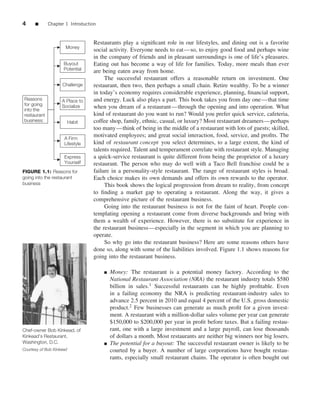
  • 315.
    Employee Input andWhat’s in It for Me? ■ 295 As a distinguished leadership expert noted, “Managers are people who do things right, and leaders are people who do the right things.” Think about that for a moment. In other words, managers are involved in being efficient and in mastering routines, whereas leaders are involved in being effective and turning goals into reality. As a human resources leader, your job is to do the right things right, to be both efficient and effective. An effective supervisor in the hospitality industry is one whom, first, knows and understands basic principles of management, and second, applies them to managing all the resource operations. In the hospitality industry we use a technique referred to as LBWA, leader- ship by walking around , spending a significant part of your day talking to your employees, guests, and peers. As you are walking around and talking to these various people, you should be performing three vital roles discussed in this book: listening, coaching, and troubleshooting. Employee Input and What’s in It for Me? Any restaurant that wants to optimize its potential will have extensive employee input into not only the vision and mission but also how to achieve or exceed them. Employees who are engaged with these processes will feel “in on things” and be more likely to go the extra mile to delight guests and create the all impor- tant guest loyalty. Employees can have input into the menu, the beverage menu, service methods, tip arrangements, shift selection and allocation, cost reductions, recycling programs, and energy reduction. It’s natural for employees to think or request “what’s in it for me?” because if they are going that extra mile they surely need recognition and rewards for outstanding accomplishments. POLICIES AND PROCEDURES Restaurant policies and procedures are necessary even for small restaurants because without them we all know chaos prevails. Policies and procedures are the “ground rules” of how to “play the game”; for example, how should a person who is repeatedly late be treated? Well, if there is a clear policy and procedure for that it is easier to enforce and besides, employees will respect an operator who has policies and procedures in place. One large and successful restaurant operator Cracker Barrel has an interesting policy on fraternization. Managers and supervisors are not allowed to fraternize with employees. For example, they should not go drinking together after a shift or attend baseball games together, etc.; unless it is a company sponsored event no fraternization is allowed. Can you guess why? Because they don’t want to leave themselves open to getting sued for discrimination or harassment if Maria did not get the shift she wanted because . . . or if someone else did get seemingly preferential treatment.
  • 316.
    296 ■ Chapter 10 Restaurant Leadership and Management Management Topics Most management texts outline the elements of management as being planning, organizing, communicating, decision-making, motivating, performance manage- ment, and control. PLANNING Planning provides the direction for the organization to go in order to be successful. It is the process of setting goals and determining how best to accomplish them. Planning is the foundation of all the other elements of management. There are two main types of planning—strategic (long range 3–10 years) and operational (short term 1–12 months) plans. Strategic plans are devised to steer the organization towards its vision and mission. Owners and managers look ahead to plan where they want the orga- nization to be in 5 or 10 years. One way organizations do this is by strengths, weaknesses, opportunities, and threats (SWOT) assessment. This SWOT assess- ment is done by comparing the organization to its competitors and the general business environment. Each restaurateur or restaurant company can decide what the points of comparison are. For example taking the guest cycle beginning with location, reservations (if the restaurant takes them), to curbside appeal, park- ing, greeting, holding area, menus, food quality, timeliness of food, presentation of food, service, atmosphere of restaurant, noise level, decor, cleanliness of restrooms, etc., Figure 10.2 shows the steps involved in the planning process: Good planning makes for a smooth production. Courtesy of the San Diego Convention & Visitors Bureau
  • 317.
    Management Topics ■ 297 ■ Forecasting ■ Determining where the organization is and where it wants to be ■ Setting goals and strategies to achieve the goals ■ Evaluating results FIGURE 10.2: Steps involved in the planning process Planning takes time but pays dividends when everyone is on the same page and making progress. FORECASTING Forecasting is a part of planning that aims to predict what will happen in the future. In a restaurant situation, we need to forecast the number of guests to expect and prepare for. Obviously, the better job we do in “guesstimating” the numbers the easier it will be to make or exceed the goals set. If a restaurant is already in existence we can examine past guest counts, sales, and even menu selections in order to plan for the next few days. Determining where the organization is and where it wants to be operationally: The owners and employees need to determine where the organization is, meaning that it has a level of guest satisfaction and guest loyalty that is measurable. There are also opinion surveys that can influence guest restaurant selection—good ratings in Zagat can help a restaurant, as some guests are influenced by this and other similar guides. Let’s say that a restaurant has a poor service rating; it would be a no-brainer to want to improve this score. This can easily be planned for by setting a goal of 90 percent on guest comments (up from the current 75 percent). In terms of profit, if current profits are, say, 4 percent return on investment, it would be smart to plan how to increase that ROI up to 15 percent. GOAL SETTING AND STRATEGIES Goals and strategies should be set for each of the key result areas of restaurant operations. Among the key result areas are: ■ Guest satisfaction ■ Guest loyalty ■ Sales ■ Labor costs ■ Food and beverage costs ■ Energy costs ■ Direct operating expenses and so on An example of goal setting would be for sales of $20,000 per week for the month of July. Another would be for 100 percent guest satisfaction or 95 percent or whatever number you like. Similarly, goals can be set for food costs (say 27 percent) and beverage costs (say 22 percent) and so on. Strategies are how the goal is met or exceeded. So, for the goal of $20,000 sales per week, a good
  • 318.
    298 ■ Chapter 10 Restaurant Leadership and Management marketing and sales plan is required to be in place and active. Promotions and sales and service training, including emotional intelligence (making a connection and bonding with guests so they will want to return) will also contribute to this goal being met. A strategy for ensuring that the food cost percentage is met is to check the cost of goods sold on a regular basis. The same applies to the labor costs; not only will effective scheduling work but also constant monitoring of sales and labor costs will ensure no surprises at month’s end. ORGANIZING The purpose of organizing is to get a job done efficiently and effectively by completing these tasks:10 ■ Divide the work to be done into specific jobs and departments. ■ Assign tasks and responsibilities associated with individual jobs. ■ Coordinate diverse organizational tasks. ■ Cluster jobs into units. ■ Establish relationships among individuals, groups, and departments. ■ Establish formal lines of authority. ■ Allocate and deploy organizational resources. So, how does this relate to restaurant leadership and management? Well, whether you’re a part of Darden restaurants’ management team or owner of your own restaurant, good organization is a must for success in the restaurant business. What should the organization of a restaurant be like? It depends on the size and complexity of the company. Is it a standalone restaurant or a chain of several restaurants? Large chains may be organized into areas with a vice president or area director for each. The company would likely have a VP for operations, marketing, finance, human resources, and franchising. For small chains, the entire chain may be run by a president or an operations director. Each store will have its own organization for example, a full-service restau- rant with front and back of the house and departments clearly defined. For example, the kitchen can have separate fry, saut´ , broil, grill, prep, salad, dessert, e and appetizer stations. Such work specialization improves efficiency. DECISION-MAKING Operating a restaurant requires countless decisions every day. Most decisions are made quickly and easily but some require more thought or information or both. The more challenging decisions go through the eight-step decision-making process:11 ■ Identification and definition of problem: Identifying the problem or chal- lenge is important otherwise we may never know if we have fixed the problem or merely patched it only to have it surface again.
  • 319.
    Communicating ■ 299 ■ Identification of decision criteria: Once the problem has been identified and defined, we need to determine the criteria relevant to the decision. Suppose the problem was the price and availability of a menu item, then the decision criteria might be the following: Get prices and availability from other suppliers, take the item off the menu, or change the dish by using other ingredients. ■ Allocation of weights to criteria: We all know that some elements of a decision are more important than others, so by putting a number for its weighting makes sense—of course, we often do this instinctively. ■ Development of alternatives: A listing of the various alternatives is pre- sented. ■ Selection of alternative: The best alternative is selected. ■ Implementation of alternative: The decision is put into action. ■ Evaluation of decision effectiveness: The degree of success as a result of the decision is gauged. Another interesting thing about decisions is that there are two major types of decisions, programmed and nonprogrammed. A programmed decision relates to decisions that occur on a regular basis, such as what to do when the stock of something goes below par, or when a guest makes a request for a booth. A nonprogrammed decision is one that rarely happens so it is handled differently. Some examples would be which software program to use for a restaurant’s front- and back-of-the-house operations, or which supplier to use. Communicating In the restaurant business we spend most of our time communicating with guests and associates. Fast-paced restaurants require quick and accurate communica- tions. From personal greetings from greeters or hosts, to introductions by service staff, communication is important as it imparts an impression of the restaurant to guests. Communications are equally important between front- and back-of- the-house staff, namely, servers and cooks. Here the communication of what the guest ordered is normally written or punched onto a screen so it quickly transmits to the cooks in the kitchen. We have all probably experienced occasions where the communication broke down and misunderstandings escalated into unfortunate situations. Interpersonal communications include verbal, nonverbal, body language, and verbal intonation. The best way to communicate is verbal face to face as there is an opportunity for immediate feedback. Nonverbal communication is without words. It can be a sound like a bell telling a server that an order is ready for pickup. Body language is an expression on a guest’s face as she or he complains about something or the cook’s gesture to a server as she asks about an order. Reading facial expression is an important part of communication because it can give a good idea of how the person talking is feeling. Active listening is really
  • 320.
    300 ■ Chapter 10 Restaurant Leadership and Management A manager communicating with guests. Courtesy of the San Diego Convention & Visitors Bureau hearing and understanding what is being said. Most of us could probable work on improving our listening skills because we are either thinking of what we are going to say next or not agreeing with what is being said instead of actively listing. Motivating12 When you lead a restaurant team, you will have certain expectations of your employees. You will expect them to do the work they have been hired to do—to produce products and services to the quality standards set. You may wonder if their performance will meet your expectations, and you may have some plans for improving their productivity. But you may not realize what these employees expect from you and how you meet their expectations may have as much to do with their performance as your expectations of them. Motivation refers to what makes people tick: the needs and desires and fears and aspirations within people that make them behave as they do. Motivation is the energizer that makes people take action; it is the why of human behavior. In the restaurant, motivation goes hand in hand with productivity. The big ques- tion is how to motivate poor performers to realize their potential and raise their
  • 321.
    Performance Management ■ 301 Needs Desires Motivation Fears Aspirations FIGURE 10.3: Needs, desires, fears, and aspirations lead to motivation productivity, and how to keep good performers from going stale in their jobs or leaving for a better opportunity. Actually, you cannot motivate people to do good work. Motivation must come from within. The one thing you as a leader can do is turn it on, to activate people’s own motivations. To do this you must get to know your associates and find out what they respond to. It may be the work itself. It may be the way you lead. It may be the work environment. It may be their individual goals: recognition, achievement, challenging opportunities, money, or whatever. Figure 10.3 shows the relationship of key motivators: needs, desires, fears, and aspirations. In sum, motivation is a complicated business, and getting people to motivate themselves to do their jobs well has no one simple answer. It takes something of an experiential approach; you try to find out what each person responds to (you can always ask them!), and if one does not work, maybe the next thing will. Remember recognition, rewards, and positive reinforcement work wonders. Performance Management13 Performance management is an important part of overall restaurant management. Performance standards form the heart of the job description and they describe the what’s, how-to’s, and how-wells of a job. Each performance standard has three things about each unit of the job: 1. What the employee is to do 2. How well it is to be done 3. To what extent it is to be done (how much, how soon) If you develop a full set of performance standards for each job that you are responsible for, you have the basis for a management system for your associates and the work they do. You can use them to describe the jobs, to define the day’s work for each job, to train associates to meet standards, to evaluate associates’ performance, and to give them feedback on how they are doing. You can use performance standards as a basis for rewarding achievement and selecting people for promotion. Intelligent and consistent use of a performance standard system reduces or eliminates those five major reasons for low productivity and high turnover. Asso- ciates are told clearly what to do. They are taught how to do it. They know how
  • 322.
    302 ■ Chapter 10 Restaurant Leadership and Management well they are doing because there is a goal standard of measurement. A man- ager can help and support associates with additional training or coaching when a standard is not being met. All this makes for much better relationships between associates and management. CONTROL The subject of control is covered in Chapter 8. Restaurant Management Issues There are any number of restaurant management issues but here are some of the most important and most likely to happen issues. SEXUAL HARASSMENT14 As a restaurant manager or owner, you need to be able to recognize and confront sexual harassment. The Equal Employment Opportunity Commission (EEOC) issued guidelines on sexual harassment in 1980, indicating that it is a form of gender discrimination under Title VII of the 1964 Civil Rights Act. The EEOC states that15 sexual harassment consists of “unwelcome advances, requests for sexual favors, and other verbal or physical conduct of a sexual nature when: (1) submission to such conduct is made, either explicitly or implicitly, a term or condition of an individual’s employment, or (2) submission to or rejection of such conduct by an individual is used as the basis for employment decisions affecting the person.” This definition of sexual harassment is known as the quid pro quo definition. Quid pro quo means that something is given in exchange for something else. In this type of sexual harassment, submission to or rejection of a sexual favor is used as the basis for employment decisions regarding that employee. The employment decision may be an increase in pay, a promotion, or keeping your job. Only management or supervisors can engage in quid pro quo harassment. There are about 76,000 EEOC cases a year, of which about 27,000 are based on race, 23,000 based on sex, and 22,500 based on retaliation. Additionally, 12,500 sexual harassment charges and 5,000 pregnancy discrimination charges are made and $274 million in monetary relief was gained by charging parties.16 An example of sexual harassment occurred at a Caesars Palace property where the EEOC asserted that male supervisors would demand and/or force female work- ers to perform sex with them under threat of being fired. Women, predominantly Spanish speakers, were forced to have sex and to make matters worse, manage- ment failed to address and correct the unlawful conduct, even though women complained about it. Further, the EEOC said, when workers complained about the unlawful conduct, they were retaliated against in the form of demotions, loss of wages, further harassment, discipline, or discharge. Caesars paid $850,000 to settle the suit.17
  • 323.
    Restaurant Management Issues ■ 303 In another case, a Subway franchise paid $166,500 for a disability harassment lawsuit. The EEOC charged in the case that the Subway owner and one of his managers subjected Ms. Gitsham to a disability-based hostile work environment, including teasing and name calling, because she is hearing impaired and wears hearing aids. Ms. Gitsham was forced to resign her position after both the owner and human resources/training manager repeatedly mocked her privately and in front of employees, creating a hostile workplace, with taunts such as: “Read my lips” and “Can you hear me now?” and “You got your ears on?”18 Another type of sexual harassment is environmental sexual harassment. In this case, comments or innuendos of a sexual nature or physical contact are con- sidered a violation when they interfere with an employee’s work performance or create an “intimidating, hostile, or offensive working environment.” In this situa- tion, the harassment must be persistent and so severe that it affects the employee’s well being. A final type of sexual harassment is third -party sexual harassment. Third- party sexual harassment involves a customer or client and an employee. The customer or client may harass an employee, or the other way around. For example, a male customer may harass a female bartender. The following examples of sexual harassment include an example of quid pro quo, environmental, and third-party sexual harassment. See if you can determine which is which. 1. Beth is a new employee who works as a cook’s assistant in a crowded kitchen. The men in the kitchen are constantly making crude, sexually oriented comments and jokes, and leave their X-rated magazines in full view of anyone walking by. Beth feels very intimidated and ill at ease. Unfortunately, the situation doesn’t improve over the first two months, and Beth feels too stressed to continue working. 2. For the past few nights, after the dining room has closed, Susan’s boss has asked her to go to his place for a drink. Although Susan has gone out with him and some friends once before, she is not interested in pursuing a relationship with him. When she tells him she is not interested, he tells her that a dining room supervisor job will be opening soon and that he could make sure she gets it if she takes him up on his invitation. 3. Barbara is a regular customer at a popular after-work bar where Bob works as a bartender. Barbara finds Bob to be a very good-looking fellow, so much so that she can’t keep her eyes, or hands, off him. Bob doesn’t like the attention Barbara gives him, but he feels he can’t do much about it since she is the customer. Such instances of sexual harassment can cost a company lost productive time, low morale, harm to its reputation, court costs, and punitive damages to harass- ment victims. In each of the situations above, there is an element of sexual harass- ment. While the second situation represents the typical exchange of sexual favors for employment opportunities, the first situation is an example of environmental
  • 324.
    304 ■ Chapter 10 Restaurant Leadership and Management sexual harassment in which the working environment was intimidating, hostile, or offensive due to physical, verbal, or visual (such as pornographic pictures) sexual harassment. The third situation represents third-party sexual harassment. As a manager you are responsible for recognizing, confronting, and prevent- ing the sexual harassment of both female and male employees by other employees or by nonemployees such as guests or people making deliveries. “An employer can be liable for customers who harass employees when the employer knew or should have known of the harassment and failed to prevent it.”19 Both you and your employer will be considered guilty of sexual harassment if you knew about, or should have known about, such misconduct and failed to correct it. If you gen- uinely did not know that sexual harassment took place, liability can be averted if there is an adequate sexual harassment policy and the situation is corrected immediately. Following are some specific actions that you can take to deal effectively with the issue of sexual harassment: ■ Be familiar with your company’s sexual harassment policy. Figure 10.4 is a sample policy. This policy should include disciplinary guidelines for people who are guilty of sexual harassment and guidelines for harassers who retaliate against those who turn them in. This policy may also include a formal complaint procedure for employees to use if they think they have been victims of sexual harassment, with provisions for immediate investigations and prompt disciplinary actions when appropriate. ■ Educate your employees on how to recognize sexual harassment, how to report it when it occurs, and the steps that will be taken if an employee is guilty of sexual harassment. ■ When an employee informs you of a possible case of sexual harassment, investigate the situation promptly according to your company policy. Your investigation is much the same as that done for any possible case of mis- conduct as just described. Don’t assume that anyone is guilty or innocent. ■ When you witness an example of sexual harassment, follow your policy and take appropriate and timely disciplinary action. ■ Provide follow-up after instances of sexual harassment. Check with victims and witnesses that harassment has indeed stopped and that no retaliation is taking place. ■ Prevent sexual harassment by being visible in your work areas, being a good role model, and taking all reported incidents seriously. CONFLICT MANAGEMENT We may wrongly assume that all conflict is bad for individuals and the organiza- tion. This is simply not so—some conflict is not only natural, but also productive, experts say; learning how to manage it, however, does not come naturally.20 Every relationship and every conflict has a past, present, and future, and resolving con- flicts effectively requires that we deal with all three.21
  • 325.
    Restaurant Management Issues ■ 305 I. Policy The policy of XYZ Restaurants is that all of our employees should be able to enjoy a work environment free from all forms of discrimination, including sexual harassment. Sexual harassment is a form of misconduct that undermines the integrity of the employment relationship, debilitates morale, and therefore interferes with the work effectiveness of its victims and their coworkers. Sexual Harassment is a violation of the law and will not be tolerated or condoned. II. Definition of Sexual Harassment Sexual harassment consists of unwelcome advances, requests for sexual favors, and other verbal or physical conduct of a sexual nature when: 1. submission to such conduct is made either explicitly or implicitly a term of condition of an employee’s employment, or 2. submission to or rejection of such conduct by an employee is used as the basis for employment decisions, or 3. the conduct interferes substantially with an employee’s work performance or creates an intimidating, hostile, or offensive work environment. Sexual harassment is not limited to actions of restaurant employees. Customers and clients may also be victims, or perpetrators, of sexual harassment. Following are examples of sexual harassment. • Unwelcome intentional touching or other unwelcome physical contact (such as pinching or patting). • Unwelcome staring or whistling. • Unwelcome sexually suggestive or flirtatious notes, gifts, or electronic or voice mail. • Offering an employment-related reward in exchange for sexual favors. • Verbal abuse of a sexual nature. • Unwelcome display of sexually suggestive objects or pictures such as pinups. • Conduct or remarks that demean or are hostile to a person’s gender. III. Coverage: XYZ Restaurants XYZ Restaurants prohibits sexual harassment during work hours or while on company property by all employees and by all nonemployees, such as customers and suppliers. IV. Responsibilities XYZ Restaurants managers are responsible for preventing sexual harassment and educating employees about this subject. They are also responsible for setting a good example, taking every complaint seriously, investigating complaints fairly, and maintaining confidentiality. XYZ Restaurants request that any employee with a complaint regarding sexual harassment make every effort to promptly present the complaint to their immediate supervisor or the human resources director. If the complaint involves the employee’s immediate supervisor, or if the employee feels uncomfortable discussing the complaint with the immediate supervisor, the employee may speak to another supervisor. V. Investigation Procedures and Disciplinary Action Once a supervisor has received a complaint, he or she is to immediately contact the Human Resources Department. After notification of the employee’s complaint, a fair and confidential investigation will be initiated. The results of the investigation will be reviewed by the Human Resources Director for possible disciplinary action. If warranted, disciplinary action up to and including termination will be imposed. Retaliation against employees who file complaints or assist in investigating complaints may also result in discipline up to an including termination. FIGURE 10.4: Sample sexual harassment policy Conflict management is the application of strategies to settle opposing ideas, goals, and/or objectives in a positive manner. Managers are often put in the middle of conflicts. They must know how to manage themselves, as well as the situation, positively and delicately. Managers must be able to separate their own emotions and feelings from the situation at hand. They need to be able to act, not
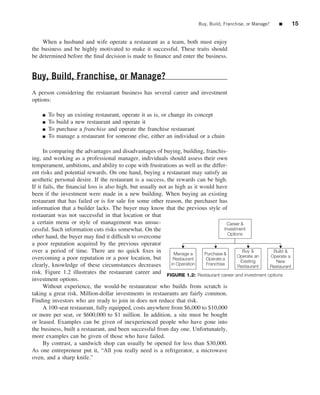
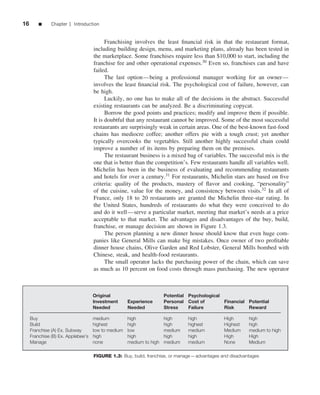
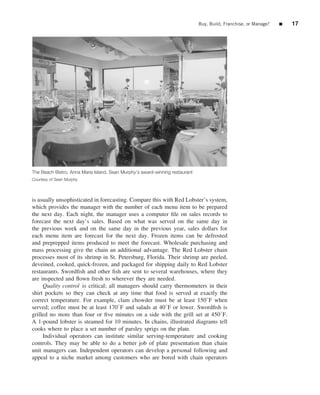
  • 326.
    306 ■ Chapter 10 Restaurant Leadership and Management react! There are many ways to manage conflict. For the purpose of this chapter, we will use a five-step approach to conflict management, which is illustrated in Step 1: Analyze Figure 10.5. The first step is to analyze what is at the center of the conflict. To do this supervisors need to ask themselves questions, as well as those involved in the conflict. Here are a few questions to ask: Step 2: Strategy ■ Who is involved? ■ How did the conflict arise? Step 3: Pre-negotiate ■ Can a positive spin be put on the situation? ■ Are there any secondary issues? ■ Have positions been taken? ■ Is negotiation plausible? Step 4: Negotiate ■ Is there a way to serve all interests at hand? ■ Are there external constraints/influences? ■ Is there a previous history of the conflict? Step 5: Implement After the main source is identified and the source of the conflict is understood, it is helpful to brainstorm and write thoughts and ideas of resolution on paper. FIGURE 10.5: Five step The second step to managing conflict is to determine the type of strategy that conflict management will be used to resolve the conflict. Some examples of commonly used resolu- process tion strategies are collaboration, compromise, competition, accommodation, and avoidance. Collaboration results most often when concerns for others are of high impor- tance. This type of strategy results in a win/win outcome. Both parties cooperate with each other and try to understand the other parties concerns, while also expressing their own. The parties both put forth a mutual effort and come to a solution that is completely satisfactory for both parties. Compromise results from high concern for one’s own interest or one’s own group interest accompanied by moderate to high interest for the other parties involved. Both parties try to resolve the conflict by finding a resolution that partially satisfies both of them, but completely satisfies neither. This type of strategy either produces a win/win or lose/lose outcome depending on if the solution chosen is the most effective. This varies depending on the situation at hand. Competition results when there is a high concern for one’s own interest or one’s own group. The outcome could vary from win/lose to lose/win, depending on who prevails. This strategy is not ideal, as it may cause increasing conflict, the losing party may try to even the score. Accommodation is the result of low concern for your own interests or the interest of your group, which produces a lose/win outcome. The opposing party is allowed to satisfy their interest, while one’s own interests are neglected. Avoidance is exactly what it sounds like. The conflict is avoided by both parties and neither party takes action to resolve it. This produces a lose/lose outcome. In the hospitality industry, this strategy is generally useless because
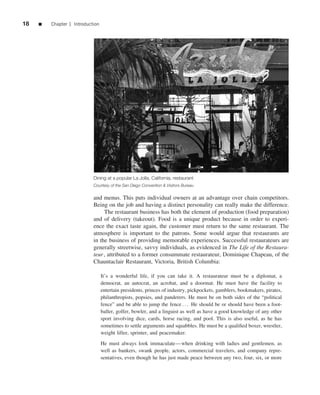
  • 327.
    Restaurant Management Issues ■ 307 employees work in close quarters. This makes it virtually impossible to avoid each other. The third step to managing conflict is to start prenegotiations. This is a key part of the conflict management process. Being effective at negotiating is a funda- mental skill for supervisors. During this step, there are several sub-steps. Initially, both of the parties involved in the conflict should be given the opportunity to come forth and offer a negotiation. If neither party is willing to come forth, then an outsider, in this case the leader, must step in. Next, the situation should be reassessed . The key parties involved in the conflict must be willing to cooperate with each other in the resolution process. The issues should be laid out on the table. From here what is negotiable, as well as what is not negotiable, must be determined. The parties involved should agree upon what information is significantly related to the conflict, as well as how communication and decision-making will take place. All of this should be completed before moving on to the fourth step. The fourth step to managing conflict is to begin the negotiation phase. All parties must be able to express their concerns and interests; they must also be willing to listen to each other. As a manager you will be considered the neutral third party. This means that you should not judge or favor either of the parties’ ideas or suggested options. You are there to facilitate a healthy discussion and keep the parties focused on the cause of conflict and how it is to be resolved (not to assign blame to a particular party). The parties involved in conflict should make a list of options that may help resolve the conflict, as well as satisfy their interests. After the lists of possible solutions are completed the options should be discussed and evaluated. Which option would best resolve the conflict and satisfy the most interests should be determined together. A commitment ought to be made to carry out the agreements, and both parties must feel assured that the other will carry out their part. The final step is for the parties to implement the negotiations made. As a supervisor you need to support the resolution and continue to communicate. It is also beneficial to continue monitoring the situation, in order to be certain that the agreement is in fact being carried out. CONFLICT RESOLUTION, HOW TO HANDLE CONFLICT22 Handling conflict in restaurants can be a challenging task. As a manager, you should always first keep the best interest of your company in mind. In Herb Kindler’s book Conflict Management: Resolving Disagreements in the Workplace and Robert Friedman’s article “Knock out on-the-job conflicts, complaints with six simple steps,” published in Nation’s Restaurant News, the authors discuss the following guiding principles for handling conflict. First of the guiding principles is to preserve dignity and respect. This means to preserve the dignity and respect of all parties involved in the conflict, including yourself. The focus should stay on resolving the conflict, not on the individual characteristics of the parties involved. As a manager, you should never talk down
  • 328.
    308 ■ Chapter 10 Restaurant Leadership and Management to an employee, especially during a conflict; this could result in them feeling like they are being attacked. If you make everyone feel respected, this will lower defenses and help the process of resolution. Second is to listen with empathy and be fully present and identify the issues.23 As you listen, determine what issues may have created the conflict. In some cases, the real issues may be beneath the surface. The flash point of a festering disagreement may ignite and result in serious consequences. An example is the hoarding of cutlery in a restaurant by some employees. When it is discovered that there is a shortage of spoons, in particular, and another employee finds out where they are being hidden a fight breaks out. Don’t daydream while an employee is trying to voice their opinion. Listen carefully to everyone involved and withhold any judgments until everyone has had a chance to speak. Try to see from each differing perspective, put yourself in each of the individual’s shoes. Give everyone a chance to speak with you on an individual, one-on-one basis. Give them your full attention and make direct eye contact. Most importantly, make sure that your employees feel heard. There is nothing worse than being left with the feeling that your opinion (or words) does not matter. Third is to and find a common ground without forcing change and agree on the issues. Recite for the participants what you perceive to be the issues and ask them to agree with you or correct you. Appealing as it may seem, as a manager it is important to not try to force others into changing. People don’t change for others, they change for themselves. They change only when they believe that they will benefit from the change. Therefore, throwing weight around as a superior will result in getting nowhere. It is also important for your employees to trust and respect you. If they believe that you are always looking out for their best interest, they are more likely to believe in you, and look up to you as their mentor. Fourth is to discuss solutions. The parties involved have some idea of how they want the situation to be solved—ask them for suggestions. Fifth is to honor diversity, including your own perspective. According to Webster’s Dictionary, diversity is defined as a “difference, variety, or unlikeness.” To diversify is to give variety to something; to engage in varied operations; to distribute over a wide range of types or classes. During this step it is important to honor diversity, as well as foster diversification. Sixth is to agree on the solutions and follow up. Discuss solutions with each participant until there is agreement on the issues. Keep detailed notes or have a recorder. Then, once agreement has been reached, document it and have the participants sign it. Then follow up to see if the agreement holds or needs further discussion. Okay, so let’s say everyone has differing viewpoints on a certain issue. This can lead to a creative way of searching for the right resolution, or it can result in feelings of isolation. All too often the search for a resolution during a conflict is a hasty one. When we rush, we rush others into an agreement. We don’t let them have time to understand what really matters to them, or come to an independent
  • 329.
    Restaurant Management Issues ■ 309 viewpoint from that of the group, a phenomenon known as groupthink . Let’s say you are the only person in a group that holds a different viewpoint, you will probably end up conforming to the group and not speaking your opinion. What you should do, of course, is to speak out and let your voice be heard. We all know the cost of a lawsuit is very high, but in the case of employment litigation, many companies find that the cost of defending themselves against the charges of unfair employment practice is extremely high, often exceeding the amount of the employee’s claim of damages. Cases for unfair employment practices may drag on for years, with increased legal expenses. So it makes sense to have an in-house dispute resolution process.24 ALTERNATIVE DISPUTE RESOLUTION Alternative dispute resolution (ADR) is a term for problem-solving and grievance resolution approaches to address employee relations and disputes outside the courtroom. The purpose of ADR is to provide employers and employees with a fair and private forum to settle workplace disputes.25 With ADR a process is in place to offer the following options:26 ■ Open Door Policy: Employees have the opportunity to meet with managers to discuss issues. ■ Third-Party Investigations: A neutral third-party, from inside or outside the organization, confidently investigates complaints and proposes resolutions. ■ Fact Finding: A neutral third-party person or team from outside the orga- nization examines the facts of the complaint and presents them in a report. ■ Peer Review : A panel of employees, or employees and managers, work together to resolve the employee complaints. ■ Mediation: A voluntary and confidential process in which a neutral third-party facilitator trained in mediation techniques negotiates a mutually acceptable settlement. The steps in the process are gathering information, framing the issues, developing options, negotiating and formalizing agreements. Participants in the mediation process create their own solutions and settlements are not binding. ■ Arbitration: Disputes are settled by an arbitrator and may be either binding or nonbinding according to the wishes of the participants. An arbitrator or panel of arbitrators hears both sides of an issue and then makes a determination. As Nancy Lockwood, a human resources content specialist with the Society of Human Resources Management, suggests the advantages of ADR are that the total cost is less than traditional means of resolving workplace disputes, legal costs are contained, the time spent on investigations is reduced, and workplace productivity is not compromised. Figure 10.6 shows the steps in an Alternative Dispute Resolution Process.
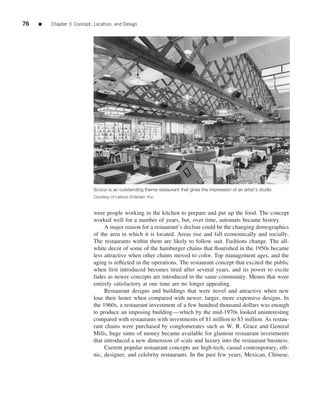
  • 330.
    310 ■ Chapter 10 Restaurant Leadership and Management Alternative Open Third Dispute Fact Peer Door Party Mediation Arbitration Resolution Finding Review Policy Investigation Process FIGURE 10.6: The steps in an alternative dispute resolution process Summary Restaurant corporations of excellence regard their employee resources as their most valuable asset and competitive advantage. Leadership begins with a vision, a mission, and goals. Vision is the articula- tion of the mission of the organization in such an appealing way that it vividly conveys what it can be like in the future. Mission statements normally have three parts: First, a statement of overall purpose; second, a statement explaining the values employees are expected to maintain in the daily decision-making process; third, a declaration of the major goals that leaders believe are essential as well as how to attain the goals. Goals should be relevant to the mission, specific and clear, challenging yet achievable, made in collaboration with employees, and written down with the strategies and tactics of how to meet the goals. Effective leaders have six traits that distinguish them from nonleaders: drive, the desire to influence others, honesty and moral character, self-confidence, intel- ligence, and relevant knowledge. Leaders create a vision, develop goals, communicate and motivate, problem- solve, and make decisions. Any restaurant that wants to optimize its potential will have extensive employee input into not only the vision and mission but also how to achieve or exceed them. Planning provides the direction for the organization to go in order to be suc- cessful. It is the process of setting goals and determining how best to accomplish them. Strategic plans are devised to steer the organization towards its vision and mission. Owners and managers look ahead to plan where they want the organi- zation to be in 5 or 10 years. Forecasting is a part of planning that aims to predict what will happen in the future. Goals and strategies should be set for each of the key result areas of restaurant operations. The purpose of organizing is to get a job done efficiently and effectively by completing these tasks. Operating a restaurant requires countless decisions every day. Most decisions are made quickly and easily but some require more thought or information or
  • 331.
    Summary ■ 311 both. The more challenging decisions go through the eight-step decision-making process. A programmed decision relates to decisions that occur on a regular basis, like what to do when the stock of something goes below par or when a guest makes a request for a booth. A nonprogrammed decision is one that rarely happens so it is handled differ- ently. Some examples would be which software program to use for a restaurant’s front- and back-of-the-house operations, or which supplier to use. In the restaurant business we spend most of our time communicating with guests and associates. Fast-paced restaurants require quick and accurate commu- nications. Interpersonal communications include verbal, nonverbal, body language, and verbal intonation. The best way to communicate is verbal face to face as there is an opportunity for immediate feedback. Motivation refers to what makes people tick: the needs and desires and fears and aspirations within people that make them behave as they do. Performance standards form the heart of the job description and they describe the what’s, how-to’s, and how-wells of a job. Each performance standard has three things about each unit of the job. The EEOC states that27 sexual harassment consists of “unwelcome advances, requests for sexual favors, and other verbal or physical conduct of a sexual nature.” Conflict management is the application of strategies to settle opposing ideas, goals, and/or objectives in a positive manner. Alternative dispute resolution (ADR) is a term for problem-solving and grievance resolution approaches to address employee relations and disputes out- side the courtroom. Key Terms and Concepts Accommodation Groupthink Alternative dispute resolution Leader (ADR) Leadership Avoidance Leadership by walking around Collaboration (LBWA) Competition Mentor Compromise Motivation Communicating Mission statement Conflict management Nonprogrammed decision Decision-making process Organizing Diversify Performance management Diversity Programmed decision Employer of choice Sexual harassment Forecasting Strategic plans Goals SWOT assessment
  • 332.
    312 ■ Chapter 10 Restaurant Leadership and Management Review Questions 1. Define the term vision. 2. What is the purpose of a mission statement? 3. Discuss the three parts of a mission statement. 4. What do you think are the most important characteristics of effective leaders and why? 5. What is meant by the term real authority? 6. What is the purpose of forecasting? 7. Discuss why Title VII of the 1964 Civil Rights Act was passed. 8. Briefly describe the steps in the conflict management process. 9. Define the terms accommodation, avoidance, compromise, and competition, as they pertain to conflict management. 10. What are the six guiding principles for handling conflict? Internet Exercise Go to the U.S. Equal Employment Opportunity Commission Web site (www.eeoc.gov) and answer the following questions: ■ What types of equal opportunity training and outreach programs are currently available? ■ What current topics are discussed under the “Statistics” link? ■ What are the current statistics under the “Sexual Harassment” link? ■ Go to the “Filing A Charge” link. What information needs to be provided in order to file a charge? Endnotes 1. John R. Walker, Introduction to Hospitality 5th ed., Upper Saddle River, NJ: Prentice Hall, 2009, p. 535. 2. John R. Walker and Jack E. Miller, Supervision in the Hospitality Industry: Leading Human Resources, 6th ed., Hoboken, NJ: John Wiley & Sons, 2010, p. 1. 3. Ibid. 4. John R. Walker, Introduction to Hospitality Management, 3rd ed., Upper Saddle River, NJ: Pren- tice Hall, 2010, p. 469. 5. John R. Walker and Jack E. Miller, Supervision in the Hospitality Industry: Leading Human Resources, 6th ed., Hoboken, NJ: John Wiley & Sons, 2010, p. 9. 6. Ibid.
  • 333.
    Summary ■ 313 7. Larry J. Gitman and Carl McDaniel, The Future of Business, 5th ed., Cincinnati, OH: South- Western Publishing, 2005, p. 209. 8. Ibid. 9. This section is from: John R. Walker and Jack E. Miller, Supervision in the Hospitality Industry: Leading Human Resources, 6th ed., Hoboken, NJ: John Wiley & Sons, 2010, p. 13–14. 10. John R. Walker, Introduction to Hospitality Management, 3rd ed., Upper Saddle River, NJ: Pren- tice Hall, 2010, p. 521. 11. Ibid pp. 553–4. 12. This section draws on John R. Walker and Jack E. Miller, Supervision in the Hospitality Industry: Leading Human Resources, 6th ed., Hoboken, NJ: John Wiley & Sons, 2010, p. 178. 13. Ibid. 14. This section draws on John R. Walker and Jack E. Miller, Supervision in the Hospitality Industry: Leading Human Resources, Hoboken, NJ: John Wiley & Sons, 2010, p. 364–6. 15. U.S. Equal Employment Opportunity Commission. www.eeoc.gov/sexual_harassment.html. Retrieved October 4, 2007. 16. Charles Robbins and David Grinberg, “Job Bias Charges Edged up in 2006,” EEOC Reports, The U.S. Equal Opportunity Commission, February, 2007. 17. U.S. Equal Employment Opportunity Commission. www.eeoc.gov/press/8-20-07.html. Retrieved October 4, 2007. 18. U.S. Equal Employment Opportunity Commission. www.eeoc.gov/press/7-27-07.html. Retrieved October 4, 2007. 19. Health, Safety & Environment Department, United Steelworkers. “Safety Incentive and Injury Discipline Policies: The Bad, the Even Worse and the Downright Ugly.” PDF obtained using www.uswa.org. October 5, 2007. 20. Ibid. 21. Morton Deutsch, Peter Coleman, and Eric Marcus, The Handbook of Conflict Resolution: Theory and Practice, San Francisco: Jossey-Bass (A John Wiley & Sons Imprint), 2006, p. 161. 22. This section was adapted from: Herb Kindler, Conflict Management: Resolving Disagreements in the Workplace, Boston: Thomson, 2006, pp. 3–4. 23. Robert Friedman, “Knock out on-the-job conflicts, complaints with six simple steps,” Nation’s Restaurant News, New York: September 11, 2006, Vol. 40, Iss. 37, p. 30. 24. Stephen Barth, “Why in-house dispute resolution makes sense,” Lodging Hospitality, May 15, 2002, Vol. 58, Iss. 7, p. 19. 25. Nancy R. Lockwood, “Alternative Dispute Resolution,” Society for Human Resource Manage- ment, SHRM Research, February 2004. 26. Ibid. 27. U.S. Equal Employment Opportunity Commission. www.eeoc.gov/sexual_harassment.html. Retrieved October 4, 2007.
  • 334.
    CHAPTER 11 Organization, Recruiting, and Staffing LEARNING OBJECTIVES After reading and studying this chap- ter, you should be able to: . ■ Describe the processes for cre- ating job and task analyses. ■ Describe the components of a job description, and list the guidelines for creating one. ■ Identify legal issues surround- ing hiring and employment. ■ Determine the legality of poten- tial interview questions.
  • 335.
    Task and JobAnalysis ■ 315 Presumably, we have our concept, our location, our menu, health and fire department approval, liquor licenses, and other local permits. We have found finances and taken care of legal matters. Now we think of setting up the jobs and organizing the restaurant so that it fulfills its function—to serve patrons and produce a profit. In an existing restaurant, improvements in job content and organization may be possible. In a new concept restaurant, tasks have to be defined to form jobs, and the jobs have to be related to each other. This chapter discusses how to analyze jobs and relate them to each other to form an organization chart. We first look at task and job analysis. Task and Job Analysis A task is a related sequence of work. A series of related tasks constitutes a responsibility. A job, then, is a series of related responsibilities. When these are written down in an organized form, they constitute a job description. Fundamen- tal to the entire human resource function is task and job analysis, the in-detail examination of the tasks and jobs to be performed. From these analyses come job descriptions, which are essential for selection and training of staff and for setting performance standards. Job specifications identify the qualifications and skills needed to perform the job. Job instructions provide the step-by-step details needed for training. Performance standards identify the outcome of the work. There are two main approaches to task and job analysis. The bottom-up method is most frequently used when the organization already exists and the work behavior of existing employees is the basis for analysis. The bottom-up method has some merit in that experienced workers often find shortcuts to save their legs. For example, an experienced server will never enter or leave the dining area empty-handed. The top-down method must be used in new restaurants because there are no existing employees to analyze. To determine what tasks must be performed, the mission, goals, and objectives of the restaurant must be examined. There is nothing to stop operators from analyzing jobs in similar organizations and, indeed, reanalyzing the jobs in relation to the mission goals and objectives of the restaurant after it has been open for a year or two. From these analyses come job descriptions that are essential for training and for developing job specifications. Once the jobs are broken down into their various steps and the tasks are detailed, it is possible to develop training programs based on this information. This same information may then be used to evaluate or appraise job perfor- mance. Figure 11.1 shows the sequence from task and job analysis to appraisal. If the employee’s performance meets or exceeds the standards, the employee may receive not only praise but also a pay raise. If the employee’s perfor- mance does not meet the standards, coaching to improve performance is the next step—followed by termination, if performance fails to improve. Depending FIGURE 11.1: The sequence on the severity of the situation, the employee could be given a verbal or written of a job from task to warning or even be dismissed. In technical terms, jobs, positions, responsibilities, performance appraisal
  • 336.
    316 ■ Chapter 11 Organization, Recruiting, and Staffing and tasks are quite separate and distinct. The job of server may have a number of server positions—one job but several positions. Each person fills a position. A server’s job may involve performing these tasks: ■ Setting up tables prior to food service ■ Taking orders/suggestive selling ■ Waiting on and serving customers ■ Making coffee ■ Preparing simple salads or desserts ■ Performing side work (cleaning salt and pepper shakers, folding napkins, cleaning ketchup bottles, cleaning ashtrays) Servers may have to perform tasks that generally are someone else’s respon- sibility, such as seating or busing tables. This happens when the restaurant is busy. Also, servers have to know how each position in the restaurant functions. On a busy night or a night that the restaurant is shorthanded, servers may have to prepare entr´ es with wines and other beverages, make sure stations are stocked, e keep coffeepots filled, make sure trays and silverware are available at all stations, and so on. Preparing employees to work successfully in the restaurant requires constant ongoing training to keep them up to date and well informed. The job description is the basis for identifying the employee qualifications needed to perform the job. These qualifications form the job specifications—or, more accurately, the person specifications. The kind of person recruited and what is taught in training are based on task and job analysis. Selecting the right person for each job—based on its analysis—is critical for successful job performance. No amount of training can produce a sincere, friendly welcome if it is not in the person’s character when hired. Most training is based on what is carried in the heads of supervisory per- sonnel. This is excellent information, no doubt, but probably not well organized or in a form that can be systematically presented for effective training. Chain orga- nizations have detailed training processes and manuals. Owners of small chains making the transition to large chains employ human resource directors and training directors to organize and present the training in a systematic manner. Necessarily, they must perform job and task analysis to obtain basic information. TECHNICAL TASKS VARY WITH THE ESTABLISHMENT In breaking down a job into its various tasks, the analyst tries to determine logical work sequences or elements that can be pulled out as separate tasks and taught as a logical sequence of duties, practices, and skills. Each establishment will have somewhat different jobs and tasks within jobs. Tasks that might be broken out of a broiler cook job are: ■ Care of broiler ■ Broiling seafood exactly as ordered
  • 337.
    Task and JobAnalysis ■ 317 ■ Broiling steaks exactly as ordered ■ Broiling chicken to specification ■ Cleaning the broiler In analyzing tasks and jobs, emphasize the job objective. For example, a person can be thought of as a clean-up person, but a better description would In recent be “a person who expedites seat turnover.” In the description for a buser, the years, job purpose of the job might be spelled out like this: “The general objective of a descriptions busperson is to speed seat turnover by setting up and clearing tables as rapidly have become impor- and as efficiently as possible without interfering with the comfort of the patron. By tant documents in law speeding seat turnover, customer satisfaction (due to shorter waits) is increased, cases dealing with along with volume of sales and tips.” employee–employer The tendency is to analyze the entire job, rather than its parts, the tasks—but problems. For it is easier to examine the tasks separately, describe them, and use the analysis as example, employees a basis for training. Figure 11.2 shows a task breakdown for the preparation of a may sue the employer green salad. It could be part of the job of a salad person or of a cook, depending for wrongful dismissal, on the restaurant. alleging that they were A number of tasks are common to more than one job within a restaurant—for not properly informed example, using good telephone manners, giving first aid, dealing with special of the duties they were requests and complaints, acting in emergencies, and cleaning. Running through expected to perform. restaurant operations are other common denominators such as courtesy, coopera- tion, dexterity, and friendliness. A preservice briefing, at which managers describe the specials of the day and other service-related information
  • 338.
    318 ■ Chapter 11 Organization, Recruiting, and Staffing JOB TITLE: Salad person LOCATION: Preprep Area OBJECTIVE: To prepare and serve a quality, elegant-looking tossed green salad with crisp greens. (Standard of performance: One salad in three minutes) EQUIPMENT AND SUPPLIES: Large salad bowl; peeler Parsley sprigs Red tomato Paring knife, grater Head of lettuce Carrot Shredder Head of red cabbage ‘‘WHAT TO DO’’ ‘‘HOW TO DO IT’’ ‘‘REMARKS’’ (important information) I. Preparing the vegetables A. Lettuce 1. Lay aside outer leaves. Make sure leaves are clean, crisp, and not 2. Pull apart leaves and shred into deteriorated. portion size. B. Red cabbage 1. Pull off outer leaves. Be sure to shake off excess water as above. 2. Shred cabbage with shredder. Make sure not to get it too fine and be careful of fingers when shredding. C. Carrots 1. Wash carrots thoroughly. Grate to small pieces. 2. Peel carrots. 3. Grate carrots into very small pieces. D. Tomatoes 1. Wash thoroughly. Leave skin on to make a uniform-looking 2. Cut into eight sectional wedges. tomato. II. Arranging the salad 1. Place large outer lettuce leaves It is very important not to toss the tomato inside bowl. with the rest of the salad. 2. Toss lettuce, cabbage, and carrots together. 3. Place tomato wedges on top of green salad. III. Garnishing the salad 1. Garnish salad with parsley Be careful not to ‘‘overdo’’ the garnish. leaves. People want the salad—not the garnish. 2. Place a scalloped-edge tomato in center also with above. IV. Serving the salad 1. Serve at once or keep it in a The crispness of the salad will deteriorate if refrigerated area. left in a warm area too long. FIGURE 11.2: Task breakdown: preparation of tossed green salad
  • 339.
    Job Descriptions ■ 319 Job Descriptions A well-organized restaurant has written job descriptions and specifications. Few independent restaurants bother to perform job analysis but rely on the owner’s or manager’s knowledge of the job. Chain operators usually have documented job descriptions and specifications for use by both manager and employees (see Figure 11.3). Often the description and specification are combined for conve- nience. The importance of good job descriptions cannot be overemphasized. They have been used as evidence in a number of lawsuits and Equal Employment Oppor- tunity Commission (EEOC) cases. More important, they help in creating a clear and common understanding of the purpose and expected outcomes of each job. Every restaurant should have one for each position. Guidelines for Writing a Job Description ■ Describe the job, not the person in the job. ■ Do not describe in fine detail, such as would be the result of a time and motion study. ■ Use short, simple, and to the point sentences. Use only words and phrases that really contribute to the description. ■ Explain technical jargon if used. ■ Make the description detailed enough to include all aspects of the job. ■ Include the essential functions of the job and the outcomes expected from performing the job.1 JOB SPECIFICATION A job specification lists the education and technical/conceptual skills a person needs to satisfactorily perform the requirements of the job (see Figure 11.4). Once the tasks performed in a job are described, a separate section of the job description form can be developed. Remember, no job requires all the faculties of an individual, which means that many jobs can be performed by people who lack several abilities or who are physically unable to perform certain tasks. Many jobs can be done by mentally or emotionally handicapped people. For example, at the Olive Garden restaurants, such workers make salads and do the dishwashing. JOB INSTRUCTION SHEET Task analysis can be converted into job instructions, which can serve not only as a guide to new employees but also as a quality assurance measure for the maintenance of work standards. Job instructions comprise a list of the work steps performed, arranged in sequential order if there is a natural cycle to the work. It is a short step from job description to job instruction sheet. If the job description is well done, the information can be reorganized, with some information added and some omitted, to form a job instruction sheet. This is used both by trainer and trainee.
  • 340.
    320 ■ Chapter 11 Organization, Recruiting, and Staffing Position Assistant Manager Reports to: Manager Position overview: Under the general supervision of the manager, subject to the Service Policy and Procedure Manual, assures constantly and consistently the creation of maximal guest satisfaction and dining pleasure. RESPONSIBILITIES AND DUTIES A. Planning and organizing 1. Studies past sales experience records, confers with manager, keeps alert to holidays and special events, and so on; forecasts loads and prepares work schedules for service employees in advance to meet requirements. 2. Observes guest reactions and confers frequently with waiters and waitresses to determine guest satisfactions, dissatisfactions, relative popularity of menu items, and so on, and reports such information with recommendations to the manager. 3. Observes daily the condition of all physical facilities and equipment in the dining room, making recommendations to the manager for correction and improvements needed. 4. Anticipates all material needs and supplies, and assures availability of same. 5. Inspects, plans, and assures that all personnel, facilities, and materials are in complete readiness for excellent service before each meal period. 6. Anticipates employment needs, recommending to the manager plans for recruitment and selection to meet needs as they arise. 7. Discusses in advance menu changes with waiters and waitresses to assure full understanding of new items. 8. Conducts meetings of service employees at appropriate times. 9. Defines and explains clearly for waiters, waitresses, and buspersons their responsibilities for relationships with: • each other • the guest • the hostess/host • the manager • the cashier • kitchen personnel B. Coordinating 1. Assures that waiters and waitresses are fully informed as to all menu items—how they are prepared, what they contain, ounces per portion. 2. Periodically discusses and reviews with employees company objectives and guest and personnel policies. 3. Keeps manager informed at all times as to service activities, progress, and major problems. C. Supervising 1. Actively participates in employment of new waiters, waitresses, and buspersons; suggests recruitment sources, studies applications, checks references, and conducts interview. 2. Following an orientation outline, introduces new employees to the restaurant, restaurant policies, fellow employees. 3. Using a training plan, trains new employees and current employees in need of training. 4. Corrects promptly any deviations from established service standards. 5. Counsels with employees on job and personal problems. FIGURE 11.3: Job description
  • 341.
    Job Descriptions ■ 321 . 6. Follows established policy in making station assignments for waiters and waitresses. 7. Establishes, with approval of manager, standards of conduct, grooming, personal hygiene, and dress. 8. Prepares, in consultation and with approval of the manager, applied standards of performance for waiters, waitresses, and buspersons. 9. Recommends deserving employees for promotion and outstanding performers for special recognition and award. 10. Strives at all times through the practice of good human relations and leadership to establish esprit de corps—teamwork, unity of effort, and individual and group pride. 11. Has a responsibility to maintain and keep a keen and constant alertness to the entire dining room situation—a sensitivity to any deviation or problem—and to assist quickly and quietly in its correction, adjusting guest complaints. 12. Greets and seats guests cordially and courteously, to assure a sincere welcome and genuine interest in their dining pleasure. D. Controlling 1. Controls, according to established policies, standards, and procedures, employees’ performance, conduct, dress, hygiene, sanitation, and personal appearance. 2. Studies all evidence of waste—time, materials, and so on—making recommendations for prevention. E. Other 1. On emergency occasions may serve guests, act as cashier, or perform specifically assigned duties of the manager. 2. Personifies graciousness and hospitality to guests and employees on the basis of ‘‘We’re glad you’re here’’ and ‘‘We’re proud to serve you.’’ FIGURE 11.3: (continued) Position: Hostess/Host 1. Maturity—capable of relating effectively to elder and younger patrons and employees. Observable personal competence and stability. 2. Education—minimum of a high school education required, some college desired. 3. Experience—prior positions as a waitress/waiter required, experience as a hostess/host desired. Possess ability to perform as cashier and assist in table clearings. Prior supervisory experience desired. Basic understanding of food, service skills, sanitation, and dining room equipment mandatory. 4. Physical requirements—appropriate physical stature, excellent hearing and vision. Observable strength to be able to walk and stand for long periods without noticeable fatigue. 5. Mental requirements—observable average intelligence, ability to retain sense of order and balance of patron seating placements. Ability to relate to several persons concurrently in a pleasing and prompt manner. 6. General character—observable conscientiousness, good grooming, basically pleasant, and exudes an attitude of willing cooperation. Possesses a ‘‘taking charge’’ demeanor of personal authority. Speaks clearly and with acceptable volume and intonation. Possesses personal confidence. FIGURE 11.4: Job specification
  • 342.
    322 ■ Chapter 11 Organization, Recruiting, and Staffing RESTAURANT MANAGER—Coordinates and directs the entire BOOKKEEPER—Audits guests’ checks. May com- operation to assure efficient quality, courteous foodservice. pute daily cash in take and operating ratios, Works through supervisory personnel, but in smaller restau- deposit money in bank, and maintain financial rants may directly supervise kitchen and dining room staffs. records. Must know all of the details involved in every restaurant job. ASSISTANT MANAGER—Performs specific supervisory duties under the manager’s direction. Generally takes over in the manager’s absence. Must be thoroughly familiar with the entire operation and have good management skills. PURCHASING AGENT AND STORE- FOOD PRODUCTION MANAGER— DINING ROOM MANAGER— CASHIER—Receives ROOM SUPERVISOR—Orders, re- Responsible for all food prepa- Coordinates dining room payment for food ceives, inspects, and stores all food ration and supervision of kitchen activities, trains and super- and beverages for distribution to the different staff. Must have thorough knowl- vises host/hostess, waiters, sold. May total food departments. Must be capable edge of food preparation and waitresses, busboys, and checks. Must be of managing an inventory and good food standards. Should busgirls. Should possess personable, quick keeping track of current market know how to work with and leadership qualities, objec- at mental arith- prices. This job is sometimes the re- supervise people. tivity, and fairness. metic, and com- sponsibility of the manager or chef. pletely honest. PANTRY SUPERVISOR—Supervises CHEF AND COOK—Prepares and portions HOST/HOSTESS—Takes reservations. salad, sandwich, and beverage all foods served. In large restaurant opera- Keeps informed on current and upcom- workers. Should be able to create tions, job can be highly specialized with in- ing table reservations. May present attractive food arrangements. May dividual cooks or chefs responsible for a menu and introduce waitperson. be in charge of requisitioning sup- single category, such as vegetables, cold Should be attractive, friendly, able to plies and supervising cleaning meats, soups, sauces, and short orders. maintain composure when restaurant is crew. busy. BEVERAGE WORKER—Prepares KITCHEN HELPER—Assists the cooks, WAITER-CAPTAIN—Supervises and co- hot beverages such as coffee, tea, chefs, and bakers by performing super- ordinates activities of dining room or hot chocolate. May assist in vised tasks. It’s a good entry job for the employees, performing in a formal the pantry and help others in the individual who wants to learn food prepa- atmosphere. May be responsible for kitchen during rush hours. It is a ration because the kitchen helper is busy scheduling hours and shifts, keeping good beginning position. measuring, mixing, washing, and chopping employees’ time records, and vegetables and salad ingredients. assigning work stations. SANDWICH MAKER—Does basi- SANITATION/MAINTENANCE WORKER— WAITPERSON—Takes food orders and cally what the name implies, but Maintains clean cooking utensils, equip- serves the foods to customers. These also is involved in preparing fill- ment ,walls, and floors. In most modern key employees must like people, be ings and dressings. This position is restaurants, dishwashers and other ma- poised and have good self-control, be an opportunity for a quick, careful chines simplify part of the job. This able to coordinate and respond to worker who may find the job has behind-the-scenes position allows the indi- many requests made at almost the a touch of creativity. Skills ac- vidual to study the various kitchen duties same time. The individual must move quired here will help the individ- before choosing a particular job or direc- quickly and accurately. Many people ual to move to a better-paying tion for the future. This category includes make this a career position. position. porters, dishwashers, and potwashers. PASTRY CHEF AND BAKER—Bakes cakes, BUSPERSON—Clears the table, re-sets cookies, pies, and other desserts. Bakes it with fresh linen and eating utensils, bread, rolls, quick breads. In some restau- fills water glasses, and helps in other rants, must also be skilled in cake decorating. housekeeping chores in the dining area. A fine way to start learning the business. FIGURE 11.5: Job functions in a large restaurant
  • 343.
    Organizing People andJobs ■ 323 Organizing People and Jobs In one way or another, every restaurant is organized so that these restaurant functions are performed: ■ Human resources management and supervision ■ Food and beverage purchasing ■ Receiving, storing, and issuing ■ Food preparation ■ Foodservice ■ Food cleaning; dish and utensil washing ■ Marketing/sales ■ Promotion, advertising, and public relations ■ Accounting and auditing ■ Bar service All of the functions can be performed by one person, as in a one-person pizza parlor, or thousands of people can be involved, as in a large restaurant chain (see Figure 11.5). An organization chart lays out the lines of communication and relationships between jobs. It also suggests lines of authority, responsibility, and accountability, which means that the jobs themselves must be structured and defined. Who is responsible for what? Who reports to whom? Who has authority for making what decisions? Who is accountable for what? Figure 11.6 shows a possible organization chart. FIGURE 11.6: A hypothetical dinner house/restaurant organization chart
  • 344.
    324 ■ Chapter 11 Organization, Recruiting, and Staffing As the restaurant grows, specialization of function becomes necessary. The owner/manager must delegate most or all of the restaurant functions, except man- agement, retaining responsibility for planning, overseeing, motivating, and making Guests major decisions—especially financial decisions. People are added and specialists take on responsibilities for purchasing, for food preparation, and for service. Figure 11.7 shows the Red Lobster recruitment process. Servers Some organization charts are flat—meaning they have fewer levels. This type of organization works well for small and large restaurant businesses, both Managers/Owners independents and chains that are informal or less autocratic. A variation of the flat organization chart is the pyramid—especially the inverted one with guests at the FIGURE 11.7: top and managers/owners at the bottom. Figure 11.8 shows an inverted pyramid Managers/owners are organization chart. supporting servers who are taking care of the guests 2 Candidate reads 3 Manager reviews brochure and job description completed 1 and completes application with Candidate applications App.Screen 4 Candidate requests application at 15-30 minutes completes restaurant 10 minutes Charting/ work sample >1 minute 45 minutes/ 15-20 minutes 5 minutes/ 15-20 minutes 5 Fax back charting/ work sample results 5-15 minutes 6 Manager 9 conducts 20 minutes interview 1 GM makes job 20 minutes 20 minutes offer 8 GM conducts 7 Employment interview 2 verification = Decision Point FIGURE 11.8: Red Lobster recruitment process Courtesy of Red Lobster Restaurants
  • 345.
    Staffing the Restaurant ■ 325 Staffing the Restaurant The restaurant continues to grow and finally reaches the maximum capacity of sales that can be generated in the location. The owner adds another restaurant by taking over a failed place or perhaps constructing a new restaurant. Recruitment, preemployment testing, interview- ing, selection, employment, placement, orientation, and training are key words in finding the right people and preparing them to work successfully in the restau- rant. Figure 11.9 shows the steps involved in staffing the restaurant. The most important hiring decision is recruiting and selecting the chef. According to Brian Wilber, dis- trict manager of Bon App´ tit Management Company, e a chef is responsible for 60 percent to 80 percent of an operation’s finances and 95 percent of its food costs.2 Joseph Keller, chef-owner of Como’s and Bistro Zinc, never hires a chef until they have worked together in the kitchen. He “auditioned” five for the opening of one of his restaurants by working together in the kitchen for one or two weeks for four to five hours a day.3 Given the financial as well as interpersonal importance of the job it is essential to have a list of carefully prepared questions about financial and peo- ple management skills. Other good questions include asking yourself why someone would want to work with your operation. In today’s tight labor market, chefs can often select who they want to work with. It’s all about getting the right people excited about working with you. When talking with potential candidates, ask them about past employee-management prob- lems/challenges they have had. People who complain FIGURE 11.9: Steps in staffing the restaurant or bad-mouth previous restaurants are a sure sign of trouble. RECRUITMENT Recruitment is the process by which prospective employees are attracted to the restaurant in order that a suitable applicant may be selected for employment. Recruitment must be carried out in accordance with existing federal and state
  • 346.
    326 ■ Chapter 11 Organization, Recruiting, and Staffing employment laws and regulations and with civil rights regulations. Restaurants recruit employees from a number of different sources, including: ■ Local career fairs ■ Recommendations from existing employees ■ As a result of being a guest lecturer at a college ■ Serving as a mentor and having interns work at the restaurant ■ Placing an advertisement in a local or community newspaper ■ Via the restaurant Web site and social media ■ Head-hunting—tactfully talking about your restaurant opportunities when meeting employees who are working at other businesses, including restaurants ■ Internal recruiting, promoting from within ■ Web sites like Monster.com, which may sound useful but will likely pro- duce a flood of unqualified applicants Whichever the method of recruiting, the message needs to be consistent. You must tell potential applicants what they want to know: 1. What the job is all about 2. Where you are 3. What the hours are 4. What qualifications are needed 5. How to apply 6. Features of the job—such as wages and benefits Let applicants know when and how to apply. For example, by fax; in person between 2:00 P.M. and 4:00 P.M., Tuesday. Figure 11.10 illustrates an example of management selection flow from Red Lobster Restaurants. PREEMPLOYMENT TESTING Federal and state laws and regulations restrict the use of employment tests if they are not valid or reliable. The validity of an employment test relates to whether it measures what it is supposed to measure and whether test scores predict successful job performance. A test is said to be reliable if essentially the same results are seen on repeated testing. A test cannot be valid unless it is also reliable. There is a range of tests for employers to select from: intelligence tests, apti- tude tests, and achievement tests. These may or may not be considered necessary for a restaurant, depending on the position available and the desire of the owner or management to utilize a test as a step in the selection of staff. Some restaurant companies check for substance abuse and honesty, and some use psychological tests in order to select the best possible employees. For example, a cashier position may require a police background check. First, however, a prospective employee would have to sign a waiver. Cooks may also be tested on their culinary skills before they are hired.
  • 347.
    Staffing the Restaurant ■ 327 Legend SC: Staffing Coordinator DSM Divisional Staffing Mgr RJP Realistic Job Preview SC mails Candidate RSC Restaurant Support Ctr 3 DSM or SC 4 Application mails FAX DE DECOtiisErhard, Inc. DO Director of Operations conducts Packet containing application & GM General Manager 2 DSM searches exploratory RJP, job desc., Charting 1 to application, & RSC resume database for screen 5 SC faxes Charting 1 Charting 1 to viable candidates answer sheet to DE & candidate 1 SC scans resumes application to DSM arriving at RSC DE scores and reports results to SC/DSM DSM reviews 6 application Red Lobster 7 DSM schedules and Management conducts Interview Selection Flow 1 with the candidate Maglio, Inc. conducts reference & background checks 8 DSM schedules onsite visit for Charting 2, restaurant tour, 11 Drug and possibly Interview 2 screening is DO or GM makes 10 9 DO or GM administers conducted Charting 2, faxes the conditional job DO or GM candidate's answer DE faxes offer conducts sheet to DE, and gives back Interview 2 the candidate a FAX results restaurant tour = If candidate is discontinued, send correspondence. FIGURE 11.10: Red Lobster management selection flow Courtesy of Red Lobster Restaurants INTERVIEWING Making a hiring decision based on a job interview is not easy, because intervie- wees are on their best behavior. We are looking for a caring, skilled, outgoing, conscientious, loyal person with good work ethics. How do we determine if a person has all these qualities in the short time an interview allows? Interviews seek to identify certain behavioral characteristics that may deter- mine successful employment practices. They have specific purposes: ■ Gain sufficient information from the candidate to enable the interviewer or a member of management to determine that the applicant is capable of doing the job for which he or she is applying. ■ Give information about the company and the job to help the applicant determine if both are right for him or her. ■ Ask appropriate legal but leading questions that will weed out undesirable workers.
  • 348.
    328 ■ Chapter 11 Organization, Recruiting, and Staffing First impressions are important both ways—in other words, the restaurant also needs to make a good first impression. An interview takes careful plan- ning. The setting should put the applicant at ease; it should be comfortable yet businesslike and without interruptions. Once the applicant has been made to feel wel- come, the completed application form is a good start- ing point for discussion. If the applicant has had nine jobs in 10 years, it would appear that he or she is not a stable employee who, if hired, would stay a long time. If there are gaps in the employment record, be sure to check them thoroughly. The majority of applicants want to be placed in positions that will allow them to be challenged, to grow and develop. Other applicants may be happy