Hybrid Electric Vehicle
THE WORLD OF ELECTRICAL TRANSPORT
VYAS INSTUTUTE OF ENGINEERING AND TECHNOLOGY, JODHPUR
Seminar Presentation
Submitted By:
Lakshminarayan
13eveee026
Submitted To:
Prof. Asad Zai
Contents
 What is HEV....?
 History
 Types of Hybridization
 Types of HEV
 Parts of HVE vehicle
 Advantages of HEV
 Disadvantage of HEV
 Future Scope
2
Image Source: Google Images
What is HEV…?
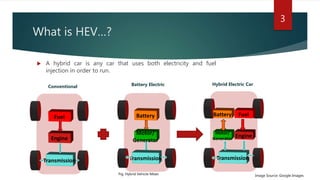
 A hybrid car is any car that uses both electricity and fuel
injection in order to run.
Motor/
Generator
Battery Fuel
Transmission
Engine
3
Image Source: Google Images
Fuel
Transmission
Engine
Battery
Transmission
Motor/
Generator
Battery ElectricConventional Hybrid Electric Car
Fig: Hybrid Vehicle Mean
History of HEV
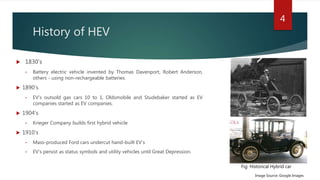
 1830’s
• Battery electric vehicle invented by Thomas Davenport, Robert Anderson,
others - using non-rechargeable batteries.
 1890’s
• EV’s outsold gas cars 10 to 1, Oldsmobile and Studebaker started as EV
companies started as EV companies.
 1904’s
• Krieger Company builds first hybrid vehicle
 1910’s
• Mass-produced Ford cars undercut hand-built EV’s
• EV’s persist as status symbols and utility vehicles until Great Depression.
4
Image Source: Google Images
Fig: Historical Hybrid car
Types of Hybridization
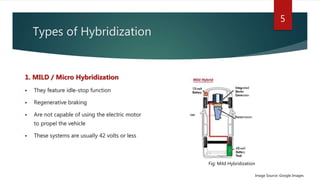
1. MILD / Micro Hybridization
 They feature idle-stop function
 Regenerative braking
 Are not capable of using the electric motor
to propel the vehicle
 These systems are usually 42 volts or less
5
Image Source: Google Images
Fig: Mild Hybridization
Types of Hybridization
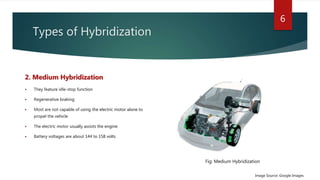
2. Medium Hybridization
 They feature idle-stop function
 Regenerative braking
 Most are not capable of using the electric motor alone to
propel the vehicle
 The electric motor usually assists the engine
 Battery voltages are about 144 to 158 volts
6
Image Source: Google Images
Fig: Medium Hybridization
Types of Hybridization
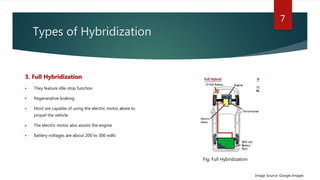
3. Full Hybridization
 They feature idle-stop function
 Regenerative braking
 Most are capable of using the electric motor alone to
propel the vehicle
 The electric motor also assists the engine
 Battery voltages are about 200 to 300 volts
7
Image Source: Google Images
Fig: Full Hybridization
Types of Hybrid
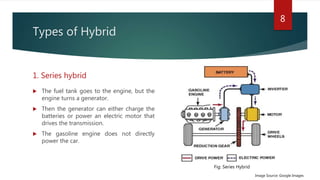
1. Series hybrid
 The fuel tank goes to the engine, but the
engine turns a generator.
 Then the generator can either charge the
batteries or power an electric motor that
drives the transmission.
 The gasoline engine does not directly
power the car.
8
Image Source: Google Images
Fig: Series Hybrid
Types of HEV
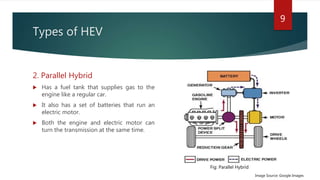
2. Parallel Hybrid
 Has a fuel tank that supplies gas to the
engine like a regular car.
 It also has a set of batteries that run an
electric motor.
 Both the engine and electric motor can
turn the transmission at the same time.
9
Image Source: Google Images
Fig: Parallel Hybrid
Types of HEV
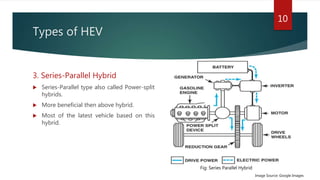
3. Series-Parallel Hybrid
 Series-Parallel type also called Power-split
hybrids.
 More beneficial then above hybrid.
 Most of the latest vehicle based on this
hybrid.
10
Image Source: Google Images
Fig: Series Parallel Hybrid
Parts of HEV vehicle
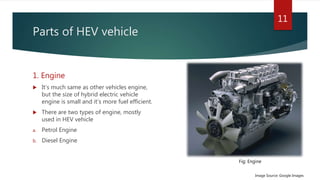
1. Engine
 It’s much same as other vehicles engine,
but the size of hybrid electric vehicle
engine is small and it’s more fuel efficient.
 There are two types of engine, mostly
used in HEV vehicle
a. Petrol Engine
b. Diesel Engine
11
Image Source: Google Images
Fig: Engine
Parts of HEV vehicle
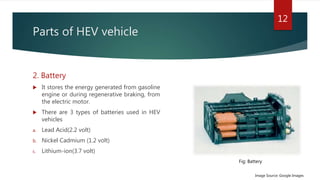
2. Battery
 It stores the energy generated from gasoline
engine or during regenerative braking, from
the electric motor.
 There are 3 types of batteries used in HEV
vehicles
a. Lead Acid(2.2 volt)
b. Nickel Cadmium (1.2 volt)
c. Lithium-ion(3.7 volt)
12
Image Source: Google Images
Fig: Battery
Parts of HEV vehicle
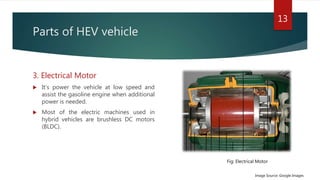
3. Electrical Motor
 It’s power the vehicle at low speed and
assist the gasoline engine when additional
power is needed.
 Most of the electric machines used in
hybrid vehicles are brushless DC motors
(BLDC).
13
Image Source: Google Images
Fig: Electrical Motor
Parts of HEV vehicle
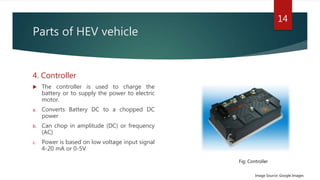
4. Controller
 The controller is used to charge the
battery or to supply the power to electric
motor.
a. Converts Battery DC to a chopped DC
power
b. Can chop in amplitude (DC) or frequency
(AC)
c. Power is based on low voltage input signal
4-20 mA or 0-5V
14
Image Source: Google Images
Fig: Controller
Parts of HEV vehicle
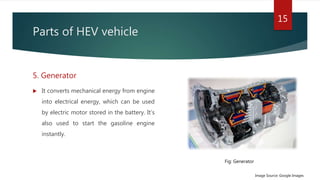
5. Generator
 It converts mechanical energy from engine
into electrical energy, which can be used
by electric motor stored in the battery. It’s
also used to start the gasoline engine
instantly.
15
Image Source: Google Images
Fig: Generator
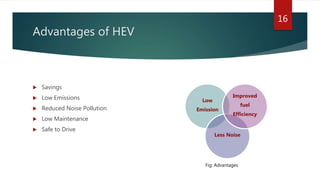
Advantages of HEV
 Savings
 Low Emissions
 Reduced Noise Pollution
 Low Maintenance
 Safe to Drive
Low
Emission
Less Noise
Improved
fuel
Efficiency
16
Fig: Advantages
Disadvantages of HEV
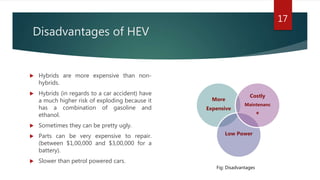
 Hybrids are more expensive than non-
hybrids.
 Hybrids (in regards to a car accident) have
a much higher risk of exploding because it
has a combination of gasoline and
ethanol.
 Sometimes they can be pretty ugly.
 Parts can be very expensive to repair.
(between $1,00,000 and $3,00,000 for a
battery).
 Slower than petrol powered cars.
More
Expensive
Low Power
Costly
Maintenanc
e
17
Fig: Disadvantages
Future Scope
 All the Major Automobile manufactures are working on Hybrid Electrical Vehicle.
 Heavy vehicle like trucks will be use hybrid system in future.
 Efficiency of hybrid electric vehicle will further increase in future.
 Safety features will be add in new generation hybrid car or other vehicle.
 Power of car have to increase in future.
 Price of vehicle will reduce due to increase in production rate of hybrid electric
vehicles.
18
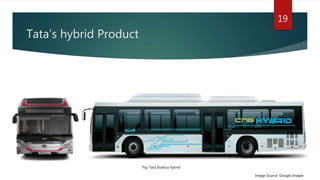
Tata’s hybrid Product
19
Image Source: Google Images
Fig: Tata Starbus hybrid
Thank you
Go! Buy a hybrid…
Any Questions…?
20

Hybrid electric vehicle Seminar Presentation

  • 1.
    Hybrid Electric Vehicle THEWORLD OF ELECTRICAL TRANSPORT VYAS INSTUTUTE OF ENGINEERING AND TECHNOLOGY, JODHPUR Seminar Presentation Submitted By: Lakshminarayan 13eveee026 Submitted To: Prof. Asad Zai
  • 2.
    Contents  What isHEV....?  History  Types of Hybridization  Types of HEV  Parts of HVE vehicle  Advantages of HEV  Disadvantage of HEV  Future Scope 2 Image Source: Google Images
  • 3.
    What is HEV…? A hybrid car is any car that uses both electricity and fuel injection in order to run. Motor/ Generator Battery Fuel Transmission Engine 3 Image Source: Google Images Fuel Transmission Engine Battery Transmission Motor/ Generator Battery ElectricConventional Hybrid Electric Car Fig: Hybrid Vehicle Mean
  • 4.
    History of HEV 1830’s • Battery electric vehicle invented by Thomas Davenport, Robert Anderson, others - using non-rechargeable batteries.  1890’s • EV’s outsold gas cars 10 to 1, Oldsmobile and Studebaker started as EV companies started as EV companies.  1904’s • Krieger Company builds first hybrid vehicle  1910’s • Mass-produced Ford cars undercut hand-built EV’s • EV’s persist as status symbols and utility vehicles until Great Depression. 4 Image Source: Google Images Fig: Historical Hybrid car
  • 5.
    Types of Hybridization 1.MILD / Micro Hybridization  They feature idle-stop function  Regenerative braking  Are not capable of using the electric motor to propel the vehicle  These systems are usually 42 volts or less 5 Image Source: Google Images Fig: Mild Hybridization
  • 6.
    Types of Hybridization 2.Medium Hybridization  They feature idle-stop function  Regenerative braking  Most are not capable of using the electric motor alone to propel the vehicle  The electric motor usually assists the engine  Battery voltages are about 144 to 158 volts 6 Image Source: Google Images Fig: Medium Hybridization
  • 7.
    Types of Hybridization 3.Full Hybridization  They feature idle-stop function  Regenerative braking  Most are capable of using the electric motor alone to propel the vehicle  The electric motor also assists the engine  Battery voltages are about 200 to 300 volts 7 Image Source: Google Images Fig: Full Hybridization
  • 8.
    Types of Hybrid 1.Series hybrid  The fuel tank goes to the engine, but the engine turns a generator.  Then the generator can either charge the batteries or power an electric motor that drives the transmission.  The gasoline engine does not directly power the car. 8 Image Source: Google Images Fig: Series Hybrid
  • 9.
    Types of HEV 2.Parallel Hybrid  Has a fuel tank that supplies gas to the engine like a regular car.  It also has a set of batteries that run an electric motor.  Both the engine and electric motor can turn the transmission at the same time. 9 Image Source: Google Images Fig: Parallel Hybrid
  • 10.
    Types of HEV 3.Series-Parallel Hybrid  Series-Parallel type also called Power-split hybrids.  More beneficial then above hybrid.  Most of the latest vehicle based on this hybrid. 10 Image Source: Google Images Fig: Series Parallel Hybrid
  • 11.
    Parts of HEVvehicle 1. Engine  It’s much same as other vehicles engine, but the size of hybrid electric vehicle engine is small and it’s more fuel efficient.  There are two types of engine, mostly used in HEV vehicle a. Petrol Engine b. Diesel Engine 11 Image Source: Google Images Fig: Engine
  • 12.
    Parts of HEVvehicle 2. Battery  It stores the energy generated from gasoline engine or during regenerative braking, from the electric motor.  There are 3 types of batteries used in HEV vehicles a. Lead Acid(2.2 volt) b. Nickel Cadmium (1.2 volt) c. Lithium-ion(3.7 volt) 12 Image Source: Google Images Fig: Battery
  • 13.
    Parts of HEVvehicle 3. Electrical Motor  It’s power the vehicle at low speed and assist the gasoline engine when additional power is needed.  Most of the electric machines used in hybrid vehicles are brushless DC motors (BLDC). 13 Image Source: Google Images Fig: Electrical Motor
  • 14.
    Parts of HEVvehicle 4. Controller  The controller is used to charge the battery or to supply the power to electric motor. a. Converts Battery DC to a chopped DC power b. Can chop in amplitude (DC) or frequency (AC) c. Power is based on low voltage input signal 4-20 mA or 0-5V 14 Image Source: Google Images Fig: Controller
  • 15.
    Parts of HEVvehicle 5. Generator  It converts mechanical energy from engine into electrical energy, which can be used by electric motor stored in the battery. It’s also used to start the gasoline engine instantly. 15 Image Source: Google Images Fig: Generator
  • 16.
    Advantages of HEV Savings  Low Emissions  Reduced Noise Pollution  Low Maintenance  Safe to Drive Low Emission Less Noise Improved fuel Efficiency 16 Fig: Advantages
  • 17.
    Disadvantages of HEV Hybrids are more expensive than non- hybrids.  Hybrids (in regards to a car accident) have a much higher risk of exploding because it has a combination of gasoline and ethanol.  Sometimes they can be pretty ugly.  Parts can be very expensive to repair. (between $1,00,000 and $3,00,000 for a battery).  Slower than petrol powered cars. More Expensive Low Power Costly Maintenanc e 17 Fig: Disadvantages
  • 18.
    Future Scope  Allthe Major Automobile manufactures are working on Hybrid Electrical Vehicle.  Heavy vehicle like trucks will be use hybrid system in future.  Efficiency of hybrid electric vehicle will further increase in future.  Safety features will be add in new generation hybrid car or other vehicle.  Power of car have to increase in future.  Price of vehicle will reduce due to increase in production rate of hybrid electric vehicles. 18
  • 19.
    Tata’s hybrid Product 19 ImageSource: Google Images Fig: Tata Starbus hybrid
  • 20.
    Thank you Go! Buya hybrid… Any Questions…? 20