FLOPPY DISK & DRIVE
ITS CONSTRUCTION & WORKING
- M.K.DEVAKI
What is a floppy disk ?
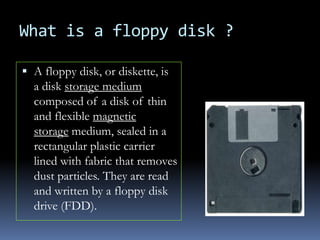
 A floppy disk, or diskette, is
a disk storage medium
composed of a disk of thin
and flexible magnetic
storage medium, sealed in a
rectangular plastic carrier
lined with fabric that removes
dust particles. They are read
and written by a floppy disk
drive (FDD).
Usage of Floppy Disk :
 Floppy disks are used for emergency boots in systems
lacking support for other bootable media, and
for BIOS can still be executed from bootable floppy
disks. If BIOS updates fail or become corrupt, floppy
drives can sometimes be used to perform a recovery.
 The floppy disk was the primary external writable
storage device used.
Types of Floppy Disk :
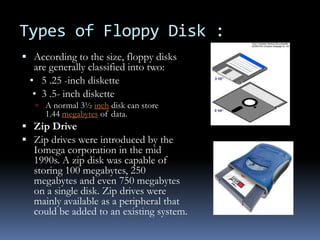
 According to the size, floppy disks
are generally classified into two:
• 5 .25 -inch diskette
• 3 .5- inch diskette
 A normal 3½ inch disk can store
1.44 megabytes of data.
 Zip Drive
 Zip drives were introduced by the
Iomega corporation in the mid
1990s. A zip disk was capable of
storing 100 megabytes, 250
megabytes and even 750 megabytes
on a single disk. Zip drives were
mainly available as a peripheral that
could be added to an existing system.
Types of Floppy disk cont.
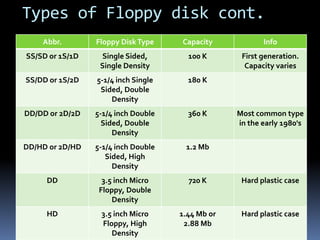
Abbr. Floppy DiskType Capacity Info
SS/SD or 1S/1D Single Sided,
Single Density
100 K First generation.
Capacity varies
SS/DD or 1S/2D 5-1/4 inch Single
Sided, Double
Density
180 K
DD/DD or 2D/2D 5-1/4 inch Double
Sided, Double
Density
360 K Most common type
in the early 1980's
DD/HD or 2D/HD 5-1/4 inch Double
Sided, High
Density
1.2 Mb
DD 3.5 inch Micro
Floppy, Double
Density
720 K Hard plastic case
HD 3.5 inch Micro
Floppy, High
Density
1.44 Mb or
2.88 Mb
Hard plastic case
Floppy Disk Makers in 1980
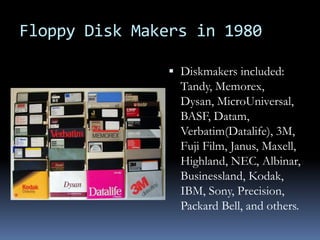
 Diskmakers included:
Tandy, Memorex,
Dysan, MicroUniversal,
BASF, Datam,
Verbatim(Datalife), 3M,
Fuji Film, Janus, Maxell,
Highland, NEC, Albinar,
Businessland, Kodak,
IBM, Sony, Precision,
Packard Bell, and others.
Floppy Disk :
Floppy disk Construction
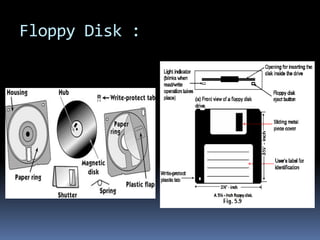
 A floppy is made up of a circular thin Mylar plastic material
coated with magnetic particles sealed into 90x94 mm plastic
case. Every magnetic particles holds one data bit.
 The Shutter with spring is present to avoid dust particles from
being depostied.
 Inserting inside the drive, the shutter opens allows magnetic
media expose to Read / Write head.
 Hub is a hole through which floppy disk is rotated by spindle
or stepper motor.
 Paper ring Clean the disk by removing microscopic bits of
dust.
Floppy drive construction :
 Made of ferrite type to make them electromagnetic.
 Head contacts much closer compared to HDD due to
low rpm [300 rpm]
 3.5 Floppy disk has only 80 tracks per side so the
actuator doesn’t need to be much precise as HDD.
 Unlike HDD, FDD has 3 heads :
 One is Read/Write head
 And other two is tunnel –erase head to clean up after r/w head
as there is a magnetization that overlaps two adjacent tracks
while writing.
Working of Floppy disk drive :
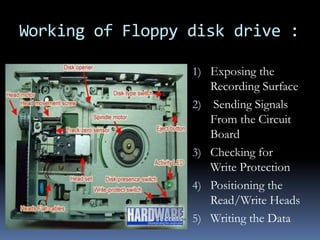
1) Exposing the
Recording Surface
2) Sending Signals
From the Circuit
Board
3) Checking for
Write Protection
4) Positioning the
Read/Write Heads
5) Writing the Data
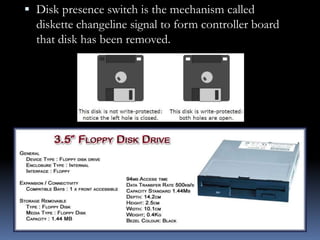
 Disk presence switch is the mechanism called
diskette changeline signal to form controller board
that disk has been removed.
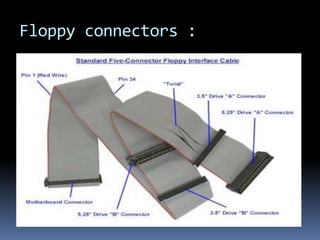
Floppy connectors :

Floppy disk & drive

  • 1.
    FLOPPY DISK &DRIVE ITS CONSTRUCTION & WORKING - M.K.DEVAKI
  • 2.
    What is afloppy disk ?  A floppy disk, or diskette, is a disk storage medium composed of a disk of thin and flexible magnetic storage medium, sealed in a rectangular plastic carrier lined with fabric that removes dust particles. They are read and written by a floppy disk drive (FDD).
  • 3.
    Usage of FloppyDisk :  Floppy disks are used for emergency boots in systems lacking support for other bootable media, and for BIOS can still be executed from bootable floppy disks. If BIOS updates fail or become corrupt, floppy drives can sometimes be used to perform a recovery.  The floppy disk was the primary external writable storage device used.
  • 4.
    Types of FloppyDisk :  According to the size, floppy disks are generally classified into two: • 5 .25 -inch diskette • 3 .5- inch diskette  A normal 3½ inch disk can store 1.44 megabytes of data.  Zip Drive  Zip drives were introduced by the Iomega corporation in the mid 1990s. A zip disk was capable of storing 100 megabytes, 250 megabytes and even 750 megabytes on a single disk. Zip drives were mainly available as a peripheral that could be added to an existing system.
  • 5.
    Types of Floppydisk cont. Abbr. Floppy DiskType Capacity Info SS/SD or 1S/1D Single Sided, Single Density 100 K First generation. Capacity varies SS/DD or 1S/2D 5-1/4 inch Single Sided, Double Density 180 K DD/DD or 2D/2D 5-1/4 inch Double Sided, Double Density 360 K Most common type in the early 1980's DD/HD or 2D/HD 5-1/4 inch Double Sided, High Density 1.2 Mb DD 3.5 inch Micro Floppy, Double Density 720 K Hard plastic case HD 3.5 inch Micro Floppy, High Density 1.44 Mb or 2.88 Mb Hard plastic case
  • 6.
    Floppy Disk Makersin 1980  Diskmakers included: Tandy, Memorex, Dysan, MicroUniversal, BASF, Datam, Verbatim(Datalife), 3M, Fuji Film, Janus, Maxell, Highland, NEC, Albinar, Businessland, Kodak, IBM, Sony, Precision, Packard Bell, and others.
  • 7.
  • 8.
    Floppy disk Construction A floppy is made up of a circular thin Mylar plastic material coated with magnetic particles sealed into 90x94 mm plastic case. Every magnetic particles holds one data bit.  The Shutter with spring is present to avoid dust particles from being depostied.  Inserting inside the drive, the shutter opens allows magnetic media expose to Read / Write head.  Hub is a hole through which floppy disk is rotated by spindle or stepper motor.  Paper ring Clean the disk by removing microscopic bits of dust.
  • 10.
    Floppy drive construction:  Made of ferrite type to make them electromagnetic.  Head contacts much closer compared to HDD due to low rpm [300 rpm]  3.5 Floppy disk has only 80 tracks per side so the actuator doesn’t need to be much precise as HDD.  Unlike HDD, FDD has 3 heads :  One is Read/Write head  And other two is tunnel –erase head to clean up after r/w head as there is a magnetization that overlaps two adjacent tracks while writing.
  • 11.
    Working of Floppydisk drive : 1) Exposing the Recording Surface 2) Sending Signals From the Circuit Board 3) Checking for Write Protection 4) Positioning the Read/Write Heads 5) Writing the Data
  • 12.
     Disk presenceswitch is the mechanism called diskette changeline signal to form controller board that disk has been removed.
  • 13.