

DEMAND AND GAME THEORY
- Kishore Raveendran




Demand: "The demand for a commodity at a given
price is the amount of it which will be bought per
unit of time at that price”.
Law of Demand: “The demand for a commodity
increases with a fall in its price and decreases with
a rise in its price, other things remaining the same”.
The Law of demand thus merely states that the
price and demand of a commodity are inversely
related, provided all other things remain unchanged
or as economists put it ceteris paribus.
ASSUMPTIONS







Income level should remain constant,
Tastes of the buyer should not change,
Prices of other goods should remain constant,
No new substitutes for the commodity,
Price rise in future should not be expected and
Advertising expenditure.
Why Demand Curve Slopes
Downwards






The reasons behind the law of
demand, i.e., inverse relationship between price
and quantity demanded are following:
Substitution effect,
Income effect,
Diminishing marginal utility.
Market Demand


The total quantity which all the consumers of a
commodity are willing to buy at a given price
per time unit, other things remaining the
same, is known as market demand for the
commodity. In other words, the market demand
for a commodity is the sum of individual
demands by all the consumers (or buyers) of the
commodity, per time unit and at a given
price, other factors remaining the same
Individual Demand


The individual demand means the quantity of
a product that an individual can buy given its
price. It implies that the individual has the
ability and willingness to pay.
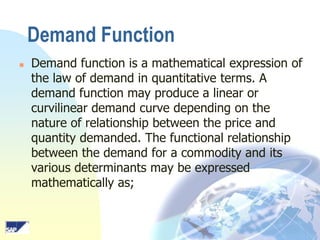
Demand Function


Demand function is a mathematical expression of
the law of demand in quantitative terms. A
demand function may produce a linear or
curvilinear demand curve depending on the
nature of relationship between the price and
quantity demanded. The functional relationship
between the demand for a commodity and its
various determinants may be expressed
mathematically as;
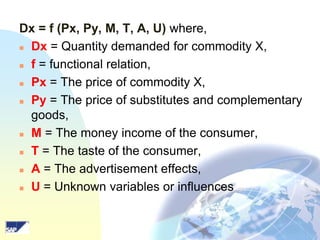
Dx = f (Px, Py, M, T, A, U) where,
 Dx = Quantity demanded for commodity X,
 f = functional relation,
 Px = The price of commodity X,
 Py = The price of substitutes and complementary
goods,
 M = The money income of the consumer,
 T = The taste of the consumer,
 A = The advertisement effects,
 U = Unknown variables or influences
Elasticity of Demand










The concept of elasticity of demand can be
defined as the degree of responsiveness of
demand to given change in price of the
commodity.
Methods of Measurement of Elasticity of Demand
By using three different methods, elasticity of demand is
measured.
Ratio Method
Expenditure Method
Point Method
Demand Forecasting


According to Cardiff and Still, “Demand
forecasting is an estimate of sales during a
specified future period based on a proposed
marketing plan and a set of particular
uncontrollable and competitive forces’’.
Objectives of Demand
Forecast







Formulation of production policy
Price policy formulation
Proper control of sales Arrangement of finance
To decide about the production capacity
Labour requirements
Production planning
GAME THEORY


Game theory is a branch of applied
mathematics that is used in the social
sciences, most notably in economics, as well as in
biology (particularly evolutionary biology and
ecology), engineering, political
science, international relations, computer science
and philosophy. It attempts to capture behaviour
mathematically in strategic situations or games in
which an individual's success in making choices
depends on the choices of others.

Demand and Game Theory

  • 1.
    DEMAND AND GAMETHEORY - Kishore Raveendran
  • 2.
      Demand: "The demandfor a commodity at a given price is the amount of it which will be bought per unit of time at that price”. Law of Demand: “The demand for a commodity increases with a fall in its price and decreases with a rise in its price, other things remaining the same”. The Law of demand thus merely states that the price and demand of a commodity are inversely related, provided all other things remain unchanged or as economists put it ceteris paribus.
  • 3.
    ASSUMPTIONS       Income level shouldremain constant, Tastes of the buyer should not change, Prices of other goods should remain constant, No new substitutes for the commodity, Price rise in future should not be expected and Advertising expenditure.
  • 4.
    Why Demand CurveSlopes Downwards     The reasons behind the law of demand, i.e., inverse relationship between price and quantity demanded are following: Substitution effect, Income effect, Diminishing marginal utility.
  • 5.
    Market Demand  The totalquantity which all the consumers of a commodity are willing to buy at a given price per time unit, other things remaining the same, is known as market demand for the commodity. In other words, the market demand for a commodity is the sum of individual demands by all the consumers (or buyers) of the commodity, per time unit and at a given price, other factors remaining the same
  • 6.
    Individual Demand  The individualdemand means the quantity of a product that an individual can buy given its price. It implies that the individual has the ability and willingness to pay.
  • 7.
    Demand Function  Demand functionis a mathematical expression of the law of demand in quantitative terms. A demand function may produce a linear or curvilinear demand curve depending on the nature of relationship between the price and quantity demanded. The functional relationship between the demand for a commodity and its various determinants may be expressed mathematically as;
  • 8.
    Dx = f(Px, Py, M, T, A, U) where,  Dx = Quantity demanded for commodity X,  f = functional relation,  Px = The price of commodity X,  Py = The price of substitutes and complementary goods,  M = The money income of the consumer,  T = The taste of the consumer,  A = The advertisement effects,  U = Unknown variables or influences
  • 9.
    Elasticity of Demand       Theconcept of elasticity of demand can be defined as the degree of responsiveness of demand to given change in price of the commodity. Methods of Measurement of Elasticity of Demand By using three different methods, elasticity of demand is measured. Ratio Method Expenditure Method Point Method
  • 10.
    Demand Forecasting  According toCardiff and Still, “Demand forecasting is an estimate of sales during a specified future period based on a proposed marketing plan and a set of particular uncontrollable and competitive forces’’.
  • 11.
    Objectives of Demand Forecast       Formulationof production policy Price policy formulation Proper control of sales Arrangement of finance To decide about the production capacity Labour requirements Production planning
  • 12.
    GAME THEORY  Game theoryis a branch of applied mathematics that is used in the social sciences, most notably in economics, as well as in biology (particularly evolutionary biology and ecology), engineering, political science, international relations, computer science and philosophy. It attempts to capture behaviour mathematically in strategic situations or games in which an individual's success in making choices depends on the choices of others.