A mini project
on
Linear Feedback Shift
Register
By
Arpith (09B81A0410)
Himaja (09B81A0429)
Kishore (09B81A0432
SHIFT REGISTER
• Shift register consists of an arrangement of flip-flops and are
important in applications involving the storage and transfer
data in a digital system, it is a type of sequential logic circuit,
mainly for storage of digital data.
• They are a group of flip-flops connected in a chain so that the
output from one flip-flop becomes the input of the next flip-
flop.
CONTENTS
• WHAT IS LFSR?
• SHIFT REGISTER
• 8 BIT LINEAR FEEDBACK SHIFT REGISTER (LFSR)
• Circuit of 8-bit LFSR
• Working of 8-bit LFSR
• TIMING DIAGRAMS
• APPLICATIONS
• IMPLEMENTATION AS CYCLIC REDUNDANCY CHECK
• DATA TRANSMISSON
• CRC ENCODING (USING LFSR)
• CRC DECODING (USING LFSR)
• TIMING DIAGRAMS
• Conclusion
WHAT IS LFSR?
Linear Feedback Shift Register (LFSR) is popularly known as
Pseudo-random number generator. The random numbers repeat itself
after 2^n-1 clock cycles (where n is the number of bits in LFSR). A
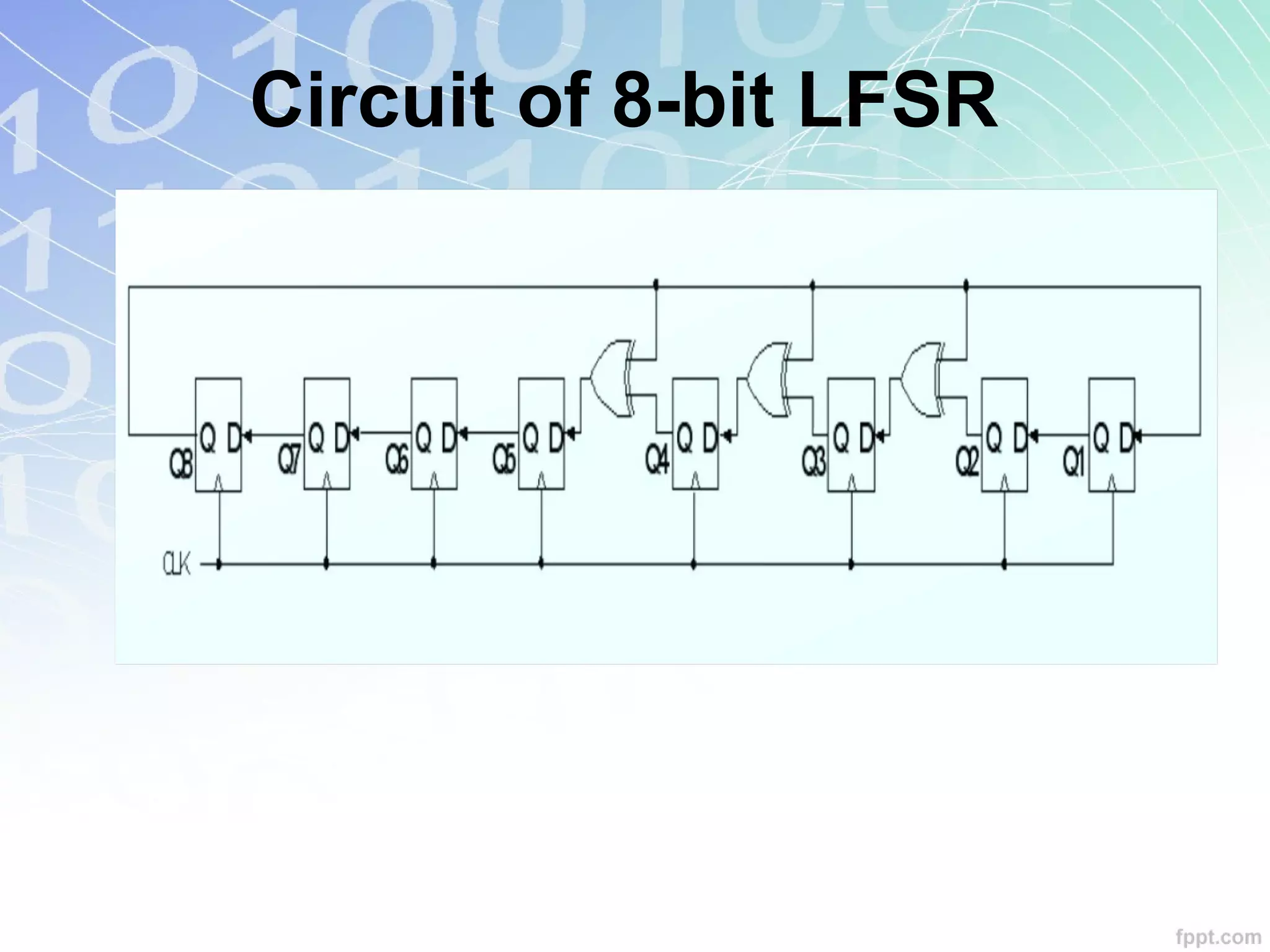
standard polynomial function: X^8+X^7+X^6+X^4+X^2+1 is used
to generate random numbers. 8 bit Linear Feedback shift register uses
8 D-Flip-flops and xor gates. Each D-Flip-flop uses Asynchronous
reset which is independent of clock. LSFR also uses Asynchronous
reset.
8 BIT LINEAR FEEDBACK
SHIFT REGISTER (LFSR)
• A linear  feedback  shift  register (LFSR)  is  a shift 
register whose  input  bit  is  a  linear function  of  its  previous 
state. 
•   The  most  commonly  used linear function  of  single  bits  is 
XOR.
•  The initial value of the LFSR is called the seed, and because 
the  operation  of  the  register  is  deterministic,  the  stream  of 
values produced by the register is completely determined by 
its current (or previous) state. 
Circuit of 8-bit LFSR
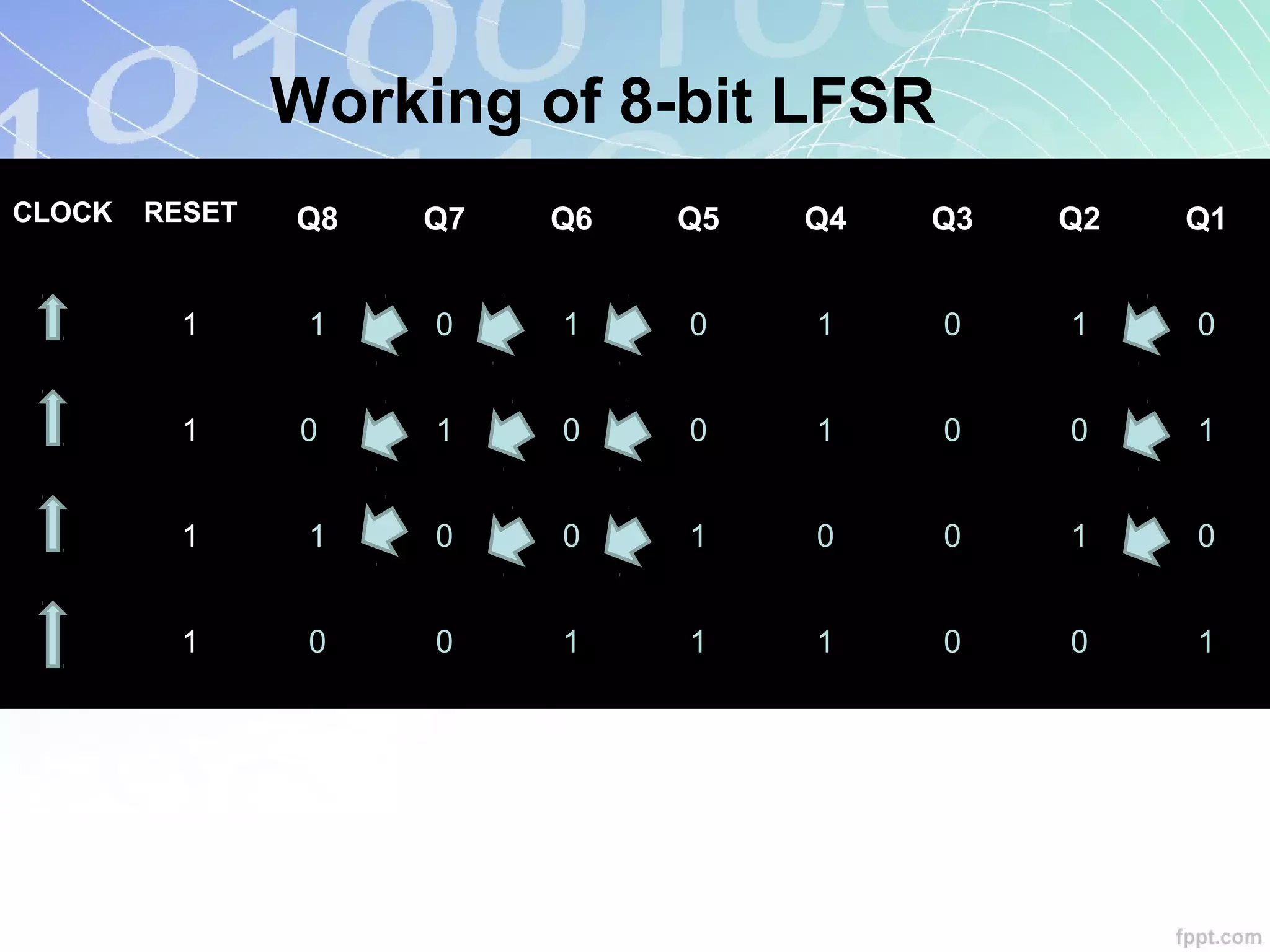
CLOCK RESET Q8 Q7 Q6 Q5 Q4 Q3 Q2 Q1
1 1 0 1 0 1 0 1 0
1 00 1 0 0 1 0 0 1
1 1 0 0 1 0 0 1 0
1 0 0 1 1 1 0 0 1
Working of 8-bit LFSR
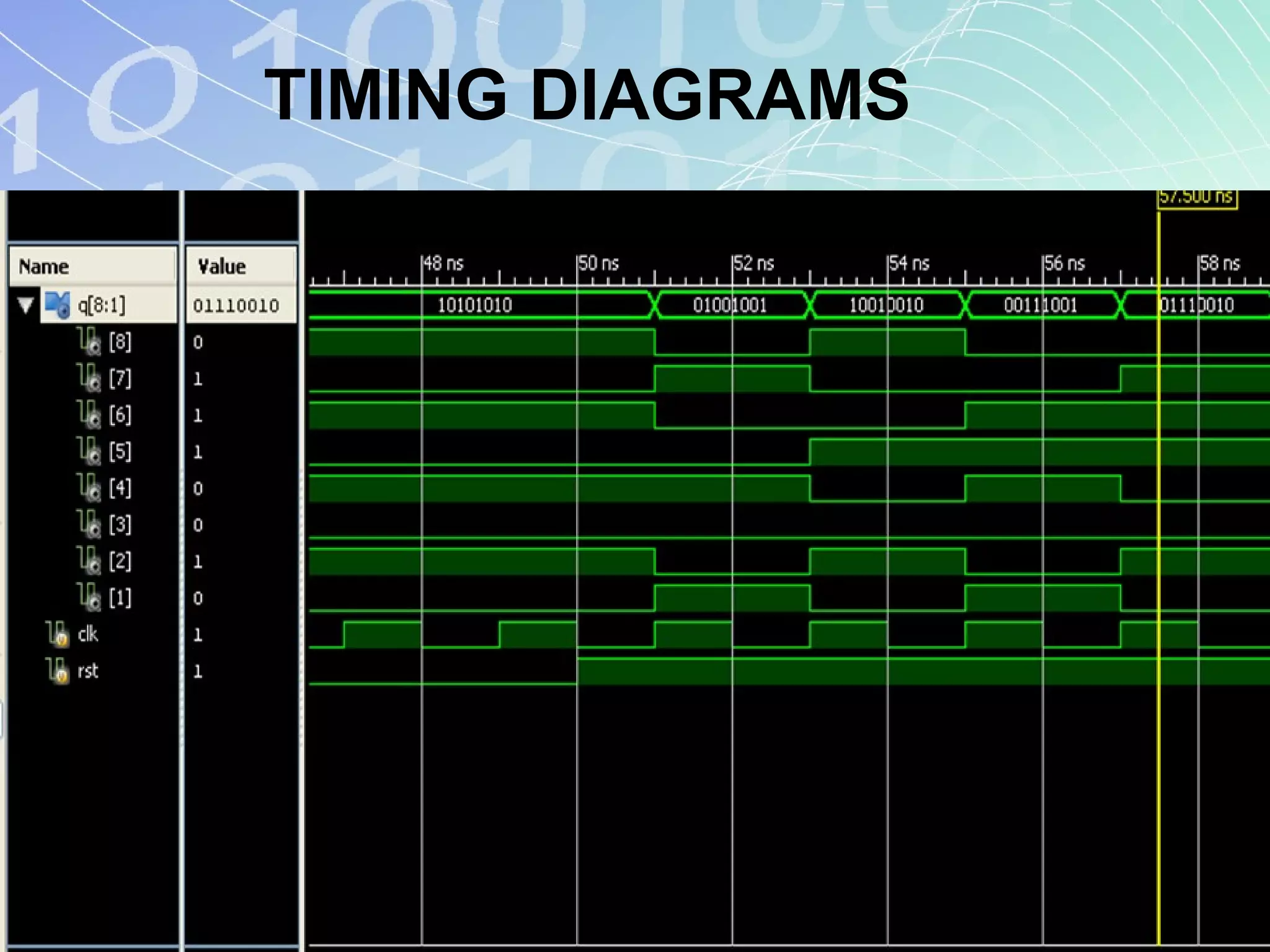
TIMING DIAGRAMS
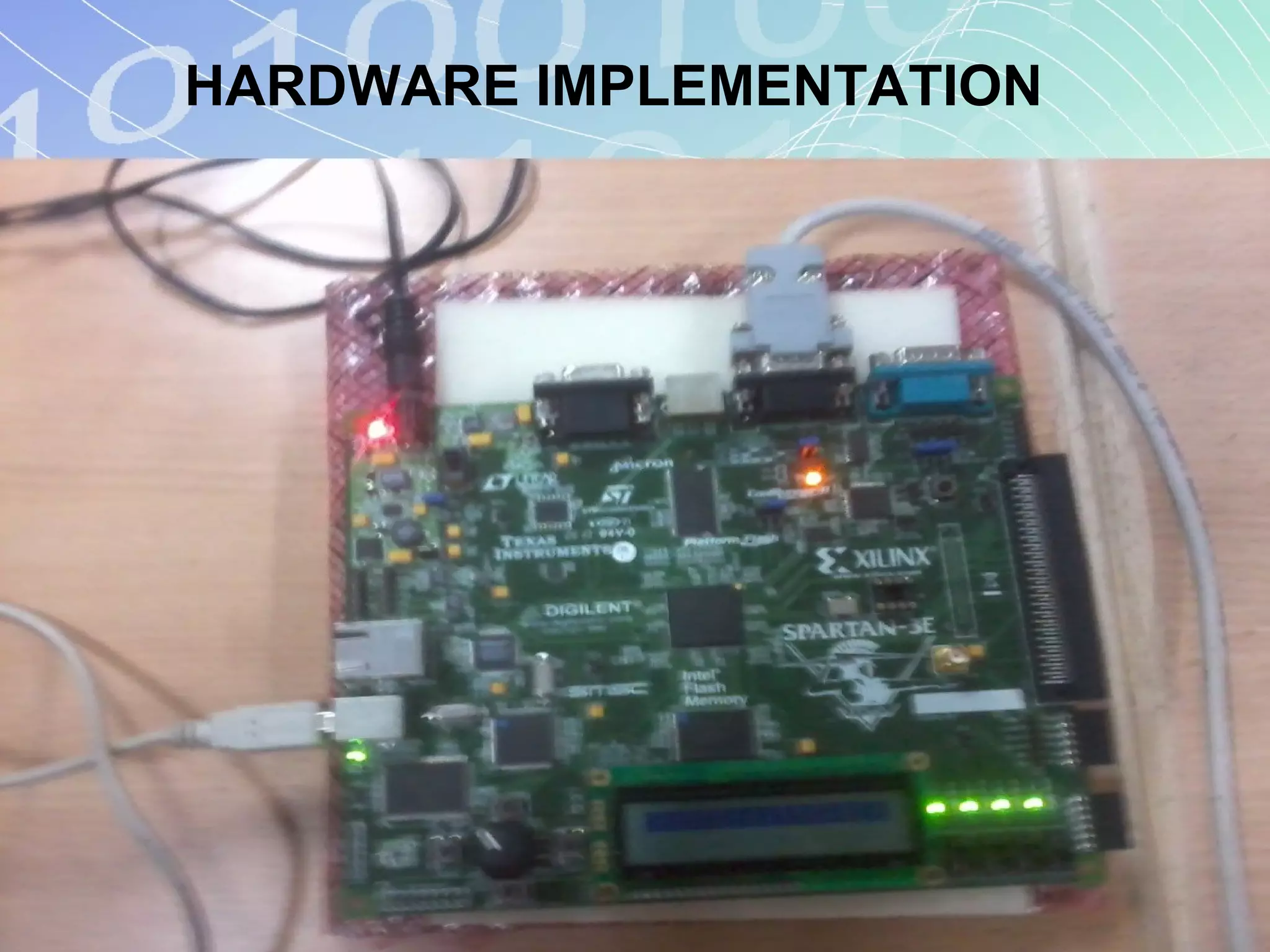
HARDWARE IMPLEMENTATION
APPLICATIONS
• Random number generators
• Error detection and correction
• Jamming
• Warfare
IMPLEMENTATION AS
CYCLIC REDUNDANCY CHECK
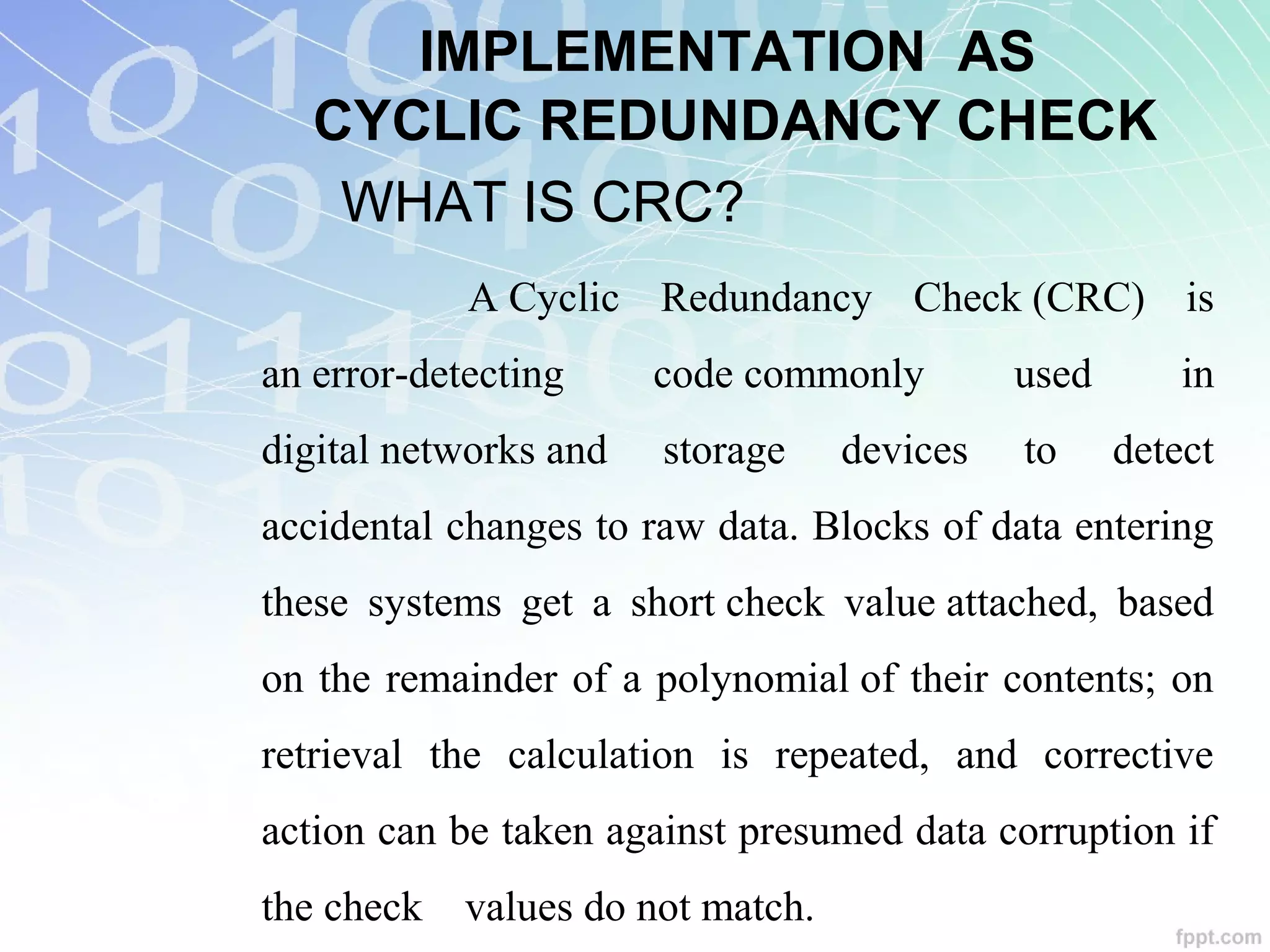
WHAT IS CRC?
A Cyclic Redundancy Check (CRC) is
an error-detecting code commonly used in
digital networks and storage devices to detect
accidental changes to raw data. Blocks of data entering
these systems get a short check value attached, based
on the remainder of a polynomial of their contents; on
retrieval the calculation is repeated, and corrective
action can be taken against presumed data corruption if
the check values do not match.
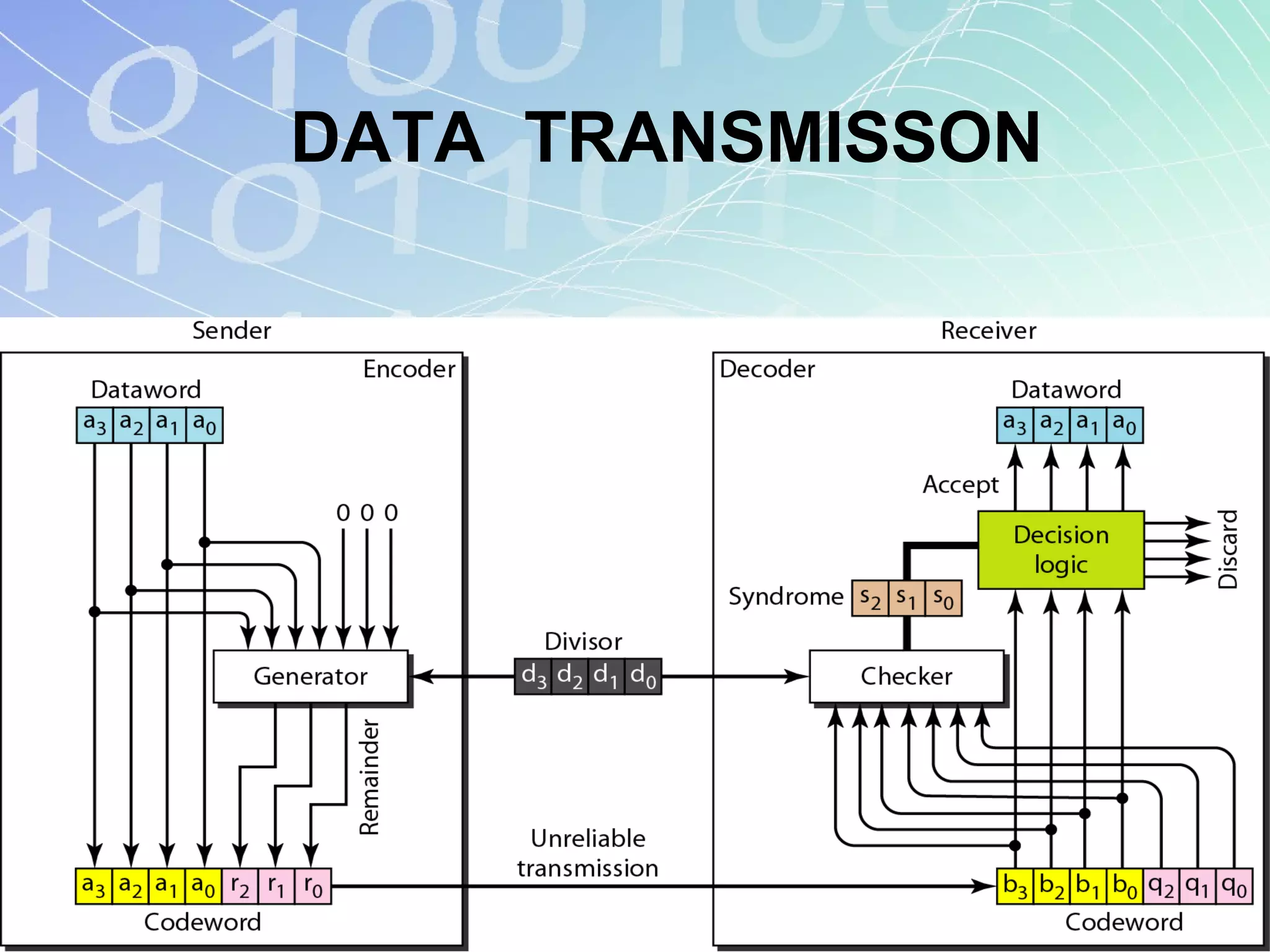
DATA TRANSMISSON
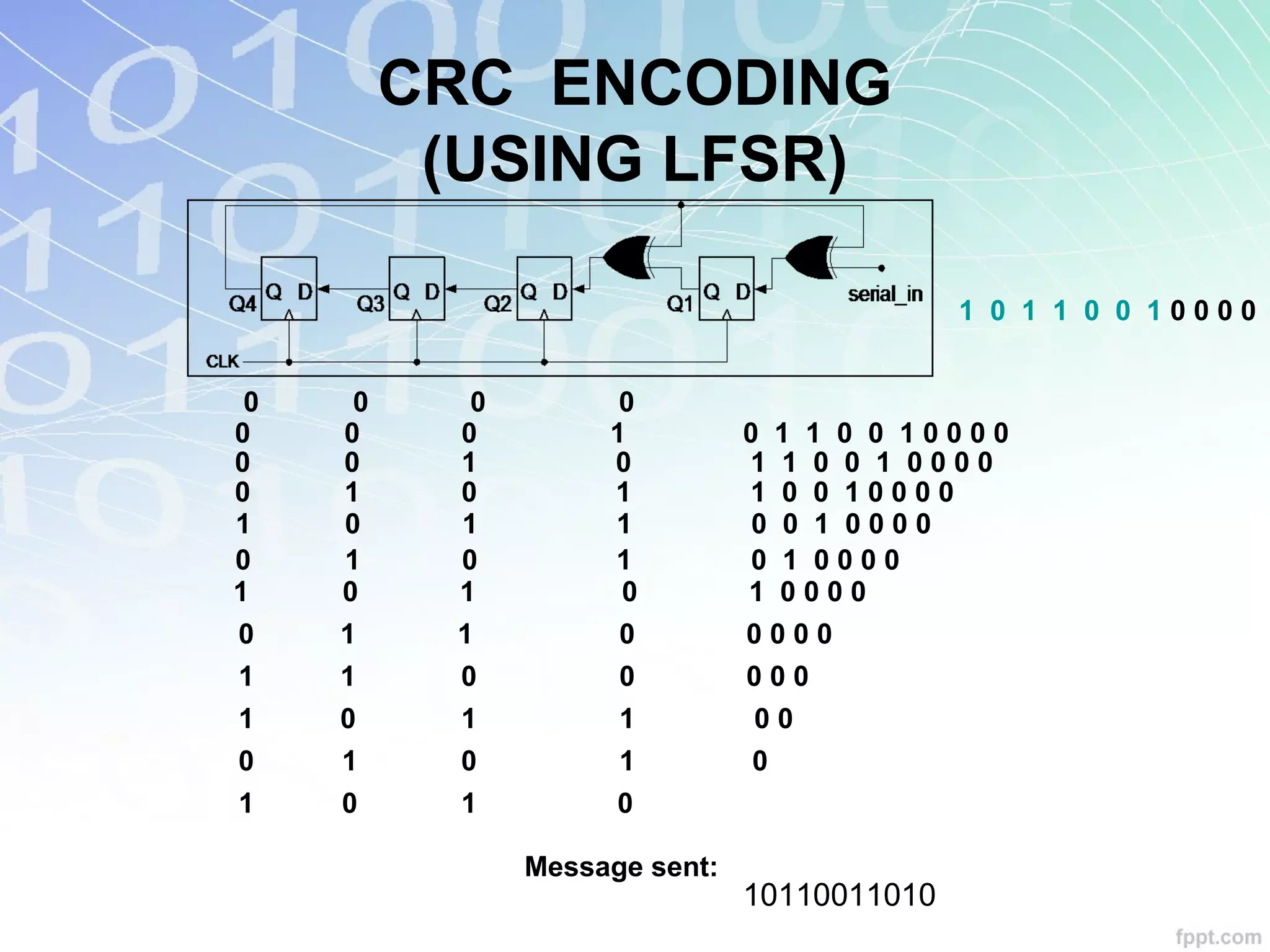
CRC ENCODING
(USING LFSR)
1 0 1 1 0 0 1 0 0 0 0
0 0 0 0
0 0 0 1 0 1 1 0 0 1 0 0 0 0
0 0 1 0 1 1 0 0 1 0 0 0 0
0 1 0 1 1 0 0 1 0 0 0 0
1 0 1 1 0 0 1 0 0 0 0
0 1 0 1 0 1 0 0 0 0
1 0 1 0 1 0 0 0 0
0 1 1 0 0 0 0 0
Message sent:
1 1 0 0 0 0 0
1 0 1 1 0 0
0 1 0 1 0
1 0 1 0
10110011010
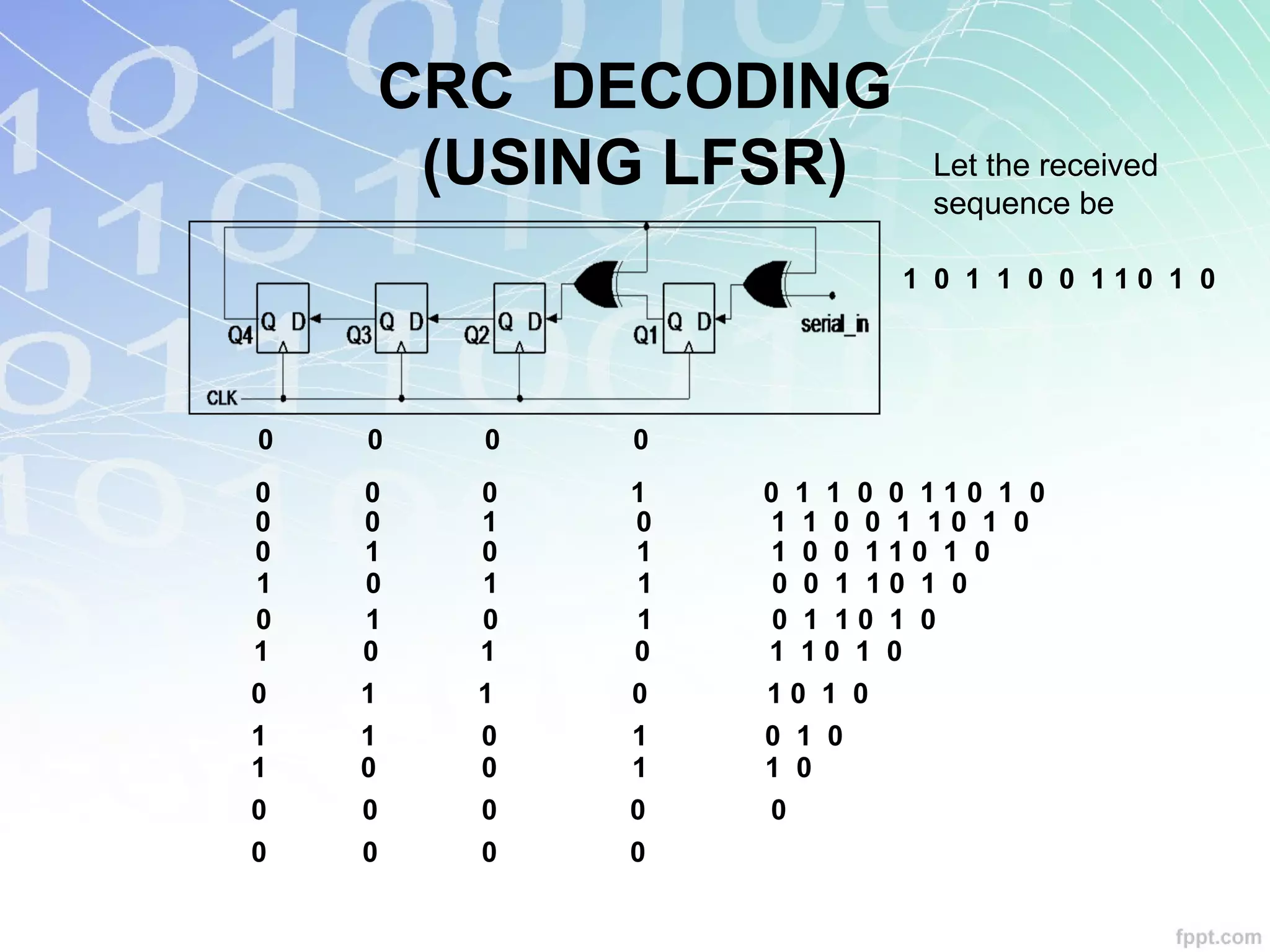
CRC DECODING
(USING LFSR)
1 0 1 1 0 0 1 1 0 1 0
0 0 0 0
0 0 0 1 0 1 1 0 0 1 1 0 1 0
0 0 1 0 1 1 0 0 1 1 0 1 0
0 1 0 1 1 0 0 1 1 0 1 0
1 0 1 1 0 0 1 1 0 1 0
0 1 0 1 0 1 1 0 1 0
1 0 1 0 1 1 0 1 0
0 1 1 0 1 0 1 0
1 1 0 1 0 1 0
1 0 0 1 1 0
0 0 0 0 0
0 0 0 0
Let the received
sequence be
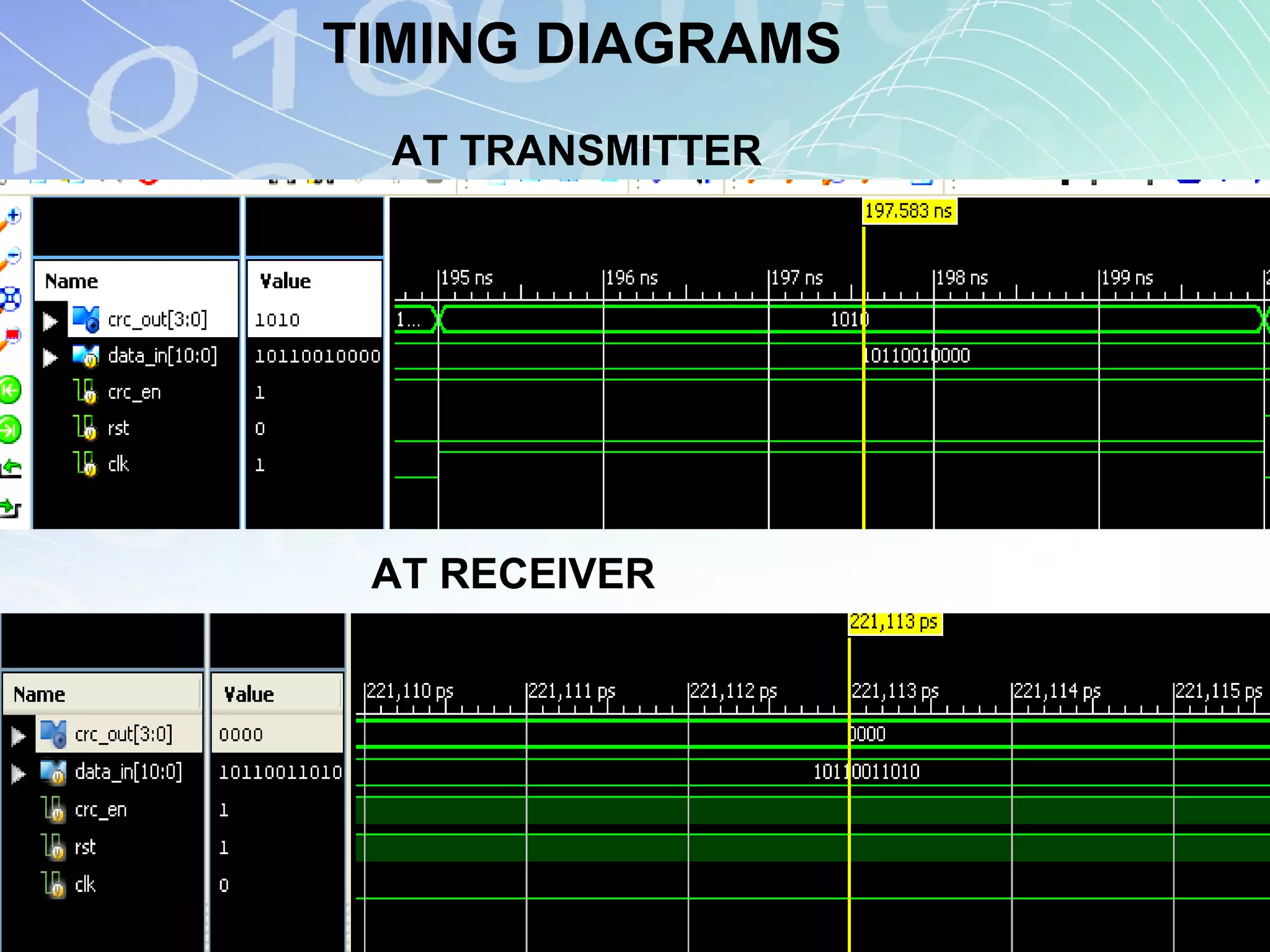
TIMING DIAGRAMS
AT TRANSMITTER
AT RECEIVER
Conclusion
• LFSR’s are n-bit counters exhibiting pseudo-random
behaviour. These are built from a small number of xor
gates and hence require very less hardware.
• This can be used as a fast counter, if the particular
sequence of count values is not important.
• A traditional application for LFSRs is in cyclic
redundancy check (CRC)calculations, which can be
used to detect errors in data communications. The
stream of data bits being transmitted is used to modify
the values fed back into an LFSR .

LFSR

  • 1.
    A mini project on LinearFeedback Shift Register By Arpith (09B81A0410) Himaja (09B81A0429) Kishore (09B81A0432
  • 2.
    SHIFT REGISTER • Shiftregister consists of an arrangement of flip-flops and are important in applications involving the storage and transfer data in a digital system, it is a type of sequential logic circuit, mainly for storage of digital data. • They are a group of flip-flops connected in a chain so that the output from one flip-flop becomes the input of the next flip- flop.
  • 3.
    CONTENTS • WHAT ISLFSR? • SHIFT REGISTER • 8 BIT LINEAR FEEDBACK SHIFT REGISTER (LFSR) • Circuit of 8-bit LFSR • Working of 8-bit LFSR • TIMING DIAGRAMS • APPLICATIONS • IMPLEMENTATION AS CYCLIC REDUNDANCY CHECK • DATA TRANSMISSON • CRC ENCODING (USING LFSR) • CRC DECODING (USING LFSR) • TIMING DIAGRAMS • Conclusion
  • 4.
    WHAT IS LFSR? LinearFeedback Shift Register (LFSR) is popularly known as Pseudo-random number generator. The random numbers repeat itself after 2^n-1 clock cycles (where n is the number of bits in LFSR). A standard polynomial function: X^8+X^7+X^6+X^4+X^2+1 is used to generate random numbers. 8 bit Linear Feedback shift register uses 8 D-Flip-flops and xor gates. Each D-Flip-flop uses Asynchronous reset which is independent of clock. LSFR also uses Asynchronous reset.
  • 5.
    8 BIT LINEARFEEDBACK SHIFT REGISTER (LFSR) • A linear  feedback  shift  register (LFSR)  is  a shift  register whose  input  bit  is  a  linear function  of  its  previous  state.  •   The  most  commonly  used linear function  of  single  bits  is  XOR. •  The initial value of the LFSR is called the seed, and because  the  operation  of  the  register  is  deterministic,  the  stream  of  values produced by the register is completely determined by  its current (or previous) state. 
  • 6.
  • 7.
    CLOCK RESET Q8Q7 Q6 Q5 Q4 Q3 Q2 Q1 1 1 0 1 0 1 0 1 0 1 00 1 0 0 1 0 0 1 1 1 0 0 1 0 0 1 0 1 0 0 1 1 1 0 0 1 Working of 8-bit LFSR
  • 8.
  • 9.
  • 10.
    APPLICATIONS • Random numbergenerators • Error detection and correction • Jamming • Warfare
  • 11.
    IMPLEMENTATION AS CYCLIC REDUNDANCYCHECK WHAT IS CRC? A Cyclic Redundancy Check (CRC) is an error-detecting code commonly used in digital networks and storage devices to detect accidental changes to raw data. Blocks of data entering these systems get a short check value attached, based on the remainder of a polynomial of their contents; on retrieval the calculation is repeated, and corrective action can be taken against presumed data corruption if the check values do not match.
  • 12.
  • 13.
    CRC ENCODING (USING LFSR) 10 1 1 0 0 1 0 0 0 0 0 0 0 0 0 0 0 1 0 1 1 0 0 1 0 0 0 0 0 0 1 0 1 1 0 0 1 0 0 0 0 0 1 0 1 1 0 0 1 0 0 0 0 1 0 1 1 0 0 1 0 0 0 0 0 1 0 1 0 1 0 0 0 0 1 0 1 0 1 0 0 0 0 0 1 1 0 0 0 0 0 Message sent: 1 1 0 0 0 0 0 1 0 1 1 0 0 0 1 0 1 0 1 0 1 0 10110011010
  • 14.
    CRC DECODING (USING LFSR) 10 1 1 0 0 1 1 0 1 0 0 0 0 0 0 0 0 1 0 1 1 0 0 1 1 0 1 0 0 0 1 0 1 1 0 0 1 1 0 1 0 0 1 0 1 1 0 0 1 1 0 1 0 1 0 1 1 0 0 1 1 0 1 0 0 1 0 1 0 1 1 0 1 0 1 0 1 0 1 1 0 1 0 0 1 1 0 1 0 1 0 1 1 0 1 0 1 0 1 0 0 1 1 0 0 0 0 0 0 0 0 0 0 Let the received sequence be
  • 15.
  • 16.
    Conclusion • LFSR’s aren-bit counters exhibiting pseudo-random behaviour. These are built from a small number of xor gates and hence require very less hardware. • This can be used as a fast counter, if the particular sequence of count values is not important. • A traditional application for LFSRs is in cyclic redundancy check (CRC)calculations, which can be used to detect errors in data communications. The stream of data bits being transmitted is used to modify the values fed back into an LFSR .