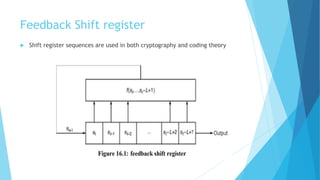
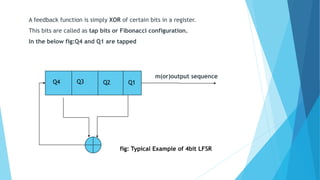
This document summarizes a presentation about linear feedback shift registers (LFSRs). It defines an LFSR as a type of feedback shift register that uses a linear feedback function, typically an XOR of certain bits in the register. An LFSR can generate long pseudo-random sequences of 1s and 0s before repeating, with the period of an n-bit LFSR being 2n - 1. The feedback function is applied after each shift to determine the next bit. LFSRs are commonly used in cryptography due to their ability to generate random-looking sequences. The document provides an example of a 4-bit LFSR and discusses the use of primitive polynomials to ensure maximum periods. It also lists some applications of LFSRs





![[IJET V2I3P1] Authors: G Hemanth kumar Dr. M. Saravanan, Charan kumar. K](https://cdn.slidesharecdn.com/ss_thumbnails/ijet-v2i3p1-160609050730-thumbnail.jpg?width=640&height=640&fit=bounds)


