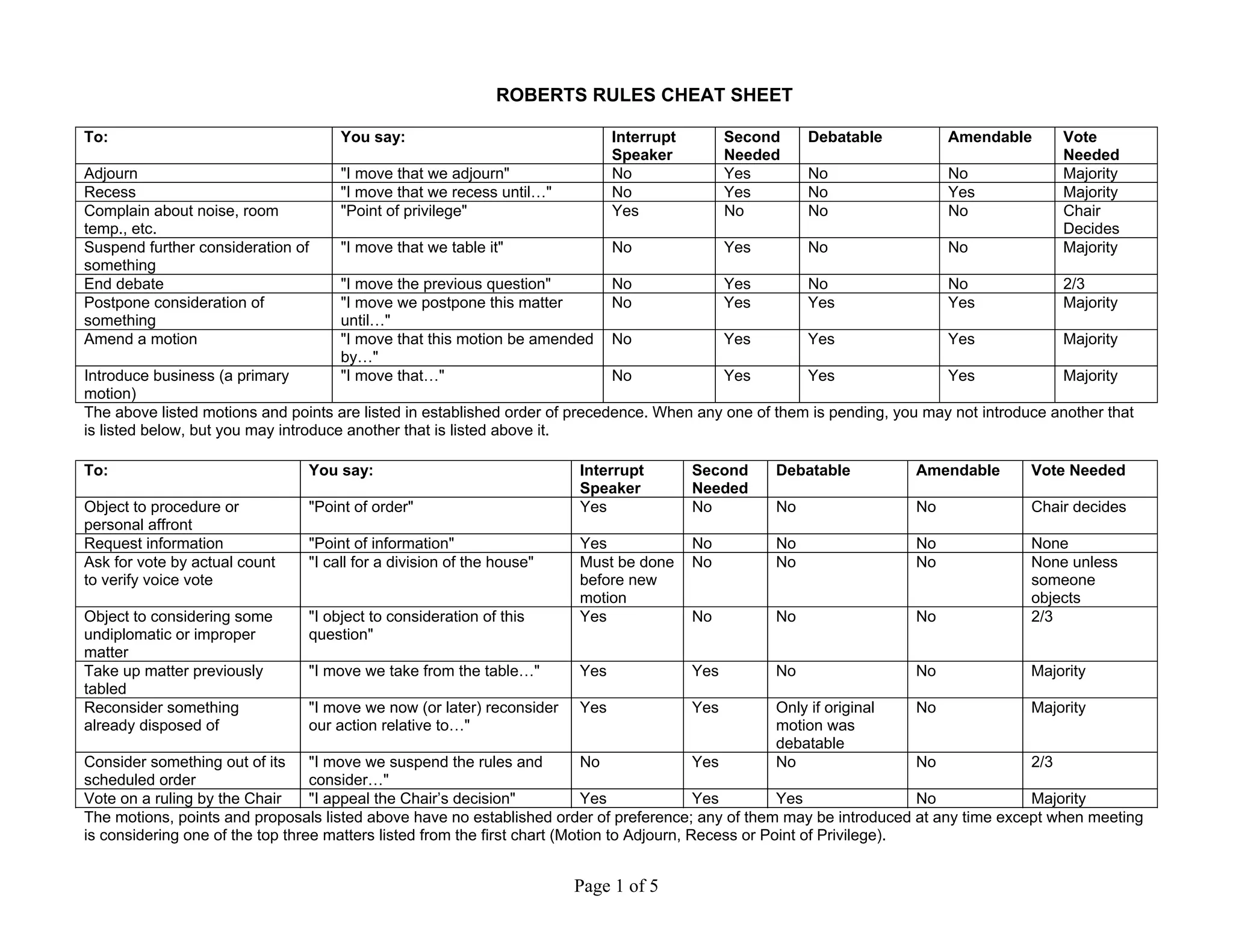
ROBERTS RULES CHEAT SHEET 
To: You say: Interrupt 
Speaker 
Page 1 of 5 
Second 
Needed 
Debatable Amendable Vote 
Needed 
Adjourn "I move that we adjourn" No Yes No No Majority 
Recess "I move that we recess until…" No Yes No Yes Majority 
Complain about noise, room 
"Point of privilege" Yes No No No Chair 
temp., etc. 
Decides 
Suspend further consideration of 
something 
"I move that we table it" No Yes No No Majority 
End debate "I move the previous question" No Yes No No 2/3 
Postpone consideration of 
"I move we postpone this matter 
something 
until…" 
No Yes Yes Yes Majority 
Amend a motion "I move that this motion be amended 
by…" 
No Yes Yes Yes Majority 
Introduce business (a primary 
motion) 
"I move that…" No Yes Yes Yes Majority 
The above listed motions and points are listed in established order of precedence. When any one of them is pending, you may not introduce another that 
is listed below, but you may introduce another that is listed above it. 
To: You say: Interrupt 
Speaker 
Second 
Needed 
Debatable Amendable Vote Needed 
Object to procedure or 
personal affront 
"Point of order" Yes No No No Chair decides 
Request information "Point of information" Yes No No No None 
Ask for vote by actual count 
"I call for a division of the house" Must be done 
to verify voice vote 
before new 
motion 
No No No None unless 
someone 
objects 
Object to considering some 
undiplomatic or improper 
matter 
"I object to consideration of this 
question" 
Yes No No No 2/3 
Take up matter previously 
tabled 
"I move we take from the table…" Yes Yes No No Majority 
Reconsider something 
already disposed of 
"I move we now (or later) reconsider 
our action relative to…" 
Yes Yes Only if original 
motion was 
debatable 
No Majority 
Consider something out of its 
scheduled order 
"I move we suspend the rules and 
consider…" 
No Yes No No 2/3 
Vote on a ruling by the Chair "I appeal the Chair’s decision" Yes Yes Yes No Majority 
The motions, points and proposals listed above have no established order of preference; any of them may be introduced at any time except when meeting 
is considering one of the top three matters listed from the first chart (Motion to Adjourn, Recess or Point of Privilege).
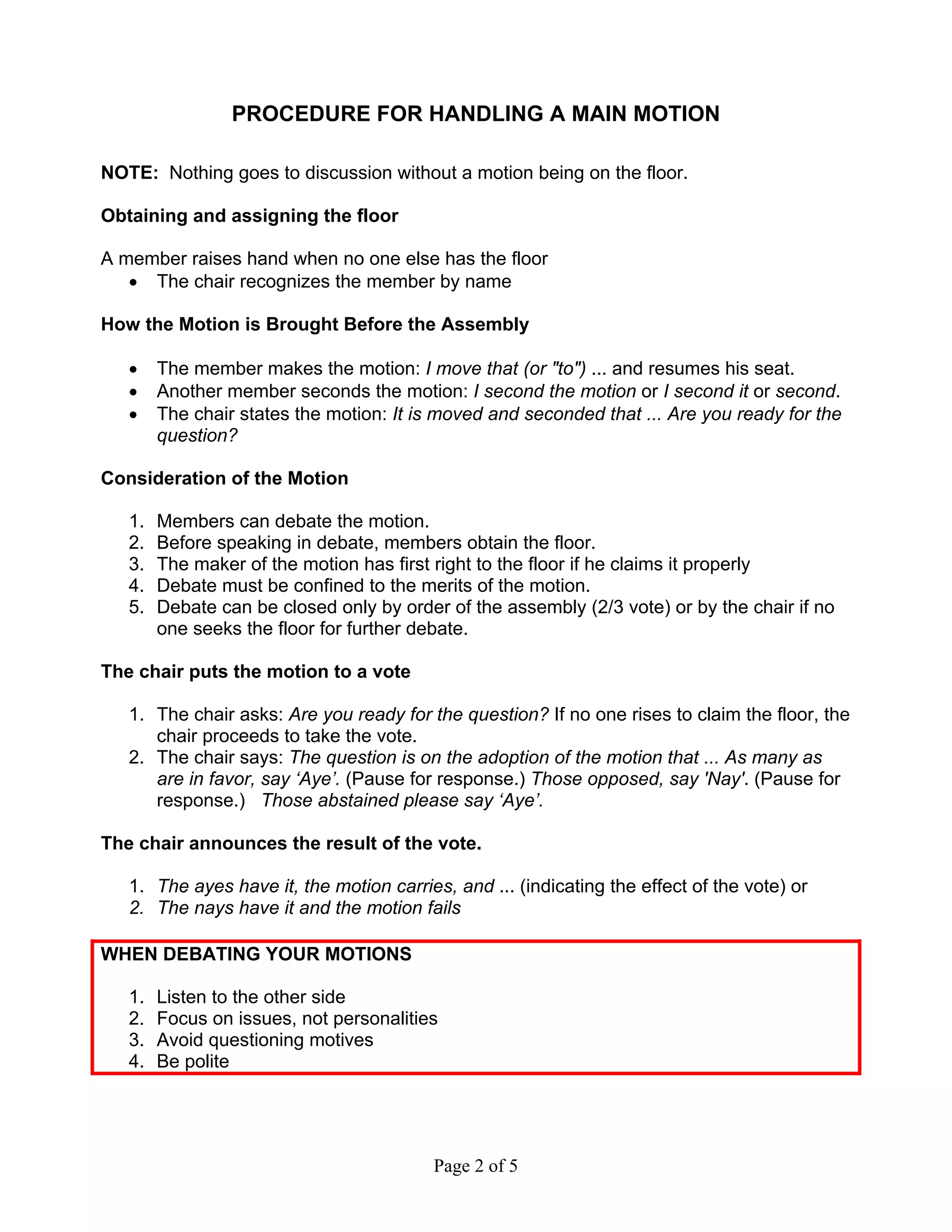
PROCEDURE FOR HANDLING A MAIN MOTION 
NOTE: Nothing goes to discussion without a motion being on the floor. 
Obtaining and assigning the floor 
A member raises hand when no one else has the floor 
• The chair recognizes the member by name 
How the Motion is Brought Before the Assembly 
• The member makes the motion: I move that (or "to") ... and resumes his seat. 
• Another member seconds the motion: I second the motion or I second it or second. 
• The chair states the motion: It is moved and seconded that ... Are you ready for the 
Page 2 of 5 
question? 
Consideration of the Motion 
1. Members can debate the motion. 
2. Before speaking in debate, members obtain the floor. 
3. The maker of the motion has first right to the floor if he claims it properly 
4. Debate must be confined to the merits of the motion. 
5. Debate can be closed only by order of the assembly (2/3 vote) or by the chair if no 
one seeks the floor for further debate. 
The chair puts the motion to a vote 
1. The chair asks: Are you ready for the question? If no one rises to claim the floor, the 
chair proceeds to take the vote. 
2. The chair says: The question is on the adoption of the motion that ... As many as 
are in favor, say ‘Aye’. (Pause for response.) Those opposed, say 'Nay'. (Pause for 
response.) Those abstained please say ‘Aye’. 
The chair announces the result of the vote. 
1. The ayes have it, the motion carries, and ... (indicating the effect of the vote) or 
2. The nays have it and the motion fails 
WHEN DEBATING YOUR MOTIONS 
1. Listen to the other side 
2. Focus on issues, not personalities 
3. Avoid questioning motives 
4. Be polite
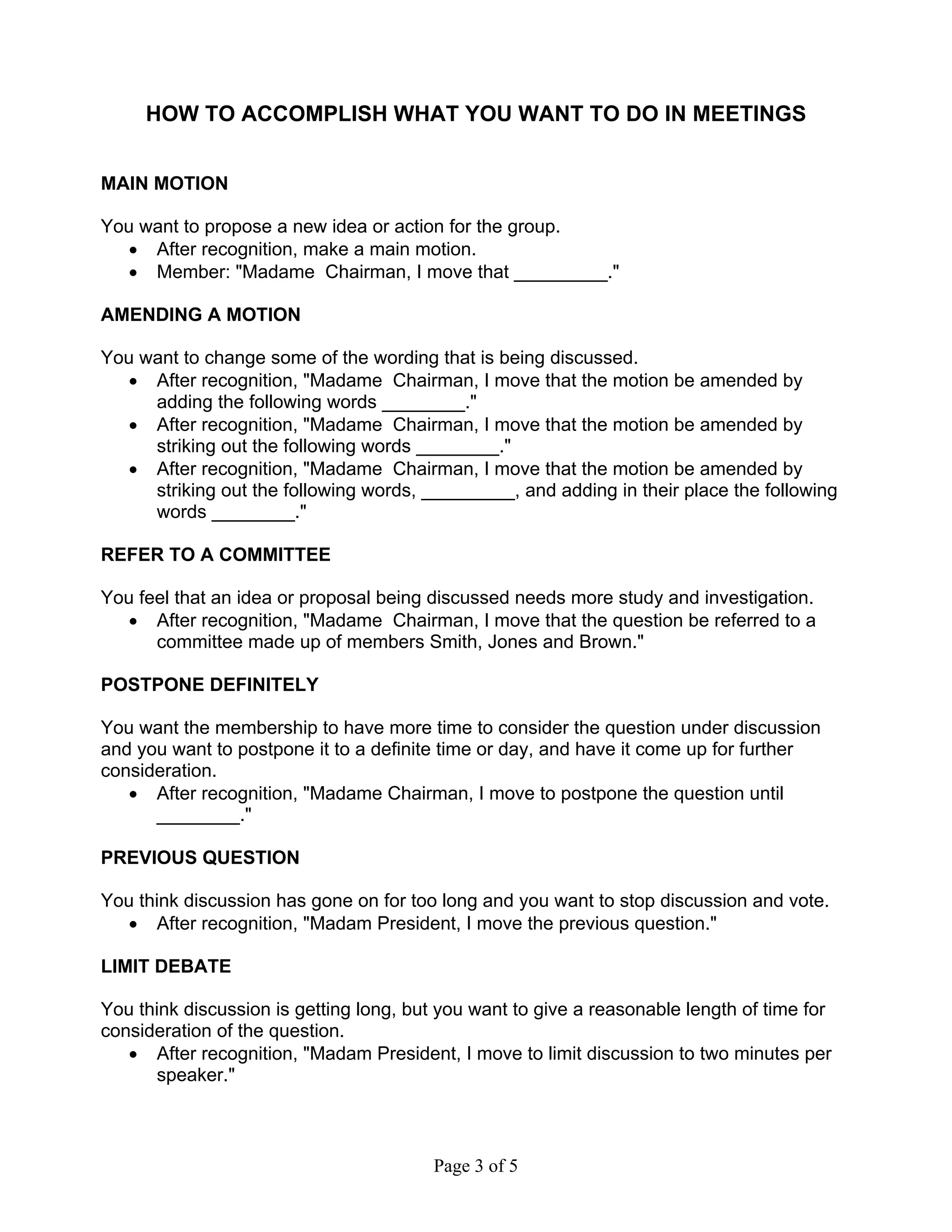
HOW TO ACCOMPLISH WHAT YOU WANT TO DO IN MEETINGS 
MAIN MOTION 
You want to propose a new idea or action for the group. 
• After recognition, make a main motion. 
• Member: "Madame Chairman, I move that _________." 
AMENDING A MOTION 
You want to change some of the wording that is being discussed. 
• After recognition, "Madame Chairman, I move that the motion be amended by 
adding the following words ________." 
• After recognition, "Madame Chairman, I move that the motion be amended by 
striking out the following words ________." 
• After recognition, "Madame Chairman, I move that the motion be amended by 
striking out the following words, _________, and adding in their place the following 
words ________." 
REFER TO A COMMITTEE 
You feel that an idea or proposal being discussed needs more study and investigation. 
• After recognition, "Madame Chairman, I move that the question be referred to a 
committee made up of members Smith, Jones and Brown." 
POSTPONE DEFINITELY 
You want the membership to have more time to consider the question under discussion 
and you want to postpone it to a definite time or day, and have it come up for further 
consideration. 
• After recognition, "Madame Chairman, I move to postpone the question until 
Page 3 of 5 
________." 
PREVIOUS QUESTION 
You think discussion has gone on for too long and you want to stop discussion and vote. 
• After recognition, "Madam President, I move the previous question." 
LIMIT DEBATE 
You think discussion is getting long, but you want to give a reasonable length of time for 
consideration of the question. 
• After recognition, "Madam President, I move to limit discussion to two minutes per 
speaker."
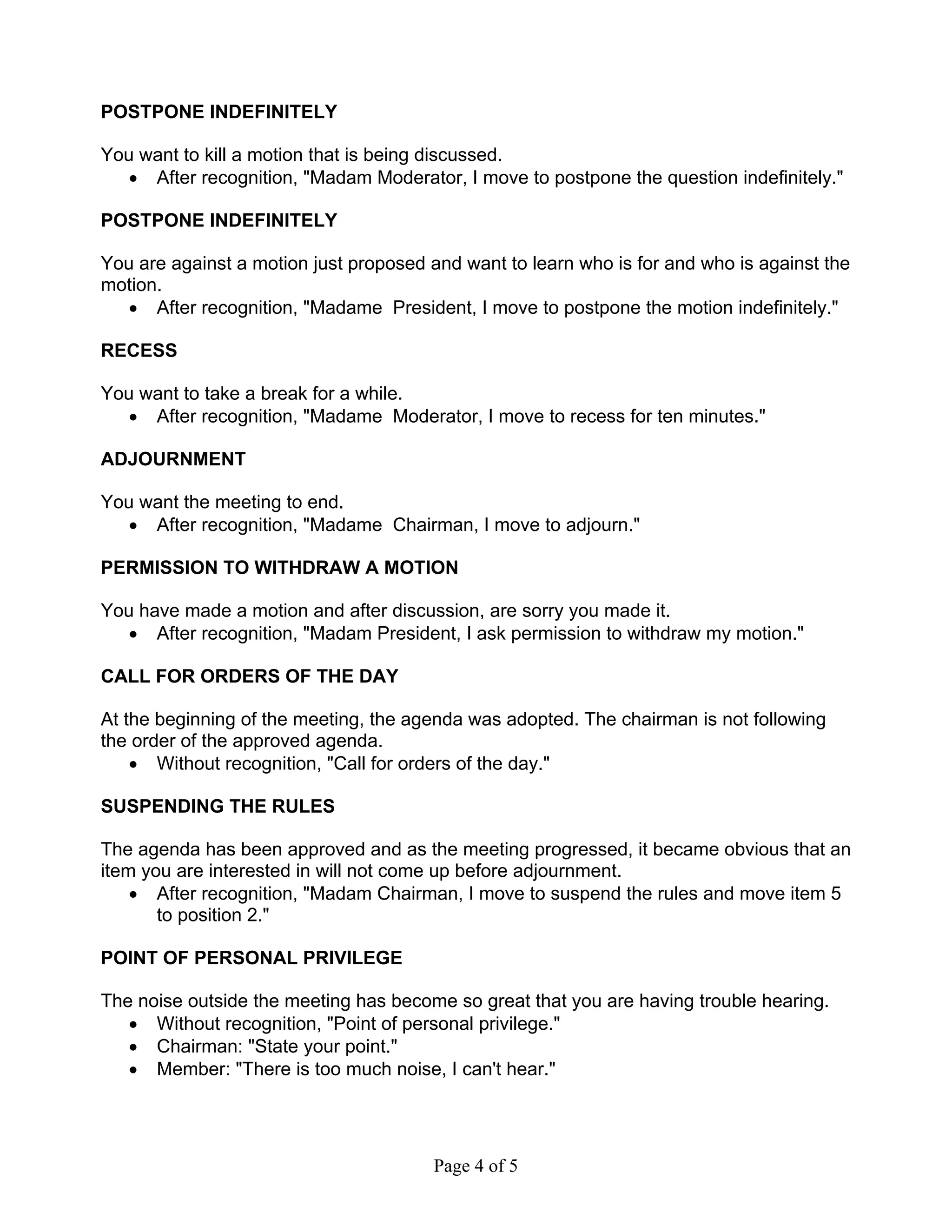
POSTPONE INDEFINITELY 
You want to kill a motion that is being discussed. 
• After recognition, "Madam Moderator, I move to postpone the question indefinitely." 
POSTPONE INDEFINITELY 
You are against a motion just proposed and want to learn who is for and who is against the 
motion. 
• After recognition, "Madame President, I move to postpone the motion indefinitely." 
Page 4 of 5 
RECESS 
You want to take a break for a while. 
• After recognition, "Madame Moderator, I move to recess for ten minutes." 
ADJOURNMENT 
You want the meeting to end. 
• After recognition, "Madame Chairman, I move to adjourn." 
PERMISSION TO WITHDRAW A MOTION 
You have made a motion and after discussion, are sorry you made it. 
• After recognition, "Madam President, I ask permission to withdraw my motion." 
CALL FOR ORDERS OF THE DAY 
At the beginning of the meeting, the agenda was adopted. The chairman is not following 
the order of the approved agenda. 
• Without recognition, "Call for orders of the day." 
SUSPENDING THE RULES 
The agenda has been approved and as the meeting progressed, it became obvious that an 
item you are interested in will not come up before adjournment. 
• After recognition, "Madam Chairman, I move to suspend the rules and move item 5 
to position 2." 
POINT OF PERSONAL PRIVILEGE 
The noise outside the meeting has become so great that you are having trouble hearing. 
• Without recognition, "Point of personal privilege." 
• Chairman: "State your point." 
• Member: "There is too much noise, I can't hear."
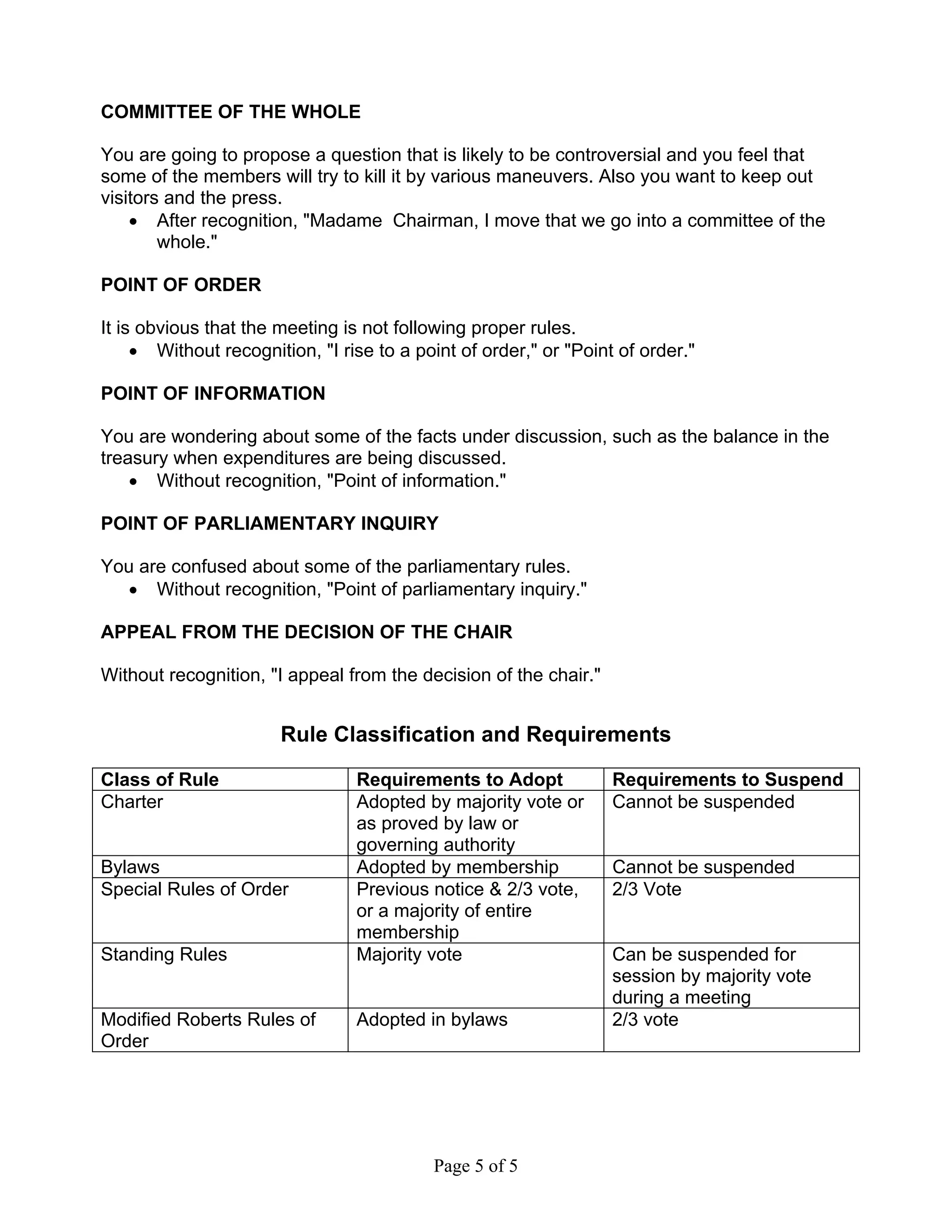
COMMITTEE OF THE WHOLE 
You are going to propose a question that is likely to be controversial and you feel that 
some of the members will try to kill it by various maneuvers. Also you want to keep out 
visitors and the press. 
• After recognition, "Madame Chairman, I move that we go into a committee of the 
Page 5 of 5 
whole." 
POINT OF ORDER 
It is obvious that the meeting is not following proper rules. 
• Without recognition, "I rise to a point of order," or "Point of order." 
POINT OF INFORMATION 
You are wondering about some of the facts under discussion, such as the balance in the 
treasury when expenditures are being discussed. 
• Without recognition, "Point of information." 
POINT OF PARLIAMENTARY INQUIRY 
You are confused about some of the parliamentary rules. 
• Without recognition, "Point of parliamentary inquiry." 
APPEAL FROM THE DECISION OF THE CHAIR 
Without recognition, "I appeal from the decision of the chair." 
Rule Classification and Requirements 
Class of Rule Requirements to Adopt Requirements to Suspend 
Charter Adopted by majority vote or 
as proved by law or 
governing authority 
Cannot be suspended 
Bylaws Adopted by membership Cannot be suspended 
Special Rules of Order Previous notice & 2/3 vote, 
or a majority of entire 
membership 
2/3 Vote 
Standing Rules Majority vote Can be suspended for 
session by majority vote 
during a meeting 
Modified Roberts Rules of 
Order 
Adopted in bylaws 2/3 vote

Cheat Sheet - Roberts Rules of Order

  • 1.
    ROBERTS RULES CHEATSHEET To: You say: Interrupt Speaker Page 1 of 5 Second Needed Debatable Amendable Vote Needed Adjourn "I move that we adjourn" No Yes No No Majority Recess "I move that we recess until…" No Yes No Yes Majority Complain about noise, room "Point of privilege" Yes No No No Chair temp., etc. Decides Suspend further consideration of something "I move that we table it" No Yes No No Majority End debate "I move the previous question" No Yes No No 2/3 Postpone consideration of "I move we postpone this matter something until…" No Yes Yes Yes Majority Amend a motion "I move that this motion be amended by…" No Yes Yes Yes Majority Introduce business (a primary motion) "I move that…" No Yes Yes Yes Majority The above listed motions and points are listed in established order of precedence. When any one of them is pending, you may not introduce another that is listed below, but you may introduce another that is listed above it. To: You say: Interrupt Speaker Second Needed Debatable Amendable Vote Needed Object to procedure or personal affront "Point of order" Yes No No No Chair decides Request information "Point of information" Yes No No No None Ask for vote by actual count "I call for a division of the house" Must be done to verify voice vote before new motion No No No None unless someone objects Object to considering some undiplomatic or improper matter "I object to consideration of this question" Yes No No No 2/3 Take up matter previously tabled "I move we take from the table…" Yes Yes No No Majority Reconsider something already disposed of "I move we now (or later) reconsider our action relative to…" Yes Yes Only if original motion was debatable No Majority Consider something out of its scheduled order "I move we suspend the rules and consider…" No Yes No No 2/3 Vote on a ruling by the Chair "I appeal the Chair’s decision" Yes Yes Yes No Majority The motions, points and proposals listed above have no established order of preference; any of them may be introduced at any time except when meeting is considering one of the top three matters listed from the first chart (Motion to Adjourn, Recess or Point of Privilege).
  • 2.
    PROCEDURE FOR HANDLINGA MAIN MOTION NOTE: Nothing goes to discussion without a motion being on the floor. Obtaining and assigning the floor A member raises hand when no one else has the floor • The chair recognizes the member by name How the Motion is Brought Before the Assembly • The member makes the motion: I move that (or "to") ... and resumes his seat. • Another member seconds the motion: I second the motion or I second it or second. • The chair states the motion: It is moved and seconded that ... Are you ready for the Page 2 of 5 question? Consideration of the Motion 1. Members can debate the motion. 2. Before speaking in debate, members obtain the floor. 3. The maker of the motion has first right to the floor if he claims it properly 4. Debate must be confined to the merits of the motion. 5. Debate can be closed only by order of the assembly (2/3 vote) or by the chair if no one seeks the floor for further debate. The chair puts the motion to a vote 1. The chair asks: Are you ready for the question? If no one rises to claim the floor, the chair proceeds to take the vote. 2. The chair says: The question is on the adoption of the motion that ... As many as are in favor, say ‘Aye’. (Pause for response.) Those opposed, say 'Nay'. (Pause for response.) Those abstained please say ‘Aye’. The chair announces the result of the vote. 1. The ayes have it, the motion carries, and ... (indicating the effect of the vote) or 2. The nays have it and the motion fails WHEN DEBATING YOUR MOTIONS 1. Listen to the other side 2. Focus on issues, not personalities 3. Avoid questioning motives 4. Be polite
  • 3.
    HOW TO ACCOMPLISHWHAT YOU WANT TO DO IN MEETINGS MAIN MOTION You want to propose a new idea or action for the group. • After recognition, make a main motion. • Member: "Madame Chairman, I move that _________." AMENDING A MOTION You want to change some of the wording that is being discussed. • After recognition, "Madame Chairman, I move that the motion be amended by adding the following words ________." • After recognition, "Madame Chairman, I move that the motion be amended by striking out the following words ________." • After recognition, "Madame Chairman, I move that the motion be amended by striking out the following words, _________, and adding in their place the following words ________." REFER TO A COMMITTEE You feel that an idea or proposal being discussed needs more study and investigation. • After recognition, "Madame Chairman, I move that the question be referred to a committee made up of members Smith, Jones and Brown." POSTPONE DEFINITELY You want the membership to have more time to consider the question under discussion and you want to postpone it to a definite time or day, and have it come up for further consideration. • After recognition, "Madame Chairman, I move to postpone the question until Page 3 of 5 ________." PREVIOUS QUESTION You think discussion has gone on for too long and you want to stop discussion and vote. • After recognition, "Madam President, I move the previous question." LIMIT DEBATE You think discussion is getting long, but you want to give a reasonable length of time for consideration of the question. • After recognition, "Madam President, I move to limit discussion to two minutes per speaker."
  • 4.
    POSTPONE INDEFINITELY Youwant to kill a motion that is being discussed. • After recognition, "Madam Moderator, I move to postpone the question indefinitely." POSTPONE INDEFINITELY You are against a motion just proposed and want to learn who is for and who is against the motion. • After recognition, "Madame President, I move to postpone the motion indefinitely." Page 4 of 5 RECESS You want to take a break for a while. • After recognition, "Madame Moderator, I move to recess for ten minutes." ADJOURNMENT You want the meeting to end. • After recognition, "Madame Chairman, I move to adjourn." PERMISSION TO WITHDRAW A MOTION You have made a motion and after discussion, are sorry you made it. • After recognition, "Madam President, I ask permission to withdraw my motion." CALL FOR ORDERS OF THE DAY At the beginning of the meeting, the agenda was adopted. The chairman is not following the order of the approved agenda. • Without recognition, "Call for orders of the day." SUSPENDING THE RULES The agenda has been approved and as the meeting progressed, it became obvious that an item you are interested in will not come up before adjournment. • After recognition, "Madam Chairman, I move to suspend the rules and move item 5 to position 2." POINT OF PERSONAL PRIVILEGE The noise outside the meeting has become so great that you are having trouble hearing. • Without recognition, "Point of personal privilege." • Chairman: "State your point." • Member: "There is too much noise, I can't hear."
  • 5.
    COMMITTEE OF THEWHOLE You are going to propose a question that is likely to be controversial and you feel that some of the members will try to kill it by various maneuvers. Also you want to keep out visitors and the press. • After recognition, "Madame Chairman, I move that we go into a committee of the Page 5 of 5 whole." POINT OF ORDER It is obvious that the meeting is not following proper rules. • Without recognition, "I rise to a point of order," or "Point of order." POINT OF INFORMATION You are wondering about some of the facts under discussion, such as the balance in the treasury when expenditures are being discussed. • Without recognition, "Point of information." POINT OF PARLIAMENTARY INQUIRY You are confused about some of the parliamentary rules. • Without recognition, "Point of parliamentary inquiry." APPEAL FROM THE DECISION OF THE CHAIR Without recognition, "I appeal from the decision of the chair." Rule Classification and Requirements Class of Rule Requirements to Adopt Requirements to Suspend Charter Adopted by majority vote or as proved by law or governing authority Cannot be suspended Bylaws Adopted by membership Cannot be suspended Special Rules of Order Previous notice & 2/3 vote, or a majority of entire membership 2/3 Vote Standing Rules Majority vote Can be suspended for session by majority vote during a meeting Modified Roberts Rules of Order Adopted in bylaws 2/3 vote