BE 2120 MFC Team Project
Katherine Knight, Chris Hund,
Marett Richardson, Michael Calfe
Introduction
Recognition and Definition of Problem/Need
i.e. Specifics, Equations, Goals, Constraints,
Considerations
Ultimate Use & Sustainability
Introduction
● Recognizing the Problem:
○ We need to develop alternative methods of energy production
● Defining the Problem:
○ Microbial Fuel Cell
○ Clemson Aquaculture Center
○ Minimum 1 W/m3
of anode volume
● Governing Equations
○ V=IR
○ P=IV
Introduction-Goals
● Process Goals
○ Produce 1 W of power per cubic meter of anode volume
○ Materials compatible with aquatic environment
● Structural Goals
○ 75 percent natural/organic material by weight
○ Support the weight of the cathode and potentiometer
○ Prevent stress on wires and connections
● Mechanical Goals
○ Maintain connections for electron flow
Introduction-Constraints and Considerations
● Constraints
○ Only 25 percent by weight can be non-natural material
○ Budget of $20
○ Limited by organic material and organisms already present
○ Temperature of environment
● Considerations
○ Environmental effect with long term implementation
○ Aesthetically pleasing
Literature Review / Theory
Description of various MFCs, Information from
Research Articles, Past Experiences
Microbial Fuel Cell Theory
A microbial fuel cell is a type of biological reactor that takes advantage of the
transfer of electrons during cell respiration. By separating the two stages of
cell respiration into two chambers of a device, the natural flow of electrons
can easily be captured via some type of resistor.
Reactions and MFC Schematic
C6
H12
O6
+ 6 H2
O → 6CO2
+ 24H+
+ 24e -
oxidation of glucose (loss of electrons)
24e -
+ 6O2
+ 24 H+
→ 12 H2
O reduction of oxygen (gain of electrons)
_________________________________
C6
H12
O6
+ 6O2
→ 6CO2
+ 6H2
O overall reaction
Common Types of Microbial Fuel Cells
● Two-Chamber MFC - Aqueous anode and cathode chambers. Schematic
in previous slide is an example
● Single-Chamber MFC - Aqueous anode chamber and a cathode chamber
that is just subject to the air. Still utilizes a PEM, typically with carbon cloth
for the cathode.
● Sediment MFC - may not even require a constructed anode and cathode
structure within an overall structure. Often, sediment MFCs only require a
cathode, anode and PEM. The anode is buried in anaerobic sediments
within the environment and the cathode is left exposed to aerobic water
or air. Only structure used is to support the electrodes in place.
Literature Reviews of Research Articles
1. “Microbial Fuel Cells for Sulfide Removal”
Rather than being used as a source of energy, this article showed that MFCs can be used as
means for purification. Many MFC designs focus on the removal of carbon based compounds, which
in turn leaves waste that usually contains forms of ionic sulfur. The group at Ghent University in
Belgium who ran this experiment used that waste product as the microbial culture in the anode. The
microorganisms present were found to have a high likelihood of reducing sulfate to sulfide and then
sulfide to elemental sulfur. At this stage, the sulfur is in a phase in which is can easily be removed.
This process proved to be both environmentally and economically advantageous because what used
to be waste could now be used to create more product.
2. “Testing Alternative Proton Exchange Membranes”
This article was about testing a salt bridge as an alternative proton
exchange membrane. The salt bridge is a much less expensive option as the
the traditional proton exchange membrane is quite expensive. In this
experiment they used a two chamber MFC with one chamber being the anode
and the other being the cathode. They discovered that the salt bridge is more
cost effective than the traditional proton exchange membrane because it is
much cheaper and produces slightly less electricity
3. “The Effects of electrode Spacing and Flow Direction”
This article looked at different electrode locations and flows in sediment
MFCs in a constructed wetland style. They found that the more traditional
design of two submerged electrode chambers performed the best when
compared with a cathode located inside of an anode layer or an air cathode
design. Additionally, they found that providing both an upflow of influent
through the anode and a down-flow providing additional oxygen to the
cathode produced the most electricity.
Past Experiences
● Lab on Microbial Fuel Cells
○ Basic Power Evaluations
○ Optimizing Power Production
○ Testing to Determine Ideal Internal Resistance
● Lecture on Microbial Fuel Cells
○ Respiration Review
○ Components
○ Major Types
Design Methodology and
Materials
Analysis of Information, Synthesis of Design,
Description of Design with CAD, Listing of
Materials, Description of Alternatives
Design Goals
● The main goal was to design a microbial fuel cell that achieved a power
density of one Watt per meter cubed of anode volume.
● Another important goal was that it had to made with 75 percent natural
materials
● Easy access to potentiometer
Design and Analysis of Information
● We wanted to make a MFC that utilized the water as a barrier to exchange
protons
● The anode would be buried in the mud in the aquaculture pond so it
would be in an anaerobic environment and the cathode would float free
in the water
● We brainstormed different ways to do this and initially came up with a raft
made of cork to suspend the cathode in the water that would be
anchored with rocks attached with string to the raft
● To achieve 75% natural material we only used non-organic materials for
electrical purposes and to protect from the elements
Initial Design Sketches
● Had rope anchored in the mud
with rocks in order to increase
the weight ratio of
organic:inorganic materials in
the design
● Left images show options of
fraying the copper wire vs
curling it within (eventually
chose the frayed option)
● Switched from cork to bamboo
for monetary purposes. Also
believed that the bamboo
would be more buoyant
Final Design
● We made this design before we took a trip to the aquaculture center so
some of the design changed
● We changed the raft material to bamboo because it was free of cost and
would work just as well if not better
● We also decided it would be easier and more effective to just tie the raft
to the sides of the aquaculture pond with string
● We wanted to try to use a different anode and cathode material other
than the graphite pieces to try to obtain a higher voltage so we obtained
metal shavings from a fabrication shop on campus
○ During fabrication we added crushed graphite because the metal shavings were difficult
to pack
CAD Designs
Description of Designs
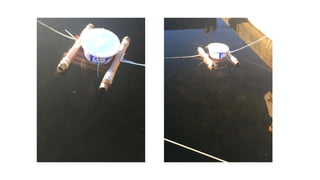
● Bamboo Pontoon
○ Buoyant sides were cut from a larger strand of bamboo, leaving in tact the natural barrier
between segments for flotation purposes
○ Platform was constructed of bamboo as well that was split in half
○ Who structure was initially lashed together, then the platform and all the knots were
bolstered with Gorilla Glue
○ A tupperware container could then be placed on top of the platform which kept the
potentiometer dry and easily accessible for measurement
○ Two strings were tied to the structure and attached to the walls of the aquaculture center
to keep the MFC from moving while also serving as a backup in case the bamboo failed as
a flotation device
○ Didn’t feel any more structure was necessary; that letting the cathode float freely would
be a reasonable design
● Cathode and Anode
○ Designed with a mesh pouch so microorganisms could grow inside
○ Manually sewn together along the edges, then stapled at the top when the copper wire
was inserted
○ Copper wire was frayed out inside because we hypothesized that that would increase the
overall surface area in contact with the microorganisms (if it were left in tact, the whole
inside of the wire would never come into contact with the microbial growth needed to
capture the transfer of electrons)
○ Aluminum shavings were chosen to fill the inside of both chambers because aluminum
has a higher conductivity than graphite, which would lead to more electron flow across
the MFC.
○ Aluminum - 3.50e7 S/m
○ Graphite - 3.00e5 S/m
Achieving 1 W/m^3
Anode volume = 0.0004572m^3
Internal resistance = 259 ohms
So our MFC needs to generate 0.0004572 W to reach this goal
Using P=I2
R we need a current of 1.328*10-3
Using V=IR this is a voltage of 0.344 volts
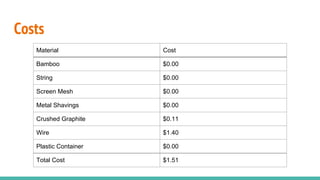
Costs
Material Cost
Bamboo $0.00
String $0.00
Screen Mesh $0.00
Metal Shavings $0.00
Crushed Graphite $0.11
Wire $1.40
Plastic Container $0.00
Total Cost $1.51
Results and Discussion
Testing and Evaluation of MFC, Polarization
Curves, Power vs. Time Calculation, Redesign
Resistance
(R) [ohms]
Voltage (V)
[V]
Current (I)
[A]
189 0.04 0.000212
516 0.07 0.000136
1000 0.08 0.00008
1468 0.084 5.72E-05
2238 0.083 3.71E-05
2984 0.08 2.68E-05
5250 0.1 1.9E-05
4450 0.095 2.13E-05
Average Power Density=0.0854 W/m^3
Voltage (V)
[V]
Resistance (R)
[ohms]
Current (I) [A]
0.098 254.8 0.000384615
0.181 852 0.000212441
0.202 1345 0.000150186
0.207 2233 9.27004E-05
0.249 3452 7.21321E-05
0.239 4310 5.54524E-05
0.244 5230 4.66539E-05
0.059 152.2 0.000387648
Suggestions for Further Research
● Test again at higher internal resistance
○ Second polarization curve showed that the ideal internal resistance increased over the
time it was in the aquaculture center
● Use larger metal shavings or smaller mesh
○ Increase the surface area of conductive material - higher probability of electrons being
transferred
● A single larger gauge wire coiled in the anode and cathode
Conclusions and Results
● Achieved maximum power density of 0.1298 W/m^3
● Achieved average power density of 0.0854 W/m^3
● Achieved structural goals
○ The overall weight ratio did not exceed 25% inorganic materials.
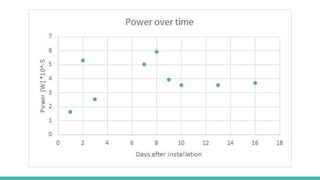
● No solid correlation in the relationships of power & power density vs. time
● Raw data also showed little correlation with temperature either
○ In theory, as temperatures decreased, voltage should also decrease because
microorganism growth is inhibited in colder temperatures
Works Cited
Doherty, Liam, Xiaohong Zhao, Yaqian Zhao, and Wenke Wang. "The Effects of Electrode Spacing and Flow Direction on the
Performance of Microbial Fuel Cell-constructed Wetland." Ecological Engineering 79 (2015): 8-14. Web. 27 Sept. 2015.
Drapcho, Caye. In-class Lectures and Labs. 2015
Korneel Rabaey, Kirsten Van de Sompel, Lois Maignien, Nico Boon, Peter Aelterman, Peter Clauwaert, Liesje De Schamphelaire, Hai The
Pham, Jan Vermeulen, Marc Verhaege, Piet Lens,ǁ and, and Willy Verstraete. Microbial Fuel Cells for Sulfide Removal. Environmental
Science & Technology 2006 40 (17), 5218-5224
Min, Booki, Shaoan Cheng, and Bruce E. Logan. "Electricity generation using membrane and salt bridge microbial fuel cells." Water
research 39.9 (2005): 1675-1686.
Appendix
Raw Data
MFC Raw Data sheet Anode Volume (V) [m3
] Internal Resistance (R) [Ω]
0.0004572 259
Date Volts (V) [V] Temp (ºC) Current (I) [A] Power (P) [W] Power Density (PDV
) [W/m3
]
11/4/2015 0.065 18.4 0.00025097 1.63E-05 0.0357
11/5/2015 0.117 18.7 0.00045174 5.29E-05 0.1156
11/6/2015 0.081 22.0 0.00031274 2.53E-05 0.0554
11/10/2015 0.114 17.7 0.00044015 5.02E-05 0.1097
11/11/2015 0.124 19.1 0.00047876 5.94E-05 0.1298
11/12/2015 0.101 16.3 0.00038996 3.94E-05 0.0861
11/13/2015 0.096 16.5 0.00037066 3.56E-05 0.0778
11/16/2015 0.096 13.5 0.00037066 3.56E-05 0.0778
11/19/2015 0.098 18.6 0.00037838 3.71E-05 0.0811

Microbial Fuel Cell Project

  • 1.
    BE 2120 MFCTeam Project Katherine Knight, Chris Hund, Marett Richardson, Michael Calfe
  • 2.
    Introduction Recognition and Definitionof Problem/Need i.e. Specifics, Equations, Goals, Constraints, Considerations Ultimate Use & Sustainability
  • 3.
    Introduction ● Recognizing theProblem: ○ We need to develop alternative methods of energy production ● Defining the Problem: ○ Microbial Fuel Cell ○ Clemson Aquaculture Center ○ Minimum 1 W/m3 of anode volume ● Governing Equations ○ V=IR ○ P=IV
  • 4.
    Introduction-Goals ● Process Goals ○Produce 1 W of power per cubic meter of anode volume ○ Materials compatible with aquatic environment ● Structural Goals ○ 75 percent natural/organic material by weight ○ Support the weight of the cathode and potentiometer ○ Prevent stress on wires and connections ● Mechanical Goals ○ Maintain connections for electron flow
  • 5.
    Introduction-Constraints and Considerations ●Constraints ○ Only 25 percent by weight can be non-natural material ○ Budget of $20 ○ Limited by organic material and organisms already present ○ Temperature of environment ● Considerations ○ Environmental effect with long term implementation ○ Aesthetically pleasing
  • 6.
    Literature Review /Theory Description of various MFCs, Information from Research Articles, Past Experiences
  • 7.
    Microbial Fuel CellTheory A microbial fuel cell is a type of biological reactor that takes advantage of the transfer of electrons during cell respiration. By separating the two stages of cell respiration into two chambers of a device, the natural flow of electrons can easily be captured via some type of resistor.
  • 8.
    Reactions and MFCSchematic C6 H12 O6 + 6 H2 O → 6CO2 + 24H+ + 24e - oxidation of glucose (loss of electrons) 24e - + 6O2 + 24 H+ → 12 H2 O reduction of oxygen (gain of electrons) _________________________________ C6 H12 O6 + 6O2 → 6CO2 + 6H2 O overall reaction
  • 9.
    Common Types ofMicrobial Fuel Cells ● Two-Chamber MFC - Aqueous anode and cathode chambers. Schematic in previous slide is an example ● Single-Chamber MFC - Aqueous anode chamber and a cathode chamber that is just subject to the air. Still utilizes a PEM, typically with carbon cloth for the cathode. ● Sediment MFC - may not even require a constructed anode and cathode structure within an overall structure. Often, sediment MFCs only require a cathode, anode and PEM. The anode is buried in anaerobic sediments within the environment and the cathode is left exposed to aerobic water or air. Only structure used is to support the electrodes in place.
  • 10.
    Literature Reviews ofResearch Articles 1. “Microbial Fuel Cells for Sulfide Removal” Rather than being used as a source of energy, this article showed that MFCs can be used as means for purification. Many MFC designs focus on the removal of carbon based compounds, which in turn leaves waste that usually contains forms of ionic sulfur. The group at Ghent University in Belgium who ran this experiment used that waste product as the microbial culture in the anode. The microorganisms present were found to have a high likelihood of reducing sulfate to sulfide and then sulfide to elemental sulfur. At this stage, the sulfur is in a phase in which is can easily be removed. This process proved to be both environmentally and economically advantageous because what used to be waste could now be used to create more product.
  • 11.
    2. “Testing AlternativeProton Exchange Membranes” This article was about testing a salt bridge as an alternative proton exchange membrane. The salt bridge is a much less expensive option as the the traditional proton exchange membrane is quite expensive. In this experiment they used a two chamber MFC with one chamber being the anode and the other being the cathode. They discovered that the salt bridge is more cost effective than the traditional proton exchange membrane because it is much cheaper and produces slightly less electricity
  • 12.
    3. “The Effectsof electrode Spacing and Flow Direction” This article looked at different electrode locations and flows in sediment MFCs in a constructed wetland style. They found that the more traditional design of two submerged electrode chambers performed the best when compared with a cathode located inside of an anode layer or an air cathode design. Additionally, they found that providing both an upflow of influent through the anode and a down-flow providing additional oxygen to the cathode produced the most electricity.
  • 13.
    Past Experiences ● Labon Microbial Fuel Cells ○ Basic Power Evaluations ○ Optimizing Power Production ○ Testing to Determine Ideal Internal Resistance ● Lecture on Microbial Fuel Cells ○ Respiration Review ○ Components ○ Major Types
  • 14.
    Design Methodology and Materials Analysisof Information, Synthesis of Design, Description of Design with CAD, Listing of Materials, Description of Alternatives
  • 15.
    Design Goals ● Themain goal was to design a microbial fuel cell that achieved a power density of one Watt per meter cubed of anode volume. ● Another important goal was that it had to made with 75 percent natural materials ● Easy access to potentiometer
  • 16.
    Design and Analysisof Information ● We wanted to make a MFC that utilized the water as a barrier to exchange protons ● The anode would be buried in the mud in the aquaculture pond so it would be in an anaerobic environment and the cathode would float free in the water ● We brainstormed different ways to do this and initially came up with a raft made of cork to suspend the cathode in the water that would be anchored with rocks attached with string to the raft ● To achieve 75% natural material we only used non-organic materials for electrical purposes and to protect from the elements
  • 17.
    Initial Design Sketches ●Had rope anchored in the mud with rocks in order to increase the weight ratio of organic:inorganic materials in the design ● Left images show options of fraying the copper wire vs curling it within (eventually chose the frayed option) ● Switched from cork to bamboo for monetary purposes. Also believed that the bamboo would be more buoyant
  • 18.
    Final Design ● Wemade this design before we took a trip to the aquaculture center so some of the design changed ● We changed the raft material to bamboo because it was free of cost and would work just as well if not better ● We also decided it would be easier and more effective to just tie the raft to the sides of the aquaculture pond with string ● We wanted to try to use a different anode and cathode material other than the graphite pieces to try to obtain a higher voltage so we obtained metal shavings from a fabrication shop on campus ○ During fabrication we added crushed graphite because the metal shavings were difficult to pack
  • 19.
  • 21.
    Description of Designs ●Bamboo Pontoon ○ Buoyant sides were cut from a larger strand of bamboo, leaving in tact the natural barrier between segments for flotation purposes ○ Platform was constructed of bamboo as well that was split in half ○ Who structure was initially lashed together, then the platform and all the knots were bolstered with Gorilla Glue ○ A tupperware container could then be placed on top of the platform which kept the potentiometer dry and easily accessible for measurement ○ Two strings were tied to the structure and attached to the walls of the aquaculture center to keep the MFC from moving while also serving as a backup in case the bamboo failed as a flotation device ○ Didn’t feel any more structure was necessary; that letting the cathode float freely would be a reasonable design
  • 22.
    ● Cathode andAnode ○ Designed with a mesh pouch so microorganisms could grow inside ○ Manually sewn together along the edges, then stapled at the top when the copper wire was inserted ○ Copper wire was frayed out inside because we hypothesized that that would increase the overall surface area in contact with the microorganisms (if it were left in tact, the whole inside of the wire would never come into contact with the microbial growth needed to capture the transfer of electrons) ○ Aluminum shavings were chosen to fill the inside of both chambers because aluminum has a higher conductivity than graphite, which would lead to more electron flow across the MFC. ○ Aluminum - 3.50e7 S/m ○ Graphite - 3.00e5 S/m
  • 23.
    Achieving 1 W/m^3 Anodevolume = 0.0004572m^3 Internal resistance = 259 ohms So our MFC needs to generate 0.0004572 W to reach this goal Using P=I2 R we need a current of 1.328*10-3 Using V=IR this is a voltage of 0.344 volts
  • 27.
    Costs Material Cost Bamboo $0.00 String$0.00 Screen Mesh $0.00 Metal Shavings $0.00 Crushed Graphite $0.11 Wire $1.40 Plastic Container $0.00 Total Cost $1.51
  • 28.
    Results and Discussion Testingand Evaluation of MFC, Polarization Curves, Power vs. Time Calculation, Redesign
  • 29.
    Resistance (R) [ohms] Voltage (V) [V] Current(I) [A] 189 0.04 0.000212 516 0.07 0.000136 1000 0.08 0.00008 1468 0.084 5.72E-05 2238 0.083 3.71E-05 2984 0.08 2.68E-05 5250 0.1 1.9E-05 4450 0.095 2.13E-05
  • 31.
  • 32.
    Voltage (V) [V] Resistance (R) [ohms] Current(I) [A] 0.098 254.8 0.000384615 0.181 852 0.000212441 0.202 1345 0.000150186 0.207 2233 9.27004E-05 0.249 3452 7.21321E-05 0.239 4310 5.54524E-05 0.244 5230 4.66539E-05 0.059 152.2 0.000387648
  • 33.
    Suggestions for FurtherResearch ● Test again at higher internal resistance ○ Second polarization curve showed that the ideal internal resistance increased over the time it was in the aquaculture center ● Use larger metal shavings or smaller mesh ○ Increase the surface area of conductive material - higher probability of electrons being transferred ● A single larger gauge wire coiled in the anode and cathode
  • 34.
    Conclusions and Results ●Achieved maximum power density of 0.1298 W/m^3 ● Achieved average power density of 0.0854 W/m^3 ● Achieved structural goals ○ The overall weight ratio did not exceed 25% inorganic materials. ● No solid correlation in the relationships of power & power density vs. time ● Raw data also showed little correlation with temperature either ○ In theory, as temperatures decreased, voltage should also decrease because microorganism growth is inhibited in colder temperatures
  • 35.
    Works Cited Doherty, Liam,Xiaohong Zhao, Yaqian Zhao, and Wenke Wang. "The Effects of Electrode Spacing and Flow Direction on the Performance of Microbial Fuel Cell-constructed Wetland." Ecological Engineering 79 (2015): 8-14. Web. 27 Sept. 2015. Drapcho, Caye. In-class Lectures and Labs. 2015 Korneel Rabaey, Kirsten Van de Sompel, Lois Maignien, Nico Boon, Peter Aelterman, Peter Clauwaert, Liesje De Schamphelaire, Hai The Pham, Jan Vermeulen, Marc Verhaege, Piet Lens,ǁ and, and Willy Verstraete. Microbial Fuel Cells for Sulfide Removal. Environmental Science & Technology 2006 40 (17), 5218-5224 Min, Booki, Shaoan Cheng, and Bruce E. Logan. "Electricity generation using membrane and salt bridge microbial fuel cells." Water research 39.9 (2005): 1675-1686.
  • 36.
  • 37.
    MFC Raw Datasheet Anode Volume (V) [m3 ] Internal Resistance (R) [Ω] 0.0004572 259 Date Volts (V) [V] Temp (ºC) Current (I) [A] Power (P) [W] Power Density (PDV ) [W/m3 ] 11/4/2015 0.065 18.4 0.00025097 1.63E-05 0.0357 11/5/2015 0.117 18.7 0.00045174 5.29E-05 0.1156 11/6/2015 0.081 22.0 0.00031274 2.53E-05 0.0554 11/10/2015 0.114 17.7 0.00044015 5.02E-05 0.1097 11/11/2015 0.124 19.1 0.00047876 5.94E-05 0.1298 11/12/2015 0.101 16.3 0.00038996 3.94E-05 0.0861 11/13/2015 0.096 16.5 0.00037066 3.56E-05 0.0778 11/16/2015 0.096 13.5 0.00037066 3.56E-05 0.0778 11/19/2015 0.098 18.6 0.00037838 3.71E-05 0.0811