PRESENTATION ON
AUTOMOBILE HVAC
SYSTEM
Submitted by:-Kartik
Bhardwaj
16162039
6th sem (B.tech mechanical
engg.)
Submitted to :-
Mr. Paramjit
lamba sir
Mechanical deptt.
GJUS&T,Hisar
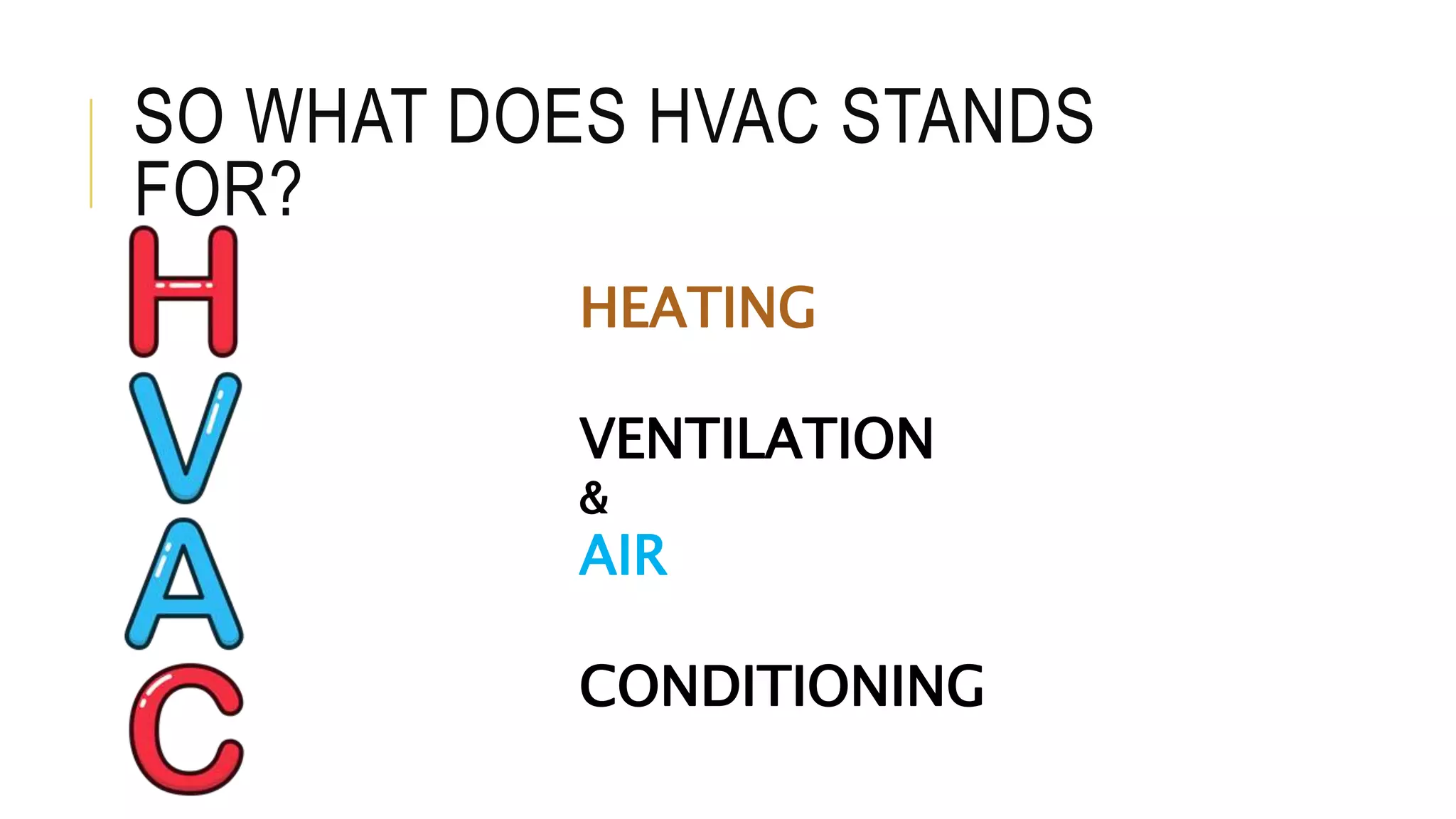
SO WHAT DOES HVAC STANDS
FOR?
HEATING
VENTILATION
&
AIR
CONDITIONING
BASIC INTRO OF AN AUTOMOTIVE
HVAC SYSTEM
“Your HVAC system is nothing more than a heat exchanger.”
Heating, ventilation, and air conditioning (HVAC) systems are
responsible for providing thermal comfort and fresh air to building
occupants. Air conditioning like it says 'conditions' the air. It not only
cools it down, but also reduces the moisture content, or humidity. All
air conditioners work the same way whether they are installed in a
building, or in a car. The fridge or freezer is in a way an air
conditioner as well. It consists of refrigerant which circulates within
the HVAC system and with the help of condenser and evaporator all
the conditioning of cabin air is done.
A BRIEF HISTORY ABOUT HVAC
Now that you know have basic intro about HVAC let’s know about some history
of HVAC. Even early civilizations created ways for their citizens to enjoy
conditioned air.
Ancient Rome:-Rome was one of the first cities to influence the air within
buildings. Rome’s hypocaust system was primarily used to heat the public
bathhouses and saunas. A hypocaust would push heated air through a system
of air ducts and under raised floors to heat a room.
Ancient China:-The Han Dynasty introduce the mechanized rotary fan. A single
person could manually cool an entire room using large wheels which engaged a
series of interconnected fans.
Early America:-Wood burning stoves helped warm early American homes
beginning in the mid-1600s. In 1744, Benjamin Franklin created his own
version of the cast iron stove. This new stove was more efficient than its
predecessor and spread across America as settlers moved west.
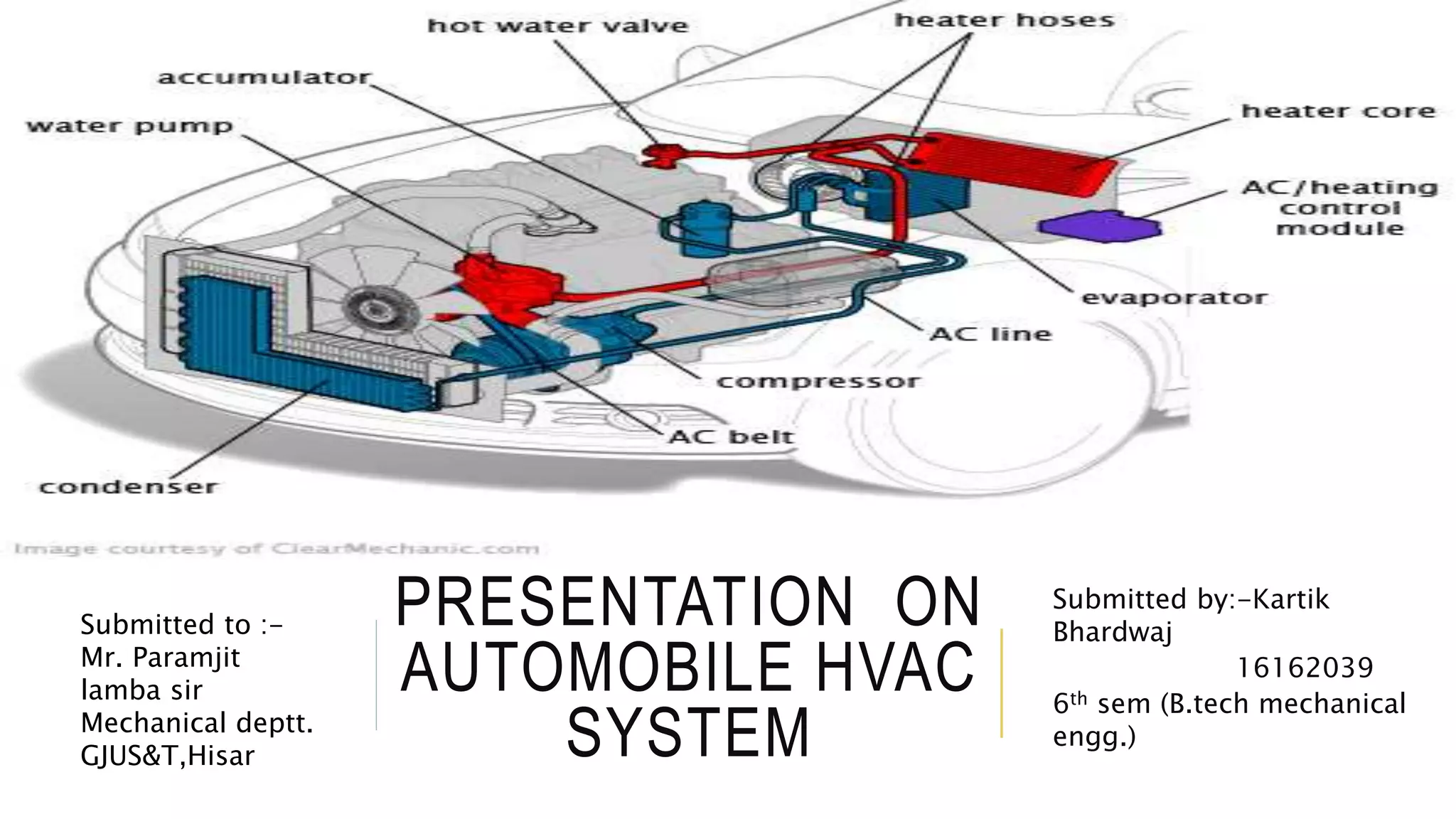
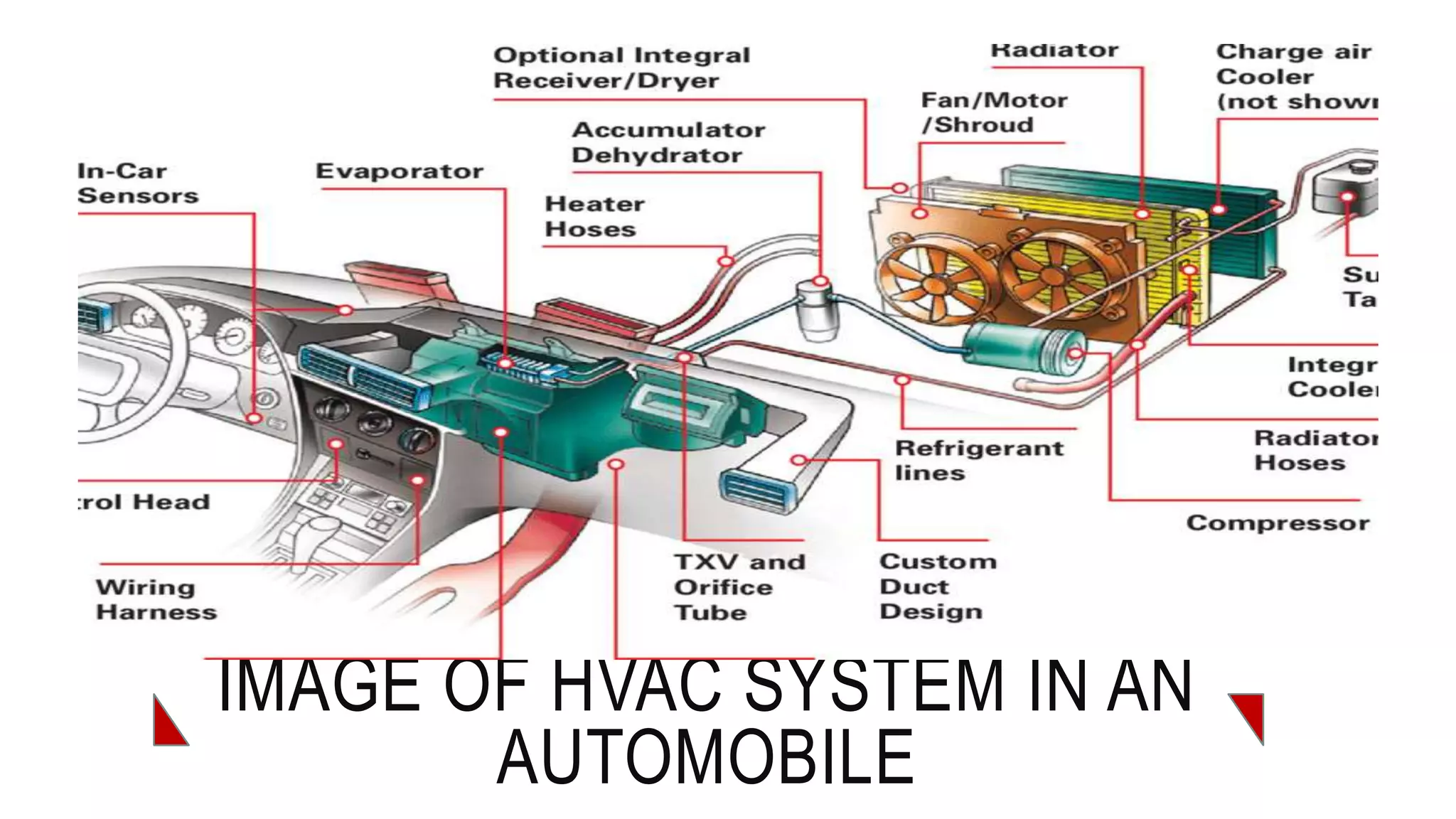
IMAGE OF HVAC SYSTEM IN AN
AUTOMOBILE
COMPONENTS OF AN AUTOMOBILE
HVAC SYSTEM
A basic HVAC system of a automobile consists of various components
like compressor, evaporator etc with each component having their
respective position on the basis of their job. But they can be divided
mainly into two types for:-
Onboard components Outboard
components
0NBOARD COMPONENTS
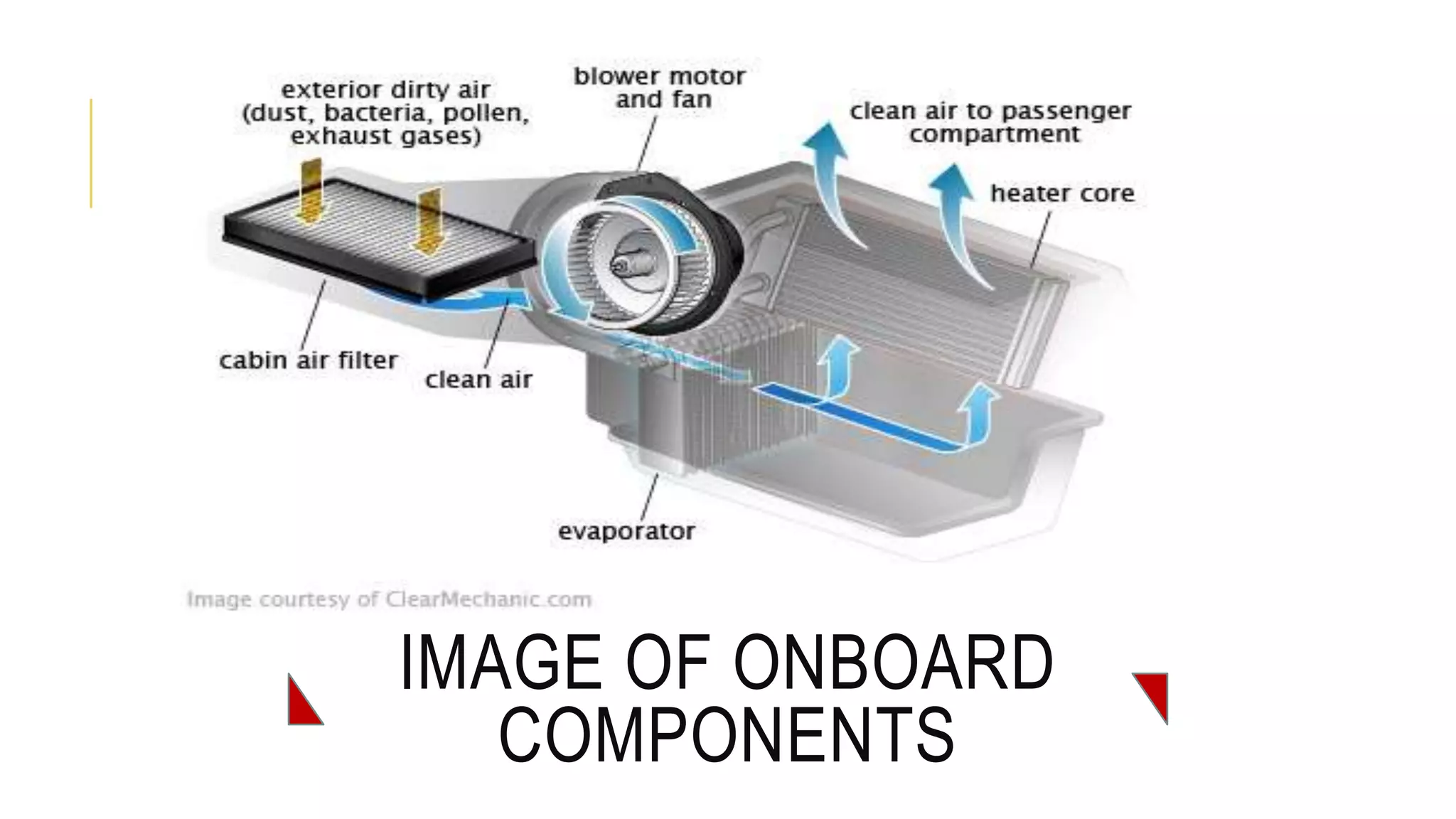
So basically onboard components include those HVAC system
component which are located inside of the cabin of an automobile.
Those are:-
CABIN AIR FILTER
BLOWER MOTOR AND FAN
EVAPORATOR
HEATER CORE
IMAGE OF ONBOARD
COMPONENTS
OUTBOARD COMPONENTS
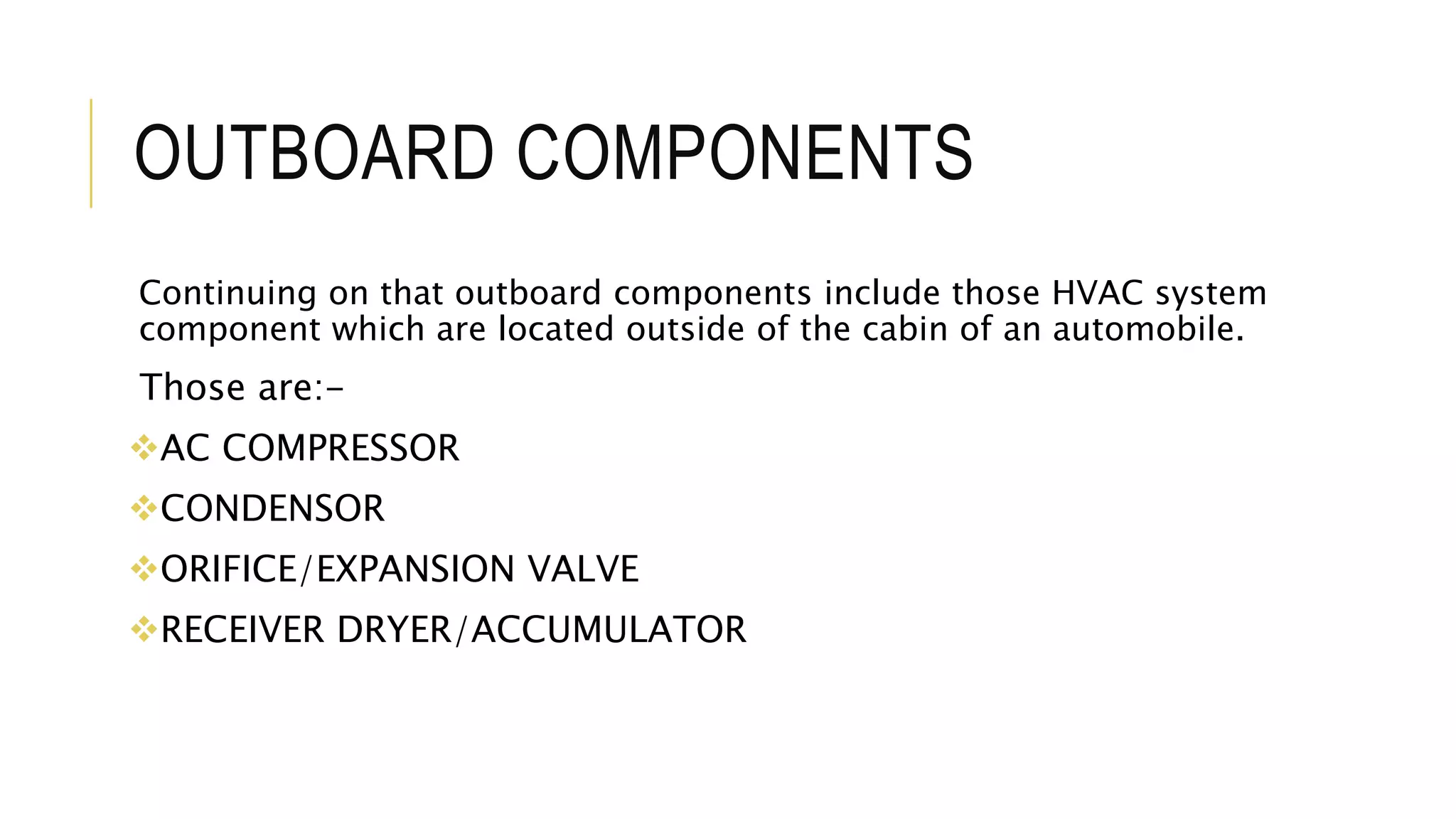
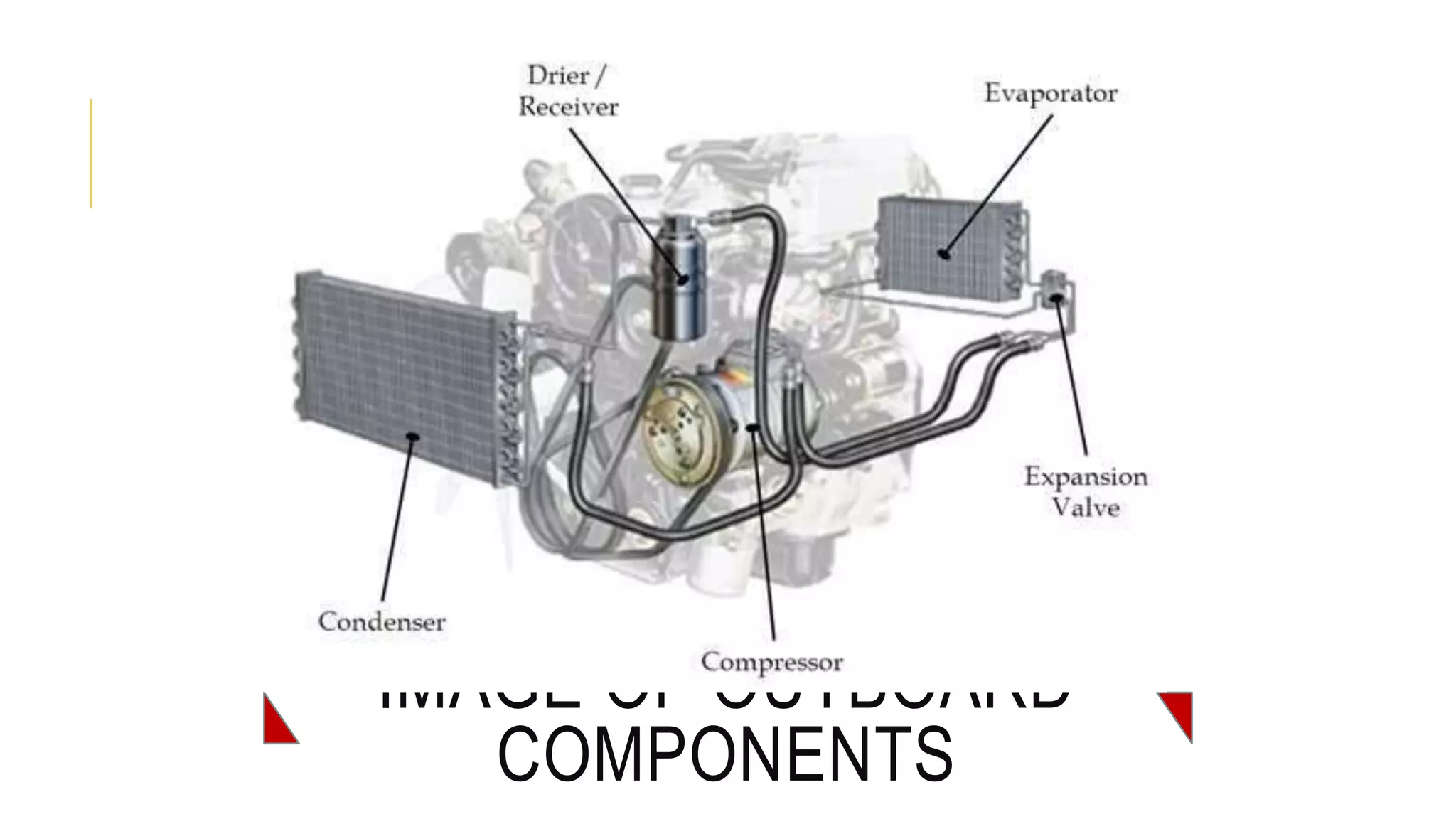
Continuing on that outboard components include those HVAC system
component which are located outside of the cabin of an automobile.
Those are:-
AC COMPRESSOR
CONDENSOR
ORIFICE/EXPANSION VALVE
RECEIVER DRYER/ACCUMULATOR
IMAGE OF OUTBOARD
COMPONENTS
ABOUT EACH COMPONENTS
OF HVAC SYSTEM
ONBOARD COMPONENTS:-
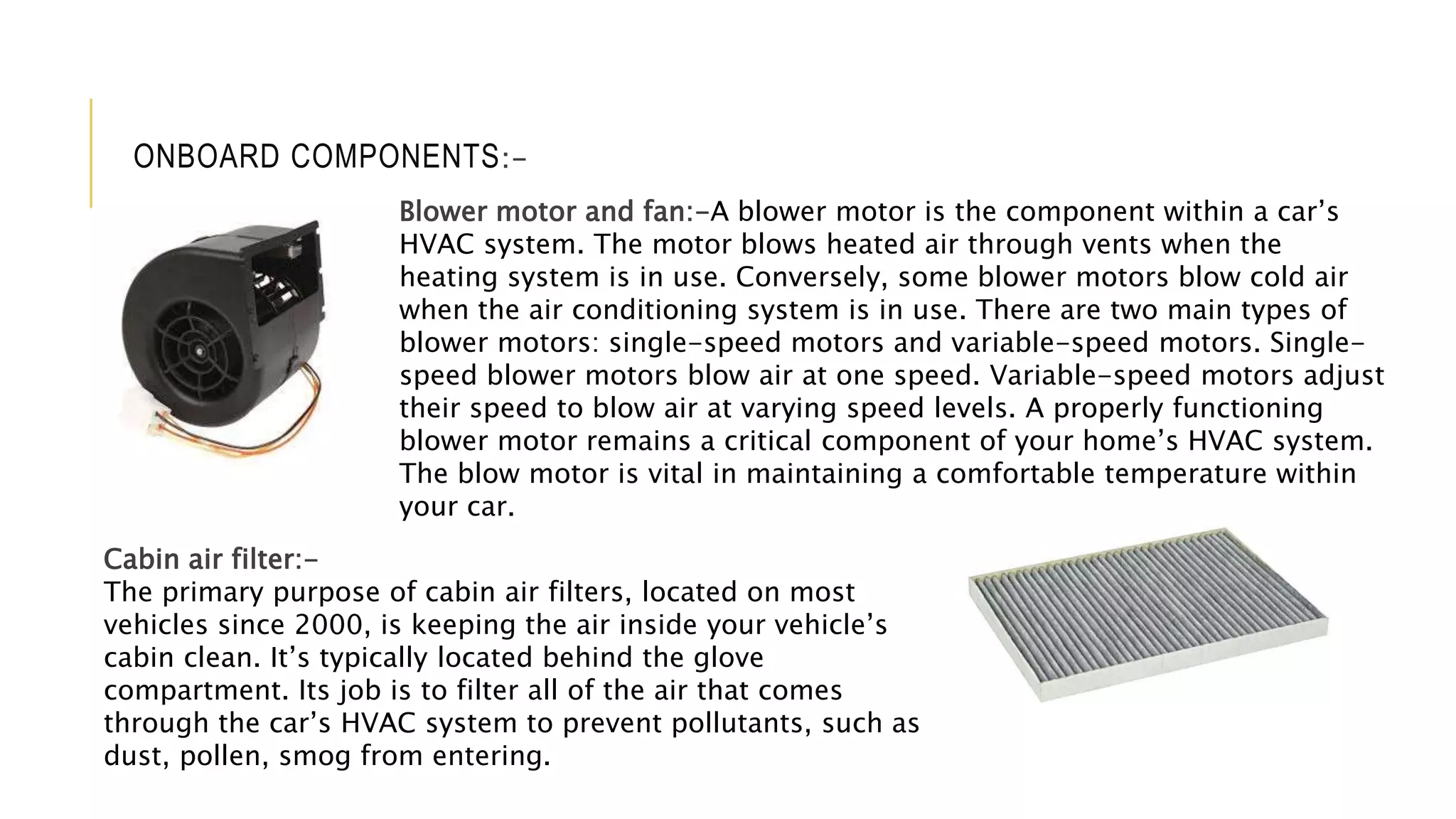
Blower motor and fan:-A blower motor is the component within a car’s
HVAC system. The motor blows heated air through vents when the
heating system is in use. Conversely, some blower motors blow cold air
when the air conditioning system is in use. There are two main types of
blower motors: single-speed motors and variable-speed motors. Single-
speed blower motors blow air at one speed. Variable-speed motors adjust
their speed to blow air at varying speed levels. A properly functioning
blower motor remains a critical component of your home’s HVAC system.
The blow motor is vital in maintaining a comfortable temperature within
your car.
Cabin air filter:-
The primary purpose of cabin air filters, located on most
vehicles since 2000, is keeping the air inside your vehicle’s
cabin clean. It’s typically located behind the glove
compartment. Its job is to filter all of the air that comes
through the car’s HVAC system to prevent pollutants, such as
dust, pollen, smog from entering.
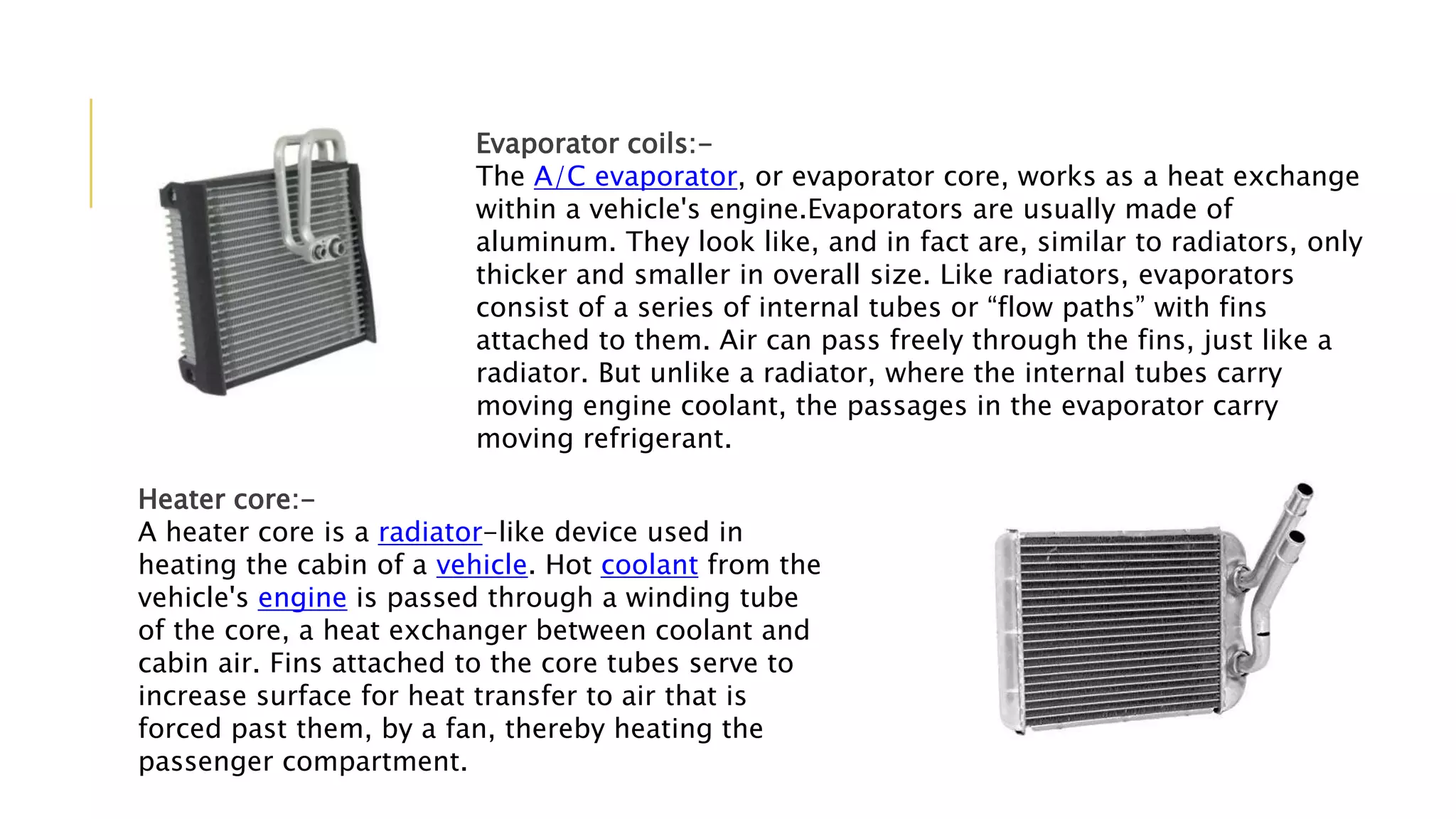
Evaporator coils:-
The A/C evaporator, or evaporator core, works as a heat exchange
within a vehicle's engine.Evaporators are usually made of
aluminum. They look like, and in fact are, similar to radiators, only
thicker and smaller in overall size. Like radiators, evaporators
consist of a series of internal tubes or “flow paths” with fins
attached to them. Air can pass freely through the fins, just like a
radiator. But unlike a radiator, where the internal tubes carry
moving engine coolant, the passages in the evaporator carry
moving refrigerant.
Heater core:-
A heater core is a radiator-like device used in
heating the cabin of a vehicle. Hot coolant from the
vehicle's engine is passed through a winding tube
of the core, a heat exchanger between coolant and
cabin air. Fins attached to the core tubes serve to
increase surface for heat transfer to air that is
forced past them, by a fan, thereby heating the
passenger compartment.
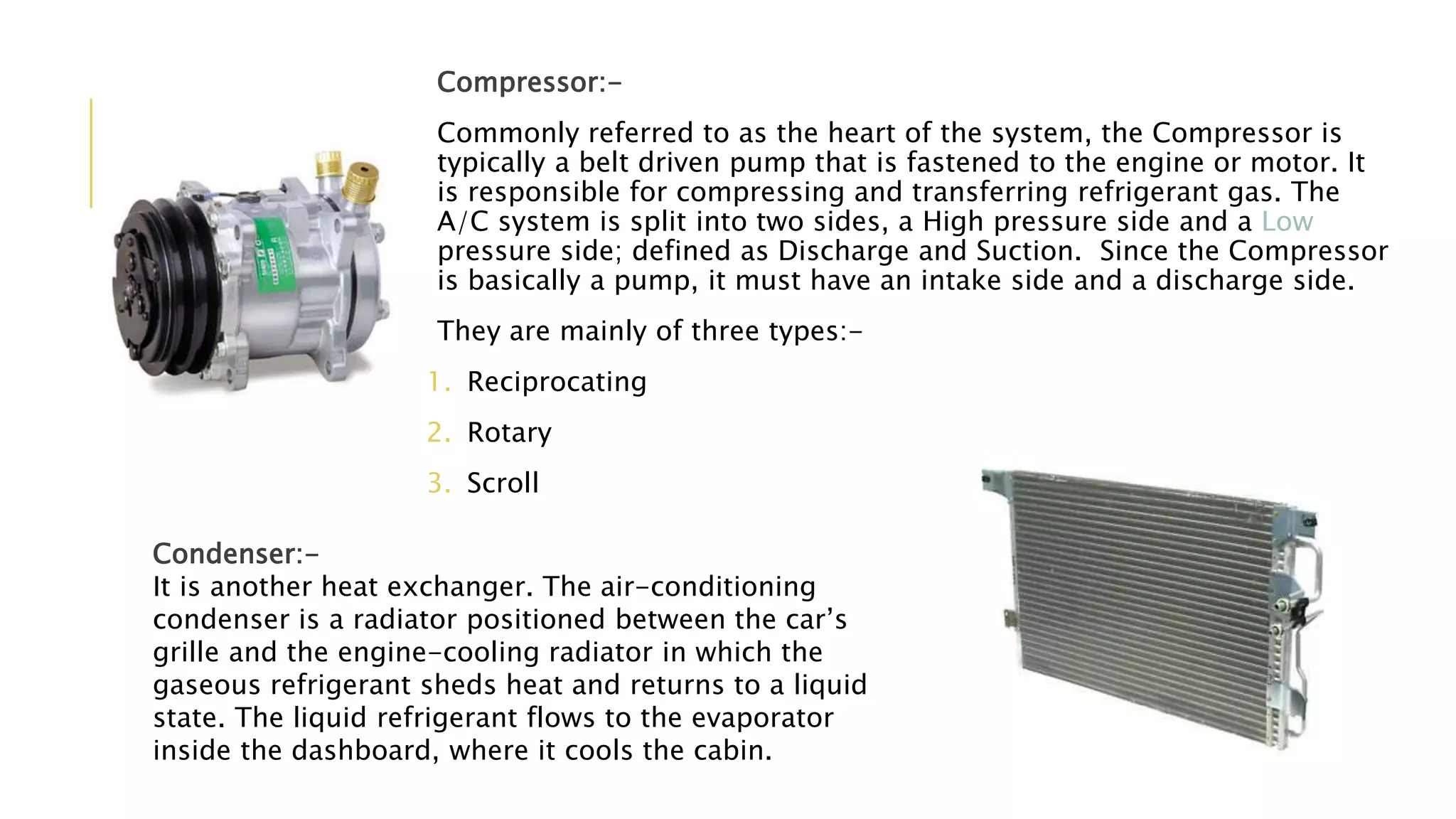
Compressor:-
Commonly referred to as the heart of the system, the Compressor is
typically a belt driven pump that is fastened to the engine or motor. It
is responsible for compressing and transferring refrigerant gas. The
A/C system is split into two sides, a High pressure side and a Low
pressure side; defined as Discharge and Suction. Since the Compressor
is basically a pump, it must have an intake side and a discharge side.
They are mainly of three types:-
1. Reciprocating
2. Rotary
3. Scroll
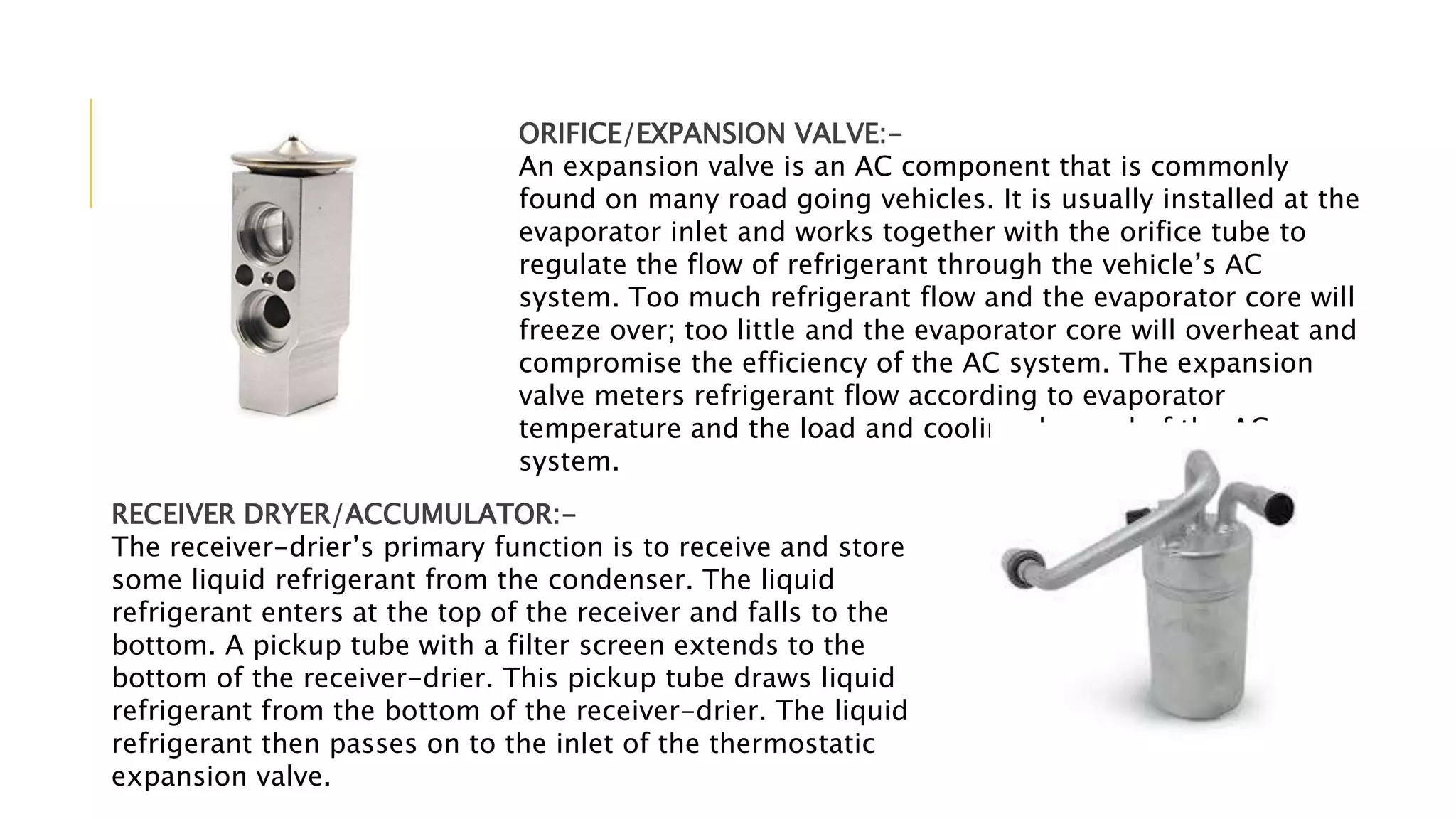
Condenser:-
It is another heat exchanger. The air-conditioning
condenser is a radiator positioned between the car’s
grille and the engine-cooling radiator in which the
gaseous refrigerant sheds heat and returns to a liquid
state. The liquid refrigerant flows to the evaporator
inside the dashboard, where it cools the cabin.
ORIFICE/EXPANSION VALVE:-
An expansion valve is an AC component that is commonly
found on many road going vehicles. It is usually installed at the
evaporator inlet and works together with the orifice tube to
regulate the flow of refrigerant through the vehicle’s AC
system. Too much refrigerant flow and the evaporator core will
freeze over; too little and the evaporator core will overheat and
compromise the efficiency of the AC system. The expansion
valve meters refrigerant flow according to evaporator
temperature and the load and cooling demand of the AC
system.
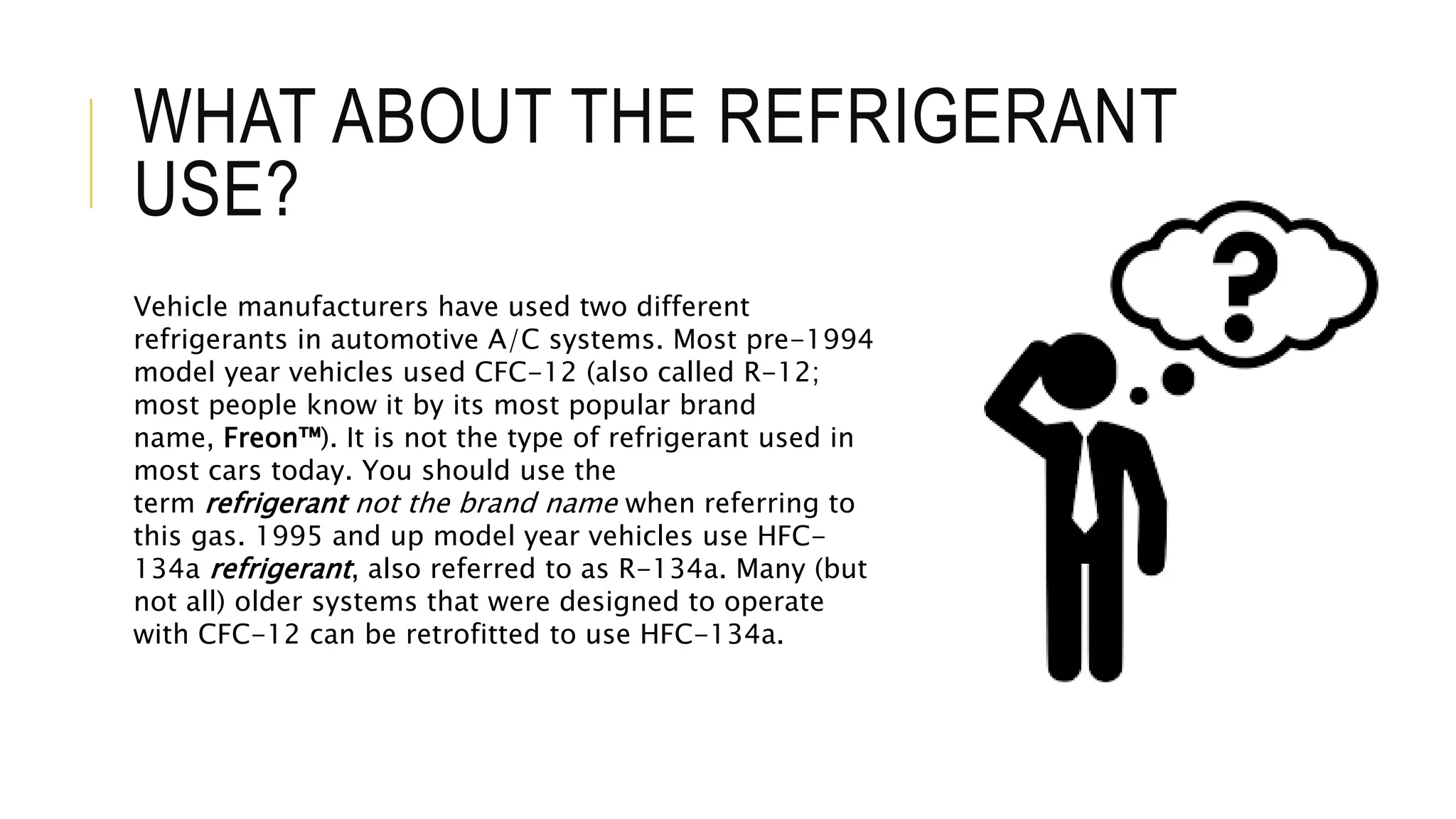
RECEIVER DRYER/ACCUMULATOR:-
The receiver-drier’s primary function is to receive and store
some liquid refrigerant from the condenser. The liquid
refrigerant enters at the top of the receiver and falls to the
bottom. A pickup tube with a filter screen extends to the
bottom of the receiver-drier. This pickup tube draws liquid
refrigerant from the bottom of the receiver-drier. The liquid
refrigerant then passes on to the inlet of the thermostatic
expansion valve.
WHAT ABOUT THE REFRIGERANT
USE?
Vehicle manufacturers have used two different
refrigerants in automotive A/C systems. Most pre-1994
model year vehicles used CFC-12 (also called R-12;
most people know it by its most popular brand
name, Freon™). It is not the type of refrigerant used in
most cars today. You should use the
term refrigerant not the brand name when referring to
this gas. 1995 and up model year vehicles use HFC-
134a refrigerant, also referred to as R-134a. Many (but
not all) older systems that were designed to operate
with CFC-12 can be retrofitted to use HFC-134a.
IMAGE OF REFRIGERANT
CONTAINER
THANKYOU!
ANY
QUESTIONS?

Presentation on automobile hvac system

  • 1.
    PRESENTATION ON AUTOMOBILE HVAC SYSTEM Submittedby:-Kartik Bhardwaj 16162039 6th sem (B.tech mechanical engg.) Submitted to :- Mr. Paramjit lamba sir Mechanical deptt. GJUS&T,Hisar
  • 2.
    SO WHAT DOESHVAC STANDS FOR? HEATING VENTILATION & AIR CONDITIONING
  • 3.
    BASIC INTRO OFAN AUTOMOTIVE HVAC SYSTEM “Your HVAC system is nothing more than a heat exchanger.” Heating, ventilation, and air conditioning (HVAC) systems are responsible for providing thermal comfort and fresh air to building occupants. Air conditioning like it says 'conditions' the air. It not only cools it down, but also reduces the moisture content, or humidity. All air conditioners work the same way whether they are installed in a building, or in a car. The fridge or freezer is in a way an air conditioner as well. It consists of refrigerant which circulates within the HVAC system and with the help of condenser and evaporator all the conditioning of cabin air is done.
  • 4.
    A BRIEF HISTORYABOUT HVAC Now that you know have basic intro about HVAC let’s know about some history of HVAC. Even early civilizations created ways for their citizens to enjoy conditioned air. Ancient Rome:-Rome was one of the first cities to influence the air within buildings. Rome’s hypocaust system was primarily used to heat the public bathhouses and saunas. A hypocaust would push heated air through a system of air ducts and under raised floors to heat a room. Ancient China:-The Han Dynasty introduce the mechanized rotary fan. A single person could manually cool an entire room using large wheels which engaged a series of interconnected fans. Early America:-Wood burning stoves helped warm early American homes beginning in the mid-1600s. In 1744, Benjamin Franklin created his own version of the cast iron stove. This new stove was more efficient than its predecessor and spread across America as settlers moved west.
  • 5.
    IMAGE OF HVACSYSTEM IN AN AUTOMOBILE
  • 6.
    COMPONENTS OF ANAUTOMOBILE HVAC SYSTEM A basic HVAC system of a automobile consists of various components like compressor, evaporator etc with each component having their respective position on the basis of their job. But they can be divided mainly into two types for:- Onboard components Outboard components
  • 7.
    0NBOARD COMPONENTS So basicallyonboard components include those HVAC system component which are located inside of the cabin of an automobile. Those are:- CABIN AIR FILTER BLOWER MOTOR AND FAN EVAPORATOR HEATER CORE
  • 8.
  • 9.
    OUTBOARD COMPONENTS Continuing onthat outboard components include those HVAC system component which are located outside of the cabin of an automobile. Those are:- AC COMPRESSOR CONDENSOR ORIFICE/EXPANSION VALVE RECEIVER DRYER/ACCUMULATOR
  • 10.
  • 11.
  • 12.
    ONBOARD COMPONENTS:- Blower motorand fan:-A blower motor is the component within a car’s HVAC system. The motor blows heated air through vents when the heating system is in use. Conversely, some blower motors blow cold air when the air conditioning system is in use. There are two main types of blower motors: single-speed motors and variable-speed motors. Single- speed blower motors blow air at one speed. Variable-speed motors adjust their speed to blow air at varying speed levels. A properly functioning blower motor remains a critical component of your home’s HVAC system. The blow motor is vital in maintaining a comfortable temperature within your car. Cabin air filter:- The primary purpose of cabin air filters, located on most vehicles since 2000, is keeping the air inside your vehicle’s cabin clean. It’s typically located behind the glove compartment. Its job is to filter all of the air that comes through the car’s HVAC system to prevent pollutants, such as dust, pollen, smog from entering.
  • 13.
    Evaporator coils:- The A/Cevaporator, or evaporator core, works as a heat exchange within a vehicle's engine.Evaporators are usually made of aluminum. They look like, and in fact are, similar to radiators, only thicker and smaller in overall size. Like radiators, evaporators consist of a series of internal tubes or “flow paths” with fins attached to them. Air can pass freely through the fins, just like a radiator. But unlike a radiator, where the internal tubes carry moving engine coolant, the passages in the evaporator carry moving refrigerant. Heater core:- A heater core is a radiator-like device used in heating the cabin of a vehicle. Hot coolant from the vehicle's engine is passed through a winding tube of the core, a heat exchanger between coolant and cabin air. Fins attached to the core tubes serve to increase surface for heat transfer to air that is forced past them, by a fan, thereby heating the passenger compartment.
  • 14.
    Compressor:- Commonly referred toas the heart of the system, the Compressor is typically a belt driven pump that is fastened to the engine or motor. It is responsible for compressing and transferring refrigerant gas. The A/C system is split into two sides, a High pressure side and a Low pressure side; defined as Discharge and Suction. Since the Compressor is basically a pump, it must have an intake side and a discharge side. They are mainly of three types:- 1. Reciprocating 2. Rotary 3. Scroll Condenser:- It is another heat exchanger. The air-conditioning condenser is a radiator positioned between the car’s grille and the engine-cooling radiator in which the gaseous refrigerant sheds heat and returns to a liquid state. The liquid refrigerant flows to the evaporator inside the dashboard, where it cools the cabin.
  • 15.
    ORIFICE/EXPANSION VALVE:- An expansionvalve is an AC component that is commonly found on many road going vehicles. It is usually installed at the evaporator inlet and works together with the orifice tube to regulate the flow of refrigerant through the vehicle’s AC system. Too much refrigerant flow and the evaporator core will freeze over; too little and the evaporator core will overheat and compromise the efficiency of the AC system. The expansion valve meters refrigerant flow according to evaporator temperature and the load and cooling demand of the AC system. RECEIVER DRYER/ACCUMULATOR:- The receiver-drier’s primary function is to receive and store some liquid refrigerant from the condenser. The liquid refrigerant enters at the top of the receiver and falls to the bottom. A pickup tube with a filter screen extends to the bottom of the receiver-drier. This pickup tube draws liquid refrigerant from the bottom of the receiver-drier. The liquid refrigerant then passes on to the inlet of the thermostatic expansion valve.
  • 16.
    WHAT ABOUT THEREFRIGERANT USE? Vehicle manufacturers have used two different refrigerants in automotive A/C systems. Most pre-1994 model year vehicles used CFC-12 (also called R-12; most people know it by its most popular brand name, Freon™). It is not the type of refrigerant used in most cars today. You should use the term refrigerant not the brand name when referring to this gas. 1995 and up model year vehicles use HFC- 134a refrigerant, also referred to as R-134a. Many (but not all) older systems that were designed to operate with CFC-12 can be retrofitted to use HFC-134a.
  • 17.
  • 18.