Republic to Empire
600 BCE – 180 AD
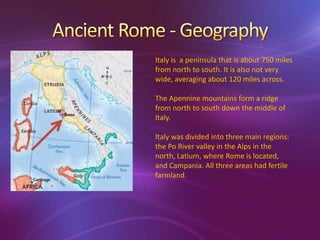
Italy is a peninsula that is about 750 miles
from north to south. It is also not very
wide, averaging about 120 miles across.

The Apennine mountains form a ridge
from north to south down the middle of
Italy.

Italy was divided into three main regions:
the Po River valley in the Alps in the
north, Latium, where Rome is located,
and Campania. All three areas had fertile
farmland.
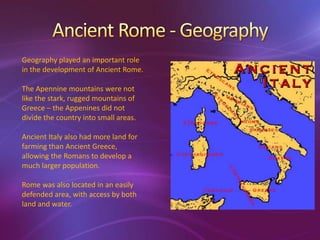
Geography played an important role
in the development of Ancient Rome.

The Apennine mountains were not
like the stark, rugged mountains of
Greece – the Appenines did not
divide the country into small areas.

Ancient Italy also had more land for
farming than Ancient Greece,
allowing the Romans to develop a
much larger population.

Rome was also located in an easily
defended area, with access by both
land and water.
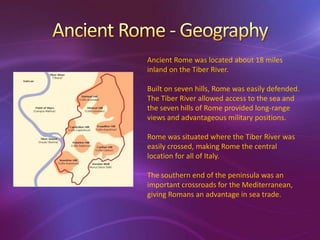
Ancient Rome was located about 18 miles
inland on the Tiber River.

Built on seven hills, Rome was easily defended.
The Tiber River allowed access to the sea and
the seven hills of Rome provided long-range
views and advantageous military positions.

Rome was situated where the Tiber River was
easily crossed, making Rome the central
location for all of Italy.

The southern end of the peninsula was an
important crossroads for the Mediterranean,
giving Romans an advantage in sea trade.
• Roman legend attributed the founding of Rome to the twins
  Romulus and Remus, who were raised by a she-wolf; when the
  twins grew, they traced the boundaries of Rome with a plow,
  marking its borders (733 BCE)
• In reality, the Romans were Indo-European people that moved
  into Italy in the period between 1000-1500 BCE
• They moved into Latium and were Latin speakers
• After 800 BCE, others began to move into Italy,
specifically the Etruscans and Greeks.
• The Greeks colonized southern Italy between 750 –
550 BCE
   •The Greeks grew olives, grapes
   •Passed on their alphabet
   •Provided model for arts
• Rome was developed by the Etruscans, from
  the Northeast part of Italy called Etruria
• After 650 BCE, they expanded into north-
  central Italy and came to control Rome and
  most of Latium
• Romans adopted Etruscan dress – the toga
  and cloak
• Roman armies were developed on Etruscan
  model
• In 509 BCE, the Romans overthrew the last
  Etruscan king and established a republic, a
  form of government in which the leader is not
  a monarch and citizens have the right to vote.
• For the first two hundred years of the
  Republic, Rome was in a constant state of war.
• In 338 BCE, the Romans crushed the state of
  Latium. They then went on the march to
  conquer the rest of italy
• By 264 BCE, the Romans conquered the Greeks
  who had colonized southern Italy and Sicily
• The Romans created a Confederation, a type of
  rule that allowed some of the conquered people
  full Roman citizenship (the right to vote and hold
  office).
• The other communities remained allied states
  and were allowed to run their own affairs as long
  as they continued to provide soldiers and taxes
  (tithes) to Rome
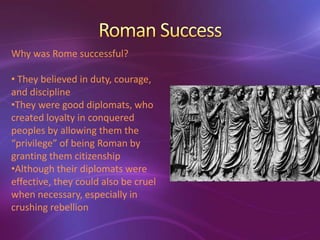
Why was Rome successful?

• They believed in duty, courage,
and discipline
•They were good diplomats, who
created loyalty in conquered
peoples by allowing them the
“privilege” of being Roman by
granting them citizenship
•Although their diplomats were
effective, they could also be cruel
when necessary, especially in
crushing rebellion
• The Roman military was a huge factor in
  Rome’s successful takeover of the Italian
  peninsula
• Large population allowed them to constantly
  replenish the army
  – If defeated, the Romans sent another army rather
    than give up
  – They built colonies throughout Italy and
    connected towns with easy to traverse roads that
    allowed for fast military movement
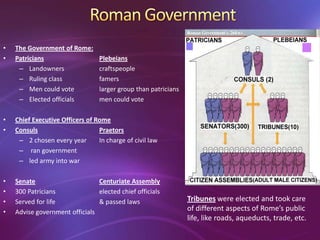
•   The Government of Rome:
•   Patricians                    Plebeians
     – Landowners                 craftspeople
     – Ruling class               famers
     – Men could vote             larger group than patricians
     – Elected officials          men could vote

•   Chief Executive Officers of Rome
•   Consuls                      Praetors
     – 2 chosen every year       In charge of civil law
     – ran government
     – led army into war

•   Senate                      Centuriate Assembly
•   300 Patricians              elected chief officials
•   Served for life             & passed laws                    Tribunes were elected and took care
•   Advise government officials                                  of different aspects of Rome’s public
                                                                 life, like roads, aqueducts, trade, etc.
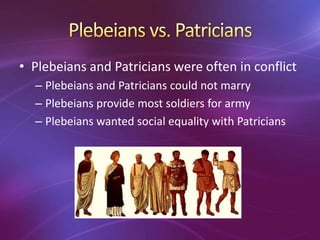
• Plebeians and Patricians were often in conflict
  – Plebeians and Patricians could not marry
  – Plebeians provide most soldiers for army
  – Plebeians wanted social equality with Patricians
• The conflict between Plebeians and Patricians
  was partially resolved in 471 BCE
  – Tribunes of the Plebeians were created
  – Were given power to protect Plebeians from
    Patrician abuses
  – In the 4th century BCE, plebeians were allowed to
    become consul
  – In 287 BCE the Council of Plebs was allowed to
    create and pass laws that affected all Romans
Rome had an elaborate system of laws that was
imitated throughout the Mediterranean.

Rome’s first code of laws was the Twelve Tables,
adopted in 450 BCE. All the Roman laws were
engraved on twelve tables.

As Rome grew, the Twelve Tables did not meet their
needs. They developed a system of civil law that
applied to all Roman citizens.

Laws were applied differently to non-Romans,
which created conflict throughout Italy. A new set
of laws, the Law of Nations, which contained
standards of justice that could be applied to
everyone.
• Many of Rome’s laws and principles are still in
  use today:
  – People were assumed innocent unless proven
    guilty
  – People accused of wrongdoing were allowed to
    defend themselves before a judge
  – Judges were expected to make decisions based on
    evidence presented in court
After Rome conquered all of
Italy and the Greek colonies on
Sicily, they faced a challenge
from Carthage.

Carthage was established in
Africa by the Phoenicians. They
had a large trading empire
throughout the Mediterranean.
The Carthaginians had a colony
on western Sicily, which made
the Romans fearful of
Carthaginian power.

In 264 BCE, Rome and Carthage
battled for control of the
Mediterranean. The wars were
Carthage were called Punic
wars, after the Latin word for
the Phoenicians, punicus.
• First Punic War:
    – Began 264 BCE, when Rome sent army to Sicily
    – Rome created a large naval fleet and defeated the Carthaginians in 241 BCE
    – Carthage gave up all rights to Sicily and paid a fine to the Romans
• Second Punic War:
    – Hannibal was major general for Carthage and vowed revenge
    – He attacked Rome in 218 BCE by moving through Spain and crossing the Alps
      with his army (including elephants!) They struggled with the Alps crossing and
      many died
    – Rome went to meet Hannibal at Cannae in 216 BCE and were slaughtered.
      Rome raised a second army to fight off Hannibal
    – Hannibal roamed Italy for nearly ten years but could not attack the major
      cities because his army wasn’t large enough
    – In 206 BCE the Romans finally pushed the Carthaginians out of Spain
    – In 202 BCE, Rome invaded Carthage in order to draw Hannibal out of Italy, it
      worked, and the Carthaginians were once again defeated
• After the Second Punic War, Italy became the
  dominant power in the Mediterranean
• Prominent Romans wanted the complete
  destruction of Carthage so they could not rise to
  power again
• In 146 BCE, the Romans invaded Carthage and
  destroyed the city; the city was burned by
  soldiers and the entire population was sold into
  slavery
• Carthage became a Roman province called Africa

Ancient rome

  • 1.
    Republic to Empire 600BCE – 180 AD
  • 2.
    Italy is apeninsula that is about 750 miles from north to south. It is also not very wide, averaging about 120 miles across. The Apennine mountains form a ridge from north to south down the middle of Italy. Italy was divided into three main regions: the Po River valley in the Alps in the north, Latium, where Rome is located, and Campania. All three areas had fertile farmland.
  • 3.
    Geography played animportant role in the development of Ancient Rome. The Apennine mountains were not like the stark, rugged mountains of Greece – the Appenines did not divide the country into small areas. Ancient Italy also had more land for farming than Ancient Greece, allowing the Romans to develop a much larger population. Rome was also located in an easily defended area, with access by both land and water.
  • 4.
    Ancient Rome waslocated about 18 miles inland on the Tiber River. Built on seven hills, Rome was easily defended. The Tiber River allowed access to the sea and the seven hills of Rome provided long-range views and advantageous military positions. Rome was situated where the Tiber River was easily crossed, making Rome the central location for all of Italy. The southern end of the peninsula was an important crossroads for the Mediterranean, giving Romans an advantage in sea trade.
  • 5.
    • Roman legendattributed the founding of Rome to the twins Romulus and Remus, who were raised by a she-wolf; when the twins grew, they traced the boundaries of Rome with a plow, marking its borders (733 BCE) • In reality, the Romans were Indo-European people that moved into Italy in the period between 1000-1500 BCE • They moved into Latium and were Latin speakers • After 800 BCE, others began to move into Italy, specifically the Etruscans and Greeks. • The Greeks colonized southern Italy between 750 – 550 BCE •The Greeks grew olives, grapes •Passed on their alphabet •Provided model for arts
  • 6.
    • Rome wasdeveloped by the Etruscans, from the Northeast part of Italy called Etruria • After 650 BCE, they expanded into north- central Italy and came to control Rome and most of Latium • Romans adopted Etruscan dress – the toga and cloak • Roman armies were developed on Etruscan model
  • 7.
    • In 509BCE, the Romans overthrew the last Etruscan king and established a republic, a form of government in which the leader is not a monarch and citizens have the right to vote. • For the first two hundred years of the Republic, Rome was in a constant state of war. • In 338 BCE, the Romans crushed the state of Latium. They then went on the march to conquer the rest of italy
  • 8.
    • By 264BCE, the Romans conquered the Greeks who had colonized southern Italy and Sicily • The Romans created a Confederation, a type of rule that allowed some of the conquered people full Roman citizenship (the right to vote and hold office). • The other communities remained allied states and were allowed to run their own affairs as long as they continued to provide soldiers and taxes (tithes) to Rome
  • 9.
    Why was Romesuccessful? • They believed in duty, courage, and discipline •They were good diplomats, who created loyalty in conquered peoples by allowing them the “privilege” of being Roman by granting them citizenship •Although their diplomats were effective, they could also be cruel when necessary, especially in crushing rebellion
  • 10.
    • The Romanmilitary was a huge factor in Rome’s successful takeover of the Italian peninsula • Large population allowed them to constantly replenish the army – If defeated, the Romans sent another army rather than give up – They built colonies throughout Italy and connected towns with easy to traverse roads that allowed for fast military movement
  • 11.
    The Government of Rome: • Patricians Plebeians – Landowners craftspeople – Ruling class famers – Men could vote larger group than patricians – Elected officials men could vote • Chief Executive Officers of Rome • Consuls Praetors – 2 chosen every year In charge of civil law – ran government – led army into war • Senate Centuriate Assembly • 300 Patricians elected chief officials • Served for life & passed laws Tribunes were elected and took care • Advise government officials of different aspects of Rome’s public life, like roads, aqueducts, trade, etc.
  • 12.
    • Plebeians andPatricians were often in conflict – Plebeians and Patricians could not marry – Plebeians provide most soldiers for army – Plebeians wanted social equality with Patricians
  • 13.
    • The conflictbetween Plebeians and Patricians was partially resolved in 471 BCE – Tribunes of the Plebeians were created – Were given power to protect Plebeians from Patrician abuses – In the 4th century BCE, plebeians were allowed to become consul – In 287 BCE the Council of Plebs was allowed to create and pass laws that affected all Romans
  • 14.
    Rome had anelaborate system of laws that was imitated throughout the Mediterranean. Rome’s first code of laws was the Twelve Tables, adopted in 450 BCE. All the Roman laws were engraved on twelve tables. As Rome grew, the Twelve Tables did not meet their needs. They developed a system of civil law that applied to all Roman citizens. Laws were applied differently to non-Romans, which created conflict throughout Italy. A new set of laws, the Law of Nations, which contained standards of justice that could be applied to everyone.
  • 15.
    • Many ofRome’s laws and principles are still in use today: – People were assumed innocent unless proven guilty – People accused of wrongdoing were allowed to defend themselves before a judge – Judges were expected to make decisions based on evidence presented in court
  • 16.
    After Rome conqueredall of Italy and the Greek colonies on Sicily, they faced a challenge from Carthage. Carthage was established in Africa by the Phoenicians. They had a large trading empire throughout the Mediterranean. The Carthaginians had a colony on western Sicily, which made the Romans fearful of Carthaginian power. In 264 BCE, Rome and Carthage battled for control of the Mediterranean. The wars were Carthage were called Punic wars, after the Latin word for the Phoenicians, punicus.
  • 17.
    • First PunicWar: – Began 264 BCE, when Rome sent army to Sicily – Rome created a large naval fleet and defeated the Carthaginians in 241 BCE – Carthage gave up all rights to Sicily and paid a fine to the Romans • Second Punic War: – Hannibal was major general for Carthage and vowed revenge – He attacked Rome in 218 BCE by moving through Spain and crossing the Alps with his army (including elephants!) They struggled with the Alps crossing and many died – Rome went to meet Hannibal at Cannae in 216 BCE and were slaughtered. Rome raised a second army to fight off Hannibal – Hannibal roamed Italy for nearly ten years but could not attack the major cities because his army wasn’t large enough – In 206 BCE the Romans finally pushed the Carthaginians out of Spain – In 202 BCE, Rome invaded Carthage in order to draw Hannibal out of Italy, it worked, and the Carthaginians were once again defeated
  • 18.
    • After theSecond Punic War, Italy became the dominant power in the Mediterranean • Prominent Romans wanted the complete destruction of Carthage so they could not rise to power again • In 146 BCE, the Romans invaded Carthage and destroyed the city; the city was burned by soldiers and the entire population was sold into slavery • Carthage became a Roman province called Africa