LESSON PLAN for GRADE 7
Subject/Learning Area: Enrichment Class (Public Speaking)
Year Level: SSC Grade 7
Section: Polaris, Rigel and Procyon
Time: M(2:3-45), T(3:45-4:45) and F(8:15-9:15)
Date: August 4, 2015
I. OBJECTIVES
At the end of the session, students must have:
a. identified what is storytelling, its importance and the do’s and don’ts in storytelling.
b. described the difference of storytelling among the various public speaking activities.
c. employed the general rules in storytelling.
II. SUBJECT MATTER
Topic: Storytelling
Reference: Tell Me the Story by Wendy C. Collins, pp. 1-12
(http://www.qualityspeech.com/v/vspfiles/downloadables/storytelling%20book.pdf)
Materials: mystery box with different nouns inside, cartolina, whiteboard and marker.
III. LEARNING PROCEDURE
TEACHER’S DIALOGUE STUDENTS’ DIALOGUE
A. Learning Activity
Good morning Grade 7.
Facilitators, kindly lead our prayer for
today.
B. Motivation
For today, I will be the one who’ll lead
the ice breaker. So class, are you ready
for our activity?
So our game will be called CONNECT
THE NOUNS.
So this game is about making your own
story. BUT, with a new twist!
Here is my mystery box. You need to
pick two nouns at the same time. After
that, you need to create your own story
connecting the nouns you have selected.
Are you now ready class?
So I would like five volunteers to start
our game.
(This game will be for 10 minutes only.)
C. Introduction
Alright. Now, let’s get into our business
Good morning Ma’am Jane and Ma’am
Jovs.
Yes Ma’am.
Yes Ma’am.
for today. Our activity is very relevant to
our topic which is all about
STORYTELLING. Does anyone know
about storytelling? Or how it becomes
different from any other public speaking
activities?
Okay very good Student A.
Class, let us remember that storytelling is
a wonderful art that is meant to be shared
with others. Story presentation is not as
critical and demanding as other forms of
speech because it needs not be word
perfect or memorized.
D. Lesson Proper
Now, let us know the different purposes
of storytelling.
1. STORYTELLING DEVELOPS
IMAGINATION.
So why do you think it develops our
imagination?
A story allows you to mentally create the
most elaborate and the most splendid
settings, the most interesting characters
and the most spine tingling adventures.
So, the storyteller paints the scene while
the listener sees it with his mind’s eyes.
Remember that a good storyteller can
paint a vivid picture in the listener’s mind
that is more splendid and creative than
any flat visual could possibly be.
2. STORYTELLING WIDENS
LISTENERS’ HORIZONS.
A story can teach the listeners about life
in another city of life in another country.
It helps the listeners understand what
other people are like, how they feel, how
they think and how they live. It can give
the listeners new ideas that never crossed
their path before.
3. STORYTELLING GIVES
ENJOYMENT.
Listeners are delighted to hear stories,
right?
So having a good story, you can transport
your audience to another world. Then it
Storytelling is a kind of public speaking
activity which uses books. The reader
will read the story to the audience with
appropriate costumes and with the
presence of emotions and feelings, sound
variations and gestures.
Learners’ responses may vary.
Yes Ma’am.
will affect their mood. It can lighten and
uplift their spirits.
4. STORYTELLING HELPS
SOLVE PROBLEMS.
Listening to the conflicts the trouble the
characters in the story and hearing how
they solve the problems actually gives us
valuable lessons. We may learn not only
what to do rather we may learn things we
need not to do. Without even realizing it,
the storyteller actually gives us the most
valuable pieces of advice.
Again, let us enumerate the four purposes
of storytelling.
So now that we have known its
importance, let us take note of the DO’S
and DON’TS in storytelling.
1. DO MAKE IT INTERESTING.
As we have discussed earlier, storytelling
develops our imagination and gives
enjoyment. So keep the pace lively! Act
out your stories! It is good to vary your
style of presentation now and keep the
interest.
2. DON’T BE FRIVOLOUS
THAT THE MESSAGE IS
LOST.
Fun means noisy and chaotic at times.
Remember to let your audience know
that you expect them to behave. It is a
time when you want to get across a
serious image. Keep a balance.
3. DO EXPECT THE AUDIENCE
TO BEHAVE.
The storyteller is the one responsible for
the discipline. One of his jobs is to
maintain control. Let your audience
know that goofing around will not be
tolerated.
4. DO GIVE A CLEAR
MESSAGE, INTENT and
PLAN of ACTION.
For example:
MESSAGE: God has plans for you.
INTENT: You need to obey and follow
God’s plan.
PLAN of ACTION: Enumerate practical
things you can do to obey and follow
God.
These are (1) Storytelling develops
imagination. (2) It widens the horizons.
(3) It gives enjoyment and (4) It helps
solve problems.
So these are the four important things we
need to remember. Hence, we should
apply these in order to be successful in
our storytelling.
So class, do you understand?
Do you have any questions?
Clarifications?
E. Generalizations
Remember class that STORYTELLING
is one of the most fun and least
intimidating type of public speaking
activity. Thus, it helps in enhancing our
vocabulary through listening of different
stories. It also enables us to develop our
expressions, emotions and feelings.
Yes Ma’am.
None Ma’am.
IV. EVALUATION
(Students’ performance will serve as an evaluative tool.)
The class will be divided into five groups. Each group will choose what will be the theme of
their story. For that, they will need to prepare for the stage design/production since each member
will follow the theme they have decided.
V. AGREEMENT
It’s storytelling time! Next meeting will be your performance day. Each student should prepare a
not more than 5-minute story. Also prepare for the appropriate costumes and all necessary things
which will be used in your performance.
Checked by:
MRS. JOSEPHINE JANE H. DABUCO
Cooperating Teacher, INHS
Prepared by:
JOVELYN R. AZUELO
BSEd English, WVSU

STORYTELLING Lesson Plan

  • 1.
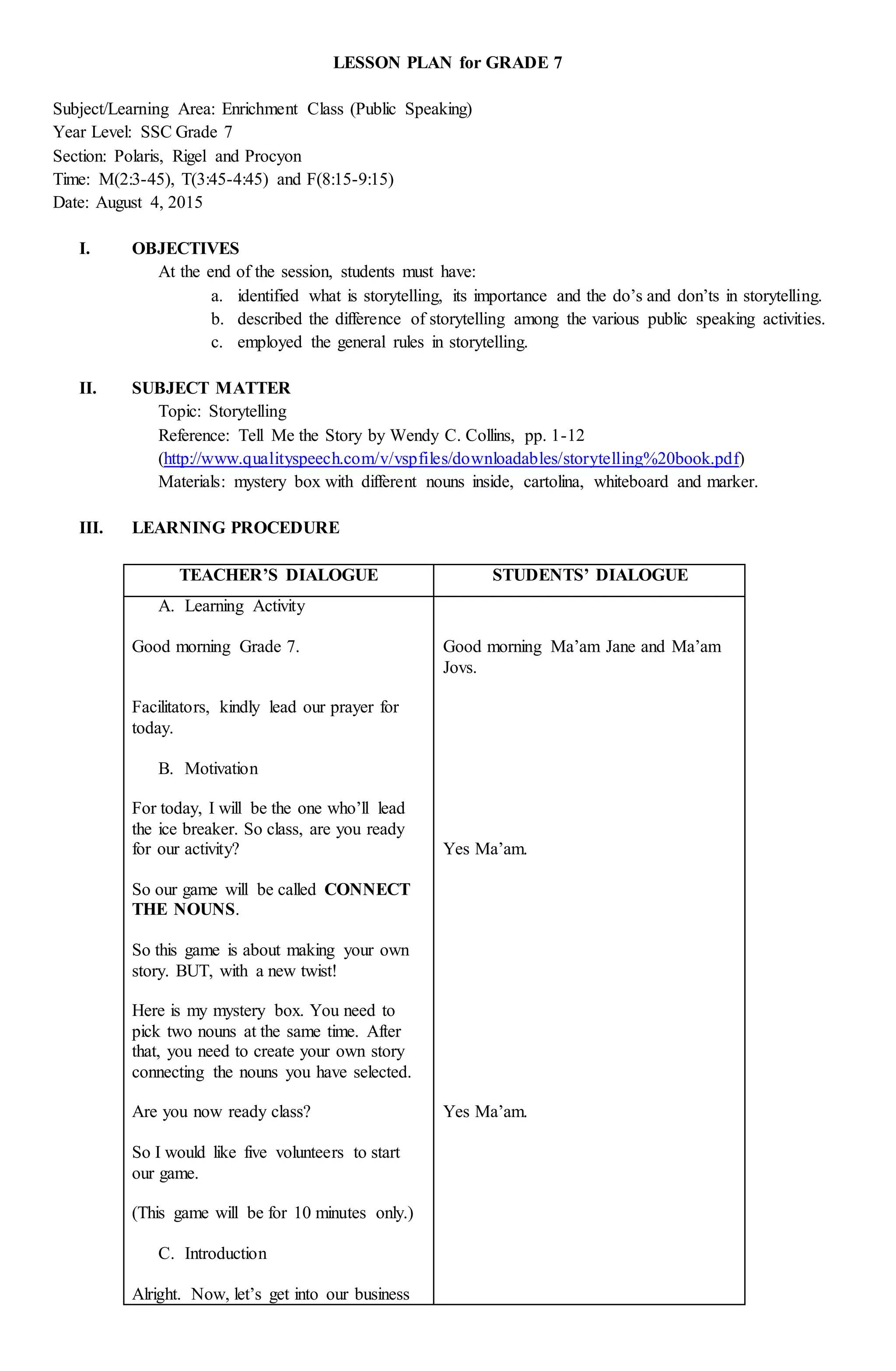
    LESSON PLAN forGRADE 7 Subject/Learning Area: Enrichment Class (Public Speaking) Year Level: SSC Grade 7 Section: Polaris, Rigel and Procyon Time: M(2:3-45), T(3:45-4:45) and F(8:15-9:15) Date: August 4, 2015 I. OBJECTIVES At the end of the session, students must have: a. identified what is storytelling, its importance and the do’s and don’ts in storytelling. b. described the difference of storytelling among the various public speaking activities. c. employed the general rules in storytelling. II. SUBJECT MATTER Topic: Storytelling Reference: Tell Me the Story by Wendy C. Collins, pp. 1-12 (http://www.qualityspeech.com/v/vspfiles/downloadables/storytelling%20book.pdf) Materials: mystery box with different nouns inside, cartolina, whiteboard and marker. III. LEARNING PROCEDURE TEACHER’S DIALOGUE STUDENTS’ DIALOGUE A. Learning Activity Good morning Grade 7. Facilitators, kindly lead our prayer for today. B. Motivation For today, I will be the one who’ll lead the ice breaker. So class, are you ready for our activity? So our game will be called CONNECT THE NOUNS. So this game is about making your own story. BUT, with a new twist! Here is my mystery box. You need to pick two nouns at the same time. After that, you need to create your own story connecting the nouns you have selected. Are you now ready class? So I would like five volunteers to start our game. (This game will be for 10 minutes only.) C. Introduction Alright. Now, let’s get into our business Good morning Ma’am Jane and Ma’am Jovs. Yes Ma’am. Yes Ma’am.
  • 2.
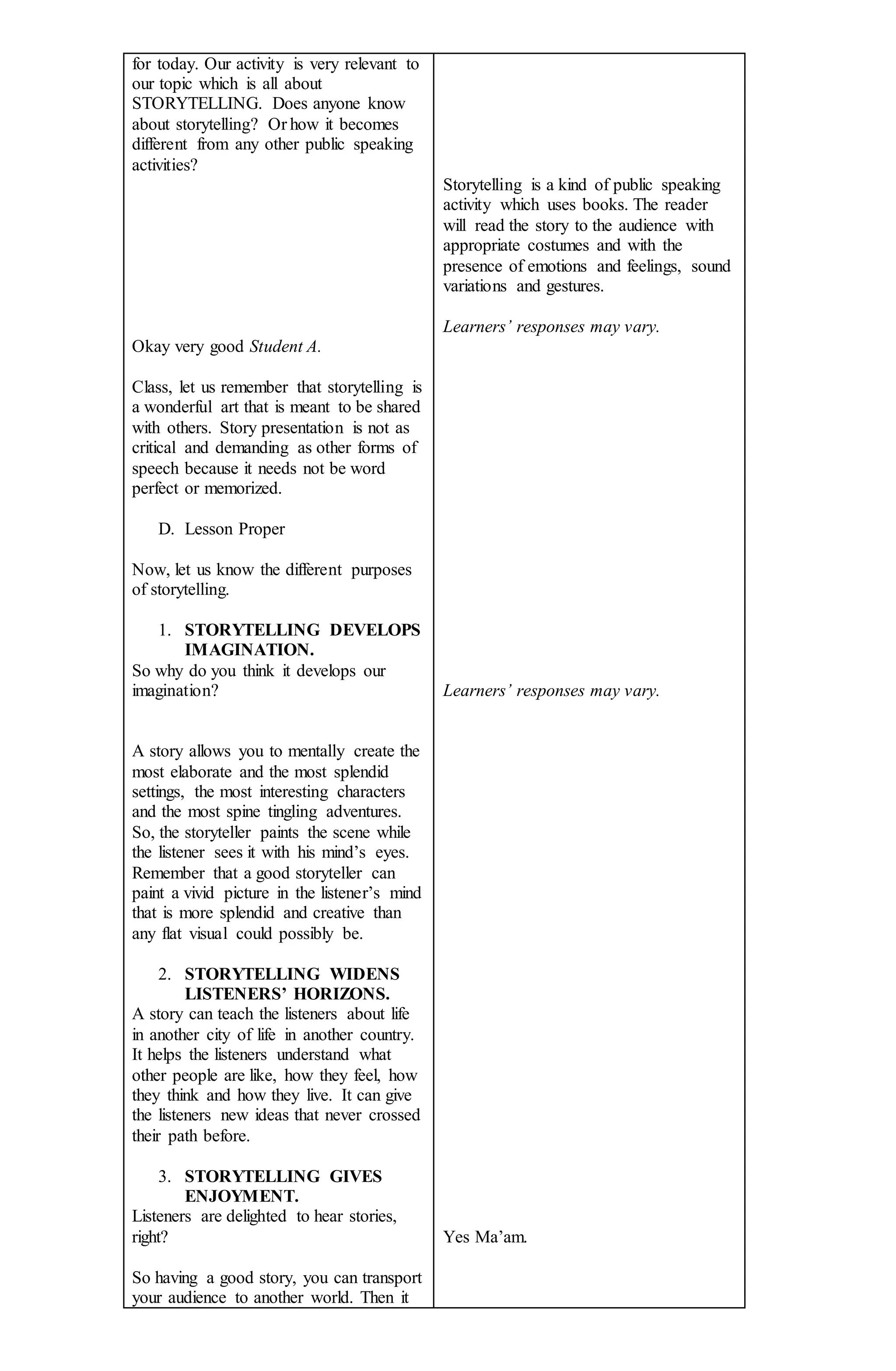
    for today. Ouractivity is very relevant to our topic which is all about STORYTELLING. Does anyone know about storytelling? Or how it becomes different from any other public speaking activities? Okay very good Student A. Class, let us remember that storytelling is a wonderful art that is meant to be shared with others. Story presentation is not as critical and demanding as other forms of speech because it needs not be word perfect or memorized. D. Lesson Proper Now, let us know the different purposes of storytelling. 1. STORYTELLING DEVELOPS IMAGINATION. So why do you think it develops our imagination? A story allows you to mentally create the most elaborate and the most splendid settings, the most interesting characters and the most spine tingling adventures. So, the storyteller paints the scene while the listener sees it with his mind’s eyes. Remember that a good storyteller can paint a vivid picture in the listener’s mind that is more splendid and creative than any flat visual could possibly be. 2. STORYTELLING WIDENS LISTENERS’ HORIZONS. A story can teach the listeners about life in another city of life in another country. It helps the listeners understand what other people are like, how they feel, how they think and how they live. It can give the listeners new ideas that never crossed their path before. 3. STORYTELLING GIVES ENJOYMENT. Listeners are delighted to hear stories, right? So having a good story, you can transport your audience to another world. Then it Storytelling is a kind of public speaking activity which uses books. The reader will read the story to the audience with appropriate costumes and with the presence of emotions and feelings, sound variations and gestures. Learners’ responses may vary. Learners’ responses may vary. Yes Ma’am.
  • 3.
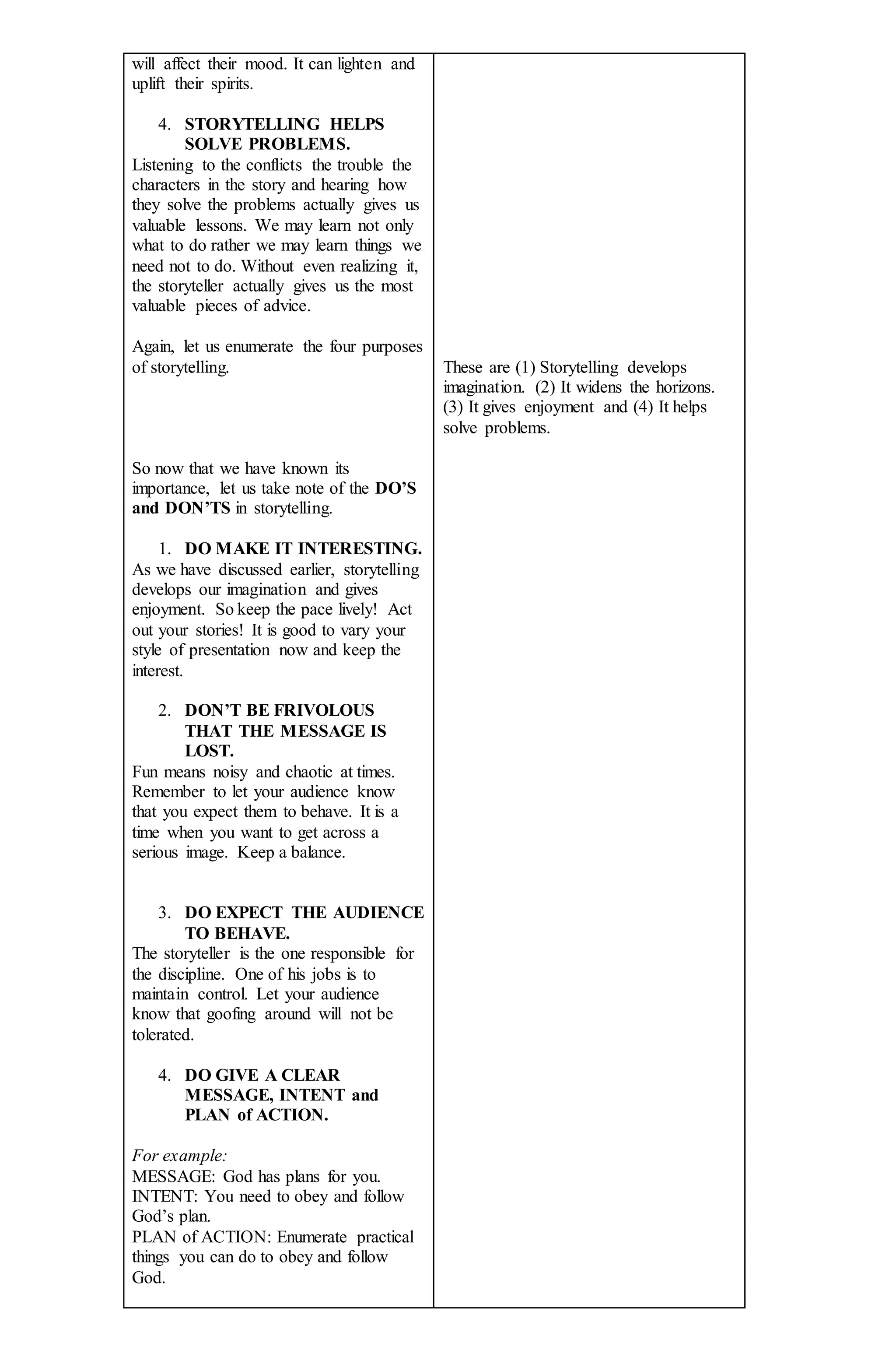
    will affect theirmood. It can lighten and uplift their spirits. 4. STORYTELLING HELPS SOLVE PROBLEMS. Listening to the conflicts the trouble the characters in the story and hearing how they solve the problems actually gives us valuable lessons. We may learn not only what to do rather we may learn things we need not to do. Without even realizing it, the storyteller actually gives us the most valuable pieces of advice. Again, let us enumerate the four purposes of storytelling. So now that we have known its importance, let us take note of the DO’S and DON’TS in storytelling. 1. DO MAKE IT INTERESTING. As we have discussed earlier, storytelling develops our imagination and gives enjoyment. So keep the pace lively! Act out your stories! It is good to vary your style of presentation now and keep the interest. 2. DON’T BE FRIVOLOUS THAT THE MESSAGE IS LOST. Fun means noisy and chaotic at times. Remember to let your audience know that you expect them to behave. It is a time when you want to get across a serious image. Keep a balance. 3. DO EXPECT THE AUDIENCE TO BEHAVE. The storyteller is the one responsible for the discipline. One of his jobs is to maintain control. Let your audience know that goofing around will not be tolerated. 4. DO GIVE A CLEAR MESSAGE, INTENT and PLAN of ACTION. For example: MESSAGE: God has plans for you. INTENT: You need to obey and follow God’s plan. PLAN of ACTION: Enumerate practical things you can do to obey and follow God. These are (1) Storytelling develops imagination. (2) It widens the horizons. (3) It gives enjoyment and (4) It helps solve problems.
  • 4.
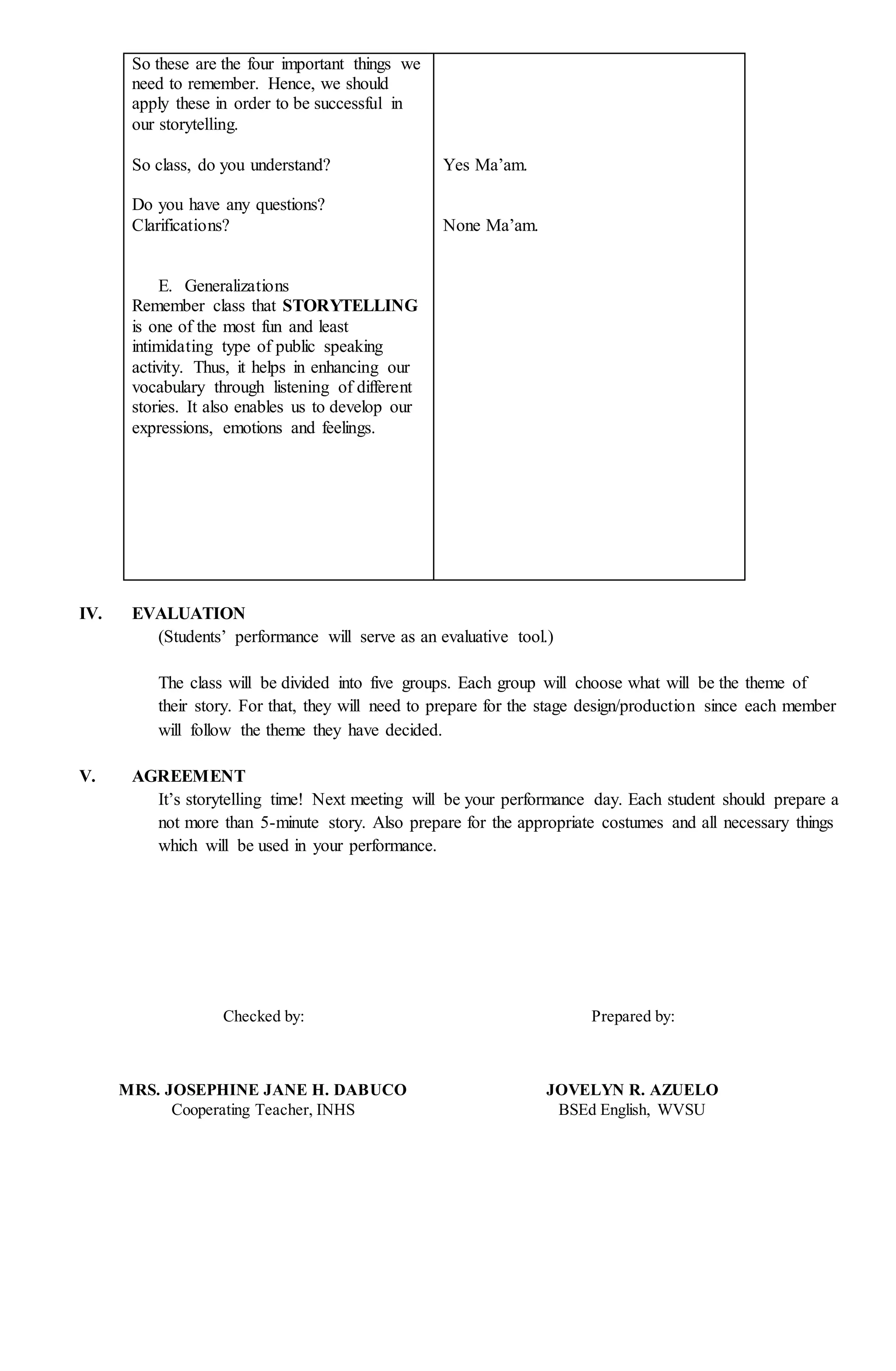
    So these arethe four important things we need to remember. Hence, we should apply these in order to be successful in our storytelling. So class, do you understand? Do you have any questions? Clarifications? E. Generalizations Remember class that STORYTELLING is one of the most fun and least intimidating type of public speaking activity. Thus, it helps in enhancing our vocabulary through listening of different stories. It also enables us to develop our expressions, emotions and feelings. Yes Ma’am. None Ma’am. IV. EVALUATION (Students’ performance will serve as an evaluative tool.) The class will be divided into five groups. Each group will choose what will be the theme of their story. For that, they will need to prepare for the stage design/production since each member will follow the theme they have decided. V. AGREEMENT It’s storytelling time! Next meeting will be your performance day. Each student should prepare a not more than 5-minute story. Also prepare for the appropriate costumes and all necessary things which will be used in your performance. Checked by: MRS. JOSEPHINE JANE H. DABUCO Cooperating Teacher, INHS Prepared by: JOVELYN R. AZUELO BSEd English, WVSU