Line-Focus Principle & Anode
Heel Effect
Cline Reeve Venci L. Argallon
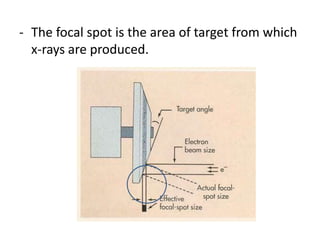
- The focal spot is the area of target from which
x-rays are produced.
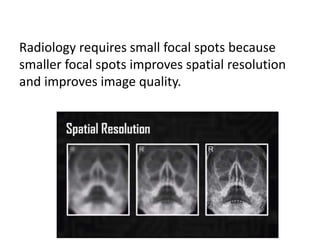
Radiology requires small focal spots because
smaller focal spots improves spatial resolution
and improves image quality.
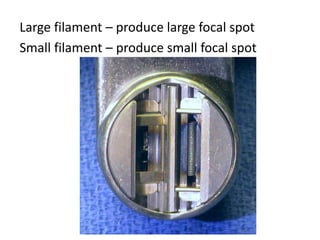
Large filament – produce large focal spot
Small filament – produce small focal spot
In general, large body parts will
require the selection of the
large focal spot setting and
small parts, require the small
focal spot.
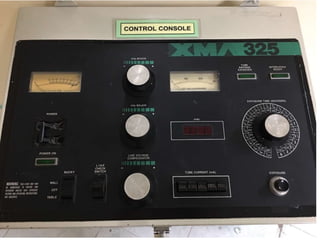
• 300 mA and above uses large focal spot
• 300 mA and below small and large focal spot
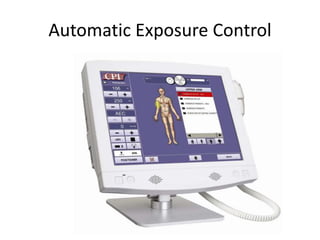
Automatic Exposure Control
Line-focus principle
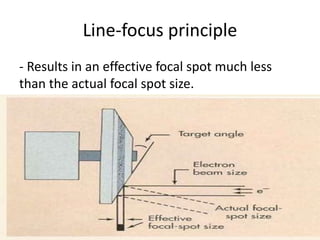
- Results in an effective focal spot much less
than the actual focal spot size.
Line-focus principle
Effective focal spot must always be smaller than
the actual focal spot.
Actual focal spot must be large enough to
accommodate more heat dissipation.
Line-focus principle
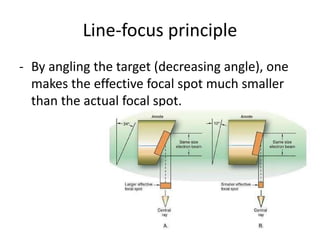
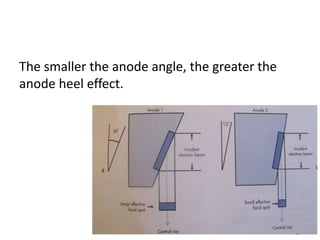
- By angling the target (decreasing angle), one
makes the effective focal spot much smaller
than the actual focal spot.
As target angle decreases, so
does the effective focal spot.
Diagnostic x-ray tube has 5-20
degrees target angle.
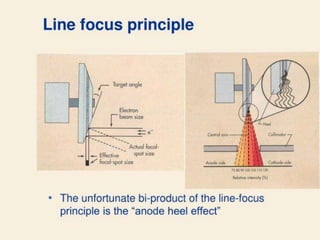
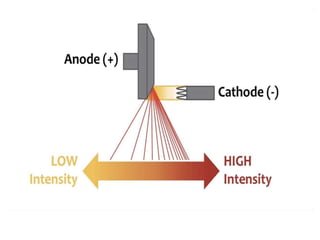
The smaller the anode angle, the greater the
anode heel effect.
X-ray tube must have a small
effective focal spot and target
angle but minimal anode heel
effect.
Line focus-principle-and-anode-heel-effect

  • 1.
    Line-Focus Principle &Anode Heel Effect Cline Reeve Venci L. Argallon
  • 2.
    - The focalspot is the area of target from which x-rays are produced.
  • 3.
    Radiology requires smallfocal spots because smaller focal spots improves spatial resolution and improves image quality.
  • 4.
    Large filament –produce large focal spot Small filament – produce small focal spot
  • 5.
    In general, largebody parts will require the selection of the large focal spot setting and small parts, require the small focal spot.
  • 6.
    • 300 mAand above uses large focal spot • 300 mA and below small and large focal spot
  • 8.
  • 11.
    Line-focus principle - Resultsin an effective focal spot much less than the actual focal spot size.
  • 12.
    Line-focus principle Effective focalspot must always be smaller than the actual focal spot. Actual focal spot must be large enough to accommodate more heat dissipation.
  • 13.
    Line-focus principle - Byangling the target (decreasing angle), one makes the effective focal spot much smaller than the actual focal spot.
  • 14.
    As target angledecreases, so does the effective focal spot. Diagnostic x-ray tube has 5-20 degrees target angle.
  • 16.
    The smaller theanode angle, the greater the anode heel effect.
  • 18.
    X-ray tube musthave a small effective focal spot and target angle but minimal anode heel effect.