Augsburg University of Applied Sciences | Faculty of Mechanical and Process Engineering
Brno University of Technology | Faculty of Mechanical Engineering |
Institute of Process and Environmental Engineering
Projektování a řízení procesů (KPJ)
Conceptual Design of Distillation, Absorption
and Stripping Systems
Prof. Dr.-Ing. Marcus Reppich
Room D5/249
 marcus.reppich@hs-augsburg.de
Important notice: These documents are to be used exclusively for study purposes, they are made available to
participants of the lecture Conceptual Design of Distillation, Absorption and Stripping Systems (Projektování a
řízení procesů, KPJ) at the Institute of Process and Environmental Engineering at the Brno University of Tech-
nology only.
Cover image: Copyright by BASF SE
Conceptual Design of Distillation, Absorption and Stripping Systems
Timetable and Contents of Lectures and Exercises
Lectures
19.11.2013 P 09 Fundamentals of Binary Distillation
26.11.2013 P 10 Types of Distillation Columns
03.12.2013 P 11 Design of Distillation Columns
Exercises
19.11.2013 Assignment date
26.11.2013 C 10
Design of a Multicomponent Distillation System Using the Process
Simulation Software CHEMCAD
(group work of two students, elaboration of a final project
report)
03.12.2013 C 11
10.12.2013 C 12
13.12.2013 Due date
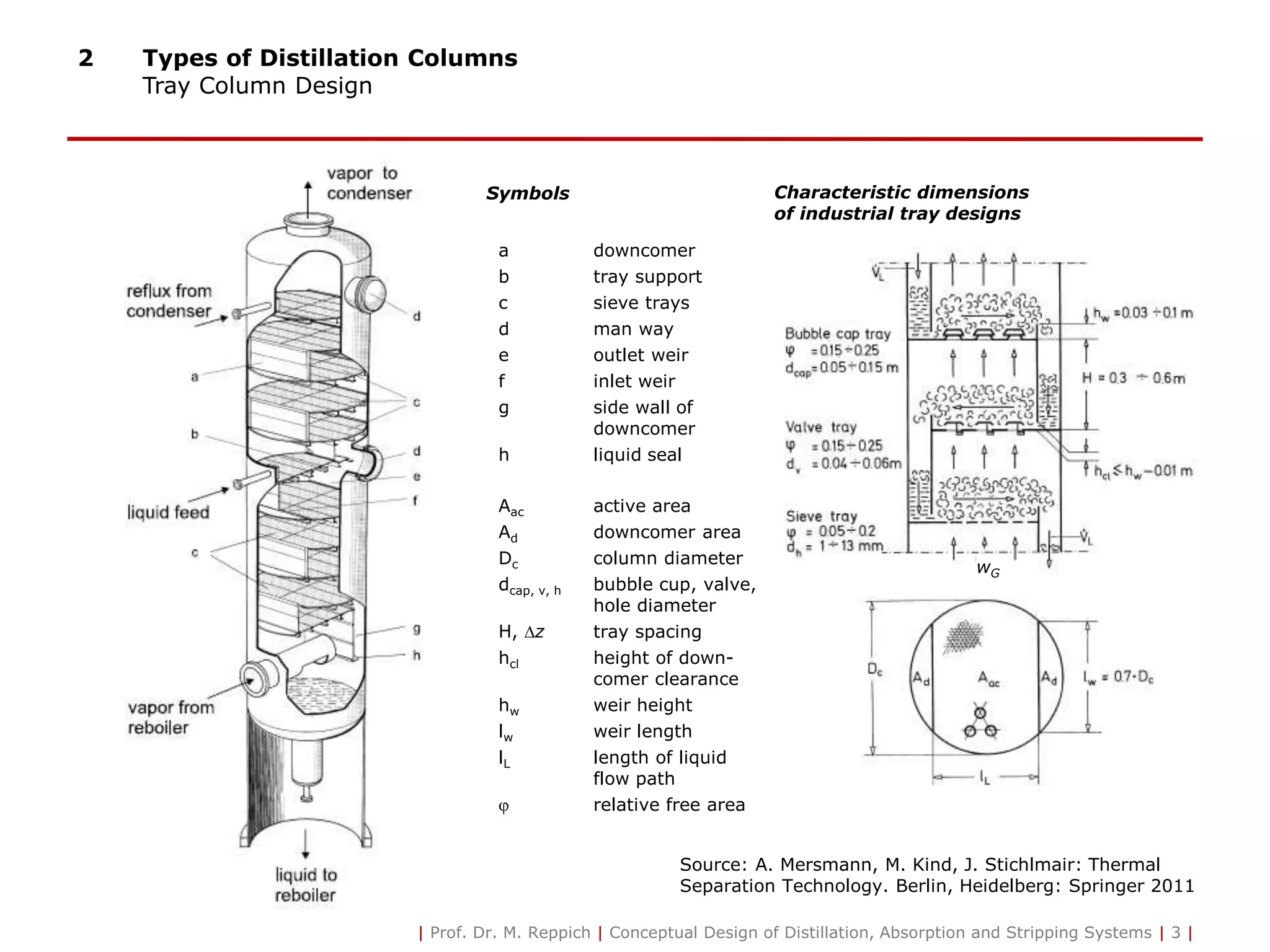
2 Types of Distillation Columns
Tray Column Design
Source: A. Mersmann, M. Kind, J. Stichlmair: Thermal
Separation Technology. Berlin, Heidelberg: Springer 2011
Symbols
a downcomer
b tray support
c sieve trays
d man way
e outlet weir
f inlet weir
g side wall of
downcomer
h liquid seal
Aac active area
Ad downcomer area
Dc column diameter
dcap, v, h bubble cup, valve,
hole diameter
H, z tray spacing
hcl height of down-
comer clearance
hw weir height
lw weir length
lL length of liquid
flow path
 relative free area
Characteristic dimensions
of industrial tray designs
wG
| Prof. Dr. M. Reppich | Conceptual Design of Distillation, Absorption and Stripping Systems | 3 |
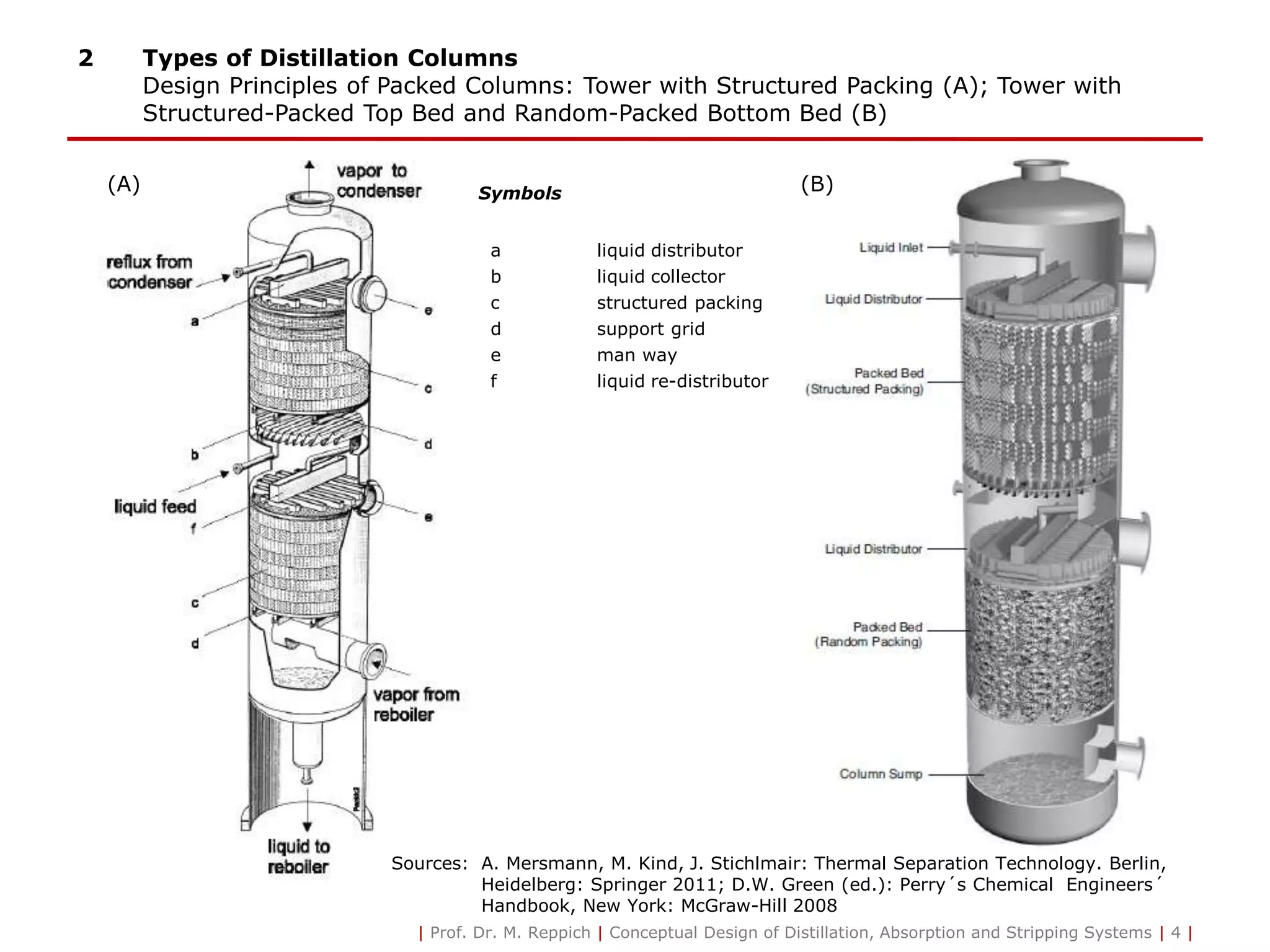
2 Types of Distillation Columns
Design Principles of Packed Columns: Tower with Structured Packing (A); Tower with
Structured-Packed Top Bed and Random-Packed Bottom Bed (B)
Symbols
a liquid distributor
b liquid collector
c structured packing
d support grid
e man way
f liquid re-distributor
(A) (B)
Sources: A. Mersmann, M. Kind, J. Stichlmair: Thermal Separation Technology. Berlin,
Heidelberg: Springer 2011; D.W. Green (ed.): Perry´s Chemical Engineers´
Handbook, New York: McGraw-Hill 2008
| Prof. Dr. M. Reppich | Conceptual Design of Distillation, Absorption and Stripping Systems | 4 |
2 Types of Distillation Columns
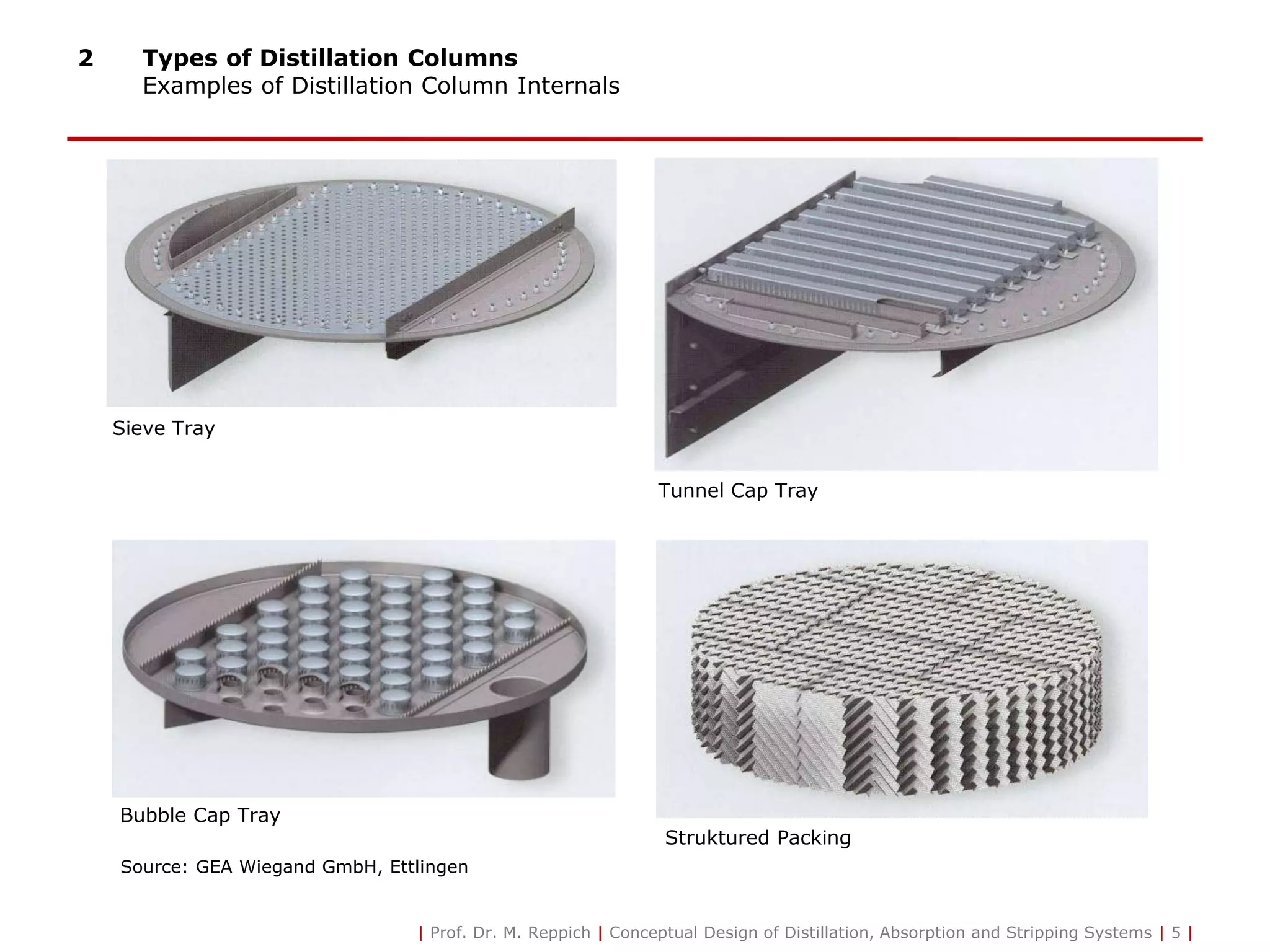
Examples of Distillation Column Internals
Source: GEA Wiegand GmbH, Ettlingen
Sieve Tray
Bubble Cap Tray
Tunnel Cap Tray
Struktured Packing
| Prof. Dr. M. Reppich | Conceptual Design of Distillation, Absorption and Stripping Systems | 5 |
2 Types of Distillation Columns
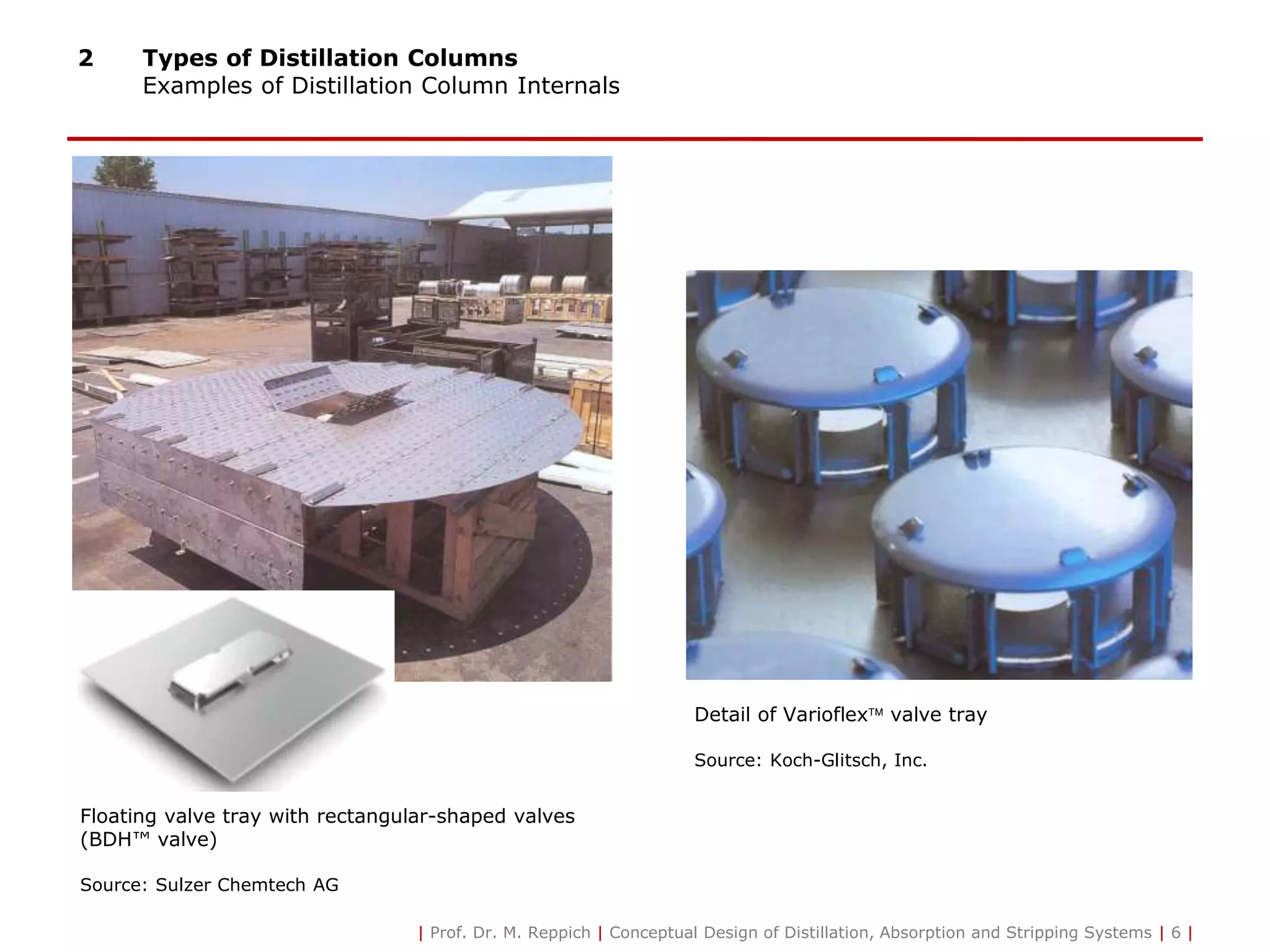
Examples of Distillation Column Internals
Floating valve tray with rectangular-shaped valves
(BDH™ valve)
Source: Sulzer Chemtech AG
Detail of Varioflex valve tray
Source: Koch-Glitsch, Inc.
| Prof. Dr. M. Reppich | Conceptual Design of Distillation, Absorption and Stripping Systems | 6 |
2 Types of Distillation Columns
Examples of Distillation Column Internals
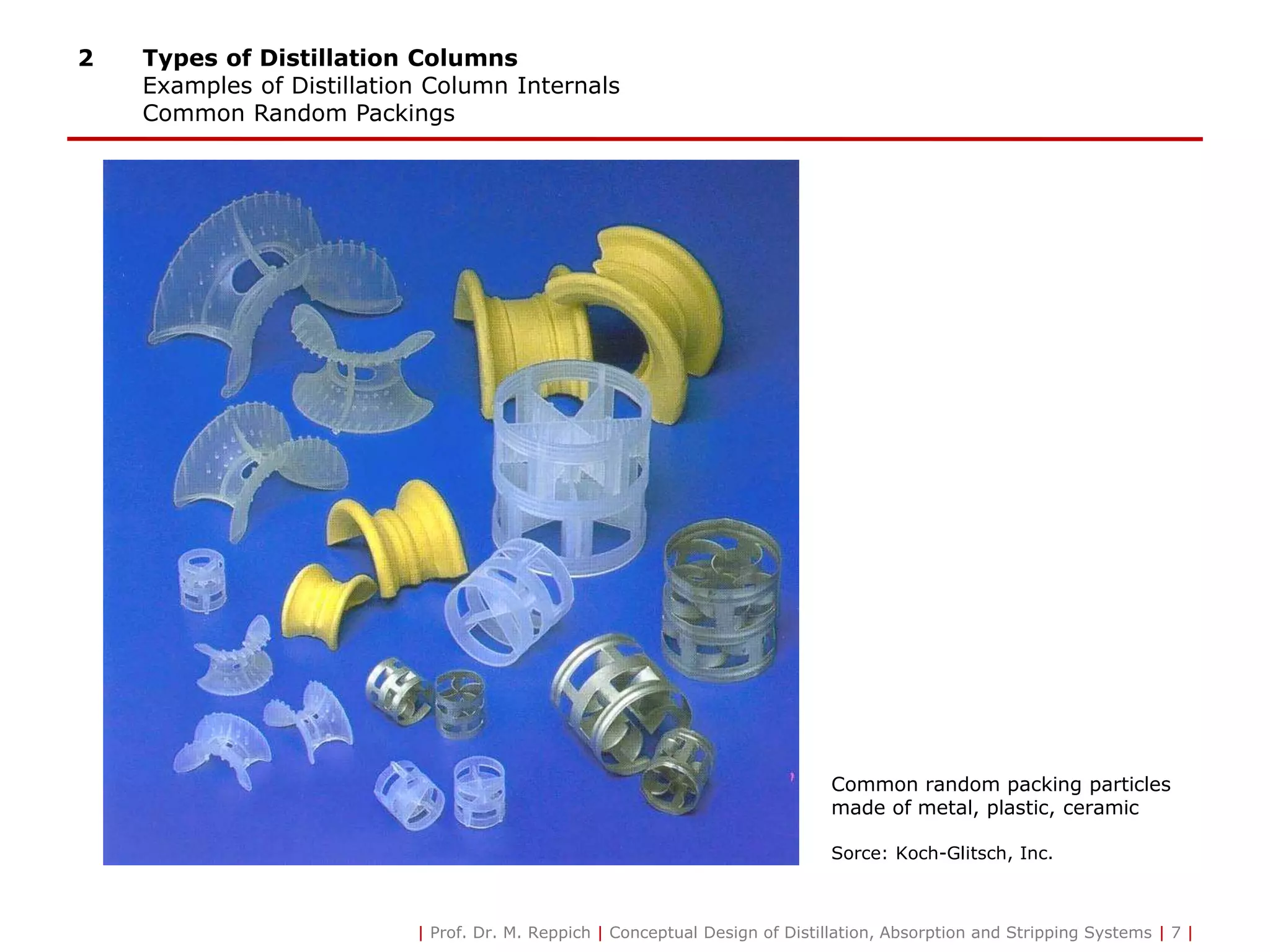
Common Random Packings
Common random packing particles
made of metal, plastic, ceramic
Sorce: Koch-Glitsch, Inc.
| Prof. Dr. M. Reppich | Conceptual Design of Distillation, Absorption and Stripping Systems | 7 |
2 Types of Distillation Columns
Examples of Distillation Column Internals
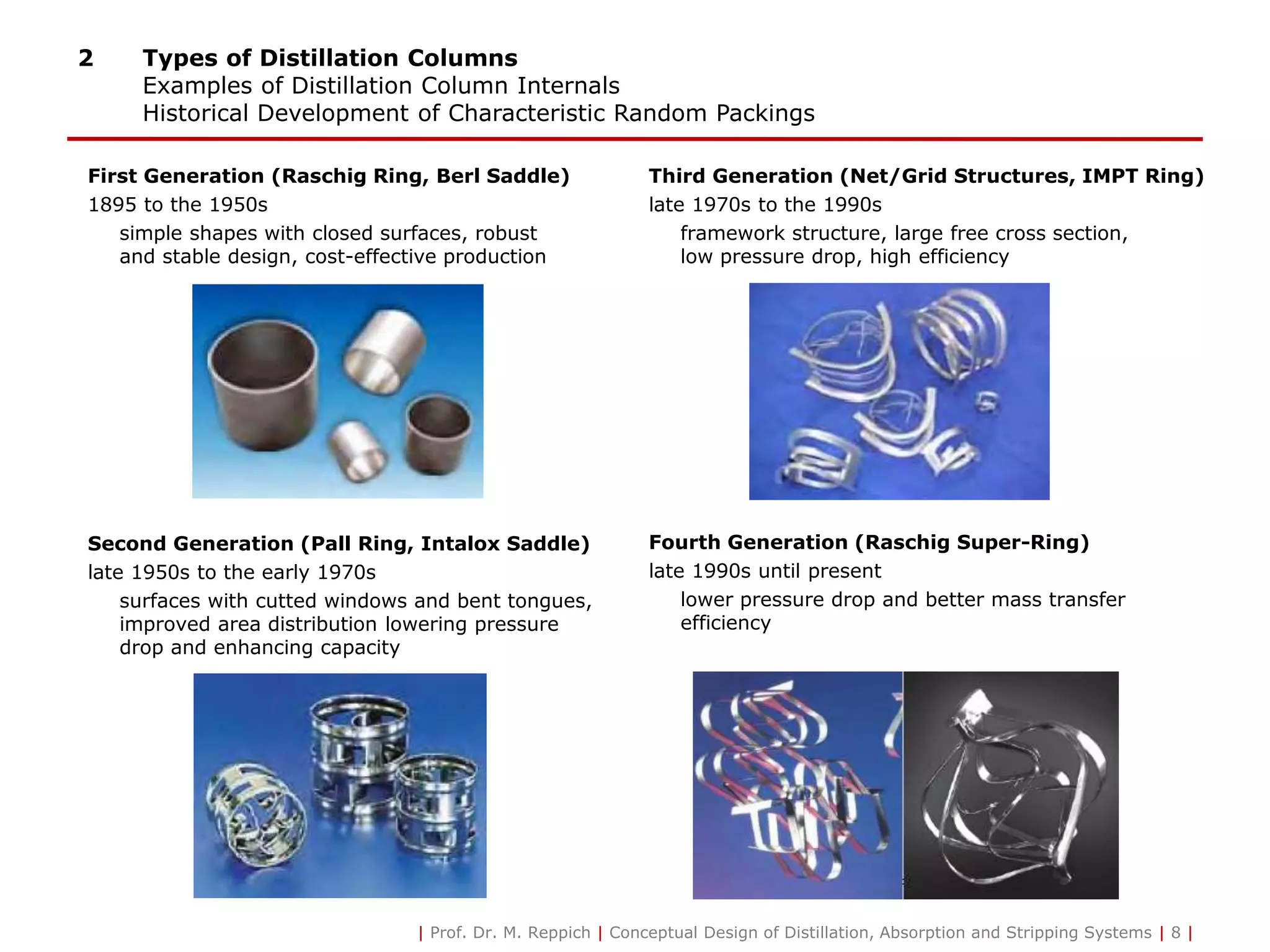
Historical Development of Characteristic Random Packings
First Generation (Raschig Ring, Berl Saddle)
1895 to the 1950s
simple shapes with closed surfaces, robust
and stable design, cost-effective production
Second Generation (Pall Ring, Intalox Saddle)
late 1950s to the early 1970s
surfaces with cutted windows and bent tongues,
improved area distribution lowering pressure
drop and enhancing capacity
Third Generation (Net/Grid Structures, IMPT Ring)
late 1970s to the 1990s
framework structure, large free cross section,
low pressure drop, high efficiency
Fourth Generation (Raschig Super-Ring)
late 1990s until present
lower pressure drop and better mass transfer
efficiency
| Prof. Dr. M. Reppich | Conceptual Design of Distillation, Absorption and Stripping Systems | 8 |
2 Types of Distillation Columns
Examples of Distillation Column Internals
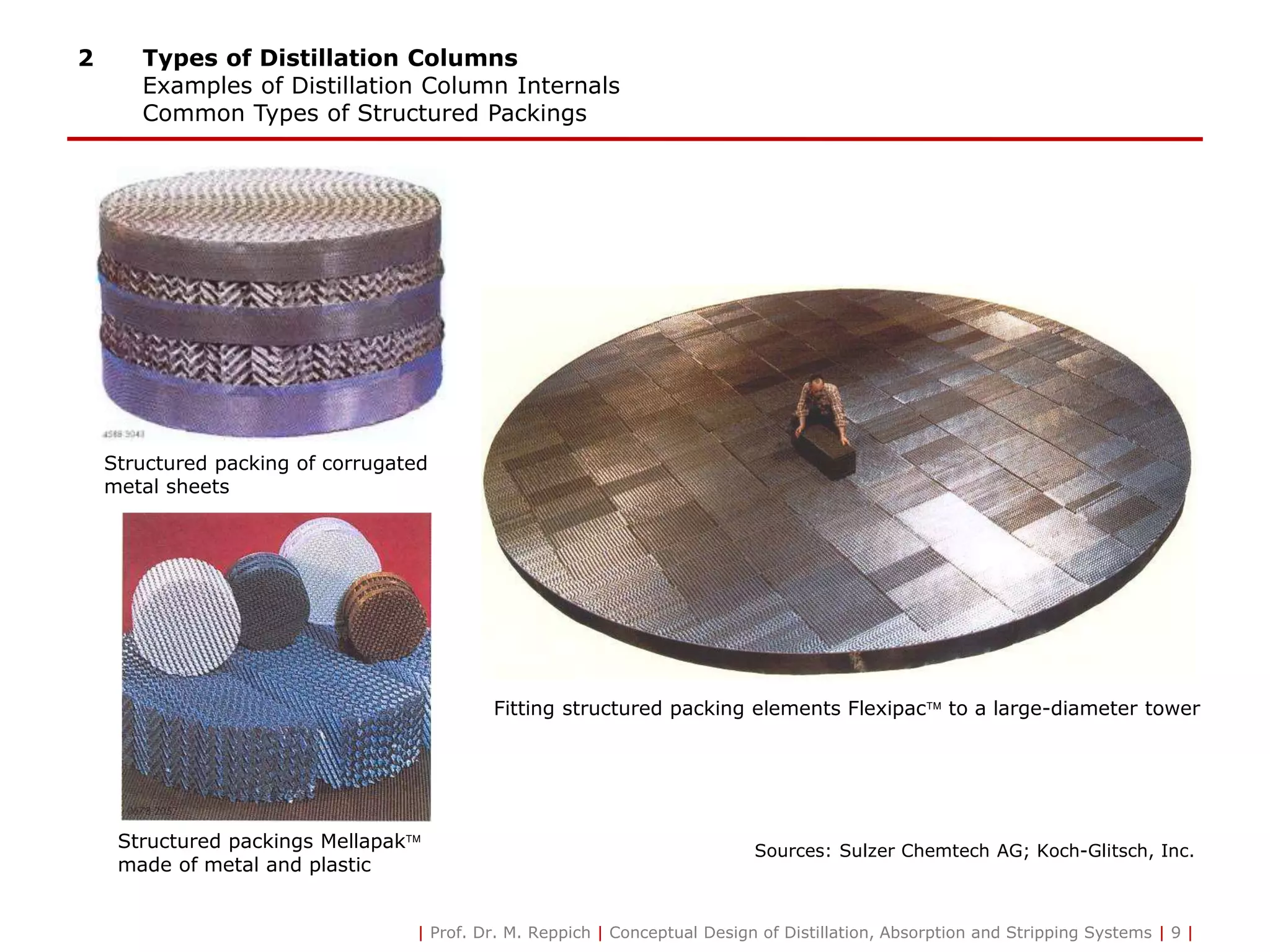
Common Types of Structured Packings
Sources: Sulzer Chemtech AG; Koch-Glitsch, Inc.
Structured packing of corrugated
metal sheets
Structured packings Mellapak
made of metal and plastic
Fitting structured packing elements Flexipac to a large-diameter tower
| Prof. Dr. M. Reppich | Conceptual Design of Distillation, Absorption and Stripping Systems | 9 |
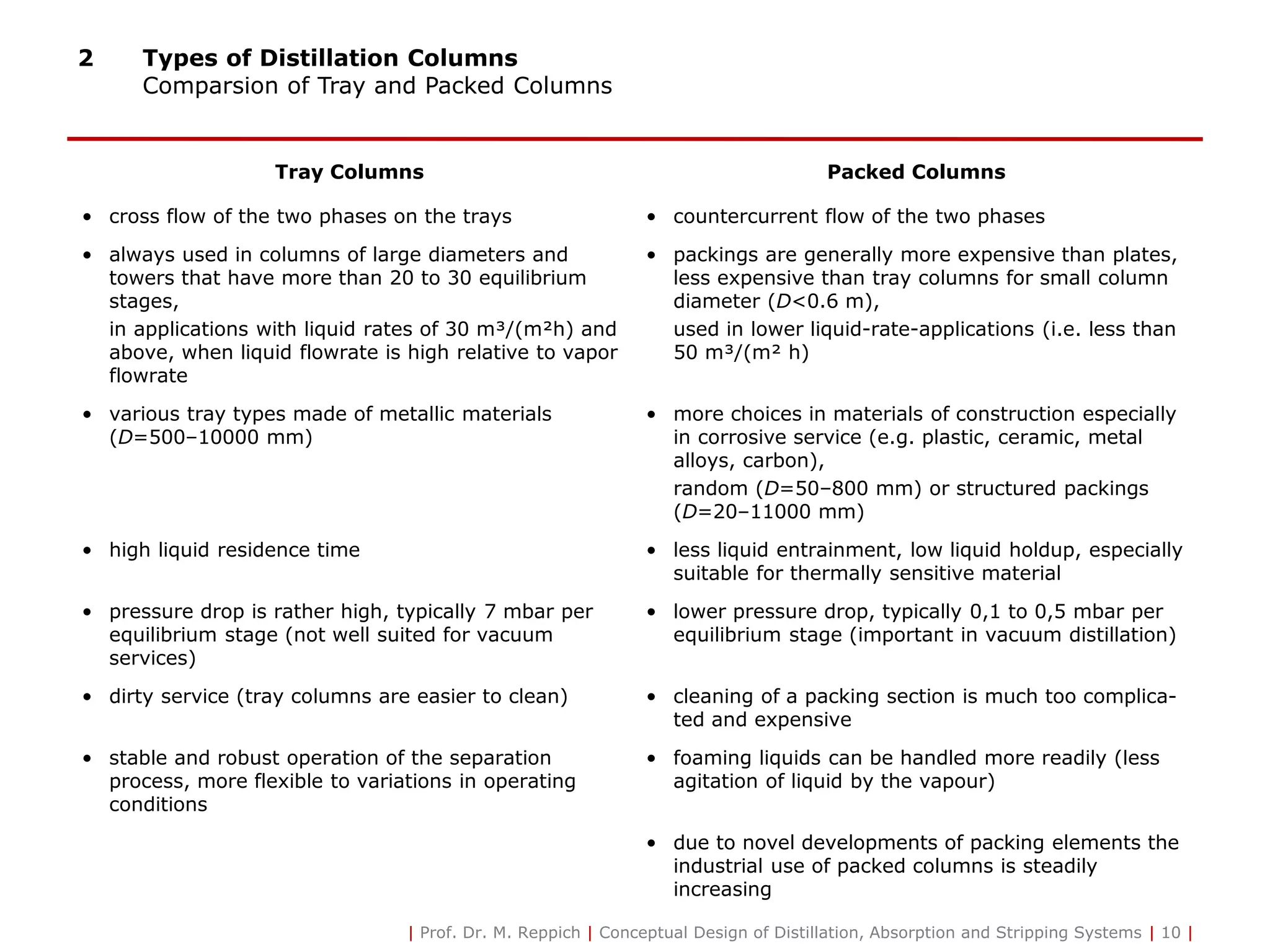
Tray Columns Packed Columns
• cross flow of the two phases on the trays • countercurrent flow of the two phases
• always used in columns of large diameters and
towers that have more than 20 to 30 equilibrium
stages,
in applications with liquid rates of 30 m³/(m²h) and
above, when liquid flowrate is high relative to vapor
flowrate
• packings are generally more expensive than plates,
less expensive than tray columns for small column
diameter (D<0.6 m),
used in lower liquid-rate-applications (i.e. less than
50 m³/(m² h)
• various tray types made of metallic materials
(D=500–10000 mm)
• more choices in materials of construction especially
in corrosive service (e.g. plastic, ceramic, metal
alloys, carbon),
random (D=50–800 mm) or structured packings
(D=20–11000 mm)
• high liquid residence time • less liquid entrainment, low liquid holdup, especially
suitable for thermally sensitive material
• pressure drop is rather high, typically 7 mbar per
equilibrium stage (not well suited for vacuum
services)
• lower pressure drop, typically 0,1 to 0,5 mbar per
equilibrium stage (important in vacuum distillation)
• dirty service (tray columns are easier to clean) • cleaning of a packing section is much too complica-
ted and expensive
• stable and robust operation of the separation
process, more flexible to variations in operating
conditions
• foaming liquids can be handled more readily (less
agitation of liquid by the vapour)
• due to novel developments of packing elements the
industrial use of packed columns is steadily
increasing
2 Types of Distillation Columns
Comparsion of Tray and Packed Columns
| Prof. Dr. M. Reppich | Conceptual Design of Distillation, Absorption and Stripping Systems | 10 |
2 Types of Distillation Columns
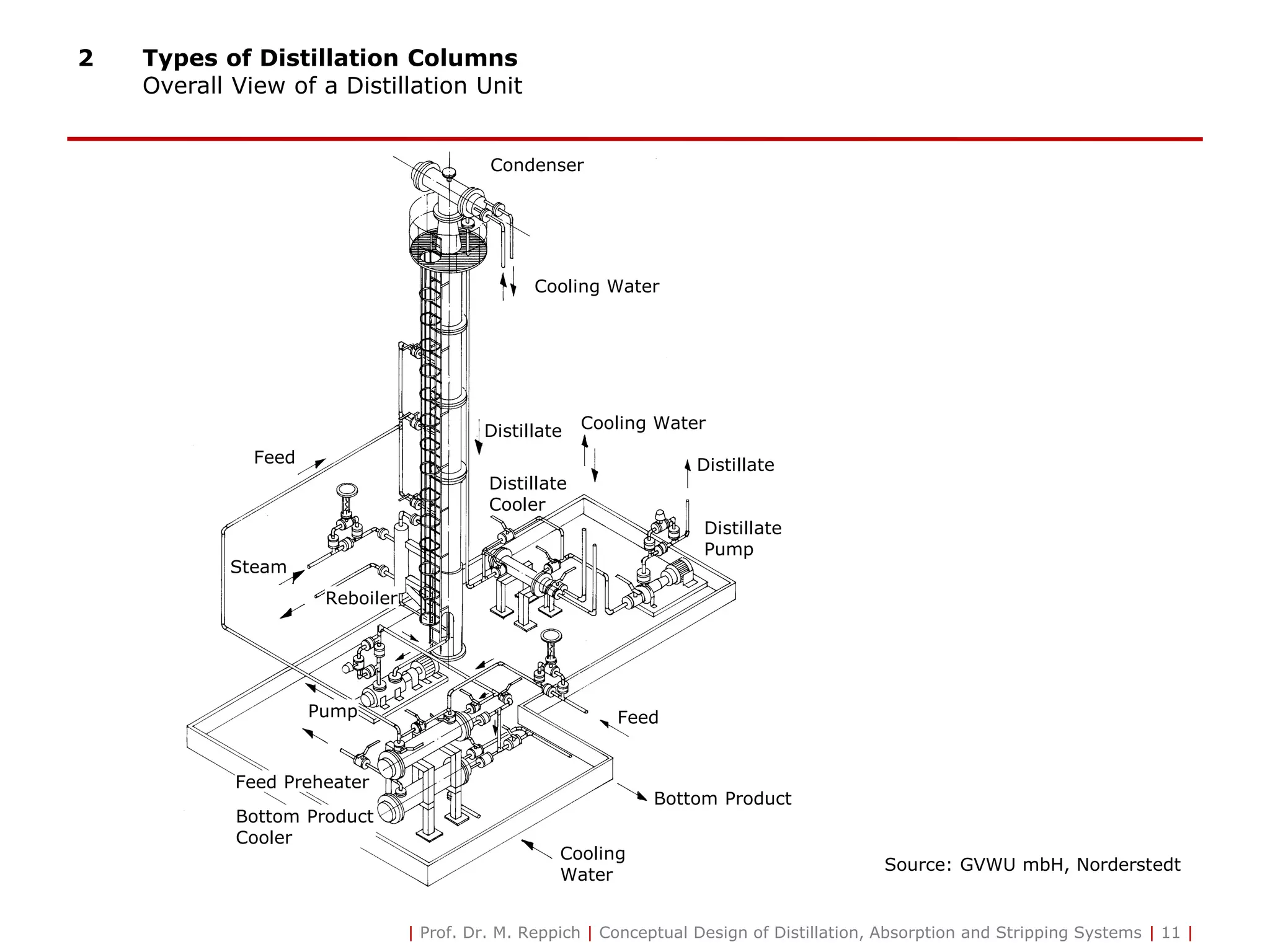
Overall View of a Distillation Unit
Source: GVWU mbH, Norderstedt
Condenser
Cooling Water
Feed
Feed
Distillate
Distillate
Cooling Water
Steam
Bottom Product
Cooling
Water
Bottom Product
Cooler
Feed Preheater
Distillate
Pump
Pump
Distillate
Cooler
Reboiler
| Prof. Dr. M. Reppich | Conceptual Design of Distillation, Absorption and Stripping Systems | 11 |
2 Types of Distillation Columns
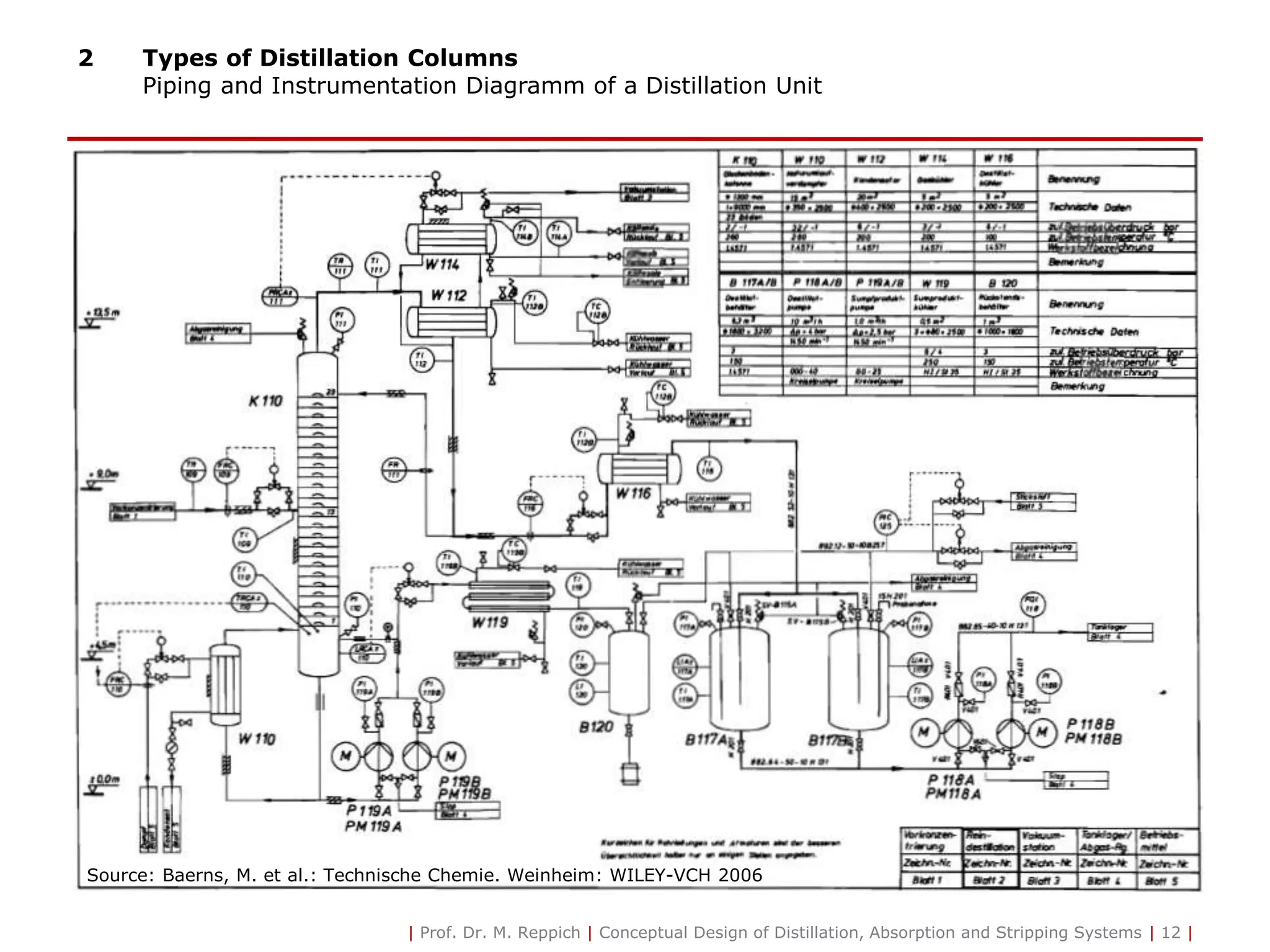
Piping and Instrumentation Diagramm of a Distillation Unit
Source: Baerns, M. et al.: Technische Chemie. Weinheim: WILEY-VCH 2006
| Prof. Dr. M. Reppich | Conceptual Design of Distillation, Absorption and Stripping Systems | 12 |

Plate column & Pcked column description

  • 1.
    Augsburg University ofApplied Sciences | Faculty of Mechanical and Process Engineering Brno University of Technology | Faculty of Mechanical Engineering | Institute of Process and Environmental Engineering Projektování a řízení procesů (KPJ) Conceptual Design of Distillation, Absorption and Stripping Systems Prof. Dr.-Ing. Marcus Reppich Room D5/249  marcus.reppich@hs-augsburg.de Important notice: These documents are to be used exclusively for study purposes, they are made available to participants of the lecture Conceptual Design of Distillation, Absorption and Stripping Systems (Projektování a řízení procesů, KPJ) at the Institute of Process and Environmental Engineering at the Brno University of Tech- nology only. Cover image: Copyright by BASF SE
  • 2.
    Conceptual Design ofDistillation, Absorption and Stripping Systems Timetable and Contents of Lectures and Exercises Lectures 19.11.2013 P 09 Fundamentals of Binary Distillation 26.11.2013 P 10 Types of Distillation Columns 03.12.2013 P 11 Design of Distillation Columns Exercises 19.11.2013 Assignment date 26.11.2013 C 10 Design of a Multicomponent Distillation System Using the Process Simulation Software CHEMCAD (group work of two students, elaboration of a final project report) 03.12.2013 C 11 10.12.2013 C 12 13.12.2013 Due date
  • 3.
    2 Types ofDistillation Columns Tray Column Design Source: A. Mersmann, M. Kind, J. Stichlmair: Thermal Separation Technology. Berlin, Heidelberg: Springer 2011 Symbols a downcomer b tray support c sieve trays d man way e outlet weir f inlet weir g side wall of downcomer h liquid seal Aac active area Ad downcomer area Dc column diameter dcap, v, h bubble cup, valve, hole diameter H, z tray spacing hcl height of down- comer clearance hw weir height lw weir length lL length of liquid flow path  relative free area Characteristic dimensions of industrial tray designs wG | Prof. Dr. M. Reppich | Conceptual Design of Distillation, Absorption and Stripping Systems | 3 |
  • 4.
    2 Types ofDistillation Columns Design Principles of Packed Columns: Tower with Structured Packing (A); Tower with Structured-Packed Top Bed and Random-Packed Bottom Bed (B) Symbols a liquid distributor b liquid collector c structured packing d support grid e man way f liquid re-distributor (A) (B) Sources: A. Mersmann, M. Kind, J. Stichlmair: Thermal Separation Technology. Berlin, Heidelberg: Springer 2011; D.W. Green (ed.): Perry´s Chemical Engineers´ Handbook, New York: McGraw-Hill 2008 | Prof. Dr. M. Reppich | Conceptual Design of Distillation, Absorption and Stripping Systems | 4 |
  • 5.
    2 Types ofDistillation Columns Examples of Distillation Column Internals Source: GEA Wiegand GmbH, Ettlingen Sieve Tray Bubble Cap Tray Tunnel Cap Tray Struktured Packing | Prof. Dr. M. Reppich | Conceptual Design of Distillation, Absorption and Stripping Systems | 5 |
  • 6.
    2 Types ofDistillation Columns Examples of Distillation Column Internals Floating valve tray with rectangular-shaped valves (BDH™ valve) Source: Sulzer Chemtech AG Detail of Varioflex valve tray Source: Koch-Glitsch, Inc. | Prof. Dr. M. Reppich | Conceptual Design of Distillation, Absorption and Stripping Systems | 6 |
  • 7.
    2 Types ofDistillation Columns Examples of Distillation Column Internals Common Random Packings Common random packing particles made of metal, plastic, ceramic Sorce: Koch-Glitsch, Inc. | Prof. Dr. M. Reppich | Conceptual Design of Distillation, Absorption and Stripping Systems | 7 |
  • 8.
    2 Types ofDistillation Columns Examples of Distillation Column Internals Historical Development of Characteristic Random Packings First Generation (Raschig Ring, Berl Saddle) 1895 to the 1950s simple shapes with closed surfaces, robust and stable design, cost-effective production Second Generation (Pall Ring, Intalox Saddle) late 1950s to the early 1970s surfaces with cutted windows and bent tongues, improved area distribution lowering pressure drop and enhancing capacity Third Generation (Net/Grid Structures, IMPT Ring) late 1970s to the 1990s framework structure, large free cross section, low pressure drop, high efficiency Fourth Generation (Raschig Super-Ring) late 1990s until present lower pressure drop and better mass transfer efficiency | Prof. Dr. M. Reppich | Conceptual Design of Distillation, Absorption and Stripping Systems | 8 |
  • 9.
    2 Types ofDistillation Columns Examples of Distillation Column Internals Common Types of Structured Packings Sources: Sulzer Chemtech AG; Koch-Glitsch, Inc. Structured packing of corrugated metal sheets Structured packings Mellapak made of metal and plastic Fitting structured packing elements Flexipac to a large-diameter tower | Prof. Dr. M. Reppich | Conceptual Design of Distillation, Absorption and Stripping Systems | 9 |
  • 10.
    Tray Columns PackedColumns • cross flow of the two phases on the trays • countercurrent flow of the two phases • always used in columns of large diameters and towers that have more than 20 to 30 equilibrium stages, in applications with liquid rates of 30 m³/(m²h) and above, when liquid flowrate is high relative to vapor flowrate • packings are generally more expensive than plates, less expensive than tray columns for small column diameter (D<0.6 m), used in lower liquid-rate-applications (i.e. less than 50 m³/(m² h) • various tray types made of metallic materials (D=500–10000 mm) • more choices in materials of construction especially in corrosive service (e.g. plastic, ceramic, metal alloys, carbon), random (D=50–800 mm) or structured packings (D=20–11000 mm) • high liquid residence time • less liquid entrainment, low liquid holdup, especially suitable for thermally sensitive material • pressure drop is rather high, typically 7 mbar per equilibrium stage (not well suited for vacuum services) • lower pressure drop, typically 0,1 to 0,5 mbar per equilibrium stage (important in vacuum distillation) • dirty service (tray columns are easier to clean) • cleaning of a packing section is much too complica- ted and expensive • stable and robust operation of the separation process, more flexible to variations in operating conditions • foaming liquids can be handled more readily (less agitation of liquid by the vapour) • due to novel developments of packing elements the industrial use of packed columns is steadily increasing 2 Types of Distillation Columns Comparsion of Tray and Packed Columns | Prof. Dr. M. Reppich | Conceptual Design of Distillation, Absorption and Stripping Systems | 10 |
  • 11.
    2 Types ofDistillation Columns Overall View of a Distillation Unit Source: GVWU mbH, Norderstedt Condenser Cooling Water Feed Feed Distillate Distillate Cooling Water Steam Bottom Product Cooling Water Bottom Product Cooler Feed Preheater Distillate Pump Pump Distillate Cooler Reboiler | Prof. Dr. M. Reppich | Conceptual Design of Distillation, Absorption and Stripping Systems | 11 |
  • 12.
    2 Types ofDistillation Columns Piping and Instrumentation Diagramm of a Distillation Unit Source: Baerns, M. et al.: Technische Chemie. Weinheim: WILEY-VCH 2006 | Prof. Dr. M. Reppich | Conceptual Design of Distillation, Absorption and Stripping Systems | 12 |