Page 1 of 10
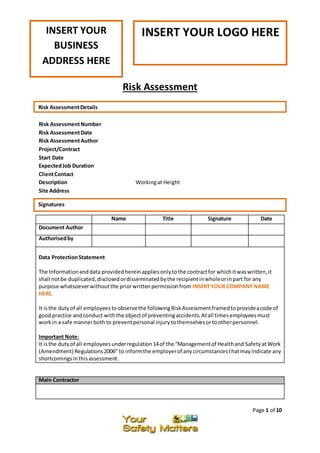
Risk Assessment
Risk AssessmentNumber
Risk AssessmentDate
Risk AssessmentAuthor
Project/Contract
Start Date
ExpectedJob Duration
ClientContact
Description Workingat Height
Site Address
Main Contractor
Name Title Signature Date
Document Author
Authorisedby
Data ProtectionStatement
The Informationanddata providedhereinappliesonlytothe contractfor whichitwaswritten,it
shall notbe duplicated,disclosedordisseminatedbythe recipientinwholeorinpart for any
purpose whatsoeverwithoutthe priorwrittenpermissionfrom INSERTYOUR COMPANYNAME
HERE.
It isthe dutyof all employeestoobservethe followingRiskAssessmentframedtoprovideacode of
goodpractice andconduct withthe objectof preventingaccidents.Atall timesemployeesmust
workin a safe mannerboth to preventpersonal injurytothemselvesortootherpersonnel.
Important Note:
It isthe dutyof all employeesunderregulation14of the “Managementof Healthand SafetyatWork
(Amendment) Regulations2006” to informthe employerof anycircumstancesthatmayindicate any
shortcomingsinthisassessment.
INSERT YOUR LOGO HEREINSERT YOUR
BUSINESS
ADDRESS HERE
Risk AssessmentDetails
Signatures
Page 2 of 10
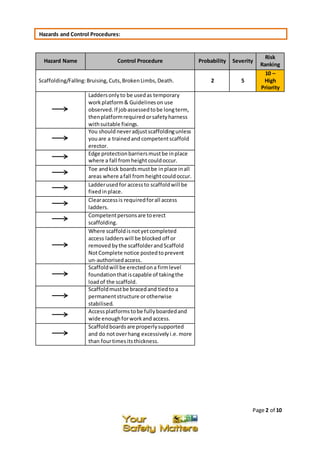
Hazard Name Control Procedure Probability Severity
Risk
Ranking
Scaffolding/Falling:Bruising,Cuts,BrokenLimbs,Death. 2 5
10 –
High
Priority
Laddersonlyto be usedas temporary
workplatform& Guidelineson use
observed.If jobassessedtobe longterm,
thenplatformrequired orsafetyharness
withsuitable fixings.
You should neveradjustscaffoldingunless
youare a trainedand competentscaffold
erector.
Edge protectionbarriersmustbe inplace
where a fall fromheight couldoccur.
Toe andkick boardsmustbe inplace inall
areas where afall from heightcouldoccur.
Ladderused for accessto scaffoldwill be
fixedinplace.
Clearaccessis requiredforall access
ladders.
Competentpersonsare toerect
scaffolding.
Where scaffoldisnotyetcompleted
access ladderswill be blocked off or
removed bythe scaffolderandScaffold
NotComplete notice postedtoprevent
un-authorisedaccess.
Scaffoldwill be erectedona firmlevel
foundationthatiscapable of takingthe
loadof the scaffold.
Scaffoldmustbe bracedand tiedto a
permanentstructure orotherwise
stabilised.
Accessplatformstobe fullyboardedand
wide enoughforworkand access.
Scaffoldboards are properlysupported
and do notoverhang excessivelyi.e.more
than fourtimesitsthickness.
Hazards and Control Procedures:
Page 3 of 10
Hazard Name Control Procedure Probability Severity
Risk
Ranking
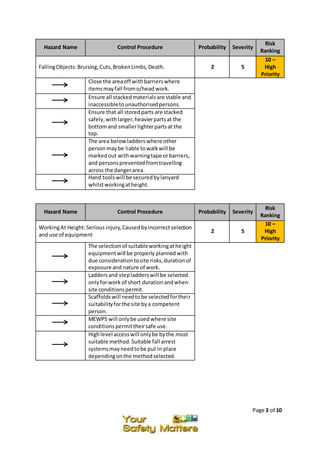
FallingObjects:Bruising,Cuts,BrokenLimbs,Death. 2 5
10 –
High
Priority
Close the areaoff withbarrierswhere
itemsmayfall fromo/head work.
Ensure all stackedmaterialsare stable and
inaccessibleto unauthorisedpersons.
Ensure that all storedparts are stacked
safely,withlarger,heavierpartsat the
bottomand smallerlighterpartsat the
top.
The area belowladderswhere other
personmaybe liable towalkwill be
markedout withwarningtape orbarriers,
and personsprevented fromtravelling
across the dangerarea.
Hand toolswill be securedbylanyard
whilstworkingatheight.
Hazard Name Control Procedure Probability Severity
Risk
Ranking
WorkingAt Height:Serious injury,Causedbyincorrectselection
and use of equipment
2 5
10 –
High
Priority
The selectionof suitableworkingatheight
equipmentwill be properly plannedwith
due considerationtosite risks,durationof
exposure and nature of work.
Laddersand stepladderswill be selected
onlyforwork of short durationandwhen
site conditionspermit.
Scaffoldswill needtobe selectedfortheir
suitabilityforthe site bya competent
person.
MEWPS will onlybe usedwhere site
conditions permittheirsafe use.
Highlevel accesswill onlybe bythe most
suitable method.Suitable fall arrest
systemsmayneedtobe put in place
dependingonthe methodselected.
Page 4 of 10
Hazard Name Control Procedure Probability Severity
Risk
Ranking
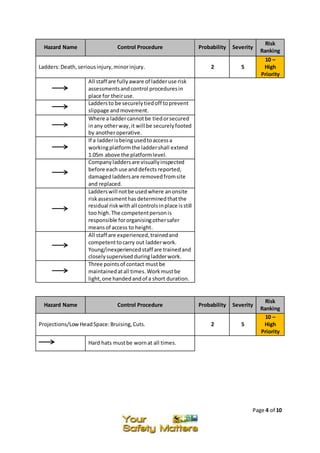
Ladders:Death,seriousinjury,minorinjury. 2 5
10 –
High
Priority
All staff are fullyaware of ladderuse risk
assessmentsandcontrol proceduresin
place for theiruse.
Laddersto be securelytiedoff toprevent
slippage andmovement.
Where a laddercannotbe tiedorsecured
inany otherway,it will be securelyfooted
by anotheroperative.
If a ladderisbeing usedtoaccessa
workingplatformthe laddershall extend
1.05m above the platformlevel.
Companyladdersare visuallyinspected
before eachuse anddefects reported,
damagedladdersare removedfromsite
and replaced.
Ladderswill notbe usedwhere anonsite
riskassessmenthas determinedthatthe
residual riskwith all controlsinplace isstill
too high.The competentpersonis
responsible fororganisingothersafer
meansof access to height.
All staff are experienced,trainedand
competenttocarry out ladderwork.
Young/inexperiencedstaff are trainedand
closelysupervised duringladderwork.
Three pointsof contact must be
maintainedatall times.Workmustbe
light,one handedandof a short duration.
Hazard Name Control Procedure Probability Severity
Risk
Ranking
Projections/LowHeadSpace:Bruising,Cuts. 2 5
10 –
High
Priority
Hard hats mustbe wornat all times.
Page 5 of 10
Hazard Name Control Procedure Probability Severity
Risk
Ranking
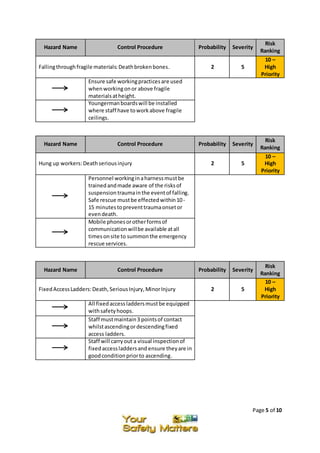
Fallingthroughfragile materials:Deathbrokenbones. 2 5
10 –
High
Priority
Ensure safe workingpracticesare used
whenworkingonor above fragile
materialsatheight.
Youngermanboardswill be installed
where staff have toworkabove fragile
ceilings.
Hazard Name Control Procedure Probability Severity
Risk
Ranking
Hung up workers:Deathseriousinjury 2 5
10 –
High
Priority
Personnel workinginaharnessmustbe
trainedandmade aware of the risksof
suspension traumainthe eventof falling.
Safe rescue mustbe effectedwithin10-
15 minutestopreventtraumaonsetor
evendeath.
Mobile phonesorotherformsof
communicationwillbe available atall
timesonsite to summonthe emergency
rescue services.
Hazard Name Control Procedure Probability Severity
Risk
Ranking
FixedAccessLadders:Death,SeriousInjury,MinorInjury 2 5
10 –
High
Priority
All fixedaccessladdersmustbe equipped
withsafetyhoops.
Staff mustmaintain3 pointsof contact
whilstascendingordescendingfixed
access ladders.
Staff will carryout a visual inspectionof
fixedaccessladdersand ensure theyare in
goodconditionpriorto ascending.
Page 6 of 10
Hazard Name Control Procedure Probability Severity
Risk
Ranking
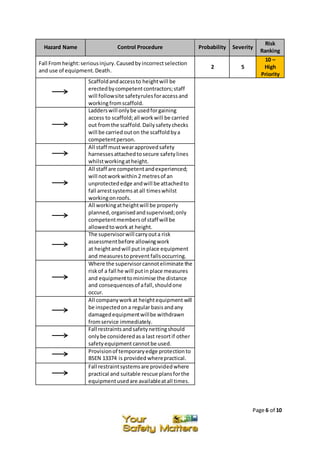
Fall Fromheight:seriousinjury.Causedbyincorrectselection
and use of equipment.Death.
2 5
10 –
High
Priority
Scaffoldandaccessto heightwill be
erectedbycompetentcontractors;staff
will followsite safetyrulesforaccessand
workingfromscaffold.
Ladderswill onlybe usedforgaining
access to scaffold;all workwill be carried
out fromthe scaffold.Dailysafetychecks
will be carried outon the scaffoldbya
competentperson.
All staff mustwearapprovedsafety
harnessesattachedtosecure safetylines
whilstworkingatheight.
All staff are competentandexperienced;
will notworkwithin 2 metresof an
unprotectededge andwill be attachedto
fall arrestsystemsat all timeswhilst
workingonroofs.
All workingatheightwill be properly
planned,organisedandsupervised;only
competentmembersof staff will be
allowedtowork at height.
The supervisorwill carryouta risk
assessmentbefore allowingwork
at heightandwill putinplace equipment
and measurestoprevent fallsoccurring.
Where the supervisorcannoteliminate the
riskof a fall he will putin place measures
and equipmenttominimise the distance
and consequencesof afall,shouldone
occur.
All companyworkat heightequipment will
be inspectedona regularbasisandany
damagedequipmentwillbe withdrawn
fromservice immediately.
Fall restraintsandsafetynettingshould
onlybe consideredasa last resortif other
safetyequipment cannotbe used.
Provisionof temporaryedge protectionto
BSEN 13374 is provided wherepractical.
Fall restraintsystemsare providedwhere
practical and suitable rescue plansforthe
equipmentusedare availableatall times.
Page 7 of 10
Hazard Name Control Procedure Probability Severity
Risk
Ranking
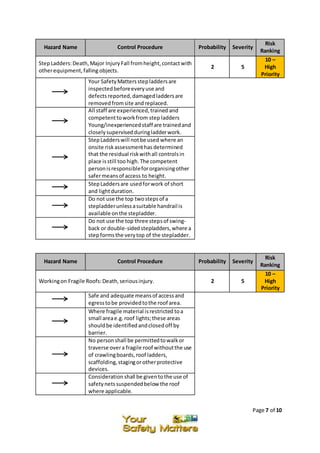
StepLadders:Death,Major InjuryFall fromheight,contactwith
otherequipment,falling objects.
2 5
10 –
High
Priority
Your SafetyMattersstepladdersare
inspectedbeforeeveryuse and
defects reported,damagedladdersare
removedfromsite and replaced.
All staff are experienced,trained and
competenttoworkfrom step ladders
Young/inexperiencedstaff are trainedand
closelysupervised duringladderwork.
StepLadderswill notbe used where an
onsite riskassessmenthas determined
that the residual riskwithall controlsin
place isstill too high.The competent
personisresponsiblefororganisingother
safermeansof access to height.
StepLaddersare usedforwork of short
and lightduration.
Do not use the top twostepsof a
stepladderunlessasuitable handrailis
available onthe stepladder.
Do not use the top three stepsof swing-
back or double-sidedstepladders,where a
stepformsthe verytop of the stepladder.
Hazard Name Control Procedure Probability Severity
Risk
Ranking
Workingon Fragile Roofs:Death,seriousinjury. 2 5
10 –
High
Priority
Safe and adequate meansof accessand
egresstobe providedtothe roof area.
Where fragile material isrestricted toa
small areae.g.roof lights;these areas
shouldbe identifiedandclosedoff by
barrier.
No personshall be permittedtowalkor
traverse overa fragile roof withoutthe use
of crawlingboards,roof ladders,
scaffolding,stagingorotherprotective
devices.
Considerationshall be giventothe use of
safetynetssuspendedbelow the roof
where applicable.
Page 8 of 10
Hazard Name Control Procedure Probability Severity
Risk
Ranking
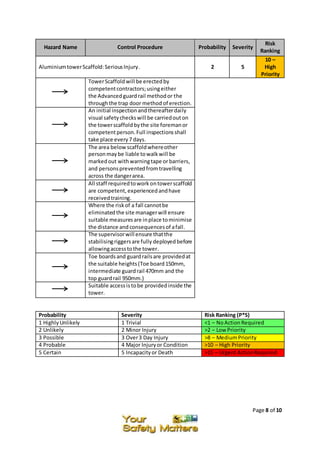
AluminiumtowerScaffold:SeriousInjury. 2 5
10 –
High
Priority
TowerScaffoldwill be erectedby
competentcontractors;usingeither
the Advancedguardrail methodor the
throughthe trap door method of erection.
An initial inspectionandthereafterdaily
visual safetycheckswill be carriedouton
the towerscaffoldbythe site foremanor
competentperson.Full inspectionsshall
take place every7 days.
The area belowscaffoldwhereother
personmaybe liable towalkwill be
markedout withwarningtape or barriers,
and personspreventedfromtravelling
across the dangerarea.
All staff requiredtoworkontowerscaffold
are competent, experiencedandhave
receivedtraining.
Where the riskof a fall cannotbe
eliminatedthe site managerwill ensure
suitable measuresare inplace tominimise
the distance and consequencesof afall.
The supervisorwill ensure thatthe
stabilisingriggersare fully deployedbefore
allowingaccesstothe tower.
Toe boardsand guardrailsare providedat
the suitable heights(Toe board150mm,
intermediate guardrail 470mm and the
top guardrail 950mm.)
Suitable accessistobe providedinside the
tower.
Probability Severity Risk Ranking (P*S)
1 HighlyUnlikely 1 Trivial <1 – NoActionRequired
2 Unlikely 2 Minor Injury >2 – Low Priority
3 Possible 3 Over3 Day Injury >8 – MediumPriority
4 Probable 4 Major Injuryor Condition >10 – High Priority
5 Certain 5 Incapacityor Death >15 – Urgent ActionRequired
Page 9 of 10
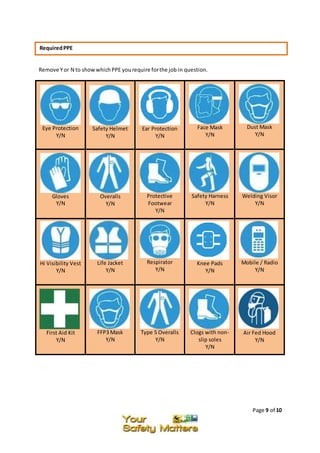
Remove Yor N to showwhichPPE yourequire forthe job in question.
Eye Protection
Y/N
Safety Helmet
Y/N
Ear Protection
Y/N
Face Mask
Y/N
Dust Mask
Y/N
Gloves
Y/N
Overalls
Y/N
Protective
Footwear
Y/N
Safety Harness
Y/N
Welding Visor
Y/N
Hi Visibility Vest
Y/N
Life Jacket
Y/N
Respirator
Y/N
Knee Pads
Y/N
Mobile / Radio
Y/N
First Aid Kit
Y/N
FFP3 Mask
Y/N
Type 5 Overalls
Y/N
Clogs with non-
slip soles
Y/N
Air Fed Hood
Y/N
RequiredPPE
Page 10 of 10
I have read and understood the contents of this Risk Assessments.
Anything I did not understand has been explained to me to my satisfaction.
I agree to followthe RiskAssessment and understand that any control procedures are provided for
my safety and the safety of others.
Print Name Signed Date
Sign OffSheet

Working at Height - Risk Assessment Template

  • 1.
    Page 1 of10 Risk Assessment Risk AssessmentNumber Risk AssessmentDate Risk AssessmentAuthor Project/Contract Start Date ExpectedJob Duration ClientContact Description Workingat Height Site Address Main Contractor Name Title Signature Date Document Author Authorisedby Data ProtectionStatement The Informationanddata providedhereinappliesonlytothe contractfor whichitwaswritten,it shall notbe duplicated,disclosedordisseminatedbythe recipientinwholeorinpart for any purpose whatsoeverwithoutthe priorwrittenpermissionfrom INSERTYOUR COMPANYNAME HERE. It isthe dutyof all employeestoobservethe followingRiskAssessmentframedtoprovideacode of goodpractice andconduct withthe objectof preventingaccidents.Atall timesemployeesmust workin a safe mannerboth to preventpersonal injurytothemselvesortootherpersonnel. Important Note: It isthe dutyof all employeesunderregulation14of the “Managementof Healthand SafetyatWork (Amendment) Regulations2006” to informthe employerof anycircumstancesthatmayindicate any shortcomingsinthisassessment. INSERT YOUR LOGO HEREINSERT YOUR BUSINESS ADDRESS HERE Risk AssessmentDetails Signatures
  • 2.
    Page 2 of10 Hazard Name Control Procedure Probability Severity Risk Ranking Scaffolding/Falling:Bruising,Cuts,BrokenLimbs,Death. 2 5 10 – High Priority Laddersonlyto be usedas temporary workplatform& Guidelineson use observed.If jobassessedtobe longterm, thenplatformrequired orsafetyharness withsuitable fixings. You should neveradjustscaffoldingunless youare a trainedand competentscaffold erector. Edge protectionbarriersmustbe inplace where a fall fromheight couldoccur. Toe andkick boardsmustbe inplace inall areas where afall from heightcouldoccur. Ladderused for accessto scaffoldwill be fixedinplace. Clearaccessis requiredforall access ladders. Competentpersonsare toerect scaffolding. Where scaffoldisnotyetcompleted access ladderswill be blocked off or removed bythe scaffolderandScaffold NotComplete notice postedtoprevent un-authorisedaccess. Scaffoldwill be erectedona firmlevel foundationthatiscapable of takingthe loadof the scaffold. Scaffoldmustbe bracedand tiedto a permanentstructure orotherwise stabilised. Accessplatformstobe fullyboardedand wide enoughforworkand access. Scaffoldboards are properlysupported and do notoverhang excessivelyi.e.more than fourtimesitsthickness. Hazards and Control Procedures:
  • 3.
    Page 3 of10 Hazard Name Control Procedure Probability Severity Risk Ranking FallingObjects:Bruising,Cuts,BrokenLimbs,Death. 2 5 10 – High Priority Close the areaoff withbarrierswhere itemsmayfall fromo/head work. Ensure all stackedmaterialsare stable and inaccessibleto unauthorisedpersons. Ensure that all storedparts are stacked safely,withlarger,heavierpartsat the bottomand smallerlighterpartsat the top. The area belowladderswhere other personmaybe liable towalkwill be markedout withwarningtape orbarriers, and personsprevented fromtravelling across the dangerarea. Hand toolswill be securedbylanyard whilstworkingatheight. Hazard Name Control Procedure Probability Severity Risk Ranking WorkingAt Height:Serious injury,Causedbyincorrectselection and use of equipment 2 5 10 – High Priority The selectionof suitableworkingatheight equipmentwill be properly plannedwith due considerationtosite risks,durationof exposure and nature of work. Laddersand stepladderswill be selected onlyforwork of short durationandwhen site conditionspermit. Scaffoldswill needtobe selectedfortheir suitabilityforthe site bya competent person. MEWPS will onlybe usedwhere site conditions permittheirsafe use. Highlevel accesswill onlybe bythe most suitable method.Suitable fall arrest systemsmayneedtobe put in place dependingonthe methodselected.
  • 4.
    Page 4 of10 Hazard Name Control Procedure Probability Severity Risk Ranking Ladders:Death,seriousinjury,minorinjury. 2 5 10 – High Priority All staff are fullyaware of ladderuse risk assessmentsandcontrol proceduresin place for theiruse. Laddersto be securelytiedoff toprevent slippage andmovement. Where a laddercannotbe tiedorsecured inany otherway,it will be securelyfooted by anotheroperative. If a ladderisbeing usedtoaccessa workingplatformthe laddershall extend 1.05m above the platformlevel. Companyladdersare visuallyinspected before eachuse anddefects reported, damagedladdersare removedfromsite and replaced. Ladderswill notbe usedwhere anonsite riskassessmenthas determinedthatthe residual riskwith all controlsinplace isstill too high.The competentpersonis responsible fororganisingothersafer meansof access to height. All staff are experienced,trainedand competenttocarry out ladderwork. Young/inexperiencedstaff are trainedand closelysupervised duringladderwork. Three pointsof contact must be maintainedatall times.Workmustbe light,one handedandof a short duration. Hazard Name Control Procedure Probability Severity Risk Ranking Projections/LowHeadSpace:Bruising,Cuts. 2 5 10 – High Priority Hard hats mustbe wornat all times.
  • 5.
    Page 5 of10 Hazard Name Control Procedure Probability Severity Risk Ranking Fallingthroughfragile materials:Deathbrokenbones. 2 5 10 – High Priority Ensure safe workingpracticesare used whenworkingonor above fragile materialsatheight. Youngermanboardswill be installed where staff have toworkabove fragile ceilings. Hazard Name Control Procedure Probability Severity Risk Ranking Hung up workers:Deathseriousinjury 2 5 10 – High Priority Personnel workinginaharnessmustbe trainedandmade aware of the risksof suspension traumainthe eventof falling. Safe rescue mustbe effectedwithin10- 15 minutestopreventtraumaonsetor evendeath. Mobile phonesorotherformsof communicationwillbe available atall timesonsite to summonthe emergency rescue services. Hazard Name Control Procedure Probability Severity Risk Ranking FixedAccessLadders:Death,SeriousInjury,MinorInjury 2 5 10 – High Priority All fixedaccessladdersmustbe equipped withsafetyhoops. Staff mustmaintain3 pointsof contact whilstascendingordescendingfixed access ladders. Staff will carryout a visual inspectionof fixedaccessladdersand ensure theyare in goodconditionpriorto ascending.
  • 6.
    Page 6 of10 Hazard Name Control Procedure Probability Severity Risk Ranking Fall Fromheight:seriousinjury.Causedbyincorrectselection and use of equipment.Death. 2 5 10 – High Priority Scaffoldandaccessto heightwill be erectedbycompetentcontractors;staff will followsite safetyrulesforaccessand workingfromscaffold. Ladderswill onlybe usedforgaining access to scaffold;all workwill be carried out fromthe scaffold.Dailysafetychecks will be carried outon the scaffoldbya competentperson. All staff mustwearapprovedsafety harnessesattachedtosecure safetylines whilstworkingatheight. All staff are competentandexperienced; will notworkwithin 2 metresof an unprotectededge andwill be attachedto fall arrestsystemsat all timeswhilst workingonroofs. All workingatheightwill be properly planned,organisedandsupervised;only competentmembersof staff will be allowedtowork at height. The supervisorwill carryouta risk assessmentbefore allowingwork at heightandwill putinplace equipment and measurestoprevent fallsoccurring. Where the supervisorcannoteliminate the riskof a fall he will putin place measures and equipmenttominimise the distance and consequencesof afall,shouldone occur. All companyworkat heightequipment will be inspectedona regularbasisandany damagedequipmentwillbe withdrawn fromservice immediately. Fall restraintsandsafetynettingshould onlybe consideredasa last resortif other safetyequipment cannotbe used. Provisionof temporaryedge protectionto BSEN 13374 is provided wherepractical. Fall restraintsystemsare providedwhere practical and suitable rescue plansforthe equipmentusedare availableatall times.
  • 7.
    Page 7 of10 Hazard Name Control Procedure Probability Severity Risk Ranking StepLadders:Death,Major InjuryFall fromheight,contactwith otherequipment,falling objects. 2 5 10 – High Priority Your SafetyMattersstepladdersare inspectedbeforeeveryuse and defects reported,damagedladdersare removedfromsite and replaced. All staff are experienced,trained and competenttoworkfrom step ladders Young/inexperiencedstaff are trainedand closelysupervised duringladderwork. StepLadderswill notbe used where an onsite riskassessmenthas determined that the residual riskwithall controlsin place isstill too high.The competent personisresponsiblefororganisingother safermeansof access to height. StepLaddersare usedforwork of short and lightduration. Do not use the top twostepsof a stepladderunlessasuitable handrailis available onthe stepladder. Do not use the top three stepsof swing- back or double-sidedstepladders,where a stepformsthe verytop of the stepladder. Hazard Name Control Procedure Probability Severity Risk Ranking Workingon Fragile Roofs:Death,seriousinjury. 2 5 10 – High Priority Safe and adequate meansof accessand egresstobe providedtothe roof area. Where fragile material isrestricted toa small areae.g.roof lights;these areas shouldbe identifiedandclosedoff by barrier. No personshall be permittedtowalkor traverse overa fragile roof withoutthe use of crawlingboards,roof ladders, scaffolding,stagingorotherprotective devices. Considerationshall be giventothe use of safetynetssuspendedbelow the roof where applicable.
  • 8.
    Page 8 of10 Hazard Name Control Procedure Probability Severity Risk Ranking AluminiumtowerScaffold:SeriousInjury. 2 5 10 – High Priority TowerScaffoldwill be erectedby competentcontractors;usingeither the Advancedguardrail methodor the throughthe trap door method of erection. An initial inspectionandthereafterdaily visual safetycheckswill be carriedouton the towerscaffoldbythe site foremanor competentperson.Full inspectionsshall take place every7 days. The area belowscaffoldwhereother personmaybe liable towalkwill be markedout withwarningtape or barriers, and personspreventedfromtravelling across the dangerarea. All staff requiredtoworkontowerscaffold are competent, experiencedandhave receivedtraining. Where the riskof a fall cannotbe eliminatedthe site managerwill ensure suitable measuresare inplace tominimise the distance and consequencesof afall. The supervisorwill ensure thatthe stabilisingriggersare fully deployedbefore allowingaccesstothe tower. Toe boardsand guardrailsare providedat the suitable heights(Toe board150mm, intermediate guardrail 470mm and the top guardrail 950mm.) Suitable accessistobe providedinside the tower. Probability Severity Risk Ranking (P*S) 1 HighlyUnlikely 1 Trivial <1 – NoActionRequired 2 Unlikely 2 Minor Injury >2 – Low Priority 3 Possible 3 Over3 Day Injury >8 – MediumPriority 4 Probable 4 Major Injuryor Condition >10 – High Priority 5 Certain 5 Incapacityor Death >15 – Urgent ActionRequired
  • 9.
    Page 9 of10 Remove Yor N to showwhichPPE yourequire forthe job in question. Eye Protection Y/N Safety Helmet Y/N Ear Protection Y/N Face Mask Y/N Dust Mask Y/N Gloves Y/N Overalls Y/N Protective Footwear Y/N Safety Harness Y/N Welding Visor Y/N Hi Visibility Vest Y/N Life Jacket Y/N Respirator Y/N Knee Pads Y/N Mobile / Radio Y/N First Aid Kit Y/N FFP3 Mask Y/N Type 5 Overalls Y/N Clogs with non- slip soles Y/N Air Fed Hood Y/N RequiredPPE
  • 10.
    Page 10 of10 I have read and understood the contents of this Risk Assessments. Anything I did not understand has been explained to me to my satisfaction. I agree to followthe RiskAssessment and understand that any control procedures are provided for my safety and the safety of others. Print Name Signed Date Sign OffSheet