PSYCHOMETRIC TEST SAMPLES
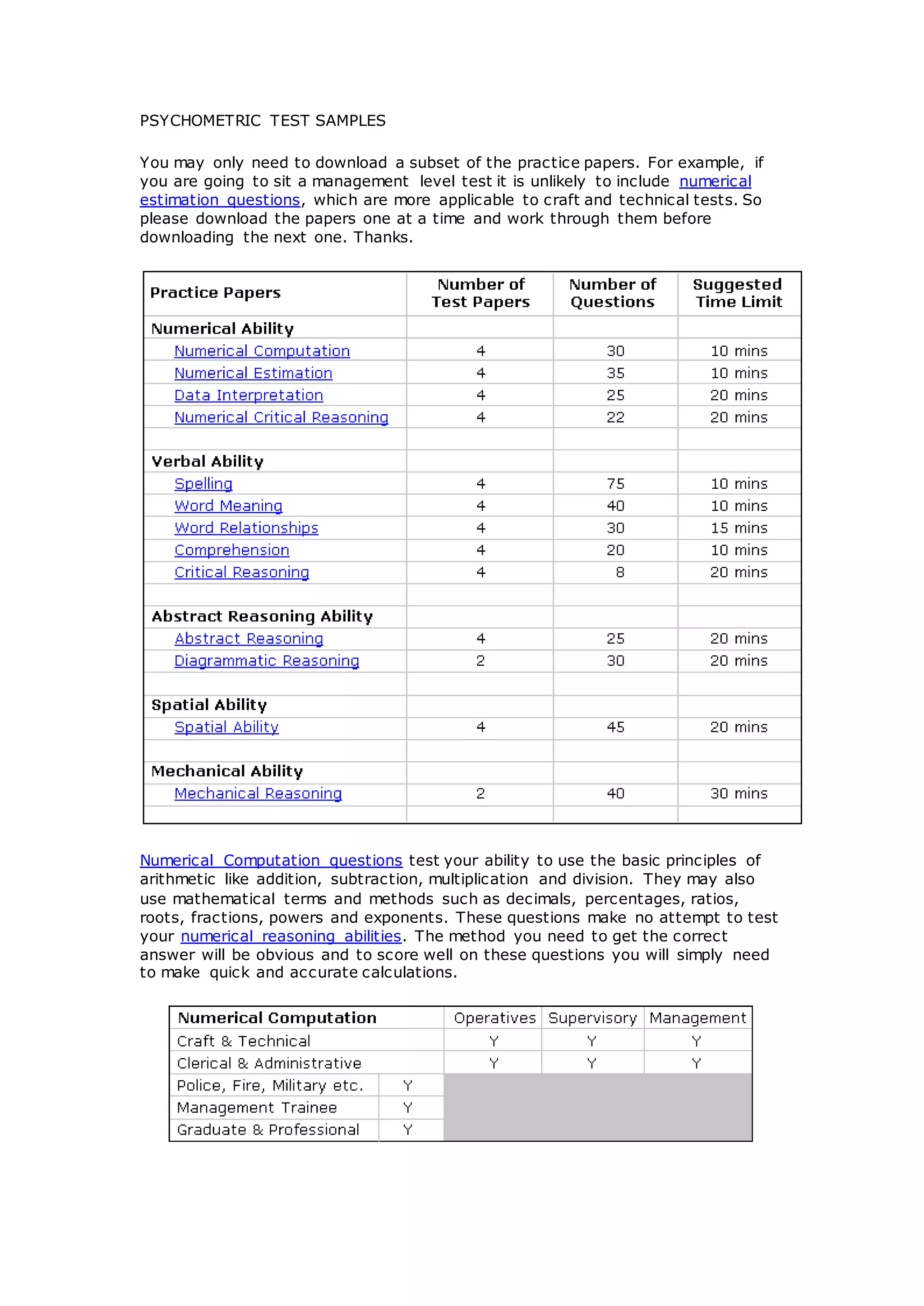
You may only need to download a subset of the practice papers. For example, if
you are going to sit a management level test it is unlikely to include numerical
estimation questions, which are more applicable to craft and technical tests. So
please download the papers one at a time and work through them before
downloading the next one. Thanks.
Numerical Computation questions test your ability to use the basic principles of
arithmetic like addition, subtraction, multiplication and division. They may also
use mathematical terms and methods such as decimals, percentages, ratios,
roots, fractions, powers and exponents. These questions make no attempt to test
your numerical reasoning abilities. The method you need to get the correct
answer will be obvious and to score well on these questions you will simply need
to make quick and accurate calculations.
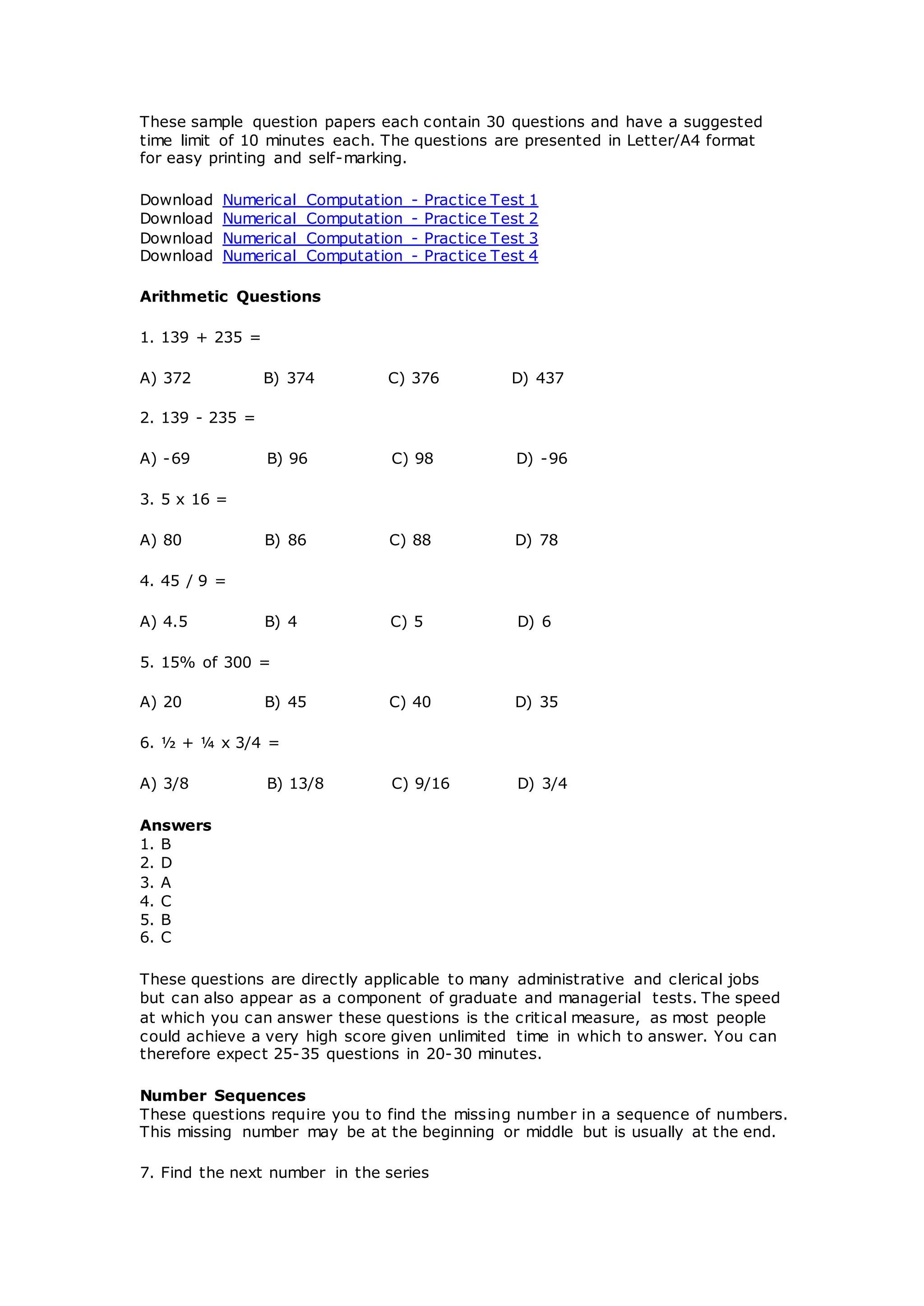
These sample question papers each contain 30 questions and have a suggested
time limit of 10 minutes each. The questions are presented in Letter/A4 format
for easy printing and self-marking.
Download Numerical Computation - Practice Test 1
Download Numerical Computation - Practice Test 2
Download Numerical Computation - Practice Test 3
Download Numerical Computation - Practice Test 4
Arithmetic Questions
1. 139 + 235 =
A) 372 B) 374 C) 376 D) 437
2. 139 - 235 =
A) -69 B) 96 C) 98 D) -96
3. 5 x 16 =
A) 80 B) 86 C) 88 D) 78
4. 45 / 9 =
A) 4.5 B) 4 C) 5 D) 6
5. 15% of 300 =
A) 20 B) 45 C) 40 D) 35
6. ½ + ¼ x 3/4 =
A) 3/8 B) 13/8 C) 9/16 D) 3/4
Answers
1. B
2. D
3. A
4. C
5. B
6. C
These questions are directly applicable to many administrative and clerical jobs
but can also appear as a component of graduate and managerial tests. The speed
at which you can answer these questions is the critical measure, as most people
could achieve a very high score given unlimited time in which to answer. You can
therefore expect 25-35 questions in 20-30 minutes.
Number Sequences
These questions require you to find the missing number in a sequence of numbers.
This missing number may be at the beginning or middle but is usually at the end.
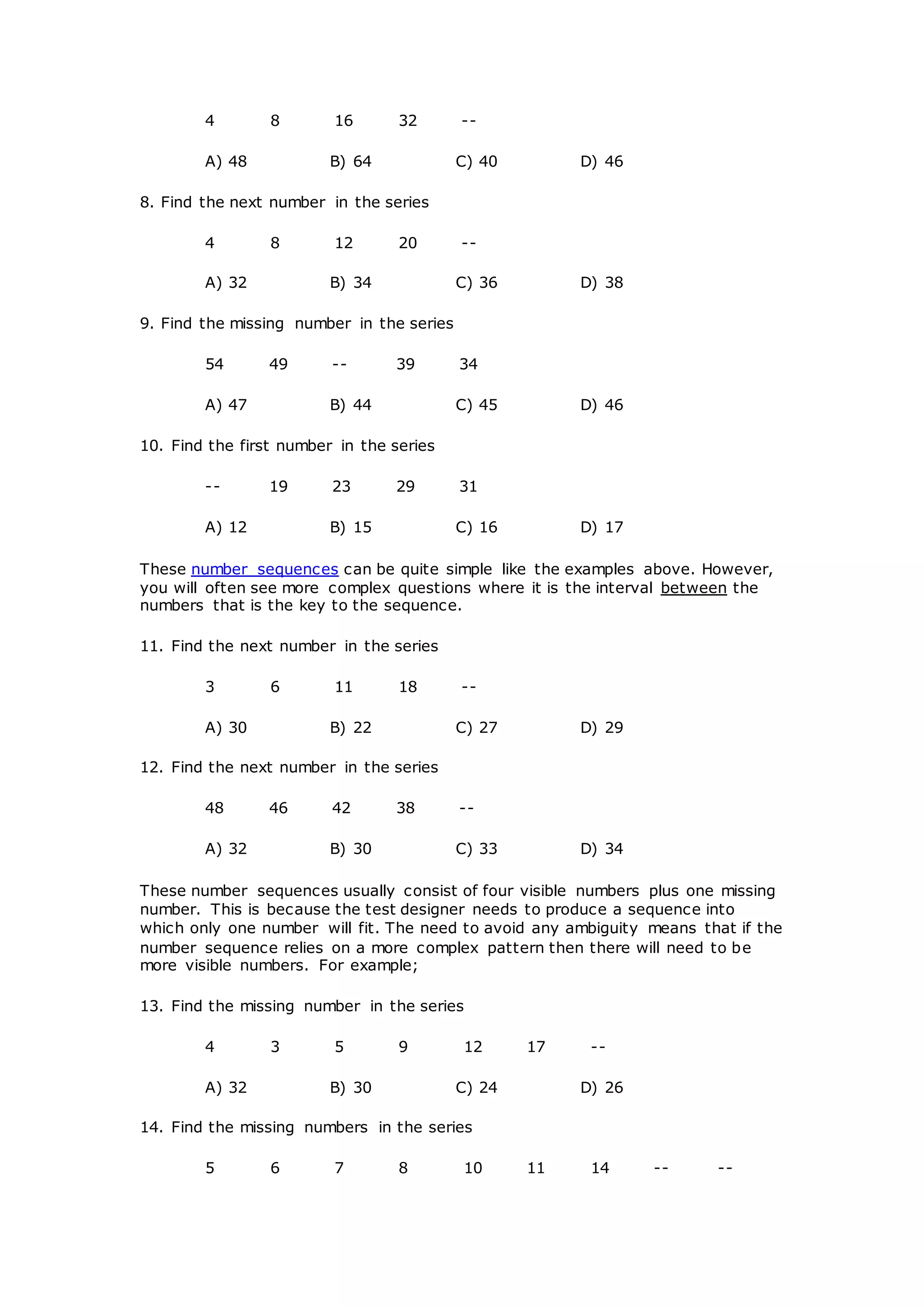
7. Find the next number in the series
4 8 16 32 --
A) 48 B) 64 C) 40 D) 46
8. Find the next number in the series
4 8 12 20 --
A) 32 B) 34 C) 36 D) 38
9. Find the missing number in the series
54 49 -- 39 34
A) 47 B) 44 C) 45 D) 46
10. Find the first number in the series
-- 19 23 29 31
A) 12 B) 15 C) 16 D) 17
These number sequences can be quite simple like the examples above. However,
you will often see more complex questions where it is the interval between the
numbers that is the key to the sequence.
11. Find the next number in the series
3 6 11 18 --
A) 30 B) 22 C) 27 D) 29
12. Find the next number in the series
48 46 42 38 --
A) 32 B) 30 C) 33 D) 34
These number sequences usually consist of four visible numbers plus one missing
number. This is because the test designer needs to produce a sequence into
which only one number will fit. The need to avoid any ambiguity means that if the
number sequence relies on a more complex pattern then there will need to be
more visible numbers. For example;
13. Find the missing number in the series
4 3 5 9 12 17 --
A) 32 B) 30 C) 24 D) 26
14. Find the missing numbers in the series
5 6 7 8 10 11 14 -- --
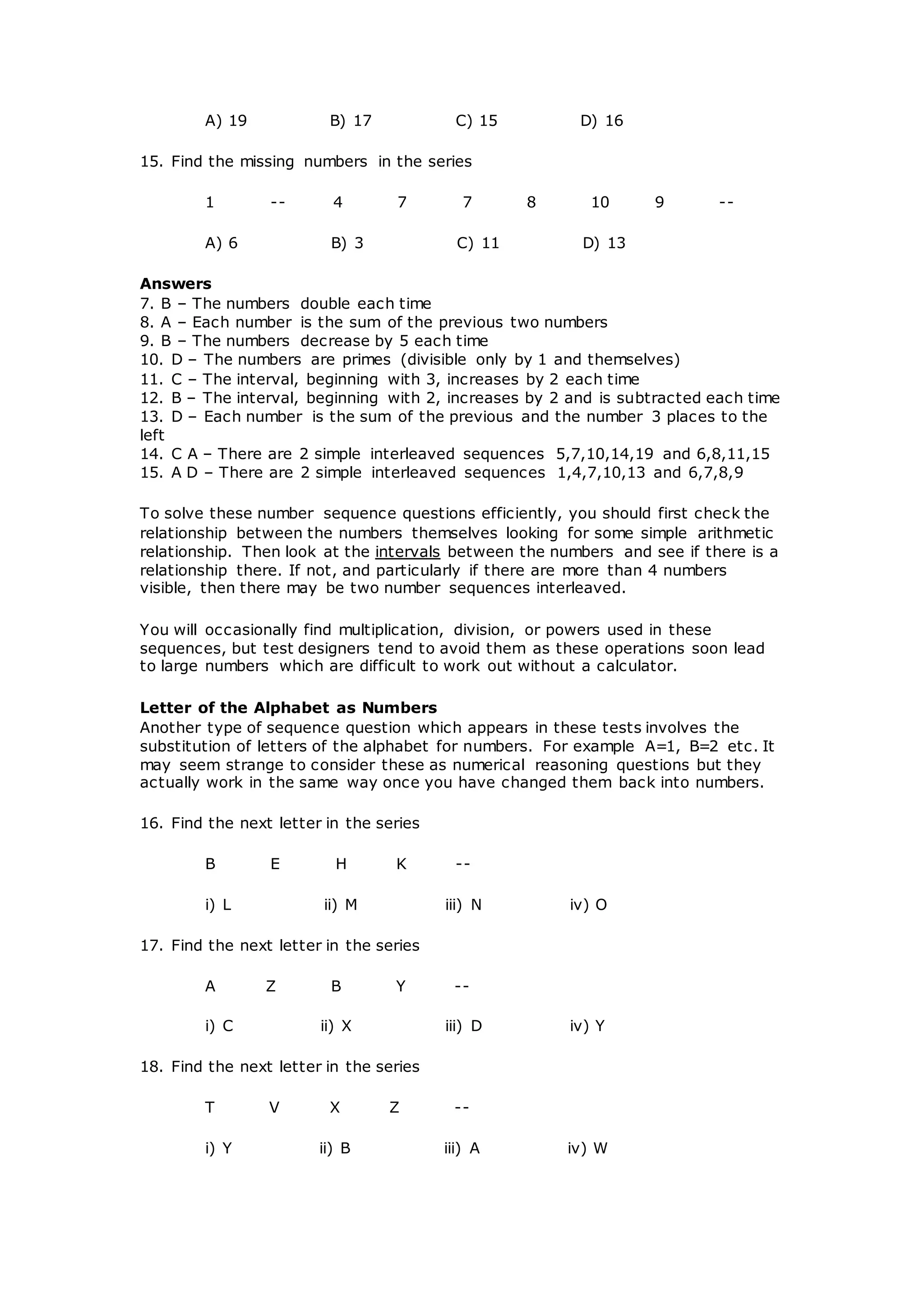
A) 19 B) 17 C) 15 D) 16
15. Find the missing numbers in the series
1 -- 4 7 7 8 10 9 --
A) 6 B) 3 C) 11 D) 13
Answers
7. B – The numbers double each time
8. A – Each number is the sum of the previous two numbers
9. B – The numbers decrease by 5 each time
10. D – The numbers are primes (divisible only by 1 and themselves)
11. C – The interval, beginning with 3, increases by 2 each time
12. B – The interval, beginning with 2, increases by 2 and is subtracted each time
13. D – Each number is the sum of the previous and the number 3 places to the
left
14. C A – There are 2 simple interleaved sequences 5,7,10,14,19 and 6,8,11,15
15. A D – There are 2 simple interleaved sequences 1,4,7,10,13 and 6,7,8,9
To solve these number sequence questions efficiently, you should first check the
relationship between the numbers themselves looking for some simple arithmetic
relationship. Then look at the intervals between the numbers and see if there is a
relationship there. If not, and particularly if there are more than 4 numbers
visible, then there may be two number sequences interleaved.
You will occasionally find multiplication, division, or powers used in these
sequences, but test designers tend to avoid them as these operations soon lead
to large numbers which are difficult to work out without a calculator.
Letter of the Alphabet as Numbers
Another type of sequence question which appears in these tests involves the
substitution of letters of the alphabet for numbers. For example A=1, B=2 etc. It
may seem strange to consider these as numerical reasoning questions but they
actually work in the same way once you have changed them back into numbers.
16. Find the next letter in the series
B E H K --
i) L ii) M iii) N iv) O
17. Find the next letter in the series
A Z B Y --
i) C ii) X iii) D iv) Y
18. Find the next letter in the series
T V X Z --
i) Y ii) B iii) A iv) W
Answers
16. iii – There are two letters missing between each one, so N is next
17. i – There are 2 interleaved sequences A,B,C and Z,Y, so C is next
18. ii – Miss a letter each time and ‘loop’ back, so B is next
Because arithmetic operations cannot be performed on letters there is less room
for ambiguity in these questions. This means that interleaved sequences can be
used with fewer visible letters than in questions that use numbers. Question 17
for example can use 2 interleaved sequences even though only four letters are
visible. This would be very difficult to achieve with numbers.
It is implicit in these ‘alphabetic sequence’ questions that the sequence ‘loops’
back around and starts again. See question 18. It is important to recognize this
as it is not usually stated explicitly – you are just expected to know it.
If you see more than one of these questions in a test then it is almost certainly
worth taking the time to write out the letters of the alphabet with their ordinal
numbers underneath. You can then treat these questions in a similar way t o
number sequence questions. This can save a lot of time overall and avoid simple
mistakes.
Data Interpretation
Information is provided that requires you to interpret it and then apply the
appropriate logic to answer the questions. Sometimes the questions are designed
to approximate the type of reasoning required in the workplace. These data
interpretation questions will often use very specific illustrations, for example the
question may present financial data or use information technology jargon.
However, an understanding of these areas is not required to answer the question.
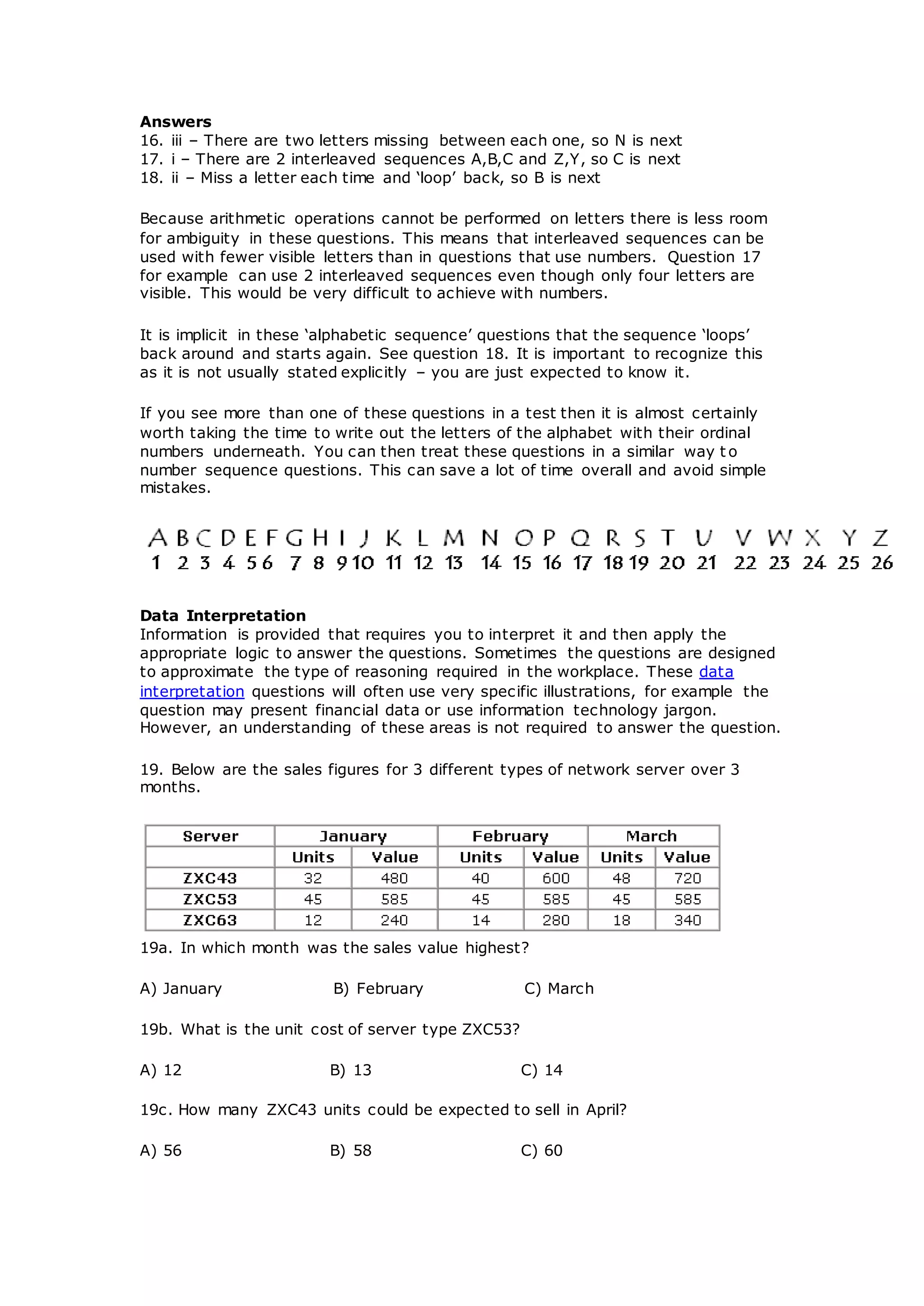
19. Below are the sales figures for 3 different types of network server over 3
months.
19a. In which month was the sales value highest?
A) January B) February C) March
19b. What is the unit cost of server type ZXC53?
A) 12 B) 13 C) 14
19c. How many ZXC43 units could be expected to sell in April?
A) 56 B) 58 C) 60
19d. Which server had its unit price changed in March?
A) ZXC43 B) ZXC53 C) ZXC63
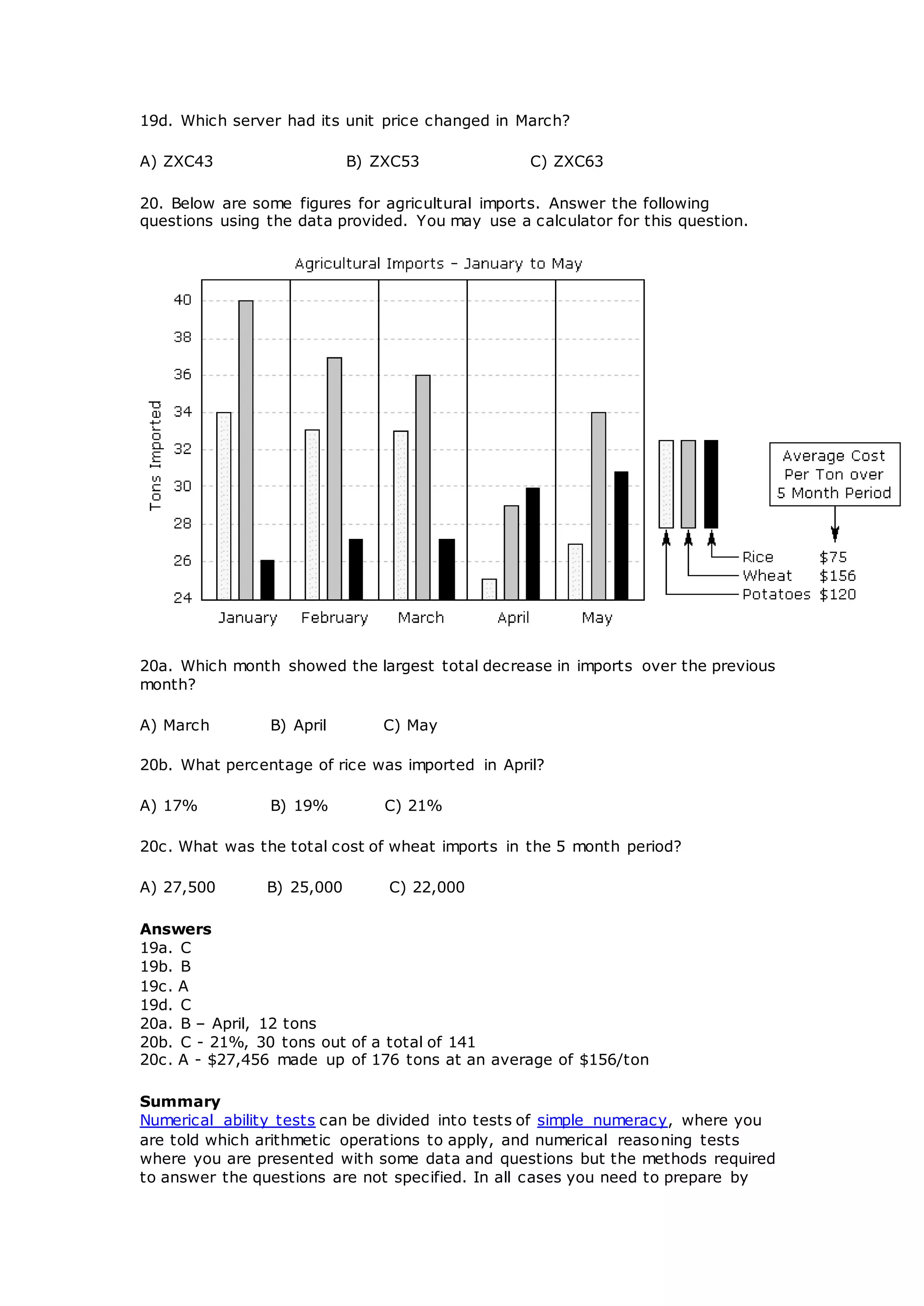
20. Below are some figures for agricultural imports. Answer the following
questions using the data provided. You may use a calculator for this question.
20a. Which month showed the largest total decrease in imports over the previous
month?
A) March B) April C) May
20b. What percentage of rice was imported in April?
A) 17% B) 19% C) 21%
20c. What was the total cost of wheat imports in the 5 month period?
A) 27,500 B) 25,000 C) 22,000
Answers
19a. C
19b. B
19c. A
19d. C
20a. B – April, 12 tons
20b. C - 21%, 30 tons out of a total of 141
20c. A - $27,456 made up of 176 tons at an average of $156/ton
Summary
Numerical ability tests can be divided into tests of simple numeracy, where you
are told which arithmetic operations to apply, and numerical reasoning tests
where you are presented with some data and questions but the methods required
to answer the questions are not specified. In all cases you need to prepare by
practicing your mental arithmetic until you are both quick and confident. Your
score in the simple speed tests will be very much influenced by your ability to add,
subtract, multiply and divide quickly and accurately.
Even though you will need to do fewer arithmetic operations in the reasoning
tests, there is no point in working out how to arrive at the answer if you make a
simple mistake when calculating it. Although you are allowed to use a calculator
for some questions, you should make a habit of mentally estimating your answers
as a way of checking them.
Numerical Reasoning questions assess your ability to use numbers in a logical and
rational way. The questions require a basic level of education in order to
successfully complete and are therefore measuring numerical ability rather than
educational achievement. The questions measure your understanding of such
things as number series, numerical transformations, the relationships between
numbers and your ability to perform numerical calculation.

Psychometric test samples

  • 1.
    PSYCHOMETRIC TEST SAMPLES Youmay only need to download a subset of the practice papers. For example, if you are going to sit a management level test it is unlikely to include numerical estimation questions, which are more applicable to craft and technical tests. So please download the papers one at a time and work through them before downloading the next one. Thanks. Numerical Computation questions test your ability to use the basic principles of arithmetic like addition, subtraction, multiplication and division. They may also use mathematical terms and methods such as decimals, percentages, ratios, roots, fractions, powers and exponents. These questions make no attempt to test your numerical reasoning abilities. The method you need to get the correct answer will be obvious and to score well on these questions you will simply need to make quick and accurate calculations.
  • 2.
    These sample questionpapers each contain 30 questions and have a suggested time limit of 10 minutes each. The questions are presented in Letter/A4 format for easy printing and self-marking. Download Numerical Computation - Practice Test 1 Download Numerical Computation - Practice Test 2 Download Numerical Computation - Practice Test 3 Download Numerical Computation - Practice Test 4 Arithmetic Questions 1. 139 + 235 = A) 372 B) 374 C) 376 D) 437 2. 139 - 235 = A) -69 B) 96 C) 98 D) -96 3. 5 x 16 = A) 80 B) 86 C) 88 D) 78 4. 45 / 9 = A) 4.5 B) 4 C) 5 D) 6 5. 15% of 300 = A) 20 B) 45 C) 40 D) 35 6. ½ + ¼ x 3/4 = A) 3/8 B) 13/8 C) 9/16 D) 3/4 Answers 1. B 2. D 3. A 4. C 5. B 6. C These questions are directly applicable to many administrative and clerical jobs but can also appear as a component of graduate and managerial tests. The speed at which you can answer these questions is the critical measure, as most people could achieve a very high score given unlimited time in which to answer. You can therefore expect 25-35 questions in 20-30 minutes. Number Sequences These questions require you to find the missing number in a sequence of numbers. This missing number may be at the beginning or middle but is usually at the end. 7. Find the next number in the series
  • 3.
    4 8 1632 -- A) 48 B) 64 C) 40 D) 46 8. Find the next number in the series 4 8 12 20 -- A) 32 B) 34 C) 36 D) 38 9. Find the missing number in the series 54 49 -- 39 34 A) 47 B) 44 C) 45 D) 46 10. Find the first number in the series -- 19 23 29 31 A) 12 B) 15 C) 16 D) 17 These number sequences can be quite simple like the examples above. However, you will often see more complex questions where it is the interval between the numbers that is the key to the sequence. 11. Find the next number in the series 3 6 11 18 -- A) 30 B) 22 C) 27 D) 29 12. Find the next number in the series 48 46 42 38 -- A) 32 B) 30 C) 33 D) 34 These number sequences usually consist of four visible numbers plus one missing number. This is because the test designer needs to produce a sequence into which only one number will fit. The need to avoid any ambiguity means that if the number sequence relies on a more complex pattern then there will need to be more visible numbers. For example; 13. Find the missing number in the series 4 3 5 9 12 17 -- A) 32 B) 30 C) 24 D) 26 14. Find the missing numbers in the series 5 6 7 8 10 11 14 -- --
  • 4.
    A) 19 B)17 C) 15 D) 16 15. Find the missing numbers in the series 1 -- 4 7 7 8 10 9 -- A) 6 B) 3 C) 11 D) 13 Answers 7. B – The numbers double each time 8. A – Each number is the sum of the previous two numbers 9. B – The numbers decrease by 5 each time 10. D – The numbers are primes (divisible only by 1 and themselves) 11. C – The interval, beginning with 3, increases by 2 each time 12. B – The interval, beginning with 2, increases by 2 and is subtracted each time 13. D – Each number is the sum of the previous and the number 3 places to the left 14. C A – There are 2 simple interleaved sequences 5,7,10,14,19 and 6,8,11,15 15. A D – There are 2 simple interleaved sequences 1,4,7,10,13 and 6,7,8,9 To solve these number sequence questions efficiently, you should first check the relationship between the numbers themselves looking for some simple arithmetic relationship. Then look at the intervals between the numbers and see if there is a relationship there. If not, and particularly if there are more than 4 numbers visible, then there may be two number sequences interleaved. You will occasionally find multiplication, division, or powers used in these sequences, but test designers tend to avoid them as these operations soon lead to large numbers which are difficult to work out without a calculator. Letter of the Alphabet as Numbers Another type of sequence question which appears in these tests involves the substitution of letters of the alphabet for numbers. For example A=1, B=2 etc. It may seem strange to consider these as numerical reasoning questions but they actually work in the same way once you have changed them back into numbers. 16. Find the next letter in the series B E H K -- i) L ii) M iii) N iv) O 17. Find the next letter in the series A Z B Y -- i) C ii) X iii) D iv) Y 18. Find the next letter in the series T V X Z -- i) Y ii) B iii) A iv) W
  • 5.
    Answers 16. iii –There are two letters missing between each one, so N is next 17. i – There are 2 interleaved sequences A,B,C and Z,Y, so C is next 18. ii – Miss a letter each time and ‘loop’ back, so B is next Because arithmetic operations cannot be performed on letters there is less room for ambiguity in these questions. This means that interleaved sequences can be used with fewer visible letters than in questions that use numbers. Question 17 for example can use 2 interleaved sequences even though only four letters are visible. This would be very difficult to achieve with numbers. It is implicit in these ‘alphabetic sequence’ questions that the sequence ‘loops’ back around and starts again. See question 18. It is important to recognize this as it is not usually stated explicitly – you are just expected to know it. If you see more than one of these questions in a test then it is almost certainly worth taking the time to write out the letters of the alphabet with their ordinal numbers underneath. You can then treat these questions in a similar way t o number sequence questions. This can save a lot of time overall and avoid simple mistakes. Data Interpretation Information is provided that requires you to interpret it and then apply the appropriate logic to answer the questions. Sometimes the questions are designed to approximate the type of reasoning required in the workplace. These data interpretation questions will often use very specific illustrations, for example the question may present financial data or use information technology jargon. However, an understanding of these areas is not required to answer the question. 19. Below are the sales figures for 3 different types of network server over 3 months. 19a. In which month was the sales value highest? A) January B) February C) March 19b. What is the unit cost of server type ZXC53? A) 12 B) 13 C) 14 19c. How many ZXC43 units could be expected to sell in April? A) 56 B) 58 C) 60
  • 6.
    19d. Which serverhad its unit price changed in March? A) ZXC43 B) ZXC53 C) ZXC63 20. Below are some figures for agricultural imports. Answer the following questions using the data provided. You may use a calculator for this question. 20a. Which month showed the largest total decrease in imports over the previous month? A) March B) April C) May 20b. What percentage of rice was imported in April? A) 17% B) 19% C) 21% 20c. What was the total cost of wheat imports in the 5 month period? A) 27,500 B) 25,000 C) 22,000 Answers 19a. C 19b. B 19c. A 19d. C 20a. B – April, 12 tons 20b. C - 21%, 30 tons out of a total of 141 20c. A - $27,456 made up of 176 tons at an average of $156/ton Summary Numerical ability tests can be divided into tests of simple numeracy, where you are told which arithmetic operations to apply, and numerical reasoning tests where you are presented with some data and questions but the methods required to answer the questions are not specified. In all cases you need to prepare by
  • 7.
    practicing your mentalarithmetic until you are both quick and confident. Your score in the simple speed tests will be very much influenced by your ability to add, subtract, multiply and divide quickly and accurately. Even though you will need to do fewer arithmetic operations in the reasoning tests, there is no point in working out how to arrive at the answer if you make a simple mistake when calculating it. Although you are allowed to use a calculator for some questions, you should make a habit of mentally estimating your answers as a way of checking them. Numerical Reasoning questions assess your ability to use numbers in a logical and rational way. The questions require a basic level of education in order to successfully complete and are therefore measuring numerical ability rather than educational achievement. The questions measure your understanding of such things as number series, numerical transformations, the relationships between numbers and your ability to perform numerical calculation.