Solving Word ProblemsInvolving
Linear Equations With One
Variable
The algebraic tools, the equation and the
methods for manipulating equations that we
have learned are useful only if we can apply
them to daily life situations. In this case,
mathematics would be interesting and useful
and not just an intellectual game.
2.
For most people,the translation of a
story into an equation makes the problem
difficult. In solving verbal problems, we
are never given the equation to solve
directly; we must form the equation
based on what the story tells us,
represent the unknown numbers as literal
numbers, and form an equation based
upon the relationship about these
numbers.
3.
Steps in ProblemSolving;
1. Understand the problem.
a. Read and study the problem well.
b. Choose a variable to represent the
unknown.
c. Propose a solution.
2. Translate the problem into an equation.
3. Solve the equation.
4. Interpret the result and check the proposed
solution.
4.
Number Problems
Of allthe word problems, the
number problems are the easiest
to translate into equations since
the relationships among
numbers are directly stated in
the problems.
5.
Examples:
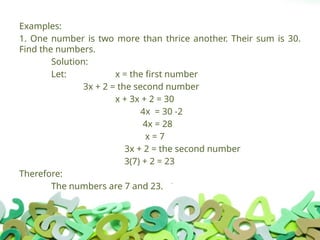
1. One numberis two more than thrice another. Their sum is 30.
Find the numbers.
Solution:
Let: x = the first number
3x + 2 = the second number
x + 3x + 2 = 30
4x = 30 -2
4x = 28
x = 7
3x + 2 = the second number
3(7) + 2 = 23
Therefore:
The numbers are 7 and 23.
6.
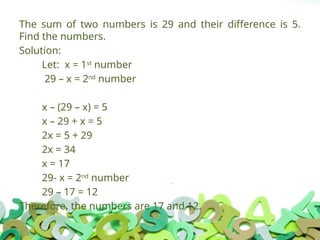
The sum oftwo numbers is 29 and their difference is 5.
Find the numbers.
Solution:
Let: x = 1st
number
29 – x = 2nd
number
x – (29 – x) = 5
x – 29 + x = 5
2x = 5 + 29
2x = 34
x = 17
29- x = 2nd
number
29 – 17 = 12
Therefore, the numbers are 17 and 12.
7.
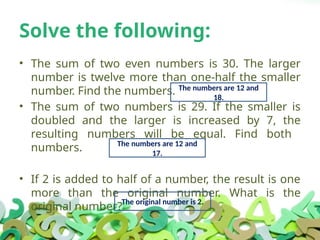
Solve the following:
•The sum of two even numbers is 30. The larger
number is twelve more than one-half the smaller
number. Find the numbers.
• The sum of two numbers is 29. If the smaller is
doubled and the larger is increased by 7, the
resulting numbers will be equal. Find both
numbers.
• If 2 is added to half of a number, the result is one
more than the original number. What is the
original number?
The numbers are 12 and
18.
The numbers are 12 and
17.
The original number is 2.
8.
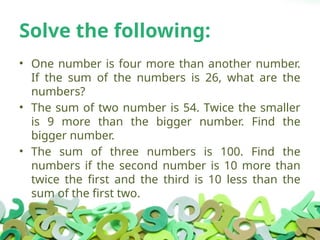
Solve the following:
•One number is four more than another number.
If the sum of the numbers is 26, what are the
numbers?
• The sum of two number is 54. Twice the smaller
is 9 more than the bigger number. Find the
bigger number.
• The sum of three numbers is 100. Find the
numbers if the second number is 10 more than
twice the first and the third is 10 less than the
sum of the first two.
9.
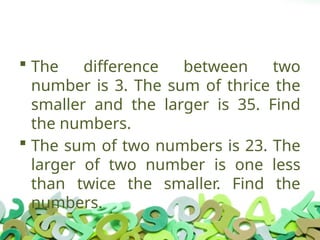
The differencebetween two
number is 3. The sum of thrice the
smaller and the larger is 35. Find
the numbers.
The sum of two numbers is 23. The
larger of two number is one less
than twice the smaller. Find the
numbers.
10.
Solve the following:
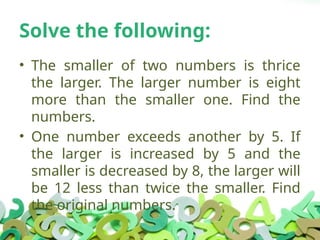
•The smaller of two numbers is thrice
the larger. The larger number is eight
more than the smaller one. Find the
numbers.
• One number exceeds another by 5. If
the larger is increased by 5 and the
smaller is decreased by 8, the larger will
be 12 less than twice the smaller. Find
the original numbers.
11.
Odd, Even, andConsecutive
Integers
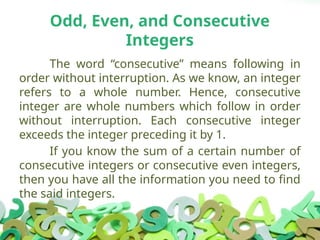
The word “consecutive” means following in
order without interruption. As we know, an integer
refers to a whole number. Hence, consecutive
integer are whole numbers which follow in order
without interruption. Each consecutive integer
exceeds the integer preceding it by 1.
If you know the sum of a certain number of
consecutive integers or consecutive even integers,
then you have all the information you need to find
the said integers.
12.
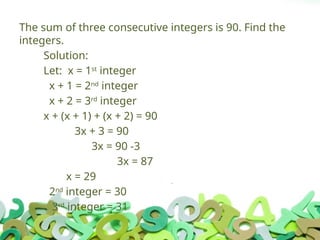
The sum ofthree consecutive integers is 90. Find the
integers.
Solution:
Let: x = 1st
integer
x + 1 = 2nd
integer
x + 2 = 3rd
integer
x + (x + 1) + (x + 2) = 90
3x + 3 = 90
3x = 90 -3
3x = 87
x = 29
2nd
integer = 30
3rd
integer = 31
13.
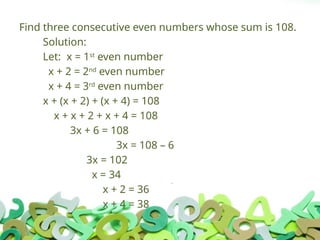
Find three consecutiveeven numbers whose sum is 108.
Solution:
Let: x = 1st
even number
x + 2 = 2nd
even number
x + 4 = 3rd
even number
x + (x + 2) + (x + 4) = 108
x + x + 2 + x + 4 = 108
3x + 6 = 108
3x = 108 – 6
3x = 102
x = 34
x + 2 = 36
x + 4 = 38
14.
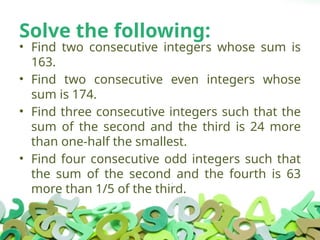
Solve the following:
•Find two consecutive integers whose sum is
163.
• Find two consecutive even integers whose
sum is 174.
• Find three consecutive integers such that the
sum of the second and the third is 24 more
than one-half the smallest.
• Find four consecutive odd integers such that
the sum of the second and the fourth is 63
more than 1/5 of the third.
15.
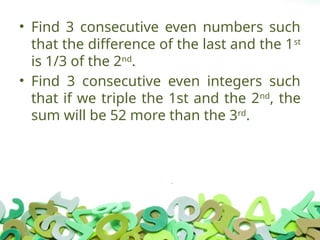
• Find 3consecutive even numbers such
that the difference of the last and the 1st
is 1/3 of the 2nd
.
• Find 3 consecutive even integers such
that if we triple the 1st and the 2nd
, the
sum will be 52 more than the 3rd
.
16.
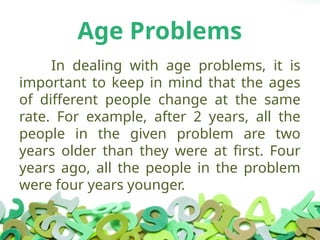
Age Problems
In dealingwith age problems, it is
important to keep in mind that the ages
of different people change at the same
rate. For example, after 2 years, all the
people in the given problem are two
years older than they were at first. Four
years ago, all the people in the problem
were four years younger.
17.
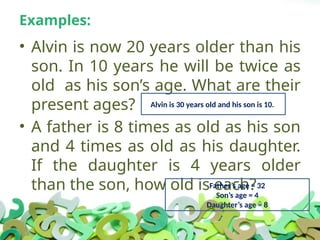
Age Problems
Also, itis easier if one makes a table
showing the representation for current
ages in the problem, “future ages”(a
number of years from now), and “past”(a
number of years ago). If possible,
represent the youngest present age by a
single letter, then represent the other
ages.
18.
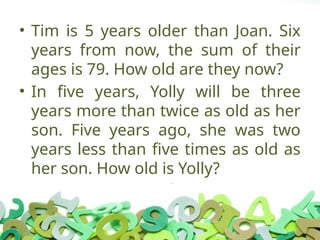
Examples:
• Alvin isnow 20 years older than his
son. In 10 years he will be twice as
old as his son’s age. What are their
present ages?
• A father is 8 times as old as his son
and 4 times as old as his daughter.
If the daughter is 4 years older
than the son, how old is each?
Alvin is 30 years old and his son is 10.
Father’s age = 32
Son’s age = 4
Daughter’s age = 8
19.
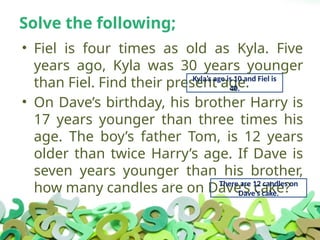
• Tim is5 years older than Joan. Six
years from now, the sum of their
ages is 79. How old are they now?
• In five years, Yolly will be three
years more than twice as old as her
son. Five years ago, she was two
years less than five times as old as
her son. How old is Yolly?
20.
Solve the following;
•Fiel is four times as old as Kyla. Five
years ago, Kyla was 30 years younger
than Fiel. Find their present age.
• On Dave’s birthday, his brother Harry is
17 years younger than three times his
age. The boy’s father Tom, is 12 years
older than twice Harry’s age. If Dave is
seven years younger than his brother,
how many candles are on Dave’s cake?
Kyla’s age is 10 and Fiel is
40.
There are 12 candles on
Dave’s cake.
21.
Solve the following;
•In five years, Kenta will be
three years more than twice
as old as his son, MJ. Five
years ago, he was two years
less than 5 times as old as
his son, MJ. How old is
Kenta?
The present age of Kenta is
28.
22.
• Aris istwice as old as Rico while
Jay is 24 years younger than
Aris.If half of Aris’ age six years
ago was three less than one-
half the sum of Rico’s age in
four years and Jay’s present
age, find their present age.
23.
Solve the following;
•Mr. Reyes, a mathematics teacher was travelling
by bus with his family consisting of his mother,
wife, son, and daughter. The bus conductor
doubting the son’s right to have a half-fare ticket
asked, “How old is your daughter?” Mr. Reyes,
irritated at having his honestly questioned,
confused the conductor with his answer: “My
daughter is twice as old as my son. My wife is
three times as old as the sum of the ages of my
son and daughter, and I am as old as my wife and
my daughter. My mother whose age is the total
of all our age is now 69.” Can you help the
conductor in finding the age of the girl?
24.
Solve the following;
•The age of Diophantus, the father of Algebra
may be calculated from what is written on his
tombstone. It goes “Diophantus youth lasted
1/6 of his life. He grew a beard after 1/12
more. After 1/7 more of his life, Diophantus
married. 5 years later, he had a son. The son
live exactly ½ as long as his father, and
Diophantus died just after 4 years after his
son. All of these add up to the years
Diophantus lived.” How old was Diophantus
when he died?
25.
DIGIT PROBLEMS
The arithmeticnumbers like
integers, common fractions, decimal
fractions, or mixed numbers that we are
using are combinations of the digits :
0,1,2,3,4,5,6,7,8,9.
In finding the value of a number, the
position of each digit must be considered.
26.
DIGIT PROBLEMS
For example:
7alone has seven ones
7 in 75 has a value of seventy ones
(seventy tens)
7 in 753 has a value of seven
hundred ones (seven hundreds)
27.
DIGIT PROBLEMS
Similarly, eachdigit in 753
contributes a different value to the
number because of its position. The
number 753 means 7 groups of 100, 5
groups of 10, and 3 groups of 1 and could
be expressed as
7(100) + 5(10) + 3(1).
In fact, each position has a value ten
times as great as the place on its right.
28.
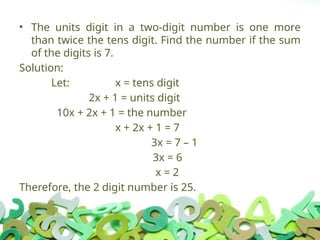
• The unitsdigit in a two-digit number is one more
than twice the tens digit. Find the number if the sum
of the digits is 7.
Solution:
Let: x = tens digit
2x + 1 = units digit
10x + 2x + 1 = the number
x + 2x + 1 = 7
3x = 7 – 1
3x = 6
x = 2
Therefore, the 2 digit number is 25.
29.
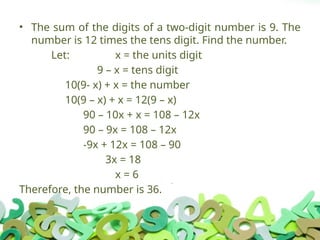
• The sumof the digits of a two-digit number is 9. The
number is 12 times the tens digit. Find the number.
Let: x = the units digit
9 – x = tens digit
10(9- x) + x = the number
10(9 – x) + x = 12(9 – x)
90 – 10x + x = 108 – 12x
90 – 9x = 108 – 12x
-9x + 12x = 108 – 90
3x = 18
x = 6
Therefore, the number is 36.
30.
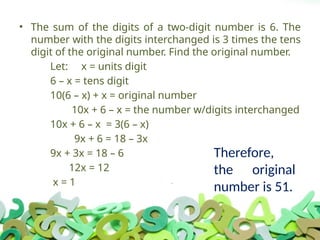
• The sumof the digits of a two-digit number is 6. The
number with the digits interchanged is 3 times the tens
digit of the original number. Find the original number.
Let: x = units digit
6 – x = tens digit
10(6 – x) + x = original number
10x + 6 – x = the number w/digits interchanged
10x + 6 – x = 3(6 – x)
9x + 6 = 18 – 3x
9x + 3x = 18 – 6
12x = 12
x = 1
Therefore,
the original
number is 51.
31.
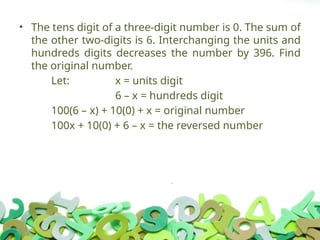
• The tensdigit of a three-digit number is 0. The sum of
the other two-digits is 6. Interchanging the units and
hundreds digits decreases the number by 396. Find
the original number.
Let: x = units digit
6 – x = hundreds digit
100(6 – x) + 10(0) + x = original number
100x + 10(0) + 6 – x = the reversed number
32.
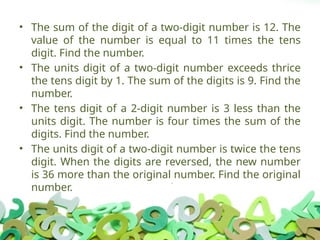
• The sumof the digit of a two-digit number is 12. The
value of the number is equal to 11 times the tens
digit. Find the number.
• The units digit of a two-digit number exceeds thrice
the tens digit by 1. The sum of the digits is 9. Find the
number.
• The tens digit of a 2-digit number is 3 less than the
units digit. The number is four times the sum of the
digits. Find the number.
• The units digit of a two-digit number is twice the tens
digit. When the digits are reversed, the new number
is 36 more than the original number. Find the original
number.
33.
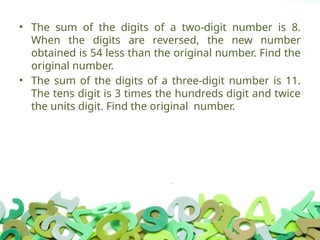
• The sumof the digits of a two-digit number is 8.
When the digits are reversed, the new number
obtained is 54 less than the original number. Find the
original number.
• The sum of the digits of a three-digit number is 11.
The tens digit is 3 times the hundreds digit and twice
the units digit. Find the original number.