Foresighting
Trajectories for
Advanced Innovative
Technologies
Professor Joyce Tait (Edinburgh)
Professor Joanna Chataway (RAND, OU)
Dr Michele Mastroeni (RAND, Edinburgh)
1
Foresighting Future Value
Chains
Professor Joyce Tait
2
3
4
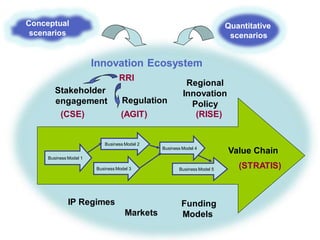
Innovation Ecosystem
Business Model 5
Business Model 4
Business Model 3
Business Model 2
Business Model 1
Value Chain
Regulation
Regional
Innovation
Policy
Scenario 2
Stakeholder
engagement
IP Regimes
Conceptual
scenarios
(STRATIS)
(AGIT) (RISE)(CSE)
Quantitative
scenarios
Funding
Models
RRI
Markets
5
joyce.tait@ed.ac.uk
6
Joanna Chataway
Perspectives on
public private
partnerships
health innovation
A focus on the SGC
Health innovation public private partnerships are
growing in number, diversifying in nature and are a
major feature of the policy landscape
UK Life Science Strategy put partnerships and
collaborations at the heart of government policy:
 Strategy for UK Life Sciences: Building a Life Sciences
Ecosystem
 Innovation Health and Wealth: Accelerating adoption
and diffusion in the NHS (includes opening up NHS
patient data)
 TSB and research councils working to promote
partnership
Public private partnerships: a growing
phenomenon
SGC at a glance
 A public private partnership that supports the discovery of
medicines through open access research
 Based in Oxford and Toronto, operating since 2004
 Funded by Wellcome Trust, Canadian government, and
9 leading pharma companies, 20M $/year currently
 Open Access Policy
 Promptly placing results, reagents and know-how in the public domain
(no patents)
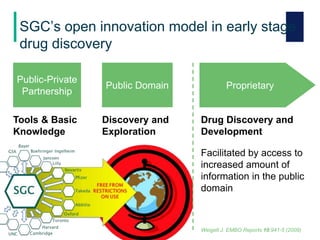
SGC’s open innovation model in early stage
drug discovery
Public-Private
Partnership
Public Domain Proprietary
Tools & Basic
Knowledge
Discovery and
Exploration
Drug Discovery and
Development
Facilitated by access to
increased amount of
information in the public
domain
Weigelt J. EMBO Reports 10:941-5 (2009)
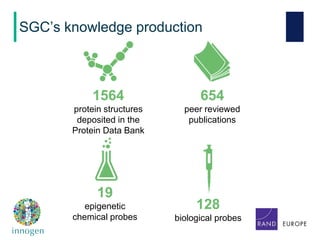
SGC’s knowledge production
1564
protein structures
deposited in the
Protein Data Bank
654
peer reviewed
publications
128
biological probes
19
epigenetic
chemical probes
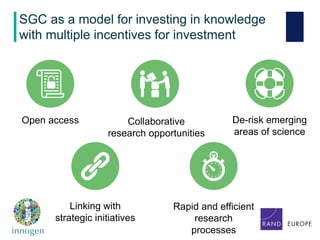
SGC as a model for investing in knowledge
with multiple incentives for investment
Open access Collaborative
research opportunities
De-risk emerging
areas of science
Linking with
strategic initiatives
Rapid and efficient
research
processes
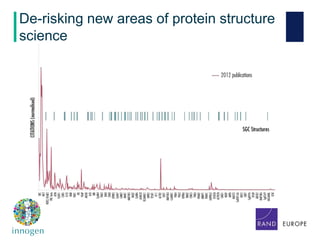
De-risking new areas of protein structure
science
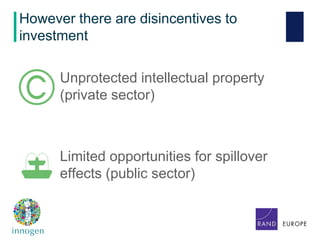
However there are disincentives to
investment
Unprotected intellectual property
(private sector)
Limited opportunities for spillover
effects (public sector)
However there are disincentives to
investment
Unprotected intellectual property
(private sector)
Limited opportunities for spillover
effects (public sector)
‘The SGC needs to show evidence of
wider benefits in the form of economic
benefits, spillovers and encouraging
investment. The science is good but the
SGC hasn’t catalysed the development of
a cluster in the way [we] hoped.’
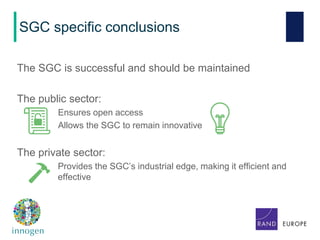
SGC specific conclusions
The SGC is successful and should be maintained
The public sector:
Ensures open access
Allows the SGC to remain innovative
The private sector:
Provides the SGC’s industrial edge, making it efficient and
effective
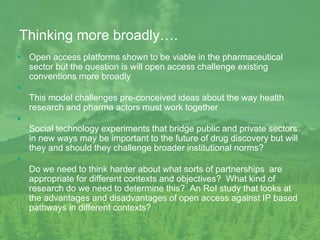
Thinking more broadly….
 Open access platforms shown to be viable in the pharmaceutical
sector but the question is will open access challenge existing
conventions more broadly

This model challenges pre-conceived ideas about the way health
research and pharma actors must work together

Social technology experiments that bridge public and private sectors
in new ways may be important to the future of drug discovery but will
they and should they challenge broader institutional norms?

Do we need to think harder about what sorts of partnerships are
appropriate for different contexts and objectives? What kind of
research do we need to determine this? An RoI study that looks at
the advantages and disadvantages of open access against IP based
pathways in different contexts?
chataway@rand.or
g
Mission-Oriented Research
Pulling together to overcome obstacles
20
Michele Mastroeni, RAND Europe
Difficulties of bringing innovation forward
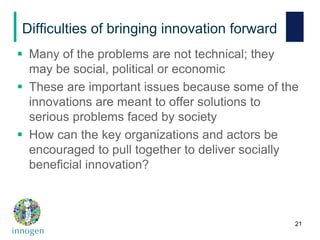
 Many of the problems are not technical; they
may be social, political or economic
 These are important issues because some of the
innovations are meant to offer solutions to
serious problems faced by society
 How can the key organizations and actors be
encouraged to pull together to deliver socially
beneficial innovation?
21
Missions or Grand Challenges
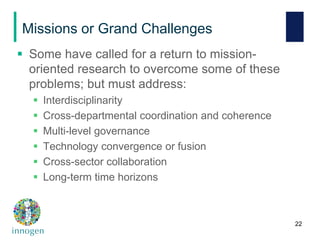
 Some have called for a return to mission-
oriented research to overcome some of these
problems; but must address:
 Interdisciplinarity
 Cross-departmental coordination and coherence
 Multi-level governance
 Technology convergence or fusion
 Cross-sector collaboration
 Long-term time horizons
22
Innogen Approach
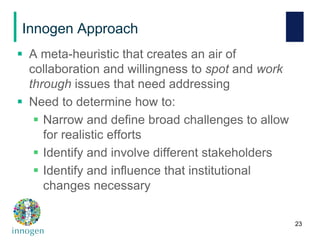
 A meta-heuristic that creates an air of
collaboration and willingness to spot and work
through issues that need addressing
 Need to determine how to:
 Narrow and define broad challenges to allow
for realistic efforts
 Identify and involve different stakeholders
 Identify and influence that institutional
changes necessary
23
mastroen@rand.org
24
www.innogen.ac.uk
For further details, please contact Elisabeth
Barlow at elisabeth.barlow@ed.ac.uk
25

Science & Innovation 2014: Foresighting Trajectories for Advanced Innnovative Technologies

  • 1.
    Foresighting Trajectories for Advanced Innovative Technologies ProfessorJoyce Tait (Edinburgh) Professor Joanna Chataway (RAND, OU) Dr Michele Mastroeni (RAND, Edinburgh) 1
  • 2.
  • 3.
  • 4.
    4 Innovation Ecosystem Business Model5 Business Model 4 Business Model 3 Business Model 2 Business Model 1 Value Chain Regulation Regional Innovation Policy Scenario 2 Stakeholder engagement IP Regimes Conceptual scenarios (STRATIS) (AGIT) (RISE)(CSE) Quantitative scenarios Funding Models RRI Markets
  • 5.
  • 6.
  • 7.
    Joanna Chataway Perspectives on publicprivate partnerships health innovation A focus on the SGC
  • 8.
    Health innovation publicprivate partnerships are growing in number, diversifying in nature and are a major feature of the policy landscape UK Life Science Strategy put partnerships and collaborations at the heart of government policy:  Strategy for UK Life Sciences: Building a Life Sciences Ecosystem  Innovation Health and Wealth: Accelerating adoption and diffusion in the NHS (includes opening up NHS patient data)  TSB and research councils working to promote partnership Public private partnerships: a growing phenomenon
  • 9.
    SGC at aglance  A public private partnership that supports the discovery of medicines through open access research  Based in Oxford and Toronto, operating since 2004  Funded by Wellcome Trust, Canadian government, and 9 leading pharma companies, 20M $/year currently  Open Access Policy  Promptly placing results, reagents and know-how in the public domain (no patents)
  • 10.
    SGC’s open innovationmodel in early stage drug discovery Public-Private Partnership Public Domain Proprietary Tools & Basic Knowledge Discovery and Exploration Drug Discovery and Development Facilitated by access to increased amount of information in the public domain Weigelt J. EMBO Reports 10:941-5 (2009)
  • 11.
    SGC’s knowledge production 1564 proteinstructures deposited in the Protein Data Bank 654 peer reviewed publications 128 biological probes 19 epigenetic chemical probes
  • 12.
    SGC as amodel for investing in knowledge with multiple incentives for investment Open access Collaborative research opportunities De-risk emerging areas of science Linking with strategic initiatives Rapid and efficient research processes
  • 13.
    De-risking new areasof protein structure science
  • 14.
    However there aredisincentives to investment Unprotected intellectual property (private sector) Limited opportunities for spillover effects (public sector)
  • 15.
    However there aredisincentives to investment Unprotected intellectual property (private sector) Limited opportunities for spillover effects (public sector) ‘The SGC needs to show evidence of wider benefits in the form of economic benefits, spillovers and encouraging investment. The science is good but the SGC hasn’t catalysed the development of a cluster in the way [we] hoped.’
  • 16.
    SGC specific conclusions TheSGC is successful and should be maintained The public sector: Ensures open access Allows the SGC to remain innovative The private sector: Provides the SGC’s industrial edge, making it efficient and effective
  • 17.
    Thinking more broadly…. Open access platforms shown to be viable in the pharmaceutical sector but the question is will open access challenge existing conventions more broadly  This model challenges pre-conceived ideas about the way health research and pharma actors must work together  Social technology experiments that bridge public and private sectors in new ways may be important to the future of drug discovery but will they and should they challenge broader institutional norms?  Do we need to think harder about what sorts of partnerships are appropriate for different contexts and objectives? What kind of research do we need to determine this? An RoI study that looks at the advantages and disadvantages of open access against IP based pathways in different contexts?
  • 19.
  • 20.
    Mission-Oriented Research Pulling togetherto overcome obstacles 20 Michele Mastroeni, RAND Europe
  • 21.
    Difficulties of bringinginnovation forward  Many of the problems are not technical; they may be social, political or economic  These are important issues because some of the innovations are meant to offer solutions to serious problems faced by society  How can the key organizations and actors be encouraged to pull together to deliver socially beneficial innovation? 21
  • 22.
    Missions or GrandChallenges  Some have called for a return to mission- oriented research to overcome some of these problems; but must address:  Interdisciplinarity  Cross-departmental coordination and coherence  Multi-level governance  Technology convergence or fusion  Cross-sector collaboration  Long-term time horizons 22
  • 23.
    Innogen Approach  Ameta-heuristic that creates an air of collaboration and willingness to spot and work through issues that need addressing  Need to determine how to:  Narrow and define broad challenges to allow for realistic efforts  Identify and involve different stakeholders  Identify and influence that institutional changes necessary 23
  • 24.
  • 25.
    www.innogen.ac.uk For further details,please contact Elisabeth Barlow at elisabeth.barlow@ed.ac.uk 25

Editor's Notes

  • #8 One thing Innogen and Rand Europe have both worked on a lot in recent years is the changing way in which public and private sectors are working together. In health innovation the increase in volume of scope of co-operation is related to falling productivity of research, changing nature of regulation, increasingly intensive use of data in health innovation and other changes in innovation contexts.
  • #9 Partnerships involving public and private organisations and institutions are an important part of the effort to move forward stratified and personalised medicine. The 2011 UK government Life Science policy based on the two reports identified in this slide is an example of this – both reports are based on an assumption that public and private sectors have to work in different kinds of partnerships and collaborations to both increase the pace and the effectiveness of health innovation. The 2012 review of the way in which the strategy was working was very much constructed around the achievements and challenges in encouraging productive working between public and private sectors. So there has been a lot of experimentation in this space but surprisingly little ex ante or ex post evaluation. And there is little to go on when we are thinking about what various PPPs might offer in more strategic terms. I want to talk about an evaluation that we have recently completed of a unique public private partnership in drug discovery. I
  • #10 SGC = Catalyst, accelerator and vehicle for effective collaboration (through an open access approach – open window…) In their own words The SGC catalyses research in new areas of human biology and drug discovery by focusing explicitly on less well-studied areas of the human genome . The SGC accelerates research in these new areas by making all its research output available to the scientific community with no strings attached, and by creating an open collaborative network of scientists in hundreds of universities around the world and in nine global pharmaceutical companies. Together, this network of academic and industry scientists is driving a new scientific and drug discovery ecosystem whose primary aim is to advance science and is less influenced by personal, institutional or commercial gain. SGC is based at Toronto and Oxfrod but has over 500 collaborators in public and private sectors primarily in Europe, the US and Latin America.
  • #12 SGC works at industrial scale. Reach – SGC’s international network of researchers has enabled over 500 scientists to co-publish with the SGC and these represent 17 different countries. In addition, since 2007, the SGC has distributed over 1200 clones to a wide variety of academic researchers and over 200 to industry. (Figures from 2006 show clones were sent to both public (37) and private (9) sectors in multiple countries (8) in phase 1. ) Over half (59%) of scientists surveyed stated that their research had led to improved public engagement with science. Different routes to this kind of impact were identified and included public lectures, teaching activities, public engagement including radio broadcasts, museum exhibits and so on. The point here is that although SGC is praised for its focus and ‘industrial model’ of research, it does also contribute in social impact terms. SGC has led to two spin out companies Compared to similar organisations such as RIKEN and PSI, the SGC appears to be competitive in a cost per structure calculation
  • #13  Starting with the SGC as a model for investing in knowledge, we found there were multiple incentives for investment in the SGC across both public and private funders including those here. Our evaluation showed that the perception is that open access is a real incentive for investment because of what it can unlock in the way the science is conducted. It enables efficient and reproducible research, helps to avoid MTAs and bureaucracy, create economic advantages in pooling resources. We know this from the interviews that we did with private sector interviewees in particular. Rapid and efficient – private sector funders think that the openess and focus on delivery of science they can use (almost a 100% reproducibility) De-risking – joint efforts in areas of protein research (which I will say a bit a more about in moment)
  • #14 However, whilst important to de-risking, collaboration in and of itself probably wouldn’t be sufficient to encourage a move into new areas of science. This graph shows that SGC has indeed been successful in broadening out the number of proteins that are the focus of research. Here the red line shows the publications according to different kinds of human proteins, whereas the blue lines show where SGC’s focus has been – it is clearly covering a broader array of structures. Our evaluation confirms this and one key factor in explaining this is that SGC funding does not depend on traditional peer review. Peer review tends to be a conservative force that creates tight focus around small numbers of fashionable and better known areas of science.
  • #15  Questions about the need for sustained public funding from the public sector (and long-term funding commitments raise questions about opportunity costs) Five private sector investors saw unprotected intellectual property as a difficulty and disincentive to investment. This was mainly due to the difficulties of securing ‘buy-in’ in their companies. Others pointed out that although it wasn’t currently a disincentive it was source of constant discussion with legal teams Lack of IP was seen by three researchers as a disincentive to small firm engagement A number of interviewees thought that problems might be short term – the direction of travel is in the direction of open access with one interviewee saying that in the near future there would be a model of drug discovery with no IP until phase 2 trails.
  • #16  Five private sector investors saw unprotected intellectual property as a difficulty and disincentive to investment. This was mainly due to the difficulties of securing ‘buy-in’ in their companies. Others pointed out that although it wasn’t currently a disincentive it was source of constant discussion with legal teams Lack of IP was seen by three researchers as a disincentive to small firm engagement A number of interviewees thought that problems might be short term – the direction of travel is in the direction of open access with one interviewee saying that in the near future there would be a model of drug discovery with no IP until phase 2 trails.
  • #17 Public sector: why is it reluctant: de-risking; SGC falls between public sector funders.